


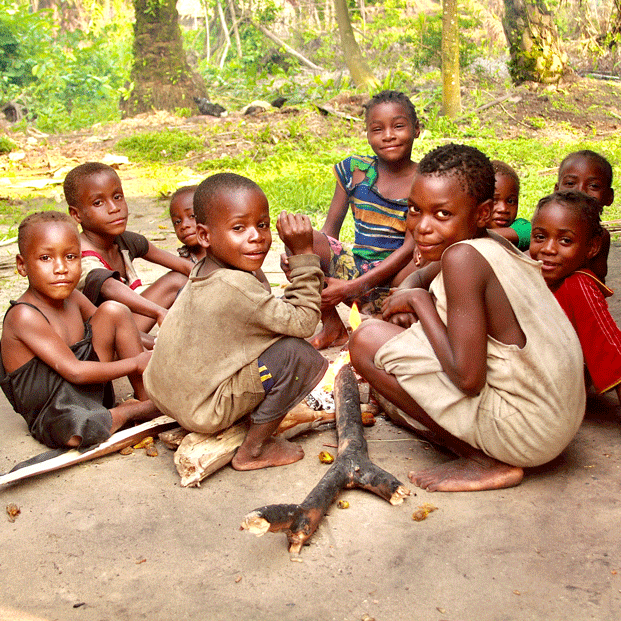


Media summary: Socialisation practices emphasised in hunter–gatherer societies may bolster child and adolescent innovativeness.
Both social learning and innovation are central to cumulative cultural evolution (Legare & Nielsen, Reference Legare and Nielsen2015). However, while children in diverse societies demonstrate a suite of cognitive traits which make them especially sensitive to identifying and learning cultural information (Henrich & McElreath, Reference Henrich and McElreath2003; Kline, Reference Kline2015), psychologists working primarily in WEIRD societies (Western, Educated, Industrialised, Rich, and Democratic – Henrich et al., Reference Henrich, Heine and Norenzayan2010) have noted that making novel tools is difficult for children under the age of 10 (Beck et al., Reference Beck, Apperly, Chappell, Guthrie and Cutting2011; Cutting et al., Reference Cutting, Apperly and Beck2011; Nielsen et al., Reference Nielsen, Tomaselli, Mushin and Whiten2014; Whalley et al., Reference Whalley, Cutting and Beck2017). Here, we argue that cross-cultural diversity in subsistence and socialisation practices complicates the image of children as infrequent tool innovators. Drawing upon the ethnographic literature, we argue that the developmental niche documented among several contemporary hunter–gatherer societies may set the stage for children's innovative capabilities to flourish. Elsewhere, we have argued that hunter–gatherer children have probably contributed to changes in cultural values (Reckin et al., Reference Reckin, Lew-levy, Lavi, Ellis-Davies and Moreauin press). Here, we focus our discussion on children's potential and actual contributions to technological and/or material innovations in the past and present.
In what follows, we first describe the results of psychological studies on innovation, and outline how gaps in prior knowledge, including previous familiarity with the testing materials, and asocial experimental settings, may limit researchers’ ability to measure variation in children's tool innovation across cultural contexts. Second, we outline how the cultural and subsistence contexts of hunter–gatherers foster behavioural flexibility, including in childhood and adolescence. Third, we summarise findings from two meta-ethnographic reviews on learning in hunter–gatherer societies (Lew-Levy et al., Reference Lew-Levy, Reckin, Lavi, Cristóbal-Azkarate and Ellis-Davies2017, Reference Lew-Levy, Lavi, Reckin, Cristóbal-Azkarate and Ellis-Davies2018), focusing on specific socialisation practices which may encourage hunter–gatherer child and adolescent innovative capabilities. While many of these practices appear to be widespread, it is important to note that hunter–gatherers are diverse, and thus, not all descriptions will generalise to all hunter–gatherer societies. Wherever possible, we also outline clear ethnographic examples of children's innovations. Fourth, using examples from the Palaeolithic, Paleoindian, and Late Stone age, we illustrate how the ethnographic record can provide an interpretative framework for enriching how archaeologists think about, and identify, children as innovators. We also outline some of the challenges to identifying social learning processes in the archaeological record. Finally, we outline areas of future research for psychology, anthropology, and archaeology.
Defining ‘innovation’ across disciplines
Innovation is central to the behavioural flexibility of human and non-human animals alike (Reader & Laland, Reference Reader and Laland2001). Through innovations, species can rapidly respond to environmental novelty (Laland, Reference Laland1992). In humans, innovations in social conventions, such as rituals, and instrumental skills, such as hunting technology, have helped our species inhabit diverse and challenging environments, and coordinate within and across social groups (Boyd & Richerson, Reference Boyd and Richerson1985; Fogarty et al., Reference Fogarty, Creanza and Feldman2015; Legare & Nielsen, Reference Legare and Nielsen2015; McElreath et al., Reference McElreath, Boyd and Richerson2003). Because of its importance to human evolution and culture, the study of innovation spans several academic disciplines, and each discipline defines the term differently (Fogarty et al., Reference Fogarty, Creanza and Feldman2015; Walsh et al., Reference Walsh, Riede, O'Neill and Prentiss2019). In the present paper, we draw upon definitions from psychology and archaeology.
In psychology, innovation, and specifically, tool innovation, has been defined as the construction of ‘new tools, or using old tools in new ways, to solve new problems’ (Legare & Nielsen, Reference Legare and Nielsen2015, p. 689). Although innovative behaviours, including tool use and modification, have been described in other species (see Griffin & Guez, Reference Griffin and Guez2014 for review; Lefebvre et al., Reference Lefebvre, Reader and Sol2004; Overington et al., Reference Overington, Morand-Ferron, Boogert and Lefebvre2009; Reader et al., Reference Reader, Hager and Laland2011), psychologists are often concerned with understanding the unique cognitive and developmental processes which underpin human innovation, including advanced analogical (Chan et al., Reference Chan, Fu, Schunn, Cagan, Wood and Kotovsky2011; Markman et al., Reference Markman, Wood, Linsey, Murphy and Laux2011) or counterfactual reasoning (Tijus et al., Reference Tijus, Brézillon, Poitrenaud and Léger2009) to devise solutions, and inhibition (Gönül et al., Reference Gönül, Takmaz, Hohenberger and Corballis2018) or cognitive flexibility (Gönül et al., Reference Gönül, Hohenberger, Corballis and Henderson2019; Pope et al., Reference Pope, Fagot, Meguerditchian, Watzek, Lew-Levy, Autrey and Hopkins2020) to apply them.
Archaeologists often separate innovation from invention, the latter defined as ‘a wholly new phenomenon’, and the former, as ‘a novel modification of something already in existence that proves adaptive and diffuses through a population by processes of selection’ (Walsh et al., Reference Walsh, Riede, O'Neill and Prentiss2019, p. 54; see also Richerson & Boyd, Reference Richerson and Boyd2005; Mesoudi & O'Brien, Reference Mesoudi and O'Brien2008; Rogers, Reference Rogers1983; Shennan, Reference Shennan2001). Archaeologists are concerned with understanding the contexts under which a phenomenon has undergone observable adaptive change over time (Walsh et al., Reference Walsh, Riede, O'Neill and Prentiss2019). Usually, archaeologists are restricted to the study of innovations that have ‘spread in a population to a detectable frequency’ (Fogarty et al., Reference Fogarty, Creanza and Feldman2015, p. 737; see also Walsh et al., Reference Walsh, Riede, O'Neill and Prentiss2019). Archaeological research typically emphasises the role of technological and cultural innovation in relation to the evolution of behavioural and cognitive complexity, the ability to thrive in new ecological niches, and/or the transmission and diffusion of cultural traits (e.g. Hussain & Will, Reference Hussain and Willin press; Knecht, Reference Knecht1991; McBrearty & Brooks, Reference McBrearty and Brooks2000; Shea & Sisk, Reference Shea and Sisk2010).
Building on these definitions, the present paper views innovations as creative outputs that are new and useful in specific settings (Fogarty et al., Reference Fogarty, Creanza and Feldman2015), and which are transmitted throughout a group. We consider innovations as arising through multiple individual- and group-level processes, including invention, modification, recombination, trial-and-error and copying error (Ramsey et al., Reference Ramsey, Bastian and van Schaik2007). We discuss both the processes (i.e. socialisation practices) and products (e.g. new subsistence technologies) of child and adolescent innovators.
Experimental research on children as innovators
Evidence of innovative capacities can be found early in human development. During this time, innovations serve an important role in supplementing knowledge or ability in both social and physical domains. For example, when learning to walk, infants develop unique strategies for using supports (Adolph & Robinson, Reference Adolph and Robinson2013) and 2–3-year-olds fill gaps in their lexicon by combining or modifying known words, such as saying ‘I can button it’ rather than ‘I can turn it on’ (Clark, Reference Clark1982). Throughout childhood, innovations are seen in children's pretence and game play (Carr et al., Reference Carr, Kendal and Flynn2016; Nielsen et al., Reference Nielsen, Cucchiaro and Mohamedally2012) and during this time cognitive skills which probably support innovation improve drastically, including analogical reasoning (Richland et al., Reference Richland, Morrison and Holyoak2006, Reference Richland, Chan, Morrison and Au2010), counterfactual reasoning (Rafetseder et al., Reference Rafetseder, Schwitalla and Perner2013), inhibition (Montgomery & Koeltzow, Reference Montgomery and Koeltzow2010) and cognitive flexibility (Deák & Wiseheart, Reference Deák and Wiseheart2015; Doebel & Zelazo, Reference Doebel and Zelazo2015). Further, 5-year-old children outperform older children and adults in contexts which require them to consider causal relationships or object uses in innovative ways (Defeyter & German, Reference Defeyter and German2003; Gopnik et al., Reference Gopnik, Griffiths and Lucas2015; Lucas et al., Reference Lucas, Bridgers, Griffiths and Gopnik2015).
Although creative problem-solving metrics like divergent thinking (Gönül et al., Reference Gönül, Hohenberger, Corballis and Henderson2019), floating object (Cheke et al., Reference Cheke, Loissel and Clayton2012; Hanus et al., Reference Hanus, Mendes, Tennie and Call2011; Nielsen, Reference Nielsen2013) and functional fixedness (Defeyter & German, Reference Defeyter and German2003) tasks have been conducted alongside or as proxies for innovation metrics (Carr et al., Reference Carr, Kendal and Flynn2016; but see Beck et al., Reference Beck, Williams, Cutting, Apperly and Chappell2016), here we focus on direct measures of tool innovation. For children, the most prevalent tool innovation metric is the hook task, a paradigm originally devised for corvids (Bird & Emery, Reference Bird and Emery2009; Weir et al., Reference Weir, Chappell and Kacelnik2002) and later modified for humans (Beck et al., Reference Beck, Apperly, Chappell, Guthrie and Cutting2011; Cutting et al., Reference Cutting, Apperly and Beck2011). In this paradigm, participants must bend a malleable stick, often a pipe cleaner, into a hook in order to retrieve a basket containing a sticker or other reward from the bottom of a clear tube. Although children aged 3–4 are able to reproduce this action after watching a demonstration (Cutting et al., Reference Cutting, Apperly and Beck2011; Gönül et al., Reference Gönül, Takmaz, Hohenberger and Corballis2018), most children below the ages of 7–8 are unable to successfully innovate the hook. Even 10–11-year-olds do not exhibit mature levels of hook use (Beck et al., Reference Beck, Apperly, Chappell, Guthrie and Cutting2011; Cutting et al., Reference Cutting, Apperly and Beck2011, Reference Cutting, Apperly, Chappell and Beck2014; Gönül et al., Reference Gönül, Takmaz, Hohenberger and Corballis2018; Whalley et al., Reference Whalley, Cutting and Beck2017; but see Sheridan et al., Reference Sheridan, Konopasky, Kirkwood and Defeyter2016). Children similarly struggle to innovate in tasks requiring them to create a functional stick tool, meant to push a reward out of the middle of a horizontal clear tube, by unbending, combining or taking apart non-functional precursors (Cutting et al., Reference Cutting, Apperly and Beck2011; Neldner et al., Reference Neldner, Redshaw, Murphy, Tomaselli, Davis, Dixson and Nielsen2019). These findings have been replicated in several small-scale societies; recently settled San hunter–gatherer, Indigenous Australian and NiVanuatu agriculturalist children exhibit low rates of tool innovation in experimental paradigms (Neldner et al., Reference Neldner, Mushin and Nielsen2017, Reference Neldner, Redshaw, Murphy, Tomaselli, Davis, Dixson and Nielsen2019; Nielsen et al., Reference Nielsen, Tomaselli, Mushin and Whiten2014).
There are several methodological reasons why tool innovation tasks, like the hook task, might occlude the true breadth of children's innovative potential. Empirical measures of innovation are ill-structured, and rely upon a great deal of prior information in order to reach the prescribed solution (Chappell et al., Reference Chappell, Cutting, Apperly and Beck2013; Cutting et al., Reference Cutting, Apperly, Chappell and Beck2014). For example, to appropriately solve the hook task, children must understand the physical affordances of the pipe cleaner and basket handle, remember and flexibly apply prior knowledge of hook use to a novel context, and have the cognitive and motoric dexterity to perform all of the required actions within a 1–3 minute testing period. Under these constraints, failure does not necessarily indicate a lack of innovative ability (Reader et al., Reference Reader, Morand-Ferron and Flynn2016), but may be attributable to any number of gaps in prior information or simply an inability to access it fast enough. These issues are compounded in experiments conducted in small-scale societies, where children are less likely than WEIRD children to have manipulated the precursor materials prior to the experiment, making object affordances especially opaque. For example, in a remote village in the Republic of the Congo, a Bondongo fisher–farmer child responded to the hook task by requesting he be allowed to retrieve his fishing hook, suggesting that a lack of familiarity with the affordances of the pipe cleaner may have prevented his success (Pope, unpublished data).
Further, in order to avoid confounding innovation with social learning, most experimental studies are designed so that children are tested individually to prevent the use of socially acquired information. However, applying socially learned information to new settings is probably central to tool innovation in everyday contexts (Muthukrishna & Henrich, Reference Muthukrishna and Henrich2016). For example, after seeing a pre-formed hook, dyads were more successful than individuals at solving the hook task (Gönül et al., Reference Gönül, Hohenberger, Corballis and Henderson2019). In another extractive foraging task, complex tool innovation was observed in groups of 3–4-year-olds, but not individuals (McGuigan et al., Reference McGuigan, Burdett, Burgess, Dean, Lucas, Vale and Whiten2017). In cultural evolution studies, in which tasks are solved over multiple generations, larger group size has been associated with greater improvement to existing technologies (Derex et al., Reference Derex, Beugin, Godelle and Raymond2013), increased complexity (Muthukrishna et al., Reference Muthukrishna, Shulman, Vasilescu and Henrich2014) and higher solution rates (Kempe & Mesoudi, Reference Kempe and Mesoudi2014). Several modelling and ethnographic studies also demonstrate that group size and inter-group contact are positively correlated with material culture diversity (Caldwell et al., Reference Caldwell, Cornish and Kandler2016; Collard et al., Reference Collard, Ruttle, Buchanan and O'Brien2013; Henrich, Reference Henrich2004; Kline & Boyd, Reference Kline and Boyd2010; Shennan, Reference Shennan2001). These results suggest that innovation, even in the strictest sense, does not occur in an information vacuum. Instead, social and physical environments may influence innovative proclivity (Ivcevic, Reference Ivcevic2009).
Hunter–gatherer social and subsistence contexts
Hunting and gathering societies are commonly defined by a subsistence economy that primarily relies on non-domesticated resources obtained via hunting, fishing and foraging (Kelly, Reference Kelly1995; Lee & Daly, Reference Lee and Daly1999). Until approximately 12,000 years ago and before the emergence of agriculture, all human societies hunted and gathered for subsistence. Today, hunter–gatherers inhabit diverse environments, and have been shaped, among other things, by a long history of relationships with agropastoralists, colonisation and nation-states (Guenther, Reference Guenther2007). Reliance on non-foraged food is increasing, owing to growing engagements with neighbouring societies, new economic opportunities, state intervention and restrictions on the use of wild resources (Reyes-García & Pyhälä, Reference Reyes-García and Pyhälä2016). While we acknowledge that defining hunter–gatherers by their subsistence economy reflects eighteenth-century European classifications rather than local ones (e.g. Barnard, Reference Barnard2004), in the absence of better terminology, we make use of the term ‘hunter–gatherer’ throughout the text.
Anthropologists have pointed to distinctive cultural and social traits that are shared by many hunter–gatherer societies varying in geography, ecology and histories, and which are usually not shared with their immediate agrarian or pastoralist neighbours (Endicott, Reference Endicott, Gibson and Sillander2011; Finlayson & Warren, Reference Finlayson and Warren2010; Hewlett et al., Reference Hewlett, Fouts, Boyette and Hewlett2011; Lee & Daly, Reference Lee and Daly1999; Schweitzer et al., Reference Schweitzer, Biesele and Hitchcock2000). These cultural values include high levels of egalitarianism, which allow equal access to resources to all group members (Woodburn, Reference Woodburn1982); a tendency towards mobility in which people and/or entire dwelling sites move frequently (Kelly, Reference Kelly1983; MacDonald & Hewlett, Reference MacDonald and Hewlett1999); sharing which maintains the redistribution of material resources and social relationships (Lavi & Friesem, Reference Lavi and Friesem2019); respect for personal autonomy, including the freedom and independence of individuals (Gardner, Reference Gardner1991; Woodburn, Reference Woodburn1982); and lastly, small residential groups (Bird-David, Reference Bird-David2017) with large lifelong and intergenerational networks (Bird et al., Reference Bird, Bird, Codding and Zeanah2019; Dyble et al., Reference Dyble, Salali, Chaudhary, Page, Smith, Thompson and Migliano2015). Many hunter–gatherers also exhibit shared features of infancy, childhood and adolescence. These include close physical contact with mother, indulgence towards infants, frequent nursing, co-sleeping, weaning around three years of age, four-year birth spacing, separation and stranger rejection, dense social contexts, primary care by the mother, more father care than in other societies, transition into a multi-aged, mixed-gender playgroup in middle childhood, little child responsibility for subsistence and childcare, and few restrictions on childhood and adolescent sexuality (Konner, Reference Konner, Hewlett and Lamb2005, Reference Konner, Meehan and Crittenden2016). Because most research on child development is conducted in WEIRD societies (Nielsen et al., Reference Nielsen, Haun, Kärtner and Legare2017), studying hunter–gatherer childhoods can provide an alternative and diverse perspective on the role of children as innovators, and the social contexts that encourage innovative propensities to flourish. In this paper, we consider aspects of the social and cultural environment, as documented among many contemporary hunter–gatherers, as especially conducive to the development of innovative children and adolescents.
Specifically, hunter–gatherers rely on non-domesticated resources that shift in availability and abundance seasonally, yearly and across generations (Kelly, Reference Kelly1983). And yet many hunter–gatherers routinely view their environment as abundant and giving (e.g. Bird-David, Reference Bird-David1990). This may be due to social and subsistence strategies that mitigate risk, including widespread sharing of resources (Lavi & Friesem, Reference Lavi and Friesem2019; Lewis et al., Reference Lewis, Vinicius, Strods, Mace and Migliano2014; Peterson, Reference Peterson1993) and high levels of mobility (Kelly, Reference Kelly1983; MacDonald & Hewlett, Reference MacDonald and Hewlett1999). Behavioural flexibility and increased rates of innovation may also help mitigate resource fluctuation. Indeed, several modelling studies suggest that rates of innovation increase in fluctuating environments (Acerbi & Parisi, Reference Acerbi and Parisi2006; Fogarty et al., Reference Fogarty, Creanza and Feldman2015; Fogarty & Creanza, Reference Fogarty and Creanza2017). An ethnographic survey of 20 hunter–gatherer societies conducted by Collard and colleagues (Reference Collard, Kemery and Banks2005) further showed that communities living in environments with a higher risk of resource failure had more diverse toolkits. Ethnographic studies also suggest that some hunter–gatherer societies exhibit high interpersonal variance in beliefs and skill (e.g. Gardner, Reference Gardner1991). Since diversity probably results in better group-level problem solving skills because individuals can draw upon a breadth of different experiences (Post et al., Reference Post, Lia, DiTomaso, Tirpak and Borwankar2009; Smaldino, Reference Smaldino2014), interpersonal variability may be adaptive to hunter–gatherers because it allows societies to continuously develop diverse toolkits that are better suited to novel environmental circumstances. In what follows, we suggest that aspects of socialisation documented in many contemporary hunter–gatherer societies may foster interpersonal variation and innovation in early life. Specifically, we argue that an emphasis on learning through autonomous exploration, adult and peer teaching, play and innovation seeking in adolescence probably encourages the development of children's tool innovation capabilities, especially in the domain of subsistence. In order to make our case, we link these socialisation practices to existing psychological research focusing on the development of problem-solving skills.
Socialising innovative capabilities
Autonomous exploration
As mentioned, respect for individual autonomy is a central social value in diverse hunter–gatherer societies (Endicott, Reference Endicott, Gibson and Sillander2011; Gardner, Reference Gardner1991). In order to respect individual autonomy, people avoid telling others what to do, and all community members have the freedom to choose their actions, whereabouts, and social associations. This emphasis on autonomy structures children's learning and development (Gardner, Reference Gardner2000; Lavi, Reference Laviin press; Morris, Reference Morris1982). Indeed, autonomy is encouraged from infancy. Studies among the Aka, Batek, Paliyan and Inuit suggest that indulgence in the form of frequent touching, holding and on-demand breastfeeding allows parents to wait for children's initiative before they respond, and thus, supports the development of autonomy (Briggs, Reference Briggs1979; Endicott & Endicott, Reference Endicott, Endicott, McKenna, Gray, Narvaex, Valentino and Fuentes2014; Gardner, Reference Gardner1966; Hewlett, Reference Hewlett, Roopnarine and Carter1992; Hewlett et al., Reference Hewlett, Lamb, Leyendecker and Scholmerich2000). For example, Bird-David (Reference Bird-David2008) argues that Nayaka parents believe that babies feed themselves, rather than being fed by parents.
In diverse hunter–gatherer societies, parents rarely interfere with young children's activities, even when they play with sharp knives or near fires (Crittenden, Reference Crittenden, Meehan and Crittenden2016a; Harris, Reference Harris1980; Hewlett, Reference Hewlett, Roopnarine and Carter1992; Lancy, Reference Lancy2016a, Reference Lancy, Geary and Berchb; Lew-Levy et al., Reference Lew-Levy, Crittenden, Boyette, Mabulla, Hewlett and Lamb2019b; Naveh, Reference Naveh2014). In addition, parents occasionally make toy versions of adult tools for children, including bows, arrows, spears, digging sticks, fishing lines and baskets (Crittenden, Reference Crittenden, Meehan and Crittenden2016a; Dira & Hewlett, Reference Dira and Hewlett2016; Hewlett et al., Reference Hewlett, Fouts, Boyette and Hewlett2011; Imamura, Reference Imamura, Terashima and Hewlett2016; Neuwelt-Truntzer, Reference Neuwelt-Truntzer1981; Nishiaki, Reference Nishiaki, Nishiaki and Aoki2013; Thompson, Reference Thompson2003; Wallace & Hoebel, Reference Wallace and Hoebel1952). Among the Aka, parents also show infants how to use these tools (Hewlett, Reference Hewlett, Roopnarine and Carter1992; Hewlett & Roulette, Reference Hewlett and Roulette2016). From early childhood onwards, children are afforded extensive autonomy to explore their surroundings. By the age of three, Nayaka children circulate among relatives and experiment with tools at will (Lavi, Reference Laviin press). Tsimane children's independent daily travel distance increases with age (Davis & Cashdan, Reference Davis and Cashdan2019, Reference Davis, Cashdan, Ashdown and Faherty2020). Exploration in childhood probably gives children opportunities to learn the causal affordances of their cultural toolkits, observe how parents and other community members use these objects and determine when and where these tools are used (Bjorklund & Gardiner, Reference Bjorklund and Gardiner2012; Davis & Cashdan, Reference Davis, Cashdan, Ashdown and Faherty2020; Lancy, Reference Lancy2016a, Reference Lancy2017; Riede et al., Reference Riede, Johannsen, Högberg, Nowell and Lombard2018).
Adult and peer teaching
From an evolutionary perspective, teaching can be defined as ‘behaviour that evolved to facilitate learning in others’ (Kline, Reference Kline2015, p. 6). This definition leads to the broad inclusion of several social learning activities, such as opportunity scaffolding, chore assignment, instruction, correction and negative feedback (e.g. Boyette & Hewlett, Reference Boyette and Hewlett2017; Hewlett & Roulette, Reference Hewlett and Roulette2016; Kline, Reference Kline2015). While lesson-style didactic teaching is commonly observed in WEIRD societies and frequently exported to non-WEIRD societies in school settings (Rogoff et al., Reference Rogoff, Matusov, White, Olson and Torrance1996, Reference Rogoff, Paradise, Arauz, Correa-Chávez and Angelillo2003), such out-of-context child-focused activities probably play a limited role in knowledge acquisition in small-scale societies (Lancy, Reference Lancy2010, Reference Lancy, Geary and Berch2016b). Instead, more subtle forms of teaching, which tend to be embedded within meaningful community activities, are abundant. For example, among the Baka, children position themselves in participatory situations, such as by assisting in butchering, where they can overhear and elicit teaching from adults (Sonoda, Reference Sonoda, Terashima and Hewlett2016a, Reference Sonodab). Similarly, Christian and Gardner (Reference Christian and Gardner1977) note that parents make efforts to induce a Dene child to learn by listening and observing adults. In most cases, however, it is believed that the learner decides whether – and to what – she or he listens (Bombjaková, Reference Bombjaková2018; Christian & Gardner, Reference Christian and Gardner1977).
When it comes to tool manufacture, in many cases parents teach through opportunity scaffolding, during which a caregiver provides a child with an object, but does not provide cues on how this object should be used (Hewlett & Roulette, Reference Hewlett and Roulette2016; see also Kline, Reference Kline2016). For example, among the Gidra, parents give children well-made child-sized bows as gifts (Nishiaki, Reference Nishiaki, Nishiaki and Aoki2013). Gidra children are expected to discover how to reproduce these bows without direct intervention from adults, and begin to skilfully produce bows at around 14 years of age. Similarly, Aka adults frequently made net fragments available to children, possibly so that children could reverse engineer their manufacture (Neuwelt-Truntzer, Reference Neuwelt-Truntzer1981). Nayaka adults refrain from interfering and instructing when children experiment with trap setting, preferring to let children learn from their own errors (Naveh, Reference Naveh2016).
Object exploration may facilitate children's innovative capabilities. Bonawitz et al. (Reference Bonawitz, Shafto, Gweon, Chang, Katz and Schulz2009, Reference Bonawitz, Shafto, Gweon, Goodman, Spelke and Schulz2011), working with WEIRD pre-schoolers, examined the role of pedagogy in children's propensity for exploration. In their experiment, demonstrators presented children with a novel toy which could be manipulated to produce hidden functions, such as a squeaking sound, music or flashing light. In one condition, experimenters demonstrated a single function of the toy, while in another condition, children were left to explore the toy themselves. Children who were left to explore the toy autonomously discovered more of the toy's affordances than those in the pedagogical demonstration condition. By facilitating tool exploration through opportunity scaffolding, parents may encourage the discovery of novel object affordances.
While in situ learning is the norm in most societies surveyed, not all knowledge can be acquired through direct experience. In such cases, storytelling may be central to knowledge transmission among hunter–gatherers (Scalise Sugiyama, Reference Scalise Sugiyama2011; Weissner, Reference Weissner2014). Stories often address recurrent problems, such as inclement weather, missed hunting opportunities and the violation of social norms and practices. By listening to stories, children acquire a cumulative body of knowledge that they would be unable to develop independently, and can generalise this knowledge to solve unfamiliar problems (Scalise Sugiyama, Reference Scalise Sugiyama2017). Further, by listening to stories, learners gain new information that they can experiment with, improve upon and incorporate into their behavioural repertoire (Scalise Sugiyama, Reference Scalise Sugiyama2017), leading to innovative ways of performing tasks over time.
Horizontal teaching via demonstration, commands, feedback and instruction also plays a central role in knowledge acquisition from middle childhood onwards. Several developmental studies in WEIRD societies suggest that peer learning and teaching, or what Tomasello et al. (Reference Tomasello, Kruger and Ratner1993) call collaborative learning, increases children's ability to solve novel tasks (see also Azmitia, Reference Azmitia1988; Perlmutter et al., Reference Perlmutter, Kuo, Behrend and Muller1989; Rendell et al., Reference Rendell, Fogarty, Hoppitt, Morgan, Webster and Laland2011). For example, children are more likely to employ logical reasoning when discussing a task with a peer than an adult (Kruger & Tomasello, Reference Kruger and Tomasello1986; Tomasello et al., Reference Tomasello, Kruger and Ratner1993). Peer teaching may be beneficial because it forces children to take on another's perspective and assume complementary roles, ultimately facilitating the incorporation of new problem-solving stances into children's repertoire (Damon, Reference Damon1984; Kruger & Tomasello, Reference Kruger and Tomasello1986; Phelps & Damon, Reference Phelps and Damon1989). In school settings, collaborative learning has been shown to be generative, in the sense that, by sharing information with peers, children can produce new knowledge unknown to either peer, including in the domains of mathematical concepts, moralistic reasoning and Piagetian conservation (Ames & Murray, Reference Ames and Murray1982; Forman, Reference Forman1989; Phelps & Damon, Reference Phelps and Damon1989; Kruger, Reference Kruger1992). Modelling studies suggest that horizontal transmission is especially important in fluctuating environments because it ‘creates the conditions for exploring the space of possible behaviours and for the emergence of the new behaviours appropriate to the changed environments’ (Acerbi & Parisi, Reference Acerbi and Parisi2006, para. 4.3).
A small but growing body of evidence suggests that collaborative horizontal learning is central to knowledge transmission in hunter–gatherer societies. For example, in a study of teaching subsistence skills using structured behavioural observations of Hadza and BaYaka 3–18-year-olds, child-to-child teaching represented approximately 75% of the observed teaching interactions, even as adults were in visual or auditory range of surveyed children 57–69% of the time (Lew-Levy et al., Reference Lew-Levy, Kissler, Boyette, Crittenden, Mabulla and Hewlett2020; see also Boyette & Hewlett, Reference Boyette and Hewlett2017). Among the San (Imamura, Reference Imamura, Terashima and Hewlett2016; Imamura & Akiyama, Reference Imamura and Akiyama2016; Shostak, Reference Shostak, Lee and DeVore1976, Reference Shostak1981), Chabu (Dira & Hewlett, Reference Dira and Hewlett2016), Aka (Boyette & Hewlett, Reference Boyette and Hewlett2017; Hewlett et al., Reference Hewlett, Fouts, Boyette and Hewlett2011), Baka (Gallois et al., Reference Gallois, Duda, Hewlett and Reyes-García2015, Reference Gallois, Duda and Reyes-Garcia2017, Reference Gallois, Lubbers, Hewlett and Reyes-García2018), BaYaka (Lewis, Reference Lewis2002; Salali et al., Reference Salali, Chaudhary, Thompson, Grace, van der Burgt, Dyble and Migliano2016, Reference Salali, Chaudhary, Bouer, Thompson, Vinicius and Migliano2019), Kaytetye (Thompson, Reference Thompson2003), Jenu Kuruba (Demps et al., Reference Demps, Zorondo-Rodríguez, García and Reyes-García2012), Batek (Lye, Reference Lye1997), Agta (Hagen et al., Reference Hagen, Ploeg and Minter2016), Pitjantjatjara (Ilyatjari, Reference Ilyatjari1991) and Hadza (Crittenden, Reference Crittenden, Meehan and Crittenden2016a), researchers report that hunting, tree climbing, navigation, fishing, tool manufacture, medicinal plant knowledge and foraging knowledge are learned from and with other children. Such collaborative learning may improve children's ability to find novel ways of producing material culture.
Learning through play
Play makes up a large proportion of the time budgets of all juvenile mammals (Bekoff & Byers, Reference Bekoff and Byers1992), and involves the combination and recombination of established patterns and actions, which, over time, contributes to behavioural flexibility (Bateson, Reference Bateson2014; Fagen, Reference Fagen1981). Since play usually emulates the behaviours of mature species, play arguably allows juveniles to practice adult behaviours in safe settings (Smith, Reference Smith1982). Unlike other mammals, humans engage in a species-specific type of play, known as pretence play, which involves ‘the projecting of a supposed situation onto an actual one, in the spirit of fun’ (Lillard, Reference Lillard1993, p. 349). Cognitively, pretence play involves ‘a capacity to generate, and to reason with, novel suppositions or imaginary scenarios’ (Carruthers, Reference Carruthers2002, p. 229). Thus, pretence play may lay the groundwork for innovative thinking and problem-solving skills (Carruthers, Reference Carruthers2002).
Many scholars report that much learning occurs in the mixed-sex, multi-age playgroup in hunter–gatherer societies (see Konner, Reference Konner, Hewlett and Lamb2005, Reference Konner, Meehan and Crittenden2016 for review). Pretence play, and specifically, work-themed pretence play, makes up about 20% of hunter–gatherer children's play time (see Boyette, Reference Boyette2018 for review). During pretence, children emulate adult social behaviours and practise subsistence skills (Fouts et al., Reference Fouts, Bader and Neitzel2016; Gosso et al., Reference Gosso, Morais and Otta2007; Lew-Levy & Boyette, Reference Lew-Levy and Boyette2018; MacDonald, Reference MacDonald2007; Morelli et al., Reference Morelli, Rogoff and Angelillo2003; Neuwelt-Truntzer, Reference Neuwelt-Truntzer1981). For example, children build small huts with hearths adjacent to adult camps (Bombjaková, Reference Bombjaková2018; Crittenden, Reference Crittenden, Meehan and Crittenden2016a; Flannery, Reference Flannery1953; Ilyatjari, Reference Ilyatjari1991; Lewis, Reference Lewis2002; Lew-Levy et al., Reference Lew-Levy, Boyette, Crittenden, Hewlett and Lamb2019a; Mackie et al., Reference Mackie, Surovell and O'Brien2015; Neuwelt-Truntzer, Reference Neuwelt-Truntzer1981; Shostak, Reference Shostak, Lee and DeVore1976; Thompson, Reference Thompson2003; Tonkinson, Reference Tonkinson1978; Vanstone, Reference Vanstone1965). In these play camps, children emulate the sexual division of labour, with boys pretending to hunt or hunting small game such as rodents or birds, and girls pretending to, or actually, cooking small versions of meals in cooking pots or tin cans. Among the Hadza and BaYaka, cooked food will carefully be shared among all those present, following the conventions of adult sharing (Crittenden, Reference Crittenden, Terashima and Hewlett2016b; Crittenden & Zes, Reference Crittenden and Zes2015; Lew-Levy et al., Reference Lew-Levy, Boyette, Crittenden, Hewlett and Lamb2019a). Among the Mbuti, Turnbull (Reference Turnbull and Montagu1978) suggests that children emulate recently observed adult fights during play, while coming to a different resolution than adults. While playing hunter and hunted, Nayaka children vocalised animals’ fears, feelings and emotions (Naveh, Reference Naveh2014). Through these early play experiences, children both develop the subsistence skills necessary for full participation in the family economy and learn the rules of moral and social engagement (Bird & Bliege Bird, Reference Bird and Bliege Bird2002, Reference Bird, Bliege Bird, Hewlett and Lamb2005; Bliege Bird & Bird, Reference Bliege Bird and Bird2002; Bock & Johnson, Reference Bock and Johnson2004; Boyette, Reference Boyette2019; Crittenden et al., Reference Crittenden, Conklin-Brittain, Zes, Schoeninger and Marlowe2013; Crittenden, Reference Crittenden, Meehan and Crittenden2016a; Gallois et al., Reference Gallois, Duda, Hewlett and Reyes-García2015; Hewlett & Cavalli-Sforza, Reference Hewlett and Cavalli-Sforza1986; Lye, Reference Lye1997; Tucker & Young, Reference Tucker, Young, Hewlett and Lamb2005). For example, Gardner (Reference Gardner1966) argues that Paliyan children are socially skilled and independent by the age of eight, and economically independent between the ages of 13 and 14. Likewise, Harris (Reference Harris1980) describes Yolngu children between the ages of 6 and 8 foraging, fishing, and swimming away from the supervision of adults.
While some of the cognitive benefits associated with pretence play may be deferred to adulthood, several developmental studies conducted in WEIRD societies suggest that children's play improves their problem-solving skills in the short term (Pellegrini & Gustafson, Reference Pellegrini, Gustafson, Pellegrini and Smith2005; Sylva et al., Reference Sylva, Bruner, Genova, Bruner, Jolly and Sylva1976). For example, 3–5-year-olds who had the opportunity to incorporate sticks and clamps into their free play prior to a problem-solving task were able to combine these objects in novel ways to retrieve chalk from a box more quickly than children who were shown how to clamp the sticks together by a demonstrator (Sylva et al., Reference Sylva, Bruner, Genova, Bruner, Jolly and Sylva1976). The positive effect of play over demonstration on children's problem solving was heightened in problem-solving tasks that required more complex solutions (Smith & Dutton, Reference Smith and Dutton1979). Since children are smaller and weaker than adults, they face different adaptive challenges when participating in foraging; size and strength are a greater constraint for children than adults, while free time is not (Bliege Bird & Bird, Reference Bliege Bird and Bird2002; Riede et al., Reference Riede, Johannsen, Högberg, Nowell and Lombard2018; Tucker & Young, Reference Tucker, Young, Hewlett and Lamb2005). As a result, children in hunter–gatherer societies sometimes use distinct, child-specific technologies when participating in food collecting. For example, Hadza children set sticky traps for collecting weaverbirds, an activity not conducted by adults (Crittenden, Reference Crittenden, Meehan and Crittenden2016a). Mikea children target smaller and shallower ovy tubers ignored by adult foragers (Tucker & Young, Reference Tucker, Young, Hewlett and Lamb2005). Baka children use tools unique to the playgroup, such as slingshots and small bows for hunting birds, squirrels and mice (Gallois et al., Reference Gallois, Duda and Reyes-Garcia2017). Baka children also develop unique names for edible plants, birds and mice that adults do not recognise. It is possible that the extensive participation in pretence play not only prepares children for adult work, but also generates child-specific food-producing innovations.
Innovation seeking in adolescence
Features of adolescence observed among several hunter–gatherer societies make this developmental period especially tailored to learning innovations (Hewlett, Reference Hewlettin press, Reference Hewlett, Akazawa, Nishiaki and Aoki2013, Reference Hewlett, Terashima and Hewlett2016). First, since most basic competencies are acquired by early adolescence, older adolescents may seek out more knowledgeable models from whom they can learn specialised skills or refine previously acquired skills (Henrich & Gil-White, Reference Henrich and Gil-White2001; Hewlett & Hewlett, Reference Hewlett, Hewlett and Hewlett2012), such as in the domains of basketry (Puri, Reference Puri, Ellen, Lycett and Johns2013), hunting (Dira & Hewlett, Reference Dira and Hewlett2016) and hide work (Erikson, Reference Erikson1939; Ohmagari & Berkes, Reference Ohmagari and Berkes1997), and for the manufacture of skis, sledges and canoes (Jordan, Reference Jordan2014). Second, adolescents have more free time than adults; while adolescents can, and often do, participate in many aspects of subsistence and childcare, they are not required to do so (Hewlett & Hewlett, Reference Hewlett, Hewlett and Hewlett2012). Compared with farmers, hunter–gatherer adolescence is characterised by greater sexual freedom (Hewlett & Hewlett, Reference Hewlett, Hewlett and Hewlett2012; Konner, Reference Konner, Hewlett and Lamb2005). Furthermore, with excess time and an increasing desire to find mates, adolescents, and particularly boys, often travel long distances (Hewlett & Hewlett, Reference Hewlett, Hewlett and Hewlett2012; MacDonald & Hewlett, Reference MacDonald and Hewlett1999), which provide opportunities to encounter, or even seek out, innovations from afar.
Three studies by Hewlett (Reference Hewlettin press, Reference Hewlett, Akazawa, Nishiaki and Aoki2013, Reference Dira and Hewlett2016) working with the Aka and Chabu suggest that, indeed, adolescents are highly receptive to acquiring novel technologies and culture forms. Both Aka and Chabu adolescents identified innovations as modifications and recombinations of previous technologies, such as new trap, house, basketry or pottery designs. In addition, Chabu adolescents identified innovations as being sought after. Aka adolescents identified innovators as calm and wise, while Chabu adolescents identified innovators as hard workers, kind and generous. Thus, for both the Chabu and Aka, prosociality was a central characteristic of innovators. Both Chabu and Aka adolescents were willing to travel long distances to learn from particularly good and innovative teachers, usually via oblique transmission. In both societies, adolescents autonomously selected individuals from whom to learn innovations. Aka adolescents were keener to learn innovative behaviours than adults, and stated that one of the reasons they did so was to impress potential mates, and to lead a good life. Chabu adolescents more frequently listed self-sufficiency and attracting mates as reasons to learn innovations. Both Aka and Chabu adolescents stated that learning innovations, particularly in the realm of subsistence and/or trade, is beneficial for supporting their parents and/or a future family. These studies suggest that adolescence is an opportune and adapted period of development for learning technological innovations.
Archaeological implications
In archaeology, a growing number of researchers are considering the role of children and adolescents in the production and reproduction of technological and cultural products (e.g. Lillehammer, Reference Lillehammer2010a, Reference Lillehammer2010b; Nowell, Reference Nowell2015, Reference Nowell, Haidle, Conard and Bolus2016; Tehrani & Riede, Reference Tehrani and Riede2008), including innovations (Riede et al., Reference Riede, Johannsen, Högberg, Nowell and Lombard2018). However, identifying child and adolescent innovators in the past has been hindered by the resolution the archaeological record has to offer. As opposed to the contemporary ethnographic context where fine-grained social processes can be directly observed, the nature of the archaeological record only allows us to infer social processes through the prism of material evidence, which is incomplete owing to archaeological formation and taphonomic processes (see Kelly et al., Reference Kelly, Pelton, Robinson, Lavi and Friesem2019 for discussion). To elucidate invisible social processes, ethnoarchaeologists have, at times, used selective ethnographic examples to support universal models of the human past, or to represent people of the past as ‘premodern’ or ‘primitive’ (see Athreya & Rogers Ackermann, Reference Athreya, Rogers Ackermann, Porr and Mathews2018; French, Reference French2019; Gosselain, Reference Gosselain2016 for discussion). In the present paper, we reject a direct analogy between contemporary hunter–gatherer societies and the day-to-day reality of past hunter–gatherers. However, by calling upon evidence from a wide array of ethnographic, experimental and psychological studies, archaeologists can broaden their interpretive framework for understanding the cultural and behavioural diversity of past societies. Here, we hope to show that ethnographic data from contemporary hunter–gatherer societies can enrich how archaeologists think about, and interpret the archaeological contributions of, children and adolescents as innovators. In what follows, we examine whether the socialisation practices described above can be interpreted from the archaeological record. We focus on archaeological sites attributed to Homo sapiens, in order to avoid current debates around the limits of comparison of ethnographic data to other species of Homo (French, Reference French2019), as well as debates around the authorship of transitional industries (e.g. Higham et al., Reference Higham, Douka, Wood, Ramsey, Brock, Basell and Jacobi2014; Negrino & Riel-Salvatore, Reference Negrino, Riel-Salvatore, Borgia and Cristiani2018). Nonetheless, many of the perspectives discussed could be relevant to other species of Homo (e.g. Nowell, Reference Nowell, Haidle, Conard and Bolus2016; Spikins et al., Reference Spikins, Hitchens, Needham and Rutherford2014).
Autonomous exploration
Numerous artefacts have been interpreted as child-sized tools. For example, sites from North America and Europe have produced complete spears associated with the burial of adolescents (Trinkaus & Buzhilova, Reference Trinkaus and Buzhilova2018), miniature spear throwers from Thule cultures and the Oregon Coast (Losey & Hull, Reference Losey and Hull2019; Park, Reference Park1998), harpoon and dart heads from Thule and Dorset sites (Kenyon & Arnold, Reference Kenyon and Arnold1985; Park, Reference Park1998; Park & Mousseau, Reference Park and Mousseau2003), as well as bows, arrows and projectile tips of varying materials from Paleoindian and Palaeolithic European sites (Dawe, Reference Dawe1997; Frison, Reference Frison1970; Kenyon & Arnold, Reference Kenyon and Arnold1985; Langley, Reference Langley2018; Park, Reference Park1998; Rosendahl et al., Reference Rosendahl, Beinhauer, Löscher, Kreipl, Walter and Rosendahl2006). Some of these weapons and weapon components may be functional (e.g. Dawe, Reference Dawe1997; Kenyon & Arnold, Reference Kenyon and Arnold1985; Losey & Hull, Reference Losey and Hull2019; Rosendahl et al., Reference Rosendahl, Beinhauer, Löscher, Kreipl, Walter and Rosendahl2006), while others are deemed too small to have been functionally useful, and thus have been interpreted as toys used in imitative play (e.g. Kenyon & Arnold, Reference Kenyon and Arnold1985). Some artefacts may have been manufactured by children; poorly made arrows from Rosebud Creek in Montana were arguably made for and by children (Dawe, Reference Dawe1997). Atypical use-wear patterns on poorly and irregularly shaped points at Trollesgave in Denmark have been interpreted as showing that they were used by children for woodworking and meat cutting (Donahue & Fischer, Reference Donahue and Fischer2015), suggesting that children participated in work activities at this site. Whether scaled-down functional tools, or toys, these objects could have facilitated enskilment in the manufacture and use of complex tools.
Another line of evidence for childhood autonomy comes from Australian and European cave sites. Finger flutings and footprints may have been made by children exploring caves, including dangerous and difficult to access areas, either without adults (Bednarik, Reference Bednarik1986; Roveland, Reference Roveland2000; Van Gelder, Reference Van Gelder2015b), or with older members of a group (e.g. Romano et al., Reference Romano, Citton, Salvador, Arobba, Rellini, Firpo, Negrino and Avan2019). The ability to explore tools and sites may have provided children with the opportunity to familiarise themselves with the affordances of their material culture and environment. For example, although not direct archaeological evidence, in an experimental study, a child innovated bipolar knapping. Following a period of attempting but failing to imitate the adult producing bladelets by holding the core on their lap, the child proceeded to place the flint on the pavement, essentially bipolar knapping on an anvil, thereby providing a solution to problems with motor control and hand–eye coordination (Sternke & Sørensen, Reference Sternke and Sørensen2009). Such creative solutions to child-sized problems serve to illustrate the positive consequences of allowing independent exploration, potentially leading to innovation.
Adult and peer teaching
Lithics comprise an important evidence base for highlighting potential teaching in the archaeological record. The production sequence for making stone tools, known as the chaîne opératoire approach to analysis, has often been operationalised to identify instances of pedagogy in past societies (e.g. Audouze & Cattin Reference Audouze and Cattin2011; Fischer, Reference Fischer1990a, Reference Fischer, Cziesla, Eickhoff, Arts and Winterb; Grimm, Reference Grimm and Derevenski2000; Karlin et al., Reference Karlin, Ploux, Bodu, Pigeot, Berthelet and Chavaillon1993; Pigeot, Reference Pigeot1990; Takakura, Reference Takakura2013; Cunnar Reference Cunnar2015). Some scholars proposed that the spatial distributions of lithic raw material, tools and production waste may reflect different skill levels, indicating that novices were directly instructed by, or sought input from, experts (e.g. Fisher Reference Fischer1990a, Reference Fischer, Cziesla, Eickhoff, Arts and Winterb; Grimm Reference Grimm and Derevenski2000; Karlin et al. Reference Karlin, Ploux, Bodu, Pigeot, Berthelet and Chavaillon1993). For example, at Palaeolithic and Paleoindian sites in Europe, Japan and North America, archaeologists have interpreted lithic cores, knapping scatters and/or completed preforms and tools left at the site as being produced specifically for the purpose of teaching (e.g. Audouze & Cattin, Reference Audouze and Cattin2011; Bodu et al., Reference Bodu, Karlin, Ploux and Cziesla1990; Cattin, Reference Cattin, Zubrow, Audouze and Enloe2010; Cunnar, Reference Cunnar2015; Fischer, Reference Fischer1990a, Reference Fischer, Cziesla, Eickhoff, Arts and Winterb; Karlin et al., Reference Karlin, Ploux, Bodu, Pigeot, Berthelet and Chavaillon1993; Simonet, Reference Simonet2009, Reference Simonet2012; Takakura, Reference Takakura2013). Academic cores (Johansen & Stapert, Reference Johansen and Stapert2008), involving the expert production of blade manufacture, with all by-products left at the site, have been found at Hattoridai 2 (Japan) and Pincevent (France) (e.g. Bodu et al., Reference Bodu, Karlin, Ploux and Cziesla1990; Karlin et al., Reference Karlin, Ploux, Bodu, Pigeot, Berthelet and Chavaillon1993; Takakura, Reference Takakura2013). Poorly executed preforms and debitage scatters, positioned in an arc around more expertly produced debitage, have been interpreted as face-to-face learning experiences in the Great Basin (USA) (Cunnar, Reference Cunnar2015) and at Trollesgave (Denmark) (Fischer, Reference Fischer1990a, Reference Fischer, Cziesla, Eickhoff, Arts and Winterb).
At some sites, spatial patterns suggest that novice knappers were more spatially distant from skilled knappers, and therefore may not have received direct instruction at the time that novice knapping occurred. For example, at Etiolles (France), Pigeot (Reference Pigeot1990) argues that master knappers worked close to the hearth, while less experienced knappers were kept on the outer edges of the knapping workshop. Based on an analysis of lithic assemblages at Hattoridai 2 (Japan), Takakura (Reference Takakura2013, p. 160) argued that ‘the activity zones of the skilled knappers and novice knappers were differentiated based on well-defined spatial rules’. At Solvieux (France), Grimm (Reference Grimm and Derevenski2000, p. 64) interprets lithic products from Location 1 as suggesting that novice flintknappers ‘may also occupy a space of benign community neglect […] where they configure their own learning relations with other apprentices’. Such spatially distinct practice areas may have served as a setting for peer teaching. At some of these sites, authors make the case for multiple learning processes, including expert–novice teaching and spatially distinct novice practice areas (e.g. Grimm, Reference Grimm and Derevenski2000; Takakura, Reference Takakura2013).
It is important to note that the interpretation of social interactions based on spatial patterning should be treated very carefully, especially in Stone Age, Palaeolithic or Paleoindian sites. For example, Hammond and Hammond (Reference Hammond and Hammond1981) suggest that children might disrupt original spatial patterning when experimenting with knapping and while collecting raw materials and tools left on the activity's surface. The clearing away of debitage into ‘dump’ areas can also disrupt or eliminate evidence of original activity areas (e.g. Bodu et al., Reference Bodu, Karlin, Ploux and Cziesla1990). Furthermore, the archaeological resolution in such sites rarely enables us to unequivocally determine the contemporaneity of such deposits (Bailey, Reference Bailey2007). For instance, whether more skilful knapping happened alongside novice production or a few hours/days/months later can be difficult to determine given the archaeological resolution. It is also debatable whether poorly manufactured tools should be used as a direct evidence for inexperience (see discussion in Hovers et al., Reference Hovers, Malinksy-Buler, Goder-Goldberger, Keshtain, Le Tensorer, Jagher and Otte2011).
Nonetheless, experimental archaeological studies can help researchers consider the social interactions involved during learning in the deep past (see d'Errico & Banks, Reference d'Errico and Banks2015 for a conceptual framework on teaching in Palaeolithic archaeology). For instance, Tostevin (Reference Tostevin, Lavi and Friesem2019) argues that learning flint knapping requires close intimacy and sharing of time. An experimental study performed by Putt et al. (Reference Putt, Woods and Franciscus2014) suggests that novice knappers produced more efficient flakes in non-verbal lessons compared with novice knappers who received verbal instruction. Thus, while archaeological evidence for face-to-face learning and the involvement of didactic lesson-style teaching as opposed to non-verbal observations and trial and error remains elusive, the convergence of ethnographic evidence for participatory teaching reviewed previously and the experimental findings outlined here brings to the forefront the possibility that didactic lessons may not be necessary to the successful teaching of complex skills, and also compel us to consider the role of peer interactions during the acquisition of knapping skill.
Beyond lithics, European Upper Palaeolithic parietal art, particularly illustrations of animals depicting their behaviours, social structures, physiology, kill zones through placement of weaponry and movement may have served the purpose of educating younger members of community about animal ethology and hunting (Azéma & Rivère, Reference Azéma and Rivère2012; Guthrie, Reference Guthrie2005; Mithen, Reference Mithen1988). Cooney (Reference Cooney, Crawford, Hadley and Shepherd2018) further argues that children may also have participated in creating parietal art from early ages. Lombard (Reference Lombard2015) argues that making and observing parietal art may have been used as a tool to help children learn, and generalise from, the cumulative body of knowledge that makes up complex skills, such as hunting.
Learning through play
Numerous artefacts have been interpreted as toys, including dolls, balls, a toy snow knife, miniature sleds, animal and human figurines, and a shell (Jacobi, Reference Jacobi2004; Kenyon & Arnold, Reference Kenyon and Arnold1985; Langley, Reference Langley2018; Park, Reference Park2006; Politis, Reference Politis1998; Riede et al., Reference Riede, Johannsen, Högberg, Nowell and Lombard2018). Lithic assemblages can also be interpreted as evidence for flint knapping by ‘beginners’ as part of ‘play’, particularly in assemblages where evidence of unskilled flintknapping appears to be unstructured and/or highly variable (e.g. Bodu et al., Reference Bodu, Karlin, Ploux and Cziesla1990). Finger flutings, prints or stencils of hands, fingers and other body parts found in caves may represent children playing with clay, and possibly making of figurative art (Bednarik, Reference Bednarik1986, Reference Bednarik2008; Cooney, Reference Cooney, Crawford, Hadley and Shepherd2018; Cooney Williams & Janik, Reference Cooney Williams and Janik2018; Groenen, Reference Groenen1988; Hallam, Reference Hallam1971; Romano et al., Reference Romano, Citton, Salvador, Arobba, Rellini, Firpo, Negrino and Avan2019; Sharpe & Van Gelder, Reference Sharpe and Van Gelder2006; Van Gelder, Reference Van Gelder2015a). Stone rings found in northeast Greenland may represent elaborate playhouses made by Thule children (Hardenberg, Reference Hardenberg2010). Using stone and other materials, children are believed to have constructed a range of miniature summer and winter houses, as well as doll houses, in which objects representing key items such as ‘meat’ or ‘blubber’ were included. These houses may be compelling examples of the aforementioned pretence play, which underpin a capacity for innovation.
Toys may have also been incorporated into children's pretence play. For example, thaumatropes are bone discs on which an image is engraved on either side. By attaching a cord thread to the centre, the disc can be flipped back and forth, creating an optical illusion of a moving picture, such as a running doe (Azéma & Rivère, Reference Azéma and Rivère2012; Langley, Reference Langley2018; Nowell, Reference Nowell2015; Riede et al., Reference Riede, Johannsen, Högberg, Nowell and Lombard2018). Riede et al. (Reference Riede, Johannsen, Högberg, Nowell and Lombard2018) interpret these bone discs as potential optical toys used to entertain children while helping them learn animal gaits, and may have also helped novice fibre spinners learn to twist and turn thread, thus developing the manual skills necessary for producing cordage. Thus, thaumatropes may serve as an example of how play, learning, technology and innovation are intertwined. Whether autonomously or while participating in community events (Cooney Williams & Janik, Reference Cooney Williams and Janik2018; Nowell, Reference Nowell2015), play was central to children's lived experience in the past, and probably represented an important avenue for learning.
Innovation seeking in adolescence
Several archaeologists suggest that, owing to availability of raw material, skill acquisition may have been limited to specific seasons and/or locations (e.g. Eigeland, Reference Eigeland2011; Milne, Reference Milne2005; Simonet, Reference Simonet2009, Reference Simonet2012; Sternke, Reference Sternke2011). Such learning experiences may have been reserved for older adolescents. For example, on Baffin Island, chert is only available during the summer months. Milne (Reference Milne2005) argues that, during this time, older adolescents who were strong and skilled enough probably trekked inland carrying chert nodules some 10 km from the source to the workshop, and participated in goose hunting. Since raw material would have been abundant at the teaching workshop, adolescents may have had ample opportunity to observe, experiment with, and learn new knapping innovations from especially skilled teachers.
Concluding Remarks
In this paper, we have reviewed the psychological and ethnographic evidence for hunter–gatherer children as tool innovators. We have argued that the developmental niche of many hunting and gathering societies is conducive to socialisation practices that encourage child and adolescent innovative capabilities. These socialisation practices include autonomous exploration, peer and adult teaching, play, and innovation seeking in adolescence. While few empirical studies have directly investigated children's innovations, we found compelling evidence for children as innovators of child-sized subsistence technologies (Crittenden, Reference Crittenden, Meehan and Crittenden2016a; Gallois et al., Reference Gallois, Duda and Reyes-Garcia2017), and adolescents as active acquirers of innovations (Hewlett, Reference Hewlettin press, Reference Hewlett, Akazawa, Nishiaki and Aoki2013, Reference Dira and Hewlett2016). In doing so, this paper contributes an ethnographically grounded perspective on the cultural contexts which may favour the emergence of innovation in childhood. Further, using archaeological examples, we have provided an interpretive framework through which to consider child and adolescent innovators, and have pointed to some of the methodological challenges associated with identifying complex social learning processes in the past.
This review points to several next steps for broadening our understanding of cross-cultural variation in childhood innovation generally, and among hunter–gatherers specifically. For psychology, while the hook task and variations thereof have helped researchers understand the cognitive underpinnings of innovation, the novelty of the materials and the strangeness of the testing settings make it difficult to conduct in small-scale societies. In order to empirically assess the ontogenesis of innovative capacities in children, our metrics themselves must become more innovative. In addition to reward extraction tasks, we might consider measuring innovation in more naturalistic settings. Studies focused on how children innovate both individually and in groups, with familiar and unfamiliar materials, and that are based on the adaptive relevance of the outcome, are needed.
Ethnographers working with hunter–gatherer children should pay close attention to aspects of child cultures. In particular, we do not know how games, tools and novel subsistence strategies are developed, and whether individual children or groups of children are the sources of these innovations. Further, it is unknown whether adults adopt innovations generated by children, or if these remain within the playgroup. Building on Hewlett's (Reference Hewlettin press, Reference Hewlett, Akazawa, Nishiaki and Aoki2013, Reference Dira and Hewlett2016) diligent work on hunter–gatherer adolescents as innovation acquirers, more work is also needed on the role of adolescents in the transmission and generation of innovations in hunter–gatherer societies. Ethnographers should also examine how the considerable variation within and between hunter–gatherer societies influences children's innovative capabilities. Children inhabiting different ecologies may face different risks, limiting their ability to explore their environments autonomously (e.g. Blurton Jones et al., Reference Blurton Jones, Hawkes, Draper, Burch and Ellanna1994; Hawkes et al., Reference Hawkes, O'Connell and Blurton Jones1995). Within societies, sex differences in behaviour may also influence children's autonomous exploration (Draper, Reference Draper1975; Froehle et al., Reference Froehle, Wells, Pollom, Mabulla, Lew-Levy and Crittenden2019; Neuwelt-Truntzer, Reference Neuwelt-Truntzer1981). Beyond hunter–gatherer societies, changing social and ecological environments, and individualism, may lead to high rates of childhood innovations in other subsistence strategies as well (e.g. Glowacki & Molleman, Reference Glowacki and Molleman2017; Greenfield et al., Reference Greenfield, Maynard and Childs2000). As state intervention and formal schooling become part of hunter–gatherer children's social worlds (e.g. Lavi, Reference Lavi2018; Pollom et al., Reference Pollom, Herlosky, Mabulla and Crittenden2020; Reyes-García & Pyhälä, Reference Reyes-García and Pyhälä2016), understanding how subsistence strategy and cultural transitions affect children's social learning experiences and innovative capabilities is also paramount.
Finally, for archaeology, the study of site formation processes is essential to better understand the integrity of the archaeological context generally, and spatial patterning specifically. In addition, increasing the focus on the effects of skill level in experimental archaeology will further improve our ability to assess technologies and better understand the processes involved in learning to use them (e.g. Eren et al., Reference Eren, Lycett, Patten, Buchanan, Pargeter and O'Brien2016; Milks, Reference Milks2019; Whittaker et al., Reference Whittaker, Pettigrew and Grohsmeyer2017; Whittaker & Kamp, Reference Whittaker and Kamp2006). Experimentation using unskilled WEIRD adults, whose educational experiences may shape their ability and willingness to learn in more exploratory and autonomous ways, can only go part of the way towards better identifying children in the archaeological record. In addition to adults having been socialised to learn in particular ways, there are also multiple physiological differences including motor skills, strength and neurological functions (e.g. Ford et al., Reference Ford, Ward, Hodges and Williams2009; Voelcker-Rehage, Reference Voelcker-Rehage2008; Voelcker-Rehage & Willimczik, Reference Voelcker-Rehage and Willimczik2006). While ethical considerations can pose greater challenges in recruiting children for experimental studies, these challenges are not insurmountable. In particular, ethnoarchaeological research with hunter–gatherer children (e.g. Politis, Reference Politis1998) can shed new light on how children play, learn and behave within their communities, and how these behaviours impact the formation of archaeological sites.
Acknowledgement
Thanks to participants of the Children & Innovation workshop for feedback on an earlier version of this paper. Thanks to Michael Vine for suggestions regarding the adaptability of behavioural flexibility in hunter–gatherer societies. Thanks to Alyssa Crittenden for suggestions regarding contextualising the inclusion of hunter–gatherers in the study of human evolution. Finally, thanks to Felix Riede and Shumon Hussain for comments on the manuscript.
Author contributions
SLL conceived of the paper. All authors wrote the manuscript and reviewed the final draft.
Financial support
SLL was funded by the Social Sciences and Humanities Research Council of Canada Postdoctoral Fellowship (award no. 756-2019-0102).
Conflicts of interest
The authors declare no conflicts of interest.
Research transparency and reproducibility
No data are associated with this article.

 Open access

