




I. INTRODUCTION
In 2016, Justin Stover produced an editio princeps of a new Latin text, which he has identified as a work by Apuleius, in particular as the third book of the De dogmate Platonis.Footnote 1 While some aspects of Stover's argument have already received ample attention in the ensuing discussion of this attribution, with some scholars accepting the attribution and some rejecting it,Footnote 2 the problems connected with two contentions central for his reasoning have not received proper treatment.
The first is his views on the transmission scenario.Footnote 3 Although Stover places most of this section after the rest of his argument, the fact that the ‘New Apuleius’ is preserved in manuscripts of Apuleius’ philosophica has clearly been the initial stimulus to attempt attributing it to Apuleius,Footnote 4 and the particular scenario reconstructed by Stover is actually the main grounds for his identification of the text as De dogmate Platonis Book 3. While Stover's reconstruction of the stemma of Apuleius’ philosophica, implying that the manuscripts preserving the ‘New Apuleius’ could have derived it directly from the archetype of the whole tradition,Footnote 5 has been discussed by specialists in the transmission of Apuleius’ philosophical corpus,Footnote 6 the very scenario of transpositions that occurred in this tradition has not so far become an object of special attention.
The second, even more important, hitherto undiscussed part of Stover's argument is his use of stylometry, in particular in the section entitled ‘Computational analysis’.Footnote 7 In it Stover briefly presents the results of several stylometric experiments and refers the readers to two papers on computational approaches to the attribution of the ‘New Apuleius’, which he co-authored,Footnote 8 for additional argumentation and detail. Generally greeted with uncritical admiration by reviewers, including even those who are sceptical about Stover's attribution,Footnote 9 in fact his computational methodology has not received any detailed evaluation whatsoever.
The purpose of the present paper is to offer an examination of the reliability of these aspects of Stover's argument. First, in section II, we show that Stover's transmission scenario rests on highly unrealistic assumptions. Section III then presents an overview of the stylometric approaches used by Stover. We show that his experiments can be replicated but their outcome is highly dependent on the composition of the reference corpus. Section IV contrasts Stover's methodology, which relies on the use of novel stylometric methods (Bootstrap Consensus Trees, Impostor Method), with popular generalist approaches for analysing complex data: the UMAP algorithm for dimensionality reduction and gradient-boosting-machine and random-forest-based binary classifiers. We show that these methods do a much better job of attributing textual fragments to correct authors both in Stover's reference corpus and in our extended corpora, and that they do not support Apuleius’ authorship of the text. Section V concludes.
II. TRANSMISSION SCENARIO
The main source for the text is MS Vat. Reg. lat. 1572 (thirteenth century). Before the ‘New Apuleius’, it contains the Pseudo-Apuleian Asclepius, Chalcidius’ translation of Plato's Timaeus, as well as Apuleius’ De deo Socratis, De dogmate Platonis and De mundo.Footnote 10 The ‘New Apuleius’ comes last at fols. 77r–86r, without any incipit or explicit (the beginning and the end of the ‘New Apuleius’ are lost), and is separated from the De mundo by the start of a new line only.
A few lines are also preserved in a thirteenth- or fourteenth-century manuscript in Venice, Marc. lat. VI.81 (3036).Footnote 11 Here again the text follows the standard group De dogmate Platonis + De mundo on fol. 130v and is attached directly to the end of the De mundo. After a couple of lines corresponding to the beginning of the ‘New Apuleius’ in Vat. Reg. lat. 1572, the text ends abruptly with the words Explicit Apuleius de dogmate Platonis liber tertius.Footnote 12 The incipit of the De mundo and the running titles of the manuscript show that this title refers to both the De mundo and the fragment of the ‘New Apuleius’ regarded as a single text.Footnote 13 Before the De dogmate Platonis, the manuscript contains Cicero, De finibus, Timaeus, Lucullus, De diuinatione and De fato, Henry Aristippus’ translation of Plato's Phaedo and Apuleius’ De deo Socratis; after the ‘New Apuleius’ fragment, it has the Asclepius, Gundissalinus’ De unitate et uno and Robert Grosseteste's translation of the Testamentum XII patriarcharum (some of the texts are given in excerpts).Footnote 14
According to Stover, in the archetype of the tradition of Apuleius’ philosophica (ω), the ‘New Apuleius’ initially constituted the third book of the De dogmate Platonis and consequently occupied the position between De dogmate Platonis Book 2 and the De mundo. The following sequence of events then unfolded:
1. ω suffered physical damage that led to the transposition of the ‘New Apuleius’ (which concomitantly lost its beginning and end) to a wrong place after the De mundo. The resulting state of ω is called ω1 in Stover's book.
2. φ—the ancestral manuscript of Vat. Reg. lat. 1572 (R) and Marc. lat. VI.81 (Z)—was copied from ω.
3. ω lost the ‘New Apuleius’ completely, and this state of the manuscript (referred to by Stover as ω2) served as an archetype for the rest of the tradition.
The incipit of De dogmate Platonis Book 3, however, was preserved in the archetype between De dogmate Platonis Book 2 and the De mundo, for, as Stover argues, it was normal for late antique manuscripts to have ‘elaborate subscriptiones on the final page of a book, with the text of the following book beginning on the next page, and these subscriptiones would include the incipit of the successive book’.Footnote 15 If the boundary between books coincided with the boundary between quaternions (or gatherings), the incipit could have been left there after the gathering(s) containing the ‘New Apuleius’ had been transposed. This scenario, according to Stover, accounts for the fact that the De mundo is named De dogmate Platonis Book 3 in some of the medieval manuscripts, including R and Z, for after such a transposition the incipit of De dogmate Platonis Book 3 would have appeared to refer to the De mundo.
We leave the assessment of Stover's stemma to specialists in the tradition of the philosophica,Footnote 16 but a few words need to be said about the scenario itself. To get to the position directly after the De mundo, the ‘New Apuleius’ must have begun exactly at the beginning of a gathering and must have ended exactly at the end of the same or, more probably, another gathering; besides, the De mundo also must have ended exactly at the end of a gathering.Footnote 17 However, such multiple correspondences between boundaries of books and gatherings are very difficult to account for: beginning a new book with a new gathering on purpose in a situation of parallel creation of different gatheringsFootnote 18 would be a very uneconomical strategy, potentially leading to waste of parchment; and a coincidence of this kind does not seem to be a very likely one.
As for the identification of the De mundo with De dogmate Platonis Book 3 in some of the manuscripts, it does not necessarily derive from an incipit that survived in the tradition after the work it referred to had been lost. A book (or a poem) following a text consisting of numerous books (poems) was obviously liable to being treated as an additional book (poem) of the same text, as can be seen from the examples of Tacitus’ Historiae, whose books are numbered in Laur. plut. 68.2 and its descendants as Annales 17–21,Footnote 19 or Nemesianus’ Eclogues, numbered in most manuscripts as Eclogues 8–11 by Calpurnius.Footnote 20
To sum up, we probably cannot positively say that the transposition scenario proposed by Stover is impossible, but the evidence certainly does not make his interpretation necessary: on the contrary, it appears to make it rather improbable. Consequently, as far as transmission is concerned, there appears to be no reason to believe that the ‘New Apuleius’ originally formed part of the corpus of Apuleius’ philosophica.
III. STOVER'S USE OF STYLOMETRY
In this section, we will provide an overview of the stylometric methods used by Stover and his co-authors with a particular focus on Bootstrap Consensus Trees. We will show that, even though the results they obtained can be replicated, these results are unstable and heavily dependent on the composition of the reference corpus.
Preliminary computations
Before reporting the results of computer-assisted stylometric experiments, Stover resorts to a simpler stylometric argument showing that the words alioquin and enimuero and the conjunction nec non are used by both Apuleius and the author of the ‘New Apuleius’ with frequencies that are much higher than the average in the corpus of Classical Latin prose.Footnote 21 In table 1 we contrast the frequencies of these words in the ‘New Apuleius’ and in Apuleius, on the one hand, and in Classical Latin prose in general, on the other hand.Footnote 22
The frequencies of alioquin, enimuero and nec non

Stover's statement appears to be corroborated by this table. However, the problem with this argument is that only three words were chosen in support of what appears to be a convincing picture. A different choice gives a different outcome. For instance, if we take the words deinde, autem and quia, which are not so extremely rare (this insures us against relying on values comparable to accidental fluctuations in the data) and at the same time are also clearly used by the author of the ‘New Apuleius’ with an unusually high frequency, we will have table 2.
The frequencies of deinde, autem and quia

Here it is rather the difference between the usage of the ‘New Apuleius’ and Apuleius (including the De dogmate Platonis) that comes to the fore. The ‘New Apuleius’ (a comparatively short text, 4,742 words long) uses deinde 35 times, while in the whole of the Apuleian corpus (c.100,000 words) we only find it 14 times. quia is used 20 times in the ‘New Apuleius’ and 14 times in the whole of the Apuleian corpus. To judge from the extremely high frequency of autem, a much closer parallel to the ‘New Apuleius’ than Apuleius would be, for example, John Scottus Eriugena (0.9% in the first book of his translation of the Areopagitica); the frequency of quia is comparable in some late antique and medieval texts, mainly didactic or technical (0.32% in Martianus Capella 9, 0.37% in Digesta 2 and in Eriugena, Areopagitica 1, 0.61% in Hugh of Saint Victor, Didascalicon 1). We were unable to find a parallel for such a high frequency of deinde.Footnote 23
Burrows's Delta and Bootstrap Consensus Trees
Stover's main tool for automated stylometric analysis are Bootstrap Consensus Trees, a text-oriented hierarchical clustering algorithm based on averaging results obtained using different subsets of the original data (relative frequencies of words in textual fragments).
To quantify differences between texts Stover and his co-authors use Burrows's Delta,Footnote 24 a widely adopted method of measuring stylistic differences between texts from a predefined corpus based on relative frequencies of words in those texts. In order to compute pairwise differences between texts in a corpus, a table is constructed with rows for texts and columns for diagnostic words. First, cells are filled with relative frequencies of words in the texts (how many times a given word is found divided by the length of the text). Then the values in the cells are z-scaled: from each cell the mean for its column is subtracted and the result is divided by the standard deviation for the column. This dampens the effect of rare and unusual words actively used by some authors but not by others, as those will have higher standard deviations. The resulting values show how far each author departs from the general trend in her frequency of use of particular words. The Delta for a pair of texts is then equal to the sum of the absolute values of pairwise differences between scaled relative frequencies of all diagnostic words.
A further measure, which ensures the robustness of the procedure, is to select words for the analysis manually: contemporary stylometry often relies on the premise that the best way to ascertain the identity of the author of a given text is to measure the use of function words in it. It is assumed that authors are less likely to be able to control the differential rates of conjunctions, prepositions and other non-content-related words than to keep track of which nouns or verbs they employ.Footnote 25 In some of Stover's and our experiments reported below, a manual selection of function words was performed. In others, most frequent words (MFWs) were extracted from the texts and the only kind of filtering applied was the removal of personal pronouns, whose distribution may be coupled with a text's genre.Footnote 26
The result of the application of Burrows's Delta to a corpus is a distance matrix: a table of pairwise differences between texts. This matrix can be used to perform various kinds of analyses, including clustering, that is, dividing texts into several groups or constructing a tree-like graph of their relationships (so-called hierarchical clustering). Clustering can be used both to validate a stylometric method (texts by the same author should be reliably grouped together) and to corroborate or disprove hypotheses about authorship (if we assume that a text was written by some author, we expect samples from this text to end up in the same subtree or cluster as this author's other works).
It is known, however, that hierarchical-clustering trees can be sensitive to small fluctuations in the data. One way to make results more robust is to use different clusterization algorithms and compare their outputs. Another approach is to repeatedly apply the same algorithm to different subsets of the data. The latter method is called bootstrapping in the statistical literature.
Bootstrap Consensus Trees (BCTs) used by Stover are built by averaging over hierarchical-clustering trees based on distance matrices computed by applying Burrows's Delta to different subsets of MFWs or manually selected function words. For example, when using MFWs, an initial ‘frequency band’ of top 50 or 100 words is selected, which is then gradually widened by some amount (usually 50 or 100) until a predefined limit (3,000 MFWs in Stover's experiments) is reached. A distance matrix is computed using Burrows's Delta, and a clustering tree based on this matrix is produced for each intermediate frequency range. Finally, the results are averaged by choosing such clusters of nodes as were contained in half of the trees or more. When manually selecting diagnostic words for analysis, their total number is usually lower (250 in Stover's experiments), the increment is smaller (Stover uses the increment of 1) and frequency bands are therefore more similar to each other.
The concept of Bootstrap Consensus Trees is widely used in bioinformatics.Footnote 27 It should be noted, however, that Stover's BCTs are rather idiosyncratic and that they do not adhere to the principles of bootstrapping in the strict sense. Classical bootstrap assumes that ‘character vectors’ used for repeated experiments (i) have the same size as the full dataset and (ii) are randomly sampled with replacement, which means, in our case, that frequencies of some words may be used several times.Footnote 28 Randomization makes sure that no particular subset of the data is overrepresented, and all replication trees have an unbiased view of the original dataset. The rationale for Stover's BCT approach, where the top-frequency bands reappear in the subsequent wider samples,Footnote 29 is that we want frequent function words to provide the foundation for the classification, but also do not want to completely discard information contained in the frequencies of content words. Stover used the open-source statistical library stylo Footnote 30 to build BCTs, and we also used it for our replication and validation experiments.
Replication
In order to ascertain that Stover's results are reliable and that we reproduce his method correctly, we first replicated Stover's experiment using the same corpus, which was published online,Footnote 31 and the same algorithm settings as reported in Stover's works. It must be pointed out, however, that the experiment reported in the bookFootnote 32 was actually performed at least three times with slight modifications.
The first iteration, reported in the 2016 brief communicationFootnote 33 and then referenced in the monograph,Footnote 34 was based on a slightly different corpus: compared to the corpus used in the book version, it lacked Cicero's Tusculanae disputationes but included Cicero's Timaeus and Paradoxa Stoicorum and Tertullian's Aduersus Marcionem. A supplement to the paper describing the method in more detail was published online.Footnote 35
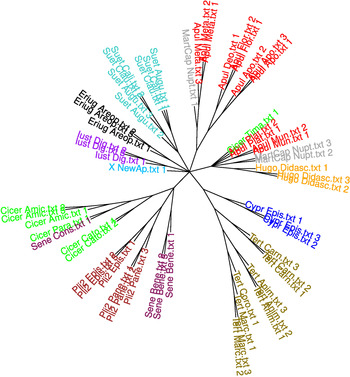
Replication of the experiment reported by Stover and his co-authors, fig. 1 (in this replication we follow Stover in designating the ‘New Apuleius’ as X_Exp). (This figure is in colour in the online version of our article.)
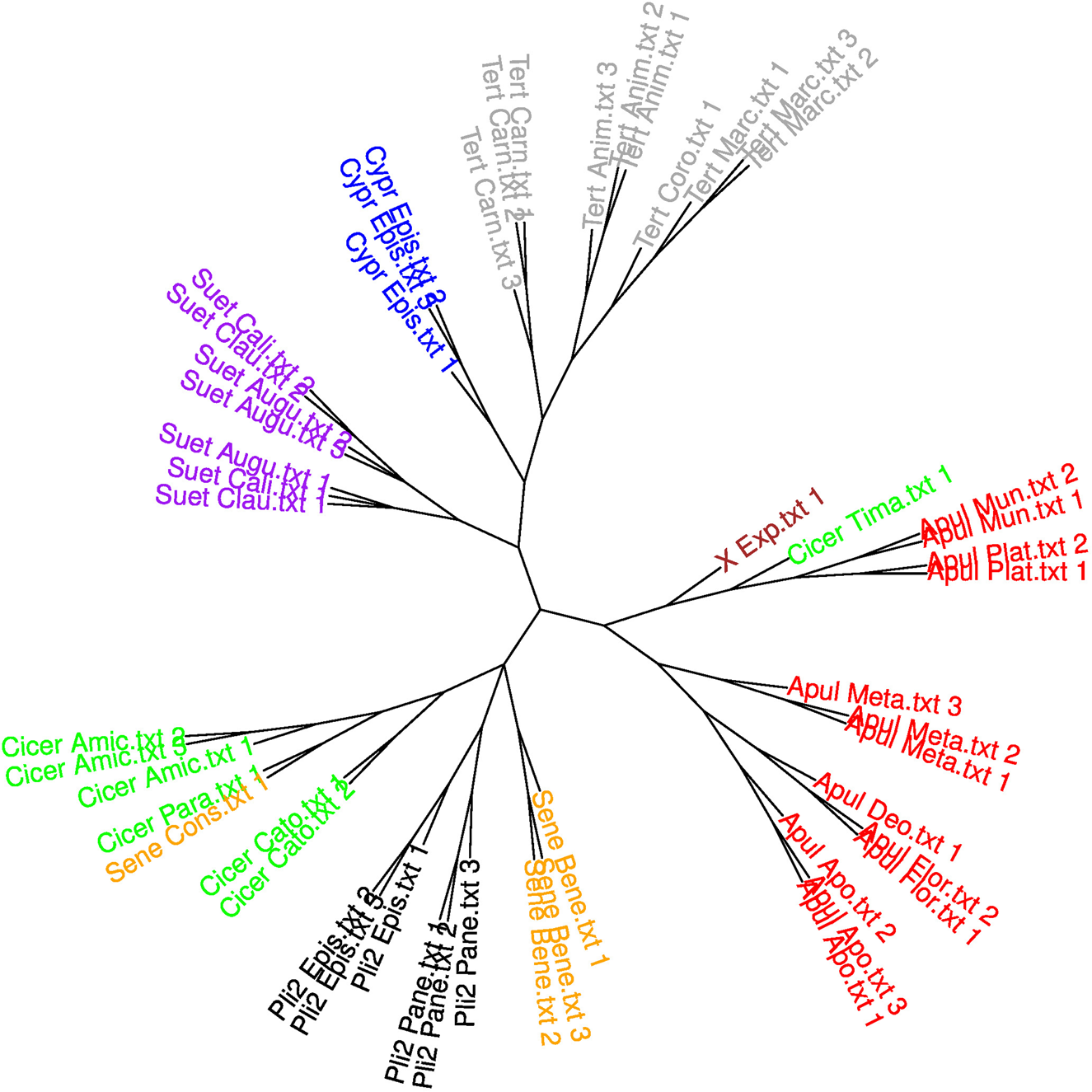
According to the supplementary materials and to the description of fig. 1 in the paper, the longer texts were truncated to the first 9,000 words ‘to maximise comparability’Footnote 36 and then split into two slices of 4,500 words each; texts shorter than 9,000 words are said to have been truncated to the first 4,500 words. However, the tree makes it clear that this description does not correspond to the actual experiment, since the longer texts are divided into three pieces instead of two, while shorter texts are sometimes represented by a single piece and sometimes divided into two parts, obviously depending on whether the text in question is longer than 6,000 words. We conjecture that sample lengths of 3,000 words were eventually chosen instead of 4,500 words, without reflecting this change in the descriptions. Texts between 6,000 and 9,000 words were truncated to 6,000 words and then divided into two pieces, while texts shorter than 6,000 words were truncated to 3,000 words. This reconstruction is confirmed by the fact that we were able to exactly replicate the results of the experiment using these parameter settings (cf. fig. 1 above).
The automated classification reported by Stover and his co-authors was largely the same as in the book. However, a fragment of the Timaeus ended up in the same subtree as the ‘New Apuleius’, the De mundo and the De dogmate Platonis, while Seneca's De constantia sapientis intruded into the subtree containing other works by Cicero. Consequently, the results of the experiment looked much less definitive and showed that the method is capable of attribution errors. The algorithm settings were also slightly different: instead of hand-picking non-content-related words, as in the book version, the authors simply based the calculation on 3,000 most frequent words (starting from 50) with personal pronouns removed.
The second iteration, eventually published in the 2017 paper,Footnote 37 but also referenced in the monograph,Footnote 38 also uses 3,000 most frequent words (starting from 100 this time) without manual selection except for personal-pronoun removal. The samples are now officially 3,000 words long. The corpus, however, is markedly different: there are no works by Cicero at all.Footnote 39 The results are more similar to those reported in the book: works by Apuleius form a separate subtree, which also includes the ‘New Apuleius’ but no texts by a different author.
The third iteration is that reported in the monograph.Footnote 40 Cicero's works were reintroduced, with the exception of the ill-behaved Timaeus and with the Paradoxa Stoicorum replaced by the Tusculanae disputationes; the set of Tertullian's texts was also reduced. The samples are now 4,522 words long (equal to the length of the shortest text, which is the De deo Socratis), and in most cases longer texts are not truncated;Footnote 41 an exception, however, was made for the Metamorphoses, which was truncated to the length of three samples, ‘because in many experiments this text would otherwise form a separate branch in the bootstrap tree’.Footnote 42 Raw most frequent words were replaced with ‘a list of 250 grammatical function words’ with personal pronouns and ‘topic-specific words (nouns such as deus, verbs such as dicere)’ removed,Footnote 43 with the smallest frequency-bandwidth of 50 and an increment of 1.
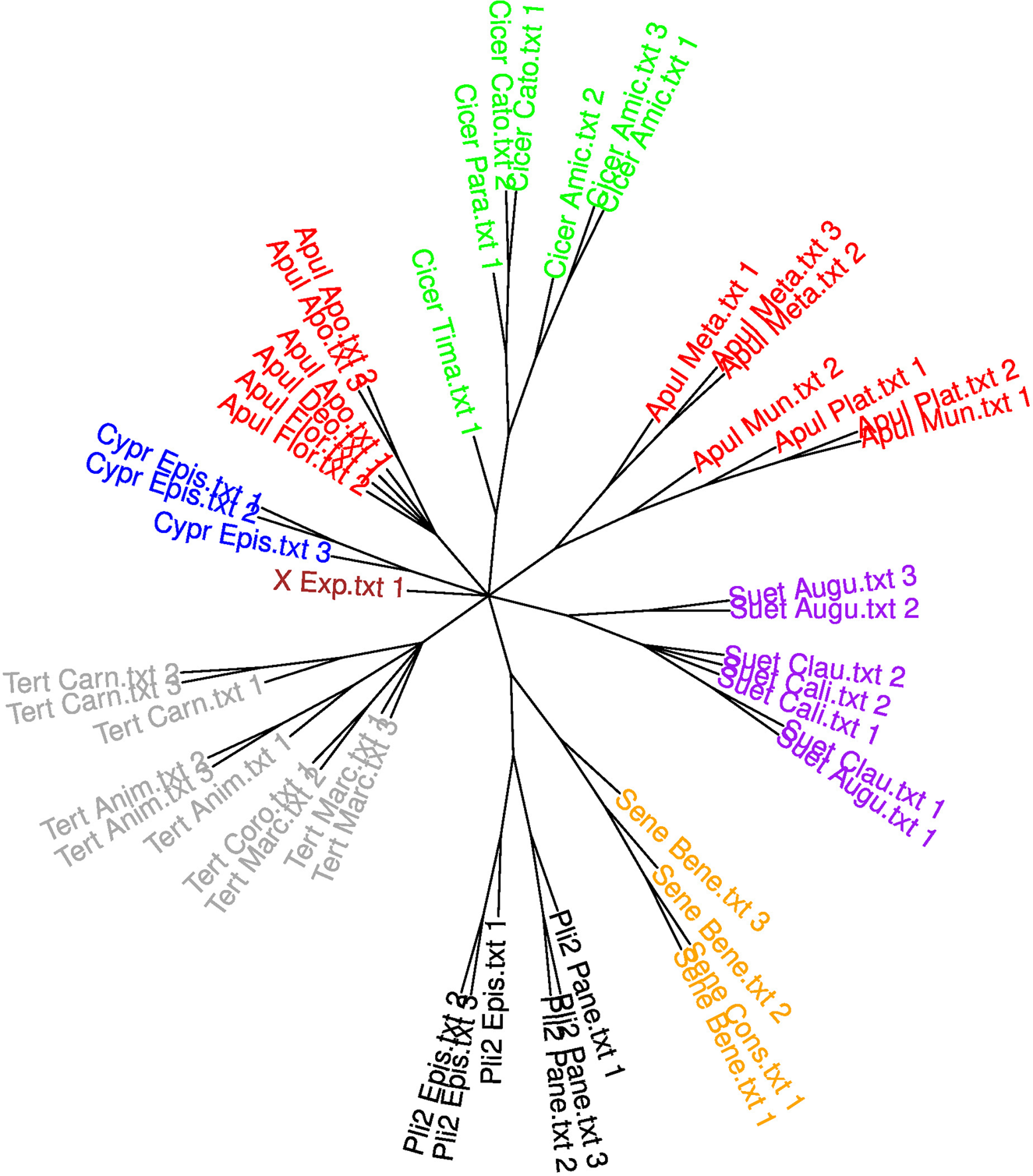
Replication of the experiment reported by Stover and his co-authors with 150 manually selected function words used as a basis for classification. (This figure is in colour in the online version of our article.)
This variability in the actual implementation of the analysis begs the question of the freedom that the stylometric method gives to the researcher. By altering the corpus and manually selecting a restricted set of ‘grammatical function words’, Stover was able to obtain the Consensus Tree that was even able to separate different stylistic strands in Pliny the Younger's writings and thus was a purportedly reliable indicator of the authorship of the ‘New Apuleius’. We do not know, however, if this combination of algorithm settings still produces results suggesting that Cicero's Timaeus was written by the same author. The results presented in the 2016 brief communication and the absence of Cicero's Timaeus from the subsequent experiments indicate that there may be content-related signals in the data that the algorithm, pace Stover, is unable to tease apart.
We chose to replicate the first of the three iterations, because the detailed (although not entirely accurate; cf. above) description of its methodology in the supplementary materials allowed us to reproduce it exactly. The results of our replication are reported in fig. 1, and they match the results reported by Stover and his co-authors.
In order to check if these results could be improved upon without any changes in the corpus, we created a BCT based on the list of 150 highly frequent, manually filtered, predominantly function words with pronouns removed (starting with the 50 most frequent words and going up to 150 by increments of 1; the same increment and starting range were used by Stover in his monograph).Footnote 44
The results are reported in fig. 2 below. They show that there is a trade-off: basing the classification on the selected function words makes the method more robust (there are no mistaken attributions in the tree), but lowers its insightfulness (the works by Apuleius are split into two unrelated groups, one of which is further split into two subgroups, with the divisions largely corresponding to genre boundaries: the contested group De dogmate Platonis + De mundo vs the Metamorphoses in one subtree vs the rest of Apuleius’ texts in another).Footnote 45 This arguably more performant approach does not treat the ‘New Apuleius’ as a text by Apuleius.
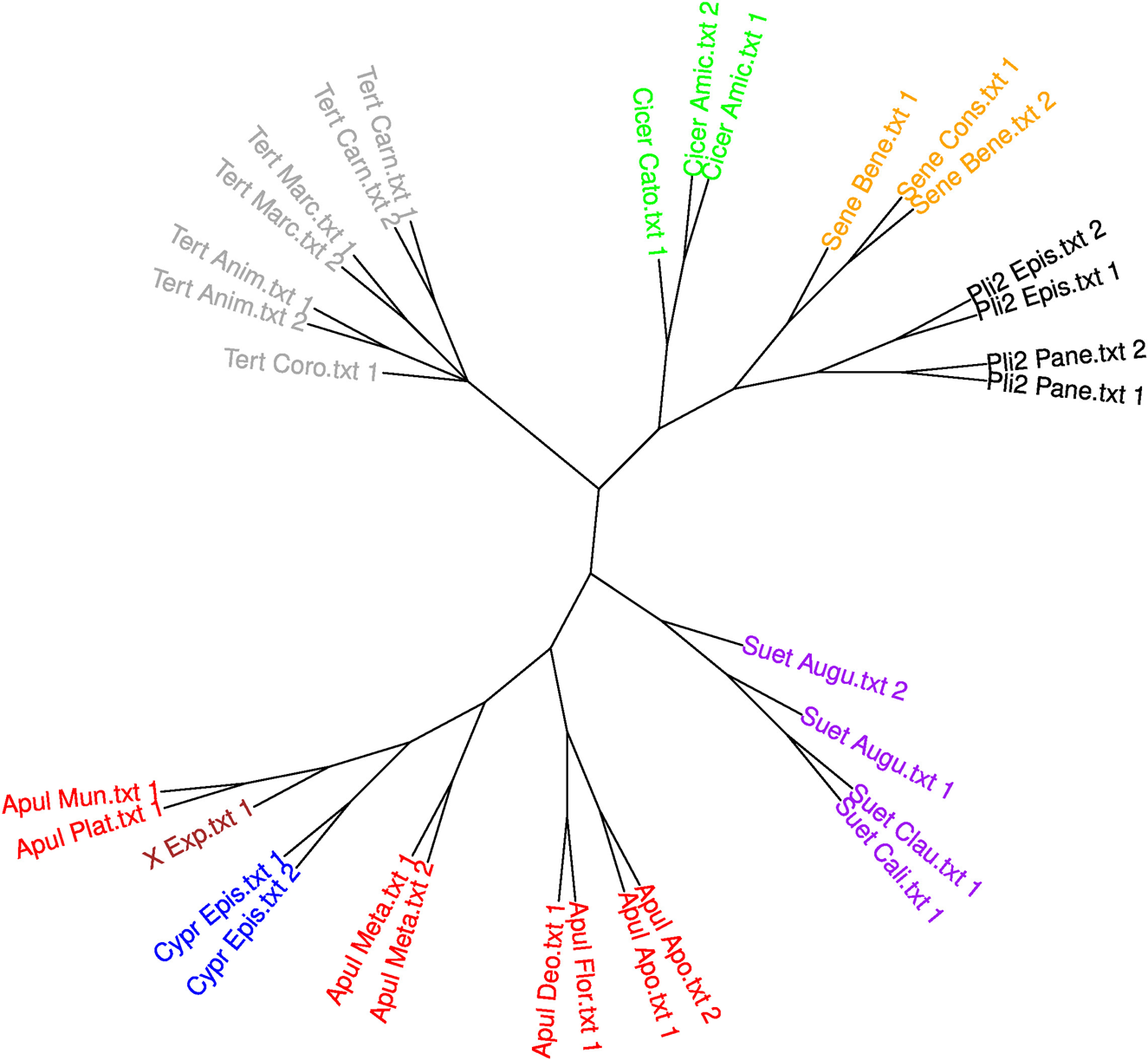
If we further make the experiment more conformant to what was reported in Stover's monograph by using the sample length of 4,500 words (and sacrificing the Timaeus and the Paradoxa Stoicorum, which are too short), we again will see the ‘New Apuleius’ clustered with the De dogmate Platonis and the De mundo (fig. 3 below). Cyprian's Epistles, however, are in this case also placed within Apuleius’ subtree.
Replication of the experiment reported by Stover and his co-authors with 150 manually selected function words and 4,500-word samples. (This figure is in colour in the online version of our article.)
Dependence on the corpus
Stover's experiments probably do show that there is some affinity between the ‘New Apuleius’ and Apuleius (and in particular between the ‘New Apuleius’ and the De dogmate Platonis together with the De mundo) in the way in which they use frequent and function words. However, attributing the new text to Apuleius is not the only way to explain this affinity.
Most importantly, it is not clear whether the experiments picked up features shared specifically by the ‘New Apuleius’ and Apuleius alone or features shared by these texts together with other texts by different authors. The intrusion of Cicero's Timaeus into the same subtree in one of the experiments and of Cyprian's letters in the other seem to confirm the latter interpretation. Moreover, it is notable that in his experiments Stover uses only texts that are earlier or slightly later than the date he ascribes to the ‘New Apuleius’ (the second century a.d.).Footnote 46 As a result, only those texts are used that are patently dissimilar in their style from both Apuleius and the ‘New Apuleius’. In other words, what Stover's experiments actually show might be that the ‘New Apuleius’ looks Apuleian when compared to Cicero, Pliny the Younger, Seneca, Suetonius and the early Christian writers, and not that it is objectively Apuleian.
More precisely, our working hypothesis is that the inclusion of the ‘New Apuleius’ in the same subtree as Apuleius in Stover's experiments reflects the fact that these texts display a set of features shared by a certain type of works but absent from the background texts used in Stover's experiment.
In order to investigate this possibility, we added to the corpus used in our replication of Stover's experiment (see the subsection on ‘Replication’ above) several texts that share certain features of genre with the ‘New Apuleius’ and with some of the authentic Apuleian texts (we have chosen technical and didactic texts), represent various periods different from that to which Stover limits his choice of comparative material, and are already known to parallel in certain cases the unusually high frequencies of particular words shown by the ‘New Apuleius’ (see the subsection on ‘Preliminary computations’ above). The following texts have been added:
• DigestaFootnote 47
• Martianus Capella
• Eriugena, Areopagitica (ninth century a.d.)
• Hugh of Saint Victor, Didascalicon (twelfth century a.d.)
In every case except Martianus Capella we used the first 9,000 words of the text adapted according to Stover's practice (that is, we removed the non-alphabetic characters, replaced all vs with us and made all the words lowercase; in the case of the Digesta, we also deleted source references). In the case of Martianus Capella, using the first 9,000 words would mean working only with the narrative part of the text, while our intention was to consider the ‘behaviour’ of both the narrative and the technical parts of this text, if possible separately. For this reason we have taken the last 9,000 words of the text (that is, Book 9 and a tiny scrap of Book 8) and placed the fragment of Book 8 (technical in content) after the text of Book 9 (containing a long narrative introduction followed by the technical main body), so that the first piece of Martianus Capella used in our experiment would contain the narrative beginning of Book 9 and exemplify Martianus’ narrative style, while the other two pieces would represent his technical style.
Using this corpus, we reran the algorithm using 3,000-word samples and the 3,000 most frequent words (starting from 50) with personal pronouns removed. The results are shown in fig. 4.
Bootstrap Consensus Tree for the enlarged corpus. (This figure is in colour in the online version of our article.)

Although the results cannot be said to correspond exactly to our initial hypothesis, it is notable that, on the one hand, the ‘New Apuleius’ again constitutes a separate branch and, on the other hand, the group De dogmate Platonis + De mundo + Cicero's Timaeus is now detached from the rest of the Apuleian corpus and united with other technical/didactic texts, viz. Hugh of Saint Victor and the technical parts of Martianus Capella. As for the narrative piece of Martianus Capella, it landed in the same branch as Apuleius’ Metamorphoses, which Martianus obviously imitates in his narrative.Footnote 48 Thus, in the way in which the samples by Martianus Capella are grouped, features of genre and imitated style clearly appear to prevail over authorial features, contrary to what the proponents of the algorithm proclaim.Footnote 49 Similar problems that were already present in fig. 1 are also evident here: in particular, the Timaeus is again separated from the rest of Ciceronian texts, and Seneca's De constantia sapientis is again detached from the rest of Seneca's works and coupled with other works by Cicero. The algorithm based on most frequent words minus pronouns is clearly not sensitive enough for a reliable identification of a work as belonging to a given author.
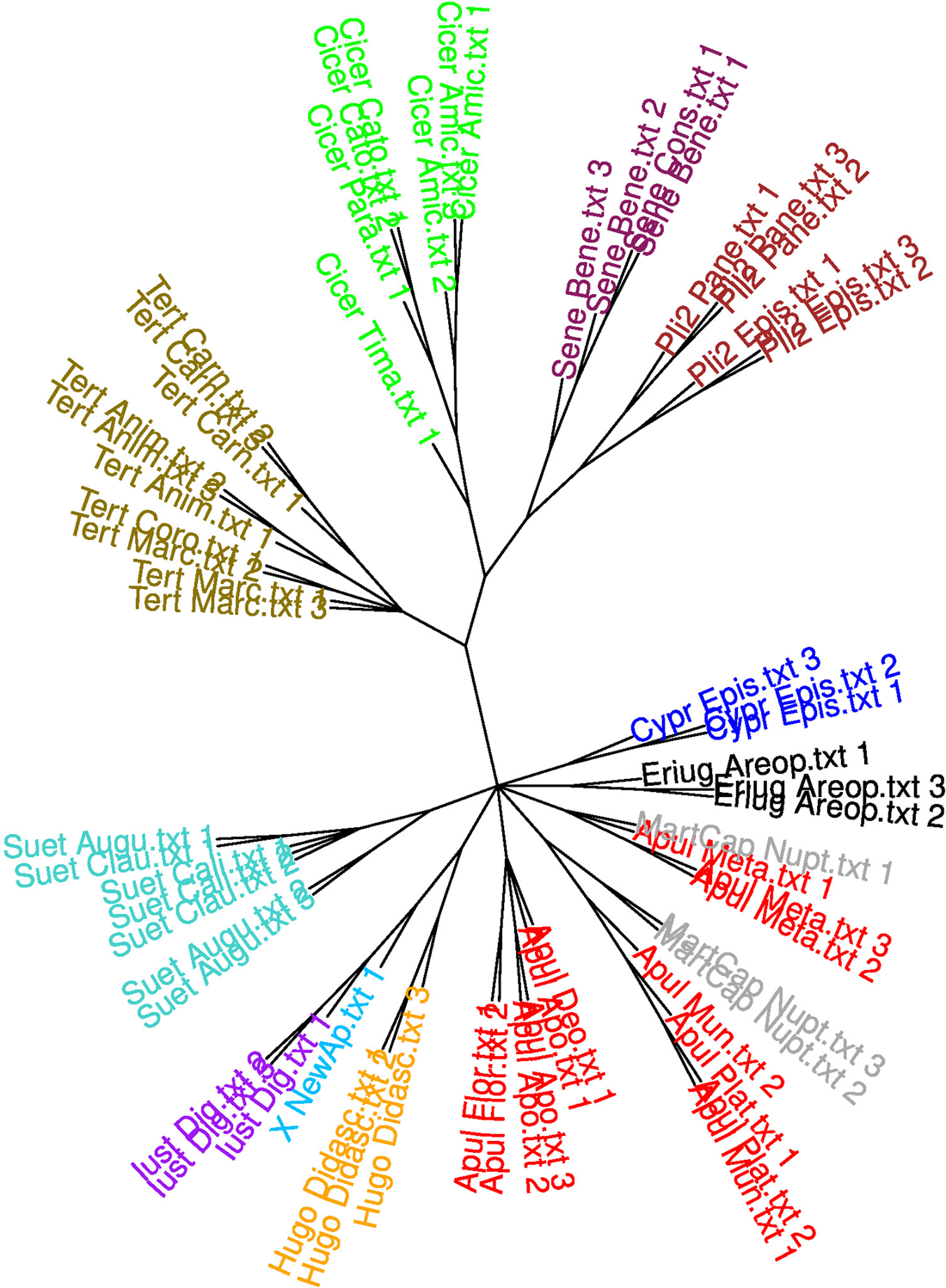
Finally, we repeated the same procedure with manual selection of function words, following the general approach adopted in Stover's third experiment but using our list of 150 words described above. As in the previous subsection, we carried out this experiment twice: first with the 3,000-word sample length and then with the 4,500-word sample length (in the latter case, we had to leave out texts that are shorter than 4,500 words and to abandon dividing Martianus Capella into narrative and technical parts). The results are presented on fig. 5 and fig. 6 respectively.
Bootstrap Consensus Tree for the enlarged corpus with a manual selection of non-content-related words (3,000-word samples). (This figure is in colour in the online version of our article.)
Bootstrap Consensus Tree for the enlarged corpus with a manual selection of non-content-related words (4,500-word samples). (This figure is in colour in the online version of our article.)
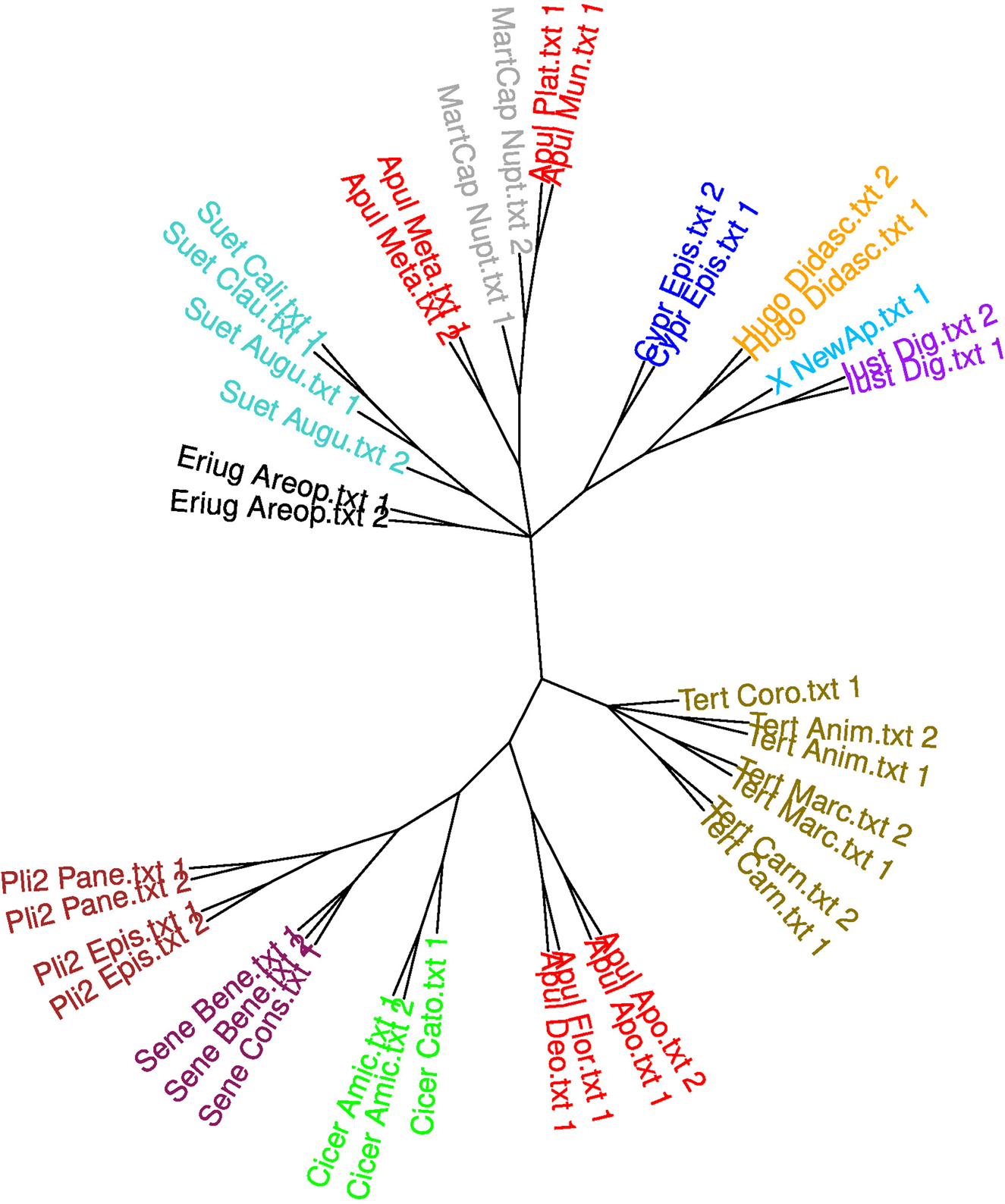
Using manually selected function words again proved to be a superior approach. In figs. 5 and 6, works by Cicero (including the Timaeus in the case of fig. 5) and Seneca are reliably grouped together, like all the other works by the same author, except for the notoriously stylistically non-uniform Apuleius (with the threefold division we have already encountered) and, again, Martianus Capella (in fig. 5). Obviously, the narrative part of Martianus’ text is too skilled an imitation of Apuleius’ Metamorphoses even for this version of the algorithm to distinguish the imitation from the model. A tendency also now becomes discernible for the technical parts of Martianus Capella to group consistently with the De dogmate Platonis and the De mundo: should we perhaps suppose that Martianus in his technical passages tried to imitate in particular what he considered Apuleius’ technical works?
As for the ‘New Apuleius’, the correspondence to our initial hypothesis is striking. In fig. 5 it is placed in the same subtree as the Apuleian corpus, but now it is also accompanied there by the technical/didactic works that we added to Stover's corpus plus Cyprian's letters, which we have seen entering the Apuleius + the ‘New Apuleius’ cluster in fig. 3, and for some reason also the works by Suetonius. Virtually the same subtree is discernible in fig. 6, though this time the undisputedly Apuleian works other than the Metamorphoses are detached from it. The ‘New Apuleius’ is in both cases particularly closely associated with the Digesta.
Whether or not these results are reliable enough to confirm our hypothesis (this crucially depends on higher validity of function words vis-à-vis raw, most frequent words as the basis for analysis), our experiments probably make it certain that the results published in Stover's works are highly dependent on the particular algorithm settings and on the composition of the corpus, at least with respect to the grouping of the Apuleian corpus with the ‘New Apuleius’. It may also be added that some features of our trees, in particular the behaviour of the samples from Martianus, clearly point toward general vulnerability of the approach to skilful imitation, although it is possible that another choice of diagnostic words for computing Burrows's Delta may lead to better and more stable results.
Other methods
In order to provide further corroboration for his hypothesis, in addition to clustering methods, Stover and his co-authors use two other methods: Principal Component Analysis and the so-called Impostor Method. We will briefly survey them in the next two subsections.
Principal Component Analysis
In order to provide another perspective on the stylistic relationship between texts in the corpus, Stover and KestemontFootnote 50 use Principal Component Analysis (PCA), a time-honoured technique for providing lower-dimensional (and therefore more interpretable) approximations of multivariate data. Unlike BCTs, PCA, when applied to textual fragments characterized by word frequencies, is able to tell us which individual words contribute to the division of texts into groups.
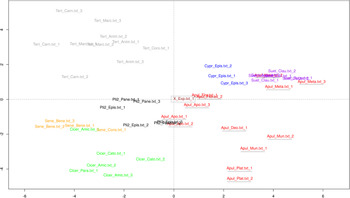
However, PCA has its limitations. As the scholars point out, ‘PCA has the drawback that, as a visualisation technique, it can only be reliably applied to a relatively small set of authors at the same time (typically three or four).’Footnote 51 They further clarify in a footnote: ‘Because only so much information can be captured in a two-dimensional analysis, including more than three œuvres in a PCA should be generally avoided. The underlying theoretical assumption is that, because of this restriction, each dimension has the potential to contrast one author with the other authors included.’Footnote 52 Consequently, Stover and Kestemont compare Apuleius’ writings together with the ‘New Apuleius’ to works by Cicero and SenecaFootnote 53 and point out that in these plots the ‘New Apuleius’ clusters with the works by Apuleius (when we look at the PCA plot for the whole corpus, which we created after replicating Stover and Kestemont's subcorpora plots [cf. fig. 7], we indeed see a lot of confusion, and the position of the ‘New Apuleius’, referred to as X_Exp, is ambiguous).
PCA plot of the reference corpus based on 50 MFWs. (This figure is in colour in the online version of our article.)

The scholars also give interpretation of the word frequencies that produce the reported configurations.
These analyses are highly selective and therefore, in our opinion, not really convincing. In the next section, we use a more powerful dimensionality-reduction technique (UMAP), which provides a very clear and nuanced view of the corpus and does not corroborate Stover's theory.
Impostor Method
The final technique that Stover mentions in the monograph as substantiating his claims about the authorship of the ‘New Apuleius’ is the Impostor Method originally proposed by Moshe Koppel and Yaron WinterFootnote 54 and applied to the Latin corpus in the 2016 brief communication by Stover and his co-authors.Footnote 55 The crux of the approach is to replace the traditional stylometric problem of choosing from a closed set (Which from among a given set of authors is the most likely creator of a given textual fragment?) with a binary-decision problem (Were textual fragments X and Y written by the same author?). In order to solve the latter problem, ‘[w]e systematically produce a set of “impostor” documents and—in a matter reminiscent of a police line-up—ask if X is sufficiently more similar to Y than to any of the generated impostors. The trick is using the proper methods to select the impostors and, more important, to measure document similarity.’Footnote 56
The similarity measure used by the scholars is constructed over counts of 4-grams (sequences of characters of length 4 without spaces or sequences of characters of length less than 4 if they were surrounded by spaces). The scholars note that their method ‘works most naturally with a very large and homogeneous feature set’;Footnote 57 100,000 most frequent 4-grams were used as diagnostic features in the original paper.
The counts of 4-grams are normalized using the technique called tf–idf (for ‘term frequency–inverted document frequency’), in which the raw or normalized frequency of a word in a given text is multiplied by the logarithm of 1 divided by the number of documents in the corpus this word appears in. In other words, tf–idf is doing nearly the exact opposite of the task performed by the normalization component of Burrows's Delta: rare words or 4-grams found with high frequencies in only several texts are considered extremely informative while subtle fluctuations in the frequencies of common words are nearly completely ironed out by small inverse-document-frequency values.
The differences between documents are then computed based on the individual scores of the 4-grams using the minmax formula (the sum of minimal elements of pairs of corresponding 4-gram scores divided by the sum of maximal elements of those pairs).
In order to make the algorithm more robust, Koppel and Winter also resort to bootstrapping: they 100 times randomly select half of the features from the diagnostic set and then based on this subset find the best match for the analysed fragment from the set of candidate texts (consisting of the purported sibling text and impostors). To make the method symmetrical, given a pair of texts X and Y, they (i) generate a set of impostors for Y and compute the score of Y (that is, how often it is chosen as the best matching candidate for X), (ii) repeat the same procedure with impostors generated for X competing with X itself, and (iii) assign X and Y to the same author if the average of the scores for X and Y produced in this way is greater than some threshold σ*, which can be tuned based on a separate development corpus.
Koppel and Winter report two sets of test results. One set of results with accuracy surpassing 90% was achieved on a corpus of posts from blogger.com, where it may be assumed that different authors have different thematic preferences and therefore the performance of the algorithm may be boosted by thematic coherence. In order to control for that, the scholars conducted an additional test based on a corpus of 2,000 pairs of student essays where the second element of the pair was always from a different essay subgenre. Impostors in this case were other texts from the same subgenre but written by different authors, and the algorithm achieved 73.1% accuracy in making authorship attribution decisions, or was wrong more than once out of four times, which is a decent result for an exploratory method but is remotely not enough for a kind of forensic authorship testing that is aimed at in the case of the ‘New Apuleius’. Koppel and Winter note: ‘This reflects the fact that same-author pairs in this corpus differ by design both in terms of subgenre and topic, leaving many fewer common features to exploit.’Footnote 58 Frankly, this begs the question whether this method really has any place in stylometric applications, where subgenre and topic are assumed to be not only unavailable as props but chosen in an adversarial fashion.
In Stover and his co-authors, the section ‘Verifying the Apuleian authorship of the Expositio’Footnote 59 reports a result of the application of this method to the ‘New Apuleius’ with frequencies of 125,000 word unigrams and bigrams (that is, individual words or successive pairs of words) used as diagnostic features and 180 background texts by 36 authors ‘writing in similar genres and/or periods as the texts in our corpus’Footnote 60 used as impostors. The scholars then report that the pair Expositio and De dogmate Platonis obtains an ‘exceptionally high score’ of .73 with only one different-author pair in the test corpus achieving a score above .50 and no different-author pairs achieving a score above or equal to .73. The scholars note further that ‘the Expositio does not yield high scores when paired with other texts by Apuleius than De Platone, most of which are in different genres than the Expositio (Platonic philosophy)’.Footnote 61 Moreover, the Metamorphoses obtains a score above .50 with the Florida, but with no other text by Apuleius.
Then Stover and his co-authors suggest that authorship attribution should be conducted in a transitive fashion: if we establish with some confidence that the same author wrote A and B and that the same author wrote B and C, we are forced to conclude that the same author wrote A and C. Transitivity holds, however, only when both links were actually proven. As things stand, neither the De dogmate Platonis is proven beyond doubt to be a text by Apuleius, nor the ‘New Apuleius’ is proven beyond doubt to have been written by the same person who composed the De dogmate Platonis: only with a large control corpus of Latin Platonic philosophy contemporary to Apuleius can we even begin seriously discussing this question using this methodology. Therefore, instead of adhering to transitive logical reasoning, we should essentially multiply the uncertainty of both postulated links, which leaves the end result very far from definite.Footnote 62
IV. GENERALIST APPROACHES
In this section, we use generalist methods for multivariate data analysis and classification to analyse Stover's corpus and our augmented reference corpora. We show that these methods are superior to ad hoc stylometric algorithms such as BCT and weak linear methods such as PCA in that they provide much more insight into the relationships between textual fragments and are better suited for author identification. These methods do not corroborate Stover's hypothesis.
Contemporary dimensionality reduction: UMAP
Stover and Kestemont's remarks on PCA quoted above reflect a rather pessimistic view of dimensionality reduction. It has been convincingly proven that two dimensions are entirely sufficient to disambiguate any number of clusters (texts written by different authors in this case), given that they form a pattern that can be projected on a 2-D surface; cf. the large-scale topic classification of texts conducted by Hinton and Salakhutdinov.Footnote 63 The trick is in recovering these patterns, and here PCA is unfortunately deficient.
The convenient interpretability of PCA is tied to its fundamental limitation: it is able to separate objects into well-defined groups only if this can be done by means of linear combinations of the variables (which means, in this case, summing normalized frequencies of different words multiplied by some coefficients). Real-world data, however, more often than not display non-linear dependencies, and textual data are especially complex in this regard, which makes PCA an inadequate method for tackling them.Footnote 64 Stover and Kestemont point to the success of PCA-based stylometric analyses performed by Burrows on a corpus of English literary texts more than 30 years ago,Footnote 65 but there is really no excuse for sticking with non-performant crude methods today or at least for not verifying them using more powerful ones.
In order to show that there is no need to impose artificial limitations on the number of authors in the analysis, we used UMAP,Footnote 66 a contemporary method for dimensionality reduction, which allows for custom distance measures. The results of its application to frequencies of 100 MFWs with Burrows's Delta used as the distance measure, shown on fig. 8, are remarkably clear. There is no confusion at all between different authors; Apuleian texts in different genres tend to cluster together, and the ‘New Apuleius’ (again referred to as X_Exp following Stover's corpus conventions) is essentially on its own although it is not far from Apuleius’ philosophical works.
UMAP plot of the reference corpus based on 100 MFWs and Burrows's Delta. (This figure is in colour in the online version of our article.)
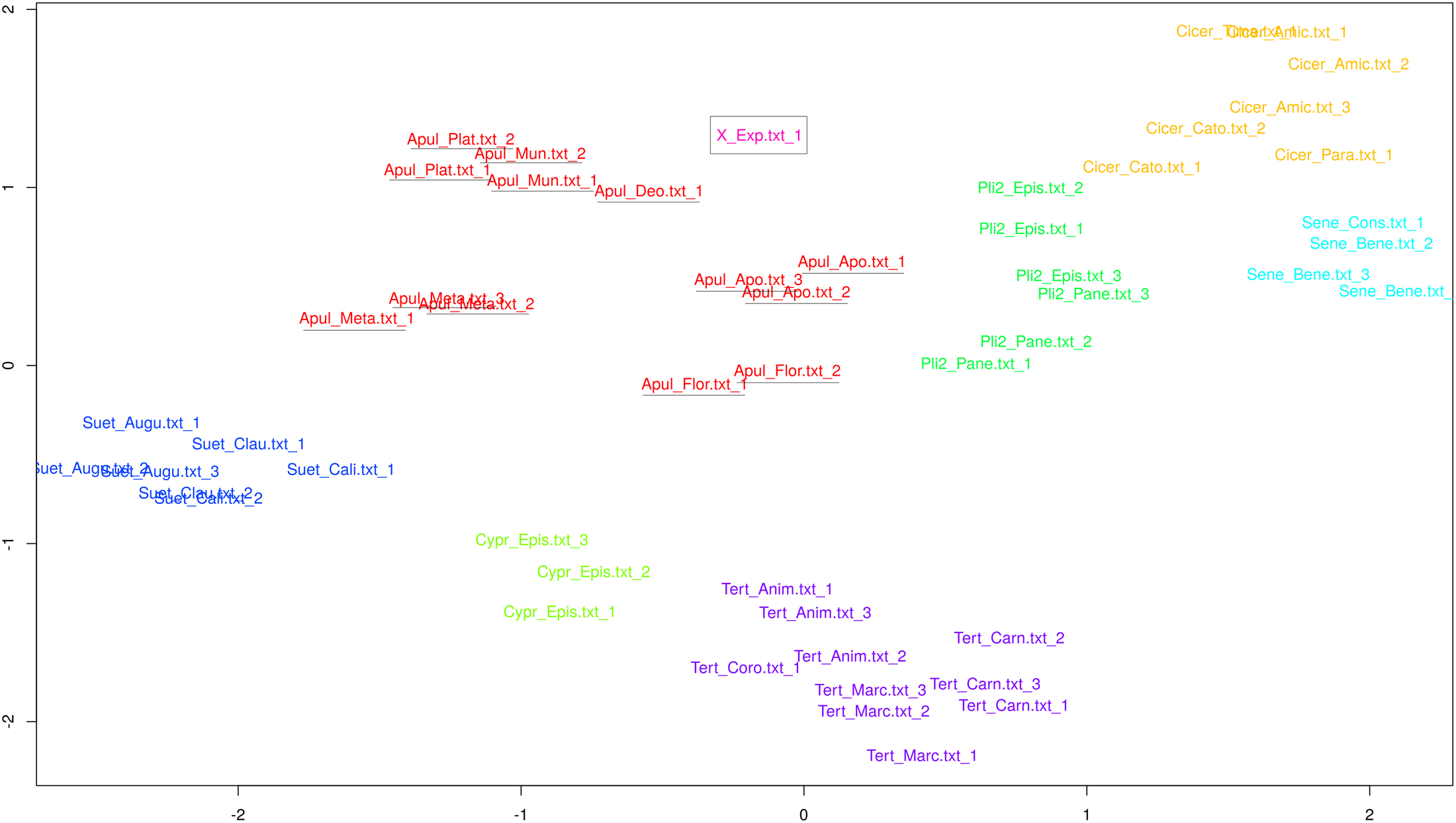
The UMAP analysis of our extended corpus, shown on fig. 9, again mostly succeeds in correctly separating the known authors, except for a narrative sample from Martianus Capella, placed deep in the area defined by the Metamorphoses, and the third sample from the Digesta (which is not a text written by a single author). Texts by Apuleius form a diffuse elongated cluster largely parallel to and partly intertwined with the area occupied by the Digesta together with the works by Martianus, Hugh of Saint Victor and Eriugena. The ‘New Apuleius’ is also a part of this pack: it is placed close to some Apuleian texts, but is not more apparently similar to them than the sample from the Digesta or works by Hugh of Saint Victor.
UMAP plot of the enlarged corpus based on 100 MFWs and Burrows's Delta. (This figure is in colour in the online version of our article.)

This shows that there are absolutely no grounds for artificially reducing the power of dimensionality-reduction analyses in stylometry by using small unrepresentative text samples. It may also be noted that UMAP by and large makes BCTs redundant: using a narrow frequency band of MFWs and Burrows's Delta, it immediately produces highly interpretable and, as far as we can verify them, essentially correct results.
Gradient-boosting classifier
Dimensionality reduction and clustering techniques are well suited for exploratory analysis, but they cannot be set up to provide an answer to a straightforward question: was this fragment written by a given author or not? Even the Impostor Method, which is a binary classifier, is deficient in this regard: it gives a yes/no answer regarding a pair of textual fragments. As we showed in the previous section, this can lead to contradictions and demands strong transitivity assumptions. A more logical approach would be to use a binary-classification model that can be fitted on a corpus of textual fragments some of which belong to a given author and then ask this model to assess the probability of a new fragment's being written by the same author.
We propose to use the gradient-boosting machine as such a model. The gradient-boosting machineFootnote 67 is probably the most powerful classifier used by the statistical-learning community that is not a neural network or a support-vector machine. Its main advantage over neural networks is that it does not need an enormous training data-set to converge, and this makes it particularly suitable for our task. Support-vector machines do not have such data requirements, but they take time proportional to the cube of the number of observations in order to converge, which makes it impractical to use them with cross-validation (see below) requiring dozens or hundreds of model reruns.
The gradient-boosting machine is an ensemble classifier: when learning from the data, it iteratively adds new predictors in such a way that each successive predictor corrects part of the remaining error left after using all of the previous ones. Each new predictor is a decision tree that assigns the data-point to a particular class based on its characteristics.
For example, if we use relative frequencies of words A, B and C as predictors for the authorship of a text, the classifier may first use the relative frequency of A as a defining feature, then correct the intermediate result by using the relative frequency of C, then refine the result even further by using a combination of the frequencies of A and B, etc. The number of predictors and the complexity of interactions (how many variables each predictor can take into account simultaneously) are chosen by the researcher.
It has been shown that in most cases it is advantageous not to use any interactions at all, because otherwise the classifier becomes too sensitive to noise in the training dataset and cannot generalize to new data. As for the number of predictors in the ensemble, the standard procedure is to divide the training corpus into a training set proper and a ‘held-out’ set (also called ‘development set’) and then check what number of predictors obtains the best classification results on the held-out set after the model was trained on the training set. In order to make the results more robust, each value for the number of predictors can be tested on several different versions of training and held-out sets (this is called cross-validation), and the results of these tests are averaged.
In our experiment, we used the implementation of the gradient-boosting machine provided in the R package gbm.Footnote 68 We used relative frequencies of the same set of function words as in the BCT experiments as features of 3,000-word-long textual fragments. We treated the De dogmate Platonis and the De mundo as texts written by Apuleius to make our assumptions more accommodating to Stover's hypothesis.
First, we checked if the gradient-boosting classifier is able to tell apart fragments by Apuleius from fragments by other authors in Stover's initial corpus. We adopted the following procedure for each fragment in the corpus:
(1) The fragment in question was held out for testing.
(2) The remaining fragments were repeatedly split into the development set consisting of one fragment and all other fragments (this method is called leave-one-out cross validation). These splits were used to determine the optimal number of predictors with the upper bound of 200. The fragments written by Apuleius were assigned the label 1, and all other fragments received the label 0.
(3) The model with the number of predictors chosen using leave-one-out cross validation was trained on all fragments from the training set. It was then asked to give a score from 0 to 1 to the held-out fragment.
The scores provided by the classifier are not informative individually, and the crucial question is whether we can find a threshold such that all fragments by Apuleius will lie above this threshold and all fragments by other authors will lie below this threshold. This will mean that the classifier achieved perfect discrimination. This indeed was nearly the case. The top of the list of the fragments sorted in the decreasing order of their ranks is shown in table 3 (below).
The ranking of fragments from Stover's corpus according to their probability of being authored by Apuleius as estimated by the gradient-boosting algorithm based on relative frequencies of selected function words

We see that the fragments by Apuleius occupy the top of the list and that the only mistake made by the classifier is the inflated score of the first fragment of Pliny's Panegyric, which is slightly higher than the score of the second fragment of the Metamorphoses. Further down in the list the scores drop sharply.
We may therefore hypothesize that, after training our model on all fragments with known authorship, given a score provided by the model to a new textual fragment, this fragment may be considered ‘Apuleian with high confidence’ if the score is above 0.31 and ‘possibly Apuleian’ if the score is somewhere near 0.3. The score of the fragment consisting of the first 3,000 words of the ‘New Apuleius’ provided by the model is 0.048, which is more than 6 times less than 0.3.
We repeated the same experiment on the augmented corpus that we used for BCT experiments, again using the relative frequencies of manually selected function words as features of 3,000-word-long textual fragments. The results, presented in table 4 (below), show that, given more data, the classifier can now confidently conclude that Pliny's Panegyric was not written by Apuleius. At the same time, the first fragment by Martianus Capella again proves itself to be indistinguishable from the fragments by Apuleius.
The ranking of fragments from the augmented corpus according to their probability of being authored by Apuleius as estimated by the gradient-boosting algorithm based on relative frequencies of selected function words

The threshold of the scores distinguishing ‘probably Apuleian’ texts from all the rest is now around 0.28. The score of the first 3,000 words of the ‘New Apuleius’ given by the model trained on all fragments from the augmented corpus is below 0.002.Footnote 69
Testing on a more representative corpus
In order to further test that our results do not depend on the choice of corpus, either by ourselves or by Stover, we added all sufficiently long Latin texts from the PHI5 database and the DigilibLT repository to the corpus we used before and reran the dimensionality-reduction and binary-classification analyses on the resulting, much bigger collection of 298 texts, which we take in their entirety. We did not try to apply BCT to this corpus, as this algorithm has already been shown to be unstable (moreover, trees with thousands of branches are no longer easily interpretable).
The results of applying UMAP to the bigger corpus are shown in fig. 10 (below). In order to make the figure more readable, we replaced names of textual fragments with grey crosses, except for the ‘New Apuleius’ and the Apuleian fragments. The ‘New Apuleius’ is firmly embedded in the region occupied by fragments of the Digesta. Apuleian fragments do not hang together, with some of his text samples gravitating towards works of Cicero, Petronius, Aulus Gellius and other authors and the samples from the Metamorphoses being more independent.
UMAP plot of the big corpus based on 100 MFWs and Burrows's Delta

When training a binary classifier, we encountered the problem of overfitting: owing to the huge disparity between the volume of positive and the volume of negative training data, the gradient-boosting algorithm becomes too sensitive to random fluctuations and does not generalize well. Instead, we trained a binary classifier based on the random-forest algorithm,Footnote 70 which by design avoids overfitting. Similar to the gradient-boosting machine, the random-forest classifier consists of a set of decision trees with each tree trained on a subset of features. The difference is that, whereas in the gradient-boosting machine trees are fitted sequentially with each one trying to improve the performance by looking at hitherto neglected features (thus potentially leading to overfitting), in the random-forest classifier all trees are independent and the result is produced using a simple average. This still gives rise to strong performance in most cases while not letting a small subset of features have an undue influence.
In the resulting ranking, 24 out of 31 fragments by Apuleius appear above the ‘New Apuleius’, which occupies the thirty-second position. Non-Apuleian fragments in the top thirty positions include samples written by Columella, Pseudo-Quintilian, Julius Valerius and Zeno of Verona. Thus the random-forest algorithm, given a larger corpus, does not forcefully disprove Apuleius’ authorship, but clearly does not support it either.
Based on the results of applying (i) UMAP and the gradient-boosting classifier to Stover's original corpus and to our augmented corpus and (ii) UMAP and the random-forest classifier to a bigger validation corpus, we may conclude that
(1) Powerful general methods for statistical learning and dimensionality reduction outperform ad hoc methods and older tools used by Stover and his co-authors: they provide better insight into stylistic differences between textual fragments and in most cases convincingly separate Apuleian fragments from fragments by other authors, given enough training data.
(2) Careful stylistic imitation can defeat even the most powerful stylometric tools.
(3) As far as computer-assisted analyses can be relied upon, there are no indications that the ‘New Apuleius’ is a text by Apuleius.
V. CONCLUSIONFootnote 71
Although our observations do not completely preclude the Apuleian authorship of the ‘New Apuleius’, they imply that in fact we have no reasons to suppose that he indeed composed it since the only reliable connections of this text with Apuleius appear to be the facts that
(1) the ‘New Apuleius’ is found in miscellaneous manuscripts containing works by Apuleius,
(2) there is some general similarity in the way in which Apuleius and the author of the ‘New Apuleius’ use function words, although the overall impression the style of the new text leaves is rather completely un-Apuleian,Footnote 72 and
(3) there are textual parallels between the ‘New Apuleius’ and the De dogmate Platonis.Footnote 73
This is obviously not enough for a conclusive attribution. The hypothesis that the text in question is De dogmate Platonis Book 3 appears to be especially weak.Footnote 74 Nevertheless, Stover is certainly to be thanked for drawing attention to the intriguing problem of stylistic affinities between the new text and the Apuleian corpus.






 Open access

