

Introduction
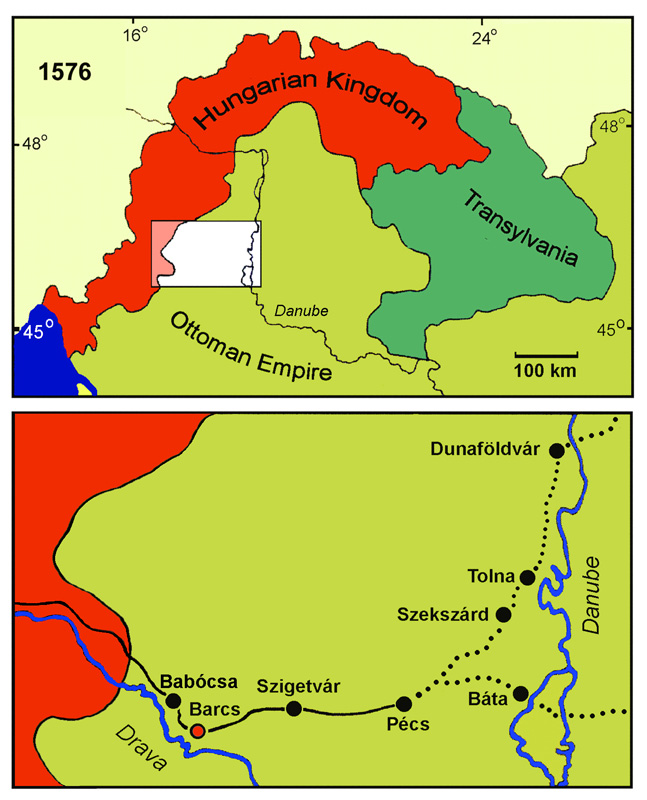
Map of Hungary under Ottoman occupation at the end of the sixteenth century (top), and cattle-driving routes from southern Transdanubia towards northern Italy (bottom) (after Reference Bartosiewicz, Peters and SchiblerBartosiewicz 1999: 48, fig. 1).Click to enlarge.

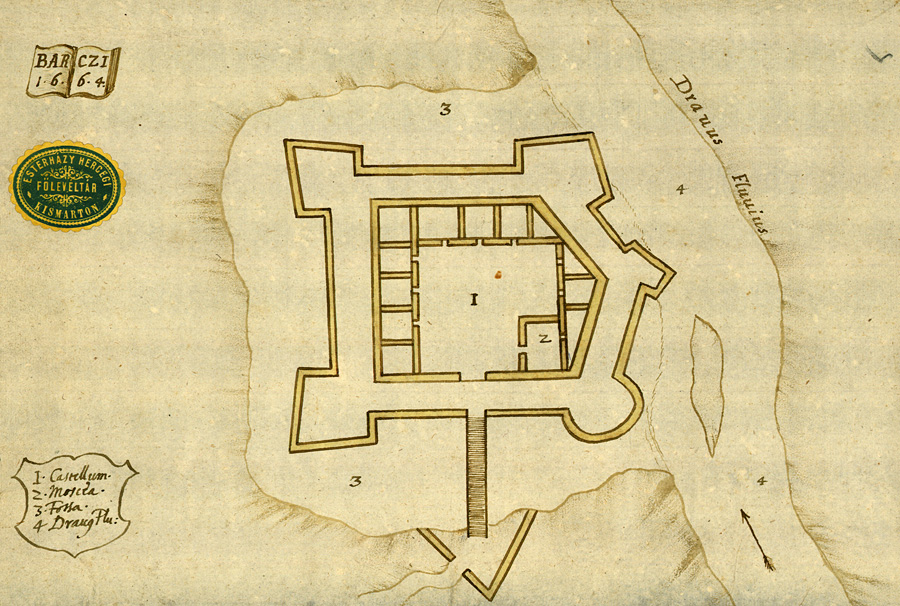
The castle of Barcs in Hungary, erected in AD 1567, shortly after the Ottoman occupation of Szigetvár in 1566, is located on the north-eastern bank of the river Drava about 30km south-west of Szigetvár (Figure 1). Archaeological investigations in 19891994 and 20022003 have revealed that the Turkish fort was a newly-built palisaded stronghold set in its riverside environment (Figure 2). Its military importance declined after AD 1600, but the garrison formed by about 200 soldiers of Balkan origin remained considerable. Soldiers living on the border of the Ottoman Empire performed service on the river and its banks, but they also farmed and worked as craftsmen in peacetime. Their material culture and the background they represent point to Balkan connections, but the artefacts found in excavation suggest that the Turkish occupants of the castle used western artefacts as well as objects from the Orient (Kovács & Rózsás 2010).
Pál Esterházy's ink drawing of the castle of Barcs in Mars Hungaricus, 1664. ( National Archives of Hungary, T. 2. No. 1046, gratefully acknowledged; photograph: Erika Czikkely Nagy).

The walrus ivory plaque
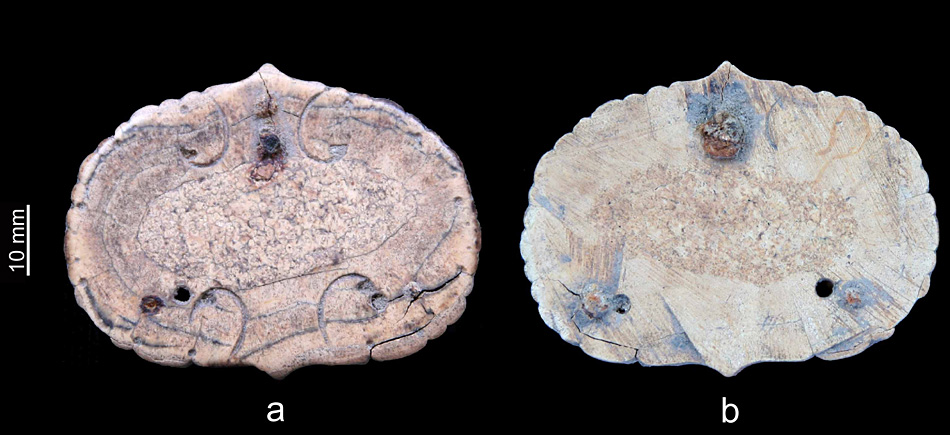
The walrus-tusk belt plaque, castle of Barcs, probably late sixteenth century.Click to enlarge.

In addition to personal belongings, a decorated object made from walrus ivory also came to light (Figure 3). The plaque, carved from the base section of the walrus tusk, is 52.3mm long, 39.1mm wide and 6.57.0mm thick. The edges were symmetrically designed. The external surface of the object was also symmetrically decorated by four motifs most probably representing creepers (Figure 3a). The two series of drillings and remains of iron rivets placed in a larger and a smaller triangular arrangement suggest that the plaque had been fastened to a support in three places in the shape of a triangle.
The parallels known so far for this object suggest that it was most probably a belt plaque. Similar ivory plaques of sixteenth-century date depicting hatayi blossoms and leaves have been displayed in the Topkapi Palace Museum in Istanbul (Çağman 1983: 1645). The plaque recovered from the castle of Barcs is the second such artefact found in Hungary following the fragment of a Tau-shaped crosier found in a thirteenth/fourteenth-century grave at the Greek monastery at Veszprémvölgy in 2001 (Fülöp & Koppány 2004: 124, fig. 6a).
Trading walrus ivory
Since the distribution of walrus is restricted to the circumpolar area around the North Pole, this species was hunted and exploited in northern countries, most often Scandinavia. However, data from Köln (Cologne), Germany, indicate that this rare and precious raw material had reached further into Europe already by the eleventhtwelfth century. In addition to mainland Europe, developing commercial and political relations with Scandinavia enabled walrus ivory to travel as far as the Middle and Far East in this period (Reference MacgregorMacGregor 1985: 40; Reference RoesdahlRoesdahl 2001: 33).
Walrus ivory was also an important raw material for goods circulating in Russia during the sixteenthseventeenth century. It was part of the tax paid to the Tartars of Crimea, where it was turned mostly into decorated knife and dagger handles (Reference IvanicsIvanics 1994: 334). Walrus ivory was a highly appreciated prestige material in the Istanbul court of the sultan (Reference AtilAtil 1987: 120). According to a list of gifts compiled under the reign of Süleyman the Magnificent (15201566), mostly belt ornaments, combs, back-scratchers, inkstands and handles for daggers were produced, but other items such as spoons and headdresses have been also mentioned (Reference MericMeric 1963: 76670).
Given the rarity of artefacts made from walrus ivory, the belt plaque found at a Turkish fortress along the Drava is a surprising find, and may have entered Hungary through Tartar and OttomanTurkish mediation. It is suggested that one of the commanders, who took the object to Barcs, may have had direct relations with the Sublime Porte in Istanbul which allowed him to acquire this special object.
Acknowledgements
We thank Ibolya Gerelyes and Mária Ivanics for providing data on Ottoman-Turkish and Tartar sources. László Bartosiewicz is acknowledged for reviewing the draft manuscript. This study is part of a project supported by the Hungarian National Research Fund (OTKA K 72231).