


On July 2, 1964, President Lyndon Johnson signed the Civil Rights Act of 1964 into law. The act had been conceived and introduced by the administration of Johnson’s predecessor, John F. Kennedy, and was adopted by Congress only after a coalition of northern Democrats and Republicans struck a compromise to break a long filibuster by southern Democratic senators.
This was a significant moment. It was only the second civil rights law that Congress had passed in eighty-six years. With its passage, the American national government took a definitive stand against racial (and other forms of) discrimination. It was followed a year later by the Voting Rights Act, which finally put the weight of the federal government behind the Fifteenth Amendment, which had gone effectively unenforced for nearly a century. Jim Crow—the system of explicit, state-sanctioned racial segregation and discrimination, encoded in law and often-violent social practices, particularly (although far from exclusively) in the South—had been under sustained attack by a broad and deep social movement that had gathered strength from the 1950s and peaked in the early 1960s. These laws, along with other actions by the federal government, marked if not the final nails in Jim Crow’s coffin at least an important step toward the graveyard for explicit racial discrimination in the United States.
But above all, the mid-1960s represented a dramatic turn in the American state’s role in promoting the palpable advance of American democracy and racial equality. As Martin Luther King Jr. described his strategy leading up to the Selma voting rights march in 1965, his aim was explicitly to “arouse the federal government.”Footnote 1 He recognized that national power was critical to the struggle for racial equality. And this is our core proposition: that the engagement of the state is the critical condition for progress toward democratization in the United States. Under what conditions might we expect that engagement to occur?
1. Race, the state, and democratization
Sometimes the American state—the organized political community of the country’s fixed territory and its structures of governance—has been a passive conduit of white supremacy, neither affirmatively suppressing rights nor acting to protect them. More often, the state has been an agent of racial oppression.Footnote 2 But two major periods of democratization, when the state promoted and enforced the expansion of rights and some measure of racial justice, punctuate this grim tale. The first is what the historian C. Vann Woodward called the “First Reconstruction” occurring in the decades after the Civil War.Footnote 3 Democratization in this period was real but short-lived. The second critical period of democratization was the era that we call (with apologies to Eric Hobsbawm) the “Long 1960s” (and that Woodward called the “Second Reconstruction”) beginning roughly with Brown v. Board of Education in 1954 and ending in the early 1970s with the retreat from civil rights enforcement. Although the twentieth-century drive for civil rights began earlier, it was the Brown decision that pushed the national government firmly toward the side of enforcing racial equality. The 20 years that followed saw a dramatic revolution in the state’s stance toward racial equality.
Why did the American national state take this turn during Reconstruction and the Long 1960s and not at other times? How did the institutions and practices of American governance, so long attuned to the requirements of white supremacy and racial oppression, pivot toward advancing equality? We explore the factors that enabled the American national state periodically and temporarily to become an agent of democratization and show that these developments depended on the emergence of distinctive configurations of state power during these two periods.
2. The state and racial democratization
The conflict between white supremacy and racial egalitarian impulses has been a driving force of American political development, and previous accounts of this struggle focus particularly on explaining when and why political forces arose and consolidated in American politics that were able to challenge the dominant white supremacist order.Footnote 4 Most approaches to this problem, both generally and in the United States more specifically, can be grouped broadly speaking into three categories, considering what we might call exogenous factors, top-down politics, and bottom-up pressure.
One critical exogenous factor that many analysts consider is international pressure, particularly war. This explanation has two different components. One is simply sheer military force as a driver of democratization, such as the Union Army’s occupation of southern states during Reconstruction. But that occupation ended in 1877, and the political effects of Reconstruction, particularly the enfranchisement of Black men, lasted for several more decades, so clearly military force by itself is an insufficient explanation. A second variant of this explanation focuses on the impact of wars, both hot and cold, on American society. Philip Klinkner and Rogers Smith have argued that when the country has fought a war that a) was associated with the struggle against racism; and b) involved substantial mobilization of the population in the war effort, progress toward racial equality becomes more likely. Both the Civil War and World War II (and its aftermath, the Cold War) fulfilled these conditions and helped to foster a sense of common purpose and enhanced attachment to the national state, in contrast to more limited wars that have proved more alienating.Footnote 5 The Cold War in particular helped expose the contradictions inherent in American race relations and bolster the emerging postwar coalition for racial equality.Footnote 6
A second approach focuses on the role of elite actors, particularly political parties as the primary agents of democratization. Parties are critical intermediaries in democratic politics between voters and governing institutions: they organize voters, select and support candidates for office, and champion policy agendas, all in the pursuit of the power that in a democracy only elections can legitimately confer. But as the Earl of Derby remarked when he and Benjamin Disraeli led the Conservative Party to adopt electoral reform in 1867, support for democratization is a “leap in the dark” for party leaders.Footnote 7 What would induce a political party to support the extension of rights to those previously excluded, when those new voters might not support that party? Dawn Teele focuses on exactly this problem of electoral uncertainty in the case of the extension of suffrage to women; she finds that close electoral competition made parties more likely to take the risk of supporting women’s suffrage, rather than any particular programmatic commitment to women’s rights.Footnote 8
Richard Valelly also places parties at the center of the story of “the two Reconstructions.”Footnote 9 His focus is on how parties—the Republicans in the First Reconstruction and the Democrats in the Second—were able to build cross-racial coalitions on behalf of democratization, and why the Republicans’ Reconstruction coalition apparently proved less durable than the Democrats’ a century later. The Democratic Party’s ideological turn toward support for racial egalitarianism in the twentieth century is also a critical part of the story, and Eric Schickler has shown that beginning with the New Deal, the party gradually committed itself from the bottom up to a program of economic liberalism and support for civil rights.Footnote 10 The broad embrace of democratization by Democrats at the local and state levels, he shows, paved the way for the party’s internal struggle between its northern and southern wings and its ultimate embrace of civil rights at the national level in the 1960s.Footnote 11
On a broader comparative canvas, Daniel Ziblatt identifies a recurring “conservative dilemma”: conservative parties in democracies tend to represent established economic and social elites who favor social order, stability, and the preservation of a status quo in which they are disproportionately wealthy and powerful.Footnote 12 Almost by definition, these elites constitute a numerical minority, but in a democratizing political system they must compete for broad public support in democratic elections in which numbers matter. Ziblatt shows that when conservative parties are well established electorally and organizationally and able to build party organizations that can effectively compete for votes in an expanding and uncertain electoral arena, democratization is more likely to proceed without violence and the “democratization trap”—the need for a dominant group to cede its power, whether willingly or violently, in order to democratization to proceed—is less likely to constrain a country’s political development or lead it down a violent and authoritarian path.Footnote 13 Dankwart Rustow argued that societal consensus on who belongs within the polity is an essential precondition for democratization, and the challenge of expanding the boundaries of political membership even into democratic or democratizing regimes has often proved explosive.Footnote 14
Finally, others have taken a more bottom-up approach and identified social movements and the mass mobilization of the broad public as key causal forces in advancing the cause of racial equality by creating pressure “from below” for changes in law, policy, and social mores and behavior. This account applies most obviously to the mass civil rights movement that impelled the United States toward racial equality and democratization in the decades following World War II.Footnote 15 More generally, scholars such as Daniel Schlozman and Sidney Tarrow have shown how social movements have interacted with political parties, sometimes pushing American politics toward greater inclusion and democratization, and sometimes pulling the other way.Footnote 16
For the most part, these are what we might call “demand-side” explanations for racial democratization. They ask why and when people, groups, and organizations come to demand democratization. But popular mobilization and partisan maneuvering do not necessarily lead to laws, and even when enacted, laws do not necessarily get enforced. Successful democratization and progress toward racial equality require a supply of governance as well—a government with both the ability and the inclination to respond to democratizing demands, promote and implement controversial and potentially convulsive change, define and enforce new rules, punish transgressions, and ensure democratic accountability. In other words, democratization and racial change require the state, and explaining these developments requires a state-centered, or “supply-side” explanation alongside the demand side: under what conditions should we expect the state to embrace and enforce racial democratization?
3. The civil rights state as an agent of racial democratization
In particular, we argue that racial democratization requires a “Civil Rights State,” a historically distinctive configuration of state power that is attuned to demands for racial democratization and empowered to meet them.Footnote 17 Our analysis shows that racial democratization came about not only when Americans demanded equality, whether through electoral channels or contentious action, but especially when the national state was fully and broadly engaged in promoting racial equality, pushing against resistant subnational governments.Footnote 18 Our findings demonstrate that the key building blocks of national state power to advance racial equality were sufficiently in place only during the two reconstructions. Racial democratization in these periods relied heavily on the state’s coercive apparatus, a set of tools associated with state capacities arrayed principally along elements of extractive ability (raising revenues through taxation), administration (delivering services and maintaining bureaucratic routines), and coercive authority and power to enforce rules and laws, as Theda Skocpol explains in her influential account of the state.Footnote 19
This is, in some ways, a curious assertion about the course of democratization in the United States. Max Weber, of course, defined the state in 1919 as “a human community that (successfully) claims the monopoly of the legitimate use of force within a given territory.”Footnote 20 Weber’s empirical referent was the bureaucratic state of late imperial Prussia, the legacy of an absolutist regime that was gradually, if haltingly, tiptoeing toward rational modern governance, backed with the threat (and often the reality) of lethal force that presaged a violent and tortured path toward democracy.Footnote 21
The American state, of course, has long been notoriously considered a peculiarity in comparative terms. In his essential conceptual account of the state, J. P. Nettl could not have been blunter: “an American sociopolitical self-examination simply leaves no room for any valid notion of the state.”Footnote 22 The United States was slow to develop bureaucratic capacity and until well into the twentieth century had only a small standing army. Governing authority is dispersed and divided among separated national institutions as well as among literally thousands of governments—national, state, and local—making uniformity of governance hard to achieve and rendering “stateness” elusive in the American context.Footnote 23 Most scholars of the American state who have tried to analyze it in Weberian terms (whether more explicitly or less), have found that it diverges from the core European model centered around the progressive democratization of absolutism, and hence comes up short.Footnote 24 When measured against the Weberian ideal of centralized, rational authority, the American state seems weak and fragmented; the tools to effectively exercise the state’s authority are usually quite dispersed and often work against one another.
As numerous scholars have shown, of course, the notion of the weak American state has long been a canard. The state has frequently been able to muster ample coercive force, especially aimed at maintaining traditional racial hierarchies. Vesla Weaver and Amy Lerman, among others, for example, have documented the deep and broad power of an extensive carceral state that has undermined the democratizing promise of the civil rights era for many Black Americans.Footnote 25 With Joe Soss and Gwen Prowse, Weaver has extended this argument more broadly, showing how state power has been deployed to impose extensive and repressive social control on race-class marginalized communities in a way that again belies the American regime’s liberal democratic claims.Footnote 26 Soss and colleagues, among others, have shown how the pernicious combination of neoliberalism and paternalism has created a parallel regime of social control, surveillance, and marginalization in social policy alongside the carceral state.Footnote 27 The forceful power of the national state has been apparent in other realms as well, particularly emanating from the state’s military and law-enforcement functions, which have been frequent, if intermittent, drivers of state-building, both directly, through the expansion of coercive instruments of power, and more indirectly, through the impact of war mobilization on state capacity.Footnote 28
Much of this oppressive capacity resides at the subnational level—in police departments, carceral systems, welfare systems, land-use and zoning plans, criminal codes, as well as in the long-run state-level structures of law, custom, and political economy that defined state-level authoritarianism.Footnote 29 For much of American history, the national state has been at least acquiescent and often complicit in the construction and maintenance of white supremacy, particularly although not exclusively in the South.Footnote 30
But occasionally the national state has broken free from its alliance with state and local power and exerted independent democratizing force against generally unwilling state governments, an instance of state power breaking the apparently self-reinforcing interaction of closed and hierarchical societies with at-best quasi-democratic states that perpetuated the authoritarian enclaves of the American South through most of the twentieth century.Footnote 31 Strong states that wield such coercive tools are not necessarily inimical to democracy. The relationship between state building and democratization is uneven: comparativists find that strong states can, under varying conditions, set in motion a variety of mechanisms that either promote or undermine democracy.Footnote 32 The key issue for our account of American political development is the expectation that a national government acquires and employs the capacities to achieve democracy, rights, and public order. But when, and under what conditions, is this likely to happen?
In two periods in particular—the two Reconstructions—the national’s democratizing efforts were successful to one degree or another, and we aim to build an explanation for this pattern of occasional success.
4. The multidimensional civil rights state
What makes the American state effective despite its apparent deviation from the Weberian model is that it is multidimensional.Footnote 33 It threads together numerous means of wielding power into a complex whole that can provide surprising strength, blending both direct coercion (or “despotic power”) with what Michael Mann calls “infrastructural power,” a set of more collaborative tools that allow the state to project its authority consistently over an extensive territory.Footnote 34 In our analysis, state capacity has two key elements: standard-setting and coercive enforcement of those standards. In order for a state to be effective, it must be able to say authoritatively what the rules are (standard-setting) and also to make people comply with those rules (coercion).
We unbundle the state’s enforcement capacity into four elements, which we call varieties of coercion: military, administrative, associational, and fiscal. This typology complements comparative scholarship. For example, Skocpol highlights the dimensions of capacity, measured by the presence of trained and skilled civil servants, sufficient allocation of resources obtained from efficacious tax-raising and excise systems, and crucially administrative-military control of a border-defined territorial jurisdiction.Footnote 35 A key point in our framework, however, is that these features of state capacity in a democracy imply a pre-existing articulation of standardized rights and duties that are supposed to apply uniformly across national territory, hence the disaggregation of standard-setting from coercion. Both standard-setting and coercion, we argue, are necessary for successful racial democratization in the United States; one without the other has not proved sufficient.
Each aspect of state capacity is essential to understanding how the American state has occasionally been able to wield power effectively and to counter historically embedded patterns of racial inequality. But these dimensions do not necessarily synchronize. State capacity is not a linear or automatic consequence of any particular type or level of institutionalization. As Skocpol further notes, states often “pursue goals … that are beyond their reach.”Footnote 36 Therefore, state capacity is often unbalanced; capacity in one area does not necessarily imply capacity elsewhere. “The state,” it turns out, is a composite of these elements, which rise and fall over time, each charting its own history and unfolding according to its own logic. They have combined and recombined in different configurations over the course of American history; and as we explain below, the ever-shifting configurations of these dimensions of “stateness” give the American state its protean character and help explain why it seems to operate in different ways at different times.
The puzzle, then, is to explain how the federal government has occasionally been able to summon the force to challenge and to try to displace embedded racial hierarchies. We find that the key building blocks of state power to advance racial equality were sufficiently in place only during the two reconstructions, and that racial democratization in these periods relied heavily on the state’s coercive apparatus. Rather than contradicting one another and canceling each other out, the dimensions of state capacity aligned, pointing in a common direction toward a state that can pursue and achieve even difficult and challenging policy aims in a focused way.
During Reconstruction and the Long 1960s, we propose, it was particularly the confluence of activity along these dimensions of the state that produced the American state’s prodigious turn toward racial democratization. The moments were brief. Counter forces in American politics began quickly to chip away at each element of the civil rights structure that was built during the two Reconstructions. But for that moment, in the 1960s and 1970s, it was the government’s commitment—spurred, of course, by the civil rights movement’s moral leadership and strategic acumen—that was responsible for the most productive and progressive era in the nation’s mostly sorry history of racial oppression.
Measuring state capacity generally involves identifying and assessing “the state’s ability to perform the core functions most commonly deemed necessary for modern states: protection from external threats, the maintenance of internal order, the administration and provision of basic infrastructure necessary to sustain economic activity, and the extraction of revenue.”Footnote 37 But these functions bear at best an ambivalent relationship to democratization, and in this respect, state ability to employ coercive capacity can be double-edged, alternatively facilitating the push for rights of citizenship or exploited to prevent citizens’ claims. The American state has historically revealed this duality. In comparative terms, extractive capacity—identifying tax revenue claims, often linked to formalizing robust property rights and securing their payment—is often primary. Property rights got written into the U.S. Constitution in the 1780s and, through measures such as homesteading, enjoyed widening application. As one of the foundations of the rule of law, property rights can be understood as foundational to the development of democracy.Footnote 38 The inclusion between the 1780s and 1860s of enslaved persons as property, however, exposes the danger of assuming this notion is an objective concept. Moreover, in contrast to many other democracies, the U.S. Constitution’s inclusion of the right to bear arms further limits the state’s monopoly of legitimate coercive powers, making political violence something of an endemic condition in American political development.Footnote 39
4.1. Standard-setting
Governance in the United States has long involved a struggle for mastery between national and local authorities, in which the national government tries to standardize key aspects of citizenship and economic and social life, often pushing against local forces that seek to defy national authority.Footnote 40 Standard-setting refers to the extent to which the national government is able to overcome and suppress variation in the legal categorization and treatment of individuals, so that law and policy are uniform across the country’s territory.Footnote 41 Desmond King and Marc Stears define a “standard” as “a publicly-stated expectation of uniform and equal experience that is blind to the contingencies and particularities of individual cases, and that both private citizens and public officials seek to guarantee in all like cases.”Footnote 42
To measure national standard-setting, we observe a discrete set of actions the federal government can take to articulate uniform expectations for behavior and to establish common national benchmarks for the conduct of public affairs. This occurs in a number of empirically observable ways. First, Congress passes national laws that establish broad rules about racial equality and the definition and protection of rights. Second, the executive branch can act to set national civil rights standards through executive orders, proclamations, or other presidential directives or regulatory actions that set rules for the conduct of government business with respect to racial equality. Finally, federal courts—particularly the Supreme Court—issue rulings meant to clarify and standardize matters of constitutional interpretation that are intended to apply broadly across the country. Taken together, these actions outline the federal government’s efforts to set standards for civil rights and racial equality, and we present data that document the patterns of the US national government’s standard-setting activity on civil rights and racial equality over time.
In the realm of racial equality, the standard-setting activity of the national government has what might be most charitably described as a checkered history. National actions that promote racial equality were largely scarce until the second half of the twentieth century, although there have been more moments of national standard-setting on behalf of racial equality, particularly from the courts, than is generally recognized.
4.2. Varieties of coercion
States also possess tools to enforce compliance with national standards: armed force, bureaucratic administration, associational connections with civil society, and money. In general, the state’s capacity on all of these dimensions has increased substantially, if unevenly, cumulating in a growing arsenal of tools available to national actors. But capacity is not the same as activity; the accumulated tools of state power are necessary but not sufficient for national officials to enforce standards, particularly against recalcitrant states. Against the backdrop of rising capacity, we aim to identify periods in which the national state was more active in deploying national power to enforce standards of racial equality in each of these areas. But activity is not entirely independent of capacity. Actors in later periods have more coercive tools available to them than those in earlier periods; thus, the democratizing officials of the Second Reconstruction had to hand a more developed coercive apparatus than their First Reconstruction predecessors. Moreover, the coercive tools of national state power that have facilitated democratization were often developed in earlier periods for different purposes; again, national officials in the Second Reconstruction had access, for example, to administrative and fiscal instruments developed in the early twentieth century that far outstripped the tools available to their nineteenth-century forebears.
As Weber noted, coercion by force always lurks in the background of the state’s power, and in the United States, coercive force has varied over time. In American law, it was historically local governments that wielded broad coercive authority.Footnote 43 Amid high levels of mobility and social fluidity in the nineteenth century, private and hybrid public-private forms of coercion also became key weapons in the arsenal of American governance.Footnote 44
In the early republic, the national government did not maintain a large permanent military establishment, a legacy of the eighteenth-century mistrust of the British standing army, which was perceived as an instrument of imperial oppression in the revolutionary era. At the same time, the national government possessed what Ira Katznelson describes as “flexible capacity,” a military whose size and reach accordioned up and down to meet the exigencies of foreign wars, domestic insurrection, and territorial expansion.Footnote 45 From the beginning, the military had a domestic role, and the army was critical to the conquest and displacement of Indigenous people as the United States expanded its territorial reach.
Measuring this aspect of the state’s coercive activity is not straightforward. National coercive capacity has certainly expanded over time as the military has become larger and more professionalized. Since the 1790s, and particularly under the Insurrection act of 1807, presidents have had the legal authority to use the military in cases of domestic disturbances or insurrection, and the military has frequently been deployed at home—from the Whiskey Rebellion of the 1790s to the Bonus March of 1932, among numerous other episodes. The military was also a key ingredient of the repression of organized labor in the late nineteenth and early twentieth centuries. In addition to the military proper, the government has also developed a many-tentacled federal law enforcement apparatus, including agencies such as the FBI, the US Marshals Service, and the Secret Service, among many others.
In the realm of racial equality, the state’s military apparatus has a long and Janus-faced history.Footnote 46 Reconstruction was backed by military occupation of much of the South. But after the removal of federal troops from the South, the lack of a national police power to enforce civil rights law severely constrained the federal government’s capacity to promote racial equality even if it had been so inclined (which it mostly was not). Moreover, Reconstruction provoked an extremely violent reaction on the part of white southerners. Organized paramilitary groups such as the Ku Klux Klan, the Knights of the White Camelia, the White League, and the Red Shirts engaged in widespread terrorist activity, especially targeting Black voting and other political activity, and often in conjunction with local Democratic Party organizations and either sanctioned or winked at by state governments.Footnote 47 Lynching, as a tactic of “racial terrorism,” became increasingly widespread as a tactic of political intimidation, particularly in the waning years of Reconstruction, peaking in the early twentieth century, and continuing through the first decades of the twentieth century.Footnote 48 In effect, by the end of the Reconstruction era, the national state had lost whatever claim it might have had earlier to the monopolization of legitimate force, obviated any immediate prospect for real civil rights enforcement. To the extent that there was any coercive state control in the post-Reconstruction South, it resided in state governments, which were largely complicit in the violent enforcement of segregation and which had abdicated their role in democratic standard setting (despite statutory and constitutional changes in southern states around the turn of the twentieth century that seemed to preserve the forms of democratic rule while undermining it in practice).Footnote 49 This state of affairs formed the backdrop for the rise of alternative strategies, particularly focused on the courts to enforce federal civil rights law in the early twentieth century in the absence of effective federal coercive capacity.Footnote 50 But without even the threat of force, there was little to persuade southern states to comply, and not until the Long 1960s did the national government consistently threaten and deploy force on behalf of racial democratization.
Alongside the tools of violent coercion, as Weber theorized, modern states also typically develop administrative means of regulating society and ensuring compliance with national standards. But in the United States, the national bureaucracy developed comparatively slowly and in conjunction with earlier patterns of patronage.Footnote 51 Nonetheless, beginning in the late nineteenth century, the national government developed new tools of administrative governance that provided ample nationwide enforcement capacity for national standards: independent regulatory commissions; novel legal frameworks such as corporate, antitrust, and administrative law; congressional delegation; formal organizational structures and rulemaking procedures. Although the administrative state was subject to many of the same haphazard and conflicting forces of political oversight that plagued the national state’s earlier iteration, its rise substantially augmented the national government’s ability to enforce standards and wrest control of governance from the states.Footnote 52
But even as the national state’s administrative capacity expanded, the application of that capacity in the realm of racial equality has been notoriously uneven. The Department of Justice was established in 1870 as part of a deliberate strategy on the part of the Grant administration to confront Klan violence that southern states were unwilling to curb.Footnote 53 The department met with mixed success, partly because of the movement for budget cuts and antipatronage retrenchment in an administration that was perceived as corrupt, but it represented an early attempt to deploy the national state’s administrative resources to protect civil rights.Footnote 54
Between the late nineteenth and mid-twentieth centuries, the federal government’s administrative capacity expanded dramatically, through civil service reform, the growth of regulation, congressional delegation, and the explosion of agency creation during the New Deal.Footnote 55 The consolidation of the empowered New Deal administrative state provided a powerful set of regulatory tools that were available to subsequent officials who were confronted with the rising challenge to federal law and authority by southern state governments and their surrogates. By the Second Reconstruction, then, the administrative state had acquired the financial and organizational resources that enabled it to act as an agent of forceful federal action on racial equality, particularly since the formal establishment of the Civil Rights Division (along with the U.S. Commission on Civil Rights) by the Civil Rights Act of 1957. Numerous other federal agencies have also been active in attempting to enforce civil rights standards. The temporary Fair Employment Practice Committee established during World War II, the Equal Employment Opportunity Commission, created by the Civil Rights Act of 1964, and the Office of Federal Contract Compliance in the Department of Labor helped enforce antidiscrimination standards in employment. The Office for Civil Rights, originally in the Department of Health, Education, and Welfare (now in the Department of Education), tried to promote school integration in the decades after Brown, not least by collecting and publishing data on racial diversity in public schools. These and other tools of administrative governance in the New Deal’s wake gave national officials during the Second Reconstruction a wider array of tools to overcome local reluctance and enforce national democratic standards than had been available before.
At the same time, other parts of the federal bureaucracy have been notably less successful at implementing racial equality standards, such as the Department of Housing and Urban Development’s tepid efforts to enforce fair housing laws.Footnote 56 But the administrative state has also often worked against advancing racial equality. The federal government itself was segregated for much of the twentieth century.Footnote 57 And many of the programs of the expanding welfare state in the twentieth century—such as early New Deal work relief, public assistance, and the GI Bill—did more to reinforce than to overcome racial inequality.Footnote 58
It is a longstanding pattern of American governance that the government acts not alone but in partnership with ostensibly “private” individuals and groups. Observers since Tocqueville have remarked that the United States has an especially robust civil society, which would seem to imply a weak state. The national government is often only partially equipped to serve the intended ends of governance, constrained by the imperatives of political compromise, fragmented or contested authority, and fiscal and administrative limitations. Often, public aims are achieved through the mobilization of private actors—pensions and health insurance provided by employers, for example, social services provided by nonprofit organizations, or prisons operated by private companies.Footnote 59 This phenomenon has given rise to a deeply rooted pattern of American governance: a repertoire of associational connections between civil society and the state that extends and enhances limited instrumentalities of state power formally.Footnote 60 In order to observe the American state at work, then, we must look beyond the formal boundaries of government to view its “associational” connections and assess how they can generate forces complementing the use of direct federal power. What matters here are both the shape of the organizational and movement ecosystem—its size and scope—and the nature of the links between civil society organizations and the state that might spur symbiotic cooperation that can amplify the power of the state proper.
In the case of racial equality, for example, organizations such as the NAACP and its Legal Defense Fund (LDF) played critical roles in partnership (although sometimes at odds) with government officials in challenging segregation and helping the government develop its capacity to enforce the rights protected by the Civil Rights Act of 1964, which actually granted very limited power to the federal government.Footnote 61 The links between the LDF and the Justice Department, for example, were instrumental in advancing James Meredith’s case to integrate the University of Mississippi in 1962.Footnote 62
Finally, the state relies heavily on the federal government’s fiscal capacity—its authority to tax, spend, and set rules for the receipt of federal funding—to exert power and effect social and economic change. The state’s fiscal authority is critical to its standardizing mission because it can use financial carrots and sticks to induce others, such as state and local governments and other organizations, to behave in a particular way, even when the national government is constitutionally prohibited from acting directly.
The power of federal fiscal policy for enforcing national expectations obviously grows as federal spending increases. The federal income tax, enabled for good by the Sixteenth Amendment in 1913, vastly expanded the reach and capacity of national fiscal policy. But more than spending levels, it is the growth of a particular set of fiscal tools that has expanded the national government’s leverage over other actors. One example of such a fiscal instrument is grants-in-aid, which offer federal money to states and other entities if they comply with federally determined rules. This technique originated with the Morrill Act of 1862, which established land-grant colleges, and took root particularly during the Progressive Era.Footnote 63
Federal fiscal incentives have a long history in the civil rights realm. Although federal grants-in-aid had become a familiar tool for achieving national policy objectives, they were initially a weak tool for this purpose; before the mid-twentieth century they were typically designed to preserve local control as far as possible, especially with respect to race relations.Footnote 64 But in the 1950s, Representative Adam Clayton Powell Jr., who represented Harlem, pioneered the legislative strategy of applying this tool to civil rights. He repeatedly proposed amendments to spending bills that would deny federal funds to programs or jurisdictions that practiced segregation. Routinely defeated by the House, the controversial “Powell amendment” approach gained legitimacy in the early 1960s, particularly as national executive-branch officials sought additional tools to enforce state compliance with new national civil rights standards. Powell’s approach eventually formed the basis of Title VI of the Civil Rights Act of 1964, which bars discrimination in any program receiving federal funds.Footnote 65 Federal education officials in particular seized on Title VI as a means to advance school integration goals, which had been advancing rather slowly in the decade since Brown in the face of the southern strategy of “massive resistance.”Footnote 66 The 1965 Elementary and Secondary Education Act, which provided historic levels of federal funding to local public schools, made essentially every school district in the United States subject to Title VI’s antidiscrimination provision. In 1968, the Supreme Court endorsed the federal government’s use of Title VI to desegregate public schools “root and branch”—not just by avoiding discrimination but also by taking affirmative steps to ensure racially proportional school enrollment.Footnote 67 In health care, similarly, Title VI helped break a stalemate over nondiscrimination rules tied to federal funding. The 1946 Hill-Burton Act, which provided federal grants to states for hospital construction, included a nondiscrimination clause that was at best weakly enforced. But under the aegis of Title VI, the 1965 Medicare program opened up broad access to health care facilities.Footnote 68 Finally, federal contracting rules have also played an important role in civil rights enforcement. The employment practices that came to be known as “affirmative action” arose originally out of a series of presidential orders that prohibited racial discrimination by companies and labor unions being paid by federal contracts.
5. The fall and rise of the civil rights state
Both standard-setting and some measure of coercive enforcement by the state are critical components for the success of racial democratization. In fact, the “Long 1960s” is the only era in American history during which all five elements of the American state—both standard-setting and the four varieties of coercion—operated at a high level, enabling the federal government to respond effectively to public and partisan demands for racial equality.
We explore the multiple dimensions of the state over a succession of periods in American history, from the Civil War to the late twentieth century. We define these periods according to a series of critical turning points in the history of race and American politics in order to examine configurations of factors that might be associated with a range of outcomes, which we define as the progress (or regress) of racial democratization. Because it focuses particularly on these racial-political junctures, rather than more common temporal markers such as shifting party alignments and systems or presidential administrations, our periodization differs from conventional periodization schemes in American political development (although it bears some resemblance to them).
Figure 1 summarizes our periodization. Periodization schemes in historical-institutional analysis typically identify independent, causal factors that are hypothesized to affect some set of dependent outcomes: for example, if we suspect that a particular kind of institutional change will systematically cause a change in policy or some other outcome, we might divide time into “before” and “after” eras, with the moment of institutional change marking the boundary between the two, in order to examine such a hypothesis.Footnote 69 In American political development, common periodization schemes have typically followed patterns of party systems and electoral realignments, identifying periods of stable partisan configurations at both the elite and mass levels punctuated by decisive moments of change.Footnote 70 Stephen Skowronek similarly identifies cycles of “political time” based on a recurring sequence of rising and falling institutional orders and presidents’ positions in those orders.Footnote 71
Civil Rights State Periodization.

Figure 1 Long description
The table has three columns: Era, Dates and Turning Point. Row 1: Era Civil War, Dates 1846–1864, Turning Point End of Civil War. Row 2: Era Reconstruction, Dates 1865–1890, Turning Point Failure of Lodge Elections Bill. Row 3: Era Plessy/Disenfranchisement, Dates 1891–1908, Turning Point Conclusion of southern state disenfranchisement. Row 4: Era Progressive/New Deal, Dates 1909–1940, Turning Point Establishment of FEPC. Row 5: Era World War II/Cold War, Dates 1941–1953, Turning Point Brown v. Board of Education. Row 6: Era Long 1960s, Dates 1954–1973, Turning Point Nixon resignation. Row 7: Era 1970s, Dates 1974–1980, Turning Point Election of Ronald Reagan. Row 8: Era Reagan, Dates 1981–2008, Turning Point Obama election.
For our analysis, however, periodization serves a different purpose. We divide American history into periods to define not our suspected causal factors but rather our outcome, the progress (or regress) of racial democratization. The eras that serve as the building blocks of our analysis identify periods of common and distinctive patterns of racially defined power and inclusion in American politics.Footnote 72 These periods allow us to identify the directionality of movement either toward (or away from) democratization and to investigate our central claim: that it is distinctive configurations of state power that best account for these patterns over time.Footnote 73
The Civil War Era begins, as does our data set, in 1846, the year the Wilmot Proviso, which would have banned slavery from territory acquired in the war with Mexico that was then underway, was first introduced in the House of Representatives. Thus this period, which continues until 1864, comprises the era of the rising conflict over slavery, which had largely been suppressed from the national agenda by the Second Party System.Footnote 74 Although the war itself lasted until early 1865, by that year the war’s end was in sight, Abraham Lincoln had been reelected, and the government’s attention had turned largely to the question of how to construct the postwar order. The Reconstruction Era that followed is often considered to have ended in 1877, when the military occupation of the South ended following the brokered compromise that settled the disputed 1876 presidential election. But Republican efforts to promote and enforce civil and voting rights for southern Black men outlasted the end of military Reconstruction by more than a decade, and we consider the Reconstruction era to have lasted through the failure of the Lodge elections bill in 1890.Footnote 75
After 1890, the northern commitment to racial equality in the South withered, ushering in a pivotal transformative period in southern politics and society. Between 1891 and 1908, southern states adopted new laws and constitutional provisions that systematically disenfranchised African Americans and imposed increasingly stringent rules and customs of segregation that were validated by courts, enforced by raw violence and its threat, and sanctioned by the federal government (and the Republican Party’s national leadership, whose response to the autocratization of the South ranged from indifference to approbation).Footnote 76
The decades between the Plessy-disenfranchisement era and the election of Franklin Roosevelt at the peak of the Great Depression constitute an era characterized by Progressive political reform, the gradual expansion of national regulatory power, and the persistence and deepening of anti-immigrant sentiment and white supremacy in national policy. The New Deal is generally considered a critical inflection point in American political development, inaugurating an era of a dramatically expanding national state in both domestic and global affairs. But in racial politics, Roosevelt’s first two terms were a period of continuity, as southern domination of Congress and the Democratic Party kept race discrimination off the national agenda and constrained the growth of the state to avoid challenging racial hierarchy.Footnote 77 It was the beginning of World War II, rather, that marked a distinct shift in the government’s stance toward racial issues, beginning with the creation of the Fair Employment Practice Committee in 1941 and accelerating as the war and the Cold War, combined with the large-scale migration of African Americans from the rural South to northern cities and the gathering ideological transformation of the Democratic Party, pushed racial inequality to the center of the national agenda.Footnote 78
With Brown v. Board of Education in 1954, and the reaction that followed, came the Long 1960s: the two-decade era when civil rights and racial equality sat at the center of national politics to a degree not seen in nearly a century. Although the national partisan split on civil rights notably began to appear with the 1964 presidential candidacy of Barry Goldwater, an opponent of the Civil Right Act, and the punitive “law and order” formulation began to take hold as the foundation of the anticivil rights agenda, under Richard Nixon the party (and the national government) continued to steer a moderate, if often temporizing, course on civil rights.Footnote 79
But a new era began with Nixon’s resignation from the presidency in 1974 and the Republicans’ embrace of a consistently racially conservative approach, fueled by the growing shift of southern white voters away from their historic Democratic loyalties. This postcivil rights era took an even sharper turn with Ronald Reagan’s ascendancy to the presidency in 1981; Reagan and his Republican successors took a combative approach to racial matters in federal policy, particularly through judicial appointments and bureaucratic battles, sharply defining a new turn in postcivil rights governance.Footnote 80
One clear drawback of this (or any) periodization scheme is that it tends to flatten out variation within periods, and we recognize that each period contains within itself contradictory elements and contending racial orders; American historical eras have consistently included progressive-egalitarian advocates and organizations fiercely determined to uphold the prevailing hierarchy of racial inequality.Footnote 81 For example, the era of disenfranchisement around the turn of the twentieth century, while bleak, was not devoid of pro-democracy forces. Similarly, the Long 1960s nurtured the seeds of the postcivil rights reaction to racial democratization bearing fruit today. These within-period tensions and contradictions are among the forces that impel change from one period to the next.Footnote 82
In Figure 2, we schematically depict the changing contours of state activity through these periods of American political history. Each dimension of state power is represented by a row in Figure 2, each era by a column. This framework allows us to show how each dimension of the state capacity develops independently over time, how subsequent generations of state actors take up these coercive tools and apply them to the challenge of racial equality, and how the components of state power converge (or not, as the case may be) over time. Each cell of the table, representing one dimension in one period, indicates the level at which that dimension of state power was operating at that time, especially in advancing racial equality: one asterisk for low, two for moderate, and three for high (based on a general sweep of the political history of these periods, as we suggest briefly here).
The Rise and Fall (and Rise and Fall Again) of the Civil Rights State.

Figure 2 Long description
The table has columns: Era, Civil War (1846–1864), Reconstruction (1865–1890), Plessy (1891–1908), Progressive/New Deal (1909–1940), WWII/Cold War (1941–1953), Long 1960s (1954–1973), Post-Civil Rights (1974–). Row 1: Standard-Setting, moderate, high, moderate, moderate, high, high, moderate. Row 2: Administrative, low, moderate, low, moderate, high, high, moderate. Row 3: Military, moderate, high, moderate, moderate, high, high, moderate. Row 4: Associational, moderate, moderate, low, moderate, high, high, moderate. Row 5: Fiscal, moderate, low, low, moderate, high, high, moderate. Asterisks indicate levels: one for low, two for moderate, three for high.
We begin with the Civil War and Reconstruction, to highlight how the relative move toward a robust and forceful civil rights state undergirded Reconstruction’s democratizing thrust. Before the Civil War, the national state was largely limited as a standard-setter on racial matters. It banned the importation of enslaved people in 1808 at the first constitutionally allowed opportunity but otherwise acknowledged that issues of enslavement and race relations were state matters; to the extent that the national government took up the issue, it came down on the side of slavery and white supremacy, in the Fugitive Slave Act of 1850 and the Dred Scott decision in 1857. During the war, the government took one critical step toward standard-setting: the Emancipation Proclamation, although this singular gesture was of dubious legality and limited in its application.
The war boosted the state’s coercive capacity. American society—both northern and southern—mobilized for what many call the world’s first sustained “total war.” Military buildup paralleled substantial expansion of the state’s coercive capacity, particularly, as Richard Bensel has noted, in the Confederacy, which had to create a brand-new state apparatus during wartime.Footnote 83
On the remaining two dimensions, the Civil War-era state remained underdeveloped. There was, on the whole, little in the way of African American political organization during this period, although as Martha Jones notes, African American activists were instrumental in battles over citizenship before and during the war.Footnote 84 And although government spending grew massively during the war, federal spending was still largely driven by the patterns of patronage established in the first half of the nineteenth century.
By contrast, the Reconstruction era (lasting into the early 1890s) saw a breakthrough. Substantial reforms of the Constitution and the national statute books in this era established standards of national citizenship and legal equality for formerly enslaved African Americans, and the national government articulated new standards for labor contracts. Moreover, the federal government backed up these new standards with military occupation, at least through 1877. On the associational dimension, new forms of Black political organization emerged in the postwar South, particularly around the Republican Party, the expansion of the Black press, and the importance of Black suffrage advocates in the emerging women’s suffrage movement. This era also brought countermobilization from the forces of white supremacy: the rise of the first Ku Klux Klan, for example, and militias associated with southern Redeemers and the southern Democratic Party.
And a more structured fiscal state began to emerge with the Morrill Act, which used federal funds from the sale of public lands to establish land-grant colleges; this was essentially the first grant-in-aid program, in which the federal government used financial incentives to induce compliance with a policy goal.
The upshot is that the Reconstruction era saw an early peak of a civil rights state, as the five dimensions of the state converged to create favorable conditions for the definition and enforcement of racial equality. The result was a generation of largely successful (although incomplete) democratization.
But the Reconstruction experiment came to an end in the late nineteenth century, and the state’s posture in that period helps explain why. In the period after Reconstruction’s fall—roughly, the 1890s and 1900s, designated here as the era of Plessy v. Ferguson, mass disenfranchisement, and the rise of Jim Crow—the level of state activity declines markedly. In a series of decisions culminating in Plessy, the Supreme Court hollowed out the meaning of the Fourteenth Amendment and the 1875 Civil Rights Act. Following the 1875 act, Congress would not pass another civil rights bill until 1957, through a combination of neglect and deliberate and strategic opposition.Footnote 85 After the failure in 1890 of the Lodge Federal Elections Bill, which would have strengthened federal enforcement of voting rights in the South, the national government pulled back almost entirely from its standard-setting and coercive commitments toward racial equality. The result was the effective dismantling of the capacity that the federal government had painstakingly assembled, and the national state receded as a democratizing agent. After the end of the military occupation, the national government declined to meet white supremacist violence with force. In 1898, for example, President William McKinley declined to counter what can only be described as a coup d’état in Wilmington, North Carolina, in which white supremacist militias affiliated with the Democratic Party violently overthrew the city’s duly elected, biracial Republican-Populist fusion government.Footnote 86 The state’s associational and fiscal dimensions generally did not advance during this period, either.
The Progressive Era in the early twentieth century saw the beginning of substantial changes in the state’s posture. The national government began to assert its broad standard-setting authority, with the advent of economic regulation and the establishment of social benefits on a limited scale. National coercive authority began to evolve beyond the military, especially with the creation of what would eventually become the Federal Bureau of Investigation in 1919. The associational ecosystem of civil rights organizations also evolved substantially during the Progressive Era. Major national Black organizations were established, most notably the National Association for the Advancement of Colored People (NAACP) in 1909 and the National Urban League the following year. And the national government’s fiscal capacity took a major step forward, as the federal government began to use grants-in-aid more routinely, beginning in areas such as agriculture and vocational education.Footnote 87 In 1923, the Supreme Court declared grants-in-aid constitutional, solidifying the state’s fiscal legitimacy.Footnote 88
The Progressive-era expansion of the national state was focused largely on reform and regulation of the economy, through legal and administrative innovations such as antitrust law and the establishment of the Federal Trade Commission and the Federal Reserve system that expanded the state’s administrative power. Progressive reformers were also generally concerned with expanding democracy’s reach, through means such as the Australian ballot, primary elections (which became a key cog in the machinery of disenfranchisement in the South through the white primary), and referenda, all of which were aimed at reducing the hold of partisan patronage and of party bosses, often from immigrant backgrounds, who had accumulated power in many corners of American politics.Footnote 89 But the Progressive approach to democratization was decidedly not in the direction of racial democratization; the Progressive Era, built on such nativist and exclusionary impulses, saw the consolidation of the Solid South, the rise of the lily-white Republican Party that abandoned the Republicans’ earlier voting rights advocacy, and race-based immigration restrictions. Progressivism perhaps reached its apotheosis in the presidency of Woodrow Wilson, who vigorously pursued a program of economic and political reform but also championed the racist film, The Birth of a Nation, and segregated the executive branch (although he did prove amenable to lobbying by the NAACP on the issue of lynching.Footnote 90 The new tools of state power that were created in this period were not immediately used as instruments for racial equality—quite the opposite, in fact—but they laid the foundation for the later emergence of a civil rights state.
This trend toward state development accelerated in the middle of the twentieth century, through the Depression, the New Deal, World War II, and the beginning of the Cold War. The national government’s standard-setting inclinations and authority skyrocketed during the New Deal as the federal government asserted new mastery over society and the economy. In the New Deal’s earliest phase, this new standard-setting approach to national governance focused primarily on stabilizing and reorganizing the economy in response to the Great Depression. But later in the 1930s and through the 1940s, the reformist impulse of American liberalism and the Democratic left’s quasi-social democratic aspirations toward planning and a more robust welfare state waned. In their place arose a regime that increasingly made its peace with corporate capitalism, eschewed planning in favor of fiscal policy tools, and came to focus more centrally on individual rights.Footnote 91
The state’s coercive power began to grow, especially during World War II and the Cold War. The national state’s direct authority expanded through the delegation of congressional power to the executive branch, the exponential growth of the administrative state, and the consolidation of the legitimate rulemaking authority of the federal bureaucracy. At the same time, a powerful national security state evolved through World War II and the beginning of the Cold War that included a growing and increasingly intrusive domestic law enforcement and internal security apparatus.Footnote 92 The military was also increasingly deployed domestically during this period, to subdue the Bonus Army in 1932, for example, or to incarcerate Japanese-Americans during the war. New Deal state building largely extended the Progressive ambivalence (or even antipathy) toward racial democratization. The Solid South still exerted a strong hold on the Democratic Party, and the imperative to protect white supremacy and regional authoritarianism remained a key constraint on mid-century state expansion.Footnote 93
This period saw the first flourishing of civil rights organizing on a larger scale. Perhaps even more significant on the associational front, it saw the establishment of the NAACP Legal Defense Fund (LDF). The LDF’s legal strategy and often close coordination with the Department of Justice and other federal government agencies came to be an important engine of civil rights enforcement in the coming decades.Footnote 94 Finally, this era saw the full flourishing of the fiscal state, as the proliferation of New Deal programs and the rise of cooperative federalism motored by federal money substantially reshaped American national governance. Taken together, in the immediate post-World War II years the national state continued to acquire and develop new tools of national coercion, while national political leaders began gingerly to take halting steps toward consolidating those tools on behalf of racial equality.
All of this brings us to the Long 1960s. For the first (and thus far, only) time in American history, all the cells indicate high civil rights enforcement activity, suggesting that this era represented the unique convergence of all five dimensions of the American state and the height of the civil rights state. The Long 1960s saw an explosion of national standard-setting on civil rights, from Supreme Court decisions on public education, interracial marriage, interstate transportation, jury discrimination, voting rights, and employment discrimination. Congress, of course, passed a series of major laws promoting racial inequality between 1964 and 1968: the Civil Rights, Voting Rights, and Fair Housing Acts. These actions substantially altered the national posture toward civil rights and articulated clear (if not always unambiguous) standards for racial equality.
Moreover, the national government increasingly backed these actions up with forceful enforcement action, using the layered capacity that had emerged over the preceding decades. Presidents Eisenhower and Kennedy deployed the army to oversee the integration of Central High School in Little Rock, Arkansas, in 1957 and the University of Mississippi in 1962. Federal marshals were a vital presence throughout the civil rights movement, helping protect protesters, keep order, and limit the potential for violence. (The FBI, of course, was often on the other side, plotting to disrupt and undermine groups and individuals it considered “subversive,” including Martin Luther King Jr.) And these decades represented perhaps the peak of the more conventional coercive capacity of the American state—the height of the administrative state as a tool of national governance.Footnote 95
The Long 1960s also saw the full flowering of popular mobilization for racial equality and democratization, particularly in the broad civil rights movement that burst into public consciousness with the Montgomery Bus Boycott in 1955 and for more than a decade continued to capture national and global attention, provoke the nation’s conscience, and prod the government into action. But these decades also saw a high level of symbiosis and coordination between the state and civil society organizations: the NAACP, the LDF, the organizers of the Freedom Summer voter registration campaign, among others, helped advance the state’s enforcement agenda, often in ways the government could not.
Finally, the 1960s represented the peak of the fiscal state. Federal spending expanded dramatically, fueled by economic growth, fixed tax brackets, and, of course, the Vietnam War. And the use of fiscal instruments of federal control proliferated as well. It was in this period that Presidents Kennedy, Johnson, and (perhaps surprisingly) Nixon used executive orders and federal contracting rules to establish the set of fair employment practices that came to be known as “affirmative action” (in fact, the phrase “affirmative action” comes from JFK’s 1961 order on equal employment opportunity on federal contracts).Footnote 96 The Long 1960s, then, featured the convergence of the five dimensions of state power and the full engagement of the state in the move to democratize and to enforce progress toward racial equality.
Even at this peak moment of the civil rights state, however, the tools of coercive state power are not self-executing, and the executive branch had to learn over time how to deploy its recently acquired powers. As the push toward civil rights and racial democratization gathered force, particularly after Brown, federal officials often found themselves groping uncertainly toward the means to enforce national standards and overcome the lawlessness and violence that were once again bedeviling federal efforts to democratize the South in what seemed to many like a reprise of Reconstruction, although on a considerably smaller scale.Footnote 97 Confronted with this violent resistance, President Kennedy, who shared the common view of Reconstruction as corrupt and misguided, told his speechwriter Ted Sorenson, “it makes me wonder whether everything I learned about the evils of Reconstruction was really true.”Footnote 98 The Justice Department under the Eisenhower and Kennedy administrations repeatedly confronted the challenge of state governments’ failure to comply with court rulings and other federal standards, and government civil rights lawyers such as John Doar and Burke Marshall had to develop capacity and build skills in order to figure out how to use the new enforcement tools effectively.Footnote 99
But the convergence of these elements of state power is not necessarily stable. Each is a dynamic process, and there is no reason to expect that any configuration of the state will endure. New state configurations bring their own axes of controversy and conflict, and each element of state power is and remains contested ground as new political battles are fought on new terrain. In particular, the conflict between white supremacy and racial egalitarianism remains fundamental to American political development, and it is an especially powerful motive force in American politics when it coincides with partisan conflict, as it has increasingly done since the 1970s.Footnote 100
To underscore this historical dynamism, we might extend the story briefly beyond the Long 1960s to suggest how and why the Civil Rights State has unraveled. In the 1970s and 1980s, the federal government began to retreat from national standard-setting on civil rights. The Supreme Court, for example, began to back away from its championing of racial equality as an overriding national goal in areas such as school desegregation, university admissions, and employment. The court steadily diluted civil rights. And the turn toward devolution of national policy back to the states beginning in the Reagan administration has opened the door once again to policy variation and the dominance of local majorities. By contrast, the state’s coercive capacity has not slackened in the decades since the 1960s, but state coercion has been channeled increasingly into a massive carceral state and militarized policing apparatus that continue to have devastating consequences for racial equality and the character of American democracy.Footnote 101 The organizational ecosystem has seen both the decline and resurgence of civil rights organizing, particularly with the growth and maturity of the Movement for Black Lives in the last few years. But at the same time, recent decades have seen substantial countermobilization on the right, from the rise of an organized and effective conservative legal movement to effective political organizing, that has pushed the Republican Party increasingly toward white supremacy and, at the extremes, the embrace of dangerous and violent white nationalism.Footnote 102 And the state has gradually retreated from the use of federal fiscal resources as a tool of national control, devolving power and responsibility to states and local governments and increasingly dispersing funds as block grants with fewer strings attached.
6. Standard-setting and the civil rights state
The central claim that emerges from our conceptual argument is that the concurrent mobilization of these diverse strands of authority and the convergence of these mechanisms of state power was a necessary condition for the emergence of the Civil Rights State. Our analysis charts a set of conceptual guidelines for further exploring the dynamics of state power and racial equality in greater historical depth and proposes a framework for systematic empirical examination. Demonstrating its plausibility requires a systematic empirical examination of how the five components of state power have risen and fallen, combined and recombined, over time, often apparently independently of one another. We begin that task here by demonstrating both the historical pattern of national standard-setting for racial equality and its frequent disconnection from the tools of national coercion.
Here we demonstrate the historical pattern of standard-setting, the institutional articulation of uniform national expectations, with respect to racial equality and civil rights over time. The starting point to measure the state’s standardizing activity is national legislation: When has Congress adopted measures that promote (or retard) racial equality and the protection of rights, and when has it failed to do so? Our data display the general contours of the national state’s approach to standard-setting for civil rights and racial equality over time and highlight the importance of the combination of standard-setting and coercive enforcement for achieving progress. By and large, the data on standard-setting confirm the conventional wisdom that the national civil rights state was quiescent between the end of Reconstruction and the post-World War II era. But our data also reveal, however, that aspects of the national state’s attempts at standard-setting on civil rights emerged during the Progressive era, earlier than is usually noted. But without a matching commitment to enforcement, these (largely judicial) attempts at standard-setting amounted to very little on-the-ground change.
Figures 3 and 4 present data on significant civil rights legislation from the 1840s to the present. These data include bills passed or seriously considered (on the floor of one or both chambers) by Congress whose primary purpose related to race policy or the enforcement of rights for racial minorities, either by expanding rights or enforcement (coded as “pro”) or contracting them (coded as “anti”). We do not include bills or laws, probably considerably more numerous, in which such provisions were subsidiary to other legislative aims. (Also included are some prominent examples of pertinent amendments offered to major legislation on the floor of one or both chambers: the Wilmot Proviso in the 1840s, which sought to ban slavery in territory acquired in the Mexican-American War, or the Powell Amendment in the 1950s.) Figure 3 lists these major legislative acts and attempts, while Figure 4 summarizes their frequency by era.Footnote 103
National Civil Rights Legislation.

Figure 3 Long description
The table has three columns: Era, Passed and Failed. Row 1: Civil War; Passed: Confiscation Acts (x2, 1861–2), D.C. Emancipation Act (1862), Morrill Act (1862), Fugitive Slave Act Repeal (1864); Failed: Wilmot Proviso (1846), Wade-Davis Bill (1864). Row 2: Reconstruction; Passed: Civil Rights Act (1866), Voting Rights in D.C. (1867), Reconstruction Acts (x4, 1867–8), Freedmen’s Bureau Extension (1868), First Enforcement Act (1870), Second Enforcement Act (1871), Ku Klux Klan Act (1871), Civil Rights Act (1875), Second Morrill Act (1890); Failed: Enforcement Bill (1875), Equal Accommodations (18??), Federal Education Bill (18??), Federal Elections Bill (1890). Row 3: Plessy; Passed: Morrill Funding for Langston University (1900); Failed: Reduce Southern Representation (1901). Row 4: Progressive/New Deal; Passed: blank; Failed: Dyer Anti-Lynching Bill (1922), Anti-Miscegenation in D.C. (1913). Row 5: WW II; Passed: blank; Failed: Powell Amendment (1950s). Row 6: Long 1960s; Passed: Civil Rights Act (1957), Civil Rights Act (1960), USCCR Extension (x5), Civil Rights Act (1964), Voting Rights Act (1965), Fair Housing Act (1968), VRA Extension (1970), EEO Act (1972); Failed: blank. Row 7: 1970s; Passed: USCCR Extensions (x5), VRA Amendments (1975), Equal Credit Opportunity (1976), CR Attorney’s Fees Awards Act (1976); Failed: blank. Row 8: Reagan+; Passed: VRA Extensions (x2, 1981, 2006), USCCR Extensions (x5), Civil Rights Restoration Act (1987), Fair Housing Amendments (1988), Civil Rights Act (1991), EEOC Training Revolving Fund Act (1992), Voting Rights Language Assistance Act (1992), National Voter Registration Act (1993); Failed: Fair Housing Amdts. (1991), Busing Relief (1981). Bold indicates pro, italics indicate anti.
National Civil Rights Legislation by Period.

Figure 4 Long description
The bar graph has grouped vertical bars for C W, Recon, Plessy, Prog slash N D, W W I I, C R, 1970s and Reagan plus. The legend lists Pro, Anti, Pro left parenthesis Failed right parenthesis and Anti left parenthesis Failed right parenthesis. The vertical axis shows values from minus 6 to 14. C W: Pro 5; Anti 2; Pro left parenthesis Failed right parenthesis minus 2. Recon: Pro 13; Anti 1; Pro left parenthesis Failed right parenthesis minus 4. Plessy: Pro 1; Anti 2; Pro left parenthesis Failed right parenthesis minus 1. Prog slash N D: Pro left parenthesis Failed right parenthesis minus 1. W W I I: Pro left parenthesis Failed right parenthesis minus 1. C R: Pro 12; Pro left parenthesis Failed right parenthesis minus 3. 1970s: Pro 8. Reagan plus: Pro 13; Pro left parenthesis Failed right parenthesis minus 1.
Not surprisingly, statutory action on civil rights has not been steady over the course of American history. Rather, it has come in concentrated bursts, punctuated by long periods of silence and occasional moves to reduce or eliminate rights protections. Civil rights legislation has come in two primary waves (as Figure 4 indicates): during the Civil War and Reconstruction, and during the Long 1960s and the subsequent decades. During the Civil War, with southern states temporarily out of the Union, Congress began to take aim at enslavement, and after the war congressional action largely built the Reconstruction regime of rights protection backed by federal oversight. As resurgent Democrats began to reclaim power and the Republican Party’s dominant democratizing faction waned beginning in the late 1870s, however, pro-civil rights measures began more frequently to meet defeat.
For nearly a century after 1875, Congress was essentially silent on racial equality. When it acted, it was to contract rights: the lone successful piece of legislation in Figures 3 and 4 between 1891 and 1957 is the 1894 act that repealed many of the enforcement provisions adopted during Reconstruction (passed during the 53rd Congress, the first time since the 1850s that Democrats controlled the presidency and both houses of Congress). Other major legislation during this period, even when it did not address civil rights directly, was equally damaging to the cause of racial equality, as southern Democrats came to occupy pivotal and powerful positions in Congress. Most New Deal social policy enactments, for example, systematically excluded African Americans from the expanded social protection that was enacted in this era.Footnote 104 The rare favorable item that made it onto the floor of either house in this long era was defeated, most notably the Dyer Anti-Lynching bill, which passed the House in 1922 only to be buried by a southern-led filibuster in the Senate.Footnote 105
The Long 1960s saw an explosion of civil rights legislation, including not only the major enactments of the 1960s—including the Civil Rights and Voting Rights Acts as well as the Hart-Celler Act of 1965, which eliminated the race-based national origins formula for immigration—but also a number of other less historic but still consequential items. Although many of these acts were far-reaching in both their ambitions and their effects, others, such as the Fair Housing Act of 1968, had more limited effects, often largely because of enforcement limitations.Footnote 106 Similarly, emerging post-World War II federal standards in crime and policing policy helped shape the late-twentieth-century explosion of the deeply racialized carceral state.Footnote 107 Since the Long 1960s, subsequent congresses have continued to adopt pro-civil rights legislation, although on a more modest scale. Most of these post-Long 1960s enactments have been either extensions or of adjustments to previous laws or, in two cases (in 1987 and 1991), actions to overturn unfavorable Supreme Court decisions. Since the 1990s, congressional standard-setting action on civil rights has gone quiet.
Executive-led standard-setting—unilateral presidential action—promoting racial democratization follows a similar pattern. Figure 5 shows a count of executive actions (executive orders and proclamations) by era.Footnote 108 Similar to the legislative pattern, executive action on civil rights begins during the Civil War with Lincoln (including the Emancipation Proclamation). It picks up slightly during Reconstruction, with several executive orders regarding the ratification and then the enforcement of the Fourteenth Amendment. The White House then goes dark until World War II, when Roosevelt begins gingerly to wield executive power to establish antidiscrimination rules for the federal government, a practice that Truman and Eisenhower continue and even expand slightly. The Long 1960s represents the peak of executive action on civil rights, as Presidents Kennedy, Eisenhower, and Nixon stiffened antidiscrimination rules and practices for federal agencies and contractors, among other things. Executive action on civil rights in the subsequent decades has ratcheted down substantially. What appears to be a surge in executive action in the Reagan and post-Reagan era turns out to be due to the proliferation of symbolic and commemorative acts (such as recognizing significant anniversaries or declaring things like Black Maternal Health Week). In Figure 5, the solid bars indicate the full set of executive actions, while the striped bars omit these symbolic or commemorative actions and include only substantive orders. Substantive executive action on civil rights follows a familiar pattern: building in the mid-twentieth century, cresting during the Long 1960s, and declining thereafter.
Executive Action on Minority Rights.

Figure 5 Long description
The bar graph has two bars per category, labeled Total and Substantive. X-axis categories, left to right: CW, Recon, Plessy, Prog slash ND, WW II, CR, 1970s, Reagan plus. Y-axis scale: 0 to 60. Bar values by category: CW: Total 2, Substantive 1. Recon: Total 6, Substantive 6. Plessy: Total 0, Substantive 0. Prog slash ND: Total 0, Substantive 0. WW II: Total 11, Substantive 10. CR: Total 28, Substantive 22. 1970s: Total 6, Substantive 2. Reagan plus: Total 49, Substantive 11.
The Supreme Court has been a third important source of national standard-setting, generally more consistently active on issues of civil rights and racial equality than Congress over time. To examine judicial standard-setting over time, we compiled a database of all Supreme Court cases from 1846 to the present that bear directly on minority rights—309 cases in all.Footnote 109 These cases cover a wide range of topical terrain: from enslavement, labor rights, education, housing, and criminal law to immigration and indigenous rights. To focus more narrowly on racial democratization, we created a subset of these cases by excluding cases on immigration and citizenship and the rights of Native Americans, leaving a set of 209 cases.Footnote 110 Each case was coded as either positive (rights-expanding) or negative (rights-contracting) toward racial democratization, allowing us to measure the court’s level of favorability toward racial democratization in each period by calculating the share of positive decisions in each era.Footnote 111
Figure 6 shows the number of relevant cases in each era. The solid bars indicate the total number of cases; the striped bars the number of cases in the more limited data set, excluding immigration and Native American cases. The data find the Supreme Court more consistently active over time on civil rights and racial equality issues than Congress. The long fallow period for congressional enactments, from the late nineteenth century until the 1960s, was actually a very fertile one for the court’s engagement with civil rights issues. (The 1970s appear to stand out as a low point in terms of the volume of cases, but that is an illusion because this period is considerably shorter than the others. When these data are normalized to show cases/year, as shown in the Appendix (Figures A1 and A2), the volume of cases is comparable to other periods, particularly in the twentieth century.) A second point that stands out in Figure 6 is that the mix of cases has changed over time. In the late nineteenth and early twentieth centuries, immigration and Native American cases were considerably more common on the court’s docket than cases involving African Americans, especially during the Plessy and Progressive eras. But beginning in the World War II era, African American rights came to dominate the court’s civil rights docket. Moreover, this was not just a matter of a declining share of immigration and Native American cases but also, and most significantly, of a substantial increase, as early as the 1930s, in the volume and frequency of cases involving African Americans.
Supreme Court Decisions on Minority Rights.

Figure 6 Long description
The bar graph has two bars for each category, with a legend listing All cases and Race only. The horizontal axis categories, in order, are: CW, Recon, Plessy, Prog slash ND, WW II, CR, 1970s, Reagan plus. The vertical axis shows labeled values from 0 to 80. Plotted values by category: CW: All cases 5; Race only 7. Recon: All cases 36; Race only 24. Plessy: All cases 57; Race only 28. Prog slash ND: All cases 74; Race only 39. WW II: All cases 34; Race only 28. CR: All cases 50; Race only 46. 1970s: All cases 14; Race only 0. Reagan plus: All cases 33; Race only 26.
The court’s attitude toward civil rights changed even earlier than its caseload. Figure 7 charts the court’s changing approach to civil rights and questions of racial equality, showing the share of each era’s decisions that were favorable to rights protection and equality. These data show that during the Civil War and Reconstruction, the court’s approach to civil rights was considerably more equivocal than Congress’s, resulting in the court’s substantial backsliding on the promise of Reconstruction beginning in the 1870s. It is little surprise that the nadir of the court’s favorability toward rights came during the Plessy era, one of the worst periods in the history of American race relations and democracy. But the court’s attitude turned rapidly during the Progressive era, particularly on African American cases (although less so on issues of immigration and Native American claims). During the 1910s and 1920s, for example, the court issued rulings (often repeatedly) that sought to invalidate white primaries and grandfather clauses and to ban debt peonage and convict leasing in southern labor contracts, although during the same period the court also upheld railroad segregation, restrictive real estate covenants, and Black exclusion from juries. In all, the court ruled favorably in a substantial majority of civil rights cases involving African American rights during the Progressive era (while immigration and Native American rights fared considerably less well). In the middle of the Progressive Era, the Judiciary Act of 1925 gave the Supreme Court discretion over most of its docket; rather than being required to consider appeals from lower courts, the Supreme Court gained the ability to accept only the cases it chose to hear through the certiorari process.Footnote 112 Under this new process, the court could have avoided civil rights cases altogether if it had chosen. That the justices accepted these cases deliberately and then ruled consistently favorably on these issues even after the shift from mandatory to discretionary jurisdiction suggests a genuine commitment on the part of the justices to this kind of constitutional standard-setting on issues of racial equality. Finally, in the World War II era, the court’s record on civil rights cases continued to evolve, although we do not usually think of civil rights as a key pillar of the Roosevelt- and Truman-era court; the court in this period was almost universally favorable toward African American rights, almost matching the favorability peak that would arrive during the Long 1960s.
Percentage of Positive Supreme Court Minority Rights Decisions.

Figure 7 Long description
The bar graph title reads Percentage of Positive Supreme Court Minority Rights Decisions. The horizontal axis lists C W, Recon, Plessy, Prog slash N D, W W I, C R, 1970s and Reagan plus. The vertical axis shows percent from 0 to 100. A legend lists All cases and Race only. C W: All cases 10 percent; Race only 10 percent. Recon: All cases 40 percent; Race only 40 percent. Plessy: All cases 25 percent; Race only 10 percent. Prog slash N D: All cases 55 percent; Race only 75 percent. W W I: All cases 85 percent; Race only 90 percent. C R: All cases 85 percent; Race only 90 percent. 1970s: All cases 60 percent; Race only 70 percent. Reagan plus: All cases 30 percent; Race only 35 percent.
One critical feature of the court’s rulings during this period was repetition; on several issues, the court had to rule again and again on the same question, often expressing increasing exasperation at the repeated flouting of their rulings by southern states.Footnote 113 For example, the court ruled no less than seven times between 1935 and 1953 that Black exclusion from jury service violated due process, six times that confessions obtained by police coercion were invalid, and three times that peonage violated the Thirteenth Amendment. Similarly, the court ruled against the white primary twice, in 1927 and 1932, before it was decisively banned in 1944 (and even then it had to be relitigated in the early 1950s). The evident gap between national standards set by the court and the enforcement of those standards on the ground became an increasingly salient feature of the political landscape around civil rights and racial equality in the 1950s and 1960s and further highlights the importance of a comprehensive account of the civil rights state.Footnote 114
7. Conclusion: looking forward
What does this scheme say about the prospects for racial democratization and the reformation of the civil rights state today? First, to underscore our main conclusion, racial democratization requires not just earnest and concerted demands for change among grassroots movements and advocacy groups but also state capacity, which entails a convergence of standard-setting and varieties of coercion, especially to effect change that significantly reorders power relations among groups.Footnote 115 When standard-setting and coercion are both present, racial democratization is possible, if perhaps not assured. When standard-setting and coercion are out of sync, the likelihood of progress declines. As the experience of the first half of the twentieth century demonstrates, democratic standard-setting without effective pro-democratic coercion can result at best in stasis and frustration, stymying opportunities for racial democratization. In the absence of democratic standard-setting, by contrast, state coercion can readily become unmoored from democratic claims to equal treatment and the rule of law, risking the emergence and intensification of racial authoritarianism.Footnote 116 When neither standard-setting nor effective coercion prevail, the potential rises for effective civil rights state failure, at least with respect to the state’s democratizing project.Footnote 117 The linkage between standard-setting and coercion is not automatic, and capacity has proven to be an important condition for progress. American political development, moreover, is not linear and racial democratization, once achieved, is not irreversible. As the nature of state power shifts, democratizing gains are at risk.
Second, understanding racial democratization will require a fuller account of the historical evolution of the rise and fall of the state’s coercive power than we have been able to offer here. The varieties of coercion in American political development—their origins, evolution, patterns of growth and decay, and application to the challenges of multiracial democracy—remain poorly understood, and further research is necessary to identify and measure the key attributes of state power that have enabled racial democratization in the past, and might do so again.
Finally, the decay of the civil rights state suggests why there has not been a more robust response to the erosion of civil and voting rights over the last generation. In the polarized context of contemporary American politics, standard-setting on civil rights remains fervidly contested. The Supreme Court in recent years has continued to retreat from (and indeed commonly eviscerate) national standards in areas such as school integration and voting rights. The prospects for national voting rights legislation that might counter this trend seem dim at best. The most vigorous application of the state’s coercive apparatus remains the country’s highly militarized policing and carceral machinery, which continues to suppress racial democratization, along with the expansion of immigration enforcement under the second Trump administration.
At the same time, demands for racial democratization continue, and some have suggested, based on developments such as the Obama presidency and the Movement for Black Lives that seemed to evince a renewed commitment to the cause of racial equality, that a Third Reconstruction may have briefly been on the horizon in the first decades of the twenty-first century.Footnote 118 More broadly, what seems like a coherent coalition for the recognition of systemic racism and for some form of reparations is increasingly making itself felt as a force in American politics, although it is clearly meeting with a substantial reaction.Footnote 119 But without the engagement of the national state, even such broad-based demand for racial reckoning is not enough; claims for racial democratization have more often than not gone unanswered. Moreover, even when pressure from below results in the adoption of national standards, enforcement of those standards does not necessarily follow. Without vigorous, effective, and multidimensional enforcement, even the best intentions crystallized in standards can go sideways.
It is equally, if not more, important, then, to understand what made the First and Second Reconstructions both possible and, to a greater or lesser extent, durable. Only by linking the structure and history of the American state with the course of racial democratization (and de-democratization) will we be able to understand and possibly to realize the conditions that might make a successful and lasting Third Reconstruction possible.
Acknowledgements
Earlier versions of this paper were presented at the annual meetings of the American Political Science Association, the Midwest Political Science Association, the Social Science History Association, and the Toronto Political Development Workshop and at the University of California, Berkeley, Cornell University, the Hebrew University of Jerusalem, Northwestern University, and the University of Oxford. Kory Gaines and Ido Harlev provided outstanding research assistance. For helpful advice and comments, we are grateful to David Bateman, Megan Ming Francis, Paul Frymer, Daniel Galvin, Shamira Gelbman, Kimberley Johnson, Rob Mickey, Justin Peck, Kumar Ramanathan, Warren Snead, Chloe Thurston, Vesla Weaver, and Emily Zackin, as well as numerous workshop participants and several anonymous reviewers.
Competing interests
The authors declare none.
Appendix
Minority Rights Court Decisions Per Year.

Figure A1 Long description
The bar graph has two bars for each category, labeled in the legend as All Cases and Race only. X-axis categories, in order: CW, Recon, Plessy, Prog slash ND, WW II, CR, 1970s, Reagan plus. Y-axis scale ranges from 0 to 3.5. Plotted bar values by category: CW: All Cases 0.3; Race only 0.2. Recon: All Cases 1.4; Race only 0.9. Plessy: All Cases 3.2; Race only 1.5. Prog slash ND: All Cases 2.3; Race only 1.2. WW II: All Cases 2.6; Race only 2.1. CR: All Cases 2.5; Race only 2.3. 1970s: All Cases 2.5; Race only 1.6. Reagan plus: All Cases 0.8; Race only 0.6.
Minority Rights Executive Actions Per Year.

Figure A2 Long description
The grouped bar graph has x-axis categories: C W, Recon, Plessy, Prog slash N D, W W I, C R, 1970s, Reagan plus. The y-axis shows numeric ticks from 0.00 to 1.60. Legend entries: Total; Substantive. Plotted values by category: C W: Total about 0.08; Substantive about 0.06. Recon: Total about 0.20; Substantive about 0.20. Plessy: Total about 0.22; Substantive about 0.22. Prog slash N D: Total 0.00; Substantive 0.00. W W I: Total about 0.50; Substantive about 0.50. C R: Total about 1.40; Substantive about 1.10. 1970s: Total about 0.72; Substantive about 0.70. Reagan plus: Total about 1.18; Substantive about 0.25.
National Legislation Data Sources and Coding
Data on civil rights legislation came primarily from the American Institutions Project Legislative Significance dataset, originally collected by Ira Katznelson and John Lapinski and expanded by David Bateman. The data are available at http://www.davidalexbateman.net/congressional-data.html. This dataset includes all statutes adopted by the United States Congress from 1877 to 1994. Each statute is coded for both significance and policy substance. The dataset uses a three-tiered policy classification scheme, progressing from broad domains of governance (such as sovereignty or domestic and international affairs) to more specific but still wide-ranging categories (such as social policy or defense) and finally to very precise and fine-grained policy areas (such as housing or foreign aid). To identify relevant statutes, we began with several Tier 2 categories and Tier 3 subcategories that seemed most directly relevant (category codes in parentheses):
• Civil Rights (3)
o Tier 3 subcategory: African Americans (7)
• Representation (7)
• Constitutional Amendments (7)
o Tier 3 subcategory: Political Participation and Rights (26)
These categories yielded most of the statutes that appear in our data. In order to cast the widest net possible, we also canvassed several other Tier 2 categories that might plausibly include statutes related to racial democratization and the expansion of rights for racially defined minorities:
• Membership and Nation (2): this category consists primarily of laws relating to immigration and naturalization and commemorations of national cultures
• Agriculture and Food (11)
• Social Policy (14)
o Tier 3 subcategory: Education (66)
o Tier 3 subcategory: Social Insurance (72)
o Tier 3 subcategory: Transfers, Poverty (73)
Although it is well established that legislation in these categories has frequently had important racial consequences, our aim was to identify legislative action that had clear and explicit national standard-setting purposes with respect to racial equality, so these kinds of laws were not included in our data.
For legislative activity before 1877, we relied largely on Jeffery Jenkins, Justin Peck, and Vesla Weaver’s comprehensive histories of civil rights legislation in the era spanning the Civil War through the mid-twentieth century.Footnote 120 The Jenkins and Peck data also allowed us to cross-reference and validate the data derived from the Legislative Significance dataset, which revealed that these data were in fact comprehensive and complete, which increases our confidence that the Legislative Significance data collected from after the period Jenkins and Peck cover are also reasonably complete.
Finally, Jenkins and Peck catalogue not only successful legislation but also congressional proposals that received some measure of serious consideration (such as committee hearings, floor debate, or votes at some level). These data are more difficult to replicate for the later period, when there is a much higher volume of legislative activity. To approximate the identification of failed-but-serious legislative proposals for more recent years, we used the legislative database at congress.gov, supplemented with secondary sources to capture other proposals such as the Powell Amendment.


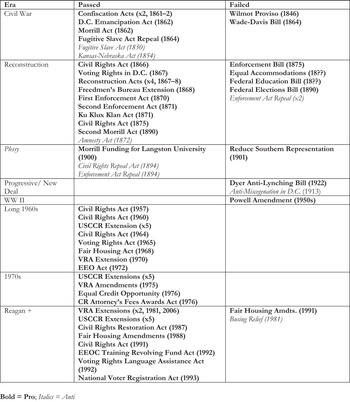


 Open access

