


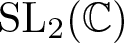





1. Introduction
The Procesi bundle is an important vector bundle on the Hilbert scheme of points in  $\mathbb{C}^2$. It has played a key role in Hamain’s proof of the $n!$-theorem [Reference Haiman7, Theorem 5.2.1]. Take n an integer greater or equal to 1. If $\mathfrak{S}_n$ denotes the symmetric group on n letters, then the fibres of the Procesi bundle $\mathscr{P}^n$ are $\mathfrak{S}_n$-modules, isomorphic to the regular representation of $\mathfrak{S}_n$; thus the Procesi bundle has rank $n!$. Consider now the natural action of $\mathrm{GL}_2(\mathbb{C})$ on $\mathbb{C}^2$. This action induces a $\mathrm{GL}_2(\mathbb{C})$-action on the Hilbert scheme $\mathcal{H}_n$ of n points in $\mathbb{C}^2$. Let Γ be a finite subgroup of $\mathrm{SL}_2(\mathbb{C})$ of order $\ell$. Over $\mathcal{H}_n^{\Gamma}$, the fibres of $\mathscr{P}^n$ are $(\mathfrak{S}_n \times \Gamma)$-modules. The main result of this article shows that, for each irreducible component $\mathcal{C}$ of $\mathcal{H}_n^{\Gamma}$ and for each $I \in \mathcal{C}$, the fibre of $\mathscr{P}^n$ at I can be constructed, as an $(\mathfrak{S}_n \times \Gamma)$-module, by induction from the fibre of $\mathscr{P}^k$ over an ideal $I_0\in \mathcal{H}_{k}^{\Gamma}$ for some ${k \leq n}$ such that $\{I_0\}$ is an irreducible component of $\mathcal{H}_k^{\Gamma}$. The integer k is explicit and depends on $\mathcal{C}$, Γ and n. The result is stated in § 1.2 below. But first we introduce the main players and the notation used in the article.
1.1. The Hilbert scheme of points in the plane
Let  $\mathcal{H}_n$ be the Hilbert scheme of n points in $\mathbb{C}^2$. As a set
 \begin{equation*}
\mathcal{H}_n= \{I \subset \mathbb{C}[x,y]| I\ \text{is an ideal and } \mathrm{dim}(\mathbb{C}[x,y]/I)=n\}.
\end{equation*}
\begin{equation*}
\mathcal{H}_n= \{I \subset \mathbb{C}[x,y]| I\ \text{is an ideal and } \mathrm{dim}(\mathbb{C}[x,y]/I)=n\}.
\end{equation*} Fogarty showed [Reference Fogarty4, Proposition 2.2 and Theorem 2.9] that  $\mathcal{H}_n$ is a smooth connected 2n dimensional algebraic variety. Let the group $\mathfrak{S}_n$ act on ${(\mathbb{C}^2)}^n$ by permuting the n copies of $\mathbb{C}^2$ and denote by σn the Hilbert–Chow morphism. It is defined as follows
 \begin{eqnarray*}
\sigma_n\colon \begin{array}{ccccc}
\mathcal{H}_n & \to & {(\mathbb{C}^2)}^n/\mathfrak{S}_n\\
I & \mapsto & \sum_{p \in V(I)}{\mathrm{dim}\left((\mathbb{C}[x,y]/I)_p\right)[p]} \\
\end{array}
\end{eqnarray*}
\begin{eqnarray*}
\sigma_n\colon \begin{array}{ccccc}
\mathcal{H}_n & \to & {(\mathbb{C}^2)}^n/\mathfrak{S}_n\\
I & \mapsto & \sum_{p \in V(I)}{\mathrm{dim}\left((\mathbb{C}[x,y]/I)_p\right)[p]} \\
\end{array}
\end{eqnarray*} where  $[p]$ denotes the orbit of p in ${(\mathbb{C}^2)}^n/\mathfrak{S}_n$ for $p \in {(\mathbb{C}^2)}^n$.
1.2. The Procesi bundle
The Procesi vector bundle is a  $GL_2(\mathbb{C})$-equivariant vector bundle on the Hilbert scheme of n points in $\mathbb{C}^2$. To construct the Procesi bundle, one first needs to introduce the isospectral Hilbert scheme. The n th-isospectral Hilbert scheme, denoted by $\mathcal{X}_n$, is the reduced fibre product of $\mathcal{H}_n$ with $(\mathbb{C}^2)^n$ over $(\mathbb{C}^2)^n/\mathfrak{S}_n$:
(1.1)

Here, the morphism πn is the quotient map. The scheme  $\mathcal{X}_n$ is an algebraic variety, projective over $(\mathbb{C}^2)^n$. Crucially, Haiman [Reference Haiman8, Theorem 5.2.1] has proven that ρn is a finite and flat morphism. This implies that the sheaf $\mathscr{P}^n:={\rho_n}_*\mathcal{O}_{\mathcal{X}_n}$ is locally free and thus defines a vector bundle on $\mathcal{H}_n$. This vector bundle is the n th-Procesi bundle. Note that, by construction, the fibres of $\mathscr{P}^n$ are $\mathfrak{S}_n$-modules. The natural $\mathrm{GL}_2(\mathbb{C})$-action on $\mathcal{H}_n$ and the diagonal action on ${(\mathbb{C}^2)}^n$ give a $\mathrm{GL}_2(\mathbb{C})$-action on $\mathcal{X}_n$, making $\mathscr{P}^n$ into a $\mathrm{GL}_2(\mathbb{C})$-equivariant vector bundle. Moreover, by letting $\mathfrak{S}_n$ acts trivially on $\mathcal{H}_n$, all morphisms ρn, σn, πn and fn are $(\mathfrak{S}_n \times \mathrm{GL}_2(\mathbb{C}))$-equivariant.
For  $I \in \mathcal{H}_n$, denote by $\mathscr{P}^n_{|I}$ the fibre of the vector bundle associated with $\mathscr{P}^n$ at I. Note that when $I \in \mathcal{H}_n^{\Gamma}$, the fibre $\mathscr{P}^n_{|I}$ is an $(\mathfrak{S}_n \times \Gamma)$-module. Let $\mathcal{C}$ be an irreducible component of $\mathcal{H}_n^{\Gamma}$ of dimension 2r. Take ${(p_1,\dots,p_r) \in {({(\mathbb{C}^2)}\setminus \{(0,0)\})}^{r}}$ such that for each $(i,j) \in [\![1, r]\!]^2, i \neq j \Rightarrow \Gamma p_i \cap \Gamma p_j = \emptyset$. Let $q:=(\Gamma p_1,\dots,\Gamma p_{r}) \in {(\mathbb{C}^2)}^{r\ell}$ and $p:=(0,q) \in {(\mathbb{C}^2)}^n$, where $\ell = |\Gamma|$. Let Sp denote the stabilizer of p in $\mathfrak{S}_n \times \Gamma$. Let $\mathrm{g}_{\Gamma}:=n-\ell r$. Then there exists a unique irreducible component $\{I_{0}\}$ of the scheme $\mathcal{H}_{\mathrm{g}_{\Gamma}}^{\Gamma}$ such that a generic point of $\mathcal{C}$ is of the form $V(I_0) \cup V(q)$. This defines a bijection between the irreducible components of $\mathcal{H}_{\mathrm{g}_{\Gamma}}^{\Gamma}$ of dimension zero and the 2r-dimensional components of $\mathcal{H}_n^{\Gamma}$. The main result of this article is the following theorem.
Theorem 1. For each irreducible component  $\mathcal{C}$ of $\mathcal{H}_n^{\Gamma}$, there exists an isomorphism of groups ${\unicode{x1090E} \colon S_p \xrightarrow{\,\smash{{{\scriptstyle\sim}}}\,} \mathfrak{S}_{\mathrm{g}_{\Gamma}} \times \Gamma}$, making $\mathscr{P}^{\mathrm{g}_{\Gamma}}_{|I_{0}}$ into a Sp-module such that for each $I \in \mathcal{C}$,
 \begin{equation*}
\left[\mathscr{P}^n_{|I}\right]_{\mathfrak{S}_n \times \Gamma}=\left[\mathrm{Ind}_{S_p}^{\mathfrak{S}_n\times \Gamma}\left(\mathscr{P}^{\mathrm{g}_{\Gamma}}_{|I_{0}}\right)\right]_{\mathfrak{S}_n \times \Gamma}.
\end{equation*}
\begin{equation*}
\left[\mathscr{P}^n_{|I}\right]_{\mathfrak{S}_n \times \Gamma}=\left[\mathrm{Ind}_{S_p}^{\mathfrak{S}_n\times \Gamma}\left(\mathscr{P}^{\mathrm{g}_{\Gamma}}_{|I_{0}}\right)\right]_{\mathfrak{S}_n \times \Gamma}.
\end{equation*}This theorem reduces the study of the fibres of the Procesi bundle over the Γ-fixed points to the study of the fibres of the Procesi bundle over the irreducible components of the Γ-fixed points of dimension zero. For this reason, we refer throughout to this result as the reduction theorem.
1.3. Combinatorial consequences in type A
In the case where Γ is the cyclic subgroup  $\mu_{\ell}$ (of order $\ell$, generated by $\omega_{\ell}$) in the maximal diagonal torus of $\mathrm{SL}_2(\mathbb{C})$ (type A), the reduction theorem interplays well with the combinatorics of $\ell$-cores. Indeed, each irreducible component of the scheme $\mathcal{H}_n^{\Gamma}$ contains at least one fixed point under the maximal diagonal torus of $\mathrm{SL}_2(\mathbb{C})$. These fixed points are indexed by partitions of n. If λ is a partition of n, let $I_{\lambda} \in \mathcal{H}_n$ denote the associated fixed point and write $\mathscr{P}^{n}_{\lambda}$ for the fibre of the vector bundle associated with $\mathscr{P}^n$ at Iλ. Denote by $\gamma_{\ell}$ the $\ell$-core associated with λ. The size of $\gamma_{\ell}$ is denoted by $\mathrm{g}_{\ell}$ and $r_{\ell}:=\frac{n-\mathrm{g}_{\ell}}{\ell}$. Let $\tau_{\ell}$ be the character of $\mu_{\ell}$ such that $\tau_{\ell}(\omega_{\ell})$ is equal to $\zeta_{\ell}$, a fixed primitive $\ell^{\text{th}}$ root of unity. For M and N two $\mu_{\ell}$-modules, let $\mathrm{Hom}_{\mu_{\ell}}(M,N)$ denote the set of all $\mu_{\ell}$-equivariant maps from M to N. Let $w_{\ell,n} \in \mathfrak{S}_n$ be the product of the $r_{\ell}$ cycles of length $\ell$:
 \begin{equation*}
(\mathrm{g}_{\ell}+1,...,\mathrm{g}_{\ell}+\ell)...(n-\ell+1,...,n).
\end{equation*}
\begin{equation*}
(\mathrm{g}_{\ell}+1,...,\mathrm{g}_{\ell}+\ell)...(n-\ell+1,...,n).
\end{equation*} Let  $C_{\ell,n}$ be the cyclic subgroup of $\mathfrak{S}_{r_{\ell}\ell}$ generated by $w_{\ell,n}$. Consider also the subgroup $W_{\ell,n}^{\mathrm{g}_{\ell}}:= \mathfrak{S}_{\mathrm{g}_{\ell}} \times C_{\ell,n}$ of $\mathfrak{S}_n$. Denote by $\theta_{\ell}$ the character of $C_{\ell,n}$ such that $\theta_{\ell}(w_{\ell,n})=\zeta_{\ell}$. The following is a corollary of the main reduction theorem.
Corollary 1. For each partition λ of n and each  $i \in [\![0, \ell- 1]\!]$, $\mathrm{Hom}_{\mu_{\ell}}\left(\tau_{\ell}^i,\mathscr{P}^n_{\lambda}\right)$ is isomorphic, as an $\mathfrak{S}_n$-module, to
 \begin{equation*}
\bigoplus_{j=0}^{\ell - 1}{\mathrm{Ind}_{W_{\ell,n}^{\mathrm{g}_{\ell}}}^{\mathfrak{S}_n}\left(\mathrm{Hom}_{\mu_{\ell}}\left(\tau_{\ell}^j,\mathscr{P}^{\mathrm{g}_{\ell}}_{\gamma_{\ell}}\right)\boxtimes\theta_{\ell}^{i-j}\right)}.
\end{equation*}
\begin{equation*}
\bigoplus_{j=0}^{\ell - 1}{\mathrm{Ind}_{W_{\ell,n}^{\mathrm{g}_{\ell}}}^{\mathfrak{S}_n}\left(\mathrm{Hom}_{\mu_{\ell}}\left(\tau_{\ell}^j,\mathscr{P}^{\mathrm{g}_{\ell}}_{\gamma_{\ell}}\right)\boxtimes\theta_{\ell}^{i-j}\right)}.
\end{equation*}1.4. Notation
In this last subsection of the introduction we fix notation. Let G be a finite group. Denote by  $\mathcal{R}(G)$ the Grothendieck ring of the category of finite-dimensional $\mathbb{C} G$-modules and $\mathcal{R}^{\mathrm{gr}}(G)$ the Grothendieck ring of the category of $\mathbb{Z}$-graded finite-dimensional $\mathbb{C} G$-modules. For V a given $\mathbb{C} G$-module (respectively graded $\mathbb{C} G$-module), let $[V]_{G}$ (respectively $[V]^{\mathrm{gr}}_G$), or just $[V]$ (respectively $[V]^{\mathrm{gr}}$) denote the element in $\mathcal{R}(G)$ (respectively $\mathcal{R}^{\mathrm{gr}}(G)$ ) associated with V.
All schemes will be over  $\mathbb{C}$ and we will also suppose that the structure morphism is separated and of finite type over $\mathbb{C}$. An algebraic variety will be an integral scheme. If S is a scheme and $s \in S$, denote by $\kappa_S(s)$ the residue field of the local ring $\mathcal{O}_{S,s}$. Fix an integer $n \geq 1$, and Γ a finite subgroup of $\mathrm{SL}_2(\mathbb{C})$. We denote the order of Γ by $\ell$.
By a Γ-module, one means a finite-dimensional  $\mathbb{C}[\Gamma]$-module. Let $\mathrm{Irr}_{\Gamma}$ be the set of all characters of irreducible representations of Γ. It is finite since Γ is finite. Denote by $\chi_0 \in \mathrm{Irr}_{\Gamma}$ the trivial character. Moreover, the group Γ being a subgroup of $\mathrm{SL}_2(\mathbb{C})$, it has a natural two-dimensional representation called the standard representation and denoted $\rho_{\mathrm{std}}$. It is irreducible whenever Γ is not a cyclic group. The character of the standard representation will be denoted $\chi_{\mathrm{std}}$.
The article is organized as follows. In the second section, we recall results obtained in [Reference Paegelow13] concerning the irreducible components of  $\mathcal{H}_n^{\Gamma}$. In the third section, we state and prove the main result (cf. Theorem 2). In the fourth section, we dive into the combinatorial consequences of the reduction theorem when Γ is a cyclic group and prove Corollary 1. Moreover, we prove Corollary 1 in two edge cases using only representation theory and symmetric function theory, in particular avoiding Haiman’s results on the isospectral Hilbert scheme. In the last section, we study the combinatorics arising from Theorem 2 when Γ is the binary dihedral group.
2. Root systems and irreducible components of  $\mathcal{H}_n^{\Gamma}$

In this section, we introduce notation on root systems and recall the parameterization of irreducible components of  $\mathcal{H}_n^{\Gamma}$. These are also the connected components since $\mathcal{H}_n^{\Gamma}$ is smooth thanks to the fact that Γ is a finite group.
Definition 1. Define the McKay undirected multigraph  $G_{\Gamma}$ associated with Γ in the following way. The set of vertices is $I_{\Gamma} := \mathrm{Irr}_{\Gamma}$ and there is an edge between a pair of irreducible characters $(\chi,\chi')$ if and only if $\langle \chi\chi_{\mathrm{std}}|\chi'\rangle \neq 0$, with multiplicity $\langle \chi\chi_{\mathrm{std}}|\chi'\rangle$. Let $A_{\Gamma}$ denote the adjacency matrix of $G_{\Gamma}$.
Remark 1. Note that  $G_{\Gamma}$ is indeed undirected because Γ is a subgroup of $\mathrm{SL}_2(\mathbb{C})$.
Thanks to the McKay correspondence, one can associate to Γ a realization  $(\mathfrak{h},\Pi,\Pi^{\vee})$ of the generalized Cartan matrix $2 \mathrm{Id} - A_{\Gamma}$. Let $\tilde{W}$ denote the Weyl group associated with $(\mathfrak{h},\Pi,\Pi^{\vee})$. For each $\chi \in I_{\Gamma}$, the simple root, respectively coroot, associated with χ is denoted by $\alpha_{\chi} \in \Pi$, respectively $\alpha_{\chi}^{\vee} \in \Pi^{\vee}$. For each $\chi \in I_{\Gamma}$, let $\Lambda_{\chi}\in \mathfrak{h}^*$ (respectively $\Lambda^{\vee}_{\chi} \in \mathfrak{h}$) be the fundamental weight (respectively fundamental coweight) associated with $\alpha^{\vee}_{\chi}$ (respectively αχ). Let $\tilde{Q}$ (respectively $\tilde{Q}^{\vee}$) denote the root (respectively coroot) lattice of $(\mathfrak{h},\Pi,\Pi^{\vee})$. Write
 \begin{equation*}
{\delta^{\Gamma}:=\sum_{\chi \in I_{\Gamma}}{\mathrm{dim}(X_{\chi})\alpha_{\chi}} \in \tilde{Q}}, \quad \delta^{\vee}_{\Gamma}:=\sum_{\chi \in I_{\Gamma}}{\mathrm{dim}(X_{\chi})\alpha^{\vee}_{\chi}} \in \tilde{Q}^{\vee}
\end{equation*}
\begin{equation*}
{\delta^{\Gamma}:=\sum_{\chi \in I_{\Gamma}}{\mathrm{dim}(X_{\chi})\alpha_{\chi}} \in \tilde{Q}}, \quad \delta^{\vee}_{\Gamma}:=\sum_{\chi \in I_{\Gamma}}{\mathrm{dim}(X_{\chi})\alpha^{\vee}_{\chi}} \in \tilde{Q}^{\vee}
\end{equation*} for the minimal positive imaginary root and coroot. Denote by  $\tilde{Q}^+ \subset \tilde{Q}$ the monoid generated by Π. For $d \in \tilde{Q}$, write dχ and $|d|_{\Gamma}$ for the integers $\langle d, \Lambda_{\chi}^{\vee} \rangle$ and $\sum_{\chi \in I_{\Gamma}}{d_{\chi}\delta^{\Gamma}_{\chi}}$.
Definition 2. We define a  $\tilde{W}$-action on $\tilde{Q}$. Denote by $s_{\chi} \in \tilde{W}$, for $\chi \in I_{\Gamma}$, the standard generators of $\tilde{W}$ and choose $d \in \tilde{Q}$:
 \begin{equation*}
(s_\chi.d)_{\xi} :=
\begin{cases}
(\sum_{h\in \overline{E_{\Gamma}}, h'=\chi}{d_{h''}}) - d_{\chi} &\text{if } \chi=\xi\neq \chi_0 \\
(\sum_{h\in \overline{E_{\Gamma}}, h'=\chi}{d_{h''}}) - d_{\chi} + 1 &\text{if } \chi=\xi= \chi_0 \\
d_{\xi} &\text{else}.
\end{cases}
\end{equation*}
\begin{equation*}
(s_\chi.d)_{\xi} :=
\begin{cases}
(\sum_{h\in \overline{E_{\Gamma}}, h'=\chi}{d_{h''}}) - d_{\chi} &\text{if } \chi=\xi\neq \chi_0 \\
(\sum_{h\in \overline{E_{\Gamma}}, h'=\chi}{d_{h''}}) - d_{\chi} + 1 &\text{if } \chi=\xi= \chi_0 \\
d_{\xi} &\text{else}.
\end{cases}
\end{equation*}Remark 2. This action corresponds to the one defined in [Reference Nakajima11, Definition 2.3] in the special case of double, one vertex framed quivers, and it is linked to the natural action by reflections on  $\mathfrak{h}^*$ (denoted $*$) in the following way. Thanks to the remark at the end of [Reference Nakajima11, Definition 2.3], one has
 \begin{equation}
\omega*(\Lambda_0-\alpha) = \Lambda_0 - \omega.\alpha, \quad \forall (\omega,\alpha) \in \tilde{W} \times \tilde{Q}
\end{equation}
\begin{equation}
\omega*(\Lambda_0-\alpha) = \Lambda_0 - \omega.\alpha, \quad \forall (\omega,\alpha) \in \tilde{W} \times \tilde{Q}
\end{equation} where Λ0 denotes  $\Lambda_{\chi_0}$.
Let Q (respectively W) denote the sublattice of  $\tilde{Q}$ (respectively the subgroup of $\tilde{W}$) generated by ${\{\alpha_{\chi} | \chi \in I_{\Gamma}\setminus \{\chi_0\}\}}$ (respectively by $\big\{s_{\chi} | \chi \in I_{\Gamma}\setminus \{\chi_0\}\big\}$). For $a\in Q$, denote by $t_a \in \tilde{W}$ the image of a under the isomorphism ${W \lt imes Q \xrightarrow{\,\smash{{{\scriptstyle\sim}}}\,} \tilde{W}}$.
Lemma 1. For each  $(a,d) \in Q \times \tilde{Q}$, there exists $k \in \mathbb{Z}$ such that $t_a.d= d-a + k\delta^{\Gamma}$.
Proof. Thanks to relation (2.1) and [Reference Kac9, Formula 6.5.2], there exists  $k \in \mathbb{Z}$ such that
 \begin{equation*}
t_a.d = d- a + \langle d, \delta^{\vee}_{\Gamma} \rangle a + k \delta^{\Gamma}
\end{equation*}
\begin{equation*}
t_a.d = d- a + \langle d, \delta^{\vee}_{\Gamma} \rangle a + k \delta^{\Gamma}
\end{equation*} Since  $d \in \tilde{Q}$, $\langle d,\delta^{\vee}_{\Gamma} \rangle=0$ by definition of $\delta^{\vee}_{\Gamma}$.
Lemma 2. For each  $d \in \tilde{Q}$, there exists a unique integer r such that d and $r\delta^{\Gamma}$ are in the same $\tilde{W}$-orbit for the . action of Definition 2.
Proof. Take  $d \in \tilde{Q}$. Then $a:=d-d_0\delta^{\Gamma} \in Q$ and thanks to Lemma 1, $t_a.d$ is an element of the desired form. Now suppose that there are two integers r 1 and r 2 such that $r_1\delta^{\Gamma}$ and $r_2\delta^{\Gamma}$ are in the same $\tilde{W}$-orbit. Since $\delta^{\Gamma}$ is in the kernel of the generalized Cartan matrix $2\mathrm{Id}-A_{\Gamma}$, $\delta^{\Gamma}$ is fixed under the action of W-action. This observation reduces the $\tilde{W}$-orbit of $r_1\delta^{\Gamma}$ to the Q-orbit. There must then exist $a \in Q$ such that ${t_a.r_1\delta^{\Gamma}=r_2\delta^{\Gamma}}$. Using Lemma 1, there exists $k \in \mathbb{Z}$ such that $t_a.r_1\delta^{\Gamma}= r_1\delta^{\Gamma}-a + k\delta^{\Gamma}$, one can conclude that a = 0 and that $r_1=r_2$.
Definition 3. The weight of  $d \in \tilde{Q}$ is the unique integer rd such that $r_d\delta^{\Gamma}$ and d are in the same $\tilde{W}$-orbit.
Now that the weight of an element of  $\tilde{Q}$ has been defined, we can recall the parametrization of connected components of the fixed point locus. Set
 \begin{equation*}
{\mathcal{A}^n_{\Gamma}:=\{d \in \tilde{Q}^+ \big | |d|_{\Gamma}=n\ \text{and } r_d \geqslant 0\}}.
\end{equation*}
\begin{equation*}
{\mathcal{A}^n_{\Gamma}:=\{d \in \tilde{Q}^+ \big | |d|_{\Gamma}=n\ \text{and } r_d \geqslant 0\}}.
\end{equation*} It is shown in [Reference Paegelow13, Corollary 3.3] that the set  $\mathcal{A}^n_{\Gamma}$ indexes the irreducible components of $\mathcal{H}_n^{\Gamma}$. Indeed, if one denotes by ${\mathcal{H}_n^{\Gamma,d}:=\left\{I \in \mathcal{H}_n^{\Gamma} | \mathrm{Tr}(\mathbb{C}[x,y]/I)=\sum_{\chi \in I_{\Gamma}}{d_{\chi}\chi}\right\}}$, then
 \begin{equation*}
\mathcal{H}_n^{\Gamma}= \coprod_{d \in \mathcal{A}^n_{\Gamma}}{\mathcal{H}_n^{\Gamma,d}}.
\end{equation*}
\begin{equation*}
\mathcal{H}_n^{\Gamma}= \coprod_{d \in \mathcal{A}^n_{\Gamma}}{\mathcal{H}_n^{\Gamma,d}}.
\end{equation*} By [Reference Paegelow13, Proposition 3.11], the connected component  $\mathcal{H}_n^{\Gamma,d}$ labelled by $d \in \mathcal{A}^n_{\Gamma}$ has dimension $2r_d$. The restriction of $\mathscr{P}^n$ to each connected component $\mathcal{H}_n^{\Gamma,d}$ of $\mathcal{H}_n^{\Gamma}$ defines a vector bundle and the fibres of this vector bundle are $(\mathfrak{S}_n\times \Gamma)$-modules.
3. The reduction theorem
In this section, we state and prove the main result of the article. We begin with some preliminary results. Fix  $d \in \mathcal{A}^n_{\Gamma}$. Consider
 \begin{equation}
d_0=d-r_d\delta^{\Gamma}.
\end{equation}
\begin{equation}
d_0=d-r_d\delta^{\Gamma}.
\end{equation} By construction,  $r_{d_0}=0$. We fix ${\mathrm{g}_{\Gamma}:=|d_0|_{\Gamma}}$. To improve readability, we set $\mathrm{g} = \mathrm{g}_{\Gamma}$ and $r = r_d$ throughout this section. The connected component $\mathcal{H}_{\mathrm{g}}^{\Gamma,{d_0}} \subset \mathcal{H}_{\mathrm{g}}^{\Gamma}$ is zero-dimensional. Let $I_{d_0}$ be the unique ideal of $\mathbb{C}[x,y]$ belonging to $\mathcal{H}_{\mathrm{g}}^{\Gamma,{d_0}}$.
Lemma 3. The image of  $I_{d_0}$ under $\sigma_{\mathrm{g}}$ is the point $\overline{0}\in {(\mathbb{C}^2)}^{\mathrm{g}}/\mathfrak{S}_{\mathrm{g}}$.
Proof. Consider the diagonal  $\mathbb{C}^{\times}$-action on $\mathbb{C}^2$ given by
 \begin{equation*}
{t.(x,y):=(tx,ty), \quad \forall (t,(x,y)) \in \mathbb{C}^{\times} \times \mathbb{C}^2}.
\end{equation*}
\begin{equation*}
{t.(x,y):=(tx,ty), \quad \forall (t,(x,y)) \in \mathbb{C}^{\times} \times \mathbb{C}^2}.
\end{equation*} This action induces a  $\mathbb{C}^{\times}$-action on $\mathcal{H}_{\mathrm{g}}$ which commutes with the Γ-action and the Hilbert–Chow morphism $\sigma_{\mathrm{g}}$ is $\mathbb{C}^{\times}$-equivariant. The fact that $\mathbb{C}^{\times}$ is connected and the irreducible component $\mathcal{H}_{\mathrm{g}}^{\Gamma,{d_0}}$ equals $\{I_{d_0}\}$ implies that $I_{d_0}$ is a $\mathbb{C}^{\times}$-fixed point. This ideal must then be mapped by $\sigma_{\mathrm{g}}$ to a $\mathbb{C}^{\times}$-fixed point of ${(\mathbb{C}^2)}^{\mathrm{g}}/\mathfrak{S}_{\mathrm{g}}$. Finally, we note that $\overline{0}$ is the only fixed point in ${(\mathbb{C}^2)}^{\mathrm{g}}/\mathfrak{S}_{\mathrm{g}}$.
Denote by Uf the following open subset of  ${(\mathbb{C}^2)}^{r}$:
 \begin{equation*}
\{(p_1,\dots ,p_{r}) \in {(\mathbb{C}^2\setminus \{(0,0)\})}^r\big{|} \forall (i,j) \in [\![1, r ]\!]^2, i \neq j \Rightarrow \Gamma p_i \cap \Gamma p_j = \emptyset\}.
\end{equation*}
\begin{equation*}
\{(p_1,\dots ,p_{r}) \in {(\mathbb{C}^2\setminus \{(0,0)\})}^r\big{|} \forall (i,j) \in [\![1, r ]\!]^2, i \neq j \Rightarrow \Gamma p_i \cap \Gamma p_j = \emptyset\}.
\end{equation*} Let  $D_{d_0}:=\left\{I_{d_0} \cap \bigcap_{j=1}^{r}{I(\Gamma p_j)} \subset \mathbb{C}[x,y] \big{|} (p_1,\dots, p_r) \in U^f \right\}$.
Lemma 4. The set  $D_{d_0}$ is a dense open subset of $\mathcal{H}_n^{\Gamma,d}$.
Proof. In type A, this is [Reference Gordon5, Lemma 7.8.(i)]. Take  $I=I_{d_0} \cap \bigcap_{j=1}^{r}{I(\Gamma p_j)} \in D_{d_0}$. Lemma 3 implies that ${V(I_{d_0})=\overline{0}}$. Therefore, for all $j \in [\![1, r ]\!]$ we have ${V(I_{d_0}) \cap \Gamma p_i = \emptyset}$, which gives an isomorphism of Γ-modules
 \begin{equation*}
\mathbb{C}[x,y]/I \simeq \mathbb{C}[x,y]/I_{d_0} \oplus \bigoplus_{j=1}^{r}{\mathbb{C}[x,y]/I(\Gamma p_j)}.
\end{equation*}
\begin{equation*}
\mathbb{C}[x,y]/I \simeq \mathbb{C}[x,y]/I_{d_0} \oplus \bigoplus_{j=1}^{r}{\mathbb{C}[x,y]/I(\Gamma p_j)}.
\end{equation*} This isomorphism shows that I is of codimension  $\mathrm{g} + r\ell=n$ in $\mathbb{C}[x,y]$ and that the character of the Γ-module $\mathbb{C}[x,y]/I$ is d. This means that $D_{d_0} \subset \mathcal{H}_n^{\Gamma,d}$. The association $(p_1,\dots ,p_r) \mapsto \mathbb{C}[x,y]/I$ defines a vector bundle over Uf whose fibres are cyclic $\mathbb{C}[x,y]$-modules of dimension n. Thus, there is a (unique) morphism $U^f \to \mathcal{H}_n$ such that this vector bundle is the pull-back of the tautological bundle on $\mathcal{H}_n$. Since
 \begin{equation*}
I = I_{d_0} \cap \bigcap_{j=1}^{r}{I(\Gamma p_j)}, \quad \textrm{and} \quad I' =I_{d_0} \cap \bigcap_{j=1}^{r}{I(\Gamma p_j')}
\end{equation*}
\begin{equation*}
I = I_{d_0} \cap \bigcap_{j=1}^{r}{I(\Gamma p_j)}, \quad \textrm{and} \quad I' =I_{d_0} \cap \bigcap_{j=1}^{r}{I(\Gamma p_j')}
\end{equation*} are equal (and hence define the same closed point of  $\mathcal{H}_n$) if and only if $(0,\Gamma p_1,\dots, \Gamma p_r), (0,\Gamma p_1',\dots, \Gamma p_r') \in (\mathbb{C}^2)^n$ are in the same $\mathfrak{S}_n$-orbit, the fibres of this morphism are finite. In other words, it is a quasi-finite morphism. Hence, by Zariski’s Main Theorem [Reference Grothendieck6, Théorème 8.12.6], the image $D_{d_0}$ of Uf is a (connected) locally closed subset of $\mathcal{H}_n$ of dimension 2r. Since $D_{d_0}$ is contained in $\mathcal{H}_n^{\Gamma,d}$ and the latter also has dimension 2r, we deduce that $D_{d_0}$ is an open dense subset of $\mathcal{H}_n^{\Gamma,d}$.
Throughout the remainder of this section we fix  $(p_1,\dots,p_{r}) \in U^f$. Denote by J the ideal $\bigcap_{j=1}^{r}{I(\Gamma p_j)}$ of $\mathbb{C}[x,y]$.
Remark 3. By construction, J is an element of  $\mathcal{H}_{r\ell}^{\Gamma}$.
Define
 \begin{equation}
{I_d:=I_{d_0} \cap J \in \mathcal{H}_n^{\Gamma,d}}.
\end{equation}
\begin{equation}
{I_d:=I_{d_0} \cap J \in \mathcal{H}_n^{\Gamma,d}}.
\end{equation}Choosing an ordering of the elements of Γ, let
 \begin{equation}
q:=(\Gamma p_1,\dots,\Gamma p_{r}) \in {(\mathbb{C}^2)}^{r\ell}
\end{equation}
\begin{equation}
q:=(\Gamma p_1,\dots,\Gamma p_{r}) \in {(\mathbb{C}^2)}^{r\ell}
\end{equation}and
 \begin{equation}
p:=(0,q) \in \mathbb{C}^{2n}.
\end{equation}
\begin{equation}
p:=(0,q) \in \mathbb{C}^{2n}.
\end{equation} Note that p is a point in  ${\pi_n^{-1}(\sigma_n(I_d))\subset {(\mathbb{C}^2)}^n}$. Finally, let Sp be the stabilizer of p in ${\mathfrak{S}_n \times \Gamma}$.
By construction of p, Sp is in fact a subgroup of  $\mathfrak{S}_{\mathrm{g}} \times \mathfrak{S}_{r \ell} \times \Gamma$. Moreover, for each $\gamma \in \Gamma$, there exists a unique $x_{\gamma} \in \mathfrak{S}_{r \ell}$ such that $(x_{\gamma}, \gamma) \in S_p \cap (\mathfrak{S}_{r \ell} \times \Gamma)$. Then $\gamma \mapsto (1, x_{\gamma}, \gamma)$, where $(1, x_{\gamma}, \gamma)$ is thought of as an element of $\mathfrak{S}_{\mathrm{g}} \times \mathfrak{S}_{r \ell} \times \Gamma$, defines an injective group homomorphism ${\nabla\colon \Gamma \to S_p}$. Since $\nabla(\Gamma) \cap \mathfrak{S}_g = \{1 \}$, we have a group isomorphism
 \begin{equation}
\unicode{x1090E} \colon \begin{array}{ccc}
S_p & \xrightarrow{\,\smash{{{\scriptstyle\sim}}}\,} & \mathfrak{S}_{\mathrm{g}} \times \Gamma
\end{array}
\end{equation}
\begin{equation}
\unicode{x1090E} \colon \begin{array}{ccc}
S_p & \xrightarrow{\,\smash{{{\scriptstyle\sim}}}\,} & \mathfrak{S}_{\mathrm{g}} \times \Gamma
\end{array}
\end{equation} which sends  $(x_1,x_2,\gamma) \in S_p \subset (\mathfrak{S}_{\mathrm{g}} \times \mathfrak{S}_{r \ell} \times \Gamma)$ to $(x_1,\gamma)$. The inverse is given by $(\sigma,\gamma) \mapsto \sigma\nabla(\gamma)$.
We can now state the main theorem of this article.
Theorem 2. The isomorphism  $\unicode{x1090E}$ endows $\mathscr{P}^{\mathrm{g}}_{|I_{d_0}}$ with a Sp-module structure such that, for each $I \in \mathcal{H}_n^{\Gamma,d}$,
 \begin{equation*}
\left[\mathscr{P}^n_{|I}\right]_{\mathfrak{S}_n \times \Gamma}=\left[\mathrm{Ind}_{S_p}^{\mathfrak{S}_n\times \Gamma}\left(\mathscr{P}^{\mathrm{g}}_{|I_{d_0}}\right)\right]_{\mathfrak{S}_n \times \Gamma}.
\end{equation*}
\begin{equation*}
\left[\mathscr{P}^n_{|I}\right]_{\mathfrak{S}_n \times \Gamma}=\left[\mathrm{Ind}_{S_p}^{\mathfrak{S}_n\times \Gamma}\left(\mathscr{P}^{\mathrm{g}}_{|I_{d_0}}\right)\right]_{\mathfrak{S}_n \times \Gamma}.
\end{equation*}The proof is postponed to the end of the section. We first require several intermediate results.
If R is a commutative ring and M an R-module then we write  $\mathrm{Ann}_{R}(M)$ for its annihilator $\left\{r \in R | \forall m \in M, r.m=0\right\}$ and $\mathrm{Supp}_{R}(M)=\left\{x \in \mathrm{Spec}(R)| M_{x} \neq 0\right\}$ for the support of M. We present two general lemmas before diving into the construction.
Lemma 5. Let G be a finite group acting on an affine variety V over  $\mathbb{C}$. Let M be a finite dimensional $\mathbb{C}[V] \rtimes G$-module such that $\mathrm{Supp}_{\mathbb{C}[V]} (M)$ is a G-orbit. Let $x \in \mathrm{Supp}_{\mathbb{C}[V]}(M)$ and denote by Gx the stabilizer of x in G. Then there is an isomorphism of ${(\mathbb{C}[V] \rtimes G)}$-modules
 \begin{equation*}
M \simeq \mathrm{Ind}_{\mathbb{C}[V] \rtimes G_x}^{\mathbb{C}[V] \rtimes G}\left(M_x\right).
\end{equation*}
\begin{equation*}
M \simeq \mathrm{Ind}_{\mathbb{C}[V] \rtimes G_x}^{\mathbb{C}[V] \rtimes G}\left(M_x\right).
\end{equation*}Proof. Since the module M is finite-dimensional, [Reference Eisenbud3, Theorem 2.13] says that the diagonal map  $\tilde{\phi} \colon M \to \bigoplus_{y \in \mathrm{Supp}_{\mathbb{C}[V]}(M)}{M_y}$ is an isomorphism of $\mathbb{C}[V]$-modules. For each $g \in G$, multiplication $m \mapsto g . m$ defines an isomorphism of $\mathbb{C}$-vector spaces ${M_x \xrightarrow{\,\smash{{{\scriptstyle\sim}}}\,} M_{g.x}}$. Therefore, we may rewrite $\tilde{\phi}$ as
 \begin{equation*}
\phi\colon M \xrightarrow{\,\smash{{{\scriptstyle\sim}}}\,} \bigoplus_{\bar{g} \in G/G_q}{M_{\bar{g}.x}} \text{ }.
\end{equation*}
\begin{equation*}
\phi\colon M \xrightarrow{\,\smash{{{\scriptstyle\sim}}}\,} \bigoplus_{\bar{g} \in G/G_q}{M_{\bar{g}.x}} \text{ }.
\end{equation*}Again using [Reference Eisenbud3, Theorem 2.13], we identify Mx with the subspace of M consisting of sections annihilated by a power of the maximal ideal mx defining x. Consider the canonical multiplication map
 \begin{equation*}
\psi \colon (\mathbb{C}[V] \rtimes G) \otimes_{\mathbb{C}[V] \rtimes G_x} M_x \to M
\end{equation*}
\begin{equation*}
\psi \colon (\mathbb{C}[V] \rtimes G) \otimes_{\mathbb{C}[V] \rtimes G_x} M_x \to M
\end{equation*} of  $(\mathbb{C}[V]\rtimes G)$-modules given by $f_g g \otimes m \mapsto f_g . m$. Since the composite
 \begin{eqnarray*}
\phi \circ \psi\colon \begin{array}{ccc}
(\mathbb{C}[V] \rtimes G) \otimes_{\mathbb{C}[V] \rtimes G_x} M_x & \to & \bigoplus_{\bar{g} \in G/G_q}{M_{\bar{g}.x}}\\
f_gg \otimes m & \mapsto & f_gg.m \\
\end{array}
\end{eqnarray*}
\begin{eqnarray*}
\phi \circ \psi\colon \begin{array}{ccc}
(\mathbb{C}[V] \rtimes G) \otimes_{\mathbb{C}[V] \rtimes G_x} M_x & \to & \bigoplus_{\bar{g} \in G/G_q}{M_{\bar{g}.x}}\\
f_gg \otimes m & \mapsto & f_gg.m \\
\end{array}
\end{eqnarray*}is an isomorphism, ψ must also be an isomorphism.
Lemma 6. Let R and S be commutative, local, noetherian  $\mathbb{C}$-algebras. If $f\colon R\to S$ is an unramified morphism of local rings and M is an S-module that is R-semisimple then M is S-semisimple.
Proof. Let  $\chi\colon R \to \mathbb{C}$ be the algebra morphism defined by the maximal ideal mR of R. The module M being R-semisimple means that $M={\{m \in M| \forall r \in R, r.m=\chi(r)m\}}$. The action of S on M factors through $S/m_{R}S$. Since the morphism f is unramified, the quotient $S/m_{R}S$ equals the residue field $S/m_{S}S$ of S; see e.g. [17, Tag 02GF]. The ring $S/m_{R}S$ is thus a semisimple ring, which implies that M is S-semisimple.
We are now able to start our main construction. Let
 \begin{equation*}
{{(\mathbb{C}^2)}^{r\ell}}^{\circ}:=\left\{(x_1,...,x_{r\ell}) \in {(\mathbb{C}^2)}^{r\ell} \Big|\forall i \neq j \Rightarrow x_i \neq x_j\right\}
\end{equation*}
\begin{equation*}
{{(\mathbb{C}^2)}^{r\ell}}^{\circ}:=\left\{(x_1,...,x_{r\ell}) \in {(\mathbb{C}^2)}^{r\ell} \Big|\forall i \neq j \Rightarrow x_i \neq x_j\right\}
\end{equation*} be the complement to the big diagonal. Restricting (1.1) to  ${{(\mathbb{C}^2)}^{r\ell}}^{\circ}$ gives a commutative diagram:

The Hilbert–Chow morphism  $\sigma_{r\ell}$ is a crepant resolution of singularities, which is an isomorphism over the smooth locus of ${{(\mathbb{C}^2)}^{r\ell}} / \mathfrak{S}_{r\ell}$. Therefore, the morphism $\sigma_{r\ell}^{\circ}$ is an isomorphism. This implies that $f^{\circ}_{r\ell}$ is also an isomorphism. Consider now the morphism
 \begin{equation*}
\tilde{h} \colon {(\mathbb{C}^2)}^{r\ell} \to {(\mathbb{C}^2)}^n/\mathfrak{S}_n
\end{equation*}
\begin{equation*}
\tilde{h} \colon {(\mathbb{C}^2)}^{r\ell} \to {(\mathbb{C}^2)}^n/\mathfrak{S}_n
\end{equation*} sending x to the orbit  $\overline{(0,x)}$ of $(0,x) \in {(\mathbb{C}^2)}^n$. The morphism $\tilde{h}$ is finite since it is the composition of the finite morphism ${{(\mathbb{C}^2)}^{r\ell} \to {(\mathbb{C}^2)}^n}$ with the (finite) quotient morphism ${{(\mathbb{C}^2)}^n \to {(\mathbb{C}^2)}^n/\mathfrak{S}_n}$. In particular, $\mathrm{Im}(\tilde{h})$ is a closed subscheme of ${(\mathbb{C}^2)}^n/\mathfrak{S}_n$. One can then consider ${h\colon {(\mathbb{C}^2)}^{r\ell} \to \mathrm{Im}(\tilde{h})}$.
Lemma 7. The morphism h is étale when restricted to  ${{(\mathbb{C}^2)}^{r\ell}}^{\circ}$.
Proof. The fact that the morphism  $\tilde{h}$ is finite implies that h is finite. Therefore, it is enough to prove that h is smooth over ${{(\mathbb{C}^2)}^{r\ell}}^{\circ}$.
Set  ${\mathbb{Z}^+_n:=\left\{(k_1,k_2) \in {(\mathbb{Z}_{\geq 0})}^2 \big| 0 \leq k_1+k_2 \leq n\right\}}$. Recall that $\mathrm{g}=|d_0|_{\Gamma}$ where d 0 is defined in (3.1). For $(k_1,k_2) \in \mathbb{Z}_n^+$, let
 \begin{equation*}
f_{k_1,k_2}(X_1,...,X_n,Y_1,...,Y_n):= \sum_{i=1}^{n}{X_i^{k_1}Y_i^{k_2}} \in \mathbb{C}[{(\mathbb{C}^2)}^n]^{\mathfrak{S}_n},
\end{equation*}
\begin{equation*}
f_{k_1,k_2}(X_1,...,X_n,Y_1,...,Y_n):= \sum_{i=1}^{n}{X_i^{k_1}Y_i^{k_2}} \in \mathbb{C}[{(\mathbb{C}^2)}^n]^{\mathfrak{S}_n},
\end{equation*} \begin{equation*}
P_{k_1,k_2}:= \sum_{i=\mathrm{g}+1}^n{Z_i^{k_1}T_i^{k_2}} \in \mathbb{C}[Z_{\mathrm{g}+1},...,Z_n,T_{\mathrm{g}+1},...,T_n].
\end{equation*}
\begin{equation*}
P_{k_1,k_2}:= \sum_{i=\mathrm{g}+1}^n{Z_i^{k_1}T_i^{k_2}} \in \mathbb{C}[Z_{\mathrm{g}+1},...,Z_n,T_{\mathrm{g}+1},...,T_n].
\end{equation*} Thanks to [Reference Weyl18, Chapter II and Section 3], the set  $\left\{f_{k_1,k_2} | (k_1,k_2) \in \mathbb{Z}^+_n \right\}$ is a set of generators of $\mathbb{C}\left[{(\mathbb{C}^2)}^n\right]^{\mathfrak{S}_n}$. Moreover, the set $\{P_{k_1,k_2} | (k_1,k_2) \in \mathbb{Z}^+_n\}$ is a set of generators of $\mathbb{C}\left[{(\mathbb{C}^2)}^{r\ell}\right]^{\mathfrak{S}_{r\ell}}$. By definition,
 \begin{equation*}
\tilde{h}^{\sharp}\colon \begin{array}{ccc}
\mathbb{C}\left[{(\mathbb{C}^2)}^n\right]^{\mathfrak{S}_n} & \to & \mathbb{C}\left[{(\mathbb{C}^2)}^{r\ell}\right]\\
f_{k_1,k_2} & \mapsto & P_{k_1,k_2}.
\end{array}
\end{equation*}
\begin{equation*}
\tilde{h}^{\sharp}\colon \begin{array}{ccc}
\mathbb{C}\left[{(\mathbb{C}^2)}^n\right]^{\mathfrak{S}_n} & \to & \mathbb{C}\left[{(\mathbb{C}^2)}^{r\ell}\right]\\
f_{k_1,k_2} & \mapsto & P_{k_1,k_2}.
\end{array}
\end{equation*} This implies that  $\mathbb{C}\left[\mathrm{Im}(\tilde{h})\right]=\mathbb{C}[Z_{\mathrm{g}+1},...,Z_n,T_{\mathrm{g}+1},...,T_n]^{\mathfrak{S}_{r\ell}}$ and in particular that
 \begin{equation*}
{\mathrm{Im}(\tilde{h}) \simeq {(\mathbb{C}^2)}^{r\ell}/\mathfrak{S}_{r\ell} \subset {(\mathbb{C}^2)}^n/\mathfrak{S}_n}.
\end{equation*}
\begin{equation*}
{\mathrm{Im}(\tilde{h}) \simeq {(\mathbb{C}^2)}^{r\ell}/\mathfrak{S}_{r\ell} \subset {(\mathbb{C}^2)}^n/\mathfrak{S}_n}.
\end{equation*} This allows us to identify h with the morphism  ${h\colon {(\mathbb{C}^2)}^{r\ell} \to {(\mathbb{C}^2)}^{r\ell}/\mathfrak{S}_{r\ell}}$. It is then clear that the restriction of h to ${{(\mathbb{C}^2)}^{r\ell}}^{\circ}$ is smooth. Indeed, h is finite and the $\mathfrak{S}_{r\ell}$-action on ${{(\mathbb{C}^2)}^{r\ell}}^{\circ}$ is free, which implies that ${{(\mathbb{C}^2)}^{r\ell}}^{\circ}/\mathfrak{S}_{r\ell}$ is smooth.
Recall that Id is the element of  $\mathcal{H}_n^{\Gamma,d}$ defined in (3.2). The stalk of $\mathscr{P}^n$ at $I \in \mathcal{H}_n$ is denoted $\mathscr{P}^n_I$. The isospectral Hilbert scheme $\mathcal{X}_n$ is an algebraic variety over $\mathcal{H}_n\times {(\mathbb{C}^2)}^n$. This implies that the fibre ${\mathscr{P}^n_{|I_d}:=\mathscr{P}^n_{I_d} \otimes_{\mathcal{O}_{\mathcal{H},I_d}} \kappa_{\mathcal{H}_n}(I_d)}$ of the Procesi bundle is a $\mathbb{C}\left[{(\mathbb{C}^2)}^n\right]$-module. It is moreover an $(\mathfrak{S}_n \times \Gamma)$-module. This endows $\mathscr{P}^n_{|I_d}$ with a structure of ${\big (\mathbb{C}\left[{(\mathbb{C}^2)}^n\right] \rtimes (\mathfrak{S}_n \times \Gamma)\big)}$-module. To improve readability, set
 \begin{align}
& \bullet x^0:=(I_{d_0},0) \in \mathcal{X}_{\mathrm{g}}\nonumber\\
& \bullet {x^q:=(J,q) \in \mathcal{X}_{r\ell}}\nonumber\\
& \bullet {x^p:=(I_d,p) \in \mathcal{X}_n}\nonumber\\
& \bullet x^{(0,q)}:=((I_{d_0},0),(J,q)) \in \mathcal{X}_{\mathrm{g}}\times \mathcal{X}_{r\ell}. \qquad \qquad \qquad \qquad\qquad\qquad\qquad\qquad
\end{align}
\begin{align}
& \bullet x^0:=(I_{d_0},0) \in \mathcal{X}_{\mathrm{g}}\nonumber\\
& \bullet {x^q:=(J,q) \in \mathcal{X}_{r\ell}}\nonumber\\
& \bullet {x^p:=(I_d,p) \in \mathcal{X}_n}\nonumber\\
& \bullet x^{(0,q)}:=((I_{d_0},0),(J,q)) \in \mathcal{X}_{\mathrm{g}}\times \mathcal{X}_{r\ell}. \qquad \qquad \qquad \qquad\qquad\qquad\qquad\qquad
\end{align} Recall that p is the point of  ${(\mathbb{C}^2)}^n$ defined in Equation (3.4) and that Sp is the stabilizer of p in $\mathfrak{S}_n \times \Gamma$ and that $I_{d_0}$ is the unique element of $\mathcal{H}_{\mathrm{g}}^{\Gamma,d_0}$. We fix affine open subsets $U^{d} \subset \mathcal{H}_n$ and $U^{d_0} \subset \mathcal{H}_{\mathrm{g}}$, containing Id and $I_{d_0}$ respectively. Since Sp is a finite group and Id is fixed by Sp, we may assume that Ud is Sp-stable. Define the algebras
 \begin{equation}
A^{d}:= \mathcal{O}_{\mathcal{H}_n}\left(U^d\right), \qquad A^{d_0}:=\mathcal{O}_{\mathcal{H}_{\mathrm{g}}}\left(U^{d_0}\right).
\end{equation}
\begin{equation}
A^{d}:= \mathcal{O}_{\mathcal{H}_n}\left(U^d\right), \qquad A^{d_0}:=\mathcal{O}_{\mathcal{H}_{\mathrm{g}}}\left(U^{d_0}\right).
\end{equation} The morphisms ρn and  $\rho_{\mathrm{g}}$ are finite and thus affine. Therefore, we can also consider the algebras
 \begin{equation}
B^d:=\mathcal{O}_{\mathcal{X}_n}\left(\rho_n^{-1}\left(U^d\right)\right), \qquad B^{d_0}:=\mathcal{O}_{\mathcal{X}_{\mathrm{g}}}\left(\rho_{\mathrm{g}}^{-1}\left(U^{d_0}\right)\right).
\end{equation}
\begin{equation}
B^d:=\mathcal{O}_{\mathcal{X}_n}\left(\rho_n^{-1}\left(U^d\right)\right), \qquad B^{d_0}:=\mathcal{O}_{\mathcal{X}_{\mathrm{g}}}\left(\rho_{\mathrm{g}}^{-1}\left(U^{d_0}\right)\right).
\end{equation}Lemma 8. There exists a surjective morphism of rings  $\unicode{x10912}\colon \mathcal{O}_{\mathcal{X}_n,x^p} \twoheadrightarrow {(\mathscr{P}^n_{|I_d})}_p$.
Proof. Let us construct  $\unicode{x10912}$ locally around Id. Let $m_{I_d} \in \mathrm{Spec}(A^d)$ be the maximal ideal of Ad corresponding to Id and $m_{x^p} \in \mathrm{Spec}(B^d)$ be the maximal ideal of Bd corresponding to xp. By definition, the stalk $\mathscr{P}^n_{I_d}$ equals $B^d\otimes_{A^d}A^d_{m_{I_d}}$. Moreover, the fibre of the associated vector bundle $\mathscr{P}^n_{|I_d}$ is isomorphic to $\mathscr{P}^n_{I_d} \otimes_{A^d_{m_{I_d}}}\left(A^d_{m_{I_d}}/m_{I_d}A^d_{m_{I_d}}\right)$, which is then isomorphic to $B^d/m_{I_d}B^d$. The localization of $(\mathscr{P}^n_{|I_d})$ at the maximal ideal associated with p in $\mathbb{C}\left[{(\mathbb{C}^2)}^n\right]$ is isomorphic to ${B^d/m_{{I_d}}B^d \otimes_{B^d} B^d_{x^p} \simeq B^d_{x^p}/m_{I_d}B^d_{x^p}}$. Finally, one has $\mathcal{O}_{\mathcal{X}_n,x^p} \simeq B^d_{x^p}$, which makes the construction of the desired morphism canonical. Indeed, it is just the quotient map $B^d_{x^p} \twoheadrightarrow B^d_{x^p}/m_{I_d}B^d_{x^p}$.
Let us denote by V the following open set of  ${(\mathbb{C}^2)}^n$
 \begin{equation}
\left\{(s_1,...,s_{\mathrm{g}},\Gamma t_1,...,\Gamma t_{r}) \in {(\mathbb{C}^2)}^n \big{|} \forall (i,j,\gamma) \in [\![1,\mathrm{g}]\!]\times [\![1, r]\!]\times \Gamma, s_i \neq \gamma.t_j\right\}.
\end{equation}
\begin{equation}
\left\{(s_1,...,s_{\mathrm{g}},\Gamma t_1,...,\Gamma t_{r}) \in {(\mathbb{C}^2)}^n \big{|} \forall (i,j,\gamma) \in [\![1,\mathrm{g}]\!]\times [\![1, r]\!]\times \Gamma, s_i \neq \gamma.t_j\right\}.
\end{equation}Applying the key factorization result [Reference Haiman7, Lemma 3.3.1], one has
 \begin{align}
\beta\colon \begin{array}{ccc}
(f_{\mathrm{g}} \times f_{r\ell})^{-1}(V) & \xrightarrow{\sim} & f_n^{-1}(V) \\
((I,u),(I',u')) & \mapsto & (I\cap I', (u,u')),\\
\end{array}
\end{align}
\begin{align}
\beta\colon \begin{array}{ccc}
(f_{\mathrm{g}} \times f_{r\ell})^{-1}(V) & \xrightarrow{\sim} & f_n^{-1}(V) \\
((I,u),(I',u')) & \mapsto & (I\cap I', (u,u')),\\
\end{array}
\end{align} which is an isomorphism of schemes over  ${(\mathbb{C}^2)}^n$. Let ${\alpha\colon f_n^{-1}(V) \xrightarrow{\,\smash{{{\scriptstyle\sim}}}\,} (f_{\mathrm{g}} \times f_{r\ell})^{-1}(V)}$ be the inverse morphism to β. By construction, $p \in V$. Recall that $x^{(0,q)}$ is the point of ${\mathcal{X}_{\mathrm{g}}\times \mathcal{X}_{r\ell}}$ defined in (3.6). The isomorphism α induces an isomorphism of local rings
 \begin{equation*}
\alpha^{\sharp}_{x^p}\colon \mathcal{O}_{\mathcal{X}_{\mathrm{g}}\times \mathcal{X}_{r\ell},x^{(0,q)}} \xrightarrow{\,\smash{{{\scriptstyle\sim}}}\,} \mathcal{O}_{\mathcal{X}_n,x^p}.
\end{equation*}
\begin{equation*}
\alpha^{\sharp}_{x^p}\colon \mathcal{O}_{\mathcal{X}_{\mathrm{g}}\times \mathcal{X}_{r\ell},x^{(0,q)}} \xrightarrow{\,\smash{{{\scriptstyle\sim}}}\,} \mathcal{O}_{\mathcal{X}_n,x^p}.
\end{equation*} Denote  $\iota_{\mathrm{g}}\colon \mathcal{X}_{\mathrm{g}} \to \mathcal{X}_{\mathrm{g}} \times \mathcal{X}_{r\ell}$ the morphism that, set theoretically, maps ${(I,u) \in \mathcal{X}_{\mathrm{g}}}$ to $\left((I,u),(J,q)\right) \in \mathcal{X}_{\mathrm{g}} \times \mathcal{X}_{r\ell}$. The morphism $\iota_{\mathrm{g}}$ is a closed immersion. On the level of stalks, one has $\iota^{\sharp}_{x^0}\colon \mathcal{O}_{\mathcal{X}_{\mathrm{g}}\times \mathcal{X}_{r\ell},x^{(0,q)}} \twoheadrightarrow \mathcal{O}_{\mathcal{X}_{\mathrm{g}},x^0}$ and we write K for the kernel. The following proposition is key to the main result since it allows us to identify the summand ${(\mathscr{P}^n_{|I_d})}_p$ of $\mathscr{P}^n_{|I_d}$ with the fibre $\mathscr{P}^{\mathrm{g}}_{|I_{d_0}}$ of the Procesi bundle on $\mathcal{H}_{\mathrm{g}}$.
Proposition 1. There exists a surjective morphism  $\unicode{x10907}\colon \mathcal{O}_{\mathcal{X}_{\mathrm{g}},x^0} \to {(\mathscr{P}^n_{|I_d})}_p$ such that the following diagram commutes

Proof. It is enough to show that  $\unicode{x10912}(\alpha^{\sharp}_{x^p}(K))=0$.
Since the point q, the point of  ${(\mathbb{C}^2)}^{r\ell}$ defined in (3.3), is a collection of r-free and distinct Γ-orbits, it belongs to ${{(\mathbb{C}^2)}^{r\ell}}^{\circ}$. One then has the following isomorphism of local rings
 \begin{equation*}
(\mathrm{id}_{\mathcal{X}_{\mathrm{g}}} \times f_{r\ell})^{\sharp}_{x^{(0,q)}}\colon \mathcal{O}_{\mathcal{X}_{\mathrm{g}}\times {{(\mathbb{C}^2)}^{r\ell}}^{\circ}, (x^0,q)} \xrightarrow{\,\smash{{{\scriptstyle\sim}}}\,} \mathcal{O}_{\mathcal{X}_{\mathrm{g}}\times \mathcal{X}_{r\ell},x^{(0,q)}}.
\end{equation*}
\begin{equation*}
(\mathrm{id}_{\mathcal{X}_{\mathrm{g}}} \times f_{r\ell})^{\sharp}_{x^{(0,q)}}\colon \mathcal{O}_{\mathcal{X}_{\mathrm{g}}\times {{(\mathbb{C}^2)}^{r\ell}}^{\circ}, (x^0,q)} \xrightarrow{\,\smash{{{\scriptstyle\sim}}}\,} \mathcal{O}_{\mathcal{X}_{\mathrm{g}}\times \mathcal{X}_{r\ell},x^{(0,q)}}.
\end{equation*} Note that  $(\mathrm{id}_{\mathcal{X}_{\mathrm{g}}} \times f_{r\ell})$ is a morphism over ${(\mathbb{C}^2)}^n$. To keep the notation concise, we denote the preceding isomorphism by $f^{\sharp}_{x^{(0,q)}}$. This new piece of information gives the commuting diagram
(3.11)

Let Xi and Yi for  $i \in [\![1,n]\!]$ be the coordinate functions on ${(\mathbb{C}^2)}^n$. Then
 \begin{equation*}
\tilde{K}=\langle X_{\mathrm{g}+1}-X_{\mathrm{g}+1}(q),Y_{\mathrm{g}+1}-Y_{\mathrm{g}+1}(q),...,X_n-X_n(q),Y_n-Y_n(q)\rangle.
\end{equation*}
\begin{equation*}
\tilde{K}=\langle X_{\mathrm{g}+1}-X_{\mathrm{g}+1}(q),Y_{\mathrm{g}+1}-Y_{\mathrm{g}+1}(q),...,X_n-X_n(q),Y_n-Y_n(q)\rangle.
\end{equation*} Let us denote  $X_i-X_i(q)$ by $\tilde{X}_i$ and $Y_i-Y_i(q)$ by $\tilde{Y}_i$ so that the kernel K is equal to
 \begin{equation*}
\langle f_{r\ell}^{\sharp}(\tilde{X}_{\mathrm{g}+1}),f_{r\ell}^{\sharp}(\tilde{Y}_{\mathrm{g}+1}),...,f_{r\ell}^{\sharp}(\tilde{X}_n),f_{r\ell}^{\sharp}(\tilde{Y}_n)\rangle.
\end{equation*}
\begin{equation*}
\langle f_{r\ell}^{\sharp}(\tilde{X}_{\mathrm{g}+1}),f_{r\ell}^{\sharp}(\tilde{Y}_{\mathrm{g}+1}),...,f_{r\ell}^{\sharp}(\tilde{X}_n),f_{r\ell}^{\sharp}(\tilde{Y}_n)\rangle.
\end{equation*} Proving that  $\unicode{x10912}\left(\alpha^{\sharp}_{x^p}(K)\right)=0$ amounts to showing that for all $i \in [\![\mathrm{g}+1,n]\!]$
 \begin{align*}
\unicode{x10912}\left(\alpha^{\sharp}_{x^p}\left(f_{r\ell}^{\sharp}(X_i)\right)\right)&=X_i(q)\\
\unicode{x10912}\left(\alpha^{\sharp}_{x^p}\left(f_{r\ell}^{\sharp}(Y_i)\right)\right)&=Y_i(q).
\end{align*}
\begin{align*}
\unicode{x10912}\left(\alpha^{\sharp}_{x^p}\left(f_{r\ell}^{\sharp}(X_i)\right)\right)&=X_i(q)\\
\unicode{x10912}\left(\alpha^{\sharp}_{x^p}\left(f_{r\ell}^{\sharp}(Y_i)\right)\right)&=Y_i(q).
\end{align*}Let us focus on diagram (3.11). Zooming in on the left part gives

The upper square commutes because  $f_{x^p}$ is an isomorphism over ${(\mathbb{C}^2)}^n$. Now zooming in on the right-hand side of (3.11) gives

The fact that the preceding diagram commutes is clear once one comes back to the description in terms of the rings of functions (3.7) and (3.8):

The ring  $\mathcal{O}_{\mathcal{H}_n,I_d}$ then acts on ${(\mathscr{P}^n_{|I_d})}_p$ via $\kappa_{\mathcal{H}_n}(I_d) \simeq A^d_{m_{I_d}}/m_{I_d}A^d_{m_{I_d}}$. In particular ${(\mathscr{P}^n_{|I_d})}_p$ is a semisimple $\mathbb{C}[{(\mathbb{C}^2)}^n]^{\mathfrak{S}_n}_p$-module since the action of the ring $\mathbb{C}\left[{(\mathbb{C}^2)}^n\right]^{\mathfrak{S}_n}_p$ is defined using $\sigma^{\sharp}_{I_d}$. Thanks to Lemma 7, one knows that the restriction of h to ${{(\mathbb{C}^2)}^{r\ell}}^{\circ}$ is étale, which in particular implies that this morphism is unramified. Now, applying Lemma 6 to $R=\mathbb{C}\left[{(\mathbb{C}^2)}^n\right]_p$ and $S=\mathbb{C}\left[{{(\mathbb{C}^2)}^{r\ell}}^{\circ}\right]_q$ implies that ${(\mathscr{P}^n_{|I_d})}_p$ is a $\mathbb{C}\left[{{(\mathbb{C}^2)}^{r\ell}}^{\circ}\right]_q$-semisimple module. Finally, since ${(\mathscr{P}^n_{|I_d})}_p$ is a finite dimensional $\mathbb{C}\left[{(\mathbb{C}^2)}^n\right]$-module supported at p, the endomorphisms of ${(\mathscr{P}^n_{|I_d})}_p$ given by the action of $\left(X_i-X_i(p)\right)$ and of $\left(Y_i-Y_i(p)\right)$ are nilpotent for all $i \in [\![1, n ]\!]$; see e.g. [Reference Bourbaki2, II, Section 4, No. 4, Corollary 1]. In particular, it follows that the endomorphisms of ${(\mathscr{P}^n_{|I_d})}_p$ given by the action of $\left(f^{\sharp}_n(X_i)-X_i(p)\right)$ and $\left(f^{\sharp}_n(Y_i)-Y_i(p)\right)$ are nilpotent for all $i \in [\![1, n ]\!]$. Combining semisimplicity with nilpotency gives the result. The morphism $\unicode{x10907}$ is by construction surjective.
Recall that  $\unicode{x1090E}\colon S_p \xrightarrow{\,\smash{{{\scriptstyle\sim}}}\,} \mathfrak{S}_{\mathrm{g}} \times \Gamma$ is an isomorphism of groups, cf. (3.5). Let $\mathcal{O}_{\mathcal{X}_{\mathrm{g}},x^0}$ be an Sp-module via $\unicode{x1090E}$.
Lemma 9. The morphism  ${\unicode{x10907} \colon \mathcal{O}_{\mathcal{X}_{\mathrm{g}},x^0} \to {(\mathscr{P}^n_{|I_d})}_p}$ is Sp-equivariant.
Proof. For each  ${(\sigma,\gamma) \in \mathfrak{S}_{\mathrm{g}} \times \Gamma}$ and for each point $((I,u),(I',u')) \in \mathcal{X}_{\mathrm{g}} \times \mathcal{X}_{r\ell}$, define
 \begin{equation*}
(\sigma,\gamma).((I,u),(I',u')):=\left((\gamma.I,\sigma\gamma u),(\gamma.I', \nabla(\gamma)u')\right).
\end{equation*}
\begin{equation*}
(\sigma,\gamma).((I,u),(I',u')):=\left((\gamma.I,\sigma\gamma u),(\gamma.I', \nabla(\gamma)u')\right).
\end{equation*} This endows the variety  $\mathcal{X}_{\mathrm{g}} \times \mathcal{X}_{r\ell}$ with an $(\mathfrak{S}_{\mathrm{g}} \times \Gamma)$-action. The morphism $\iota_{\mathrm{g}}$ is naturally $(\mathfrak{S}_{\mathrm{g}} \times \Gamma)$-equivariant since $J\in \mathcal{H}_{r\ell}^{\Gamma}$ and q is $\nabla(\Gamma)$-invariant. By construction (3.9), the open set V of ${(\mathbb{C}^2)}^n$ is Sp-stable and hence Sp acts on $f_n^{-1}(V)$. Recall from (3.10) that β is the morphism mapping $((I,u),(I',u')) \in (f_{\mathrm{g}} \times f_{r\ell})^{-1}(V)$ to ${(I\cap I', (u,u')) \in f_n^{-1}(V)}$. For $(\sigma,\gamma) \in \mathfrak{S}_{\mathrm{g}} \times \Gamma$, we check that
 \begin{align*}
\beta\left((\sigma,\gamma).\left((I,u),(I',u')\right)\right) & = \beta \left((\gamma.I,\sigma\gamma u),(\gamma.I', \nabla(\gamma)u')\right) \\
& = \left(\gamma.I \cap \gamma.I', (\sigma\gamma u, \nabla(\gamma)u')\right) \\
& = \left(\gamma. (I \cap I'), (\sigma\gamma u, \nabla(\gamma)u')\right) \\
& = \sigma \nabla(\gamma) . \beta \left((I,u),(I',u')\right)
\end{align*}
\begin{align*}
\beta\left((\sigma,\gamma).\left((I,u),(I',u')\right)\right) & = \beta \left((\gamma.I,\sigma\gamma u),(\gamma.I', \nabla(\gamma)u')\right) \\
& = \left(\gamma.I \cap \gamma.I', (\sigma\gamma u, \nabla(\gamma)u')\right) \\
& = \left(\gamma. (I \cap I'), (\sigma\gamma u, \nabla(\gamma)u')\right) \\
& = \sigma \nabla(\gamma) . \beta \left((I,u),(I',u')\right)
\end{align*}since
 \begin{equation*}
\nabla(\gamma) . (u,u') = (\gamma u, \nabla(\gamma)u') \, \textrm{for } \, (u,u' ) \in (\mathbb{C}^2)^{\mathrm{g}} \times (\mathbb{C}^2)^{r \ell} = (\mathbb{C}^2)^n.
\end{equation*}
\begin{equation*}
\nabla(\gamma) . (u,u') = (\gamma u, \nabla(\gamma)u') \, \textrm{for } \, (u,u' ) \in (\mathbb{C}^2)^{\mathrm{g}} \times (\mathbb{C}^2)^{r \ell} = (\mathbb{C}^2)^n.
\end{equation*} Therefore, we deduce that  $\alpha( g . x) = \unicode{x1090E}(g) . \alpha(x)$ for $x \in f_n^{-1}(V)$ and $g \in S_p$. This implies that $\alpha^{\sharp}_{x^p}$ is Sp-equivariant. Finally, the fact that the affine open set Ud has been taken to be Sp-stable and the fact that Id is $(\mathfrak{S}_n \times \Gamma)$-fixed, implies that $\unicode{x10912}$ is Sp-equivariant. We conclude that $\unicode{x10907}\colon \mathcal{O}_{\mathcal{X}_{\mathrm{g}},x^0} \twoheadrightarrow ({\mathscr{P}^n_{|I_d}})_p$ is Sp-equivariant.
Denote by  $m_{I_{d_0}} \in \mathrm{Spec}(A^{d_0})$ the maximal ideal corresponding to $I_{d_0}$. We need a final result before proving Theorem 2.
Lemma 10. If  ${({\mathscr{P}^n_{|I_d}})_p}^{\mathfrak{S}_{\mathrm{g}}}$ is a 1-dimensional vector space, then the ideal $m_{I_{d_0}}\mathcal{O}_{\mathcal{X}_{\mathrm{g}},x^0}$ is contained in the annihilator $\mathrm{Ann}_{\mathcal{O}_{\mathcal{X}_{\mathrm{g}},x^0}}\left(({\mathscr{P}^n_{|I_d}})_p\right)$.
Proof. Recall that  $A^{d_0}:=\mathcal{O}_{\mathcal{H}_{\mathrm{g}}}(U^{d_0})$. To show that $m_{I_{d_0}}\mathcal{O}_{\mathcal{X}_{\mathrm{g}},x^0}\subset \mathrm{Ann}_{\mathcal{O}_{\mathcal{X}_{\mathrm{g}},x^0}}$ $\left(({\mathscr{P}^n_{|I_d}})_p\right)$, it is enough to show that the ideal ${\mathrm{Ann}_{A^{d_0}}\left(({\mathscr{P}^n_{|I_d}})_p\right)}$ is maximal since the A d 0-module $({\mathscr{P}^n_{|I_d}})_p$ is supported at $I_{d_0}$. Denote by $e \in {({\mathscr{P}^n_{|I_d}})_p}$ the identity element of this ring. Since e is invariant under the action of $\mathfrak{S}_{\mathrm{g}}$, our hypothesis forces ${({\mathscr{P}^n_{|I_d}})_p}^{\mathfrak{S}_{\mathrm{g}}} = \mathbb{C}.e$. Moreover, ${({\mathscr{P}^n_{|I_d}})_p}^{\mathfrak{S}_{\mathrm{g}}}$ is an A d 0-submodule of $({\mathscr{P}^n_{|I_d}})_p$ since the group $\mathfrak{S}_{\mathrm{g}}$ acts trivially on A d 0. One can check that $\mathrm{Ann}_{A^{d_0}}\left(({\mathscr{P}^n_{|I_d}})_p\right)=\mathrm{Ann}_{A^{d_0}}(\mathbb{C}.e)$. Finally, this implies that $\mathrm{Ann}_{A^{d_0}}\left(({\mathscr{P}^n_{|I_d}})_p\right)$ is a maximal ideal since the annihilator of a simple module is always maximal.
Proof of Theorem 2
The algebraic variety  $\mathcal{H}_n^{\Gamma,d}$ being an irreducible component of the scheme $\mathcal{H}_n^{\Gamma}$, on which $\mathfrak{S}_n \times \Gamma$ acts trivially, it is enough to prove the desired equality for $I=I_d$. The support of $\mathscr{P}^n_{|I_d}$ as an $\mathcal{O}_{\mathcal{X}_n}$-module is $\left\{(I_d,x) \in \mathcal{X}_n | \pi_n(x)=\sigma_n(I_d)\right\}$ which is equal to $\rho_n^{-1}(I_d)$. Using [Reference Bourbaki2, II, Section 4, No. 4 and Proposition 19], one has
 \begin{equation*}
\mathrm{Supp}_{\mathbb{C}[{(\mathbb{C}^2)}^n]}\left(\mathscr{P}^n_{|I_d}\right)=f_n\left(\rho^{-1}_n(I_d)\right).
\end{equation*}
\begin{equation*}
\mathrm{Supp}_{\mathbb{C}[{(\mathbb{C}^2)}^n]}\left(\mathscr{P}^n_{|I_d}\right)=f_n\left(\rho^{-1}_n(I_d)\right).
\end{equation*} In particular, the support of  $\mathscr{P}^n_{|I_d}$ as a $\mathbb{C}\left[{(\mathbb{C}^2)}^n\right]$-module is an $\mathfrak{S}_n$-orbit which is Γ-stable, thus it is an ${(\mathfrak{S}_n \times \Gamma)}$-orbit. Thanks to Lemma 5, one has
 \begin{equation*}
\left[\mathscr{P}^n_{|I_d}\right]_{\mathfrak{S}_n\times \Gamma}=\left[\mathrm{Ind}_{S_p}^{\mathfrak{S}_n\times \Gamma}\left({(\mathscr{P}^n_{|I_d})}_p\right)\right]_{\mathfrak{S}_n \times \Gamma}.
\end{equation*}
\begin{equation*}
\left[\mathscr{P}^n_{|I_d}\right]_{\mathfrak{S}_n\times \Gamma}=\left[\mathrm{Ind}_{S_p}^{\mathfrak{S}_n\times \Gamma}\left({(\mathscr{P}^n_{|I_d})}_p\right)\right]_{\mathfrak{S}_n \times \Gamma}.
\end{equation*} It remains to show that  $\left[{(\mathscr{P}^n_{|I_d})}_p\right]_{S_p}=\left[\mathscr{P}^{\mathrm{g}}_{|I_{d_0}}\right]_{S_p}$. We first note that repeating the above argument with $\mathfrak{S}_n$ rather than $\mathfrak{S}_n \times \Gamma$ shows that
 \begin{equation}
\left[\mathscr{P}^n_{|I_d}\right]_{\mathfrak{S}_n}=\left[\mathrm{Ind}_{\mathfrak{S}_{\mathrm{g}}}^{\mathfrak{S}_n} \left({(\mathscr{P}^n_{|I_d})}_p\right)\right]_{\mathfrak{S}_n},
\end{equation}
\begin{equation}
\left[\mathscr{P}^n_{|I_d}\right]_{\mathfrak{S}_n}=\left[\mathrm{Ind}_{\mathfrak{S}_{\mathrm{g}}}^{\mathfrak{S}_n} \left({(\mathscr{P}^n_{|I_d})}_p\right)\right]_{\mathfrak{S}_n},
\end{equation} since the stabilizer of p in  $\mathfrak{S}_n$ is $\mathfrak{S}_{\mathrm{g}}$. This implies that $\mathrm{Ind}_{\mathfrak{S}_{\mathrm{g}}}^{\mathfrak{S}_n}\left({(\mathscr{P}^n_{|I_d})}_p\right)$ is isomorphic to the regular representation of $\mathfrak{S}_n$. Combining Proposition 1 and Lemma 9, one has an Sp-equivariant surjective morphism $\unicode{x10907}\colon \mathcal{O}_{\mathcal{X}_{\mathrm{g}},x^0} \twoheadrightarrow {(\mathscr{P}^n_{|I_d})}_p$ such that the diagram

is commutative. Since  $\mathrm{Ind}_{\mathfrak{S}_{\mathrm{g}}}^{\mathfrak{S}_n}\left({(\mathscr{P}^n_{|I_d})}_p\right)$ is isomorphic to the regular representation of $\mathfrak{S}_n$, the space ${\left(({\mathscr{P}^n_{|I_d}})_p\right)}^{\mathfrak{S}_{\mathrm{g}}}$ must be one-dimensional. Therefore, Lemma 10 says that $m_{I_{d_0}}\mathcal{O}_{\mathcal{X}_{\mathrm{g}},x^0}\subset \mathrm{Ann}_{\mathcal{O}_{\mathcal{X}_{\mathrm{g}},x^0}}\left(({\mathscr{P}^n_{|I_d}})_p\right)$. Hence we can factor the morphism $\unicode{x10907}$ as

As shown in Lemma 3,  $\sigma_{\mathrm{g}}(I_{d_0}) = \overline{0}$. Hence the fibre $\mathscr{P}^{\mathrm{g}}_{|I_{d_0}}$ is supported at ${0 \in (\mathbb{C}^2)^{\mathrm{g}}}$ when considered as a $\mathbb{C}\left[{(\mathbb{C}^2)}^{\mathrm{g}}\right]$-module. Since $x^0 = (I_{d_0},0) \in \mathcal{X}_{\mathrm{g}}$, this implies that the localization map
 \begin{equation*}
\mathscr{P}^{\mathrm{g}}_{|I_{d_0}} \to {(\mathscr{P}^{\mathrm{g}}_{|I_{d_0}})}_0 = \mathcal{O}_{\mathcal{X}_{\mathrm{g}},x^0}/m_{I_{d_0}}\mathcal{O}_{\mathcal{X}_{\mathrm{g}},x^0}
\end{equation*}
\begin{equation*}
\mathscr{P}^{\mathrm{g}}_{|I_{d_0}} \to {(\mathscr{P}^{\mathrm{g}}_{|I_{d_0}})}_0 = \mathcal{O}_{\mathcal{X}_{\mathrm{g}},x^0}/m_{I_{d_0}}\mathcal{O}_{\mathcal{X}_{\mathrm{g}},x^0}
\end{equation*} is an isomorphism. This identification is  $(\mathfrak{S}_{\mathrm{g}} \times \Gamma)$-equivariant. Making Sp acts via the isomorphism $\unicode{x1090E}$, we may think of it as a Sp-equivariant isomorphism. In particular, the quotient $\mathcal{O}_{\mathcal{X}_{\mathrm{g}},x^0}/m_{I_{d_0}}\mathcal{O}_{\mathcal{X}_{\mathrm{g}},x^0}$ has dimension $\mathrm{g}!$. Equation (3.12) implies that $({\mathscr{P}^n_{|I_d}})_p$ also has dimension $\mathrm{g}!$. We deduce that the surjection $\hat{\unicode{x10907}}$ is actually an isomorphism. Finally, we conclude that $\mathscr{P}^{\mathrm{g}}_{|I_{d_0}}$ is isomorphic to $({\mathscr{P}^n_{|I_d}})_p$ as Sp-modules, provided Sp acts on the former via $\unicode{x1090E}$.
Remark 4. The diagonal copy of  $\mathbb{G}_{\mathrm{m}}$ in $\mathrm{GL}_2(\mathbb{C})$ commutes with the action of Γ. Therefore $\mathscr{P}^n$ can be considered as a $(\mathfrak{S}_n\times \Gamma \times \mathbb{G}_{\mathrm{m}})$-equivariant vector bundle on $\mathcal{H}_n$ and on $\mathcal{H}_n^{\Gamma,d}$. However, our methods do not allow for a reduction result that induces the $\mathbb{G}_{\mathrm{m}}$-action. Indeed, the action of $\mathbb{G}_{\mathrm{m}}$ on $\mathcal{H}_n^{\Gamma,d}$ is non-trivial so one cannot expect a reduction result to hold.
4. Combinatorial consequences in type A
In this section, we explore the meaning of Theorem 2 when Γ is of type A. Fix an integer  $\ell \geq 1$. Recall that $\zeta_{\ell}$ denotes the primitive $\ell^{\text{th}}$ root of unity $e^{\frac{2i\pi}{\ell}}$, and that ${\omega_{\ell}\in \mathrm{SL}_2(\mathbb{C})}$ is the diagonal matrix $\mathrm{diag}( \zeta_{\ell}, \zeta_{\ell}^{-1})$. The cyclic subgroup of order $\ell$ in $\mathrm{SL}_2(\mathbb{C})$ is ${\mu_{\ell}= \langle \omega_{\ell} \rangle}$. Assume, in this section, that ${\Gamma=\mu_{\ell}}$.
Let us first fix notation concerning partitions. A partition λ of n, denoted by  $\lambda \vdash n$, is a tuple $(\lambda_1 \geq \lambda_2 \geq ... \geq \lambda_r \geq 0)$ such that $|\lambda|:=\sum_{i=1}^r{\lambda_i}=n$. Denote by $\mathcal{P}_n$ the set of all partitions of n and by $\mathcal{P}$ the set of all partitions of integers. For ${\lambda=(\lambda_1,...,\lambda_r) \in \mathcal{P}}$, denote by ${\mathcal{Y}(\lambda)}$ its associated Young diagram ${\left\{(i,j) \in \mathbb{Z}_{\geq 0}^2| i \lt \lambda_j, j \lt r\right\}}$. The conjugate partition of a partition λ of n, denoted by $\lambda^*$, is the partition associated with the reflection of $\mathcal{Y}(\lambda)$ along the diagonal (which is again a Young diagram of a partition of n). For example, consider $\lambda=(2,2,1)$. Its associated Young diagram is

and in that case  $\lambda^*=(3,2)$. A partition λ will be called symmetric if it is equal to its conjugate. The hook $H_{(i,j)}(\lambda)$ in position $(i,j) \in \mathcal{Y}(\lambda)$ of a partition λ is the set
 \begin{equation*}
\left\{(a,b) \in \mathcal{Y}(\lambda) | a=i\ \text{and } b \geqslant j\ \text{or } a \gt i\ \text{and } b=j\right\}.
\end{equation*}
\begin{equation*}
\left\{(a,b) \in \mathcal{Y}(\lambda) | a=i\ \text{and } b \geqslant j\ \text{or } a \gt i\ \text{and } b=j\right\}.
\end{equation*} Define the length  $h_{(i,j)}(\lambda)$ of a hook $H_{(i,j)}(\lambda)$ to be its cardinal. In addition, let $n(\lambda)$ denote the partition statistic $\sum_{i=1}^{|\lambda|}{(i-1)\lambda_i}$ of λ.
Let  $\gamma_{\ell}(\lambda)$ be the $\ell$-core of the partition $\lambda \in \mathcal{P}$, which is the partition obtained from λ by removing all hooks of length $\ell$. Denote by $\mathrm{g}_{\ell}(\lambda):={|\gamma_{\ell}(\lambda)|}$ and by ${r_{\ell}(\lambda):=\frac{|\lambda|-\mathrm{g}_{\ell}(\lambda)}{\ell}}$ the number of hooks of length $\ell$ that one needs to remove from λ to obtain $\gamma_{\ell}(\lambda)$. If λ is clear from context, we shorten $\gamma_{\ell}(\lambda)$, $\mathrm{g}_{\ell}(\lambda)$ and $r_{\ell}(\lambda)$ to $\gamma_{\ell}$, $\mathrm{g}_{\ell}$ and $r_{\ell}$. Given $\mathrm{g}_{\ell}$ and $r_{\ell}$ such that $n = \mathrm{g}_{\ell} + r_{\ell} \ell$, we associate the permutation
 \begin{equation}
w_{\ell,n}^{\mathrm{g}_{\ell}} := (\mathrm{g}_{\ell}+1,\dots ,\mathrm{g}_{\ell}+\ell) \dots (n-\ell+1,\dots ,n) \in \mathfrak{S}_n,
\end{equation}
\begin{equation}
w_{\ell,n}^{\mathrm{g}_{\ell}} := (\mathrm{g}_{\ell}+1,\dots ,\mathrm{g}_{\ell}+\ell) \dots (n-\ell+1,\dots ,n) \in \mathfrak{S}_n,
\end{equation} which is a product of  $r_{\ell}$ cycles of length $\ell$. Let $C_{\ell,n}$ be the cyclic subgroup of $\mathfrak{S}_{r_{\ell}\ell}$ generated by $w_{\ell,n}^{\mathrm{g}_{\ell}}$. Consider also the subgroup $W_{\ell,n}^{\mathrm{g}_{\ell}}:= \mathfrak{S}_{\mathrm{g}_{\ell}} \times C_{\ell,n}$ of $\mathfrak{S}_n$. Denote by $\theta_{\ell}$ the character of $C_{\ell,n}$ such that $\theta_{\ell}(w_{\ell,n}^{\mathrm{g}_{\ell}})=\zeta_{\ell}$. Let us also use the following notation. For V a given $W_{\ell,n}^{\mathrm{g}_{\ell}}$-module let
 \begin{equation*}
[V]_{W_{\ell,n}^{\mathrm{g}_{\ell}}}=\sum_{j=0}^{\ell - 1}{[V^{\ell}_j\boxtimes \theta_{\ell}^j]_{W_{\ell,n}^{\mathrm{g}_{\ell}}}},
\end{equation*}
\begin{equation*}
[V]_{W_{\ell,n}^{\mathrm{g}_{\ell}}}=\sum_{j=0}^{\ell - 1}{[V^{\ell}_j\boxtimes \theta_{\ell}^j]_{W_{\ell,n}^{\mathrm{g}_{\ell}}}},
\end{equation*} where  $V^{\ell}_j$ is an $\mathfrak{S}_{\mathrm{g}_{\ell}}$-module for each $j \in [\![0, \ell - 1 ]\!]$ and $\boxtimes$ denotes the external tensor product. Moreover, if λ is a partition of n, let us shorten $\mathscr{P}^n_{|I_{\lambda}}$, the fibre of the n th-Procesi bundle at the monomial ideal Iλ generated by $\left\{x^iy^j | (i,j)\in \mathbb{N}^2\setminus{\mathcal{Y}(\lambda)}\right\}$, to $\mathscr{P}^n_{\lambda}$.
4.1. Corollary of the reduction theorem
To state the main result of this subsection, we need two lemmas. Denote by  $\tau_{\ell}$ the character of $\mu_{\ell}$ such that $\tau_{\ell}(\omega_{\ell})=\zeta_{\ell}$.
Lemma 11. Let C 1 and C 2 be two groups isomorphic to  $\mu_{\ell}$. Take $c_1\in C_1$ and $c_2\in C_2$ generators of C 1 and C 2. If one denotes respectively by τ 1, τ 2 and τ 3 the characters of respectively C 1, C 2 and $\langle (c_1,c_2) \rangle \lt C_1\times C_2$ that respectively map c 1, c 2 and $(c_1,c_2)$ to $\zeta_{\ell}$, then
 \begin{equation*}
\mathrm{Ind}_{\langle (c_1,c_2) \rangle}^{C_1\times C_2}\left(\tau_3^j\right)=\sum_{i=0}^{\ell - 1}{\tau_1^{j-i}\boxtimes \tau_2^i}, \quad \forall j \in [\![0 , \ell - 1]\!].
\end{equation*}
\begin{equation*}
\mathrm{Ind}_{\langle (c_1,c_2) \rangle}^{C_1\times C_2}\left(\tau_3^j\right)=\sum_{i=0}^{\ell - 1}{\tau_1^{j-i}\boxtimes \tau_2^i}, \quad \forall j \in [\![0 , \ell - 1]\!].
\end{equation*}Proof. Take  $(p,q) \in [\![0,\ell - 1]\!]^2$. On the one hand, Frobenius reciprocity gives
 \begin{align*}
\langle \tau_1^p\boxtimes \tau_2^q, \mathrm{Ind}_{\langle (c_1,c_2) \rangle}^{C_1 \times C_2}\left(\tau_3^j\right)\rangle &= \langle \mathrm{Res}_{\langle (c_1,c_2) \rangle}^{C_1\times C_2}\left(\tau_1^p\boxtimes \tau_2^q\right), \tau_3^j\rangle\\
&=\langle \tau_3^{p+q},\tau_3^j\rangle\\
&=\delta^{j}_{p+q}.
\end{align*}
\begin{align*}
\langle \tau_1^p\boxtimes \tau_2^q, \mathrm{Ind}_{\langle (c_1,c_2) \rangle}^{C_1 \times C_2}\left(\tau_3^j\right)\rangle &= \langle \mathrm{Res}_{\langle (c_1,c_2) \rangle}^{C_1\times C_2}\left(\tau_1^p\boxtimes \tau_2^q\right), \tau_3^j\rangle\\
&=\langle \tau_3^{p+q},\tau_3^j\rangle\\
&=\delta^{j}_{p+q}.
\end{align*}On the other hand
 \begin{align*}
\sum_{i=0}^{\ell - 1}{\langle \tau_1^p \boxtimes \tau_2^q,\tau_1^{j-i}\boxtimes \tau_2^{i}\rangle} &= \sum_{i=0}^{\ell - 1}{\delta^{p}_{j- i}\delta^i_q}\\
&= \delta_{j-q}^p.
\end{align*}
\begin{align*}
\sum_{i=0}^{\ell - 1}{\langle \tau_1^p \boxtimes \tau_2^q,\tau_1^{j-i}\boxtimes \tau_2^{i}\rangle} &= \sum_{i=0}^{\ell - 1}{\delta^{p}_{j- i}\delta^i_q}\\
&= \delta_{j-q}^p.
\end{align*}Lemma 12. Let Δ be the cyclic subgroup of  $\mathfrak{S}_{r_{\ell}\ell}\times \mu_{\ell}$ generated by the element $(w_{\ell,n}^{\mathrm{g}_{\ell}},\omega_{\ell})$. If $\hat{\theta}_{\ell}$ denotes the character of Δ such that $\hat{\theta}_{\ell}\big((w_{\ell,n}^{\mathrm{g}_{\ell}},\omega_{\ell})\big)=\zeta_{\ell}$ then
 \begin{equation*}
\mathrm{Ind}_{\Delta}^{\mathfrak{S}_{r_{\ell}\ell}\times \mu_{\ell}}\left(\hat{\theta}_{\ell}^j\right)= \sum_{i=0}^{\ell - 1}{\mathrm{Ind}_{C_{\ell,n}}^{\mathfrak{S}_{r_{\ell}\ell}}\left(\theta_{\ell}^{j-i}\right)\boxtimes \tau_{\ell}^i}, \quad \forall j \in [\![0, \ell - 1]\!].
\end{equation*}
\begin{equation*}
\mathrm{Ind}_{\Delta}^{\mathfrak{S}_{r_{\ell}\ell}\times \mu_{\ell}}\left(\hat{\theta}_{\ell}^j\right)= \sum_{i=0}^{\ell - 1}{\mathrm{Ind}_{C_{\ell,n}}^{\mathfrak{S}_{r_{\ell}\ell}}\left(\theta_{\ell}^{j-i}\right)\boxtimes \tau_{\ell}^i}, \quad \forall j \in [\![0, \ell - 1]\!].
\end{equation*}Proof. One has  $\mathrm{Ind}_{\Delta}^{\mathfrak{S}_{r_{\ell}\ell}\times \mu_{\ell}}\left(\hat{\theta}_{\ell}^j\right)=\mathrm{Ind}_{C_{\ell,n} \times \mu_{\ell}}^{\mathfrak{S}_{r_{\ell}\ell}\times \mu_{\ell}}\left(\mathrm{Ind}_{\Delta}^{C_{\ell,n} \times \mu_{\ell}}\left(\hat{\theta}_{\ell}^j\right)\right)$. Using Lemma 11,
 \begin{align*}
\mathrm{Ind}_{C_{\ell,n} \times \mu_{\ell}}^{\mathfrak{S}_{r_{\ell}\ell}\times \mu_{\ell}}\left(\mathrm{Ind}_{\Delta}^{C_{\ell,n} \times \mu_{\ell}}\left(\hat{\theta}_{\ell}^j\right)\right) &= \sum_{i=0}^{\ell - 1}{\mathrm{Ind}_{C_{\ell,n} \times \mu_{\ell}}^{\mathfrak{S}_{r_{\ell}\ell}\times \mu_{\ell}}\left(\theta_{\ell}^{j-i}\boxtimes \tau_{\ell}^i\right)}\\
&=\sum_{i=0}^{\ell - 1}{\mathrm{Ind}_{C_{\ell,n}}^{\mathfrak{S}_{r_{\ell}\ell}}\left(\theta_{\ell}^{j-i}\right)\boxtimes \tau_{\ell}^i}.
\end{align*}
\begin{align*}
\mathrm{Ind}_{C_{\ell,n} \times \mu_{\ell}}^{\mathfrak{S}_{r_{\ell}\ell}\times \mu_{\ell}}\left(\mathrm{Ind}_{\Delta}^{C_{\ell,n} \times \mu_{\ell}}\left(\hat{\theta}_{\ell}^j\right)\right) &= \sum_{i=0}^{\ell - 1}{\mathrm{Ind}_{C_{\ell,n} \times \mu_{\ell}}^{\mathfrak{S}_{r_{\ell}\ell}\times \mu_{\ell}}\left(\theta_{\ell}^{j-i}\boxtimes \tau_{\ell}^i\right)}\\
&=\sum_{i=0}^{\ell - 1}{\mathrm{Ind}_{C_{\ell,n}}^{\mathfrak{S}_{r_{\ell}\ell}}\left(\theta_{\ell}^{j-i}\right)\boxtimes \tau_{\ell}^i}.
\end{align*}We can now state and prove the main result of this subsection.
Corollary 2. For each partition λ of n, one has the following decomposition of  $\mathscr{P}^n_{\lambda}$:
 \begin{equation*}
[\mathscr{P}^n_{\lambda}]_{\mathfrak{S}_n\times \mu_{\ell}}=\sum_{i=0}^{\ell - 1}{\sum_{j=0}^{\ell - 1}{\left[\mathrm{Ind}_{W_{\ell,n}^{\mathrm{g}_{\ell}}}^{\mathfrak{S}_n}\left((\mathscr{P}^{\mathrm{g}_{\ell}}_{\gamma_{\ell}})^{\ell}_j\boxtimes\theta_{\ell}^{i-j}\right)\boxtimes \tau_{\ell}^i\right]_{\mathfrak{S}_n\times \mu_{\ell}}}}.
\end{equation*}
\begin{equation*}
[\mathscr{P}^n_{\lambda}]_{\mathfrak{S}_n\times \mu_{\ell}}=\sum_{i=0}^{\ell - 1}{\sum_{j=0}^{\ell - 1}{\left[\mathrm{Ind}_{W_{\ell,n}^{\mathrm{g}_{\ell}}}^{\mathfrak{S}_n}\left((\mathscr{P}^{\mathrm{g}_{\ell}}_{\gamma_{\ell}})^{\ell}_j\boxtimes\theta_{\ell}^{i-j}\right)\boxtimes \tau_{\ell}^i\right]_{\mathfrak{S}_n\times \mu_{\ell}}}}.
\end{equation*}Proof. With the notation established at the beginning of this section, the group Sp introduced in § 3 is equal to  $\mathfrak{S}_{\mathrm{g}_{\ell}}\times \Delta$. Thanks to Theorem 2, it is enough to show that
 \begin{equation*}
\left[\mathrm{Ind}_{S_p}^{\mathfrak{S}_n\times \mu_{\ell}}(\mathscr{P}^{\mathrm{g}_{\ell}}_{\gamma_{\ell}})\right]_{\mathfrak{S}_n \times \mu_{\ell}} = \sum_{i=0}^{\ell - 1}{\sum_{j=0}^{\ell - 1}{\left[\mathrm{Ind}_{W_{\ell,n}^{\mathrm{g}_{\ell}}}^{\mathfrak{S}_n}\left((\mathscr{P}^{\mathrm{g}_{\ell}}_{\gamma_{\ell}})^{\ell}_j\boxtimes\theta_{\ell}^{i-j}\right)\boxtimes \tau_{\ell}^i\right]_{\mathfrak{S}_n\times \mu_{\ell}}}}.
\end{equation*}
\begin{equation*}
\left[\mathrm{Ind}_{S_p}^{\mathfrak{S}_n\times \mu_{\ell}}(\mathscr{P}^{\mathrm{g}_{\ell}}_{\gamma_{\ell}})\right]_{\mathfrak{S}_n \times \mu_{\ell}} = \sum_{i=0}^{\ell - 1}{\sum_{j=0}^{\ell - 1}{\left[\mathrm{Ind}_{W_{\ell,n}^{\mathrm{g}_{\ell}}}^{\mathfrak{S}_n}\left((\mathscr{P}^{\mathrm{g}_{\ell}}_{\gamma_{\ell}})^{\ell}_j\boxtimes\theta_{\ell}^{i-j}\right)\boxtimes \tau_{\ell}^i\right]_{\mathfrak{S}_n\times \mu_{\ell}}}}.
\end{equation*}One has
 \begin{equation*}
\left[\mathrm{Ind}_{S_p}^{\mathfrak{S}_n\times \mu_{\ell}}(\mathscr{P}^{\mathrm{g}_{\ell}}_{\gamma_{\ell}})\right]_{\mathfrak{S}_n\times \mu_{\ell}}=\sum_{j=0}^{\ell - 1}{\left[\mathrm{Ind}_{\mathfrak{S}_{\mathrm{g}_{\ell}}\times \Delta}^{\mathfrak{S}_n\times \mu_{\ell}}\left((\mathscr{P}^{\mathrm{g}_{\ell}}_{\gamma_{\ell}})^{\ell}_j\boxtimes \hat{\theta}_{\ell}^j\right)\right]_{\mathfrak{S}_n \times \mu_{\ell}}}.
\end{equation*}
\begin{equation*}
\left[\mathrm{Ind}_{S_p}^{\mathfrak{S}_n\times \mu_{\ell}}(\mathscr{P}^{\mathrm{g}_{\ell}}_{\gamma_{\ell}})\right]_{\mathfrak{S}_n\times \mu_{\ell}}=\sum_{j=0}^{\ell - 1}{\left[\mathrm{Ind}_{\mathfrak{S}_{\mathrm{g}_{\ell}}\times \Delta}^{\mathfrak{S}_n\times \mu_{\ell}}\left((\mathscr{P}^{\mathrm{g}_{\ell}}_{\gamma_{\ell}})^{\ell}_j\boxtimes \hat{\theta}_{\ell}^j\right)\right]_{\mathfrak{S}_n \times \mu_{\ell}}}.
\end{equation*}Moreover
 \begin{align*}
\sum_{j=0}^{\ell - 1}{\mathrm{Ind}_{\mathfrak{S}_{\mathrm{g}_{\ell}}\times \Delta}^{\mathfrak{S}_n\times \mu_{\ell}}\left((\mathscr{P}^{\mathrm{g}_{\ell}}_{\gamma_{\ell}})^{\ell}_j\boxtimes \hat{\theta}_{\ell}^j\right)}
&=\sum_{j=0}^{\ell - 1}{\mathrm{Ind}_{\mathfrak{S}_{\mathrm{g}_{\ell}}\times \mathfrak{S}_{r_{\ell}l} \times \mu_{\ell}}^{\mathfrak{S}_n\times \mu_{\ell}}\left(\mathrm{Ind}_{\mathfrak{S}_{\mathrm{g}_{\ell}}\times \Delta}^{\mathfrak{S}_{\mathrm{g}_{\ell}}\times \mathfrak{S}_{r_{\ell}\ell} \times \mu_{\ell}}\left( (\mathscr{P}^{\mathrm{g}_{\ell}}_{\gamma_{\ell}})^{\ell}_j\boxtimes \hat{\theta}_{\ell}^j\right)\right)}\\
&=\sum_{j=0}^{\ell - 1}{\mathrm{Ind}_{\mathfrak{S}_{\mathrm{g}_{\ell}}\times \mathfrak{S}_{r_{\ell}\ell} \times \mu_{\ell}}^{\mathfrak{S}_n\times \mu_{\ell}}\left((\mathscr{P}^{\mathrm{g}_{\ell}}_{\gamma_{\ell}})^{\ell}_j \boxtimes \mathrm{Ind}_{\Delta}^{\mathfrak{S}_{r_{\ell}l} \times \mu_{\ell}}\left(\hat{\theta}_{\ell}^j\right)\right)}\\
&=\sum_{i=0}^{\ell - 1}{\sum_{j=0}^{\ell - 1}{\mathrm{Ind}_{\mathfrak{S}_{\mathrm{g}_{\ell}}\times \mathfrak{S}_{r_{\ell}\ell} \times \mu_{\ell}}^{\mathfrak{S}_n\times \mu_{\ell}}\left((\mathscr{P}^{\mathrm{g}_{\ell}}_{\gamma_{\ell}})^{\ell}_j \boxtimes \mathrm{Ind}_{C_{\ell,n}}^{\mathfrak{S}_{r_{\ell}\ell}}\left(\theta_{\ell}^{j-i}\right)\boxtimes \tau_{\ell}^i\right)}}.
\end{align*}
\begin{align*}
\sum_{j=0}^{\ell - 1}{\mathrm{Ind}_{\mathfrak{S}_{\mathrm{g}_{\ell}}\times \Delta}^{\mathfrak{S}_n\times \mu_{\ell}}\left((\mathscr{P}^{\mathrm{g}_{\ell}}_{\gamma_{\ell}})^{\ell}_j\boxtimes \hat{\theta}_{\ell}^j\right)}
&=\sum_{j=0}^{\ell - 1}{\mathrm{Ind}_{\mathfrak{S}_{\mathrm{g}_{\ell}}\times \mathfrak{S}_{r_{\ell}l} \times \mu_{\ell}}^{\mathfrak{S}_n\times \mu_{\ell}}\left(\mathrm{Ind}_{\mathfrak{S}_{\mathrm{g}_{\ell}}\times \Delta}^{\mathfrak{S}_{\mathrm{g}_{\ell}}\times \mathfrak{S}_{r_{\ell}\ell} \times \mu_{\ell}}\left( (\mathscr{P}^{\mathrm{g}_{\ell}}_{\gamma_{\ell}})^{\ell}_j\boxtimes \hat{\theta}_{\ell}^j\right)\right)}\\
&=\sum_{j=0}^{\ell - 1}{\mathrm{Ind}_{\mathfrak{S}_{\mathrm{g}_{\ell}}\times \mathfrak{S}_{r_{\ell}\ell} \times \mu_{\ell}}^{\mathfrak{S}_n\times \mu_{\ell}}\left((\mathscr{P}^{\mathrm{g}_{\ell}}_{\gamma_{\ell}})^{\ell}_j \boxtimes \mathrm{Ind}_{\Delta}^{\mathfrak{S}_{r_{\ell}l} \times \mu_{\ell}}\left(\hat{\theta}_{\ell}^j\right)\right)}\\
&=\sum_{i=0}^{\ell - 1}{\sum_{j=0}^{\ell - 1}{\mathrm{Ind}_{\mathfrak{S}_{\mathrm{g}_{\ell}}\times \mathfrak{S}_{r_{\ell}\ell} \times \mu_{\ell}}^{\mathfrak{S}_n\times \mu_{\ell}}\left((\mathscr{P}^{\mathrm{g}_{\ell}}_{\gamma_{\ell}})^{\ell}_j \boxtimes \mathrm{Ind}_{C_{\ell,n}}^{\mathfrak{S}_{r_{\ell}\ell}}\left(\theta_{\ell}^{j-i}\right)\boxtimes \tau_{\ell}^i\right)}}.
\end{align*}The last equality follows from Lemma 12. By gathering terms, one has
 \begin{align*}
& \sum_{i=0}^{\ell - 1}{\sum_{j=0}^{\ell - 1}{\mathrm{Ind}_{\mathfrak{S}_{\mathrm{g}_{\ell}}\times \mathfrak{S}_{r_{\ell}l} \times \mu_{\ell}}^{\mathfrak{S}_n\times \mu_{\ell}}\left((\mathscr{P}^{\mathrm{g}_{\ell}}_{\gamma_{\ell}})^{\ell}_j \boxtimes \mathrm{Ind}_{C_{\ell,n}}^{\mathfrak{S}_{r_{\ell}l}}\left(\theta_{\ell}^{j-i}\right)\boxtimes \tau_{\ell}^i\right)}} \\
& \quad =
\sum_{i=0}^{\ell - 1}{\sum_{j=0}^{\ell - 1}{\mathrm{Ind}_{W_{\ell,n}^{\mathrm{g}_{\ell}}}^{\mathfrak{S}_n}\left((\mathscr{P}^{\mathrm{g}_{\ell}}_{\gamma_{\ell}})^{\ell}_j \boxtimes \theta_{\ell}^{j-i}\right)\boxtimes \tau_{\ell}^i}}
\end{align*}
\begin{align*}
& \sum_{i=0}^{\ell - 1}{\sum_{j=0}^{\ell - 1}{\mathrm{Ind}_{\mathfrak{S}_{\mathrm{g}_{\ell}}\times \mathfrak{S}_{r_{\ell}l} \times \mu_{\ell}}^{\mathfrak{S}_n\times \mu_{\ell}}\left((\mathscr{P}^{\mathrm{g}_{\ell}}_{\gamma_{\ell}})^{\ell}_j \boxtimes \mathrm{Ind}_{C_{\ell,n}}^{\mathfrak{S}_{r_{\ell}l}}\left(\theta_{\ell}^{j-i}\right)\boxtimes \tau_{\ell}^i\right)}} \\
& \quad =
\sum_{i=0}^{\ell - 1}{\sum_{j=0}^{\ell - 1}{\mathrm{Ind}_{W_{\ell,n}^{\mathrm{g}_{\ell}}}^{\mathfrak{S}_n}\left((\mathscr{P}^{\mathrm{g}_{\ell}}_{\gamma_{\ell}})^{\ell}_j \boxtimes \theta_{\ell}^{j-i}\right)\boxtimes \tau_{\ell}^i}}
\end{align*} Finally, since every representation of  $\mathfrak{S}_n$ is isomorphic to its dual, for each ${(i,j) \in [\![0, \ell - 1 ]\!]^2}$, one has
 \begin{equation*}
\left[\mathrm{Ind}_{W_{\ell,n}^{\mathrm{g}_{\ell}}}^{\mathfrak{S}_n}\left((\mathscr{P}^{\mathrm{g}_{\ell}}_{\gamma_{\ell}})^{\ell}_j \boxtimes \theta_{\ell}^{j-i}\right)\right]_{\mathfrak{S}_n}=\left[\mathrm{Ind}_{W_{\ell,n}^{\mathrm{g}_{\ell}}}^{\mathfrak{S}_n}\left((\mathscr{P}^{\mathrm{g}_{\ell}}_{\gamma_{\ell}})^{\ell}_j \boxtimes \theta_{\ell}^{i-j}\right)\right]_{\mathfrak{S}_n}
\end{equation*}
\begin{equation*}
\left[\mathrm{Ind}_{W_{\ell,n}^{\mathrm{g}_{\ell}}}^{\mathfrak{S}_n}\left((\mathscr{P}^{\mathrm{g}_{\ell}}_{\gamma_{\ell}})^{\ell}_j \boxtimes \theta_{\ell}^{j-i}\right)\right]_{\mathfrak{S}_n}=\left[\mathrm{Ind}_{W_{\ell,n}^{\mathrm{g}_{\ell}}}^{\mathfrak{S}_n}\left((\mathscr{P}^{\mathrm{g}_{\ell}}_{\gamma_{\ell}})^{\ell}_j \boxtimes \theta_{\ell}^{i-j}\right)\right]_{\mathfrak{S}_n}
\end{equation*}Remark 5. If one takes  $\lambda=\gamma_{\ell}$, then $r_{\ell}=0$ and $W_{\ell,n}^{\mathrm{g}_{\ell}}=\mathfrak{S}_n$. In that case, Corollary 2 is trivially true and does not provide any additional information. Note also that Corollary 2 implies [Reference Bonnafé and Lehrer1, Theorem 4.6] when the complex reflection group is taken to be $\mathfrak{S}_n$ and Γ is taken to be $C_{\ell,n}$.
4.2. Independent proofs in two edge cases
The proof of Theorem 2 relies heavily on the geometry of the punctual Hilbert scheme and the deep result of Haiman on the isospectral Hilbert scheme. The goal of what follows is to prove Corollary 2 directly in two special cases without using Theorem 2. To prove Corollary 2 in these two edge cases, we use the representation theory of the symmetric group and symmetric functions. We will in particular use [Reference Bonnafé and Lehrer1, Theorem 4.6]. The irreducible representations of  $\mathfrak{S}_n$ are parametrized by partitions of n. Denote respectively by Vλ and χλ the representation space and the character of the irreducible representation of $\mathfrak{S}_n$ associated with $\lambda \vdash n$.
Definition 4. Let R be any finitely generated  $\mathbb{Z}$-algebra. For a given integer k, define the ring of symmetric polynomials over R as $\Lambda^k_R:=R[z_1,...,z_k]^{\mathfrak{S}_k}$. Setting $\mathrm{deg}(z_i)=1$ for all $i \in [\![1,k ]\!]$, $\Lambda_R^k=\bigoplus_{d \geq 0}{\Lambda^k_{R,d}}$ is a graded ring. One has moreover a ring morphism $\pi^k\colon \Lambda^{k+1}_R \to \Lambda^k_R$ by mapping $z_{k+1}$ to 0. For each integer d, the morphism π k restricts to a morphism $\pi^k_d\colon \Lambda^{k+1}_{R,d} \to \Lambda^k_{R,d}$ of R-modules. One can now define the graded R-algebra of symmetric functions
 \begin{equation*}
\Lambda_R := \bigoplus_{d \geq 0}{\varprojlim\Lambda^k_{R,d}}.
\end{equation*}
\begin{equation*}
\Lambda_R := \bigoplus_{d \geq 0}{\varprojlim\Lambda^k_{R,d}}.
\end{equation*} In the following, we will shorten  $\Lambda_{\mathbb{Z}}$ to Λ. Let us recall the notation concerning symmetric functions. For $\mu \in \mathcal{P}$ a given partition, denote by pµ and sµ respectively the power symmetric function and the Schur function associated with µ. We recall now the plethystic substitution. One knows that $\Lambda\otimes_{\mathbb{Z}} \mathbb{Q}$ is generated as a free $\mathbb{Q}$-algebra by the family $\{p_k | k \in \mathbb{Z}_{\geq 0}\}$.
Definition 5. Take K a finitely generated field extension of  $\mathbb{Q}$. Take $\{s_1,\dots,s_m\}$ a set of generators of K i.e. $K=\mathbb{Q}(s_1,\dots, s_m)$. For $A \in \Lambda_K:=\Lambda\otimes_{\mathbb{Z}} K$, and $k \in \mathbb{Z}_{\geq 0}$ define $p_k\big[A\big]$ to be the symmetric function in the indeterminates $s_1^k,\dots s_m^k,z_1^k,z_2^k,\dots$. One can now extend the plethystic substitution to the following endomorphism
 \begin{equation*}
\big[A\big]\colon \begin{array}{ccc}
\Lambda_K & \to & \Lambda_K\\
f & \mapsto & f\big[A\big] \\
\end{array}.
\end{equation*}
\begin{equation*}
\big[A\big]\colon \begin{array}{ccc}
\Lambda_K & \to & \Lambda_K\\
f & \mapsto & f\big[A\big] \\
\end{array}.
\end{equation*}Remark 6. Mainly, we will do plethystic substitutions using  $Z:= p_1 =\sum_{k \geq 1}{z_k} \in \Lambda$. Note that for all $k\geq1, p_k[Z]=p_k$ and so for all $f \in \Lambda_K, f[Z]=f$.
For  ${\left([V],[W]\right) \in \mathcal{R}(\mathfrak{S}_{k_1})\times \mathcal{R}(\mathfrak{S}_{k_2})}$ define the induced product
 \begin{equation*}
{[V].[W]:=\left[\mathrm{Ind}_{\mathfrak{S}_{k_1} \times \mathfrak{S}_{k_2}}^{\mathfrak{S}_{k_1+k_2}}(V\otimes W)\right]}.
\end{equation*}
\begin{equation*}
{[V].[W]:=\left[\mathrm{Ind}_{\mathfrak{S}_{k_1} \times \mathfrak{S}_{k_2}}^{\mathfrak{S}_{k_1+k_2}}(V\otimes W)\right]}.
\end{equation*} This product endows  $\mathcal{R}(\mathfrak{S}):=\bigoplus_{k \geq 0}{\mathcal{R}(\mathfrak{S}_k)}$ and $\mathcal{R}^{\mathrm{gr}}(\mathfrak{S}):=\bigoplus_{k \geq 0}{\mathcal{R}^{\mathrm{gr}}(\mathfrak{S}_k)}$ with the structure of graded rings. Let us denote by $\mathrm{Fr}\colon \mathcal{R}(\mathfrak{S}) \xrightarrow{\,\smash{{{\scriptstyle\sim}}}\,} \Lambda$ the Frobenius characteristic map which is an isomorphism of graded rings. If $A:=\bigoplus_{(r,s) \in \mathbb{Z}^2}{A_{r,s}}$ is a bigraded $\mathfrak{S}_n$-module, denote by $\mathrm{Fr}(A)$ the following element ${\sum_{(r,s) \in \mathbb{Z}^2}{\mathrm{Fr}(A_{r,s})q^rt^s}}$ of $\Lambda[q^{\pm 1},t^{\pm 1}]$.
Remark 7. Graded  $\mathfrak{S}_n$-modules will be considered bigraded with trivial t-graduation.
Definition 6. Take  $(F,G) \in \Lambda^2$ and write $[V]=\mathrm{Fr}^{-1}(F), [W]=\mathrm{Fr}^{-1}(G)$. The Kronecker product of F and G is
 \begin{equation*}
F\otimes G:=\mathrm{Fr}([V]\otimes [W])
\end{equation*}
\begin{equation*}
F\otimes G:=\mathrm{Fr}([V]\otimes [W])
\end{equation*} If λ is a partition of n, the fibre  $\mathscr{P}^n_{\lambda}$ is a bigraded $\mathfrak{S}_n$-module. Haiman introduced the transformed Macdonald symmetric functions $\tilde{H}_{\lambda}(z;q,t)$ [Reference Haiman8, Definition 3.5.2]. The $n!$ theorem [Reference Haiman8, Theorem 4.1.5] can be reformulated in the following way.
Proposition 2. For each partition λ of n, one has  $\mathrm{Fr}([\mathscr{P}^n_{\lambda}])=\tilde{H}_{\lambda}(z;q,t)$.
Definition 7. Let V be a finite-dimensional complex vector space and G be a finite subgroup of  $\mathrm{GL}(V)$ generated by (pseudo-)reflections in V. The group G then acts on the symmetric algebra S(V) of V, which is naturally graded $S(V)=\bigoplus_{i\geq 0}{S^i(V)}$. Let $\mathfrak{M}$ be the graded maximal ideal of $S(V)^G$. Define $S(V)^{\mathrm{co}(G)}:=S(V)/\mathfrak{M}S(V)$ the coinvariant algebra of G, which is then also graded. Note that as a G-module it is isomorphic to the regular representation of G by the Chevalley–Shephard–Todd Theorem.
If  $V=\bigoplus_{i \in \mathbb{Z}}{V_i}$ is a graded vector space, then let $\mathrm{dim}^{\mathrm{gr}}(V):=\sum_{i \in \mathbb{Z}}{\mathrm{dim}(V_i)q^i} \in \mathbb{Z}[q^{\pm 1}]$ be the graded dimension of V. In this section, let us denote by $V^n=\mathbb{C}^n$ the permutation representation of $\mathfrak{S}_n$.
Definition 8. For  $\lambda \vdash n$, define
 \begin{equation*}
{F_{\lambda}(q):=\mathrm{dim}^{\mathrm{gr}}\big((S(V^n)^{\mathrm{co}(\mathfrak{S}_n)}\otimes V_{\lambda}^*)^{\mathfrak{S}_n}\big)}
\end{equation*}
\begin{equation*}
{F_{\lambda}(q):=\mathrm{dim}^{\mathrm{gr}}\big((S(V^n)^{\mathrm{co}(\mathfrak{S}_n)}\otimes V_{\lambda}^*)^{\mathfrak{S}_n}\big)}
\end{equation*} the fake degree associated with the irreducible representation Vλ of  $\mathfrak{S}_n$.
Lemma 13. If  $\lambda \vdash n$, then the fake degree $F_{\lambda}(q)$ is equal to $q^{n(\lambda)}\frac{\prod_{i=1}^n{\left(1-q^i\right)}}{\prod_{c \in \mathcal{Y}(\lambda)}{\left(1-q^{h_c(\lambda)}\right)}}$.
Proof. To prove this equality one can use [Reference Stanley16, Proposition 4.11] and [Reference Stanley and Fomin15, Corollary 7.21.5].
Let us first study  $[\mathscr{P}^n_{\lambda}]$ as a $(\mathfrak{S}_n \times \mathbb{T}_1)$-module, where $\mathbb{T}_1$ denotes the maximal diagonal torus of $\mathrm{SL}_2(\mathbb{C})$. Using [Reference Haiman8, Proposition 3.5.10], one has
 \begin{equation}
\tilde{H}_{\lambda}(z;q,q^{-1})= \frac{\prod_{c \in \mathcal{Y}(\lambda)}{\left(1-q^{h_c(\lambda)}\right)}}{q^{n(\lambda)}}s_{\lambda}\left[\frac{Z}{1-q}\right].
\end{equation}
\begin{equation}
\tilde{H}_{\lambda}(z;q,q^{-1})= \frac{\prod_{c \in \mathcal{Y}(\lambda)}{\left(1-q^{h_c(\lambda)}\right)}}{q^{n(\lambda)}}s_{\lambda}\left[\frac{Z}{1-q}\right].
\end{equation}Lemma 14. The following equality holds in  $\Lambda_{\mathbb{Q}(q)}$:
 \begin{equation*}
s_{\lambda}\left[\frac{Z}{1-q}\right]=\frac{\mathrm{Fr}\left(S(V^n)^{\mathrm{co}(\mathfrak{S}_n)}\otimes V_{\lambda}\right)}{\prod_{i=1}^n{\left(1-q^i\right)}}.
\end{equation*}
\begin{equation*}
s_{\lambda}\left[\frac{Z}{1-q}\right]=\frac{\mathrm{Fr}\left(S(V^n)^{\mathrm{co}(\mathfrak{S}_n)}\otimes V_{\lambda}\right)}{\prod_{i=1}^n{\left(1-q^i\right)}}.
\end{equation*}Proof. Let us start rewriting the plethysm
 \begin{align*}
s_{\lambda}\left[\frac{Z}{1-q}\right] &= \sum_{i=0}^{\infty}{\mathrm{Fr}\left([S^i(V^n)\otimes V_{\lambda}]\right)q^i}\\
&= \sum_{i=0}^{\infty}{\mathrm{Fr}\left([S^i(V^n)]\right)\otimes \mathrm{Fr}\left([V_{\lambda}]\right)q^i}\\
&= \sum_{i=0}^{\infty}{\mathrm{Fr}\left([S^i(V^n)]\right)q^i} \otimes \mathrm{Fr}([V_{\lambda}])\\
&= s_n\left[\frac{Z}{1-q}\right]\otimes \mathrm{Fr}\left([V_{\lambda}]\right)
\end{align*}
\begin{align*}
s_{\lambda}\left[\frac{Z}{1-q}\right] &= \sum_{i=0}^{\infty}{\mathrm{Fr}\left([S^i(V^n)\otimes V_{\lambda}]\right)q^i}\\
&= \sum_{i=0}^{\infty}{\mathrm{Fr}\left([S^i(V^n)]\right)\otimes \mathrm{Fr}\left([V_{\lambda}]\right)q^i}\\
&= \sum_{i=0}^{\infty}{\mathrm{Fr}\left([S^i(V^n)]\right)q^i} \otimes \mathrm{Fr}([V_{\lambda}])\\
&= s_n\left[\frac{Z}{1-q}\right]\otimes \mathrm{Fr}\left([V_{\lambda}]\right)
\end{align*} where the first and the last equalities come from [Reference Haiman8, Proposition 3.3.1]. Proposition 2 for  $\lambda=(n)$ gives
 \begin{equation*}
\tilde{H}_{n}(z;q,t)=\tilde{H}_{n}(z;q,q^{-1})=\mathrm{Fr}\left(\left[S(V^n)^{\mathrm{co}(\mathfrak{S}_n)}\right]\right) .
\end{equation*}
\begin{equation*}
\tilde{H}_{n}(z;q,t)=\tilde{H}_{n}(z;q,q^{-1})=\mathrm{Fr}\left(\left[S(V^n)^{\mathrm{co}(\mathfrak{S}_n)}\right]\right) .
\end{equation*} Moreover using the equation  $(\star)$, one has
 \begin{equation*}
\tilde{H}_{n}(z;q,q^{-1})=\prod_{i=1}^n{\left(1-q^i\right)}s_n\left[\frac{Z}{1-q}\right] .
\end{equation*}
\begin{equation*}
\tilde{H}_{n}(z;q,q^{-1})=\prod_{i=1}^n{\left(1-q^i\right)}s_n\left[\frac{Z}{1-q}\right] .
\end{equation*}Summing it up, one gets
 \begin{align*}
s_{\lambda}\left[\frac{Z}{1-q}\right] &= \frac{\mathrm{Fr}\left(\left[S(V^n)^{\mathrm{co}(\mathfrak{S}_n)}\right]\right)}{\prod_{i=1}^n{\left(1-q^i\right)}}\otimes \mathrm{Fr}\left([V_{\lambda}]\right)\\
&= \frac{\mathrm{Fr}\left(\left[S(V^n)^{\mathrm{co}(\mathfrak{S}_n)} \otimes V_{\lambda}\right]\right)}{\prod_{i=1}^n{(1-q^i)}}.
\end{align*}
\begin{align*}
s_{\lambda}\left[\frac{Z}{1-q}\right] &= \frac{\mathrm{Fr}\left(\left[S(V^n)^{\mathrm{co}(\mathfrak{S}_n)}\right]\right)}{\prod_{i=1}^n{\left(1-q^i\right)}}\otimes \mathrm{Fr}\left([V_{\lambda}]\right)\\
&= \frac{\mathrm{Fr}\left(\left[S(V^n)^{\mathrm{co}(\mathfrak{S}_n)} \otimes V_{\lambda}\right]\right)}{\prod_{i=1}^n{(1-q^i)}}.
\end{align*}Proposition 3. Take  $\lambda \in \mathcal{P}_n$. The following equality holds in $\mathcal{R}(\mathfrak{S}_n)^{\mathrm{gr}}$:
 \begin{equation*}
F_{\lambda}(q)\left[\mathscr{P}^n_{\lambda}\right]_{\mathfrak{S}_n}^{\mathrm{gr}} = \left[S(V^n)^{\mathrm{co}(\mathfrak{S}_n)}\otimes V_{\lambda}\right]_{\mathfrak{S}_n}^{\mathrm{gr}}.
\end{equation*}
\begin{equation*}
F_{\lambda}(q)\left[\mathscr{P}^n_{\lambda}\right]_{\mathfrak{S}_n}^{\mathrm{gr}} = \left[S(V^n)^{\mathrm{co}(\mathfrak{S}_n)}\otimes V_{\lambda}\right]_{\mathfrak{S}_n}^{\mathrm{gr}}.
\end{equation*} If, by abuse of notation, one denotes by  $\tau_{\ell}$ the irreducible character $\chi_{(n)} \boxtimes \tau_{\ell}$ (where $\chi_{(n)}$ is the trivial character of $\mathfrak{S}_n$), then
 \begin{equation*}
F_{\lambda}(\tau_{\ell}) \left[\mathscr{P}^n_{\lambda}\right]_{\mathfrak{S}_n \times \mu_{\ell}} = \left[S(V^n)^{\mathrm{co}(\mathfrak{S}_n)}\otimes V_{\lambda}\right]_{\mathfrak{S}_n \times \mu_{\ell}}
\end{equation*}
\begin{equation*}
F_{\lambda}(\tau_{\ell}) \left[\mathscr{P}^n_{\lambda}\right]_{\mathfrak{S}_n \times \mu_{\ell}} = \left[S(V^n)^{\mathrm{co}(\mathfrak{S}_n)}\otimes V_{\lambda}\right]_{\mathfrak{S}_n \times \mu_{\ell}}
\end{equation*} in the  $\mathbb{Z}$-algebra $\mathcal{R}(\mathfrak{S}_n)\boxtimes \mathcal{R}(\mu_{\ell})$.
Proof. Combining Lemma 14 with  $(\star)$ gives
 \begin{align*}
\frac{q^{n(\lambda)}}{\prod_{c \in \mathcal{Y}(\lambda)}{\left(1-q^{h_c(\lambda)}\right)}}\tilde{H}_{\lambda}(z;q,q^{-1}) &=s_{\lambda}\left[\frac{Z}{1-q}\right]\\
&= \frac{\mathrm{Fr}\left(\left[S(V^n)^{\mathrm{co}(\mathfrak{S}_n)}\otimes V_{\lambda}\right]\right)}{\prod_{i=1}^n{(1-q^i)}}.
\end{align*}
\begin{align*}
\frac{q^{n(\lambda)}}{\prod_{c \in \mathcal{Y}(\lambda)}{\left(1-q^{h_c(\lambda)}\right)}}\tilde{H}_{\lambda}(z;q,q^{-1}) &=s_{\lambda}\left[\frac{Z}{1-q}\right]\\
&= \frac{\mathrm{Fr}\left(\left[S(V^n)^{\mathrm{co}(\mathfrak{S}_n)}\otimes V_{\lambda}\right]\right)}{\prod_{i=1}^n{(1-q^i)}}.
\end{align*}Combining Lemma 13 and Proposition 2 gives
 \begin{equation*}
F_{\lambda}(q)\mathrm{Fr}\left([\mathscr{P}^n_{\lambda}]^{\mathrm{gr}}\right)=\mathrm{Fr}\left(\left[S(V^n)^{\mathrm{co}(\mathfrak{S}_n)}\otimes V_{\lambda}\right]^{\mathrm{gr}}\right).
\end{equation*}
\begin{equation*}
F_{\lambda}(q)\mathrm{Fr}\left([\mathscr{P}^n_{\lambda}]^{\mathrm{gr}}\right)=\mathrm{Fr}\left(\left[S(V^n)^{\mathrm{co}(\mathfrak{S}_n)}\otimes V_{\lambda}\right]^{\mathrm{gr}}\right).
\end{equation*}Taking the inverse Frobenius characteristic map gives the first equality.
Since graded modules are the same as  $\mathbb{T}_1$-modules, one can take the pullback by ${\tau_{\ell}\colon \mu_{\ell} \to \mathbb{T}_1}$ of the first equality to get the second equality.
In the next two subsections, we apply Proposition 3 to understand the structure of  $\mathscr{P}^n_{\lambda}$ as a $(\mathfrak{S}_n\times \mu_{\ell})$-module, and prove directly Corollary 2 in two particular cases.
4.2.1. When
$\gamma_{\ell}$ is very small

Denote by  $\mathcal{P}_{n,\ell}^{o}$ the set of all partitions of n with $\ell$-core either empty or equal to $(1)\vdash 1$. We show that Corollary 2 holds for all $\lambda \in \mathcal{P}_{n,\ell}^o$.
Lemma 15. For each divisor j of  $\ell$, the j-core of λ is equal to the j-core of the $\ell$-core of λ.
Proof. One can use the link between partitions and abacuses [Reference Olsson12, Proposition 3.2]. Consider the j-abacus of λ. Thanks to [Reference Olsson12, Proposition 1.8], one knows that to obtain the j-core of λ, one needs to move, in each runner, all the beads as high as possible. Notice now that with the j-abacus one can also obtain the  $\ell$-core. Let $\ell=kj$. Again using the result of [Reference Olsson12, Proposition 1.8], let us describe a procedure to obtain the $\ell$-core out of the j-abacus of λ. If $i \in [\![0, j- 1]\!]$, then the level of a position in the j-abacus aj + i is defined to be the integer a and the length of a movement of a bead from a position $a_1j+i$ to a position $a_2j+i$ is defined to be $a_1-a_2$. Now the $\ell$-core of λ is obtained by moving all beads, in each runner, as high as possible only with movements of length k. One then has that the j-core of λ is equal to the j-core of the $\ell$-core of λ.
Lemma 16. For each  $\lambda \in \mathcal{P}_{n,\ell}^{o}$, and each $ k \in [\![0, \ell - 1 ]\!], F_{\lambda}(\zeta_{\ell}^k)\neq 0$.
Proof. Take j a divisor of  $\ell$ and denote by $\Phi_j$ the jth cyclotomic polynomial. It is then enough to show that $v_{\Phi_j}(F_{\lambda})=0$ where $v_{\Phi_j}\colon \mathbb{Q}(q) \to \mathbb{Z}$ is the $\Phi_j$-valuation. From Lemma 13, one has
 \begin{equation*}
v_{\Phi_j}(F_{\lambda})= \#\left\{i \in [\![1, n]\!]\big| i \equiv 0 \,\mathrm{mod} j\right\} - \#\left\{c \in \mathcal{Y}(\lambda) \big| |h_c(\lambda)| \equiv 0 \,\mathrm{mod} j\right\}
\end{equation*}
\begin{equation*}
v_{\Phi_j}(F_{\lambda})= \#\left\{i \in [\![1, n]\!]\big| i \equiv 0 \,\mathrm{mod} j\right\} - \#\left\{c \in \mathcal{Y}(\lambda) \big| |h_c(\lambda)| \equiv 0 \,\mathrm{mod} j\right\}
\end{equation*} Now, [Reference Olsson12, Proposition 3.6] gives the result for  $j=\ell$. If j is a divisor of $\ell$, one can again apply [Reference Olsson12, Proposition 3.6], by using Lemma 15, to the j-core of λ which is just the j-core of $\gamma_{\ell}$.
Recall that  $\theta_{\ell}$ denotes the character of $C_{\ell,n}$ such that $\theta_{\ell}(w_{\ell,n}^{\mathrm{g}_{\ell}})=\zeta_{\ell}$.
Proposition 4. If  $\lambda \in \mathcal{P}_{n,\ell}^{o}$, then $\left[\mathrm{Res}^{\mathfrak{S}_n}_{C_{\ell,n}}\left(V_{\lambda}\right)\right]=\left[F_{\lambda}\left(\theta_{\ell}^{-1}\right)\right]$.
Proof. Consider
 \begin{equation*}
v_{\ell,n}:=
\begin{cases}
\left(\zeta_{\ell}^{\ell - 1},...,\zeta_{\ell},1,2\zeta_{\ell}^{\ell - 1},...,2,...,r_{\ell}\zeta_{\ell}^{\ell - 1},...,r_{\ell}\right)\in V^n & \text{if } \gamma_{\ell}=\emptyset\\
\left(0, \zeta_{\ell}^{\ell - 1},...,\zeta_{\ell},1,2\zeta_{\ell}^{\ell - 1},...,2,...,r_{\ell}\zeta_{\ell}^{\ell - 1},...,r_{\ell}\right)\in V^n & \text{if } \gamma_{\ell}=(1)\\
\end{cases}.
\end{equation*}
\begin{equation*}
v_{\ell,n}:=
\begin{cases}
\left(\zeta_{\ell}^{\ell - 1},...,\zeta_{\ell},1,2\zeta_{\ell}^{\ell - 1},...,2,...,r_{\ell}\zeta_{\ell}^{\ell - 1},...,r_{\ell}\right)\in V^n & \text{if } \gamma_{\ell}=\emptyset\\
\left(0, \zeta_{\ell}^{\ell - 1},...,\zeta_{\ell},1,2\zeta_{\ell}^{\ell - 1},...,2,...,r_{\ell}\zeta_{\ell}^{\ell - 1},...,r_{\ell}\right)\in V^n & \text{if } \gamma_{\ell}=(1)\\
\end{cases}.
\end{equation*} The stabilizer of  $v_{\ell,n}$ in $\mathfrak{S}_n$ is the trivial group. Moreover $v_{\ell,n}$ is an eigenvector of $w_{\ell,n}^{\mathrm{g}_{\ell}}$ with eigenvalue $\zeta_{\ell}$. One can now apply [Reference Springer14, Proposition 4.5] to obtain the result.
We can now prove Corollary 2 for all  $\lambda \in \mathcal{P}_{n,\ell}^{o}$.
Proposition 5. For each partition  $\lambda \in \mathcal{P}_{n,\ell}^{o}$,
 \begin{equation*}
\left[\mathscr{P}^n_{\lambda}\right]_{\mathfrak{S}_n \times \mu_{\ell}}=\sum_{i=0}^{\ell - 1}{\left[\mathrm{Ind}_{C_{\ell,n}}^{\mathfrak{S}_n}\left(\theta_{\ell}^{i}\right)\boxtimes \tau_{\ell}^i\right]_{\mathfrak{S}_n\times \mu_{\ell}}}.
\end{equation*}
\begin{equation*}
\left[\mathscr{P}^n_{\lambda}\right]_{\mathfrak{S}_n \times \mu_{\ell}}=\sum_{i=0}^{\ell - 1}{\left[\mathrm{Ind}_{C_{\ell,n}}^{\mathfrak{S}_n}\left(\theta_{\ell}^{i}\right)\boxtimes \tau_{\ell}^i\right]_{\mathfrak{S}_n\times \mu_{\ell}}}.
\end{equation*}Proof. Let us start with [Reference Morita and Nakajima10, Theorem 8], which can be reformulated in the following way
 \begin{equation*}
\left[S(V^n)^{\mathrm{co}(\mathfrak{S}_n)}\right]_{\mathfrak{S}_n \times \mu_{\ell}}=\left[\mathscr{P}^n_{(n)}\right]_{\mathfrak{S}_n \times \mu_{\ell}}=\sum_{i=0}^{\ell - 1}{\left[\mathrm{Ind}_{C_{\ell,n}}^{\mathfrak{S}_n}\left(\theta_{\ell}^{i}\right)\boxtimes \tau_{\ell}^i\right]_{\mathfrak{S}_n\times \mu_{\ell}}}.
\end{equation*}
\begin{equation*}
\left[S(V^n)^{\mathrm{co}(\mathfrak{S}_n)}\right]_{\mathfrak{S}_n \times \mu_{\ell}}=\left[\mathscr{P}^n_{(n)}\right]_{\mathfrak{S}_n \times \mu_{\ell}}=\sum_{i=0}^{\ell - 1}{\left[\mathrm{Ind}_{C_{\ell,n}}^{\mathfrak{S}_n}\left(\theta_{\ell}^{i}\right)\boxtimes \tau_{\ell}^i\right]_{\mathfrak{S}_n\times \mu_{\ell}}}.
\end{equation*} Using the second equality of Proposition 3 for  $\lambda=(n)$ and Proposition 4, one obtains
 \begin{equation*}
F_{\lambda}(\tau_{\ell})\left[\mathscr{P}^n_{\lambda}\right]_{\mathfrak{S}_n\times \mu_{\ell}} = \sum_{i=0}^{\ell - 1}{\left[\mathrm{Ind}_{C_{\ell,n}}^{\mathfrak{S}_n}\left(\theta_{\ell}^iF_{\lambda}(\theta_{\ell}^{-1})\right) \boxtimes \tau_{\ell}^i\right]_{\mathfrak{S}_n\times \mu_{\ell}}}.
\end{equation*}
\begin{equation*}
F_{\lambda}(\tau_{\ell})\left[\mathscr{P}^n_{\lambda}\right]_{\mathfrak{S}_n\times \mu_{\ell}} = \sum_{i=0}^{\ell - 1}{\left[\mathrm{Ind}_{C_{\ell,n}}^{\mathfrak{S}_n}\left(\theta_{\ell}^iF_{\lambda}(\theta_{\ell}^{-1})\right) \boxtimes \tau_{\ell}^i\right]_{\mathfrak{S}_n\times \mu_{\ell}}}.
\end{equation*} Let us decompose  $F_{\lambda}(\theta)=\sum_{j=0}^{\ell - 1}{a_j\theta_{\ell}^j}$ with $a_j \in \mathbb{Z}_{\geq 0}$ and rearrange the two sums
 \begin{align*}
F_{\lambda}(\tau_{\ell})\left[\mathscr{P}^n_{\lambda}\right]_{\mathfrak{S}_n\times \mu_{\ell}} =& \sum_{i=0}^{\ell - 1}{\sum_{j=0}^{\ell - 1}{\left[\mathrm{Ind}_{C_{\ell,n}}^{\mathfrak{S}_n}\left(a_j\theta_{\ell}^{i-j}\right) \boxtimes \tau_{\ell}^i\right]_{\mathfrak{S}_n\times \mu_{\ell}}}}\\
=& \sum_{i=0}^{\ell - 1}{\sum_{j=0}^{\ell - 1}{\left[\mathrm{Ind}_{C_{\ell,n}}^{\mathfrak{S}_n}\left(\theta_{\ell}^{i}\right) \boxtimes a_j\tau_{\ell}^{i+j}\right]_{\mathfrak{S}_n\times \mu_{\ell}}}}\\
=& F_{\lambda}(\tau_{\ell})\sum_{i=0}^{\ell - 1}{\left[\mathrm{Ind}_{C_{\ell,n}}^{\mathfrak{S}_n}\left(\theta_{\ell}^i\right) \boxtimes \tau_{\ell}^i\right]_{\mathfrak{S}_n\times \mu_{\ell}}}.
\end{align*}
\begin{align*}
F_{\lambda}(\tau_{\ell})\left[\mathscr{P}^n_{\lambda}\right]_{\mathfrak{S}_n\times \mu_{\ell}} =& \sum_{i=0}^{\ell - 1}{\sum_{j=0}^{\ell - 1}{\left[\mathrm{Ind}_{C_{\ell,n}}^{\mathfrak{S}_n}\left(a_j\theta_{\ell}^{i-j}\right) \boxtimes \tau_{\ell}^i\right]_{\mathfrak{S}_n\times \mu_{\ell}}}}\\
=& \sum_{i=0}^{\ell - 1}{\sum_{j=0}^{\ell - 1}{\left[\mathrm{Ind}_{C_{\ell,n}}^{\mathfrak{S}_n}\left(\theta_{\ell}^{i}\right) \boxtimes a_j\tau_{\ell}^{i+j}\right]_{\mathfrak{S}_n\times \mu_{\ell}}}}\\
=& F_{\lambda}(\tau_{\ell})\sum_{i=0}^{\ell - 1}{\left[\mathrm{Ind}_{C_{\ell,n}}^{\mathfrak{S}_n}\left(\theta_{\ell}^i\right) \boxtimes \tau_{\ell}^i\right]_{\mathfrak{S}_n\times \mu_{\ell}}}.
\end{align*}The proposition now follows from Lemma 16.
4.2.2. When
$\gamma_{\ell}$ is small and
$\ell$ is prime


Denote by  $\mathcal{P}_n^{ \lt \ell}$ the set of all partitions µ of n such that the size $\mathrm{g}_{\ell}(\mu)$ of the $\ell$-core of µ is less than $\ell$. Let us show that Corollary 2 also holds for all partitions of $\mathcal{P}_n^{ \lt \ell}$ where $\ell$ a prime number.
Proposition 6. For each partition λ of n, and each integer  $\ell\geq 1$, one has the following equality of $(\mathfrak{S}_n\times \mu_{\ell})$-modules
 \begin{equation*}
\left[S(V^n)^{\mathrm{co}(\mathfrak{S}_n)}\right] = \sum_{i=0}^{\ell - 1}{\sum_{j=0}^{\ell - 1}{\left[\mathrm{Ind}_{W_{\ell,n}^{\mathrm{g}_{\ell}}}^{\mathfrak{S}_n}\left(\left(S(V_{\mathrm{g}_{\ell}})^{\mathrm{co}(\mathfrak{S}_{\mathrm{g}_{\ell}})}\right)^{\ell}_j\boxtimes \theta_{\ell}^{i-j}\right)\boxtimes \tau_{\ell}^i\right]}}.
\end{equation*}
\begin{equation*}
\left[S(V^n)^{\mathrm{co}(\mathfrak{S}_n)}\right] = \sum_{i=0}^{\ell - 1}{\sum_{j=0}^{\ell - 1}{\left[\mathrm{Ind}_{W_{\ell,n}^{\mathrm{g}_{\ell}}}^{\mathfrak{S}_n}\left(\left(S(V_{\mathrm{g}_{\ell}})^{\mathrm{co}(\mathfrak{S}_{\mathrm{g}_{\ell}})}\right)^{\ell}_j\boxtimes \theta_{\ell}^{i-j}\right)\boxtimes \tau_{\ell}^i\right]}}.
\end{equation*}Proof. This result is a special case of [Reference Bonnafé and Lehrer1, Theorem 4.6]. Let  ${\gamma_{\ell}=(\gamma_{\ell,1},...,\gamma_{\ell,t}) \vdash \mathrm{g}_{\ell}}$. Take
 \begin{equation*}
v=\left(1,..,1,2,..,2,...,t,...,t,(t+1)\zeta_{\ell}^{\ell - 1},...,t+1,...,(t+r_{\ell})\zeta_{\ell}^{\ell - 1},...,(t+r_{\ell})\right) \in V^n
\end{equation*}
\begin{equation*}
v=\left(1,..,1,2,..,2,...,t,...,t,(t+1)\zeta_{\ell}^{\ell - 1},...,t+1,...,(t+r_{\ell})\zeta_{\ell}^{\ell - 1},...,(t+r_{\ell})\right) \in V^n
\end{equation*} where 1 is repeated  $\gamma_{\ell,1}$ times, 2 is repeated $\gamma_{\ell,2}$ times and so on until t. The stabilizer of v in $\mathfrak{S}_n$ is exactly $\mathfrak{S}_{\mathrm{g}_{\ell}}$ and $w_{\ell,n}^{\mathrm{g}_{\ell}}v=\zeta_{\ell} v$.
For  $\lambda \vdash n$, let us denote $a_{\mu,j}^{\ell}(\lambda):= \langle \mathrm{Res}^{\mathfrak{S}_n}_{W_{\ell,n}^{\mathrm{g}_{\ell}}}(V_{\lambda}), V_{\mu} \boxtimes \theta_{\ell}^j \rangle$ where $\mu \vdash \mathrm{g}_{\ell}(\lambda)$, $j \in [\![0, \ell - 1 ]\!]$.
Proposition 7. For all partitions λ of n
 \begin{equation*}
F_{\lambda}(\tau_{\ell})=\sum_{\mu \vdash \mathrm{g}_{\ell}}{\sum_{j=0}^{\ell - 1}{a_{\mu,j}^{\ell}(\lambda) F_{\mu}(\tau_{\ell}) \tau_{\ell}^{-j}}}.
\end{equation*}
\begin{equation*}
F_{\lambda}(\tau_{\ell})=\sum_{\mu \vdash \mathrm{g}_{\ell}}{\sum_{j=0}^{\ell - 1}{a_{\mu,j}^{\ell}(\lambda) F_{\mu}(\tau_{\ell}) \tau_{\ell}^{-j}}}.
\end{equation*}Proof. Let us start this proof by showing that
 \begin{equation*}
F_{\lambda}(\tau_{\ell}) = \sum_{i=0}^{\ell - 1}{\langle V_{(n)}, V_{\lambda}\otimes \left(S(V^n)^{\mathrm{co}(\mathfrak{S}_n)}\right)_i^{\ell} \rangle \tau_{\ell}^i}.
\end{equation*}
\begin{equation*}
F_{\lambda}(\tau_{\ell}) = \sum_{i=0}^{\ell - 1}{\langle V_{(n)}, V_{\lambda}\otimes \left(S(V^n)^{\mathrm{co}(\mathfrak{S}_n)}\right)_i^{\ell} \rangle \tau_{\ell}^i}.
\end{equation*}Using Proposition 6, one has
 \begin{align*}
F_{\lambda}(\tau_{\ell}) &= \sum_{i=0}^{\ell - 1}{\sum_{j=0}^{\ell - 1}{\langle V_{(n)}, V_{\lambda}\otimes \mathrm{Ind}_{W_{\ell,n}^{\mathrm{g}_{\ell}}}^{\mathfrak{S}_n}\left(\left(S(V_{\mathrm{g}_{\ell}})^{\mathrm{co}(\mathfrak{S}_{\mathrm{g}_{\ell}})}\right)_j^{\ell}\boxtimes \theta_{\ell}^{i-j}\right) \rangle \tau^i_{\ell}}}\\
&= \sum_{i=0}^{\ell - 1}{\sum_{j=0}^{\ell - 1}{\sum_{k=0}^{\ell - 1}{\sum_{\mu \vdash \mathrm{g}_{\ell}}{a_{\mu,k}^{\ell}(\lambda)\langle V_{(n)}, \mathrm{Ind}_{W_{\ell,n}^{\mathrm{g}_{\ell}}}^{\mathfrak{S}_n}\left(\left(V_{\mu}\otimes\left(S(V_{\mathrm{g}_{\ell}})^{\mathrm{co}(\mathfrak{S}_{\mathrm{g}_{\ell}})}\right)_j^{\ell}\right)\boxtimes \theta_{\ell}^{i-j+k}\right) \rangle \tau^i_{\ell}}}}}.
\end{align*}
\begin{align*}
F_{\lambda}(\tau_{\ell}) &= \sum_{i=0}^{\ell - 1}{\sum_{j=0}^{\ell - 1}{\langle V_{(n)}, V_{\lambda}\otimes \mathrm{Ind}_{W_{\ell,n}^{\mathrm{g}_{\ell}}}^{\mathfrak{S}_n}\left(\left(S(V_{\mathrm{g}_{\ell}})^{\mathrm{co}(\mathfrak{S}_{\mathrm{g}_{\ell}})}\right)_j^{\ell}\boxtimes \theta_{\ell}^{i-j}\right) \rangle \tau^i_{\ell}}}\\
&= \sum_{i=0}^{\ell - 1}{\sum_{j=0}^{\ell - 1}{\sum_{k=0}^{\ell - 1}{\sum_{\mu \vdash \mathrm{g}_{\ell}}{a_{\mu,k}^{\ell}(\lambda)\langle V_{(n)}, \mathrm{Ind}_{W_{\ell,n}^{\mathrm{g}_{\ell}}}^{\mathfrak{S}_n}\left(\left(V_{\mu}\otimes\left(S(V_{\mathrm{g}_{\ell}})^{\mathrm{co}(\mathfrak{S}_{\mathrm{g}_{\ell}})}\right)_j^{\ell}\right)\boxtimes \theta_{\ell}^{i-j+k}\right) \rangle \tau^i_{\ell}}}}}.
\end{align*}One can now use the Frobenius reciprocity theorem
 \begin{align*}
F_{\lambda}(\tau_{\ell}) &= \sum_{i=0}^{\ell - 1}{\sum_{j=0}^{\ell - 1}{\sum_{k=0}^{\ell - 1}{\sum_{\mu \vdash \mathrm{g}_{\ell}}{a_{\mu,k}^{\ell}(\lambda)\langle V_{(\mathrm{g}_{\ell})}\boxtimes \theta_{\ell}^0, \left(V_{\mu}\otimes\left(S(V_{\mathrm{g}_{\ell}})^{\mathrm{co}(\mathfrak{S}_{\mathrm{g}_{\ell}})}\right)_j^{\ell}\right)\boxtimes \theta_{\ell}^{i-j+k} \rangle \tau^i_{\ell}}}}}\\
&= \sum_{i=0}^{\ell - 1}{\sum_{j=0}^{\ell - 1}{\sum_{k=0}^{\ell - 1}{\sum_{\mu \vdash \mathrm{g}_{\ell}}{a_{\mu,k}^{\ell}(\lambda)\delta_0^{i-j+k}\langle V_{(\mathrm{g}_{\ell})}, V_{\mu}\otimes\left(S(V_{\mathrm{g}_{\ell}})^{\mathrm{co}(\mathfrak{S}_{\mathrm{g}_{\ell}})}\right)_j^{\ell}\rangle \tau^i_{\ell}}}}}\\
&= \sum_{j=0}^{\ell - 1}{\sum_{k=0}^{\ell - 1}{\sum_{\mu \vdash \mathrm{g}_{\ell}}{a_{\mu,k}^{\ell}(\lambda)\langle V_{(\mathrm{g}_{\ell})}, V_{\mu}\otimes\left(S(V_{\mathrm{g}_{\ell}})^{\mathrm{co}(\mathfrak{S}_{\mathrm{g}_{\ell}})}\right)_j^{\ell}\rangle \tau^{j-k}_{\ell}}}}\\
&= \sum_{\mu \vdash \mathrm{g}_{\ell}}{\sum_{k=0}^{\ell - 1}{a_{\mu,k}^{\ell}(\lambda)\sum_{j=0}^{\ell - 1}{\langle V_{(\mathrm{g}_{\ell})}, V_{\mu}\otimes\left(S(V_{\mathrm{g}_{\ell}})^{\mathrm{co}(\mathfrak{S}_{\mathrm{g}_{\ell}})}\right)_j^{\ell}\rangle\tau_{\ell}^j \tau^{-k}_{\ell}}}}\\
&= \sum_{\mu \vdash \mathrm{g}_{\ell}}{\sum_{k=0}^{\ell - 1}{a_{\mu,k}^{\ell}(\lambda)F_{\mu}(\tau_{\ell})\tau^{-k}_{\ell}}}.
\end{align*}
\begin{align*}
F_{\lambda}(\tau_{\ell}) &= \sum_{i=0}^{\ell - 1}{\sum_{j=0}^{\ell - 1}{\sum_{k=0}^{\ell - 1}{\sum_{\mu \vdash \mathrm{g}_{\ell}}{a_{\mu,k}^{\ell}(\lambda)\langle V_{(\mathrm{g}_{\ell})}\boxtimes \theta_{\ell}^0, \left(V_{\mu}\otimes\left(S(V_{\mathrm{g}_{\ell}})^{\mathrm{co}(\mathfrak{S}_{\mathrm{g}_{\ell}})}\right)_j^{\ell}\right)\boxtimes \theta_{\ell}^{i-j+k} \rangle \tau^i_{\ell}}}}}\\
&= \sum_{i=0}^{\ell - 1}{\sum_{j=0}^{\ell - 1}{\sum_{k=0}^{\ell - 1}{\sum_{\mu \vdash \mathrm{g}_{\ell}}{a_{\mu,k}^{\ell}(\lambda)\delta_0^{i-j+k}\langle V_{(\mathrm{g}_{\ell})}, V_{\mu}\otimes\left(S(V_{\mathrm{g}_{\ell}})^{\mathrm{co}(\mathfrak{S}_{\mathrm{g}_{\ell}})}\right)_j^{\ell}\rangle \tau^i_{\ell}}}}}\\
&= \sum_{j=0}^{\ell - 1}{\sum_{k=0}^{\ell - 1}{\sum_{\mu \vdash \mathrm{g}_{\ell}}{a_{\mu,k}^{\ell}(\lambda)\langle V_{(\mathrm{g}_{\ell})}, V_{\mu}\otimes\left(S(V_{\mathrm{g}_{\ell}})^{\mathrm{co}(\mathfrak{S}_{\mathrm{g}_{\ell}})}\right)_j^{\ell}\rangle \tau^{j-k}_{\ell}}}}\\
&= \sum_{\mu \vdash \mathrm{g}_{\ell}}{\sum_{k=0}^{\ell - 1}{a_{\mu,k}^{\ell}(\lambda)\sum_{j=0}^{\ell - 1}{\langle V_{(\mathrm{g}_{\ell})}, V_{\mu}\otimes\left(S(V_{\mathrm{g}_{\ell}})^{\mathrm{co}(\mathfrak{S}_{\mathrm{g}_{\ell}})}\right)_j^{\ell}\rangle\tau_{\ell}^j \tau^{-k}_{\ell}}}}\\
&= \sum_{\mu \vdash \mathrm{g}_{\ell}}{\sum_{k=0}^{\ell - 1}{a_{\mu,k}^{\ell}(\lambda)F_{\mu}(\tau_{\ell})\tau^{-k}_{\ell}}}.
\end{align*} For the remainder of this subsection, let us suppose that the fixed integer  $\ell$ is prime.
Lemma 17. For each  $\lambda \in \mathcal{P}_n^{ \lt \ell}$ and each $k \in [\![0, \ell - 1 ]\!], F_{\lambda}(\zeta_{\ell}^k) \neq 0$.
Proof. Since  $\ell$ is prime it is enough to show that $v_{\Phi_{\ell}}(F_{\lambda})=0$. Using the fact that ${\mathrm{g}_{\ell} \lt \ell}$, one can use the same argument as in Lemma 16.
Lemma 18. Take λ a partition of n. For all  $\mu \in \mathcal{P}_{\mathrm{g}_{\ell}} \setminus \{\gamma_{\ell}\}$,
 \begin{equation*}
a_{\mu,j}^{\ell}(\lambda)=a_{\mu,0}^{\ell}(\lambda), \quad \forall j \in [\![0, \ell - 1 ]\!].
\end{equation*}
\begin{equation*}
a_{\mu,j}^{\ell}(\lambda)=a_{\mu,0}^{\ell}(\lambda), \quad \forall j \in [\![0, \ell - 1 ]\!].
\end{equation*}Proof. The Murnaghan–Nakayama recursive formula gives the following result
 \begin{equation*}
\exists a \in \mathbb{Z}, \forall i \in [\![1, \ell - 1 ]\!], \forall x \in \mathfrak{S}_{\mathrm{g}_{\ell}}, \chi_{\lambda}\left(x{\left(w_{\ell,n}^{\mathrm{g}_{\ell}}\right)}^i\right)=a\chi_{\gamma_{\ell}}(x).
\end{equation*}
\begin{equation*}
\exists a \in \mathbb{Z}, \forall i \in [\![1, \ell - 1 ]\!], \forall x \in \mathfrak{S}_{\mathrm{g}_{\ell}}, \chi_{\lambda}\left(x{\left(w_{\ell,n}^{\mathrm{g}_{\ell}}\right)}^i\right)=a\chi_{\gamma_{\ell}}(x).
\end{equation*}We deduce that:
 \begin{equation*}
\sum_{j=0}^{\ell - 1}{a_{\mu,j}^{\ell}(\lambda)\zeta_{\ell}^j=0}, \quad \forall \mu \in \mathcal{P}_{\mathrm{g}_{\ell}}\setminus \{\gamma_{\ell}\}.
\end{equation*}
\begin{equation*}
\sum_{j=0}^{\ell - 1}{a_{\mu,j}^{\ell}(\lambda)\zeta_{\ell}^j=0}, \quad \forall \mu \in \mathcal{P}_{\mathrm{g}_{\ell}}\setminus \{\gamma_{\ell}\}.
\end{equation*}Indeed,
 \begin{align*}
&\sum_{j=0}^{\ell - 1}{a_{\mu,j}^{\ell}(\lambda) \zeta_{\ell}^j} = \frac{1}{|W_{\ell,n}^{\mathrm{g}_{\ell}}|}\sum_{j=0}^{\ell - 1}{\sum_{i=0}^{\ell- 1}{\sum_{x \in \mathfrak{S}_{\mathrm{g}_{\ell}}}{\chi_{\lambda}\left(x{\left(w_{\ell,n}^{\mathrm{g}_{\ell}}\right)}^i\right)\chi_{\mu}(x)\theta_{\ell}^{-ij+j}\left(w_{\ell,n}^{\mathrm{g}_{\ell}}\right)}}} \\
& = \frac{1}{|W_{\ell,n}^{\mathrm{g}_{\ell}}|}\left(\sum_{j=0}^{\ell - 1}{\sum_{x \in \mathfrak{S}_{\mathrm{g}_{\ell}}}{\chi_{\lambda}(x)\chi_{\mu}(x)\theta_{\ell}^j\left(w_{\ell,n}^{\mathrm{g}_{\ell}}\right)}}+ \sum_{j=0}^{\ell - 1}{\sum_{i=1}^{\ell - 1}{\sum_{x \in \mathfrak{S}_{\mathrm{g}_{\ell}}}{\chi_{\lambda}\left(x{\left(w_{\ell,n}^{\mathrm{g}_{\ell}}\right)}^i\right)\chi_{\mu}(x)\theta_{\ell}^{j(1- i)}\left(w_{\ell,n}^{\mathrm{g}_{\ell}}\right)}}}\right)\\
&= \langle\mathrm{Res}^{\mathfrak{S}_n}_{\mathfrak{S}_{\mathrm{g}_{\ell}}}(\chi_{\lambda}),\chi_{\mu}\rangle\frac{1}{\ell}\sum_{j=0}^{\ell - 1}{\theta_{\ell}^j\left(w_{\ell,n}^{\mathrm{g}_{\ell}}\right)} + \frac{a}{|W_{\ell,n}^{\mathrm{g}_{\ell}}|}\sum_{j=0}^{\ell - 1}{\sum_{i=1}^{\ell - 1}{\sum_{x \in \mathfrak{S}_{\mathrm{g}_{\ell}}}{\chi_{\gamma_{\ell}}(x)\chi_{\mu}(x)\theta_{\ell}^{-ij+j}\left(w_{\ell,n}^{\mathrm{g}_{\ell}}\right)}}}\\
&= \langle\mathrm{Res}^{\mathfrak{S}_n}_{\mathfrak{S}_{\mathrm{g}_{\ell}}}(\chi_{\lambda}),\chi_{\mu}\rangle\frac{1}{\ell}\sum_{j=0}^{\ell - 1}{\theta_{\ell}^j\left(w_{\ell,n}^{\mathrm{g}_{\ell}}\right)} + a\frac{\langle \chi_{\gamma_{\ell}},\chi_{\mu}\rangle}{\ell}\sum_{j=0}^{\ell - 1}{\sum_{i=1}^{\ell -1}{\theta_{\ell}^{-ij+j}\left(w_{\ell,n}^{\mathrm{g}_{\ell}}\right)}}.
\end{align*}
\begin{align*}
&\sum_{j=0}^{\ell - 1}{a_{\mu,j}^{\ell}(\lambda) \zeta_{\ell}^j} = \frac{1}{|W_{\ell,n}^{\mathrm{g}_{\ell}}|}\sum_{j=0}^{\ell - 1}{\sum_{i=0}^{\ell- 1}{\sum_{x \in \mathfrak{S}_{\mathrm{g}_{\ell}}}{\chi_{\lambda}\left(x{\left(w_{\ell,n}^{\mathrm{g}_{\ell}}\right)}^i\right)\chi_{\mu}(x)\theta_{\ell}^{-ij+j}\left(w_{\ell,n}^{\mathrm{g}_{\ell}}\right)}}} \\
& = \frac{1}{|W_{\ell,n}^{\mathrm{g}_{\ell}}|}\left(\sum_{j=0}^{\ell - 1}{\sum_{x \in \mathfrak{S}_{\mathrm{g}_{\ell}}}{\chi_{\lambda}(x)\chi_{\mu}(x)\theta_{\ell}^j\left(w_{\ell,n}^{\mathrm{g}_{\ell}}\right)}}+ \sum_{j=0}^{\ell - 1}{\sum_{i=1}^{\ell - 1}{\sum_{x \in \mathfrak{S}_{\mathrm{g}_{\ell}}}{\chi_{\lambda}\left(x{\left(w_{\ell,n}^{\mathrm{g}_{\ell}}\right)}^i\right)\chi_{\mu}(x)\theta_{\ell}^{j(1- i)}\left(w_{\ell,n}^{\mathrm{g}_{\ell}}\right)}}}\right)\\
&= \langle\mathrm{Res}^{\mathfrak{S}_n}_{\mathfrak{S}_{\mathrm{g}_{\ell}}}(\chi_{\lambda}),\chi_{\mu}\rangle\frac{1}{\ell}\sum_{j=0}^{\ell - 1}{\theta_{\ell}^j\left(w_{\ell,n}^{\mathrm{g}_{\ell}}\right)} + \frac{a}{|W_{\ell,n}^{\mathrm{g}_{\ell}}|}\sum_{j=0}^{\ell - 1}{\sum_{i=1}^{\ell - 1}{\sum_{x \in \mathfrak{S}_{\mathrm{g}_{\ell}}}{\chi_{\gamma_{\ell}}(x)\chi_{\mu}(x)\theta_{\ell}^{-ij+j}\left(w_{\ell,n}^{\mathrm{g}_{\ell}}\right)}}}\\
&= \langle\mathrm{Res}^{\mathfrak{S}_n}_{\mathfrak{S}_{\mathrm{g}_{\ell}}}(\chi_{\lambda}),\chi_{\mu}\rangle\frac{1}{\ell}\sum_{j=0}^{\ell - 1}{\theta_{\ell}^j\left(w_{\ell,n}^{\mathrm{g}_{\ell}}\right)} + a\frac{\langle \chi_{\gamma_{\ell}},\chi_{\mu}\rangle}{\ell}\sum_{j=0}^{\ell - 1}{\sum_{i=1}^{\ell -1}{\theta_{\ell}^{-ij+j}\left(w_{\ell,n}^{\mathrm{g}_{\ell}}\right)}}.
\end{align*} The first term is equal to 0 since  $\theta_{\ell}\left(w_{\ell,n}^{\mathrm{g}_{\ell}}\right)=\zeta_{\ell}$ and since $\mu \neq \gamma_{\ell}$, one has $\langle \chi_{\gamma_{\ell}},\chi_{\mu}\rangle = 0$. Thus $\sum_{j=1}^{\ell - 1}{\left(a_{\mu,j}^{\ell}(\lambda)-a_{\mu,0}^{\ell}(\lambda)\right)\zeta_{\ell}^j=0}$ which then gives the result since $\ell$ is prime.
One is now able to prove Corollary 2 in this case.
Proposition 8. For each  $\lambda \in \mathcal{P}_n^{ \lt \ell}$, Corollary 2 holds.
Proof. For a given finite group G, let  $\mathrm{Reg}(G)$ denote the regular representation of G. We wish to show the following equality of $(\mathfrak{S}_n \times \mu_{\ell})$-modules
 \begin{equation*}
\left[\mathscr{P}^n_{\lambda}\right]=\sum_{i=0}^{\ell - 1}{\sum_{j=0}^{\ell - 1}{\left[\mathrm{Ind}_{W_{\ell,n}^{\mathrm{g}_{\ell}}}^{\mathfrak{S}_n}\left(\left(\mathscr{P}^{\mathrm{g}_{\ell}}_{\gamma_{\ell}}\right)^{\ell}_j\boxtimes\theta_{\ell}^{i-j}\right)\boxtimes \tau_{\ell}^i\right]}}.
\end{equation*}
\begin{equation*}
\left[\mathscr{P}^n_{\lambda}\right]=\sum_{i=0}^{\ell - 1}{\sum_{j=0}^{\ell - 1}{\left[\mathrm{Ind}_{W_{\ell,n}^{\mathrm{g}_{\ell}}}^{\mathfrak{S}_n}\left(\left(\mathscr{P}^{\mathrm{g}_{\ell}}_{\gamma_{\ell}}\right)^{\ell}_j\boxtimes\theta_{\ell}^{i-j}\right)\boxtimes \tau_{\ell}^i\right]}}.
\end{equation*}Using Proposition 6, the right-hand side of the second equality of Proposition 3 can be rewritten as
 \begin{equation}
\sum_{\mu \vdash \mathrm{g}_{\ell}}{\sum_{k=0}^{\ell - 1}{\sum_{j=0}^{\ell - 1}{\sum_{i=0}^{\ell - 1}{a_{\mu,k}^{\ell}(\lambda)\left[\mathrm{Ind}^{\mathfrak{S}_n}_{W_{\ell,n}^{\mathrm{g}_{\ell}}}\left(\left(V_{\mu}\otimes \left(S(V_{\mathrm{g}_{\ell}})^{\mathrm{co}(\mathfrak{S}_{\mathrm{g}_{\ell}})}\right)^{\ell}_j\right)\boxtimes \theta_{\ell}^{i-j+k}\right)\boxtimes \tau_{\ell}^i\right]}}}}.
\end{equation}
\begin{equation}
\sum_{\mu \vdash \mathrm{g}_{\ell}}{\sum_{k=0}^{\ell - 1}{\sum_{j=0}^{\ell - 1}{\sum_{i=0}^{\ell - 1}{a_{\mu,k}^{\ell}(\lambda)\left[\mathrm{Ind}^{\mathfrak{S}_n}_{W_{\ell,n}^{\mathrm{g}_{\ell}}}\left(\left(V_{\mu}\otimes \left(S(V_{\mathrm{g}_{\ell}})^{\mathrm{co}(\mathfrak{S}_{\mathrm{g}_{\ell}})}\right)^{\ell}_j\right)\boxtimes \theta_{\ell}^{i-j+k}\right)\boxtimes \tau_{\ell}^i\right]}}}}.
\end{equation} Let us fix  $\mu \in \mathcal{P}_{\mathrm{g}_{\ell}}\setminus \{\gamma_{\ell}\}$ and consider the associated term in (4.2). Using Lemma 18, this term is equal to
 \begin{equation*}
a_{\mu,0}^{\ell}(\lambda)\sum_{j=0}^{\ell - 1}{\left[\mathrm{Ind}^{\mathfrak{S}_n}_{W_{\ell,n}^{\mathrm{g}_{\ell}}}\left(\left(V_{\mu}\otimes \left(S(V_{\mathrm{g}_{\ell}})^{\mathrm{co}(\mathfrak{S}_{\mathrm{g}_{\ell}})}\right)^{\ell}_j\right)\boxtimes \mathrm{Reg}(C_{\ell,n}) \right) \boxtimes \mathrm{Reg}(\mu_{\ell})\right]}.
\end{equation*}
\begin{equation*}
a_{\mu,0}^{\ell}(\lambda)\sum_{j=0}^{\ell - 1}{\left[\mathrm{Ind}^{\mathfrak{S}_n}_{W_{\ell,n}^{\mathrm{g}_{\ell}}}\left(\left(V_{\mu}\otimes \left(S(V_{\mathrm{g}_{\ell}})^{\mathrm{co}(\mathfrak{S}_{\mathrm{g}_{\ell}})}\right)^{\ell}_j\right)\boxtimes \mathrm{Reg}(C_{\ell,n}) \right) \boxtimes \mathrm{Reg}(\mu_{\ell})\right]}.
\end{equation*} Denote for all  $\nu \vdash \mathrm{g}_{\ell}, F_{\nu}(\tau_{\ell})=\sum_{k=0}^{\ell - 1}{f_{\nu,k}\tau_{\ell}^k}$. Applying the second equality of Proposition 3 for µ, gives us
 \begin{equation*}
a_{\mu,0}^{\ell}(\lambda)\sum_{k=0}^{\ell - 1}{\sum_{j=0}^{\ell - 1}{f_{\mu,k}\left[\mathrm{Ind}^{\mathfrak{S}_n}_{W_{\ell,n}^{\mathrm{g}_{\ell}}}\left(\left(\mathscr{P}^{\mathrm{g}_{\ell}}_{\mu}\right)^{\ell}_{j-k}\boxtimes \mathrm{Reg}(C_{\ell,n}) \right)\boxtimes \mathrm{Reg}(\mu_{\ell})\right]}}.
\end{equation*}
\begin{equation*}
a_{\mu,0}^{\ell}(\lambda)\sum_{k=0}^{\ell - 1}{\sum_{j=0}^{\ell - 1}{f_{\mu,k}\left[\mathrm{Ind}^{\mathfrak{S}_n}_{W_{\ell,n}^{\mathrm{g}_{\ell}}}\left(\left(\mathscr{P}^{\mathrm{g}_{\ell}}_{\mu}\right)^{\ell}_{j-k}\boxtimes \mathrm{Reg}(C_{\ell,n}) \right)\boxtimes \mathrm{Reg}(\mu_{\ell})\right]}}.
\end{equation*} By construction of the Procesi bundle,  $\sum_{j=0}^{\ell - 1}{\left[(\mathscr{P}^{\mathrm{g}_{\ell}}_{\nu})^{\ell}_j\right]}=\left[\mathrm{Reg}(\mathfrak{S}_{\mathrm{g}_{\ell}})\right]$ and by definition of the fake degree $\sum_{j=0}^{\ell - 1}{f_{\nu,k}}=\dim(V_{\nu})$. Summing everything up leads to
 \begin{equation*}
a_{\mu,0}^{\ell}(\lambda)\sum_{k=0}^{\ell - 1}{\sum_{j=0}^{\ell - 1}{f_{\mu,k}\left[\mathrm{Ind}^{\mathfrak{S}_n}_{W_{\ell,n}^{\mathrm{g}_{\ell}}}\left(\left(\mathscr{P}^{\mathrm{g}_{\ell}}_{\mu}\right)^{\ell}_{j-k}\boxtimes \mathrm{Reg}\left(C_{\ell,n}\right)\right)\boxtimes \mathrm{Reg}(\mu_{\ell})\right]}},
\end{equation*}
\begin{equation*}
a_{\mu,0}^{\ell}(\lambda)\sum_{k=0}^{\ell - 1}{\sum_{j=0}^{\ell - 1}{f_{\mu,k}\left[\mathrm{Ind}^{\mathfrak{S}_n}_{W_{\ell,n}^{\mathrm{g}_{\ell}}}\left(\left(\mathscr{P}^{\mathrm{g}_{\ell}}_{\mu}\right)^{\ell}_{j-k}\boxtimes \mathrm{Reg}\left(C_{\ell,n}\right)\right)\boxtimes \mathrm{Reg}(\mu_{\ell})\right]}},
\end{equation*}which is equal to
 \begin{equation*}
a_{\mu,0}^{\ell}(\lambda)\dim(V_{\mu})\left[\mathrm{Reg}(\mathfrak{S}_n\times \mu_{\ell})\right].
\end{equation*}
\begin{equation*}
a_{\mu,0}^{\ell}(\lambda)\dim(V_{\mu})\left[\mathrm{Reg}(\mathfrak{S}_n\times \mu_{\ell})\right].
\end{equation*} The last equality holds for the fibre of the Procesi bundle over Iµ for any partition µ of  $\mathrm{g}_{\ell}$. In particular, it holds for $I_{\gamma_{\ell}}$. One gets that the term
 \begin{equation*}
\sum_{i=0}^{\ell - 1}{\sum_{j=0}^{\ell - 1}{\sum_{k=0}^{\ell - 1}{a_{\mu,k}^{\ell}(\lambda)\left[\mathrm{Ind}^{\mathfrak{S}_n}_{W_{\ell,n}^{\mathrm{g}_{\ell}}}\left(\left(V_{\mu}\otimes \left(S(V_{\mathrm{g}_{\ell}})^{\mathrm{co}(\mathfrak{S}_{\mathrm{g}_{\ell}})}\right)^{\ell}_j\right)\boxtimes \theta_{\ell}^{i-j+k}\right) \boxtimes \tau_{\ell}^i\right]}}}
\end{equation*}
\begin{equation*}
\sum_{i=0}^{\ell - 1}{\sum_{j=0}^{\ell - 1}{\sum_{k=0}^{\ell - 1}{a_{\mu,k}^{\ell}(\lambda)\left[\mathrm{Ind}^{\mathfrak{S}_n}_{W_{\ell,n}^{\mathrm{g}_{\ell}}}\left(\left(V_{\mu}\otimes \left(S(V_{\mathrm{g}_{\ell}})^{\mathrm{co}(\mathfrak{S}_{\mathrm{g}_{\ell}})}\right)^{\ell}_j\right)\boxtimes \theta_{\ell}^{i-j+k}\right) \boxtimes \tau_{\ell}^i\right]}}}
\end{equation*}is equal to
 \begin{equation*}
a_{\mu,0}^{\ell}(\lambda)\sum_{k=0}^{\ell - 1}{\sum_{j=0}^{\ell - 1}{f_{\mu,k}\left[\mathrm{Ind}^{\mathfrak{S}_n}_{W_{\ell,n}^{\mathrm{g}_{\ell}}}\left(\left(\mathscr{P}^{\mathrm{g}_{\ell}}_{\gamma_{\ell}}\right)^{\ell}_{j-k} \boxtimes \mathrm{Reg}(C_{\ell,n})\right)\boxtimes \mathrm{Reg}(\mu_{\ell})\right]}},
\end{equation*}
\begin{equation*}
a_{\mu,0}^{\ell}(\lambda)\sum_{k=0}^{\ell - 1}{\sum_{j=0}^{\ell - 1}{f_{\mu,k}\left[\mathrm{Ind}^{\mathfrak{S}_n}_{W_{\ell,n}^{\mathrm{g}_{\ell}}}\left(\left(\mathscr{P}^{\mathrm{g}_{\ell}}_{\gamma_{\ell}}\right)^{\ell}_{j-k} \boxtimes \mathrm{Reg}(C_{\ell,n})\right)\boxtimes \mathrm{Reg}(\mu_{\ell})\right]}},
\end{equation*}which can be rewritten as
 \begin{equation*}
\sum_{i=0}^{\ell - 1}{\sum_{j=0}^{\ell - 1}{\sum_{k=0}^{\ell - 1}{a_{\mu,k}^{\ell}(\lambda)\left[\mathrm{Ind}^{\mathfrak{S}_n}_{W_{\ell,n}^{\mathrm{g}_{\ell}}}\left(\left(\mathscr{P}^{\mathrm{g}_{\ell}}_{\gamma_{\ell}}\right)^{\ell}_j\boxtimes \left(\theta_{\ell}^{i-j}F_{\mu}\left(\theta_{\ell}^{-1}\right)\theta_{\ell}^{k}\right)\right)\boxtimes \tau_{\ell}^i\right]}}}.
\end{equation*}
\begin{equation*}
\sum_{i=0}^{\ell - 1}{\sum_{j=0}^{\ell - 1}{\sum_{k=0}^{\ell - 1}{a_{\mu,k}^{\ell}(\lambda)\left[\mathrm{Ind}^{\mathfrak{S}_n}_{W_{\ell,n}^{\mathrm{g}_{\ell}}}\left(\left(\mathscr{P}^{\mathrm{g}_{\ell}}_{\gamma_{\ell}}\right)^{\ell}_j\boxtimes \left(\theta_{\ell}^{i-j}F_{\mu}\left(\theta_{\ell}^{-1}\right)\theta_{\ell}^{k}\right)\right)\boxtimes \tau_{\ell}^i\right]}}}.
\end{equation*} Finally, for  $\mu=\gamma_{\ell}$,
 \begin{equation*}
\sum_{i=0}^{\ell - 1}{\sum_{j=0}^{\ell -1}{\sum_{k=0}^{\ell -1}{a_{\gamma_{\ell},k}^{\ell}(\lambda)\left[\mathrm{Ind}^{\mathfrak{S}_n}_{W_{\ell,n}^{\mathrm{g}_{\ell}}}\left(\left(V_{\gamma_{\ell}}\otimes \left(S(V_{\mathrm{g}_{\ell}})^{\mathrm{co}(\mathfrak{S}_{\mathrm{g}_{\ell}})}\right)^{\ell}_j\right)\boxtimes \theta_{\ell}^{i-j+k}\right)\boxtimes \tau_{\ell}^i\right]}}}
\end{equation*}
\begin{equation*}
\sum_{i=0}^{\ell - 1}{\sum_{j=0}^{\ell -1}{\sum_{k=0}^{\ell -1}{a_{\gamma_{\ell},k}^{\ell}(\lambda)\left[\mathrm{Ind}^{\mathfrak{S}_n}_{W_{\ell,n}^{\mathrm{g}_{\ell}}}\left(\left(V_{\gamma_{\ell}}\otimes \left(S(V_{\mathrm{g}_{\ell}})^{\mathrm{co}(\mathfrak{S}_{\mathrm{g}_{\ell}})}\right)^{\ell}_j\right)\boxtimes \theta_{\ell}^{i-j+k}\right)\boxtimes \tau_{\ell}^i\right]}}}
\end{equation*}is equal to
 \begin{equation*}
\sum_{i=0}^{\ell - 1}{\sum_{j=0}^{\ell - 1}{\sum_{k=0}^{\ell -1}{a_{\gamma_{\ell},k}^{\ell}(\lambda)\left[\mathrm{Ind}^{\mathfrak{S}_n}_{W_{\ell,n}^{\mathrm{g}_{\ell}}}\left(\left(\mathscr{P}^{\mathrm{g}_{\ell}}_{\gamma_{\ell}}\right)^{\ell}_j\boxtimes \left(\theta_{\ell}^{i-j}F_{\gamma_{\ell}}\left(\theta_{\ell}^{-1}\right)\theta_{\ell}^{k}\right)\right)\boxtimes \tau_{\ell}^i\right]}}}.
\end{equation*}
\begin{equation*}
\sum_{i=0}^{\ell - 1}{\sum_{j=0}^{\ell - 1}{\sum_{k=0}^{\ell -1}{a_{\gamma_{\ell},k}^{\ell}(\lambda)\left[\mathrm{Ind}^{\mathfrak{S}_n}_{W_{\ell,n}^{\mathrm{g}_{\ell}}}\left(\left(\mathscr{P}^{\mathrm{g}_{\ell}}_{\gamma_{\ell}}\right)^{\ell}_j\boxtimes \left(\theta_{\ell}^{i-j}F_{\gamma_{\ell}}\left(\theta_{\ell}^{-1}\right)\theta_{\ell}^{k}\right)\right)\boxtimes \tau_{\ell}^i\right]}}}.
\end{equation*}By putting the pieces back together, and using Proposition 7, one gets
 \begin{equation*}
\sum_{i=0}^{\ell -1}{\sum_{j=0}^{\ell -1}{\left[\mathrm{Ind}^{\mathfrak{S}_n}_{W_{\ell,n}^{\mathrm{g}_{\ell}}}\left(\left(\mathscr{P}^{\mathrm{g}_{\ell}}_{\gamma_{\ell}}\right)^{\ell}_j\boxtimes \left(\theta_{\ell}^{i-j}F_{\lambda}\left(\theta_{\ell}^{-1}\right)\right)\right)\boxtimes \tau_{\ell}^i\right]}},
\end{equation*}
\begin{equation*}
\sum_{i=0}^{\ell -1}{\sum_{j=0}^{\ell -1}{\left[\mathrm{Ind}^{\mathfrak{S}_n}_{W_{\ell,n}^{\mathrm{g}_{\ell}}}\left(\left(\mathscr{P}^{\mathrm{g}_{\ell}}_{\gamma_{\ell}}\right)^{\ell}_j\boxtimes \left(\theta_{\ell}^{i-j}F_{\lambda}\left(\theta_{\ell}^{-1}\right)\right)\right)\boxtimes \tau_{\ell}^i\right]}},
\end{equation*}is equal to
 \begin{equation*}
F_{\lambda}(\tau_{\ell})\sum_{i=0}^{\ell -1}{\sum_{j=0}^{\ell - 1}{\left[\mathrm{Ind}^{\mathfrak{S}_n}_{W_{\ell,n}^{\mathrm{g}_{\ell}}}\left(\left(\mathscr{P}^{\mathrm{g}_{\ell}}_{\gamma_{\ell}}\right)^{\ell}_j\boxtimes \theta_{\ell}^{i-j}\right)\boxtimes \tau_{\ell}^i\right]}},
\end{equation*}
\begin{equation*}
F_{\lambda}(\tau_{\ell})\sum_{i=0}^{\ell -1}{\sum_{j=0}^{\ell - 1}{\left[\mathrm{Ind}^{\mathfrak{S}_n}_{W_{\ell,n}^{\mathrm{g}_{\ell}}}\left(\left(\mathscr{P}^{\mathrm{g}_{\ell}}_{\gamma_{\ell}}\right)^{\ell}_j\boxtimes \theta_{\ell}^{i-j}\right)\boxtimes \tau_{\ell}^i\right]}},
\end{equation*}which completes the proof, after applying Lemma 17.
5. Combinatorial consequences in type D
In this last section, we consider the case where Γ is of type D. Let us fix an integer  $\ell=4l \geq 1$ divisible by 4. Let s be an element of $\mathrm{SL}_2(\mathbb{C})$ with integer coefficients and diagonal coefficients equal to 0 and denote $BD_{\ell}$ the finite subgroup of $\mathrm{SL}_2(\mathbb{C})$ generated by $\omega_{2l}$ and s. The order of $BD_{\ell}$ is $\ell$. Recall that $\tau_{2l}$ is the character of $\mu_{2l}$ that maps $\omega_{2l}$ to $\zeta_{2l}$. For $i \in \mathbb{Z}$, consider $\chi_i:=\mathrm{Ind}_{\mu_{2l}}^{BD_{\ell}}{\tau_{2l}^i}$. Note that χi is irreducible if and only if i is not congruent to 0 or l modulo 2l. If l is even, the character table of $BD_{\ell}$ is

If l is odd, the character table of  $BD_{\ell}$ is

Thanks to [Reference Paegelow13, Theorem 5.25], the irreducible components of  $\mathcal{H}_n^{BD_{\ell}}$ that contain a $\mathbb{T}_1$-fixed point are parametrized by symmetric 2l-cores of size less than or equal to n and congruent to n modulo 2l. Moreover, the fixed points of $\mathcal{H}_n$ under $\langle \mathbb{T}_1,BD_{\ell} \rangle$ are the monomial ideals parametrized by symmetric partitions of n. When λ is a symmetric partition of n, the fibre of the Procesi bundle over Iλ is then an $(\mathfrak{S}_n \times BD_{\ell})$-module. As such, it admits a decomposition
 \begin{equation*}
\left[\mathscr{P}^n_{\lambda}\right]_{\mathfrak{S}_n\times BD_{\ell}}=\sum_{\chi \in I_{BD_{\ell}}}{\left[D_{n,\chi}^{\ell}(\lambda)\boxtimes \chi\right]_{\mathfrak{S}_n \times BD_{\ell}}},
\end{equation*}
\begin{equation*}
\left[\mathscr{P}^n_{\lambda}\right]_{\mathfrak{S}_n\times BD_{\ell}}=\sum_{\chi \in I_{BD_{\ell}}}{\left[D_{n,\chi}^{\ell}(\lambda)\boxtimes \chi\right]_{\mathfrak{S}_n \times BD_{\ell}}},
\end{equation*} where  $I_{BD_{\ell}}$ is the set of irreducible characters of $BD_{\ell}$. The goal of this section is to describe the $\mathfrak{S}_n$-modules $D_{n,\chi}^{\ell}(\lambda)$ for each $\chi \in I_{BD_{\ell}}$. To do so, we will use Corollary 2.
Lemma 19. If λ is a symmetric partition of n, then the number  ${r_{D,2l}(\lambda):=\frac{n-\mathrm{g}_{2l}(\lambda)}{2l}}$ is a multiple of 2.
Proof. To prove this one can use [Reference Olsson12, Lemma 2.2] and the link between abacuses and β-sets to see that the 2l-abacus of  $\lambda^*$ is equal to the horizontal reflection of the 2l-abacus of λ. When λ is symmetric, the number $r_{D,2l}$ of 2l-hooks that needs to be removed to go from λ to $\mathrm{g}_{2l}$ is a multiple of 2.
Lemma 20. The restrictions of the irreducible characters of  $BD_{\ell}$ to $\mu_{2l}$ are
•
$\mathrm{Res}^{BD_{\ell}}_{\mu_{2l}}(\chi_{0^+})=\tau_{2l}^0$•
$\mathrm{Res}^{BD_{\ell}}_{\mu_{2l}}(\chi_{0^-})=\tau_{2l}^0$•
$\mathrm{Res}^{BD_{\ell}}_{\mu_{2l}}(\chi_{l^+})=\tau_{2l}^{\ell}$•
$\mathrm{Res}^{BD_{\ell}}_{\mu_{2l}}(\chi_{l^-})=\tau_{2l}^{\ell}$


•
$\forall i \in [\![1, l - 1 ]\!], \mathrm{Res}^{BD_{\ell}}_{\mu_{2l}}(\chi_i)=\tau_{2l}^i+\tau_{2l}^{-i}$.

From there one can deduce the following information on the  $D_{n,\chi}^{\ell}(\lambda)$ modules.
Proposition 9. For each symmetric partition λ of n, the following equalities hold in  $\mathcal{R}(\mathfrak{S}_n)$
(1)
$\left[D_{n,\chi_{0^+}}^{\ell}(\lambda)+D_{n,\chi_{0^-}}^{\ell}(\lambda)\right]=\left[\left(\mathscr{P}^n_{\lambda}\right)_{0}^{2l}\right]$(2)
$\left[D_{n,\chi_{l^+}}^{\ell}(\lambda)+D_{n,\chi_{l^-}}^{\ell}(\lambda)\right]=\left[\left(\mathscr{P}^n_{\lambda}\right)_{l}^{2l}\right]$(3)
$\left[D_{n,\chi_{l^+}}^{\ell}(\lambda)\right]=\left[D_{n,\chi_{l^-}}^{\ell}(\lambda)\right]$(4)
$\forall i \in [\![1, l - 1 ]\!], \left[D_{n,\chi_{i}}^{\ell}(\lambda)\right]=\left[\left(\mathscr{P}^n_{\lambda}\right)_{i}^{2l}\right]=\left[\left(\mathscr{P}^n_{\lambda}\right)_{2l-i}^{2l}\right]$.


Proof. Equalities (i) and (ii) come directly from Lemma 20. Concerning equality (iii), note that  $BD_{\ell} \triangleleft BD_{2\ell}$ and that $\omega_{\ell}$ acts non-trivially on $I_{BD_{\ell}}$. It swaps $\chi_{l^+}$ and $\chi_{l^-}$ and fixes all other irreducible characters of $BD_{\ell}$. The $\mathfrak{S}_n$-module $\mathscr{P}^n_{\lambda}$ being bigraded, it follows that
 \begin{equation*}
\omega_{\ell}.\left[\mathscr{P}^n_{\lambda}\right]_{\mathfrak{S}_n\times BD_{2\ell}}=\left[\mathscr{P}^n_{\lambda}\right]_{\mathfrak{S}_n \times BD_{2\ell}}.
\end{equation*}
\begin{equation*}
\omega_{\ell}.\left[\mathscr{P}^n_{\lambda}\right]_{\mathfrak{S}_n\times BD_{2\ell}}=\left[\mathscr{P}^n_{\lambda}\right]_{\mathfrak{S}_n \times BD_{2\ell}}.
\end{equation*} Now, applying the restriction from  $\mathfrak{S}_n \times BD_{2\ell}$ to $\mathfrak{S}_n \times BD_{\ell}$, one has
 \begin{equation*}
\left[D_{n,\chi_{l^+}}^{\ell}(\lambda)\right]=\left[D_{n,\chi_{l^-}}^{\ell}(\lambda)\right].
\end{equation*}
\begin{equation*}
\left[D_{n,\chi_{l^+}}^{\ell}(\lambda)\right]=\left[D_{n,\chi_{l^-}}^{\ell}(\lambda)\right].
\end{equation*}Moreover, by combining [Reference Haiman8, Proposition 3.5.11] with Lemma 20, it follows that
 \begin{equation*}
2\left[D_{n,\chi_{i}}^{\ell}(\lambda)\right]=\left[\left(\mathscr{P}_{\lambda}^n\right)_{i}^{2l}+\left(\mathscr{P}_{\lambda}^n\right)_{2l-i}^{2l}\right]=2\left[\left(\mathscr{P}_{\lambda}^n\right)_{i}^{2l}\right].
\end{equation*}
\begin{equation*}
2\left[D_{n,\chi_{i}}^{\ell}(\lambda)\right]=\left[\left(\mathscr{P}_{\lambda}^n\right)_{i}^{2l}+\left(\mathscr{P}_{\lambda}^n\right)_{2l-i}^{2l}\right]=2\left[\left(\mathscr{P}_{\lambda}^n\right)_{i}^{2l}\right].
\end{equation*} Lemma 19 implies that  $n-\mathrm{g}_{2l}$ is a multiple of $\ell = 4l$. Recall from (4.1) that we can associate to the integers $n,\mathrm{g}_{2l}$ and $r_{2l} = (n - \mathrm{g}_{2l})/2l$ the permutation $w^{\mathrm{g}_{2l}}_{2l,n} \in \mathfrak{S}_n$ of order 2l. Moreover, one can choose $s_{2l} \in \mathfrak{S}_{n-\mathrm{g}_{2l}}$ such that $N_{\ell} := \langle w^{\mathrm{g}_{2l}}_{2l,n},s_{2l} \rangle \subset \mathfrak{S}_{n - \mathrm{g}_{2l}}$ is abstractly isomorphic to $BD_{\ell}$.
Example 1. When l = 2, λ is a symmetric partition of 8,  $r_{D,4}(\lambda)=2$ then $\mathrm{g}_{2l}=0$. In that case $w^{0}_{2l,n}=(1 2 3 4)(5 6 7 8) \in \mathfrak{S}_8$ and one can take $s_{2l}=(1 8 3 6)(2 7 4 5) \in \mathfrak{S}_8$.
Proposition 10. For each symmetric partition λ of n and for each  $i \in [\![1, l - 1 ]\!]$,
 \begin{equation*}
\left[D^{\ell}_{n,\chi_i}(\lambda)\right]_{\mathfrak{S}_n}=\sum_{j=0}^{2l - 1}{\left[\mathrm{Ind}_{\mathfrak{S}_{\mathrm{g}_{2l}}\times N_{\ell}}^{\mathfrak{S}_n}\left(\left(\mathscr{P}_{\gamma_{2l}}^{\mathrm{g}_{2l}}\right)^{2l}_j\boxtimes \chi_{i-j}\right)\right]_{\mathfrak{S}_n}}.
\end{equation*}
\begin{equation*}
\left[D^{\ell}_{n,\chi_i}(\lambda)\right]_{\mathfrak{S}_n}=\sum_{j=0}^{2l - 1}{\left[\mathrm{Ind}_{\mathfrak{S}_{\mathrm{g}_{2l}}\times N_{\ell}}^{\mathfrak{S}_n}\left(\left(\mathscr{P}_{\gamma_{2l}}^{\mathrm{g}_{2l}}\right)^{2l}_j\boxtimes \chi_{i-j}\right)\right]_{\mathfrak{S}_n}}.
\end{equation*}Moreover,
 \begin{equation*}
\left[D^{\ell}_{n,\chi_{l^+}}(\lambda)\right]_{\mathfrak{S}_n}=\frac{1}{2}\sum_{j=0}^{2l - 1}{\left[\mathrm{Ind}_{\mathfrak{S}_{\mathrm{g}_{2l}}\times N_{\ell}}^{\mathfrak{S}_n}\left(\left(\mathscr{P}_{\gamma_{2l}}^{\mathrm{g}_{2l}}\right)^{2l}_j\boxtimes \chi_{l-j}\right)\right]_{\mathfrak{S}_n}}.
\end{equation*}
\begin{equation*}
\left[D^{\ell}_{n,\chi_{l^+}}(\lambda)\right]_{\mathfrak{S}_n}=\frac{1}{2}\sum_{j=0}^{2l - 1}{\left[\mathrm{Ind}_{\mathfrak{S}_{\mathrm{g}_{2l}}\times N_{\ell}}^{\mathfrak{S}_n}\left(\left(\mathscr{P}_{\gamma_{2l}}^{\mathrm{g}_{2l}}\right)^{2l}_j\boxtimes \chi_{l-j}\right)\right]_{\mathfrak{S}_n}}.
\end{equation*}Proof. Fix  $i \in [\![1,l - 1 ]\!]$. Thanks to Proposition 9 and Corollary 2, one has
 \begin{align*}
\left[D^{\ell}_{n,\chi_i}(\lambda)\right]_{\mathfrak{S}_n}=&\sum_{j=0}^{2l -1}{\left[\mathrm{Ind}_{W^{\mathrm{g}_{2l}}_{2l,n}}^{\mathfrak{S}_n}\left(\left(\mathscr{P}_{\gamma_{2l}}^{\mathrm{g}_{2l}}\right)^{2l}_j\boxtimes \theta_{2l}^{i-j}\right)\right]_{\mathfrak{S}_n}}\\
=&\sum_{j=0}^{2l - 1}{\left[\mathrm{Ind}_{\mathfrak{S}_{\mathrm{g}_{2l}}\times N_{\ell}}^{\mathfrak{S}_n}\left(\mathrm{Ind}_{W_{2l,n}^{\mathrm{g}_{2l}}}^{\mathfrak{S}_{\mathrm{g}_{2l}}\times N_{\ell}}\left(\left(\mathscr{P}_{\gamma_{2l}}^{\mathrm{g}_{2l}}\right)^{2l}_j\boxtimes \theta_{2l}^{i-j}\right)\right)\right]_{\mathfrak{S}_n}}\\
=&\sum_{j=0}^{2l - 1}{\left[\mathrm{Ind}_{\mathfrak{S}_{\mathrm{g}_{2l}}\times N_{\ell}}^{\mathfrak{S}_n}\left(\left(\mathscr{P}_{\gamma_{2l}}^{\mathrm{g}_{2l}}\right)^{2l}_j\boxtimes \chi_{i-j}\right)\right]_{\mathfrak{S}_n}}.
\end{align*}
\begin{align*}
\left[D^{\ell}_{n,\chi_i}(\lambda)\right]_{\mathfrak{S}_n}=&\sum_{j=0}^{2l -1}{\left[\mathrm{Ind}_{W^{\mathrm{g}_{2l}}_{2l,n}}^{\mathfrak{S}_n}\left(\left(\mathscr{P}_{\gamma_{2l}}^{\mathrm{g}_{2l}}\right)^{2l}_j\boxtimes \theta_{2l}^{i-j}\right)\right]_{\mathfrak{S}_n}}\\
=&\sum_{j=0}^{2l - 1}{\left[\mathrm{Ind}_{\mathfrak{S}_{\mathrm{g}_{2l}}\times N_{\ell}}^{\mathfrak{S}_n}\left(\mathrm{Ind}_{W_{2l,n}^{\mathrm{g}_{2l}}}^{\mathfrak{S}_{\mathrm{g}_{2l}}\times N_{\ell}}\left(\left(\mathscr{P}_{\gamma_{2l}}^{\mathrm{g}_{2l}}\right)^{2l}_j\boxtimes \theta_{2l}^{i-j}\right)\right)\right]_{\mathfrak{S}_n}}\\
=&\sum_{j=0}^{2l - 1}{\left[\mathrm{Ind}_{\mathfrak{S}_{\mathrm{g}_{2l}}\times N_{\ell}}^{\mathfrak{S}_n}\left(\left(\mathscr{P}_{\gamma_{2l}}^{\mathrm{g}_{2l}}\right)^{2l}_j\boxtimes \chi_{i-j}\right)\right]_{\mathfrak{S}_n}}.
\end{align*} The same computation gives us the second formula for  $\left[D^{\ell}_{n,\chi_{l^+}}(\lambda)\right]_{\mathfrak{S}_n}$. Thanks to Proposition 9, it is equal to $\frac{1}{2}\left[\left(\mathscr{P}^n_{\lambda}\right)_{l}^{2l}\right]_{\mathfrak{S}_n}$.
Remark 8. Note that Propositions 9 and 10 together allow one to express all but two of the  $\mathfrak{S}_n$-modules $\left[D^{\ell}_{n,\chi}(\lambda)\right]$ in terms of the $\mathfrak{S}_{\mathrm{g}_{2l}}$-modules $\left(\left[D^{\ell}_{\mathrm{g}_{2l},\chi}(\lambda)\right]\right)_{\chi \in I_{BD_{\ell}}}$. It is not clear how to express $\left[D_{n,\chi_{0^{+}}}^{\ell}(\lambda)\right]$ and $\left[D_{n,\chi_{0^{-}}}^{\ell}(\lambda)\right]$ in this way since we do not know how $\left[\left(\mathscr{P}^n_{\lambda}\right)_{0}^{2l}\right]$ splits in two in Proposition 9(i).
Acknowledgements
The first author was supported in part by Research Project Grant RPG-2021-149 from The Leverhulme Trust and EPSRC grants EP-W013053-1 and EP-R034826-1. The authors would like to thank Cédric Bonnafé for suggesting we consider the Procesi bundle on fixed point components and for many fruitful discussions. We would also like to thank the referee for valuable comments and suggestions.


 Open access

