

The site at Pattanam
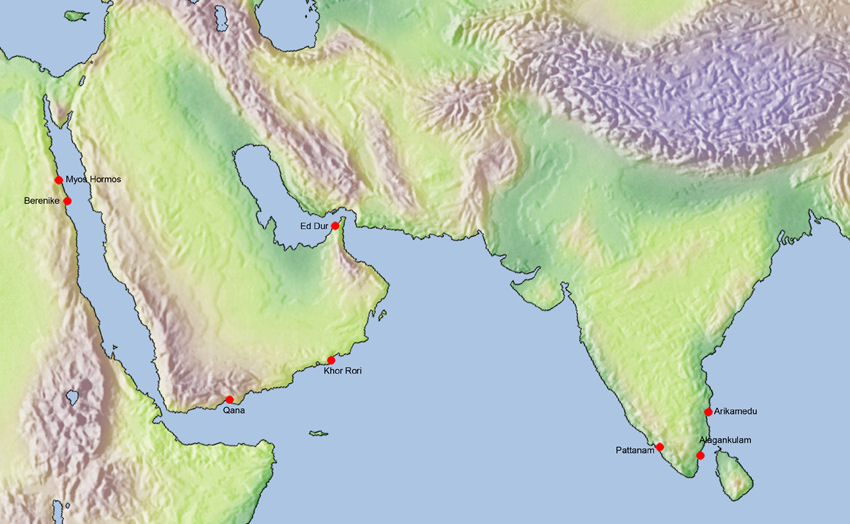
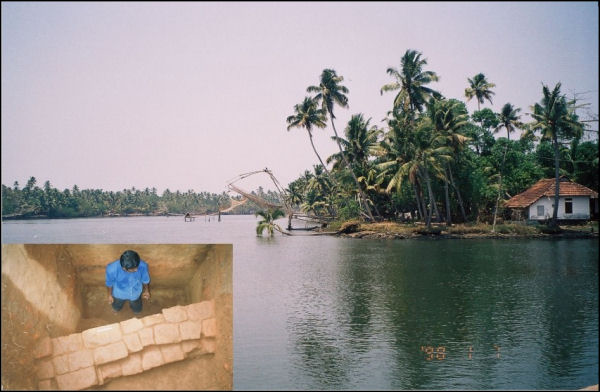
The modern state of Kerala on the Malabar Coast of South India is rich in archaeological finds, particularly 'Megalithic' (Iron Age-Early Historic) burials. Until recently no archaeological evidence existed for settlement sites of the Early Historic period (300 BC-AD 500). This lacuna was filled when, as part of a geo-archaeological survey undertaken by the first author, a concentration of surface artefacts located an Early Historic settlement at the village of Pattanam, situated 5km south-east of the Periyar river mouth (Shajan et al. 2004) (Figures 1-2). Modern occupation has both hindered and assisted exploration, the latter by providing additional glimpses into sub-surface levels, which has resulted in the collection of more pottery. In 2004 a small, controlled excavation by the Centre for Heritage Studies, Thripunithura, uncovered a Megalithic-Early Medieval sequence (Reference SelvakumarSelvakumar et al. 2005). A number of artefact classes, such as pottery and beads, indicate wide-ranging contacts at Pattanam during the Early Historic and Early Medieval (AD 500-1000) periods. In addition to being the first Early Historic settlement in Kerala, the pottery from Pattanam presents a number of other firsts that are reported on here.
Map of sites mentioned in the text (A. Simpson).

View of a branch of the Periyar river, the Paravur thodu c. 1km south-west of Pattanam; inset: Trench I, Pattanam excavations (K.P. Shajan).

Roman and Indian finewares
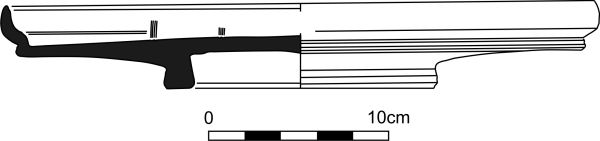
The presence of imported pottery has already been highlighted (Reference ShajanShajan et al. 2004), but an important new finding has since come to light from the excavation: a sherd of Italian sigillata from an Early Historic level. This is the first occurrence of Roman sigillata not only from the Malabar but from the entire west coast of India. Until recently, when three sherds were published from Alagankulam (Reference SridharSridhar 2005: pl. 1), the only genuine Roman sigillata in India was from Arikamedu, comprising sherds from Syria (Eastern Sigillata A), Western Asia Minor (Eastern Sigillata B) and Italy (Reference SlaneSlane 1996). Some of the Italian vessels from Arikamedu are large platters with thick bases (Reference SlaneSlane 1996: Figures 7.1, 7.20, 7.22; Conspectus forms 11-12, 18-19) (Figure 3). The Pattanam sherd is small (c. 32 x 32mm) and heavily abraded with only a few millimetres of dark red slip adhering, but its thickness suggests that it too comes from the base of one of these platters and is likely to date to the late first century BC or early first century AD. This vessel fragment from Pattanam provides tangible evidence for contact between the two coasts. The Roman pottery found at Pattanam is thought to have arrived via the Egyptian Red Sea ports, where Italian sigillata is common at both Myos Hormos (Quseir al-Qadim) and Berenike.
Italian sigillata Conspectus form 18 (A. Simpson after Conspectus Tafel 16, 18.3.1).

Contact between the south Indian coasts is reinforced by hundreds of sherds of Indian rouletted ware (Reference WheelerWheeler et al. 1946: fig. 12) at Pattanam (Figure 4). The type normally has an east coast concentration, and the Pattanam finds represent the first examples from the west coast. Here too a link can be made with the Red Sea ports as rouletted ware is present at both Myos Hormos and Berenike.
Left: Abraded rouletted ware sherds from Pattanam (V. Selvakumar). Right: rouletted ware sherds from Arikamedu (R. Tomber, courtesy of Pondicherry Museum).

Roman amphorae
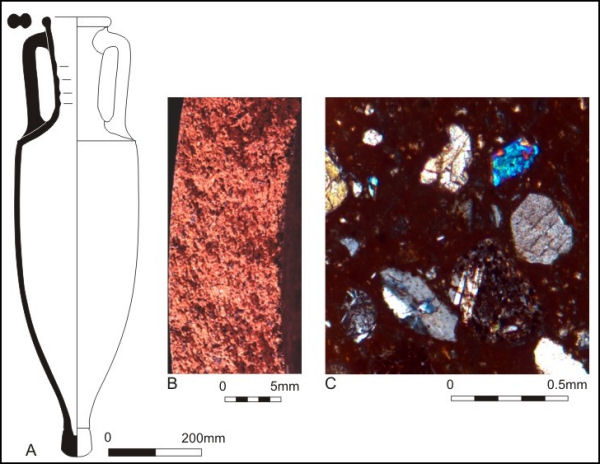
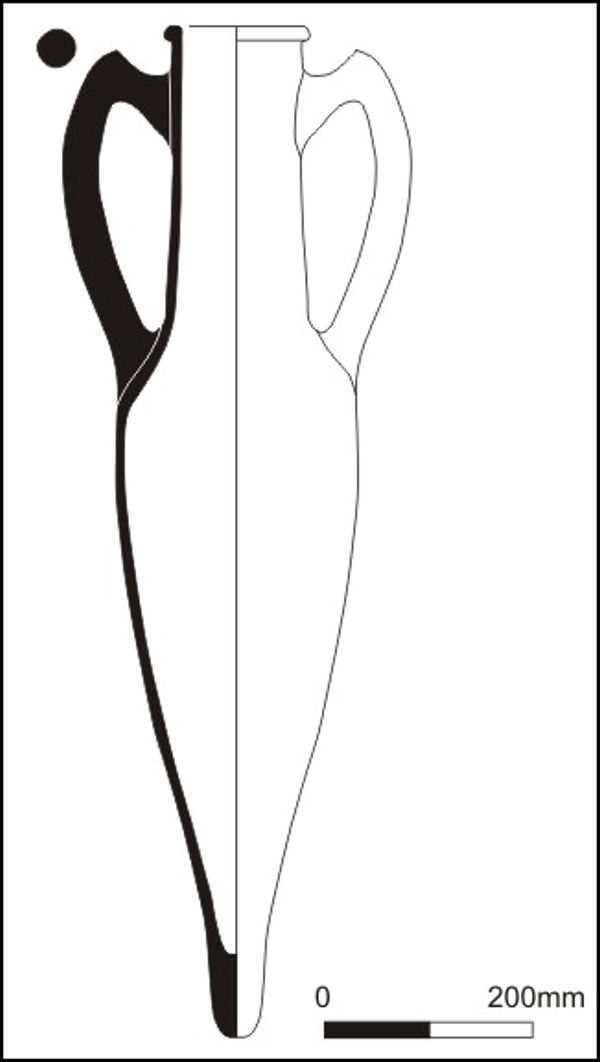
Additional imported pottery comprises Roman amphorae, of which c. 50+ sherds have been identified from the surface and Early Historic phases of the excavation. The most common is a wine amphora from the Campanian/Bay of Naples area, characterised by a 'black sand' fabric consisting of volcanic minerals and rocks (Figure 5) and dated between the late first century BC and first three-quarters of the first century AD. Other wine amphorae of a similar shape but composed of a different clay are also found at Pattanam, and may come from another source in Italy. Yet another wine amphora, which continued into the second century AD, originated in the Rhodian Peraea (Figure 6). These and additional fabric groups from Pattanam, which without rims, bases or handles cannot at present be assigned to specific types, have been examined in thin section to characterise their clays. This will provide an on-going dataset for Pattanam to help catalogue future finds. Amphorae have been found elsewhere in India, the largest assemblage from Arikamedu, but these are the first from the Malabar coast.
A: Campanian wine amphora. B: Campanian fabric in fresh fracture. C: Campanian fabric in thin section showing volcanic rocks and pyroxenes (P. Copeland, R.Tomber).

Rhodian amphora (P. Copeland).

West Asian and Arabian pottery
Pottery from outside the Roman world is more difficult to date and two types represented span the Sasanian (AD 224-651) to Early Islamic period, and a combination of conventional dates and their position in the excavated sequence indicates rare pieces are Sasanian. This category includes turquoise glazed wares and storage vessels lined with bitumen, known as torpedo jars and used for carrying wine (Reference TomberTomber 2007).
Arabia is another potential source area for pottery imports represented by surface and excavated sherds. A pale-coloured organic tempered fabric (frequently with a black lining) is similar to one identified at Myos Hormos and Berenike (Reference TomberTomber 2004) where it can be attributed to a source in the Hadramawt of Yemen and dated from the late first century BC/early first century AD to at least the fourth century. However, in this context a source in the Gulf is also possible, especially given the presence of other unsourced organic fabrics from Early Medieval contexts at Pattanam that may be from this region.
Pattanam: the port
The imported pottery from Pattanam demonstrates extensive external contacts and for both Roman and Sasanian types a mixture of transport containers and finewares are present. The pottery compares - although it comprises at this point a smaller and more reduced range - with that found at the major ports for Indian Ocean commerce active during the Early Historic period, such as Myos Hormos and Berenike on the Red Sea, Qana and Khor Rori in South Arabia (Reference TomberTomber 2005; Reference SedovSedov 1992), Ed-Dur in the Gulf (Reference RuttenRutten 2007) and Arikamedu (Reference SlaneSlane 1996; Reference WheelerWheeler et al. 1946) on the Coromandal coast. These artefacts, together with the site size and its urban characteristics, all indicate that it was an important place and its location would have accommodated a port. As presented elsewhere (Reference ShajanShajan et al. 2004), there is a strong argument for equating Pattanam with the renowned Indo-Roman port Muziris, and on-going excavation by the Kerala Centre for Historical Research will help to determine if this is indeed the case.
Acknowledgements
The authors thank Dr Paul Roberts, British Museum, for confirming identification of the Italian sigillata. K.P. Shajan acknowledges the Council of Scientific and Industrial Research India for a research associate post, the Nehru Trust for the Indian Collections at the Victoria and Albert Museum for a 2005 fellowship that enabled him to conduct research in the UK and Prof Rajan Gurukkal, Mahatma Gandhi University, for his support during exploration. R. Tomber acknowledges the Arts and Humanities Research Council who funded this research through a grant held with Prof David Peacock. Photographs were edited by Penny Copeland.