


On November 2016, the monsoon storms finally left the Gulf of Guinea. It was then that the Nigerian Delta insurgents—who had engaged in battles, looting, and violence against civilians during the summer—returned to the ocean. Reported monthly pirate attacks had decreased by two-thirds from the spring to the summer before nearly doubling at the end of the year (Daxecker and Prins, Reference Daxecker and Prins2013). This dramatic resurgence in piracy stands in sharp contrast with the lull in violence on the Nigerian Delta; 102 violent events (18.5 per month) were reported in the summer of 2016, and the number decreased to 22 (11 per month) in the following months. As one witness mentioned upon noticing this seasonal pattern of “inverse correlation” between violence and piracy; “at the tactical level, the ‘attackers’, when not employed in militancy, oil theft, illegal bunkering or gang warfare, engage in piracy to cover some of their funding needs” (Steffen, Reference Steffen2017). This observation implies that rebel groups' decision to substitute piracy for violence depended on their tactical environment.Footnote 1
How do rebels choose tactics during civil war? Why do they substitute one tactic for another? The importance of substitution is highlighted in studies of both international and intrastate conflict (Most and Starr, Reference Most and Starr1984; Morgan and Palmer, Reference Morgan and Palmer2000; Palmer et al., Reference Palmer, Wohlander and Clifton Morgan2002; Clark and Reed, Reference Clark and Reed2005; Clark et al., Reference Clark, Nordstrom and Reed2008), and recent attention to the variety of rebels' tactics further underscores this importance (Cunningham, Reference Cunningham2013; Cunningham et al., Reference Cunningham, Dahl and Frugé2017). However, previous studies focus exclusively on the existence or absence of substitution. The absence of valid and exogenous measures of costs and benefits of rebels' tactics further complicates empirically identifying substitution.
I address these problems by formally deriving a typology of substitution and arguing that ignoring different types of substitution can result in misleading predictions. In fact, the problem is not limited to violence and piracy, which I analyze in this article. It is relevant to repertories of rebels' strategies in general, including their choices between violent and non-violent tactics, guerrilla and conventional warfare, violence against infrastructure and human subjects, and violence against civilians and combatants. To understand the importance of typology, consider the following stylized cases (Option A and B can be changed to those in the above examples):
Case I: Option A and B are equally appealing to a rebel group;
Case II: Option A is more appealing than Option B to a rebel group.
In Case I, the rebel group can substitute Option A and B; they compare the relative costs of options A and B and choose the one with lower cost—that is, Option A and B are equivalent substitutes. By contrast, in Case II, the costs for Option B does not matter as far as Option A is affordable. Only if Option A is too costly do the rebels consider Option B as a viable alternative. That is, Option B is a downward substitute for Option A, and, conversely, Option A is an upward substitute for Option B. If we were to ignore substitution, we could not explain why the cost of one option affects the rebels' choices for another option in Case I. Yet, understanding the existence of substitution is not sufficient. Indeed, if we were to exclusively focus on the equivalent substitution as previous studies do, we could not explain why the costs for Option B does not affect the rebels' choices of Option A in Case II. Only by differentiating the types of substitution can we explain both Case I and II.
Empirically, I address the “severe specification and measurement problems” that have plagued existing studies on substitution (Morgan and Palmer, Reference Morgan and Palmer2000, 22). I do this by exploiting exogenous variation in the tactical costs for maritime piracy and ground violence during civil war. Although the costs of rebels' tactics are usually hard to measure and endogenous to, say, government's repression and international sanctions (Clark and Reed, Reference Clark and Reed2005; Clark et al., Reference Clark, Nordstrom and Reed2008), I examine weather-induced variation in the feasibilities of rebels' ground and maritime violent activities. This design-based approach allows me to causally identify how the tactical costs affect rebels' choices and substitutions between piracy and violence without relying on model-dependent assumptions. The analysis of 31 coastal conflict countries for the 2001–2016 period indicates that maritime piracy is an upward substitute of ground violence; that is, rebels engage in piracy whenever it is feasible and consider ground violence as an alternative option only when piracy is infeasible.
These findings warn of possible unintended side-effects of conflict resolution efforts. For instance, international marine patrols may decrease maritime piracy while also unintendedly increasing violence on the ground; marine patrols would increase the cost for maritime piracy, which would in turn incentivize the rebels to resort to ground violence. This implies that international marine patrols and land-based peacekeeping operations should be planned and implemented in tandem. By contrast, if piracy is an upward substitute of violence, peacekeeping operations may reduce violence without increasing piracy, and hence the peacekeeping operations may be conducted independently from marine patrols. Only with proper understandings of substitution types can we reliably avoid harmful side-effects of conflict resolution policies.
1. Literature: armed conflict and substitution
While previous studies use a variety of theoretical and empirical approaches to analyze armed conflict, most do not account for strategic alternatives to armed conflict and their substitutive relationships. For instance, although an increasing number of studies examine the effects of weather and climate conditions on armed conflict (Hsiang et al., Reference Hsiang, Meng and Cane2011, Reference Hsiang, Burke and Miguel2013, Reference Hsiang, Burke and Miguel2014; Gartzke, Reference Gartzke2012; Buhaug et al., Reference Buhaug, Nordkvelle, Bernauer, Böhmelt, Brzoska, Busby, Ciccone, Fjelde, Gartzke, Gleditsch, Goldstone, Hegre, Holtermann, Koubi, Link, Link, Lujala, O'Loughlin, Raleigh, Scheffran, Schilling, Smith, Theisen, Tol, Urdal and von Uexkull2014; Sarsons, Reference Sarsons2015) and maritime piracy (Jablonski and Oliver, Reference Jablonski and Oliver2013; Percy and Shortland, Reference Percy and Shortland2013; Flückiger and Ludwig, Reference Flückiger and Ludwig2015), these studies focus on ground and marine violent activities in isolation and ignore the potential for substitution.
Theories of substitution (Most and Starr, Reference Most and Starr1984; Morgan and Palmer, Reference Morgan and Palmer2000; Palmer et al., Reference Palmer, Wohlander and Clifton Morgan2002; Clark and Reed, Reference Clark and Reed2005; Clark et al., Reference Clark, Nordstrom and Reed2008; Cunningham et al., Reference Cunningham, Dahl and Frugé2017) question the validity of such approaches. Rebels' choices are not limited to violent strategies and peaceful conflict resolution (Fearon, Reference Fearon2004). They can also choose among other options, including non-violent protests (Cunningham et al., Reference Cunningham, Dahl and Frugé2017), active participation in conventional politics (Cunningham, Reference Cunningham2013), and exile to foreign countries (Salehyan and Gleditsch, Reference Salehyan and Gleditsch2006). Even during civil war, rebel groups can choose various tactics, such as combat with government forces, violence against civilians (Kalyvas, Reference Kalyvas2006), terrorism (Findley and Young, Reference Findley and Young2012), active cooperation with enemies (Campbell et al., Reference Campbell, Findley and Kikuta2017), and piracy (Daxecker and Prins, Reference Daxecker and Prins2017). Given the variety of strategic and tactical options, the exclusive focus on armed conflict and violence can be problematic. In fact, even when violence provides substantial benefits at a relatively low cost, rebels may employ an alternative strategy if the payoffs from the alternative strategy are even better.
Existing theories about rebels' tactical options and substitution also have limitations. They rather narrowly focus on the presence or absence of a substitutive or complementary relationship, without differentiating between types of substitution. Daxecker and Prins (Reference Daxecker and Prins2017), for instance, conduct one of the first systematic analyses of the relationship between armed conflict and maritime piracy, and find that the incidence of piracy is positively associated with a larger number of conflict events. However, the positive association does not necessarily mean that armed conflict and piracy would constitute a complementary relationship. In fact, as Morgan and Palmer (Reference Morgan and Palmer2000) point out, the positive association can be attributed to an increase in available resources. More importantly, even though armed conflict and piracy might have a complementary relationship in the long term, they can also have a substitutive relationship in the short term. In fact, even though rebels may engage in piracy activities to fund their ground military activities, they may still need to allocate a limited amount of resources to piracy or violence in day-to-day operations. As Most and Starr (Reference Most and Starr1984) argue, unless actors possess infinite resources and time, there almost always exists some substitution in the short term. This means that the dichotomy of substitution and complementation is not always useful, and that we also need to analyze differences within substitution or complementation.
2. Theoretical model: a typology of substitution
To formalize our argument,Footnote 2 consider an armed rebel group that can allocate a finite amount of resources r > 0 (such as funding, military personnel, weaponry, and time) to two tactics, V and ¬V.Footnote 3 Although I focus on ground violence V and its alternative ¬V for concreteness, the options V and ¬V can take other forms. For instance, a rebel group may allocate limited resources to peaceful and violent tactics, conventional and guerrilla warfare, violence against human subjects and infrastructure, or violence against civilians and combatants. Any of these substitutions can be captured by the model if the following three conditions are met: both options require the same set of resources, the rebels' resources are finite, and the following assumptions of functional forms are plausible (or one can use other functional forms; see footnote 5 for a few examples).
The amounts of resources allocated to the two options are denoted by y V, y ¬V > 0. By spending resources on a certain activity, the rebel group receives benefits $f_.( {y_.} )$ , such as political, tactical, and monetary gains, while they also need to incur costs $g_.( {y_.} )$
 . Thus, the rebels' generic payoff is u = f V(y V) − g(y V) + f ¬V(y ¬V) − g ¬V(y ¬V) with a resource constraint of y V + y ¬V ≤ r. As Morgan and Palmer (Reference Morgan and Palmer2000) note, the resource constraint is the key element that creates the substitutive relationship. That is, rebels need to compare and substitute their options because they do not possess infinite resources.Footnote 4
I assume a quadratic profit function $f_.( {y_.} ) = ( {b_.-y_.} ) y_.$ , where $b_. > 0$
 represents the marginal profit when $y_. = 0$
 (initial marginal returns; the larger $b_.$
 , the more profitable the option). The function reflects the notion that allocating a certain amount of resources allows the rebel group to acquire more political, tactical, or monetary gains, but excessive effort entails backlash and associated costs, such as government repression (Young, Reference Young2013), international sanctions (Findley and Teo, Reference Findley and Teo2006), and avoidance by civilians (Kalyvas, Reference Kalyvas2006).Footnote 5 Certainly, this functional form assumption is relatively restrictive, and researchers need to carefully assess the plausibility of the assumption. In case of maritime piracy and ground violence, the assumption is plausible; rampant piracy or violence often elicits government repression or international intervention. Intensive piracy or violence can also result in commercial vessels' avoidance of the coastal seas, or flight of the local population and firms, which reduce rebels' marginal profits.
I also assume a linear cost function $g_.( {y_.} ) = c_.y_.$ with $\;c_. > 0$
 . The linear cost function represents the loss of a certain amount of resources that would have been used for other purposes. When the parameter $c_.$
 takes a larger value, the activity requires more resources (larger operational costs), or those resources could have been used for other more profitable activities (larger opportunity costs). Additionally, as Cunningham et al. (Reference Cunningham, Dahl and Frugé2017) argue, investing more resources in a specific activity causes harsher competition over the remaining resources, which entails additional costs. With these parameterizations, the utility function becomes: u = (b V − y V)y V − c Vy V + (b ¬V − y ¬V)y ¬V − c ¬Vy ¬V.
Quantities of interest are the effects of the costs c V and c ¬V on the rebels' choice over violence and its alternative. In particular, I focus on the incidence of V and ¬V, defined as YV = I(y V > 0) and Y¬V = I(y ¬V > 0), where I is an indicator function. Although the continuous effort levels y V and y ¬V may also be of interest, dichotomous outcomes are more useful for deriving a typology of substitution. Furthermore, the effort levels are complicated non-linear functions of c V and c ¬V, and hence empirical analysis can only weakly identify the theoretical relationship.
2.1 Optimal choices
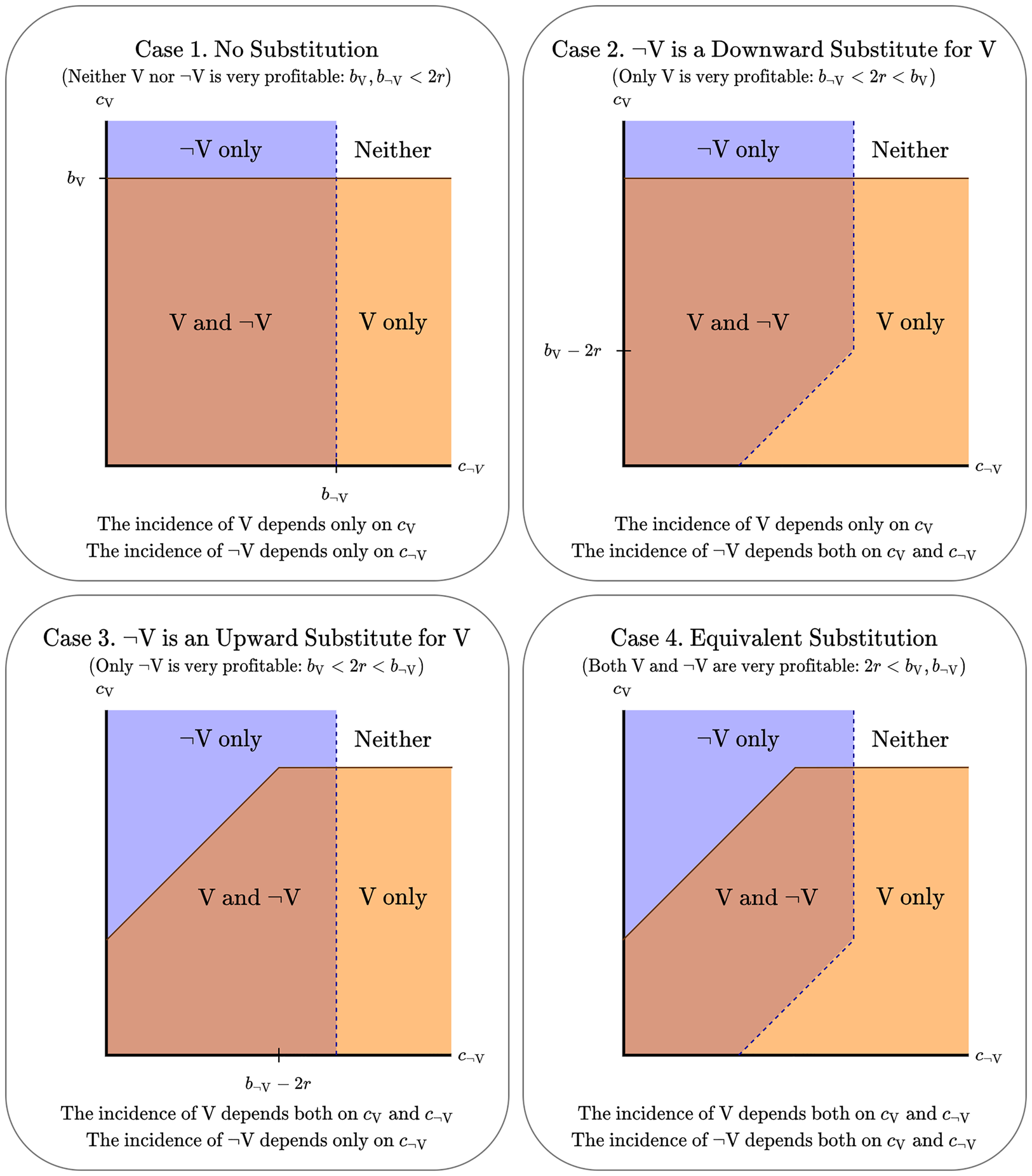
Because the model has a unique optimum that can take seven different forms, I focus on the effects of c V and c ¬V on YV and Y¬V. For the details of the optima and their conditions, see the Supporting Information.Footnote 6 Figure 1 summarizes the results of the formal analysis. In each pane, the incidences of V and ¬V are mapped to the corresponding costs c V and c ¬V under a certain condition of profitability of violence and its alternative b V and b ¬V. The solid and dashed lines separate the areas in which the rebel group employs violence V (orange areas; YV = 1) and its alternative ¬V (blue areas; Y¬V = 1), respectively. In the areas at the left-bottom corner (brown areas), rebels employ both V and ¬V (YV = Y¬V = 1). The parameters 2r and $b_.\;$ separate Case 1–4, because the resource constraint (which is the core element of substitution) is only effective when $b_. > 2r$
 (see Supporting Information 1 for the mathematical details).
Typology of substitution.
Note: The figures show the incidences of violence V and its alternative ¬V with respect to their costs c V and c ¬V. The solid (orange areas) and dashed (blue areas) lines separate the conditions in which the rebel group employs violence and its alternative, respectively. The panes of cases 1–4 correspond to the cases in which an alternative option ¬V is (1) not a substitute for violence, (2) a downward substitute for violence, (3) an upward substitute for violence, and (4) an equivalent substitute for violence.
2.2 Case 1: no substitution
When neither option provides sufficiently large profits (b V, b ¬V < 2r, Case 1 of Figure 1), the rebels' decision is not meaningfully affected by the resource constraint. In this case, spending all resources is suboptimal. Thus, the rebels independently assess the costs and benefits of each option and allocate resources until it causes substantial backlash and the marginal return becomes negative. This follows from Morgan and Palmer (Reference Morgan and Palmer2000)'s claim that if it were not for a resource constraint, there would be no incentive to compare or substitute available options. With no substitution, the incidence of each tactics depends only on its own costs.
2.3 Case 2: downward substitute for violence
By contrast, when only violence is sufficiently profitable (¬V is a downward substitute for violence; b ¬V < 2r < b V, Case 2 of Figure 1), rebels' choices are constrained by resource availability. When the costs of violence are small, rebels would like to spend more available resources on V and fewer on ¬V. However, the resource constraint forces them to compare the relative payoffs and optimally allocate the finite resources. While rebels always spend some resources on violence unless the costs are enormous (c V > b V), they engage in the alternative tactics ¬V only when ¬Vis relatively cheap (c ¬V < b ¬V) and they are more profitable than resorting to violence under strong backlash (b ¬V − c ¬V > b V − c V − 2r). This means that while the incidence of rebels' violence depends only on its costs c V, the incidence of the alternative choice depends on both c V and c ¬V.
2.4 Case 3: upward substitute for violence
The situation is opposite when an alternative option ¬V is an upward substitute for violent activities (Case 3 of Figure 1). When only the alternative is sufficiently profitable (b V < 2r < b ¬V), rebels have incentives to spend resources on ¬V as far as it is affordable (c ¬V < b ¬V). However, because the marginal return from violence is lower, they are willing to allocate resources to violence only when it provides positive returns (c V < b V) and provides a better payoff than the alternative tactics under strong backlash (b V − c V > b ¬V − c ¬V − 2r). Thus, when an alternative option is an upward substitute for violence, the incidence of ¬V depends only on its costs c ¬V, while the incidence of rebels' violence depends both on c V and c ¬V.
2.5 Case 4: equivalent substitute for violence
Finally, when the returns from violent activities and the alternative are sufficiently high (2r < b V, b ¬V, Case 4 of Figure 1), the alternative option constitutes an equivalent substitute for violence. The results in this case are a mixture of Cases 2 and 3. Because both options provide large profits, rebels can easily substitute one for the other. As a result, rebels weigh the relative costs and benefits of V and ¬V when allocating their resources. This implies that rebels employ violence only when it provides a positive return and the alternative option is not predominantly profitable, and vice versa. Thus, neither c V nor c ¬V alone can perfectly predict the incidences of V or ¬V. Only when we consider c V and c ¬V jointly are we able to precisely predict the outcomes.
3. Empirical model: measurement and specification
The model suggests that the costs for violence and its alternative affect rebels' choices differently, depending on the types of substitution—which in turn are defined by the marginal profits and resource constraint. Empirically analyzing the substitutive relationship, however, raises immense problems (Morgan and Palmer, Reference Morgan and Palmer2000).
3.1 Design-based approach to measurement and endogeneity problems
A critical problem for empirically analyzing substitution and formal models more generally is measuring the core parameters. Because it is nearly impossible to validly measure all of the parameters and ensure that all of the measurements are exogenous, I focus on the effects of validly measurable parameters and analyze which range of unobservable parameter values are the most consistent with empirical patterns.Footnote 7 Specifically, I examine rebels' choices between ground violence and maritime piracy during civil war, and use the daily variation in ocean wind speed and ground rainfall as exogenous proxies for the operational costs for violence and piracy respectively ($c_.$ ). Because the weather variables are exogenous, they provide a design-based approach to the endogeneity problems raised by Clark and Reed (Reference Clark and Reed2005). The other parameters—the marginal profits $b_.$
 and resource constraint r—are considered as unobservables. Because those unobservable parameters predict only four empirical patterns (no, upward, downward, and equivalent substitutions), I analyze which type of substitution and corresponding ranges of the unobservable parameters are the most consistent with the estimated effects of c V and c ¬V on YV and Y¬V. Although this does not necessarily mean that a particular type of substitution is “true,” it implies that the substitution type is the best available way to describe the data.
A unique analytical advantage of focusing on the violence-piracy substitution is that other than the substitution mechanism, there is only a limited number of mechanisms through which daily ocean wind speed (ground rainfall) can directly affect ground (maritime) violence.Footnote 8 As a result, I can use ocean wind speed and ground rainfall as separate proxies. This differs from the analysis of violence and non-violent protests, in which I only have a single set of proxies (ground weather variables) that can affect both of the outcomes. The separate proxies ensure that the regression model is empirically identifiable. I also conduct mechanism checks in later subsections (see Causal mechanism subsections) to address the possibility that ocean wind speed (ground rainfall) correlates with ground wind speed (ocean rainfall), which in turn affects violence (piracy), or that ocean wind speed affects fishery-related sectors, which in turn might affect violence. Furthermore, by using the daily measures, I can isolate the short-term effects from the long-term effects of weather, such as those on agricultural production (Miguel et al., Reference Miguel, Satyanath and Sergenti2004).
An important assumption is that the weather conditions affect the cost $c_.$ (this does not mean that the costs would depend only on weather conditions; in fact, $c_.$
 depends on opportunity costs as well). As widely acknowledged by military experts and historians (House et al., Reference House, Near, Shields, Celentano, Husband, Mercer and Pugh1996; Ochmanek, Reference Ochmanek2003; Meier, Reference Meier2015), rainy weather poses special challenges for military operations, including marching on muddy ground, maintenance of supply lines, and lower morale, which entail higher tactical costs.Footnote 9 Indeed, recent studies confirm these anecdotes by analyzing the effects of daily weather on combat events during civil war (Carter and Veale, Reference Carter and Veale2013, Reference Carter and Veale2015). Carter and Veale (Reference Carter and Veale2015), for instance, find that rainy weather halts ground military operations. Similarly, as Percy and Shortland (Reference Percy and Shortland2013) argue, windy oceans make piracy activities potentially deadly endeavors; a majority of contemporary rebel groups or pirates do not possess large-scale armored ships, mostly relying on speedboats, fishing vessels, or even handmade wooden boats, which are especially vulnerable to rough water (Murphy, Reference Murphy2009; Cook and Garrett, Reference Cook and Garrett2013). Even for pirates who possess mother ships, rainy weather can deter them from conducting piracy activities with smaller ships.
3.2 Theoretical considerations about specification
Another challenge for analyzing substitution is to ensure the consistency between the theoretical and empirical models. Because the theoretical model is built on a number of simplifications, I need to carefully assess the empirical consequences of each. First, as mentioned above, the model focuses on only two options—violence and its alternative (piracy)—and considers other options as factors that can affect the opportunity costs for those two strategies. That is, if rebels have a third choice, such as negotiated settlements, exile to foreign countries (exit strategy; Salehyan and Gleditsch, Reference Salehyan and Gleditsch2006) or nonviolent contestation (Cunningham, Reference Cunningham2013), it increases the opportunity costs of violence and piracy, reflected by larger values of c V and c ¬V. Thus, if a third choice is far more attractive than piracy and violence, piracy and violence would not occur. By contrast, the presence of a third choice does not alter any results of my model if that choice is far less attractive than violence and piracy. Finally, if a third choice is as profitable as violence or piracy, rebel groups may choose it even when my model predicts that they should choose violence or piracy. Although this would not bias the causal estimates, the existence of third choices can add noise and hence lower the power of analysis. This makes my empirical analysis a hard test for the substitution hypotheses.
Similarly, my analysis assumes a single group that chooses between ground and maritime violent activities. Even without an organized group, a small number of individual soldiers can switch tactics. Indeed, pirates are often equipped with firearms and use small motorboats (Murphy, Reference Murphy2009; Cook and Garrett, Reference Cook and Garrett2013; Percy and Shortland, Reference Percy and Shortland2013). This means that soldiers can switch their tactics from day to day if they simply own a motorboat. Moreover, even with an organized rebel group, the results hold if there is labor mobility between the rebel and piracy groups. Weather conditions can affect individual soldiers' decisions over fighting on the ground and pirating on the ocean, which constitutes individual-level substitution between violent or piracy activities. As previous studies show (ibid), individual-level choices can affect group-level strategies through the availability of human resources and hence the feasibilities of violent and piracy activities. Note also that if none of these assumptions hold, violence and piracy would be independent processes, and thus violence (piracy) would depend only on the ground (ocean) weather conditions.
Finally, it is worthwhile to note what the model does not assume. First, the theoretical model does not assume that a rebel group considers the alternative option—piracy in this case—to be realistic. For instance, even though contemporary piracy usually does not require exceptional skills or naval capabilities (Murphy, Reference Murphy2009), rebel groups might not think of piracy as a viable option for idiosyncratic reasons. In my model, this is equivalent to setting the costs for an alternative option c ¬V to an arbitrarily large value. With a very large c ¬V, rebels never use the alternative option, and hence the likelihood of rebels' violence only depends on its costs c V. Thus, if piracy were not on a rebel group's menu of choices for whatever reason, only ground weather conditions would affect violence and ocean weather would not make a difference.
Second, the substitution does not require the assumption that violence and piracy serve the same objective. Because rebels have finite resources, they must prioritize their objectives and thus substitute corresponding strategies. It is the resource constraint—not the similarity of objectives—that causes substitution between violence and piracy. In general, as Morgan and Palmer (Reference Morgan and Palmer2000) show, resource constraints force players to substitute their options even if the options serve different objectives.
3.3 Empirical model
Given the measurement and theoretical assessments above, I can specify an empirical model. Although my theory implies complicated functions that depend on unobserved parameters such as $b_.$ and r, I use linear approximations of the population functions (Angrist and Pischke, Reference Angrist and Pischke2009; Hsiang et al., Reference Hsiang, Burke and Miguel2013). In addition, because the theory predicts that ground weather's effect depends on ocean weather and vice versa (e.g., when violence is a downward substitute of piracy, ground rainfall reduces violence only if ocean conditions are windy and piracy is not feasible), I also add linear interactions of the weather variables and graphically assess the conditional effects. The regression models therefore take forms of;Footnote 10


where i is a coastal conflict country, t is a date, d t is a year of a given date. The outcome variables violence it and piracy it are 1 if there are the incidences of rebels' violence or piracy respectively and 0 otherwise. The explanatory variables rain it and wind it correspond to the deviations of ground rainfall and ocean wind speed. The deviations are calculated as the observed values minus the average values of country i on a given month-day. By using the deviation measures, I can account for country-specific seasonality. The column vector x it includes covariates with corresponding row vectors of the coefficients β 4 and γ 4. The model also includes country-specific intercepts μ i and ν i, which control for climatic differences across countries; date-specific intercepts ϕ t and φt, which account for arbitrary time trends in the outcome and explanatory variables; and country-year fixed effects $\theta _{id_t}$ and $\vartheta _{id_t}$
 , which account for confounders that can change from one year to another.
While the temporal unit has a high resolution, I use coastal countries as spatial units because there are no data about within-country geographical locations of rebel groups.Footnote 11 It is therefore important to theoretically consider the problems that might be caused by ecological inference. From the standpoint of my theoretical model, rebel groups' activities can cause backlash or deplete the resources necessary for other actions (Cunningham et al., Reference Cunningham, Dahl and Frugé2017). This decreases the marginal payoffs from a given activity, which in turn can disincentivize other groups from engaging in the same activity. This implies that there might be a negative externality and correlation among groups, which can cause a bias toward zero in an empirical analysis with aggregated units (King et al., Reference King, Tanner and Rosen2004). In fact, the theoretical predictions about the dichotomous variables hold even when I extend the model to the aggregated incidences of violence and piracy with two rebel groups.Footnote 12
3.4 Predictions
The theory predicts not only whether but also how ground rainfall and ocean wind affect ground violence and maritime piracy. Table 1 summarizes the predicted directions of the conditional effects (β 3 and γ 3 in the above equations).Footnote 13 First, in the absence of substitution, there is no conditional effect; the incidence of violence depends on ground weather conditions, while the incidence of piracy depends on ocean weather. Second, when piracy is an upward substitute for violence, violence occurs only when it is profitable and piracy is not—while piracy can happen whenever it is profitable. This suggests that sunny weather on the ground leads to violence only if ocean conditions are windy (negative β 3), while the incidence of piracy depends only on ocean wind.
Predicted directions of the conditional effects

Note: The table summarized the predicted directions of the conditional effects of ground rainfall and ocean wind speed on the incidence of violent events (β 3) and the incidence of piracy events (γ 3). “−” and “0” indicate a negative and zero coefficient value respectively.
Third, by contrast, when piracy is a downward substitute for violence, the situation is reversed. While violence can happen whenever it is profitable for its own sake, piracy occurs when it is feasible and violence is not feasible. This means that calm ocean conditions invite pirates only if the ground weather is rainy (negative γ 3), while only ground weather conditions will affect the incidence of violence. Finally, when piracy is an equivalent substitute for armed conflict, rebels weigh the returns from the ground and marine military activities, and hence ground and ocean weather conditions affect both violence and piracy. Because violence occurs when violence is feasible but piracy is not, and vice versa, the directions of β 3 and γ 3 are predicted to be negative. Because we use continuous predictors of weather, we also graphically assess the conditional effects.
4. Data and method
The sample includes coastal areas of 31 conflict countries for the period of 2001–2016, resulting in 128,973 coastal country-day observations.Footnote 14 The time period is selected on the basis of data availability.Footnote 15 Because piracy activities are physically infeasible in inland countries, I follow Daxecker and Prins (Reference Daxecker and Prins2013) and limit the countries to those on the coast. Furthermore, because my theory assumes the existence of armed conflict, I drop non-conflict countries and periods (Themner, Reference Themner2012).Footnote 16 Finally, among the remaining 44 coastal conflict countries, I drop those that have zero variance of the outcome variables.Footnote 17 This leaves the 31 coastal conflict countries listed in Supporting Information 2.Footnote 18
4.1 Outcome variables
The outcome variables are the incidences of rebels' violence and piracy. The event data of violent activities come from the Global Terrorism Database (GTD; LaFree and Dugan Reference LaFree and Dugan2007), and I conduct a robustness check with UCDP GED (Sundberg et al., Reference Sundberg, Lindgren and Padskocimaite2010).Footnote 19 For GTD, I include any terrorism events that occurred on the ground. For UCDP GED, I include any violent event in which at least one of the participants is a rebel group because rebels can put their efforts toward any types of ground military activities. Finally, to select events that are relevant to piracy, I limit the events to those that occurred within 100 km from the coastline.Footnote 20 The outcome variable violence it takes the value of 1 if there is any violent event on day t within 100 km from the territorial seas of country i.
The piracy data come from the Maritime Piracy Event and Location Dataset (MPELD; Daxecker and Prins, Reference Daxecker and Prins2013). I also conduct a robustness check with the Maritime Piracy Dataset (MPD; Coggins Reference Coggins2012). Both datasets rely on the reports of piracy attacks submitted to the International Maritime Bureau (IMB). The MPELD also uses additional information available from the International Maritime Organization (IMO). The IMB defines piracy as “an act of boarding or attempting to board any ship with the apparent intent to commit theft or any other crime and with the apparent intent or capability to use force in the furtherance of that act” (IMB, 2010; Coggins, Reference Coggins2012, 606). The variable piracy it takes the value of 1 if there is any piracy event on day t in which at least one of the attackers come from country i.
Although all of the event datasets are based on reports of media or international organizations and thus subject to reporting biases, “as long as the measurement error is uncorrelated with the independent variables, measurement error in the dependent variable is not particularly problematic in a standard regression framework other than increasing the uncertainty around the estimates we obtain” (Weidmann, Reference Weidmann2016, 208). As I detail in the next subsection, my predictors rainit and windit are based on satellite observations, which are not subject to systematic reporting biases.
4.2 Explanatory variables
The ground rainfall values are derived from the Tropical Rainfall Measuring Mission dataset (TRMM; Huffman et al., Reference Huffman, Bolvin, Nelkin, Wolff, Adler, Gu, Hong, Bowman and Stocker2007), which is available every 3 h in 0.25-degree by 0.25-degree grid cells (2.8 km by 2.8 km cells at the equator). The TRMM is a joint mission by NASA and Japan Aerospace Exploration Agency, and the precipitation data are based on the cross-validation and aggregation of multiple satellite radar and weather sensors. The variable rain it is the average amount of ground rainfall (millimeters per hour) on day t within 100 km of the coast of country i.Footnote 21
The data of ocean wind speed come from the Cross-Calibrated Multi-Platform gridded surface vector wind dataset (CCMP; Atlas et al., Reference Atlas, Hoffman, Ardizzone, Mark Leidner, Jusem, Smith and Gombos2010), which is available daily at a spatial resolution of 0.25-degree by 0.25-degree ocean grid cells. The CCMP project is based on and funded by NASA's research programs. The CCMP products are cross-calibrated from multiple satellite data so that the wind measures are consistent over time. The variable wind it is the average speed of ocean wind (meter per second) on day t within 100 km of the coast of country i.Footnote 22 Both weather variables are based on satellite images and are therefore not affected by the problems relating to weather station data (Schultz and Mankin, Reference Schultz and Mankin2019).
4.3 Control variables
The covariates include past-one-year (t − 1, …, t − 365) averages of ground rainfall and ocean wind speed and their interactions.Footnote 23 Long-term rainfall may affect daily rainfall (due to autocorrelation) and have long-term consequences like affecting agricultural production (Miguel et al., Reference Miguel, Satyanath and Sergenti2004). It is therefore necessary to control for the long-term precipitation. Similarly, long-lasting rough seas can reduce income opportunities of fishery-related sectors, which in turn might affect maritime piracy. By controlling for the long-term ocean wind speed, I can mitigate possible biases due to the endogeneity.
I do not include other political, economic, or social covariates, such as democracy indexes, GDP per capita, or even maritime patrols. Because these factors can be affected by the weather conditions but are unlikely to affect the weather variables, controlling for them can cause posttreatment control biases. Moreover, because the regression model includes country-year fixed effects, the model accounts for any confounder that changes across years.
4.4 Estimator
The linear regression models are estimated with ordinary least squares (OLS).Footnote 24 Note that even though the error terms of the two regressions ε it and ɛ it may correlate, the variables on the right-hand side of the equations are the same; thus, seemingly unrelated regression and corresponding feasible generalized least squares are numerically identical to OLS (Greene, Reference Greene2011).Footnote 25 The standard errors are clustered for each country. For expository purposes, I show the estimated effects as a percentage scale.
5. Results
The following table (Table 2) shows the estimated values at a percentage scale. Without accounting for the conditional effects (columns 1 and 3 in Table 2), there is weak evidence that ocean wind halts maritime piracy (p = 0.0868), while the effect of ground rainfall on violence is negative but indistinguishable from zero (p = 0.1277). These results are not surprising as these models ignore the conditional effects and are thus underspecified. If piracy were an upward substitute of violence, for instance, the effect of rainfall would be ambiguous because sunny weather may not result in violence if rebels can also conduct piracy activities.
OLS estimates

Note: The table shows the OLS estimates of the coefficients at a percentage scale. The models include the country fixed effects, date fixed effects, and country-year fixed effects. The control variables for models 1 and 3 are the past-one-year average of ground rainfall and ocean wind speed respectively. The control variables for models 2 and 4 are the past-one-year averages of ground rainfall and ocean wind speed, and their interaction. n = 128, 973. ${^\ast} \;{\rm p} < 0.05, \;\;{^{\dagger}} {\rm p} < 0.10$ .
.
When the interaction terms are included (columns 2 and 4 in Table 2), the results indicate that the empirical patterns are most consistent with the upward substitution hypothesis; the effect of ground rainfall on violent events depends on the ocean wind speed, while such a conditional effect is not statistically discernible for the incidence of piracy events. While the coefficient of rainitwindit in the regression of violent events is negative and statistically significant (p = 0.0094), the corresponding coefficient is not significant and even positive for piracy (p = 0.4974). This does not necessarily mean that there is no conditional effect, as the upper bound of the confidence interval is large. But the lower bound of the confidence interval is close to zero (−0.0101), indicating that the conditional effect is unlikely to be a large negative value. These results contradict the no, downward, and equivalent substitution hypotheses and are best explained by the upward substitution hypothesis. Importantly, if we would be interested only in the presence or absence of substitution, we could not fully explain those mixed results.
I also conduct joint tests to examine whether ground violence and maritime piracy depends on ocean wind and ground rainfall. In the case of ground violence (column 2 in Table 2), the omission of all terms containing ocean wind (ocean wind and the interaction term) significantly worsen the predictive performance of the regression (p = 0.0191), and, not surprisingly, the omission of ground rainfall and the interaction term reduce the predictive performance as well (p = 0.0118). By contrast, in the regression of maritime piracy (column 4 in Table 2 ), the omission of ground rainfall and the interaction term does not significantly lower the predictive performance (p = 0.2768), while the omission of ocean wind and interaction terms still decrease the predictive performance (p = 0.0412). The joint tests therefore indicate that ground violence depends both on ground and ocean weather, while maritime piracy depends only on ocean weather. These patterns are consistent with the upward substitution hypothesis.
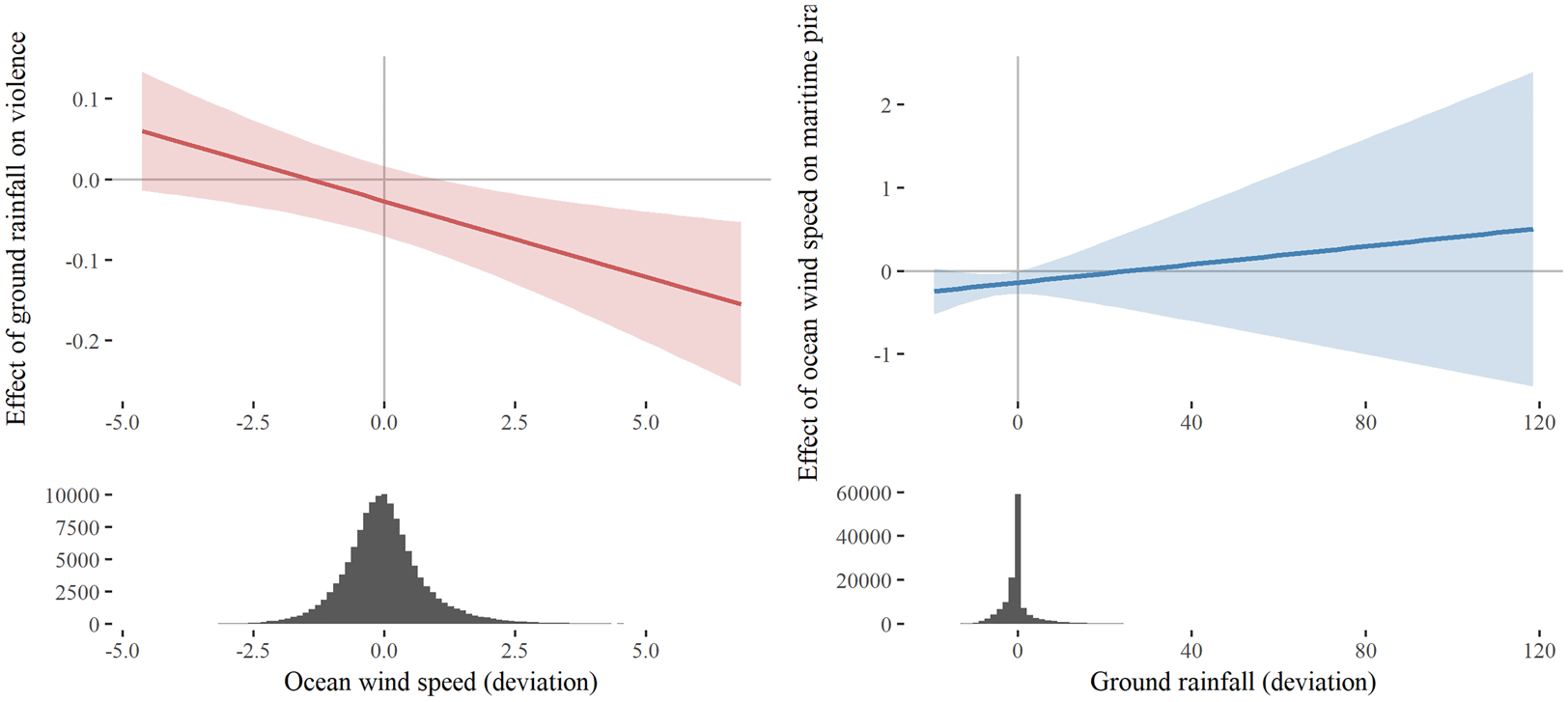
Substantively, when ocean wind speed deviation is zero, an increase of rainfall by 1 mm per hour decreases the probability of rebel's violent events by 0.02269 percentage points (see Figure 2).Footnote 26 By contrast, when ocean wind speed is unusually high by one standard deviation (1.342 m per second), the effect size is doubled; an increase of rainfall by 1 mm per hour lowers the probability of violent events by 0.0520 percentage points. Regarding piracy, when there is zero deviation in ground rainfall, an increase of ocean wind speed by 1 m per second decreases the probability of piracy events by 0.1361 percentage points. In contrast, when ground rainfall deviation is above zero by one standard deviation of observed rainfall (6.108 mm per hour), the effect of ocean wind remains nearly the same; it decreases the probability of piracy by only 0.103 percentage points. Given the rarity of the outcome variables (only 9.546 and 2.353 percent of the observations experienced violence and piracy, respectively), these effects are not negligible.
Marginal effect plots.
Note: The left pane shows the marginal effect of rainfall on the incidence of violence with respect to ocean wind speed. The right pane shows the marginal effect of wind speed on the incidence of maritime piracy with respect to rainfall. The envelopes are 95 percent confidence intervals.
5.1 Causal mechanism I: fishing
An alternative explanation for the observed relationships is fishing (Hendrix and Glaser, Reference Hendrix and Glaser2011; Flückiger and Ludwig, Reference Flückiger and Ludwig2015; Axbard, Reference Axbard2016); rainfall decreases rebels' violence especially when the ocean is windy, for rough seas limit opportunities for fishery-based industries. That is, when the ocean is rough, more people may be willing to join rebels' violent activities, and thus ground rainfall could substantially affect the levels and incidence of violence. To examine this possibility, I collect data on the phytoplankton absorption coefficient, which is a measure of phytoplankton abundance in the ocean (Flückiger and Ludwig, Reference Flückiger and Ludwig2015). The analysis shows that the main results hold even after controlling for phytoplankton abundance.Footnote 27
5.2 Causal mechanism II: cross-area correlations of rainfall and wind
Another alternative explanation is that windy ocean conditions correlate with strong wind on the ground, which could make it difficult for rebels to conduct violent activities. This might explain the finding that rebels conduct violence when both ocean and land weather conditions are favorable. Although satellite data of ground wind speed are not available, I conduct a placebo test as detailed in Supporting Information 13. The analysis indicates that the cross-area correlations of rainfall and wind are unlikely to explain the main findings.
5.3 Robustness checks
I also conduct a series of robustness checks, which is summarized in Table 3. My main findings hold in most of the robustness checks. The results are robust to different thresholds for coastal areas and seas (SI 4), alternative datasets of violence and piracy (SI 5), the control for minimum and maximum temperature (SI 6), different time-windows for the lagged predictors (SI 7), the inclusion of country-year-month fixed effects, which account for any unobserved confounders that change across months (SI 8), the inclusion of countries that have zero variance in the outcome variables (SI 9), and leave-one-country-out tests (SI 11).
Robustness checks
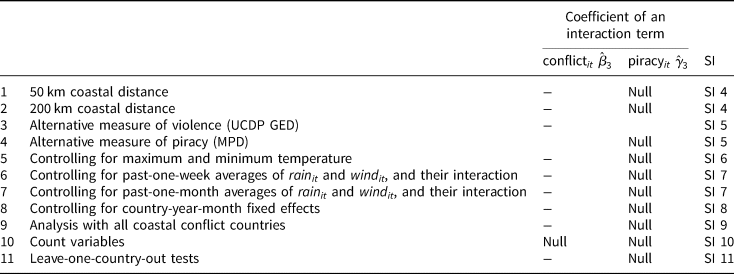
Note: In the table, “−” indicates a significantly negative value of a coefficient, “+” indicates a significantly positive value, and “null” indicates a null result. The section numbers of the supporting information are listed in the last column.
Only when I use the counts of violent events and piracy attacks as outcome variables do the results become statistically indistinguishable from zero (SI 10). As mentioned in the theory section, the typology of substitution is based on the dichotomized outcomes. Because the conditional effects on continuous or count outcome variables can take complicated non-linear functions, it is difficult to empirically identify the conditional effects.
6. Conclusion
In this paper, I argue that substitution and its typology are crucial for understanding the dynamics of armed conflict. A formal analysis indicates that the costs of violence affect rebels' choices. The nature of the effect depends on the type of substitutive relationship—whether an alternative option is a downward, equivalent, or upward substitute for violence. I apply the theoretical argument to rebels' choices over ground and maritime violent activities during civil war and use day-to-day weather variation as exogenous proxies of the operational costs for those activities. The analysis shows that the empirical patterns are the most consistent with the upward substitution hypothesis. A series of mechanism and robustness checks provide further credence to the findings.
A key implication of this study is that the relationship between violence and its alternatives can hinge on the type of substitution. Although recent studies examine the roles of alternative strategies, such as non-violent contestation (Cunningham et al., Reference Cunningham, Dahl and Frugé2017), participation in conventional politics (Cunningham, Reference Cunningham2013), and exile to foreign countries (Salehyan and Gleditsch, Reference Salehyan and Gleditsch2006), they tend to presume a specific relationship of substitution. Cunningham (Reference Cunningham2013), for instance, argues that non-violent contestation does not require large-scale mobilization and is therefore less costly than violent conflict. However, an interesting question is how the interpretation of the empirical findings would change if the relationship were revered and non-violent contestation became a downward or equivalent substitute for violent conflict.
This study also suggests that empirically analyzing substitution requires at least two sources of exogenous variation. Because substitution depends on the costs of two options, we cannot easily identify substitution types without having valid exogenous measurements of both costs. I addressed this problem by exploiting unique analytical advantages in rebels' choices between ground and maritime violent activities. That is, ground rainfall (ocean wind) only affects the costs for ground (maritime) violent activities while not directly changing the operational costs for maritime (ground) violent activities. Future studies can use a similar empirical strategy in other similar cases—though this approach does of course have limitations (e.g., substitution between violent and non-violent tactics, both of which are mostly ground-based). It is a task of future research to expand the theory of substitution, carefully craft a research design, and thus shed more light on the roles of alternative strategies in armed conflict.
Supplementary material
The supplementary material for this article can be found at https://doi.org/10.1017/psrm.2021.47
Acknowledgement
I am grateful to Michael G. Findley, Stephen Jessee, Jay C. Kao, Xin Nong, Scott Wolford, the two anonymous reviewers, and the editors of PSRM for thoughtful comments. I also express appreciation to Ross Buchanan for writing support. This paper was presented at the Southern Political Science Association Annual Meeting in 2019, and the Pacific International Politics Conference in 2019.


 Open access

