





Introduction
Nonprofit organizations (NPOs) operate under various external influences, making it essential to incorporate these factors into a comprehensive assessment of their financial health (Prentice, Reference Prentice2016a). While numerous studies have explored financial predictors essential for sustaining NPOs’ core functions, most adopt a closed-system perspective. They focus on designing financial metrics to evaluate performance but overlook broader contextual factors that shape foundations’ financial health (Prentice, Reference Prentice2016a). Our research analyzes Chinese foundations to investigate the relationships between intraorganizational financial metrics and contextual factors. In China, foundations constitute a legally defined category of NPOs—alongside social associations (社会团体) and social service organizations (社会服务机构)—and primarily operate their own charitable programs rather than focusing on grantmaking (Wang, Reference Wang2023a). Accordingly, references to “foundations” in this study should be understood as counterparts to charitable nonprofits in the U.S. context. By examining which contextual factors influence the financial health of foundations, we emphasize the significance of contextualizing intraorganizational financial metrics within an organization’s unique external environment rather than relying on them in isolation to assess a foundation’s financial health.
Before addressing the research question, it is crucial to understand the financial indicators used to evaluate foundations, recognize the role of contextual factors in financial health, and deepen our understanding of Chinese foundations.
Overview of intraorganizational indicators and the role of contextual factors
In the nonprofit sector, it is widely recognized that evaluating NPOs’ financial performance requires a multifaceted approach (Prentice, Reference Prentice2016b). Extensive research has aimed to establish comprehensive metrics for nonprofit financial management. Tuckman and Chang (Reference Tuckman and Chang1991), pioneers in studying financial health within this sector, proposed a model identifying key indicators of financial vulnerability, including equity adequacy, revenue concentration, administrative cost ratio, and operating margin. Later studies expanded on this model with larger samples and diverse nonprofit types, yielding incremental improvements (Greenlee & Trussel, Reference Greenlee and Trussel2000; Hodge & Piccolo, Reference Hodge and Piccolo2005; Trussel, Reference Trussel2002). Inspired by Altman’s (Reference Altman1968) bankruptcy measure for for-profits, an accounting-based approach with 17 indicators has been developed to assess NPOs’ financial vulnerability (Keating et al., Reference Keating, Fischer, Gordon and Greenlee2005). Bowman (Reference Bowman2011) further suggested six measures to capture both short- and long-term financial capacity and sustainability. These measures primarily focus on intraorganizational factors, such as accounting ratios (e.g., liquidity measures) and revenue-related measures (e.g., revenue portfolio diversification) (Prentice, Reference Prentice2016a).
While recognizing that NPOs face external influences, a thorough financial health assessment should incorporate political and economic factors, as some studies move beyond the closed-system perspective to examine contextual elements, yet lack systematic analysis (Keating et al., Reference Keating, Fischer, Gordon and Greenlee2005; Prentice, Reference Prentice2016a). In the U.S. context, researchers have examined nonprofit financial health using multiple metrics from an open-systems perspective, focusing on environmental influences. These studies, however, emphasize economic dimensions rather than adopting a broader view that also considers regulatory or political contexts. For instance, Prentice (Reference Prentice2016a) analyzed how macroeconomic trends, community characteristics, and peer competition affect financial health, yet all predictors were market- and economy-based. In China, studies typically rely on established financial indicators to assess financial health rather than investigating environmental determinants (Wang & He, Reference Wang and He2018). Related work has explored how political connections or accreditation evaluations influence donations (Cheng & Wu, Reference Cheng and Wu2021; Ni & Zhan, Reference Ni and Zhan2017; Wang, Reference Wang2023b), but these studies focus on single indicators without explicitly addressing financial health and, like U.S. research, examine individual factors rather than broader contextual influences. Additionally, because of different emphases, economic factors and multiple financial indicators in U.S. research versus political and regulatory factors and single financial indicators in Chinese research, the findings differ.
Chinese foundations and current research on the impacts of contextual factors
Chinese foundations hold particular importance as they have historically been established top-down by the government and benefit from abundant resources (Ni & Zhan, Reference Ni and Zhan2017). Furthermore, the number of foundations has surged since the enactment of the 2004 Regulations for Foundation Management, growing eightfold to 7,600 by 2019 (Wang, Reference Wang2023a).
Empirical studies have examined Chinese foundation governance and discussed how contextual factors impact donation income and revenue diversification (Lai et al., Reference Lai, Zhu, Tao and Spires2015; Xu & Liu, Reference Xu and Liu2016). For example, Zhu et al. (Reference Zhu, Ye and Liu2018) found that accountability to multiple stakeholders and active board involvement in networking and decision-making increase revenue diversification by leveraging board members’ social and political capital. Cheng and Wu (Reference Cheng and Wu2021), Henderson (Reference Henderson2011), and Ni and Zhan (Reference Ni and Zhan2017) identified positive relationships between political connections and foundations’ donation levels, as such connections enhance legitimacy and signal credibility. Wang (Reference Wang2023b) showed that higher evaluation scores in voluntary certification programs are positively associated with donations because of political recognition and legitimacy, which improve donor confidence. Similarly, Zhang et al. (Reference Zhang, Marquis and Qiao2016) argued that in weak market institutions, political recognition amplifies reputation and public trust, further boosting donations. Collectively, these studies demonstrate that political and regulatory factors can enhance specific financial outcomes, but they focus on single indicators rather than comprehensive measures of financial health and rarely examine multiple contextual factors simultaneously. This gap underscores our central motivation: to investigate the broader relationship between contextual influences and the overall financial health of Chinese foundations.
The paper is structured as follows: We first develop hypotheses and discuss how Chinese foundations interact with their external environments. These interactions are operationalized through political connections, accreditation results, and city of establishment, with the expectation that foundations with stronger political ties, higher evaluations, and locations in developed cities exhibit better financial health. We then describe the Research Infrastructure of Chinese Foundations (RICF) dataset, define financial health and contextual factors, and outline the ordinary least squares (OLS) model. The following section presents regression results, followed by the conclusion and discussion of limitations.
Theory and hypothesis
In this research, we focus on political connections, accreditation evaluations, and city of establishment as the key contextual factors shaping foundations’ financial health in China. We analyze these factors through the lenses of resource dependency, institutional legitimacy, and network robustness and propose corresponding hypotheses. This selection is guided not only by prior empirical studies reviewed in the previous section but also by the fact that these dynamics operate uniquely in the comparative contexts relative to democratic systems, making them meaningful to explore.
Although governments represent a primary funding source and regulatory authority across regimes, the underlying logic differs. In democratic contexts, studies from the U.S., U.K., Australia, Germany, and France show that state regulation is designed to protect donors, limit fraud, and ensure transparency, while self-regulation often complements government oversight to enhance trust and market efficiency (Barber & Farwell, Reference Barber, Farwell, Dunn, Sidel and Breen2016; Salamon & Anheier, Reference Salamon and Anheier1998). These mechanisms strengthen nonprofits’ legitimacy, diversify income sources, and improve financial sustainability. In comparative contexts, such as China, Vietnam, Tanzania, and Malawi, state regulation also facilitates nonprofit development but primarily aims to channel activities into state-favored directions, with self-regulation often co-opted by the state (Gugerty, Reference Gugerty, Dunn, Sidel and Breen2016; Salamon & Anheier, Reference Salamon and Anheier1998; Sidel, Reference Sidel, Dunn, Sidel and Breen2016). In such settings, alignment with government priorities determines the strength of political connections, which in turn secures favorable financial support. Moreover, in the absence of well-developed market institutions, these relationships provide critical legitimacy, enhancing reputation and public trust, which attract additional financial resources (Cheng & Wu, Reference Cheng and Wu2021; Ni & Zhan, Reference Ni and Zhan2017; Zhang et al., Reference Zhang, Marquis and Qiao2016). In China, legitimacy is conferred through the Nonprofit 5A Accreditation system (Wang, Reference Wang2023a). Together, political connections and accreditation evaluations define the political environment in which foundations operate. Finally, foundations are embedded in regional economic environments, which influence the strength of local infrastructure and the diversity of potential collaborators (Zhu et al., Reference Zhu, Ye and Liu2018). These conditions are essential for network development and revenue diversification. Thus, we treat the city of establishment as a reflection of a foundation’s external economic environment.
Resource dependency management: Strategic political connections and their positive impacts on financial health
Organizations cannot rely solely on internal resources for growth; they also acquire resources from the external environment to enhance organizational capabilities and achieve their goals (AbouAssi et al., Reference AbouAssi, Bowman, Johnston, Bauer and Tran2021; Guo & Acar, Reference Guo and Acar2005; Hsu et al., Reference Hsu, Hsu and Hasmath2017; Pfeffer & Salancik, Reference Pfeffer and Salancik2003). Dependence on the external environment introduces unequal power dynamics, requiring strategic responses to manage the resulting uncertainties (AbouAssi et al., Reference AbouAssi, Bowman, Johnston, Bauer and Tran2021; Pfeffer & Salancik, Reference Pfeffer and Salancik2003). In authoritarian regimes, governments represent one of the primary sources of funding and shape the regulatory landscape for NPOs (Hsu et al., Reference Hsu, Hsu and Hasmath2017). This indicates that government decisions significantly impact resource allocation and determine the financial sustainability of NPOs in a competitive market. Consequently, NPOs strategically build relationships with governments to secure funding and mitigate vulnerabilities amidst shifting economic conditions (Cheng & Wu, Reference Cheng and Wu2021).
Scholars have examined the role of political connections in providing financial advantages to NPOs in China. These connections enhance access to government funding (Zhao et al., Reference Zhao, Wu and Tao2016). In China, most contract funding and grants are directed to NPOs whose personnel or finances are partly or fully controlled by government agencies (Zhao et al., Reference Zhao, Wu and Tao2016) due to their established communication channels with the government, facilitating access to government-controlled resources (Ni & Zhan, Reference Ni and Zhan2017). Consequently, NPOs with political ties are more likely to secure government subsidies, which support personnel costs, program execution, and capacity building, thereby achieving financial stability (Zhao et al., Reference Zhao, Wu and Tao2016; Hebei Youth Development Foundation, 2020). These organizations also tend to run high-profile programs that attract attention with government support. For example, the China Youth Development Foundation, through Project Hope, runs various initiatives that have become a symbol of educational progress in China (China Youth Development Foundation, n.d.), consistently receiving government support and avoiding termination risks. Additionally, political connections encourage donations from public employees due to administrative mandates. Public employees in China are sometimes required to contribute to charitable initiatives led by politically connected NPOs (Wang, Reference Wang2023b), with some local governments promoting “donate one yuan a day” programs or even deducting contributions directly from salaries (Wang, Reference Wang2023b). Thus, NPOs with political connections often establish stronger governmental relationships, securing greater financial support.
This leads to our first hypothesis: Foundations with political connections typically exhibit better financial health (H1).
Institutional legitimacy: Better accreditation results, higher recognition, and extensive financial support
In addition to direct funding, foundations must secure resources that indirectly enhance their capacity to attract funds, such as legitimacy, information, and reputation, by adhering to institutional norms within their field (AbouAssi et al., Reference AbouAssi, Bowman, Johnston, Bauer and Tran2021; Wang, Reference Wang2023a). In authoritarian countries, governments are dominant actors in the institutional environment, implying that government recognition enhances foundations’ legitimacy. Furthermore, due to the limited development of market institutions in China, political connections provide legitimacy by strengthening foundations’ reputations and consolidating public trust (Cheng & Wu, Reference Cheng and Wu2021; Ni & Zhan, Reference Ni and Zhan2017; Zhang et al., Reference Zhang, Marquis and Qiao2016). Consequently, political connections help foundations attract private donations, benefiting asset accumulation, increasing surplus, and diversifying revenue sources (Cheng & Wu, Reference Cheng and Wu2021; Zhang et al., Reference Zhang, Marquis and Qiao2016).
Accreditation serves as a means to standardize the performance of NPOs and establish their legitimacy (Wang, Reference Wang2023a), thus constituting a viable metric for assessing foundations’ adherence to institutional norms (Meyer & Rowan, Reference Meyer and Rowan1977). Research has demonstrated the positive impact of accreditation on NPOs’ trust, reputation, fundraising, and financial performance (Adena et al., Reference Adena, Alizade, Bohner, Harke and Mesters2019; Feng et al., Reference Feng, Neely and Slatten2019). China introduced the Nonprofit 5A Accreditation system, which categorizes NPOs from 1A to 5A based on basic organizational conditions, governance, performance, and social recognition, with 3A denoting the threshold for passing (Luo et al., Reference Luo, Zheng and Long2023; Wang, Reference Wang2023b). Foundations with a 3A or higher rating gain government recognition, which confers legitimacy and attracts a broader and larger volume of donations.
Therefore, we hypothesize: Foundations that conform to institutional norms, as indicated by achieving passing results in the accreditation system, demonstrate better financial health (H2).
Network robustness: Stable and diverse resource guarantees in developed cities
Networks offer foundations broader opportunities for information sharing and collaboration (Granovetter, Reference Granovetter1985; Guo & Acar, Reference Guo and Acar2005). Strong ties provide organizations with stable, readily accessible resources, while weak ties contribute nonredundant resources (Granovetter, Reference Granovetter1983, Reference Granovetter1973).
As societies progress, urbanization leads to larger populations, robust infrastructure, and greater investment, creating a dynamic market involving various entities (Carroll & Stater, Reference Carroll and Stater2009). In such environments, nonprofit board members are more likely to represent diverse communities and maintain connections with a range of external entities (MacIndoe & Sullivan, Reference MacIndoe and Sullivan2014). When board members engage in boundary-spanning activities (Zhu et al., Reference Zhu, Ye and Liu2018), nonprofits in developed cities are more likely to establish strong and diverse networks. This mechanism enhances nonprofit revenue (Hodge & Piccolo, Reference Hodge and Piccolo2005).
Overall, foundations in developed cities benefit from greater economic capacity, stronger institutional infrastructure, richer human capital, and more collaborative opportunities, enabling them to build diverse networks and expand their funding sources. Prior research shows that regional GDP per capita serves as a proxy for local resource availability and is positively associated with revenue diversification among Chinese NPOs (Zhu et al., Reference Zhu, Ye and Liu2018). Revenue diversification enhances financial stability (Zhu et al., Reference Zhu, Ye and Liu2018).
Thus, the third hypothesis follows: Foundations in developed cities exhibit better financial health (H3).
Method
Data
We utilize data from the RICF, a comprehensive repository offering detailed insights into different aspects of Chinese foundations (Ma et al., Reference Ma, Wang, Dong and Li2017). It encompasses a broad range of information, including organizational personnel, demographic profiles, financial metrics, and charitable programs. The dataset is curated from various authoritative sources, such as Chinese governments’ official websites, foundations’ official online platforms, and credible magazines or websites, ensuring the reliability and accuracy of the information.
We focus on the most recent clean data available from 2013 to 2016. To ensure meaningful analysis, we exclude observations with zero total assets, zero total annual expenses, and zero total revenue, as these may indicate that the foundations are inactive or at risk of ceasing operations (Wang & He, Reference Wang and He2018). After this exclusion, 8,114 observations remain. To address extreme outliers in the outcome variables, we apply Tukey’s (Reference Tukey1977) 1.5 × interquartile range (IQR) rule, where the IQR represents the distance between the 25th and 75th percentiles. Values lying more than 1.5 × IQR below the 25th percentile or above the 75th percentile are treated as outliers and winsorized to cap extremes, improving data quality while retaining most observations.
Outcome variables
We adopt the financial health indicators framework introduced by Tuckman and Chang (Reference Tuckman and Chang1991). Widely applied in Western contexts, this four-indicator model has yielded reliable research results (Greenlee & Trussel, Reference Greenlee and Trussel2000; Wang & He, Reference Wang and He2018). It has also proven useful in comparative settings. For example, Sulaiman and Zakari (Reference Sulaiman, Zakari and El-Karanshawy2015) applied the full set of indicators to assess the financial sustainability of Malaysia’s Islamic endowments; Bukhori et al. (Reference Bukhori, Othman, Aris and Omar2013) used them to examine the financial vulnerability of Malaysian cooperatives, which are tax-exempt, member-owned entities in the broader social economy; Wang and He (Reference Wang and He2018) used the indicators and quartile groupings to evaluate Chinese foundations’ financial health; and Silva and Burger (Reference Silva and Burger2015) combined these indicators with others to analyze the relationship between NPO characteristics and financial vulnerability in Uganda. These studies demonstrate the framework’s strong potential for assessing the financial health of Chinese foundations.
Equity adequacy
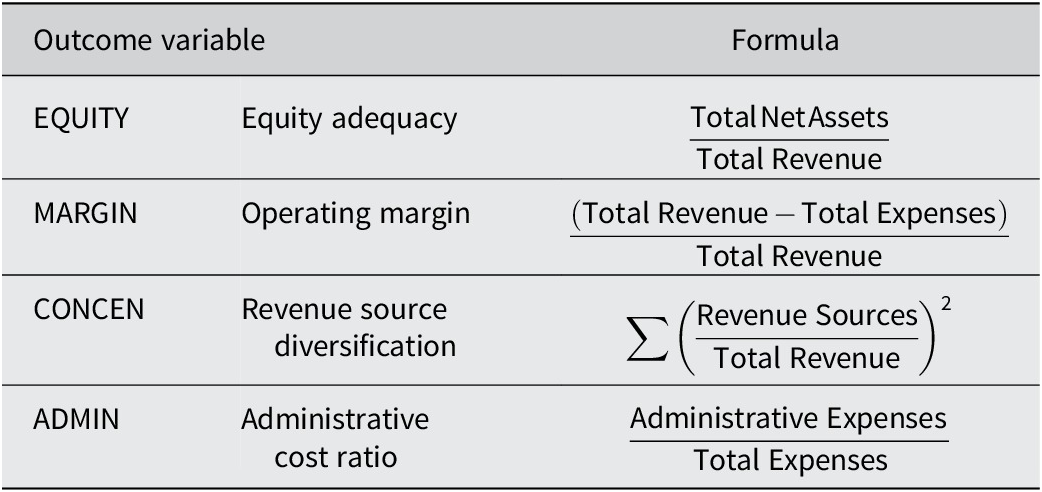
In Tuckman and Chang’s framework, financial health is reflected by four measures (see Table 1). The first measure, equity adequacy (EQUITY), is a continuous variable calculated by dividing total net assets by total revenue. A higher ratio indicates a foundation with substantial reserves relative to its revenue, suggesting it has sufficient assets to maintain operations during economic downturns and secure credit in financial markets (Trussel & Parsons, Reference Trussel and Parsons2007; Tuckman & Chang, Reference Tuckman and Chang1991; Wang & He, Reference Wang and He2018).
Calculation of outcome variables

Table 1. Long description
The table consists of three columns: Outcome variable, Description, and Formula.
* Row 1: E Q U I T Y, representing Equity adequacy. The formula is Total Net Assets all over Total Revenue.
* Row 2: M A R G I N, representing Operating margin. The formula is the numerator open parenthesis Total Revenue minus Total Expenses close parenthesis all over the denominator Total Revenue.
* Row 3: C O N C E N, representing Revenue source diversification. The formula is the summation of the open parenthesis numerator Revenue Sources all over denominator Total Revenue close parenthesis squared.
* Row 4: A D M I N, representing Administrative cost ratio. The formula is Administrative Expenses all over Total Expenses.
Operating margin
The second item is the operating margin (MARGIN), which evaluates a foundation’s surplus using the formula: (Total Revenue − Total Expenses)/Total Revenue (Tuckman & Chang, Reference Tuckman and Chang1991). This continuous variable indicates financial health, where a higher value shows the foundation has a surplus to weather unexpected crises (Trussel & Parsons, Reference Trussel and Parsons2007). A negative value, however, suggests that expenses exceed revenue.
Revenue source diversification
Third, revenue source diversification (CONCEN)Footnote 1 is indicated by the sum of the squares of each revenue source amount divided by total revenue (Tuckman & Chang, Reference Tuckman and Chang1991). Ranging from 0 to 1, a value close to 1 suggests higher revenue concentration, indicating poorer financial flexibility and autonomy (Trussel & Parsons, Reference Trussel and Parsons2007; Tuckman & Chang, Reference Tuckman and Chang1991).
Administrative cost ratio
The final variable, the administrative cost ratio (ADMIN), is calculated as administrative expenses divided by total expenses. A higher ADMIN suggests an organization’s ability to reduce overhead rather than cut charitable programs during crises (Tuckman & Chang, Reference Tuckman and Chang1991), and may also reflect investment in capacity building (e.g., employee benefits and information technology) that can enhance effectiveness within a certain range (Berrett, Reference Berrett2022). In China, however, the 2004 Regulation limits administrative expenses to no more than 10% of total annual expenditures, and exceeding this threshold triggers regulatory scrutiny. Our data show that only about 11% of foundations exceed the 10% threshold in any given year. Accordingly, in the Chinese context, a higher ADMIN is treated as a financial red flag, while its interpretation warrants caution in other institutional settings.
To ensure comparability, we convert all outcome variables into percentiles ranging from 0 to 1. This transformation also aids interpretation, where a one-unit change in the predictor variables corresponds to a predicted change in percentage points for the outcome variables.
Independent variables
To explore the effects of contextual factors on the foundations’ financial health, we first examine political connections. Political connection is represented as a binary variable indicating whether the foundation has managers who are government employees, coded as 0 if there are no government employees and 1 if there are.
Next, we consider the evaluation results of Chinese Nonprofit 5A Accreditation. The accreditation system categorizes NPOs from 1A to 5A, with 3A as the passing threshold (Luo et al., Reference Luo, Zheng and Long2023; Wang, Reference Wang2023b). Consequently, evaluation results are treated as a binary variable: Foundations scoring below 3A are coded as 0, and those achieving 3A or higher are coded as 1. Foundations not participating in the evaluation system are also categorized as scoring below 3A.
Finally, we include the city of establishment. The “New First-tier Cities Research Institute,” an initiative by China Business Weekly, publishes the “China City Business Charm Ranking” annually. In this ranking, cities are categorized into five tiers, with “new first-tier” cities classified as newly elevated to the first tier in a given year. City of establishment is coded as an ordinal variable: Foundations in first-tier and “new first-tier” cities are coded as 1, while those in second-, third-, fourth-, and fifth-tier cities are coded as 2, 3, 4, and 5, respectively. City rankings were updated in 2013 and 2016; for intermediate years, we applied the 2013 rankings to 2014 and the 2016 rankings to 2015, thereby capturing changes over time while maintaining the ordinal structure of the variable.
Control variables
In our research, unobservable effects may arise from foundation type and organizational characteristics. In China, distinct regulations govern public and private foundations, influencing expenditure patterns and funding sources. To account for this, we include foundation type as a binary control variable, coding private foundations as 0 and public foundations as 1. Additionally, previous research indicates that organizational-level factors affect financial performance (Lam & McDougle, Reference Lam and McDougle2016). For instance, large organizations are typically associated with stable financial conditions (Lam & McDougle, Reference Lam and McDougle2016). Accordingly, we control for key organizational-level variables, including foundation age (calculated as the difference between the data collection date and the establishment date), the number of full-time employees (a discrete variable), and asset size (a continuous variable measured as the natural logarithm of total assets) (Lam & McDougle, Reference Lam and McDougle2016; Trussel & Parsons, Reference Trussel and Parsons2007).
Estimation strategy
We employ OLS regression on pooled yearly data to examine how contextual factors relate to the financial health of foundations, as this method allows annual comparisons across organizations rather than focusing on within-organization changes over time. Additionally, the predictors are stable: Among foundations observed between 2013 and 2016, only 9.8% changed political connection status, 8.9% changed evaluation results, and 5.3% changed city tier (see Appendix A for summary tables and histograms). Therefore, we use contemporaneous yearly outcomes and predictors. The model is:

In Equation (1), $ {\mathrm{DepVar}}_{it} $
represents one of the four financial health indicators for each foundation in each year from 2013 to 2016. Coefficients
$ {\mathrm{DepVar}}_{it} $
represents one of the four financial health indicators for each foundation in each year from 2013 to 2016. Coefficients $ {\beta}_1 $
to
$ {\beta}_1 $
to $ {\beta}_3 $
capture the impact of a one-unit change in political connections, evaluation results, and city of establishment, respectively, on financial health.
$ {\beta}_3 $
capture the impact of a one-unit change in political connections, evaluation results, and city of establishment, respectively, on financial health. $ {\mathrm{ControlVars}}_{it} $
include foundation age, number of full-time employees, asset size, and foundation type. The model will be estimated four times using OLS, once for each financial health indicator.
$ {\mathrm{ControlVars}}_{it} $
include foundation age, number of full-time employees, asset size, and foundation type. The model will be estimated four times using OLS, once for each financial health indicator.
Results and interpretation
Descriptive overview
After pooling all observations by year (justified by the comparability of foundations’ financial patterns over time; see Appendix B), Figure 1 visualizes the distributions of financial indicators. These analyses reveal distinct distribution patterns for each financial indicator.
Histograms of financial outcome variables for pooled observations.

Fig. 1. Long description
The multi-panel figure contains four histograms arranged in a two-by-two grid.
Panel a, top-left, titled Histogram of Equity Adequacy. The x-axis ranges from 0 to 30. The y-axis represents Frequency from 0 to 1200. The data shows a right-skewed distribution with a primary peak near 1.5 and smaller secondary peaks between 20 and 30.
Panel b, top-right, titled Histogram of Operating Margin. The x-axis ranges from negative 1.0 to 1.0. The y-axis represents Frequency from 0 to 600. The distribution is bimodal, with a significant cluster of bars between negative 1.5 and negative 1.0, and a larger, broader peak centered just above 0.0.
Panel c, bottom-left, titled Histogram of Revenue Source Diversification. The x-axis ranges from 0.3 to 1.0. The y-axis represents Frequency from 0 to 3000. The data is heavily left-skewed, with a massive spike at the 1.0 mark and very low frequency across the rest of the range.
Panel d, bottom-right, titled Histogram of Administrative Cost Ratio. The x-axis ranges from 0.000 to 0.175. The y-axis represents Frequency from 0 to 1400. The distribution shows a sharp peak at 0.000, followed by a steady decline as the ratio increases, with a small uptick at the far right end of the scale near 0.175.
The distribution of equity adequacy is right-skewed, with most values concentrated between 0 and 10, indicating that the majority of observations reflect limited financial reserves. For operating margin, the distribution exhibits a clear bimodal pattern, with peaks around −1.1 and 0. This polarization suggests that while some organizations experience poor financial performance, others maintain a minimal surplus. The distribution of revenue source diversification is left-skewed, with most observations clustered near 1. This indicates that they rely on concentrated revenue streams, reflecting financial vulnerabilities. However, the small tail ranging from 0.3 to 0.6 reveals a subset of observations with diversified revenue sources. The administrative cost ratio shows a positively skewed distribution, with the majority of observations below 0.10. This suggests that most organizations maintain low administrative costs, countering potential concerns about the effects of the 2004 Regulation.
Overall, these distributions highlight significant variability across observations for each financial indicator. This variability underscores the need for further exploration of the organizational characteristics and external environments influencing these patterns.
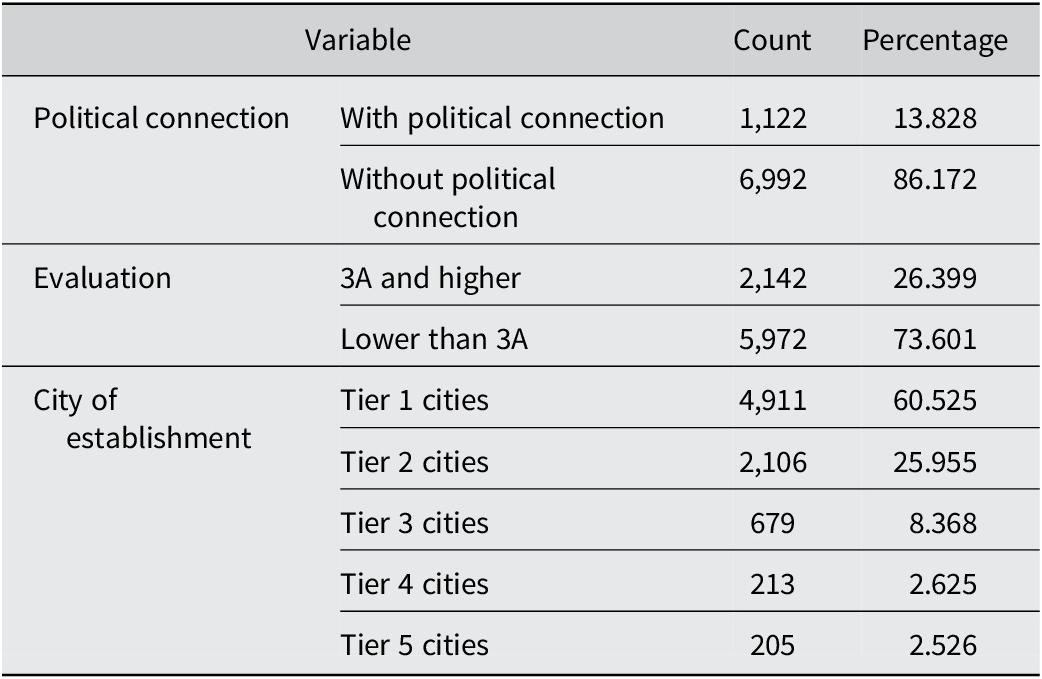
Additionally, Table 2 provides an overview of the contextual characteristics relevant to pooling observations. Most foundations lack political connections and do not meet evaluation standards, with a higher concentration situated in developed cities. To further examine the relationship between contextual factors and foundations’ financial health, we proceed to the regression analysis results.
Descriptive information of independent variables

Table 2. Long description
The table is organized into four columns: Variable, Sub-category, Count, and Percentage.
* Political connection:
- With political connection: Count 1,122, Percentage 13.828.
- Without political connection: Count 6,992, Percentage 86.172.
* Evaluation:
- 3 A and higher: Count 2,142, Percentage 26.399.
- Lower than 3 A: Count 5,972, Percentage 73.601.
* City of establishment:
- Tier 1 cities: Count 4,911, Percentage 60.525.
- Tier 2 cities: Count 2,106, Percentage 25.955.
- Tier 3 cities: Count 679, Percentage 8.368.
- Tier 4 cities: Count 213, Percentage 2.625.
- Tier 5 cities: Count 205, Percentage 2.526.
The relationship between contextual factors and foundations’ financial health
Applying the OLS model, we find that contextual factors uniquely influence four financial metrics. This subsection will delve into the specific impacts of these contextual factors within China’s unique context.
Established political connections: A positive predictor of financial health
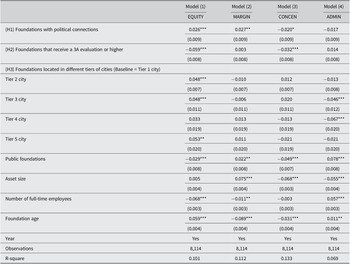
In Table 3, Model 1 demonstrates that foundations with political connections experience a 2.6 percentage point increase in their equity percentile rank compared to those without political connections, and this result is statistically significant. Model 2 also shows a statistically significant positive relationship between political connections and the percentile rank of operating margin. Model 3 suggests a significant positive relationship between political connections and revenue source diversification percentile rank. Model 4 indicates a negative relationship between political connections and the administrative cost percentile rank, but this result is not statistically significant (p = 0.072). Model 4 indicates a statistically significant negative relationship between political connections and the administrative cost ratio percentile rank. Overall, the effects of political connections on financial health indicators are consistent, with most results being statistically significant, except for administrative costs. Thus, our first hypothesis is supported: Foundations with political connections exhibit better financial health.
The prediction of foundations’ financial health using political connections, evaluation results, and locations

Table 3. Long description
The table presents regression results for 8,114 observations across four models. The columns are Model 1 E Q U I T Y, Model 2 M A R G I N, Model 3 C O N C E N, and Model 4 A D M I N.
Key findings by row:
* H 1 Foundations with political connections: Positive significant coefficients for E Q U I T Y 0.026 and M A R G I N 0.027; negative significant for C O N C E N negative 0.020.
* H 2 Foundations with 3 A evaluation or higher: Negative significant for E Q U I T Y negative 0.059 and C O N C E N negative 0.032.
* H 3 City Tiers (Baseline Tier 1): Tier 2, 3, and 5 cities show positive significant coefficients for E Q U I T Y ranging from 0.048 to 0.053. Tier 3 and 4 cities show negative significant coefficients for A D M I N negative 0.046 and negative 0.067 respectively.
* Public foundations: Negative significant for E Q U I T Y negative 0.029 and C O N C E N negative 0.049; positive significant for M A R G I N 0.022 and A D M I N 0.078.
* Asset size: Positive significant for M A R G I N 0.075; negative significant for C O N C E N negative 0.068 and A D M I N negative 0.055.
* Number of full-time employees: Negative significant for E Q U I T Y negative 0.068 and M A R G I N negative 0.011; positive significant for A D M I N 0.057.
* Foundation age: Positive significant for E Q U I T Y 0.059 and A D M I N 0.011; negative significant for M A R G I N negative 0.089 and C O N C E N negative 0.031.
All models include Year controls. R-square values are 0.101, 0.112, 0.133, and 0.069 respectively. Standard errors are provided in parentheses below each coefficient.
Note: All outcome variables, including EQUITY, MARGIN, CONCEN, and ADMIN, have been converted into percentiles ranging from 0 to 1. EQUITY = equity adequacy, MARGIN = operating margin, CONCEN = revenue source diversification, ADMIN = administrative cost ratio. A higher value in EQUITY and MARGIN indicates better financial performance, while a higher value in CONCEN reflects a higher concentration of revenue sources, which signals worse financial performance. Additionally, a higher value in ADMIN represents poorer financial performance in the Chinese context.
*p < 0.05, **p < 0.01, ***p < 0.001.
The positive relationship between political connections and foundations’ financial health can be attributed to several factors. First, foundations with political connections prioritize the 2004 Regulation, which views higher administrative costs unfavorably; as a result, these foundations typically maintain a lower administrative cost. Second, as discussed, strong government ties enable foundations to secure government grants covering operational and program expenses (Ni & Zhan, Reference Ni and Zhan2017; Zhao et al., Reference Zhao, Wu and Tao2016). Additionally, administrative requirements and legitimacy provided by government associations help foundations attract larger and more diverse donations (Cheng & Wu, Reference Cheng and Wu2021; Wang, Reference Wang2023b; Zhang et al., Reference Zhang, Marquis and Qiao2016). These grants and donations allow foundations to accumulate assets over the long term and generate short-term surpluses, while diverse revenue sources contribute to financial stability, thereby reflecting positive financial health across the four financial indicators.
Accreditation evaluation results: Attracting diverse funding while limiting asset accumulation
The output shows that receiving a 3A or higher evaluation in the accreditation system is positively related to operating margin and revenue source diversification, while negatively related to equity adequacy and administrative cost ratio. In Model 1, receiving a 3A or higher evaluation is significantly associated with a lower equity adequacy percentile rank. However, in Model 2, a 3A or higher evaluation is linked to a higher operating margin percentile rank, though this result is not statistically significant (p = 0.675). This discrepancy may be due to selection bias. When the Nonprofit 5A Accreditation was introduced in 2012, the Ministry of Civil Affairs aimed for 30% participation among nonprofits (Luo et al., Reference Luo, Zheng and Long2023). However, even in Shenzhen, where participation is relatively high, only 26.6% of nonprofits in a sample engaged in the accreditation process (Luo et al., Reference Luo, Zheng and Long2023). Research shows that organizations with a higher level of professionalism are more likely to recognize the value of accreditation, while those with political connections are more inclined to participate in the accreditation (Luo et al., Reference Luo, Zheng and Long2023). These organizations are confident in achieving favorable outcomes and are focused on meeting the evaluation criteria. The accreditation evaluates four aspects: organizational conditions, governance, performance, and social recognition, with specific metrics provided by various government levels (The Ministry of Civil Affairs, n.d.). In Shenzhen’s evaluation guidelines, the “Activities and Impacts” category emphasizes program operation, encouraging foundations to invest in charitable programs. The “Financial Management” category stresses stable increases in revenue and expenditure on charitable programs (Shenzhen Market Supervisory Authority, 2024). Thus, foundations aiming for high evaluation scores prioritize short-term actions, such as raising funds and investing in programs, over long-term asset accumulation. As a result, they perform poorly in equity adequacy but well in operating margin, reflecting a strategic trade-off between short- and long-term financial considerations.
Model 3 shows statistically significant positive effects of higher evaluation results on revenue source diversification. The accreditation initiated by the government tends to attract organizations with political connections (Luo et al., Reference Luo, Zheng and Long2023). Also, the accreditation emphasizes party building and collaboration with governments (Shenzhen Market Supervisory Authority, 2024). Higher evaluation levels, therefore, indicate stronger political connections and organizational legitimacy (Wang, Reference Wang2023b), which can lead to increased donations and revenue sources (Cheng & Wu, Reference Cheng and Wu2021; Zhang et al., Reference Zhang, Marquis and Qiao2016). Additionally, the effect on administrative cost ratio is positive but not statistically significant (p = 0.088). Overall, the regression analysis provides mixed support for Hypothesis 2.
Location in developed cities: A negative predictor of financial health
In our third hypothesis, we propose that foundations in developed cities exhibit better financial health due to their active markets and greater opportunities to establish networks with diverse entities that provide both stable and unique resources. However, our regression results indicate that foundations in developed cities have poorer financial health compared to those in less developed areas. Model 1 indicates that, relative to foundations in Tier 1 (most developed) cities, those in Tiers 2, 3, and 5 report significantly higher equity adequacy. Model 4 shows that foundations in Tiers 3 and 4 have lower administrative costs than those in Tier 1. No significant differences emerge in operating margins or revenue diversification. These results do not support our third hypothesis.
Several factors may explain this. Developed cities typically have more heterogeneous populations and a higher demand for nonprofit services, resulting in larger foundation sizes (Carroll & Stater, Reference Carroll and Stater2009; Lu & Dong, Reference Lu and Dong2018). These foundations should remain active to meet the high needs of their communities. As a result, mission-driven foundations prioritize program implementation over accumulating net assets, resulting in lower equity adequacy. Furthermore, larger organizational size and the high costs associated with operating in developed cities tend to reduce surpluses and increase administrative costs.
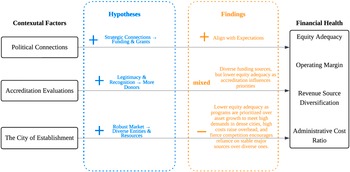
Additionally, building on network theory, weak ties offer nonoverlapping resources and help establish new relationships (Granovetter, Reference Granovetter1973). In contrast, strong ties are readily available, provide greater motivation to help, and yield immediate benefits (Granovetter, Reference Granovetter1983). Foundations based in larger cities are more likely to receive substantial and consistent support from local governments and corporations, leading to greater efficiency. Consequently, these organizations are not incentivized to invest in establishing weak ties or diversifying their revenue streams. This may help explain why our results show no significant differences in revenue concentration between Tier 1 cities and other city tiers, despite expectations from previous empirical research. Moreover, our data indicate that Tier 1 cities have a high density of foundations, suggesting a competitive landscape. Thus, foundations in these areas may focus on securing stable, concentrated funding sources rather than pursuing a broader range of uncertain opportunities. In summary, Figure 2 presents the connections between contextual factors and foundations’ financial health, showing both the hypothesized relationships and the empirical findings.
Hypotheses versus findings on foundations’ financial health.

Fig. 2. Long description
The flowchart is organized into four vertical sections connected by horizontal arrows.
1. Contextual Factors (Left): Three boxes listed vertically contain Political Connections, Accreditation Evaluations, and The City of Establishment.
2. Hypotheses (Blue dashed box): Each factor is associated with a blue plus sign and a hypothesized positive mechanism.
- Political Connections: Strategic Connections yields Funding and Grants.
- Accreditation Evaluations: Legitimacy and Recognition yields More Donors.
- The City of Establishment: Robust Market yields Diverse Entities and Resources.
3. Findings (Orange dashed box): Describes the actual results compared to hypotheses.
- Top row: An orange plus sign labeled Align with Expectations.
- Middle row: Labeled mixed. Notes diverse funding sources but lower equity adequacy as accreditation influences priorities.
- Bottom row: An orange minus sign. Notes lower equity adequacy as programs are prioritized over asset growth to meet high demands in dense cities, high costs raise overhead, and fierce competition encourages reliance on stable major sources over diverse ones.
4. Financial Health (Right): A single vertical box containing four outcome metrics: Equity Adequacy, Operating Margin, Revenue Source Diversification, and Administrative Cost Ratio.
Discussion
Our study reveals that political connections positively influence financial health, foundations in developed cities tend to exhibit weaker financial health, and higher accreditation evaluations have mixed effects. Our research innovatively integrates the external political and economic environments of foundations to provide a comprehensive explanation of their financial performance, offering valuable insights for both academia and practice. However, it has limitations, which future research could address.
Implications for foundations: Balancing financial metrics with strategic financial management aligned to contextual factors
Our research highlights that absolute financial metrics alone do not capture a foundation’s financial health. Instead, external factors provide a critical context for understanding these financial conditions. Our findings reveal that variations in the same contextual factors uniquely influence financial metrics, sometimes creating tensions between them. For example, Chinese foundations receiving a 3A or higher evaluation in the accreditation system exhibit positive financial indicators such as diversified revenue sources, but they also show negative indicators, including weaker equity adequacy. Moreover, while studies often argue that foundations in developed cities enjoy better financial health, our findings suggest otherwise.
These findings suggest that Chinese foundations should balance attention to financial metrics with an understanding of external environmental influences to achieve sustainable operations. Specifically, given the positive associations between political connections and financial health, foundations can seek to build relationships with governments to secure stable and substantial financial support. This can be achieved by leveraging board members’ networks, participating in government-led forums and exchanges, and aligning some project goals with public policy priorities. For foundations aiming to diversify funding sources and achieve a surplus in the short term, improving performance in the accreditation system is a practical strategy. Enhanced accreditation can bolster reputation and public trust, attracting a wider range of donors and generating more surplus. Such foundations should align their priorities with accreditation criteria, invest in charitable program operations, and avoid undue concern over weak asset accumulation performance. Foundations in developed cities should diversify financial support to include multiple entities that can provide backup during revenue shortfalls and overcome inertia in financial practices. Due to larger organizational size and higher operating costs in developed cities, these foundations need to plan overhead expenditures carefully. However, they should not overemphasize lowering administrative cost ratios.
Reframing financial health measures in the comparative contexts
The recognized indicators for measuring the financial health of nonprofits, such as those developed by Tuckman and Chang (Reference Tuckman and Chang1991), originate from Western contexts, which limits their applicability in comparative settings. For example, some studies omit these indicators due to data constraints or their lack of relevance to local conditions and combine the framework with other approaches (e.g., Silva & Burger, Reference Silva and Burger2015), complicating comparability across studies and increasing data processing complexity. Additionally, many studies apply these indicators primarily for descriptive purposes (Bukhori et al., Reference Bukhori, Othman, Aris and Omar2013; Sulaiman & Zakari, Reference Sulaiman, Zakari and El-Karanshawy2015; Wang & He, Reference Wang and He2018), which may provide only surface-level insights but fail to reveal the underlying factors shaping financial conditions, increasing the risk of misinterpretation.
Our study adapts Tuckman and Chang’s framework for China, demonstrating its applicability in the comparative contexts. We adjusted the administrative cost ratio threshold to 10 percent to reflect local conditions, while retaining the other three indicators unchanged, as their underlying components (e.g., total net assets, total revenue, and total expenses) are comparable across contexts. For revenue diversification, the formula remains constant, but the classification of revenue sources can differ across studies, even within the same country, due to research design choices rather than limitations of the framework. By showing how it can be adapted for regression in the comparative settings, our study enhances confidence in the reliability of these measures for statistical applications.
Limitations and future research
At the conclusion of our study, we acknowledge several limitations that future research could address. First, we treated political connections as a binary variable, which simplifies the complexity of connections and their varying degrees of influence on foundations’ financial health. For example, scholars have identified three types of political connections: foundations affiliated with governments, political figures linked to foundations, and interpersonal relationships between government officials and foundation managers (Sun et al., Reference Sun, Mellahi and Wright2012). These different types of connections suggest varying levels of resource interaction and distinct impacts on the financial health of Chinese foundations (Zhou & Ye, Reference Zhou and Ye2021). However, due to data limitations, we were unable to quantify interpersonal relationships. Future research could address these nuances through qualitative approaches.
Second, our analysis examines contextual factors and financial health across all foundations without distinguishing mission types or service domains. Although China lacks a universal classification system comparable to U.S. NTEE codes, future research could categorize foundations by mission using website and report content. Typologies informed by relevant attributes and prior literature, combined with machine-learning classifiers, could enable systematic mission classification. This would allow comparative analyses across mission areas. Collaborative efforts could further support cross-country comparisons among similarly regulated NPOs in developing contexts, offering valuable insights for practitioners.
Furthermore, future research could incorporate mission- and values-based measures to complement the financial efficiency perspective emphasized in this study. Doing so would provide a more comprehensive understanding of how external environments influence both financial performance and value delivery. For example, integrating community-centered impact measures alongside financial indicators could offer a fuller assessment of NPO success and inform strategic financial management.
Finally, as circumstances evolve, future research should examine additional factors that influence foundations’ financial health and their external environments. Although political connections in our sample are relatively stable, examining the dynamics of government relationships may reveal vulnerabilities when political priorities shift or government support is withdrawn. In addition, technological advancements may enhance transparency and stakeholder engagement, potentially narrowing the resource gap between politically connected and unconnected foundations (Zhou & Ye, Reference Zhou and Ye2021).
Supplementary material
The supplementary material for this article can be found at http://doi.org/10.1017/S0957876526000276.
Acknowledgments
This paper was presented at the 53rd ARNOVA Conference. We sincerely thank Jessica Berrett, Noah DiAntonio, Mary F. Evans, Anika Tasnim Hossain, Ken-Hou Lin, Marilu Nuñez Palomino, Shiqi Peng, Maddie Shorman, Sarah Traore Kane, Liz Wong, and Huitan Xu for their valuable feedback and insights, which greatly contributed to improving this work. We also appreciate the thoughtful suggestions from the reviewers, which further strengthened this paper.
Funding statement
J.M. acknowledges the support from (1) Zhejiang Dunhe Foundation, (2) the Gradel Institute of Charity, New College, University of Oxford, (3) USTC Summer Fellowships (Grant Nos. S19582024 and S19582025), and computing resources through (4) the Texas Advanced Computing Center at the University of Texas at Austin (Keahey et al., Reference Keahey, Anderson, Zhen, Riteau, Ruth, Stanzione, Cevik, Colleran, Gunawi, Hammock, Mambretti, Barnes, Halbah, Rocha and Stubbs2020) and (5) Dell Technologies, Client Memory Team and AI Initiative PoC Lead Engineer Wente Xiong.
Competing interests
The authors declare that they have no competing interests.



 Open access

