


INTRODUCTION
Human parvovirus B19 infection is associated with a wide spectrum of diseases (for review see [Reference Heegaard and Brown1, Reference Kerr, Modrow and Berns2]). In addition to acute infection resulting in anaemia and erythema infectiosum (fifth disease), a childhood disease, acute symmetrical polyarthropathy or arthritis in children and adults were reported as clinical manifestations. Depending on the week of gestation B19 infection can be life-threatening for the fetus as it might cause hydrops foetalis and fetal death. Acute infection of pregnant women during the first 20 weeks of gestation is associated with a 6–9% excess of foetal loss [Reference Miller3–Reference Enders7].
Parvovirus B19 is transmitted by respiratory aerosol spread from individuals with acute infection [Reference Chorba8]. The majority of infections occur during childhood and adolescence. Although the infection is endemic, regional epidemics are reported preferentially during late winter and spring [Reference Enders, Weidner and Enders9]. In developed countries seroprevalence characterized by IgG against the viral capsid proteins VP1 and VP2 has been reported as being about 2–21% in children aged 1–5 years, 30–40% in adolescents (aged 15 years) and 40–60% in young adults (aged 20 years) and may reach maximum levels in the elderly with over 90% [Reference Cohen and Buckley10–Reference Vyse13]. In Germany, only limited data have been published for selected groups, recording values of 69·8% for pregnant women [Reference Enders, Weidner and Enders9], 68% for blood donors with a mean age of 35 years [Reference Pfrepper, Enders and Motz14] and 77% for individuals aged ⩾60 years [Reference Eis-Hübinger15]. Detailed epidemiological data about parvovirus B19 infection are essential for both, since the medical care-management of acute infections in pregnant women and the protective legislation during pregnancy and maternity prohibit the employment of pregnant women if the occupational activities endanger the health of either the pregnant woman or the fetus. We tested a representative panel of sera collected from adults in former Eastern Germany (FEG) and former Western Germany (FWG) during the German National Health Survey and from healthy Thuringian children and adolescents for the presence of IgG against parvovirus B19. These data offer new insights into the seroepidemiology of the infection and may provide a basis for reconsidering official guidelines.
MATERIAL AND METHODS
Samples
Adult population (18–79 years)
The recruitment of German residents to participate in the 1997–1998 German National Health Examination Survey has been described in detail elsewhere [Reference Thefeld, Stolzenberg and Bellach16]. Stratified sampling was used to select 130 sampling points (communities of fewer than 50 000 inhabitants and city wards in cities with more than 50 000 inhabitants). All sampling points were stratified according to state and community type (size, urban/rural) and sampled with a probability proportional to the frequency with which that particular community type occurred in the population as a whole. As the population in FEG amounts to only one-fifth of the total German population, FEG sampling points were oversampled. An age-stratified sample of 13 222 persons aged 18–79 years was randomly selected from the primary sampling units in order to identify individuals who were eligible to be included in the present study. Individuals were excluded if they had died, moved or if they spoke insufficient German to participate (12·3%). Of the 11 601 remaining individuals, 7124 (61·4%) responded and 6583 were available for testing.
Children and adolescents (0–18 years)
Serum samples were analysed from 649 healthy children and adolescents aged between 0 and 18 years. The participants were recruited by paediatricians in various towns in the German federal state of Thuringia. Serum samples were obtained anonymously between 1999 and 2006 and stored at −20°C. Parental consent was obtained prior to processing the samples.
Antibody test
Qualitative testing for IgG against parvovirus B19 capsid proteins VP1 and VP2 was performed using the recomWell ELISA (Mikrogen GmbH, Neuried, Germany). The borderline range was defined as between the mean of the two cut-off controls (lower limit) and the lower limit multiplied by 2·5× (upper limit) For IgG quantitation serial dilutions of a positive serum sample adjusted to the International Standard for parvovirus B19 IgG (NIBSC, Potters Bar, Hertfordshire, UK) [Reference Ferguson and Heath17] were tested in duplicate in two independent experiments. According to the resulting calibration curves, it was possible to calculate IgG quantities for the OD ranges from 0·2 to <1·2 and from 1·2 to 2·5 by using different calculation methods which were determined by linear regression analysis. All samples with an OD >2·5 were further diluted 1:10 in sample diluent buffer and retested.
Statistical analysis
Data analysis was performed using the complex samples module in SPSS, version 12 (SPSS Chicago, IL, USA). In calculating the seroprevalences, only individuals with a positive test were considered; borderline tests were considered as negative unless otherwise indicated. Seroprevalence estimates were calculated for the total, FEG, and FWG populations and weighted using a weights variable which accounted for deviations in the survey sample as described elsewhere [Reference Thierfelder18, Reference Hellenbrand19]. Consequently, slight differences occur between the number of samples which were tested and the numbers given in the tables. Prevalences were compared using Fisher's exact test; values of P<0·05 were considered as significant. Confidence intervals of 95% were calculated.
RESULTS
Seroprevalence of parvovirus B19 in the adult population
For the total adult population in Germany, a seroprevalence of 72·1% (95% CI 71·0–73·2) was observed, ranging from 66·9% (95% CI 59·9–73·9) in young adults (18–19 years) to 79·1% (95% CI 75·3–82·9) in the 65–69 years age group (Table 1). In the elderly age group (70–74 years) a slight reduction of the value to 74·4% (95% CI 69·9–78·9) was observed alongside an increased number of serum samples which tested as borderline (Fig. 1). Whereas the percentage of borderline sera was low in younger adults (18–44 years: 1·6%, 95% CI 1·2–2·0), it reached 4·6% (95% CI 3·3–5·9) in subjects aged between 45 and 54 years and increased further to 9·8% (95% CI 8·6–11·0, P=<0·0001) in older individuals (75–79 years).
Seroprevalence of parvovirus B19 in the adult population (males and females) in Germany according to age (years). ■, Seropositive individuals;  , equivocal;□, seronegative.

Seroprevalence of IgG against VP1/VP2 proteins of parvovirus B19 in the adult population (18–79 years) given in 5-year intervals

FEG, Former Eastern Germany; FWG, former Western Germany.
The number of serum samples tested in each age group, subdivided in males, females, and inhabitants of FEG and FEG are indicated in combination with the percentage that tested seropositive.
Significant gender-specific differences were observed in the total adult population (18–79 years), resulting in 73·4% (95% CI 71·9–74·9) for women and 70·8% (95% CI 69·2–72·4) for men (P=0·016). These differences were most evident for the age groups >30 years: 73·7% (95% CI 71·0–76·4) of women (30–44 years) were seropositive, whereas in age-matched males 68·3% (95% CI 65·5–71·1, P=0·008) were determined. In the 18–29 years age groups the percentages were inversely rated with values of 69·2% in females and 72·4% in males (Table 1). As a part of the serum collection, 38 samples taken from pregnant women (20–41 years), 27/38 (71·1%, 95% CI 56·7–85·5) tested positive. This value is almost identical to that found in the age-matched cohort consisting of 1277 serum samples taken from women, of which 924 (72·4%, 95% CI 70·0–74·9, P=1·0) were positive.
No significant differences were observed between the former Eastern and Western states of Germany: 72·8% of the population of FEG (95% CI 70·4–75·1) were seropositive compared to 72·0% (95% CI 70·8–73·2, P=0·57, Table 1) in FWG. Even when analysing specific age and gender subgroups no significant differences were observed with one exception: among young men (18–34 years) the seroprevalence was significantly higher in individuals living in the former Western states (FWG: 71·5%, 95% CI 68·3–74·7; FEG: 63·3%, 95% CI 56·6–70·0; P=0·03). When analysing the seroprevalence of the population living in the various federal states in Germany no significant differences were observed (data not shown).
In addition to regional factors the potential influence of the degree of urbanization such as living in rural regions, small, medium, or big cities was analysed. The highest prevalence of 74·8% (95% CI 72·5–77·1%) was observed for people living in small cities (5000–19 999 inhabitants) (Table 2). Compared to 69·0% (95% CI 67·0–71·0) for inhabitants of big cities (>100 000 inhabitants), this difference was highly significant (P=0·0003). Gender-specific differences were only evident for those living in medium-sized cities (20 000–100 000 inhabitants). Here 75·1% (95% CI 72·3–77·9) of females (18–79 years) tested positive, in contrast to only 69·8% of males (95% CI 66·7–72·9, P=0·013). Other analyses of the subgroups showed no significantly different data.
Seroprevalence of parvovirus B19 of the adult population (18–79 years) according to the living situation in rural regions (<5000 inhabitants), small (5000–19 999 inhabitants), medium-sized (20 000–100 000 inhabitants) and big cities (>100 000 inhabitants)

The numbers of serum samples tested in each group are indicated in combination with the percentage that tested seropositive.
Seroprevalence of parvovirus B19 in children and adolescents
In order to determine the seroprevalence of parvovirus B19 in children, 649 sera from children and adolescents (0–18 years) were analysed. Of these, 233 were taken from newborn babies and children aged <1 year. Maternal VP1/VP2-specific antibodies were found to persist with declining titres up to an age of 5–7 months (Table 3 a). Analysis of serum samples obtained from 23 infants at birth revealed 18 were seropositive (78·3%, 95% CI 61·4–95·2). In the course of the first half-year, the seroprevalence gradually declined to 38·5% (95% CI 12·0–65·0) and 25% (95% CI 0·5–49·5) in 4- and 6-month-old infants, respectively. Only 4/49 (8·2%, 95% CI 0·5–15·9) children aged 10–12 months showed detectable amounts of antibodies. In combination with a declining seroprevalence the average IgG titres decreased from 203 IU/ml in newborn babies to 7·0 IU/ml in 5- to 7-month-old infants (Fig. 2); similarly, the number of borderline sera increased. Starting at the age of 8 months, increasing titres of VP1/VP2-specific IgG were observed. These may have been produced because acute B19 infections occasionally occur at the age of 8–12 months.
Average titres (IU/ml) observed in seropositive infants aged <1 year (0–12 months). 0 months=blood samples obtained at time of birth.

Prevalence of IgG against VP1/VP2 proteins of parvovirus B19 in newborns and young children aged <1 year (0–12 months)

Serum samples marked ‘0’ were obtained at birth. The numbers of serum samples tested in each age group are indicated in combination with the percentage that tested seropositive.
A total of 416 serum samples from older children and adolescents aged between 13 months and 18 years were analysed. Up to age of 3 years, 10/49 (20·4%, 95% CI 9·1–31·7) children displayed B19-specific IgG (Table 3b, Fig. 3). Gradually rising values were observed with increasing age: 50% seroprevalence was found in children attending elementary school (6–10 years) and 58% in young adults aged 15–18 years. Gender-specific differences could be observed only in the age groups between 10 and 15 years: 49/71 girls (69%, 95% CI 58·3–79·8) tested positive in contrast to 26/60 boys (43·3%, 95% CI 30·8–55·8, P=0·004).
Seroprevalence of parvovirus B19 in children (1–18 years). Children were divided into subgroups according to the German system for education: day nursery (12–36 months/1–3 years); kindergarten (37–72 months/3–6 years); elementary school (73–120 months/6–10 years); secondary school (121–180 months/10–15 years); grammar school (181–216 months/15–18 years).

Prevalence of IgG against VP1/VP2 proteins of parvovirus B19 in children and young adults (2–18 years)
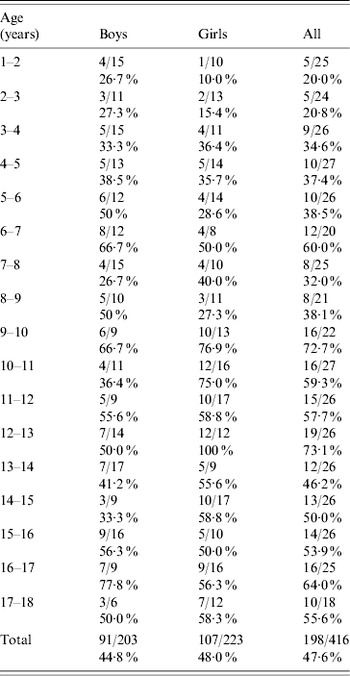
The numbers of serum samples tested in each age group are indicated in combination with the percentage that tested seropositive.
Influence of socio-economic parameters on seroprevalence
The participants of the German National Health Examination Survey were required to answer a questionnaire concerning profession, level of education and income. Based on the answers, they were subdivided into different social groups [Reference Jöckel, Ahrens, Bellach and Jöckel20]. The highest parvovirus B19 seroprevalence was observed in socially disadvantaged women (77·1%, 95% CI 74·3–80·0) compared to 72·4% (95% CI 70·3–74·5, P=0·013) and 72·9% (95% CI 69·4–76·5, P=0·07) in the middle and upper classes, respectively. In the male population these differences were not as evident [socially disadvantaged: 71·5% (95% CI 67·9–75·1), middle class: 71·1% (95% CI 69·0–73·2, P=0·9), upper class: 69·6% (95% CI 66·4–72·8, P=0·5)].
Parvovirus B19 infection is frequent in children (Table 3b, Fig. 3). Individuals having close contact with children, either because of family circumstances or because of their occupation may have an increased risk of virus transmission. In Germany, kindergarten and nursery-school workers take care of children aged <6 years, while school teachers, employees in after-school care, and youth welfare workers have professional contacts to children aged between 6 and 18 years. Health-care workers (nurses, physicians) also have frequent contacts to patients who may suffer from acute B19 infection. In order to discover whether the individual risk of B19 infection is dependent on the occupation, the seroprevalences were correlated with the various occupational categories. This comparative analysis focused on individuals of child-bearing age (18–49 years). The highest prevalence of 88·9% (95% CI 81·1–96·7) was detected in women who had occupational contact with children aged <6 years (Table 4a). This value is significantly higher when compared to 71·9% (95% CI 69·9–73·9, P=0·002) detected in age-matched women (Table 1) and to 72·5% (95% CI 70·0–74·9, P=0·003) in females who had no occupational contact with children or patients. Increased rates of 94·7% (95% CI 84·6–100) became evident in young female entrants working in children's day care (aged 20–29 years) compared to age-matched women in the German population (69·8%, 95% CI 65·7–73·9, P=0·019; Table 1). In contrast, females of childbearing age who had occupational contact with children aged >6 years and adolescents showed an overall seroprevalence of 63·8% (95% CI 51·4–76·1). This group included 44 teachers: 26 of these were seropositive (59·1%, 95% CI 44·6–73·6, P=0·09 vs. female population 18–49 years). Similarly reduced values of 69·9% (95% CI 63·8–76·0) and 63·6% (95% CI 47·2–80) were observed for women working in health care, both those who had contact with patients (such as physicians, nurses) and those who had none (such as those who worked in administration or hospital kitchens). These differences turned out not to be significant (P=0·6 and 0·3, respectively) compared to the age-matched female population.
Prevalence of IgG against VP1/VP2 proteins of parvovirus B19 in different age groups of adult men and women working in occupational fields with frequent contacts with either children or patients

Since only six serum samples were available for testing from males working in kindergartens and seven from men working in health care with no patient contact, it is not feasible to make a comparison with females working in similar contexts. The seroprevalence of men working in health care with patient contact was 66·7% (95% CI 50·3–83·1) and was not significantly different when compared to the age-matched male population (70·4%, 95% CI 68·4–72·7, p=0·68; Table 1) and to men working in areas where they had no contact with patients or children (70·5%, 95% CI 68·3–72·7, P=0·54; Table 4a). Seroprevalence in males with occupational contact with older children (6–18 years) was determined as 75·7% (95% CI 61·9–89·5). This value is not significantly higher than that of females working in the same professions (63·8%, 95% CI 51·4–76·1, P=0·26). In this group, 31 male teachers were included; 25 of these tested seropositive (80·6%, 95% CI 66·7–94·5). Compared to female teachers there was a trend towards a higher prevalence in men (P=0·08).
In order to estimate whether seroprevalence may be influenced by contacts with one's own children, the subjects were asked if they live in households with children aged <6 years or with children aged between 6 and 18 years. The questionnaire referred to current living conditions, so that influences exerted by children who may previously have been part of the same household could not be included in the study. It must be assumed that for the majority of young adults (18–24 years), children living in the same household means siblings, not children of their own. Calculations were carried out once more for the age groups between 18 and 49 years. The seroprevalence was compared to individuals living alone and to age-matched groups of the total study population. The influences on seroprevalence in women exerted by one child aged either <6 years (69·2%, 95% CI 63·9–75·6, P=0·40) or >6 years (73·2%, 95% CI 68·9–77·5, P=0·21) did not result in increased rates when compared to age-matched women (71·9%, 95% CI 69·9–73·9) (Tables 1, 4b). Regardless of age, two children meant a significant increase of the seroprevalence to 81·7% (95% CI 78·0–85·4, P<0·0001). Three or more children in the same household did not further increase the seroprevalence. As far as men were concerned neither one nor two children living in the same household aged <6 years (69·5% 95% CI 64·8–74·2, P=0·09) or aged >6 years (73·9% 95% CI 70·5–77·3, P=0·78) resulted in significantly increased seroprevalence when compared to the age-matched male population (70·4%).
Prevalence of IgG against VP1/VP2 proteins of parvovirus B19 in different age groups of adult men and women living in households together with one or more children aged <6 years or between 6 and 18 years

DISCUSSION
In the German population 50% of the children aged between 6 and 10 years displayed VP1/VP2-specific IgG as a serological marker for previous B19 infection (Table 3b, Fig. 3). This indicates that the incidence of parvovirus B19 infection is highest among young children. In older children and adolescents gradually increasing values were observed reaching a maximum of 79·1% in adults aged between 65 and 69 years. Overall, the seroprevalence in adults (18–79 years) was 72·1%. In the population of England and Wales similar rates were observed starting from 21% in children (1–4 years), and ending up with more than 75% in those aged >45 years [Reference Vyse13]. Similar values have been reported in the European population when Belgian (74%), Italian (79%) and German blood donors (77%) were tested [Reference Eis-Hübinger15, Reference Letaief21, Reference Manaresi22]. The slightly reduced seroprevalence we observed in the elderly (>70 years) might be due to a reduction of individual IgG titres. This assumption is supported by the observation that the percentage of serum samples with borderline IgG titres increased with age from 1% in young adults to almost 10% in the elderly (Fig. 1). Analysing the IgG titres in the various age groups we found mean values of 123 IU/ml in young adults (20–24 years) which decreased to 53 IU/ml in the 60–64 years age group (not shown). In individuals with low titres the age-related fading of specific antibodies might result in borderline or negative values. When analysing both positive and borderline values in the elderly (>60 years) it may be assumed that a total of 90% of the German population has had contact with parvovirus B19 during their lifetime. Interestingly, a slight increase in titre to 79 IU/ml was observed in subjects aged >70 years. Whether increasing numbers of parvovirus B19 re-infections occurring in people with low antibody titres may be responsible for this observation is unclear.
Differences between adult men (70·8%) and women (73·4%) were found, even though these were not highly significant (P=0·017). As child care is generally undertaken by women, this factor may be responsible for the difference observed. In children, gender-specific differences were observed between ages 10 and 15 years: 69% of girls tested seropositive as opposed to 43·3% of boys (Table 3 b, Fig. 3). It may be speculated that girls at this age may have more frequent and intensive contacts with younger siblings and other small children. Comparing the FEG and FWG populations the overall values for men and women were almost identical (Table 1). Even in the younger age groups (18–34 years; birth years: 1963–1980) both men and women living in FWG displayed similar values for parvovirus B19 seroprevalence as those living in FEG.
Minor differences were observed for those living in small towns compared to inhabitants of big cities. As similar differences were observed when correlating seroprevalence to the various social groups these discrepancies might be correlated with a higher social level of people living in big cities: whereas in big cities, 35·0% of the inhabitants were represented by members of the upper class, only 17·6% of the population living in small cities and 18·1% of those living in the countryside, respectively, fell into this category. In addition, an increased seroprevalence was observed in families with more than two children, who tended to be living in small and medium cities. Analysing our cohort showed 42·8% of all single households were located in big cities, while to only 16·7% were found in small cities. The increased seroprevalence in small cities might, therefore, be due to a higher percentage of families with children.
Acute parvovirus B19 infection in pregnant women is a high risk since abortion and hydrops foetalis may occur. A study of acutely B19-infected pregnant women in Germany found that the fetal death rate increased by 5·6% and hydrops foetalis occurred in 3·9% [Reference Enders7]. Similar rates were reported in other countries [23–Reference Rodis26]. In order to estimate the impact of acute B19 infections on the development of fetal symptoms in a distinct population, it is important to gain data regarding the amount of susceptible women of childbearing age. In our serum collection, 38 samples were taken from pregnant women (20–41 years); 27 of these displayed B19-specific IgG (71·1%). In the age-matched cohort of women, an overall seroprevalence (72·4%) was observed, ranging from 67·0–73·6% depending on age group (Table 1). B19-specific IgG found in the sera of newborn infants reflects the maternal antibody status. Since these antibodies were found to decline during the first 6–7 months of life, both in titre and in frequency of occurrence, the mean value of 72·3% obtained for children during the first 2 months was used as a further marker to estimate the seroprevalence in pregnant women (Fig. 2, Table 3a). All three values are without significant differences and indicate that 27·6–28·9% of pregnant women are susceptible. A recently published study determined a similar seroprevalence of 69·2% in women (17–45 years) in FWG [Reference Enders, Weidner and Enders9] which is related to those reported from other European countries: studies in The Netherlands, Denmark, and Finland reported on slightly lower rates of 70%, 65–66% and 58·6% [Reference Valeur-Jensen27–Reference Van Gessel30], whereas higher seroprevalences of 75·3% and 81·0% were found in Russia and Sweden, respectively [Reference Odland31, Reference Skjöldebrand-Sparre32].
Since acutely infected patients shed high amounts of infectious particles, transmission is a matter of concern, particularly for pregnant women. They may be at increased risk either by occupational contact with children or by family contact with their own children who in turn acquire the infection in children's day-care centres, schools or playgrounds. When correlating the data of seroprevalence with the respective occupational areas, we observed a significantly increased rate of 88·9% in women working in kindergarten and nursery day care who had contacts with children aged <6 years (Table 4a). Increased values were observed in all age groups of these professions and indicate that entrants seroconvert rapidly after they begin their employment. Similar observations have been reported in studies undertaken in Denmark and Canada [Reference Valeur-Jensen27, Reference Gilbert33]. School teachers having contact with children and adolescents aged >6 years did not show similar high values. Despite the fact that acute parvovirus infections are frequent in children aged between 6 and 15 years (Table 3b, Fig. 3), seroprevalence was low (63·8%) in women having occupational contact with children of these age groups. This value was even lower when compared to the age-matched female population in Germany (71·9%). These observations are in accord with the situation reported from Denmark [Reference Valeur-Jensen27]. Virus transmission is facilitated by frequent and close physical contact, which does not occur in the case of school teachers.
Surprisingly, the seroprevalence in males who had occupational contacts with children and adolescents was distinctly higher (75·7%) than that of females. This value is identical to that of men living in households with two or more children aged between 6 and 18 years (75·3%, Table 4b). It may be assumed that in these cases, close contact with their own children is responsible for virus transmission and contributes to the increased seroprevalence observed in men. The family as a major factor which enhances the risk of parvovirus B19 infection becomes even more evident in women. Regardless of age, two or more children living in the same household increased the seroprevalence to 81–82%, indicating again that close physical contact with one's own children is a major factor influencing the risk of acute B19 infection. Similar observations have been reported in various other countries and continents [Reference Gilbert6, Reference Harger25, Reference Valeur-Jensen27, Reference Jensen28, Reference Chisaka34].
In conclusion, our study allowed a detailed and comprehensive analysis of the seroprevalence of parvovirus B19 in the German population. Parvovirus B19 infection is frequent during childhood resulting in a seroprevalence of 55–65% in young adults (17–20 years). With a reduced incidence, acute infections may occur in adults, and almost 90% of the elderly display markers for previous infection. For seronegative adults, children living in the same household represent the main individual risk for infection. Occupational risk is evident for women working in contact with children aged <6 years, but not for school teachers.
ACKNOWLEDGEMENTS
This study was supported by a grant provided by the Deutsche Vereinigung zur Bekämpfung der Viruskrankheiten e.V (DVV e.V.). The authors thank Heribert Stolzenberg and Bärbel-Maria Kurth (both Robert-Koch-Institut, Berlin) for many helpful suggestions and discussions and Rhona Dunphy for help with the English language.
DECLARATION OF INTEREST
None.



