

Alongside the current trend of reducing meat in the diet, there is increasing public sentiment that consumers should also reduce their consumption of dairy products. The arguments put forward here are similar to those relating to reducing meat consumption, namely animal welfare and environmental protection (Zur and Klöckner, Reference Zur and Klöckner2014; Carfora et al., Reference Carfora, Conner, Caso and Catellani2020; Ioannidou et al., Reference Ioannidou, Lesk, Stewart-Knox and Francis2024). This is accompanied by an increasing offer of plant-based dairy alternatives (PBDAs) in stores: various plant-based drinks (soy, almond and coconut), yoghurts, cream and cheese (Aschemann-Witzel et al., Reference Aschemann-Witzel, Gantriis, Fraga and Perez-Cueto2021; Hansen et al., Reference Hansen, Gebhardt and Hess2023).
The key issue explored in this study is people's willingness to move away from dairy consumption in favour of plant-based alternatives, which largely depends on consumers’ attitudes towards dairy products and the perception of PBDAs, especially in comparison to dairy. We assumed that attitudes towards dairy and PBDAs are embedded within a broader cultural context and may vary depending on the role dairy plays in a country's food traditions, as well as the general attitude towards sustainable consumption in that country.
This study aimed to investigate the spectrum of consumers’ attitudes and barriers related to dairy products and PBDAs. Moreover, since contemporary communication advocating the reduction or elimination of dairy consumption often emphasises arguments related to animal welfare and environmental concerns, this study focuses on exploring reactions to these two arguments for consuming PBDA instead of dairy products.
The research was preceded by an extensive qualitative study that highlighted the complexity of attitudes towards dairy products and PBDAs (Adamczyk et al., Reference Adamczyk, Jaworska, Affeltowicz and Maison2022). The findings from the qualitative study guided the development of most of the scales used in the current research. However, the qualitative study did not show the intensity of attitudes or the intensity of barriers associated with PBDAs. To address this gap, the present study employs a quantitative survey on representative samples, enabling the assessment of the intensity of previously identified attitudes and behaviours within the target populations. The research was conducted in three European countries – Poland, Germany and the UK – which differ in dairy consumption traditions and exhibit varying levels of pro-environmental and pro-animal consumer attitudes (Urban and Kaiser, Reference Urban and Kaiser2022; Verriet and Leroy, Reference Verriet and Leroy2017).
Arguments for replacing dairy with plant-based dairy alternatives
European consumers, in contrast to, for example, Asian consumers, live in a predominantly dairy-oriented food culture in which dairy products have historically constituted a significant part of the diet (Autio et al., Reference Autio, Sekki, Autio, Peltonen and Niva2023). Recently, however, several publications – both scientific and popular science – have drawn attention to the negative effects of dairy consumption, primarily in the context of problems arising from mass production (e.g. Jacobs, Reference Jacobs2020; Guzmán-Luna et al., Reference Guzmán-Luna, Mauricio-Iglesias, Flysjö and Hospido2022). One argument for substituting dairy with PBDAs concerns animal welfare. Several reports describe the suffering experienced by animals raised on dairy farms, including the routine artificial insemination of dairy cows and their immediate separation from newborn calves (Ventura et al., Reference Ventura, von Keyserlingk and Weary2015; Kolbe, Reference Kolbe2018; Jacobs, Reference Jacobs2020). A second argument relates to environmental concerns. The dairy sector is considered a significant contributor to agricultural greenhouse gas emissions – similar to the meat industry – and is associated with negative impacts on soil fertility and biodiversity (McMichael et al., Reference McMichael, Powles, Butler and Uauy2007; Guzmán-Luna et al., Reference Guzmán-Luna, Mauricio-Iglesias, Flysjö and Hospido2022). Advocates for reducing dairy intake also refer to health-related arguments. While dairy products have traditionally been promoted as rich sources of protein and fat, providing more essential minerals per calorie than many other foods (Heaney, Reference Heaney2009; Garcia et al., Reference Garcia, Osburn and Cullor2019), proponents of reducing or replacing dairy consumption point to the high fat content of some dairy products, which may contribute to cardiovascular disease and obesity (Fontecha et al., Reference Fontecha, Calvo, Juarez, Gil and Martínez-Vizcaino2019). They also note that a significant portion of the global population suffers from milk allergies or lactose intolerance (Katoch et al., Reference Katoch, Nain, Kaur and Rasane2022; Appiani et al., Reference Appiani, Cattaneo and Laureati2023; Nolden and Forde, Reference Nolden and Forde2023). However, allegations concerning high fat and cholesterol content apply only to some dairy products. In addition, the widespread availability of lactose-free products largely addresses the problem of lactose intolerance. Therefore, the main focus of our study lies on more recently highlighted arguments against dairy, namely animal welfare and environmental concerns.
Despite there being publications highlighting the negative sides of dairy production and consumption, there are also critiques of PBDAs. For example, not all plant-based drinks are equivalent in terms of emissions and the use of natural resources. Some, such as almond and rice drinks, require substantially more water for production compared to others, such as soy or oat milk (Haas et al., Reference Haas, Schnepps, Pichler and Meixner2019). Furthermore, it is noted that PBDAs often do not match dairy in terms of protein and micronutrient content (Carfora et al., Reference Carfora, Conner, Caso and Catellani2020), and are frequently highly processed with added sugars, flavours or other ingredients to enhance taste and texture, which could diminish the health profile (Rauber et al., Reference Rauber, MLDC, Steele, Millett, Monteiro and Levy2018, Reference Rauber, Steele, Louzada, Millett, Monteiro and Levy2020; Ramsing et al., Reference Ramsing, Santo, Kim, Altema-Johnson, Wooden, Chang, Semba and Love2023).
Are dairy-oriented cultures willing to reduce dairy and transition towards plant-based dairy alternatives?
Despite the aforementioned expert opinions on dairy and its alternatives, the market success or failure of these products fundamentally depends on consumer purchasing decisions. It is crucial to investigate whether consumers are open to decreasing dairy consumption and replacing it with plant-based alternatives. Furthermore, understanding how consumers respond to the arguments used in PBDA promotion can provide insight into which considerations they regard as influential when thinking about potential changes in dairy consumption.
Although research on PBDAs has been expanding, studies focusing on consumer perspectives remain limited. Evidence suggests that dairy may be losing its former dietary significance, with many consumers reducing intake in favour of plant-based substitutes due to concerns about health, the environment and animal welfare (e.g. Haas et al., Reference Haas, Schnepps, Pichler and Meixner2019; Autio et al., Reference Autio, Sekki, Autio, Peltonen and Niva2023). However, other studies indicate that such concerns do not strongly motivate dairy reduction (Morelli and Vitale, Reference Morelli and Vitale2020; Adamczyk et al., Reference Adamczyk, Jaworska, Affeltowicz and Maison2022). Qualitative research conducted in France, Germany and Poland (Adamczyk et al., Reference Adamczyk, Jaworska, Affeltowicz and Maison2022) shows that dairy from verified local sources is often perceived as ethically acceptable because it does not involve animal suffering, thus creating less moral dissonance than meat consumption. Moreover, consumers rarely make a direct cognitive link between dairy products and their animal origin during consumption.
Despite health concerns such as allergies, lactose intolerance or high fat content, many consumers still regard dairy – especially milk and yoghurt – as important sources of nutrients supporting bone and digestive health (Pohjanheimo and Sandell, Reference Pohjanheimo and Sandell2009; Haas et al., Reference Haas, Schnepps, Pichler and Meixner2019). This argument is further reinforced by the growing availability of lactose-free and low-fat dairy products. The market outlook for PBDAs remains uncertain. While some researchers view them as a rapidly expanding category likely to ‘move from niche to mainstream’ (Haas et al., Reference Haas, Schnepps, Pichler and Meixner2019), sensory factors such as unfamiliar flavours and textures continue to limit acceptance. Many PBDAs have beany notes, chalky mouth feel or darker colour compared with cow's milk (Cardello et al., Reference Cardello, Llobell, Giacalone, Roigard and Jaeger2022; Giacone et al., Reference Giacone, Siegrist, Stadelmann and Hartmann2024), making adaptation difficult (Cardello et al., Reference Cardello, Llobell, Giacalone, Roigard and Jaeger2022; Appiani et al., Reference Appiani, Cattaneo and Laureati2023). Even regular users sometimes revert to milk in specific contexts, such as coffee (Autio et al., Reference Autio, Sekki, Autio, Peltonen and Niva2023).
The studies cited above, along with many others examining consumer attitudes towards dairy and PBDAs, are often geographically limited to a single country (e.g. Giacone et al., Reference Giacone, Siegrist, Stadelmann and Hartmann2024). Even when conducted internationally, they frequently rely on small or non-representative samples, for example, including only PBDA consumers (Vargas-Bello-Pérez et al., Reference Vargas-Bello-Pérez, Tajonar, Foggi, Mele, Simitzis, Mavrommatis, Tsiplakou, Habib, Gonzalez-Ronquillo and Toro-Mujica2022; Hansen et al., Reference Hansen, Gebhardt and Hess2023). These methodological constraints make it difficult to draw firm conclusions about global consumer attitudes or to accurately assess PBDA's potential impact on dairy consumption.
Aim of the study
The aim of the study was to examine the potential of PBDAs as replacements for dairy among European consumers and the extent to which they could threaten the strong position of dairy products. To this end, the study was structured around four areas of inquiry. The first area focused on attitudes towards dairy products – those products that plant-based alternatives would potentially replace. Understanding these attitudes is crucial because it allows us to identify potential barriers and thus understand the extent to which PBDA may threaten the established position of dairy products. The second area examined consumer perceptions of PBDAs. This part of the study aimed to identify whether there are perceptual differences in this respect between consumers from the surveyed countries (Poland, Germany and the UK), and to determine how these perceptions of PBDAs differ from those of traditional dairy products. The third area of research addressed consumer experiences with PBDAs and the reasons for their use, particularly emphasising the variances across the countries studied. The fourth area focused on the potential of two arguments used in public communication that could interest consumers in PBDA: (a) ethical considerations, specifically animal welfare; and (b) ecological concerns, particularly environmental protection (Schiano et al., Reference Schiano, Harwood, Gerard and Drake2020).
The study had the following specific research questions:
RQ1. How are dairy and PBDAs perceived?
RQ2. What are the motives for limiting dairy consumption? Among these motives, what significance do pro-environmental and pro-animal arguments hold?
RQ3. What motivates the consumption of PBDAs? Among these motivations, how crucial are pro-environmental and pro-animal welfare concerns?
RQ4. What are the biggest barriers to PBDA consumption?
RQ5. Are there differences among the three investigated countries (Poland, Germany and the UK) concerning the aforementioned research questions (perception of PBDA vs. dairy, motives to reduce dairy and consume PBDA, and barriers towards PBDA)?
Materials and methods
The quantitative survey was conducted across three European countries: Poland, Germany and the UK. Since the current research project was carried out within the framework of a larger project (EIT Food under Horizon 2020 programme), the selection of the countries in which the survey was conducted resulted from the previous selection of the countries in which the project was carried out (consortium members). Additionally, these countries exhibit varying degrees of pro-environmental attitudes and behaviours, as previously noted. This diversity enabled the exploration of potential cross-country differences in attitudes and behaviour concerning PBDAs (Schiano et al., Reference Schiano, Harwood, Gerard and Drake2020).
The online surveys were conducted using quota sampling to mirror each country's population on gender, age, urbanicity (size of place of residence) and education. Quotas were set to national benchmarks, and respondents were recruited from the local research panels until the quota for each country was filled. Therefore, differences between samples are due to differences in population structure. A total of 2,157 respondents were surveyed: Poland (N = 726), Germany (N = 714) and the UK (N = 717). The detailed demographic structures of the samples for each country, along with descriptive statistics, are presented in the Supplementary materials (Table S1).
Respondents were recruited through established online participant panels, which are pre-recruited pools of adult residents who consent to receive survey invitations from a commercial provider. Panellists are ordinary respondents (not trained interviewers) who maintain demographic profiles with the vendor. In each country, we subcontracted established commercial panel providers to program and host the questionnaire on their platform and to administer fieldwork (invitation routing, screening, quota control and device/IP duplicate suppression). The research team designed the survey instrument and set the eligibility criteria, quota targets and data-quality rules. Invitations carried unique, single-use links; participation was voluntary and compensated with panel credits redeemable for rewards. Panellists did not receive study-specific training; standardised on-screen instructions guided self-administration, and in-survey checks (attention item and speed threshold) supported data quality.
The study received ethical approval from the Institute for Social Studies at the University of Warsaw (Decision No. 5/21).
The survey explored various aspects related to dairy products and PBDAs, including: (a) usage, (b) perception of both product categories, (c) motives for consuming dairy, (d) reasons for limiting dairy intake, (e) motivations for consuming/trying PBDAs and (f) obstacles to trying/consuming PBDAs.
Current dairy consumption
Dairy consumption was assessed using two questions. The first question asked participants to select the option that best described their current dairy consumption habits from three choices: (1) I do not consume dairy; (2) I consume dairy but am actively reducing intake; and (3) I consume dairy without restrictions. The second question required the respondents to rate the frequency with which they consumed various dairy products: milk, cheese, yoghurt and cream, on a scale from (1) Never to (5) Almost every day.
Perception of dairy and plant-based dairy alternatives
The perception of dairy and PBDAs was measured using a semantic differential scale. The participants were asked to evaluate seven attributes separately for: (a) dairy and (b) PBDAs on a scale ranging from −3 to 3. The attributes assessed were: (1) Not tasty – tasty; (2) Unhealthy – healthy; (3) Not ecological – ecological; (4) Unethical – ethical; (5) Unnatural – natural; and (6) Not an important part of the human diet – an important part of the human diet.
Intended dairy consumption (future)
The participants were queried about their future intended dairy consumption (e.g. over the next 2–5 years). The item offered six response options, which we collapsed into four categories: (1) I plan to completely give up dairy; (2) I plan to reduce dairy consumption; (3) I do not plan to alter my dairy intake; and (4) I plan to increase dairy consumption.
Motives for reducing dairy
Questions about the motives for reducing dairy were directed to two distinct groups of respondents. The first group consisted of individuals who already had reduced their dairy intake (motives). They were asked to identify the factors that influenced their decision, including perceptions related to dairy (taste, health) and external factors (animal welfare, environmental concerns). These factors were selected based on insights from previous qualitative research (Adamczyk et al., Reference Adamczyk, Jaworska, Affeltowicz and Maison2022). Respondents viewed a list of motives and selected all that applied. They also had an ‘Other (please specify)’ option. Second, among individuals who did not currently limit their dairy intake, we presented the same list and asked which considerations, if any, might influence their dairy consumption in the future (potential motives).
Current usage of plant-based dairy alternatives
The respondents were asked to report the frequency of their consumption of the following plant-based dairy products: soy drink, oat drink, coconut drink, soy-based yoghurt, coconut-based yoghurt, plant-based cheese and plant-based cream. The response scale ranged from: (1) Never heard of it; (2) Heard of it but never tried it; (3) Tried it only once; (4) Consume it occasionally; and (5) Consume it regularly.
Motives for consuming plant-based dairy alternatives
The participants who reported frequent consumption of PBDAs (responding with a 4 or 5 to the previous question regarding at least one product category) were asked to identify all the reasons for choosing these products. The motives included: enhancing dietary variety, curiosity, taste preferences, health considerations, animal welfare and environmental concerns. These categories were derived from Adamczyk et al. (Reference Adamczyk, Jaworska, Affeltowicz and Maison2022).
Barriers to consuming plant-based dairy alternatives
The participants who had not yet chosen PBDAs (responding with a 2 or 3 to the previous question across all product categories) were asked to specify the reasons for their reluctance. The potential barriers included: (a) a preference for dairy without the desire for dietary changes; (b) challenges in using PBDAs for cooking; (c) perceptions of PBDAs as unpalatable; and (d) concerns about their health implications. These barriers were also based on Adamczyk et al. (Reference Adamczyk, Jaworska, Affeltowicz and Maison2022).
Results
Current usage of dairy and plant-based dairy alternatives
General usage patterns
Initially, we examined overall consumption patterns of dairy and PBDAs across the entire sample. The majority of respondents reported consuming dairy without limitations, and only a small proportion – between 2.5% and 5.3% – fully abstained from dairy. Detailed usage patterns for specific dairy categories (milk, cheese, yoghurt and cream) are provided in the Supplementary Materials.
In contrast to dairy, the PBDA section presents detailed results for each individual category. We chose to retain category-level reporting for PBDAs because the field is still relatively new, consumption patterns differ substantially across product types and prior research suggests that consumers often accept certain PBDA categories but not others. Category-level results, therefore, provide more meaningful insight into adoption patterns and allow for a clearer interpretation of emerging trends.
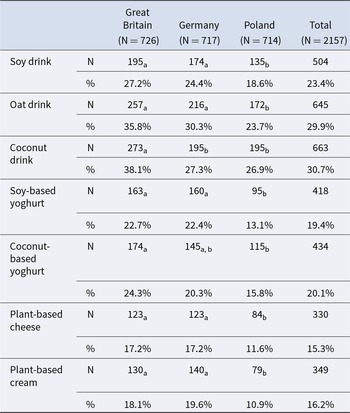
For each PBDA category, usage was defined as consuming the product at least occasionally. Across all countries, plant-based drinks emerged as the most commonly used PBDA category, consumed at least occasionally by a substantial portion of respondents.
Cross-country differences
The consumption patterns between countries were analysed with Chi-square analysis. When it comes to dairy consumption patterns, Poland has the largest population of consumers who do not limit dairy intake compared to Germany and the UK. Notably, a significantly higher percentage of individuals in the UK, compared to Poland, attempt to limit their dairy intake, suggesting a greater inclination towards dairy restriction among the British population than among Polish consumers. The detailed results are presented in Table 1 (statistics of Chi-square tests are presented below the table).
Overall current dairy usage

Table 1 Long description
The table reports current dairy consumption patterns in Great Britain, Germany, and Poland, with totals across all respondents. In every country, the largest group says they consume dairy without restrictions: 57.9% in Great Britain (415), 60.1% in Germany (429), and 67.1% in Poland (487), for 61.7% overall (1,331). The next most common response is consuming dairy while actively reducing intake: 38.2% in Great Britain (274), 34.6% in Germany (247), and 30.4% in Poland (221), totaling 34.4% (742). Not consuming dairy is uncommon: 3.9% in Great Britain (28), 5.3% in Germany (38), and 2.5% in Poland (18), totaling 3.9% (84). Poland has the highest unrestricted dairy use and the lowest non-consumption, while Germany has the highest non-consumption. Letter markers indicate some country differences are statistically meaningful, but they do not show the size or practical importance of those differences.
(*) Each subscript letter denotes a subset of country categories whose column proportions are not significantly different from each other at the p < 0.05 level based on Chi2 analysis: χ2 (4, N = 2,157) = 19.22, p < 0.001.
The consumption patterns of PBDA between the three countries were also analysed using Chi-square analysis. When it comes to cross-country differences, consumption of almost all PBDA was less frequent in Poland compared to the other two countries. In Germany and Great Britain, the consumption patterns for the majority of plant-based categories were similar, except for coconut drink, which is slightly more popular in the latter. The detailed results are presented in Table 2 (statistics of Chi-square tests are presented below the table).
Current usage of different categories of plant-based dairy alternatives (percentage of people who consume a given category at least occasionally)

Table 2 Long description
Percentages show the share of people in Great Britain, Germany, and Poland who consume each plant-based dairy alternative at least occasionally, with counts also provided. Across all categories, Great Britain has the highest usage and Poland the lowest. Overall totals are highest for coconut drink (30.7%, 663 people) and oat drink (29.9%, 645), followed by soy drink (23.4%, 504). Great Britain leads for coconut drink at 38.1% (273) versus 27.3% in Germany (195) and 26.9% in Poland (195), and for oat drink at 35.8% (257) versus 30.3% (216) and 23.7% (172). Soy drink is 27.2% in Great Britain (195), 24.4% in Germany (174), and 18.6% in Poland (135). Yoghurt alternatives are less common: soy-based yoghurt totals 19.4% (418) and coconut-based yoghurt totals 20.1% (434), with Poland notably lower at 13.1% and 15.8%. Plant-based cheese and cream are the least used overall at 15.3% (330) and 16.2% (349), and Poland is again lowest at 11.6% and 10.9%. Letter markers indicate which country percentages are not meaningfully different within each product category, so comparisons should be made within a row rather than across different products.
Note: Each subscript letter denotes a subset of country categories whose column proportions are not significantly different from each other at the p < 0.05 level based on Chi2 analyses. Chi2 tests were performed for each category separately: Soy drink: χ2 (2, N = 2157) = 15.51, P < 0.001; Oat drink: χ2(2, N = 2157) = 25.48, P < 0.001; Coconut drink: χ2 (2, N = 2157) = 27.20, P < 0.001; Soy-based yoghurt: χ2 (2, N = 2157) = 27.77, P < 0.001; Coconut-based yoghurt: χ2 (2, N = 2157) = 15.96, P < 0.001; Plant-based cheese: χ2 (2, N = 2157) = 11.74, P = 0.002; Plant-based cream: χ2 (2, N = 2157) = 23.23, P < 0.001.
Perception of dairy and plant-based dairy alternatives
General perception
This part of the analysis examined how consumers perceive dairy and PBDAs across several evaluative dimensions. Dairy and PBDAs perceptions were assessed using six attributes: taste, healthiness, naturalness, dietary importance, ecological impact and ethical considerations. To test differences in perceptions of dairy and PBDAs while accounting for country effects, mixed-model repeated-measures ANOVAs were performed, with product category (dairy vs. PBDA) as a within-subject factor and country as a between-subject factor. In the main text, we report the within-subject effect of product category; the between-country effects and interaction terms are presented in the Supplementary Materials.
Overall, dairy was rated significantly more favourably than PBDAs on taste, healthiness, naturalness and dietary importance, whereas PBDAs received more positive evaluations on ecological and ethical attributes. A significant within-subject effect of product category (dairy vs. PBDA) emerged for all attributes: taste F(1, 2154) = 1541.22, P < 0.001, ηp2 = 0.417; healthiness F(1, 2154) = 220.01, P < 0.001, ηp2 = 0.093; naturalness F(1, 2154) = 659.24, P < 0.001, ηp2 = 0.234; dietary importance F(1, 2154) = 903.08, P < 0.001, ηp2 = 0.295; ecological impact F(1, 2154) = 55.42, p < 0.001, ηp2 = 0.011; and ethical considerations F(1, 2154) = 21.14, P < 0.001, ηp2 = 0.010.
The mean evaluations for dairy and PBDAs are presented in Fig. 1.
Mean evaluation(*) of dairy and plant-based dairy in terms of all attributes across three countries.

Figure 1 Long description
The graph compares mean evaluations of dairy and plant-based dairy products across six attributes: Tasty, Healthy, Natural, Important, Ecological and Ethical. The x-axis lists these attributes, while the y-axis ranges from 0 to 3. The legend identifies six groups: Great Britain - dairy (solid line), Great Britain - PBDA (dashed line), Germany - dairy (solid line), Germany - PBDA (dashed line), Poland - dairy (solid line) and Poland - PBDA (dashed line). For the Tasty attribute, Great Britain dairy is highest, followed by Germany dairy, with plant-based options lower. Healthy shows similar trends, with dairy generally rated higher. Natural sees Germany dairy peak, while plant-based options are lower. Important shows a decline for all groups, with Germany dairy slightly higher. Ecological ratings rise for plant-based options, especially in Poland, while dairy remains lower. Ethical sees a similar trend, with plant-based options rated higher, particularly in Poland. Overall, dairy products tend to have higher evaluations for Tasty and Healthy, while plant-based options excel in Ecological and Ethical attributes. The graph highlights the differences in perception across countries and product types, emphasizing the strengths of plant-based options in sustainability-related attributes.
Cross-country differences
To analyse cross-country differences in dairy and PBDA perception, separate one-way ANOVAs were performed with each attribute as a dependent variable and the country serving as a between-subject factor.
For dairy, the analysis showed that perceptions differed significantly between countries on five of the six evaluated attributes: healthiness (F (2, 2154) = 40.55; P < 0.001; ηp2 = 0.036); naturalness (F (2, 2154) = 7.20; P = 0.010; ηp2 = 0.004); dietary importance (F (2, 2154) = 17.35; P < 0.001; ηp2 = 0.016); ecological impact (F (2, 2154) = 47.96; p < 0.001; ηp2 = 0.043); and ethical considerations (F (2, 2154) = 30.92; P < 0.001; ηp2 = 0.028). The only attribute on which the perception of dairy products did not differ between countries was taste (F (2, 2154) = 0.891; P = 0.411; ηp2 = 0.001).
The results consistently show that Polish respondents rate dairy more favourably on each attribute compared to both German and British consumers. Noteworthy disparities were particularly evident for the ecological and ethical attributes, where Polish consumers perceived dairy as significantly more ecological and ethical than their German or British counterparts.
For PBDAs, significant cross-country differences emerged on four of the six attributes: healthiness (F (2, 2154) = 12.27; P < 0.001; ηp2 = 0.011), with the British rating plant-based dairy as healthier than Poles and Germans. In terms of naturalness (F (2, 2154) = 3.77; P = 0.023; ηp2 = 0.003) and ecological impact (F (2, 2154) = 3.36; P = 0.035; ηp2 = 0.003), Germans rated PBDAs lower than their British and Polish counterparts, with the ecological differences being marginally significant. Finally, for ethical considerations (F (2, 2154) = 11.73; P < 0.001; ηp2 = 0.011), the British and Germans perceived PBDAs as more ethical compared to the Poles. Perceptions of PBDA on taste dimension (F (2, 2154) = 2.06; P = 0.128; ηp2 = 0.002) and dietary importance (F (2, 2154) = 1.26; P = 0.283; ηp2 = 0.001) were consistent across all countries.
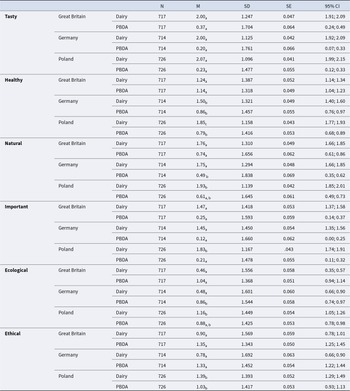
The detailed statistics for dairy and PBDA perception, including the results of post-hoc Bonferroni corrections, are presented in Table 3.
Perception of dairy and PBDAs in terms of various attributes

Table 3 Long description
Mean ratings on a minus three to plus three scale compare dairy versus plant-based dairy alternatives for six attributes in Great Britain, Germany, and Poland, with sample sizes around 714 to 726 per country. For tastiness, dairy is consistently high at about 2.00 to 2.07, while plant-based alternatives are much lower at about 0.20 to 0.37 across all three countries. For naturalness and importance, dairy again scores higher in every country, with naturalness around 1.75 to 1.93 for dairy versus about 0.49 to 0.74 for plant-based, and importance around 1.45 to 1.83 for dairy versus about 0.12 to 0.25 for plant-based. For healthiness, dairy is rated higher than plant-based in Germany and Poland, while Great Britain rates them similarly at about 1.24 for dairy and 1.14 for plant-based. For ecological and ethical attributes, plant-based alternatives generally score higher than dairy in Great Britain and Germany, while Poland rates dairy higher on ecological and slightly higher on ethical. Differences marked by letter groupings indicate statistically reliable country differences within the same product type, and the table does not test dairy versus plant-based differences directly.
Note: Subscripts denote country groups whose means do not differ at P < 0.05, based on one-way ANOVAs with Bonferroni-corrected post hoc tests. Comparisons are made between countries within the same product type (dairy with dairy; PBDA with PBDA), not across product types. M = mean on a semantic differential scale (−3 to +3).
Motives for limiting dairy consumption
Assessment of future intended dairy consumption – general results
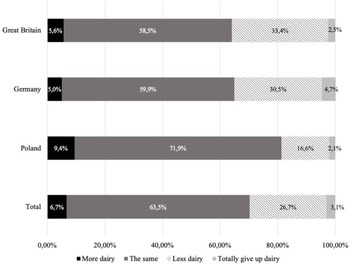
Before delving into the specific reasons for limiting dairy consumption, the general future intended dairy consumption was examined. Due to the small size of the group that declared complete abstention from dairy (N = 77), they were excluded from this part of the analysis. The results reveal that, in all investigated countries, the vast majority of consumers (63.5%) do not intend to alter their dairy consumption in the foreseeable future, whereas almost 27% intend to reduce their dairy intake.
Assessment of future intended dairy consumption – cross-country differences
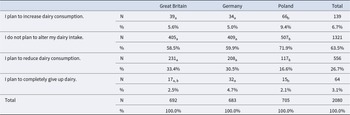
Next, the distribution of intention categories (e.g. decrease, no change and increase) was compared between countries using Chi-square analysis. In Poland, a significantly higher proportion of respondents plan to increase their dairy consumption compared with their counterparts in Great Britain and Germany. Conversely, a larger share of consumers in Great Britain and Germany are inclined to decrease their dairy intake in the future compared with those in Poland. The detailed results of these comparisons are presented in Table 4 and Fig. 2 (Chi-square statistics are reported below the table).
Planned future dairy usage.

Figure 2 Long description
The stacked bar graph has four horizontal stacked bars labeled Great Britain, Germany, Poland and Total. The horizontal axis shows percent, ranging from 0 comma 00 percent to 100 comma 00 percent, with tick labels at 0 comma 00 percent, 20 comma 00 percent, 40 comma 00 percent, 60 comma 00 percent, 80 comma 00 percent and 100 comma 00 percent. Each bar is divided into four segments with a legend listing: More dairy, The same, Less dairy, Totally give up dairy. Great Britain bar segment values: More dairy 5 comma 6 percent; The same 58 comma 5 percent; Less dairy 33 comma 4 percent; Totally give up dairy 2 comma 5 percent. Germany bar segment values: More dairy 5 comma 0 percent; The same 59 comma 9 percent; Less dairy 30 comma 5 percent; Totally give up dairy 4 comma 7 percent. Poland bar segment values: More dairy 9 comma 4 percent; The same 71 comma 9 percent; Less dairy 16 comma 6 percent; Totally give up dairy 2 comma 1 percent. Total bar segment values: More dairy 6 comma 7 percent; The same 63 comma 5 percent; Less dairy 26 comma 7 percent; Totally give up dairy 3 comma 1 percent.
Planned future dairy usage

Table 4 Long description
The table reports how people in Great Britain, Germany, and Poland say they will change their future dairy consumption, showing counts and percentages by country and overall. In every country, the most common response is no planned change: 58.5% in Great Britain (405), 59.9% in Germany (409), and 71.9% in Poland (507), for 63.5% overall (1321). Planning to reduce dairy is next most common overall at 26.7% (556), but it is much lower in Poland at 16.6% (117) than in Great Britain at 33.4% (231) and Germany at 30.5% (208). Planning to increase dairy is uncommon: 5.6% in Great Britain (39), 5.0% in Germany (34), and 9.4% in Poland (66), 6.7% overall (139). Planning to completely give up dairy is rare across countries, ranging from 2.1% in Poland (15) to 4.7% in Germany (32), 3.1% overall (64). Country differences are indicated by letter markers showing which proportions are statistically distinguishable at the stated significance threshold.
Note: Each subscript letter denotes a subset of country categories whose column proportions are not significantly different from each other at the P < 0.05 level based on Chi2 analysis: χ2 (6, N = 2080) = 74.40, P < 0.001.
Motives for dairy reduction – general results
In this part of the analysis, we examine reasons respondents reported for (a) having already reduced their dairy intake and (b) factors that might influence future dairy consumption among respondents who currently do not limit dairy intake. We summarise the frequency of reported reasons among people who limit their consumption of dairy products (N = 742; 34,4% of the population; Table 1) and, separately, the frequency of potential future considerations among dairy non-restrictors (N = 1,331; 61,7% of the population; Table 1).
Looking at the results for the three countries together, among consumers who try to limit their consumption of dairy products (but have not given them up completely), ethical issues related to animal welfare and environmental protection were most frequently mentioned (although in this case, the differences between countries are substantial – see the section below). Taste was reported as the least important motive for dairy reduction across all countries. In contrast, among respondents who do not currently limit dairy intake, the considerations most commonly indicated as potentially influencing future consumption were health and taste.
Figure 3 contrasts the considerations reported by people who limit their consumption of dairy with the considerations that non-restrictors of dairy say might influence their future consumption. Different motives prevail across the two groups: among consumers who already limit dairy, ethical and environmental considerations are most common, whereas among those who do not limit dairy, health and taste are most frequently cited as potentially influential.
Comparison of reported motives for current versus possible future dairy reduction.

Figure 3 Long description
The image showing two grouped horizontal bar graphs. Left graph title: Consumers limiting dairy intake dash motives for dairy reduction left parenthesis N equals 742 right parenthesis. X axis label: percent. X axis range: 0 percent to 50 percent, with tick labels at 0 percent, 10 percent, 20 percent, 30 percent, 40 percent, 50 percent. Y axis categories: Ethical concerns; Environmental concerns; Health; Taste. Legend: Great Britain; Germany; Poland; Total. Ethical concerns: 26 percent, 18 percent, 35 percent, 23 percent. Environmental concerns: 33 percent, 24 percent, 18 percent, 26 percent. Health: 13 percent, 12 percent, 33 percent, 23 percent. Taste: 7 percent, 10 percent, 10 percent, 9 percent. Right graph title: Consumers not limiting dairy intake dash potential motives for dairy reduction left parenthesis N equals 1331 right parenthesis. X axis label: percent. X axis range: 0 percent to 60 percent, with tick labels at 0 percent, 20 percent, 40 percent, 60 percent. Y axis categories: Ethical concerns; Environmental concerns; Health; Taste. Legend: Great Britain; Germany; Poland; Total. Ethical concerns: 15 percent, 20 percent, 8 percent, 14 percent. Environmental concerns: 13 percent, 14 percent, 11 percent, 13 percent. Health: 36 percent, 43 percent, 48 percent, 42 percent. Taste: 31 percent, 29 percent, 30 percent, 30 percent.
Motives for dairy reduction – cross-country differences
Frequencies of answers were compared between countries using Chi-square analysis. Among consumers who had already reduced their dairy intake, notable cross-country differences were observed. In Germany, ethical motives were more prevalent than in the other two countries. Environmental motives were more frequently cited in Great Britain and Germany than in Poland, where health was the most commonly cited reason for reducing dairy intake. The frequencies of all reported motives are detailed in Table 5 (Chi-square statistics are presented below the table).
Dairy reduction motives for consumers who already limit dairy intake*

Table 5 Long description
The table reports how often people who already limit dairy in Great Britain, Germany, and Poland selected different motives for reducing dairy, shown as counts and percentages within each country. Animal welfare is the top motive in Germany at 132 people (53.4%), compared with 71 (25.9%) in Great Britain and 40 (18.1%) in Poland. Environmental concerns are most common in Germany and Great Britain at 99 (40.1%) and 87 (31.8%), and lower in Poland at 40 (18.1%). Health is the leading motive in Poland at 73 (33.0%), while it is much less common in Great Britain at 36 (13.1%) and Germany at 30 (12.1%). Taste is the least-cited motive overall, ranging from 7.3% in Great Britain and 7.7% in Germany to 10.4% in Poland. Across all countries combined, animal welfare is most frequent (32.7%), followed by environment (30.5%), health (18.7%), and taste (8.4%). Percentages do not add to 100% because respondents could choose more than one motive, and some country differences were tested for statistical significance.
Note: Each subscript letter denotes a subset of country categories whose column proportions are not significantly different from each other at the P < 0.05 level based on Chi2 analysis. Chi2 tests were performed for each motive separately: Animals: χ2 (2, N = 742) = 75.37, P < 0.001; Environment: χ2 (2, N = 742) = 26.95, P < 0.001; Health: χ2 (2, N = 742) = 42.35, P < 0.001; Taste: χ2 (2, N = 742) = 1.75, P = 0.416.
* The percentages for each country do not sum up to 100% as this was a multiple-choice question.
Among respondents who do not currently limit dairy intake, significant cross-country differences were also found. Health-related considerations were cited more often in Poland than in Great Britain, whereas animal welfare motives were mentioned less frequently in Poland than in Germany and Great Britain. Motives related to environmental concerns and taste did not differ significantly between countries. The frequencies of all potential motives are shown in Table 6 (Chi-square statistics are presented below the table).
Motives reported by consumers who do not currently limit dairy consumption regarding possible future dairy reduction*

Table 6 Long description
The table reports how often non–dairy-limiters in Great Britain, Germany, and Poland selected different motives that might lead them to reduce dairy in the future, with both counts and percentages shown. Health is the most selected motive overall at 42.5% (566 people), ranging from 36.4% in Great Britain (151) to 42.7% in Germany (183) and 47.6% in Poland (232). Taste is the next most common at 29.8% overall (396), with similar levels across countries: 31.3% in Great Britain (130), 28.9% in Germany (124), and 29.2% in Poland (142). Ethical concerns about animal welfare total 14.0% (187) and are higher in Great Britain (15.2%, 63) and Germany (20.0%, 86) than in Poland (7.8%, 38). Environmental concerns are least cited at 12.5% overall (167) and are fairly similar across countries, from 10.9% in Poland (53) to 14.2% in Germany (61). Percentages do not add to 100% because respondents could choose more than one motive, and some country differences were tested for statistical significance.
Note: Each subscript letter denotes a subset of country categories whose column proportions are not significantly different from each other at the P < 0.05 level based on Chi2 analysis. Chi2 tests were performed for each motive separately: Animals: χ2 (2, N = 1331) = 28.95, P < 0.001; Environment: χ2 (2, N = 1331) = 2.34, P = 0.310; Health: χ2 (2, N = 1331) = 11.61, P = 0.003; Taste: χ2 (2, N = 1331) = 0.72, P = 0.697.
* The percentages for each country do not sum up to 100% as this was a multiple-choice question.
Reasons for consuming plant-based dairy alternatives
General results
This analysis focused on understanding why consumers opt for plant-based alternatives. The survey included only those who reported trying at least one PBDA product (Great Britain N = 561, 78%; Germany N = 555, 78%; Poland N = 495, 68%).
Across all three countries, curiosity was identified as the most significant reason for choosing PBDAs. The desire for dietary variety followed as a uniformly cited motive across the respective countries. Health and taste considerations were less commonly noted overall.
Cross-country differences
To compare the reasons for consuming PBDA across three countries, the Chi-square analysis was used. Health and taste considerations were mentioned more frequently by British consumers than by Polish consumers.
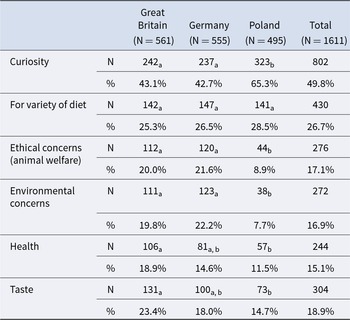
Significant cross-country differences were also observed in ethical and environmental motivations. A substantially larger percentage of consumers in Germany (22%) and the UK (20%) reported choosing plant-based dairy for ethical and environmental reasons, compared with only 8% in Poland. This pattern is consistent with the earlier findings on dairy reduction motives, where pro-environmental factors were more prominent in Great Britain and Germany than in Poland. The detailed frequencies of all stated reasons are presented in Table 7 and Fig. 4 (Chi-square statistics are reported below the table).
Motives for consuming plant-based dairy alternatives (N = 1611).

Figure 4 Long description
A horizontal bar graph titled Motives for consuming plant based dairy alternatives left parenthesis N equals 1611 right parenthesis. Y axis categories, top to bottom: Out of curiosity; For variety of the diet; Ethical concerns left parenthesis animal welfare right parenthesis; Environmental concerns; Health; Taste. X axis label: percent. X axis range: 0 percent to 70 percent, with tick labels at 0 percent, 10 percent, 20 percent, 30 percent, 40 percent, 50 percent, 60 percent, 70 percent. Legend entries: Great Britain; Germany; Poland; Total. Out of curiosity: 43 percent, 43 percent, 66 percent, 50 percent. For variety of the diet: 25 percent, 22 percent, 29 percent, 27 percent. Ethical concerns left parenthesis animal welfare right parenthesis: 20 percent, 22 percent, 9 percent, 17 percent. Environmental concerns: 20 percent, 22 percent, 8 percent, 17 percent. Health: 16 percent, 19 percent, 12 percent, 15 percent. Taste: 23 percent, 18 percent, 15 percent, 19 percent.
Motives for consuming plant-based dairy alternatives

Table 7 Long description
The table reports counts and percentages of respondents in Great Britain (561), Germany (555), and Poland (495) who selected different motives for consuming plant-based dairy alternatives, plus totals (1611). Curiosity is the most common motive overall (49.8%), driven by Poland at 65.3% (323) compared with about 43% in Great Britain (242) and Germany (237). Variety of diet is similar across countries at roughly one quarter (25.3% to 28.5%; total 26.7%). Ethical animal-welfare concerns and environmental concerns are much lower in Poland (8.9% and 7.7%) than in Great Britain (20.0% and 19.8%) and Germany (21.6% and 22.2%). Health is reported by 18.9% in Great Britain, 14.6% in Germany, and 11.5% in Poland (total 15.1%). Taste follows a similar pattern, highest in Great Britain (23.4%), then Germany (18.0%), then Poland (14.7%) (total 18.9%). Some country differences are statistically meaningful for most motives, while variety shows little evidence of difference across countries.
Note: Each subscript letter denotes a subset of country categories whose column proportions are not significantly different from each other at the p < 0.05 level based on Chi2 analysis. Chi2 tests were performed for each motive separately: Curiosity: χ2 (2, N = 1611) = 68.42, P < 0.001; Variety: χ2 (2, N = 1611) = 1.37, P = 0.504; Animals: χ2 (2, N = 1611) = 34.74, P < 0.001; Environment: χ2 (2, N = 1611) = 44.29, P < 0.001; Health: χ2 (2, N = 1611) = 11.34, P = 0.003; Taste: χ2 (2, N = 1611) = 13.18, P = 0.001.
Barriers to consuming plant-based dairy alternatives
General results
The final part of the analysis aimed to identify the barriers preventing consumers from opting for PBDAs. The frequencies of these barriers were calculated specifically for consumers who, according to their responses to the question on the use of PBDAs, indicated that they either had never tried any such products or had tried them only once. The distribution was as follows: Great Britain (N = 328, 46%), Germany (N = 253, 35%) and Poland (N = 201, 28%).
The primary barrier preventing consumers from trying plant-based dairy products was the lack of intention to change dietary habits, with a strong preference for traditional dairy products. Additionally, consumers cited the difficulty of substituting traditional dairy products with PBDAs in cooking as a significant challenge. Less frequently mentioned barriers included perceptions of PBDAs as unhealthy and unpalatable. Notably, the barriers did not vary significantly across the countries (comparison with Chi-square analysis).
The frequencies of all the identified barriers are detailed in Table 8 (statistics of Chi-square tests are presented below the table).
Barriers to consuming plant-based dairy alternatives

Table 8 Long description
The table reports counts and percentages of four stated barriers to consuming plant-based dairy alternatives among respondents in Great Britain (328), Germany (253), and Poland (201), plus the combined total (782). Overall, the most common barrier is preferring dairy with no desire to change diet: 188 people, 24.0% total (27.4% Great Britain, 21.7% Germany, 21.4% Poland). The second most common barrier is difficulty using these products for cooking: 176 people, 22.5% total (19.8% Great Britain, 27.7% Germany, 20.4% Poland), with Germany highest on this item. Perceiving the products as unpalatable is reported by 105 people, 13.4% total (12.5% Great Britain, 11.9% Germany, 16.9% Poland), with Poland highest. Health concerns are least common: 64 people, 8.2% total (6.7% Great Britain, 10.3% Germany, 8.0% Poland). Differences between countries are small and should be interpreted cautiously because the table indicates no statistically reliable differences across countries for these barriers at the stated significance threshold.
Note: Each subscript letter denotes a subset of country categories whose column proportions are not significantly different from each other at the P < 0.05 level based on Chi2 analysis. Chi2 tests were performed for each motive separately: No desire to change: χ2 (2, N = 782) = 3.50, P = 0.167; Cooking: χ2 (2, N = 782) = 5.74, P = 0.057; Health: χ2 (2, N = 782) = 2.44, P = 0.295; Taste: χ2 (2, N = 782) = 2.88, P = 0.237.
Discussion
The survey showed that dairy continues to enjoy high popularity across European countries, with only a small percentage of individuals completely ceasing dairy consumption in each of the surveyed countries. Notably, Germany exhibits the highest proportion of individuals currently abstaining from dairy, whereas Poland records the highest number of dairy consumers, with fewer individuals limiting or eliminating dairy from their diets.
The perception of dairy remains predominantly positive in Europe. Dairy's appeal is particularly noted in its flavour, which is consistently rated highly across the three surveyed countries. This favourable perception is likely influenced by the wide variety of dairy products that are available, allowing consumers to find flavours that suit their preferences. However, perceptions vary significantly in terms of health benefits, with Polish consumers ranking dairy as extremely healthy, followed by Germans and then by British consumers, who rate it the lowest.
Regarding the dimensions of naturalness and dietary indispensability, Polish consumers also hold significantly more positive views about dairy compared to their German and British counterparts. When considering eco-friendliness and ethical considerations – dimensions often highlighted in communications promoting PBDAs (Braunsberger and Flamm, Reference Braunsberger and Flamm2019; Schiano et al., Reference Schiano, Harwood, Gerard and Drake2020) – these factors are perceived as the least important in influencing dairy consumption. Nonetheless, the survey reveals substantial differences between countries in terms of the importance of these factors as reasons for discontinuing dairy. For German consumers, these considerations represent important arguments for potentially reducing consumption of dairy products, whereas for Polish consumers, they are among the least significant. This discrepancy may be attributed to Polish consumers perceiving dairy as more ethical and environmentally friendly compared to their German and British counterparts. This finding is critical as, despite the promotion of PBDAs as more ethical and eco-friendly alternatives (Jacobs, Reference Jacobs2020; Guzmán-Luna et al., Reference Guzmán-Luna, Mauricio-Iglesias, Flysjö and Hospido2022), such motives appear to have limited impact on dairy perception, potentially posing significant barriers to PBDA acceptance, particularly among Polish consumers. The observed greater receptiveness of German consumers to pro-environmental and ethical arguments aligns with the findings from previous surveys (Pointke et al., Reference Pointke, Ohlau, Risius and Pawelzik2022).
The perception of PBDAs across the surveyed countries – Great Britain, Germany and Poland – exhibits similarities in most dimensions but differs markedly from the perception of traditional dairy. Notably, the most pronounced differences between the two categories lie in the dimension of taste; PBDAs are perceived by most consumers as significantly less flavourful than dairy, as well as being deemed less essential in the human diet and less natural. The perception of dairy as significantly more important in the diet than PBDAs across all surveyed countries may reflect dietary traditions and the long-standing view of dairy as an essential component of the diet (Collier et al., Reference Collier, Harris, Bendtsen, Norman and Niimi2023). Consequently, this creates a substantial barrier for consumers to adopt PBDA, as they regard dairy as far more important to their dietary needs.
Moreover, the taste issue could pose a significant barrier to the adoption of dairy alternatives. However, the perception of PBDAs in terms of health reveals an interesting pattern. Although the difference between dairy and PBDAs is less pronounced in the health dimension than in others, substantial inter-country variations exist. For British consumers, the health perception of dairy and PBDA is quite similar, whereas dairy is regarded as less healthy by British consumers compared to those in Poland and Germany. Conversely, PBDAs are viewed as healthier, indicating a smaller perceived difference between the two categories for British consumers. This perception aligns with previous qualitative research (Adamczyk et al., Reference Adamczyk, Jaworska, Affeltowicz and Maison2022), which suggests that British consumers strongly associate plant-based products with being healthy and lower in calories (which is often not supported by reality). Interestingly, the results suggest that the perception of healthiness in the case of PBDA (especially among British consumers) stems more from their plant origins (plants = healthy) and does not take into account the significance of their high degree of processing, which may reduce the health benefits of dairy substitutes (Martín-Miguélez et al., Reference Martín-Miguélez, Martín, González-Mohino and Delgado2024; Fedde et al., Reference Fedde, Wießner, Hägele, Müller and Bosy-Westphal2025).
In contrast, Polish consumers exhibit the largest disparity in health perception between the two product categories, viewing dairy as significantly healthier than PBDAs. This significant perceptual difference suggests that for Polish (and possibly German) consumers, the view that PBDAs are less healthy may act as a barrier to their adoption.
The survey segment addressing motives for reducing dairy comprised two parts: (a) motives of individuals who have already reduced their dairy intake, and (b) hypothetical motives for those who currently consume dairy without constraints. It turns out that for individuals who have already limited dairy consumption, concerns for animal welfare and environmental impacts were the most cited reasons for limiting dairy. However, it is important to note that the overall number of people who have completely abandoned dairy is relatively small (3.9%). This shows that these arguments actually have little influence on consumer choices.
Furthermore, ethical motives (related to animal welfare) and environmental motives (related to ecological concerns) resonate significantly more with German consumers compared to their British, and even more so to their Polish, counterparts. However, the situation differs markedly among those who currently consume dairy without restrictions – constituting the vast majority of the population. For this group, health concerns emerge as the most persuasive motive for potentially reducing dairy consumption across all three countries.
Although ecological and ethical arguments are considered much less important overall, notable differences among the countries persist. These arguments are least compelling to Polish consumers and most convincing to German consumers. Our findings partly contrast with earlier results (Hansen et al., Reference Hansen, Gebhardt and Hess2023), which suggested that pro-animal and pro-environmental arguments can effectively persuade consumers to avoid cow's milk. In our study, these arguments did resonate with the subgroup already trying to limit their dairy consumption (34.4%), but this did not typically translate into complete abandonment of dairy. Rather, respondents tended to replace only one or two products with PBDAs, usually in domains they perceived as less important. For example, in France, participants in the earlier qualitative study (Adamczyk et al., Reference Adamczyk, Jaworska, Affeltowicz and Maison2022) indicated that they could replace some products (e.g. milk) but considered giving up hard cheeses – seen as a ‘national treasure’ – as impossible.
Furthermore, both our study and others in the field (Adamczyk et al., Reference Adamczyk, Jaworska, Affeltowicz and Maison2022) suggest that the transition away from dairy products towards their plant-based counterparts might occur at a slower pace compared to the shift from meat to meat alternatives. This is primarily due to the lack of compelling reasons to cease dairy consumption altogether and the even fewer motivations to consistently integrate plant-based alternatives into their diets.
In conclusion, the results of the study show that the position of dairy products seems stable in Europe and is essentially not threatened by the availability of PBDA products on the market. These products have little potential to completely replace dairy products, but they can supplement the diet. Most people who reach for these products do so out of curiosity (Mekanna et al., Reference Mekanna, Issa, Bogueva and Bou-Mitri2024) and usually do not replace dairy products with them, but rather expand the range of products they consume. It should also be emphasised that a serious problem with PBDA highlighted by consumers is its imperfect taste, which in most cases is inferior to dairy products. The second barrier to PBDA consumption, which unfortunately consumers are not always aware of, is their high degree of processing, which can have a negative impact on health (Fedde et al., Reference Fedde, Wießner, Hägele, Müller and Bosy-Westphal2025).
The current study also has implications for marketing. In this context, consumers are frequently encouraged to modify their eating habits, and the effectiveness of such efforts depends on whether the underlying arguments are perceived as convincing. For PBDA, manufacturers seek claims that might motivate consumers to shift part of their consumption from dairy to plant-based alternatives. Our results indicate that the arguments commonly used in PBDA communication – those referring to animal welfare and environmental protection – are not, on their own, strong enough to produce widespread changes in consumption. These considerations appear more persuasive to consumers in the UK and Germany than in Poland, where they resonate less. Moreover, even where they are influential, these arguments are more likely to encourage consumers to reduce their dairy intake than to replace dairy with PBDAs. From this perspective, the current market position of dairy products does not appear to be fundamentally challenged by PBDA-related messaging.
The conducted study has several limitations. Firstly, the results were based primarily on self-reported data, which inherently relies on participant declarations. To assess the actual impact of pro-ecological and ethical arguments on shifting attitudes towards PBDAs, experimental studies should be conducted, where consumers could be presented with various types of information materials referring to various arguments for moving away from dairy products towards PBDAs.
Another limitation is the geographical scope of the survey, which was conducted in only three European countries. Consumer preferences in Europe are highly diverse concerning dietary habits, the dietary role of dairy and the receptiveness to pro-environmental and ethical arguments in food consumption. Consequently, future research on the potential of PBDAs would benefit from expanding the survey to include additional countries that might exhibit slightly different attitudes towards dairy and its dietary significance. For example, countries like Greece, where dairy plays a unique cultural role, or Scandinavian countries, known for a greater openness to pro-environmental and ethical considerations in consumption, could provide new insights.
One more limitation of the study is the treatment of PBDA in this study as a single category. However, it is known that both the presence of PBDAs and the barriers to them depend on the category. For example, plant-based milk has long been present in stores and is accepted and used by many consumers. The situation is different with products such as yoghurts, cheeses or cream. In their case, there are still many products whose problem is a worse taste than their dairy counterparts.
Supplementary material
The supplementary material for this article can be found at https://doi.org/10.1017/S0022029925101970.
Funding statement
The publication was created as a result of a project that received funding from the European Institute of Innovation and Technology (EIT) under Grant Agreement No. 501-D125-60-0208153; project number 21151. This European body receives support from the European Union's ‘Horizon 2020’ research and innovation program.
Authorship Statement
Dominika Maison: Conceptualisation, Methodology, Investigation, Formal analysis, Writing – original draft, Writing – review and editing, Project administration, Validation, Funding acquisition. Diana Jaworska: Methodology, Investigation, Formal analysis, Writing – original draft, Writing – review and editing. Katarzyna Stasiuk: Methodology, Formal analysis, Writing – original draft, Writing – review and editing.
Compliance with ethical standards
Ethical approval for the involvement of human subjects in this study was granted by the Ethics Committee of the Institute for Social Studies at the University of Warsaw (Decision No. 5/21).
Informed consent
Informed consent was obtained individually from all participants involved in the studies.
Data availability statement
Complete data and original materials for the study can be found at the Open Science Framework: https://osf.io/59n2p/?view_only=76234adc93e1425f9fcb9c32721b51ac
Declaration of generative AI and AI-assisted technologies in the writing process
During the preparation of this work, the authors used ChatGPT5.1 to improve the language. After using this tool/service, the authors reviewed and edited the content as needed and take full responsibility for the content of the publication.






 Open access

