




The phenomenon of biblical orientalism has long been scrutinized for its role in the European and Zionist colonization of Palestine. The centrality of a biblical framework in 19th- and early 20th-century Holy Land literature by European and North American authors was instrumental in ignoring, displacing, and appropriating the history and culture of the indigenous Palestinian people, although the Bible is part of the Palestinian heritage as well. I turn to discuss the definition and context of the term “biblical orientalism” below. Provisionally, I use it to designate cultural production that applies the Bible’s text and narrative as a predominant frame of interpretation to the contemporary Eastern Mediterranean region across its various aspects, with the aim of (re)constructing an ancient Christian and Jewish past in the region. This use of the Bible involves a temporal dislocation, often noted as a salient feature of orientalism, in which “the Orient” is regarded as frozen in time or as a deteriorated relic of a glorious past. My interest here lies in how biblical imagery and narratives shape contemporary perceptions of the landscape of Palestine/Israel, drawing on W. J. T. Mitchell’s classical analysis of the “Holy Landscape” and the wilderness as visual and ideological constructions.Footnote 1
Although the critique of orientalism has influenced the study of contemporary Israeli culture in various fields, the specific legacy of biblical orientalism remains underexamined and has been principally studied in connection to early, pre-state Zionist art and literature.Footnote 2 Over the past decade, however, a few young Jewish Israeli artists, as well as scholars, have critically engaged with these Zionist tropes—echoing similar interests among young Palestinian artists (with whose work I draw a brief comparison in my conclusion).Footnote 3 Their work exposes the ongoing influence of biblical narratives and orientations in disciplines such as geography and archaeology on perceptions of the local landscape. It similarly highlights the environmental aspects of this ideological construal, past and present.Footnote 4
This paper examines two such art projects, each focusing on a specific site in Palestine/Israel. The first is Paleosol 80 South (2013), a short film by Amir Yatziv and Jonathan Doweck, documenting the area of Mount Karkom/Jabal Ideid on the southwestern edge of the Negev/Naqab, which is one of the attributed locations of the biblical Mount Sinai; the second is Ella Littwitz’s Qasr al-Yahud project (2021), a body of work in various media that revolves around a baptism site on the Jordan River (Figs. 1, 2).Footnote 5 Both works address the biblical significance of the sites alongside their contemporary military and political realities, thereby confronting the historical frameworks that define European and Zionist approaches to the landscapes of Palestine. Both also riff on familiar forms within the canon of orientalist writing about Palestine: Paleosol 80 South adopts the genre of the expedition diary, whereas Littwitz’s work takes the form of collecting materials from the site, referencing both scientific fieldwork and pilgrimage.
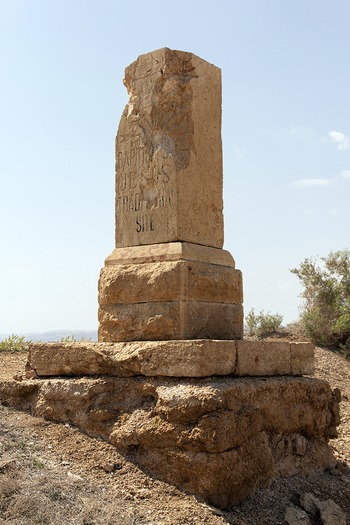
Ella Littwitz, a signpost pointing to Qasr al-Yahud. Photograph courtesy of the artist.

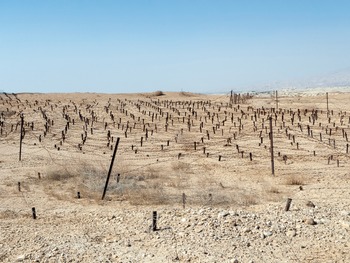
Ella Littwitz, a minefield near Qasr al-Yahud. Photograph courtesy of the artist.

These works take up a particularly fraught trope of biblical and environmental orientalism: that of the wilderness. They document desert landscapes on the edges of the nationally claimed territory, which belong to the founding myth of the Israelites wandering in the desert for forty years. The theological significance of both sites lies in their role as symbolic frontiers; in this sense, they are archetypes of the biblical wilderness imagery and its accompanying associations. Despite important differences in the history of the two sites and their current political status—Qasr al-Yahud is in the occupied West Bank, and Mount Karkom/Jabal Ideid is on the Israeli side of the Green Line (the 1949 armistice border)—both have been militarized border areas for decades. Significantly, the artworks document and address the forced “rewilding”—or laying waste—of these places, which have been turned into closed military zones through expulsion and exclusion of all other human activity. The ambivalent depiction of desert landscapes as both sublimely wild and ruined or wasted is integral to the orientalist cliché. Yet the works in question show how political and military violence turn this cliché into a reality. The dominance of military presence over these landscapes (they are literally blasted with the explosions of mines and artillery) paradoxically reinforces their mythic and aesthetic allure as wild, uninhabited land.Footnote 6 The superimposition of these two levels accounts for much of the works’ critical force.Footnote 7
My analysis focuses on biblical orientalism as a cultural disposition underpinning colonial ecology. This perspective has been applied to nature management in Palestine/Israel (e.g., in nature reserves and national parks), but rarely to military land use, which is justified through security reasons rather than cultural or ecological considerations. Although empirical studies assess the environmental effects of military usage, there is little discussion of how it fits into a broader environmental imagination.Footnote 8 This is a major gap, given the size of the territories directly controlled by the Israeli security forces. Army bases and training areas cover more than one-third of the territory on the Israeli side of the Green Line, mostly concentrated in the Negev/Naqab.Footnote 9 Additionally, approximately 30 percent of Area C in the West Bank is designated for military training areas, primarily concentrated in the Jordan Valley, not including the buffer zone along the Jordanian border.Footnote 10 All of these areas are military exclosures where civilian presence is partially or entirely prohibited.Footnote 11 Although the Palestinian bedouin inhabitants of these areas are most affected, this pervasive militarization impacts the entire region and everyone living there. It is therefore important to examine how the military shaping of the landscape overlaps and combines with cultural agendas, especially in desert areas.
The artworks studied here offer this essential perspective, examining sites of military exclosure in light of the religious and cultural narratives associated with them. More than simply highlighting these themes, they contribute to understanding them by bringing to the surface implicit and often overlooked connections. Each work uses its specific media to articulate the visual, material, and textual resonances between seemingly disparate and even contradictory registers of meaning: military-technological rationale on the one hand and biblical myth on the other.
A focus on biblical orientalism also is needed in view of the renewed efficacy of a biblical imaginary in Israel today, malignantly evident in the repeated public references to the biblical command to “blot out the memory of Amalek” (Deuteronomy 25:19) to express support and justification for the genocide in Gaza.Footnote 12 This is but an extreme example of a general trend evident in many areas in Israel, from pop music to school textbooks. Although partially tied to the desecularization of Israeli society in recent decades, we must explore the deeper roots of such biblical framings in the history of colonial relations in Palestine.Footnote 13
Biblical and Environmental Orientalism
The construction of the Holy Landscape as a literary, visual, and scientific topos has been integral to the orientalist discourse and power relations surrounding Palestine.Footnote 14 The rise of colonial interests in the Middle East in the late Ottoman period produced a surge of literature about Palestine, accompanied by an equally rich visual record of paintings, illustrations, photographs, and maps.Footnote 15 Much of this work was produced by research institutes backed by imperial governments, notably the British Palestine Exploration Fund (PEF), and practically all of it focused on the biblical significance of the land, exploring its geography, archaeology, history, and natural features in relation to the scriptures. It ignored or sidelined centuries of Muslim and Arab history, as well as the contemporary society of the Palestinians and bedouins.Footnote 16
Kamel defines biblical orientalism as a simplifying approach to Palestine (and, more broadly, the Eastern Mediterranean) that relies on a selective use of religion, focusing on the links between biblical events and the area’s physical and social characteristics. This approach introduced an “imaginary perception of Palestine based on the Bible” in which “both people and places are depicted as ‘shadows’ of a far-off past, ‘fossils’ frozen in time.”Footnote 17 Kamel focuses on works published by the PEF, which are indeed central both in volume and in their subsequent influence. However, similar approaches were replicated by research institutions in other countries and informed the representation of Palestine in art, fiction, and commercial media, all of which developed in tandem with the region’s growing tourism industry.Footnote 18 Nassar and Zanrini describe, in this manner, the “biblification” of Palestine in 19th-century photography. The latter observes, “Images of ‘Holy Land’ landscapes constructed a vision of an empty and ancient land, filled with ghosts of a Biblical past. This genre of imaging … came at the cost of obscuring, if not outrightly erasing, modern urban life of the nineteenth century and early twentieth century.”Footnote 19
The construction of the Holy Landscape entailed, therefore, specific dialectics of knowledge, ignorance, and fantasy. European travelers, painters, and novelists often depicted Palestine as “dream-land” (Twain), where concrete reality receded before the mysteries of the past (Chateaubriand), an imaginary place onto which Europeans could project their fantasies.Footnote 20 Yet this imagined land was made the object of extensive knowledge production as it was canvased for archaeological findings, surveyed, and mapped.
Within this sphere of orientalist production, the practices of biblical geography and biblical archaeology are particularly relevant to the artworks analyzed below. Rather than reworking the aesthetics of 19th-century landscape images, these works use contemporary visual language to address the epistemic and ideological aspects of biblical orientalism. It is therefore useful to distinguish, following Aiken, scriptural geography as a specific (although internally diverse) genre of “non-fictional literary works dealing with the places in which the story, or narrative, of the Bible takes place.”Footnote 21 Inspired by Protestant faith in the literal truth of the scriptures, many of these works involved a literalist reading of both text and landscape, merging them under the notion of “the Land of the Book” (also encompassing the polemics arising from this fusion of textual and empirical knowledge).Footnote 22 The scripture was treated as a historical document, and the land served as a site of material evidence to be compared with the text. This synthesis of textual and empirical methods served to claim ownership of the land, justified through divine promise and enacted through scientific practices that laid the groundwork for colonial administration.
Open landscapes and natural geographical features—the Sea of Galilee, the River Jordan, the hills of Judea, etc.—hold as important a place in the itinerary of biblical geographies as the cities, tombs, and ruins of antiquity. In fact, because Christian holy sites in the cities were mostly under the authority of the Orthodox Church, Western clergymen (especially Protestants) and explorers often focused their attention elsewhere, either in the attempt to locate undiscovered places from the Hebrew Bible or in the study of the geology, climate, flora, and fauna of the region.Footnote 23 Crucially, the very “naturalness” or pastoral quality of the landscape was an important index of its perceived antiquity.
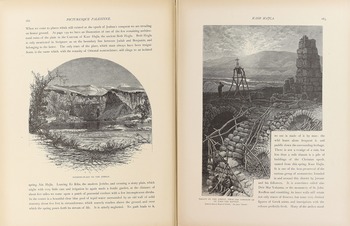
The “trouble with the wilderness,” widely discussed in colonial environmentalism, intersects here with the problem of the Holy Landscape. European travelers notoriously portrayed Palestine as a sparsely populated wilderness, and those who did examine local society tended to view it as a “living museum” of biblical customs.Footnote 24 Landscape paintings and photographs of the era tend to be empty of people or include only a few solitary figures, often focusing on bedouins or shepherds cast as stand-ins for ancient Israelites and Canaanites (Fig. 3).Footnote 25 This temporal distancing both folded indigenous culture into the Hebraic narrative and justified colonial efforts to “develop” and “modernize.” Zionist settlers echoed this myth, claiming Palestine was terra nullius, “a land without a people,” and adopting the slogan of “making the desert bloom.”Footnote 26
Pages from Charles William Willson, Picturesque Palestine, Sinai and Egypt, vol. 1, 1881–1884, London: Virtue. The Valley of Jordan near Jericho. Source: https://archive.org/details/picturesquepales02wilsuoft/page/82/mode/2up.

This production of an imaginary wilderness was not specific to Palestine but typical of orientalist discourse throughout the Middle East and beyond.Footnote 27 Western authors regularly described the region’s environment as unnaturally arid, barren, and deteriorated in comparison to a speculative past, often identified with biblical times, or with Greek and Roman antiquity, in which the area was supposedly greener and more densely populated (although contradicting the notion that the landscapes of Palestine were frozen in time, the two ideas often coexisted in texts from the period). The deterioration was blamed on the local population and Ottoman rulers, who supposedly exhausted the land’s resources through reckless use and lack of knowledge and planning.Footnote 28
The biblical inflection of the wilderness gave it additional meanings. As Mitchell argues, the wilderness was not just uninhabited land awaiting its “redeemers.”Footnote 29 It was a spiritual and moral space where the identity of the individual and the people was forged through wandering and trial; a place of divine revelation and vengeance, where the wrath of God was unleashed in the forces of nature.
The contemporary artworks I examine reflect these various components of biblical orientalism: the temporal aspect of projecting a mythical past onto contemporary landscapes; the literalist attitude that applies textual sources directly to material reality (which Said had already diagnosed as a Don Quixote syndrome of orientalism);Footnote 30 and the connection between the biblical archetype of the wilderness and modern ecological conceptions of the Middle Eastern environment. I examine these layers in contrast and connection to the militarization of the landscape.
Biblical Orientalism in Israel Today
When considering biblical orientalism as an intellectual and ideological orientation rather than a set of aesthetic conventions, its ambivalent role in Israeli culture is revealed. Although biblical orientalism remains influential across many fields of knowledge and policymaking in Israel, contemporary Israeli artists and writers have shown relatively little interest in it. As far as “serious” artistic production is concerned, biblical orientalism subsided in the first decades of the 20th century.Footnote 31 Although early Zionist culture was deeply influenced by this (primarily Christian) orientation, the canon of pre-Israeli and Israeli art and literature from the late 1920s onward rejected it, establishing itself as a secular, modernist, and predominantly urban alternative.Footnote 32 Biblical landscapes were viewed as unpalatable kitsch from which the self-styled secular modernity of Israeli culture sought to distance itself. Critics have argued that despite this negation orientalist attitudes and presumptions continue to inform Israeli cultural production, influencing in particular discourses about nature and land.Footnote 33 Yet these attitudes have often remained unreflective, disguised by the adoption of universalist and secular ideologies.Footnote 34 Internal artistic reflection on the idea and function of the sacred landscape remains rare in Israeli art.
The ongoing influence of biblical orientalism, by contrast, is directly evident in other areas of research and planning in Israel, in which biblical geography and archaeology remain living traditions.Footnote 35 Meron Benvenisti points to the continuity of a biblical and colonial framework connecting the work of the PEF and earlier Christian explorers to the consolidation of the “Hebrew map” under the newly founded state of Israel.Footnote 36 Biblical references as well as rhetoric and visual tropes of Holy Land literature are still prominent in the discourse and policy of official bodies such as the Israel Nature and Parks Authority, the Israel Antiquities Authority, and the Jewish National Fund (JNF-KKL), which between them manage most of the country’s “open space reserves” (with a significant overlap with military training areas), and have extensive outreach in tourism and education.Footnote 37 Sites such as the Biblical Zoo and several “biblical parks” promise visitors an experience of “biblical nature” and ancient “biblical agriculture.” Moreover, the notion of biblical landscape remains a central index of cultural, societal, and heritage values that inform policymaking in areas such as agronomy, landscape planning, and conservation.Footnote 38 The search for biblical landmarks continues to guide large-scale archaeological excavations, a trend that has seen an uptake in recent years as the religious far-right strengthens its position in state institutions.Footnote 39 In all these areas, the overarching narrative linking a biblical past to the Zionist present is still used to displace, symbolically and physically, Palestinian history and presence. Although the current efficacy of biblical symbolism in Israel has more immediate sources in religious Zionism and Kahanism,Footnote 40 my analysis of the ongoing influence of biblical orientalism points to its prevalence in hegemonic Israeli culture as well.
Biblical Sites, Militarized Borders
Before turning to the works themselves, I provide a brief background on the sites they explore. A preliminary distinction should be made regarding their status, which entails distinct forms of government and different mechanisms of control. The Jordan Valley is in Area C of the occupied West Bank, where Israel subjects its Palestinian inhabitants to military rule and (according to the UN Human Rights Office and other rights groups) to an apartheid regime.Footnote 41 The Negev/Naqab is part of the Israeli territory recognized under international agreements, and its Palestinian bedouin inhabitants are Israeli citizens. Despite these differences, many studies have identified continuities in the settler-colonial dynamics between the Negev/Naqab and the Occupied Palestinian Territory.Footnote 42
Mount Karkom or Jabal Ideid, located in the southern Negev/Naqab about 10 km from the Egyptian border, is one of the places speculatively identified with the biblical Mount Sinai. The mountain and its surroundings have been under the effective control of the Israeli army since the 1948 war, first under military law and then as a training facility and firing zone (known as “80 South”) used chiefly by the Israeli Air Force. Until 1948, the area was part of the bedouin territories that stretched across the Negev/Naqab to the Sinai Peninsula.Footnote 43 Most of the bedouin inhabitants of the Naqab were forced into exile during and after the 1948 war, and those who remained within the Israeli borders were internally displaced.Footnote 44 However, Nasasra shows that during the 1950s many communities were able to resist this expulsion, moving back and forth across the borders and maintaining economic activity with their relatives on the Egyptian and Jordanian sides. This resistance was gradually suppressed through military operations and the consolidation of closed military zones along the border.Footnote 45
Since 1980, archaeologist Emmanuel Anati has led numerous excavations in the area, discovering an exceptional concentration of some 40,000 petroglyphs, along with inscriptions and other findings.Footnote 46 Anati concluded that the site had been a sacred worshiping precinct for millennia and was to be identified with Mount Sinai, disputing the better-accepted tradition that points to Jabal Musa in the Sinai Peninsula. Although Anati’s hypothesis has been largely rejected in the archaeological literature, it retains some popularity among the Israeli public and is frequently highlighted in travel guides and media reports about the site.
Qasr al-Yahud is a Christian baptism site on the Jordan River, a few kilometers east of Jericho in the Israeli-occupied West Bank. It faces a twin site on the Jordanian side, Al-Maghtas, or Bethany Beyond the Jordan. According to Christian tradition, this is where John the Baptist baptized Jesus. The site also is traditionally associated with the Israelites crossing into the Promised Land and the prophet Elijah’s ascent to heaven.Footnote 47 The nearby site of Nabi Musa (about 7 kilometers to the southwest) was, until 1967, the center of one of the most important religious festivals and pilgrimages celebrated by Palestinian Muslims.Footnote 48
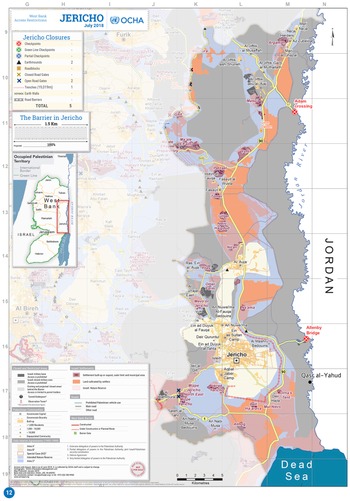
Since the 1967 war, the Jordan Valley north of the Dead Sea has been deeply marginalized,Footnote 49 with the Jordan River serving as the ceasefire border between Jordan and the Occupied Palestinian Territory. A strip of 10 to 20 kilometers west of the river became a military buffer zone, and large tracts of it were planted with land mines. Prior to the Israel–Jordan peace treaty, there were frequent conflicts between Israeli forces and Palestinians crossing the border from Jordan, and most of the bedouin communities that had been living in the area for centuries were expelled.Footnote 50 In the Oslo Accords, the region (like all of the West Bank) was cantonized into different areas of control with different movement restrictions (Fig. 4). The remaining Palestinian communities are subjected to ongoing violence by the military and Jewish settlers, who operate with the explicit intention of ethnic cleansing.Footnote 51
OCHA Map, West Bank Access Restrictions, Jericho, July 2018. Mark added to indicate the location of Qasr al-Yahud. Source: OCHA, “West Bank Closure Maps,” Occupied Palestinian Territory Humanitarian Atlas, https://www.ochaopt.org/atlas2019/wbclosure.html.

Ecologically, the area has suffered from the diversion of water from the Jordan River basin, primarily through the Israeli National Water Carrier, reducing the Jordan River’s flow by nearly 90 percent. This depletion has severely impacted water quality, ecosystems, and traditional farming along the river.Footnote 52 The extraction of minerals from the Dead Sea further reduced water levels and led to innumerable sinkholes along its shores. While extracting water and minerals, Israel denies the Palestinians access to these resources by declaring the areas along the Jordan River and the Dead Sea to be closed military zones.Footnote 53 Alongside these destructive factors, an Israeli survey highlights the positive ecological effects of the military exclosure, stating that “nature can prosper almost uninterrupted” in the alluvial plain between the border fence and the river, and emphasizing its function as an ecological corridor on the north-south axis. The “rewilding” of these military areas also draws attention on popular science platforms.Footnote 54
This transformation of the Jordan Valley into a militarized buffer zone and an ecologically degraded area sharply contrasts with its role during Ottoman rule, when it served as a vital thoroughfare on the main north-south route and on east-west routes connecting Nablus and Jerusalem to Ajlun and Salt in today’s Jordan. It was part of the Hajj route and a key segment of Christian pilgrimages. Under British Mandate and later Jordanian rule, new churches and monasteries were built on the western bank, but they were abandoned in 1967, and most remain in ruin. After the Israel–Jordan peace treaty, the area was gradually de-mined and reopened for archaeology and pilgrimage. The revival of tourism led to rivalry between Israel and Jordan over which bank holds the “authentic” baptism site, although the river dividing them is now just ten meters wide and easily crossed.Footnote 55
Paleosol 80 South
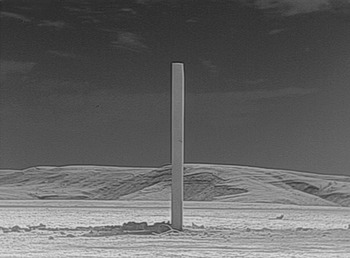
Paleosol 80 South Footnote 56 is a short film that documents Mount Karkom/Jabal Ideid and its surroundings using a military thermal camera, capturing the desert terrain and wildlife as well as various military constructions and machinery, many of which resemble monumental modernist sculptures. The footage is accompanied by a voice-over reciting passages from Emmanuel Anati’s expedition diaries, which describe his impressions of the mountain and surrounding landscape, his grappling with the meaning of the archaeological findings, and his musing about the ancient “people of the desert” (Figs. 5, 6).
Amir Yatziv and Jonathan Doweck, Paleosol #1, c-print, 25 × 30 cm. Photograph courtesy of the artist.

Amir Yatziv and Jonathan Doweck, Paleosol #7, c-print, 25 × 30 cm. Photograph courtesy of the artist.

The combination of these diaries, written and recited in a melodramatic tone, with the thermal footage and futuristic monuments gives the film immediate science-fictional connotations. It evokes familiar formulas such as expeditions to alien planets or into off-limit hazard zones. The visual alienation of the thermal camera is echoed in the narrator’s attitude, who describes an exotic, hostile landscape. This combination creates a temporal dislocation, juxtaposing several time frames: the archaeological narrative refers to an archaic landscape, prefigured in the “paleosol,” the primordial layer of rock, whereas the stylistic choices point to some near or distant future. In between, the viewer’s knowledge and certain visual indicators place us in a contemporary landscape governed by present-day military technologies.
Using desert landscapes in the Middle East to represent alien planets is common in Hollywood productions. As Mann notes, this convention perpetuates orientalist perceptions of the desert as dead, empty, and profoundly alien.Footnote 57 The use of this cinematic trope in an experimental film like Paleosolo 80 South is notable because its subject is precisely the identity and history of a specific desert location, quite the opposite of using one desert landscape or another to represent Mars. Filming on location has, in this case, a documentary rather than a purely cinematographic function. At the same time, the fact that the science fiction genre is so readily invoked shows the extent to which such alienating mechanisms are already operative in the film’s materials. They are effected in different ways, both in Anati’s diary and in the site’s military use. Using desert terrain for live fire exercises, one might say, is an extreme expression of the same attitude that leads to shooting them as extraterrestrial planets: they are imagined to be cut off from any lifeworld. Such attitudes lend an air of plausibility to the otherwise scandalous fact that a site of unique heritage value (aside from its purported biblical connection) also is used for ordnance training.
Anati’s archaeological research and diary express a different register of interest and engagement with the place. Nonetheless, by editing the diary as voice-over, the artists point to an unexpected affinity with science-fictional conventions. They suggest that identifying a site in the Negev/Naqab as the “Mountain of God” is also a way of fictionalizing it or relegating it to a sphere beyond this world. Anati’s decision to focus his study on the Mount Sinai hypothesis, despite uncovering evidence of human activity spanning 100,000 years, is a classic example of the simplified, selective chronology typical of biblical orientalism.
The work fuses two dominant perspectives: the biblical story of the Sinai covenant and the militarist framework of power. These frame the national project of the state of Israel: from the founding myth of a nation wandering through the desert in search of the Promised Land to the advanced military technologies that grant it sovereign power over that territory in the present. It similarly underscores the analogy between the logic of the closed military zone and that of the sacred precinct—which, according to Anati’s speculation, was accessible only to initiated religious figures. Both function as spaces of exclusive access to power. At a formal level, the narrator’s position is one of identification with both perspectives, conveyed, on the one hand, through Anati’s diary (a gesture repeated in several of Yatziv’s works) and on the other through the military technology used as the film’s visual medium. However, the displacement of the archaeological diary onto the militarized landscape creates an immediate irony that suspends this identification. The gap between what is shown and what is told raises suspicion and invites the viewer to examine more closely the elements of the landscape that refract, as it were, through the military and biblical lenses. Because Mount Sinai itself is not mentioned in the recited passages but only in a postscript, the visual storyline equivocates on the meaning of the recited narrative, leaving the viewer to speculate about the identity of the “ancient people” discussed there.
The film’s temporal ambiguity and method of alienation encourage the viewer to suspend current assumptions about what is “natural” in this landscape and what is not, what was there before and what came after. The narrator describes the landscape as a harsh and hostile wilderness on the one hand (“a merciless struggle is waged here between the forces of nature and living creatures, and woe to the weak”) and as a place of primordial communion with nature on the other (“It seems the individuals surrounding the mountain focused on the shapes of nature. Did they worship the mountain? Did they worship fire?”).Footnote 58 The presence of industrial structures renders this attitude slightly absurd, but the archaeological descriptions invite us to regard these structures as an authentic part of the landscape, as we might an ancient ruin. The landscape may appear as a desert wilderness disturbed by industrial structures, but equally, as an industrial landscape reclaimed by the desert, or, finally, as a desert landscape that has been disturbed by human activity for as far back as human history goes.
A minor detail in the film enriches this temporal ambiguity: the antelopes seen crossing the screen at one point are oryxes, a species extinct in the region since the 19th century that approached total extinction in the wild by the 1930s. The Israel Nature and Parks Authority reintroduced oryxes to the Negev/Naqab during the 1980s as part of a campaign to reintroduce “biblical” species.Footnote 59 Although we are inclined to see these animals as a natural part of the landscape, they are, in fact, an old-new addition. Their presence is as much a product of government policy as is the jet fighter flying overhead, and belongs to the same biblical imaginary that frames this site.
The human protagonists of the film are two male figures, whom we see only from a distance, as they carry out various activities: welding a metal beam off a radar station, hoisting an empty bombshell, lighting a campfire, lying in the shade, etc. The catalog text accompanying the work identifies these figures as bedouin metal scavengers who forage for scrap (and not-so-scrap) metal. This is likely a common connotation for local viewers, because metal scavenging at military facilities is a known issue periodically deplored in the media. In the film’s fiction, however, these figures are sometimes identified with the narrator-explorer, and sometimes with the mysterious ancient people discussed in the diary. Their presence is felt to be clandestine or marginal, and the same temporal ambiguity applies to them: although clearly contemporary figures, they are projected into the mythical past of biblical times.
The allusion to metal scavenging opens a window from the film’s science-fictional world to the Negev/Naqab’s contemporary politics. Illegal and dangerous metal scavenging in fire zones became a default source of income for many bedouins as the state of Israel seized their lands and restricted camel and goat herding.Footnote 60 This form of economic survival relates to the practices of daily resistance that Nasasra describes:Footnote 61 by defying movement restrictions and finding ways to make a living in a militarized space, the bedouins retain their connection to confiscated territories. This dynamic is a reminder that firing zones are not just a military expediency but also one of the mechanisms the state of Israel applies to control the southern Negev/Naqab, a frontier area where there are only a handful of Jewish settlements. Finally, in depicting this form of economic survival, the film emphasizes the bedouins’ absence from Anati’s tale about the ancient people of the desert.Footnote 62
By drawing attention to the textual and technological mechanisms that guide our reading of the landscape, the film also encourages the viewer to look beyond them. By playing out the tensions between two disparate perspectives of power—the military gaze and the biblical myth—it offers a surprisingly sober view of the landscape that evades both. It replaces the biblical wilderness conjured in Anati’s diary with a contemporary, strange ecology of radar stations and concrete monoliths, rewilded antelopes, metal foragers, and SUVs. These diverse elements receive roughly equal treatment in screen time and activity, suspending conventional notions of hierarchy or order among them. The landscape therefore appears as neither mythic wilderness nor apocalyptic wasteland, but as something else: a real, particular site shaped by physical and cultural violence, as well as everyday life that persists in the shadow of this violence.
Facts on the Ground
Ella Littwitz has created an extensive body of work centered on Qasr al-Yahud and the Jordan Valley, first shown in 2021 at the Center for Contemporary Art in Tel Aviv, under the title “A High Degree of Certainty,” along with an accompanying monograph titled Facts on the Ground. Footnote 63 Parts of the installation have since been exhibited elsewhere.Footnote 64 I begin with what can be described as the centerpiece of the installation, which also captures its essential artistic strategy. It includes two sculptural works: The Curse and the Blessing (or Region Bounded by Two Functions), and A High Degree of Certainty (Fig. 7).Footnote 65
Ella Littwitz, A High Degree of Certainty, 2020, and The Curse and the Blessing (or Region Bounded by Two Functions), 2021, installation view, Center for Contemporary Art Tel Aviv, 2021. Photograph: Eyal Tagar, courtesy of the artist.

The Curse and the Blessing (or Region Bounded by Two Functions) consists of two intertwined towers made of local materials tied to traditional Palestinian industry. One tower is built of Nabulsi soap bars, the other of mud bricks made from riverbank soil. Their form echoes the soap-making process, replicating the way soap bars are stacked to dry. This process points to a historical link between Nablus and the Jordan River: Nablus’s soap industry depended on bedouins in the Jordan Valley, who supplied alkaline ash (qilw), made by burning barilla plants gathered in the valley’s slopes, combined with olive oil and water to produce soap. Bedouins also traded and distributed the soap across Transjordan.Footnote 66
The intertwined towers can be seen as an allusion to the relatively recent past when the Jordan River was not a border but a pathway for economic, cultural, and ecological exchanges connecting its two banks. The work approaches the local environment as a source of livelihood, recalling that it was not a wilderness but part of a developed economy. It relates to the river not as a holy site but as a place where people built houses and made soap of local materials.
However, another very different reading derives from the work’s title. According to the artist, “the curse and the blessing” alludes to a biblical passage describing the ceremony on Mount Gerizim and Mount Ebal, identified as two hills flanking present-day Nablus. These hills also are known as the Mount of Blessings and the Mount of Curses. In the Bible, the ceremony is one of several rites of initiation that the Israelites are ordered to perform upon crossing the Jordan River,Footnote 67 marking their transformation from a band of nomads to a nation. It is also among the founding myths of the Zionist movement.Footnote 68 In other words, the title of the work refers to the colonization of the land and the biblical myth sanctioning it, whereas its materials belong to the material culture of the Palestinians and bedouins dispossessed by this colonization. The work’s full title, The Curse and the Blessing (or a Region Bounded by Two Functions), has, in fact, several layers of meaning. It evokes, first, the entwinement of blessing and curse in the notion of the Promised Land, the sacred place dogged by the curse of violence and occupation. It also refers to the two functions that bind this landscape: the textual and the material (both ecological and economic). These define a sanctified and hollowed place on the one hand, empty except for pilgrims and soldiers, and a place of living on the other.
The second of the pair consists of two sheets of geotextile that were “baptized” in the river’s holy water, one on the Jordanian side and the other on the Israeli-occupied side. The fabric is an absorbent material used in landscape engineering to stabilize soil and prevent ground erosion. This fabric alludes to the geological instability of the Great Rift Valley, where tectonic movements, seasonal floods, and mineral extraction produce an unstable terrain. These forces add to the difficulties of clearing the area of land mines, which sometimes drift underground. These movements likewise shift the river channel and change its course, complicating both the search for “authentic” biblical sites and the contemporary marking of the border. The nearly identical pieces of mud-soaked fabric point to the absurdity of the attempt to conceptually and physically stabilize this shallow, winding stream into an uncrossable border. The work and its title, A High Degree of Certainty, are ironic about the attempt to pinpoint the sanctity of the water on one bank or the other.Footnote 69 At the same time, the double “baptizing” recalls that an unequal extraction of resources has reduced this once much larger river to a muddy stream, with consequences that affect both banks. Finally, this work emphasizes the transformation of the river from a pathway to a militarized border, so that anyone wishing to dip at both banks would have to obtain the necessary permissions and make a long detour to cross at one of the two border points currently in operation.
Looking at the installation as a whole, there is a clear tension between the textual level, which denotes the overdetermination of the landscape with myths and systems of belief (religious, geographical, political) and the material level, which carries entirely different connotations (a tension that is central to Littwitz’s practice in general). The sensual experience of these materials, their color, texture, and smell, creates a strong recollection of the landscape that, along with the shrine-like symmetry of the work, amounts to more than just an ironic take on the sanctity of the place. Rather, it is an artistic embodiment of a river as a source of blessing, material and spiritual alike, and a lament for its ruin.
Littwitz describes the area around Qasr al-Yahud as a maze of religious, military, and administrative signs and symbols. Many of the works in this oeuvre consist of objects picked up from this maze, which function as conventional signs. Littwitz’s practice, like that of other salient contemporary artists, is based on the ethos of fieldwork:Footnote 70 making excursions to the site to collect and bring back findings. In the series Semiology of the Underground, for instance, the artist engraved found minefield warning signs with drawings of a plant, Arabidopsis thaliana, genetically modified to detect mines by changing color in the presence of explosives.Footnote 71 In This Line, Littwitz created a series of wall sculptures from pieces of the float-line that marks the Israeli–Jordanian border in the middle of the river (Fig. 8).Footnote 72 The line, twisted into knots, is accompanied by a paragraph from the Israeli–Jordanian peace treaty that qualifies the status of the occupied territories west of the border, equivocating the very function of the border as an agreed separation between the territory of one sovereign state and another.Footnote 73
Ella Littwitz, This Line, 2020, fragments of the Israel–Jordan border float line and an extract from the Israel–Jordan peace treaty, dimensions variable. Photograph courtesy of the artist.

A significant gesture in these works is the removal of objects conveying vital information from the site.Footnote 74 They are either stolen or obtained through negotiation with the authorities, and their removal is necessarily perceived as an act of subversion or sabotage. Unlike classic instances of conceptual art that deal with semiotics, these works do not so much reflect on the logical attributes of a sign-system as on the localized, material network of signs embedded in the landscape and the holes left in the network upon their removal. Their weathered look heightens this effect, making the viewer contemplate their past use as signs meant to deter or protect.Footnote 75
All these works speak of the attempts to map, delineate, and control a territory and attest to the ad hoc status of these arrangements. Noam Gal accordingly reads this project as an expression of radical skepticism, as though the artist refused to believe any geographical facts until she could personally verify them. Sergio Edelstein similarly sees it as an “ode to the impotence of political will,” expressing the arbitrariness of human-made borders and symbols with respect to nature. Although this skeptical trend certainly exists in Littwitz’s work, it is countered by an opposite and to my mind more interesting current, which searches for the deeper roots of these symbols and beliefs in a long history of interaction with local environments.
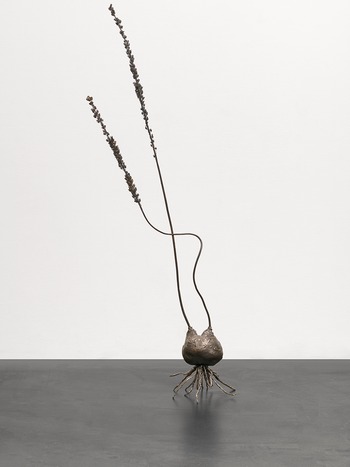
Roots are a recurring metaphor in this body of work, appearing in the bronze casts of local plants. The work The Sword in the Stone (Fig. 9)Footnote 76 is a bronze cast of Drimia maritima, a perennial plant traditionally used in the Middle East and North Africa to mark property boundaries because of its deep roots, toxicity, and tall blossom spike visible from afar. It is a natural equivalent of sorts to the floats and border signs, and its uprooting is traditionally considered no less transgressive than the removal of the latter. The name of the work, relating to the legend of King Arthur, suggests this uprooting and perhaps also the connection between the power of empires and divine promises to the trampling of local property rights. Another group of bronze casts is taken from Dittrichia viscosa, a “pioneer plant” that is often the first to grow on disturbed lands in the region, whose chemical properties prevent other plants from growing in its immediate proximity. This group of sculptures is titled Widow’s Boundaries (Fig. 10), taken from a biblical phrase used as a blessing upon the foundation of new settlements in Israel: “The Lord tears down the house of the proud but maintains the widow’s boundaries.”Footnote 77 The plant becomes a metaphor for the Zionist pioneers, the settlers of the “barren” lands, while also reflecting the self-identification of these settlers as a “widowed” nation, bereaved and in need of protection.
Ella Littwitz, The Sword in the Stone, 2021. Photograph: Trevor Good, courtesy of Alexander Levy Gallery.

Ella Littwitz, Widow’s Boundaries, 2020, bronze casts of Dittrichia viscosa, dimensions variable. Photograph: Eyal Tagar, courtesy of the artist.

Here again, there is a tension between the title that underscores the plant’s symbolic meaning and the work’s material presence, which emphasizes its organic form. There is a degree of arbitrariness in the human attribution of meaning to these plants, regarding them as “pioneers,” “invaders,” or “defenders” of lands. But the plants’ biological qualities and their “politics” of competition over resources make them susceptible to meaning attributions in the first place. Seen in this light, the work Semiology of the Underground can be read differently: the genetically modified Arabidopsis thaliana is not just an instance of advanced military technology but a continuation of far older uses of plants as indices and markers of the ground and what lies beneath it. Here, these plant casts can be read as an instantiation of what Eduardo Kohn calls “living semiotic”: the idea that human signs are not a self-enclosed system with an arbitrary relation to signified referents, but rather an open system that is rooted in broader signifying processes of life in nature.Footnote 78 From this perspective, Littwitz’s project does more than deconstruct a hegemonic system of symbols and beliefs imposed on the landscape. It traces multiple lines of signification that are materially embedded in the landscape, following them as they intersect, contradict, or reinforce one another. Alongside the gross marks of militarization and biblification, the work brings to life the echoes of another history, and other meaning-systems rooted in the site.
Conclusion
By revisiting the tradition of biblical orientalism and its resonances with the military shaping of the landscape, the works I have analyzed allow us to articulate three different components in the manufacturing of wilderness or the forced rewilding of the sites they explore. I have discussed the temporal dimension of selective historicization through biblical geography, archaeology, and related textual mechanisms (e.g., the evocation of biblical events in place-names) in conjunction with the military and technological aspect, responsible for effectively emptying these places of people and specifically excluding their original inhabitants, while also scarring the landscape with explosives, debris, land mines, and more. These components are joined by an additional layer of ecological factors, specific to each site: in the Jordan Valley, the extraction of water and minerals alongside the security mechanisms controlling the border; and in the Negev/Naqab, the reintroduction of “biblical” wildlife and the clandestine economy of dealing in military refuse—elements that play into the disturbed ecology of these sites and determine their present conditions.
The artworks do not merely bring together these different perspectives, which are rarely surveyed as a whole. Each work creates a condensation of meanings through specific elements of its medium. Paleosol 80 South does so primarily through the juxtaposition of the aural and the visual, whereas Facts on the Ground relies on the relation between an object and its title. This compact unity of disparate meanings, one of the definitions of irony, brings to the surface both the inner logic of these connections and their manifest contradictions. This layering of perspectives counters the simplifying orientalist gaze. It produces representations of desert landscapes that are considerably more complex than the dichotomies between wild and civilized, primitive and modernized, desolate and fecund, and so on.
The force of these works lies in their critical reflection on mechanisms of power that shape the landscape; that also is their internal limitation. The perspective of the Palestinian inhabitants affected by these mechanisms is marked in each work as banished or marginalized, but it remains fragmented, deducible only from clues and traces. A brief comparison of these two works with projects by Palestinian artists with similar themes and strategies underscores this limit. As these projects have been extensively discussed and analyzed elsewhere, I limit myself to a few comparative remarks.Footnote 79
Larissa Sansour’s In the Future, They Ate From the Finest Porcelain (2016)Footnote 80 is a science fiction film that explores the reconstruction/fabrication of national identity through archaeology. It tells the story of a “narrative resistance group” that deposits elaborate tableware in the ground to prove the existence of a fictional civilization and establish future claims to their stolen lands. Set in an apocalyptic, militarized future, the film shares some conceptual and visual features with Paleosol 80 South. Here, however, the fabrication of a mythical past is reappropriated as a tool of resistance. The film also reflects on how Palestinian identity and subjectivity are affected by the temporal twist captured in the work’s title, suspended between a distant, speculative future and a vanished past. In a similar vein, Dima Srouji’s art and research address colonial practices in archaeology, and specifically the weaponization of biblical archaeology in Zionist settler-colonialism. In works like Maternal Labor (2024),Footnote 81 she focuses on the physical labor and agency of Palestinian women and girls who were hired by Western research institutions to excavate the lands they owned and cultivated. This work and other projects (e.g., Maternal Exhumations, 2023)Footnote 82 also highlight (in affinity with Littwitz’s work) the continuity between this displaced archaeological heritage and contemporary Palestinian material culture and expertise.
It is not surprising that perspectives of resistance and reparation are less emphatic in the works of Jewish Israeli artists, given their different positionality, and because current conditions tend to cement this difference. Beneath their irony, these works portray bleak landscapes that have been culturally and ecologically drained. However, conveying a sense of the landscape as actively drained rather than simply empty is an achievement, especially desert landscapes that, from 19th-century photography to contemporary science fiction films, have been portrayed as empty and alien. Their strategy, in this sense, is closer to the critical approach Mitchell evokes in “Holy Landscape.” He observes that the landscape image, presumably the most innocent of all idolizing tendencies, becomes an idol in its own right when it “serves to naturalize power relations and erase history and legibility.”Footnote 83 Mitchell therefore advocates a Nietzschean approach to such idols, one that strikes them with a “‘hammer as with a tuning fork,’ so as not to smash them, but to make them sound and resonate, divulge their own hollowness, and vomit up the human sacrifices they have demanded.” Both of the works I have discussed here are keen tuning forks for this purpose.
Acknowledgments
I thank Ella Littwitz, Amir Yatziv, and Jonathan Doweck for sharing their work. I am grateful to Eva Axer and my colleagues at the Leibniz-Zentrum für Literatur-und Kulturforschung and to Matan Kaminer for their invaluable advice and feedback on earlier versions of this article; to Basma Fahum and Michal Baror for discussing and sharing their rich knowledge on the subject; and to Avital Barak, Natalia Gutkowski, and the participants of the workshop for political ecology at the Martin Buber Society of Fellows for their expertise and feedback. The article is based on research conducted as part of the Program Area Knowledge of Life, led by Eva Axer and Georg Toepfer at the Leibniz-Zentrum für Literatur- und Kulturforschung, Berlin. This research was funded by the generous support of the Minerva Stiftung Postdoctoral Fellowship.
Conflicts of interest
The author has none to declare.





 Open access

