




The National Archives in Stockholm preserve nearly 23,000 fragments of medieval books.Footnote 1 Throughout the sixteenth and early seventeenth centuries, obsolete sheets of parchment were repurposed as covers for paper account booklets. More than 17,000 of these medieval wrappers contain music, which is almost always monophonic plainchant, surviving on leaves from liturgical books of various types. But three of the wrappers preserve polyphony.Footnote 2 Fragments 813 and 5786 are double-page spreads, or bifolios, from the same polyphonic host collection of Latin motets, which strongly resembles late thirteenth- or early fourteenth-century motet compilations of northern French orgin in appearance, contents, notation and style. A further bifolio of similar date – fragment 535, badly damaged by fire – records two three-voice organum compositions and, as suggested below, may originally have come from the same polyphonic collection as the motets. In 1996, Gunilla Björkvall, Jan Brunius and Anna Wolodarski reported, in Swedish, their discovery of two of these polyphonic fragments, describing the archival and cultural circumstances of their presence in Stockholm.Footnote 3 While Brunius, Björkvall and Wolodarski transcribed the motet texts in 813, the musical contents of Stockholm’s polyphonic fragments have otherwise remained unedited and unstudied.Footnote 4 This article focuses principally on the well-preserved motet fragments 813 and 5786: it analyses and contextualises them for the first time, revealing their broad and significant consequences for current understandings of the composition and transmission of polyphony at the turn of the thirteenth century into the fourteenth.
Fragment 813 records, in varying states of completeness, four different Latin double motets, three-part compositions in which the two upper voices present independent syllabic texts above a quoted plainchant melisma in the lowest voice or tenor. All four of these motets represent unique compositions, unknown from any other manuscripts, and one of them – Dies ista celebris/Hec est dies/MANERE, which survives almost in its entirety – notates portions of its plainchant tenor in red ink. The three-voice organum Tumba sancti Nicholai in fragment 535 also features two red tenor notes. This article demonstrates that 813 and 535 offer two new examples for specific non-rhythmic uses of red notation described in fourteenth-century theoretical treatises following Philippe de Vitry but never seen before in practice: the Stockholm motet uses red ink to prompt octave transposition, while the organum highlights pitches that have been added to its plainchant quotation.Footnote 5 The Stockholm motet and organum fragments possibly stemmed originally from the same polyphonic collection, one whose contents and copying probably antedate what has until now been considered the first known use of red notation in Fauvel, the famous version of the Roman de Fauvel with musical interpolations, produced in Paris in 1317 or 1318.Footnote 6 In their use of red notes, as well as in several other features of their contents and notation, the Stockholm motet and organum fragments are not directly comparable with any other known source of thirteenth- or fourteenth-century polyphony, complete or fragmentary.
There survive several independent motet collections of French origin from the period c. 1260–c. 1290 whose contents overlap to a degree that is indicative of a core repertoire of compositions, which was relatively widely transmitted and well preserved for posterity.Footnote 7 This is not the case after c. 1290 up until the appearance in the late thirteen-teens of Fauvel, which presents a mix of thirteenth- and distinctively novel fourteenth-century compositions in the context of a satirical Roman. Currently, the only substantial witness to a turn-of-the century layer of the motet repertoire seems to be the largely unique contents of an eighth section or fascicle apparently copied in the late thirteenth or early fourteenth century as an appendix to the older and monumental Montpellier Codex (Mo).Footnote 8 On the one hand, rhythmic techniques evident in the newest pieces in Mo 8 and in Fauvel are undoubtedly more modern than anything surviving in the Stockholm motet fragments. On the other, 813 offers new evidence of the use of red notation, and two of its motets provide new musical settings for decades-old Latin song texts, two techniques otherwise unknown in sources before Mo 8 and Fauvel. In fact, the quotation and musical re-working of ‘historical’ Latin conductus texts from the early thirteenth century has long been regarded as an idiosyncratic practice in Fauvel, a peculiarity of this compilation’s supremely subtle and uniquely allegorical and politicised status.Footnote 9 From the new perspective of the Stockholm fragments, this article engages with and synthesises the surviving manuscript evidence for a period of motet history of which scholarly understandings remain limited and partial, and for a Latin-texted portion of the repertoire that is still comparatively little studied.Footnote 10 The article makes the case for an apparent gap in evidence for motet circulation and composition – and especially for Latin motets – in the decades around 1300, exploring possible explanations for and ramifications of a lacuna in extant polyphonic sources and proffering insights into what has been lost.
Physical Characteristics of Motet Fragments 813 and 5786 in Context
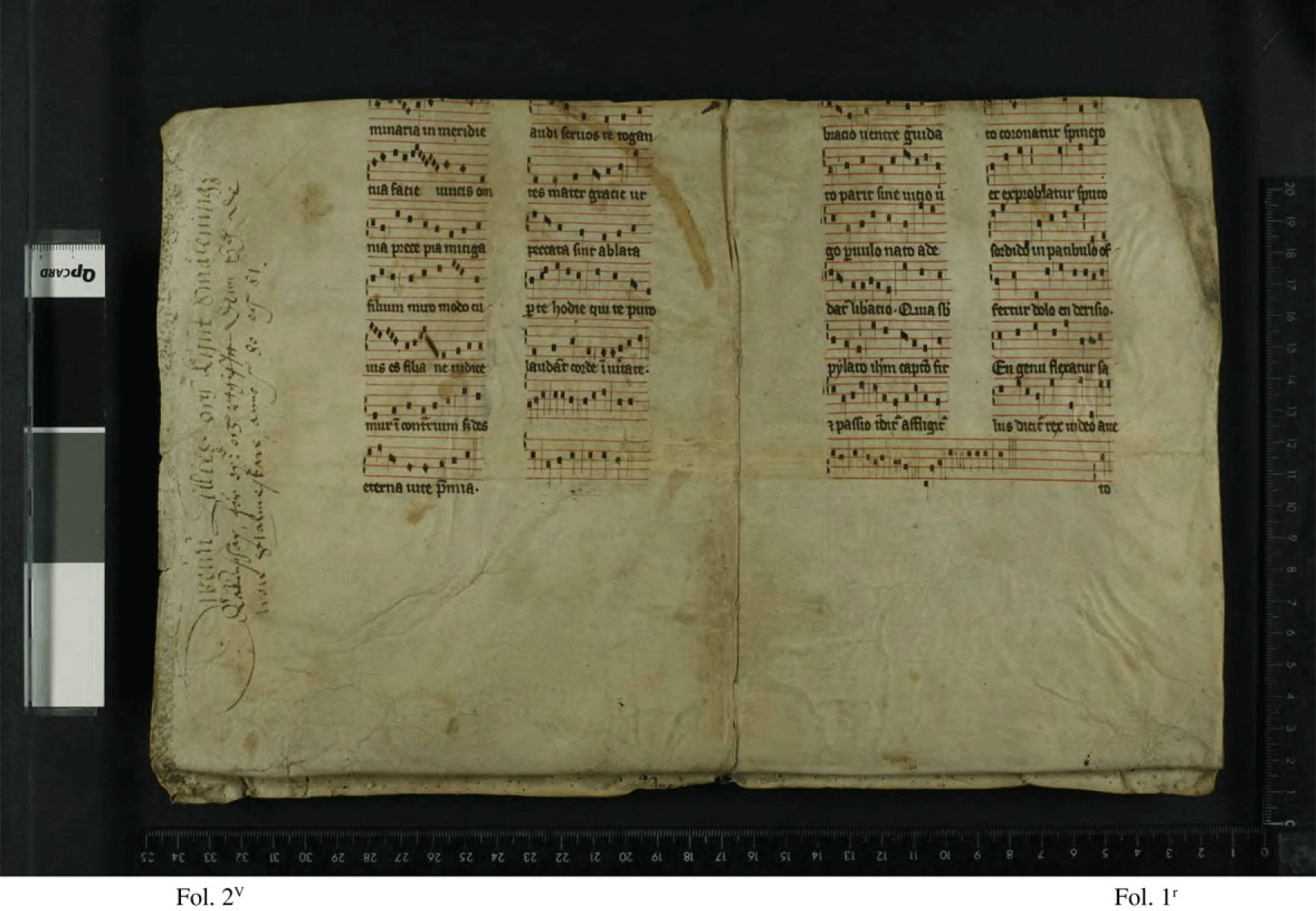
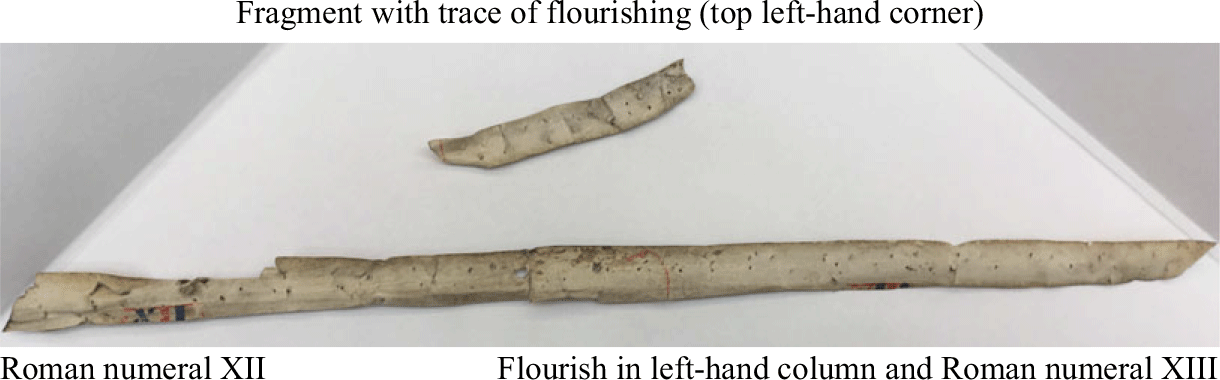
Fragments 813 and 5786 differ in their states of survival and in the nature of their musical contents, but they clearly derive from the same host collection of motets and were probably repurposed as account covers as part of the same process.Footnote 11 813 is a complete wrapper in very good condition, comprised of two bifolios stitched together on the long edge, whose musical contents are preserved in their entirety (see Figures 1a and b and 2a and b). 5786, a single bifolio, was originally one half of a wrapper of the same kind (see Figures 3a and b). Sewing holes are visible along one long edge of 5786, and when this covering bifolio was detached from its sixteenth-century accounts, a long-edge strip of parchment – with matching sewing holes – was found in the spine of the account booklet (see Figure 4).Footnote 12 This strip is all that remains of what was once a further bifolio from the motet collection: on one side, it has traces of the red pen-trail flourishing evident elsewhere in 5768 and 813 as well as of two multi-coloured roman numeral headings of the same kind in 813.
Stockholm Riksarkivet, fragment 813 I (recto)

Stockholm Riksarkivet, fragment 813 I (verso)
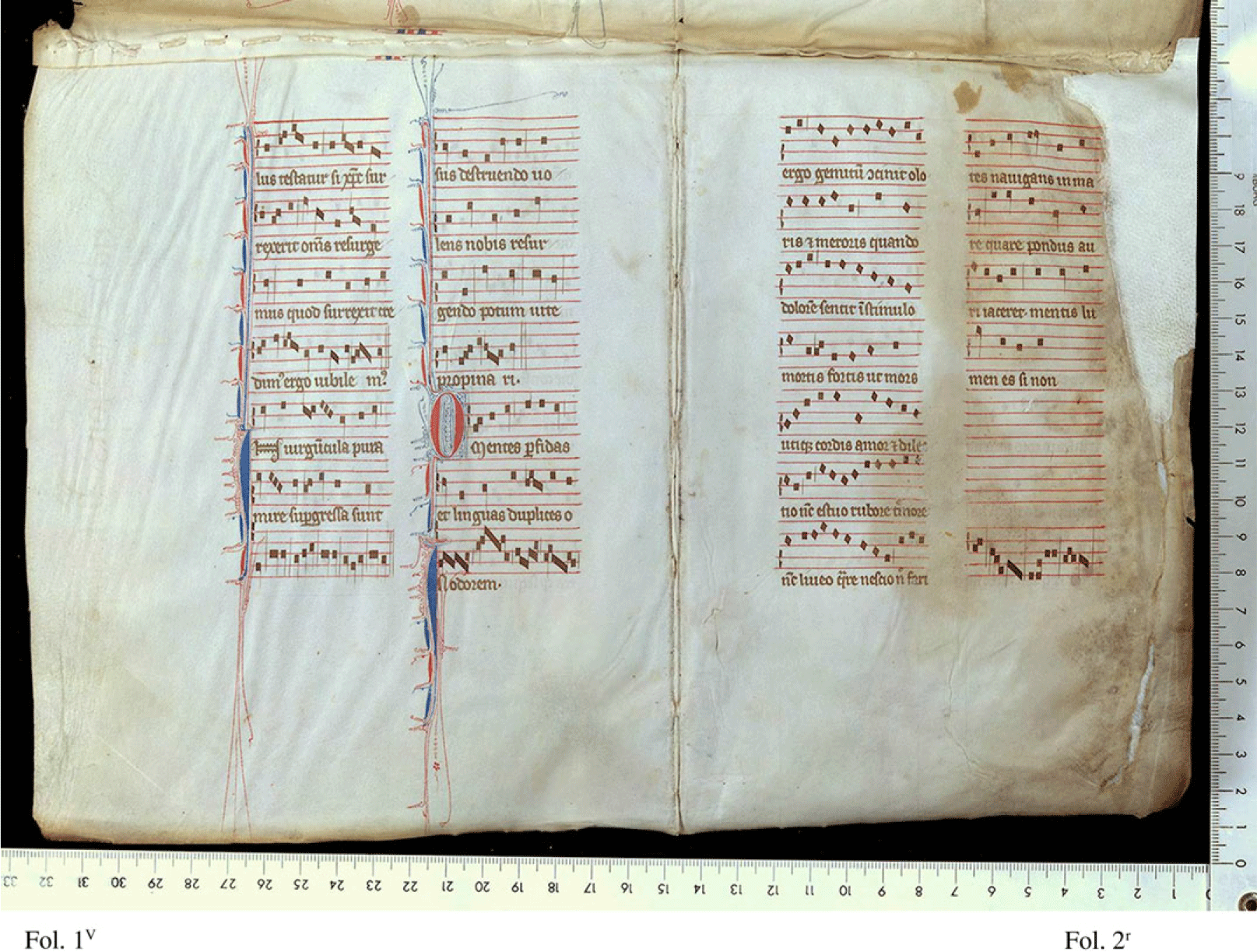
Stockholm Riksarkivet, fragment 813 II (recto)
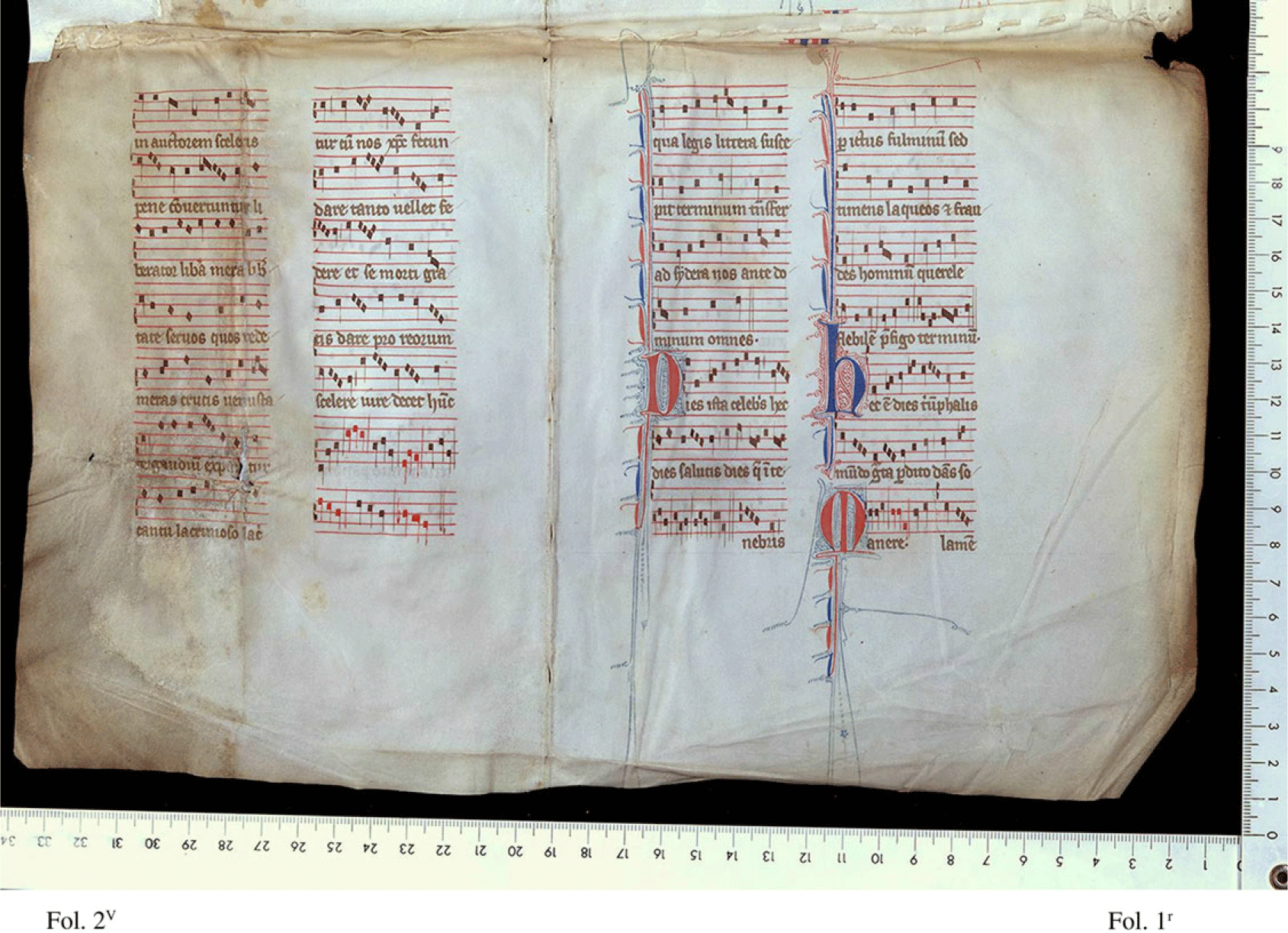
Stockholm Riksarkivet, fragment 813 II (verso)
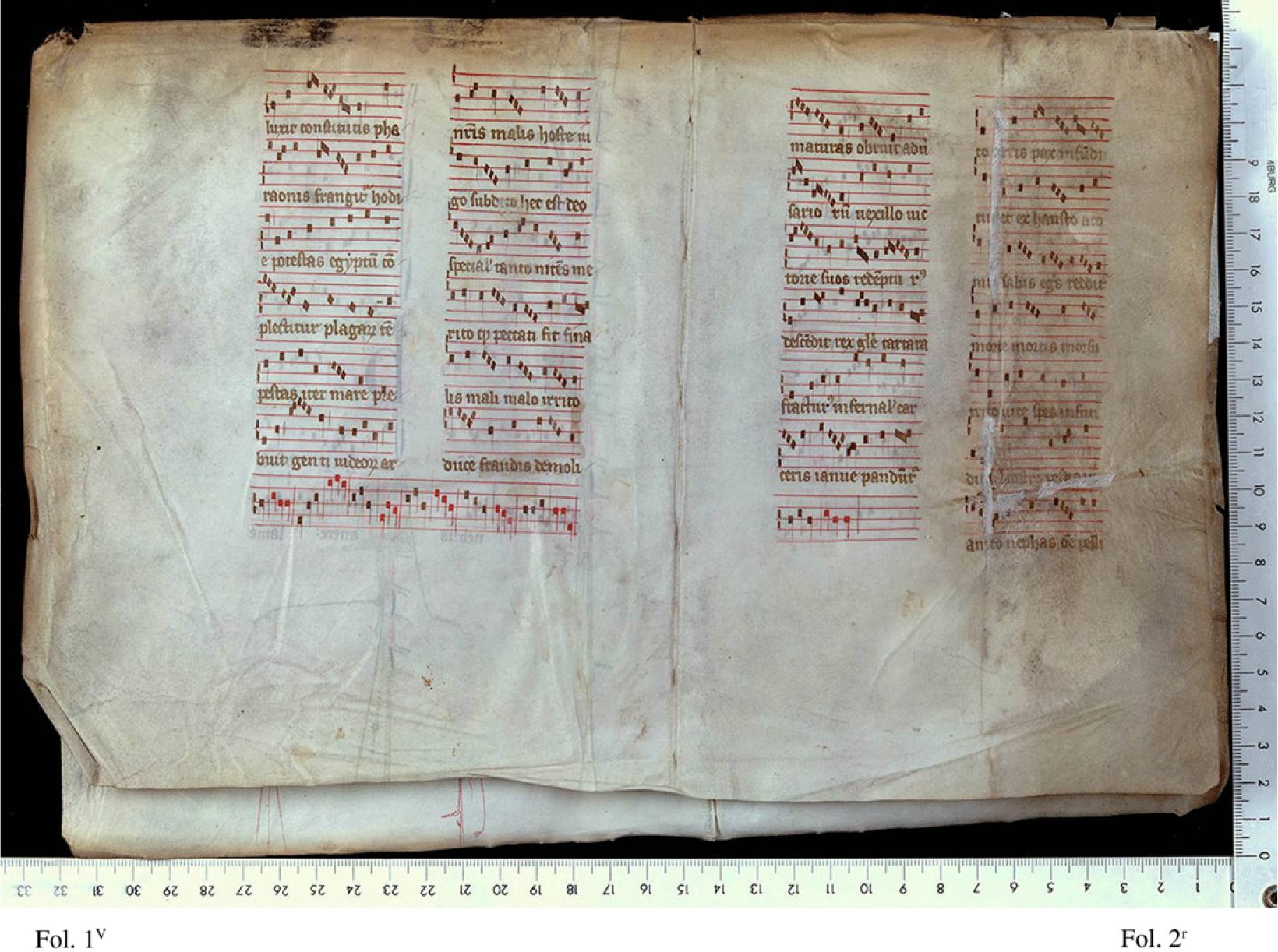
Stockholm Riksarkivet, fragment 5786 (recto)
Stockholm Riksarkivet, fragment 5786 (verso)

Stockholm Riksarkivet, fragment 5786 (Binding strip, verso)
The two bifolios that make up 813 (labelled I and II respectively) and the single bifolio that remains of 5786 are of the same size (c. 220 by 320 mm). All three bifolios must have been cut down at the point at which they were repurposed as wrappers. If, in their current state, the bifolios of 813 and 5786 are folded along the original gutter, the pages of the booklet are oddly and impractically unequal in width, one leaf noticeably wider (by c. 30 mm) than the other. It appears that the two bifolios of 813 were opened face upwards and cut twice, once along the bottom (clipping the downward pen-flourishings) and once on their left-hand side (resulting in a smaller margin than is visible on the right of the bifolio). Fragment 5786, on the other hand, was up-side down when it was trimmed in the same way.Footnote 13 In 5786, the full expanse of empty parchment at the bottom of the page – reduced in 813, but here extending even below the long downward trails of the flourished initial – was preserved at the expense of the top two lines of its upper-most musical staves. The expansive margins surrounding the musical notation in the Stockholm fragments are striking, especially considering that they were cut down on at least two sides in the sixteenth-century process of making wrappers. The presence of sewing holes and the imprint left by binding thread visible in the gutters of the bifolios (see especially Figures 1a and 2a) indicates that they stem from a bound codex, but one whose leaves were not subject to heavy (or perhaps any) trimming. The unusually generous proportions of this book, with a significant amount of blank space framing the musical notation on each page, may have increased its luxury status.
Their substantial margins aside, the appearance of 813 and 5786 is otherwise conventional for a late thirteenth-century continental motet collection (see comparable examples listed in Table 1, under ‘decoration and layout’). In decoration, the Stockholm fragments are relatively high-grade: the three individual voices of each motet are treated to opening red and blue initials. Each red or blue initial receives elegant pen-flourishings, ending in large loops, in the alternate colour. Along the vertical arms of the flourishing are rows of alternating red and blue J motifs with projecting curlicues.Footnote 14 Only Mo – with a so-called old corpus dated c. 1270, to which fascicles 1 and 7 were added later (c. 1290) and fascicle 8 later still – is more lavish (though much more heavily trimmed).Footnote 15 Mo has fully illuminated initials throughout, and historiated initials at the beginning of each fascicle. Most similar in appearance to Stockholm are Ba (dating from c. 1280 and of either Parisian or Southern French origin),Footnote 16 Tu (dated c. 1300 and likely copied in Liège)Footnote 17 and the Leuven fragments (probably also turn of the century and copied in the upper Meuse area in Lorraine).Footnote 18 813 and 5786 are more elaborate than Ba and Tu, whose tenor initials are not flourished with J motifs as the upper voices are.Footnote 19 Leuven has the same equality between tenor and upper-voice flourishing as in Stockholm, but its flourishing style is distinctively different – each J motif scalloped and finialed – such that, overall, it is Tu that most resembles 813 and 5786.Footnote 20
Continental Motet Collections Comparable to Stockholm Fragments (813 and 5786), c. 1270–c. 1310 (ordered chronologically within sections)
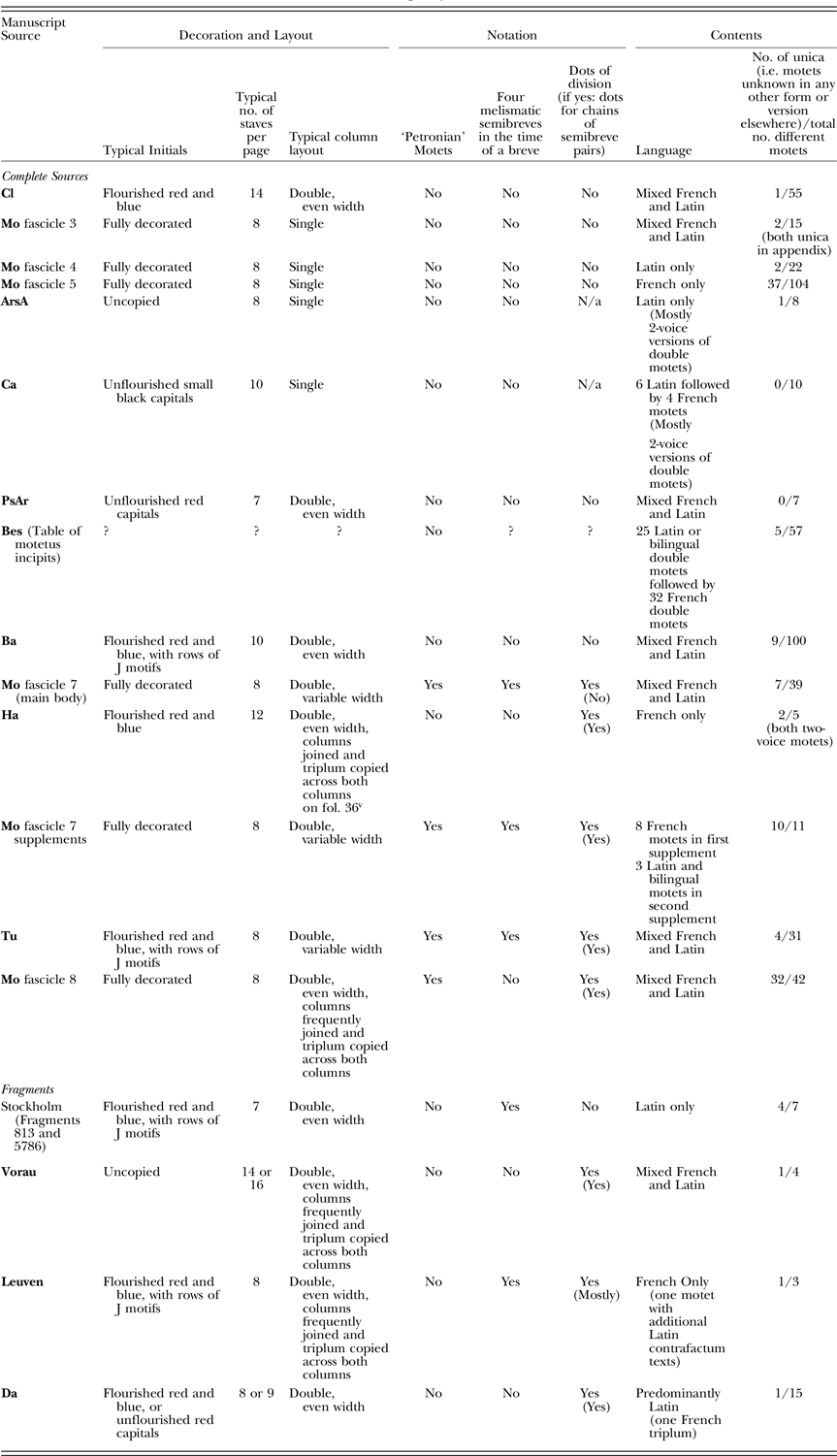
In terms of the dimensions of their writing space, however, 813 and 5786 are closer to Mo than to any other contemporary motet collection.Footnote 21 Stockholm has a writing block of c. 90 by 125 mm with seven staves (of 12 mm each) per page (see Table 1, for numbers of staves in comparable sources). In Mo fascicles 1–7 there is an average writing block of c. 80 by 125 mm and eight staves (of 11 mm each) per page, while the eighth fascicle has the same number and size of staves within a slightly taller writing block (c. 80 by 130 mm). The Stockholm fragments have a wider writing space than Mo fascicles 1–8, and their writing block is the same height as Mo fascicles 1–7, but, with one fewer stave per page, Stockholm has more space for text underlay, which can be somewhat cramped on occasion in Mo. Mo and Stockholm stand apart from Cl, Ba and Vorau, which are noticeably larger-format collections, as well as from the less formal single-column copies of double motets, mostly in reduced two-voice versions, in Ca and ArsA.Footnote 22 Tu, Leuven and Da – collections whose decoration is closer to Stockholm’s than to Mo’s – are all a little larger in size, and eight staves per page is the rule here also.Footnote 23
In layout, what survives of the Stockholm motet collection employs a consistent format of two equal-width columns. This is similar to Cl, PsAr, Ba and Da (see under ‘column layout’ in Table 1). The motet fascicles of Mo’s old corpus, by contrast, are copied in a single column, while Mo 7 – like Tu – often uses double columns of unequal width, expanding the left-hand column to accommodate motet tripla that are significantly denser in notes and words than their accompanying motetus voices. Mo 8, on the other hand, maintains two columns of equal width, but here there is a different kind of adjustment for a more capacious triplum voice, evident also in Ha, Vorau and Leuven: individual staves near or at the bottom of the page are joined such that the triplum part can continue across both columns, taking up space usually allotted to the motetus.Footnote 24 This technique to expand the available space for a triplum within an equal-width double column layout is not exploited in Cl, PsAr, Ba or what remains of Da. Arguably, it is not necessary in these sources, since their triplum and motetus voices tend not to be radically different in rhythmic and textual profile. In Stockholm, however, there is one motet (in 813 bifolio I, fol. 2r–v; see Figures 1a and 1b) in which wasted space could have been avoided by adopting the accommodation so common in Mo 8. Two staves of the motetus column in 813 I are twice simply left blank in order to align this voice with the corresponding triplum, whose notation took up more room.Footnote 25 Despite containing at least one composition of a style that posed the same challenges of mise en page encountered in Tu and Mo fascicles 7 and 8, the Stockholm fragments did not adopt any of the solutions – broadening or joining certain columns – evident in these sources.
Semibreve Groups and Dots of Division in Late Thirteenth-Century Motet Sources
The musical style and notation of the Stockholm fragments stands in similarly complex relation to that of other late thirteenth-century motet collections (detailed under ‘notation’ in Table 1). Fragments 813 and 5786 use a highly accurate and precise late thirteenth-century notation that broadly follows the principals outlined in Franco of Cologne’s Ars cantus mensurabilis musicae, dated c. 1280:Footnote 26 there are discrete note-shapes for duplex long, long, breve and semibreve, measured rests, occasional dots of perfection and Franconian ligatures.Footnote 27 However, in their treatment of semibreves the fragments perplexingly and uniquely exhibit characteristics that are, as demonstrated below, both conservative and radical in relation to Franco’s theory and to broader late thirteenth-century practice.
Franco emphasises that that a breve can be divided into a maximum of three component parts or semibreves, advocating the use of a small dot or stroke to differentiate varied groupings within chains of syllabically-texted semibreves. Any melismatic groupings are obvious from text underlay, but for individually-texted semibreves dots were necessary to establish how a string of five diamond-shaped figures in a row should be parsed in their division across the two breve units (whether as a pair of semibreves followed by a trio, or a trio followed by a pair). The Stockholm fragments – in common with sources dated before c. 1280 – never actually take advantage of Franco’s maximum number of three for syllabic semibreves, nor do they employ dots of division for breve units. 813 and 5786 do not divide breves into as many as three texted semibreves but rather (as similarly in Cl, Mo’s old corpus and Ba) make exclusive use of semibreve pairs.Footnote 28 Since syllabic semibreve groupings are never varied in Stockholm, no dots of division are required for clarification.
The default presumption that syllabic semibreves should be grouped in pairs also underlies the notation and interpretation of the main body of Mo fascicle 7. Dots for semibreve groups are used sparingly here, and only in motets that divide their breves into three or more texted semibreves. However, in an initial supplement added at the end of fascicle 7 – whose compositions are absent from Mo’s medieval table of contents – the new scribe is more liberal with dots: they are now provided to spell out chains of semibreve pairs, a clarification that is gratuitous by the codex’s earlier standards.Footnote 29 The inclusion of dots to demarcate previously presumed groupings of semibreves into pairs is evident also in Ha (dated in the early 1290s) and in the layer of sources that were probably copied c. 1300 or in the early fourteenth century: Tu (which provides many clarificatory dots of division absent from the copies of the same motets in Mo 7), Mo 8, Vorau, Leuven and Da. In the thirteenth-century repertoire overall, and even in its latest layer of sources, motets that consistently use only pairs of texted semibreves are more common than those that mix pairs and trios or that divide their breves into more than three semibreves (exceeding Franco’s maximum). Nevertheless, once more varied semibreve groupings were established, even if not always exploited, it became more necessary to make explicit the typical arrangement of semibreves into pairs. An awareness of possible variety, and the deposition of the semibreve pair as the exclusive and then default grouping, evidently motivated the introduction of additional dots – especially prominent in Tu and Mo 8 – to spell out the duple division of semibreve chains. This was a clarification deemed unnecessary in sources before c. 1290 but which became common thereafter.
In their use only of pairs of texted semibreves, and in the absence of any retrospective clarification of semibreve groupings with dots, the Stockholm fragments do not fully exploit theoretical possibilities described by Franco and resemble musical sources (like Mo’s old corpus or Ba) dated c. 1280 or before. It is therefore especially remarkable that two motets in 813 occasionally divide their breves into four semibreves as part of melismatic embellishments – decorative downward turn figures – that exceed Franco’s maximum limit.Footnote 30 The division of the perfect breve into four or more semibreves is typically associated with Petrus de Cruce, whom the fourteenth-century theorist Jacobus names as the instigator of this technique, citing as examples two motets by Petrus that are preserved in full as the opening pieces of Mo fascicle 7 and also (though less prominently positioned) in Tu.Footnote 31 These are three-voice compositions in which a notably slow-moving plainchant tenor supports an elaborate, French-texted triplum characterised by groups of up to seven syllabically-texted semibreves within the time of a breve unit (demarcated by dots of division). Fragments 813 and 5768 do not contain any pieces in this style, found only in sources dated c. 1290 or later, and this is unsurprising given that their contents are exclusively Latin-texted. In practice, however, it is clear that the use of more than three semibreves in the time of a breve was not confined to Petrus or to ‘Petronian’ style works. Although Franco declared that only a tripartite division of the breve was acceptable, the theorist known as Anonymous IV – writing shortly after, and indeed citing, Franco but in general describing much older forms of thirteenth-century notation and repertoire – several times stated that the breve could be divided into two, three or four.Footnote 32 Anonymous IV’s remarks apparently pertain to instrumental music, but it is possible that this non-Franconian practice occurred also within the realm of vocal music in the late thirteenth century, and was perhaps even established before, and continued alongside, a strictly tripartite theoretical limit for the breve.Footnote 33
The use of four semibreves within the time of a perfect breve, then, need not necessarily be deemed Petronian or even post-Franconian. However, four-semibreve melismas of the kind seen in Stockholm – written as a stand-alone cluster of individual diamond-shaped note-heads – are entirely absent from Cl, Mo’s old corpus and Ba and appear only twice within the main body of Mo 7, invariably within Petronian style compositions.Footnote 34 Certain of the three-note melismas in 813 and in 5786 are also unusual by the notational standards of sources up to and including the main body of fascicle 7. While Stockholm principally uses the traditional descending three-note conjunctura that is the almost exclusive three-note decoration in Mo 7, fragment 813 features on several occasions a melismatic three-semibreve turn figure (for example, e'–d'–e' in Figure 2a, 813 II, fol. 2v, right-hand column, first system) that is notated – like its four-semibreve melismas – as a free-standing group of three diamond-shaped noteheads. This notation is absent from the main body of Mo 7 and from earlier sources, which only ever group three diamond-shaped semibreves to be sung to a single syllable in the context of a conjunctura.Footnote 35
Both three- and four-semibreve decorations of the type found in 813 are, however, noticeably more common already in the first supplement added to Mo 7, as well as in Mo’s later eighth fascicle and especially in Tu.Footnote 36 As noted above, Mo 7’s first supplement was copied by a new scribe who supplied more clarificatory dots of division for breve units than in the fascicle’s main body, and although the supplement was clearly an afterthought, Alison Stones has concluded that the whole of fascicle 7 was decorated by a single artist, and a different artist from the one who subsequently worked on Mo 8.Footnote 37 This suggests that fascicle 7’s internal layers were not too chronologically disparate, positioning its supplementary material closer to the preceding compositions in this section than to fascicle 8. In consequence, certain kinds of three- and four-semibreve melismatic decorations found in 813 cannot be identified in any sources before c. 1290, but they need not necessarily post-date 1300.
There are, however, examples where both three- and four-semibreve melismas notated as in 813 are clearly later additions to earlier thirteenth-century motets. These decorations are most prevalent in Tu, where five motets contain four-semibreve decorations that are absent from the versions of those same pieces in Mo fascicles 5 and 7.Footnote 38 In a Latin motet in the early fourteenth-century Northern Italian source Ob e 42, multiple four-semibreve melismas in the motetus are absent from the French-texted versions of the same motet in Mo 7 and also, in this case, Tu.Footnote 39 It is likely that, at least in the first 813 motet featuring a four-semibreve melisma (here in the triplum; see Figure 1a, 813 I, fol. 1r, left-hand column, third system), this decoration was a later addition. As demonstrated below, the motetus of this otherwise unknown composition in 813 is cited as a musical example by Franco. This citation confirms that the motet was created before the completion of Franco’s treatise c. 1280, and it also denies the presence of a four-semibreve melisma as part of the triplum’s original conception. Franco would hardly have selected an example from a motet that flouted the theoretical doctrine he sought to establish, and there is otherwise nothing in the essential musical and textual fabric of this triplum that does so.
At least in one instance, then, 813 apparently records a later, more florid and somewhat modernised version of an older composition, and this is demonstrably the case in the two motets in 5786 with extant earlier concordances.Footnote 40 But just how big is the chronological gap between the age of the contents and the copying of 813 and 5786? The Stockholm motet collection could be dated as late as 1320 on the grounds that its decorative three- and four-semibreve semibreve groups, rare in sources before c. 1290, are characteristic of early fourteenth-century sources such as Fauvel (although here the lengthening of certain semibreves within these groups is occasionally shown by the addition of down-stems).Footnote 41 Yet the notation in 813 of three- and four-semibreve groups in a context where dots of division are absent – and the invariable division of syllabic semibreves into pairs can be presumed – is entirely unique in the context of any other extant thirteenth- or fourteenth-century source. The absence of dots of division in Stockholm suggests a chronological proximity to the practice of parsing semibreve chains in pairs, a practice that evidently did not require notational clarification in Mo 7, but was spelled out in the first supplement to this fascicle and, subsequently, in Tu and Mo 8. A date of copying of around and probably before 1300 for the Stockholm fragments might, therefore, best account for their exceptional and contradictory combination of archaic and modern notational features.
Latin Motet Collections and Unica around 1300
Across the three bifolios that survive as fragments 813 and 5786 there is no trace of a vernacular French text. This is a strong indication that the original collection from which 813 and 5786 stemmed was one that overwhelmingly, if not exclusively, contained three-voice Latin motets, and this would also explain its destruction at the time of the reformation in Sweden. It would be impossible to draw three such entirely Latinate bifolios from any of the complete surviving sources that mix French, bilingual and Latin double motets dated in the decades around 1300. Only two of the thirty-two bifolios that make up Ba lack French texts altogether.Footnote 42 Of Mo 7’s forty bifolios, just one is without any trace of French texts.Footnote 43 In Mo 8, a single bifolio out of twenty-four preserves exclusively Latin motets, and none of the twenty bifolios that forms the motet collection in Tu is entirely in Latin.Footnote 44
In its pronounced Latinity, Stockholm is an outlier (see the antepenultimate column of Table 1), since Latin double motets in mid to late thirteenth-century sources are fairly scarce in comparison to their vernacular counterparts.Footnote 45 The only complete surviving example of a collection of exclusively Latin-texted three-voice motets is in Mo’s old corpus, fascicle 4.Footnote 46 The contents of fascicle 4 overlap with those in Ba, which is the largest extant thirteenth-century repository of three-voice Latin motets, preserving forty-four such compositions across its mixed-language collection of 100 motets. Fascicle 7 of Mo – whose contents overlap with Ba and Tu – is overwhelmingly devoted to vernacular-texted motets, some of which feature declamatory semibreve tripla and/or French song tenors, rather than plainchant foundations.Footnote 47 The proportion of Latin double motets increases in Mo 8, to sixteen out of forty-two, and twelve of these compositions are unica, a repertoire unrepresented in Ba.
There are two fourteenth-century collections of Latin-texted motets, both of which are more heterogenous in their generic contents – also including organa and conducti – and distinctly retrospective in their contents. Da, the so-called Wimpfen fragments that represent remains of a collection probably produced in France at the beginning of the fourteenth century for a Dominican convent in Germany, preserves fourteen three-voice Latin motets and one bilingual motet (with a French triplum).Footnote 48 Only one of these motets is otherwise unknown, and all other of the double motets in Da are already present in some form in Mo 4 or Ba.Footnote 49 The Spanish Las Huelgas manuscript, Hu, long identified as an early fourteenth-century source but recently dated as late as the 1340s, is a complete codex of purely Latin-texted compositions. It presents an even more historical repertoire than Da, and one whose Latin double motets are, again, largely already known from Ba or even earlier sources.Footnote 50
Fragment 5786 confirms that the Stockholm collection contained some of the same well-known and well-established Latin motets also found in Da and Hu. The two motets copied in 5786 and a third cued by a catchword are all are known from other sources (principally Ba). Yet the concentration in 813 of four unique works, in a generally newer style, is very unusual in the broader manuscript context (see the final column of Table 1, under ‘contents’). In the majority of continental motet sources dating from the late thirteenth or early fourteenth centuries fewer than one in five motets are unica. The first supplement of eight vernacular double motets to Mo fascicle 7 and the mixed Latin, French and bilingual motets in Mo 8 are the only other collections where more than half of the motets are unknown elsewhere and where one finds a run of more than three unique compositions. This indicates that we have much less evidence for motets created in the decades around the turn of the thirteenth century into the fourteenth than we do for the earlier thirteenth century. In the particular case of three-voice Latin motets, the current picture is defined almost entirely by the pieces that happen to have been chosen around 1280 for inclusion in Ba (whose total number of compositions was, it seems, capped at 100) and those which were available and/or attractive, probably in the early fourteenth century, to the compilers of Mo 8. Arguably, the four unique Latin motets in Stockholm 813 offer a partial glimpse of a lost late thirteenth-century repertoire that is not otherwise represented in these two sources. And the survival of the 813 unica confirms that – despite the heavily vernacular emphasis in Mo 7 and Tu – Latin double motets continued to be copied and created in final decades of the thirteenth century.
Summary of the Stockholm Fragment’s Physical Characteristics, Notation and Contents in Context
In sum, fragments 813 and 5786 do not straightforwardly align with any other surviving late thirteenth- or early fourteenth-century motet sources and there exists no known motet collection which closely resembles that from which these Stockholm bifolios seem to have derived. The musical style of the Stockholm motets is broadly comparable to Latin double motets in Ba and Mo 8: all three of the motets in 5786 are known from sources dated before c. 1280, while one of the four unica in 813 is cited in Franco’s Ars cantus and thus likely also pre-dates c. 1280. Although the purely Latin contents, notation and size of the writing space in 813 and 5786 most closely resembles Mo 4, the apparent addition of more modern four-semibreve decorations in 813 (first seen in sources after c. 1290) indicates that the Stockholm fragments were likely copied at least two decades after Mo’s old corpus. This hypothesis is supported by the artistic decoration of the fragments – which is most similar in appearance to Tu – as well as the striking preponderance of unica in 813, a state equaled only by sources dated after c. 1290: namely, the first supplement to Mo 7 and Mo 8. The therefore somewhat archaic style, notation and layout of the Stockholm fragments may be partially explained by their Latinate contents, which do not urgently require the same innovations of notation and mise en page found in sources that contain predominantly French-texted motets, such as Mo 7 and Tu. Nevertheless, Stockholm’s lack of dots of division to clarify the grouping of semibreves (a technique used in the early fourteenth-century Latin motet collection in Da) discourages a date after 1300. The appearance of red notation in Stockholm 813 is exceptional.
Reimagining a Lost Book: The Codicology of the Stockholm Motet Collection
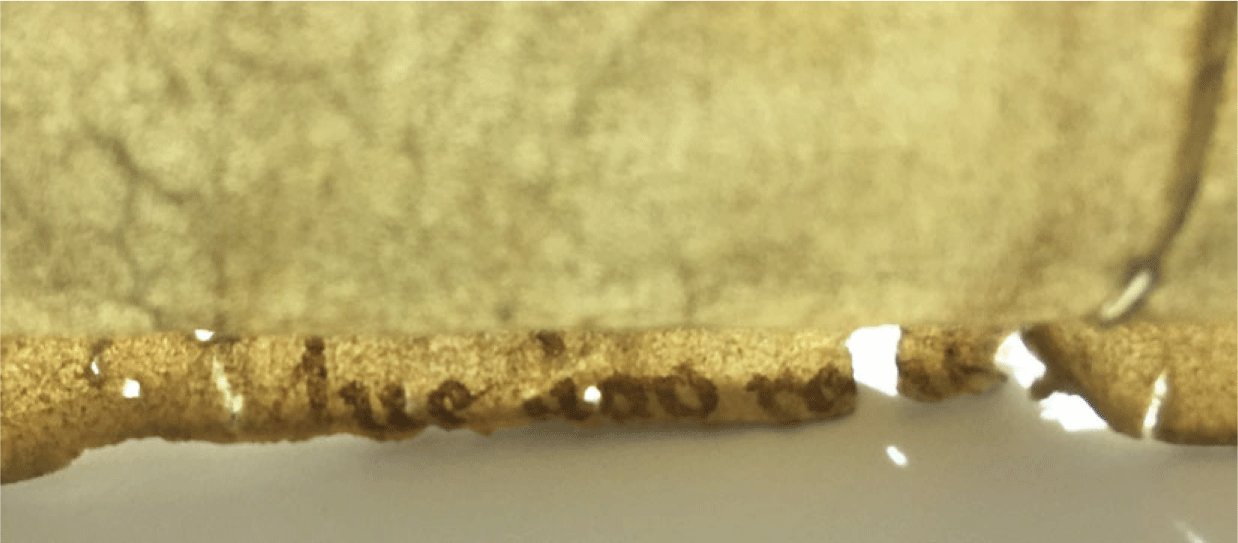
Comparison with other manuscripts enhances understanding of the unique and exceptional Stockholm motet fragments only to a limited extent. Fortunately, what happens to have survived in Stockholm is itself revealing in three principal respects, allowing aspects of the collection’s contents and original codicology to be divined with some confidence. First, the four pages of 813 bifolio II read successively, and thus not only is one motet preserved almost in full, but the codicological position of this bifolio in the center of a gathering is also certain. Second, both of the bifolios in 813 and the strip of 5786 preserve traces of a numbering system, which is key to establishing their sequence. And third, a catchword is just visible at the bottom of what was therefore likely the last leaf of the nearly complete bifolio of 5786 (see Figure 3b, fol. 2v, and the detail in Figure 5). This catchword – cueing the incipit of the next gathering at the end of the previous one, in order to ensure that internal booklets were ordered correctly – is discussed shortly. It usefully identifies another motet once in the Stockholm collection, and its presence is a strong indication this bifolio was on the outside of a gathering.
Stockholm Riksarkivet, fragment 5786 (recto), fol. 2v: Close-up of catchword ‘Ave virgo re?ia’
The function of Stockholm’s numbering system, roman numerals in alternating red and blue inks, is clearest in the two complete bifolios of 813, each of which bears a number at a top of an individual folio. Appearing in one instance on a verso (see Figure 1b, 813-I, fol. 1v) and in the other on a recto (see Figure 2a, 813-II, fol. 1r), III and IIII respectively accompany the opening of a new composition. These numerals must mark individual pieces, since they cannot be page or folio numbers.Footnote 51 And indeed, the end of the composition at the top of the folio marked IIII is, as established below, the conclusion of the same motet whose opening folio was marked III. The practice of enumerating individual compositions is not otherwise found in any other continental collection of thirteenth-century motets.Footnote 52 Numbering of folios is more typical, but even this is undertaken rarely and is not so decorative: Tu and Leuven stand alone in their original provision of folio numbers in red ink. The tally and sequence of individual compositions was important in Ba – with exactly 100 motets, alphabetically ordered by motetus incipit – but neither the individual compositions (nor folios) were actually numbered here.Footnote 53 Stockholm’s decorative roman numerals, counting each new motet, constitute yet another unusual and relatively luxurious feature of this source. The surviving strip of parchment once attached to 5786 (see Figure 4) preserves the tops of the numerals XII and XIII, proof that the collection contained at least thirteen compositions.
Codicologically, Stockholm’s numerals aid the hypothetical reconstruction of the motet collection’s opening gatherings in Figure 6. The gatherings are presumed to be the typical quaternions, that is, four bifolios folded to give eight leaves or sixteen pages. Bifolios of which concrete traces survive are highlighted in bold and labelled with their call numbers, while the individual motets they contain are indicated by their sequential position in the relevant fragment number (where 813-1 is the first piece extant in fragment 813). The roman numerals accompanying each new composition at the top of folios within the collection are hypothesised and, where they survive, given in bold.
Hypothetical Gathering Diagram for Stockholm Motet Collection (Extant leaves in bold)
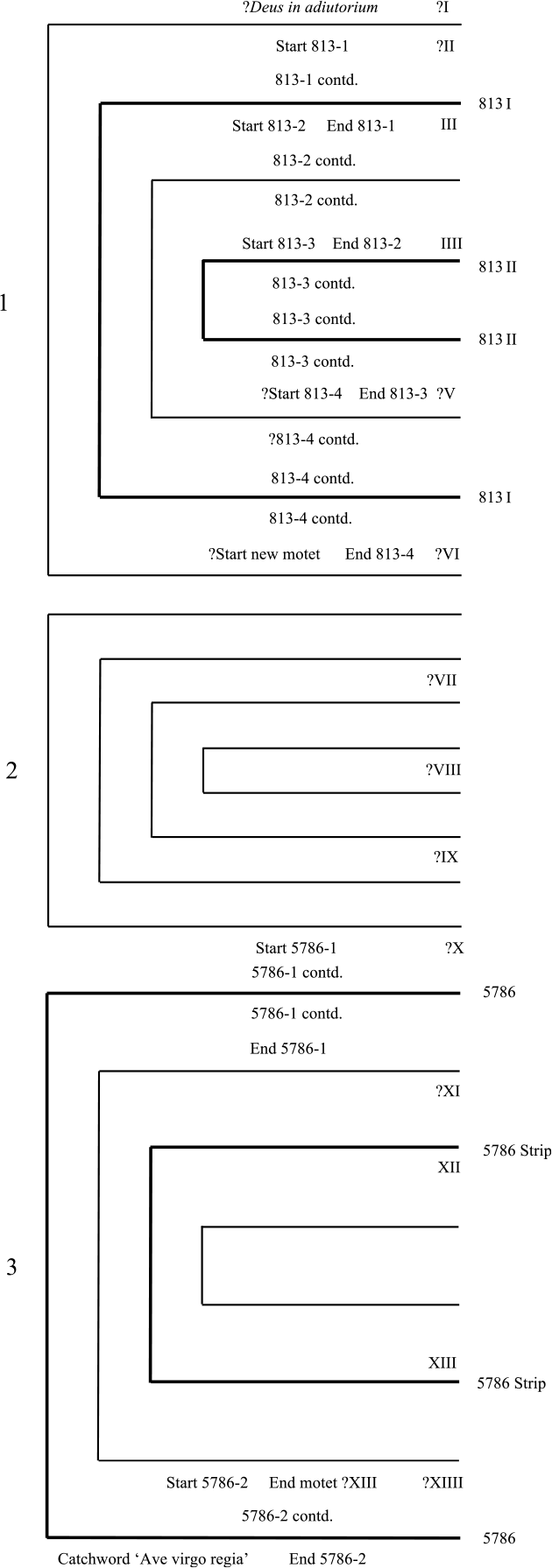
That the two bifolios (I and II) of 813 were the second and fourth of the original collection’s opening gathering is most likely. Bifolio II is indisputably at the center of a gathering, and it starts with the ending of motet III (813-2), whose opening is found on the verso of the first leaf of bifolio I and whose middle portion is missing. Probably, the two bifolios of 813 were originally separated by a single, now lost, intervening bifolio whose first leaf contained the middle of the collection’s third motet. This gives a good indication as to the space occupied by compositions in the first gathering: motet IIII (813-3) – which is almost complete in bifolio II – covered around four pages, while motet III was a little shorter, at a total of around three. Compositions numbered I and II in the book must both, however, have fitted within the space of fewer than four pages between them. Preceding the collection’s motet III on the first leaf of bifolio I is the middle and the end of a motet that was presumably labelled II (813-1). The missing opening of this piece, the collection’s motet II, must have covered at least part, if not all, of a preceding page in the lost outer leaf of the collection’s first gathering. It is likely, therefore, that the Stockholm motet collection opened with a short prefatory piece, labelled I, occupying just a single page, of precisely the type and single-page format that we find in an opening function for the libri motettorum in Mo – at the beginning of the codex and of fascicle 8 – in Tu and in Da: a three-voice conductus-style setting of the liturgical versicle Deus in adiutorium.Footnote 54
Later parts of the collection are more difficult to reconstruct with certainty, but the basic estimate of around three or four pages per motet and the relative position of bifolios I and II of 813 suggests that the middle portion of the motet copied on the last leaf of 813 bifolio I (813-4) was number V in the collection. Surviving concordances for the two motets in 5768 facilitate an accurate assessment of the amount of space that their missing portions once occupied. Precisely the central section of the first motet in 5786 survives there within the space of two pages. Thus the lost opening and concluding portions of motet 5786-1 must each have required almost exactly a whole page. Since 5786’s catchword reveals it to be the outer leaf of a gathering, the start of motet 5786-1 presumably took up the complete final page of the preceding gathering. As such, it is probable that 5786 did not come from the collection’s second gathering, rather that 5786 and its accompanying strip with motets XII and XIII were – like the two leaves in 813 – part of the same, and probably third gathering of the collection.Footnote 55 We may speculate, therefore, that the Stockholm motet collection comprised at least four gatherings (the fourth opening with the motet cued by the catchword, possibly number XV) and a minimum of around twenty individual compositions.
Contents and Concordances in the Stockholm Motet Fragments
Table 2 presents the surviving contents of the Stockholm motet collection in their presumed original order, listing complete and partial concordances identified for their music and/or texts. Fragment 5786, apparently the later part of the Stockholm collection, records compositions known from other thirteenth-century compendia. Its first motet, Non pepercit/Non pepercit/MORS, is extant in Ba and Bes, both of which also contained O maria/O maria/VERITATEM, preserved several leaves later in Stockholm and additionally transmitted in Cl, Mo 4 and Da. The catchword following O maria/O maria/VERITATEM in 5786 (see Figure 5) is just decipherable as ‘Ave virgo’ (where the ‘ir’ of ‘virgo’ is represented by an abbreviation) and a word that seems to begin ‘re-’ and to end ‘-ia’. There survive two different motets that could plausibly be indicated here, both of whose triplum texts have the identical incipit Ave virgo regia. Probably, the motet following O maria/O maria/VERITATEM in Stockholm was Ave virgo regia/Ave gloriosa mater/DOMINO: versions of these two motets are transmitted side-by-side in Cl, Mo 4 and Hu, occupying prominent opening positions in the first two of these sources. But it is possible that the Stockholm collection contained instead Ave virgo regia/Ave plena gratia/FIAT, a Latin reworking and reduction otherwise unique to Ba (though cited by Franco) of a French four-voice motet (in Mo 2 and Cl).
Contents of Stockholm Riksarkivet, fragments 813 and 5768
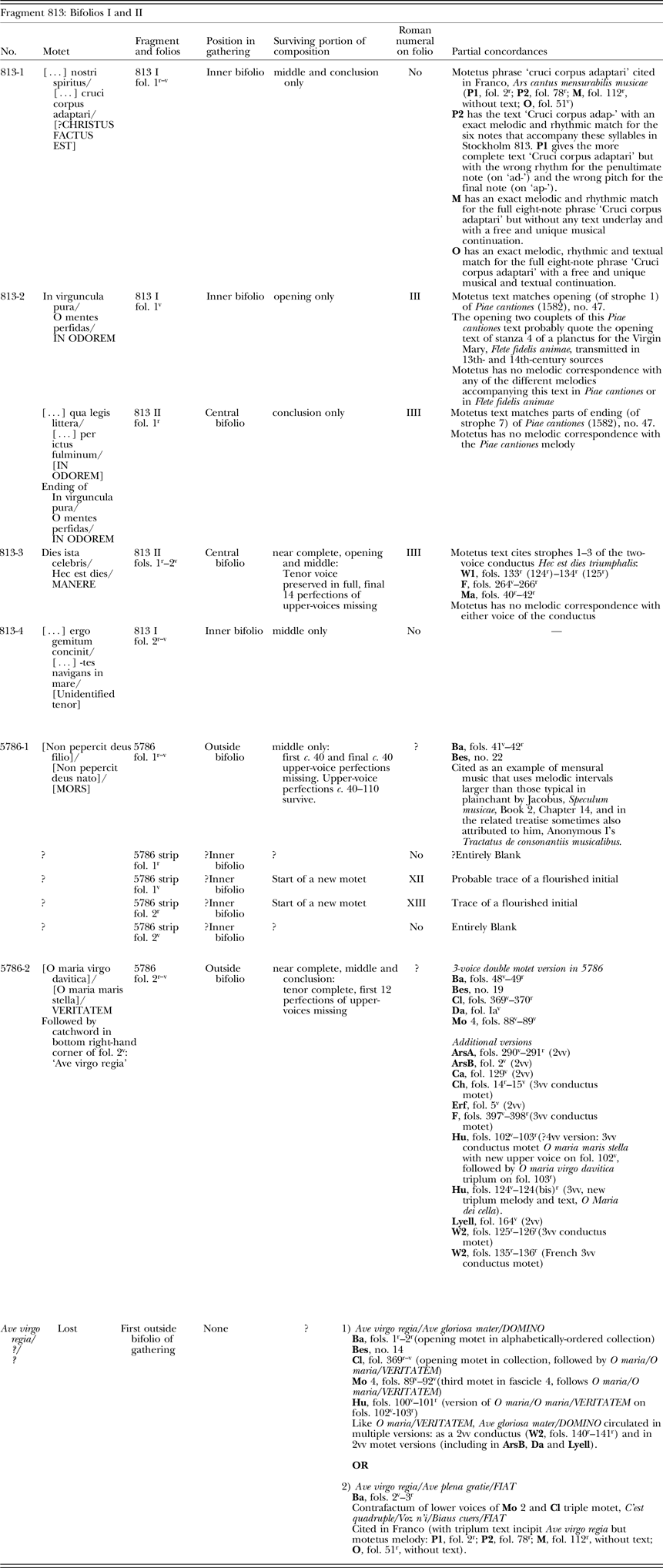
By contrast, the four motets in 813 are incomplete and otherwise unknown. As yet, it has proved impossible to trace any connections for the final motet in 813, of which just the middle portion survives (813-4; see the transcription in an appendix).Footnote 56 813-4’s tenor, whose chant source is unidentified, is otherwise unknown in the thirteenth- or fourteenth-century repertoire, and its triplum is notable for the fragments’ most intensive use of declamation in semibreve pairs, as well as their only notational error.Footnote 57 The preceding three unique motets in 813, which are now scrutinised in turn, contain partial external concordances and connections that offer new perspectives for understandings of late thirteenth- and early fourteenth-century theory and practice. The first provides a source for at least one of the musical examples cited by Franco; the second is a multi-sectional composition on the tenor IN ODOREM whose motetus adopts a pre-existing Latin text known from the later, printed collection Piae cantiones (1582); and the third combines a pre-existing Latin conductus text in its motetus with the use of red notation to indicate octave transposition in its MANERE tenor.
A Passiontide Motet Reconstructed and A New Source for Franconian Examples (813-1)
The opening of what was perhaps the first true motet of the Stockholm collection, after an initial three-voice Deus in adiutorium, has been lost, and with it, any text label for the tenor voice. However, as Wulf Arlt observed, what survives of the end of this tenor melody is a standard plainchant responsory verse formula in the second mode.Footnote 58 Responsory verses in mode two are both widespread and highly formulaic, adapting a common set of basic melodic components to accommodate the syllable counts of their many different accompanying texts.Footnote 59 Since the upper-voice texts of 813-1 refer to Christ’s crucifixion and resurrection, it is likely that the tenor was drawn either from the Feast of the Cross or from a Lenten or Easter responsory. A search, limited to these liturgical occasions, of the most complete surviving Office manuscript of Parisian origin – the noted breviary and psalter Lat. 15181–2, dated c. 1300 – reveals four very close, although not perfect matches for 813-1’s tenor (see Example 1, where individual components or melodic blocks in the responsory melody are divided by dashed barlines).Footnote 60 The motet tenor ending took some liberties with its chant source (marked in Example 1 by crosses above the relevant pitches), which was altered to cadence on e, rather than the c on which the responsory verses invariably end. If 813-1’s tenor quotation was otherwise exact, it borrowed a chant whose text had a different number of syllables – at most one or two extra or fewer – than the first four Passiontide responsory verses shown in Example 1.
Chant Comparands for 813-1 Tenor: Lenten Second-Mode Responsory Verses in Lat. 15181
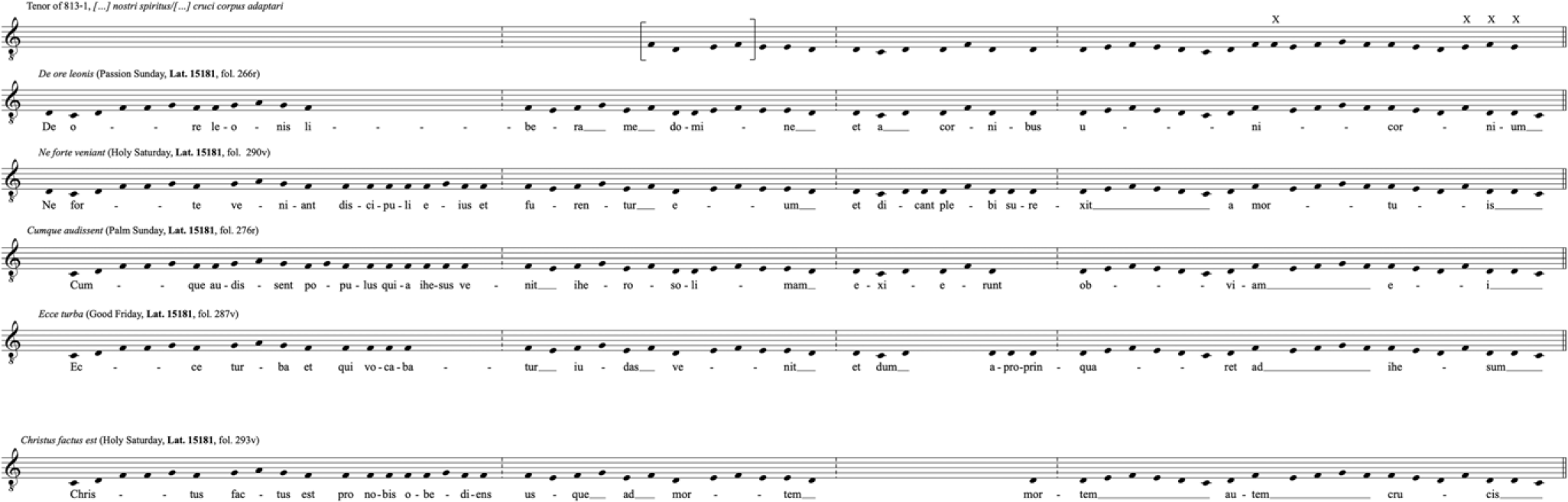
Yet it may be that the creator of motet 813-1 was liberal also with the internal melodic details of an inherently flexible and ubiquitous chant formula. Possibly, the proclaimed tenor source of 813-1 was not one of the closest matches for its melody, but rather a musically more distant responsory whose textual content was more pertinent. Christus factus est for Holy Saturday, given in the final system of Example 1, does not have enough syllables to require in full the third melodic component of the verse formula (a recitation around d) and thus omits a group of six pitches included in the tenor of 813-1. But as a thematic foundation for this motet it is a perfect fit. The chant text – ‘Christ became obedient to us, even to death, death on the cross’ – matches the motetus’s initial description of Christ’s crucifixion, and its subsequent insistent repetition of forms of the word ‘death’ (‘mors’). Moreover, the Biblical origins of the responsory text are in a Pauline epistle to the Philippians, a link with 813-1’s triplum text, which names Saint Paul (‘quod Paulus testatur’).Footnote 61 The lost tenor opening of 813-1 could, therefore, have been labelled, somewhat artificially, with text from the responsory Christus factus est, notwithstanding the fact that this plainchant melody did not match exactly the verse formula adapted as the basis of the motet.Footnote 62
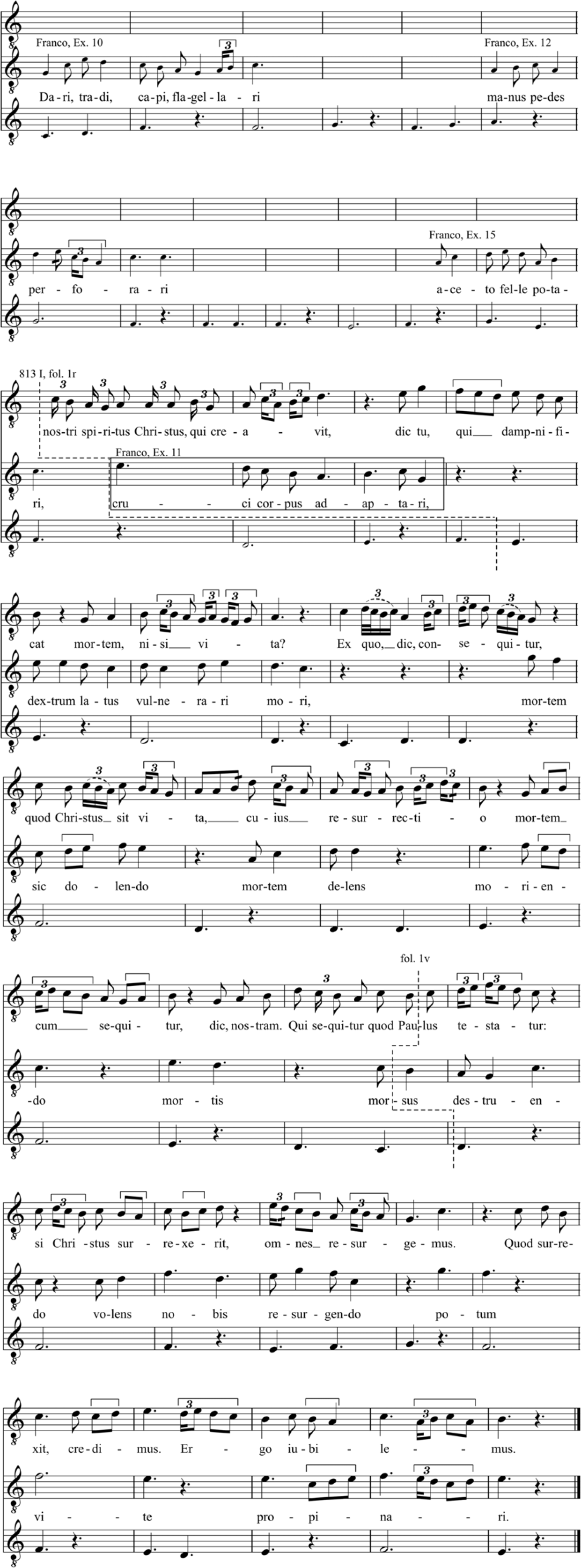
Whatever its tenor label, 813-1 was better known in the middle ages than its currently incomplete survival suggests, since its motetus is quoted by the theorist Franco. Felix Heinzer identified the text and music of the motetus phrase ‘cruci corpus adaptari’ as identical with an example in chapter five of the Ars cantus (see the transcription of 813-1 in Example 2, where Franco’s example is boxed).Footnote 63 Franco chose this internal phrase of 813-1’s motetus to demonstrate an instance where three breves are notated between two perfect longs.Footnote 64 Remarkably, three surrounding musical examples from this portion of Franco’s text, all hitherto unknown in any extant composition, have previously been linked to ‘cruci corpus adaptari’ (no. 11). Friedrich Ludwig as well as Gilbert Reaney and André Gilles suggested that Franco’s neighboring citations ‘Dari, tradi, capi, flagellari’ (no. 10), ‘manus pedes perforari’ (no. 12), and ‘aceto felle potari’ (no. 15) came from the same lost Passiontide motet.Footnote 65 Two later treatises modelled on Franco’s also cite ‘Dari, tradi’, which, in one instance, is immediately followed by ‘manus pedes’.Footnote 66
Hypothetical Reconstruction of 813-1 (with Franco’s Examples)
Only ‘cruci corpus’ survives within 813-1, but the three additional musical and poetic phrases known from Franco’s treatise surely came from the lost opening portion of this motet (see the reconstructed motet text and translation in Table 3).Footnote 67 Structurally and semantically, Franco’s example texts are highly compatible with the 813-1 motetus, whose opening section (with ‘-ari’ rhymes) recounts Christ’s crucifixion, before turning to his death (with ‘-endo’ rhymes, but a return to ‘-ari’ for the final line). Franco’s texts share 813-1’s initial end rhyme, line length (eight syllables), and paroxytonic stress, and they describe events leading up to the crucifixion. Given that ‘Dari, tradi’ is always cited first – and also most widely – in theoretical treatises, we might presume (as Ludwig did) that this was the motetus incipit. This could explain its exceptional line-length, of ten syllables, which also has a parallel later in the 813-1 motetus text: at the moment Christ’s death is revealed and the rhyme changes there is an extended musical phrase with a ten-syllable line, here created by an enjambement. ‘Dextrum latus vulnerari mori’ effectively bridges the two parts of the motetus text, marking the end of the insistence on ‘-i’ rhymes, and mirroring the incipit ‘Dari, tradi, capi, flagellari’, not only in syllable count but also in the use of internal rhyme.
Hypothetical Reconstruction (with Franco’s Examples) of 813-1 Motetus Text
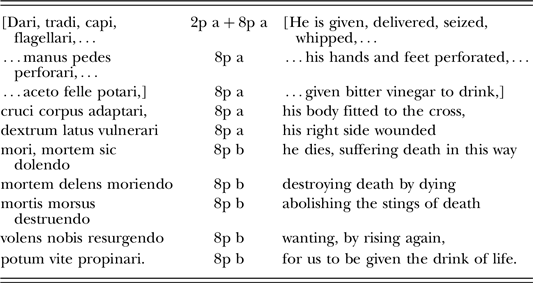
Musically, Franco’s examples are equally compatible with each other and the broader context of 813-1. The melodic phrases are principally in the second rhythmic mode, occupying the same melodic range, and concluding on c′ cadences. The theoretical purpose of these examples – to define the unit of the perfect long and its component values (with clarificatory dots in ‘Dari, tradi’ and ‘manus pedes’) – is also in line with the notation of 813-1, whose motetus makes more extensive use of dots of perfection than any other composition in 813 or 5786.Footnote 68 A hypothetical reconstruction of 813-1’s opening reveals, moreover, that Franco’s three citations work in very convincing polyphonic combination with the tenor’s responsory verse formula (see Example 2).Footnote 69 Since the start of 813-1 probably only occupied a single page in the manuscript, there would not have been space for a melodic repetition of what currently survives of this motet tenor. I therefore presume that this motet was based on a single statement of a complete responsory verse melody and supply a typical version of this chant formula that both maintains the tenor’s rhythmic pattern and is appropriate in length to the presumed manuscript space available.Footnote 70 Above this hypothetical tenor, Franco’s three additional citations produce consonant and convincing counterpoint. ‘Dari, tradi’ works best harmonically as the motetus incipit, and ‘manus pedes’ and ‘aceto felle’ are given here in positions that produce the strongest consonances (unisons, fifths and octaves), although the melodies of Franco’s citations are so well-suited to the modal and melodic profile of the underlying tenor melody that multiple convincing polyphonic combinations with this plainchant quotation are possible.Footnote 71
Four of Franco’s previously abstract and unidentified citations enable the reimagination of a motet that apparently occupied a prominent position at the outset of the Stockholm collection. This motet, as a significant repository of theoretical examples, in turn enhances understandings of Franconian treatises and their musical sources. Copies of Franco’s treatise often prefer apparently obscure or otherwise unknown Latin-texted citations from motets that survive most widely with accompanying vernacular texts.Footnote 72 In three cases, only relatively late and ‘peripheral’ motet sources offer concordances for Latin contrafactum motetus incipits cited by Franco instead of well-known vernacular ones.Footnote 73 Leuven uniquely preserves Divini roris/Arida frondescit/IOHANNE, from whose motetus and triplum voices Franco draws examples;Footnote 74 Da stands as the only witness to Salve virgo/O maria mater dei/FLOS FILIUS EIUS;Footnote 75 Ob e 42 is the only manuscript to record O crux admirabilis/Cruci, cruci/PORTARE, cited in a later re-working of Franco’s treatise.Footnote 76 The survival of Franco’s ‘cruci corpus’ example in 813 fits with this broader picture. It is conceivable that 813-1, like other of Franco’s citations, was a Latin contrafactum – carefully crafted to accord with a liturgical context for its pre-existing tenor formula – of a vernacular original. The motetus’s shifts in rhythmic mode are strange in any context, but they might be better suited to the flexible declamation of a French text than the Latin motetus in 813, whose conventional stresses are contradicted by their musical settings.Footnote 77
Although details of text, music and notation in Franco’s examples can be unstable, or even actively modified and added to, across the different manuscript witnesses to his Ars cantus, the actual compositions selected for exemplification are identifiably the same pieces and are strikingly consistent in all sources. This indicates that the musical examples were an integral part of this treatise, probably selected by Franco himself, and the ongoing discovery of motet sources for Franconian musical examples is further encouragement to take seriously their status as genuine citations. The reconstruction of 813-1 substantially increases the proportion of examples in the fifth chapter of Franco’s treatise with a known or probable host motet, but sources for four examples at the end of this chapter remain unidentified.Footnote 78 It is, at first glance, remarkable that Franconian treatises should have sought exemplification in a layer of the repertoire that now has the appearance of obscurity, for which some motet sources are still unknown while others had a comparatively limited (and late) circulation, typically outside Parisian collections and with a preference for Latin texts. But this could indicate that Franco’s Ars cantus and its derivatives were intended precisely for musicians who were not at the center of composing and performing activities in France, and who therefore required such instruction in mensural notation. This hypothesis is compatible, too, with the origin of copies of Franco’s treatise – English and Italian, as well as French – and of those derived from it.Footnote 79
The Ars musicae mensurabilis secundum Franconem treatise, which contains the ‘Dari, tradi’ example, survives in two manuscripts: one may be English (Lat. 15129),Footnote 80 and the other (Upp. C 55) was definitely in Sweden by the late fourteenth century and is bound with texts that bear traces of Swedish ownership from the 1320s and 1330s.Footnote 81 Notably, the related Ars motettorum compilata breviter – not only citing ‘Dari, tradi’, but also ‘manus pedes’ – survives in another Swedish source, Upp. C 453.Footnote 82 This treatise contains a further musical example preserved in the Stockholm motet fragments, namely the motetus explicit of O maria/O maria/VERITATEM (5786-1), a composition whose triplum incipit is also cited by Franco.Footnote 83 Such indirect interconnections between theory and practice among the scant remaining witness to late thirteenth- and early fourteenth-century polyphony in Sweden are revealing. They support the hypothesis that Franconian treatises preferred Latin-texted examples where possible, not only because of a textual authority better conveyed by the Latin language than the vernacular, but also because it was precisely the Latin motets, typically less well represented in ‘central’ French sources, that travelled to the ‘peripheral’ locations – including Sweden – where such treatises seem principally to have been required.
A Multi-Sectional IN ODOREM Motet with A Piae cantiones Text (813-2)
Copied beneath the Passiontide motet cited by Franco are the opening phrases of a new motet, In virguncula pura/O mentes perfidas/IN ODOREM (813-2), which is marked as the third piece in the Stockholm collection (see Figure 1b, fol. 2v). Although the leaf that once recorded the middle of this composition is lost, the motet’s conclusion survives on the second bifolio of 813 (813 bifolio II; see Figure 2a, fol. 1r). The relationship between these two parts of the same composition has not previously been recognised: Björkvall, Brunius and Wolodarski, understandably, considered them to belong to separate motets.Footnote 84 On each bifolio, only small amounts of the motetus and triplum texts remain. Musically, the rhythmic pattern of the tenor melodies in the opening and closing sections, as well as the rhythmic disposition of the upper-voices, differs (see Example 3). Although the motet tenor begins with fast-moving six-note groupings, it ends with a slower and more conventional three-note arrangement in the fifth rhythmic mode. Similarly, the upper-voices commence in a quite heavily decorated first rhythmic mode but conclude in a slower and somewhat plainer third mode.Footnote 85
Transcription of 813-2, In virguncula/O mentes/IN ODOREM (beginning and ending extant)
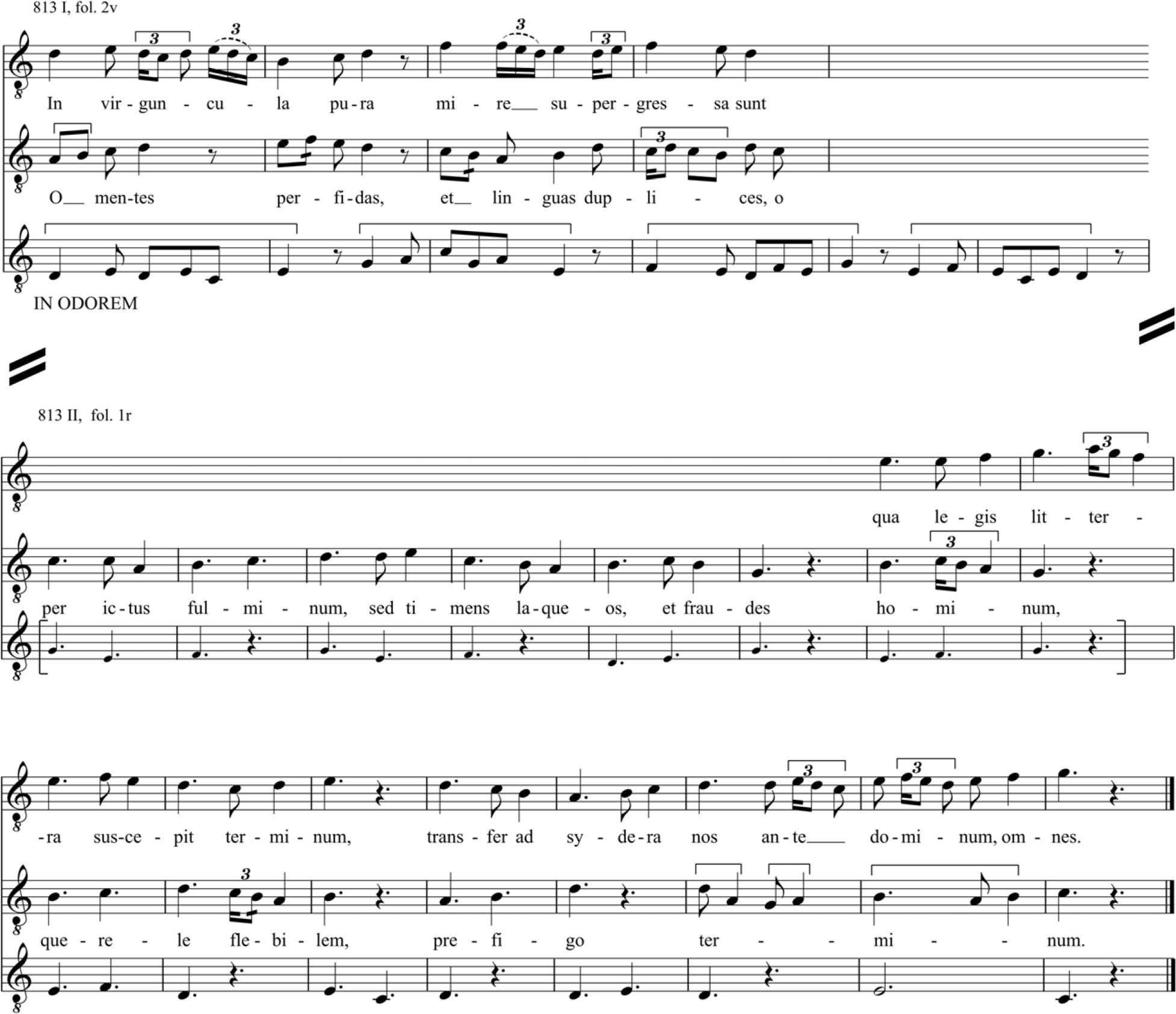
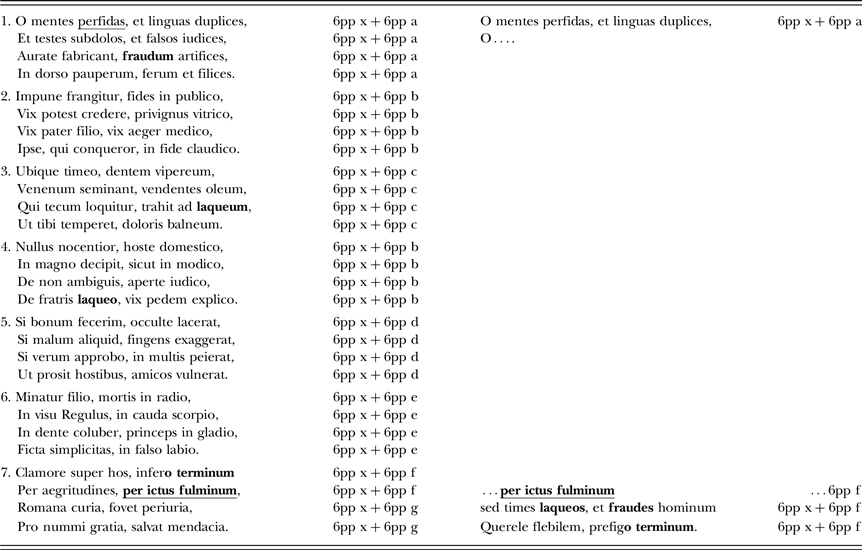
Two decisive factors prove that these short opening and closing sections do indeed belong to the same composition. The first is the underlying melodic quotation in the tenor. The concluding portion of the motet tenor, despite the change in rhythmic pattern, also uses the melody of the plainchant melisma IN ODOREM. This tenor’s final four ordines survive (on 813 II, fol. 1r), and they match exactly the sequence of pitches within the IN ODOREM chant.Footnote 86 When this chant quotation is used to reconstruct the tenor’s preceding four ordines (as in Example 3), it additionally offers a plausible harmonic foundation for this extant portion of the triplum and motetus. The second piece of evidence hinges on the motetus text, whose opening Björkvall, Brunius and Wolodarski identified as a match for the beginning of the Latin song text O mentes perfidas (but not its accompanying melody) found in the printed collection of Piae cantiones.Footnote 87 Published in Greifswald in 1582, the Piae cantiones preserve a repertoire of Latin songs, many medieval in origin, known in Swedish and Finnish cathedral schools.Footnote 88 It has, until now, escaped notice that the end of the motetus text on 813’s bifolio II is an altered version final stanza of O mentes perfidas (see Table 4). The phrase ‘per ictus fulminum’ appears at the same position in both Piae cantiones and motetus texts, and the conclusion of the motetus is identical, in its poetic form, with the song’s preceding stanzas: couplets of six-syllable lines of proparoxytone stress in which an irregular, lone internal rhyme (designated x in Table 4) is followed by an end rhyme that is shared by all four couplets in the stanza.Footnote 89
Comparison of O mentes perfidas from Piae cantiones (1582, no. 47) and 813-2 Motetus Text
There are only four other known motets on the tenor quotation IN ODOREM, drawn from an Alleluia for the feast of Saint Andrew.Footnote 90 All four are originally Latin-texted works found in sources dated to or before c. 1280, and just one was widely transmitted: Mens fidem seminat/IN ODOREM, itself based on a three-voice clausula and recorded within the earliest extant motet collection in F (dated to the 1240s), was copied and re-worked over several decades. 813-2 shows awareness of existing motet traditions for the IN ODOREM tenor in several respects. 813-2’s triplum text is Marian, like the triplum of Mo fascicle 4 motet, In odorem flagrans/In odoris miro/IN ODOREM, which is the only straightforwardly sacred IN ODOREM motet, as well as the only one to acknowledge (in its motetus) Saint Andrew.Footnote 91 All other Latin IN ODOREM motets are moralising and essentially condemnatory ones, a trend continued by 813-2’s motetus. In the later Piae cantiones print, O mentes perfidas is included within the category of songs ‘On the fragility and misery of the human condition’ (‘De fragilitate et miseriis humanae conditionis’). Admonitory or politicised Latin motet texts – of which the Stockholm unicum 813-4 is another example – are most common in early thirteenth-century sources, principally F, and then in early fourteenth-century ones, principally Fauvel. But they are not prominent in the intervening layer of sources (including Mo’s old corpus, Ba and Mo 7 and 8), in which Latin motets are overwhelmingly and straightforwardly sacred, and chiefly Marian.Footnote 92
The IN ODOREM tenor was associated with admonitory texts apparently throughout the thirteenth century, despite the lack of any precedent for this interpretation in the feast of Saint Andrew. Possibly, the local meaning of the tenor words (literally, ‘in the odor’) and their olfactory and bodily connotations encouraged reflection on the human condition, and the aspects of it that were not only sweet but also unsavory. Certainly, the upper voices of all IN ODOREM motets exhibit a marked preoccupation with the words of their tenor label and its sounds. 813-2 continues this tradition, with an opening reference to the tenor here split between the two upper voices to sound simultaneously: the triplum begins ‘In’ and the motetus (as in the unique StV motet Vivere vere/O perversa/IN ODOREM) with a vocative ‘O’. The triplum’s closing, ‘omnes’, also contains the framing vowel and consonant sounds of ‘odorem’, and may additionally pun on the motetus’s opening ‘O mentes’. Moreover, this liturgically unprecedented reference to ‘minds’ (‘mentes’) may itself be an allusion to the beginning of Mens fidem, the best known IN ODOREM motet, with which 813-2 additionally shares a distinctive final tenor cadence (an extended e resolving to c).Footnote 93
The rhythmic arrangement of 813-2’s tenor is entirely conventional in its closing section, moving at the level of the perfect long, like all other extant IN ODOREM motets and clausulae. By contrast, 813-2’s opening use of faster movement in breves is unique in the context of this tenor, and is a feature more typical of motets in the post-1270 layer of sources.Footnote 94 The motet’s starkly multi-sectional design, with different tenor arrangements and modal profiles for its upper voices in the two (surviving) parts, is striking.Footnote 95 While this is highly unusual in a thirteenth-century context, large-scale structures created by rhythmic sections and patterns in both tenor and upper voices are a defining feature of fourteenth-century motets in Fauvel and beyond.Footnote 96 Textually, 813-2 also bears comparison with Latin motets in Fauvel – not only in its thematic preoccupation with deception and greed – but also, in its (apparently purely textual) adoption of a pre-existing Latin song. Although the complete text of O mentes perfidas is preserved only in the chronologically late Piae cantiones print, it is probable that this Latin song text was an early thirteenth-century one, which also pre-dated 813-2. The text’s opening two couplets are additionally widely transmitted in early thirteenth- and fourteenth-century sources as the beginning of the fourth stanza of a lament song or planctus for the Virgin Mary, Flete fidelis animae, whose melody is again unrelated to either that in 813-2 or in the Piae cantiones. Footnote 97 It seems, therefore, that O mentes perfidas itself began with a quotation from a well-known planctus, adding additional couplets and stanzas to make a new, multi-strophic song.Footnote 98
In combining the text of O mentes perfidas with the IN ODOREM tenor, the creator of 813-2 may have been quoting a song that was itself known to be based on a quotation and was simultaneously an allusion to the IN ODOREM motet Mens fidem. Such considered textual craft might also account for the variant final stanzas of the motetus and Piae cantiones text (see Table 4). 813-2 maintains to the end the text’s established rhyme scheme, while the final two couplets in the Piae cantiones – which describe corruption in the Roman curia – exceptionally introduce a new rhyme. The motetus’s poetic consistency may speak for its primacy, but there are better grounds to argue that the ending in the motetus, rather than in the Piae cantiones, was a semantically motivated adaptation. Financial corruption in Rome was, presumably, not topical in either the French or Swedish circles in which 813-2 circulated. The alternative motetus ending recalls earlier stanzas (shared vocabulary highlighted in bold in Table 4), with the return of the adjective ‘fraudulent’ (‘fraudes’), as well as the image of the ‘snare’ (‘laqueus’). And the final and self-descriptive motetus word, ‘end’ (‘terminum’), is either moved from the start of this stanza or repeated here. 813-2 may have altered the conclusion of its quoted Latin motetus text to make its semantic content more relevant, and to draw attention to its ending and its relation to earlier content, as in the potential ‘omnes’/‘O mentes’ play with the triplum.Footnote 99 This offers a parallel to the ‘Fauvelisation’ of (usually admonitory) older texts, and especially their endings, reused in Fauvel: alterations or additions to make borrowed texts more pertinent to the surrounding literary narrative and political message of the Roman. To date, this – and the adoption of pre-existing texts more generally – has looked like an isolated phenomenon, driven by the special circumstances of Fauvel. Yet it seems that the quotation and adaption of politicised texts in motets could have been a more widespread practice around or indeed before 1300.
Although much of 813-2 is missing, much may still be divined about the piece’s overall construction and the context of its creation. The tenor’s opening arrangement is the most modern of any extant IN ODOREM motets, but the composition looks otherwise stylistically conservative within the context of the Stockholm collection itself, with unambiguously modal rhythmic profiles in the upper voices and an absence of texted semibreves. 813-2 was evidently composed in the knowledge of long-standing musical and textual conventions surrounding the IN ODOREM melisma. Its position within an established tenor tradition confirms a French origin. It is, therefore, especially problematic to argue for any direct link between the Latin motetus text, uniquely preserved in a source that travelled to Sweden in the middle ages, and the presence of the same text within the later Piae cantiones print of Swedish/Finnish origin. As in the case of the quotations from motet 813-1 in Franconian treatises present in Sweden in the early fourteenth century discussed above, I do not believe that the Stockholm motet collection was itself a source for such material. To posit concrete relationships between extant witness in Sweden would, in fact, be to underestimate this country’s extensive cultural connections with France and the Parisian University, especially in the late thirteenth and early fourteenth centuries.Footnote 100 The Stockholm motet fragments, the Uppsala Franconian treatises, and the Piae cantiones seem rather to be three largely independent testimonies to Swedish interest in and access to medieval musical and poetic traditions in Western and Central Europe of which only few and partial written traces have survived.Footnote 101
Red Notation in Theory and Practice: Octave Transposition in Dies ista celebris/Hec est dies/MANERE (813-3)
Stockholm’s most complete motet is Dies ista celebris/Hec est dies/MANERE (813-3). Numbered four in the collection and occupying most of a bifolio whose leaves read successively (813 II; see Figures 2a and 2b), this motet stands out for its use of red ink for alternate tenor ordines. The tenor colours produce a visual pattern: each tenor group of three long notes and a long rest in black ink followed by the exactly the same graphic and notational signs copied in red. As emphasised above, the use of musical notation in red ink is a technique previously associated exclusively with fourteenth-century music, with its first known appearance in Fauvel and its first description in treatises that apparently derive from a lost theoretical work by Vitry, his Ars vetus et nova. Generally, evidence for red notation, in surviving manuscript sources and theoretical discussions, is relatively modest.Footnote 102 In practice, its effect is always mensural (with – to date – just one known exception in Fauvel, discussed below): red notes usually signal a shift from triple, or so-called perfect, note values to duple, or imperfect, ones. In theory, the rhythmic implications of the notation are also most discussed, but witnesses to Vitry’s Ars vetus et nova (of which three survive, each preserving slightly different versions of Vitry’s lost original text) and two, later, related ‘Vitriacan’ treatises describe non-rhythmic significations for colouration (presented and summarised in Table 5).Footnote 103 The principal non-mensural use of red ink – invariably mentioned first and included in all five of the Vitriacan sources that discuss such functions – is to indicate that the red notes need to be transposed by an octave. Octave transposition offers a convincing explanation for the red notes in 813-3, since it is not feasible to interpret this motet tenor in anything other than the conventional rhythmic pattern of the fifth mode throughout.Footnote 104
Fourteenth-Century Treatises on the Non-Rhythmic Uses of Red Notes
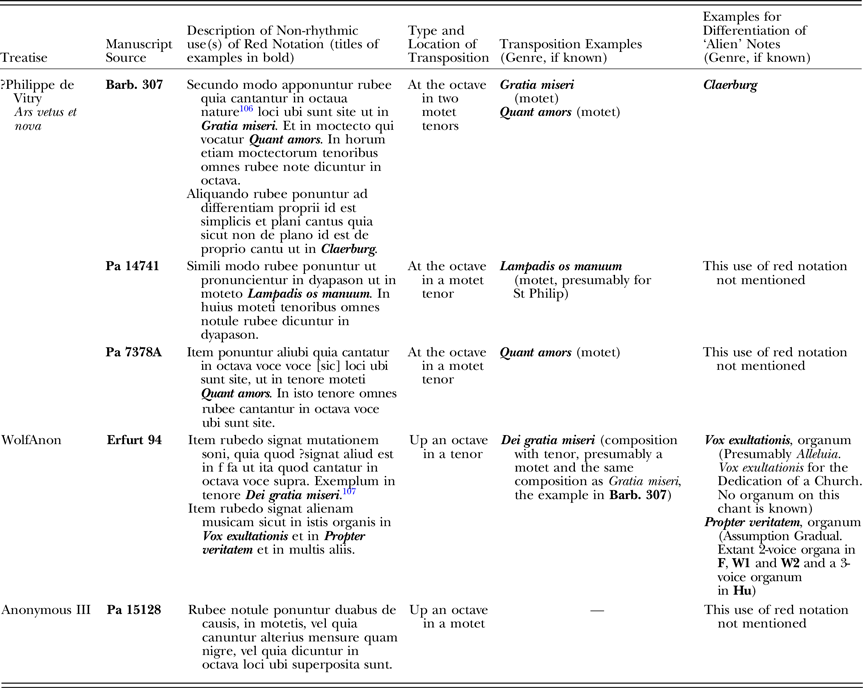
Witnesses to Vitry’s Ars vetus et nova first explain the mensural significance of red colouration, after which they turn to an alternative function. The version in the manuscript Barb. 307 may be translated as follows:
Red [notes] are used in a second way, because they are sung at the octave of the nature of the pitch-level at which they are located, as in Gratia miseri and in the motet called Quant amors. In the tenors of these motets red notes are recited at the octave.Footnote 105
Barb. 307 circuitously states that red ink can be used in motet tenors to signal transposition ‘at the octave’ (‘in octava’), without specifying in which direction. Two examples are cited, Gratia miseri and Quant amors, both motets that are currently lost. Variant versions of this same passage are found in the two further manuscript witnesses derived from Vitry’s Ars vetus et nova. Pa 7378A has a condensed version of what is in Barb. 307 (omitting the example Gratia miseri), while Pa 14741 gives a single and different example for the phenomenon: another lost motet, with the text Lampadis os manuum (literally ‘[mouth] of a lamp, mouth of hands’, two soubriquets for the apostle Saint Philip). The later Vitriacan treatise in Erfurt 94, typically referred to as ‘WolfAnon’, also acknowledges the use of red notation to signify transposition, although now specifically up an octave and giving the example of the tenor of Dei gratia miseri, surely the same lost motet as Gratia miseri. Footnote 108 Specification of the upward direction of octave transposition is reiterated in the further related and Vitriacan witness ‘Anonymous III’ in Pa 15128, which does not name any examples. Apparently, therefore, transposition up an octave was the only type known to these later theorists, and/or the original ‘in octava’ was susceptible to this, more prescriptive, interpretation.Footnote 109
It is downward octave transposition, however, that is signified by the red tenor notes in 813-3. Taking this motet’s notation at face value, simply treating red ink as black, consistent harmonic discrepancies emerge between different coloured tenor ordines (see the excerpt in Example 4, where colouration is indicated by dashed brackets). Both black and red ordines feature some unusual voicings: the motet’s opening sonority (with the tenor note in black ink), for example, spans a twelfth – an octave plus a fifth – and the motetus voice lies underneath the tenor. But while those ordines in black ink are harmonically conventional – always containing an interval of a fifth or an octave between their outer voices – those in red ink frequently feature unsupported fourths (marked by boxes in Example 4).Footnote 110 If the tenor’s red notes are transposed down an octave then such unsupported fourths are eliminated, and transformed into fifth and octave sonorities that match the harmonic idiom of their surrounding black ordines (compare Example 5, where red ordines – indicated by dashed brackets – are transposed down an octave). In total, thirty stressed sonorities in what survives of the motet as a whole are affected by the use of red ink. In ten cases, the tenor transposition makes no contrapuntal difference, simply replicating one of the pitches of an octave or fifth already formed by the motetus and triplum voices.Footnote 111 But on seventeen occasions, downward octave transposition turns the interval of a fourth between the outer voices into a fifth.
Opening of 813-3, Dies ista celebris/Hec est dies/MANERE, Red Notes Transcribed as Written (Colouration indicated by dashed brackets)

In just three instances (perfections 31, 46 and 79 in Example 5), the tenor transposition introduces a new unsupported fourth. Each time that new fourth involves the tenor pitch B♮ as the lowest sounding note. Evidently, a fifth sonority was not desirable here, since the use of B♮ and the F♮ that is elsewhere typical in the motet would have produced a diminished interval, and so a fourth (B–e) was a reasonable compromise. In the tenor’s final ordo, however, copied in red ink and for which the corresponding upper voices are lost, the penultimate B is prefaced by a flat sign. The exceptional flattening of the tenor chant’s B on this final occasion was clearly to avoid a fourth sonority as part of the final cadence, facilitating instead a perfect fifth against what must have been an upper-voice f.
Transcription of 813-3, Dies ista celebris/Hec est dies/MANERE, Red Notes Transposed Down an Octave (Colouration indicated by dashed brackets)
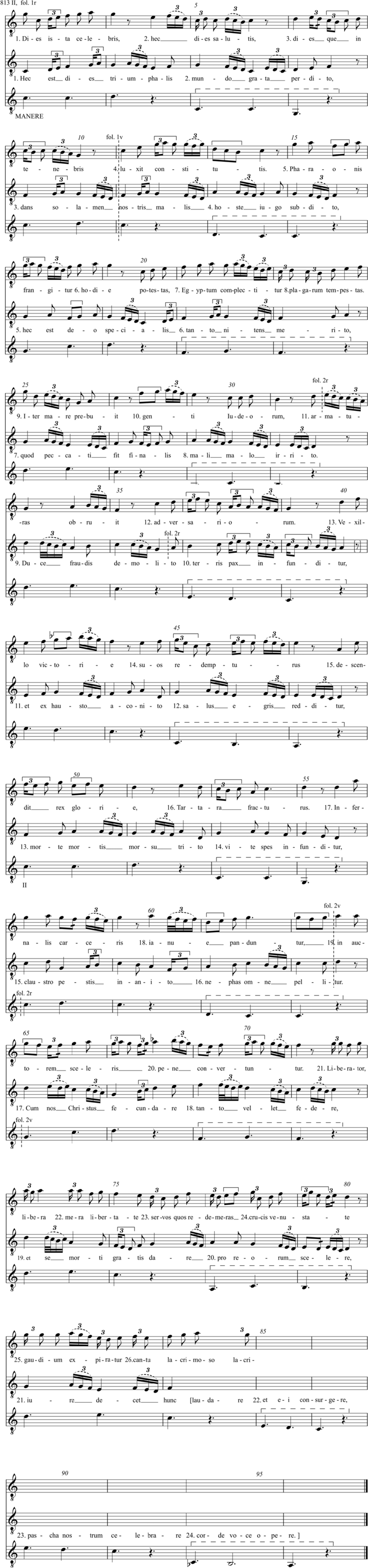
Downward tenor transposition in 813-3 not only makes best harmonic sense, but it also solves a particular problem with the range of the MANERE melisma. MANERE’s high tessitura is manageable for the many two-voice motets based on this chant quotation, but in three- and four-voice works – where the tenor typically remains at the bottom of the texture – upper voices are pushed unusually high in range. This is solved in the motet In marie misere/Gemma pudicie/MANERE (in Mo 4 and Fauvel) simply by transposing the entire MANERE melisma down a fifth (to start on f), while the English motet Fusa cum silencio/MANERE/Lavem labet criminis (in DRc 20, fol. 1v) places the chant quotation in the middle of the texture, labelling it ‘Medius cantus. Manere’.Footnote 112 The technique of octave transposition in alternate tenor ordines was, therefore, especially well-suited to MANERE, comfortably expanding the motet’s overall range downwards, while allowing the motetus and tenor voices to occupy the same range and to exchange their function as the lowest voice. Clearly, therefore, the decision to transpose alternate tenor ordines down an octave – presumably as well as the decision to notate these ordines in red – was central to the conception of Dies ista celebris/Hec est dies/MANERE from the outset.
Quoting Conductus Texts: Consequences for Compositional Design
The MANERE tenor was a carefully considered choice in one further respect, since it was not the only quoted material in 813-3. As Björkvall, Brunius and Wolodarski noted, the motetus text, Hec es dies, adopts in its entirety a pre-existing Latin conductus, one that must have been at least several decades old at the point of the motet’s composition.Footnote 113 As a two-voice conductus celebrating Christ’s sacrifice for mankind, Hec es dies is transmitted in three sources from the first half of the thirteenth century (W1, F and Ma, dated between the 1230s and the 1250s). In all three manuscripts it is recorded with three stanzas of a highly regular poetic text. Each stanza has eight lines that are effectively four couplets: pairs of eight- and seven-syllable lines with alternating rhymes and stresses (an eight-syllable paroxytone line followed by a seven-syllable proparoxytone one). As apparently in the case of O mentes perfidas in 813-2, none of the music of the original Hec es dies conductus is present in 813-3, and the quotation in the Stockholm motetus is purely textual.Footnote 114 The borrowed Latin text is here presented musically in a remarkably consistent fashion for a motet: every poetic line in the motetus has the same first-mode rhythmic pattern and is matched throughout to a single tenor ordo.
MANERE, a melisma with thirty-six pitches, lends itself well to 813-3’s three-note rhythmic pattern, where twelve tenor ordines produce a complete statement of the chant quotation. The MANERE melody is presented twice in 813-3, resulting in twenty-four iterations of the tenor ordo. This marries with the text of the Hec est dies conductus, in which three eight-line stanzas produce twenty-four poetic lines in total. Such numerical correspondence between the total number of pitches in the MANERE tenor, its division into rhythmic units, and the number of poetic lines in Hec est dies reveals pre-compositional planning in the construction of 813-3. The motet creator must simultaneously have considered the dimensions of the two quoted elements, which were surely chosen in conjunction for their mutual compatibility.
As suggested above, the quoted motetus text and tenor chant of 813-2 were also selected in dialogue, and for their poetic connections. In 813-3, the structural relationship between tenor and motetus was evidently more important than the semantic one. Neither the local meaning nor the liturgical context of this tenor – drawn from a Gradual for the feast of St John the Evangelist, where Jesus states that, until his return, John should ‘remain’ (‘manere’) – makes it the most directly pertinent plainchant foundation for the Easter theme of the upper voices. As a foil to the underlying predictability of tenor and motetus, the triplum serves to add the surface layer of musical variety that is more typical of motets. Dies ista celebris, whose text and music appears to be freely composed, complements Hec est dies, reflecting on the liberation brought about by Christ’s death. Although the triplum’s poetic form is quite regular, its musical declamation is varied, frequently cutting across the consistent and matched phrases of the lower two voices.
The large-scale, mathematical planning for the tenor and motetus foundation in 813-3 is noteworthy, especially as a device more typically associated with fourteenth-century motets than thirteenth-century ones. Moreover, the re-use in 813-3 of an old, Latin text, and without its original music, is similarly unusual in a thirteenth-century context. The Marian motet Benedicta Marie/Beate virginis/BENEDICTA in Mo 8 offers the only comparand for 813-3, very similar in design, though rhythmically even more old-fashioned (without any texted semibreves).Footnote 115 The pre-exiting conductus text – Beate virginis, a two-voice conductus transmitted in W1, F, Ma and elsewhere – has three regular eight-line stanzas that are quoted in full in the motetus.Footnote 116 As in 813-3, the Mo 8 motet affords the poetic lines of Beata virginis an unusually consistent rhythmic presentation: each motetus line is largely matched to single tenor ordo, once again creating a highly regular foundation for an independent and overlapping triplum.Footnote 117 These Stockholm and Mo 8 motets are outliers in a thirteenth-century context, but the use of pre-existing Latin conductus texts is an established technique within the motets of Fauvel. Seven different conductus texts – all extant in F – are quoted and combined in five different Fauvel motets, only once with a corresponding musical reference to the original composition.Footnote 118 Significantly, in Thalamus puerpere/Quomodo cantabimus/[TENOR] (Fauvel, fol. 32r), a quoted conductus text appears above red tenor notes that exemplify the second non-mensural function of colouration described in treatises derived from Vitry’s Ars vetus et nova.
Red Ink for ‘Alien’ Notes: Fauvel and the Stockholm Organum Fragment
After explaining the use of red notes to indicate octave transposition, the version of Vitry’s treatise in Barb. 307 outlines a further non-rhythmic use of coloured notation (see details in Table 5). An obscure sentence, omitted in Pa 7378A and Pa 14741, may be translated as follows:
Elsewhere red [notes] are placed in order to mark a difference from the proper, which is to say the simple and plain, chant, because as they are, they are not from the plain, that is the proper, melody, as in Claerburg.Footnote 119
The strangely titled example Claerburg, whose genre is not indicated, remains unknown. Nevertheless, it seems that this composition was one in which red ink was used to highlight visually the notes of a plainchant quotation that were added or had been altered, where red simply marked out notes that did not belong to the chant proper.Footnote 120 This interpretation is corroborated by a later Vitriacan witness. Although Pa 15128 breaks off immediately after a sentence describing octave transposition, Erfurt 94 continues with a short statement whose content relates to Barb. 307’s. Erfurt 94 states that red ink signifies ‘alien music’ (‘alienam musicam’), here giving examples from organa: Propter veritatem, Vox exultationis and ‘many others’ (‘multis aliis’). That it was necessary or desirable to mark out ‘alien music’ in red is rather surprising. Perhaps the intention was partly practical, to allow singers quickly to identify moments at which they must pay attention and deviate from the version of a melody they knew well. Yet such use of red ink seems additionally to indicate an increased preoccupation with literal quotation in the late thirteenth and early fourteenth centuries.Footnote 121
Ernest H. Sanders identified in the Fauvel motet Thalamus/Quomodo/[TENOR] the only instance known to date in which red ink ‘marks a difference’ from a musical quotation.Footnote 122 The Fauvel motet tenor does not quote plainchant, as described in Barb. 307 and Erfurt 94, but rather an otherwise unidentified and un-labelled song melody in virelai (abba) form that is stated twice.Footnote 123 Preceding the tenor’s final two pitches are three iterations of the pitch c, notated in red.Footnote 124 The red ink cannot reasonably convey any information about mensuration or transposition here, and the three pitches that it highlights are not part of the tenor’s melodic quotation, demonstrably absent from all previous iterations of this same material. As mentioned above, Thalamus/Quomodo/[TENOR] quotes, here in both upper voices, a Latin conductus text and one known from F (which uniquely preserves the multi-stanza version of this text). In the Fauvel motet, the first two successive stanzas of the same (three-stanza) conductus are presented simultaneously: the motetus sings the text of the conductus’s opening stanza, Quomodo cantabimus, at the same time as the triplum declaims its second stanza, beginning Thalamus puerpere.Footnote 125 Both of the non-rhythmic uses of red ink in motet tenors to survive in practice – in Fauvel and in Stockholm 813 – are, therefore, in conjunction with quoted conductus texts in the upper voices.
A further piece of evidence from Stockholm Riksarkivet provides a second and new example of the use of red notes to show deviation from a quoted melody. In this case, the tenor melody is a plainchant and the composition is not a motet but rather – as described in the Vitriacan treatise in Erfurt 94 – an organum. Fragment 535 is a single bifolio that was badly damaged by an archival fire (see Figures 7a and b). An outer bifolio, whose two leaves are not contiguous, 535 preserves three-voice organum settings of the end of the responsory Terribilis est and the start of the Alleluia verse Tumba Sancti Nicholai. Both organa are copied in late thirteenth-century Franconian notation with measured rests.Footnote 126 The remains of a gold-leaf initial are perceptible at the opening of the Alleluia verse, Tumba, as are two red notes within its tenor. Although parts of this composition are impossible to read because of holes scorched in the parchment, Example 6 offers a transcription of what remains of the organum tenor (with red ink indicated by crossed noteheads).Footnote 127 Example 6 presents this organum tenor version of the Alleluia verse for Saint Nicholas – with missing or illegible portions of music and text indicated by square brackets – underneath the same section of the chant melody as recorded in Lat. 830, a Parisian noted Missal dated c. 1270.Footnote 128
Comparison of Opening of Alleluia Verse Tumba Sancti Nicholai in Lat. 830, 535 Organum Tenor and Lat. 15129 Organum Tenor (Colouration indicated by crossed noteheads)
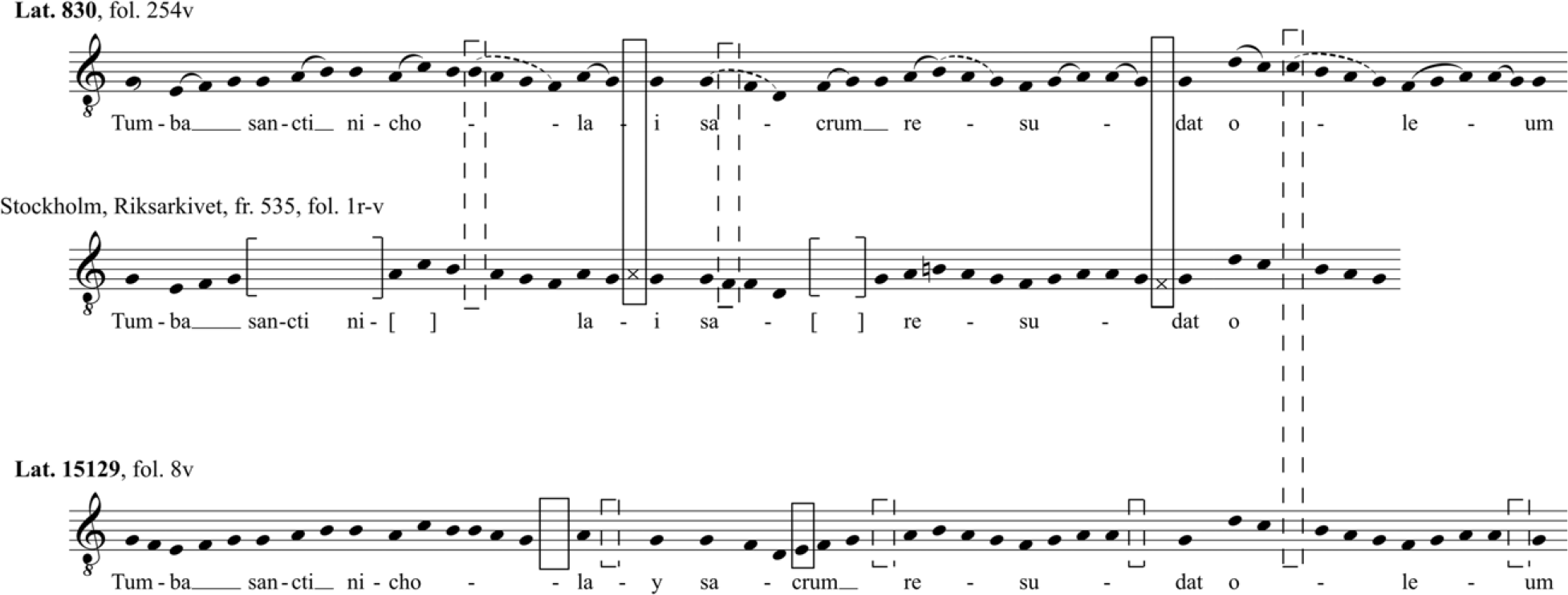
Stockholm Riksarkivet, fragment 535 (recto)

Stockholm Riksarkivet, fragment 535 (verso)
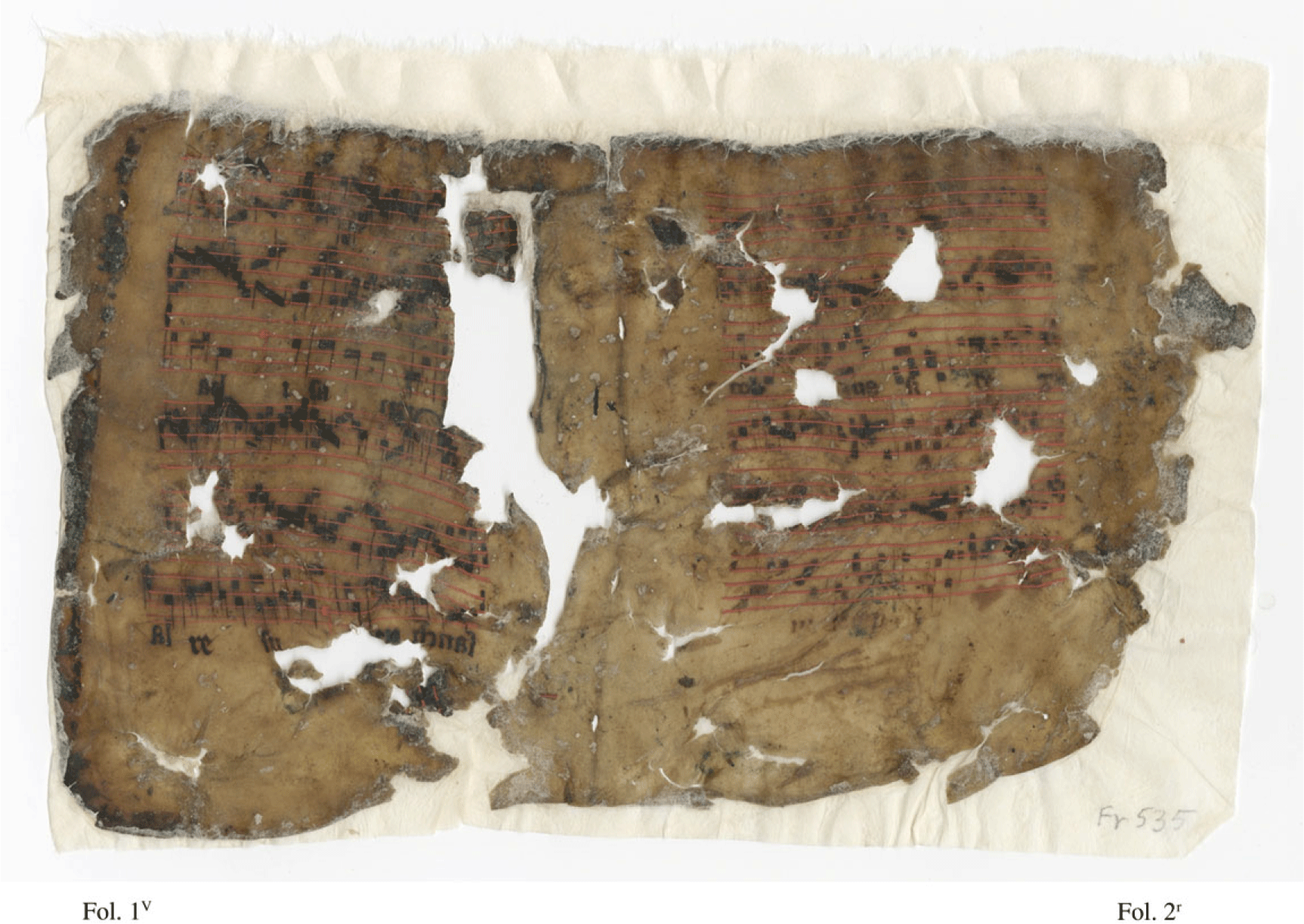
The match between the monophonic and polyphonic sources of the Tumba plainchant is very close. There are just three minor discrepancies concerning the omission or inclusion of a repeated pitch (marked by dashed boxes in Example 6). Yet in two instances the organum tenor deviates significantly from the plainchant melody, with two ‘extra’ pitches (marked by solid boxes in Example 6) that are notated in red. Both times, the polyphonic tenor disrupts the chant’s conventional a–g–g cadence, inserting a new pitch (first a and then f) before the final g. The use of red ink in 535 evidently serves to highlight these alterations, picking out the ‘alien’ notes in the chant exactly as described in the treatise in Erfurt 94. Although 535’s Terribilis est is a chant elaborated in polyphony in the early thirteenth-century Magnus liber sources, the Alleluia Tumba Sancti Nicholai is not, and earlier organa provide, instead, for the Saint Nicolas responsory Ex eius tumba. In this respect, 535 also aligns with Erfurt 94’s testimony: while Erfurt 94’s first example – the organum Propter veritatem – appears in Magnus liber sources, these early collections of organa do not include its second example, Alleluia Vox exultationis, and indeed no polyphonic elaboration for this chant is known.Footnote 129
Fragment 535 deserves a separate study, and it is frustrating that the current warped state of this organum fragment makes its dimensions difficult to compare with those of the motet wrappers. Although the score-format organum bifolio had a somewhat smaller writing block than the bicolumnar motet bifolios, it has their similarly generous margins and the same number (five) of sewing holes for binding as are clearly visible in 813 (compare Figure 7, with Figures 1 and 2).Footnote 130 The close match between the Tumba tenor and a Parisian source for this chant also indicates a French origin for 535, especially since this chant melody was otherwise quite variable. This is attested by the tenor of the only other surviving organum for this chant, a different two-voice composition in Lat. 15129 (whose tenor is presented as the bottom system of Example 6, which marks with dashed boxes the omissions in Lat. 15129 of repeated pitches present in Lat. 830, and with solid boxes variants in Lat. 15129 on which Lat. 830 and Stockholm 535 agree).Footnote 131 The Terribilis est organum in 535 further supports the fragment’s French origin. It is an independent composition from the three-voice setting of Terribilis est in F, but these two organa share a particular textual and melodic version of the responsory verse, which differs from the one employed as the basis of two-voice organa elsewhere within the Magnus liber repertoire itself.Footnote 132 It is hard to imagine that two wholly independent but similarly bound collections of polyphony, apparently contemporary and featuring non-mensural uses of red notation otherwise largely unknown, travelled from France to Sweden. It is likely, therefore, that the gold-decorated organa in 535 were a related fascicle for the same motet book as 813 and 5786. Perhaps these organa functioned like the three-voice organa that make up Mo’s first fascicle, serving in the Stockholm collection as a more sumptuously decorated and unnumbered (or independently numbered) preface to a liber motettorum.Footnote 133 They might equally have been part of a Latinate collection that resembled Da, apparently made for export and principally comprised of motets, but also including organa and conducti.
Conceptual Contexts and Lost Evidence for Red Notation
Fragments 813 and 535 substantially increase the witnesses to and contexts for non-mensural functions of red notation. They provide new examples in practice for phenomena previously known only in theory, where red ink cues octave transposition in a motet tenor and marks ‘alien’ notes within the plainchant foundation of an organum. Both extant motets whose tenors use red notes to non-rhythmic effect – Dies ista celebris/Hec est dies/MANERE in 813 and Thalamus/Quomodo/[TENOR] in Fauvel – also quote sacred and historical Latin texts in their upper voice(s). This confirms a preoccupation with quotation and quotational authority that, more generally, motivated the non-rhythmic functions of red notes. In 535 and in Fauvel, the non-rhythmic use of red ink is purely symbolic, simply highlighting (perhaps gratuitously) respective deviations from a given plainchant melody or a song tenor, with no effect on how these notes are to be sung.Footnote 134 In 813, however, the function and effect of the red notes is more nuanced. As the MANERE tenor appears on the page, the pitches of its chant tenor – regardless of whether they are coloured black or red – constitute an absolutely literal quotation. Yet as this tenor is performed, the melody of the original chant is distorted by octave transpositions prompted by the red ink. The Stockholm motet does indeed alter its chant quotation, but these alterations exist only in the sounding version of the motet and not the written one, which – thanks to the extra meaning that red ink made it possible to convey – preserved visually the textual authority of the conventional plainchant quotation.
The potential to imply a performance direction, here transposition, gives red notes a sophisticated and powerful function. No longer do they merely mark out quotational alterations, but rather they are the means of upholding written quotational integrity. Red ink as an instruction for octave displacement is, simultaneously, practical: a tenor is probably easier to read without any visually-disorienting leaps or clef changes, and therefore also to sing, since the relevant pitches can first be seen, recalled and/or imagined in their more natural and proximate range. Another unusual motet in the Stockholm fragments, which represents somethings of a theoretical curiosity, merits consideration in precisely this context. Non pepercit/Non pepercit/MORS – the first (incomplete) piece in 5786, and known from other late thirteenth-century sources (Ba, and the table of contents in Bes; see details in Table 2) – is named by Jacobus, in book two of his Speculum musicae, as evidence that mensural music could encompass melodic intervals not found in plainchant. The motetus of Non pepercit/Non pepercit/MORS is without parallel in other motets of the late thirteenth and early fourteenth centuries, frequently leaping by more than an octave within a melodic phrase (see Example 7, which gives the version of this motet in 5786, providing missing sections from Ba and indicating variants in this source).Footnote 135
Transcription of 5786-1, Non pepercit/Non pepercit/MORS (lost sections supplied from Ba, fols. 41v–42r, with variants in this source indicated)

The MORS melisma on which Non pepercit/Non pepercit/MORS is based is in an even higher tessitura than MANERE, and so here, as in 813-3, the motetus (and sometimes also the triplum) usurps the tenor’s foundational role.Footnote 136 Usually, leaps of an octave or more in the motetus Non pepercit are initially in a downward direction, and invariably to sound a fifth or an octave beneath the given tenor pitch.Footnote 137 Yet this motet creator also relished these spectacular melodic disjunctions for their own sake, since occasionally an equally plausible harmonic alternative could have been produced by a more conventional melodic line.Footnote 138 Non pepercit/Non pepercit/MORS offers proof that similarly ungainly jumps demanded by octave displacements in the MANERE tenor of 813-3 were not impossible for singers. Moreover, its leaps – though here introduced in freely-composed upper voices rather than by alteration of the tenor quotation itself – were motivated by the same compositional problem: an underlying chant melisma that was high in range. The upper-voice leaps in Non pepercit/Non pepercit/MORS are, effectively, produced by the transposition down an octave of a more expected and melodically sensible pitch. This motetus, whose inclusion in Ba places it before c. 1280, could, therefore, be seen as a conceptual precursor or indeed inspiration for the practice of octave transposition of tenor quotations that came to be signaled by red ink.Footnote 139 Both surviving copies of Non pepercit/Non pepercit/MORS in Ba and in Stockholm 5786 are notated normally in black throughout, although the upper-voices in Ba were exceptionally copied on six-line staves, the better to accommodate their wide range. One might imagine a version of this motet whose upper voices used red notes as a means of exploring, or even showing off, a new notational technology. By avoiding local clef changes (see examples in Figure 3a, fol. 1r, right-hand column), red notation could have made wide melodic leaps easier to read and to sing, also obviating the more cumbersome mitigation of adding stave lines. Red notation would additionally provide a potentially witty contrast to the motetus’s conventional (though colourful) written appearance, and its bizarre effect in performance.
Whether or not the play with octave displacements in Non pepercit somehow inspired or was related to red notation, it is worth considering that non-rhythmic uses of red ink may sometimes, or even often, have been omitted by copyists. In Fauvel, for example, three ‘alien’ notes added at the very end of the plainchant tenor in Nulla pestis/Plange, nostra/VERGENTE (fol. 3r) are separated visually, by a blank space, from their chant quotation proper. But they are not coloured in red, as they were in Thalamus/Quomodo/[TENOR]. Perhaps the change of ink, here and in other cases, was too much trouble for the scribe, especially since the colour was purely symbolic and slightly superfluous. However, Nulla/Plange/VERGENTE is also in imperfect modus, and so potentially there was an additional risk that red notes might here erroneously imply a change to perfect mensuration.
The multiple meanings of red notes surely encouraged the extinction of the least essential ones, especially since the mensural significance of red notes genuinely enhanced the prescriptiveness and efficiency of musical notation in a way that made it most indispensable. In the tenor of Fauvel’s Garrit gallus/In nova fert/NEUMA (fol. 44v), the alternation of black and red ink complements the visual palindrome of the tenor’s notational pattern, but it is also the clearest possible way of making the rhythmic content explicit. It seems, therefore, that the version of Vitry’s Ars vetus et nova in Barb. 307 told, backwards, a history of red notation. It started with the mensural usage that had possibly already supplanted all others, before acknowledging red ink’s transposing and then highlighting functions. Earlier, non-rhythmic uses of colouration were plausibly edged out or omitted in the face of later developments, but they also seem to have been a slice of history for which quite a lot of musical evidence is genuinely missing.Footnote 140 All three known compositions that survive are unica; treatises mention three different unknown motet examples in which red ink indicated octave transposition; and similarly lost are the three named examples (plus the ‘many others’) in which red ‘marked a difference’, or the ‘alien notes’, in a quoted melody.
Conclusions
The Stockholm motet fragments 813 and 5786 and the organum fragment 535 provide important new evidence for the types of polyphonic compositions and books that were created at the turn of the thirteenth century into the fourteenth and circulated far beyond Paris. The chance survival of these particular bifolios in Sweden offers concrete examples of works and practices otherwise only known from theorical treatises: a new concordance for a previously unknown motet cited by Franco c. 1280, and uses of red notation in an organum and a motet tenor described only in Vitriacan witnesses dated c. 1320 and after. The remaining traces of the Stockholm collection suggest that this was once a book containing organa in Franconian notation and sacred Latin double motets of various kinds. Some of the motets are Marian (the triplum of 813-2, 5786-2 and the following motet cued by a catchword); some have admonitory texts lamenting human vice, greed and vanity (the motetus of 813-2 and 813-4); others describe Christ’s crucifixion and reflect on its salvific consequences (813-1, 813-3 and 5786-1). Two neighbouring motets in fragment 813 (813-2 and 3) present pre-existing Latin song texts in new musical settings and contexts. They share this characteristic with the unique motet Benedicta Marie/Beate virginis/BENEDICTA in Mo 8 – whose motetus (like the motetus of 813-3) adopts a conductus text known from F – and with the opening three-voice conductus Parce virgo spes that prefaces the motet collection in Tu, setting a Latin song text that (as for the motetus of 813-2) is otherwise known only from the Piae cantiones.Footnote 141 This provision of new music for older Latin poetry demonstrates an interest in the distant past, a historicist tendency until now first associated with Fauvel in the thirteen-teens and thought to be politically motivated and exceptional in this context. The Stockholm fragments, alongside the previously isolated examples in Tu and Mo 8, confirm that the creation of new music for older Latin poetry was a more widespread and probably earlier practice. Such historicism – directed towards Latin texts and in conjunction with the preservation of literal quotations facilitated by the use of red notation – could have been in reaction to a more radical multi-note style pursued in late thirteenth-century vernacular-texted compositions, perhaps additionally encouraged by fin-de-siècle self-consciousness around 1300.
That the two bifolios of 813 have the potential to provide us with four compositions otherwise lost to posterity is an important reminder that surviving motet manuscripts offer a picture of polyphonic practice that may be partial, in both senses of this word. Not only is our knowledge of late thirteenth-century polyphony inevitably incomplete, but the predominance of vernacular-texted compositions in the final fascicles of the Montpellier codex – the major witness to late thirteenth-century motets – may reflect preference as much as genuine prevalence. Mo 7 and 8 and Tu (and similarly – though to a lesser extent – Ba, which has a greater overall proportion of Latin-texted compositions) tend to record French double motet versions of compositions whose Latin contrafacta are known only from Franco’s theoretical citations and/or from later and ‘peripheral’ musical sources (such as Leuven, Da, Ob e 42 and possibly also Stockholm in the case of 813-1). Late thirteenth- or early fourteenth-century sources where Latin motets are in a majority are typically those which apparently originated in and/or travelled early in their lives beyond French-speaking lands. In addition to Stockholm, the Wimpfen fragments (Da) and the Las Huelgas manuscript (Hu), Latin texts predominate in contemporary English motet collections, such as ArsA – bound within a Sarum Missal and containing only Latin-texted motets of French provenance – and in the many more English sources of this period preserving a repertoire that appears to be largely and distinctly local.Footnote 142 Stockholm’s emphasis on Latin motets could indicate that, like Da, this was a collection designed for export, commissioned or acquired by a cleric who had travelled to study at the University of Paris and who shortly returned with it to his home country. There may, therefore, have been a disjunction between the types of collections and compositions copied and prized within French-speaking lands, and those – principally older-style Latin-texted sacred works, as in Stockholm, Da and Hu – that were favored internationally.
Perhaps to its medieval readers, as today, the most remarkable feature of the Stockholm manuscript was its eye-catching use of red notes, which distinguishes it from any other extant collection of Ars vetus motets. It could be that the initial non-rhythmic uses of red notes were an innovation, maybe even something of a gimmick, more popular abroad than in France. As emphasised above, the need or desire to highlight ‘alien’ notes in the tenor of the Tumba Sancti Nicholai organum in 535 is entirely at odds with earlier thirteenth-century practice in the Parisian Magnus liber organi, in which plainchant foundations were frequently, and silently, manipulated or adapted. The use of red notation in 813’s motet on the MANERE tenor makes not only the motet’s notational erudition, but also the sophisticated choice and treatment of its pre-existing materials, more plain to see. These subtleties are no less subtle, but they are much more straightforwardly perceived than those of the most innovative or experimental motets in Mo 7 and 8, which play with more intricate and notationally complex – though less immediately visible – imperfect rhythmic modes and hockets.Footnote 143 Of the examples of red notation to signify octave transposition cited in Vitriacan treatises, one is a vernacular motet (Quant amours), but from their incipits, the other two – Gratia miseri and the motet for St Philip, Lampadis os manuum – could plausibly have appeared in a book like the original Stockholm collection.Footnote 144
What might explain the apparent absence of c. 1300 sources suggested by the prevalence of unica, especially in 813 and Mo 8, and the many unknown musical examples cited in both Franconian and Vitriacan treatises? The thirteenth century seems to have been the age of the polyphonic codex, with the Magnus liber organi described by Anonymous IV and motet books such as Ba and Mo, 100 and more than 300 compositions strong. After around 1290, however, witnesses – also for theoretically notorious, vernacular motets by Petrus de Cruce – are more scarce, probably because they are often less monumental: Mo fascicles 1, 7 and 8, and Tu are not books but booklets. It appears that Mo’s additional fascicles were made with a view to supplementing this larger codex, but Tu’s rubbed and dirty outer leaves indicate that it circulated independently as booklet before it was, luckily, bound into a (non-musical) miscellany. Fauvel, the first notated polyphonic witness that is indisputably fourteenth-century, is an exceptionally formal and large-scale collection, but it is a literary Roman with musical interpolations, not a motet book. It could be, therefore, that there was a change in the nature of musical collections in the late thirteenth century, a move away from comprehensive compendia towards smaller and more ephemeral sources such as fascicles, booklets and rotuli (as attested by the survival of Br, and many English examples). The retrospective Latin-texted collection in Hu was, however, a sizeable codex, and it seems that similar collections in Stockholm and Da were also: perhaps their more old-fashioned contents encouraged an outdated and dying format.
To speak of lost polyphony ‘around 1300’ is, of course, to hedge one’s bets between two centuries. Yet such caution is productive because the issue of dating is, itself, inherently complex and even contradictory. When exactly the Stockholm fragments were copied is a different question to the date of composition of their motets, and the latter question becomes even more complex if motets could be composed in a deliberately archaic style. Although all of the motets in 5786 survive in sources before c. 1280, it is possible to place only one motet in 813 (813-1, whose motetus is cited by Franco) before this date. Either 813-1 was unknown to or rejected by the compilers of Ba, or it was composed just too late to be included in this collection. It is, of course, possible that the three further unica in 813 also pre-dated c. 1280 and – although subsequently available to the copyist of the Stockholm collection – were passed over by the earlier compilers of Ba and the later compilers of Mo 7 and Mo 8. Equally, some of the unique motets surviving in 813 may indeed have been composed after c. 1280, but in the same, or indeed in an even more conservative, style.Footnote 145 Given the tendency to re-use historical texts in compositions in Stockholm, Tu and Mo 8, the new music created for these texts could have been similarly retrospective, deliberately eschewing the most radical declamatory semibreve techniques seen in French-texted tripla around 1290. Latin and vernacular compositions towards the end of the thirteenth century, then, may already have been opposing representatives of self-consciously ‘old’ and ‘new’ musical idioms. This contrast was subsequently politicised in Fauvel and thematised in Vitry’s Ars vetus et nova treatise, and its associated debates inspired Jacobus’s unapologetically reactionary stance – firmly on the side of the ancients – later in the fourteenth century. Red notes, a novel technology apparently motivated initially by a desire to respect historical quotations in Ars vetus compositions of the kind in Stockholm 535 and 813, were ultimately adopted and mobilised in the rhythmic sphere, which became the lasting preoccupation and legacy of the fourteenth-century Ars nova.
Appendix
Transcription of 813-4 (middle portion extant)
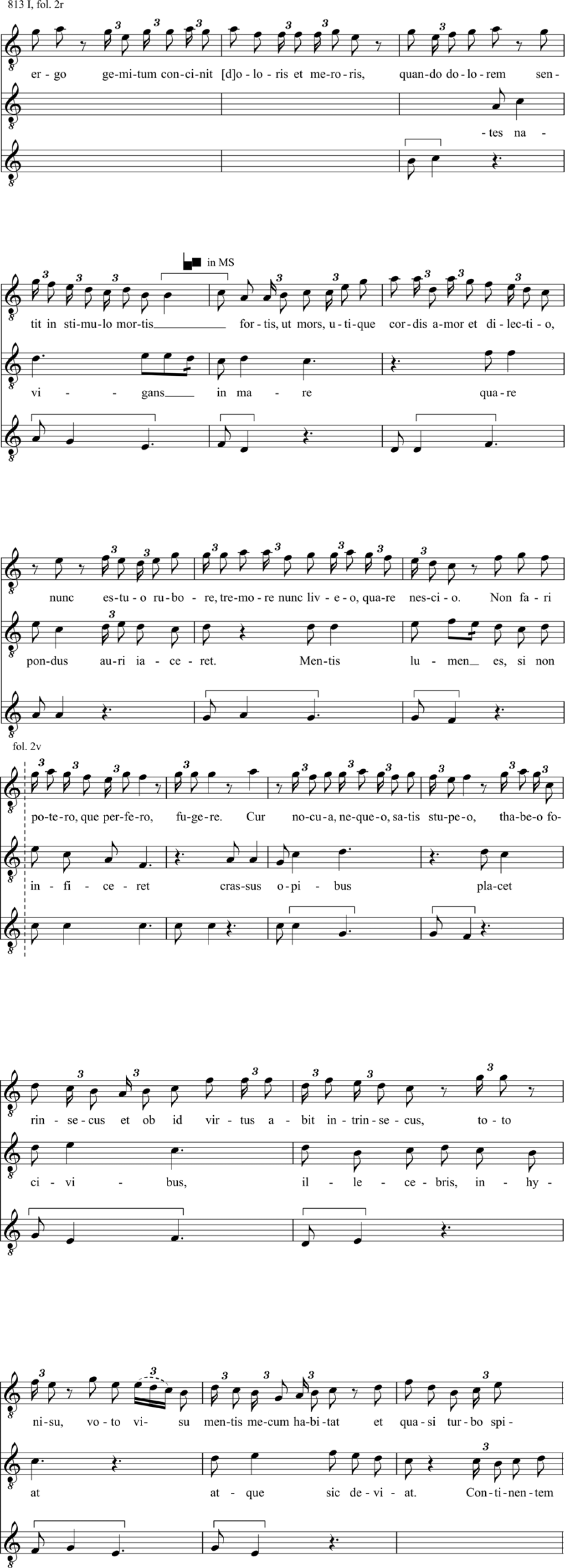


 Open access

