

1. Introduction
The Bīsotūn Inscription (DB), a trilingual text inscribed on the rock face at Mount Bīsotūn (Behistun)Footnote 1 overlooking the main road from Babylonia to Media and commemorating the events following the death of Cambyses II and Darius I’s triumph over the nine rebellious kings, ranks among the most famous textual testimonies of the Ancient Near East. Its exploration is closely linked to the beginnings of various disciplines, including Assyriology, and for this reason, the inscription has provoked an immense amount of scholarship over the years.Footnote 2 Research interest centered on the inscription’s role in the decipherment of the Assyro-Babylonian cuneiform script, the understanding of Elamite, and the clarification of the Old Persian script, grammar, and vocabulary; on the insights it provided into political history and royal ideology; and on the interrelationships among the four versions, including the heavily fragmented Aramaic version from Elephantine. While there are opposing views on some aspects, research on the latter point suggests that the languages involved are translation languages whose Urtext is lost.Footnote 3 Among these languages, Akkadian—or more specifically, its Babylonian variety—holds a special position due to its extensive documentation across all genres, providing significant material for comparative studies. Against this background, it is clear that the language of the Babylonian version (DB Bab.) stands in sharp contrast to the scribal tradition evident in the numerous and slightly earlier royal inscriptions of the Neo-Babylonian empire, displaying, on the whole, linguistic traits that are also absent in contemporaneous archival or learned texts (Hackl Reference Hackl and Vita2021: 1451–1453).
In the context of the ongoing Bīsotūn Project, directed by Wouter F. M. Henkelman and aimed at producing full re-editions of all versions, it seemed worthwhile to revisit the linguistic relationship of the Babylonian version to the other versions, particularly with regard to the process of adapting and reshaping elements drawn from the other languages involved.Footnote 4 For this purpose, it was necessary to first establish the surviving text of the Babylonian version through a survey of previous editions and a re-examination of the inscription at Mount Bīsotūn.Footnote 5 During this process, questions arose regarding the reliability of the current standard edition presented in Von Voigtlander (Reference Von Voigtlander1978). As a consequence of this serendipitous discovery, it was crucial to take a step back and closely review to what extent the text of the Babylonian version is actually verified. The results of this scrutiny, supported by information gleaned from Von Voigtlander’s correspondence with George G. Cameron and Matthew W. Stolper during her work on the inscription, as well as their repercussions, are the main focus of the present article. To this end, the following pages incorporate extensive quotations from Von Voigtlander (Reference Von Voigtlander1978) and her letters in an effort to enhance transparency regarding her method. To further contextualize her contributions, a detailed overview of the editorial history of the Babylonian version is presented ahead of this discussion.
2. The Editorial History of the Babylonian (Akkadian) Version
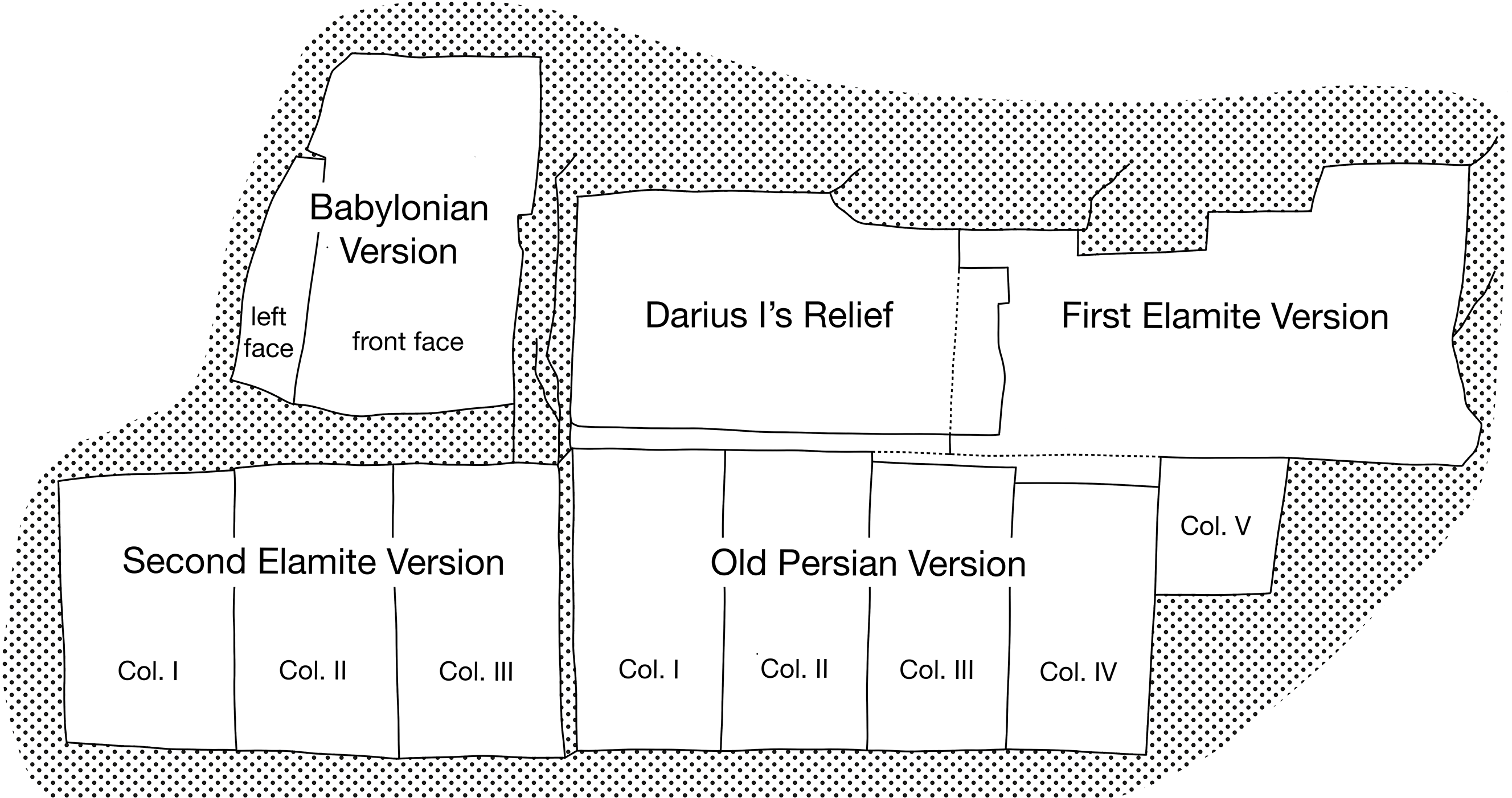
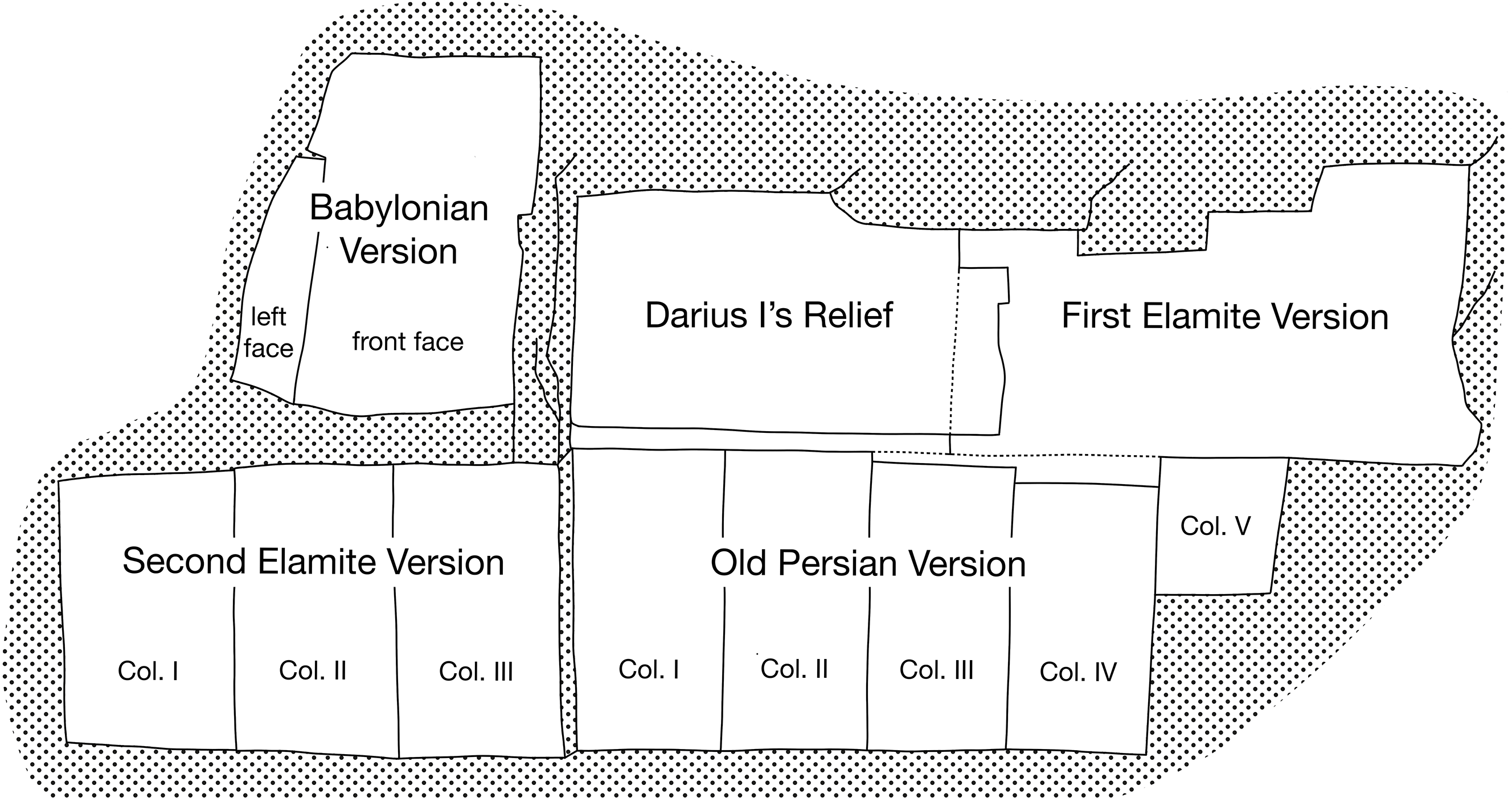
The systematic explorationFootnote 6 of the Bīsotūn Inscription is intimately linked to the name of Sir Henry Creswicke Rawlinson, an officer of the British East India Company army, who between 1835 and 1847, studied the monument and its trilingual inscription, and produced paper squeezes and copies that ultimately served him and others as the basis of the editions in the years to follow.Footnote 7 In his accounts of the difficulties involved in scaling the cliff and copying the inscriptions at Mount Bīsotūn, the Babylonian inscription, carved on a block on the left side of the bas-relief of Darius I, stands out due to its relative inaccessibility (fig. 1). In a paper read to the Society of Antiquaries in 1850, Rawlinson offers a vivid picture of the situation he was facing:
The Babylonian transcript at Behistun is still more difficult to reach than either the Scythic [i.e., Elamite] or the Persian tablets [i.e., rock inscriptions]. The writing can be copied by the aid of a good telescope from below, but I long despaired of obtaining a cast of the inscription; for I found it quite beyond my powers of climbing to reach the spot where it was engraved, and the craigsmen[sic!] of the place, who were accustomed to track the mountain goats over the entire face of the mountain, declared the particular block inscribed with the Babylonian legend [i.e., inscription] to be unapproachable.
Rawlinson (Reference Rawlinson1851b: 75)
The position of the inscriptions on the rock at Mount Bīsotūn (drawing by T. Tang)
The solution to this tantalizing problem, often cited as one of the most iconic episodes of recovering an artefact in the early days of the discipline, was achieved in the autumn of 1847 and is described by Rawlinson as follows:
At length, however, a wild Kurdish boy, who had come from a distance, volunteered to make the attempt, and I promised him a considerable reward if he succeeded. (…) The boy’s first move was to squeeze himself up a cleft in the rock a short distance to the left of the projecting mass. When he had ascended some distance above it, he drove a wooden peg firmly into the cleft, fastened a rope to this, and then endeavoured to swing himself across to another cleft at some distance on the other side. (…) He had brought a rope with him attached to the first peg, and now, driving in a second, he was enabled to swing himself right over the projecting mass of rock. Here with a short ladder he formed a swinging seat, like a painter’s cradle, and, fixed upon this seat, he took under my direction the paper cast of the Babylonian translation of the records of Darius which is now at the Royal Asiatic Society’s rooms, and which is almost of equal value for the interpretation of the Assyrian inscriptions as was the Greek translation on the Rosetta Stone for the intelligence of the hieroglyphic texts of Egypt.
Rawlinson (Reference Rawlinson1851b: 75–76)Close to sixty years after Rawlinson’s efforts, in 1904,Footnote 8 the site was visited by Leonard William King and Reginald Campbell Thompson, following a decision of the Trustees of the British Museum to publish a revised edition of the Babylonian version. Such a visit was deemed necessary on account of the decaying state of the paper squeezes made by Rawlinson in 1844 and 1847 (King & Thompson Reference King and Thompson1907: xx–xxi), thus rendering them inadequate for the collations required to revise Rawlinson’s editio princeps (Rawlinson Reference Rawlinson1851a) and later copy (Rawlinson Reference Rawlinson1870: pl. 39–40). Drawing on his experience in copying Assyrian rock inscriptions, King was able to access the Babylonian version with the help of climbing contraptions, as detailed in the following passage:
By climbing up a ravine round the end of the mountain, he [i.e., King] succeeded in reaching a natural ledge about 200 feet above the inscription. Here iron crowbars were driven into crevices in the limestone, and ropes, made fast to them, were shaken with some difficulty down the uneven face of the rock, until their ends reached the ledge which is hewn in the surface below the inscription, and is rather less than 200 feet above the foot of the cliff (…) This lower ledge was reached by climbing from below. Cradles made of wood from packing cases and mule-girths were slung from the pendent ropes and were raised or lowered, according to the position of the text under examination, by natives stationed on the natural ledge above.
King & Thompson (Reference King and Thompson1907: xxii)King and Thompson’s efforts proved fruitful, leading to significant improvements upon Rawlinson’s readings, and their re-edition became a seminal work for many decades to come. It is therefore no surprise that Franz Heinrich Weißbach’s notable re-edition of the Bīsotūn Inscription, published shortly thereafter in 1911, is also based on the work of King and Thompson (Weißbach Reference Weißbach1911). His work, in turn, served as the basis for the first comprehensive linguistic study of the Bīsotūn Inscription (Rössler Reference Rössler1938).
Despite these considerable advancements in understanding the inscriptions, particularly the much damaged Babylonian version, many philological issues arising from the fragmentary nature of the text remained. This prompted George G. Cameron to undertake a comprehensive re-examination of all three versions in 1948 which, in his own words, was meant “to bring to an end a century of work upon the relief and inscriptions of Darius, King of Persia, on Mount Bisitun in Iran.” (Cameron Reference Cameron1951: 47). Somewhat similar to King, Cameron used a movable painter’s scaffold and a boatswain’s chair to access the rock face and verify what King (and Thompson) had read about forty years earlier.Footnote 9 In addition to copying the largely erased earlier Elamite version (fig. 1) for the first time, he made latex squeezes of the inscriptions. Building on this fieldwork, which he continued during a second visit in 1957, Cameron improved substantially on the readings of the Old Persian version, and even more so on those of the much more elusive Elamite version (Cameron Reference Cameron1951 and Reference Cameron1960).
Since Cameron’s main focus was on these two versions, he placed the revision of the Babylonian version in the hands of his students Warren C. Benedict and Elizabeth N. Von Voigtlander, resulting in a first article with an edition of lines 1-29 (Benedict & Voigtlander Reference Benedict and Voigtlander1956). However, Von Voigtlander later took issue with this publication, noting its poor quality, which had led her to disregard it when compiling the eventual re-edition of the Babylonian version, published in the first (nominally second) volume of the Corpus Inscriptionum Iranicarum. Her concerns are reflected in the following passage:
Our attempted restorations suffered from many deficiencies, partly because of our inexperience, I admit, but largely because of the damage to the squeeze. I have made no reference to this publication in my notes to l. [i.e., lines] 1-29 in the present edition. I consider it to have been superseded by my new readings, and I am sure that if Dr. Benedict were still alive I would have his concurrence.
Von Voigtlander (Reference Von Voigtlander1978: xii)This re-edition, now encompassing the complete Babylonian version, was primarily based on new latex squeezes that Cameron made in 1957 after the earlier ones from 1948 had suffered irreparable damage during storage (Benedict & Voigtlander, Reference Benedict and Voigtlander1956: 1, n. 2).Footnote 10 Even though Von Voigtlander did not study the inscription in situ like Rawlinson and King,Footnote 11 her lengthy work on the Babylonian version, ultimately spanning more than fifteen years according to her correspondence with Cameron, led to tremendous advances over the previous editions—so much so that now essentially the entire text of the Babylonian version was recovered. As a result, she was able to publish what is today considered the standard version of the Babylonian text, which consequently served as the basis for major editions and translations that followed (Borger & Hinz Reference Borger, Hinz and Borger1984; Malbran-Labat Reference Malbran-Labat1994). Essentially, this also applies to the last comprehensive edition by Chul-Hyun Bae, although he was able to offer improved readings based on new photographs he took during a visit to Mount Bīsotūn in 1998 (Bae Reference Bae2001: 103). The following quotation from Rüdiger Schmitt’s review article captures the significance of the advances made in Von Voigtlander’s re-edition:
Die langersehnte (…) Ausgabe The Bisitun Inscription of Darius the Great. Babylonian Version zeigt erfreulicherweise – und dies haben wir vornehmlich dem vollen Einsatz Camerons zu verdanken! –, daß der Text durch die Jahrtausende hindurch gar nicht so schwer gelitten hat, wie dies bisher immer angenommen worden ist. Damit ist nun endlich auch eine solide Grundlage für die Arbeit an diesem Text und für seine Vergleichung mit den beiden anderen keilschriftlichen Versionen geschaffen: Frau von Voigtlanders Hoffnung, daß diese Textausgabe auch für die Erforscher altpersischen und elamischen Parallelfassungen eine wertvolle Hilfe sein möge, wird sich zweifelsohne erfüllen.
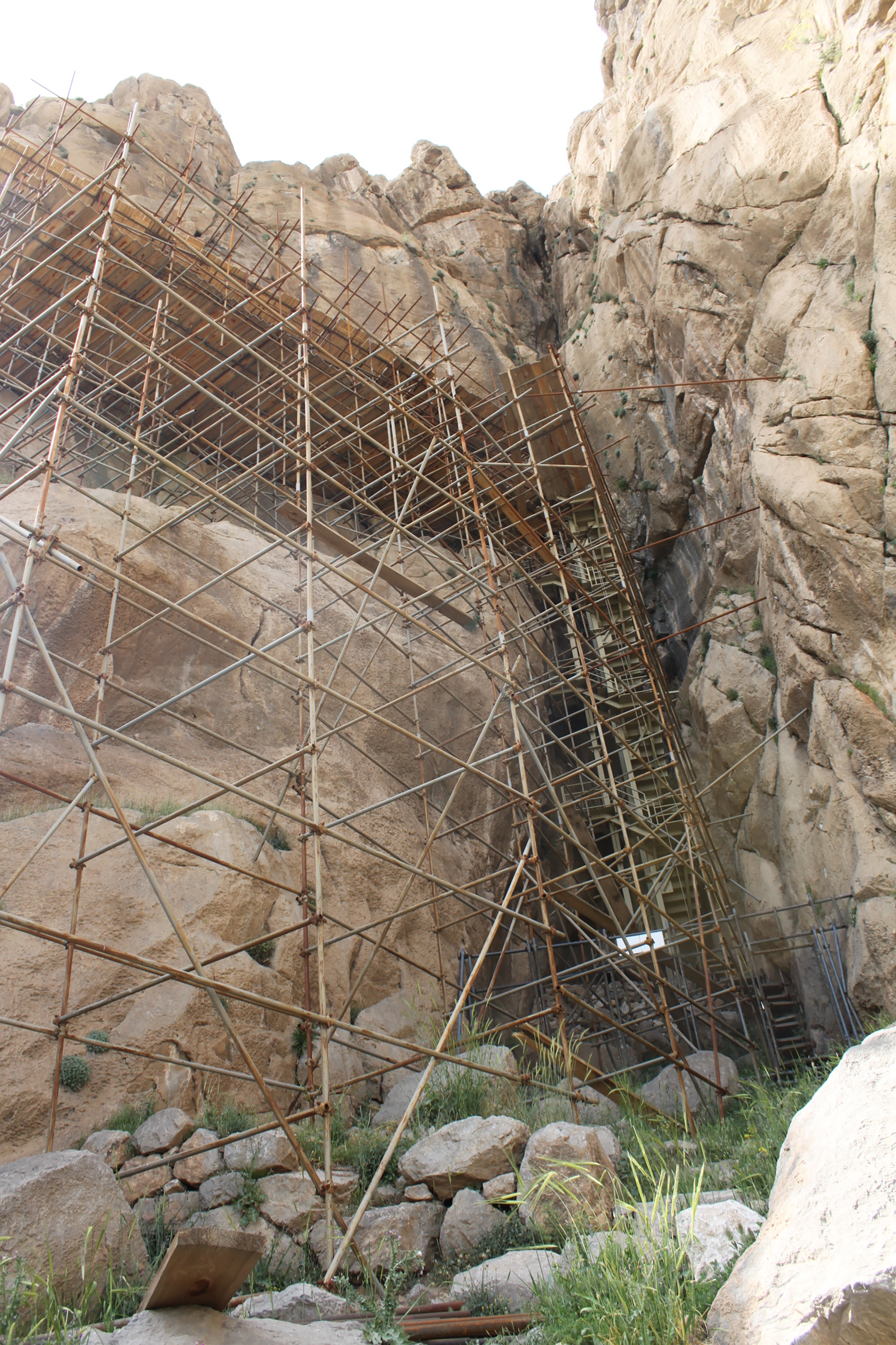
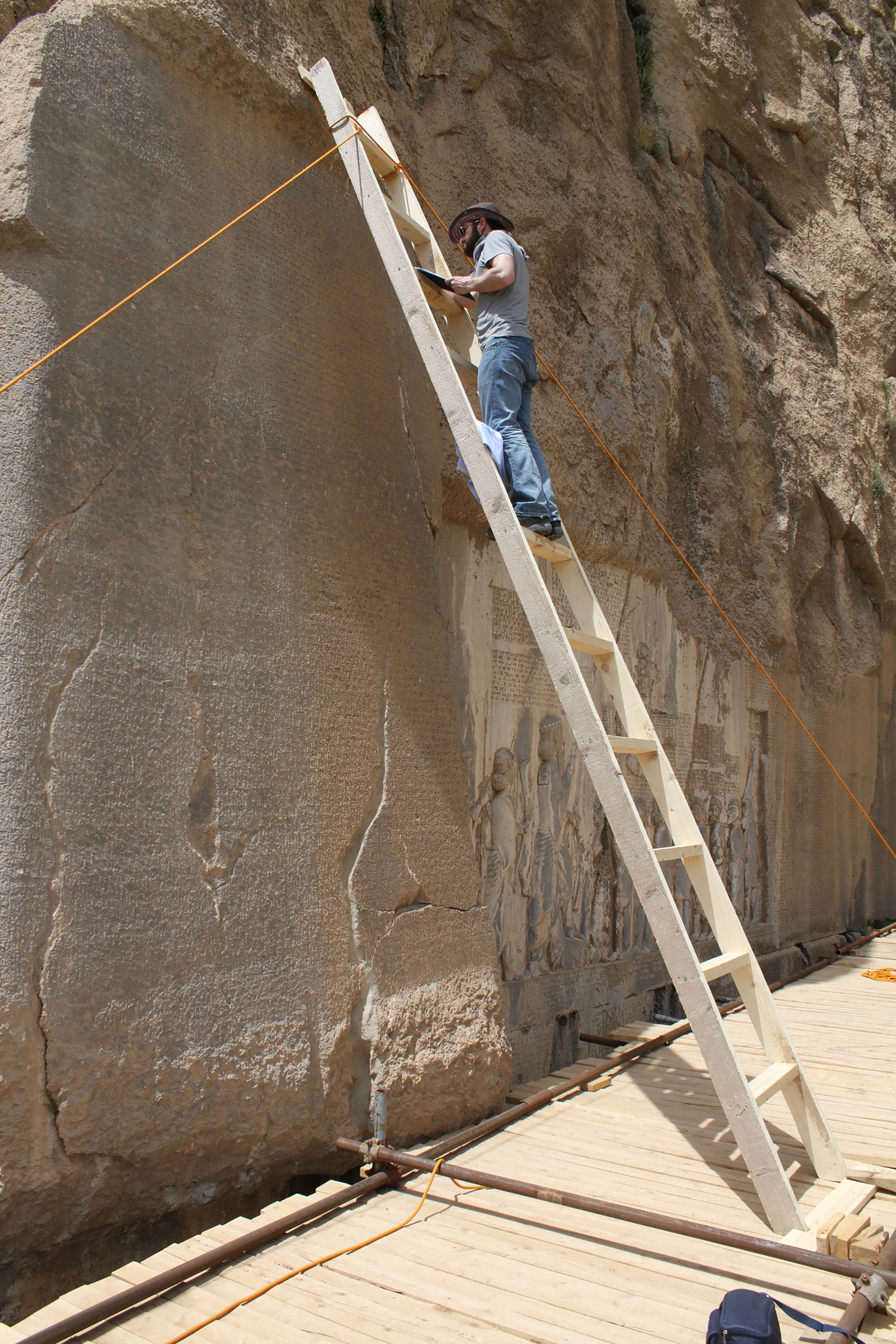
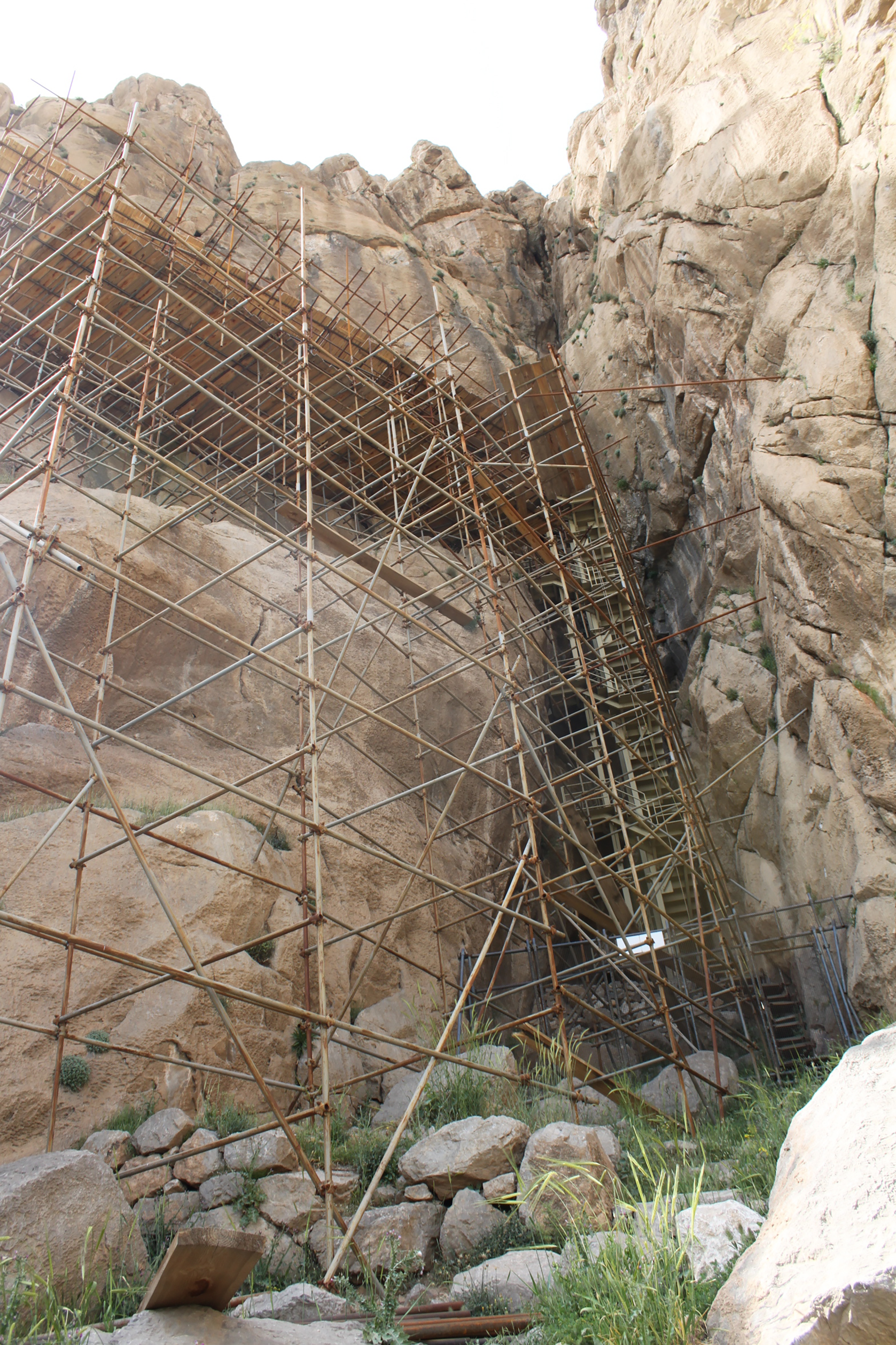
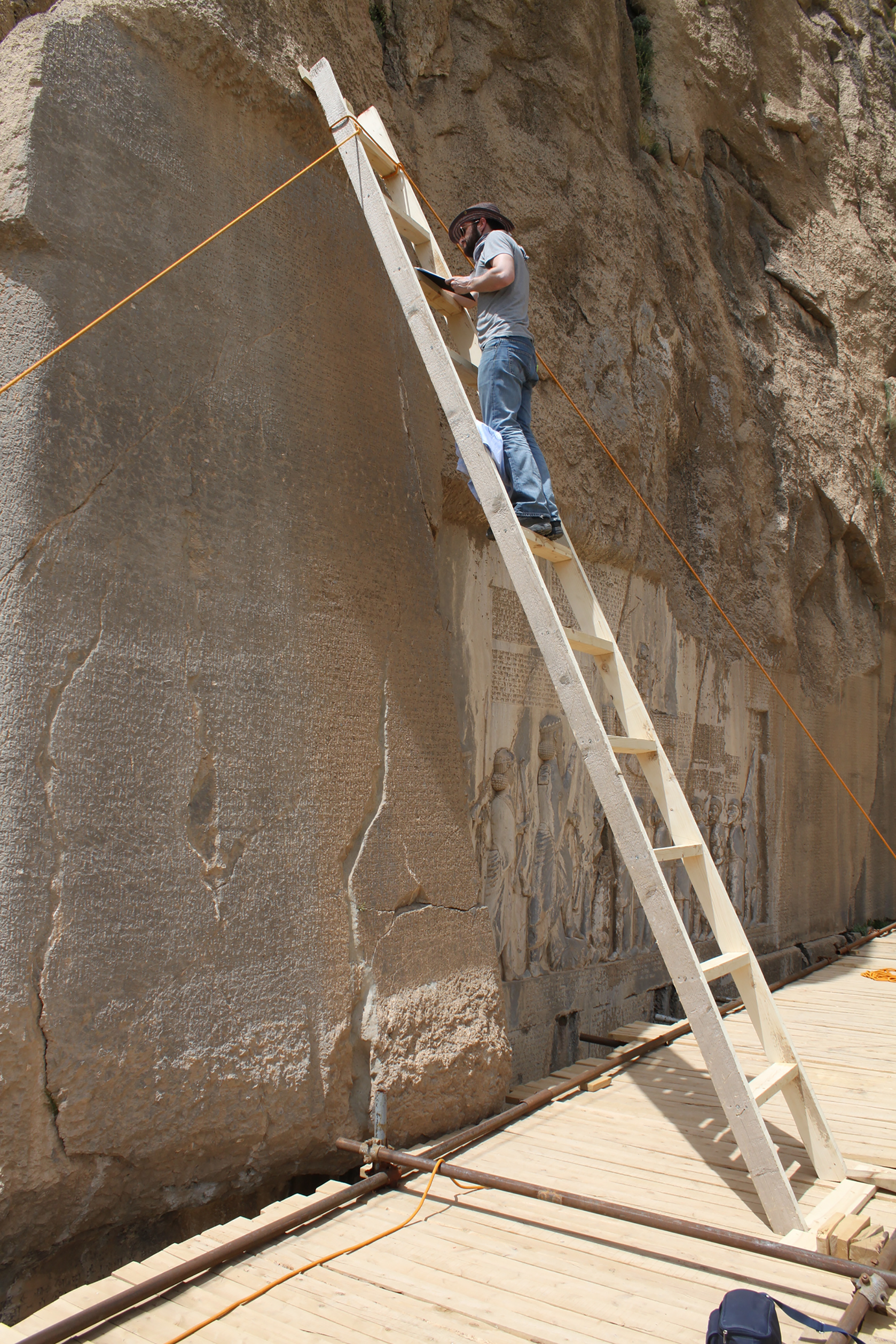
Schmitt (Reference Schmitt1980: 106–107)In preparation for a full and thorough re-edition of the Babylonian version in the context of the aforementioned Bīsotūn Project, the author of these lines visited the site in 2012. Access to the inscription was provided by means of a scaffold (fig. 2), on which a six-meter-long ladder was erected to compensate for the missing upper decks (fig. 3).
Western wall of the gully at Mount Bīsotūn, with the monument obscured by the scaffold (photo by the author)
Ladder atop the scaffold, with the author examining the Babylonian inscription (photo by W.M.F. Henkelman)
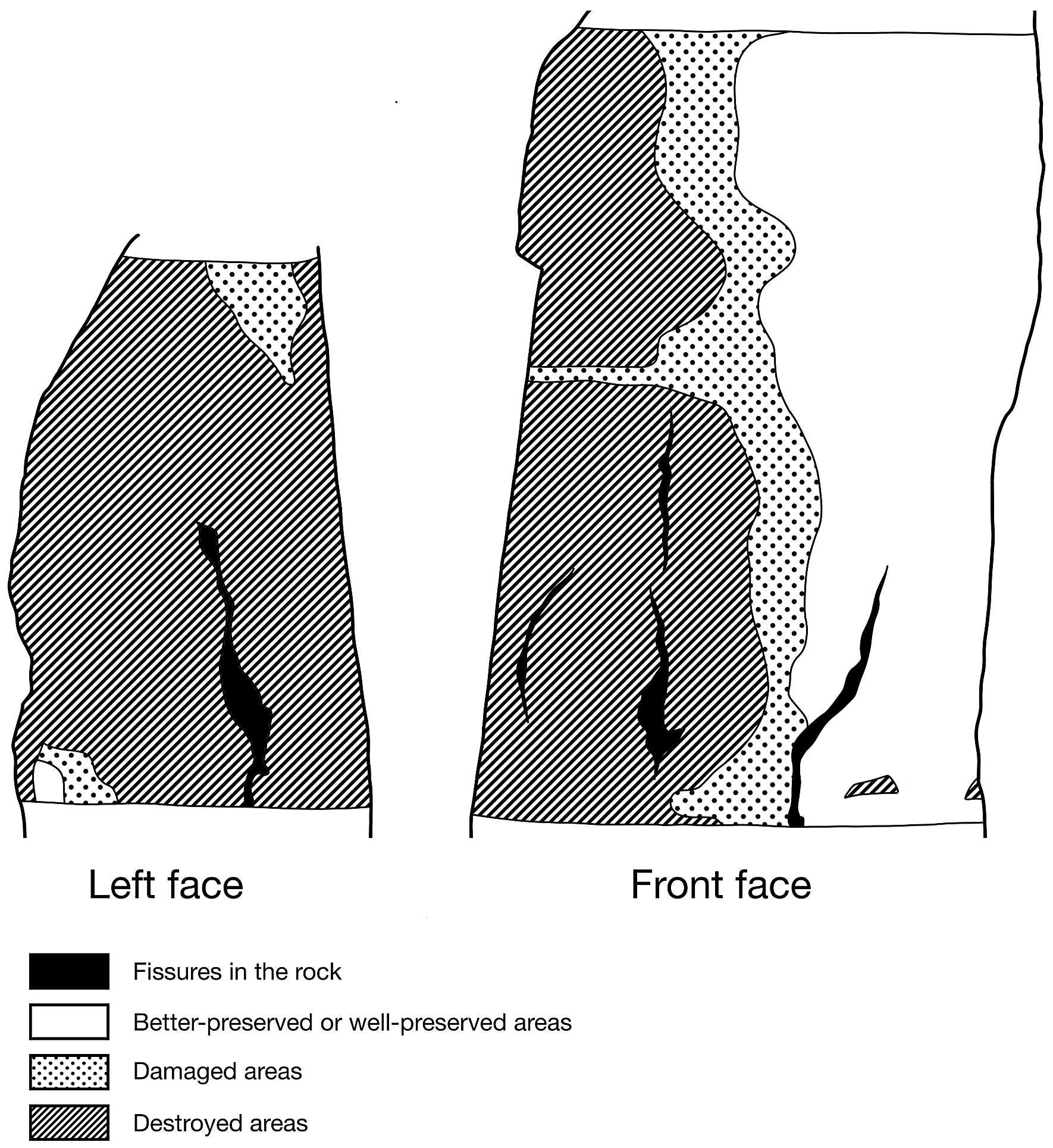
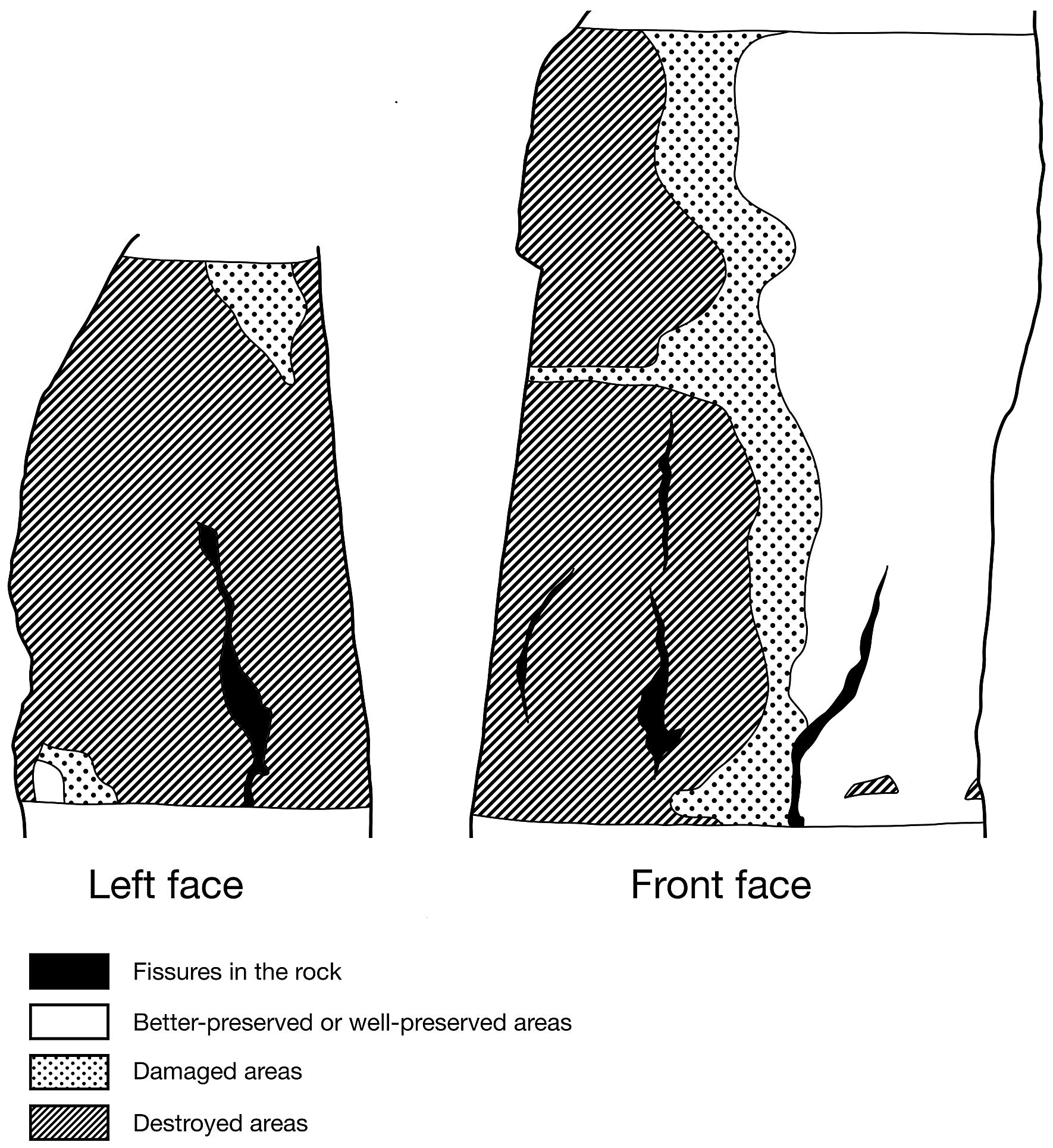
A preliminary examination revealed that the surface of the rock face in this area is significantly eroded, to the effect that about two-thirds of the Babylonian version are now irretrievably lost (fig. 4)—an observation also evident from the 3D scans made on behalf of the Bīsotūn Project. The substantial damage to this area of the monument, easily explicable due to the exposed position of the block bearing the Babylonian version, is not a recent issue, which clearly emerges from the accounts of earlier visitors to the site:Footnote 12
I must add, too, that it is of the more importance that this invaluable Babylonian key [for the interpretation of Assyrian, i.e., Akkadian inscriptions] should have been thus recovered [see above], as the mass of rock on which the inscription is engraved bore every appearance, when I last visited the spot, of being doomed to a speedy destruction, water trickling from above having almost separated the overhanging mass from the rest of the rock, and its own enormous weight thus threatening very shortly to bring it thundering down into the plain, dashed into a thousand fragments.
Rawlinson (Reference Rawlinson1851b: 76)The first 35 lines of the Babylonian version are inscribed on the front or right face [of the block] only. The thirty-sixth and all subsequent lines begin on the left face and continue around the angle and across the front face. Lamentably, the entire left side of the front face, exposed as it is to wind and weather and to rocks tumbling from above, has suffered more than any other portion of the great inscription. At many places, consequently, the signs which were once cut into the rock have entirely disappeared or have left only the faintest of traces both on the rock and the latex squeeze. Thus it is that the beginnings of the lines are only too often restorable not at all or with the utmost difficulty.
Cameron apud Benedict & Von Voigtlander (Reference Benedict and Voigtlander1956: 1, n. 2)The extensive damage to the engraving on this face was probably caused by erosion from rain and windblown particles carried in from the mouth of the gully and not by streams of water pouring over it from gaps above as is the case with the Old Persian and Elamite texts at certain points. On one of my visits to the site, in May 1969, after a winter and spring of heavy rains, I observed and was able to photograph the monument with streams of water gushing out from springs well above the sculpture as well as from points directly above the Elamite and Old Persian texts. These streams have in some cases deeply eroded these inscriptions; in others they have left a tufa deposit covering the signs.
Von Voigtlander (Reference Von Voigtlander1978: 4)
Current condition of the Babylonian version (drawing by T. Tang)
A more thorough examination, conducted against the backdrop of the earlier copies and editions, further revealed that the signs now lost closely correspond to what Rawlinson (Reference Rawlinson1870: pl. 39–40) and King & Thompson (Reference King and Thompson1907) had recorded as missing in their works. In a similar vein, the edition presented by Benedict & Von Voigtlander (Reference Benedict and Voigtlander1956), which covers only lines found on the front face of the block, indicates significant damage to the inscription, most notably at the beginnings of the lines. All this stands in stark contrast to the full edition offered in Von Voigtlander (Reference Von Voigtlander1978), in which restorations are almost absent and damaged signs, indicated by half-squared brackets, are rarely acknowledged. The following pages thus survey what is known about Von Voigtlander’s method in an effort to understand how she arrived at a near-complete reading (not restoration!) of the Babylonian version. The discussion concentrates on the discrepancy between the signs that are actually documented through copies and photographs and Von Voigtlander’s readings. Philological issues necessitate occasional digressions. The purpose of this survey is to establish two premises: first, that Von Voigtlander’s additional readings cannot be verified and are therefore subject to doubt, also in light of other observations; and second, that about two-thirds of the Babylonian version should be considered lost.
3. A Reassessment of the Babylonian (Akkadian) Version according to Von Voigtlander (1978)
Any attempt to corroborate Von Voigtlander’s readings is hampered by the fact that her re-edition does not include the kind of reproductions used in the field, such as autographed copies or photographs—an issue also noted by earlier commentators.Footnote 13 The lack of photographs of the original is hardly surprising, as she relied on Cameron’s latex squeezes and did not examine the inscription on the rock face herself.Footnote 14 Judging by the following quotations, she was fully aware of this issue, but damage to the squeezes seems to have given her sufficient reason to publish her re-edition without copies or photographs:
(…) we will no doubt be stopping in London, and I will try to drop off the small squeeze there. It is in good condition, possibly the best of the lot. But Bivar [i.e., Adrian D. H. Bivar] should know that these are working squeezes. (…) The top squeeze is also in good condition, but the other two have dried and show a tendency to powder or even flake off. I have protected them as well as I could, but I suppose the hydrocarbons which are part of the smog here [i.e., Tehran] and permeate everywhere may have caused some deterioration in the latex. We think because they are so dry that they probably will suffer some damage in transportation -- I hope not. But if photographs are required they should have been taken in their pristine state. I wonder too if he [i.e., Bivar] realizes their size and what reduction will do to their already impaired legibility (I mean the inscription itself). But we will cope with the problem when the time comes.
Von Voigtlander to Cameron (December 1973)It would perhaps have been desirable to incorporate in this publication a hand copy of the signs, but since there are approximately 9500 signs in the Babylonian text, this would have been a formidable undertaking and would have further delayed publication. Moreover, an attempt to reproduce them in their damaged state as I believed I saw them would have reinforced the subjective element always present in identifying such signs. I have tried to make up for this lack by the use of whole and half brackets to indicate the extent of the damage and the probability or possibility of the reading, supplemented by a description of the traces where it seemed desirable. I have also recorded and attempted to account for all gaps 3 cm or over in length. Photographs have also been suggested. Since the three large squeezes are each approximately 1.3 m in height and from 2.3 to 2.9 m in length, photographing the material adequately would pose some difficulty. (…) I do not wish to disparage the value of photographs. A set of photos of the legible portion of the lines read by R [i.e., Rawlinson] and KT [i.e., King & Thompson] would be useful.
Von Voigtlander (Reference Von Voigtlander1978: 68)Regardless of whether these lines reflect an unwillingness to support her readings with modern reproductions, the lack of copies and photographs poses a formidable obstacle to forming an opinion about the reliability of Von Voigtlander’s re-edition. Comparison with Rawlinson’s squeezes, which Von Voigtlander also consulted, offers no remedy, as they have disintegrated. This comes as no surprise, given that King and Thompson had already noted their deplorable condition around 1900 (see section 2).Footnote 15 The limited durability of Cameron’s latex squeezes, plain from the quotations presented so far,Footnote 16 further raises the question of whether they were suitable for resolving epigraphic issues at a time when they were no longer fit for photography. The latter follows from Von Voigtlander’s letters sent to Cameron in 1972 and 1973, in which she proposes new readings based on the latex squeezes. An anecdote recounted in another letter may provide some insight into this issue, albeit it is equally possible that the indirect statement about the overall quality of the squeezes merely reflects the constraints of the untrained eye:Footnote 17
You should see the apt[.] -- there are squeezes all over -- the old first sq[ueeze] in the study -- the new 1st [squeeze] on the living room floor -- the second on the guest bed, and the third on the floor of the big entrance and the two small ones d[r]aped over the living room chairs. Now I will be able to roll up one. I have a bad time with engineers - an ignorant breed! -- who stand and look at the squeeze and tell me there is really nothing there. God!
Von Voigtlander to Cameron (March 1972)There is no way of determining whether this observation by the engineers referred to all the squeezes or specifically to one of the severely damaged or destroyed areas of the Babylonian version. But it does highlight the need to examine the method Von Voigtlander employed to obtain new readings from these squeezes. In her book, the section dedicated to reading the squeezes—likely included in recognition of the unconventional nature of the editing process—serves as a useful point of departure (Von Voigtlander Reference Von Voigtlander1978: 68–69). After addressing the challenges posed by the dimensions of the squeezes, it describes how Von Voigtlander established the lines and counted the missing signs. A description of her method is also found in one of her letters to Stolper. Since the latter is expressed in a more concise and tangible manner, the following quotation is taken from that letter and not the pertinent section in her book:
Finally on my methods. I first draw in the line with a soft pencil because the engraved line fades out early and the eye does tend to wander in damaged areas. As I read I mark the ends of the words with chalk of one color and the signs with another, keeping a wet sponge handy for frequent use. When I am satisfied that my readings fit together I copy them and record the length of each word or phrase. I add the numbers together to get a plausible figure for each line. If it isn’t plausible I go back and check for omissions or overlapping readings. This method is not foolproof but it helps. It also helps to locate later an area that I wish to re-read. So suggested emendations should not take up more space than my original readings.
Von Voigtlander to Stolper (undated [1972 or 1973])The quotation reflects the common practice of calculating the number of signs that can fit into broken or damaged passages based both on the preserved text and the dimensions of the writing material. In Von Voigtlander’s case, this process naturally involved significantly more complexity and conjecture, given the sheer size of the inscription. The effort required to do so is evident from the intricate table with measurements and sign counts that accompanies her re-edition (Von Voigtlander Reference Von Voigtlander1978: 70–72). It is also reasonable to assume that during this process, she used the much better preserved Old Persian version to reconstruct and locate the corresponding Babylonian text in the damaged and destroyed areas of the inscription. Yet, while Von Voigtlander’s commentaries on new readings frequently include references to the Persian and Elamite versions, she makes no explicit mention of this method in her book or letters to Cameron. It is also worth noting that almost all of these references highlight deviations in the Babylonian version, such as instances where the latter includes text omitted in the other versions.Footnote 18 Actual restorations based on the other versions, on the other hand, are mentioned only rarely (Von Voigtlander Reference Von Voigtlander1978: 11 and 45).
With this in mind, it is important to reiterate that her additions to the previously available text generally represent new readings, not restorations. This follows from both the pertinent section in her book (Von Voigtlander Reference Von Voigtlander1978: 68–69) and letters to Cameron and Stolper. Based on these sources, her method of reading badly worn signs included the following approaches, one of which has already been touched upon in the previous quotation:
I found a new help to reading when I accidentally left a wet sponge on the squeeze overnight. After soaking for several hours, or preferably overnight, the high spots bleach out and turn a slightly different color from the background. Of course, if the sign is really all but gone it does little good, but if the engraving is still deeper than the scars and pits it is quite helpful. In cases where the scars are deeper than the engraving it does little. So I have been soaking and reading in doubtful areas. This has taken time too, but it has been worth it. Sometimes something surprising has come to light, sometimes I have had to correct the readings.
Von Voigtlander to Cameron (July 1972)In badly worn areas the minute differences in elevation between worn wedges and the rock background, which often I could discern only with the help of a reading glass, might or might not be reproduced on a reduced photograph with sufficient clarity. In my reading I had to take full advantage of the three dimensional quality of the squeezes, not only visually but by touch.
Von Voigtlander (Reference Von Voigtlander1978: 68)The process she refers to as “overnight soaking with a wet sponge” in another letter to Cameron (February 1973) and reading by touch played a crucial role in her effort to obtain new readings, particularly in areas whose surfaces are essentially eroded away. The condition of these areas is best revealed by the following quotation:
The problem was not so much in learning to read the signs backward [from the negative squeezes] as it was to learn how to identify eroded signs. I learned that verticals frequently survived, though broadened, since probably they served as miniature water channels and were eroded to a greater depth; that wedge heads were usually last to disappear, probably because they were more deeply incised; and that the stems of horizontal wedges were soonest obliterated or reduced to a threadlike line.
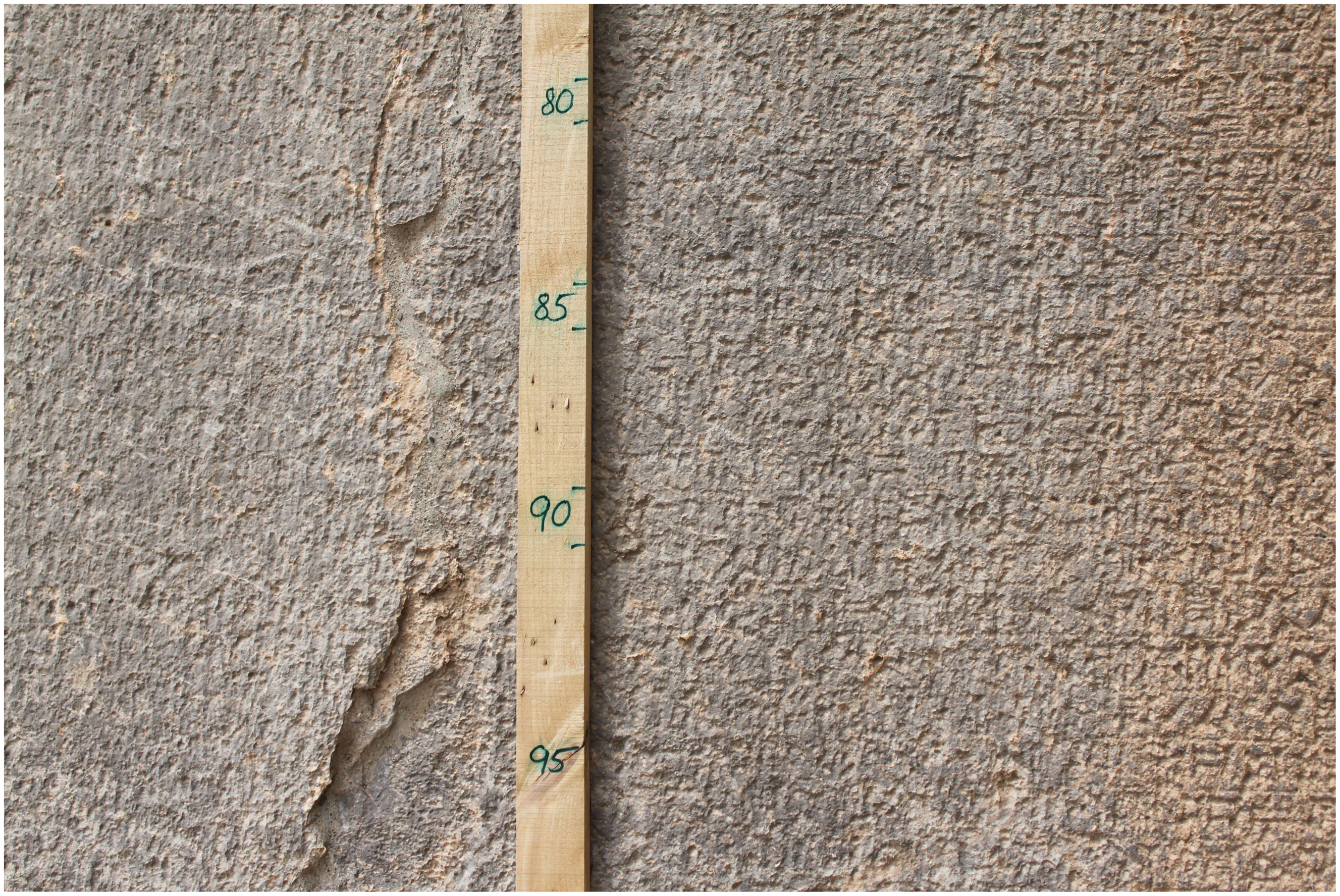
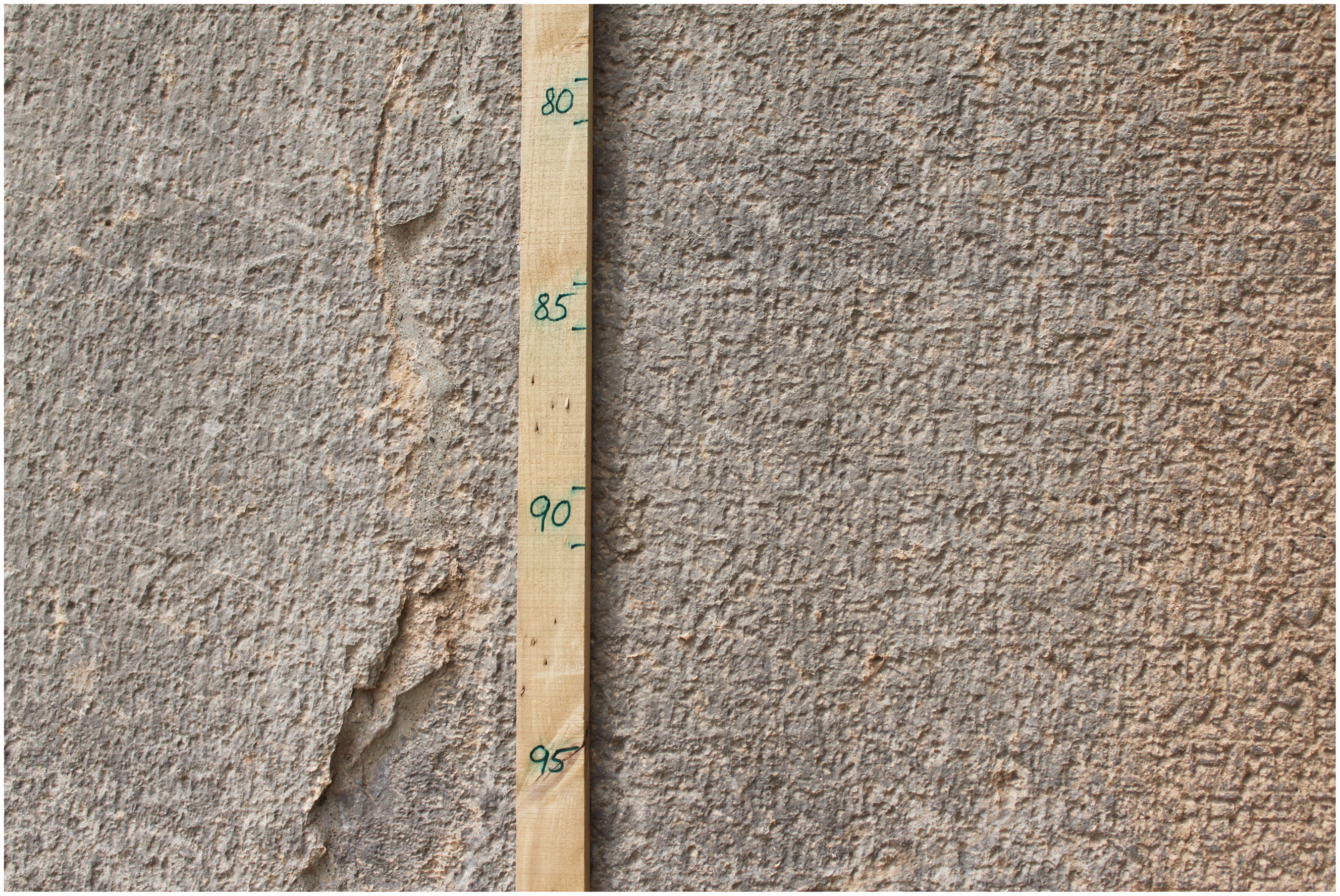
Von Voigtlander (Reference Von Voigtlander1978: 68)For the modern observer of the inscription on the rock face it becomes immediately clear what these lines refer to: the verticals that, broadened by erosion, cover about half of the front face and almost all of the left face of the block bearing the Babylonian version (fig. 1)—an area neatly corresponding to what Rawlinson, as well as King and Thompson, had recorded as missing in their reproductions of the inscription (see section 2); this emerges particularly clearly from the few surviving signs in the upper right corner of the left face, belonging to lines 36–49, which Rawlinson (Reference Rawlinson1870: pl. 39) recorded as an isolated section of damaged but preserved surface (fig. 4).Footnote 19 It also becomes clear that the original signs, hinted at by these verticals and traces of other wedges, are worn to the point that no separation between individual signs—let alone serious interpretation—is possible, even against the backdrop of readings that might be expected in light of parallel passages or the other versions (fig. 5).
Lines 78–97, with completely eroded signs on the left, damaged signs in the center, and better-preserved signs on the far right (photo by the author)
Von Voigtlander was, of course, fully aware that having pushed her readings far beyond what Rawlinson, as well as King and Thompson, had proposed would invite scrutiny. This is reflected in a letter she drafted after studying Rawlinson’s squeezes in the British Museum.Footnote 20 In it, she put forward the idea that the poor lighting conditions faced by these London-based scholars during the Victorian era diminished the quality of their readings:
First, as to R and KT’s readings. In R’s first copy he read all the signs which he considered easily legible. In his second, he pushed his readings back into the line into more difficult areas, copying what he saw even if it did not make sense. KT, in turn, corrected this portion and then attempted to push their readings even farther back. In doing so they came upon one of the most difficult areas to read where the rock surface has broken down into small pits. Since eroded wedge heads also have this form and the pits obscure what remains of the stem it is almost impossible to read this area without context. This, of course, I can get by working through from the beginning of the line, but they could not do this. Consequently their readings are frequently unreliable in this area. Other sources of error are a less sensitive squeeze (this I can attest) and probably poor light. London is frequently a gloomy city and indoor lighting of the period was poor by modern standards. I never read by artificial light and find that a slightly diffused daylight brings up the signs best.
Von Voigtlander to Stolper (undated [1972 or 1973])At this point, it is necessary to offer a first assessment of Von Voigtlander’s re-edition. While it is plausible that the verticals were indeed properly visible on the negative squeezes—that is, on the image of the reversed inscription protruding from them—it is difficult to imagine that even the soaked squeezes provided a level of detail sufficient to identify specific signs. After all, the surface of the area in question is so badly eroded that it is impossible to determine whether the verticals result from the water trickling down from above or genuinely reflect traces of signs—that is, according to Von Voigtlander, rock surface broken down into small pits or eroded wedge heads of the same form (see above). Against this backdrop, the three-dimensional quality of the squeezes may have even been misleading when examined not only visually but also by touch, creating the impression of discernible traces of signs where none can be reliably confirmed on the rock face. The method is further undermined by the fact that this area does not preserve any clearly recognizable signs that could anchor the speculative readings preceding and following them—even though Von Voigtlander claims in the previous quotation that she could “get [this] by working through from the beginning of the line.”
Assuming that the condition of the inscription—and particularly the left face with the beginnings of the lines—has much deteriorated between the time the squeezes were taken and the author’s visit to the site could offer an avenue for explaining the discrepancy between Voigtlander’s readings and the signs that are visible today. However, in light of the accounts of the earlier commentators (section 2), it seems very unlikely that the squeezes made by Cameron in 1957 recorded the inscription in a much better condition. Incidentally, this also follows from one of Von Voigtlander’s letters, in which she critiques King and Thompson’s practice of backward reading, that is, reading from right to left given the significantly better legibility of the signs on the right (full quotation below). It is therefore suggested here that during her lengthy work on the inscription, Von Voigtlander became overly confident, overestimating what could be gleaned from the squeezes and failing to clarify to what extent her new readings were influenced by the parallel versions. Following this interpretation provides an explanation for why she claimed to have read the inscription almost in its entirety— plain from the near-absence of brackets in the published re-edition (Von Voigtlander Reference Von Voigtlander1978: 9)— while at the same time emphasizing undecipherable portions caused by erosion (Von Voigtlander Reference Von Voigtlander1978: xi) and repeatedly dismissing the readings of entire sections. This dichotomy is neatly encapsulated in the following quotations:
You will observe a dearth of brackets. I have considered what to do about bracketting[sic!] for a long time. With few exceptions, these signs can all be identified with optimum lighting and visual aids. Some are fainter than others, but I havent[sic!] given up until the faint ones were amply supported by the context. In cases where the sign was badly damaged or washed out, or where the word used might be questioned, I have used brackets. Otherwise, I have left them out, for they are more easily added than removed. When I say they are legible, this is not to say than [error for that] every wedge in the sign can be distinguished.
Von Voigtlander to Cameron (July 1966)I’ve been holding back, since every day brought me a little closer to having some manuscript to send you. At last the day has arrived and here is the latest and I hope almost the last, edition of lines 1-35. Real vintage stuff, this. Please discard the old copy of 1-29 that I sent you from Pakistan. It is very bad, and I would like to hear that you have burned it! Well, I will not make excuses though I understand some of the reasons it wasn’t well read -- bad Pakistani glasses and having to work with it on a bed where I could not get down over the signs.
Von Voigtlander to Cameron (March 1972)It might be objected that despite all these shortcomings, there is no definitive proof demonstrating that Von Voigtlander’s readings are unreliable. It is therefore necessary to take the discussion beyond the realm of speculation and turn to issues that can still be put to the test today, based on philological considerations and a re-reading of the preserved sections of the inscription. A first case is offered by the following passage found in the letter just cited, which, in passing, sheds further light on Von Voigtlander’s approach to using brackets (italics indicate handwritten additions):
In l. 25, 27, 28 - libbū ki pa-na-tu-šú, I realize that it might look better if it were either šá or ki-i, but it isn’t. There is a ki without i in NRa [i.e., DNa] 20 which I have always supposed was scribal error. As for šá, it just isn’t šá, spacewise, wedgewise, or sightwise.
It also might be better if it were panatuš or panatuššu but it just isn’t. I have spent the better part of 4 days checking those lines, isolating the phrases and comparing them. I’d certainly be glad of your opinion and Chicago’s. If this the above reading is just too impossible we could resort to brackets, with explanatory notes. No, I don’t think that’s possible on second thought.
Von Voigtlander to Cameron (March 1972)The reading pa-na-tu-šú aligns with pa-na-tu-u-a, mentioned in line 3 and likewise preceded by a preposition, and matches the spellings found in learned and archival texts, with the locative u before pronominal suffixes (CAD P 81 s.v. panātu). In her re-edition, however, Von Voigtlander (Reference Von Voigtlander1978: 17–18) proposes the reading pa-na-as-su for /panāssu/ (< /*panāt-šu/). What is surprising is not so much that she found no issue with combining the nominative-accusative form with a preposition in all three instances (lines 25, 27, and 28), but rather that she changed her own reading of the sequence -tu-šú to -as-su (and omitted the ki altogether), glossing over the fact that the signs involved differ markedly in form.Footnote 21 The considerations and circumstances surrounding these new readings are elucidated in another letter:
In l. 25, 27, and 28 I had the devil’s own time until I realized that, in spite of the iš-šu-u and lìb-bu-u in the end of l. 28, he was writing iš-šu-ú and lìb-bu-ú. With that and relocating the phrase I get a consistent pattern of pa-na-as-su, which now looks right. I was never happy with the former reading. I have been forgetting to say that I have gotten these new readings with I don’t know what you think the help of overnight soaking with a wet sponge. Sometimes the wedges come up remarkably.
Von Voigtlander to Cameron (February 1973)The most obvious explanation to account for this and similar cases is that the passages in question occur in the destroyed areas of the Babylonian version, which naturally offer much more room for interpretation (see above). However, notable misreadings are also found in the preserved areas of the inscription. While not all of them can be presented here due to space constraints—this is a task for the full re-edition—the following pages aim to illustrate these discrepancies by providing evocative examples.
The first three examples presented below illustrate cases of minor misreadings. Each example begins with Von Voigtlander’s reading (a), adapted for better comparability, and is followed by a reading that can be supported by collation today (b), with deviations bolded; the translation reflects the reading in (b), and text (signs) presented in the copies is underscored (fig. 6–11). It is worth noting that Von Voigtlander (Reference Von Voigtlander1978) typically provides explanations for her emendations, incidentally clarifying that they are deliberate changes, not mistakes. Interestingly, collation often shows that the signs in Rawlinson (Reference Rawlinson1870: pl. 39–40) and King & Thompson (Reference King and Thompson1907) were copied accurately. Deviations from Rawlinson (Reference Rawlinson1870: pl. 39–40) have an asterisk added.

Copy for example (1)

Copy for example (2)

Copy for example (3)

Copy for example (4)

Copy for example (5)

Copy for example (6)

In her comment on this line, Von Voigtlander (Reference Von Voigtlander1978: 12) notes that “[t]he second sign was copied še-im by R and read so by KT. The first section of the sign does resemble še but the second is not im as engraved in this inscription.” While it is true that the im exhibits a somewhat unorthodox form—like the following aleph sign—the copy above shows that im is the most likely reading (fig. 6). In any case, a reading šem cannot be reconciled with the wedges on the rock and amounts to an emendation based on other occurrences of the verb, e.g., in line 48.

In her comment on this line, Von Voigtlander (Reference Von Voigtlander1978: 14) emphasizes the reading of the verb, stressing that “it-ba-am-ma is engraved on unstable rock. Only am remains legible which makes the KT reading [i.e., it-te-ba-a] impossible.”Footnote 22 As can be seen in the copy above (fig. 7), there is no am visible on the rock face today, which is consonant with what Rawlinson, as well as King and Thompson, copied. It thus seems that Von Voigtlander’s reading was influenced by the more common spelling it-ba-am-ma, which recurs throughout the inscription and can be confidently restored on Fragment 3 (Bab 59245) of the Babylonian version from Babylon.Footnote 23 It is also unclear why she singled out the verb as being inscribed on unstable rock, while the much more damaged signs to the left, for which she likewise provided readings, are indeed found on significantly scarred rock.

In her comment on this line, Von Voigtlander (Reference Von Voigtlander1978: 21) maintains that “R and KT read ina UGU here, but this is impossible. The sign is GÚ not UGU, and there is no space for ina, which must be taken as a scribal omission.” As illustrated by the copy above (fig. 8), the readings of Rawlinson, as well as those of King and Thompson, are correct, yielding the common prepositional phrase ina muḫḫi that frequently precedes rivers and canals in the sense indicated in the translation above. Von Voigtlander mistook the second half of ugu to form the determinative íd before the hydronym Idiqlat (Tigris), drawing an analogy with line 35. However, the traces are clear enough to show that íd is missing altogether. While Rawlinson, as well as King and Thompson, were hesitant to read the final sign of the hydronym, collation reveals that faint traces of the expected kur (for lat) are still visible on the rock. It is worth noting, though, that the spacing between the second and final signs is somewhat unusual, possibly indicating an error on the part of the scribe. Furthermore, Von Voigtlander (Reference Von Voigtlander1978: 21) points out that “[b]oth R and KT read a-ba here [i.e., the second occurrence of íd ]. The evidence indicates that their squeeze was defective in this line. The sign is clear.” While collation shows that King and Thompson did misread the sign, it was not due to a defective squeeze, but rather because the engur element of íd is partly covered by an encrustation, leading them to interpret it as a ba. The imprint of this encrustation should also have shown up on Cameron’s squeezes.
There are many more examples of this kind, but to capture the full scope of the underlying issue, we now turn to cases of major misreadings. As can be expected, they are not as numerous as minor misreadings, but their implications are all the more striking given that they are found in the better-preserved areas of the Babylonian version. These misreadings are considered major not so much because they necessarily involve the misinterpretation of numerous signs, but rather because they induce (substantial) shifts in meaning.

In her comment on this line, Von Voigtlander (Reference Von Voigtlander1978: 24) points out that “KT read e-mu-qu as certain over -ma a-na (176, n. 1). However, the signs here are clearly to be read as above on the present squeeze.” Collation does not support Von Voigtlander’s reading. Instead, e-mu-qu is still visible on the rock, confirming King and Thompson’s interpretation (fig. 9). It thus appears that Von Voigtlander’s reading was first and foremost prompted by the phrase a-lik-ma … du-ú-ku-šú-nu-tu, which recurs throughout the inscription.

In her comment on this line, Von Voigtlander (Reference Von Voigtlander1978: 11) notes that “[h]ere [i.e., in the second occurrence of suḫuš in line 3] the first section of suḫuš is damaged and the second legible. There is no gap following the sign as in the first occurrence. R and KT read this sign as ad - tu. The phrase, ultu suḫuš, corresponds to OP hacā paruviyata and Elam. saššada karadalari in the two occurrences in this line and in l. 18.” The sign is also discussed in a letter to Cameron (February 1973), in which she dismisses her earlier reading sag and considers the reading suḫuš-tu or, as an alternative, egir. However, collation shows that in line 18, the sign actually consists of two signs and confirms a reading qer-bu (fig. 10). In line 3, the signs following ul-tu are much more worn, but the remaining traces correspond to those found in line 18.
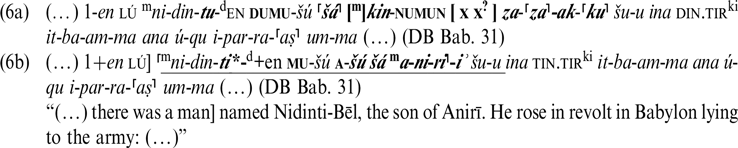
In her comment on this line, Von Voigtlander explains in great detail of why she dismissed most previous readings, despite the resulting discrepancies with the other versions. The following lines suffice to illustrate her considerations:
Very little remains of the first sign, but kin is legible and in good condition. There is some damage to the lower wedge at the end of numun, otherwise it too is in good condition. R and KT read a -šú šá here with šú over the end wedges of kin which are deeply cut. Otherwise there is no justification for their reading which must be classed as a restoration. (…) R and KT read m. They read the first sign as a, but it is clearly za deeply engraved. Following is a 1.5 cm gap (…). This they took to be the head of a low horizontal wedge which made their reading of ni here possible. However if this scar is excluded, the two low verticals following appear to be the lower half of another za. The next sign, which has the superficial appearance of a poorly engraved ri as read by KT and R, is rather an NB variant writing of ak (…) used in DB. The final sign, though damaged, appears to be ku.
Von Voigtlander (Reference Von Voigtlander1978: 19–20)None of these corrected readings, which have been called into question previously,Footnote 24 can be confirmed through collation (fig. 11). Rather, it becomes clear that Rawlinson’s (Reference Rawlinson1870: pl. 39) original readings are largely, and King & Thompson’s (Reference King and Thompson1907: 170) readings are fully accurate. The passage consequently does not lend itself as an example of the Babylonian version providing more information for a Babylonian audience (pace Von Voigtlander Reference Von Voigtlander1978: 20).
It bears repeating that examples (1)–(6) come from areas of the inscription sufficiently preserved for reexamination, and that similar examples abound. Taken together, they greatly compound the doubts raised above about the reliability of Von Voigtlander’s readings in the significantly damaged or destroyed areas, to the extent that these readings should be dismissed entirely. This conclusion is made all the more pressing by the unavailability of modern reproductions of the squeezes (see above).
Additional observations give further strength to this notion. For instance, there are forms in Von Voigtlander’s edition of the damaged and destroyed areas that appear peculiar even by Neo-Babylonian notational standards, such as ul-te-er-ri, “I brought back” (Von Voigtlander Reference Von Voigtlander1978: 17), in example (7).

While it might be argued that the writing reflects a preterite spelled with an additional CV sign (ul-te-er ri for /*ultēr/ instead of /*ultetēr/),Footnote 25 despite the following perfect forms, it remains that târu is not productive in the Š-stem (CAD T 278 s.v. târu).Footnote 26 Additionally, collation shows that the remaining traces of the last two signs do not correspond to -er-ri, and that there are further mistakes in Von Voigtlander’s reading of the (much) better preserved continuation of the line: after áš-ri-šú, there is no ana-ku, and the perfect form of epēšu is written with -šú, not -uš.Footnote 27 While it is true that the limited reliability of Von Voigtlander’s readings, or rather restorations, often has a minimal impact on the interpretational level—similar to what we see in line 25—example (8) serves as a case in point of how restorations presented as verified readings can introduce misinformation into the scholarly discourse, much like some of the examples cited above.

Line 26 includes the Babylonian terms (or calques) of the five items that Gaumata (Gumātu) had taken away from the people, including what the Persian version calls viϑ-, “estate.” Von Voigtlander (Reference Von Voigtlander1978: 17) suggested reading its Babylonian counterpart as é qa-šá-a-tú, “bow land,” which represents the common—albeit exceptionally spelled—umbrella term for (military) service land in Babylonian tax terminology. In the same vein, she provided lú ḫun.ga meš for Babylonian agrūti, “hirelings,” to correspond with Old Persian māniya-, “household slaves,” and Elamite kurtaš, “workers.” The significance of these recovered equivalents is encapsulated in Von Voigtlander’s comment on line 26:Footnote 28
The Babylonian list of possessions taken by Gaumata from the army has long been of interest to students of Old Persian and Elamite in the expectation that it would help in establishing the meanings of the OP and Elam. words in this passage. A considerable body of literature exists on the OP and Elam. equivalents, but this is the first time a reading of the Bab. has been offered. Since in some other lines the Babylonian scribe has tailored the text to the Babylonians (e.g. l. 12, 15 et al., and 31) it may be that he has done the same thing here, and the list reports Gaumata’s depredations in Babylonia alone.
Von Voigtlander (Reference Von Voigtlander1978: 17)It therefore comes as no surprise that the reading of this line also occurs repeatedly in her letters to Cameron and Stolper, further underscoring the significance she assigned to it:
On l. 26 there is a new reading at the beginning. Again, it’s not the usual order of these signs. I am now reading GUD where I formerly read GA. The final little lower wedge is clear, which ties you to some such reading. Relocating the line and lengthening it produced the new readings.
Von Voigtlander to Cameron (February 1973)Soon after I received your letter I wrote to Cameron and asked his opinion on your request. As he stands godfather to the project, I felt it was at least a matter of courtesy that I should do this. In addition, he has always stressed the importance of my reading of l. 26, and I wanted his opinion on publishing it in this way. I don’t doubt that you also cleared it with him. Now four months have passed without an answer to my last two letters to him. There have frequently been long gaps in our correspondence, though he usually answers inquiries promptly, and I have been expecting to hear from him while time slips by. It is also possible that either my inquiry or his answer has been lost in the mails.
In answer[sic!] to your request you have my permission to publish my reading of l. 26. Make sure however that you quote from the revised version which I sent in February 1973.
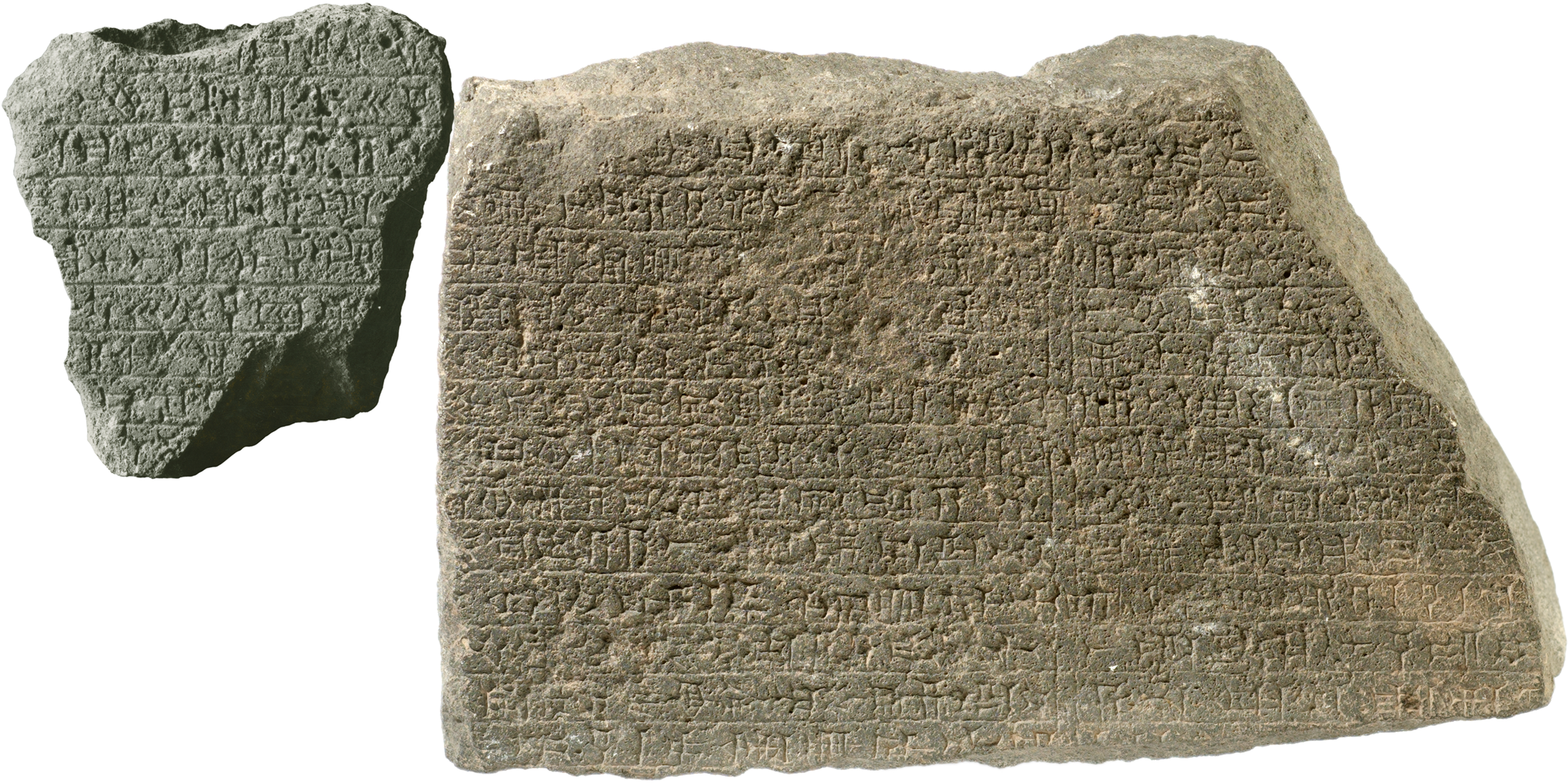
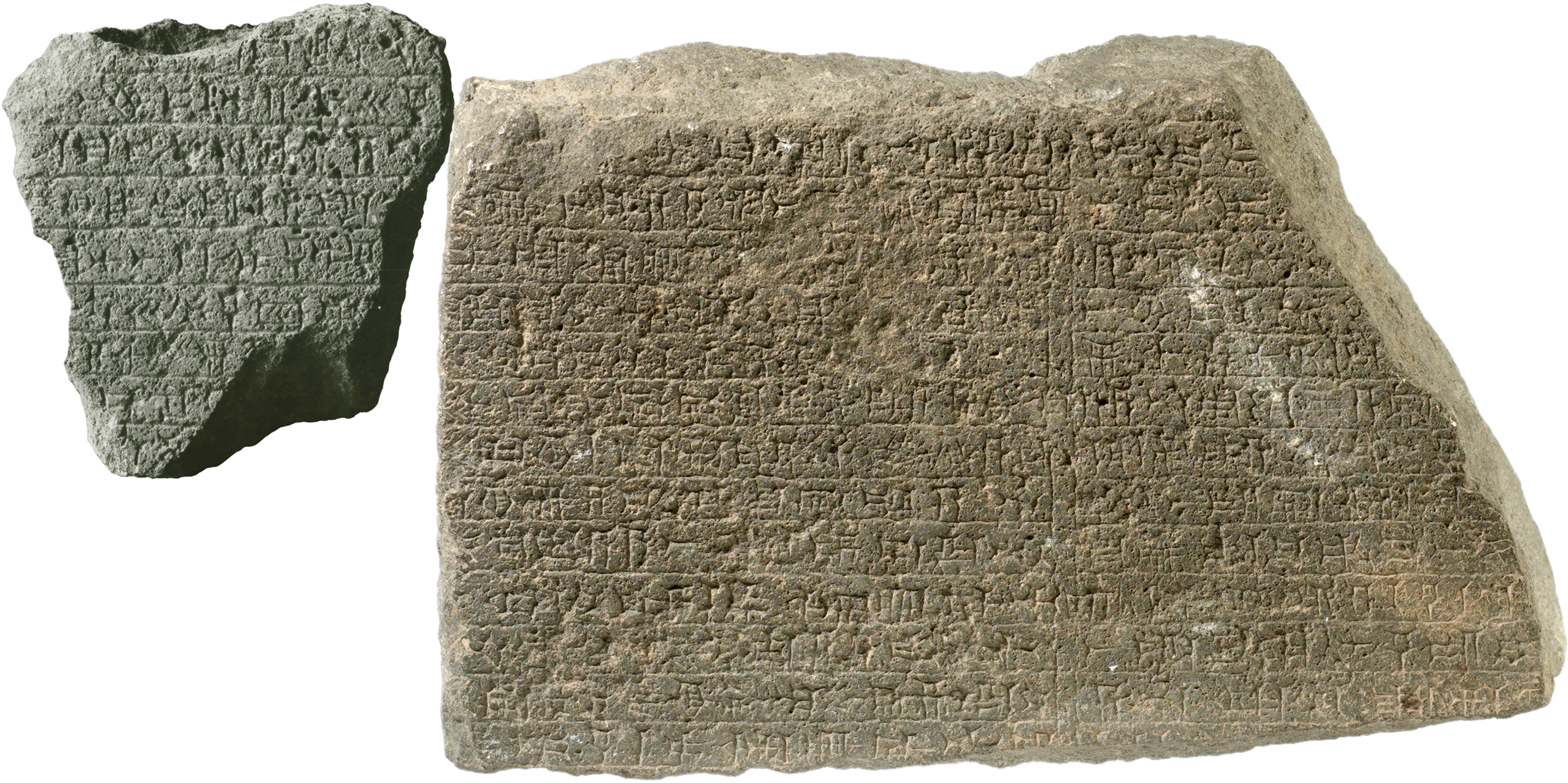
Von Voigtlander to Stolper (September 1973)Later commentators picked up on the phenomenon which Von Voigtlander referred to as text tailored to the Babylonians (see quotation above and Von Voigtlander Reference Von Voigtlander1978: 20). An example of this can be found in Bae (Reference Bae2001: 103), who deduced from line 26 that the Babylonian version “paraphrased the repertoire of Gaumāta’s usurpation into Babylonian social terminology.”Footnote 29 However, the pertinent references are either located in the destroyed areas (lines 12, 15, 17, 19, 20, 26, 32, and 72) or result from erroneous readings, as illustrated by example (6) above (line 31). The fragments of the Babylonian version from BabylonFootnote 30 do record parts of the lines in question but offer no support for confirming Von Voigtlander’s readings of these references.Footnote 31 Instead, they further demonstrate the general unreliability of Von Voigtlander’s readings. This follows from the fact that major deviationsFootnote 32 between her re-edition of the destroyed sections of DB Bab. and the fragments primarily occur in cases involving fragments that were inaccessible to her. This is illustrated by § 24b of DB Bab., which includes text from the long-known Fragment 1 (Bab 3627) and the adjoining Fragment 7 (Bab 59328) (fig. 12).Footnote 33 The example begins with Von Voigtlander’s reading [= VV] (a) and continues with the text from the fragments (b), with restorations added for better comparability and deviations bolded (excluding simple spelling variants). The surviving text of DB Bab. is underscored.
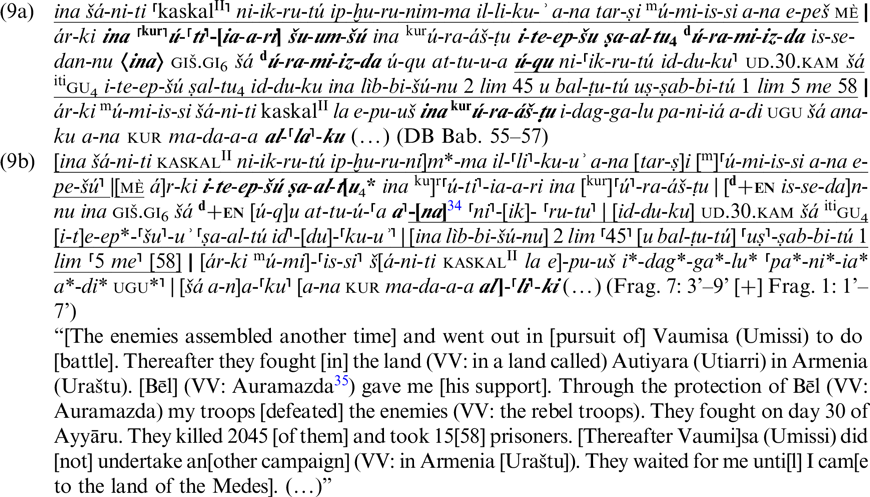
Fragment 7 (Bab 59328) and Fragment 1 (Bab 3627) (Staatliche Museen zu Berlin – Vorderasiatisches Museum, photos: excavation photo [frag. 7]; O. M. Teßmer [frag. 1])
All this is not to say that DB Bab. does not add text absent from one or more of the other versions—the recurring references to numbers of casualties and prisoners are a case in point (e.g., lines 51 and 56). However, in nearly all cases, this additional text is likewise located in the destroyed areas. Most notably, this observation applies to additions that not only provide exclusive details but also unique phrasing. Alongside the text purportedly directed at the Babylonians, these include the following:Footnote 36 (1) the explanation, known from the Elamite version, that the Babylonian army drowned in the river as it fled (line 38); (2) the clarification that, at the time of Vahyazdata’s revolt, Darius I was still in Babylon and that it was the army stationed there that rebelled (line 72); (3) the placement of Gandutava within Sattagydia (line 81); (4) the specification that Arshada “belonged to” Vivana, possibly indicating a domain under Vivana’s control as part of his satrapal duties (line 83); (5) the statement that the revolt began in Ur (line 85); (6) the distinctive rendering of the passage that, in the Old Persian version, seems to imply an oath (line 99); (7) the addition of the adjective “Padishumarish,” seemingly echoing the Old Persian description in DNc, where Gaubaruva’s identity appears as “Patischorean” in Babylonian (line 111). None of this information can be confirmed outside of Von Voigtlander’s re-edition and thus should not be regarded as certain. In a similar vein, linguistic analysis of the Babylonian versionFootnote 37 should not draw on the text from the much damaged and destroyed areas, as it introduces corrupted data, exemplified by the form ul-te-er-ri in example (7) discussed above. The latter point is also relevant to the comparative study of the rich onomastic material. After all, the observed parallels or discrepanciesFootnote 38 likely result from Von Voigtlander’s attempt to match traces of signs with name forms in the other versions, accepting certain inaccuracies in the process, whether consciously or not.
4. Conclusion and Appraisal
The preceding pages aimed to demonstrate four key-points: (1) The current condition of the Babylonian version on the rock face largely corresponds to what Rawlinson (Reference Rawlinson1870: pl. 39–40) and King & Thompson (Reference King and Thompson1907) recorded in their published copies of the inscription; (2) Based on Cameron’s squeezes made in 1957, Von Voigtlander’s re-edition offers a wealth of new readings (not restorations!) of signs that go far beyond those that were visible then (i.e., the mid-19th and early 20th centuries) and now; (3) These new readings cannot be verified in the absence of photographs or autographed copies of the now-lost squeezes; (4) The sections of her re-edition that can still be checked today by autopsy of the original show a significant number of misreadings, some of which alter the meaning of the text considerably (see, e.g., example 6 in section 3).
It is reasonable to assume that, after gauging how much text the space of the damaged and destroyed areas could accommodate, Von Voigtlander began looking for signs that would anchor stock phrases, whose placement was largely clear from comparison with the other versions, and then added to those to account for extra space. This process can be considered standard for reconstructing lost text. What is surprising, however, is Von Voigtlander’s claim that she was able to read almost all signs based on the negative squeezes—squeezes that seemed sufficient for distinguishing between heavily worn signs and scattered rock through a method she calls “overnight soaking,” yet not for photographing (see section 3). Given the manifold vagaries involved in this process, the unavailability of modern reproductions, and the number of proven errors, the author believes that Von Voigtlander’s new readings should not be taken at face value but rather regarded as restorations inferred from the largely repetitive nature of the text and the other versions of the trilingual inscription.
Although it is tempting to speculate on what led Von Voigtlander to arrive at her proposed readings—whether overconfidence, a loss of objectivity after prolonged engagement with the text, or the pressure to confirm or add information to the better-preserved versions—her motivation remains ultimately opaque. What can, however, be stated with confidence are the consequences: The loss of approximately two-thirds of the Babylonian version has serious repercussions, as the pertinent sections include many passages that cannot be faithfully restored using the other versions or the stereotyped repertoire found in large parts of the inscription. In reviewing and building on previous findings, both historically and linguistically, it is thus crucial to consider whether they are based on these passages (see section 3). One case where uncertain readings provoked significant scholarly attention was discussed in the previous section regarding line 26 in example (8). By contrast, another case that has also drawn considerable research interest can be cited as example where the underlying readings continue to hold: this is the often-cited phrase “Cambyses died his own death” (Stolper Reference Stolper2015).
In conclusion, it is important to acknowledge that Von Voigtlander’s reconstruction and re-edition of the Babylonian version, which took more than fifteen years to complete, remains an impressive piece of scholarship. Nevertheless, the observations presented in this article strongly call into question its future usability, as they underscore the need for a clear distinction between preserved and reconstructed text—a task of paramount importance for future re-editions.
Acknowledgements
This work was supported by the Deutsche Forschungsgemeinschaft (DFG) under Grant 533947529. I am indebted to M. W. Stolper for providing me with correspondence between Von Voigtlander, George G. Cameron, and himself, along with factual information, and for granting permission to publish this material; to W. F. M. Henkelman, B. Jacobs, M. Jursa, and M. Krebernik for discussion and suggestions; to L. Cecilia and T. Tang for revising the manuscript; to J. Marzahn and A. Gutow for permission to publish photos in the possession of the Staatliche Museen zu Berlin – Vorderasiatisches Museum; and I also thank the (anonymous) peer reviewers for comments and criticism. Responsibility for errors is mine. Abbreviations are those of the Reallexikon der Assyriologie und Vorderasiatischen Archäologie.







 Open access

