

The ethical treatment of digital archaeological data is a topic of ongoing discussion (Kansa Reference Kansa and Antons2009, Kansa and Kansa Reference Kansa, Kansa, Wells, Yerka, Myers, DeMuth, Bissett and Anderson2018; Kansa et al. Reference Kansa, Schultz and Bissell2005, Reference Kansa, Kansa, Wells, Yerka, Myers, DeMuth, Bissett and Anderson2018; Kintigh Reference Kintigh2006; McManamon and Kintigh Reference McManamon and Kintigh2010; Nicholson et al. Reference Nicholson, Fernandez and Irwin2021) that has resulted in new policies and revised ethical statements by professional organizations (e.g., American Cultural Resources Association 2019; Register of Professional Archaeologists 2020). Furthermore, as archaeological field research has become more expensive and subject to political and other restrictions, the reuse of existing data and collections has become increasingly necessary and common among scholars, students, the cultural resource management (CRM) industry, and descendant communities.
Coupled with pressures for data reuse are closely related external pressures toward increasing accountability and transparency in research. These include open-access mandates (e.g., G8 Open Data Charter 2013; Obama Reference Obama2013; Office of Management and Budget 2015; Office of Science and Technology Policy 2014, 2022; see also Open Government Data Act, PL 115-453, Title II); journal requirements for the provision of data to support research replicability (American Journal of Biological Anthropology [AJBA] 2021; Nature 2013; Vines et al. Reference Vines, Andrew, Bock, Franklin, Gilbert, Kane and Moore2013, Reference Vines, Albert, Andrew, Debarre, Bock, Franklin, Gilbert, Moore, Renaut and Rennison2014); and expectations around effective data management that enables data discovery, access, reuse, and long-term preservation (e.g., National Science Foundation and National Endowment for the Humanities requirements for Data Management Plans). However, despite more than a decade of efforts of reputable repositories and data publishers (e.g., Archaeology Data Service [ADS], Open Context, the Digital Archaeological Record [tDAR], and the Digital Archaeological Archive of Comparative Slavery [DAACS]); despite numerous publications arguing for their use (e.g., Archaeology Data Service (ADS) and Digital Antiquity 2013; Kansa Reference Kansa2012; Kansa et al. Reference Kansa, Kansa, Wells, Yerka, Myers, DeMuth, Bissett and Anderson2018; Kintigh et al Reference Kintigh, Altschul, Kinzig, Fredrick Limp, Michener, Sabloff, Hackett, Kohler, Ludäscher and Lynch2015; Marwick and Birch Reference Marwick and Pilaar Birch2018; McManamon and Kintigh Reference McManamon and Kintigh2010; McManamon et al. Reference McManamon, Kintigh, Ellison and Brin2017; Richards Reference Richards2017; Saving European Archaeology from a Digital Dark Age 2020); despite long-standing statements of disciplinary ethics, including those of the Society for American Archaeology (SAA) and the Register of Professional Archaeologists (RPA), which mandate the proper stewardship of data (though usually not explicitly addressing digital data); despite the availability of highly capable technologies for data stewardship in ADS, Open Context, and tDAR; despite abundant publications providing guidance on data stewardship (ADS and Digital Antiquity 2013; Kansa and Kansa Reference Kansa and Kansa2022, to name only two); and despite clear mandates in existing laws and regulations (Cultural Heritage Partners 2012), anecdotal evidence suggests that only a small fraction of the data from recent projects—and an even tinier proportion of data from legacy projects—are now publicly findable or accessible, let alone interoperable or reusable.
To address these concerns, we call on archaeologists, archaeological organizations, federal and state agencies, cultural resource management firms, publishers, and funders to substantially advance the ability to reuse previously collected archaeological data. Archaeology is uniquely capable of providing evidence on temporal and spatial scales that may be essential in both answering important social science questions (Altschul et al. Reference Altschul, Kintigh, Klein, Doelle, Hays-Gilpin, Herr and Kohler2017, Reference Altschul, Kintigh, Klein, Doelle, Hays-Gilpin, Herr and Kohler2018; Kintigh et al. Reference Kintigh, Altschul, Beaudry, Drennan, Kinzig, Kohler and Fredrick Limp2014a, Reference Kintigh, Altschul, Beaudry, Drennan, Kinzig, Kohler and Fredrick Limp2014b) and assisting land managers and tribal nations in the management and monitoring of archaeological resources under their protection. However, this can be accomplished only by “exploiting the explosion in systematically collected archaeological data since the mid-20th century” (Kintigh et al. Reference Kintigh, Altschul, Beaudry, Drennan, Kinzig, Kohler and Fredrick Limp2014b:879).
This article draws on the authors’ experiences working to preserve and improve access to archaeological data over the past two decades with the systems the authors oversee—Open Context (Kansa) and tDAR (Nicholson and Fernandez). Here, we introduce and promote a data life-cycle framework to advance archaeology's capacity to manage data in an ethically responsible manner through the FAIR Guiding Principles for scientific data management and stewardship (Findable, Accessible, Interoperable, and Reusable; Wilkinson et al. Reference Wilkinson, Dumontier, Aalbersberg, Appleton, Axton, Baak and Blomberg2016). Although this article addresses the FAIR principles, it is important to note that their implementation and practice must consider the CARE Principles for Indigenous Data Governance (Collective Benefit, Authority to Control, Responsibility, and Ethics). Consequently, this is a companion piece to Gupta et alia's (Reference Gupta, Martindale, Supernant and Elvidge2023) contribution in this issue, “The CARE Principles and the Reuse, Sharing, and Curation of Indigenous Data in Canadian Archaeology.” These principles are presented in tandem because archaeological data have complex technical, professional, social, economic, cultural, legal, and policy entanglements, impacting how FAIR + CARE practices are understood and implemented in archaeology. Incomplete understanding and uncertainty regarding these entanglements elevate the perception of risks associated with data sharing and open science practices. We contend that the FAIR principles, when implemented with the CARE principles (Carroll et al. Reference Carroll, Garba, Figueroa-Rodríguez, Holbrook, Lovett, Materechera and Parsons2020, Reference Carroll, Herczog, Hudson, Russell and Stall2021; Gupta et al. Reference Gupta, Martindale, Supernant and Elvidge2023) provide a framework for ensuring that archaeologists in academia and industry consider their data creation, data curation, and dissemination practices more intentionally. This model of data practice goes beyond conventional implementation of the FAIR principles by connecting the reuse of information about past populations in North America to issues of trust, transparency, ethical practices, and ultimately, better science.
WHAT IS FAIR?
The FAIR Guiding Principles for scientific data management and stewardship, first published in 2016, were developed to improve the infrastructure for data reuse (Go FAIR Initiative 2020; Wilkinson et al. Reference Wilkinson, Dumontier, Aalbersberg, Appleton, Axton, Baak and Blomberg2016). The principles represent guidelines for the management of scholarly data that, if widely adopted, would transform the landscape of scholarly data sharing by improving data findability, accessibility, interoperability, and reuse (i.e., FAIR). The main objectives of this article are to bring awareness of the FAIR principles for different types of archaeological organizations and communities in the Americas, call on them to develop actionable strategies for implementing these principles, and promote a widespread commitment to FAIR + CARE practices by archaeologists, archaeological organizations, governmental agencies, cultural resources management firms, digital repositories, publishers, and funders.
Although many archaeologists in Europe recognize that we are in jeopardy of entering into a “Digital Dark Age” if we fail to address challenges in data management (Wright Reference Wright2020), many American archaeologists (academic and cultural resource management firms alike) are still reluctant to work toward archiving and preserving digital information and datasets in repositories for reuse. European cost-action efforts, such as the Saving European Archaeology from a Digital Dark Age ARIADNEplus data portal (Richards et al. Reference Richards, Jakobsson, Novák, Štular and Wright2021, Reference Richards, Wright, Geser and Massara2022), demonstrate well-funded, large-scale, international efforts by governments and organizations to make data from archaeological investigation FAIR. Outside of Europe, there are several exemplary individual efforts to make specific datasets, information, and even computational code FAIR in archaeology (Davies et al. Reference Davies, Deck, Kansa, Kansa, Kunze, Meyer and Orrell2021; Fritsch Reference Fritsch2021; Hiebel et al. Reference Hiebel, Goldenberg, Grutsch, Hanke and Staudt2021; Marwick and Wang Reference Marwick and Wang2019; Nuninger et al. Reference Nuninger, Opitz, Verhagen, Rouge, Laplaige, Leturcq, Le Voguer, Fruchart, Kokalj and Rodier2020; Schmidt and Marwick Reference Schmidt and Marwick2020); however, broader, discipline-wide efforts to explicitly address the FAIR principles and practices as they pertain to datasets, policy, and protocols in the Americas are still largely absent.
The complete FAIR principles described by the Go FAIR Initiative are succinctly outlined in the commitment statement of the Coalition for Publishing Data in the Earth and Space Sciences (2020) and shown in Table 1. The FAIR principles state that data should be FAIR for people and machines (Wilkinson et al. Reference Wilkinson, Dumontier, Aalbersberg, Appleton, Axton, Baak and Blomberg2016). However, this is not without its challenges. For example, until recently, managing sensitive data was exclusively done manually by human intervention, through strategies such as not publishing or sharing data, redacting locational information in reports, restricting access to physical or digital collections where precise locational data are maintained, or by reducing the resolution of data points. Human intervention will remain important in managing sensitive data, and concerns around sensitive data must be translated to machine-readable environments as well.
The FAIR Data Principles and Suggestions for How Each Component May Be Achieved.
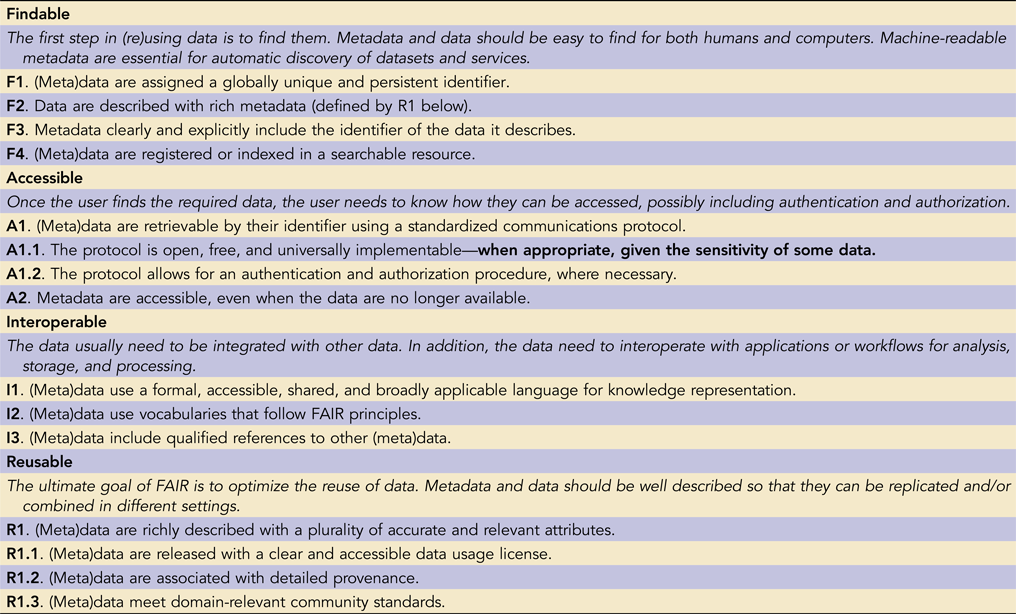
Notes : “(Meta)data” refers to both metadata and data files. Modified from Wilkinson et alia Reference Wilkinson, Dumontier, Aalbersberg, Appleton, Axton, Baak and Blomberg2016.
Once data are shared and no longer controlled by the creator, it is possible that anyone who acquires the data can reuse them without prior contextual knowledge and an understanding of potential harms. The FAIR principles, at a minimum, advocate for the inclusion of provenance to accompany data. The principles recommend that data must not only have unique and persistent identifiers and metadata appropriate to facilitate discovery but also be accessible through a standard, web-based protocol. More specifically, we argue here that provenance data should include information on (1) where data come from, (2) which community to engage with regarding consent for use and future use, (3) (re-)connecting Indigenous communities with data to complement oral histories and historical traumas (Atalay Reference Atalay2020; Rowley Reference Rowley2020), and (4) decision-making about data use and reuse (Gupta et al. Reference Gupta, Martindale, Supernant and Elvidge2023). Inclusion of this provenance information signals a community's collective rights, interests, authority, and decision-making, especially in Indigenous data. Clear usage license should also be provided so that data can be reused ethically with confidence and clarity. Incorporating this information in machine-readable formats and ensuring that data are technically and semantically interoperable can have overall benefits in data practice. The data must also be well curated, persistently accessible, and linked securely to associated publications and other resources in an appropriate archive. Archives are specifically designated spaces for the management and long-term retention and retrieval of information. Digital archives are designed to house extensive metadata, create routines to check file status, maintain robust backup procedures, and implement security and access measures, ensuring data integrity and long-term viability (Kansa et al. Reference Kansa, Atici, Kansa and Meadow2019; McManamon et al. Reference McManamon, Kintigh, Ellison and Brin2017).
Although the FAIR principles are compactly stated, there are substantial challenges to their implementation in any given context. Their implications for practitioners and organizations responsible for their implementation must be outlined in everyday language. Many of these implications will be shared with other disciplines, yet, their application in archaeology will have additional considerations and disciplinary improvements. In particular, we recognize that archaeological data are irreplaceable, which demands additional emphasis on the long-term preservation of data, especially primary data.
WHY FAIR PRACTICES ARE IMPORTANT IN ARCHAEOLOGY
A fundamental challenge of science is to confront the complexity of human societies and their interactions with the natural environment. If we are to systematically understand the complex processes that operate over hundreds and thousands of years, at regional, continental, or global scales—and that encompass segments of societies that are absent from or underreported in recorded history—research leveraging the wealth of archaeological data and knowledge is essential (Kintigh et al. Reference Kintigh, Altschul, Beaudry, Drennan, Kinzig, Kohler and Fredrick Limp2014a, Reference Kintigh, Altschul, Beaudry, Drennan, Kinzig, Kohler and Fredrick Limp2014b; van der Leeuw and Redman Reference van der Leeuw and Redman2002). The development of the FAIR principles, their prominence in scientific discussions of data stewardship worldwide, and their success in geosciences and other disciplines (Stall et al. Reference Stall, Yarmey, Cutcher-Gershenfeld, Hanson, Lehnert, Nosek, Parsons, Robinson and Wyborn2019) suggest that the time is right to push for the adoption of FAIR principles in archaeology.
Efforts to promote FAIR data constitute an important and timely step in properly conserving digital data as part of ordinary and expected disciplinary practice. It will lead to increased deposit of systematically recorded and well-documented archaeological research data in digital repositories where they can be discovered, accessed, and used by archaeologists to advance research and by land managers to make better land-use decisions. However, because good intentions alone rarely lead to proper data stewardship, we suggest some tangible steps practitioners may take to assess their digital data and improve its FAIRness.
Archaeological Data in Need of FAIR Treatment
How we effectively archive data for reuse depends on the nature of the data product. The preservation of different file formats has been extensively covered within the field of digital preservation, as has the role of metadata (Börjesson et al. Reference Börjesson, Sköld and Huvila2020; Clarke Reference Clarke2015; Kansa et al. Reference Kansa, Atici, Kansa and Meadow2019; McManamon et al. Reference McManamon, Kintigh, Ellison and Brin2017; Niven and McManamon Reference Niven and Pierce-McManamon2011; Richards et al. Reference Richards, Wright, Geser and Massara2022; Snow et al. Reference Snow, Gahegan, Lee Giles, Hirth, Milner, Mitra and Wang2006). We encourage readers to consider which of the following archaeological information and data they create or transact with that should adhere to the FAIR principles.
• Primary Excavation/Testing/Survey Databases. Often with full image collections, these will require substantial investment in appropriate database design and metadata documentation as well as incorporation of key datasets. In some contexts, primary datasets may contain data that law or professional ethics dictate remain confidential (such as archaeological site locations). Data from certain contexts will require consideration of the CARE principles given that FAIR compliance does not preclude restricted access to confidential data.
• Databases of Integrated/Standardized and Summarized Data. Organizations creating and serving integrated data sources (e.g., cyberSW 2020; Role of Culture in Early Expansions of Humans 2020) act as reusers of primary databases. In addition to needing access to summary and, in some cases, detailed primary data, they also serve as data sources for users. Ultimately, in their role as data sources, these organizations will need to apply FAIR principles to the data they serve.
• Supporting or Supplemental Data for a Publication. Subsets of data that inform published analyses have been the focus of many of the FAIR efforts in other disciplines. Securing FAIR compliance in this domain within archaeology is essential but considerably easier than for the detailed primary datasets. Journals have the capacity to disseminate and enforce editorial policies and ethical statements, which require submitters to archive all the data from which published results are derived in a public repository (AJBA 2021).
• Published Datasets. These represent a middle ground between the supporting data required by publications to document specifically reported results and the deposit of full primary datasets in a digital repository. As an example, Open Context makes FAIR-compliant datasets through a distributed workflow, where the primary data are published in full with editorial annotations—such as alignment with standard vocabularies—to make them more intelligible and to link them to related data from across the Web. Then, they are archived with the California Digital Library.
• Specialist Databases. In archaeology, specialists such as those studying faunal or plant remains produce datasets that they would seek to archive following FAIR principles, especially in cases where they cannot contribute their data to a full, archived project database. These datasets are often presented in Excel tables and encode variables that can be readily linked to open standards (e.g., taxon). However, these datasets frequently fail to include information about the archaeological context needed to interpret them because these data were not supplied to the analysts (Faniel and Yakel Reference Faniel, Yakel and Johnston2017). Furthermore, because there is little adherence to standard ways of describing and entering data among specialists, datasets cannot be easily integrated for reuse (Kansa et al. Reference Kansa, Kansa and Arbuckle2014).
• Transactional Databases of Archaeological Science Samples. There are several efforts underway to develop integrated and curated databases of archaeological science samples—for example, radiocarbon dates (Bird et al. Reference Bird, Miranda, Linden, Robinson, Kyle Bocinsky, Nicholson and Capriles2022; Gajewski et al. Reference Gajewski, Muñoz, Peros, Viau, Morlan and Betts2011; Kelly et al. Reference Kelly, Mackie, Robinson, Meyer, Berry, Boulanger and Codding2022), tree-ring data (Grissino-Mayer and Frits Reference Kansa and Kansa1997), obsidian sources (Acquafredda et al. Reference Acquafredda, Muntoni and Pallara2018; Jones et al. Reference Jones, Speakman, Billeck and Hoard2019; Northwest Research Obsidian Studies Laboratory 2001), ceramics (Berlin Reference Berlin2020; Glascock Reference Glascock2001), and isotopes (Fernandes et al. Reference Fernandes, Hudson, Takamiya, Bassino, Uchiyama and Robbeets2021; Plomp et al. Reference Plomp, Stantis, James, Cheung, Snoeck, Kootker and Kharobi2022). To be most effective, these need to be interoperable with repositories containing other data from associated archaeological contexts. However, they present special problems for long-term archiving because they are never “complete.” Instead, they are constantly updated with new samples.
• Instructional Datasets. Datasets such as those used in teaching analysis in archaeology (Cook et al. Reference Cook, Çakirlar, Goddard, DeMuth and Wells2018), or data science in general, can be useful pedagogical tools if they are reasonably simple and interesting to nonspecialists. These can also be exemplars of proper data stewardship if made available according to FAIR principles.
• Reports. Reports—and especially unpublished reports and gray literature—on archaeological projects are important to archive and make available because they often contain otherwise inaccessible documentation.
• Images. Both 2D and 3D images from excavations and laboratory work visually document millions of artifacts and excavation contexts annually. Images are important to researchers seeking comparanda, to those looking for more contextual information, and to the general public, who may wish to virtually explore sites or materials recovered from archaeological contexts.
• GIS Datasets. Thanks in part to the proliferation of affordable capture technologies and the software to analyze spatial patterning (McCoy Reference McCoy2017), documenting the location of sites, and artifacts embedded within sites and on the landscape, are now commonly recorded at nearly all archaeological sites. When aggregated, these disparate GIS datasets allow researchers to use a variety of computational techniques to examine trends in human land use, movement across and utilization of space, and our relationship to the environment (Gupta Reference Gupta, Gillings, Haciguzeller and Lock2020; Howey and Brouwer Burg Reference Howey and Burg2017; Robinson et al. Reference Robinson, Nicholson and Kelly2019).
It is important to note that all of these resources contain cultural and geographic information and they are subject to legal and ethical considerations when it comes to FAIR, especially accessibility. Stewards of this information (e.g., State and Tribal Historic Preservation Officers, federal and state repositories, and archaeological departments) must balance the protection of this information from events such as cultural resource crimes and tribal intellectual property theft while still finding ways to make it appropriately available. Proper stewardship of archaeological data that uses the FAIR and CARE principles as a foundation, albeit within existing legal frameworks, can facilitate protection and reuse of archaeological information in a responsible and ethical manner. However, this is only if (1) the stewards have established protocols, policies, and practice; (2) the stewards have proper cyberinfrastructure tools to control access; and (3) the information is managed in a manner that enables proper attribution, which includes descendant communities as arbiters of the information (Carroll et al. Reference Carroll, Herczog, Hudson, Russell and Stall2021; Marwick and Birch Reference Marwick and Pilaar Birch2018; Tsosie et al. Reference Tsosie, Yracheta, Kolopenuk and Geary2021; Walter et al. Reference Walter, Lovett, Maher, Williamson, Prehn, Bodkin-Andrews and Lee2021).
IMPLEMENTING THE FAIR PRINCIPLES
A call for the creation of data and metadata standards in archaeology—and other disciplines and organizations—is far from new. Federal agencies, such as the Centers for Medicare and Medicaid Services, the Department of Defense's Defense Information Systems Agency, and the National Oceanic and Atmospheric Administration, have all made concerted efforts, backed with a financial commitment, to document their data standardization process. Improved efficiency though enhanced data interoperability has saved these agencies time and effort, leading to more cost savings (ADS and Digital Antiquity 2013).
Adherence to the FAIR principles and participation in all phases of the data life cycle in archaeology will require modest additional expense and effort. Consequently, individuals and organizations will need financial and professional incentives to participate. Expenses to support the FAIR principles are centered on operational and maintenance costs of cyberinfrastructure (i.e., hardware and software), the staff required for programming and digital curation activities, and administrative costs (Fresa et al. Reference Fresa, Justrell and Prandoni2015; Richards et al. Reference Richards, Austin and Hardman2010; Simbulan Reference Simbulan, Cohen and Boyd2013). Two other key hurdles in advancing FAIR practices are providing (1) the time for individuals to create FAIR data and (2) professional rewards for doing so. Given these challenges and the slow rate of uptake by many archaeologists in adopting FAIR practices, we offer a few suggestions for jump-starting these efforts.
To begin, there needs to be an archaeology-wide data-governance structure. Data governance is broadly defined as the “system of decision rights and responsibilities that describe who can take what actions with what data, when, under what circumstances, and using what methods” (Smith et al. Reference Smith, Cruse and Michener2011:2). The data governance framework includes (1) strategies for data management, (2) preservation and curation, (3) accessibility, (4) quality issues, and (5) legal and policy concerns over data ownership and data security (Gupta Reference Gupta, Gillings, Haciguzeller and Lock2020). When crafting the model, the data governance structure will need to consider federal regulations, such as the National Historic Preservation Act (NHPA), the Archaeological Resource Protection Act, and tribal participation. It is also important to consider the agents and entities that will be involved in implementing any type of data governance plan and FAIR practices.
Regulatory agencies (federal and state) are positioned to have a large and immediate influence on the implementation of FAIR practices, given that they can set and enforce requirements about data collected in research efforts that they fund or authorize. Together with different representatives in the archaeological community they can specify what must be included in data management plans (see Gupta et al. Reference Gupta, Martindale, Supernant and Elvidge2023:Supplemental Text 1), stipulating that data must be deposited in repositories committed to FAIR principles. State Historic Preservation Offices are well poised to promote and enforce FAIR principles on submissions from those seeking permits from their agencies. Those carrying out NHPA Section 106 compliance work could consult with the appropriate federal, state, and tribal agencies about data availability and public access as part of data management plans.
Tribal Historic Preservation Offices (THPOs) and descendant communities need to be able to find, access, and maintain control over archaeological data recovered on their lands. They also need access to research and policy outcomes created with those data, especially as escalating climate change impacts (e.g., wildfire threats) demand larger-scale public policy responses. However, THPOs are chronically underfunded, making it difficult to carry out FAIR practices. Options for national and private funding exist that allow tribes that lack sufficient cyber-infrastructure to partner with existing platforms or digital repositories to archive and share, when appropriate, data from federally mandated archaeological investigations. Creating data education and training opportunities for THPOs can also help ensure that tribes have the internal capacity to make their data FAIR.
Granting agencies can create evaluation criteria that reward or penalize previous performance in data management and/or preclude awards to organizations that fail to meet FAIR standards related to actual data management in previous awards. Funding agencies may consider implementing a “scoring” system whereby those individuals/groups who were awarded grants and who archived their digital materials in the past, or have strong data management plans, are scored higher. The inverse of this scenario is also a possibility. We recommend that the final report for a grant or contract be accepted by the funder only when it meets the FAIR principles related to data submission, in accordance with their submitted data management plan.
Publishers (including professional societies’ publication arms) are key players in this effort. Their commitment to FAIR + CARE principles regarding requirements for supplementary data in their publications would have immediate and direct benefits on data availability and research replicability. Publications are major components of the academic reward structure and can directly influence data management behavior. Final acceptance of a peer-reviewed publication should be contingent upon adherence to FAIR principles, which require submitting primary data to a trusted repository, similar to those required by the American Journal of Biological Anthropology (AJBA 2021; Miyakawa Reference Miyakawa2020).
Professional societies and trade organizations establish professional ethics and standards of performance. The ethical statements we have reviewed, including those of the SAA (Lynott and Wylie Reference Lynott and Wylie2000) and RPA, imply data management standards that are generally consistent with the FAIR + CARE principles. However, most were established prior to current accepted data practices and do not provide sufficient details about direct implementation of these principles. Formal endorsement of the FAIR + CARE principles by professional organizations would speak to individual researcher responsibilities and provide legitimacy for funders and other authorizing bodies to demand proper data management. Professional archaeological organizations can lobby federal agencies to mandate that all companies submit FAIR + CARE data to trusted repositories as part of their final deliverables, making this a standard part of the contracting and bidding process in the Section 106 compliance process. They can also provide ethical and practical guidelines and education and give their constituents options for archiving (Wells et al. Reference Wells, Kansa, Kansa, Yerka, Anderson, Bissett, Myers and DeMuth2014).
CRM firms are responsible for most archaeological field investigations on public lands in the United States and worldwide. As a result, making the data they produce FAIR + CARE is critically important. We need to consider effective incentives for these firms to participate and the special challenges they face, especially when working for private clients and tribes who may wish to control the collected data.
Academics and educators (and students) in archaeology need to teach the basic principles of data science, including use of FAIR + CARE principles. This applies particularly to graduate programs in archaeology that are training the next-generation workforce and to continuing education programs offered by universities or professional organizations. Professors should be rewarded for getting students to reuse existing data and supporting ethical, purposeful FAIR + CARE data practice. Mons (Reference Mons2020) found that graduate students spend up to “80% of their time on ‘data munging,’ fixing formatting and minor mistakes to make data suitable for analysis—wasting time and talent.” FAIR data can reduce the time required by students to complete their program, enhancing the department's metrics that demonstrate their efficacy. Departments and schools can also incentivize FAIR + CARE practices in the academy by educating faculty on the advantages of including data management in a similar manner as a technical report in the tenure process. Allowing cited data publications as professional recognition is a relatively easy addition to tenure and promotion policies that incentivize FAIR practices.
Repositories and data publishers need to implement standards and technologies for discovery, access, interoperability, and reuse, including long-term data preservation (Research Data Alliance 2020). They must set minimal standards for metadata and implement the use of standard vocabularies for digital resource description. Ontologies and coding sheets are another important mechanism for ensuring interoperability across platforms. Repositories also need to have strategies for long-term sustainability (Ember et al. Reference Ember, Alter, Berman, Hedstrom and Vardigan2013; Erway Reference Erway2012; Kintigh and Altschul Reference Kintigh and Altschul2010; Maron et al. Reference Maron, Smith and Loy2009). Currently, tDAR and Open Context (see Competing Interests statement) are structured to make data and information deposited in their respective repositories FAIR, with continuing efforts to implement the CARE principles. Both repositories require rich descriptive metadata (see Table 1:F2), based on Dublin Core standards, and all information is assigned a globally unique and persistent identifier (Digital Object Identifier; Table 1:F1) to ensure that it is findable. All resources are retrievable by their unique identifier and through keyword searches (A1); their search protocols are open, free, and universally implementable (A1.1), making the information accessible once found. Resources are accessible in a broadly applicable language (English; Table 1:I1), and decoded data, data coding sheets, vocabularies, and ontologies are strongly recommended (Table 1:I2)—along with an appropriate reference (I3)—to make the resource interoperable with other data and computational platforms. Finally, information and data are made available with a license structure (Creative Commons; Table 1:R1.1), clearly stating reuse expectations. These functions are not wholly unique to tDAR and Open Context (e.g., ADS, DAACS, and ARIADNEplus); however, they are substantially different from other repositories (e.g., Zenodo or Figshare) that are not domain specific—or community supported—given that finding and accessing archaeology information is not prioritized on these platforms. Using trusted archaeological repositories that fit user needs means multiple options for implementing the FAIR principles based on these needs.
It is important to note that there is not a singular approach to implementing FAIR practices. Individuals, groups, and organizations often have very defined needs and constraints. Staffing, technological, and financial constraints often limit all that can be done with a digital resource. For instance, datasets deposited in tDAR are not required to conform to a particular data scheme, limiting the interoperability of datasets housed in the repository; Open Context prioritizes data interoperability in its data publishing process. Because of a myriad of different constraints on nearly all digital archival systems, archaeologists need to consider their potential audience for reuse and how a particular method for achieving the FAIR principles can accomplish this.
Actionable Steps: What Can I Do Next?
FAIR practices in archaeology do not have to happen all at once. Individuals and organizations can begin by making the appropriate information findable and accessible, with an eye to the ultimate goal of reuse; however, making data interoperable remains one of archaeology's more daunting tasks to implement (Faniel et al. Reference Faniel, Kansa, Kansa, Barrera-Gomez and Yakel2013; Kansa and Kansa Reference Kansa and Kansa2018; Marlet et al. Reference Marlet, Francart, Markhoff and Rodier2019). The lack of data standards and use of shared, controlled vocabularies by data creators presents major challenges in data discovery for repositories and for archaeological data integration by humans and machines (Kintigh et al. Reference Kintigh, Spielmann, Brin, Selçuk Candan, Clark and Peeples2018). Research infrastructures, including data federators (e.g., ARIADNEplus) and digital repositories, must agree to adopt technical standards for interoperability, several of which are well established (e.g., Dublin Core metadata). Nevertheless, pain points in implementing one aspect of the FAIR practices should not preclude work on the others.
Readers can begin their own FAIR journey by creating a data management plan (DMP) at the beginning of their next project. DMPs are designed to document a strategy for effectively organizing data products and minimizing time and effort while maximizing productivity during each data life-cycle stage (Gajbe et al. Reference Gajbe, Tiwari and Singh2021). Such plans do not need to be overly long, but they should include basic information on how researchers will handle data during and at the end of a project, what data will be collected and analyzed, what methodologies and standards will be applied, whether the data will be shared or made open access, and how and where data will be curated and archived (Doorn and Ronzino Reference Doorn and Ronzino2022). The Tooling for FAIR Data Management Plans resource created by ARIADNEplus (Doorn and Ronzino Reference Doorn and Ronzino2022) offers guidance for such work in archaeological settings.
With this information laid out, readers can begin to enhance their data by ensuring that they have metadata and persistent identifiers. Providing clear and extensive documentation ensures that data can be understood and reused (Kansa et al. Reference Kansa, Atici, Kansa and Meadow2019).
Readers must also consider where their data will be archived long term, which is different from daily storage (see Table 2 for examples). Yet, at the close of the project, these storage locations do not constitute an archive. Readers should also remember that the supplemental data section of a journal is not an archive for long-term storage and retrieval. Readers can do a self-evaluation of their dataset using the Data Management FAIR tool from the Data Archiving and Network Service (DANS). This online tool, titled FAIR-Aware (Data Archiving and Network Service [DANS] 2022) is a short, self-paced assessment of the FAIR principles as they relate to one's dataset, together with tips for improving its FAIRness. This tool does not incorporate any components of the CARE principles, so it should be used with that caveat in mind.
List of Active Digital Repositories That House Archaeological Resources.

a “Domain specific” refers to digital archives and repositories that focus on archaeological information.
We also encourage archaeologists to research existing digital repositories (Table 2) and to reach out to experts for assistance in making data FAIR, because this process does not occur in a vacuum. Such assistance may come from a domain-specific organization (e.g., ADS, DAACS, DANS, Open Context, tDAR), the National Archives and Records Administration at the Federal level, institutional repositories at one's own university, or scholars writing about these processes.
Finally, we encourage individuals to reevaluate their own or other organizations’ efforts to make data FAIR, and—for those in positions to do so—to advance professional rewards for commitments to FAIR + CARE practices, especially in support of tenure and promotion.
DISCUSSION
One question all should ask is, How does this benefit or enhance my current data practices? The benefits to investing time and money on completing the data life cycle through the adoption of FAIR practices are numerous for all major stakeholders in archaeology.
Benefits to Regulatory and Granting Agencies
Studies show that public trust in research is enhanced when data are available (Resnik Reference Resnik2011). Our ability to serve as trusted scientists lies in our ability to push the frontiers of knowledge and in our willingness to be transparent and accountable about our data. The US Government Accountability Office has dedicated websites (https://www.gao.gov/federal-data-transparency) that expound on the virtues of data availability and the ability to foster accountability and trust. Although archaeological data and information falls under different levels of federal protection, programmatic confidentiality mechanisms exist to make this information “as open as possible and closed when necessary” (European Commission Directorate-General for Research and Innovation 2016).
Furthermore, in the United States, billions of dollars are spent annually on archaeology from government and private granting foundations (SRI Foundation 2020). The focus of all of this work tends to stop at publication of results (peer-reviewed publications or reports to agencies), and the data generated to produce these publications is continually at risk of being lost. By properly archiving this data and information for reuse, thereby completing the data life cycle and meeting the FAIR principles, we are protecting this substantial investment, often footed by tax-payer dollars.
Benefits to Tribes
Comprehensive datasets and reports, with robust metadata, enhance the mission of THPOs by helping document and protect ancestral sites by providing tribes with the information needed to act in an efficient manner (Welch et al. Reference Welch, Altaha, Gatewood, Hoerig and Riley2006, Reference Welch, Altaha, Cantley, Doelle, Herr, Kersel, MacDonald, McManamon, Mills and Nials2019). FAIR practices can help THPOs access and reuse existing digital information derived from years of archaeological practices on ancestral lands but only if it is in machine-readable form that adheres to the FAIR principles. FAIR + CARE archaeological data and information collected on tribal lands is also poised to enhance tribal data sovereignty, through demonstrated control of tribal data, minimized harm and maximized benefits for tribal communities, and value from data that contribute to well-being for tribal peoples and communities (Gupta et al. Reference Gupta, Martindale, Supernant and Elvidge2023).
Benefits to Cultural Resource Management
The vast majority of archaeological data are derived from research conducted by private-sector consulting firms in response to governmental mandates for identifying and mitigating impacts to archaeological properties under threat of being damaged or destroyed by development. Adopting FAIR principles will lead to greater protection, integration, and reuse of the results of private-sector work (often paid by public-sector monies) to make their research responsibly available for comparative research at scales not previously considered. Additionally, cultural resource managers in many realms need access to key management data (GIS, artifact counts, etc.) and summary information on the archaeological contexts they are responsible for managing. Data reuse, therefore, can lead to improvements to client programmatic agreements related to creative or alternative mitigation efforts (e.g., community archaeology projects, predictive modeling, designation of traditional cultural properties, enhancement of online tools), which are increasingly sought by many regulatory agencies and tribes (Douglas and Manney Reference Douglass and Manney2020; Heilen Reference Heilen2020; Schlanger et al. Reference Schlanger, Larralde and Stein2020; Sebastian Reference Sebastian2020; Wollwage et al. Reference Wollwage, Brooks, Smith, McLemore, Strader and Gant2020). Making compliance archaeology data FAIR + CARE under thoughtful programmatic agreements can potentially yield more information about a particular region if research can be done by interoperating existing, disparate datasets. Finally, information and data reuse can add layers of efficiency to projects, saving time spent locating previous works documenting the same resources repeatedly (Beagrie and Houghton Reference Beagrie and Houghton2013).
Benefits to Scholarship
The most pressing scientific issues lie beyond the scope of individual scholarly disciplines. Solutions to social problems, from climate change to inequality to ethnic conflict, require transdisciplinary or convergence approaches (Baerwald Reference Baerwald2010; National Research Council 2014). Archaeology documents long-term change and stability in human societies on centennial and millennial timescales. In this way, the archaeological record documents numerous “natural experiments” on human societies (Dunning Reference Dunning2012), a capability that is now becoming accepted by other social scientists (Diamond and Robinson Reference Diamond and Robinson2010). These efforts will only succeed when archaeologists can reuse the enormous corpus of existing research data. Consequently, if the FAIR principles are promoted successfully and acted on, the amount of data responsibly made available will increase, facilitating our ability to address these transdisciplinary issues. Meta-analysis projects or systematic projects—such as the Eastern Archaic Faunal Working Group (Neusius et al. Reference Neusius, Styles, Peres, Walker, Crothers, Smith and Colburn2019), cyberSW (2020), DINAA (Anderson Reference Anderson and McManamon2018; Anderson et al. Reference Anderson, Wells, Yerka, Myers, DeMuth and Bissett2015, Reference Anderson, Bissett, Yerka, Wells, Kansa, Kansa, DeMuth, Myers and White2017), and People 3000 (Bird et al. Reference Bird, Miranda, Linden, Robinson, Kyle Bocinsky, Nicholson and Capriles2022)—demonstrate the power of using aggregated data to address large-scale questions of social significance, all of which are advanced using data with deep-time and broad regional perspectives. Likewise, detailed primary data will be useful for students in instructional and thesis contexts to facilitate research at multiple spatial and temporal scales.
CONCLUSIONS
The quote by David Hurst Thomas (Reference Thomas1989:31)—“[Archaeology] is not what you find, it's what you find out”—exemplifies our discipline's interest in making (and its need to make) our information and data FAIR. Archaeologists from all sectors share an interest in the human experience and in protecting the material remains of our past. But if we are to be true stewards of that past, we must come to grips with the fact that, on the whole, we are not properly caring for the digital information derived from our work. The physical, biological, and social sciences all depend on data to conduct scientific research, and their inquiries do not end with the one-time use of data generated in the field or laboratory. Data repurposing and reuse allows science to advance, through the thoughtful evaluation and reevaluation of our hypotheses; however, this is only truly possible if data meets the FAIR principles.
Technological barriers to FAIR practices are no longer an issue, ethical commitments from professional organizations are in place, and legal statutes and codes specify preserving information related to archaeological records. FAIR practices need to become a cornerstone of archaeological research. The only question that remains should be “How quickly can we implement FAIR practices?” rather than “Will it ever be FAIR?” A growing number of concerned archaeologists are advancing FAIR and CARE practices by ensuring that their research and/or the work of their agencies adheres to these principles and ideals. We hope that this introduction to FAIR + CARE principles and practices in North American archaeology encourages readers to explore their next steps along this path.
Acknowledgments
Implementing the FAIR principles and practices takes a community. We would like to thank the following individuals, and their respective organizations, who have worked with us on our mission to make the FAIR principles a reality in archaeology. These include Meghan Dennis, Jim deVos, Trish Fernandez, Jillian Galle, Shasta Gaughen, Valerie Grussing, Robert Heckman, Andrew Kandel, Eric Kansa, Keith Kintigh, Leigh Lieberman, Desiree Martinez, Franco Nicolucci, Matt Peeples, Paulina Przystupa, Julian Richards, Rebecca Tsosie, Joshua Wells, and Mary Whelan. We would like to thank the two anonymous reviewers whose recommendations greatly improved this article. Finally, we would like to extend an enormous “thank you” to Michael Heilen and Shelby Manney for putting together this volume and for their invitation to spread the FAIR gospel.
Funding Statement
Funding was provided to Nicholson by the Arizona State University Institute of Social Science Research to convene a 2020 workshop that prompted initial work on the FAIR principles in archaeology.
Data Availability Statement
No datasets were generated or analyzed during the current study.
Competing Interests
Christopher Nicholson and Rachel Fernandez are employed at Arizona State University, which oversees the operation of the Center for Digital Antiquity and the tDAR digital repository. Sarah Whitcher Kansa is employed at the Alexandria Archive Institute, which oversees the operation of the Open Context data publishing service.


 Open access

