




Introduction
Human-derived emissions from the combustion of fossil fuels, the production of cement and deforestation have led to a drastic increase in atmospheric CO2 (Malhi et al. Reference Malhi, Meir and Brown2002, Heede Reference Heede2014, Paraschiv & Paraschiv Reference Paraschiv and Paraschiv2020). In 2019 alone, ~98.2 Mt CO2 were added to the atmosphere daily (Liu et al. Reference Liu, Ciais, Deng, Lei, Davis and Feng2020). The culmination of decades of emissions since the Industrial Revolution has increased atmospheric CO2 concentrations by ~50% from 280 ppm in 1750 to a peak of 420 ppm in 2024 (Joos & Spahni Reference Joos and Spahni2008, Lan & Keeling Reference Lan and Keeling2024).
One consequence of increased atmospheric CO2 concentrations is ocean acidification (OA). Approximately a third of atmospheric CO2 enters the ocean (Sabine et al. Reference Sabine, Feely, Gruber, Key, Lee and Bullister2004, Gruber et al. Reference Gruber, Clement, Carter, Feely, Van Heuven and Hoppema2019), where it reacts with seawater in a series of steps that ultimately release free hydrogen ions, thereby lowering pH. As a result of this gaseous uptake, the average ocean’s surface pH has decreased by 0.1 pH units and is predicted to decrease a further 0.4 pH units over the next 80 years (IPCC 2022).
Changes in abiotic factors from climate change, particularly decreased ocean pH, can have a direct impact on the physiology and behaviour of marine organisms (Kroeker et al. Reference Kroeker, Kordas, Crim, Hendriks, Ramajo and Singh2013, Kindinger et al. Reference Kindinger, Toy and Kroeker2022). These changes not only impact species individually but also impact the interactions between species, such as macroalgae-herbivore interactions. For example, OA can affect the growth rate (Johnson et al. Reference Johnson, Price and Smith2014), tissue strength (Kinnby et al. Reference Kinnby, White, Toth and Pavia2021), nutritional quality (Duarte et al. Reference Duarte, López, Benítez, Manríquez, Navarro and Bonta2016, Fieber & Bourdeau Reference Fieber and Bourdeau2021) and putative chemical defences of macroalgae (Swanson & Fox Reference Swanson and Fox2007, Fieber & Bourdeau Reference Fieber and Bourdeau2021, Kinnby et al. Reference Kinnby, White, Toth and Pavia2021). Similarly, OA can impact herbivores by altering growth (Sheppard Brennand et al. Reference Sheppard Brennand, Soars, Dworjanyn, Davis and Byrne2010, Bhuiyan et al. Reference Bhuiyan, Rodríguez, Billah, Pires, Freitas and Conradi2022), survival (Lopes et al. Reference Lopes, Borges, Figueiredo, Sampaio, Diniz, Rosa and Grilo2019, Park et al. Reference Park, Ahn, Sin, Shim and Kim2020), development (Kurihara & Shirayama Reference Kurihara and Shirayama2004, Watson et al. Reference Watson, Southgate, Tyler and Peck2009, Place & Smith Reference Place and Smith2012) and reproduction (Kurihara & Shirayama Reference Kurihara and Shirayama2004, Morita et al. Reference Morita, Suwa, Iguchi, Nakamura, Shimada, Sakai and Suzuki2010, Borges et al. Reference Borges, Figueiredo, Sampaio, Rosa and Grilo2018) and by shifting energy demands (Melzner et al. Reference Melzner, Stange, Trübenbach, Thomsen, Casties and Panknin2011, Saba et al. Reference Saba, Schofield, Torres, Ombres and Steinberg2012, Ramajo et al. Reference Ramajo, Marbà, Prado, Peron, Lardies and Rodriguez-Navarro2016, Lim & Harley Reference Lim and Harley2018).
The consequences of OA on one species can impact the relationship between macroalgae and herbivores. For example, grazing pressure from invertebrates can become greater if energy demands on invertebrates increase from compensatory strategies in response to changing pH (Saba et al. Reference Saba, Schofield, Torres, Ombres and Steinberg2012, Leung et al. Reference Leung, Nagelkerken, Russell, Ferreira and Connell2018). Alternatively, grazing pressure could be altered from changes in the macroalgae, but the specific type of change is heavily dependent on the species and how the macroalga is being affected. For example, changes in nutritional quality or qualitative or quantitative changes in the production of chemical defences have been documented (Swanson & Fox Reference Swanson and Fox2007, Duarte et al. Reference Duarte, López, Benítez, Manríquez, Navarro and Bonta2016, Fieber & Bourdeau Reference Fieber and Bourdeau2021).
A significant portion of previous OA work has focused on calcifying species and communities (e.g. Andersson et al. Reference Andersson, Mackenzie, Gattuso, Gattuso and Hansson2011, Leung et al. Reference Leung, Zhang and Connell2022, Page et al. Reference Page, Bahr, Cyronak, Jewett, Johnson and McCoy2022), mainly due to the negative impacts of OA on the availability of carbonate and the alteration of seawater chemistry (Doney et al. Reference Doney, Fabry, Feely and Kleypas2009, Hurd et al. Reference Hurd, Hepburn, Currie, Raven and Hunter2009) that reduce these organisms’ ability to calcify. However, focusing on one functional group of macroalgae cannot provide a full picture of OA consequences on algae. Macroalgae are taxonomically and metabolically diverse (Li-Beisson et al. Reference Li-Beisson, Thelen, Fedosejevs and Harwood2019, Tully Reference Tully2019, Schubert et al. Reference Schubert, Alvarez-Filip and Hofmann2023, Guiry Reference Guiry2024), making it difficult to generalize regarding how they will respond as a whole to climate change based on a few studied species.
Fleshy macroalgal species are expected to be more resilient to increased CO2 concentrations compared to calcified species because the former do not experience dissolution and have access to more CO2 for photosynthesis (Koch et al. Reference Koch, Bowes, Ross and Zhang2013), which has been supported by modelling (Schlenger et al. Reference Schlenger, Beas-Luna and Ambrose2021). However, experiments have shown that the consequences of OA appear to be species-specific. Previous studies have found increases in net growth for some, but not all, of the fleshy macroalgae held under different conditions of OA (Johnson et al. Reference Johnson, Price and Smith2014, Kram et al. Reference Kram, Price, Donham, Johnson, Kelly, Hamilton and Smith2016, Paine et al. Reference Paine, Britton, Schmid, Brewer, Diaz-Pulido, Boyd and Hurd2023). In some cases, there have been contrasting results in net growth with OA conditions. For example, Swanson & Fox (Reference Swanson and Fox2007) found that CO2 levels predicted for 2100 resulted in a positive effect on the growth of the kelp Nereocystis luetkeana but a negative effect on the growth of the kelp Saccharina latissimi.
In addition to changes in net growth, shifts in chemical composition and photosynthesis as a response to lowered pH have also been observed in macroalgae (Garcia-Sanchez et al. Reference Garcia-Sanchez, Fernandez and Niell1994, Mercado et al. Reference Mercado, Javier, Gordillo, Xavier Niell and Figueroa1999, Gordillo et al. Reference Gordillo, Niell and Figueroa2001, Duarte et al. Reference Duarte, López, Benítez, Manríquez, Navarro and Bonta2016). Changes in chemical composition can alter the overall nutritional quality of macroalgae and can impact herbivore preference (Duarte et al. Reference Duarte, López, Benítez, Manríquez, Navarro and Bonta2016). Furthermore, these changes in nutritional content can impact the consumers of algae (Urabe et al. Reference Urabe, Togari and Elser2003, Schoo et al. Reference Schoo, Malzahn, Krause and Boersma2013, Sudo & Yoshida Reference Sudo and Yoshida2021, Sepúlveda et al. Reference Sepúlveda, Quijón, Quintanilla-Ahumada, Vargas, Aldana and Fernández2024). For example, the amphipod Ampithoe tarasovi, the sea urchin Tetrapygus niger and the sea snail Tegula atra experience reduced growth when fed a diet of lower-quality macroalgae (Sudo & Yoshida Reference Sudo and Yoshida2021, Sepúlveda et al. Reference Sepúlveda, Quijón, Quintanilla-Ahumada, Vargas, Aldana and Fernández2024).
High-latitude environments, such as the those of the western Antarctic Peninsula region (WAP; including islands to the west and north of the continental peninsula), are particularly vulnerable to decreased seawater pH due to the low buffering capacity associated with cold waters (Sabine et al. Reference Sabine, Feely, Gruber, Key, Lee and Bullister2004, Nissen et al. Reference Nissen, Lovenduski, Brooks, Hoppema, Timmermann and Hauck2024). The WAP is characterized by its large macroalgal forests that dominate shallow (< 70 m) benthic communities (Wiencke et al. Reference Wiencke, Amsler, Clayton, De Broyer, Koubbi, Griffiths, Raymond, d’Udekem d'Acoz and Van de Putte2014). These macroalgal communities contribute standing biomass levels comparable to temperate kelp forests, often covering more than 80% of the ocean benthos (Wiencke et al. Reference Wiencke, Amsler, Clayton, De Broyer, Koubbi, Griffiths, Raymond, d’Udekem d'Acoz and Van de Putte2014), and they play a vital role in nutrient cycling, nutrient retention and benthic food webs (Dunton Reference Dunton2001, Quartino & Boraso de Zaixso Reference Quartino and Boraso de Zaixso2008, Wiencke & Amsler Reference Wiencke, Amsler, Wiencke and Bischof2012, Iken et al. Reference Iken, Amsler, Gorman, Klein, Galloway and Amsler2023). The dominant macroalgae in these communities are large, perennial browns from the family Desmarestiaceae, while the understory is dominated by smaller red macroalgae (Wiencke et al. Reference Wiencke, Amsler, Clayton, De Broyer, Koubbi, Griffiths, Raymond, d’Udekem d'Acoz and Van de Putte2014). In addition to producing large amounts of biomass, many of the macroalgae in these near-shore communities also produce chemical defences that protect them from herbivory (Amsler et al. Reference Amsler, McClintock, Baker, Gómez and Huovinen2020). Most of this macroalgal community is chemically defended, including all of the large browns and many of the common reds, with the notable exception of Palmaria decipiens (Amsler et al. Reference Amsler, Iken, McClintock, Amsler, Peters and Hubbard2005, Aumack et al. Reference Aumack, Amsler, McClintock and Baker2010). Despite their chemical defences, these macroalgae can serve as a food resource after they die and their former chemical defences break down (Wiencke & Amsler Reference Wiencke, Amsler, Wiencke and Bischof2012).
One unique aspect of the WAP is the incredibly large number of mesograzers found in the macroalgal communities. Macroalgae shelter large mesograzer assemblages that mostly consist of amphipods with large numbers of gastropods and smaller numbers of isopods, copepods and ostracods (Iken Reference Iken1999, Huang et al. Reference Huang, Amsler, McClintock, Amsler and Baker2007, Schram et al. Reference Schram, Amsler, Amsler, Schoenrock, McClintock and Angus2016, Amsler et al. Reference Amsler, Miller, Edwards, Amsler, Engl, McClintock and Baker2022). The density of amphipods on macroalgae in this region can be extremely abundant, with densities reaching as high as 300 000 and 26 000 individuals m2 on the benthos in stands of Desmarestia menziesii, a dominant brown macroalga, and the red macroalga Plocamium sp., respectively (Huang et al. Reference Huang, Amsler, McClintock, Amsler and Baker2007, Amsler et al. Reference Amsler, McClintock, Baker and Amsler2008). These densities are approximately one to three times higher than reported amphipod densities in tropical and temperate regions (Amsler et al. Reference Amsler, McClintock and Baker2014).
In the present study, we assessed how the palatability of two common macroalgae, Desmarestia menziesii J. Agardh and Palmaria decipiens (Reinsch) R. W. Ricker, is impacted by reduced seawater pH. These two species represent a chemically defended macroalga (D. menziesii) and a palatable macroalga (P. decipiens) that occur commonly in the community. Thalli of both species were exposed to three different pH treatments simulating ambient conditions (approximately pH 8.1), near-future conditions for 2100 (pH 7.7; IPCC 2022) and distant-future conditions (pH 7.3; IPCC 2022) and then used in a feeding assay with the common amphipod Gondogeneia antarctica (Chevreux). Additionally, we also conducted a feeding assay with G. antarctica exposed to the same pH treatments to determine whether there is an impact of pH on the amphipod’s total consumption. Gondogeneia antarctica was selected because it is one of the most common amphipod species in this region (Huang et al. Reference Huang, Amsler, McClintock, Amsler and Baker2007) and is a very commonly studied WAP amphipod (e.g. Amsler et al. Reference Amsler, McClintock, Baker, Gómez and Huovinen2020, Park et al. Reference Park, Ahn, Sin, Shim and Kim2020, Ahn et al. Reference Ahn, Elias-Piera, Ha, Rossi and Kim2021). We hypothesized that the palatability of P. decipiens would increase while the palatability of D. menziesii would either increase or decrease due to reported increases in photosynthetic capacity and growth in several fleshy macroalgae species. Furthermore, we hypothesized that G. antarctica would demonstrate higher consumption at lowered pH due to a possible increase in energetic demands from compensatory strategies.
Materials and methods
Collection of macroalgae and amphipods
The shallow-water brown macroalga D. menziesii was collected from five sites near the US Antarctic Research Program’s Palmer Station on Anvers Island on the WAP. Scuba divers collected D. menziesii from Palmer Station pier (S64°46.477’, W64°03.274’), Hero Inlet (S64°46.569’, W64°02.874’), Bonaparte Point (S64°46.745’, W64°02.559’), Gamage Point (S64°46.432’, W64°03.368’) and Hermit Island (S64°47.880’, W64°00.438’). Desmarestia menziesii samples were collected between 4 and 11 m on 19–27 December 2019 (Year 1) by cutting a ~85 g or larger section from an individual of D. menziesii with a knife and then placing the section into a fine mesh bag. Palmaria decipiens was collected between 2 and 8 m from Amsler Island (S64°46.487′, W64°03.262′) on 14 March 2023 (Year 2) by collecting small rocks with macroalgae attached and placing them in a mesh bag.
The collection bags were immediately placed in a 19 l bucket filled with seawater and transported to Palmer Station. Desmarestia menziesii was rinsed repeatedly with seawater in a series of fine mesh bags submerged in a tank of seawater to dislodge associated grazers. After the final rinse, the macroalgae were inspected to remove any remaining grazers by hand. The sections of P. decipiens were placed in a sorting tank. Each macroalga was visually inspected for grazers. Any grazers found were removed.
Amphipods for the experiments were collected between 9 January 2023 and 18 February 2023 (Year 2) from multiple locations in the near vicinity of Palmer Station using the methods described by Huang et al. (Reference Huang, Amsler, McClintock, Amsler and Baker2007). Briefly, macroalgal-associated crustaceans were collected by gently prying D. menziesii off the substrata with a knife then carefully floating the macroalga into a fine mesh bag to avoid disturbing the associated grazers. After being transported back to station, the grazers were removed from D. menziesii as described above. Then, the mesograzers were placed in a sorting table aquarium to separate G. antarctica from the rest of the mesograzers. A haphazard subset of these amphipods was used in the OA experiment. Another subset of the amphipods was held in an ambient flow-through tank in groups of ~200 individuals in bottles fitted with mesh windows to allow for water flow until they were used in the macroalgae feeding experiments.
Experimental set-up
A nearly identical experimental set-up was created for the Year 1 and Year 2 experiments. The experimental set-up consisted of 24 white plastic buckets of 19 l in volume placed on a submerged platform in two adjacent aquarium tanks (2.5 m diameter and 1 m depth; 3800 l) in the aquarium facility at Palmer Station (see Fig. S1). The facility was maintained on a 24 h light cycle in Year 1 and an ambient light cycle in Year 2, consistent with light availability at the time of collection. Both tanks were plumbed with ambient flow-through seawater to create a flow-through seawater bath to maintain an ambient temperature in all replicates. The tops of the buckets were elevated above the water level of the flow-through seawater.
Filtered seawater collected and flowed out of a common, constant head tank into a water distributor located in the centre of each water bath. Water flowed from the distributor to 12 mixing reservoirs arranged in a circle around the distributor. Along with an inflow water pipe, mixing reservoirs also contained a pH probe, a tube with mixed air and compressed CO2 and a tube with compressed air alone to monitor and control the pH. After the seawater was adjusted to the desired pH in the mixing reservoirs (as described below), the seawater flowed into the experimental buckets. Finally, water flowed out of the bucket into the flow-through seawater bath.
There were eight buckets per pH treatment (ambient (8.1), 7.7 and 7.3). Seawater pH treatment levels were based on the average pH recorded for Palmer Station during collection (~8.1) and levels for the predicted near and distant future (IPCC 2022). The pH of the buckets was monitored throughout the experiment. Buckets in both decreased pH treatments were individually regulated with an automated pH monitoring system (AquaMedic, USA; Schoenrock et al. Reference Schoenrock, Schram, Amsler, McClintock, Angus and Vohra2016, Schram et al. Reference Schram, Amsler, Amsler, Schoenrock, McClintock and Angus2016). The target pH for each bucket was maintained by bubbling an air-CO2 mixture or air alone into the mixing reservoirs as needed. The air-CO2 mixture was created by combining ratios of air and CO2 with a Multi-tube Gas Proportioning rotameter (Omega Engineering, Inc., Stamford, CT, USA) connected to a CO2 cylinder and multiple air pumps.
The eight buckets for each pH treatment were randomly assigned within each water bath. Each water bath contained half of the replicates for each treatment to control for differences in light availability due to water bath location. The buckets had clear Plexiglass covers to reduce gas exchange with the atmosphere (Schram et al. Reference Schram, Amsler, Amsler, Schoenrock, McClintock and Angus2016). In Year 2, some of the bucket lids were outfitted with screen mesh to equalize light levels inside of the buckets. The control seawater pH replicates received ambient air only.
Seawater samples from a quarter of the experimental buckets were collected for pH measurements (determined spectrophotometrically) and total alkalinity (TA; determined by potentiometric titration; Dickson et al. Reference Dickson, Sabine and Christian2007) daily. This sampling method resulted in all buckets being tested over a 4 day cycle. In addition, the pH in all buckets was monitored at least once daily with a calibrated pH electrode.
In Year 1, seven thalli of D. menziesii were cut into three parts (one additional individual died and could not be used as planned). Each part of the macroalga was distributed into each of the pH treatments so that one individual was placed in the ambient, near-future and far-future treatments for comparison. After the macroalgae were placed in the buckets, the pH was slowly decreased in the lower pH treatments over a 28 h period. The experiment ran for a total of 52 days. At the end of the experiment, D. menziesii were removed from the experimental buckets and rinsed with seawater to remove epiphytes and grazers. Each macroalga was visually inspected to ensure epiphytes and grazers were fully removed. Each sample was then frozen in a −20°C freezer until processed.
In Year 2, individuals of P. decipiens were split into three parts. One third of each macroalga was distributed to each of the pH treatments. The macroalgae were placed inside clear plastic beakers with window screening mesh secured to the top of the beaker. This allowed for water flow while also protecting the macroalgae from grazing from amphipods in a concurrent experiment. The macroalgae were exposed to their respective pH treatments for 18 days. This macroalga had a shorter exposure period compared to D. menziesii because it is a pseudoperennial species with a relatively short-lived upright blade portion (Wiencke Reference Wiencke1990, Weykam et al. Reference Weykam, Thomas and Wiencke1997) and needed to be exposed to the treatments and used in the feeding assay before it started to senesce.
One hundred G. antarctica were placed into each of the experimental buckets in Year 2 to be used in a feeding rate assay. The amphipods were allowed to acclimatize to the experimental buckets for a few days before the pH in the non-ambient treatments was slowly decreased over the course of 52 h. The amphipods were fed small scrap pieces of P. decipiens and were also provided with plastic artificial plants seeded with diatoms from an outdoor tank and replaced with new, diatom-seeded artificial plants regularly. The amphipods were exposed to their respective pH treatments for 55 days.
Carbonate chemistry determination
Seawater pH was determined on the total hydrogen scale (pHT) using a Perkin Elmer UV/VIS Spectrometer Lambda 40P in Year 1 and a Perkin Elmer UV/VIS Lambda 365 in Year 2 after the addition of the pH-sensitive indicator dye m-cresol purple (SOP 6b; Dickson et al. Reference Dickson, Sabine and Christian2007). Seawater TA for the samples was determined with open-cell potentiometric titration (SOP 3b; Dickson et al. Reference Dickson, Sabine and Christian2007) using a Mettler-Toldeo T50 open-cell titrator equipped with a pH probe (Model DGi 115-SC). Samples were siphoned into a jacketed beaker plumbed to a water bath (Neslab RTE-7 Circulating Bath, Thermo Scientific, USA) to maintain a constant temperature during titration (20°C). Mettler-Toledo LabX® software was used to record titrant volumes in real time.
Carbonate chemistry parameters were calculated based on pH, TA, temperature and salinity data. In Year 1, CO2calc software (Robbins et al. Reference Robbins, Hansen, Kleypas and Meylan2010) with CO2 constants provided by Roy et al. (Reference Roy, Roy, Vogel, Porter-Moore, Pearson and Good1993) and a KHSO4 acidity constant from Dickson (Reference Dickson1990) was used for carbonate calculations as directed by Roy et al. (Reference Roy, Roy, Vogel, Porter-Moore, Pearson and Good1993). In Year 2, the R package (R Core Team 2020) seacarb by Gattuso et al. (Reference Gattuso, Epitalon, Lavigne and Orr2022) with constants from Lueker et al. (Reference Lueker, Dickson and Keeling2000) and Perez & Fraga (Reference Perez and Fraga1987) was used for carbonate calculations as directed in seacarb. The temperature was recorded during sample collection and the salinity was measured with a Seabird 45 MicroTSG from the Palmer Station Waterwall (Palmer Station Instrument Technician 2023).
Preparation of Desmarestia menziesii discs
The chemical defences from each sample of D. menziesii from Year 1 were extracted using three changes of 1:1 CH2Cl2:methanol. The resulting extracts from each solvent change were combined and then filtered. The solvents were removed by evaporation using a rotary evaporator. The resulting dry lipophilic extracts were weighed to calculate the extract yield.
Artificial food was created using 2.2% alginate with 5% Cladophora repens powder, a palatable, sympatric green alga (Amsler et al. Reference Amsler, Iken, McClintock, Amsler, Peters and Hubbard2005). Macroalgal extracts were dissolved in a minimum volume of methanol and dried on the algal powder with a rotary evaporator (Hay et al. Reference Hay, Kappel and Fenical1994).
The extracts from D. menziesii are strongly unpalatable at their natural concentrations. A preliminary feeding trial was run to determine what concentration of extract would deter feeding but also allow feeding rates to be measured. Extracts from several different D. menziesii were combined and then diluted to 50% of natural concentration. The extract-coated C. repens powder was placed in a 30 mm plastic Petri dish and mixed thoroughly with a cold alginate solution and food colouring (to help visually distinguish each treatment). Then, the mixture was gelled using cold 1 M CaCl2. Finally, the artificial food rounds were cut into smaller discs with a cork borer to ~10 mm in diameter and 2 mm in thickness. Control artificial foods were created using the same methods without the addition of the D. menziesii extract. Artificial foods for the D. menziesii experiment were prepared using these methods. All experimental extracts were diluted to 50% of their natural concentrations.
To examine the palatability of the macroalgal extract concentration, G. antarctica, one of the most common species of amphipods in the macroalgal-associated community, was given a choice of artificial food discs in a feeding assay following the methods of Amsler et al. (Reference Amsler, Iken, McClintock, Amsler, Peters and Hubbard2005). Twenty amphipods were haphazardly placed into nine 250 ml bottles filled with ambient seawater. The bottles contained an extract disc and a control disc. Paired bottles without amphipods served as autogenic controls for mass changes in the discs. Feeding preference was determined by calculating wet mass change between the paired discs from the experimental and control bottles at the end of assay.
Preparation of Palmaria decipiens discs
Two small discs were cut adjacent to each other from each section of P. decipiens from the experimental buckets. Each disc was labelled with a color-coded thread tied through the centre of the disc. The discs were allowed to soak in 250 ml plastic bottles for 4 h, then the water in the bottles was changed before the feeding assay to remove compounds released from the macroalgae when they were injured from the cutting of the discs (cf. McDowell et al. Reference McDowell, Amsler, Dickinson, McClintock and Baker2014).
Feeding assays
To examine the palatability of the macroalgal discs from each pH treatment, 20 non-treated amphipods were haphazardly placed into seven 250 ml bottles for D. menziesii and eight such bottles for P. decipiens filled with ambient seawater. The bottles contained a disc from each of the pH treatments (ambient, pH 7.7 and pH 7.3) from the same initial individual that was split at the beginning of the experiment. Paired bottles without amphipods served as controls for autogenic changes in the discs. Feeding preference was determined by calculating wet mass change between the paired discs from the experimental and autogenic control bottles at the end of assay.
To test the feeding rate of amphipods exposed to lowered pH, 10 G. antarctica from each experimental bucket were placed in a 250 ml bottle filled with water from that bucket to maintain a constant pH. Two discs from one P. decipiens were cored from adjacent spots on the algal blade. One disc was placed in the bottle with the amphipods and the other was placed in a paired bottle without amphipods to serve as an autogenic control. The feeding assay ran for 12 h. Amphipods were returned to their experimental buckets and the discs were weighed. Consumption was determined by calculating wet mass change between the paired discs from the experimental and autogenic control bottles at the end of assay.
Statistical analyses
Statistical analyses were performed with R v4.0.2 (R Core Team 2020) using the ez (Lawrence Reference Lawrence2016), car (Fox & Weisberg Reference Fox and Weisberg2019) and mvnormtest packages (Jarek Reference Jarek2012). Normality and homogeneity of variance were tested using the Shapiro-Wilks test and Levene’s test, respectively. The consumption amount from each assay was corrected using the autogenic controls. The consumption from the extract concentration experiment was compared using a t-test. Extract yields from the pH treatments were compared using an analysis of variance (ANOVA). A one-sample t-test was used to test whether amphipods were eating macroalgal discs with 50% extract concentration. The feeding assays comparing the pH treatments were compared using an ANOVA for the G. antarctica assay and a repeated-measures ANOVA for the three-choice feeding assays because the choices in such an assay are not independent of each other (Roa Reference Roa1992). A Greenhouse-Geisser correction was utilized for P. decipiens because it did not meet the assumption of sphericity (Greenhouse & Geisser Reference Greenhouse and Geisser1959, Armstrong Reference Armstrong2017). Pairwise comparisons using a Bonferroni correction were utilized as a post hoc test for the repeated-measures ANOVA. The cut-off for statistical significance was set to P ≤ 0.05.
Results
Seawater parameters during the experiments are summarized in Table I. Mean (± SD) pH values of the ambient and lowered pH treatments were very similar between Year 1 and Year 2. Data for each parameter (pH, TA, salinity, dissolved inorganic carbon (DIC), etc.) on each day of the experiment are available at the US Antarctic Program Data Center (see ’Details of data deposit’ statement below). TA, temperature and salinity remained similar between the pH treatments across both years.
Carbonate chemistry of the ambient and lowered pH treatments (mean ± SD). Seawater parameters (n = 8) are calculated from total alkalinity (TA; μmol kg−1 seawater, spectrophotometric pHT (mean ± SD), temperature (°C) and salinity (ppt). Calculated parameters included pCO2 (μatm) and saturation states of aragonite (Ωarg) and calcite (Ωcal).
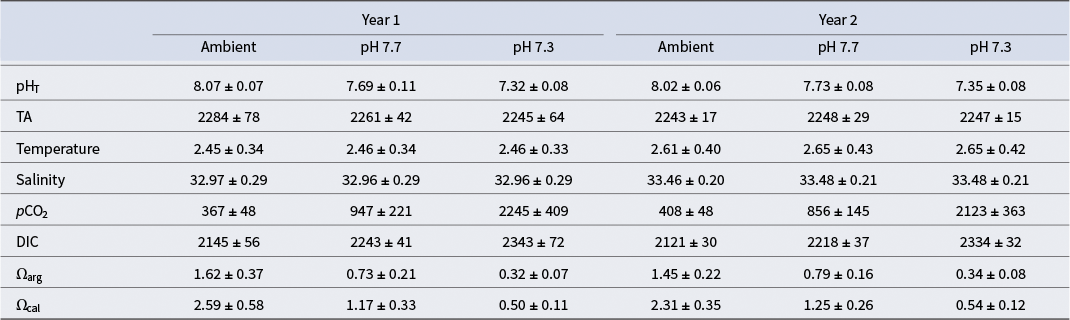
DIC = dissolved inorganic carbon.
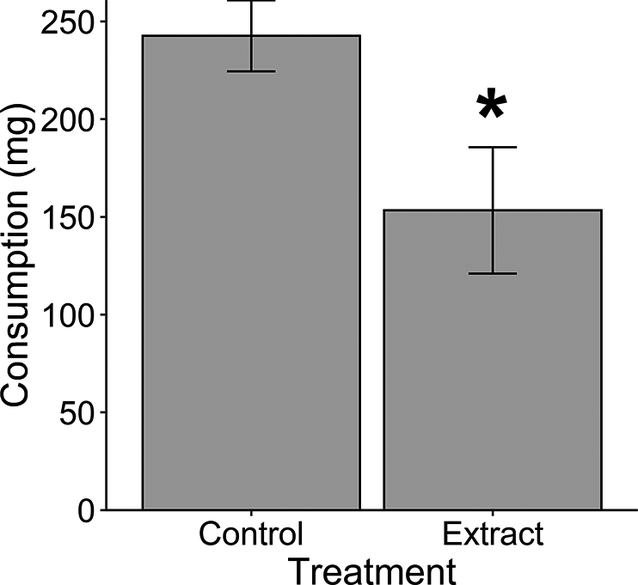
The amphipod G. antarctica showed a significant preference for the control artificial foods over the foods that contained 50% natural concentrations of D. menziesii extracts (t 16 = 2.4068, P = 0.0285). On average, macroalgal discs containing D. menziesii extract were eaten 36% less than control discs (Fig. 1). The consumption of macroalgal discs with D. menziesii extract was found to be significantly higher than 0 using a one-sample t-test, meaning amphipods were eating discs with the extract (t 8 = 4.746, P = 0.0015).
Feeding preference of Gondogeneia antarctica grazing on macroalgal discs containing ground tissue of the macroalga Cladophora repens and extract of the macroalga Desmarestia menziesii (n = 9). Bars correspond to mean consumption ± SE. The asterisk indicates a significant difference (P < 0.05) in a t-test.
Extract yields for D. menziesii ranged from 22.63 to 48.32 mg extract/g alga and did not significantly differ between the pH treatments. A preference for macroalgal discs containing extract from D. menziesii exposed to ambient seawater over extracts from macroalgae exposed to pH 7.7 and 7.3 was observed in G. antarctica (Fig. 2). A repeated-measures ANOVA showed a significant impact of pH on D. menziesii palatability (F 2,12 = 3.927, P = 0.0488). Artificial food pellets made with extracts from the ambient pH treatment were consumed ~38% more than those made with extracts from macroalgae maintained at reduced pH (Bonferroni pairwise comparison, P < 0.05).
Feeding preference of the amphipod Gondogeneia antarctica grazing on macroalgae exposed to different pH treatments. a. Consumption of discs containing ground tissue of the macroalga Cladophora repens and extracts of the macroalga Desmarestia menziesii (n = 7). b. Consumption of discs of the macroalga Palmaria decipiens (n = 8). Bars correspond to mean consumption ± SE. Letters indicate significant groups (P < 0.05) in a repeated-measures analysis of variance.
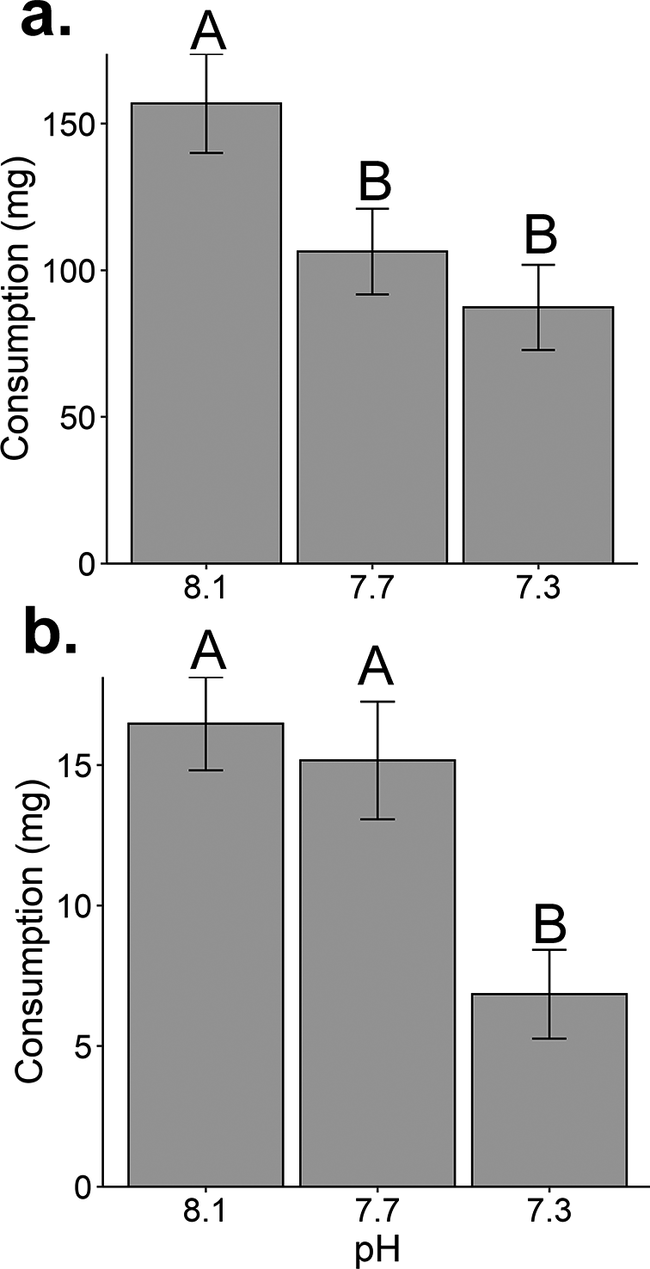
Gondogeneia antarctica had a strong preference for P. decipiens kept under ambient pH or pH 7.7 compared to macroalgae exposed to pH 7.3 (F 1.132,7.924 = 6.839, P = 0.0286; Fig. 2). On average, pairwise comparisons revealed that consumption was two-fold lower in the pH 7.3 treatment compared to the other two treatments (P < 0.05).
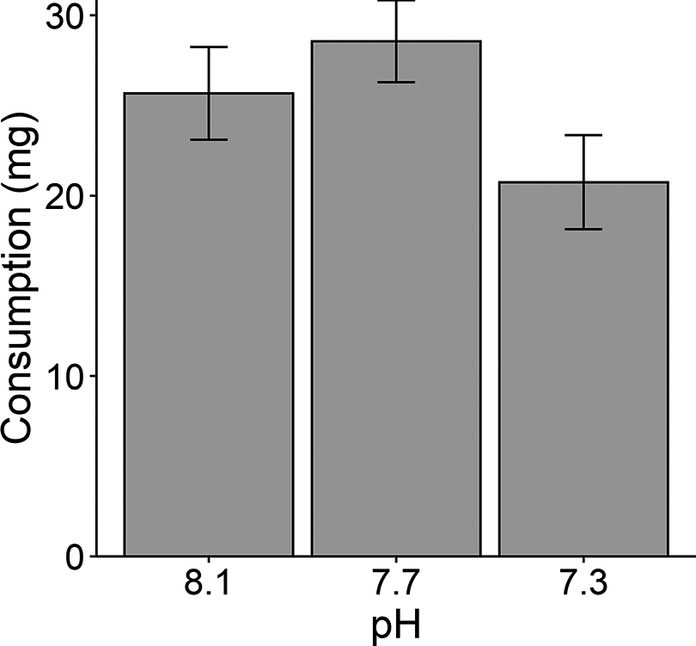
Gondogeneia antarctica that were exposed to the different pH treatments for 8 weeks exhibited no significant difference in total consumption of untreated P. decipiens (Fig. 3). Amphipods in each of the treatments consumed ~25 mg of P. decipiens over the 12 h of the experiment.
Total consumption of discs of the macroalga Palmaria decipiens by the amphipod Gondogeneia antarctica kept under different pH treatments for 8 weeks (n = 8). Bars correspond to mean consumption ± SE.
Discussion
The macroalgae D. menziesii and P. decipiens and the amphipod G. antarctica were exposed to three pH treatments simulating current ambient conditions (pH 8.1), end-of-the-century conditions (pH 7.7; IPCC 2022) and distant-future conditions (pH 7.3; IPCC 2022). These macroalgae were selected to represent a common unpalatable (D. menziesii) and palatable (P. decipiens) species (Amsler et al. Reference Amsler, Iken, McClintock, Amsler, Peters and Hubbard2005, Aumack et al. Reference Aumack, Amsler, McClintock and Baker2010). We found a reduc tion in palatability to (non-treated) G. antarctica in both D. menz iesii extracts and P. decipiens discs when exposed to decreased pH. However, when pH-treated G. antarctica were offered untreated, identical foods we found no significant difference in total consumption between G. antarctica from any of the treatments.
Previous studies have shown that OA can have a direct impact on the physiology and behaviour of marine organisms (Ericson et al. Reference Ericson, Lamare, Morley and Barker2010, Kroeker et al. Reference Kroeker, Kordas, Crim, Hendriks, Ramajo and Singh2013, Ramajo et al. Reference Ramajo, Marbà, Prado, Peron, Lardies and Rodriguez-Navarro2016), especially in consumers (e.g. Kurihara & Shirayama Reference Kurihara and Shirayama2004, Lim & Harley Reference Lim and Harley2018, Park et al. Reference Park, Ahn, Sin, Shim and Kim2020, Anand et al. Reference Anand, Rangesh, Maruthupandy, Jayanthi, Rajeswari and Priya2021). In addition to these potential direct impacts on a species, the interactions between species, such as macroalgae-herbivore interactions, can also be altered. OA-induced changes in the growth and chemical composition of macroalgae can alter consumer preference for specific macroalgal species (Fieber & Bourdeau Reference Fieber and Bourdeau2021). Additionally, differences in tolerance to low pH can shift entire ecosystem macroalgal composition, which can change the abundance of specific food items for consumers (Hall-Spencer et al. Reference Hall-Spencer, Rodolfo-Metalpa, Martin, Ransome, Fine and Turner2008, Harvey et al. Reference Harvey, Kon, Agostini, Wada and Hall‐Spencer2021).
Fleshy macroalgae are generally more resistant to OA compared to calcifying species and can sometimes benefit from a decrease in pH (Hall-Spencer et al. Reference Hall-Spencer, Rodolfo-Metalpa, Martin, Ransome, Fine and Turner2008, Johnson et al. Reference Johnson, Price and Smith2014, Kram et al. Reference Kram, Price, Donham, Johnson, Kelly, Hamilton and Smith2016). However, resistance to OA does not mean that these species are unaffected by this process. Changes in macroalgal palatability have been observed in several macroalgae when exposed to OA conditions (Swanson & Fox Reference Swanson and Fox2007, Poore et al. Reference Poore, Graba-Landry, Favret, Sheppard Brennand, Byrne and Dworjanyn2013, Duarte et al. Reference Duarte, López, Benítez, Manríquez, Navarro and Bonta2016, Fieber & Bourdeau Reference Fieber and Bourdeau2021). For example, the palatability of Fucus vesiculosus has been found to increase when exposed to low-pH treatments in summer through winter (Raddatz et al. Reference Raddatz, Guy-Haim, Rilov and Wahl2017). Additionally, Poore et al. (Reference Poore, Graba-Landry, Favret, Sheppard Brennand, Byrne and Dworjanyn2013) found that the palatability of Sargassum linearifolium was not impacted by decreases in pH alone. However, decreases in pH were able to mitigate reductions in palatability from increases in temperature.
Stress from changes in abiotic factors such as salinity, temperature and pH can alter secondary metabolite production in algae (Kolackova et al. Reference Kolackova, Janova, Dobesova, Zvalova, Chaloupsky and Krystofova2023). Alterations in secondary metabolites used as chemical defences can impact the overall palatability of macroalgae. The response can range from decreased, increased or unaffected chemical defence production between different species (Swanson & Fox Reference Swanson and Fox2007, Rich et al. Reference Rich, Schubert, Schläpfer, Carvalho, Horta and Horta2018, Fieber & Bourdeau Reference Fieber and Bourdeau2021). The kelp Laminaria setchellii and several species of the green algal genus Halimeda experience a decrease in phenolic and terpene content, respectively, when exposed to decreased pH (Campbell et al. Reference Campbell, Craft, Muehllehner, Langdon and Paul2014, Fieber & Bourdeau Reference Fieber and Bourdeau2021). However, the amount of phlorotannins, a putative chemical defence, have been shown to increase in some kelps when exposed to high-CO2 treatments (Swanson & Fox Reference Swanson and Fox2007).
In our study, D. menziesii extracts from an ambient pH were preferred over extracts from the pH 7.7 and pH 7.3 treatments. Since the extracts were lipophilic and therefore did not contain other desirable components to consumers, such as proteins, this preference for ambient-treatment extracts demonstrates that the potency of the extracts increased with decreased pH. These results suggest that OA could delay when the carbon from D. menziesii would become available to consumers in macroalgal communities along the WAP. The brown macroalga D. menziesii commonly dominates or co-dominates shallow-water communities down to 20 m in this region of the WAP (Amsler et al. Reference Amsler, Rowley, Laur, Quetin and Ross1995, Reference Amsler, Amsler, Heiser, McClintock, Iken, Galloway and Klein2024). Although this macroalga is typically not consumed while it is living, this macroalga and other sympatric species are important food resources for grazers when their chemical defences break down after death (Wiencke & Amsler Reference Wiencke, Amsler, Wiencke and Bischof2012). However, an increase in the amount or the potency of the chemical defences in D. menziesii could increase the amount of time for which the macroalga would need to be dead before the chemical defences would break down sufficiently to become palatable to consumers, lengthening the time for their carbon to become available to higher trophic levels. This concept is supported by the findings that high CO2 exposure and larger putative chemical defence levels have both been correlated with longer decay times in other brown macroalgae (Swanson & Fox Reference Swanson and Fox2007).
In addition to changes in chemical defences, shifts in chemical composition that lower nutritional quality have also been observed in OA experiments (e.g. Gordillo et al. Reference Gordillo, Niell and Figueroa2001, Duarte et al. Reference Duarte, López, Benítez, Manríquez, Navarro and Bonta2016). Decreases in protein and fatty acid concentrations have been observed in several macroalgal species when exposed to CO2 enrichment (Garcia-Sanchez et al. Reference Garcia-Sanchez, Fernandez and Niell1994, Mercado et al. Reference Mercado, Javier, Gordillo, Xavier Niell and Figueroa1999, Gordillo et al. Reference Gordillo, Niell and Figueroa2001, Rossoll et al. Reference Rossoll, Bermúdez, Hauss, Schulz, Riebesell, Sommer and Winder2012, Duarte et al. Reference Duarte, López, Benítez, Manríquez, Navarro and Bonta2016). However, these changes in composition vary with corresponding photosynthesis or growth changes for particular species. For example, decreases in protein content and increases in C:N ratios are correlated with lower growth and photosynthesis rates in Porphyra leucostricta and Gracilaria tenuistipitata (Garcia-Sanchez et al. Reference Garcia-Sanchez, Fernandez and Niell1994, Mercado et al. Reference Mercado, Javier, Gordillo, Xavier Niell and Figueroa1999). Gordillo et al. (Reference Gordillo, Niell and Figueroa2001), however, found similar composition changes but increases in growth and photosynthesis in Ulva rigida with CO2 enrichment. These reductions in nutritional quality can result in lower palatability to consumers. Duarte et al. (Reference Duarte, López, Benítez, Manríquez, Navarro and Bonta2016) found that exposure to high CO2 reduced protein content and organic matter in the brown macroalga Durvillaea antarctica. As a result, the amphipod Orchestoidea tuberculate preferred D. antarctica from the ambient CO2 treatment three-fold more than macroalgae from the higher CO2 treatment (Duarte et al. Reference Duarte, López, Benítez, Manríquez, Navarro and Bonta2016).
Our study found that the palatability of P. decipiens decreases by half when exposed to a pH 7.3 treatment for 18 days. This decrease in palatability could be attributed to a decrease in nutritional quality of the macroalga or to the production of an unpalatable metabolite as a response to stress. The nutritional quality of primary producers can influence ecosystem trophic structure by determining herbivory pressure, consumer to producer biomass ratios and the rate at which energy is cycled through the food web (Cebrian et al. Reference Cebrian, Shurin, Borer, Cardinale, Ngai, Smith and Fagan2009). Palmaria decipiens is one of the few palatable macroalgae in these communities (Amsler et al. Reference Amsler, McClintock, Baker, Gómez and Huovinen2020). A reduction in nutritional quality could lead to heavier herbivory pressure on this macroalga if grazers must consume more macroalgae to compensate for low-nutrition food items (Duarte et al. Reference Duarte, López, Benítez, Manríquez, Navarro and Bonta2016). Furthermore, reductions in nutritional quality can impact consumers through shifting biochemical compositions, decreasing egg production and reducing growth rates in some invertebrates (Urabe et al. Reference Urabe, Togari and Elser2003, Rossoll et al. Reference Rossoll, Bermúdez, Hauss, Schulz, Riebesell, Sommer and Winder2012, Schoo et al. Reference Schoo, Malzahn, Krause and Boersma2013).
Previous studies have shown that invertebrates can be susceptible to OA through alterations in reproduction (Kurihara & Shirayama Reference Kurihara and Shirayama2004, Ericson et al. Reference Ericson, Lamare, Morley and Barker2010, Morita et al. Reference Morita, Suwa, Iguchi, Nakamura, Shimada, Sakai and Suzuki2010), development (Kurihara & Shirayama Reference Kurihara and Shirayama2004, Watson et al. Reference Watson, Southgate, Tyler and Peck2009, Place & Smith Reference Place and Smith2012) and growth (Sheppard Brennand et al. Reference Sheppard Brennand, Soars, Dworjanyn, Davis and Byrne2010). In addition to these changes, the energy demands of invertebrates can also shift as organisms reallocate available energy to different processes as a response to low pH exposure (Pan et al. Reference Pan, Applebaum and Manahan2015). One common response of invertebrates to higher energy demands is increasing food intake (Saba et al. Reference Saba, Schofield, Torres, Ombres and Steinberg2012, Ramajo et al. Reference Ramajo, Marbà, Prado, Peron, Lardies and Rodriguez-Navarro2016). Saba et al. (Reference Saba, Schofield, Torres, Ombres and Steinberg2012) found that Antarctic krill increase their feeding rates greater than three-fold and increase their metabolic rates when exposed to high CO2 concentrations. In some situations, having access to greater food amounts can mitigate some of the negative effects of OA exposure. For example, Melzner et al. (Reference Melzner, Stange, Trübenbach, Thomsen, Casties and Panknin2011) found that inner-shell corrosion in the mussel Mytilus edulis was not observed in moderate CO2 treatments when given a high volume of food. Similarly, the hard coral Acropora cervicornis can utilize increased feeding to mitigate decreases in calcification and growth from high CO2 exposure (Towle et al. Reference Towle, Enochs and Langdon2015). In contrast to other studies, Ramajo et al. (Reference Ramajo, Marbà, Prado, Peron, Lardies and Rodriguez-Navarro2016) found that juvenile scallops exposed to high CO2 had significantly higher metabolic, growth, calcification and feeding rates compared to when exposed to ambient CO2. However, scallops with a low food supply exposed to the same pCO2 altered the composition of their shell-periostracum layer.
Amphipods utilize calcium carbonate to create their exoskeletons (Luquet Reference Luquet2012), making them susceptible to increased energetic requirements under OA to maintain their calcification. However, in the present study, we found no significant difference in the total consumption of G. antarctica of food discs with decreasing pH. This result aligns with the reported robustness of arthropod feeding, as a whole, to OA compared to more susceptible groups, including echinoderms and molluscs (Clements & Darrow Reference Clements and Darrow2018). Other OA studies found that the larvae of the Dungeness crab, Metacarcinus magister, and the Pacific green shore crab, Hemigrapsus oregonensis, showed no difference in feeding rates on prey items when exposed to lowered pH (Christmas Reference Christmas2013). Similar trends in feeding rates on algae have also been observed in some krill, shrimp, amphipods and copepods (Arnberg et al. Reference Arnberg, Calosi, Spicer, Tandberg, Nilsen, Westerlund and Bechmann2013, Poore et al. Reference Poore, Graba-Landry, Favret, Sheppard Brennand, Byrne and Dworjanyn2013, Li et al. Reference Li, Han, Dong, Ishimatsu, Russell and Gao2015, Cooper et al. Reference Cooper, Potts and Paytan2016, Glandon & Miller Reference Glandon and Miller2017, McLaskey et al. Reference McLaskey, Keister, Schoo, Olson and Love2019). However, while measuring feeding responses can be a tool for estimating energy acquisition (Clements & Darrow Reference Clements and Darrow2018), feeding cannot measure all processes that might be impacted by OA. For example, there can be changes in respiration, fatty acid accumulation efficiency and development rates that are not reflected in consumption rates (Arnberg et al. Reference Arnberg, Calosi, Spicer, Tandberg, Nilsen, Westerlund and Bechmann2013, Li et al. Reference Li, Han, Dong, Ishimatsu, Russell and Gao2015, McLaskey et al. Reference McLaskey, Keister, Schoo, Olson and Love2019). Consequently, any such impacts on G. antarctica could have gone undetected in our study. In addition, P. decipiens is one of the most protein-rich macroalgae in this region (Peters et al. Reference Peters, Amsler, Amsler, McClintock, Dunbar and Baker2005), making it possible that the untreated P. decipiens used as food in the experiment could have provided enough nutrition to mask possible differences in energy demands of G. antarctica.
The results of the present study show that OA negatively affected the palatability of the unpalatable D. menziesii and the palatable P. decipiens but did not impact the feeding of G. antarctica. These changes in palatability are probably occurring because of changes in either nutritional quality or secondary metabolite production. Alterations in either of these components could lead to major impacts for the WAP food web, such as delaying when an unpalatable macroalga enters the detrital food web or decreasing the nutritional quality of a palatable macroalga for consumers. Overall, our results suggest that the indirect effects of OA on food items can be more impactful than the direct effects on amphipods along the WAP.
Supplementary material
To view supplementary material for this article, please visit http://doi.org/10.1017/S095410202400052X.
Details of data deposit
Data are available at the US Antarctic Program Data Center: https://www.usap-dc.org/view/project/p0010193.
Acknowledgements
The authors gratefully acknowledge the science and logistical support staff of Antarctic Support Contract for their help and support of the US Antarctic Program. Addie Knight and Jami de Jesus provided valuable field assistance. Stacy Krueger-Hadfield and two reviewers provided constructive comments on earlier drafts of the manuscript.
Financial support
This research was supported by National Science Foundation award OPP- 1848887 from the Antarctic Organisms and Ecosystems Program.
Competing interests
The authors declare none.
Author contributions
HEO, CDA, JBM and JBS designed the study. HEO, MOA, CDA and JBS collected the macroalgae. HEO, MOA and CDA collected the amphipods. All authors conducted the experiment. HEO analysed the data, prepared the figures and wrote the first draft of the manuscript. All authors contributed to editing the final manuscript.


 Open access

