


In recent years, Latin America has witnessed a significant political shift characterized by the emergence of far-right leaders and parties, challenging the traditionally left-leaning political landscape (Mayka & Smith, Reference Mayka and Smith2021). This phenomenon, seen across various countries including Brazil with Jair Bolsonaro (Chapter 3, this volume), Argentina with Javier Milei from La Libertad Avanza (LLA; Chapter 4, this volume), and Peru with Rafael López Aliaga of Renovación Popular (RP; Chapter 6, this volume), necessitates an analysis of changing political ideologies within the region. The rise of the far right in Chile, embodied by José Antonio Kast and the Republican Party (PR), mirrors this regional trend. This chapter aims to dissect the rise of the far right in Chile, examining José Antonio Kast and the PR’s political discourse within a broader Latin American and global context. It considers the similarity with far-right movements in neighboring countries and globally, while also situating the Chilean case within its historical context, particularly the legacy of Augusto Pinochet’s dictatorship (Chapter 3, this volume; Borges & Zanotti, Reference Borges and Zanotti2024; Rovira Kaltwasser et al., 2024; Zanotti et al., Reference Zanotti and Botero2023). Furthermore, the chapter examines the complex relationship between the far right and democracy in Chile. In this respect, it is crucial to recognize that the far right’s presence in Chile is not a novel phenomenon; its roots can be traced throughout the country’s political history. A significant exemplar of this is the Independent Democratic Union (UDI), following the country’s return to democracy. With its origins deeply entrenched in Pinochet’s legacy, the UDI has long represented a conservative, right-wing faction within the Chilean political spectrum (Loxton, Reference Loxton2021). The current rise of José Antonio Kast and the PR can be seen as a “re-mainstreaming” of far-right ideas – a reinvention and reaffirmation of positions that, though always present, are now gaining renewed prominence and visibility in national political discourse (Zanotti, Reference Zanotti, Borges, Lloyd and Vommaro2024).
This phenomenon reflects not just a continuity but also an evolution in the expression of right-wing politics in Chile, marking a period where far-right ideologies, once marginalized, are finding new momentum and acceptance in the contemporary political landscape. This re-mainstreaming of far-right ideologies is not limited to Latin American democracies. In other new democracies, a similar phenomenon is observable. For instance, in Spain, the rise of VOX, a far-right political party, exemplifies this resurgence. VOX has revitalized and politicized the concept of Spanish unity, a central tenet of Francoist ideology, which had been marginalized in the country’s political discourse since the transition to democracy (Rama et al., Reference Rama, Zanotti, Turnbull-Dugarte and Santana2021). This reinvigoration of an ideology once seen as a relic of an authoritarian past highlights a common pattern in new democracies: the reemergence and reintegration of far-right ideas in mainstream political discourse. The Spanish case, like that of Chile, demonstrates how historical legacies and contemporary sociopolitical dynamics intertwine, leading to a renewed prominence of ideologies that align with far-right principles, even in societies that have moved away from authoritarian rule.
The chapter is structured as follows: First, it examines the dynamics of the emergence and the current situation of the Chilean far right, providing insights into the historical and contemporary factors that have contributed to its rise. Second, the chapter delves into the ideological tenets of the Chilean far right, exploring the core beliefs and values that underpin this political faction, as well as the issue politicized by this force. Third, the relationship between the far right and democracy is scrutinized, assessing how these ideologies interact with democratic principles and practices in Chile. Fourth, the chapter identifies and analyzes the factors that might influence the future trajectory of the Chilean far right, considering both internal dynamics and its relationship with conventional right-wing forces. Finally, the chapter concludes with a synthesis of the key findings and their implications for understanding the far right in Chile and its potential impact on the country’s political landscape.
5.1 The Emergence of the Far Right in Chile
While comparative research on the far right has been substantially centered on Europe, in recent years far-right leaders and parties have emerged in other parts of the world, from Asia to the Americas (Mudde, Reference Mudde2019). In Latin America, the far right, at least in its current fashion, is a more recent phenomenon. One of the earliest manifestations of this trend is epitomized by the figure of José Antonio Kast in Chile.
Broadly speaking, the emergence of the far right in Chile can be seen as a response to the gradual programmatic convergence of the coalitions that governed the country during the post-dictatorship period (Madariaga & Rovira Kaltwasser, Reference Rovira Kaltwasser2020). Kast, a former member of the UDI and deputy, chose to leave the party in 2016, arguing that “the great mistake of the right in recent years has been to abandon its principles and adjust its values to gain the sympathy of certain sectors.”Footnote 1 A year later, running as an independent, he competed in the presidential election and unexpectedly obtained almost 8 percent of the votes (Rovira Kaltwasser et al., Reference Rovira Kaltwasser, Salas-Lewin and Zanotti2024b). During the right-wing government led by Sebastián Piñera (2018–2022), Kast progressively intensified his criticism of the government, focusing mainly on his perception of incompetence in handling crime and public security, and the adoption by the conventional right administration of policies that contradicted conservative values. Kast’s views on Piñera’s government became particularly critical during the large-scale protests that shook the nation in October and November 2019, the so-called social outbreak (estallido social). At that juncture, Kast advocated for a strong military intervention to halt the protests and vehemently opposed the agreement that led to a constitutional referendum, which ultimately took place in October 2020.
The referendum resulted in an overwhelming popular consensus on establishing a constituent assembly tasked with drafting a new constitution (Meléndez et al., Reference Meléndez, Rovira Kaltwasser and Sajuria2021). In 2019, Kast founded a political party, the PR, which is predominantly composed of independent figures and former members of conventional right-wing parties (particularly the UDI). This development is quite common when examining other examples of far-right parties. Although their leaders often present themselves as distant from traditional politics, their histories frequently reveal affiliations with conventional right-wing parties. In this regard, the emergence of the far right at a global level has followed different types of trajectories, sometimes influenced by institutional incentives (Chapter 1, this volume). The first type of trajectory is represented by the Republican Party in the United States, which has undergone a transformation from being a conventional right-wing party to becoming a far-right party. This evolution has been characterized by the adoption of positions and political leaders that promote more radical ideologies and have a semi-loyal relationship with the principles of liberal democracy. Another type of trajectory is the emergence of a more radical sector within a traditional party, which eventually forms a new far-right party. This is the case with the PR and its leader José Antonio Kast in Chile, where a more radical faction separated from the UDI to establish the PR. This same trajectory unfolded in Spain, where the main promoters of VOX were previously associated with the Popular Party (PP) (Rama et al., Reference Rama, Zanotti, Turnbull-Dugarte and Santana2021).
In the 2021 elections, Kast launched his campaign for both the parliament and the presidency. The “Republican Party” achieved notable success, securing fifteen seats in the lower chamber and one seat in the Senate. Kast himself led the first round of the presidential race, receiving 28 percent of the total votes. However, he was surpassed in the second round by the left-leaning candidate, Gabriel Boric – leader of the coalition known as Apruebo Dignidad – who obtained 56 percent of the votes cast.
Figure 5.1 illustrates that from the first democratic election post-Pinochet until 2013, the two main coalitions of center-left and center-right dominated the political competition. After being defeated by center-left coalition candidates in four consecutive election (1989, 1993, 1999, and 2005), the right managed to prevail in the second round of the 2009 election with Sebastián Piñera. This election began a cycle of alternation of the two coalitions in power. However, a new political cycle commenced in 2017. The 2017 electoral reform, which replaced the binomial system with a system of proportional representation, had several significant effects on Chilean politics. Its primary effect was to allow for greater representation of smaller parties in Congress, leading to an increase in the fragmentation of the party system. Furthermore, the new electoral law also altered the dynamics of political competition, facilitating the entry of new political actors, such as José Antonio Kast and the “Republican Party,” and the parties comprising the “Frente Amplio” on the left flank of the system.
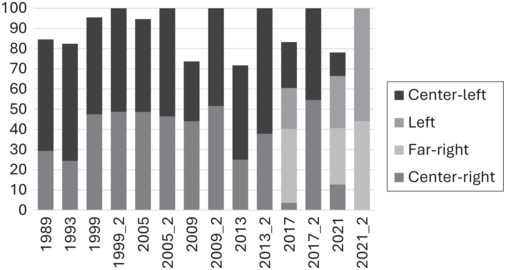
Figure 5.1 Long description
The vertical axis of the bar chart represents the vote share, measured as a percentage from 0 to 100. The horizontal axis represents the election years. Four differently colored lines represent the four main political groups: Center-Left, Left, Center-Right, and Far-right. Each line tracks the electoral performance of its respective coalition across the different election years. The vote shares for these groups rise and fall over the three-decade period, showing the changing levels of support for each bloc. The lines allow for a visual comparison of how the electoral fortunes of the Center-Left, Left, Center-Right, and Far-right have evolved in relation to one another across the series of presidential contests. The data source is identified as an elaboration by the author using SERVEL data.
Kast capitalized on this new landscape. After a strong performance that took him to the run-off in the 2021 presidential election, he was ultimately defeated by Gabriel Boric. However, his political fortunes surged in the aftermath. By leading the successful “Rechazo” (Reject) campaign against the first, left-leaning constitutional proposal in September 2022, Kast and the Republican Party gained significant momentum. This culminated in their triumph in the May 2023 elections for a new Constitutional Council, where they secured a dominant plurality with 35 percent of the vote, positioning themselves as the central force in shaping Chile’s future.
This journey, however, took an unexpected turn in the December 2023 plebiscite, where the new constitution drafted under the Republican Party’s leadership was also rejected, by a 55 to 44 percent margin. This outcome represented a significant setback for the far right but, more broadly, it offers a crucial perspective on the “backlash hypothesis” (Bustikova, Reference Bustikova2019). While the rejection of a left-leaning draft in 2022 could be interpreted as a conservative backlash, the subsequent rejection of a right-leaning draft suggests a more complex dynamic. As other research on Latin America indicates (Abreu Maia et al., Reference Abreu Maia, Chiu and Desposato2023), this result may not signal a simple reaction against progressive policies, but rather a societal preference for moderation and a rejection of comprehensive constitutional changes proposed from either political extreme.
Figure 5.2 illustrates a narrative that counters the backlash hypothesis within the context of Chile’s sociopolitical environment. The graph shows the trend of high and low acceptance of homosexuality and abortion since the return to democracy. On the one hand, the consistent, linear liberalization of attitudes toward homosexuality challenges a simple backlash narrative. High acceptance grew steadily through every period to 20.1 percent while low acceptance fell to 51.1 percent, indicating that the far right’s mobilization has so far failed to reverse the underlying societal shift on this issue. On the other hand, the trajectory for abortion offers evidence of a potential backlash or, at minimum, a hard limit to progressive change. The sharp reversal after 2014 – with high acceptance falling from a peak of 38.7 percent to 30.7 percent and low acceptance rising from 24 to 30.6 percent – coincides with the period of intensified political polarization and the rise of an organized far right under Kast. This divergence suggests that the far-right backlash is not a monolithic reaction, but a strategic one that has been effective in halting or even reversing public opinion on a highly salient and contentious issue like abortion, creating a polarized stalemate where it had previously lost ground.
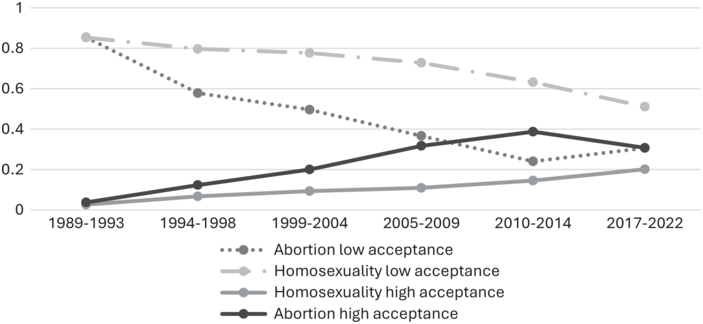
Figure 5.2 Long description
The 4-line chart shows two clear trends. First, high acceptance for both issues rose significantly, with homosexuality showing the most dramatic increase from very low to the highest level. Second, low acceptance for both issues declined correspondingly. By 2017 to 2022, high acceptance had become the dominant position for both topics, marking a substantial shift in social attitudes over the 32-year period.
The significant shifts in public opinion toward progressive values, as illustrated in Figure 5.2, were not spontaneous. They were the result of decades of mobilization by a combination of key actors. Foremost among these have been social movements. The powerful Chilean feminist wave (ola feminista), which gained massive visibility in 2018, was instrumental in placing gender equality and reproductive rights at the center of the national debate, building on the momentum that led to the 2017 law decriminalizing abortion under three specific circumstances. Similarly, LGBTQ+ rights organizations, such as the Movimiento de Integración y Liberación Homosexual (MOVILH), have waged a long and strategic campaign through both public advocacy and legal action, culminating in major legislative victories like the Anti-Discrimination Law (2012) and the Equal Marriage Law (2021).Footnote 2
This activism in civil society found institutional expression mainly through left-wing political parties. The student movements of 2006 and 2011 nurtured a new political generation that formed the Frente Amplio, the coalition that eventually brought President Gabriel Boric to power with an explicitly progressive cultural agenda. Even prior center-left governments under Michelle Bachelet were responsible for passing key legislation such as the Civil Union Agreement (2015). It is precisely this string of successes by progressive forces that provided fertile ground for a far-right emergence. José Antonio Kast and the Republican Party’s discourse is, in large part, a counter-mobilization against these very advances. They frame these changes not as societal progress but as an imposition by a “leftist elite” and a dangerous “gender ideology” that threatens traditional Chilean values, family, and security, thus mobilizing voters who feel alienated by rapid cultural transformationFootnote 3 (Bellei & Cabalin, Reference Bellei and Cabalin2013).
On the other hand, globally, a decline in the democratization process has been observed, contributing to various regime dysfunctions (Levitsky & Ziblatt, Reference Levitsky and Ziblatt2018). This trend mirrors the situation in Chile, which for years has shown an increasing public perception of unfair inequality (PNUD, 2018) and a sharp, growing distrust in core institutions such as the government and Congress.Footnote 4 This widespread discontent has created fertile ground for a readiness to compromise democratic ideals, a phenomenon confirmed by recent regional surveys where support for democracy has fallen, and a significant portion of Chileans express indifference toward the type of political regime if it delivers on security and economic stability.Footnote 5 The Chilean experience with the constitutional plebiscite reflects these wider trends, underscoring a growing disillusionment with traditional democratic processes and institutions. This discontent may potentially pave the way for more radical and populist political alternatives, such as Johannes Kaiser’s Partido Libertario (Libertarian Party).
5.2 The Ideology of the Chilean Far Right
Far-right ideologies are underpinned by at least two principal beliefs, as delineated in scholarly discourse: nativism and authoritarianism (Mudde, Reference Mudde2019). Nativism fuses xenophobic sentiment with nationalism, advocating for the primacy of native inhabitants’ interests over those of immigrants, and adopting an exclusionary posture against those not considered “native.” Authoritarianism posits a belief in a strictly regulated society where infractions are met with stringent sanctions. While Latin American far-right parties share commonalities with their Western European peers, distinctive differences have been underscored. Nativism is the core ideology of the far right in Europe. In contrast, the far right in Latin America tends to gravitate toward authoritarianism, marked by a predilection for a hierarchical and ordered society in which infringements to this order should be harshly punished (Campos, Reference Campos2021; Díaz et al., Reference Díaz, Rovira Kaltwasser and Zanotti2023; Kestler, Reference Kestler2022; Rovira Kaltwasser & Zanotti, Reference Rovira Kaltwasser and Zanotti2023; Zanotti et al., Reference Zanotti and Botero2023).
5.2.1 Authoritarianism and Nativism
In Chile, previous literature has positioned José Antonio Kast and the Republican Party within the framework of the populist radical right (PRR), a subgroup of the far right (see Mudde, Reference Mudde2019). As with most far-right actors in Latin America, the Chilean far right has been associated with social authoritarianism as the primary ideological stance. Drawing from Adorno’s (Reference Adorno2019) conception of authoritarianism, this individual predisposition suggests a strong belief in conformity, submission to authority, and the sanctioning of those who deviate from conventional norms. In defining authoritarianism, Stenner (Reference Stenner2009) points out that the experience of normative threat (defined as challenges to group authority and uniformity) is related to higher levels of intolerance, which constitutes the main behavioral manifestation of authoritarianism. In this sense, authoritarianism manifests as unease or intolerance toward individuals belonging to certain groups, which may result in dynamics of otherization. “Otherization,” a fundamental mechanism in far-right ideology, involves constructing certain groups as fundamentally different or alien, effectively creating a dichotomy between “us” (the ingroup) and “them” (the outgroup). This phenomenon is instrumental in the rhetoric and policies of far-right leaders and parties, as it helps to rally support by identifying common “enemies” or scapegoats, often based on nationality, ethnicity, or political beliefs. Moreover, it is associated with a conformist orientation that includes an unwillingness to permit others to step out of narrowly defined limits of what is proper and acceptable.
Thus, a conformist orientation implies “not only intolerance of deviant political belief but also intolerance of any beliefs thought to be threatening to the social order – religious beliefs, ethnic and racial identifications, even beliefs about proper dress and deportment” (Feldman & Stenner, Reference Feldman and Stenner1997, p. 747). Given that authoritarianism is the principal orientation of the Chilean far right, it shapes the range of issues the movement politicizes. Indeed, while it is important to evaluate the ideological characteristics of the far right in different contexts, it is also relevant to highlight how these ideologies are politicized or translated into political preferences. In this regard, the European experience generally shows that authoritarianism translates into a preference for more severe measures in law and order – so-called hardline policies. In some cases, the far right also exhibits its social authoritarianism in terms of defending “traditional society” by upholding traditional moral values such as the preservation of the heteronormative family against sexual minorities and the defense of traditional gender roles (Rama et al., Reference Rama, Zanotti, Turnbull-Dugarte and Santana2021; Zanotti & Meléndez, Reference Meléndez2022). In the case of Kast and the Republican Party, we can observe that social authoritarianism applies to both spheres: defense of hardline policies and of traditional society (Díaz et al., Reference Díaz, Rovira Kaltwasser and Zanotti2023). Thus, for example, in the field of law and order, on the website of an expert group associated with the party, Kast argues that:
The left always blames others and seeks explanations to defend drug trafficking. “It’s the fault of education,” some will say; “It’s inequality,” others will argue. The boldest will blame neoliberalism for all evils and will not courageously assume the decision to confront the drug traffickers and fight them with the full force of the law. Of course, there are many factors that influence and explain, but there is none more relevant than the weakening of the rule of law and the loss of the State’s capacity to confront these organized criminals.Footnote 6
This statement exemplifies how Kast instrumentalizes penal punitivism far beyond a simple policy preference. He uses the issue of crime to construct a Manichean narrative that pits ordinary, law-abiding citizens against both criminals and a “corrupt elite” – particularly the left – whom he accuses of being morally complicit and weak. This discursive strategy serves two goals: it reframes complex social problems as a simple matter of will and repression, and it positions him as the sole defender of order against chaos. This approach is a cornerstone of the far-right playbook in the region. The parallels with his regional counterparts are clear. In Brazil, Jair Bolsonaro built a political career on a similar foundation, famously encapsulated in his slogan, “bandido bom é bandido morto” (a good bandit is a dead bandit). For both Kast and Bolsonaro, the punitive discourse is a performance of masculine strength and a rejection of human rights guarantees, which are framed as privileges for criminals defended by a weak elite. Similarly, while Javier Milei’s primary axis in Argentina is economic, he strategically incorporates a hardline security discourse, often amplified by allies like Security Minister Patricia Bullrich. For Milei, this mano dura (iron fist) stance on crime complements his anti-state message, portraying him as tough on all forms of disorder – be it economic inefficiency or street crime – thereby reinforcing his credentials as an outsider willing to take decisive action where the establishment has failed (Zanotti et al., Reference Zanotti, Villalobos Machuca and Roldán Duque2025; Chapter 2, this volume).
Regarding the defense of traditional moral values, Kast advocates for traditional gender roles, opposes sexual minorities, and criticizes so-called gender ideology. To give just one example, Kast and the Republican Party strongly oppose the gender identity law which supposedly: “Establishes in Chilean legislation the gender ideology, which by distorting the sexed nature of the human being ‘relativizes the concept of family that arises from the sexually diverse and complementary modalization, with the purpose of union and fecundity.’”Footnote 7
Further aligning with his advocacy for traditional moral values, José Antonio Kast’s 2021 electoral programFootnote 8 proposed additional measures reflecting this stance. Notably, he called for the repeal of Chile’s law allowing abortion under three specific circumstances: to save the life of the mother, in cases of fetal nonviability, or in instances of rape. Additionally, Kast proposed disbanding the Ministry of Women and Gender Equity, advocating instead for the establishment of a “Ministry of the Family.” This move underscores his commitment to traditional family structures and contrasts sharply with more progressive and inclusive gender policies (Rovira Kaltwasser & Zanotti, Reference Rovira Kaltwasser and Zanotti2022). This political platform is powerfully reinforced by his personal life; as the father of nine children, Kast not only preaches but also performatively embodies the traditional, large Christian family ideal he champions, lending a potent sense of authenticity to his conservative base. Although Kast retracted his proposal to disband the Ministry of Women and Gender Equity during the second round of the election and released a revised electoral program, this seemed more like an adjustment to public sentiment and political dynamics rather than a genuine shift in ideological or policy preferences.
Moreover, the far right in Chile advocates for the idea that society should be culturally homogeneous (Betz, Reference Betz1994; Mudde, Reference Mudde2007). The Republican Party discursively constructs another alien group, represented by native populations. In this sense, the “otherness” of the Chilean far right is directed toward the Mapuches, especially those living in the southern Araucanía region, who have recently been fighting the state for their native lands. In this sense, the far right often frames the preservation of the homogeneity of the nation-state in terms of external threats, but occasionally it applies to internal national claims, such as those of native populations. Such perspectives are evident in regions affected by colonialism, where the dominant class often becomes the colonizing group. Indeed, the far right in countries like Australia, Brazil, and Chile advocate for a unified national identity and oppose the recognition of separate Aboriginal, Amazonian, and Mapuche nations. It is important to underline how the nativist attitude toward these indigenous groups also carries a marked racial nuance (Moffitt & Sengul, Reference Moffitt and Sengul2023; Rovira Kaltwasser & Zanotti, Reference Rovira Kaltwasser and Zanotti2023). In Chile, the “otherness towards external groups,” such as immigrants, is also present, albeit inconsistently. Kast and the Republican Party discursively construct an external group composed of undocumented immigrants prominently including both Haitian and, more recently, Venezuelan arrivals attempting to enter the country. In his 2021 electoral manifesto, Kast proposed the construction of a trench to prevent the entry of undocumented migrants,Footnote 9 and also made a video to defend this idea, in which the arguments presented resemble those proposed by Trump in defending the construction of a wall on the border between Mexico and the United States (Rovira Kaltwasser et al., Reference Rovira Kaltwasser2023). This anti-immigrant sentiment is voiced even more stridently by figures from the party’s orbit. A key example is Johannes Kaiser (now leader of the Libertarian Party), a controversial deputy originally elected for the Republican Party in 2021. After leaving its congressional bloc and subsequently forming his own political party, he has become a key voice for the most radical fringe of the far right, often taking more extreme positions than Kast and competing for the same electoral base. In an interview in July 2024, Johannes Kaiser pointed out the need for a tougher policy against immigration:
These people cannot continue into Chilean territory; they have to end up in a camp until they are forced to leave the country … And the guy who gets out of the camp, you have to grab him with a stick (a palo), or whatever is necessary to force him back into the camp.Footnote 10
5.2.2 The Additional Ideologies of the Chilean Far Right
While nativism and authoritarianism are central to the ideological framework of far-right parties, the full spectrum of their ideology often incorporates additional elements that vary according to context. For José Antonio Kast and the Republican Party in Chile, this ideological repertoire is expanded to include populism, neoliberalism, and anti-communism. Regarding populism, while it is a defining ideology of the PRR, it does not uniformly characterize the broader far right, which is an amalgamation of two party families: the PRR and the extreme right (Mudde, Reference Mudde2019). Therefore, within the far-right spectrum, there are parties and leaders who may not adopt populist rhetoric. Populism, in its ideational fashion, is described as a thin-centered ideology that draws a stark contrast between “the pure people” and “the corrupt elite,” advocating that politics should be an expression of the “volonté générale” (general will) of the people (Hawkins, Reference Hawkins2009; Mudde, Reference Mudde2004, p. 60; Mudde & Rovira Kaltwasser, Reference Mudde and Rovira Kaltwasser2013).
5.2.3 Populism
In the case of the discourse of the Chilean far right, the portrayal of the “corrupt elite” often takes precedence, depicted as a series of influential entities accused of undermining “common sense.” Although the establishment is perceived to include various actors, Kast and the Republican Party are particularly vehement in their criticism of the broader political sphere, with a specific focus on left-wing factions. The sentiment of anti-elitism within the far-right discourse in Chile is more pronounced than their advocacy for the “pure people.” This latter term typically refers to those who cherish Chile’s history, customs, and principles. This concept extends beyond a simple appreciation of civic nationalism, which emphasizes shared civic values and participation. Rather, it includes individuals who adhere to specific moral beliefs in line with far-right ideology. This aspect of the far right’s narrative is not merely about pride in national heritage; it also involves alignment with certain moral convictions. This perspective, while ostensibly similar to civic nationalism on the surface, represents a more exclusive and ideologically driven viewpoint. It differentiates a particular group as the true embodiment of Chilean values, distinct from the rest of society, including the political and social elite. Special emphasis is placed on preserving conventional heteronormative family unity, emphasized in the 2021 presidential manifesto as needing defense through “convincing a substantial and silent majority” which somehow “feels the repercussions of family breakdown.” In this context, Kast and the Republican Party’s opposition to what they label as “neo-Marxist postmodernism” is not accidental. They portray it as an assault on the “pure people” through “the calculated exploitation of issues such as human rights, gender, sexual orientation, immigration, and environmental concerns.” In summary, Christian principles are consistently invoked by Kast to delineate the members of the “pure people,” implicitly addressing both Catholic and evangelical audiences (Díaz et al., Reference Díaz, Rovira Kaltwasser and Zanotti2023, pp. 346–347).
5.2.4 Neoliberalism and the Idea of Freedom
The concept of neoliberalism and the idea of freedom serve as a pivotal framework in understanding the far right’s ideological stance in Latin America, setting it apart from European counterparts. The Latin American far right is distinctively marked by a strong commitment to neoliberal economic policies, diverging notably from the welfare chauvinism often observed in European far-right movements. In Argentina, for instance, Javier Milei’s rise within the political landscape is characterized by his unwavering advocacy for free-market principles and minimal state intervention, a stance that aligns with the core principles of neoliberalism (Chapter 2, this volume). Similarly, in Brazil, the tenure of Jair Bolsonaro as president was marked by initiatives aimed at liberalizing the economy, reducing public spending, and encouraging privatization efforts (Chapter 3, this volume). These cases in Argentina and Brazil exemplify the integration of neoliberalism into the ideological fabric of far-right parties in Latin America, often merging with other ideologies such as anti-communism and nationalism.
In the Chilean context, the far right’s alignment with neoliberal principles is notably pronounced. This ideological orientation significantly contrasts with European far-right parties, which tend to promote a form of “welfare chauvinism” that suggests state services and benefits should be reserved for native citizens (Rovira Kaltwasser & Zanotti, Reference Rovira Kaltwasser, Zanotti and Greve2021; Schumacher & Van Kersbergen, Reference Schumacher and Van Kersbergen2016). The Chilean far right’s preference for a neoliberal approach to the economy is deeply rooted in the nation’s historical context, particularly during the dictatorship of Augusto Pinochet. José Antonio Kast, starting his political career within the UDI, a right-wing party whose origins date back to Pinochet’s government, embodies this neoliberal legacy. The influence of the “Chicago Boys,” a group of economists trained in neoliberal economics, was paramount in shaping policy-making during Pinochet’s regime, marking a significant shift toward a technocratic decision-making process that favored neoliberal policies over the previously dominant Keynesian ideologies (Silva, Reference Silva1991).
Kast and the Republican Party in Chile advocate for minimal state intervention, strong constitutional protections against state interference in economic and social matters, and extensive property rights. This stance reflects a belief that private property, viewed as an extension of individual freedom, is fundamental to fostering a genuinely free and socially responsible community. Their perspective on economic policies and societal organization dovetails with conservative cultural beliefs, highlighting a unique brand of freedom that differs from the concept embraced by the left. This right-wing version of freedom, as conceptualized by Norberto Bobbio (Reference Bobbio1996), emphasizes the absence of state interference and the preservation of individual liberties.
The far right’s invocation of “freedom” in policy areas such as economics and immigration underscores the strategic employment of this notion across different factions within the right-wing political spectrum. This usage of the concept of “freedom” necessitates a nuanced examination to fully grasp the complexities of right-wing political discourse and the specificities that define their ideological stance (Zanotti et al., Reference Zanotti and Botero2023). In the current political climate, the intensification or “renewal” of references to “freedom” by conservative political figures is particularly notable. This resurgence, seen as a strategic reclamation or rebranding effort, occurs in response to evolving political dynamics, such as the ascent of populism, challenges posed by multicultural societies, and economic uncertainties. In this milieu, “freedom” acts as a unifying ideological banner for various conservative groups, serving as a conduit for expressing collective concerns, ambitions, and policy directions, ranging from anti-immigration policies to economic deregulation initiatives. This resurgence represents not just a repetition of past usages of “freedom” by the political right but involves new articulations adapted to contemporary sociopolitical challenges.
In Latin America, right-leaning political factions have traditionally aligned with neoliberal economic philosophies, underscoring the significance of economic liberty as a cornerstone for progress and development. This advocacy for a neoliberal framework translates into a clear policy agenda – reduced state intervention, free trade, and privatization – justified by the belief that fostering competitive markets and individual initiative are the most effective drivers of economic growth. Embodying this ideological heritage, José Antonio Kast and the Republican Party have made the promotion of free enterprise and limited government interference the heart of their political project.
This perspective is clearly reflected in their approach to environmental issues. The neoliberal bent of Kast and the PR informs their views on environmental protection – they argue against what they term “environmental ideological fanaticism.” They posit that extreme environmentalism can be detrimental, especially when co-opted for political ends. According to this view, the pursuit of economic freedom includes a critique of environmental policies that they believe may hinder economic development and infringe upon the free-market principles they champion. This stance not only highlights their commitment to economic liberalization but also illustrates a specific application of the broader concept of “freedom” within right-wing ideology, where it is utilized to validate their environmental and economic policy positions. Unlike some far-right leaders like Bolsonaro and Trump, Kast does not deny the importance of environmental concerns. However, his inconsistent stance on issues such as climate change mitigation measures is notable. This inconsistency was highlighted when one of his advisors in the 2021 campaign questioned the validity of climate change data, a position at odds with most experts (Díaz et al., Reference Díaz, Rovira Kaltwasser and Zanotti2023; Rovira Kaltwasser et al., Reference Rovira Kaltwasser2023).
Although Kast’s electoral manifesto emphasizes the importance of devising novel solutions to environmental challenges, it lacks specific policies to address problems like global warming or water scarcity. His program advocates more for the continuation of Chile’s integration into the global society to access energy and other resources, underscoring the neoliberal focus on economic growth over explicit actions for environmental conservation (Rovira Kaltwasser & Zanotti, Reference Rovira Kaltwasser and Zanotti2022). Although Kast’s stance on environmental issues may not be openly denialist, as is the case with other far-right leaders globally, it is essential to consider the broader ideological landscape in which he operates.
Within the Republican Party, there are voices that express skepticism toward the scientific consensus on climate change. A notable example is Johannes Kaiser. While serving as a deputy for the party, he publicly questioned the severity and even the existence of the climate crisis. In a tweet from December 2022, he posed a rhetorical question that casts doubt on the urgency of measures to contain rising sea levels, a key concern related to climate change. He wrote: “If climate change is real and is going to raise sea levels by 3 to 4 meters in the next 30 years, can someone explain to me why banks are financing 40-year investments and mortgages for condominiums and beach houses in Florida, London, the Netherlands, Denmark, etc.”Footnote 11 This statement not only revealed a skepticism that contrasts with the majority scientific opinion but also highlighted internal inconsistencies in the Republican Party’s approach to environmental issues.
Regarding the COVID-19 pandemic, José Antonio Kast’s position on COVID and vaccines was not at all conspiratorial. In March 2021, in fact, Kast was the first presidential candidate in Chile to contract COVID-19. The leader of the Republican Party called on the public to take self-care measures to avoid infection with the virus. He stated: “The infection curve is rising, and although the vaccination process has been very successful, the results will only be evident in the coming weeks.”Footnote 12
On the other hand, regarding measures to limit the spread during the second half of 2021, he indicated that the state of emergency should be ended, and that freedom should coexist with individual responsibility. In more detail, he tweeted:
It’s time to end this real Health Dictatorship that is suffocating entrepreneurship, liquidating businesses, preventing learning, and stalling the country.
5.2.5 “Freedom and Responsibility Now!”
There were representatives of the Republican Party who fueled doubts about the danger of vaccines. In March 2021, Johannes Kaiser stated that “I will not receive the booster doses, although I did receive the first two doses, because my body produces blood clots.”Footnote 14 Beyond his personal situation, the legislator complained: “If the solution for a medication to work is to take more medication, then I would like a better explanation.”Footnote 15
5.2.6 Anti-communism
Anti-communism has been a pivotal theme in the discourse of Kast and the Republican Party, not only serving as a point of contention against the government coalition led by Gabriel Boric, the Broad Front (FA), and the Communist Party, but also as a reminder of the era of Salvador Allende and the Popular Unity. This stance mirrors the deeply ingrained anti-communist sentiment in Chilean political history, which was notably prominent during the military junta led by Augusto Pinochet. This connection is not merely ideological for Kast, but deeply biographical. His brother, Miguel Kast, was a key minister in Pinochet’s government and a prominent “Chicago Boy,” shaping the regime’s neoliberal economic model. Furthermore, José Antonio Kast himself began his political life with an active defense of the dictatorship, most notably by appearing in the televised propaganda for the “Sí” (Yes) campaign in the 1988 plebiscite, which sought to extend Pinochet’s rule. These personal and familial ties demonstrate that Kast’s position is not simply one of historical admiration but is rooted in active participation in and defense of the dictatorial regime. Pinochet’s regime was characterized by a vehemently anti-Marxist and anti-communist rhetoric, aligning with a broader historical context where anti-communism was a central force in the Chilean political conflict throughout the twentieth century (Casals, Reference Casals, Riquelme and Harmer2014). Numerous political entities in Chile defined their identities in opposition to Marxist ideologies, and at various times the state actively excluded and persecuted entities identified as “communist.” Anti-communism in Chile was underpinned by three main frameworks: Catholicism, nationalism, and liberalism, all integral to the Republic’s foundation since the nineteenth century. Different interpretations within these frameworks led to varied expressions of anti-communism, ranging from pro-fascist movements and nationalist groups to the conservative-liberal right wing, the Social Christian center, and even moderate socialists. Particularly in the latter half of the twentieth century, anti-communism was often perceived as a defense of varying forms of capitalism.
Not unique to Chile, anti-communism was a global ideology, influencing how Chile received global events and ideas and facilitating transnational networks among like-minded actors. The Law of Permanent Defense of Democracy, enacted in 1948, which outlawed the Communist Party, symbolized Chile’s alignment with the Cold War’s bipolar world. However, the Marxist left regained prominence during the “long 1960s,” influenced by events like the Cuban Revolution (Casals, Reference Casals2019). The rise of the Popular Unity government crystallized anti-communist fears, laying the groundwork for the 1973 coup and the subsequent military dictatorship, which adopted anti-communism as its state ideology. This ideological stance was used to legitimize human rights violations during the dictatorship. Anti-communism began to wane by the late 1980s, paralleling the decline of socialist systems globally. Senator “Rojo” Edwards – a former Republican Party MP – has argued that commemorating the 11 September military coup, which ended Allende’s government, is complex due to the human rights violations that occurred. He also criticizes the current government for turning the commemoration into a tribute to Allende, whom he blames for the loss of democracy. This perspective is part of a broader narrative within the Chilean far right, where anti-communism remains a potent political tool.
Furthermore, Luis Silva, an elected constitutional advisor for the Republican Party, acknowledged having an “admiration” for the dictator Augusto Pinochet, describing him as “a man who knew how to rearm the state that was in tatters.”Footnote 16 Similarly, Luís Arturo Squella, the current president of the Republican Party, emphasizes that Chileans are free to form their own opinions about the governments of Allende and Pinochet, criticizing the current government’s attempts to “uniform minds” as a threat to democratic values. Anti-communism is also a characteristic of sectors of conventional right-wing politics, as exemplified by UDI senator Moreira. It should be remembered that the UDI is a party with roots during the dictatorship, being defined as an authoritarian successor party (Loxton, Reference Loxton2021). Moreira argues that the deaths, torture, and disappearances during the dictatorship were the price to “save Chile.” He rejects the notion of any outstanding debt in relation to human rights violations and downplays the fact that the dictatorship ended a democratically elected government, claiming that the latter had “delegitimized itself.”Footnote 17
The ideological congruence between conventional right-wing sectors such as the UDI and the rising far right, exemplified by José Antonio Kast and the Republican Party, can be conceptualized as a derivative phenomenon or “spin-off.” As mentioned above, Kast, a prominent political figure, began his career within the UDI, representing the party in the Lower House from 2002 to 2016. His departure from the UDI was based on his assertion that conventional right-wing parties had strayed from their foundational identity. Even at that time, this split was indicative of a broader ideological drift within the UDI, which had gradually distanced itself from unconditional support for the authoritarian regime to increase its electoral viability (Madariaga & Rovira Kaltwasser, Reference Rovira Kaltwasser2020). However, given the historical origin of the UDI and its defense of the neoliberal and conservative principles of the dictatorship, it is not surprising that radical elements within the conventional right find ideological resonance with the far right. This ideological alignment has become particularly relevant as some factions within the UDI have radicalized, seemingly to emulate or counteract the growing influence of José Antonio Kast and the Republican Party. The shared ideological backgrounds between these radical elements and the far right highlight the complex interaction between conventional and ultra-right politics in the current landscape.
5.3 The Chilean Far Right and Democracy
In assessing the relationship between the Chilean far right and democracy, it is imperative to understand that the far right, while not explicitly opposing democracy, often exhibits a complex and strained relationship with its liberal form. The spectrum of political groups and ideologies within the Chilean far right generally endorses the concept of democracy. However, their interpretation often deviates from the liberal-democratic ideals rooted in pluralism, civil liberties, and inclusive political participation. This key distinction sheds light on the far right’s nuanced approach to governance and political discourse. They sometimes reinterpret or apply democratic principles in ways that favor nationalist or conservative values, overshadowing the broader liberal-democratic norms. This nuanced relationship with democracy highlights the dynamic and sometimes contentious interplay between far-right ideologies and the democratic framework in Chile’s political context.
A closer examination of the interaction between José Antonio Kast, the PR, and democracy, set against the backdrop of Chile’s recent political history, reveals that the historical context plays a fundamental role. Chile’s transition from authoritarian governance to democracy bears inherent complexities, distinguishing it from European contexts where much of the far-right literature has been developed. This transition period in Chile saw the traditional right, historically aligned with authoritarianism, grappling with its stance on democratic principles. The traditional right, while advocating for the neoliberal and conservative ideals of the Pinochet regime, has also seen segments distancing themselves from Pinochetism. This shift is notably reflected in President Sebastián Piñera’s mention of “passive accomplices” around the fiftieth anniversary of the military coup. Piñera himself was a key figure in this effort to anchor the conventional right within democratic norms, often acting as a moderating force against more radical elements. His unexpected death in February 2024 prompted a widespread, cross-partisan recognition of his commitment to democratic institutions, leaving an open question as to how the conventional right will evolve in the absence of its most significant modernizing leader.
This historical complexity extends to far-right entities like the PR, which shares ideological origins with the traditional right. The alignment between the radical elements within the traditional right and the far right becomes more evident as both factions resonate with anti-communism and historical support for the 1973 military coup that ended the government of the Popular Unity. The theme of anti-communism in this context often aligns with support for the military coup, based on the belief that such intervention was necessary to avert a communist threat. This perspective indicates a complex interplay between semi-loyal attitudes toward democracy and anti-communism. While some far-right elements may display support for democratic processes, they simultaneously hold anti-communist views that rationalize or justify past authoritarian actions. In respect to this point, it is important to note that in the Chilean context, the far right’s engagement with authoritarianism manifests in two distinct yet interconnected forms. The first, as discussed, is deeply rooted in the nation’s authoritarian past, where the far right’s ideological lineage can be traced back to the Pinochet regime. This historical connection is not just symbolic but profoundly influences their contemporary political stance, particularly in their approach to governance and social policy. The far right in Chile often glorifies aspects of the Pinochet era, especially its anti-communist rhetoric and authoritarian governance style, viewing it as a necessary intervention to maintain national stability and prevent perceived threats. This nostalgic affiliation with an authoritarian past serves as a key underpinning of their political identity and policy propositions.
The second form of authoritarianism present within the Chilean far right aligns more closely with Adorno’s concept of social authoritarianism, and it is characterized by support for harsh punitive measures and a rigid enforcement of societal norms. In this framework, the far right champions policies that reflect a strict, often moralistic view of social order.
However, it is also essential to delve into the attitudinal component within this network of relationships. Observations of far-right leaders in other countries have shown a propensity to directly attack democracy and refuse to recognize election outcomes, as seen with Donald Trump after the 2020 elections and Jair Bolsonaro in 2022. In contrast, José Antonio Kast’s behavior after the 2021 presidential elections in Chile offers a different perspective. Kast’s prompt acknowledgment of his defeat and his congratulatory message to his opponent signify a willingness to accept electoral results and adhere to democratic norms, marking a divergence from trends observed in some other far-right leaders.
Further, within the Chilean far right, emerging differences are beginning to surface regarding their broader relationship with democracy. Figures like Johannes Kaiser or Gonzalo de la Carrera, though not part of the PR, act in line with the party’s ideological direction and exert significant influence from outside its formal structures. This development points to a division within the far right. Some leaders exhibit a conciliatory approach towards democracy, showing respect for democratic norms and working within its limits. Meanwhile, others adopt a more confrontational stance, displaying skepticism or even hostility to certain aspects of democracy. This division, while less pronounced than in other international contexts, underscores the complexity of attitudes within the Chilean far right toward democracy at large.
The exploration of these dynamics within the Chilean far right illustrates a multifaceted political landscape where democracy, in its liberal form, is both embraced and challenged. The nuanced positions of various far-right leaders and factions reflect a broader trend of adapting democratic principles to align with specific ideological goals. This adaptation process, while unique to the Chilean context, resonates with global trends in far-right movements, where democracy is often viewed through a lens that emphasizes nationalistic and conservative priorities. As such, understanding the far right’s stance on democracy in Chile requires a comprehensive analysis that considers historical influences, ideological positions, and the evolving political environment.
5.4 Interplay with the Mainstream Right and Factional Dynamics within the Chilean Far Right
In assessing the trajectory and potential future influence of the far right in Chile, it becomes crucial to understand the intricate dynamics between this political faction and other key players, including traditional right-wing parties (Bale & Rovira Kaltwasser, Reference Rovira Kaltwasser, Zanotti and Greve2021). The gradual yet significant rise in electoral relevance of the far right is a pivotal factor in shaping the contemporary political landscape of Chile, highlighting the need for a nuanced analysis of these evolving interactions and their implications for the country’s future political direction.
The far right in Chile has progressively gained electoral relevance, a phenomenon that cannot be ignored in the analysis of the contemporary Chilean political landscape. However, it is crucial to understand that the rise of this political variant in the right-wing field does not operate in a vacuum; to a large extent, its future will depend on the strategic decisions taken by conventional right-wing politics. In this sense, conventional right-wing politics faces a critical crossroads: it can choose a stance of moderation and adherence to democratic principles, or it may decide to radicalize. As the November 2025 presidential election approaches, the central tension within the Chilean right reflects a well-documented dynamic in comparative politics: the risk of the conventional right being absorbed by its radical flank (see Bale & Rovira Kaltwasser, Reference Rovira Kaltwasser, Zanotti and Greve2021). Following the far right’s 2023 constitutional defeat, a dominant narrative emerged among Chilean political observers and actors, particularly in the center and on the progressive left. This was the expectation – indeed, the hope – that a robust and credible traditional right was the necessary condition to displace Kast and the Republican Party. The presidential candidacy of Evelyn Matthei was widely seen as the embodiment of this “firewall” strategy: a figure from the traditional right perceived as capable of defeating Kast, thereby containing the far-right threat and stabilizing the political landscape. This perspective framed the election as a crucial test for the traditional right’s ability to reassert control and defend democratic norms against its radical flank.
However, the political reality in the final months of the campaign has severely tested this hypothesis. The “firewall” has proven less robust than many had hoped. Contrary to expectations of a decline, José Antonio Kast has demonstrated remarkable electoral resilience, consistently leading or co-leading in the polls. Meanwhile, Matthei’s campaign, despite positioning her as the main alternative, has struggled to consolidate a decisive advantage, with recent polls showing her path to the second round is far from secure and increasingly challenged by the leftist candidate, Jeannette Jara. This scenario reveals a crucial insight: the failure of the traditional right to decisively subordinate its radical flank has become a defining feature of the election. The key question is no longer simply whether the traditional right can defeat the far right, but what the consequences are of its apparent struggle to do so, leaving the final outcome of the presidential election highly uncertain and the far-right threat as potent as ever.
Another aspect that deserves attention is the internal dynamics of the far right. While José Antonio Kast remains the most prominent leader of the Chilean far right, his hegemony is increasingly contested by a fragmentation on his right flank, transforming what were once internal party tensions into direct electoral competition. The most significant challenge comes from deputy Johannes Kaiser, who broke away from the Republicans to found the Libertarian Party. Representing a more extreme pole, Kaiser now directly competes with Kast for the most radicalized voters. This trend of fragmentation is also exemplified by Senator “Rojo” Edwards, a former Republican Party president who resigned to create his own platform, Movimiento Libertad, before joining the Social Christian Party, appealing to a more libertarian-conservative electorate.Footnote 18 These schisms demonstrate that Kast’s leadership, while still dominant, is contingent, making the future direction of the Chilean far right a more open and unpredictable question.
5.5 Conclusion
This chapter presents an analysis of the emergence and consolidation of the far right in Chile, particularly focused on the figure of José Antonio Kast and the Republican Party. It explores the ideological characteristics of this political phenomenon in the Chilean context and how issues such as penal punitivism, the defense of traditional moral values, anti-communism, and neoliberalism are politicized, as well as its relationship with democracy, and the opportunities and constraints going forward. In the broader context of Latin American political trends, the far right in Chile prominently features authoritarianism as its main trait. This characteristic is aligned with other regional counterparts such as the former president of Brazil, Jair Bolsonaro, where authoritarianism often translates into the politicization of law-and-order issues, notably penal punitivism. However, authoritarianism of the Chilean far right also extends beyond stricter security measures to encompass a preference for traditional gender roles and define the place of certain minorities within society.
Contrasting with the European far right, where nativism typically holds central ideological importance, in Latin America, and specifically in Chile, nativism is less pronounced. Nevertheless, due to the significant influx of immigrants in recent years, there has been a noticeable shift; immigrants are increasingly becoming a group that is discursively excluded from the national identity by the far right. In this respect, while there is an emerging anti-immigrant discourse in Chile, paralleling European tendencies, a distinct feature of Chilean nationalism is its politicization of indigenous populations, particularly the Mapuche. This dual narrative of “otherness” in Chile targets both external immigrant groups and internal indigenous communities, creating a complex landscape of exclusion within its nationalistic discourse. This approach bears some similarity to the situation in Eastern Europe, where the Romani people often face similar forms of internal otherization (Minkenberg, Reference Minkenberg2002).
As mentioned, alongside these central ideological pillars, the Chilean far right also integrates additional ideologies such as populism, anti-communism, and neoliberalism. Populism is apparent in the use of rhetoric appealing to the “common will” against a perceived elite, anti-communism reflects a deep-rooted and ongoing opposition to leftist ideologies, and neoliberalism is evident in the strong advocacy for economic liberalization and free-market policies.
This amalgamation of ideological elements not only delineates the unique political stance of the Chilean far right but also significantly influences its approach to governance, policymaking, and its overall relationship with democratic principles in the national context. This chapter also points out the delicate relationship of the Chilean far right with democracy, especially with respect to the authoritarian government led by Augusto Pinochet. In this respect, it is important to note that the manifestations of authoritarianism, both as a psychological inclination and as a historical heritage, are crucial in understanding the ideology and attitudes of the far right in Chile. They underline the importance of considering the multifaceted nature of authoritarianism when analyzing the far right’s impact on contemporary political discourse and society, especially as the nation reflects on its complex political history and navigates its democratic future (see Chapter 10, this volume).
Finally, it is evident that within the Chilean far right there exist notable ideological differences between the leader José Antonio Kast and other leaders. This distinction is primarily evident in both the radicalism of the ideas and the populist style in which they are conveyed. While Kast has cultivated a more presidential image, figures such as Johannes Kaiser have embraced a more extreme and populist rhetoric. This dynamic has evolved from an internal tension to open fragmentation, with Kaiser leaving to form his own political party. This development points not only to the ideological diversity within the Chilean far right but also to a new phase of competition and potential realignment on the most radical edge of the political spectrum.
This scenario points toward a complex internal dynamic within the Chilean far right, characterized by the presence of diverse ideological currents. The analysis conducted throughout this chapter suggests the coexistence of a “moderate” faction, represented by Kast, and a more “extreme” wing, embodied by individuals like Kaiser. This internal diversity is indicative of the multifaceted nature of the far right in Chile. It underscores the intricate ideological composition and the varied political strategies that the party employs, reflecting broader trends and patterns observable in both Latin American and European contexts of far-right politics.
In conclusion, this chapter has proposed a nuanced perspective that, while recognizing ideological parallels with European cases, acknowledges the regional idiosyncrasies and national specificities of the far right in Chile. The Chilean context is distinct due to its inclination toward neoliberalism and a potent anti-communism, both deeply intertwined with the legacy of the Pinochet dictatorship. This dual approach offers a comprehensive view of the unique elements of far-right politics in Chile, but the ultimate trajectory of these elements remains an open and highly contested question. Following the presidential election, José Antonio Kast’s electoral victory has rendered a reevaluation of the Chilean case unavoidable, shifting it from a country with a far right of “intermediate” strength to one of “significant” electoral power, with profound implications for its democratic future. This dynamic underscores that the consolidation or fragmentation of the Chilean far right is not predetermined and demands continuous scholarly attention.

 Open access