

1. Introduction
Questions of how and to what extent electoral competitiveness affects democratic governments’ policy-making have been the topic of a myriad of studies in political science and economics. Most such studies can be linked to one of two ideas about two distinct types of behavior that are opportunistic, in the sense that they represent a deviation from the government’s preferred policy or principles, in the process of exploiting an opportunity to gain electoral advantage (Frey and Schneider, Reference Frey and Schneider1978).
The first such idea is that electoral competitiveness creates incentives for the governing parties to moderate their policy away from the more ideologically oriented policy positions embraced by their activists and financial supporters towards those of the median voter in order to strengthen their re-election prospects (Robertson, Reference Robertson1976; Wittman, Reference Wittman1983; Canes-Wrone and Shotts, Reference Canes-Wrone and Shotts2004). Albeit opportunistic, the policy responsiveness that this process induces is commonly seen as both integral to and a justification of democracy (Powell, Reference Powell2004). The second, more pessimistic—and overall more influential—idea holds that competitive elections rather lead to myopic policy-making, by tempting governments to seek to please voters by reducing taxes and/or increasing public consumption, effectively postponing debt reduction or public investments to the future (Rogoff and Sibert, Reference Rogoff and Sibert1988; Jacobs, Reference Jacobs2011). Importantly, these two core ideas yield partly conflicting sets of implications about the policy effects of electoral competitiveness.
The present study seeks to demonstrate how the relative importance of myopic and moderating effects of electoral competitiveness on economic policy-making can be estimated in a joint analysis, using panel data from around 1,000 election terms in Swedish local governments. In addition, we make three specific contributions to previous literature, by applying a new measure of electoral competitiveness, proposing a new technique for strengthening causal inference, and validating key underlying assumptions using new survey data on politicians.
Following the seminal work of Rogoff and Sibert (Reference Rogoff and Sibert1988), our analysis focuses primarily on taxation. Specifically, we track how changes in local incumbent governments’ re-election probability over the election cycle affect their decisions about the local tax rate. Consistent with the survey evidence, we find that moderation is the dominant expression of electoral opportunism. When the vote intention polls signal increasing electoral competitiveness, governments shift their tax policy towards the center; by contrast, there is no systematic evidence of myopic taxation decisions. We similarly find no indication of policy myopia in analyses that use the budget balance or public investment as alternative outcomes.
As elaborated in the concluding discussion, our findings have important implications for research on electoral democracy and economic policy-making, and caution against overly pessimistic arguments about the policy effects of competitive elections being inherently short-sighted.
2. Electoral competitiveness, policy myopia, and policy moderation
The essence of the concept of electoral competitiveness lies in the uncertainty regarding what coalition, party, or candidate will execute political power after the next election (Strøm, Reference Strøm1990; Cronert and Nyman, Reference Cronert and Nyman2021). Looking back at the empirical research on the impact of democratic institutions on economic policy-making, one can delineate two principal, yet partly conflicting, ideas about how such uncertainty creates incentives for incumbent governments to engage in opportunistic policy-making. Both are concerned with how incumbents, assumed to have some combination of policy-seeking and office-seeking motivations, balance the trade-off between improving their prospects of being re-elected into office on the one hand, and various preferred policies or outcomes, on the other.
The first idea holds that higher electoral competitiveness leads to a more myopic policy-making behavior. The underlying assumption is that by imposing some combination of reduced taxes and/or increased public consumption, the incumbent government can improve its popularity among voters—and thereby its re-election prospects—while effectively postponing debt reduction or public investments to the future (Frey and Schneider, Reference Frey and Schneider1978; Rogoff, Reference Rogoff1990; Jacobs, Reference Jacobs2011).
Several mechanisms have been proposed for why voters would reward such action (see Jacobs, Reference Jacobs2011; Cronert and Nyman, Reference Cronert and Nyman2024, for extensive discussions). While the relative merits of various mechanisms need not detain us here, they are often thought of as generating an essentially unconditional myopic bias in democratic policy-making (e.g., Eslava, Reference Eslava2011). Importantly, however, considering that a government’s short-sighted behavior can be expected to come at the expense of other values—such as its preferred policy, its reputation, and future macro-economic performance—it should have less to gain from engaging in such behavior when its prospects of remaining in office are certain than when they are not (e.g., Rogoff and Sibert, Reference Rogoff and Sibert1988; Schultz, Reference Schultz1995; Seiferling, Reference Seiferling2020).
The second idea instead holds that higher electoral competitiveness incentivizes governments to moderate their policy positions so that they better align with that of the median voter and thus appeal to a larger portion of the electorate. When the ruling party or parties are more certain about the electoral outcome, they can instead put more emphasis on implementing their preferred ideologically oriented policies (Frey and Schneider, Reference Frey and Schneider1978; Wittman, Reference Wittman1983; Canes-Wrone and Shotts, Reference Canes-Wrone and Shotts2004; Hobolt and Klemmensen, Reference Hobolt and Klemmensen2008; Soroka and Wlezien, Reference Soroka and Wlezien2010; Bernardi, Reference Bernardi2020).
In principle, this behavioral logic would occur for an incumbent government operating as a unitary actor, for which policy moderation generally constitutes a vote-maximizing strategy (cf. Downs, Reference Downs1957). However, similar implications follow from a more complex and likely more realistic model where the governing party comprises groups with partly different preferences for office- and policy-seeking (Robertson, Reference Robertson1976; Abou-Chadi and Orlowski, Reference Abou-Chadi and Orlowski2016).
3. Juxtaposition of the two logics: the case of taxation
It follows from the behavioral logics of both aforementioned ideas that we should expect incumbent governments faced with increasing electoral competitiveness to make economic policy adjustments that are opportunistic; not in any inherently negative sense, but strictly in the sense that they represent a deviation from the incumbent’s preferred policies or principles in an effort to gain an immediate advantage in the electoral competition. However, once the government’s ideological orientation is taken into account, the two behavioral logics yield partly conflicting sets of expectations about the direction of those policy adjustments. Usefully, this creates an opportunity for evaluating which logic is the more dominant in a given political context, by comparing the behavior of governments with different ideological orientations that find themselves in a similar electoral situation.
For the sake of simplicity, let us illustrate this argument focusing on two parties (or ideologically coherent party constellations)—a left-wing party and a right-wing party—that compete for government office on a single conflict dimension concerning the size of the public sector, where the left-wing party prefers a higher level of taxation (and, accordingly, government spending) than the right-wing party, and the median voter is located somewhere between the two. We assume that voters base their decisions on the behavior of incumbents and incumbents can choose their policy strategically in anticipation of such voter behavior.
In this situation, the income tax rate is a policy instrument that can be used opportunistically for both moderating and myopic purposes. Because taxation is subject to ideological conflict along the left–right dimension, it can be a useful policy instrument to modify for governments that seek to shift their policy profile towards the median voter.Footnote 1 At the same time, an unfunded tax reduction in the present may appeal to voters today but will need to be re-balanced at some point in the future—which is exactly what motivated the focus on taxation in Rogoff and Sibert’s (Reference Rogoff and Sibert1988) early work on myopic electoral opportunism.
Accordingly, in a scenario where the incumbent government’s electoral considerations follow a myopia logic, we would expect that:
H1: When a government faces increased (decreased) electoral competitiveness, it will enact fewer (more) tax hikes and more (fewer) tax cuts.
By contrast, if incumbent governments respond entirely according to a moderation logic, we would expect them to enact changes that go against, or less far in the direction of, their respective preferences (i.e., to adjust their policy towards the median voter). In other words, we would expect that:
H2: When a government faces increased (decreased) electoral competitiveness, it will enact fewer (more) tax changes that align with its ideological preferences and more (fewer) tax changes that go against these preferences.
Importantly, these hypotheses do not assume that any particular type of income tax change necessarily represents myopia or moderation, nor that tax changes are necessarily opportunistic. Adjustments of tax policies may—and certainly do—occur for a variety of other reasons as well, including demographic pressures, shifts in voters’ policy preferences, business cycle fluctuations, changes in government composition, etc. What our opportunism hypotheses stipulate is simply two distinct sets of expectations about how the likelihood that a given government enacts a particular type of tax policy adjustment will change on average when the level of electoral competitiveness changes. As such, they are based on two of the three dominant models of party competition: spatial competition and valence competition (De Vries et al., Reference De Vries, Hobolt, Proksch and Slapin2021). Whereas the moderation hypothesis is derived from a spatial model, the myopia hypothesis is often framed as a strategy that incumbents can use to signal valence or competence (e.g., Rogoff, Reference Rogoff1990).
4. Case overview: Swedish local governments
We test the two hypotheses on the case of Swedish local governments, which provides detailed and consistent political and economic data for up to 290 municipalities observed annually between 1998 and 2018. Electoral competition in Swedish municipalities follows a similar logic to many other proportional representation (PR) systems. Municipalities are governed by a local council to which members are elected from multi-member electoral districts in September every fourth year. The strong proportionality of the system makes it plausible that the median voter—rather than the voters in any particular district—is the pivotal actor in the electoral contests, which is an important assumption underlying the policy moderation response theorized above (Hobolt and Klemmensen, Reference Hobolt and Klemmensen2008). Furthermore, although the municipal elections coincide with the national elections, local politics clearly also matters for local vote choice, as up to two-thirds of voters either split their ballot or vote for the same party but make separate decisions for each level (Lidström, Reference Lidström2021).
Swedish municipalities have a “quasi-parliamentary” system, in which a majority coalition (or party) in the council appoints the Mayor and the committee chairs. This coalition (or party) is commonly regarded as the equivalent of a national government. Swedish local governments are both functionally and politically strong in international comparison. Around two-thirds of local government revenue derives from a substantial local income tax.Footnote 2 The tax rate, which in our sample ranges between 15 and 24 percent, is determined by the local council before the end of November each year, as part of its decision on the following year’s budget.
Three sets of fiscal regulations are worth highlighting briefly. The first is the municipal financial equalization system, designed to compensate for disparities in tax revenue potential and service delivery costs between municipalities. The system is intended to ensure that variation in the local tax rate reflects policy choices or efficiency, rather than underlying structural disparities. The second is a balanced budget rule, requiring that the budget is planned to achieve balance and that deficits are corrected within 3 years. Importantly for our analysis, this rule does not preclude opportunistic fiscal policy-making—in fact, unless the economy is in a downturn, most municipalities display substantial surpluses that provide politicians an opportunity to implement tax cuts. Indeed, over the period analyzed here, budget surpluses were recorded for 77 percent of the municipality-years (Statistics Sweden, 2020a).
These surpluses are partly due to a third regulation, requiring Swedish municipalities to exercise good economic management in their activities—which, under normal circumstances, means that the surplus over a longer term must be large enough to guarantee future generations an equal level of welfare services without having to raise the tax rate (SOU, 2021:75). This requirement has given rise to an unofficial surplus target of 2 percent of the sum of tax revenues, general grants from the central government and revenues from the equalization system—but recent simulations indicate that the average municipality would need an even larger surplus to close this so-called “tax gap” (SOU, 2021:75). Hence, the balanced budget rule should only be seen as a short-term minimum requirement; in most situations, a balanced budget would violate good financial management—perfectly compatible with policy myopia.
5. Validation of individual-level assumptions
Like any other analysis of electoral competition, ours relies on a number of behavioral assumptions about voters and about the politicians in the competing parties. To ensure that these assumptions are valid, we here bring in a combination of existing evidence and new individual-level data from two recent surveys.
5.1. Left–right competition and taxation preferences
A first crucial assumption is that the competition for votes predominately plays out along a single socio-economic left–right dimension. Swedish local councils typically consist of between five and nine parties, most of which are local-level branches of the eight dominant national parties: the Left Party, the Social Democrats and the Green Party (generally seen as left-of-center) and the Center Party, the Liberal Party, the Conservative Party, the Christian Democrats, and the Sweden Democrats (generally seen as right-of-center). Among these parties, policy positions mostly vary in a two-dimensional policy space, where the socio-economic left–right dimension has persistently been the dominant one since at least the 1880s.
The most valid policy instrument for capturing the left–right dimension in our subsequent analyses is the local income tax rate, an instrument—unlike current expenditures—over which the local politicians have ample and sole discretion, and for which measurement error is low. Importantly, as noted above, the local councils’ yearly tax rate decisions can be used opportunistically—not only for myopic purposes, but also for moderation since they are subject to substantial ideological conflict among both parties and voters (for evidence, see the Supplementary Material [SM], section S1).
5.2. Re-election prospects and opportunistic policy-making
Another key, yet largely unverified, assumption underlying the theories about both myopia and moderation is that when anticipating a competitive election—but less so otherwise—politicians are prepared to engage in opportunistic policy-making. We evaluate this assumption using a confidential survey distributed in late 2020 to nearly all Swedish local councilors. Almost 4,000 politicians participated; see the SM (section S3) for details.
One survey question asked whether respondents “believe that the parties in the governing coalition would lose or gain votes” by taking different policy actions. The items included actions representing moderation (“policy is changed towards the political ‘center”’) as well as myopia (“unfunded tax cuts are implemented”), each of which was rated on a five-level Likert item ranging from “lose many votes” to “win many votes.” The subsequent question read: “Suppose that the current governing coalition feels tempted to adapt its policies in order to be re-elected in the next election. How do you think such an adaptation would be reflected in the municipality’s economic policy?” Here, respondents were asked to rate the likelihood of each policy action on a five-level Likert item ranging from “very unlikely” to “very likely.”
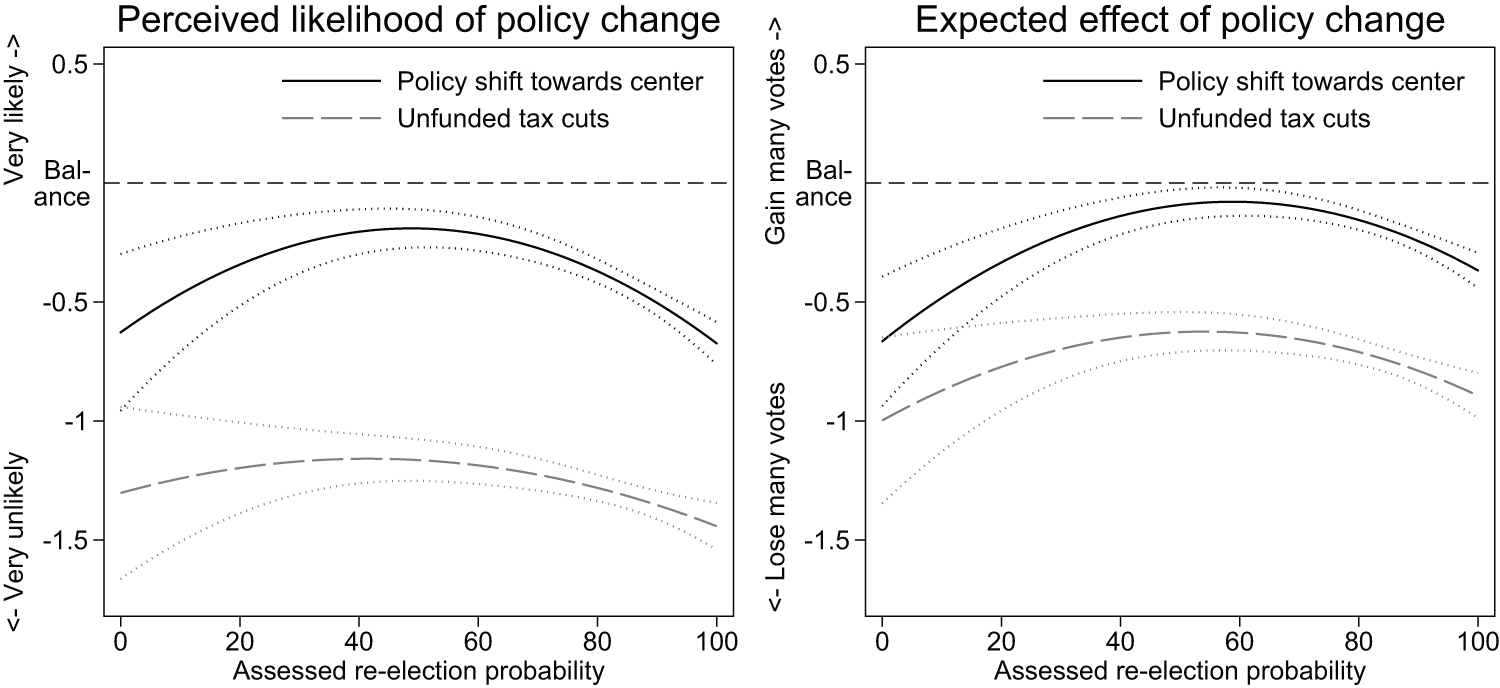
Figure 1 reports the incumbent government politicians’ answers to these two questions (scaled to range from −2 to 2), paired with data on their own assessment—at the survey date—of the probability that their party will be part of the governing coalition after the local elections in 2022, rated from 0 to 100 (N = 1,836). Each panel presents a quadratic fit of one’s policy change ratings to one’s assessed re-election probability. Bearing in mind that estimates are likely somewhat underestimated, a first take-away is that neither policy option is regarded highly; on balance, both are perceived as relatively unlikely (left panel) and ineffective (right panel). Second, the average incumbent politician is nevertheless substantially more favorable towards moderation (mean: −0.41) than myopia (mean: −1.29). Policy shifts towards the center are rated as likely or very likely by 15.7 percent of incumbents, compared to only 8.8 percent for unfunded tax cuts.Footnote 3 Third, it is clear that incumbent politicians who expect a more competitive election (as p approaches 50 percent) are significantly more likely to rate both the likelihood and the expected payoff of policy change higher—and more so for moderation.
Local incumbent politicians’ perceptions of opportunistic policy actions, by their assessed electoral prospects.

1 Long description
The image A showing Perceived likelihood of policy change. Legend: Policy shift towards center; Unfunded tax cuts. Horizontal axis label: Assessed re-election probability. Range: 0 to 100. Vertical axis tick labels: 0.5, Balance, negative 0.5, negative 1, negative 1.5. Vertical axis side text: Very likely; Very unlikely. Line styles: Policy shift towards center is a solid line. Unfunded tax cuts is a dashed line. Two dotted curved lines appear above and below each main line, denoting 95% confidence intervals. Balance reference: A horizontal dashed line at Balance. Policy shift towards center solid line: The curve rises from below negative 0.5 near assessed re-election probability 0, reaches its highest point between 40 and 60 while remaining below Balance, then declines toward assessed re-election probability 100 to below negative 0.5. Unfunded tax cuts dashed line: The curve stays below negative 1 across the full range, rises slightly toward its highest point between 40 and 60, then declines toward assessed re-election probability 100. The image B showing Expected effect of policy change. Legend: Policy shift towards center; Unfunded tax cuts. Horizontal axis label: Assessed re-election probability. Range: 0 to 100. Vertical axis tick labels: 0.5, Balance, negative 0.5, negative 1, negative 1.5. Vertical axis side text: Gain many votes; Lose many votes. Line styles: Policy shift towards center is a solid line. Unfunded tax cuts is a dashed line. Two dotted curved lines appear above and below each main line, denoting 95% confidence intervals. Balance reference: A horizontal dashed line at Balance. Policy shift towards center solid line: The curve rises from below negative 0.5 near assessed re-election probability 0, reaches its highest point between 50 and 70 while remaining below Balance, then declines toward assessed re-election probability 100 to below negative 0.5. Unfunded tax cuts dashed line: The curve stays below negative 0.5 across the full range, rises toward its highest point between 50 and 70, then declines toward assessed re-election probability 100.
These observations provide an important micro-level foundation for the panel data analyses to which we turn shortly. First, however, we need to discuss how to best estimate the competitiveness of elections over longer periods, for which we have no politician survey data at hand.
6. Measuring electoral competitiveness
Most policy analysts would probably agree that ideal measures of electoral competitiveness in policy analysis would be based on truthful responses by incumbents to questions about the probability that they will remain in power after the next election, posed at the time of policy-making (Boyne, Reference Boyne1998). However, the difficulties involved in collecting consistent data on such responses across time and space have led scholars to resort to various proxy measures.
In our view, the measures used in the literature reviewed above suffer from two shortcomings that limit their applicability in the present analysis. First, most indicators are not expressed as probabilities. Rather, they typically take a linear or non-linear form of a vote share margin—such as that between the governing parties and the opposition parties or that between the leading or largest incumbent party and the largest opposition party (e.g., Bernardi, Reference Bernardi2020)—sometimes also taking into account the historic degree of electoral volatility (e.g., Boyne, Reference Boyne1998; Hübscher and Sattler, Reference Hübscher and Sattler2017).
Second, all of them essentially only capture what may be called pre-electoral competitiveness, i.e., the uncertainty about the result of the upcoming election. As such, these measures are blind to the post-electoral competitiveness, i.e., the uncertainty concerning who will form the government given a certain election result. For multi-party systems such as the one under consideration, where coalition governments are the norm and where parties differ systematically in their capability of translating parliamentary seats into cabinet seats, such measures of electoral competitiveness are thus less useful for capturing re-election prospects.
7. An estimate of the incumbent re-election probability
To overcome these problems, we here apply the approach introduced by Cronert and Nyman (Reference Cronert and Nyman2021) to create a measure of electoral competitiveness which, arguably, comes closest so far to the ideal described above: it (a) refers specifically to the incumbent government; (b) is expressed in terms of the probability of its return to office after the next election; and (c) varies over the election cycle to better approximate the involved politicians’ re-election prospects at the time of policy-making.
As detailed in the SM (section S2), the approach involves a model that forecasts local parties’ election results by combining data on prior local election results and party-specific data from annual national-level vote intention polls from Statistics Sweden (2018, 2020b). These forecasts are then plugged into a coalition formation model which has been fit previously based on parties’ characteristics and observed coalition patterns.Footnote 4 The output is an annual, municipality-party-specific prediction of the probability that the party will be part of the coalition that assumes power after the next election. Importantly, because of the timing of the polls, this estimate refers specifically to November of each year—i.e., just around the time when the local tax rate and budget for the following year must have been decided.
To arrive at a measure of the local incumbent government’s re-election probability, p, we calculate a seat share weighted estimate of the re-election probability for the local governing coalition parties. The distribution of this measure as well as an assessment of its validity is reported in the SM (Figure S2).
8. Identification strategy
Research on the effects of electoral competitiveness on policy-making predominately relies on empirical strategies where most of the variation in the explanatory variable is found between different governments or electoral terms. However, any factor that makes one government more likely to be re-elected than another government is also likely to influence its policy-making, making such indicators highly susceptible to omitted variable bias. For example, as mentioned above, studies in this field often use a measure of competitiveness that is based either on the incumbent government’s support in the polls or the vote share margin between the largest incumbent party and the largest opposition party. Both these indicators are influenced by the popular demand for the government’s policies as well as by political institutions that foster grand or over-sized coalitions. Needless to say, such factors could also very well have an impact on government policy for reasons unrelated to the probability of re-election.
We therefore propose a new technique for generating plausibly exogenous variation in electoral competitiveness. To be clear, the problem of omitted variable bias cannot be definitively solved using this technique; yet, we argue that it is much smaller if one instead relies on the temporal variation in re-election probability that is found within a government’s term in office. The annual national-level vote intention polls mentioned above make this possible. By exploiting the fact that changes in the national party preference trends captured in these polls have very different implications for the local governments’ re-election probability depending on local factors—such as what parties are part of the government, how these parties performed in the previous election, and what other coalitions could potentially be formed—we achieve a source of variation that is less prone to omitted variable bias. Hence, our identifying variation does not come from the political circumstances that are specific to a certain incumbent government, nor from the changes in the national polls; both these factors are endogenous to policy. Instead, we exploit the variation that results from the interplay between the two factors, while holding all time- and local government-specific factors constant using fixed effects for municipality-term and year.
To illustrate this strategy, a useful analogy is the so-called Bartik or shift–share instruments (Bartik, Reference Bartik1991), that also combine local pre-conditions with national-level changes to generate a plausibly exogenous variation at the local level. In the canonical setting, Bartik was interested in estimating the elasticity of wages with respect to job growth. Because job growth is endogenous to the wage level, he instrumented it on the interactions of the local industry shares and the national growth rate in the respective industries, to create plausibly exogenous variation in local job growth. The intuition here is that while both the local industry structure and the national job growth are endogenous to wages, plausibly the interaction between the two is not. Although the strategy has received criticism (see Goldsmith-Pinkham et al., Reference Goldsmith-Pinkham, Sorkin and Swift2020), it has become a workhorse in empirical research on labor, migration, and urban development.
Unlike Bartik’s, our approach does not rely on an interaction term. Instead, the complex interplay between local pre-conditions and the national polls is modeled in the incumbent re-election probability estimation. As described in the SM (section S2), this procedure takes into account a host of factors, but the party-specific vote intention trends in the annual national polls are the only factors that vary within governments over the election term. As specified in Equation 1, we can therefore simply regress the coming year’s policy outcome (yi ,t +1) on our measure of electoral competitiveness (ci ,t) together with fixed effects at the municipality-term (ϕi) and year (τt) level. Some specifications add a vector of covariates (xi ,t), discussed further below. The time lag between the outcome and the electoral competitiveness measure is specified because, as noted above, the local tax rate and overarching budget are decided during the year before they have effect.
 \begin{equation}{y_{i,t + 1}} = {\beta _1}{c_{i,t}} + {{\beta }}\prime {x_{i,t}} + {\phi _i} + {\tau _t} + {\varepsilon _{i,t}}\end{equation}
We test our hypotheses in two complementing ways. The first, most straight-forward analysis uses dichotomous-dependent variables that indicate different kinds of policy changes. For taxation, these outcome variables include tax cuts and tax hikes, as well as ideologically opposed and ideologically preferred tax changes. For the latter two, a tax hike is coded as an ideologically preferred policy change if implemented by a left-wing government, and as an ideologically opposed change if implemented by a right-wing government—and vice versa for tax cuts.Footnote 5 These analyses are based on Equation 1, where the explanatory variable of key interest is electoral competitiveness (ci ,t). The myopia hypothesis H1 corresponds to a positive effect on the likelihood of tax cuts and a negative effect on the likelihood of tax hikes. The moderation hypothesis H2 instead corresponds to a positive effect on the likelihood of opposed tax changes and a negative effect on the likelihood of preferred policy changes.
The second analysis uses a continuous version of the policy outcome as the single dependent variable, and has the advantages of utilizing more information and generating comparable estimates of the prevalence of myopic and moderating behavior for each outcome. To enable this joint estimation, these models include our measure of electoral competitiveness (ci ,t) as well as an interaction between this measure and a binary indicator for left-wing incumbency in the local government (ci ,t × li), as specified in Equation 2:
 \begin{equation}{y_{i,t + 1}} = {\beta _1}{c_{i,t}} + {\beta _2}{c_{i,t}} \times {l_i} + {{\beta }}\prime {x_{i,t}} + {\phi _i} + {\tau _t} + {\varepsilon _{i,t}}\end{equation}
Crucially, the left-wing incumbent indicator used here (defined as in footnote 5) is centered around its sample mean, which means that β 1 tells us how an average incumbent government (rather than a right-wing incumbent) adjusts the policy outcome in response to changes in their re-election probability over the election term. For the local tax rate, the myopia hypothesis H1 states that β 1 < 0. Next, the coefficient for the interaction term (β 2) tells us whether incumbents respond to changes in their re-election probability in line with the moderation hypothesis H2—i.e., by deviating from their preferred policy. Because left-wing incumbents are assumed to prefer a higher tax rate, this hypothesis corresponds to a negative coefficient (β 2 < 0). Note that since left-wing incumbency in the local government does not vary within the 4-year election term in our data, the constitutive term for the left-wing incumbent indicator is omitted from the equation, since it is absorbed by the municipality-term fixed effects (ϕ i) included in these analyses.
We run the analyses on our municipality-year dataset spanning 1998–2018. In both sets of analyses, some specifications include a vector of covariates (xi ,t) based on official statistics. These are the population size (logged), the population density (logged), the share of people aged 0–19 years, the share of people older than 64 years, the share of households that claim social assistance, the employment rate, the present year’s budget balance, and the average value of the dependent variable in the other municipalities in the surrounding region (county). Most covariates are measured at the year of decision-making (t) and are included because they are likely to affect the need for public services. The last one—the regional average policy outcome—instead refers to the following year (t + 1) and is meant to control for spatial shocks not captured by the other covariates. For definitions, sources, and descriptive statistics, see the SM (section S4).
Our main sample consists of all municipalities and years for which the local incumbent government is categorized as either left or right (69 percent). The reason for omitting cross-cutting alliances in our main analysis is that it is not evident what the moderation hypothesis implies for governments not clearly positioned to the left or the right of the median voter. Robustness checks including cross-cutting coalitions are however reported in the SM (Tables S11 and S12). To make electoral competitiveness a monotonic function of p, we restrict the main sample to those 91 percent of municipality-terms where the average incumbent re-election probability p is equal to or greater than 0.5. An analysis that omits this restriction is also reported in the SM (Table S14).
9. Results
We begin by reporting the results from Equation 1, applied to the four dichotomous dependent variables denoting tax cuts and tax hikes as well as ideologically opposed and ideologically preferred tax changes. As noted earlier, the myopia hypothesis H1 stipulates that electoral competitiveness will increase the likelihood of tax cuts and reduce the likelihood of tax hikes, while according to the moderation hypothesis H2, electoral competitiveness will lead to more ideologically opposed tax changes and fewer preferred changes. We report three specifications of Equation 1. The first model includes the electoral competitiveness variable as well as fixed effects for the year and municipality term. The second model adds the aforementioned vector of controls, and the third additionally includes a full set of interactions between those controls, on the one hand, and competitiveness as well as left-wing incumbency, on the other.
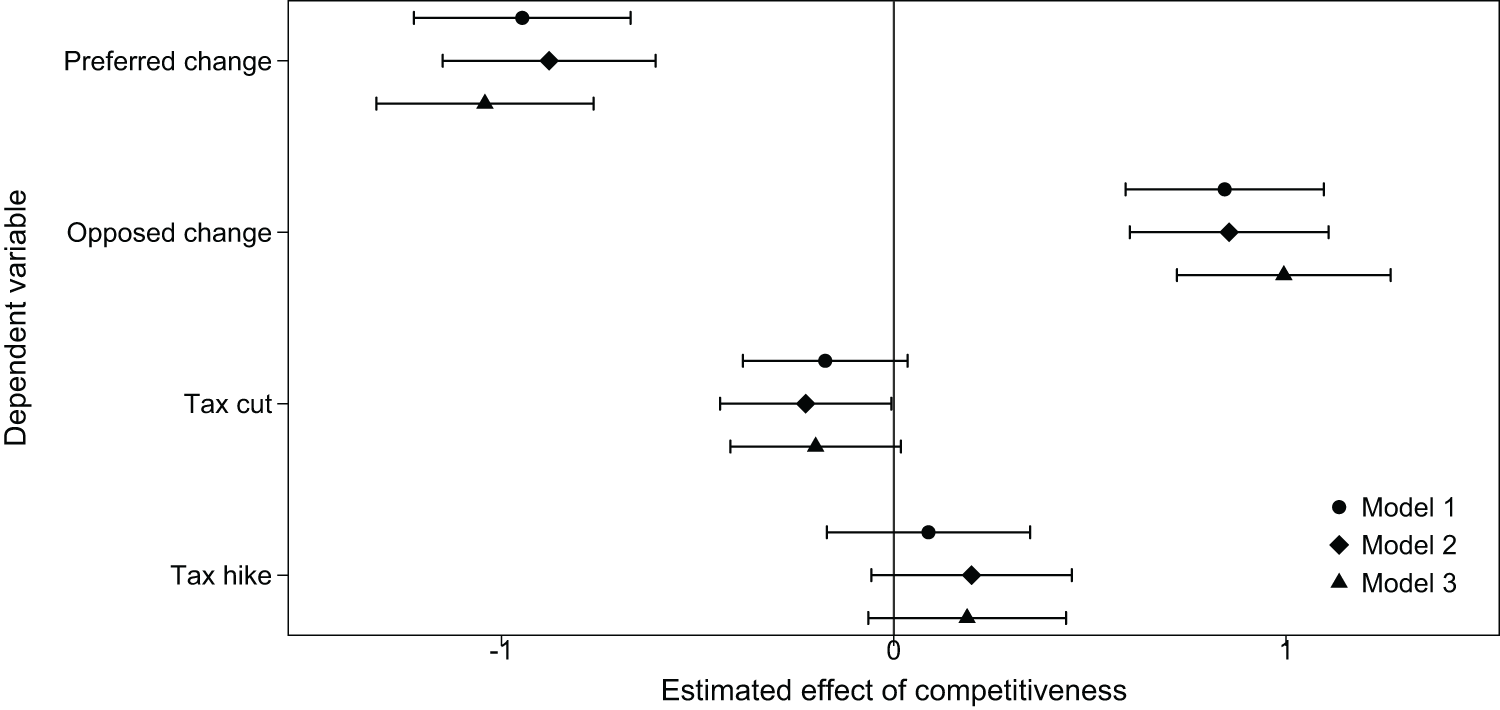
The estimated regression coefficients for electoral competitiveness (β 1) are reported in Figure 2. The negative effects on preferred changes and the positive effects on opposed changes yield strong support for the moderation hypothesis. According to our estimates, an increase in competitiveness by 10 percentage points would reduce (increase) the probability of a preferred (opposed) tax change by almost the same magnitude. By contrast, the coefficients for tax cuts and tax hikes yield no support for policy myopia. If anything, competitiveness appears to have the opposite effect to what the myopia hypothesis stipulates, but most of the relevant estimates are not significantly different from zero.
Effects of electoral competitiveness on different kinds of local tax changes.

Figure 2 Long description
The x-axis label is “Estimated effect of competitiveness”. The x-axis shows tick labels at minus 1, 0 and 1, with a vertical reference line at 0. The y-axis label is “Dependent variable”. The y-axis categories, from top to bottom, are “Preferred change”, “Opposed change”, “Tax cut” and “Tax hike”. A legend at the lower right lists “Model 1” with a filled circle marker, “Model 2” with a filled diamond marker and “Model 3” with a filled triangle marker. For “Preferred change”, three horizontal confidence-interval lines with markers are plotted to the left of 0. The filled circle marker is near minus 0.9. The filled diamond marker is near minus 0.8. The filled triangle marker is near minus 1.0. For “Opposed change”, three horizontal confidence-interval lines with markers are plotted to the right of 0. The filled circle marker is near 0.8. The filled diamond marker is near 0.8. The filled triangle marker is near 0.9. For “Tax cut”, three horizontal confidence-interval lines with markers are centered close to 0, with markers slightly to the left of 0. The filled circle marker is near minus 0.1. The filled diamond marker is near minus 0.2. The filled triangle marker is near minus 0.2. For “Tax hike”, three horizontal confidence-interval lines with markers are centered close to 0, with markers slightly to the right of 0. The filled circle marker is near 0.1. The filled diamond marker is near 0.2. The filled triangle marker is near 0.2.
Table 1 reports the results from the second set of analyses, which generates comparable estimates of the prevalence of myopic and moderating behavior in the same model. Here, the single dependent variable is the next year’s local income tax rate expressed in percentages. We run the same three specifications as before, but using Equation 2 which adds the interaction between left-wing incumbency and electoral competitiveness to each specification. As described in the previous section, the binary indicator for left-wing incumbency has been centered around its sample mean. As a consequence, the effect of competitiveness can be interpreted as the opportunistic policy response of an average (rather than a right-wing) government. To recall, if there is myopic behavior, the coefficient for competitiveness will now be negative (β 1 < 0), indicating that the average government responds to increased electoral competitiveness by reducing taxes more (or increasing them less) than it would have done had the election outcome been more certain. Moderation is instead captured by the interaction between left-wing incumbent and competitiveness. If there is moderating behavior, this coefficient will be negative (β 2 < 0). That is, when competitiveness is high, left-wing governments are less likely to raise taxes in line with their ideological preferences.
Effects of electoral competitiveness on the local tax rate

Table 1 Long description
The table reports three regression models estimating how electoral competitiveness relates to the municipal tax rate, including an interaction with a left-wing incumbent indicator centered around its sample mean. The main effect of competitiveness is negative in all models: −0.199 (SE 0.077, p<0.05) in model 1, then −0.094 (0.073) in model 2 and −0.072 (0.073) in model 3, both not statistically significant. The interaction term (left-wing × competitiveness) is negative and statistically significant in every model, becoming larger in magnitude as specifications add controls/interactions: −0.541 (0.233, p<0.05), −0.723 (0.213, p<0.01), and −0.858 (0.230, p<0.01). Sample size is about 3,749–3,750 observations; within-period R² rises from 0.006 in model 1 to 0.165 and 0.175 in models 2 and 3. All models include municipality-term and year fixed effects; additional controls are added in models 2–3, and additional interactions are added only in model 3. The dependent variable mean is 21.4, and standard errors are clustered by election period, so significance should be interpreted with that clustering in mind.
Note: Results for coefficients β 1 and β 2 in Equation 2, using the municipal tax rate as dependent variable. The left-wing incumbent indicator is centered around its sample mean, which means that the effect of competitiveness can be interpreted as the opportunistic policy response of an average (rather than a right-wing) government. Here, the myopia hypothesis H1 corresponds to a negative coefficient for competitiveness, while the moderation hypothesis H2 corresponds to a negative coefficient for the interaction between left-wing incumbent and competitiveness. The constitutive term for the left-wing incumbent indicator is absorbed due to the inclusion of the election period (municipality × election term) fixed effects, and is thus not estimable. Standard errors in parentheses, clustered by election period.
** p < 0.05, *** p < 0.01. For full output, see Table S3.
The take-away from these analyses is in line with the analyses reported earlier. As indicated by the coefficient for the interaction between left-wing incumbents and competitiveness in Table 1, we find a substantial and statistically significant moderation effect in all three specifications, ranging from −0.54 to −0.86. To illustrate the size of the effect, a coefficient of −0.5 would imply that the tax rate difference between left-wing and right-wing incumbents decreases by 0.25 percentages points when competitiveness moves from its minimum (0.5) to its maximum (1) value. The evidence for myopic behavior is much more limited. The coefficient for competitiveness is considerably smaller than the coefficient for the interaction between competitiveness and left-wing incumbency, and is statistically significant only in Model 1 without time-varying controls.
Note that since we are relying on the interaction term to separate between myopia and moderation, it is not possible to quantify these two behaviors separately for left-wing and right-wing incumbents; nor can we say that the results are driven by one bloc more than the other. Yet, for the purpose of illustration, we have estimated the models separately for the two types of governments in our sample, while excluding the interaction term (thus following Equation 1). These results are presented in the SM, Table S10. In these analyses, the coefficient for competitiveness is no longer a measure of myopia alone, but instead a measure of the overall expected tax policy response to an increase in electoral competitiveness, intermingling myopia and moderation. The analysis shows that increased competitiveness makes right-wing incumbents more likely to raise taxes and less likely to cut them, which is at odds with the logic of myopia and in line with the logic of moderation. For left-wing governments, we observe the opposite policy response, which is what we would expect under both moderation and myopia. These illustrations thus reflect the pooled sample analyses in Table 1, where moderation was found to be the more dominant behavior.
Additional versions of the analyses reported in Table 1, reported in the SM, confirm that the results above are not driven by any particular municipality (Figure S5), and that they are robust to the use of competitiveness measures based on the re-election probability of the largest incumbent party only (Table S9), as well as to the inclusion of cases where the municipality-term-average re-election probability p < 0.5; in which case the analysis distinguishes between electoral competitiveness (1 −|p − 0.5|) and electoral vulnerability (1 − p) (Table S14). Furthermore, heterogeneity analyses in Table S13 shows that myopia increases somewhat during election years, but moderation remains the more dominant behavior. Tables S11 and S12, lastly, report two supplementary analyses including cross-cutting coalitions; one in which they are analyzed separately, and one in which they are added to the main sample (in which case left-wing incumbency is coded based on the Mayor’s party). Neither analysis provides any evidence of policy myopia among these governments.
10. Alternative operationalizations of policy myopia
A potential objection to our results is that a more straightforward test for policy myopia could use policy outcomes that are less ideologically contested than the tax rate. To address this concern, we next estimate our second set of models for two additional outcome variables: the budget balance and the proportion of public investments (both as share of local GDP), considering that both increased deficits and reduced investments are commonly mentioned as symptoms of policy myopia. These results, presented in Table S6, again lend no support to the myopia hypothesis. The effects of competitiveness on the budget balance are positive, yet not statistically significant (ranging from 0.210 to 0.307). Interestingly, we find a larger, positive and mostly statistically significant effect of competitiveness on public investments (ranging from 0.367 to 0.420), indicating that governments invest more rather than less as competitiveness increases. While certainly opportunistic as defined here as well as in Veiga and Veiga (Reference Veiga and Veiga2007), this reaction favors the long term rather than the short term, at odds with the myopia hypothesis.
The relative appeal of investment expansions over investment contractions as an electoral tool is consistent with recent survey evidence on Swedish local politicians’ views on their re-election prospects and opportunistic policy actions (Cronert and Nyman, Reference Cronert and Nyman2024). One possible explanation for this result is that fiscal policy in Swedish municipalities is governed by a “golden rule,” which means that local governments are allowed to debt-finance investments, but not tax cuts or current expenditures.
11. Concluding discussion
This paper has sought to demonstrate how the relative importance of two distinct behavioral effects of electoral competitiveness—policy myopia and policy moderation—can be assessed in a joint analysis, focusing on economic policy–making in Swedish municipalities. We observed a substantial moderating effect of competitiveness on incumbents’ tax rate decisions—shifting policy towards the political center—but we found little evidence of policy myopia, whether in taxation, budget balance, or public investments. These contributions have important implications for future research on electoral democracy and economic policy-making.
First, the analyses show that politicians—also at the local level—are both sophisticated and opportunistic, as they are wary of how their re-election prospects are affected by movements in vote intentions polls and take these prospects into account when making policy. The relevance of vote intention polls for policy-making contrasts with the larger literature on democratic responsiveness that focuses on the policy impact of public opinions polls (for a recent exception, see Kayser et al., Reference Kayser, Orlowski and Rehmert2023).
Second, our findings also contrast with the overall dominance of the myopia perspective among scholars and policymakers interested in the opportunistic policy effects of elections. Indeed, over the last three decades, democracies all over the world have established institutions aimed to mitigate myopia in economic policy-making at both the local and national level, including budget rules, fiscal councils, and independent central banks. One possible interpretation of our results is that this focus on policy myopia has been misdirected, and that the extent of the problem has been exaggerated. However, another possibility is that our results instead reflect that the last decades’ institutional transformation has been successful: it may be the rules and procedures implemented since the 1990s to enforce fiscal discipline that inhibit opportunistic policy-making through myopic fiscal expansions in the case at hand (cf. Eslava, Reference Eslava2011).
Assessing this possibility, however, requires corresponding studies of historical cases, as well as studies of additional institutional and political environments. Indeed, an important task for future research will be to investigate to what extent and in what forms electoral opportunism, as a decidedly multifaceted phenomenon, manifests itself in different democratic contexts and along different policy dimensions, also beyond the socio-economic left–right dimension. In any event, pending such investigations, our results caution against the popular image among researchers and commentators of democratically elected politicians as inherently myopic and of the electoral cycle as “an inherent design flaw of democratic systems that produces short political time horizons” (Krznaric, Reference Krznaric2019).
A third take-away from our findings is that painting this more complete and nuanced picture of the opportunistic effects of elections would not have been possible without a measure of electoral competitiveness that lies close to the theoretical concept of interest—the incumbent’s re-election probability—and varies over time in ways that can be exploited for causal identification. While the present study has focused on one specific policy field, set in a favorable information-rich environment, we hope that it will stimulate much-needed scholarly efforts to improve the measurement and causal inferences of electoral competitiveness more broadly.
Supplementary material
The supplementary material for this article can be found at https://doi.org/10.1017/psrm.2026.10104.
Acknowledgements
We are grateful to Olivier Jacques, Catherine Moury, Patrik Öhberg, and the anonymous reviewers for valuable comments on earlier versions of this study. Thanks also go to Kåre Vernby for kindly sharing his survey data for Figure S1 with us, and to Vinicius Ribeiro and Robin Rönneke Belfrage for excellent research assistance.
Data availability statement
Replication data and code for this study is available at the PSRM Dataverse: https://doi.org/10.7910/DVN/JXT0SZ.
Funding statement
Funding for this study has been provided by Forte, Swedish Research Council for Health, Working Life and Welfare [2017-01121].
Declaration of competing interests
The authors have no competing interests to declare.
Ethics approval statement
Approval for this study has been granted by the Swedish Ethical Review Agency [2020-00498].


 Open access

