




The chickpea, best known as the “Eagle’s Beak Bean” (yingzui dou 鷹嘴豆), has become popular in China today as part of a global trend that celebrates it as a healthy superfood. Far less recognized is the legume’s millennium-long history in premodern China.Footnote 1 Likely introduced as early as the 1000s, the chickpea was perceived in shifting ways, at times an exotic delicacy for elites, and at others a source of sustenance in times of need; yet it consistently retained an air of foreignness.
A methodological concern that needs foregrounding is a common issue widely encountered in the study of historical botany: the problem of nomenclature. The names and descriptions of the chickpea in Classical Chinese constitute what Leah Knight refers to as a “tumultuous verbal display.”Footnote 2 Assuming that the chickpea existed in premodern China as a clear, intelligible material object, the naming of the object was already tenuous, as the plant was bestowed with multiple names by disparate observers. Furthermore, to name the chickpea was not a simple matter of matching a thing with a word. Some botanical namers might have experiential knowledge of the legume, while others might have never seen the plant. The naming process thus could be an empirical alignment of a thing and a label, a bookish task of fitting a name into a certain context, or a mixture of both. It requires historical detective work in each case to understand the nature of the naming process, and in many instances, modern scholars lack sufficient evidence to be certain.
It is thus more accurate to view the chickpea as a textual object rather than a material one. The history of the legume is best characterized as a medley of shifting textual identities, each emerging as a product of a specific historical context. The empirical knowledge of the legume held only marginal significance in the construction of a textual identity. To satisfy a historian’s undying interest in actual occurrences, I hone in on a selection of three textual identities of the chickpea, each backed by reasonable evidence of experiential knowledge of the legume.
At the core of each textual identity of the chickpea lay a name, accompanied by what I call a “textual nugget.” A textual nugget was a short description of the legume regarding its physiology, habitat, and/or medicinal attributes. The original authorship of these nuggets is often elusive, as they have been repeatedly reproduced and transplanted across writings and genres. So far as I can tell, each textual nugget concerning the chickpea has made multiple appearances across different texts, devoid of singular contents insulated to the intent of a specific author. The compilers who deployed these nuggets achieved their objectives by strategically pairing textual nuggets and names. Occasionally, they made slight alterations to the contents due to their own botanical judgements, while more often than not they left them unmolested in the original language. The textual nuggets thus possessed a degree of autonomy.
The three textual identities of the chickpea span the five centuries from the middle period of China to the end of the empire. The legume had its first moment of prominence as a cosmopolitan “Muslim Bean” in the 1300s. It then experienced a phase of obscurity as the most renowned Chinese herbalist, Li Shizhen 李時珍 (1518–1593), conflated it with the pea. A disparate identity of the legume emerged around the same time, as the bean garnered attention from famine relief specialists, consequently transforming into a source of sustenance for the impoverished.
The multiple lives of the chickpea were characterized with a common emphasis on its foreignness. It had been consistently named after Eurasian cultures on the margins of the Chinese empire, and during the period under study, it implied connections with various parts of the Islamicate world. Though it carried a continual flair of foreignness, the legume remained tenaciously present, with some accounts noting its widespread availability. The plant’s enduring presence, coupled with ongoing allusions to its alienness, makes it a perpetual foreigner in the broad expanse known as the “Central Lands” (Zhongguo 中國).
Two aspects of this foreignness merit attention. For one, it was the product of a multi-centered Asia instead of a Sino-centric order, as the “Central Lands” passed under Mongol, Han, and Manchu rule, each connected with Muslim communities of their own times. For another, the foreignness was a subdued exoticism, suggestive more of cultural flair than of blatant alterity. This tempered quality emerged, first, from processes of lexicalization, as references to foreign identity shifted from literal markers to coded meanings within cultural scripts, and second, from the Islamicate world’s manifold locally shaped identities.
The constant bean
Before delving into history, it is crucial to first examine the chickpea through the lens of modern plant science. I base my search for the legume in historical sources on the physiological characterization of the modern chickpea plant. I state the method with awareness of potential pitfalls. Historians commonly rely on the physiology of modern plants to identify historical specimens, assuming that plant appearances remain consistent over time. As a methodological reflection, it is certainly worthwhile to ponder how the historical evolution of a species may impact the accuracy of our assessment.
Luckily in the case of the chickpea, modern plant science furnishes evidence to substantiate its own application. The biology of the modern-day chickpea remains largely consistent with its historical counterparts due to its highly limited genetic diversity. The chickpea (Cicer arietinum L.), the pulse legume we know today, has C. reticulatum as its immediate wild progenitor. The distribution of the wild progenitor has been extremely narrow, which leads to its low adaptive variation—a characteristic established as early as in the Neolithic period. The wild progenitor currently exists only in eighteen locations which gather in a narrow band (37.3–39.8°N, 38.3–43.6°E) in southeastern Turkey.Footnote 3 In addition, the chickpea transformed from an autumn- to a spring-sown crop in the Early Bronze Age, which further reduced its genetic diversity. As a result, the plant already featured a low level of polymorphism long before modern breeding selection (see Figure 1).Footnote 4
Comparison of Distributions of Wild Progenitor between Chickpea, Barley, Einkorn Wheat, Emmer Wheat, Lentil, and Pea. From Shahal Abbo, Jens Berger, and Neil Turner, “Evolution of Cultivated Chickpea: Four Bottlenecks Limit Diversity and Constrain Adaptation,” Functional Plant Biology 30 (2003), 1082.
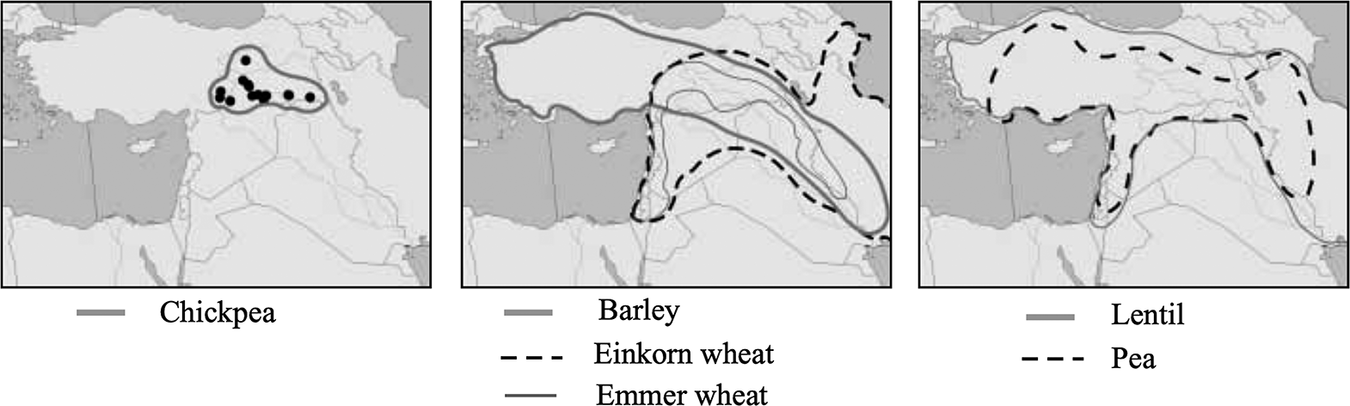
Figure 1. Long description
A three-panel series of geographical maps of the Near East and Turkey.
Left panel: Chickpea distribution. A small, concentrated area in Southeast Turkey and Northern Syria is outlined with a solid grey line and contains several black dots representing specific collection sites.
Middle panel: Barley, Einkorn wheat, and Emmer wheat distributions. Barley is represented by a thick solid grey line covering a vast area from Western Turkey through the Fertile Crescent into Western Iran. Einkorn wheat is shown with a dashed black line, concentrated in Southeast Turkey and Northern Iraq. Emmer wheat is indicated by a thin solid grey line, following the arc of the Fertile Crescent from the Levant through Northern Iraq.
Right panel: Lentil and Pea distributions. Lentil is shown with a solid grey line covering a broad area across Central and Southeast Turkey, extending into the Levant and Northern Iraq. Pea is represented by a dashed black line with a similar but slightly more restricted distribution, primarily focused on the Fertile Crescent arc and Southeast Turkey.
The physiological properties of the modern chickpea thus provide a reasonable framework for identifying its presence in premodern sources. A most critical characteristic for my inquiry is its habitat. The chickpea is a rainfed plant that remains poorly adapted to high rainfall, and a cool-season legume well suited for semi-arid and arid regions.Footnote 5 The plant is thus not widely seen in southern China, where rainfall is high. In today’s agrarian geography, the chickpea thrives best in the northwestern borderlands: modern Xinjiang, Gansu, Ningxia, and Qinghai.Footnote 6 The appearance of the modern plant also furnishes critical references, particularly the relatively short pod yielding two to three beans, the fern-leaf structure, and the ram’s head shape of the bean.Footnote 7
The cosmopolitan Muslim bean
The first time the chickpea appeared in the spotlight concurred with the rise of the Mongol Yuan dynasty (1271–1368), when it was cherished as a culinary staple and a food of healthcare value under the name Huihui dou 回回豆 (Muslim bean).Footnote 8 In Yuan vocabulary, Huihui was an inclusive term encompassing various peoples associated with the Islamicate world. While it primarily referred to the Persians, it also included Arabs and Islamized Turks across the Eurasian steppes.Footnote 9 Though appearing in commoners’ recipes occasionally, the Muslim bean was primarily associated with the Mongol regime and signified the imperial ambition to integrate the Islamic and Sinitic cultures under the Turko-Mongol framework.Footnote 10
The legume makes a most systematic presence in the Yinshan zhengyao 飲膳正要 (Essentials of the emperor’s food and drink), a fourteenth-century compilation which included cooking recipes and dietary medicine. As evinced by the title, the text was intended for the Yuan emperor as a guidebook for culinary excellence and healthcare. Not only did the text cater to an elite palate, it also addressed a cosmopolitan elite specific to the Yuan world, where the Mongols ruled in assistance with various Eurasian peoples ranging from Jurchens in the east to Persians in the west. As Paul Buell and E. N. Anderson point out, the book presented a “new international cuisine” rooted in a Mongol core embellished with spices and techniques from China and Persia.Footnote 11 It articulated the “world conquering” ambition of the Mongols and materialized an imperial order sweeping across Eurasia.Footnote 12
The author Hu Sihui 忽思慧 (d. 1330), a court dietitian, appeared well-suited for crafting this new international cuisine due to his multicultural background. Growing up in the Ningxia region, he spoke both Chinese and a Turkic language and was likely a descendent of the Hexi Uyghurs. He was evidently knowledgeable about the fusion of Sino-Turkic cultures in the northwestern borderlands and brought multicultural readiness to his service of the Mongol court.Footnote 13
The chickpea’s identity in the Yinshan zhengyao comprised two parts: first, as a main ingredient in West Asia-influenced recipes, and, second, as a Chinese materia medica. This duality aligns with the structure of the text, which consists of three chapters, including a collection of West Asia-inspired recipes, an assemblage of drinks and liquid food, and a catalog of all materia medica used in its aforementioned recipes. The chickpea appears frequently in recipes across the opening chapter and reappears in the final section, standing out as the second most common foodstuff used throughout the book.Footnote 14 The two parts were not perfectly coherent with each other; nevertheless, the discrepancies demonstrated Hu’s efforts to impart diverse cultural values to the legume.
In the opening chapter, the Muslim bean features prominently in twenty recipes, consistently as a thickening puree for soups/stews. The very first recipe, that of the “Mastic soup” (Masidaji tang 馬思答吉湯), is a good example of how the Muslim bean was used:
Mastic soup
It bolsters and boosts, warms the middle, and smooths the qi.
Mutton (one leg: cut up as pieces), tsaoko cardamoms (five), cinnamon (two qian), Muslim beans (half sheng; mashed and deskinned)
Boil all of the aforementioned ingredients into a soup. Strain broth. Add two he of cooked Muslim Beans, one sheng of aromatic non-glutinous rice, one qian of mastic. Add a little salt and adjust the taste. Add the cut-up meat and [garnish with] cilantro.Footnote 15
馬思答吉湯
補益、溫中、順氣
羊肉一腳子卸成事件, 草果五箇, 官桂二錢, 回回豆子半升搗碎去皮
右件一同熬成湯, 濾淨, 下熟回回豆子二合, 香粳米一升, 馬思答吉一錢, 鹽少許, 調和勻。下事件肉、芫荽葉。Footnote 16
The recipe incorporates the Muslim bean twice. First, the legume was boiled, skinned, and pulverized before being boiled with mutton, presumably melting into the texture of the soup. Then, additional cooked beans were added to the strained soup as a final touch. Overall, the legume was used to give body to the soup. The practice of boiling, skinning, and mashing Muslim beans was seen in all other relevant soup/stew recipes in the Yinshan zhengyao. Buell and Anderson identify the procedure with late medieval Middle Eastern techniques for cooking the chickpea, which affords circumstantial evidence confirming that the Muslim bean was indeed the chickpea.Footnote 17
In the final chapter, Hu Sihui mentions the Muslim bean a second time, including it among over two hundred foodstuffs identified as materia medica. Each food appears with a description of physiological and healthcare properties articulated according to Sinitic medical theories. Hu divides the collection into five categories, the first being “rice and grains” (migu 米穀). The Muslim Bean appears in this category along with thirty other items:
The Muslim bean: sweet in sapidity and lacking in potency. Mainly used for treating “wasting thirst.” Do not eat it boiled with salt. It appears on the grounds of the Muslim territories, and the seedling resembles [that of] beans. Today it exists everywhere in the open fields.
回回豆子 : 味甘, 無毒。主消渴。勿與鹽煮食之。出在回回地面, 苗似豆, 今田野中處處有之。Footnote 18
This description once again supports the likelihood of the Muslim bean being the chickpea. Hu pinpoints the geographical origin of the legume as the “Muslim territories” (Huihui dimian 回回地面). Just like the term Huihui, the Huihui dimian/tiandi 田地 broadly denoted the Islamicate world, though historical actors employed it without precision, allowing its associations to shift with context. For example, in an edict in 1291, Kublai Khan (r. 1260–1294) employed the term to refer to both West Asia and East Africa connected by the Arabian Sea;Footnote 19 and in a diplomatic document regarding taxing Muslim traders, Yuan officials invoked the term for the Il-Khanate (1260–1335).Footnote 20
Despite its ambiguity, the attribution of Huihui dimian makes the chickpea the strongest contender for the title of the Muslim bean. Locating the bean in the Huihui domain makes the Muslim bean part of an exotic minority in the Yinshan zhengyao. Despite the strong influence of the Islamicate world on the treatise, Hu explicitly identifies only five foods as grown in the “Muslim territories,” the other four being mastic (Masidaji, Mastajhi), saffron (Za’faran, Zanfulan 咱夫蘭), almonds (Badanren 八簷仁), and pistä (bisida 必思答).Footnote 21 All other foods had transliterated names, indicating a recent history of being imported from West Asia into China.Footnote 22 While some other legumes such as the pea could also be used as a thickening agent, they lacked the prominent foreign connotation needed for inclusion in the Huihui food group.Footnote 23
The crux of this passage lies in Hu’s effort to incorporate the Muslim bean into the discourse of materia medica, a millennia-old tradition that defined Chinese medicine. He accomplished the goal by conveniently lifting a passage from a Tang pharmacopeia Bencao shiyi 本草拾遺 (Retrieved remnants of materia medica), despite the fact that the text was about a “foreign bean” (hu douzi 胡豆子).Footnote 24 Chen Cangqi 陳藏器 (681–757) writes:
The foreign bean is sweet in sapidity and does not have potency. It is mainly used for treating “wasting thirst.” Do not eat it boiled with salt. The seedling resembles [that of] beans and grows in open fields. It often appears among rice plants.
胡豆子, 味甘無毒, 主消渴, 勿與鹽煮食之。苗似豆, 生野田間, 米中往往有之。Footnote 25
The first part of the statement, which Hu nearly quotes verbatim, contains what he needed the most: therapeutic properties couched in the language of Chinese medicine. The bean is described as having a sweet sapidity with no potency, a remedy for “wasting thirst.” The “sweetness” (gan 甘) belonged to the system of the Five Sapidities (wu wei 五味), a medical theory which organized the healing properties of foods/drugs according to sour, bitter, pungent, and salty, in addition to sweet.Footnote 26 A “sapidity” was not a description of an empirical flavor, but a prescription of medicinal functions of a food which likely—but not strictly—tasted sweet. With the modal sweetness, the Muslim bean would presumably help to alleviate acute movements of the qi. Footnote 27 By calling it “free of potency,” Hu identifies the bean as devoid of any salient therapeutic power; it would neither induce an immediate remission of an ailment nor cause any discernible harm.Footnote 28 But if someone suffers “wasting thirst,” that is, excessive thirst and frequent urination, consuming some Muslim beans would help alleviate the situation.Footnote 29 In addition, Hu advises against boiling the beans with salt, presumably only in the context of preparing the legume for a patient suffering from “wasting thirst.”
Hu’s effort to transform the Muslim bean into a materia medica appears congruent with his broader interest in adopting Chinese medical theories. The legume was part of an extensive collection of “rice and grains” occupying the top category of all foods, which was itself a saliant convention in a Chinese pharmacopeia. Rice and grains were not the primary ingredients in the recipes documented in the Yinshan zhengyao, as they were not so central to the Turko-Mongol diet. According to Buell and Anderson, the elevation of rice and grains was due to the “Sinicized audience” Hu had in mind.Footnote 30 Along the same line, Hu duplicated much content in this category from Tang and Song medical texts, including the selection of species and their descriptions.
Against the backdrop of extensive replication, the Muslim bean stood out with a greater creative twist—it was the repackaging of old content under a new name. It was unclear whether Hu truly believed in the equivalence between the foreign bean and the Muslim bean. Practically, the lack of physiological description makes the textual nugget easy to appropriate, as it offers no details about the appearance of the foreign bean, allowing its properties to be easily transferred to a new specimen.
Nevertheless, potential inconsistencies existed between the foreign bean and Muslim bean, hence Hu’s alteration of the language regarding the legume’s habitat. He first adds the reference to the “Muslim territories,” which was crucial to establishing the bean’s unique geo-cultural associations. He further drops the segment on the legume’s regular companionship with rice plants and substitutes a more generic statement that it “exists everywhere in the open fields.” This adjustment partly aligns with modern plant science, which considers it unlikely for the chickpea to extensively co-exist with rice plants, as the latter primarily thrive in flooded paddies further south. But the new claim on its presence “everywhere” is also questionable, as it remains unclear whether Hu was suggesting a broad potential territory for cultivation across the “Muslim territories” or the Yuan empire spanning the north and south.
Could it be true that the chickpea was much more widely seen in China during the Yuan period? Some circumstantial evidence supporting this claim resides in the climate: during the Little Ice Age of the late Yuan, colder temperatures from the north to the south may have facilitated the habitat expansion of cool-season legumes like the chickpea.Footnote 31 While it is challenging to find more specific proof, we should also not overlook what the statement literarily attempted to convey: it encouraged readers to believe in the wide availability of the chickpea, a point asserted to be true.
Taken together, the Muslim bean, presumably in significant quantities, brought a foreign flair into the Yuan imperial recipe for crafting a vibrant cosmopolitanism. By referencing Huihui in its name, the legume highlights the Muslim population in the empire, particularly the Persians, who were most active as officials, merchants, and technical experts under Yuan rule.Footnote 32 From the emperor’s point of view, it also symbolized the significant tie between the Il-Khanate—the western end of the Mongol sphere—and his own domain based in China.Footnote 33 Moreover, this Muslim-foreignness of the legume was not presented as a static feature; it was actively brought into an interaction with Sinitic culture. By morphing into a materia medica, the legume brought a healing power from the “Muslim territories” to address healthcare within the Chinese domain, effectively merging the eastern and western ends of the Mongol world into a mutually beneficial system. The chickpea transpired to be a mighty foreign presence—exotic, trans-cultural, and ubiquitous.
The bean which passed the foreignness
In this section, I discuss a historical moment when the chickpea became conflated with the pea and transferred its foreign allure to the everyday staple. The textual confusion emerges from the hands of Li Shizhen, the author of China’s foremost tome of pharmaceutical lore—the Bencao gangmu 本草綱目 (Classified materia medica). Li directly appropriated the Muslim bean and the erstwhile medicalization effort by Yuan authors, reinterpreting them under a new medicinal identity of the pea.
It all begins with Li’s desire to incorporate the pea as a new pharmaceutical item. Known as the wandou 豌豆, “the bean with curled [seedlings],” the pea was “a food of daily use” (riyong zhi wu 日用之物) and yet made no appearance in pharmacopeias before Li’s times.Footnote 34 Li addresses the omission by creating a medicinal identity for the legume through excerpts from existing medical writings. This approach was surely intriguing, as it directly contradicted his claim that there was no mention of the pea as a materia medica. To navigate this, Li selects certain legumes under other names and imputes their documented properties onto the pea—under the premise that all these other beans were but the pea with alternative names. The wandou is the “master name” (zhengming 正名), whereas all others are “alternative names” (bieming 別名).Footnote 35 In Li’s understanding, the master name wandou comes from a descriptive name of the plant in Classical Chinese, that “its seedlings are tender and curled” (qi miao rouruo wanwan 其苗柔弱宛宛), with wan 豌 being the phonetic loan of wan 宛.Footnote 36 Li assigns the Muslim bean to be an alternative name and incorporates most of its medicinal properties into his portrayal of the pea.
To “rescue” a legume with no existence in pharmacological literature, Li has to identify a “first” appearance of the pea which came under another name. He chooses the foreign bean recorded by Chen Cangqi—exactly the same choice as Hu Sihui’s—hence beginning the process of appropriating the Muslim bean. Chen’s description served his purpose well for its old provenance and ambiguity on physiology. Li drops the suffix zi and presents the term more formally as hudou, and then announces the equivalence between the hudou and wandou. He further asserts that the pea originated in the lands of “foreign barbarians” (hu rong 胡戎), justifying the invocation of foreignness by an overtly named foreign bean.Footnote 37 Li then enumerates seven alternative designations, including the Muslim bean, all of which presumably referred to the pea in different times.
Li continues his appropriation of the Muslim bean in the section on “primary medicinal efficacies” (zhuzhi 主治), where he cites three references and adds one original statement.Footnote 38 The foremost reference again comes from Chen’s description of the foreign bean—now also the pharmaceutical characterization of the Muslim bean by Hu. It states that the legume was mainly for treating the condition of wasting thirst, and it should be consumed boiled bland.
The remaining two references are worth mentioning because they are also similarly arbitrary appropriations. The first comes from the entry on the qingxia dou 青小豆 (“little green bean”) in the Qianjin fang 千金方 (Prescriptions worth a thousand gold pieces), where the legume was described to facilitate urination and alleviate abdominal bloating.Footnote 39 At first sight it seems reasonable for Li to cite this information, as he claimed earlier that the little green bean was another alternative name of the pea. Intriguingly, however, he also cites the same language for his description of the lüdou 綠豆, “the green bean.”Footnote 40 If we have to adjudicate which bean correctly merits the description, internal evidence from the Bencao gangmu points to the green bean: the rest of its profile demonstrates clear parallels with the line in question, a coherence which simply did not exist in the case of the pea. Similarly, the second medicinal description of the pea is a quotation from the Riyong bencao 日用本草 (Daily materia medica), one which originally describes the candou 蠶豆, “the silkworm bean” (the fava bean). The characterization shares no commonalities with the previous two, nor with Li’s own claim, which comes as the third.
Taken together, the medicinal profile of the pea is a disjointed composition based on appropriation of other legumes. The majority of its healing efficacies come from earlier writings on legumes with different names, starting with the Muslim bean. If this can be explained away with Li’s theory of master and alternative names, the disparity among therapeutic effects demonstrates an even less defensible inconsistency in medical argument. The efficacy portfolio of the pea, indeed, is a patchwork resulting from bookish efforts to assemble a new narrative. It remains a question whether Li had truly encountered a chickpea plant before appropriating the Muslim bean, as he could have done the textual work without direct experience.
Despite the uncertainty surrounding Li’s firsthand understanding of the legume, he demonstrates a keen interest in the textual record of the Muslim Bean, also found in his discussion of general health benefits. In the section “Explications” (faming 發明), Li centers the Yuan narrative and cites Hu’s use of the bean in the Yinshan zhengyao recipes:
In Yuan drink and food practices, whenever this bean is used, it is pulverized and skinned, consumed together with mutton. It is said to boost the center and facilitate the qi.
元時飲膳, 每用此豆搗去皮, 同羊肉治食, 云補中益氣。Footnote 41
To Li, the efficacies of “boosting the center and facilitating the qi” align with the connection between the pea and the Earth Phase:
The pea belongs to the Earth, and it is thus often used for treating diseases of the spleen and the stomach.
豌豆屬土, 故其所主病多系脾胃。Footnote 42
The pea facilitates the spleen and the stomach with a force emerging from the Phase of the Earth, which justifies its frequent use in health-boosting recipes, such as the mutton stews in the Yinshan zhengyao. This reasoning reflects the attention Li devotes to the Yuan treatise. He incorporates both aspects of the Muslim bean—not only the Sinitic side manifest in the materia medica discourse but also the Eurasian facet, where the bean features in West Asian culinary recipes. The connection was by itself not so accurate, as in the Yuan cookbook, the mutton soup, not the beans alone, contribute to “boosting the center and facilitating the qi.” The imprecision, nevertheless, emerges outright from Li’s eagerness to integrate as much Yuan material as possible.
At this point, it might appear that Li has successfully subjugated the Muslim bean to the reign of the pea. Most conspicuously, the legume has lost its foreign aura by dropping the reference to the Muslims and come under a master name rooted in literary Classical Chinese. But Li was not motivated by xenophobia towards foreign connections; on the contrary, he transposed the Eurasian connection into the identity of the pea and amplified it.
Li’s intention to highlight the foreignness of the pea becomes evident in the opening line of his physiological description of the legume:
The pea was a specimen originating in the Western foreign lands, and it appears abundantly in the north today.
豌豆種出西胡, 今北土甚多。Footnote 43
While Li is correct that the legume originated in regions to the west of China, its foreign provenance had receded into obscurity in quotidian contexts at least a millennium before his time.Footnote 44 A brief look into the history of the pea may help clarify this. Prior to Li’s rebranding project, the pea was a staple food and everyday source of sustenance. It was food for everyone, particularly for those in need. Judging by extant evidence, the term wandou first appeared in writings from the Six Dynasties (220–589), including the famous agricultural treatise Qimin yaoshu 齊民要術 (Techniques essential for the subsistence of common people) and a number of Buddhist texts. Behind its textual debut was a legume already naturalized into Chinese foodways. The term wandou consistently referred to a legume for daily consumption, and the bean was so commonplace in everyday life that it became a reference object for size comparison.Footnote 45 “Like the pea” (ru wandou 如豌豆) served as a familiar metaphor for a tiny quantity, a function that could only be fulfilled by a ubiquitously available object.Footnote 46
The wide presence of the pea had to do with its hardy and prolific nature, a merit well recognized in agricultural writings from the middle period through Li’s time. In Nongsang jiyao 農桑輯要 (Essentials of agriculture and sericulture), the compilation encompassing numerous earlier farming treatises, the author highly praises the pea for its early harvest time, abundance, low-maintenance, and extended durability.Footnote 47 The Song author Dong Wei 董煟 (fl. ca. early 1200s) in his Jiuhuang huomin shu 救荒活民書 (Book for relieving famines and saving the people) mentions a case in which the legume helped avert a famine because of its strong resistance to locusts.Footnote 48 As Li Shizhen nicely summarizes himself, the pea was “the foremost among all kinds of grains” for its extraordinary capacity to feed a large population cost-efficiently.Footnote 49
Therefore, while Li’s statement on the pea’s foreign origin may be accurate, it would nevertheless astonish some of his contemporaries, who consumed the legume daily and took its familiarity for granted. Li might have various reasons for attributing novelty to something so commonplace, but one practical concern could be leveraging the pea into medical discourse. To be sure, being exotic was not a requirement for a species to claim pharmaceutical value; in fact, numerous quotidian foods including rice and soybeans had obtained materia medica status long before. What was curious about the pea, as Li stated himself, was its exclusion from this class of therapeutic foods. Highlighting a possible foreign origin was an expedient way to account for this long-standing omission and to expedite its inclusion. Returning to the chickpea, the Muslim bean imparted a Eurasian quality to the pea, despite losing its distinctly foreign name. Its foreignness gained renewed significance once it became integrated into a staple deeply embedded in the everyday cuisine of the empire.
Given his historical status as the premier herbalist, Li’s conflation of the chickpea with the pea had an enduring influence for the next three centuries. Numerous texts including pharmacopeias, herbals, general encyclopedias, and gazetteers, simply quote the equivalence of the two legumes.Footnote 50 Determining whether each author had empirical knowledge of both plants requires a case-by-case investigation. However, it is likely that many authors, particularly those in the south, simply recognized the pea by its various names without even realizing the existence of the chickpea. This to a certain extent caused the “extinction” of the chickpea in the textual world.
Local writings from some northwestern provinces provide an intriguing continuation of Li’s narrative. Judging by their physiological descriptions, many authors clearly recognize the differences between the two legumes, which affirms that the cultivation of the chickpea today in these regions traces back at least to the Ming. Based on a robust empirical understanding, many of these authors list the pea and the Muslim Bean as distinctive foods.Footnote 51 Others reproduce Li’s language of equivalence, albeit not to the effect of erasing the chickpea but of emphasizing the pea’s foreignness. The Chongxiu Zhenyuan xian zhi 重修鎮原縣志 (Revised gazetteer of Zhenyuan, 1936), for example, is a gazetteer of a county in modern Gansu, the heartland of chickpea cultivation. The text introduces the wandou as follows:
One variety [of the pea] has the shape of a round vault, resembling the Muslim hat. Its common name is the Muslim bean, or the peach bean. According to the Bencao gangmu, the pea is also known as the foreign bean, the bean of the mountain barbarians, or the Uyghur bean.
一種形銳圓似回回帽者, 俗名回回豆, 亦名桃兒豆。《本草綱目》 豌豆一名胡豆, 一名戎菽, 一名回鶻豆。Footnote 52
While the latter half of this statement is a reiteration of Li’s argument, the first half is clearly a description of the chickpea. The new alternative name peach bean furnishes telling evidence. A round peach with a pronounced suture looks more similar to the ram’s head shape of the chickpea than a smooth pea. The term “peach bean” was part of a trend in descriptive naming that started no later than the Ming, when northwesterners named the chickpea based on its resemblance with other familiar objects, such as the “chicken’s head bean” (jitou dou 雞頭豆) and “eagle’s beak bean.”Footnote 53 Whether referring to a peach, a chicken’s head, or an eagle’s beak, all described a spherical shape with a ridge, typical of the chickpea.
The overtly ethnizing tone of the statement is also worth consideration. The comparison to the “Muslim hat” (possibly the doppa) ascribes a form of ownership of the legume to the modern Uyghurs. The text then further corroborates this ethnic ascription by citing selected historical names, all of which reference a Eurasian connection, whether “mountain barbarians” (a designation of ancient Xiongnü) or the Huihu (pre-Islamized medieval Uyghurs).
Given the detailed descriptions of unique physiology and ethno-cultural associations, the claim of equivalence between the chickpea and the pea no longer had the power to overshadow the former legume. Instead, the pea was now ascribed with a history consistently embedded in Eurasian steppe cultures from antiquity to the present. Similar to Li’s account but extending beyond it, its merging with the chickpea caused the pea’s identity to shift from quotidian banality to marginalized foreignness.
The Bean for the Poor
Whereas Li Shizhen’s appropriation diminished the chickpea to a certain extent, the legume received a new identity from his contemporaries who wrote with food insecurity on the mind.Footnote 54 This is perhaps the historical moment when we can recognize the legume with the greatest certainty, as its appearance is documented in specific language and aided with visualizations. The famine-relief treatises present the bean as an edible plant in times of need, providing thus far the most reliable guidance for a forager to find it in the wild. The legume resumes its old name—the Huihui dou—and yet it shares little in common with the previous Muslim bean in textual presentation. It rejects medicalization and appears with minimal conceptual embellishment. The legume’s foreignness takes on a new meaning in these texts: it moves away from exoticism toward interactive engagement with specific Eurasian communities, as it is now presented as a famine staple, identified by names reflecting Turko-Iranian phonetics.
The new Muslim bean once again consists of a recurring textual nugget describing its characteristics, one which first appears in the Jiuhuang bencao 救荒本草 (Plants for famine relief). The text was released in 1406 under the name of a prince Zhu Su 朱橚 (1361–1425).Footnote 55 According to Bian Tong 卞同 (fl. ca. 1400s), author of the first preface, the treatise emerged from Prince Zhu’s intention to document wild edibles, a subject so important for famine relief and yet regrettably neglected by existing pharmacopeias.Footnote 56 “Edibility” (keshi 可食) stands out as the most pivotal criterion of classification throughout the Jiuhuang bencao. Footnote 57 The treatise is first divided into food groups such as herbs, rice and grains, and fruits, with each category being further organized according to the edible parts, including “edible leaves” (ye keshi 葉可食), “edible flowers” (hua keshi 花可食), and “edible seeds” (shi keshi 實可食). The Muslim bean is a member of the rice and grains category with “edible seeds.”
According to the preface, the focus on edibility led the prince to rigorously pursue firsthand knowledge. He created a garden where he could observe and document plants in a controlled environment. Zhu consulted seasoned cultivators, acquired over four hundred varieties of seedlings, and oversaw their planting under his personal supervision. When they reached full growth, he commissioned painters to illustrate them.Footnote 58 As such, Zhu documented plants with both words and images, ensuring a two-pronged reliability.
Against the overarching focus on reliability, Zhu’s description of the Muslim bean is as follows:
The Muslim bean is also known as the nahe-bean. It grows in open fields. The stem is green, and the leaves resemble those of the jili (prickly weed). The leaves also look like those of a new, tender zaojia (soap pod) for the tiny serrated edges. The plant produces a light purple flower with five petals, which resembles that of the jili. The pod it grows has the shape of an apricot kernel, and it bears beans similar with the seed of qianniu (ox-leading). [The bean] is slightly big and tastes sweet.
回回豆, 又名那合豆, 生田野中, 莖青, 葉似蒺藜葉, 又似初生嫩皂莢, 而有細鋸齒, 開五瓣淡紫花, 如蒺藜花樣, 結角如杏人樣, 有豆如牽牛子, 微大味甜。Footnote 59
The author then presents how the bean may be useful for famine relief, which could be as simple as “plucking the beans and boiling them to eat” (cai dou zhu shi 採豆煮食).Footnote 60
Multiple details in the description suggest that this Muslim bean is the chickpea and that the author had experiential knowledge of it. In contrast to the Yuan account, the textual nugget features an elaborate physiological description, including details on the stem, leaf, flower, pod, and seed, all critical components of the plant. More convincingly, it is described through an array of comparisons with various other species, including the jili, zaojia, apricot kernel, and qianniu, which fit well with the appearance of the chickpea plant. The account was likely written by someone with rich, firsthand knowledge of not only the chickpea, but also botany in general.
The Jiuhuang bencao also leaves no room for nomenclature ambiguity. It features a detailed taxonomy of legumes including the wild pea (ye wandou 野豌豆), the fava bean, and a different “foreign bean,” each with a distinguished appearance. The juxtaposition eliminates the possibility of conflating the chickpea with the usual suspects and preempts the confusion caused by Li Shizhen.
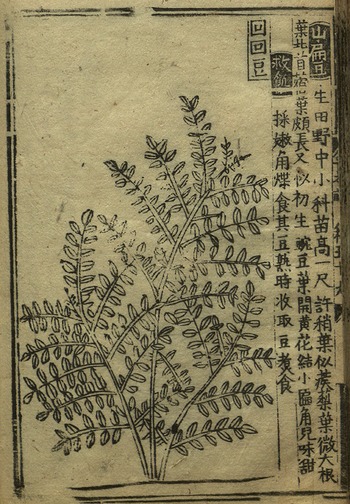
For the illustration, which was presumably made by court painter-craftsmen, see Figure 2.
Illustration of the Muslim Bean, Zhu Su, Jiuhuang bencao (1555), 2. 54b. Library of Congress, www.loc.gov/item/2012402246/. This is the same illustration used in all extant versions, including the 2007 modern edition.
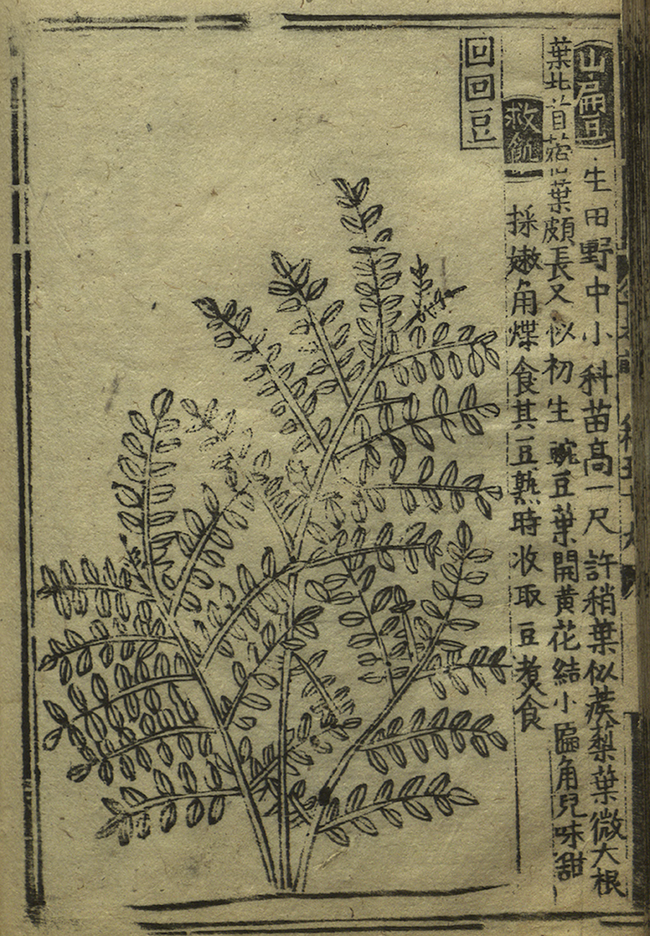
Figure 2. Long description
The woodblock print is composed of two main sections on aged, textured paper.
On the right side, there are four vertical columns of traditional Chinese characters. The first column on the far right is enclosed in a thin rectangular border at the top, identifying the plant. The subsequent columns provide botanical descriptions and culinary instructions.
Occupying the center and left of the frame is a detailed line drawing of the Muslim Bean plant. The illustration begins at the bottom center with several stems emerging from a single point. These stems branch upward and outward in a fan-like arrangement. Each stem is lined with small, oval-shaped leaflets arranged in a pinnate pattern. The lines are thick and dark, characteristic of 16th-century woodcut techniques, showing slight irregularities in ink distribution. The entire composition is framed by a double-line border at the top and left edges.
The image conveys that the leaves were small, abundant, and somewhat clustered together, which is congruent with the comparison to the jili leaves in the verbal description. It does not, however, include the visualization of the flower, the pod, nor the bean. It remains unclear to me whether it would serve as sufficient visual reference for one to identify the plant.Footnote 61
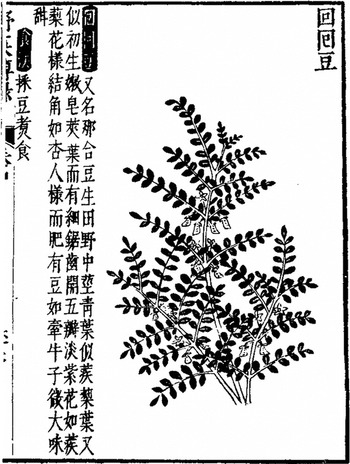
The visual component witnessed improvement, nevertheless, as the textual nugget rolled forward into subsequent treatises of a similar nature. The same description of the Muslim bean appeared in Yecai bolu 野菜博錄 (Comprehensive documentation of wild vegetables) published by Bao Shan 鮑山 (fl. ca. 1620s).Footnote 62 While Bao quoted Zhu verbatim in the textual part, he presented a new illustration with more compelling evidence to match the Muslim bean with the chickpea (see Figure 3).
Illustration of the Muslim Bean, Bao Shan, Yecai bolu, 2.67a.
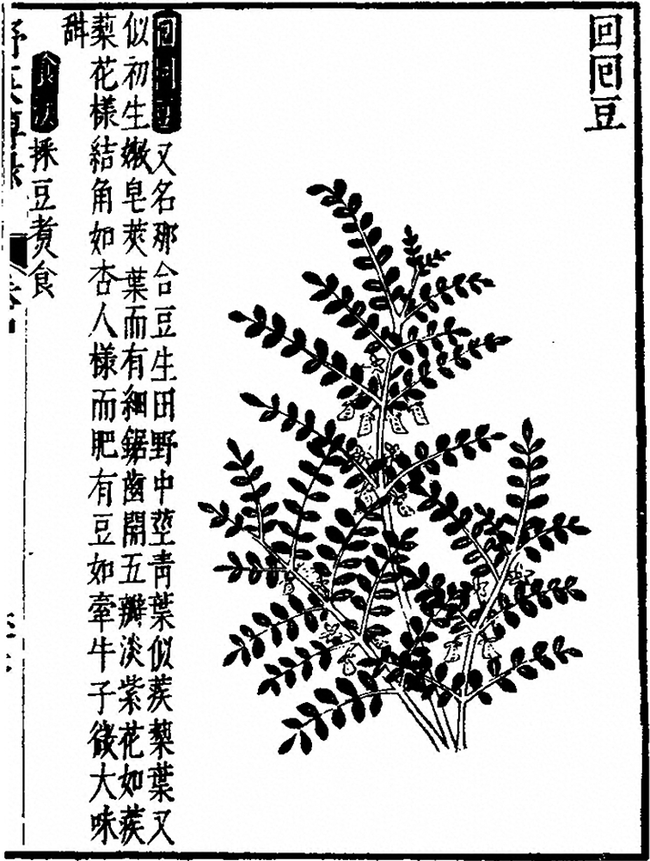
The most important clue lies in the visualization of the pod, which appears relatively short with a yield of two or three beans. This fits with the comparison of the pod to an apricot kernel, which should be noticeably different from a longer pod like that of the pea; the two-to-three yield of beans in each pod also aligns with the description of the bean being “slightly big.”
The Muslim bean in famine-relief manuals demonstrates a clear break from its counterpart in pharmacopeias.Footnote 63 The legume has morphed from an exotic healthcare dietary product into a basic foodstuff for sustenance. In this new textual description, the Huihui dou appears as a bare bean stripped of medicinal attributes. The mention of a “sweet flavor” characterizes the bean’s natural sugar content, as it immediately follows its size description. The context makes it evident that its sweet flavor is distinct from the medically loaded “sweet sapidity.” The intended accessibility of the Muslim bean is also evidenced by the style of the presentation, particularly the generous use of comparative references. All of the plants compared to the Muslim bean are fairly common specimens, indicating a good-faith effort to provide guidance for foragers in need.
The text also suggests that the new Muslim bean occupied a broader habitat, which would further add to its accessibility. If the legume was truthfully included in Zhu’s experiment, the plant should grow fine in Henan—a junction linking northern and southern China—where the prince was enfeoffed. If the statement on its growth in open fields is a first-hand observation, the chickpea plant should find Henan not only an acceptable habitat but a conducive environment for thriving in the wild.
Yet the plain, accessible staple still carried a foreign flavor, notably with its transliterated name nahe dou 那合豆. Angela Schottenhammer identifies nahe as nakhod, the Persian name of the chickpea, which appears in the Huihui yaofang 回回藥方 (Muslim formulas), a collection of translated Arabo-Persian medical texts in Ming China.Footnote 64 This is an ideal example of matching contemporaneous terms. The Persian word had by then developed into a number of variants, such as noqut نوقۇت in modern Uyghur, nohut in modern Turkish, noxud in Azerbaijani, năut in Romanian, and nut нут in Ukrainian.Footnote 65 The Chinese nahe belongs to this relay of transliterations across Eurasian languages.
While it is generally difficult to ascertain how a transliterated name was initially adopted, a variant of nahe sheds some light on a specific context in the eighteenth century. In the Qinding Huangyu Xiyu tuzhi 欽定皇輿西域圖志 (Imperially commissioned illustrated records on the western regions in the imperial domain), there is a legume identified as nahu 納呼 and a local product of the “lands of the Uyghur tribes” (Huibu tudi 回部土地).Footnote 66 This plant is probably the chickpea.
Presumably, the adoption of the name nahu is the result of documenting the indigenous way of referring to the legume during an experiential encounter. The Huangyu Xiyu tuzhi was a gazetteer of Xinjiang—the “Western Regions”—and a celebration of the recent annexation of the area into Qing territory. Before the Qing conquest, the Oirat Mongol regime Zunghar Khanate (1634–1758) ruled Xinjiang and its Uyghur inhabitants.Footnote 67 After vanquishing the Zunghar regime, Emperor Qianlong (r. 1735–1796) commissioned the Huangyu Xiyu tuzhi, intended as a comprehensive survey of Xinjiang to aid the new colonial rule. The project took nearly three decades and involved multiple field surveys to complete.Footnote 68 In the case of the nahu bean, it is noteworthy that the text cited no alternative names, including the good old “Muslim bean” and the descriptive “eagle’s beak bean,” which circulated for centuries in neighboring regions. Nahu likely came from a conversation with local Uyghurs, and its documentation mainly served to register the legume as a newly conquered foreign object.
Returning to the famine-relief manuals, it is clear that the chickpea had become less exotic and yet remained distinctively foreign in a renewed way. The texts present the legume as a modest famine food and make no mention of its foreign provenance, implying that it was widely available. Nevertheless, the authors also identify it with a transliterated name, indicating a growing possibility that Sinophone speakers would learn about the legume from contemporaneous speakers of various Eurasian languages, expanding knowledge from textual sources to oral exchanges. While these encounters may not always be face-to-face, the Sinophone speakers more clearly acknowledged the cultural ownership of the legume by the Turko-Iranian peoples, as evidenced in their efforts to document foreign names phonetically.
It remains a question to me whether the chickpea had truly become widely available to foragers in central and southern China during the Ming and Qing periods. But again, the repeated identification of the legume as an accessible famine food reflects a historical assertion that warrants attention on its own. In the case of the Jiuhuang bencao, the author may have aimed to introduce the plant as a food source and to spread word of it, though it was not truly widespread beyond the northwest and his trial ground in Henan. Much like official agronomical treatises, the original text was probably meant to “produce comprehensive, mobile knowledge that could successfully be transferred.”Footnote 69 This hypothesis fits with the transmission history of the Jiuhuang bencao, which was largely neglected as a princely undertaking during its first century but came to play an important role in sixteenth-century discussions of famine administration, valued particularly for broadening of the range of food resources.Footnote 70 For the north-based famine specialists, the impetus to promote this plant may have emerged from aspirations to diversity food resources and to create an ambitious infrastructure for famine-relief knowledge across the empire. The result is a redefined identity of the perpetual foreigner in this final episode—a combination of a stronger claim to familiarity and an acknowledgement of a more specific foreignness.
Conclusion
How long does it take for a foreign food to become local? The history of the chickpea suggests that the perception of foreignness does not always align with how long a food has been present. Although both originated in regions west of China, the pea became well integrated into empire-wide daily cuisine and was naturalized in Classical Chinese nomenclature within its first millennium. In contrast, the chickpea maintained a foreign aura, remaining linked to Eurasia and beyond within the same time span.
Taken literally, this perpetual foreignness had to do with the perception of Muslims in the Central Lands. Indeed, the ethno-cultural communities of Muslim faith, whether Persians, Arabs, post-medieval Uyghurs, or Hui, consistently resided in positions secondary to the most dominant ruling power of China. Nevertheless, we should not chalk up the foreignness of the chickpea to a homogenous alterity ascribed to the Muslims. In cultural terms, China during this millennium featured a multi-centered landscape instead of a clear binary of center and peripheries, and “Muslims” encompassed a variety of historical peoples both within and beyond the shifting boundaries of China. During the three periods covered in this paper, the Central Lands were ruled by Mongol, Han, and Manchu elites, each maintaining different relationships with disparate Muslim communities of their times. The Mongols viewed Persians as a key group within the governing class while the Manchus treated the Uyghurs as a colonial subject. Thus, the Muslimness in the Yuan case was exotic yet mainstream, while for the Manchus, it was marginal yet practical. The foreign flavor of the chickpea, therefore, was situational and deeply embedded in changing contexts.
Finally, it is worth noting that the enduring exoticism of the chickpea often carried positive associations, unlike the stigma typically linked to perpetual otherness in humans. The exotic origin of this legume made it stand out on the emperor’s plate, yet it did not prevent it from satisfying the hunger of a humble forager or from integrating into a well-established medical discourse. While the consumption of food can mold identities and chart boundaries, it can also blur and dissolve them.
Competing interests
The author has no competing interests to declare.
 / 傅衡 (1722–1770) et al., Qinding Huangyu Xiyu tuzhi, Siku quanshu edition (Taipei: Taiwan shangwu yinshuguan, 1983–86), 43.10a, 10b.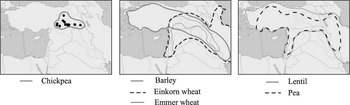

 Open access

