




1. INTRODUCTION
As complex as sounds are, they can be decomposed into a series of sine waves. The sine wave is the basis of all sounds, but also an important aesthetic archetype of electroacoustic music and sound art. Yet there are few studies dedicated to its aesthetics. Noteworthy is that scientists pioneering the development of acoustics were nevertheless reflecting upon the aesthetics of sinusoidal sounds. For example, Helmoltz discussed their opposition to rich tones: ‘[c]ompared with simple tones they are rich and splendid’ (Helmoltz Reference Helmoltz and Ellis1912: 118). Other scientists such as Henry J. Watt saw in the sine wave a sort of a perfect model:
The musical ‘ideal’ is the perfectly pure tone, devoid of all upper partials. It is perfectly balanced, regular, and continuous, a perfect system of ‘atoms’ of sound. But no instrument naturally produces or can conveniently be made to produce such perfect tones. (Watt Reference Watt1917: 214)
Most music literature about sine waves (e.g., Schwartz Reference Schwartz1973; Nyman Reference Nyman1999; Hinkle-Turner Reference Hinkle-Turner2006; DiMartino Reference DiMartino2016) report on either their use or application as a technical tool. Writers refer to the Cologne School, with general statements about ‘[the] sine-wave generator as the only sound source’ (DiMartino Reference DiMartino2016: 190) or to practitioners being ‘intrigued by the musical possibilities of the sine tones’ (Hinkle-Turner Reference Hinkle-Turner2006: 14) without discussions of the aesthetic premises involved. Likewise, discussions focused on specific artistic works (Demers Reference Demers2010; Higgins and Kahn Reference Higgins and Kahn2012; Glover Reference Glover, Potter, Gann and ap Siôn2013; Solomos Reference Solomos2015; Saladin Reference Saladin2017; Licht 2019) only briefly mention the use of sine waves without analysis.
Yet, the range of artists who have used sine waves creatively is salient, including Pauline Oliveros, Alvin Lucier, Ryoji Ikeda, Karlheinz Stockhausen and La Monte Young. Alvin Lucier and La Monte Young are among those most analysed, as in Peter J. Blamey’s doctoral thesis ‘Sine Waves and Simple Acoustic Phenomena in Experimental Music: With Special Reference to the Work of La Monte Young and Alvin Lucier’ (Blamey Reference Blamey2008). While Blamey’s thesis focused on the outputs of only two artists, it represents an in-depth discussion on sine wave aesthetics. Our literature review revealed that contemporary artists associated with the sine wave such as Ryoji Ikeda also received scant attention on that matter. Electronic music pioneer Karlheinz Stockhausen’s use of sine waves seems to be addressed mainly in one article (Toop Reference Toop1979). Interestingly, Toop addresses the ambiguity of the uneasy relationship between the sine wave and its ‘prophet’, for whom the sine wave had both musical and metaphysical qualities. This investigation into the sine wave’s conceptual use is briefly addressed by authors such as Simon Emmerson (Reference Emmerson1986: 25), M. J. Grant (Reference Grant2005: 60, 64, 84) and Seth Kim-Cohen (Reference Kim-Cohen2013: 112). Others who discuss the use of sine waves to varying degrees include Elizabeth Hinkle-Turner (Reference Hinkle-Turner2006: 30) on Ruth Anderson, Richard Glover (Reference Glover, Harrison and Gottschalk2018: 80, 81, 92) on Chiyoko Szlavnics, and Cathy L. Cox (Reference Cox2018: 88, 89. 94, 97) on Toshiro Mayuzumi.
Besides Stockhausen (Stockhausen, Eimert and Enkel Reference Stockhausen, Eimert and Enkel1954; Stockhausen Reference Stockhausen1956, 1961; Whitney Reference Whitney1964), writings by the artists themselves on their use of sine waves are scarce. Foremost, Marian Zazeela and La Monte Young (Young Reference Young1969, Reference Young2000, Reference Young2001; Young and Zazeela Reference Young and Zazeela1969) wrote on aspects of sine wave usage in many of their sonic and audiovisual pieces. Other contributions include Cat Hope (Reference Hope2009) on her use of low frequencies, Seth Cluett (Reference Cluett2006) on the relationships between sine waves and architecture, and Chiyoko Szlavnics (Reference Szlavnics2011) on the influence of psychoacoustics on her work.
Through our research-creation project Towards an Aesthetics of the Sine Wave, we aim to contribute to a better understanding of artistic approaches to the sine wave in music and sound art. We present the results of the first phase of the project covering a literature review Footnote 1 and a survey of artists who have used the sine wave as an essential component of their creative process. These usages are not limited to electronic music, but include acoustic instruments, art installations, audiovisual performances, and technological devices, among other forms of creation.
2. METHODOLOGY
From 20 April to 8 May 2020, our researchers conducted an online survey of composers and sound artists in English and French using the software LimeSurvey. The survey was disseminated through professional mailing lists including the International Computer Music Association, the Australasian Computer Music Association and the Association Francophone d’Informatique Musicale, and through online social network groups such as Women Creators, International Composers Network, and Diverse Voices in New Music and Sonic Arts Forum. We also used purposive sampling to target artists renowned for their use of sine waves. A pilot survey was tested with three potential respondents to check its internal validity (Lincoln and Guba Reference Lincoln and Guba1986). The project was approved by the Université de Montréal’s Arts and Humanities Research Ethics Committee (Project No. RC2-269193).
After requesting the respondent’s profile, education and experience, the questionnaire presented three open-ended questions:
a) What are the main concepts (theoretical, philosophical, aesthetic, technical, etc.) that motivate or guide your use of the sine wave?
b) Please name the artists, works and/or aesthetic movements that have inspired your work with sine waves?
c) What tools/instruments have you mostly used to create your works using sine waves?
In this article we present a qualitative analysis of the responses to question a), providing the broadest view of sine wave-based creative processes. We also used the results of questions b) and c) to contextualise the first question with quantitative data. Quotations from French-speaking respondents were translated into English. Respondents were identified with a numerical identifier (e.g., R-01 for respondent 1), except in the discussion of aesthetic approaches where respondents’ identities were required due to the idiosyncrasy of each discourse.
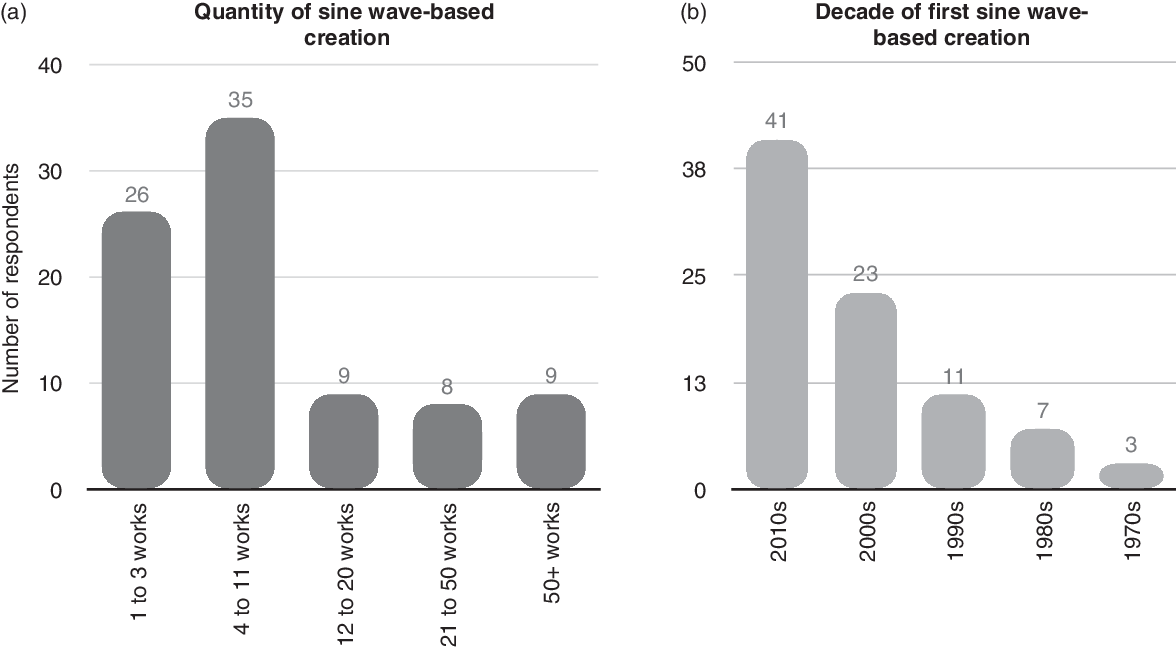
Two hundred responses were collected, of which 87 responded to question a). Despite efforts towards a gender-diverse population, 70 of 87 respondents identified as male, 10 as female, 1 as non-binary, and 6 selected ‘other’ or did not respond. To reflect their experience in creating with sine waves, respondents provided the number of sine wave-based works they had produced (Figure 1a), and the decade in which they started to work with sine waves (Figure 1b).
Distribution of respondents according to their sine wave-related production, in terms of: a) quantity; and b) initial decade.
Our analysis of question a) is based on the constant comparative technique of grounded theory (Strauss and Corbin Reference Strauss and Corbin1998), a predominantly inductive method consisting of several stages of data coding to produce complex categorisation that represents the content. This categorisation is then developed, producing a theory grounded in the data. Categorisation emerges directly from participants’ statements rather than theory. Accordingly, we are not claiming theoretical saturation (where new data has no more impact on the categorisation), beyond the content of respondents’ answers. Some respondents included text from previously redacted statements such as a description of the creative process from the artist’s webpage. These statements were included in our analysis if they were relevant to the question, but they also introduced noise into the data that is difficult to evaluate.
The coding and categorisation of the data collected in answer to our three questions were performed with NVivo qualitative data analysis software, allowing portions of the data (phrases or paragraphs) to be assigned different codes (codes are short words or expressions representing an evocative attribute). As coding progressed, themes began to emerge. Categories were formed and organised hierarchically, and a coding tree developed. A single phrase or paragraph could be assigned to different codes and appear in several categories.
Two coders with divergent backgrounds, one in music theory and one in music composition/sound art, performed the coding with support from the first three authors. The diversity of coder expertise, including an external expert with a philosophy background, and constant reviewing of the coding process by the first three authors contributed to the dependability and confirmability of the outcomes (Lincoln and Guba Reference Lincoln and Guba1986). Coding took place from 18 June to 9 October 2020, resulting in eight categories. The percentage of appearance by category in the analysis should be interpreted cautiously, being dependent on the method of segmentation within our qualitative research framework.
3. RESULTS
Eight major typological categories emerged from grounded theory coding. Each category contains a hierarchy of subcategories, of which the first two levels are represented in Table 1.
Two main typological codification levels emerging from the grounded theory analysis of the main question: ‘What are the main concepts (theoretical, philosophical, aesthetic, technical, etc.) that motivate or guide your use of the sine wave?’

3.1. Ontological Perspective
The Ontological Perspective category pertains to respondent statements that emphasised the nature of sine waves independently from a specific creative process or its use in an artwork, positing a conceptualised essence of sine waves.
Ontological properties were coded at a low level of analysis, often remaining faithful to respondents’ wordings. This recognises the ability of respondents to provide their own conceptualisation of the object. Subcategories with a small number of occurrences drift significantly from theoretical saturation and require further research before their credibility can be assessed. The decision to keep these outliers in the analysis is an attempt to evaluate the multiplicity and subtle variations of respondents’ perspectives.
The code with most data in the Ontological Perspective is Purity (29.4.%): ‘I like it’s purity, minimalistic aesthetic’ (R-28). This idea is already present in the literature, as in the work of Alvin Lucier who used sine waves ‘because their purity (no overtones) produces vivid beating against the richer, more complex instrumental sounds’ (Lucier Reference Lucier1999). Toop (Reference Toop1979: 383) also mentions purity in relation to Stockhausen’s use of sine waves: ‘If one accepts Fourier’s theorem that any sound, however complex, can be reduced to an aggregate of sine-tones (the sine-tone functioning as the “atom” of the acoustic universe), it becomes clear that the sine-tone is the “purest” of all sounds, not only physically, but also theologically.’ This quote harkens to another subcategory, that of Atomicity (12.7%). This subcategory featured quite prominently in the analysis, depicting sine waves as the core element of sound. Bridging the gap between the ontology of sine waves and creative processes, one respondent stated: ‘My interest was in the challenge to myself as a composer to use only the most fundamentally basic sound source and see how far I could take it through manipulation and transformation into building complexity and musicality’ (R-306). The third subcategory is Simplicity (17.6%). The idea of simplicity (the terms basic and minimal were considered synonymous), relates to a conflation between purity and the absence of overtones (Lucier Reference Lucier1999). For example, one respondent states: ‘They have no harmonics, so there’s no dissonance generated by harmonic roughness’ (R-23). On the other hand, another respondent contests the absence of colour in sine tones: ‘The Sine tone is often thought to have no “colour” and I disagree’ (R-299). This divergence of opinions represents the first in a series of ontological ambivalences.
The Ubiquity (3.9%) of sine waves relates them to their localisation and develops in two distinct semantic directions, either phenomenologically or physically. In the first instance, ubiquity is related to perceptual properties: ‘The ubiquity of sine waves is a characteristic that I use frequently in sound installations. The impossibility for the listener to localise the source, the sensation that sounds are produced directly in one’s head’ (R-300, trans.). In the second, it places them as an integral part of the environment: ‘In a purely logical reasoning, sine waves are ubiquitous in the environment, although rarely audible’ (R-08, trans.), opposing R-300’s phenomenological understanding. This second perspective relates to the subcategory Naturality (6%), where sine waves are framed within the classic nature–culture dialectic, either positively – for example, ‘It’s “a natural waveform” already present in our environment’ (R-25) – or negatively – for example, ‘I realize [a sine wave] is not the most naturally occurring audio wave’ (R-47). Paralleling this dialectic, Historicity (2%), a code with only two occurrences, proposes a relation between sine waves and the social history of technologies: ‘Sine waves are seen, and heard, as “old stuff” (i.e., not the current taste) while they are also perceived as evidence of technology’ (R-06, trans.). In Transparency (3.9%), the sine wave is posited as specifically distinguishable or identifiable, within the construct of another ambivalence: ‘It merges in everything, still it emerges from everything once it has been identified/segregated’ (R-321, trans.).
Potentiality (6%) proposes a first projection of the ontological argument upon the creative process: ‘I find it inspiring, because it is full of paradoxes, and thus full of poetic and sonic potential’ (R-321, trans.). Expressivity (8.8%), which signifies the broad expressive capacity of sine waves (‘cold/warm’ for one respondent), complements this perspective. Curtis Roads seemed to agree: ‘Certain basic sounds, like the magical sine wave, can be made expressive with only a touch of vibrato and tremolo, and perhaps a dash of reverberated ambiance’ (Roads Reference Roads2004: 343). Despite these characterisations, our survey revealed that the sine wave is most often perceived by artists as neutral, verging on mundane (five codes versus three for high expressivity). As Laposky (Reference Laposky1958: 342, 343) writes: ‘It is a pure wave, and as such is not so interesting by itself as a design element, just as the pure sine wave as a tone in music is not so interesting to the ear.’ One subcategory with a low coding representation, Preciseness (1%), brings up a specific relation between Expressivity and Potentiality, which parallels Roads’s statement: ‘Low frequencies are very precise, and it is simple to quickly find a satisfactory effect’ (R-303, trans.). Beauty (1%), as part of the nature of sine waves also appeared only once in the analysis.
The subcategory Therapeutic (3.9%) – having the property of affecting body and mind, either positively or negatively, again – emerged quite autonomously from the analysis. One respondent states: ‘Pure waves (especially sine waves) seemed to have some healing aspects for me’ (R-53). Hinkle-Turner, discussing the work of Ruth Anderson, recalls that ‘She began to notice that those same students usually became quietly energised after working with these pure sounds in the studio and this prompted her interest in their possible healing power’ (Hinkle-Turner Reference Hinkle-Turner2006: 31). On the other hand, sine waves are also portrayed as aggressive, specifically in relation to their use in industrial music: ‘In terms of aesthetics, to coin a term by Throbbing Gristle: Designed to make you feel uncomfortable’ (R-202). Another example from musician Monte Cazzaza in the famous Industrial Culture Handbook claimed: ‘Those low cycles are quite dangerous, physically dangerous. They can affect your heart rate – if I had a computer and the time and the money, I could probably give you a heart attack with sound’ (Vale and Juno Reference Vale and Juno1983: 78).
This last quote links directly to our final category: Cyclicity (2%), the only ontological category, unexpectedly, which directly links sine waves to their temporal dimension (independently from its Historicity).
The Ontological Perspective category depicts a broad, ill-defined object apprehended through multiple dimensions. Moving beyond the constant comparison analysis of grounded theory and into the theorisation process, we observe from a social constructivist perspective an ontologically paradoxical object: ubiquitous and nowhere to be found, with and without colour, natural and technological, expressive and boring, healing and destructive. These multidimensional paradoxes, which metaphorically parallel the cyclicity of the sine wave, are also intertwined with the other main categories presented in this paper.
3.2. Scientific References
The Scientific References category contains science-related respondent statements. It excludes vague and poetic evocations of science, or those referring to a specific technological tool (categories such as Aesthetic Approach or Creative Process have been used to encode such data).
Most data in the Scientific References refer to Acoustics (36%) and Psychoacoustics and Auditory Perception (45%). Less populated categories include Electromagnetism and Optics (3.5%), Astrophysics (2.5%) and Mathematics (7%).
Psychoacoustics and auditory perception were important for many respondents, both as inspiration and as theoretical foundation of their work. R-333 mentioned that working with sound as a physical and psychological phenomenon allowed their work to escape representation and to build spectral and spatial architectures. These perceptual phenomena have been coded in several subcategories. Beatings is the most populated subcategory. R-320, for example, declared that his ‘main interest was in creating dense micro-intervals and clusters, and to explore the resulting beat frequencies’ and in relation to the prior ontological discussion: ‘The beats stood in clear contrast to the purity of the waves’ sound.’ Perceptual effects related to Localisation and Spatialisation were commonly discussed by respondents. R-75 evoked the chase of ‘an antinode around a room with subtle pitch modulations of the sine wave.’ Another artist described combining tones on an old Moog and Buchla in search of tunings are so close on sine waves [so close] … that the sound does not come into your ears from an outside source anymore; instead it seems to originate from inside your head and then radiate outwards’ (R-53). The concepts of Consonance/Dissonance and Harmonicity/Inharmonicity were discussed as the theoretic basis of fusion and non-fusion effects. By applying inharmonic ratios to produce a series of partials, one artist noted that ‘the ear does not identify the resulting sound as one and only sound, but rather as a chord made of a large number of distinct frequencies’ (R-333). We note that with practice, one could recognise specific attributes and perceptually fuse these components into complex auditory objects. Several artists reported that they were consciously exploiting effects of Masking to structure the sound’s texture and to orient the audience’s perception. Other psychoacoustic effects mentioned include difference tones, otoacoustic emissions and Shepard tones, which have been coded in the last subcategories Auditory Illusions and Timing Effects.
The Acoustics category encompasses the properties of sound waves, which we consider to be the core material of the art under investigation. For some artists, such as R-217, the physics of sound seems to complete Western harmonic theory. Acoustics is discussed by respondents in relation to several dimensions, of which Room Acoustics is the first. R-162 underlines that his work with sine waves is guided by ‘architectural and acoustic qualities’ of sine waves, as well as their ‘ability to create location-specific interference’. In terms of psychoacoustics, the use of resonant modes of a room through the creation of nodes and antinodes is considered a rich feature and is exploited to create unique aural experiences: ‘My work with sine waves is largely about auralising the architecture around me. I create pressure fields in the space by driving room modes with high-power subwoofers, which the audience can move through and feel and hear the proportions and patterns of the space we are in’ (R-49). Notions such as Resonance Modes, standing waves, nodes and antinodes are often mentioned in a more general sense alongside the early experiments of Ernst Chladni (1756–1827), a German physicist and musician considered by some as a founder of modern acoustics. The category Signal Decomposition contains references to spectral analysis, and a complementary perspective is encompassed by the subcategory Harmonic Series, which addresses periodicity. The last subcategory, Other Acoustical Phenomena, details effects such as phasing and distortion.
Beyond acoustics, respondents referenced several non-music scientific domains. Some respondents referred to Electromagnetism and Optics that behave similarly to sound. R-2 related these elements to his academic background, connecting this category to elements discussed in the Sociocultural Perspective category: ‘My attachment to minimalism is in part driven by my interest in highlight [sic] the beauty in basic sound and light mechanisms that draw attention to physical principles and phenomena. Before turning towards art and music making, I studied physics as my first degree.’ Respondents also referred to astronomy and astrophysics, and mathematics in relation to concepts such the Golden ratio and the Fibonacci sequence.
For R-342, sine tones represent (often problematically) a sort of scientific (or pseudo-scientific) objectivity. While this statement is echoed in the category Aesthetic Approaches and its subcategory Scientific Posture, the present category provides us with a non-axiological typology representing the conflation of artistic theorisation and the scientific discipline. Among the data coded under Scientific References, a substantial proportion refers to the exploration or discovery of acoustic phenomena and auditory perception.
3.3. Philosophic References
The Philosophical References category groups respondents’ statements relate their work to broad philosophical themes, excluding aesthetics statements covered in Aesthetic Approaches, and represents artistic conceptualisations that go beyond the production process. Statements fall into three subcategories: Human–World Relationships (64%), Human–Machine Relationships (16%) and relationships to Temporal Relationships (20%).
Human–World Relationship contains evocations of sound in relation to the world that extend beyond human experience. These metaphysical concerns appear in the earliest sine wave-based compositions. For instance, Toop notes that Karel Goeyvaerts wanted to use ‘sounds with absolutely no unpredictable ‘inner life’ … detached from time itself: in a literal sense, “metaphysical”’ (Toop Reference Toop1979: 386). Some respondents mentioned a universal character of sound, linked to the Ubiquity category discussed in Section 3.1 ‘Ontological Perspective’. Others evoked an ecological perspective, where sound allows listeners to ‘connect the dots and create solid and serious networks throughout the world’ (R-34), or to ‘[facilitate] a feeling of communion with an integrated wholeness that is active, interconnected, and unified, provoking a profound identification with the essential elements that animate and connect us’ (R-324).
Human–Machine Relationship pertains to the relationships between humans, sound, technique and technologies including artificial intelligence. Indeed, sine wave-based creation is dependent on the technology that can generate those signals. This relationship seems inherent to art in which technology is ‘waiting for human presence to activate them and thus extend human action into the world … constructing and ordering social-cultural-political relations’ (Sellars in Salter Reference Salter2010: xxxiv). Many respondents exploited this condition through algorithms to articulate a human–machine relationship; to ‘reach a pipe dream that could not be performed by musicians’ (R-300, trans.); or to imagine ‘aesthetics exclusively for machines [where] the human being remains merely an external observer’ (R-235).
The Temporal Relationship category groups’ statements establish links between sound and time from a philosophical perspective. Cyclicity, previously analysed in the Ontological category, returns here in the development of artistic approaches where, for example, one respondent wanted to give a sense of the ‘unstoppable impact of time and nature’ (R-223). The regularity of a sinusoidal signal suggests a stagnation of time in an ontological sense, which was reflected by respondents justifying their use of sine waves for their ‘slow and meditative nature’ (R-223), or to ‘influence the listener’s experience and sense of time and space’ (R-231).
3.4. Psychological Aspects
The Psychological Aspects category unites statements reflecting the affective experience of sine waves, either moods and emotions as perceived by the artist in Intuitive Relationship to Sound (44%) or as affective intentions in Relationship to the Listener (56%).
Intuitive Relationship to Sound evokes the sonic experience as introspected and communicated by the artists. For instance, a respondent expressed the desire to ‘highlight the beauty in basic sound and light mechanisms’ (R-2). Respondents often expressed the therapeutic effect sine waves had on them and were ‘particularly attracted by the meditative effect the resulting music had; sedative would not be inappropriate as a description for the perceived effect’ (R-320), noting that the sine wave can lead full consciousness or even ‘a vibration state of grace’ (R-166, trans.). This concern with mind-states recalls Pauline Oliveros’s notion of Deep Listening, an attitude towards listening that leads to ‘discerning the effects on my bodymind continuum’ (Oliveros Reference Oliveros2005: xxiv).
The Relationship to the Listener subcategory groups artists’ statements referring to their audience. These statements sometimes reflected a desire to create a certain effect, to establish a connection, or to create a particular listening environment. It is interesting to note that where the Intuitive Relationship to Sound category highlighted the meditative state sine waves can induce, the Relationship to the Listener category showed the opposite: that the use of sine waves could ‘make you feel uncomfortable’ (R-202). This use of the sine wave to resonate within the body of listener is used to create radicality in the listening experience. Emphasising the dichotomic character in the use of sine wave, the non-space of the sine wave seems to find its sense precisely in the opposite, that is, within a space. For one respondent, sine waves are a type of sound that enables him to create a ‘space/listening environment with a degree of effectiveness that more complex electronic sounds do not provide’ (R-221). Another respondent (R-49, as discussed in Section 3.2 ‘Scientific References’) described how sine waves allow an intensity in the relationship between the space and its public.
More globally, working with space was often expressed as immersion, for example by ‘creating phasing patterns that result in overtones by reflection in the place the listener is at’ (R-231), and ‘immersion in a whole body experience’ (R-223).
3.5. Sociocultural Aspects
The Sociocultural Aspects category reflects complex networks of influences. It contextualises artistic practice in relation to factors that emerged from the analysis, including the professional networks and the cultural frameworks defined by artistic or scientific genres and figures. This category divides into two main subcategories: Socioprofessional Networks (18%) and Cultural Networks (78%). Two other categories: Cultural Background, and Demographic Context have low occurrence rates and require further data collection.
The Cultural Networks category portrays an assortment of influences between human agents and cultural movements, music genres, record labels and artistic periods. Minimalism, as an umbrella term, takes the lead in terms of occurrences, which is consistent with the ontological discussion presented earlier. This includes references to the minimalism of the 1960s and 1970s, as well as the glitch-era minimalism of the late 1990s to early 2000s: ‘The output of experimental music labels associated with this style of music – such as 12k, LINE, Raster-Noton, and Mille Plateaux – often focuses on the production of abstract sound spaces denoted by fields of pure tones punctuated by fragments of audio clicks and cuts’ (Anderson Reference Anderson2008: 58).
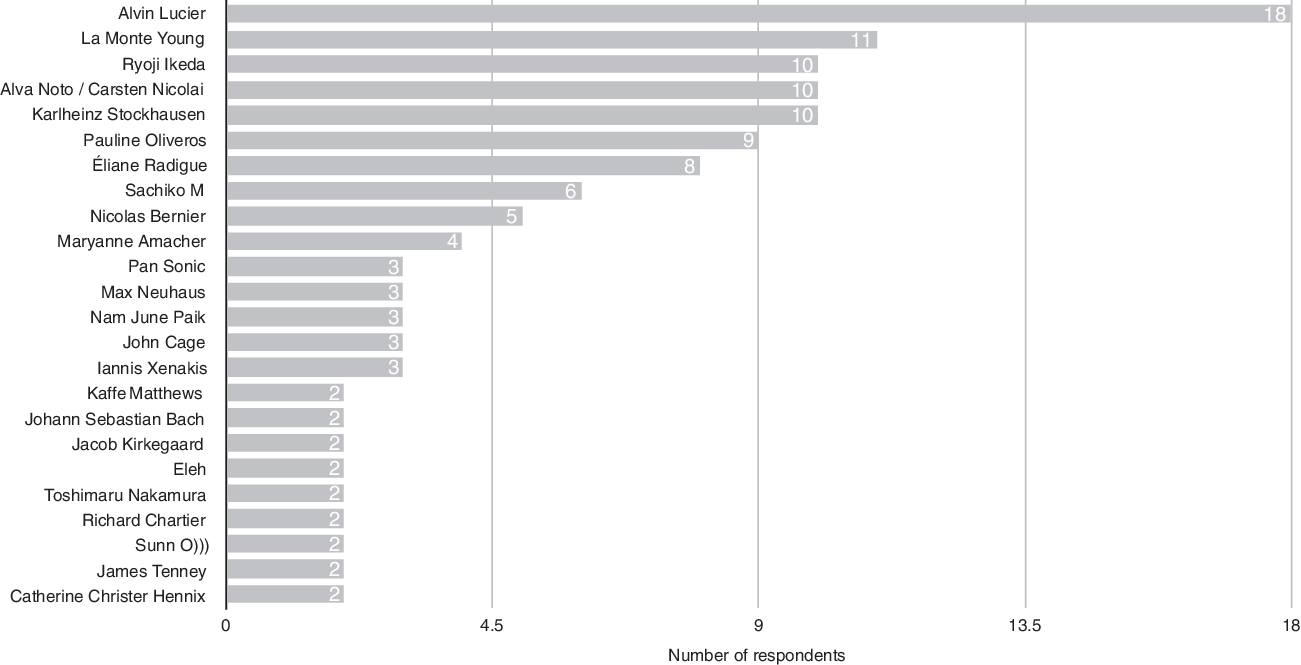
We may also relate this category to the results of question b) ‘Please name the artists, works and/or aesthetic movements that have inspired your work with sine waves?’ presented in Figure 2 (in which names with only one occurrence, about 90 occurrences, were removed). The figure shows an ambivalent relationship between historical time periods: that of early electronics and various genres of contemporary experimental music. Among the top ten named influences are four women, including Éliane Radigue, highly influential in the minimal-experimental genre for pieces such as the Adnos cycle: ‘In the first piece [ADNOS I], we are aware of rhythm, which comes into being by means of the acoustic beats of two sine waves in close intervallic relationship’ (Chatham Reference Chatham2001). It is worth noting a likely bias in the distribution for the figure of Nicolas Bernier (five occurrences), considering that he is the principal investigator of the project. The presence of outsider figures further down in the list echoes general ideas that are projected upon sine waves. One example is drone music, as represented by the presence of Sunn O))). The Cultural Networks category presents an even wider range of references than the results of question b). These include a few extra-musical figures, such as Blauert, Chladni and Kepler.
Results from question b). Please name the artists, works and/or aesthetic movements that have inspired your work with sine waves?
In terms of Socioprofessional Networks, a few respondents mentioned the relevance of academic environments. For example, R-53 mentioned that ‘The main reason I used sine waves is because in [sic] our basic EA [electroacoustic] music class taught by Scott Wyatt at the University of Illinois.’ R-320 presents a more general consideration: ‘I created a first collection of short, pure tone experimental works while working at the Institut für Elektroakustik [Institute for Electroacoustic Music] during my studies of composition at the University of Music in Vienna between 1993 and 1995.’ In an interview, Carsten Nicolai contextualised his use of high and low frequency sine waves in relation to institutional policies: ‘In the beginning, digital tools were not that great, so you started with whatever equipment was available. There was a moment when all the Universities in East Germany got all new equipment because of the political change, so they kicked out all their old equipment’ (Gillham Reference Gillham2019). This event gave Nicolai access to oscillators from the Department of Physics at the Technical University, which had a much wider frequency range than that of commercial synthesisers. This type of statement bridges the gap between the Sociocultural Perspective and the question of tools described later, notably in relation to question c) (see Figure 3).
Visualisation of the importance of the multiple disciplines enunciated by the respondents, from the most visual on the left to the most musical on the right.

Networks listed in the response were not limited to academic contexts, but also included production centres. R-223 mentions, for example, residencies at the Banff Centre (Canada). The idea of career development is sometimes explicitly discussed by respondents in relation to the development of disciplinary interests, paralleling statements in the category Artistic Fields.
3.6. Artistic Fields
The Disciplinary Aspects category (Figure 3) reflects a significant amount of data that evoke inter-, multi- or transdisciplinarity with works at ‘the crossroads of digital arts, plastic art, sound art or music, my work seeks a certain poetic immateriality’ (R-166, trans.).
This category bridges the gap between the Sociocultural Perspective (showcasing the building of a career) and the Creative Process categories (presenting the context of practice). The notion of discipline is used broadly, as some entries, such as Cymatics and Algorithmic, are not generally described as disciplines. Although respondents often traversed several sound disciplines – for example, algorithmic music, instrumental music, mixed music and sound performance – we noted the importance of visual work for many respondents, mainly video art and sculpture. As we will see in the following categories, these disciplines are reflected in the various aesthetic approaches and creative processes of the respondents.
3.7. Aesthetic Approaches
The Aesthetic Approaches category groups statements revealing aesthetic intentions and postures. We use the term posture to highlight the aesthetic tendencies revealed in the responses while avoiding direct references to aesthetic movements. For example, ‘using the most simple shape allows for an exploration of the complexity’ (R-89) relates to a minimalist posture or approach without necessarily leading to a minimalist aesthetic. Three main aesthetic postures have been coded: Minimalist, Scientific and Dualistic. Although these terms are also found in categories discussed previously, they are categorised here specifically in relation to aesthetic intentions.
Minimalist Posture was predominant (55%). The sine wave was preferred for its aesthetic character: ‘clean, simple, essential, cyclical, it is elementary and minimalist’ (R-8, trans.). These characteristics will often lead to minimalist aesthetics that are mentioned by several respondents. While the sine wave is often used to achieve ‘clarity’ or a ‘pure colour’, this is often accompanied by a desire to obtain more complex timbres. This dichotomic attitude emerged within the first sine wave-based musical works of the German school of the 1950s, where ‘new timbres could be constructed synthetically in a music based on the simplest elementary sounds’ (Frisius Reference Frisius1999, trans.). Our results corroborate the idea Footnote 2 that as much as the sine wave is used for its pure characteristic, it will often serve as ‘a minimal starting point for subsequent modulation’ (R-47) or as a ‘basis for additive synthesis’ (R-263, trans.) in order to obtain complex combinations ‘stacking sine oscillators together’ (R-147). Some respondents included reservations about the purity of sinusoidal signal: ‘To me this notion of sine tones as “pure” is totally uninteresting at its most innocuous and dangerous socioculturally in its extreme’ (R-342). The purity of the sinusoidal sound within Minimalist Posture nevertheless often seems motivated by a desire for discursive clarity, allowing one ‘to easily observe and perceive the dynamic effects’ (R-243, trans.), or helping ‘to audiate actual pitch relationships when using sine waves as a compositional tool’ (R-120).
While Scientific References formally referenced the scientific disciplines found in the respondent’s statements without considering the aesthetic impact of science itself, Scientific Posture (32%) is anchored directly in the aesthetic intentions of the respondents. Psychoacoustic effects were the most common aesthetic effect described by the respondents – primarily through beating and interference patterns. We also note that phase shifting, masking and localisation are among the recurrent aesthetic motivations behind the use of sine waves. Scientific Posture reflects a recurrent theme: the exploration of sound as a physical phenomenon. For example, in Save the Waves (2004), artist Jean-Pierre Aubé uses sine waves to make a conceptual link to the sinusoidal form of alternate electrical current. Where the sine wave seems to have a significant aesthetic impact through its conceptual use, the resulting sound output is often far from its intrinsic purity. Scientific Posture also reflects not only sound, but also the technical apparatuses used by the artists. Jean-Pierre Aubé’s use of antennas to pick up very low frequencies (VLF), or Mo H. Zareei’s approach using ‘scientific, technological, and laboratory equipment and tools as aesthetic elements’. We find another example in Gary Joynes (alias Clinker), whose statement from the Frequency Paintings series (2011–12) synthesise the main subcategories of Aesthetic Approach:
Through the early experiments of Ernst Chladni and Dr. Hans Jenny I was exposed to the physical and visual properties of sound. I have used modified and custom-built science laboratory tools to create multisensory environments that continue my interests in the slow and meditative nature of minimalist electronic sound compositions, and the experience of deep listening. (R-223)
Scientific Posture also highlights an analytical attitude displayed by the artists; a manifestation of their desire to understand the phenomena that lie behind the aesthetic results. The respondents often referred to how they ‘experimented with the properties and behaviours’ (R-324) of sound phenomena, creating with ‘sounds that reflect data, numbers, matrices etc., that are perfectly coherent with the aesthetic’ (R-172), or making links between the ‘oscillating rhythms of the human body and reflecting them in sonic oscillators’ (R-334). These responses clearly demonstrate the aesthetic impact of Scientific Posture in sine wave-based aesthetic approaches.
Dualistic Posture (13%) categorises aesthetic approaches that consider sine waves from a natural/artificial perspective. As a pure sinusoidal wave is only created through synthesis tools, it seems to call for a connection to the richness of impure sound in the ‘contrast between nature, the surrounding soundscape, and the abstraction of electronic sounds’ (R-300). These contrasts are also expressed in instrument-based practices, such as those of Anne La Berge who uses the sine wave for the aesthetic contrast it creates with her flute playing, or Cat Hope, many of whose works focus on low frequency sine waves in ‘comparison to the timbre of acoustic instruments’ (R-298). For Ernesto Azuero, the purity of the sine wave motivates him to ‘create an unimaginable artificial soundscape by the pure combination of only this material’ (R-222).
Stripped of harmonic content, the sine wave sound is often considered as an aesthetic object needing contextualisation. These strategies demonstrate the artists’ ‘deep interest in how nature intrinsically operates. Universal laws of chance, natural behaviours and phenomena, and fundamental modes of operation’ (R-324). This desire towards better understanding of the physical world can be seen as the common thread uniting the Minimalist, Scientific and Dualistic postures.
3.8. Creative Processes
The Creative Processes category groups statements on the ‘making’ itself that led to the production of artworks, resulting in three subcategories: Techniques (65%), Technological Tools (19%), and Application (16%).
In Techniques, a significant number of respondents use sine waves in a synthesis context, mainly additive synthesis. Importantly, the sine wave is often used as a control signal rather than an audio signal. It is also interesting to note that while the sine wave is often used in non-tonality-based music, its relation to pitch remains predominant in the statements in Techniques. Respondents frequently brought up the precise control of partials (or harmonics), which allowed them to work with less conventional intonation systems such as xenharmonic microtonality or just intonation. Some linked the sine wave to baroque music: ‘Just like when Bach writes the Art of the Fugue without specifying the instrumentation, [the sine wave] ‘simplifies’ to emphasise the notions of counterpoint and harmony’ (R-6, free trans.).
Respondents also used the sine wave in a more abstract/electroacoustic context for creating textures – a term with a high degree of occurrence in the database – independent of intonation systems. This interest in textures echoes previous observations where the sine wave is used as a part of a whole, an element in a larger expression. Interestingly, the sine wave rarely seems used on its own as a sound object, but more often for its visual appearance: ‘whether sonified or visualized, is perhaps the most iconic entity for this type of approach towards making art’ (R-2). When sine waves are used as icons, they are frequently used to construct more complex visualisation, whether inspired by Lissajous figures,Footnote 3 or used to ‘generate and manipulate 2D and 3D figures drawn by audio signals on oscilloscopes, vector monitors, and Vectrex game consoles’ (R-46). This manipulation factor by signal modulation is one of the predominant elements of the creation techniques used by respondents. Whereas in Aesthetic Approaches we noted that the sine wave was often a modulated signal, as a creation technique we often find it as a modulating signal. These modulations often take the form of low frequency oscillators (LFOs) or amplitude modulation (AM) synthesis. Another salient element worthy of mention is that of space. Localisation of sinusoidal sound featured prominently in our results. The sine wave is used for its propensity to make the acoustic environment alive, to ‘build spectral and spatial architectures’ (R-8), or to ‘[auralise] the architecture around me [by creating] pressure fields in the space by driving room modes with high-power subwoofers which the audience can move through’ (R-49).
The Technological Tools used by the respondents typically represent laboratory equipment, analogue synthesisers and computer programs. Several respondents designed their own software, allowing a direct correspondence between their ideas and the aesthetic outcome. Some artists considered ‘the program as a work or part of a plural work’ (R-75). Figure 4 displays the most used technological tools of respondents.
Results from question c). What tools/instruments have you mostly used to create your works using sine waves?

In terms of Application, few respondents described precisely the algorithms used in their programs. Nevertheless, it remains clear that the use of sine waves is largely inspired by their controllability and accuracy ‘From theoretical and aesthetic point of view pure maths motivate myself, the possibility to predict or to obtain certain sound, through mathematical function using programming languages, helps me a lot to figure out how to manage this sound and how to appreciate them even more’ (R-9).
Our data show that the sine wave often leads artists to systematic approaches: pitch organisation systems, sound generation systems, mathematical calculation systems and programmed signal control systems. Again, this supports the idea of simplicity as a trigger for complexity, or as Seth Cluett writes: ‘the potential of systems embedded in the stuff of acoustics and the perceptual sciences that may be capable of generating new materials for expression’ (Cluett Reference Cluett2006: 42).
4. CONCLUSION
This study lays a framework as a step towards a better understanding of the artistic approaches guiding the use of the sine wave in music and sound art. Even though some categories emerging from this study were consistent with our expectations (e.g., Purity and Minimalism), the analysis reveals an impressive breadth of interrelated concepts in dialogue with the artistic use of sine waves. Ontologically and artistically, they demonstrate a complex discursive structure in contrast with the apparent simplicity of the object. The typological framework presented in this article offers the research and artistic community a formal tool for further investigation of the range of perspectives in sine wave-based creation. A first consequent use of this typology was implemented through the online publishing of the literature review as open access, proposing an accessible collaborative tool for the community. Many categories in the typology could benefit from a more in-depth analysis. The framework could also be useful for future studies, or to analyse specific work and creative processes.
Based on our study, it seems clear that the sine wave is typically used in a dichotomic sense, which creates an intriguing ambiguity between artists’ conceptual ideas and actual usage of sine waves. For instance, the ‘purity’ described by respondents often inspires them to work with an impure signal, to integrate acoustic instruments, or to process the pure signal to obtain a more complex one. Indeed, our study shows that while artists often found themselves captivated by the fundamental properties of sine waves, they rarely put these properties at the forefront of their work. Perhaps it is not possible to define a conclusive aesthetic of the sine wave such as our research-creation project Towards an Aesthetic of the Sine Wave initially suggested. Rather, we propose the following perspective: the sine wave is a matter; a basis; a fertile field for thinking about sound – one that demonstrates how from the smallest unit, humans can derive an infinitude.
Acknowledgements
We would like to thank Laurianne Bezier, Julien Champagne and Erin Gee for their contribution to the deployment of the Sinus References Database, Erin Gee who implemented and disseminated the online questionnaire and Kjel Sidlowski for revision. This project was funded by Fonds de recherche du Québec – société et culture (FRQ-SC).


 Open access

