


The relationship between excess adverse events (Reference Brown and HarrisBrown & Harris, 1978) and genetic risk factors (Reference Plomin, De Fries and McClearnPlomin et al, 2001) for depression could be mediated by aspects of personality, such as neuroticism or extraversion (Reference Eysenck and EysenckEysenck & Eysenck, 1975), that also run in families. For example, neurotic traits could lead to an individual being excessively concerned about the occurrence of an adverse event (i.e. threat perceiving). Alternatively, risk-taking behaviours associated with extraversion, for example, could lead to the occurrence of excess events (hazard prone) (Reference McGuffin, Katz and BebbingtonMcGuffinet al, 1988). In this report from the Cardiff Depression Study (Reference Farmer, Harris and RedmanFarmer et al, 2000) we will examine the relationship between depression, life events and scores on the neuroticism and extraversion scales of the Eysenck Personality Inventory (EPI). We predict that both neuroticism and extraversion will be correlated with measures of depression, as well as the number of events experienced by subjects. Also, we hypothesise that neuroticism and extraversion scale scores will exhibit trait-like qualities, rather than being substantially influenced by alteration in mood-state.
METHOD
The Cardiff Depression Study has been detailed previously elsewhere (Farmeret al, Reference Farmer, Harris and Redman2000, Reference Farmer, Redman and Harris2001). The method of subject selection and evaluation was as follows.
Proband and sibling recruitment
A total of 108 probands with depression (D-probands) aged 18-65 years who fulfilled ICD-10 (World Health Organization, 1993) criteria F32 and F33 and who had a sibling (D-sib) who was willing to be studied were recruited. Following regular reviews of admissions to the psychiatric services in Gwent and South Glamorgan, individuals likely to fulfil the study criteria were personally approached regarding participation. Subjects with a lifetime-ever history of psychotic or bipolar symptoms were excluded from further study, as were those subjects where it was not possible to recruit their sibling. D-probands were also recruited from two general practitioner lists in Cardiff.
Age— and gender-matched control subjects (C-probands) were recruited from patients attending Dental and Orthopaedic out-patient clinics and from among the employees of the University Hospital of Wales NHS Trust. Control probands were recruited if they had no current or past history of depression, and had a sibling (C-sib) who was willing to participate in the study. Wherever possible for both D-probands and C-probands, the sibling nearest in age was recruited. However, if this sibling was unavailable or unwilling, the sibling next in age was asked to participate. Most interviews were conducted face to face but for 18.5% of the D-sibs and 33.3% of C-sibs telephone interviews were undertaken.
Interviews and self-rating questionnaires
All subjects were interviewed using the Schedule for the Clinical Assessment for Neuropsychiatry (SCAN; Reference Wing, Babor and BrughaWinget al, 1990) and the Life Events and Difficulty Schedule (LEDS; Reference Brown and HarrisBrown & Harris, 1978). Life events occurring over a 12-month time frame were examined using the LEDS method. An expert panel (Reference Brown and HarrisBrown & Harris, 1978; Reference Farmer, Harris and RedmanFarmer et al, 2000) contextually rated each subject's reported events and difficulties. For all subjects who were depressed at the time of interview, the date of onset of the current episode was carefully determined and life events recorded for the 12 months prior to that date. All remaining subjects who were not depressed at the time of interview were asked about events and difficulties occurring over the 12 months prior to interview. All subjects also completed a number of self-report questionnaires, including the EPI (Reference Eysenck and EysenckEysenck & Eysenck, 1975) and the Beck Depression Inventory (BDI; Reference BeckBeck, 1978).
Information obtained at the SCAN interview was entered into the CATEGO 5 scoring program to obtain ICD-10 diagnoses and an eight-point psychopathology severity rating, the index of definition for each subject.
The Statistical Package for the Social Sciences (SPSS, version 10 for Windows) was used to create a database and undertake the statistical analyses.
RESULTS
Brief demographic details of the subject groups
These have been described in detail elsewhere (Farmer et al, Reference Farmer, Harris and Redman2000, Reference Farmer, Redman and Harris2001). The percentage of female subjects and mean ages for each subject group were as follows: 108 D-probands, 65% female, mean age 39.78 years (s.e.=1.03); 108 D-sibs, 69% female, mean age 38.6 years (s.e.=1.02); 105 C-probands, 74% female, mean age 36.2 years (s.e.=1.20); 105 C-sibs, 60% female, mean age 39.10 years (s.e.=1.22). There were no significant differences between the groups for age or gender. There were also no significant differences between the D-probands and C-probands for marital status. However, only 52% of the D-probands were in paid employment, compared with 82% of C-probands.
Of the D-probands, 36 were experiencing their first episode of depression and the remaining 72 had also been depressed in the past. Nineteen of the D-sibs also reported having received past treatment for depression, and eight were depressed at the time of interview. Five of the C-sibs reported previous treatment for depression but none were depressed at the time of interview. The relative risk (λ) for reported treatment for depression in D-sibs compared with C-sibs was 5.42 (Reference Farmer, Harris and RedmanFarmeret al, 2000).
Neuroticism and extraversion scales, age and gender
Scores on the neuroticism and extraversion scales were significantly negatively correlated with age (neuroticism: Pearson's correlation coefficientr=-0.10, P=0.04; extraversion: r=-0.12,P=0.01).
Male subjects scored significantly lower on neuroticism compared with female subjects, although there were no gender differences for extraversion. Mean neuroticism score for 140 male subjects was 10.88 (s.e.=0.58) and for 286 female subjects was 13.15 (s.e.=0.40) (t-test: t=-3.23, d.f.=272.89, P=0.001). Mean extraversion score for the male subjects was 13.26 (s.e.=0.54) and for female subjects it was 12.49 (s.e.=0.36).
Neuroticism and extraversion scores and present and past history of depression
Neuroticism, extraversion and depression ratings at time of interview
Mean neuroticism and extraversion scores for the four groups of participants in the Cardiff Depression Study are shown in Table 1. The D-probands scored significantly higher on neuroticism compared with the other three groups (analysis of variance (ANOVA): F=94.92, d.f.=3, 425,P<0.001; Tukey B post hoc test: D-probands>D-sibs>C-probands, C-sibs) and significantly lower on extraversion compared with the other three groups (ANOVA: F=25.54, d.f.=3, 425, P<0.001; Tukey B post hoc test: D-probands<D-sibs <C-probands, C-sibs).
Neuroticism (N) and extraversion (E) mean scores and standard errors in probands with depression (D-probands) and their siblings (D-sibs) and in control probands (C-probands) and their siblings (C-sibs)

| n | EPI | Mean | s.e. | |
|---|---|---|---|---|
| D-probands | 108 | N | 19.571 | 0.35 |
| E | 8.862 | 0.56 | ||
| D-sibs | 108 | N | 11.93 | 0.66 |
| E | 12.69 | 0.66 | ||
| C-probands | 105 | N | 8.72 | 0.49 |
| E | 14.98 | 0.48 | ||
| C-sibs | 105 | N | 9.21 | 0.52 |
| E | 14.57 | 0.49 |
For all four groups combined, neuroticism and extraversion scores were significantly correlated with BDI scores (neuroticism: r=0.70,P<0.001; extraversion: r=-0.43, P<0.001). When the healthy controls (C-probands) were examined separately, there was a significant positive correlation for neuroticism and BDI (r=0.47,P<0.001) but not for extraversion and BDI (r=-0.12,P=NS).
Neuroticism, extraversion and past history of depression
Nineteen of the D-sibs had had a past episode of depression but were not ill at the time of interview, whereas 81 D-sibs had never been depressed. The D-sibs who had never been depressed had a mean neuroticism score of 10.11 (s.e.=0.69), whereas those with a history of depression had a mean neuroticism score of 15.32 (s.e.=1.32). These mean differences were statistically significant (t-test: t=-3.50, d.f.=26.82, P=0.002). There were no differences between the groups for mean scores on extraversion. The D-sibs who had never been depressed had a mean extraversion score of 13.28 (s.e.=0.77), whereas D-sibs with a history of depression had a mean extraversion score of 13.11 (s.e.=1.47).
Familiality of neuroticism and extraversion and scores for siblings with no history of depression
Neuroticism and extraversion were significantly correlated across the sib pairs, for both types of proband and their siblings combined (neuroticism:r=0.33, P<0.001; extraversion: r=0.24,P=0.001).
A total of 81 D-sibs and 100 C-sibs reported never being depressed. Mean neuroticism score for these D-sibs was 10.11 (s.e.=0.69) and for the C-sibs it was 8.96 (s.e.=0.53). These differences were not statistically significant. Mean extraversion score for these D-sibs was 13.28 (s.e.=0.77) and for the C-sibs it was 14.46 (s.e.=0.51). These differences were not statistically significant.
Life events and neuroticism and extraversion scores
Neuroticism scores were significantly correlated with the number of severe and threatening contextually rated life events in 1 year (LEDS-rated 1 and 2 events: r=0.22, P<0.001). Extraversion scores were not significantly correlated with the number of severe threatening events (r=-0.04) but were significantly correlated with the number of less severe events in 1 year (LEDS-rated 3 and 4 events: r=0.11,P=0.02).
Multiple regression analysis
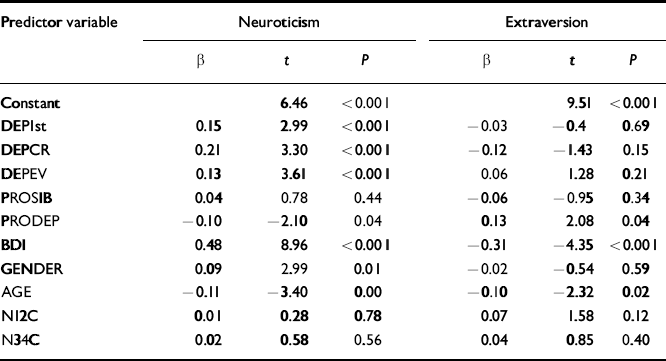
Multiple regression analyses of data from the four subject groups were carried out first with neuroticism and then with extraversion taken as the dependent variables. Five dichotomous dummy variables were created from the following groups of subjects. A total of 93 individuals (86 D-probands and 7 D-sibs) were experiencing a first episode of depression (DEP1st) and 73 (72 D-probands and 1 D-sib) were currently depressed and had been depressed in the past (DEPCR). Twenty-four subjects (19 D-sibs and 5 C-sibs) had a past history of treatment for depression but were well at the time of interview (DEPEV). The dummy variable PROSIB determined whether the subject was a proband or a sib, whereas PRODEP identified whether the subject was from a pair ascertained via a D-proband or a C-proband. The five dummy variables, plus BDI score (BDI), gender (GENDER), age (AGE) and the number of life events contextually rated as occurring over a 12-month period, both severe and threatening (N12C) and less severe (N34C), were entered as independent variables in a multiple regression analysis. The results are shown in Table 2. For neuroticism, all independent variables relating to present or past history of depression, age and gender have significant β coefficients. In order of size effect, the significant β coefficients are 0.48 for BDI, 0.21 for current and past history of depression (DEPCR), 0.15 for first episode of depression (DEP1st), 0.13 for currently well but past history of depression (DEPEV), −0.11 for age, −0.10 for being from a D-proband or a C-proband sibling pair (PRODEP) and 0.09 for gender. The remaining independent variables — numbers of severe (N12C) and less severe events (N34C) in 12 months and being a proband or a sibling (PROSIB) — have small and non-significant effects.
Multiple regression analysis: β coefficients, t-values and significance levels for neuroticism and extraversion (all subjects)
| Predictor variable | Neuroticism | Extraversion | ||||
|---|---|---|---|---|---|---|
| β | t | P | β | t | P | |
| Constant | 6.46 | <0.001 | 9.51 | <0.001 | ||
| DEPIst | 0.15 | 2.99 | <0.001 | -0.03 | -0.4 | 0.69 |
| DEPCR | 0.21 | 3.30 | <0.001 | -0.12 | -1.43 | 0.15 |
| DEPEV | 0.13 | 3.61 | <0.001 | 0.06 | 1.28 | 0.21 |
| PROSIB | 0.04 | 0.78 | 0.44 | -0.06 | -0.95 | 0.34 |
| PRODEP | -0.10 | -2.10 | 0.04 | 0.13 | 2.08 | 0.04 |
| BDI | 0.48 | 8.96 | <0.001 | -0.31 | -4.35 | <0.001 |
| GENDER | 0.09 | 2.99 | 0.01 | -0.02 | -0.54 | 0.59 |
| AGE | -0.11 | -3.40 | 0.00 | -0.10 | -2.32 | 0.02 |
| N12C | 0.01 | 0.28 | 0.78 | 0.07 | 1.58 | 0.12 |
| N34C | 0.02 | 0.58 | 0.56 | 0.04 | 0.85 | 0.40 |
By contrast, for extraversion, only the BDI score (β coefficient=-0.33), PROSIB (β coefficient=0.15) and age (β coefficient =-0.11) are significant. The remaining independent variables have small and non-significant effects.
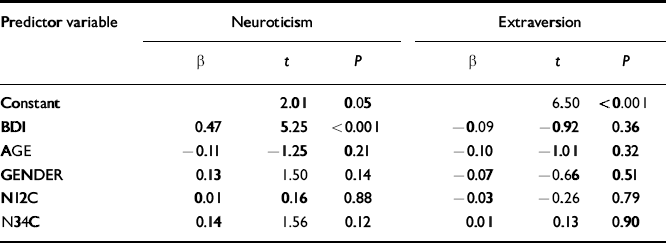
Because these analyses showed that current mental state and past history of depression were highly influential in determining both neuroticism and extraversion scores, further regression analyses were carried out on just the healthy C-probands, who had never been depressed. These results are shown in Table 3. As before, neuroticism and extraversion were taken as the dependent variables. The following independent variables were included: BDI, AGE, GENDER, N12C and N34C. As Table 3 shows that for neuroticism only BDI has a significant effect (β coefficient=0.47), whereas for extraversion none of the independent variables has a significant effect.
Multiple regression analysis: β coefficients, t-values and significance levels for neuroticism and extraversion in healthy controls (C-probands)
| Predictor variable | Neuroticism | Extraversion | ||||
|---|---|---|---|---|---|---|
| β | t | P | β | t | P | |
| Constant | 2.01 | 0.05 | 6.50 | <0.001 | ||
| BDI | 0.47 | 5.25 | <0.001 | -0.09 | -0.92 | 0.36 |
| AGE | -0.11 | -1.25 | 0.21 | -0.10 | -1.01 | 0.32 |
| GENDER | 0.13 | 1.50 | 0.14 | -0.07 | -0.66 | 0.51 |
| N12C | 0.01 | 0.16 | 0.88 | -0.03 | -0.26 | 0.79 |
| N34C | 0.14 | 1.56 | 0.12 | 0.01 | 0.13 | 0.90 |
DISCUSSION
Our results show broadly similar findings to previous studies for both scales. The negative correlation of both scales with age has been noted by Kendell & DiScipio (Reference Kendell and Di Scipio1968), whereas the elevated neuroticism scores in female subjects and the absence of significant differences between males and females for extraversion scores have been reported previously by Katz & McGuffin (Reference Katz and McGuffin1987). The high positive correlation of neuroticism with various depression measures has been noted in many previous studies (Reference Kendell and Di ScipioKendell & DiScipio, 1968; Reference Katz and McGuffinKatz & McGuffin, 1987), as has the negative correlation for extraversion scores (Reference Saklofske, Kelly and JansenSaklofske et al, 1995).
The results show that both of the EPI scales are significantly correlated in sibling pairs. These findings confirm the familiality of neuroticism and extraversion scores, which have been shown in other family and genetic studies. Indeed, twin studies have confirmed heritability estimates of around 50% for each scale, indicating that scores on neuroticism and extraversion are substantially genetically influenced (Reference Plomin, De Fries and McClearnPlomin et al, 2001). However, what is less clear is whether the familiality that we have shown for both extraversion and neuroticism scores is informative about the familiality of vulnerability to depression. One way of explaining this is to remove current and/or past mood as a confounding factor and compare D-sibs who have never had depression with C-sibs who have never had depression. It might be expected that traits associated with familial vulnerability to depression would show differences between these two groups. However, neither extraversion nor neuroticism scores were significantly different in the never-depressed D-sibs compared with the never-depressed C-sibs, suggesting that neither scale is measuring a genetically influenced vulnerability trait for depression.
Relationship to life event measures
Neuroticism scores were significantly correlated with the number of severe threatening events in the past 12 months, that is, the type of event well-recognised as being associated with the onset of depression (Reference Brown and HarrisBrown & Harris, 1978). Extraversion scores were not significantly correlated with these events but were significantly correlated with the less severe events. We have shown previously that scores for sensation-seeking in the Cardiff sibling pairs are significantly correlated with less severe events (Reference Farmer, Redman and HarrisFarmer et al, 2001). Consequently, high scores on extraversion as well as sensation-seeking appear to be associated with ‘event proneness’, but the types of event experienced pose little threat (Reference Farmer, Redman and HarrisFarmeret al, 2001).
Multiple regression analyses
Regression analyses were undertaken in order to tease apart the influence of current and past depression, life events, age and gender on neuroticism and extraversion scores, first on all subjects combined (Table 2) and then on the C-probands alone (Table 3). The C-probands were selected for mental health and, as we have noted elsewhere, the design meant that they and their siblings were likely to have been an unusually stable and agreeable group of subjects (Reference Farmer, Harris and RedmanFarmer et al, 2000).
The results show that the overwhelming influence on neuroticism scores is current depression (BDI score), although age, gender, depression in the past and being related to an individual with depression are also significant factors in determining neuroticism scores. For extraversion the major correlates of low scores are current mood and being a D-proband or D-sib, although age is also significant (see Table 2). Somewhat surprisingly, the relationship between neuroticism and BDI score remains significant when the multiple regression analysis is carried out on the C-probands alone (see Table 3), although this is not the case for extraversion scores, where there are no significant findings.
The EPI was designed to measure enduring personality traits (Reference Eysenck and EysenckEysenck & Eysenck, 1975), although it has been acknowledged also that scores fluctuate with the mood state (Reference Kendell and Di ScipioKendell & DiScipio, 1968; Reference Katz and McGuffinKatz & McGuffin, 1987). Furthermore, there is also general acceptance that neuroticism represents a genetically influenced trait underlying the vulnerability to develop depression (Reference Duggan, Sham and LeeDugganet al, 1995). This has been largely based on the results of twin and family studies, which indicate that neuroticism is heritable and that the scores are stable over time (Reference Santor, Bagby and JoffeSantor et al, 1997). However, depressive symptoms are common in the general population and are also heritable (Reference Kendler, Heath and MartinKendler et al, 1986). Similarly, those recovering from depressive episodes often also retain subclinical symptoms for over time. It therefore remains a moot point as to whether, in clinically ascertained samples, neuroticism reflects vulnerability to depression or is mainly an indicator of past or present overt depressive symptoms. The results from the Cardiff Depression Study suggest that neuroticism is in large part a proxy measure for present or past depression. However, neuroticism does seem to be associated with higher rates of threatening events and, to this extent, may be associated with ‘high threat perception’.
On the other hand, extraversion scores are lowered in depression and significantly associated with non-threatening rather than threatening events. The findings suggest that extraversion is associated with an eventful rather than hazard-prone lifestyle. Experiencing an excess of such events may better equip high-extraversion-scoring individuals to cope with the more severe and threatening events when they occur. Consequently, high extraversion may exert some protective effect from depression.
CLINICAL IMPLICATIONS
-
• Both neuroticism and extraversion scores correlated with depression and different types of life event, and are familial.
-
• High extraversion scores may protect against depression.
-
• Neuroticism reflects subclinical or residual symptoms of depression.
LIMITATIONS
-
• Probands with depression and control probands were not systematically ascertained.
-
• Control probands and siblings selected for health may have inflated differences between groups.
-
• Interviewers undertook both the Schedule for the Clinical Assessment of Neuropsychiatry and the Life Events and Difficulties Schedule together, so life events were not rated blind to psychopathology measures.




eLetters
No eLetters have been published for this article.