





Introduction
The second cabinet of Donald Tusk in Poland (2011–2014) and his Civil Platform (PO) were the targets of multiple motions for accountability through parliamentary ad hoc investigative committees (ICs). Three of these motions originated from the opposition Law and Justice (PiS) party. The most prominent case was the Amber Gold, a Ponzi scheme with alleged links to the Tusk cabinet, incurring about €200 million financial losses to its investors.Footnote 1 All motions were initially rejected by the parliamentary majority. However, the PO could not ultimately avoid a parliamentary investigation into the Amber Gold case, as the PiS successfully initiated the respective IC shortly after securing an absolute majority in the 2015 Sejm election.Footnote 2 In addition to the opposition, the coalition partner, the Polish People’s Party (PSL), initiated four ICs in collaboration with several smaller opposition parties, three of which directly addressed the misconduct by the incumbent government. These accountability initiatives coincide with the increasing consolidation of the Polish party system (Enyedi and Casal Bértoa Reference Enyedi and Casal Bértoa2018), with the two camps around PO and PiS fiercely competing for the control of executive office. In such bipolar party constellations, parliamentary accountability initiatives can become instruments of party competition, provoking parliamentary and larger public debate on alleged government misconduct of the other side. While the study of parliamentary accountability instruments as a means of competition between political parties across the government-opposition divide and within the cabinet is highly mature (Höhmann and Sieberer Reference Höhmann and Sieberer2020; Poljak Reference Poljak2025), the impact of party system institutionalization on parliamentary accountability motions has largely been overlooked. Party system institutionalization provides clarity of responsibility and competitive pressures, which are known to foster electoral accountability (Schleiter and Voznaya Reference Schleiter and Voznaya2018) and satisfaction with democracy (Jensenius and Suryanarayan Reference Jensenius and Suryanarayan2022), but its effects on the accountability-related behavior of parliamentarians are rarely systematically tested.
Against this backdrop, this study examines the impact of party system institutionalization on the initiation of ad hoc ICs across 97 cabinets in ten Central and Eastern European (CEE) countries. Motions for ICs have two major analytical advantages over other parliamentary accountability instruments. They are cooperative instruments, as parties usually need to co-sponsor such motions to surpass a formal threshold in terms of the number of supporting MPs. Such inter-party cooperation is not usually necessary for (oral and written) questions and parliamentary debates. At the same time, these initiatives more fully capture inter-party competition, as both opposition and government parties proactively use them to target their political opponents. The article traces the roots of IC initiation back to the degree of closure of the party system in the governmental arena (Casal Bértoa and Enyedi Reference Casal Bértoa and Enyedi2016, Reference Casal Bértoa and Enyedi2021; Mair Reference Mair, LeDuc, Niemi and Norris1996). Closed party systems are characterized by predictable government alliances and clear segmentation between the government and opposition. In these systems, ‘the accountability is more easily exercised because responsibility can be assigned to few meaningful political units (parties or party alliances) with long time horizon’ (Casal Bértoa and Enyedi Reference Casal Bértoa and Enyedi2016: 266). Hence, I expect that, compared to open party systems, closed party systems motivate parliamentary actors to use ICs across the government-opposition divide and within the cabinet.
The CEE cabinets are interesting in their own right and for the general comparative study of party systems and parliamentary accountability. After the transformation, ex post parliamentary oversight mechanisms became an imperative for parliaments in post-communist CEE, as the executive–legislative relations swiftly evolved from parliamentary to executive primacy (Ilonszki Reference Ilonszki2007; Kopecký Reference Kopecký2004; Nalepa Reference Nalepa2016). As Andrews asserts, the quality of governance in CEE countries ‘reflects the effectiveness of both the parliamentary majority in its ability to articulate a coherent policy program for its government to implement, and of the opposition in holding the government accountable’ (Andrews Reference Andrews, Fagan and Kopecký2018). At the same time, party system closure and the number of IC initiatives vary considerably across the CEE cabinets (Emanuele, Chiaramonte and Soare Reference Emanuele, Chiaramonte and Soare2020; Enyedi and Casal Bértoa Reference Enyedi and Casal Bértoa2018), providing an appropriate context for the systematic analysis of their interrelationship.
The study makes two key contributions to existing literature. The empirical analysis is based on a novel dataset encompassing IC proposals initiated in 97 cabinets across ten CEE countries between the early 2000s and 2024. As the instrument is inherently open to any group of MPs, the study transcends the conventional government-opposition dynamics of IC initiation. Although opposition parties have most commonly used this instrument in CEE (in 71 percent of cabinets), ICs have also been initiated by cabinet parties, either jointly (15 percent of cabinets) or only by a fraction of them (32 percent of cabinets). This comparative approach adds to the growing number of case studies examining the functioning and impact of ICs in specific countries (Friedberg and Shapira Reference Friedberg and Shapira2025; Ilonszki and Vajda Reference Ilonszki and Vajda2021; Keppel Reference Keppel2023). However, these studies have yet to produce a systematic overview of the extent and the purposes of IC use across countries and over time.
The frequency of different types of IC motions is theoretically linked to prevailing patterns of party system closure. The effect is tested in the series of multivariate models linking the three components of party system closure to the occurrence of specific IC proposals during a cabinet. The key findings are illustrated by typical cases of partisan efforts to initiate parliamentary investigations in more closed party systems. Of the three components of closure, the alternation in government has a direct bearing on the clarity of executive responsibility and lines of political competition. The empirical analysis confirms that in systems with closed alternation patterns, proposals by opposition parties and those explicitly targeting incumbents are more frequent. Closed government alternation patterns also motivate coalition parties to initiate ICs without the support of their coalition partners, particularly those directly targeting other coalition partners. This study contributes to the extant scholarship at the intersection of party systems and executive accountability. While the existing literature has predominantly focused on electoral accountability, it has devoted less attention to the behavior of political elites within diverse party system configurations (Jensenius and Suryanarayan Reference Jensenius and Suryanarayan2022; Otjes and Willumsen Reference Otjes and Willumsen2019).
Initiating ICs by opposition and government parties
Ad hoc ICs fall into the broader category of institutional mechanisms that parliaments can use to hold the executive branch accountable for misconduct (Strøm, Müller and Smith Reference Strøm, Müller and Smith2010). This implies some commonalities with other accountability mechanisms. ICs typically originate from the opposition benches (Friedberg and Shapira Reference Friedberg and Shapira2025; Keppel Reference Keppel2023), with the intention of inflicting reputational damage on the government parties. ICs usually address political scandals, crisis management, and inadequate policy initiatives by the members of the executive, in a manner similar to oral and written questions (Whitaker and Martin Reference Whitaker and Martin2022). As with the other publicly visible and time-consuming accountability mechanisms, such as oral questions and parliamentary debates, the establishment of ICs is controlled by political parties. Intra-party coordination is necessary to surpass the formal threshold for initiating ICs (the signatures of a certain proportion of MPs), which makes the instrument a collective rather than an individual right of MPs.
Beyond these commonalities, two characteristics of ICs underscore their added value in the study of executive accountability. First, the relatively high threshold for initiating ICs, coupled with the prevalence of multi-party systems in many parliamentary democracies, means that a certain number of MPs (or parliamentary party groups) are required for the initiation. This stands in contrast to oral and written parliamentary questions, which MPs can pose individually, and which parliamentary party groups usually coordinate only within their own ranks (Rasch Reference Rasch2011). The initiation of ICs hence provides unique insights into cross-party cooperation in exercising executive accountability, beyond the motivation of individual parties to do so.
Second, ICs enable incumbent parties to play a more proactive role in the politics of executive accountability. The initiation of ICs is not the exclusive privilege of the parliamentary minority. The illustrative case in the introduction demonstrates that government parties use this accountability instrument to discredit opposition parties as a credible alternative to the incumbent government. This aligns with the growing body of evidence on the interactive use of accountability instruments between government and opposition parties, whereby ‘the study of parliamentary questions cannot be separated from the study of executive answers […]’ (Maricut-Akbik Reference Maricut-Akbik2021: 543). For instance, MPs affiliated with government parties ask positive, pre-ordained questions of their co-partisan cabinet members during Question Hour in the Croatian parliament. Conversely, the ministers’ responses to opposition MPs frequently convey negative sentiment (Kukec Reference Kukec2024). A similar phenomenon has been observed in the United Kingdom, where British PMs use the Prime Minister’s Questions to criticize the previous governments (Shephard and Braby Reference Shephard and Braby2020). As groups of MPs can initiate ICs for both historical and contemporary cases of executive misconduct, incumbent government parties can directly target previous governments. This enables incumbents not only to respond to attacks by the opposition but also to actively seek accountability from former governing parties.
Exploring IC initiatives also sheds light on intra-coalition dynamics of executive accountability. It is common for some cabinet parties to initiate ICs without the support of remaining cabinet parties to investigate their political opponents. However, it is not theoretically obvious who the target of the intended investigation would be. In certain instances, a government party might initiate an IC against an opposition party. A lack of full cabinet endorsement for a proposal may either be unnecessary at the initiation stage or the other coalition partners may be reluctant to support the proposal. In any case, a proposal directed at opposition parties is unlikely to cause significant tension within the coalition. In other cases, coalition parties might propose ICs directed at their coalition partners. The strategy of ‘shadowing’ coalition partners’ ministers is employed to ensure the implementation of a shared policy agenda while maintaining distinct political identity. To this end, political actors have been known to employ various instruments, including appointing junior ministers (Lipsmeyer and Pierce Reference Lipsmeyer and Pierce2011; Thies Reference Thies2001) and parliamentary committee chairs (Carroll and Cox Reference Carroll and Cox2012; Chiru and De Winter Reference Chiru and De Winter2023), as well as legislative amendments (Martin and Vanberg Reference Martin and Vanberg2005; Zubek Reference Zubek2008) and parliamentary questions (Höhmann and Sieberer Reference Höhmann and Sieberer2020; Martin and Whitaker Reference Martin and Whitaker2019). Admittedly, the motion to establish an IC is a rather blunt instrument of intra-coalition competition, risking broader intra-coalition conflict and eventual termination. Nevertheless, ICs offer several advantages to coalition parties over other monitoring instruments. ICs rarely address policy drift by ministers, instead dealing with other forms of misconduct not covered by coalition agreements. As coalition parties are interested in cooperating within the policy-making process, ICs can help them to resume political competition and profiling outside of the policy process.
The use of ICs by various parliamentary actors is examined at the initiation stage of IC proposals rather than at the establishment/voting stage, as the latter is profoundly influenced by the government-opposition dynamic. ICs do not squarely fall into the category of institutionalized minority rights (Sieberer, Dutkowski, Meißner et al. Reference Sieberer, Dutkowski, Meißner and Müller2020). In certain countries, such as Germany, Latvia, and Slovenia, an IC is automatically established if it is supported by one-third of MPs. In many other countries, however, parliamentary minorities can only initiate ICs, which are then subject to approval by the parliamentary majority. In these cases, proposed ICs may never be established, since ‘members of the parliamentary majority have no meaningful incentive to scrutinize the behavior of their fellow party members in the executive branch […]’ (Strøm Reference Strøm, Strøm, Müller and Bergman2003: 73). By focusing on the initiation stage, the article goes beyond the pure government-opposition dynamic.
The competitive logic behind ICs assumes that parties explicitly target their political opponents when initiating proposals. This mechanism is examined by considering the theme of the IC proposals, that is, whether they target incumbent parties, parties that have held executive power in the past, or neither. The latter scenario reflects the use of ICs as informational tools for the entire parliament (Gilligan and Krehbiel Reference Gilligan and Krehbiel1987). The exploration of targets of IC proposals not only clarifies the mechanism behind the government and opposition use of these accountability instruments but also detects coalition parties’ ‘shadowing’ behavior toward their cabinet partners more precisely.
Theoretical assumptions on the effect of party system closure
The core theoretical contribution of the article traces the exercise of executive accountability through IC proposals back to the institutionalization of the party system. The stability of party interactions is considered a key precondition for the consolidation and performance of new democracies in Latin America and CEE (Lewis Reference Lewis2006; Mainwaring Reference Mainwaring and Mainwaring2018). Emerging literature confirms that predictable patterns of party cooperation and competition stabilize public policy (Mainwaring Reference Mainwaring and Mainwaring2018), reduce corruption (Schleiter and Voznaya Reference Schleiter and Voznaya2018), increase electoral accountability (Jensenius and Suryanarayan Reference Jensenius and Suryanarayan2022), and motivate higher satisfaction with democracy and electoral participation (Otjes and Willumsen Reference Otjes and Willumsen2019; Ridge Reference Ridge2023; Robbins and Hunter Reference Robbins and Hunter2012). This is achieved by providing elites with long-term horizons in electoral competition and policy-making, and giving voters clarity regarding executive responsibility and the choice of a challenger party. However, the extant literature has yet to provide a systematic analysis of the consequences of party system institutionalization for the behavior of parliamentary parties in holding the executives accountable. Meanwhile, literature on parliamentary accountability instruments has predominantly focused on issue divergence between political parties (Höhmann and Sieberer Reference Höhmann and Sieberer2020; Whitaker and Martin Reference Whitaker and Martin2022), the strength of parliamentary committees (Zubek Reference Zubek2015), and electoral pressures faced by individual MPs (Kellermann Reference Kellermann2016). As these studies commonly focus on a single or a few parliaments, they are rarely in a position to comparatively analyze the effects of party competition structures on the use of accountability instruments in parliaments.
I argue that the clarity of responsibility and stable inter-party relations that characterize institutionalized party systems motivate parliamentarians to use ICs as an instrument of executive accountability. The predictable sorting of parties into incumbents and opposition enables parliamentary actors to clearly attribute accountability for executive misconduct to the parties that held executive office during a specific period. This enables the clear targeting of specific parties by their political rivals. Moreover, the costs of attacking political rivals are lower when partisan alliances are predictable, as actors on both sides do not expect future government cooperation with each other. In contexts where parties usually cooperate in shifting constellations, it is less credible to attribute blame to other parties, while at the same time insulating oneself from responsibility for a particular case of executive misconduct.
The institutionalization of party systems has been conceptualized in various ways, depending on the theoretical interest, data availability, and regional focus of a particular study. Initial comparative studies focused on party systems in electoral and parliamentary arenas and estimated their institutionalization using measures of party age and electoral volatility (eg Robbins and Hunter Reference Robbins and Hunter2012) More recent work expands the theoretical scope of the concept to include the governmental arena (Casal Bértoa and Enyedi Reference Casal Bértoa and Enyedi2016, Reference Casal Bértoa and Enyedi2021; Mair Reference Mair, LeDuc, Niemi and Norris1996) as well as its latency (Chiaramonte and Emanuele Reference Chiaramonte and Emanuele2022; Kim Reference Kim2025). As the theoretical argument of this article is tied to political accountability in the executive arena, the independent variable ought to capture the extent to which parties cooperate or compete in that arena. Hence, this article makes use of the party system closure concept developed by Mair and operationalized by Casal Bértoa and Enyedi.
The concept of party system closure subsumes three distinct dimensions of party cooperation and competition within the governmental arena (Casal Bértoa and Enyedi Reference Casal Bértoa and Enyedi2016; Mair Reference Mair, LeDuc, Niemi and Norris1996). First, full alternation in government occurs when all incumbent ministers leave their executive positions and are replaced by politicians from different parties. Partial alternation occurs when only ministers from certain parties leave the cabinet, while others continue to serve in the subsequent government. Another option is non-alternation, whereby partisan affiliation of ministers remains constant between the outgoing and incoming governments. Second, a familiar government formula occurs when the government coalition includes parties that typically govern together and is innovative when a coalition brings together parties in a previously unseen constellation. Third, access to government is closed if only parties that have governed in the past take up ministerial positions. In contrast, open access to government involves the participation of previously excluded or new political parties.
Of the three components of closure, I expect alternation in government to most systematically motivate the accountability measures of parties against their political opponents. The alternation is directly related to the degree of segmentation of the party system into government alternatives. Theoretically, this segmentation is expected to drive accountability-related initiatives by both government and opposition parties. The familiarity of government formula and restricted government access do not capture segmentation to the same extent, as theoretically, a group of a few established parties could create a government ‘cartel’ coalescing in familiar constellations, but without segmentation along clearly defined lines. The latter two components may even unfold the opposite effect on initiation of parliamentary investigations, particularly when the entry of successful new parties results in a new governing formula or more permissive access to government. As new parties are likely to adopt a critical stance toward established parties, their entry into parliament and cabinet could lead to more IC initiatives than under a closed formula and access to government (Mölder, Enyedi and Casal Bértoa Reference Mölder, Enyedi and Casal Bértoa2023).
The first hypothesis considers the dynamic between government and opposition in terms of the frequency and targeting of IC proposals. In contexts where (an alliance of) government parties tend to be completely replaced by an alternative party or alliance, or where no replacement occurs, executive misconduct can be unambiguously attributed to particular parties. This is expected to increase the frequency of IC proposals in general, and of those targeting the incumbent/opposition in particular, as they potentially incur reputational damage to the opposing bloc of parties. This motivation applies equally to opposition parties, who may propose investigations into incumbent parties, and to government parties, who may initiate ICs targeting a past government led by current opposition parties. Hence, I expect a higher overall frequency of IC proposals and the level of targeting across the government-opposition divide in more closed party systems.
Hypothesis 1: The higher the typical party system closure, the more often government and opposition parties initiate ICs, particularly those targeting each other.
The second hypothesis relates to proposals made by a fraction of coalition parties. In multi-party governments, coalition parties employ various legislative initiatives to maintain a distinct political profile, as they are forced to delegate decision-making authority to their coalition partners (Martin and Vanberg Reference Martin and Vanberg2005). The pressure for emancipation may be particularly strong in closed party systems, where parties are locked into long-term government cooperation due to pronounced segmentation between blocs of parties. IC proposals are one tool that coalition parties can use to appeal to their distinct electorate. These proposals might target not only an opposition party but also a coalition partner. Proposals targeting an opposition party would probably not cause significant irritation to the remaining coalition partners. Proposals specifically targeting a coalition partner would fulfill the general purpose of emancipation more obviously but would incur higher costs for coalition governance and stability. In some cases, coalition parties expecting future cooperation under a closed party system may refrain from targeting each other altogether. Hence, the overall frequency with which coalition parties submit IC proposals is expected to be higher in cabinets operating under a closed party system. However, the effect on the mutual targeting of coalition parties remains ambiguous.
Hypothesis 2: The higher the typical party system closure, the higher is the frequency of IC proposals from a portion of coalition parties.
Data and operationalization
The hypotheses are tested on the basis of an original cabinet-level dataset of IC proposals from 10 countries of CEE that are members of the European Union (Bulgaria, Croatia, Czech Republic, Estonia, Hungary, Latvia, Lithuania, Poland, Romania, and Slovenia) from the early 2000s to 2024. The rules of procedure of the Slovak National Council from 1989 and subsequent amendments initially codified the mechanism of ICs. However, in November 1995, the Slovak Constitutional Court ruled the provision unconstitutional, arguing that the authority to summon witnesses restricts their constitutional rights and liberties.Footnote 3
In all 10 countries, parliamentary minorities can initiate ICs, although the required number of MPs’ signatures varies (see Table A1 in Appendix A). The regulations are most permissive in Croatia and Poland, where motions require the support of one-tenth of MPs. In Latvia and Slovenia, the threshold is one-third of MPs, but ICs are automatically established when this is surpassed. In the remaining countries, adoption of the relevant motion requires the support of the parliamentary majority (de jure or de facto).
The analysis observes proposal activity at cabinet level (n = 97). Proposals are aggregated at cabinet level because individual IC proposals do not have an obvious negative case. In other words, individual-level analysis would have to observe IC proposals that might have been initiated but were eventually not. These latent IC proposals cannot be precisely identified by observing salient cases of executive misconduct during a specific time frame, since proposed ICs sometimes address historical cases. Ad hoc parliamentary committees established for the purpose of discussing constitutional amendments, electoral legislation, or lifting of MP’s immunity were excluded from the analysis. Furthermore, caretaker cabinets were excluded from the analysis due to the ambiguity surrounding government-opposition relations during such cabinets.Footnote 4 Finally, only IC proposals by MPs were retained for analysis. The observations start in early 2000s, since information on ICs in the online archives of the respective parliaments and media is incomplete for the 1990s. Table 1 provides an overview of the included countries and legislative periods.
Overview of ICs in 10 CEE democracies

Table 1 Long description
The table presents data on the number of IC proposals across 10 Central and Eastern European democracies. It includes columns for the country, the name of the IC in the native language, the time frame of the proposals, and the number of IC proposals. The table has 10 rows, each representing a different country, and 4 columns. Notable countries include Bulgaria with 63 proposals from 2005 to 2017, Hungary with 93 proposals from 2002 to 2022, and Poland with 43 proposals from 2001 to 2023. The data highlights variations in the number of IC proposals and the time frames during which these proposals were active.
There are two groups of dependent variables. The first group focuses on the initiating actor, capturing the frequency with which IC proposals were initiated by the opposition and all cabinet parties, as well as a portion of cabinet parties, during a particular cabinet. The second group focuses on the targets of IC proposals, particularly the frequency with which proposals targeting the incumbent government and past government were initiated during the observed cabinets. An additional binary variable indicates the occurrence of ‘shadowing’ IC proposals initiated by a portion of cabinet parties that target incumbents. Targeting is indicated by assigning responsibility for executive misconduct to a specific cabinet, party, or individual politician in the proposal. The exact target is coded based on the IC proposal itself, as well as the parliamentary debate and media reports on a particular proposal. The complete material and the codes are available in the MaxQDA database in the Online Appendix. As the frequency of IC proposals initiated by cabinet parties and those targeting past governments is relatively low, the respective variables are dichotomized (ie indicating whether or not any of such proposals have been initiated during a particular cabinet). The frequency of opposition-initiated proposals and those targeting incumbents is operationalized on a continuous scale. Due to the varying duration of cabinets, the variables are standardized by counting the number of IC proposals per 200 days of a cabinet (number of IC proposals * 200/cabinet duration).
The overall distribution of motions for IC reveals considerable variation, particularly regarding opposition-initiated proposals (see Table 2). On average, MPs initiate about 0.88 IC proposals across the government-opposition divide per 200 days, amounting to around six proposals over the course of a four-year cabinet. Most of these proposals originate from the opposition benches. MPs from all cabinet parties initiated an IC in about 16 percent of cabinets, while proposals sponsored by some cabinet parties appeared in about a third of cabinets. Frequencies for IC proposals targeting a specific executive actor are lower as some proposals do not attribute responsibility to a specific party or politician. Figure 1 displays the non-standardized frequencies of the three types of IC proposals in each country. Proposals are initiated most frequently in Hungary and Bulgaria, and least frequently in Latvia and Slovenia. Figure 1 reveals considerable intra-country variation between different cabinets, particularly when observing the opposition-initiated ICs and those initiated by a portion of cabinet parties.
Descriptive statistics of main dependent and independent variables

Table 2 Long description
The table presents descriptive statistics for various variables related to proposals across government-opposition divides. It includes data on the number of proposals, mean, standard deviation, minimum, and maximum values. The variables cover proposals across government-opposition divides, opposition-initiated IC proposals, IC proposals by all cabinet parties, IC proposals by a portion of cabinet parties, targets of proposals, party system closure, government alternation, government formula, and access to government. Each variable is coded with specific metrics, such as the number per 200 days or scales ranging from 0 to 100. The table provides a comprehensive overview of the distribution and frequency of these proposals and related metrics.
Non-standardized frequency of opposition-initiated, full cabinet proposals, and proposals initiated by a fraction of cabinet parties, by country.

Figure 1 Long description
The image contains multiple scatter plots, each representing a different country: Bulgaria, Croatia, Czechia, Estonia, Hungary, Latvia, Lithuania, Poland, Romania, and Slovenia. Each plot shows the frequency of opposition-initiated proposals, full cabinet proposals, and proposals initiated by a fraction of cabinet parties over time, from the year 2000 to 2030. The x-axis represents the year, while the y-axis represents the frequency of proposals. Different symbols are used to distinguish between opposition (triangles), full cabinet (circles), and fraction of cabinet (squares) proposals. The plots show varying frequencies and trends for each country, with some countries exhibiting higher frequencies of opposition-initiated proposals compared to others. The data points are scattered, indicating the non-standardized nature of the frequencies. All values are approximated.
To operationalize party system closure, I draw on the work of Casal Bértoa and Enyedi (Reference Casal Bértoa and Enyedi2016). They code the subcomponents of closure – the extent of government alternation, government formula, and access to government – according to the familiarity of ministerial composition of the incoming governments. The degree of government alternation is based on the ministerial volatility between an outgoing and incoming government. The score is 100 if all ministers are replaced or all ministers remain in their positions. The alternation score is standardized on a scale of 0–100, to match the scales of the other two components. Familiarity of government formula indicates whether a similar constellation of parties has coalesced in any previous government. This is indicated by the proportion of ministers in an incoming government who belong to parties that have governed in the most similar constellation in the past. The scale ranges from 0 to 100, whereby minimum entails a completely unfamiliar constellation of parties (ie full openness of government formula), while maximum indicates that the incoming government includes parties that have previously governed in the same constellation. The access to government indicates whether any party without previous government experience has entered the incoming government. The value on the 0–100 scale reflects the proportion of ministers belonging to parties with previous governing experience. I use the cumulative average of party system closure and its subcomponents from democratization to the year of cabinet investiture. Such operationalization has two advantages: it captures only the historical degree of closure, and it is updated dynamically based on shifts in the degree of closure. The relevant data were collected within the framework of the WHO GOVERNS project (Casal Bértoa Reference Casal Bértoa2024).
Table 1 shows the overall variation in the cumulative index of party system closure, while Figure 2 presents disaggregated trends in individual countries. At the regional level, the average closure in the observed period is 84.32. The subcomponents of closure exhibit greater variation around their means, particularly the degree of government alternation. This contrasts with Western European countries, where party system closure rarely falls below 90 (Casal Bértoa and Enyedi Reference Casal Bértoa and Enyedi2022). At the country level, Hungary and Romania have relatively closed party systems across the entire observation period, while they are most open in the Baltic states. A trend of increasing closure is visible in Poland and Croatia, and neither country consistently moves in the opposite direction.
Party system closure index, by country.

Figure 2 Long description
The image contains twelve line graphs, each representing a different country: Bulgaria, Croatia, Czechia, Estonia, Hungary, Latvia, Lithuania, Poland, Romania, and Slovenia. The x-axis represents the years from 1990 to 2020, while the y-axis represents the party system closure index, ranging from 40 to 100. Each graph shows the trend of the party system closure index over time for the respective country. The graphs illustrate variations in party system closure across different countries, with some showing a steady increase, others a decrease, and some fluctuating trends. The data points are connected by lines, and the trends are visually observable. All values are approximated.
The models include a range of control variables. Parliamentary actors may respond to the party system in place during a specific cabinet’s tenure, rather than to long-term patterns of government competition and cooperation. To isolate the effect of the typical degree of closure over a longer period of time, I control for the fragmentation and polarization of the party system, as well as the share of genuinely new parties (GNPs). Observations of party system characteristics are specific to the arena in which the relevant IC proposals originate – parliamentary arena for opposition-initiated and proposals targeting incumbents, and governmental arena for proposals by cabinet parties and those targeting past governments. The fragmentation of the parliamentary party system is measured using the effective number of parliamentary parties (ENPPs) and that of the cabinet party system using the absolute number of cabinet parties. The degree of party system polarization in parliament is measured using the index of party polarization developed by Dalton (Reference Dalton2008) and available in the ParlGov dataset (Döring and Manow Reference Döring and Manow2024). Ideological polarization in the cabinet is operationalized as the ideological range between left- and right-most party on the general left-right dimension based on the Chapel Hill Expert Survey, but robustness checks are carried out using separate economic and sociocultural (GAL-TAN) dimensions (Rovny, Bakker, Hooghe et al. Reference Rovny, Bakker, Hooghe, Jolly, Marks, Polk, Steenbergen and Vachudova2025). GNPs are parties that gain entry to national parliaments for the first time and lack any affiliation with established parties or politicians (Emanuele and Chiaramonte Reference Emanuele and Chiaramonte2018; Sikk Reference Sikk2005). The two relevant variables in question are the seat share of GNPs in parliament and in the cabinet.
The remaining control variables are included in all models. The analysis accounts for the majority status of the cabinet, since the fact that cabinet parties hold parliamentary majority might affect the strategic use of IC proposals among cabinet parties and opposition parties. Furthermore, IC proposals might be most frequent during the cabinets formed immediately after a parliamentary election (post-electoral cabinets). Since ICs typically conclude their work at the end of the parliamentary term, parliaments begin the next term without active ICs. Parties may advocate for ICs early in the parliamentary term to shape the parliamentary agenda for the forthcoming period, given that ICs typically require a significant amount of time to complete their work. At the same time, literature on the effect of electoral cycles on parliamentary behavior shows that parties and MPs increasingly adopt competitive strategies as elections approach (Bräuninger and Debus Reference Bräuninger and Debus2009; Schwalbach Reference Schwalbach2022). To account for the possibility that motions for ICs are used as a campaigning strategy, the regression models also include a binary indicator for pre-electoral cabinets. The models also incorporate the political corruption index by V-Dem (Coppedge, Gerring, Knutsen et al. Reference Coppedge, Gerring, Knutsen, Lindberg, Teorell, Altman, Angiolillo, Bernhard, Borella, Cornell, Fish, Fox, Gastaldi, Gjerløw, Glynn, God, Grahn, Hicken, Kinzelbach and Ziblatt2024), as political corruption may be more prevalent in less institutionalized party systems (Schleiter and Voznaya Reference Schleiter and Voznaya2018), and simultaneously trigger the initiation of ICs. Finally, a high formal threshold of MPs needed to initiate an IC is the institutional hurdle that the proposing parties need to surpass. As noted in the country description, this threshold varies from 0.1 to 0.33 percent of signatory MPs.
Testing the relationship between party system closure and IC proposals across government-opposition divide
Figure 3 displays the effects of party system closure index, alternation in government, government formula, and access to government on the overall number of IC proposals by government and opposition, those initiated by opposition parties, and proposals targeting incumbents. The detailed findings are reported in Tables A2, A3, and A4 in Appendix A. Beginning with the total number of IC proposals submitted by government and opposition, the party system closure index has a positive effect, driven by the closure of government alternation. The effects of the other subcomponents are not statistically significantly different from zero. This finding lends support to the theoretical underpinnings of Hypothesis 1, as the degree of segmentation between government and opposition parties is linked to the volume of IC proposals as a means of political competition between the two.
The effects of closure and its subcomponents on the frequency of IC proposals across government-opposition divide, opposition-initiated proposals, and proposals targeting incumbents.

Figure 3 Long description
A vertical dot plot illustrates the effects of party system closure on the frequency of investigative committee (IC) proposals across different political contexts in Poland. The x-axis represents the frequency of IC proposals, ranging from negative 0.05 to 0.15. The y-axis lists four categories: Party system closure, Alternation in government, Government formula, and Access to government. The plot includes three types of markers: circles for proposals by both government and opposition, triangles for opposition-initiated proposals, and squares for proposals targeting incumbents. Each marker’s horizontal position indicates the effect size, with error bars showing the confidence intervals. Notable patterns include the clustering of markers around the zero line for Party system closure and Alternation in government, suggesting minimal effects. In contrast, the Government formula and Access to government categories show more dispersed markers, indicating varied effects. The highest frequency of proposals targeting incumbents is observed in the Access to government category. The plot highlights the complex interplay between party system institutionalization and parliamentary accountability motions, with significant variations across different political scenarios. All values are approximated.
The countries with the highest and lowest closure of government alternation clearly illustrate the main finding. In Hungary and Bulgaria, which have traditionally had the highest level of government alternation closure across CEE (with average scores of approximately 96 and 95, respectively), parties propose between one and a half and three ICs per 200 days of cabinet. In Latvia and Estonia, where partial government alternation is the norm (with average scores of about 70 and 74, respectively), the maximum frequency is approximately one IC per 200 days. Furthermore, during a significant proportion of these cabinets, no ICs have been initiated by either the opposition or the governing parties. The case of Poland illustrates the dynamic patterns of the main result. When the instrument of IC was first introduced to the Sejm in 1999, the score of government alternation closure was relatively high at about 87. This level of closure was reflected in the large number of IC proposals tabled during the two Leszek Miller cabinets (2001–2005), at the rate of approximately 3.2 proposals per 200 days. The several subsequent governments were characterized by partial alternation, with the running score dropping to 84 for the first Tusk cabinet (2007–2011) and the frequency of IC proposals during this cabinet amounting to 0.42 per 200 days. Following the 2011 parliamentary election and the formation of the second Tusk cabinet (2011–2014), a pattern of comprehensive government alternation emerged, accompanied by an increase in IC proposals during the Tusk II and particularly during the PiS-led cabinet of Beata Szydło (2015–2017).
Figure 3 additionally plots the coefficients of the effect of party system closure and its subcomponents on the frequency of opposition-sponsored proposals and the frequency of proposals that specifically target the incumbent parties. The overall index is positively associated with the frequency of opposition-initiated proposals. This positive effect is driven by the subcomponent of alternation in government, since the effects of government formula and access to government are not statistically significant. The predicted frequencies of opposition-initiated ICs for the first, second, and third quartiles of government alternation scores (76.66, 82.82, and 89.6) are 0.43, 0.78, and 1.17 proposals, respectively, per 200 days of cabinet. In a cabinet of average duration (673 days), the difference between the first and third quartile of government alternation scores translates into an increase from approximately 1.5 to approximately 4 opposition-initiated proposals. Alternation in government also has the expected positive effect on the frequency of IC proposals targeting the sitting government. The predicted frequencies of such IC proposals in the first, second, and third quartiles of the government alternation score are 0.31, 0.52, and 0.76, respectively, which also indicates a substantive increase. This result is consistent with the normative perspective on executive accountability, which ought to be primarily exercised by a parliamentary minority targeting the sitting government.
Figure 4 shows the coefficients for party system closure and its subcomponents from the binary logistic regression models predicting the likelihood of full cabinet IC proposals and those that specifically target a past government led by opposition parties (see Tables A5 and A6 in Appendix A for complete results). Neither the overall index nor its subcomponents have a statistically significant effect on the occurrence of full-cabinet IC proposals. Hence, cabinet parties are not compelled to initiate such proposals in the more competitive context of closed party systems. Nevertheless, higher alternation in government increases the likelihood of past governments being targeted by motions for IC, either by a portion of cabinet parties or by other opposition parties. The predicted likelihood of targeting past government increases from 10 percent in the first quartile of government alternation (89.6) to approximately 50 percent in the third (89.6). Hence, the clarity of responsibility and heightened competition in systems with higher alternation ensure that former cabinet parties are held accountable even after leaving office, albeit not necessarily by all cabinet parties. This is due to the potential perception of proposing ICs with excessive frequency as an abuse of power, which distracts the government from implementing its policy agenda.
The effects of closure and its subcomponents on the occurrence of IC proposals by all government parties and those targeting past governments.

Figure 4 Long description
A vertical dot plot displays the effects of closure and its subcomponents on the occurrence of IC proposals by all government parties and those targeting past governments. The x-axis ranges from -0.4 to 0.4, representing the effect size, while the y-axis lists four categories: Party system closure, Alternation in government, Government formula, and Access to government. Two types of data points are shown: circles for Proposer: government and squares for Target: past government. Each category has two data points with error bars indicating confidence intervals. Party system closure shows a positive effect for both proposer and target. Alternation in government has a slight positive effect for the proposer and a negative effect for the target. Government formula shows a neutral effect for the proposer and a slight positive effect for the target. Access to government has a negative effect for the proposer and a slight negative effect for the target. All values are approximated.
However, the likelihood of targeting former government parties with IC proposals is lower when access to government is more closed. This finding is not surprising, as ‘easy access to government can open the doors of executive power to political outsiders and populist, irresponsible, and illiberal parties, lead[ing] to a carpe diem syndrome’ (Mölder, Enyedi and Casal Bértoa Reference Mölder, Enyedi and Casal Bértoa2023: 107). In this instance, parties that have never held executive office and have little prospect of doing so in the future tend to use IC proposals excessively to attack mainstream parties, in the hope of solidifying their electoral appeal.
Turning to the control variables, none of them consistently exhibit a statistically significant effect. The effects of two variables reach conventional levels of statistical significance in some models. First, a higher ENPP is associated with a lower number of IC proposals across the government-opposition divide, likely because a high ENPP impedes the coordination of parliamentary parties around an IC proposal. This mechanism is well documented in extant literature, which reports the negative impact of party system fragmentation on the pace of cabinet formation and cabinet stability (Bergman, Ersson and Hellström Reference Bergman, Ersson and Hellström2015; Golder Reference Golder2010). Given the established correlation between the number of parliamentary parties and the degree of alternation in government, with concentrated party systems tending to result in closed government alternation, the effect of ENPP becomes statistically insignificant once alternation is incorporated into the model. Second, the frequency of IC proposals across the government-opposition divide is higher during cabinets that were formed immediately after a parliamentary election. It has been observed that parties tend to set the agenda of ICs at the onset of the term, to allow adequate time for prospective committees to complete their work. The observation that this effect ceases to exist once alternation is incorporated into the model again suggests the presence of a complex interrelationship between the independent variables.
Testing the relationship between party system closure and IC proposals by a fraction of coalition parties
Turning to intra-cabinet dynamics, the first dependent variable indicates whether any IC proposals with divided support from coalition parties were initiated during a specific cabinet or not. The second dependent variable focuses on coalition ‘shadowing’, that is, the occurrence of proposals by a fraction of coalition parties that specifically target an incumbent party. Figure 5 displays the effects of the party system closure index and its subcomponents on the two dependent variables (full results are reported in Tables A7 and A8 in Appendix A). The results show that the higher the closure of government alternation, the more likely such proposals emerge during a particular cabinet. This finding is consistent with Hypothesis 2, which posited that coalition partners ‘locked’ into long-standing cooperation in closed alternation systems utilize IC proposals to maintain a distinct political profile.
The effects of closure and its subcomponents on the occurrence of IC proposals by a fraction of cabinet parties and those that particularly target the incumbent government.

Figure 5 Long description
The dot plot is a vertical layout with four categories on the y-axis: Party system closure, Alternation in government, Government formula, and Access to government. The x-axis represents a range of values from -0.3 to 0.2. Each category has two types of markers: circles representing ‘Proposer: Fraction of cabinet’ and squares representing ‘Shadowing’. The markers indicate the effects on the occurrence of IC proposals. Party system closure shows markers around 0, with circles slightly above and squares slightly below. Alternation in government has markers around 0.1, with circles and squares closely aligned. Government formula has markers around -0.1, with circles and squares closely aligned. Access to government has markers around -0.2, with circles and squares closely aligned. The markers include error bars indicating variability or confidence intervals. The plot highlights the differences in effects of various subcomponents on IC proposals.
Even more strikingly, they do so by targeting their coalition partners with motions for parliamentary investigation, a high-risk strategy given the public visibility of such proposals. The latter effect drops below the standard level of statistical significance when cabinet polarization is measured on the GAL-TAN dimension rather than the general left-right dimension. This implies that the effect of alternation may be partially mediated by the policy differences between cabinet parties where long-term coalition partners are locked into government cooperation despite programmatic differences on sociocultural issues. Regarding effect sizes, the likelihood of IC proposals initiated by a portion of cabinet parties increases by 30 percentage points (from 17.5 percent to 47.3 percent) between the first and third quartiles of the government alternation score, while the increase in the likelihood of ‘shadowing’ proposals is 16 percentage points (from 7.7 to 23.7).
The four IC proposals initiated by PSL and smaller opposition parties during the second cabinet of Polish PM Tusk (see Introduction) illustrate the tightrope that the party walked between cooperating in various centrist governments and maintaining its own political profile. The consolidation of the Polish party system in the 2000s resulted in a shift in the government alternation patterns, with centrist and right-wing blocs alternating in power. While the centrist coalitions were initially led by the Democratic Left Alliance (SLD) and more recently by PO, PSL has been a constant presence in these coalitions since the early 1990s. Against this background, the accountability initiatives targeting other executive actors through ICs emerge as a compelling instrument through which a party can shed its reputation for being entrenched in executive power. Indeed, PSL has initiated ICs without the endorsement of their senior coalition partners in all cabinets since 2001, except for the first cabinet of PM Tusk. The highest number of such proposals was initiated during the second cabinet of Polish PM Tusk. Of the three proposals co-sponsored by PSL, two of them addressed the involvement of PO ministers Grzegorz Schetyna and Jerzy Miller in a scandal concerning the procurement of telecommunications software for the Ministry of Internal Affairs.Footnote 5 Another proposal addressed the potentially detrimental contract for the construction of the LNG terminal in Świnoujście in northwestern Poland.Footnote 6
Similar incentives for political emancipation emerged between the Social Democratic Party (PSD), the Democratic Liberal Party (PDL), and the National Liberal Party (PNL) in Romania. These parties have governed together in various constellations since the democratic transformation. The use of ICs for this purpose escalated during the first cabinet of PM Boc, which included the PSD and the PDL. A few ICs initiated by the opposition PNL were established with the support of either the PSD or the PDL. On one occasion of direct ‘shadowing‘, the PDL joined the PNL in initiating a parliamentary investigation into PSD environment minister Nicolae Nemirschi to shed light on the €500,000 contract that the minister had signed with an advertising agency.Footnote 7
The effect of closure of access to government runs in the opposite direction, as coalition partners are more inclined to submit their separate IC proposals when the access to government is relatively open. This replicates the finding concerning proposals targeting past governments, as new parties may be compelled to initiate investigations into their established counterparts.
The remainder of the empirical analysis explores whether the results can be generalized to the established ICs and the possible endogeneity between these accountability initiatives and party system closure. The main empirical analysis focuses on the initiation stage of ICs rather than their establishment for analytical reasons, as initiation is principally open to both government and opposition parties. Nevertheless, established ICs carry more political weight and are interesting in their own right. To examine the generalizability of the mechanisms to established ICs, I restrict the dependent variables to ICs that were eventually established and rerun the models with the subcomponents of closure that had a statistically significant effect in the main analysis (alternation and access to government). The results replicate the main analysis to some extent but also display notable differences. In particular, the coefficients reported in Figure B1 and Table B1 in Appendix B imply that alternation in government is not systematically related to the number of established ICs initiated by opposition or those that target the incumbent government. This discrepancy is explained by the fact that many such proposals are rejected by the parliamentary majority. Turning to the established proposals initiated by all cabinet parties and those targeting a former government, the results mirror the initiation stage (Figure B2 and Table B2): cabinet parties are no more likely to establish ICs under higher levels of government alternation, but alternation drives the number of established ICs targeting a former government. Concerning the ICs initiated by only some cabinet parties, these committees are more likely to be established under closed alternation patterns and open access to government, thus replicating previous findings (see Figure B3 and Table B3 in Appendix B). The generalizability of this mechanism may be related to the fact that non-sponsoring cabinet parties have less control over such proposals, increasing the likelihood of being accepted by the (alternative) parliamentary majority. Finally, the establishment of ‘shadowing’ proposals is not systematically related to party system closure.
Arguably, the accountability initiatives of parties may trigger a subsequent reconfiguration of party competition and cooperation. Besides specifying the correct temporal order of the independent and dependent variables and providing illustrative examples, it is worthwhile directly probing the possible endogeneity of the effect. In a simple quantitative test of reversed causality, I calculate the change in alternation closure between the starting year of a cabinet and the following four years. I then regress the respective changes on the frequency or occurrence of different types of IC proposals. The coefficients plotted in Figure B4 imply no correlation between accountability initiatives and subsequent shifts in the degree of government alternation closure. A more stringent quantitative test would require (1) the specification of a more elaborate theoretical model of party system change and (2) the disentangling of the effect of individual cabinets on changes in party system closure. Both strategies fall outside the scope of this article. Shifts in party alliances are particularly likely to be triggered by ‘shadowing’ IC proposals, but the empirical evidence is mixed at best. Examining the aftermath of 14 cabinets with ‘shadowing’ IC proposals reveals that in only two cases (the second cabinet of Hungarian PM Gyurcsany and the first cabinet of Polish PM Miller), the involved parties discontinued their cooperation in future cabinets (SzDSz and MSzP in the Hungarian case, and SLD and PSL in the Polish case). More common are cases where coalition parties siding with the opposition to initiate an IC nevertheless retain their coalition potential, even in familiar constellations (KDU-ČSL in the cabinet of the Czech PM Gross, LVZS in the first cabinet of the Lithuanian PM Skvernelis, PSL in the first two cabinets of the Polish PM Tusk, and PDL in the first cabinet of the Romanian PM Boc).
Conclusion
Party system institutionalization enhances electoral accountability and popular satisfaction with democracy, but its implications for executive accountability in parliaments are rarely examined. This study focuses on how executive accountability is exercised through the initiation of ad hoc parliamentary ICs by opposition and government parties. It provides systematic, empirical evidence on the frequency of various types of IC proposals, based on an original comparative dataset covering 10 new CEE democracies. The results reveal that parliamentary investigations are initiated more frequently when party systems in the governmental arena are closed. The degree of alternation in government is decisive because it indicates the segmentation of the party system into blocks of parties competing for executive power, with clear lines of government responsibility. Alternation in government is linked to a higher frequency of IC proposals by both opposition and government-affiliated MPs.
The descriptive results display the prevalence of opposition-initiated IC proposals and those targeting the incumbent government. Both types of proposals are more frequent under typically closed government alternation patterns. This suggests that opposition parties in CEE respond to the structure of party competition as expected, by increasing their efforts to hold the executive accountable. This finding is consistent with the normative understanding of the relationship between the parliamentary majority and minority in parliamentary democracies, in which the minority sets the executive accountability agenda, while the majority controls the legislative agenda. However, further analysis reveals that a higher alternation in government does not translate into a greater number of established opposition-initiated IC proposals. This is due to the gatekeeping prerogatives of parliamentary majorities in all CEE parliaments except Latvian and Slovenian ones. For parliamentary minorities to fully exercise executive accountability as intended by the competitive model of democracy, the establishment of ICs would need to be a minority right.
Another set of findings relates to proposals initiated by all cabinet parties and those that particularly target opposition parties that formerly held executive posts. These proposals also appear with some regularity, but only the explicit targeting of opposition parties is systematically linked to the patterns of government alternation. This suggests that under more segmented majority–minority relations, parliamentary actors (though not necessarily cabinet parties) exercise ‘delayed accountability’ by invoking historical instances of misconduct by past governments. This mechanism enhances the accountability of executive agents, as incumbent governments cannot avoid future investigations into their misconduct, even if they have effectively blocked relevant parliamentary investigation initiatives during their tenure. While these proposals may be perceived as putting pressure on the parliamentary minority, they provide a rare parliamentary accountability instrument that can thematically transcend individual legislative periods, ensuring that responsibility for misconduct does not end with the change of executive.
The findings also reveal notable intra-cabinet dynamics in the sponsorship of IC proposals. In quite a few cabinets, some coalition parties initiate ICs without the support of the other coalition partners. In 14 of the 97 cabinets, such proposals specifically target an actor within the incumbent executive. This is another instance of coalition ‘shadowing’, in addition to appointing junior ministers and committee chairs, and posing parliamentary questions. Both kinds of initiatives become more likely with increasing alternation in government, as coalition partners in long-standing government alliances may seek to establish a distinct political profile without provoking policy conflicts. The likelihood of an initiative by a fraction of coalition parties also increases with greater access to government, potentially due to smaller parties entering into governments and initiating IC proposals to increase their visibility. An in-depth qualitative analysis of cabinets with ‘shadowing’ IC proposals shows that the parties involved often resume their cooperation in the future or at least do not jeopardize their coalition potential. These kinds of proposals enable parliaments to react more swiftly to cases of misconduct by a sitting government, thus contributing to executive accountability.
The findings linking party system closure to the initiation of ICs may be applicable to democracies beyond the CEE region, where ad hoc parliamentary investigations are institutionalized and multi-party competition is the norm. The generalizability of the findings is nevertheless limited by several scope conditions of CEE countries. These include relatively high variation in party system closure, frequent scandals due to recent privatization and politicization of public service and enterprises, and underdeveloped norms of executive accountability compared to Western European democracies. In addition to extending the analysis to other democracies, future studies could examine the political impact of ICs by looking at how their recommendations are adopted and whether parliamentary debates systematically influence public opinion.
Supplementary material
The supplementary material for this article can be found at https://doi.org/10.1017/S147567652610139X.
Data availability statement
Replication data is available on the publisher’s website.
Acknowledgements
I would like to thank the anonymous reviewers, Florian Grotz, and the participants of the panel ‘The Capacity of Parliaments for Legislative Control’ at 2024 ECPR General Conference for their valuable advice at the various stages of the article.
Funding statement
The author(s) received no financial support for the research, authorship, and/or publication of this article.
Competing interests
The author declared no potential conflicts of interest with respect to the research, authorship, and/or publication of this article.
Appendix A
The requirements for initiation and establishment of investigative committees across 10 CEE countries

Table A1 Long description
The table compares the requirements for initiation and establishment of investigative committees across 10 CEE countries. It includes columns for Country, Legal act, Proposal, and Decision. Each row lists a country and details the legal act, proposal, and decision related to the initiation and establishment of investigative committees. The table shows variations in the required number of MPs signatures, ranging from one-tenth of MPs in Croatia and Poland to one-third of MPs in Latvia and Slovenia, with automatic establishment in the latter. Other countries require the support of the parliamentary majority. The table provides specific articles and paragraphs from legal acts and standing orders of parliament for each country.
Linear regression of party system closure on the frequency of IC proposals across government and opposition

Table A2 Long description
The table presents the effects of various political factors on the number of IC proposals submitted by government and opposition parties. It includes data on the party system closure index, alternation in government, government formula, and access to government. The table has four columns labeled Closure, Alternation, Formula, and Access, and multiple rows with specific political metrics such as Party system closure, Effective number of parliamentary parties, Index of party polarization in parliament, and more. Each cell contains numerical values representing the effects of these factors on IC proposals. Notable trends include the positive effect of the party system closure index on the total number of IC proposals, driven by the closure of government alternation. The effects of other subcomponents are not statistically significant. This supports the theoretical underpinnings of Hypothesis 1, linking the degree of segmentation between government and opposition parties to the volume of IC proposals as a means of political competition.
Standard errors are in parentheses.
*p < 0.05, **p < 0.01, ***p < 0.001.
Linear regression of party system closure on the frequency of IC proposals by opposition parties

Table A3 Long description
The table presents regression results analyzing the impact of party system closure on the frequency of IC proposals by opposition parties. It includes four columns labeled Closure, Alternation, Formula, and Access, each with various political metrics such as Effective number of parliamentary parties, Index of party polarization in parliament, and Seat share of genuinely new parties in parliament. The table has 14 rows, each representing different political variables and their respective regression coefficients and standard errors. Notable trends include the positive effect of party system closure on the number of IC proposals and the significant impact of alternation in government. The table also includes statistical measures like R-squared and AIC values to assess the model fit.
Standard errors are in parentheses.
*p < 0.05, **p < 0.01, ***p < 0.001.
Linear regression of party system closure on the frequency of IC proposals targeting incumbents

Table A4 Long description
The table presents regression results analyzing the impact of party system closure on the frequency of IC proposals targeting incumbents. It includes four columns labeled Closure, Alternation, Formula, and Access, each containing various political metrics. The rows list different variables such as Party system closure, Effective number of parliamentary parties, Index of party polarization in parliament, and more. Each cell contains regression coefficients with standard errors in parentheses, indicating the strength and significance of the relationships. Notable trends include the positive effect of the party system closure index on the number of IC proposals and the significant impact of government alternation. The table provides insights into how different political factors influence the frequency of IC proposals.
Standard errors are in parentheses.
*p < 0.05, **p < 0.01, ***p < 0.001.
Logistic regression of party system closure on the occurrence of IC proposals by all cabinet parties

Table A5 Long description
The table presents coefficients for party system closure and its subcomponents from binary logistic regression models predicting the likelihood of full cabinet IC proposals and those targeting past opposition-led governments. The table includes four main categories: Closure, Alternation, Formula, and Access, each with various subcomponents such as Party system closure, Number of cabinet parties, Ideological range in cabinet, and more. Each category contains coefficients and standard errors for different variables. Notably, none of the overall indices or subcomponents show a statistically significant effect on full-cabinet IC proposals, indicating that cabinet parties are not compelled to initiate such proposals in more competitive contexts of closed party systems. However, higher alternation in government increases the likelihood of past governments being targeted by motions for IC. The predicted likelihood of targeting past governments increases from 10 percent in the first quartile of government alternation to approximately 50 percent in the third quartile. This suggests that systems with higher alternation hold former cabinet parties accountable even after they leave office, though not necessarily by all cabinet parties, due to the potential perception of proposing ICs too frequently as an abuse of power.
Standard errors are in parentheses.
*p < 0.05, **p < 0.01, ***p < 0.001.
Logistic regression of party system closure on the frequency of IC proposals targeting past governments

Table A6 Long description
The table presents logistic regression results for party system closure and its subcomponents, focusing on the frequency of IC proposals targeting past governments. It includes columns for Closure, Alternation, Formula, and Access, each with various metrics such as Party system closure, Number of cabinet parties, Ideological range in cabinet, and more. Each cell contains coefficients and standard errors, indicating the statistical relationship between the variables. Notable trends include the negative impact of ideological range in the cabinet and the positive effect of alternation in government on targeting past governments. The table provides insights into how different factors influence the likelihood of IC proposals.
Standard errors are in parentheses.
*p < 0.05, **p < 0.01, ***p < 0.001.
Logistic regression of party system closure on the occurrence of IC proposals by a portion of cabinet parties

Table A7 Long description
The table presents logistic regression data on the impact of party system closure on the occurrence of IC proposals by a portion of cabinet parties. It includes four main categories: Closure, Alternation, Formula, and Access, each with various subcomponents. The table has 12 rows and 5 columns, with column headers indicating the different variables measured. Key trends include the negative impact of seat share of genuinely new parties in the cabinet across all categories, with values such as -2.190 in Closure, -0.667 in Alternation, -2.571 in Formula, and -2.884 in Access. The political corruption index shows a positive effect in Closure and Formula but a negative effect in Alternation and Access. The constant values vary significantly, with notable figures like -2.067 in Closure and -11.747 in Alternation. The table also includes observations and AIC values for each category, providing a comprehensive view of the regression analysis.
Standard errors are in parentheses.
*p < 0.05, **p < 0.01, ***p < 0.001.
Logistic regression of party system closure on the occurrence of ‘shadowing’ IC proposals

Table A8 Long description
The table presents logistic regression results analyzing the impact of party system closure on the occurrence of shadowing inter-cabinet (IC) proposals. It includes four columns labeled Closure, Alternation, Formula, and Access, each containing various metrics such as Party system closure, Number of cabinet parties, Ideological polarization in cabinet, and more. The table has 16 rows, each representing different variables and their corresponding values across the four columns. Notable trends include negative values for Seat share of genuinely new parties in cabinet across all columns and positive values for Post-electoral cabinet. The table also includes a constant row and observations count at the bottom.
Standard errors are in parentheses.
*p < 0.05, **p < 0.01, ***p < 0.001.
Appendix B
The effects of alternation in government on the frequency of established IC proposals and established proposals targeting incumbents.

Linear regression of alternation in government on the frequency of established opposition IC proposals and established proposals targeting incumbents

Table B1 Long description
The table presents a linear regression analysis of alternation in government based on the frequency of established opposition initiatives and established proposals targeting incumbents. It includes two columns: one for established opposition proposals and another for established proposals targeting incumbents. Each column lists various factors such as alternation in government, effective number of parliamentary parties, index of party polarization in parliament, seat share of genuinely new parties in parliament, majority cabinet, post-electoral cabinet, pre-electoral cabinet, IC proposal threshold, political corruption index, constant, observations, and AIC. The table shows coefficients and standard errors for each factor, indicating their impact on alternation in government. Notable trends include the negative impact of the index of party polarization in parliament and the political corruption index on alternation in government in both columns.
Standard errors are in parentheses.
*p < 0.05, **p < 0.01, ***p < 0.001.
The effects of alternation in government on the occurrence of established IC proposals by all cabinet parties and established proposals targeting past government.

Logistic regression of alternation in government on the occurrence of established IC proposals by all cabinet parties and established proposals targeting past government

Table B2 Long description
The table presents logistic regression results comparing the impact of alternation in government on established IC proposals initiated by all cabinet parties and those targeting past governments. It includes two main columns: Established full-cabinet proposals and Established proposals targeting past governments. Each column lists various factors such as alternation in government, number of cabinet parties, ideological range in cabinet, seat share of genuinely new parties in cabinet, majority cabinet, post-electoral cabinet, pre-electoral cabinet, political corruption index, constant, observations, and AIC. Notable trends include the positive relationship between alternation in government and established proposals targeting past governments, as well as the negative impact of political corruption index on both types of proposals. The table provides a detailed comparison of how different factors influence the establishment of IC proposals.
Standard errors are in parentheses.
*p < 0.05, **p < 0.01, ***p < 0.001.
The effects of alternation in government and access to government on the occurrence of established IC proposals by a portion of cabinet parties and established ‘shadowing’ proposals.

Figure B3 Long description
A line graph showing the effects of alternation in government and access to government on the occurrence of established IC proposals by a portion of cabinet parties and established shadowing proposals. The x-axis represents the different conditions, while the y-axis represents the effects. The graph includes three data points: a circle representing the proposer portion of cabinet parties, a square representing the proposer portion of cabinet parties, and a triangle representing the target shadowing. The circle is positioned at approximately 2.5 on the y-axis, the square is positioned at approximately -1.5 on the y-axis, and the triangle is positioned at approximately 1.5 on the y-axis. All values are approximated.
Logistic regression of alternation in government and access to government on the occurrence of established IC proposals by a portion of cabinet parties and established ‘shadowing’ proposals

Table B3 Long description
The table presents logistic regression results analyzing the impact of alternation in government and access to government on the occurrence of established IC proposals initiated by portions of cabinet parties and established shadowing proposals. It includes three main sections: established proposals initiated by a portion of cabinet, established proposals initiated by all cabinet parties, and established shadowing proposals. The table has 12 rows and 4 columns, with column headers including variables such as alternation in government, number of cabinet parties, ideological range in cabinet, and seat share of genuinely new parties in cabinet. Each row provides regression coefficients and standard errors for these variables. Notable trends include the positive relationship between alternation in government and established shadowing proposals, and the negative relationship between the seat share of genuinely new parties in cabinet and established proposals initiated by a portion of cabinet. The table also includes constants, observation counts, and AIC values for each model.
Standard errors are in parentheses.
*p < 0.05, **p < 0.01, ***p < 0.001.
The effect of various types of IC proposals on the change in government alternation.

Figure B4 Long description
The line graph illustrates the effect of various types of institutionalization of party system proposals on the change in government alternation. The x-axis represents the change in government alternation, ranging from -2 to 2. The y-axis categorizes the proposals into four groups: Government and opposition, Opposition, Portion of cabinet parties, and Shadowing. Each group contains three data points representing alternation at t+2, t+3, and t+4, marked by circles, squares, and triangles respectively. The data points show varying levels of alternation, with some extending beyond the zero mark on the x-axis, indicating positive or negative changes. All values are approximated.
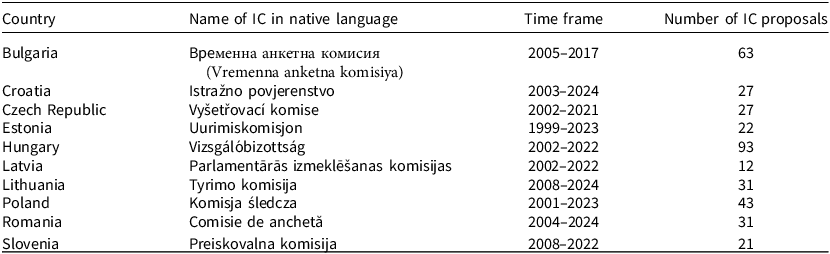
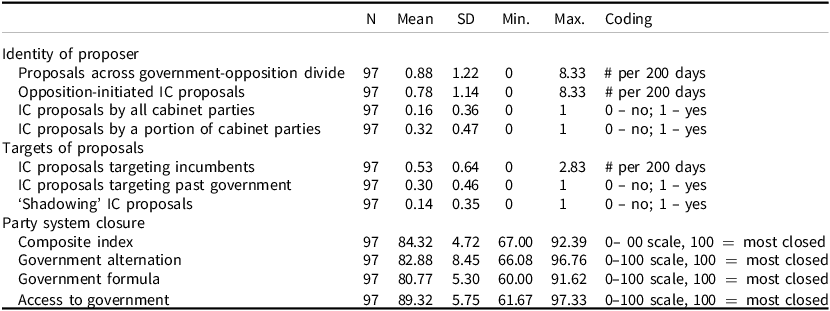
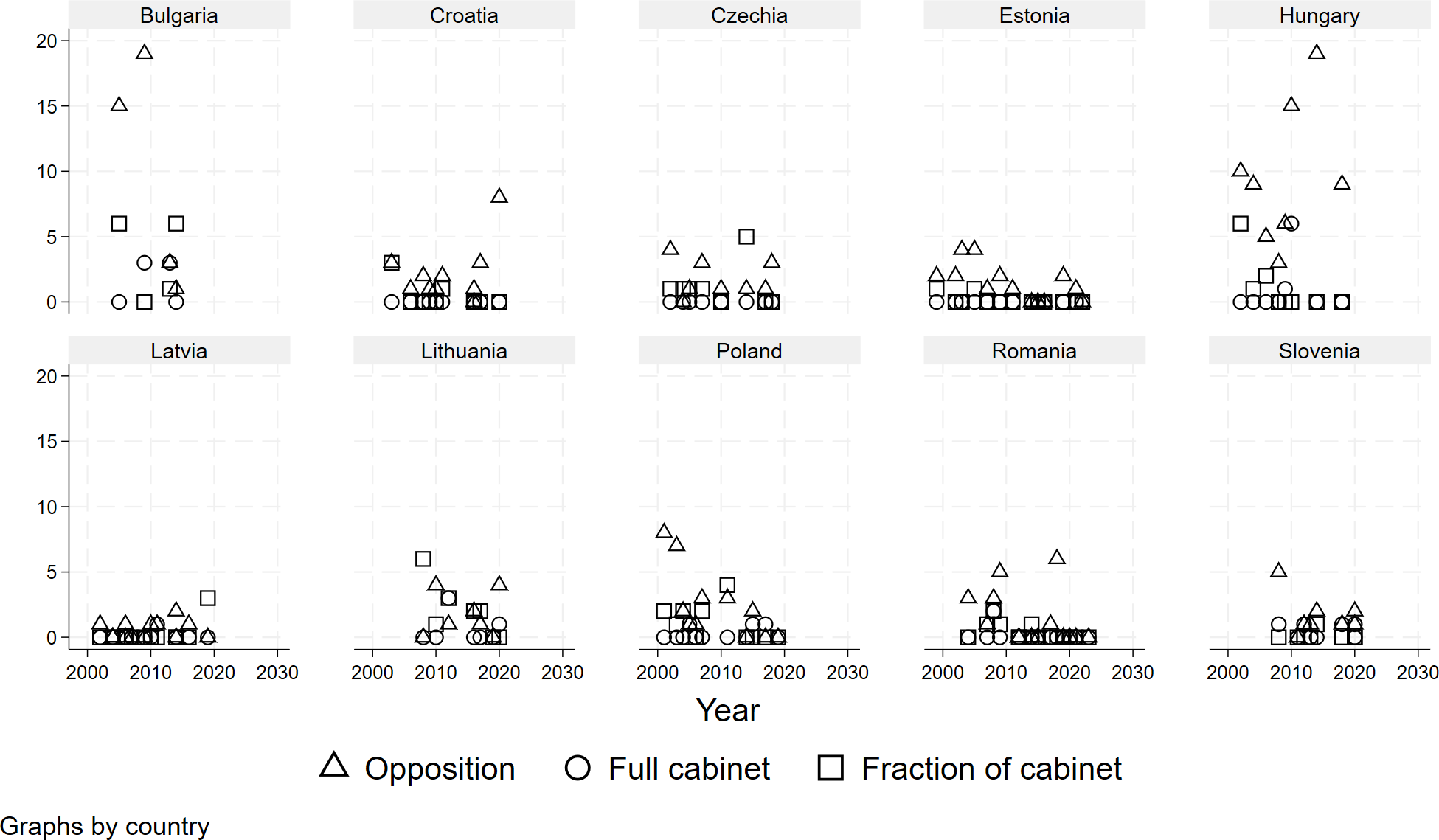
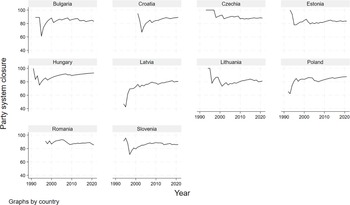
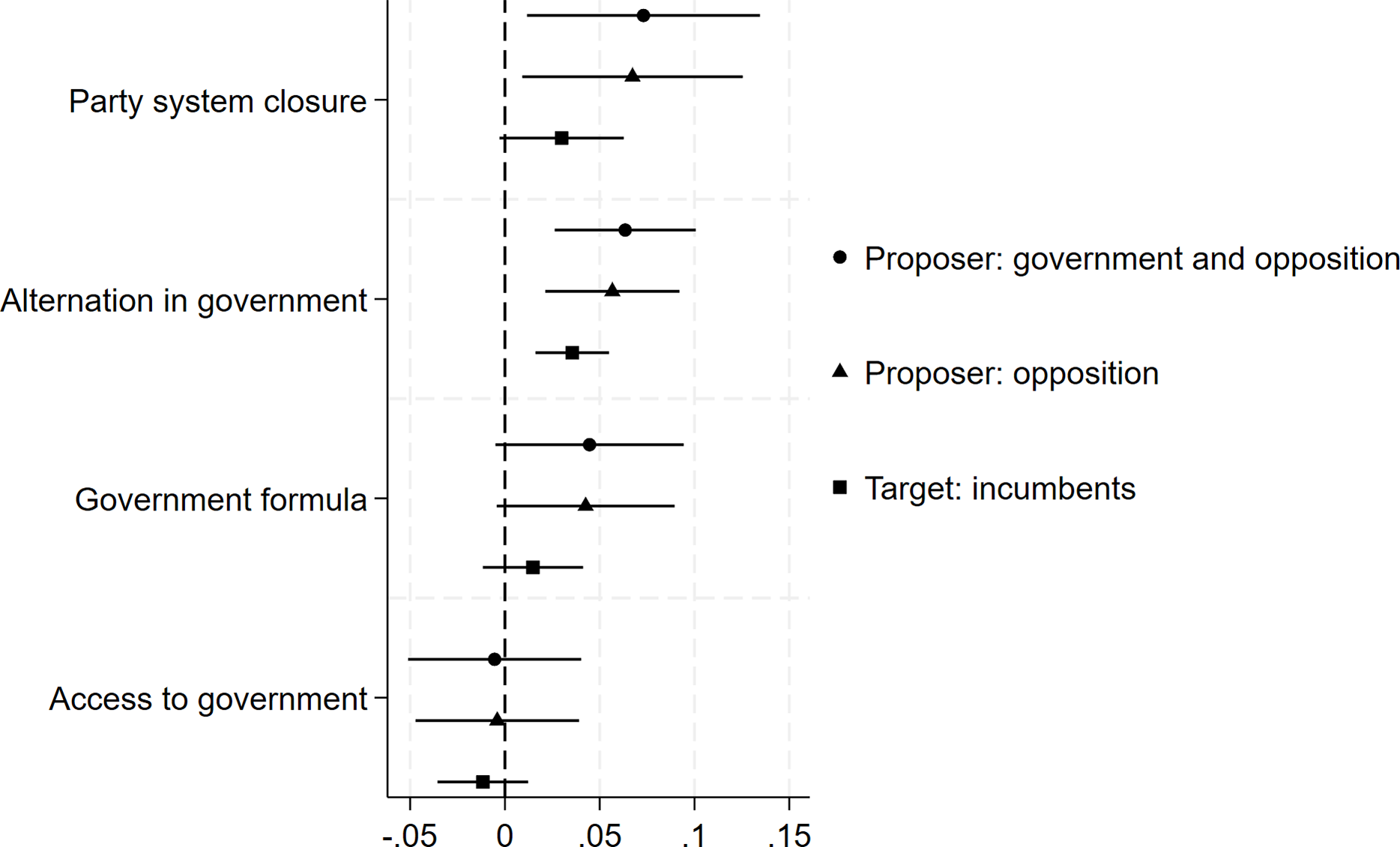
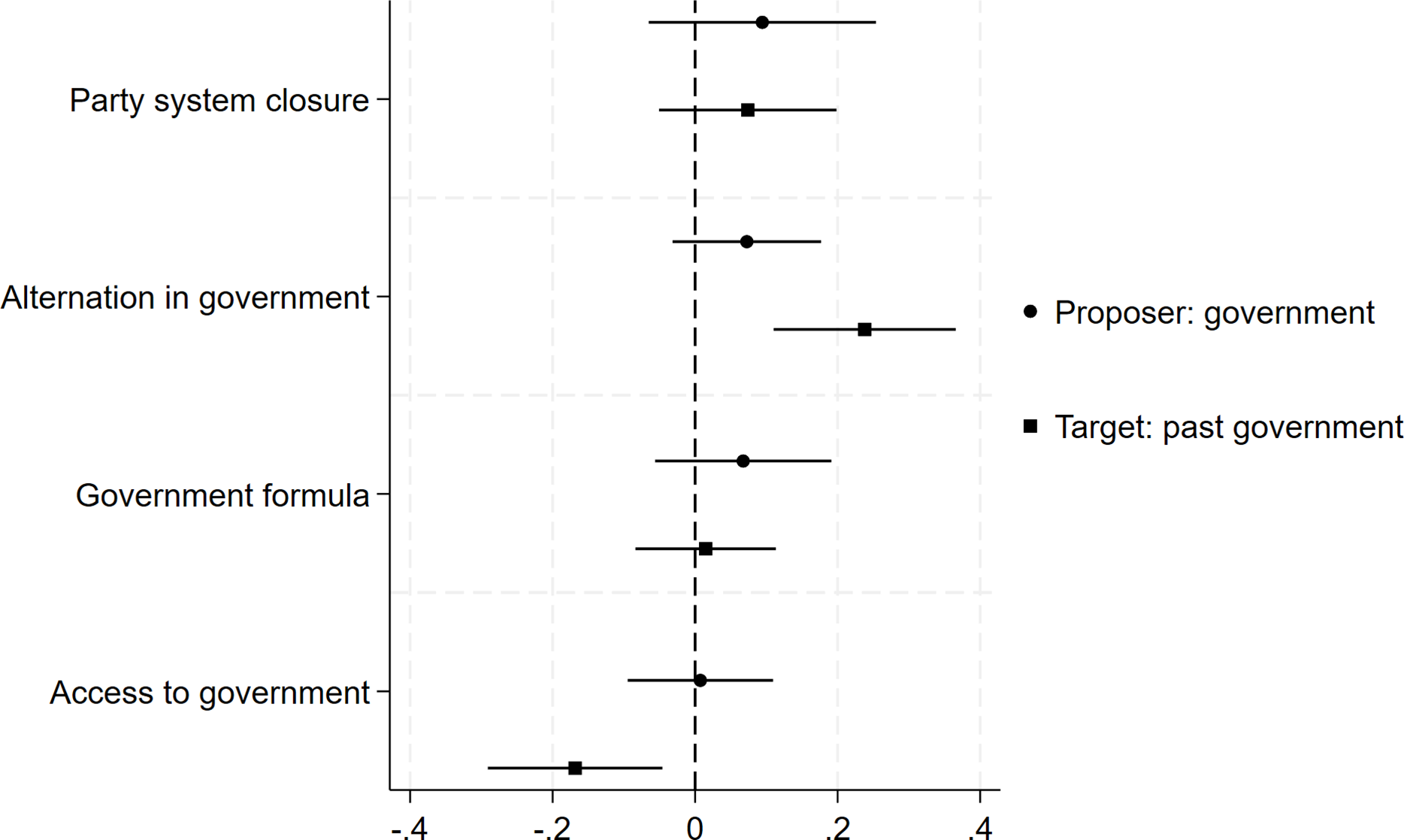
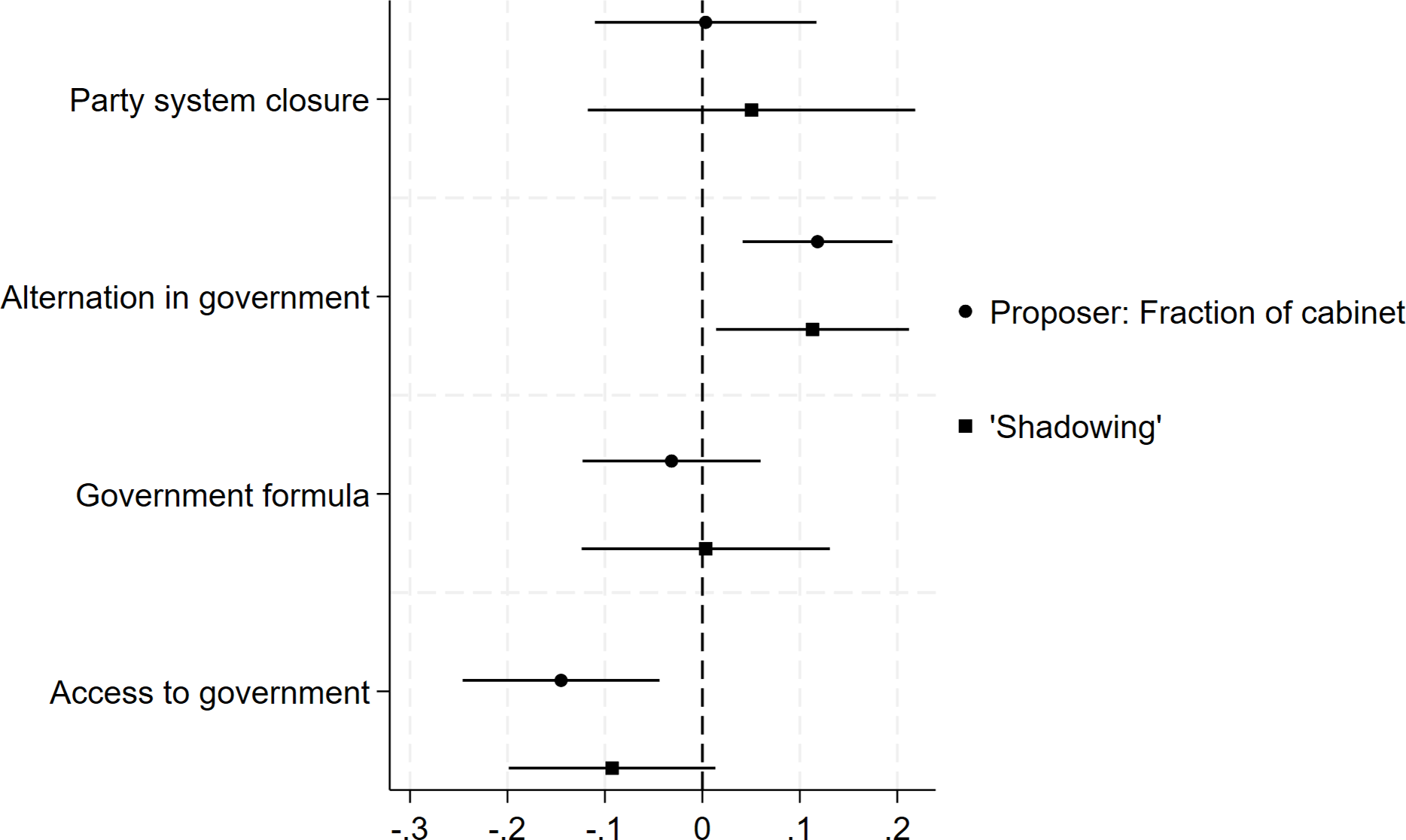
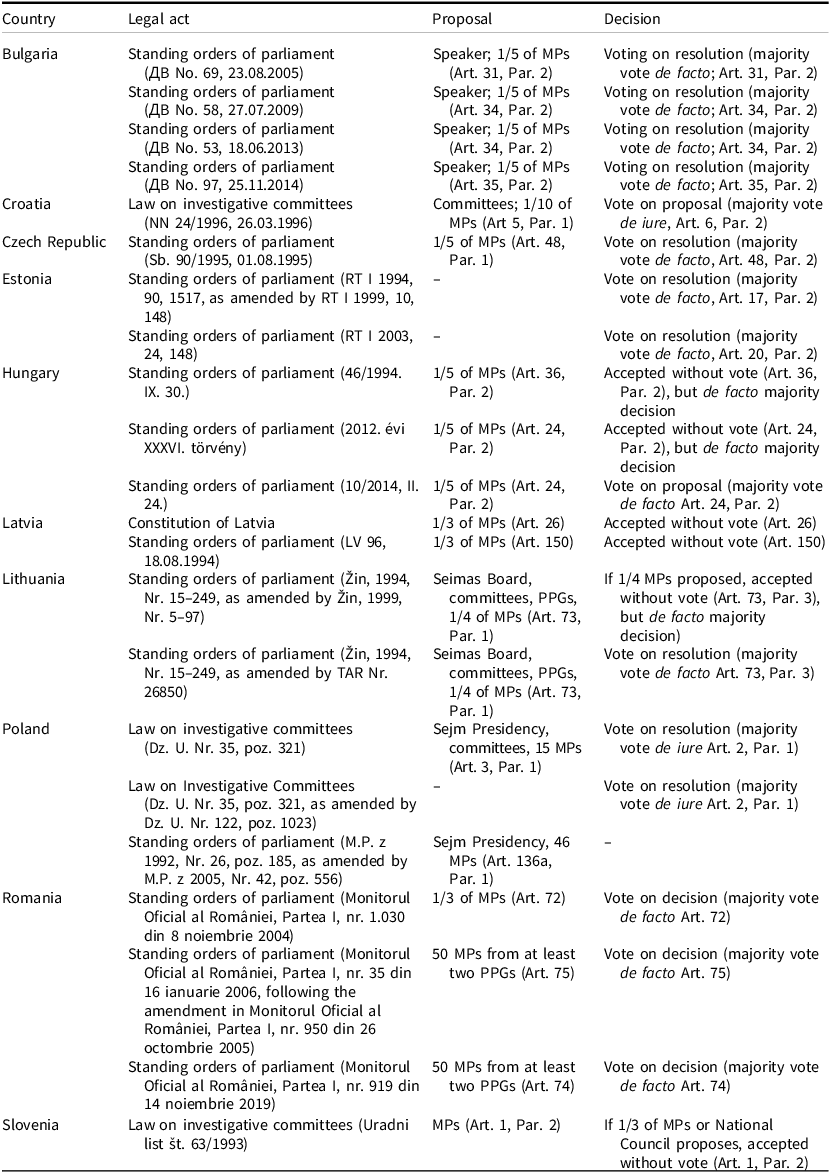
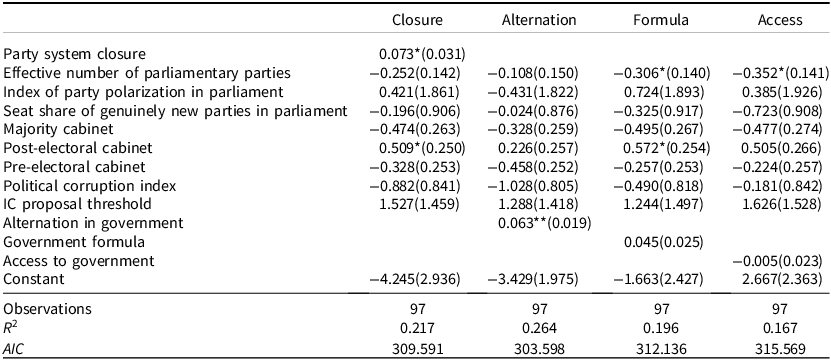
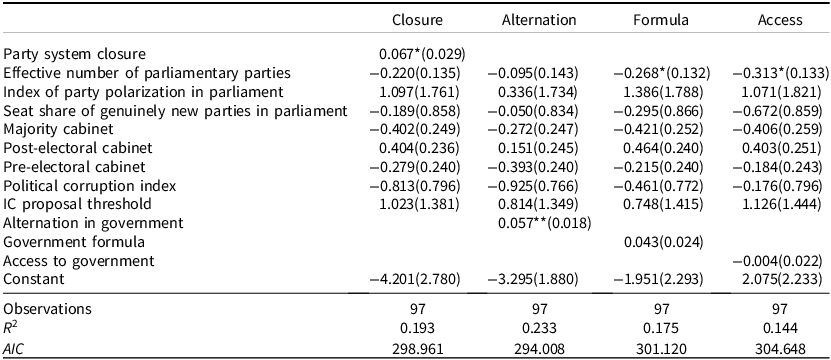
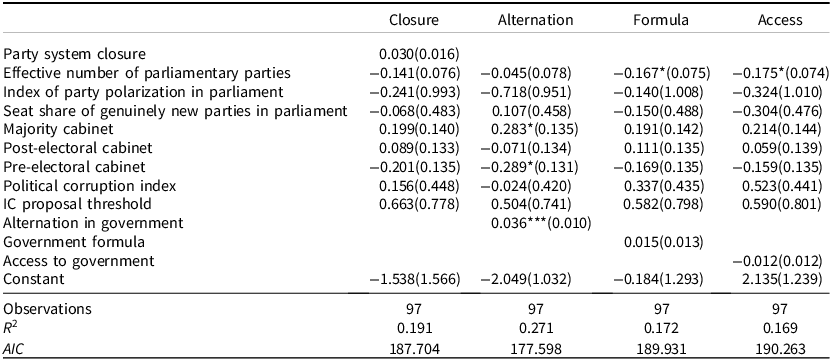
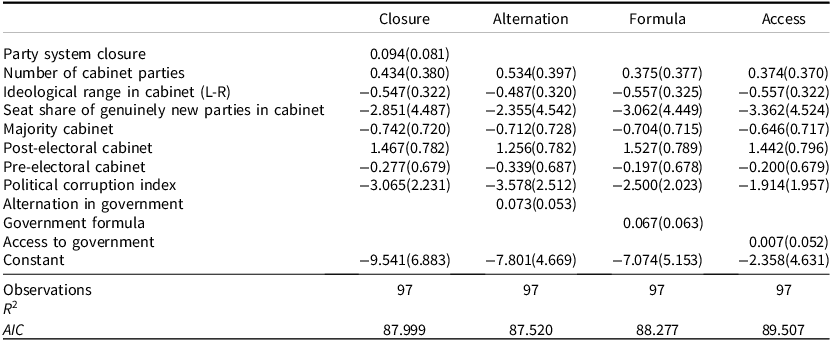
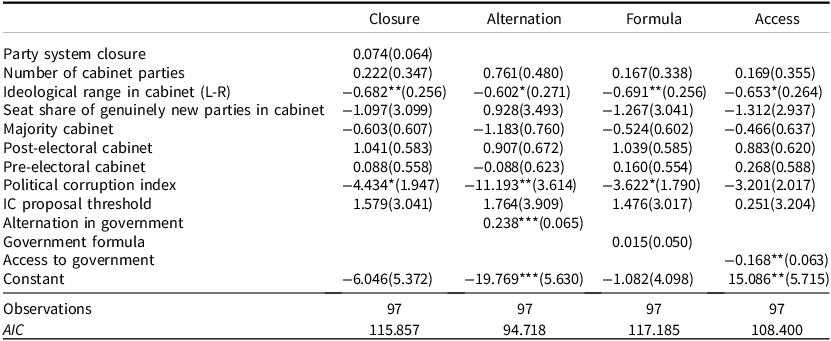
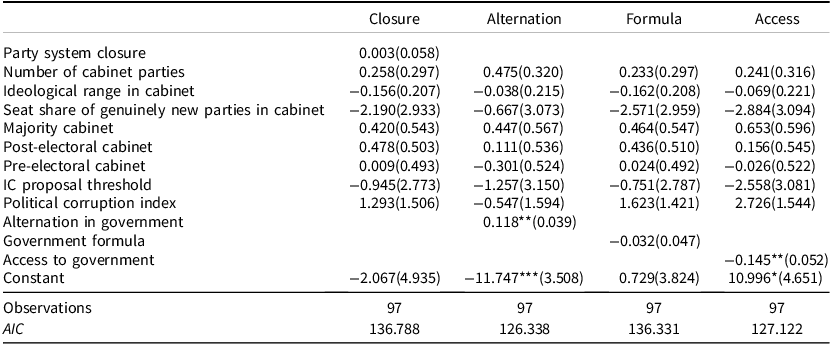
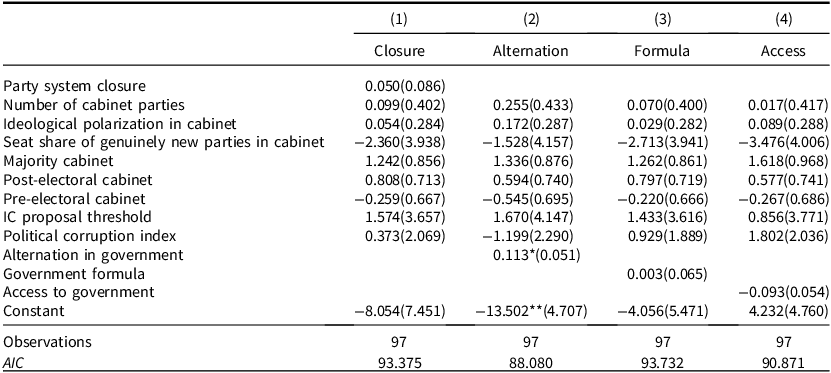
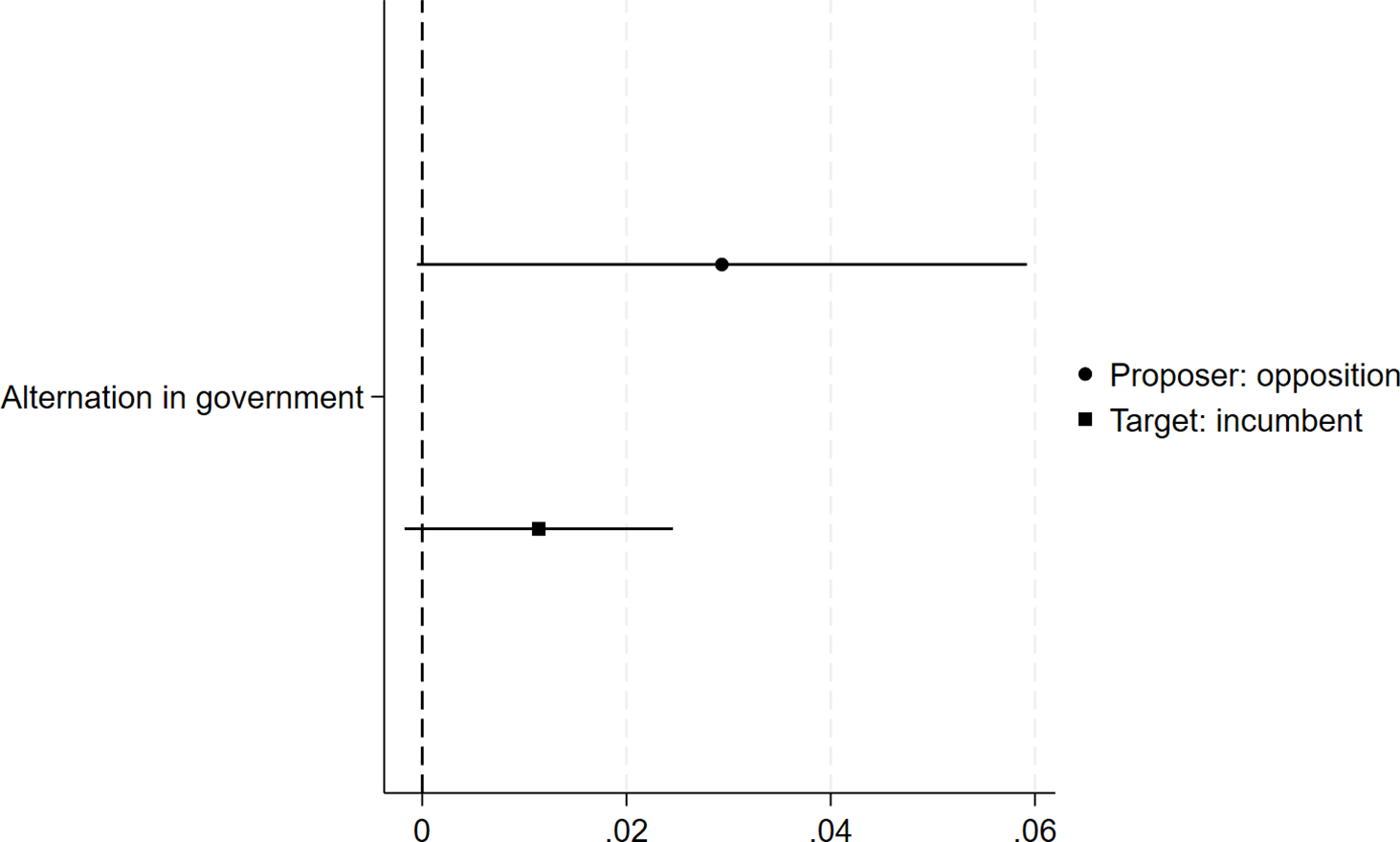
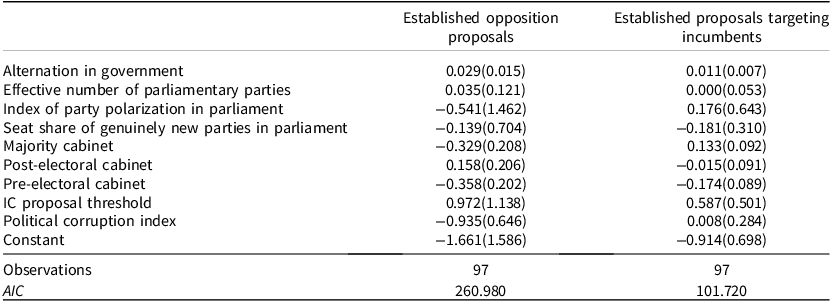
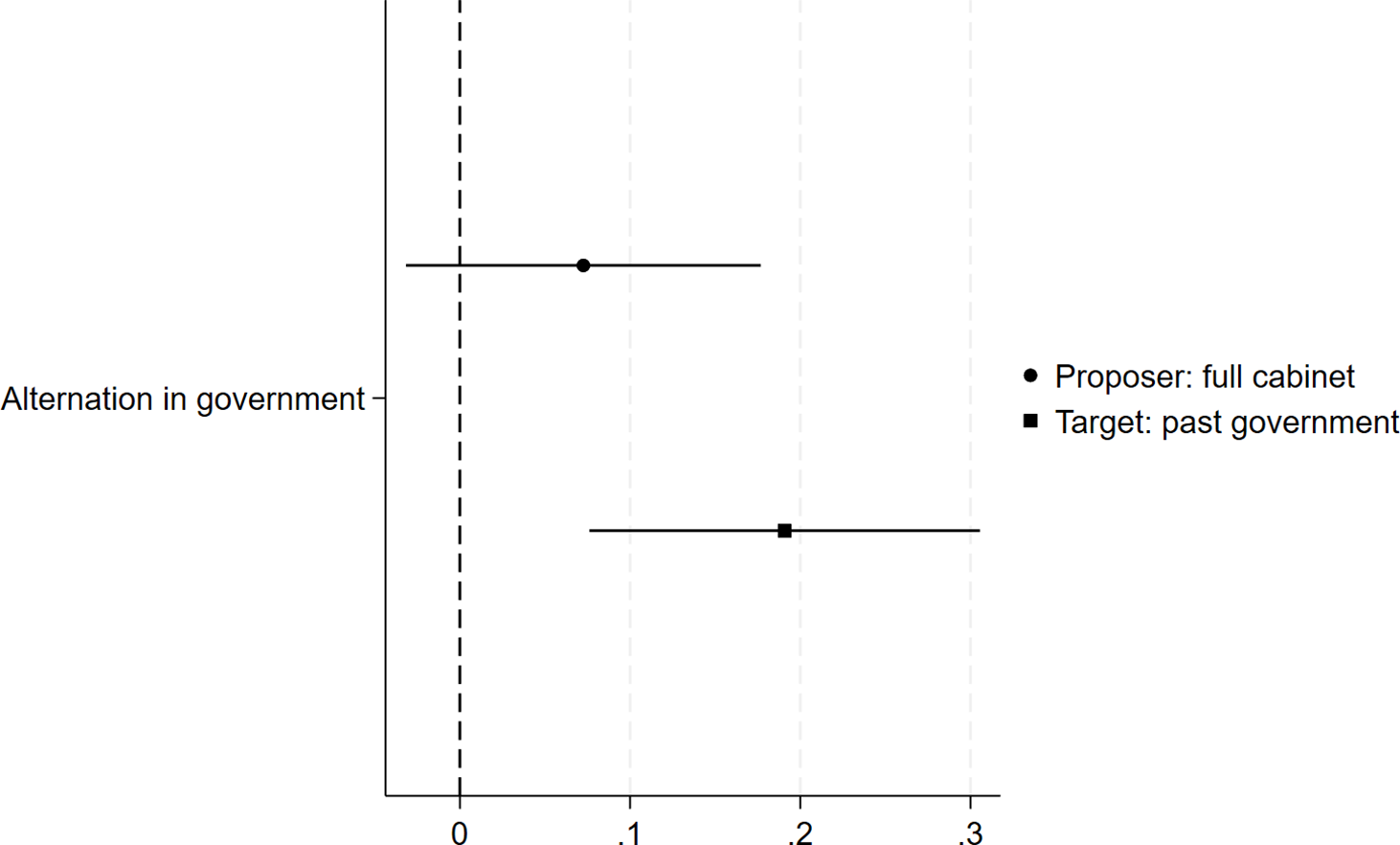
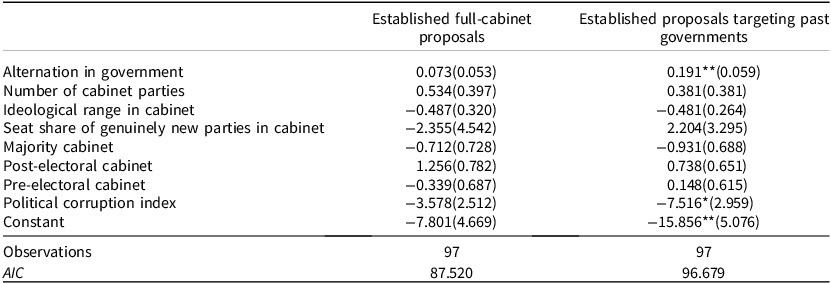
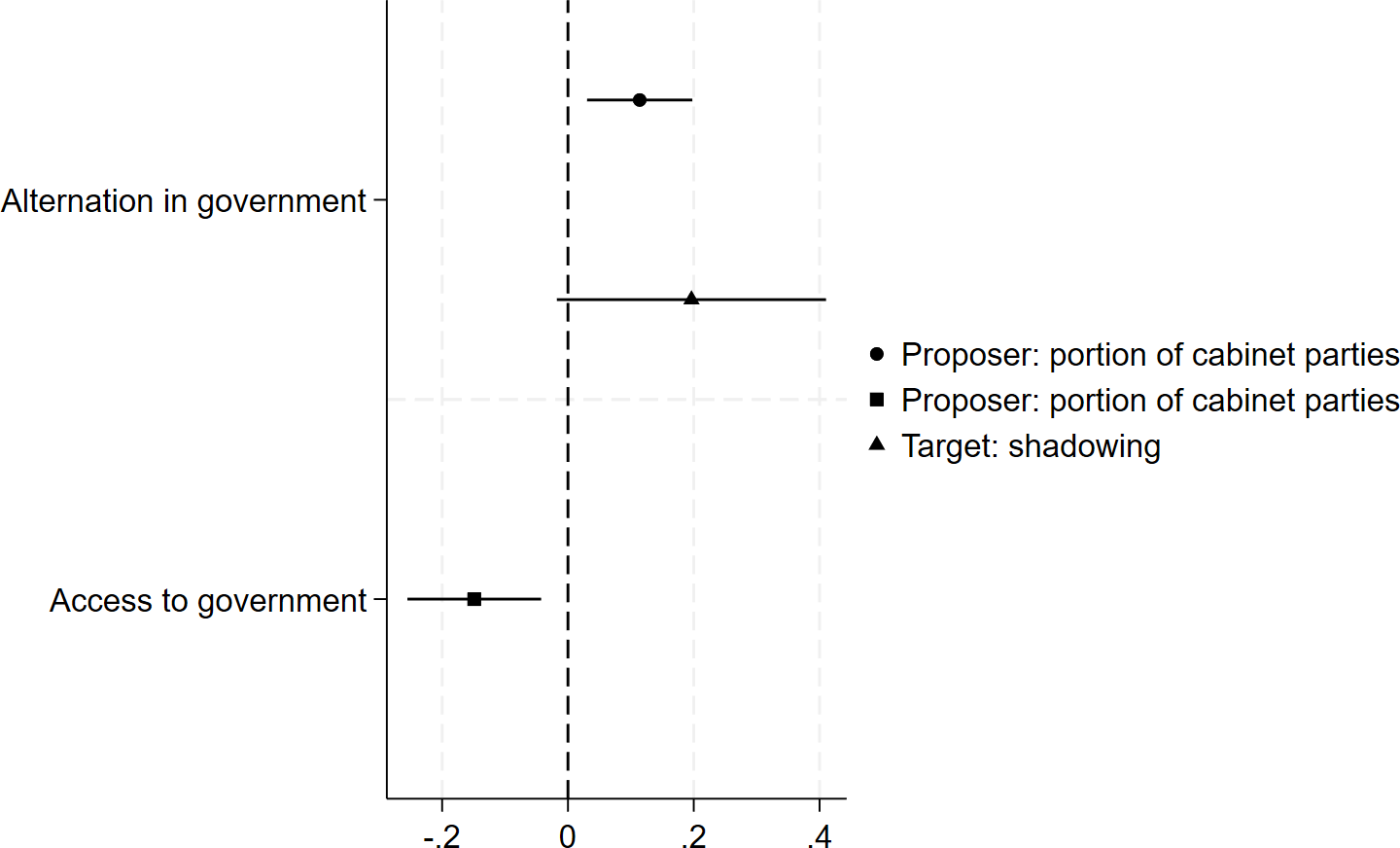
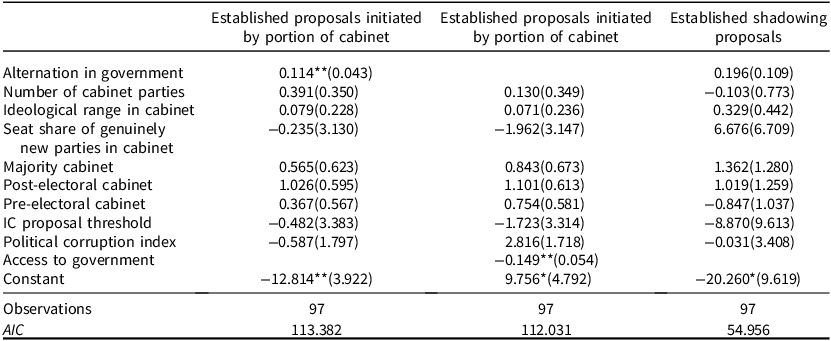
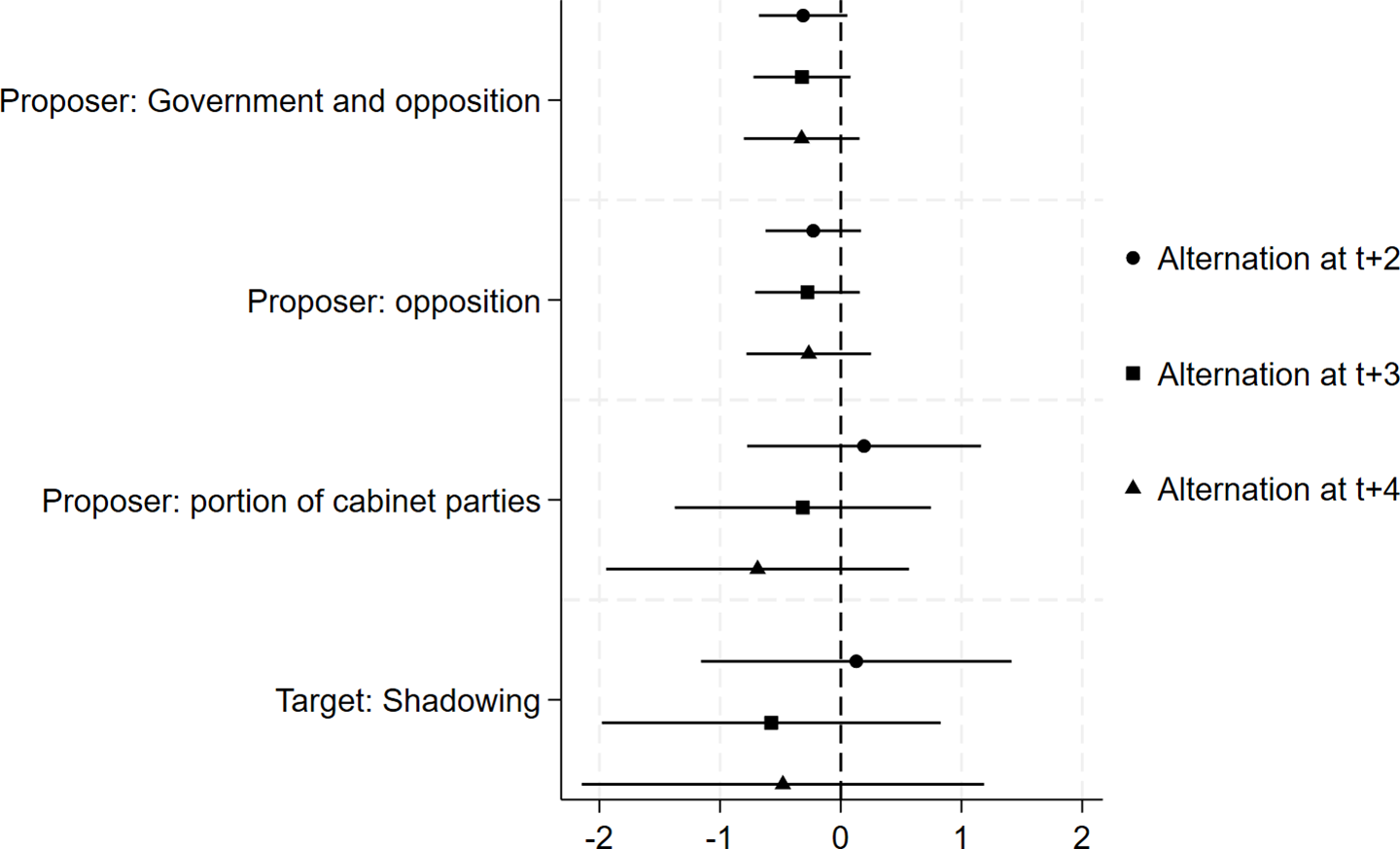


 Open access

