


Introduction
A focus of recent archaeological investigations of the 1845 Franklin Northwest Passage expedition is the attempt to identify the skeletal remains of expedition personnel discovered over the past 170 years on King William Island and on Adelaide Peninsula. These efforts have been advanced through the acquisition of archaeological DNA and stable isotope data and from DNA profiles obtained from descendants of some of the 129 men who died on the expedition (Stenton, Reference Stenton2018). Analysis of archaeological skeletal remains and descendant DNA samples has yielded positive identifications for two members of the Franklin expedition (Stenton, Fratpietro, & Park, Reference Stenton, Fratpietro and Park2024; Stenton, Fratpietro, Keenleyside, & Park, Reference Stenton, Fratpietro, Keenleyside and Park2021), and isotopic proveniencing of archaeological tooth samples has suggested several possible identifications as well as exclusions (Keenleyside, Stenton, & Newman, Reference Keenleyside, Stenton and Newman2021).
A logical extension of this work is its application to identifications proposed for three sets of skeletal remains discovered in the nineteenth century on King William Island (Hall, Reference Hall1869; McClintock, Reference McClintock1859b; Stackpole, Reference Stackpole1965) but attempts to do so have been constrained by data gaps. The attribution of a partial skeleton found in 1879 on the northwest coast of King William Island to Lieutenant John Irving, HMS Terror, was based on the discovery among the small number of artefacts associated with the grave of a mathematics medal awarded to Irving in 1830 (Schwatka, Reference Schwatka1879). The identification of the remains as those of Irving based on that discovery has never been questioned, but confirmation through DNA analysis has not been possible because the skeleton was interred in Scotland in 1881 (Bell, Reference Bell1881). A DNA profile from a paternal descendant of John Irving has been obtained, but efforts to positively identify the burial site on King William Island in the hope of finding small bones or teeth that might have been overlooked in 1879 and that would be suitable for genetic analysis have been unsuccessful.
The identification of the remains of Assistant Surgeon Harry D. S. Goodsir, HMS Erebus, has also been widely accepted, but unlike the Irving identification it is based on the results of a 2009 forensic re-examination of a skeleton exhumed from a grave on the south coast of King William Island in 1869 and reinterred in Greenwich in 1873 (Hall, Reference Hall1869; Mays et al., Reference Mays, Ogden, Montgomery, Vincent, Battersby and Taylor2011). The results of the detailed study introduced doubt about the original identification of the skeleton as being that of Lieutenant Henry T. D. Le Vesconte, HMS Erebus, and proposed Goodsir as a more likely candidate. A DNA profile has been obtained for a paternal descendant of Le Vesconte, but no descendant of Goodsir meeting the criteria for a comparative DNA test has been identified. DNA analyses conducted on hair samples retained from the 2009 study yielded no viable mitochondrial or nuclear DNA.
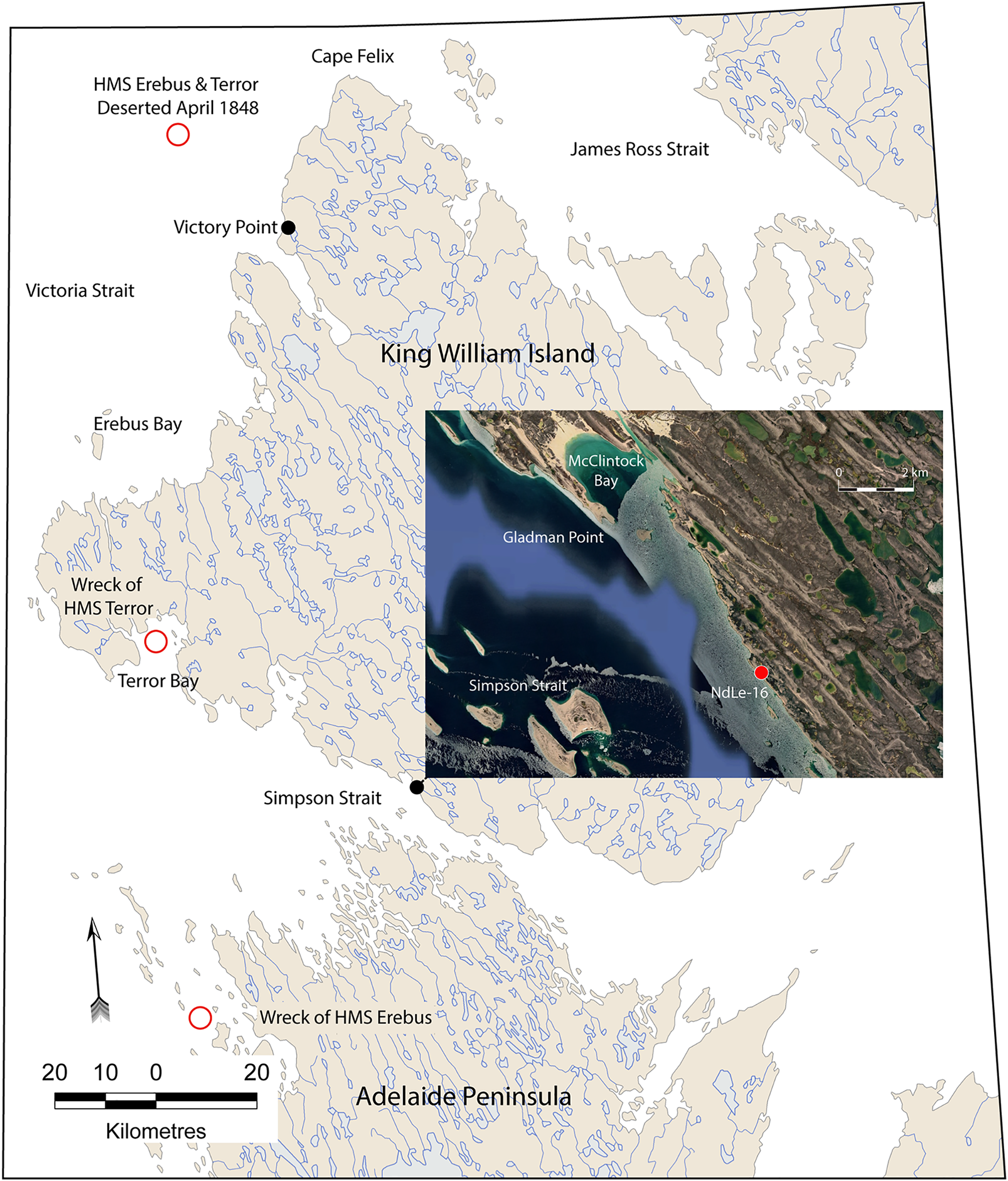
The third identification, arguably the least certain and most questioned, is that of an unburied skeleton found in 1859 on the south shore of King William Island at what is now known as archaeological site NdLe-16 (Fig. 1) (McClintock, Reference McClintock1859b; Stenton, Reference Stenton2022; Walsh, Reference Walsh1974). Initially thought to be that of Petty Officer Harry Peglar, Captain of the Foretop, HMS Terror, the individual’s identity has been a subject of continued interest and discussion through which two alternative identifications have been proposed. The presumptive identification of the remains as those of Henry Peter (“Harry”) Peglar was based on the discovery of his seaman’s certificate and other papers (known colloquially as the “Peglar Papers”) in a leather pocketbook found with the skeleton (Cyriax & Jones, Reference Cyriax and Jones1954; McClintock, Reference McClintock1859b). As in the case of Irving, attribution of the remains to Peglar based on these items seemed obvious, but it was contradicted by some of the clothing fragments found scattered around the skeleton, specifically, pieces from a double-breasted waistcoat and a black silk neckerchief tied in a loose bowknot, a style not used by seamen or officers. Those finds indicated that the remains were those of an individual holding a domestic rating – a steward or officer’s servant, an interpretation that has been widely accepted and that is supported by the observation that among the few personal effects that were found with the skeleton was a clothes brush, something that a steward might possess (Stein, Reference Stein2007). Consequently, the prevailing view is that unless Peglar had been disrated prior to the April 1848 desertion of HMS Terror, a possibility that while not unequivocally rejected appears to have gained little favour, the skeleton was not his and the discovery of his personal documents reflected either a pre-arrangement with or the thoughtful act of a friend who was a steward. With four stewards on each ship, there are eight possibilities, but attention has focused on two stewards on HMS Terror as the most plausible candidates on the basis that they had previously served with Peglar on other ships. Content analyses of the papers in the pocketbook combined with a review of the men’s service records suggested the skeleton might have been that of Thomas Armitage (Gunroom Steward) or possibly William Gibson (Subordinate Officers’ Steward). The reasoning underlying these suggested identifications has been presented in detail by the respective authors (Cyriax & Jones, Reference Cyriax and Jones1954; Jones, 1984; Stein, Reference Stein2007; Reference Stein2024) and is not restated here, but they include mention of two observations made by McClintock about the presumed steward – his approximate age and height. Now regarded as highly questionable and of limited, if any, relevance in determining the man’s identity, McClintock’s comments continue to form part of current discourse about the sailor’s identity.
Map showing location of site NdLe-16 on south shore of King William Island, Nunavut. Maps Data: Google, © 2025 Airbus.
Drawing upon archival and archaeological data, this paper first evaluates the interpretive utility of McClintock’s observations about these two variables with respect to the possible identity of the NdLe-16 skeleton. An osteological stature estimate derived from the skeleton validates McClintock’s inference about the deceased sailor’s height. The paper then presents the results of DNA analyses conducted on samples from the NdLe-16 skeleton, from descendants of six of the eight stewards and from descendants of Harry Peglar. DNA analysis confirms that the skeleton was not that of one of the eight men who joined the 1845 Franklin Northwest Passage expedition as stewards but was, in fact, Harry Peglar.
Historical background and context
Before presenting the DNA analysis, key details of the 1859 discovery and interpretation of the skeleton at NdLe-16 that have framed contemporary efforts to identify the individual are summarised. Interestingly, McClintock appears not to have expressed an opinion on the seemingly obvious contradiction between physical evidence of the man’s rating as that of a steward as deduced from the clothing, and the discovery of Harry Peglar’s seaman’s certificate, who joined HMS Terror as Captain of the Foretop. This suggests that McClintock may have felt that the apparent contradiction notwithstanding, the certificate provided sufficient confirmation of identity (Cyriax & Jones, Reference Cyriax and Jones1954, p. 194).
The skeleton
Relatively little is known about the NdLe-16 skeleton. It was discovered on 26 May 1859, roughly 5 km southeast of Gladman Point on the Simpson Strait coast of King William Island (Stenton, Reference Stenton2022). Originally thought to be in the prone position (Stenton, Reference Stenton2022, p. 7), the body lay face up and partially exposed on the snow-covered ground, and although largely complete, disturbance by small animals had damaged and disarticulated some of the limb bones and torn apart the clothing (McClintock, Reference McClintock1859b, p. 274). The presence of artefacts with the skeleton that might ordinarily have been removed by Inuit combined with the absence of any mention of it in Inuit oral historical accounts indicated that they were unaware of its existence. McClintock examined the skeleton, collected the associated items and then covered the remains with rocks (Petersen, Reference Petersen1860). The timing and circumstances are unknown, but the grave was subsequently disturbed, probably by Inuit in the nineteenth century, and was next documented in July 1973. Bleached and weathered bones were protruding from the feature, the cranium was missing, and what remained of the skeleton together with a small number of artefacts overlooked in 1859 were removed and transferred to the National Museum of Man for analysis (Stenton, Reference Stenton2022; Walsh, Reference Walsh1974). The skeleton was provisionally identified to be that of a member of the 1845 Franklin expedition, but both it and the associated artefacts were reported missing in the late 1980s and no reports describing their examinations by museum anthropologists have been found. The loss of the skeletal remains means that the review of McClintock’s thoughts about the sailor’s age and stature is limited to his 1859 observations.
Age
McClintock speculated that the deceased was a slightly built and young man who was possibly of above-average height (McClintock, Reference McClintock1859b, p. 275). He did not elaborate on these points in his published accounts of the discovery but his journal contains details that might have influenced his thinking. With respect to age, McClintock noted that nine of the teeth were apparently missing, most or all of which were thought to have been lost post-mortem, but he described those remaining as “rather small, perfectly formed and white,” and the face as “long and narrow with a long chin, the forehead low and slightly receding and the back part of the skull round and full” (McClintock, Reference McClintock1859a, May 24–25). The small size and apparent good condition of the teeth, combined with McClintock’s assessment of the attributes of the cranium, might have led him to conclude that the man was slightly built and thus young. Carl Petersen, a member of McClintock’s search team, agreed that the size of the bones suggested they were possibly those of a younger man (Petersen, Reference Petersen1860, p. 195). These conjectures are open to question given that both men lacked medical training on which inferences about chronological age would ordinarily be made (Stein, Reference Stein2007; Stenton, Reference Stenton2022). The average age of the sailors on the Franklin expedition was 28 (Lloyd-Jones, Reference Lloyd-Jones2005, p. 318), and while the skeleton would have had age-related attributes identifiable by experts, there is no basis for confidence in McClintock’s inferences about the chronological age of the skeletal remains.
Stature
On the question of the steward’s above-average stature, McClintock’s speculation is less easily dismissed because when men entered service their height was one of the physical attributes recorded. It is also interesting because unlike his age estimate, which was essentially a guess, stature is a physical characteristic about which McClintock would have gained an informed perspective through his nearly three decades of service in the British Royal Navy as of 1859. Although that cumulative experience would not have conferred on him any expertise in assessing an individual’s height from their skeleton, it prompted an action that enables an empirical evaluation of his conjecture regarding the individual’s stature. A review of his sledge journal revealed that McClintock’s examination of the skeleton included recording two bone measurements – the circumference of the cranium (21 inches) and the extreme (i.e. maximum) length of one of the femurs (McClintock, Reference McClintock1859a). No explanation was given for taking either measurement, but the reason for measuring the femur must have been his impression that the skeleton appeared to be that of a taller-than-average sailor. Whether the measurement was taken on the left or the right femur was not stated but photographs taken in 1973 show that both were intact (Stenton, Reference Stenton2022; Walsh, Reference Walsh1974).
The length of the NdLe-16 femur was recorded to be 18 inches (45.72 cm) and a stature estimate derived using the regression equation of Trotter and Gleser for the femur for White males (Trotter & Gleser, Reference Trotter and Gleser1958: Table 12; Trotter, Reference Trotter and Stewart1970) is 171.60 ± 3.94 cm which converts to a point estimate of 5′ 7½″ and a range of between 5′ 6″ and 5′ 9″.
The stature estimate for the NdLe-16 skeleton is an approximation but it provides an important lens through which to assess McClintock’s speculation about the sailor’s stature and a basis for comparison with the heights recorded for the eight stewards. Comparison of the stature estimate for the NdLe-16 skeleton must be done with caution, however, due to uncertainty about the degree to which recording of stature measurements by the Royal Navy was standardised and because discrepancies exist for the heights recorded for some of the men in question, particularly for Thomas Armitage, whose height based on a recent analysis appears to have been 5′ 6″ (Stein, Reference Stein2024, p. 99) rather than 5′ 9″ (Cyriax & Jones, Reference Cyriax and Jones1954, p. 194).
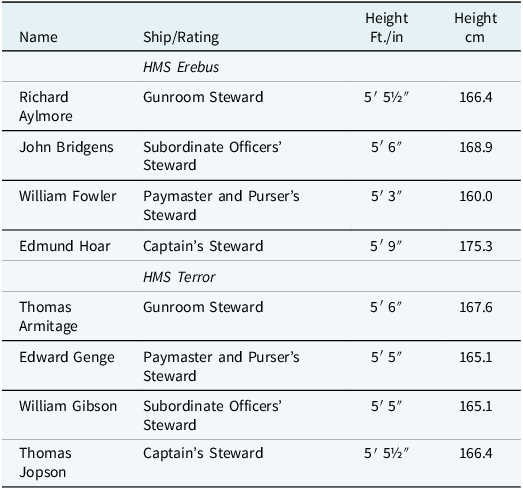
The presumed heights of the eight stewards on Erebus and Terror drawn from description books and from secondary sources (Jones, 1984; Lloyd-Jones, Reference Lloyd-Jones2005; Stein, Reference Stein2024) are listed in Table 1. For discussion purposes, men whose statures fall between 5′ 5″ and 5′ 6″ (165–168 cm) are considered to be of average height for the time period in question (Boston, Witkin, Boyle, & Wilkinson, Reference Boston, Witkin, Boyle and Wilkinson2008). Using that criteria, the heights of five of the stewards would be considered average and of the remaining three, one (Fowler) is 2″ below average, another (Bridgens) is slightly above average, and the third (Hoar) is 3″ above average. The osteological stature estimate cannot, of course, identify the steward, but comparison with the recorded heights for the eight stewards suggests that the field of possible candidates might be narrowed to two individuals, John Bridgens and Edmund Hoar, neither of whom were stewards on HMS Terror.
Height data for individuals holding domestic ratings on HMS Erebus and HMS Terror in 1845
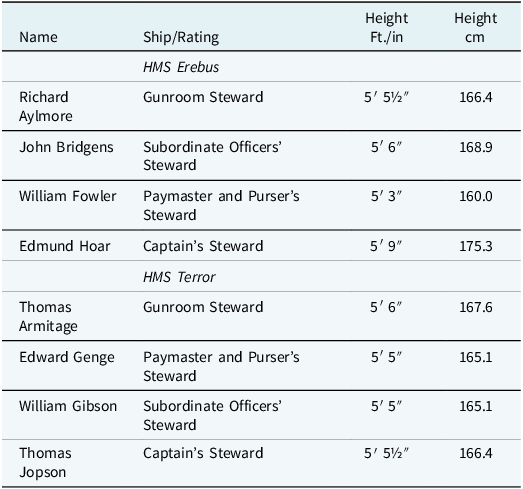
Source: Description Books (HMS Cambridge, HMS Clio, HMS Endymion, HMS Ocean, HMS Wanderer); Jones (1984); Lloyd-Jones (Reference Lloyd-Jones2005); Stein (Reference Stein2024).
DNA analysis
Several important points for discussion emerge from the preceding review. First, McClintock apparently believed that, the uniform of a steward notwithstanding, the sailor whose body he found was that of Harry Peglar (McClintock, Reference McClintock1869, p. 311), who he presumably did not know, but judged to be relatively young and possibly of above-average height. Second, the evidence indicating that the dead sailor was a steward and possibly a friend of Peglar appears to have been broadly accepted, resulting in later researchers, at least implicitly, rejecting McClintock’s conclusion that it was Harry Peglar and, in some cases explicitly, his musings about the sailor’s age and height, the latter of which has been validated. Subsequent efforts to isolate candidates for the NdLe-16 skeleton from among the Erebus and Terror stewards yielded interesting arguments (Cyriax and Jones, Reference Cyriax and Jones1954; Stein, Reference Stein2007; Stein, Reference Stein2024) but like the age and stature data, analysis of naval service records and of details contained in the Peglar Papers cannot result in a positive identification.
DNA analysis, however, offers an independent and definitive means of testing the assumptions and inferences suggested by the various other lines of evidence. A genetic approach to identifying the sailor is complicated, however, by the loss of the skeleton from which samples for testing could be extracted and by the need to acquire comparative descendant DNA samples. To address those issues, over the past decade samples for DNA analysis were obtained through new archaeological investigations conducted at NdLe-16 and from materials curated from the 1859 investigation, and descendant DNA profiles were obtained for six of the eight stewards on Erebus and Terror, and for Harry Peglar. The results of these efforts and analyses are presented below.
Materials and methods
Sample material
Ancient DNA: DNA tests were conducted on samples of human bone (n = 3), tooth (n = 1), and hair (n = 1) from NdLe-16. Bone and tooth samples were acquired through excavations conducted at NdLe-16 between 2019 and 2023. They were recovered from two adjacent 50 cm × 50 cm test units exterior to the former grave, where a thick layer of excavated soil had accumulated from being sifted in 1973 through a coarse makeshift screen (Walsh, Reference Walsh1973). Analysis of the bones (a left metatarsal and two proximal right hand phalanges) yielded a mitochondrial DNA profile indicative of haplogroup U5a2a, and a partial Y-chromosome DNA profile indicative of a male of European ancestry belonging to haplogroup R1b. The results of DNA testing on the tooth were rejected due to possible contamination prior to submission to the Palaeo-DNA Laboratory. The hair sample was obtained in 2022 from the National Maritime Museum from among the items recovered from the site in 1859. It consisted of a shaft with a root bulb extracted from within the folds of the black silk handkerchief collected by McClintock (Veall & Vedoy, Reference Veall and Vedoy2021). It contained no viable nuclear or mitochondrial DNA. With some exceptions, these results are consistent with other analyses of hair samples we obtained from other terrestrial Franklin expedition sites and for recently published results of tests conducted on hair samples recovered from HMS Erebus (Bowman et al., Reference Bowman, Christensen, Dagneau, Kavousanaki, Millar and Moore2023).
Descendant DNA: Between 2015 and 2025, buccal DNA samples were obtained from descendants of Edward Genge, William Gibson, Thomas Jopson, and Harry Peglar, HMS Terror, and descendants of Richard Aylmore, John Bridgens, and Edmund Hoar, HMS Erebus. No descendants of stewards Thomas Armitage or William Fowler meeting the criteria for comparative DNA testing were identified. The type of DNA analysis performed (mtDNA versus Y-chromosome) was determined by the manner in which descendants traced their relationship to their ancestor (i.e. through the maternal or paternal line).
DNA analysis
Ancient DNA bone and tooth specimens were analysed following the procedures described in Stenton, Keenleyside, Fratpietro and Park, (Reference Stenton, Keenleyside, Fratpietro and Park2017). Ancient hair shafts were surfaced sterilised with washes of sterile water, 100% ethanol and sterile water. Then, each shaft was crushed in extraction buffer using glass mortar and pestles and followed an extraction procedure utilising proteinase K (Hansen, Reference Hansen1974). A modified silica bead purification (Boom et al., Reference Boom, Sol, Salimans, Jansen, Wertheim-van Dillen and van der Noordaa1990) took place on this extraction product followed by additional size exclusion column purification (Matheson et al., Reference Matheson, Marion, Hayter, Esau, Fratpietro and Vernon2009).
For descendant DNA, a buccal swab is cut at the tip with clean scissors and placed into a 2.0 mL tube where it is covered with 400 uL of 10% Chelex© 100. This reaction is incubated for 3 hours at 56 °C and 1000 rpms (Walsh, Metzger, & Higuchi, Reference Walsh, Metzger and Higuchi1991). After this time, the supernatant is mixed with 1.0 mL 4M guanidinium thiocyanate and 15 uL silica bead. This is allowed to sit overnight at 4 °C after which the supernatant is removed and the remaining silica is washed with Working Wash Buffer (10mM Tris-HCl, 50mM NaCl, 1mM EDTA, anhydrous ethanol), 100% ethanol and then allowed to dry. The silica is resuspended in 55 uL sterile water and incubated for 1 hr at 56 °C to allow DNA to unbind from the silica bead and dissolve in the water (Boom et al., Reference Boom, Sol, Salimans, Jansen, Wertheim-van Dillen and van der Noordaa1990).
Members of the research team have no direct contact with the buccal swab samples submitted by the presumed descendant donors. All Palaeo-DNA Laboratory personnel were excluded as contributing to the final results, and the laboratory work for the modern and archaeological samples was performed in physically separated laboratory areas at different times.
Results
The stewards
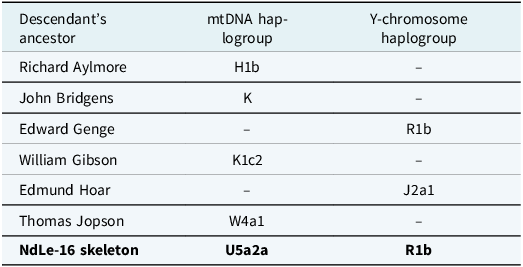
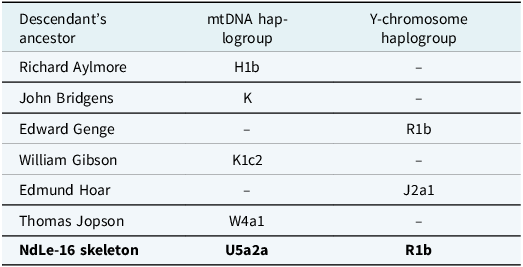
The results of the DNA analyses for the six stewards are summarised in Table 2. None of the six steward descendant samples yielded genetic profiles matching those obtained for the NdLe-16 skeleton meaning that their ancestors can be eliminated as identification candidates. The haplogroups of the four mtDNA profiles obtained all differ from that of the NdLe-16 skeleton, as does the Y-chromosome haplogroup of the descendant of Edmund Hoar. The paternal descendant of Edward Genge and the NdLe-16 skeleton both belong to haplogroup R1b; however, comparison of the NdLe-16 profile for which results were obtained with the complete Genge descendant profile shows a genetic distance of 9. This means that even if results had been obtained for all 23 of the NdLe-16 Y-chromosome markers tested, the two men did not share a recent common ancestor. To summarise, none of the six stewards for whom descendant DNA samples were available for testing match the DNA profiles obtained for the NdLe-16 skeleton.
Mitochondrial and Y-chromosome haplogroups for six stewards from HMS Erebus and HMS Terror
Harry Peglar
DNA samples from one paternal and one maternal descendant of Harry Peglar were tested following the procedures previously described. Comparison of the paternal (Y-chromosome) DNA results obtained for the presumed descendant with those obtained with other Franklin expedition remains was not conclusive, and it could not be confirmed with any certainty that the donor is a descendant of Peglar using the Y-chromosome results. These Y-chromosome haplotypes have a genetic distance of 2, which usually means that they are unlikely to share a common male ancestor within a recent genealogical timeframe. Genealogical data indicate that the DNA donor is a paternal descendant of Peglar, but additional ancient DNA markers would need to be tested for a better ability to determine relatedness.
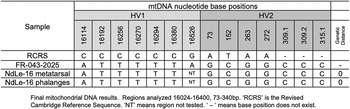
Comparison of the maternal (mitochondrial) DNA results obtained for the presumed descendant (FR-043-2025) with those obtained from other Franklin expedition remains identified the metatarsal and two proximal hand phalanges found at site NdLe-16 as the only samples that cannot be excluded from being maternally related to each other. These mitochondrial haplotypes have a genetic distance of zero indicating a likelihood that they share a common maternal ancestor (Fig. 2).
Comparison of mtDNA markers between NdLe-16 metatarsal, phalanges, and FR-043-2025.
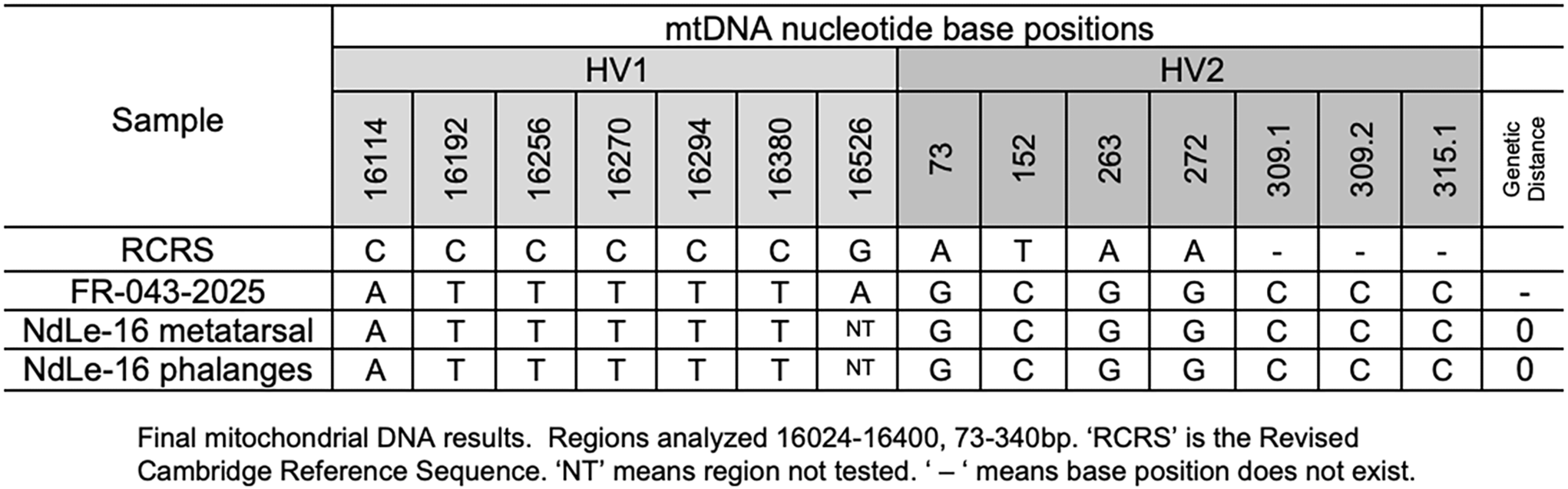
The EMPOP Mitochondrial DNA Database v4/R14 (Parson & Dür, Reference Parson and Dür2007) was used for frequency calculations. The haplotypes of both NdLe-16 and corresponding FR-043-2025 markers were found zero times among 52,973 other haplotypes within the entire database. Using the more specific Westeurasian metapopulation database due to the expected geographic origin of Franklin expedition members, the Kinship Index (Cafer, Reference Cafer2010; Just et al., Reference Just, Loreille, Molto, Merriwether, Woodward, Matheson, Creed, McGrath, Sturk-Andreaggi, Coble, Irwin, Ruffman and Parr2011), the likelihood ratio of an individual being maternally related versus an individual not being maternally related, is calculated to be 6,121. This calculation is based on this specific haplotype occurring zero times out of 22,577 Westeurasian haplotypes within this database using the Clopper Pearson 95% upper limit confidence interval. This indicates strong evidence to support that FR-043-2025 and the individual who died at NdLe-16 are 6,121 times more likely to be maternally related than non-maternally related.
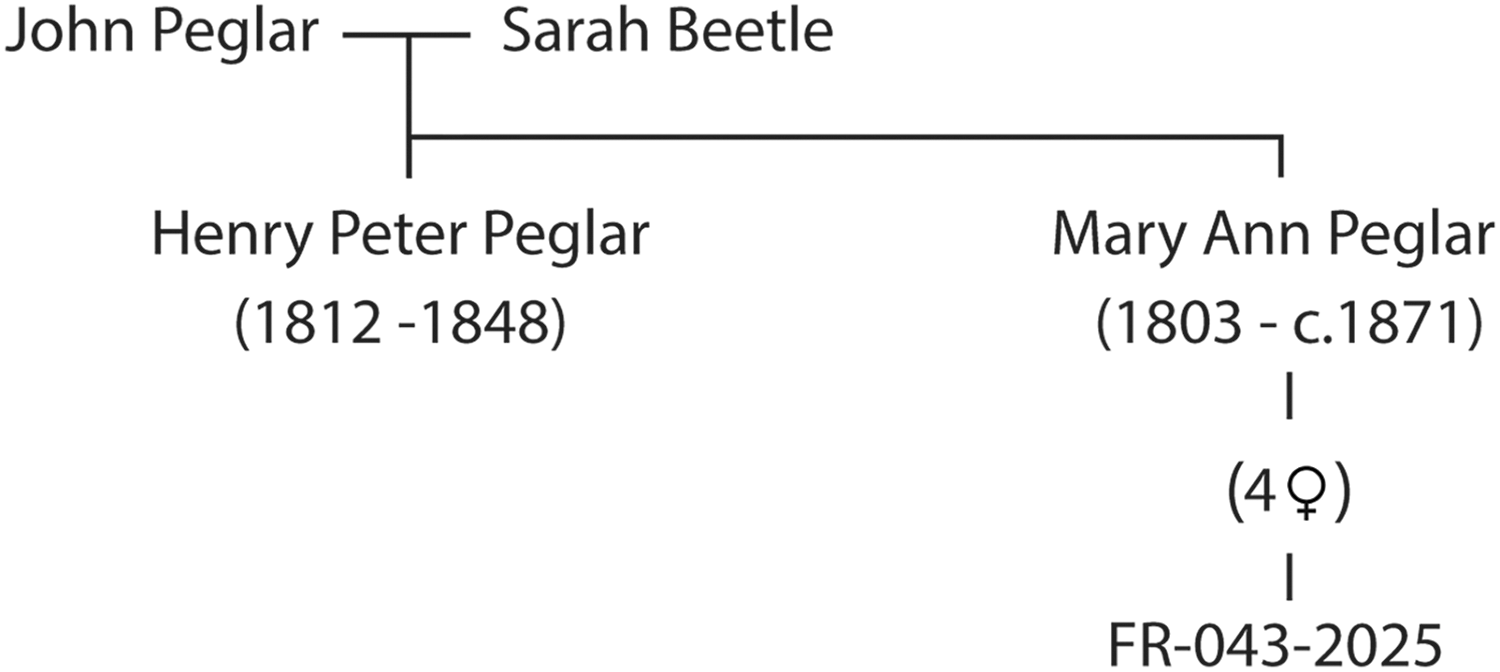
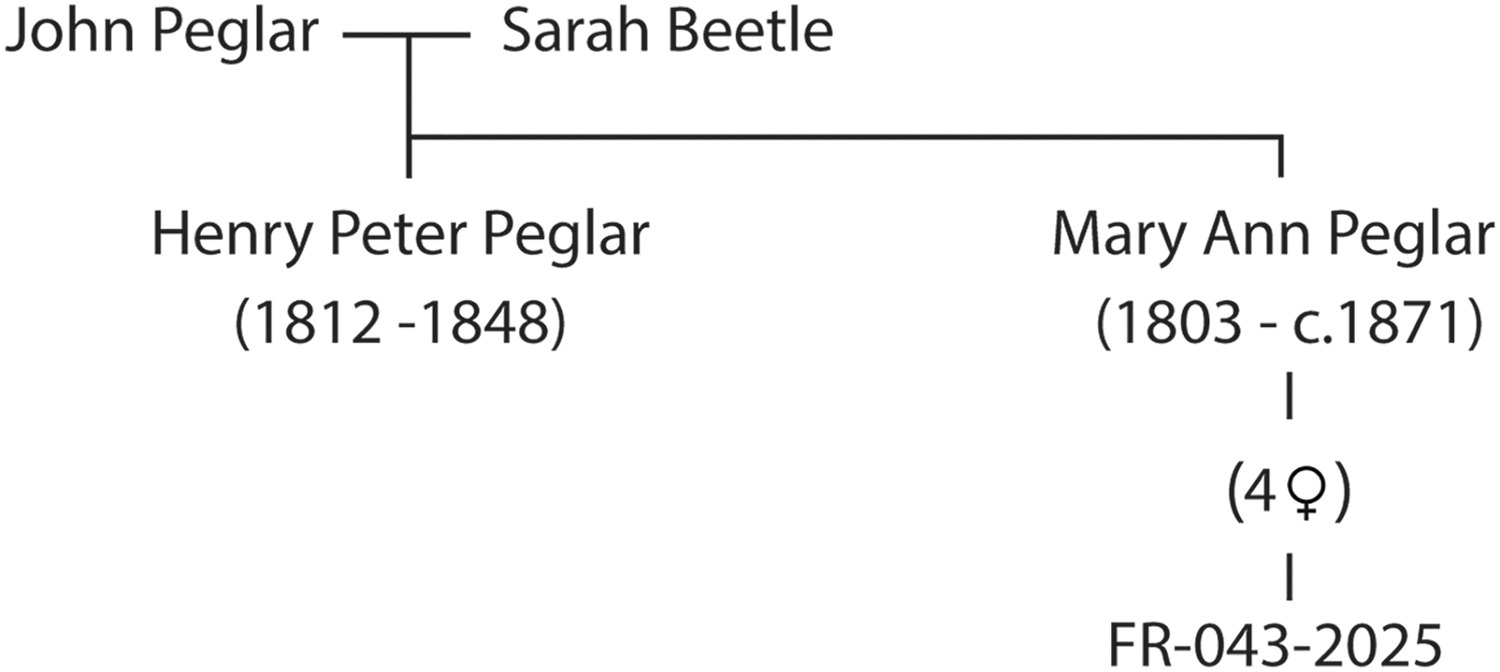
The results of the comparative mtDNA analysis detailed above strongly support the identification of the skeletal remains from NdLe-16 as those of Harry Peglar. Details of Peglar’s naval career have been summarised by Cyriax and Jones (Reference Cyriax and Jones1954), Jones (1984), and Stein (Reference Stein2007; Reference Stein2024). He was born on 22 February 1812, one of at least ten children of John and Sarah Peglar. The descendant donor is the 3rd great-grandchild of one of Harry’s older sisters, Mary Ann, who was born on 23 January 1803 in Westminster. She married Robert Church, a lithographic printer by trade, on 26 Dec 1824 at Saint Mary At Lambeth. The couple lived on Buckingham Row after marrying, the same street John and Sarah Peglar resided on, and baptismal records show that their first children were born there. They later moved elsewhere in Westminster and had a large family together. Evidently, Robert Church was close with his sisters and brothers-in-law, as he was recorded as a witness for the marriages of two of Harry’s siblings: his youngest brother Charles Albert Bruce Peglar in 1842 and an older sister Elizabeth Peglar in 1843. Mary Ann died sometime after 1871. One of her daughters married William Calcott Knell, a maritime painter. Another married William Robert Sykes, a railway engineer known for his signalling and safety inventions. The genealogical data demonstrates a pattern of mtDNA inheritance that is unbroken through five generations from Mary Ann Peglar to the descendant donor (Fig. 3).
Genealogical relationship between Harry Peglar and descendant donor (FR-043-2025) who participated in the study. The number in brackets indicates the number of mother to daughter descendants between the descendant donor and Harry Peglar’s sister with whom they share a common ancestor.
Discussion
The positive identification of Harry Peglar as the sailor who died at NdLe-16 has solved a 167-year-old mystery and presents an opportunity to re-examine key assumptions that guided previous efforts to attempt to identify his skeleton.
The first thing that can be noted is that McClintock’s inference concerning the man’s height was perceptive, but his speculation about his possible age was off the mark. Peglar was born in 1812, and if it is assumed that his death occurred in the summer or fall of 1848, he would have been 36 years old which, in the mid-nineteenth century, would not likely be considered young. Nevertheless, and despite fair criticism of McClintock’s conjectures about both of these variables, the stature estimate derived from the femur measurement confirmed that the deceased sailor was not only of above-average height, but the same height as that recorded for Harry Peglar in the HMS Gannett Description Book (Jones, 1984, p. 467).
Apart from the significance of the identification itself, which includes the fact that Peglar is the only sailor from HMS Terror whose remains have been identified thus far, the only one from the Simpson Strait region, and the only one thought to have died alone, it raises interesting questions about the effect on later research of his wearing a steward’s uniform. McClintock appears to have concluded that the skeleton was Peglar’s, who he knew had joined HMS Terror in 1845 as Captain of the Foretop, implying that he may not have attached any great significance to the possibility of Peglar having been disrated, if he in fact devoted any time to the subject. As noted, later researchers questioned McClintock’s assumption that it was Peglar and focused attention on which of the eight stewards on the expedition were plausible candidates based on possible familiarities or friendships that might have developed through previous service with Peglar on other ships. However, we now know that the body was not that of a sailor who joined the expedition in 1845 as a steward, and the uniform Peglar was wearing at the time of his death, which in effect camouflaged his identity for 167 years, is the most enigmatic aspect of his identification. The slashed waistcoat cuff fragment with braided edging has now completely disintegrated, but the neckerchief is still intact, and in any case, there is no obvious basis on which to question McClintock’s inference about the man’s rating based on these items. But Peglar did not join HMS Terror in 1845 as a steward or officer’s servant and if he wasn’t a steward as of 1848, why was he dressed as one when he died? Conversely, if he was a steward as of 1848, why?
If Peglar was not a steward or officer’s servant as of April 1848, there would be no logical reason for him to have been dressed as one during the retreat to the Back River. It seems improbable that it was due to a shortage of clothing, given that a four-foot high “huge heap” of warm clothing had been discarded at the retreat staging camp near Victory Point, and a “vast quantity” of tattered clothing was found in the boat at Erebus Bay (McClintock, Reference McClintock1859b). Even if it could be plausibly demonstrated that there was a shortage of clothing, it would not explain why Peglar would select the uniform of a steward, fully adopt the dress code by tying the neckerchief in a loose bowknot, and also carry with him a clothes brush.
The alternative explanation is that, as of April 1848, Peglar held the position of a steward or officer’s servant, in which case he would still have been wearing a uniform that was not originally his own (Jones, 1984). The main questions, therefore, are when and under what circumstances would Peglar have been disrated from a petty officer to a steward? When that might have occurred is unknown, but whatever the specific reason(s), it likely was the result of unacceptable conduct. We have no information about his behaviour between 1845 and 1848 on HMS Terror, but Peglar’s previous service record contains examples of explicit or implied misconduct that might be relevant (Jones, 1984). For example, as a Boy, 1st Class, on HMS Prince Regent in 1827, Peglar was discharged for doing something, no longer legible in the record, to an apprentice (Jones, 1984, p. 465). In 1833, while serving on HMS Marquis Camden, he was “disrated to Ordinary Seaman, confined in irons, and awarded two dozen lashes for drunkenness and mutinous conduct” (Jones, 1984, p. 466). A pattern of unsatisfactory behaviour may have continued. Between 1834 and 1838 while serving on HMS Gannett Peglar was “… rated in turn Captain of the Foretop, A.B., Gunner’s Crew, Captain’s Coxswain and A.B.” (Jones, 1984, p. 466). In 1845, he joined HMS Terror as Captain of the Foretop, but we have no information about any possible misconduct or its repercussions during the ensuing three years. What is known is that he died alone, dressed in the uniform of a steward, on the south shore of King William Island, 200 kilometres from where he stepped ashore near Victory Point in late April 1848.
In Peglar’s papers, one passage believed to have been written by him a few days before Erebus and Terror were deserted reflects sentiments likely shared by the 105 survivors as they made final preparations for the southward retreat – hopeful about the prospect of returning home balanced with trepidation about the challenges of the journey they faced: “We will have his new boots in the middel watch … as we have got some very hard ground to heave…” (Cyriax & Jones, Reference Cyriax and Jones1954, p. 193). Considering the circumstances, it is reasonable to imagine that any optimism that existed among the men about to undertake the journey would have been tempered by reflections on their own mortality.
Acknowledgements
Archaeological field investigations at NdLe-16 were made possible through generous logistical support provided by the officers and crew of the Canadian Coast Guard Ship Sir Wilfrid Laurier. Special thanks are extended to Captain Richard Marriott and to Captain Donald Gibson for facilitating access to the site to recover samples for analysis. We thank the Government of Nunavut, the Hamlet of Gjoa Haven, and the Inuit Heritage Trust for authorising the recovery and analysis of human remains from the 1845 Franklin expedition. Thanks are extended to Janet Young, Canadian Museum of History, and to Alexis Dolphin and Jeff Coffin, University of Waterloo, for their expert advice and assistance with the identifications and attributes of the phalanges and the tooth from NdLe-16, and to Margaret Veall and Diogenes Vedoy, Canadian Conservation Institute for their analysis and identification of hair and fibre samples provided by the National Maritime Museum. We also thank Dianne Strang, BTMR Genealogy, for her many contributions to the search for descendants of Franklin expedition personnel. Sincere thanks are also extended to Aisling Macken, National Maritime Museum, Greenwich, for her assistance with obtaining hair samples from the McClintock search expedition for DNA analysis and for her general advice and assistance that has helped advance our investigations of the Franklin expedition. Glenn Stein kindly provided advice and assistance concerning Admiralty Records and shared his knowledge and expertise on the service records of expedition personnel. We are also grateful to Kevin Asplin, for his assistance with obtaining information about the stewards from the National Archives. Finally, we are especially grateful to the descendants of Richard Aylmore, John Bridgens, Edward Genge, William Gibson, Edmund Hoar, Thomas Jopson, and Harry Peglar whose generous contributions made the identification of Harry Peglar possible.


 Open access

