

Modern US presidents play more active and central roles in policymaking relative to their 19th century predecessors. Not only do contemporary presidents seek to influence legislation passed by Congress, but they also use unilateral authority and other administrative measures to make policies without involving Congress (e.g., Moe, Reference Moe1985; Howell, Reference Howell2003). Moreover, as gridlock and dysfunction hinder the legislative process in Congress (Binder, Reference Binder2015), presidential policymaking gains salience as a means of national policy production. The use of unilateral directives has generated debate about executive power and its implications for democracy in the US and elsewhere (e.g., Shane, Reference Shane2009; Slater and Arugay, Reference Slater and Arugay2018).
The capacity for presidents to make policy through unilateral directives raises important measurement questions: how much policy do presidents create through unilateral power, through which instruments, and in what domains? Previous research often draws from a single category of unilateral directives—executive orders—issued primarily in the period after World War II (e.g., Mayer and Price, Reference Mayer and Price2002; Howell, Reference Howell2003). While this research has made foundational contributions to our understanding of presidential power, more complete measures of unilateral activity that span longer periods of time would enrich what we can learn about the development and use of unilateral power.
We introduce new data and measurement strategies to make such progress. First, we compile more than 50,000 presidential directives across nearly 50 unilateral instruments issued between 1877 and 2020. Second, we use machine learning techniques to measure each directive's importance and issue domain. Third, we document temporal variation in unilateral tools, indicating that presidents have exercised unilateral authority through different instruments across time. Fourth, we formally evaluate qualitative accounts of historical change in presidents’ use of unilateral powers. Finally, we extend recent analyses of presidential unilateralism to demonstrate how our data and measures contribute to theory-testing about the relationship between public opinion and presidential behavior. Our methodological framework permits new theoretical and empirical discoveries and can be applied to studying activity by executives, legislatures, bureaucracies, and courts across countries and levels of government.
1. Unilateral power and the presidency
American presidents use unilateral power to make new law.Footnote 1 Unilateral directives can have wide impact: they can reorganize agencies or create new ones, enforce racial and gender equality, declare national emergencies, announce holidays and celebrations, and change the implementation of existing policies. As Cooper (Reference Cooper2014, ix) observed, “There is virtually no significant policy area in which presidents operate that has not been shaped to one degree or another by the use or abuse of [unilateral] tools.”
By creating new policies and directing bureaucratic activity within the executive branch, presidents advance their agendas without expending political capital to rally support for legislative proposals. Perhaps most importantly, unilateral action may enable presidents to achieve policy outcomes more to their liking than legislative initiatives, or to enact policies that could not be passed in Congress (Howell, Reference Howell2003). This use of unilateral power, according to Moe and Howell (Reference Moe and Howell1999, 133), “virtually defines what is distinctly modern about the modern American presidency.” To establish the merits of these claims and evaluate the consequences of unilateral power, we require measures of the volume, substance, and contexts of presidential unilateralism.
1.1 Empirical challenges in the study of unilateral action
Empirical scholarship on presidential unilateralism is limited in four ways. First, though presidents exercise unilateral powers through a variety of means, studies have tended to focus on a single class of directives: executive orders (e.g., Krause and Cohen, Reference Krause and Cohen2000; Howell, Reference Howell2003; Warber, Reference Warber2006; Bolton and Thrower, Reference Bolton and Thrower2016; Chiou and Rothenberg, Reference Chiou and Rothenberg2017).Footnote 2 Yet if descriptive claims about presidents’ use of unilateral power rely on an incomplete or unrepresentative data source, they may mischaracterize the frequency of unilateralism. And if presidents have incentives to substitute a highly visible directive for an obscure one (Kaufman and Rogowski, Reference Kaufman and Rogowski2024; Lowande, Reference Lowande2014), studies using only executive orders ignore presidents’ strategic behavior which may result in drawing inferences about unilateralism that are incorrect. Because the president's unilateral toolkit has expanded over time and the interpretation of particular forms of unilateral action has evolved along with it, these concerns may be particularly acute for studies that span multiple decades.
Second, previous research on unilateral action focuses largely on the post-World War II era,Footnote 3 so it is difficult to evaluate claims about long-term trends in unilateral activity. Moreover, most studies model unilateral directives at the annual or biennial level despite testing variables like divided government that change infrequently. A longer time series of presidential unilateral activity would strengthen inferences related to how such variables contribute to historical changes in unilateral activity.
Third, not all unilateral directives are similarly important. Many make ceremonial announcements or address routine administrative affairs. Just as theories of lawmaking generally are not concerned with explaining patterns of trivial legislation (Clinton and Lapinski, Reference Clinton and Lapinski2006), useful theories of unilateral action should explain the issuance of important directives. Previous work identifies important directives using contemporary media coverage and retrospective evaluations (Howell, Reference Howell2003; Chiou and Rothenberg, Reference Chiou and Rothenberg2017; Williams, Reference Williams2020), distinguishes nonceremonial orders from others (Bolton and Thrower, Reference Bolton and Thrower2016), or relies upon expert judgments (Warber et al., Reference Warber, Ouyang and Waterman2018), yet the field has not reached consensus about how (or whether) to extend these approaches across directive type and time (Lowande and Rogowski, Reference Lowande and Rogowski2021).
Fourth, and finally, existing research provides no comprehensive inventory of the policy areas presidents address through unilateral action. While the Comparative Agendas Project (2021) characterizes the issue areas of executive orders issued since 1945, these issue codings are not available for a wider period of time or for directives beyond executive orders. Identifying presidents’ contributions to policymaking requires a more complete accounting of the domains in which they use unilateral power.
We address each of these limitations, provide fresh empirical insights into presidential unilateralism, and raise new questions for which our data and measures are well-suited to answer. So doing, we hope to make progress on understanding the presidency's contributions to public policy and their implications for the separation of powers, institutional development, and representation and accountability. While our approach is focused on presidential unilateral action, it could easily be extended to measure the importance of other documents and to classify other dimensions.
2. Data and measurement
We introduce an extensive inventory of presidential directives across nearly one and a half centuries. These directives were initially assembled by the CIS Index to Presidential Executive Orders & Proclamations 1987 (CIS) and were extended through 2020 by ProQuest Legislative & Executive Publications. We study the 59,048 documents issued between 1877 and 2020, each of which represents either a presidential directive or a message which contains evidence of presidential action. We use the full text of each document; while most were already text-extracted, we transcribed those that were not.
We classified directives into three groups: Executive Orders, Proclamations, and Memoranda.Footnote 4 These data provide a fuller characterization of unilateralism than existing databases.Footnote 5 Though previous research focuses largely on executive orders, it acknowledges that presidents create new policies with a variety of unilateral tools and suggests that presidents use them interchangeably (Cooper, Reference Cooper2014; Lowande, Reference Lowande2014; Rudalevige, Reference Rudalevige2021). As the Congressional Research Service (2021, 21) argues, “any distinction among these instruments—executive orders, presidential memoranda, and proclamations—is muddied by the fact that all three may be employed to direct and govern the actions of government officials and agencies.” Given that different directive categories may be used for similar purposes, aggregating across them provides a conceptually and theoretically appropriate measure of the total volume of unilateral policymaking.Footnote 6
2.1 Measuring the significance and policy domains of directives
While our data offer an expansive view of unilateral policymaking, the directives in our data vary in importance. Some presidential directives substantially change policy outcomes and/or produce important political consequences, but many other directives concern routine administrative matters or address ceremonial affairs.Footnote 7 For the purposes of describing patterns of presidential policymaking over time and testing theories about the conditions under which presidents exercise unilateral powers, we follow previous scholarship (Howell, Reference Howell2003; Chiou and Rothenberg, Reference Chiou and Rothenberg2017) and construct a measure of directive significance.
Our goal is to identify “important” directives, although we recognize the challenges in conceptualizing exactly what “importance” or “significance” means. Following the approach used in legislative scholarship, we focus on identifying directives that are “noteworthy” (Clinton and Lapinski, Reference Clinton and Lapinski2006, 234) and “innovative and consequential” (Mayhew, Reference Mayhew1991, 36). These definitions reflect our interest in distinguishing directives based on how they change existing policy as well as their political significance.Footnote 8 While this definition lacks precision, as most any definition of such a concept would, it has two advantages. First, it is consistent with how scholars have considered the significance of government actions in other domains and institutions. Second, by considering both policy impact and political significance, our conceptual definition affords the opportunity to use directives as a means of evaluating the institutional significance of the presidency across time.
Previous research has measured the significance of executive orders based on whether they were covered by contemporary media, mentioned in congressional debates or judicial decisions, discussed by presidents, or judged important by historical retrospectives (e.g., Howell, Reference Howell2003; Chiou and Rothenberg, Reference Chiou and Rothenberg2017). We adopt this general approach and extend it through the use of text analysis with supervised learning to estimate the significance of all directives in our data (see also Kaufman, Reference Kaufman2020).
In brief, we begin with the estimates of executive order significance produced by Chiou and Rothenberg (Reference Chiou and Rothenberg2017). Chiou and Rothenberg characterize significance as a latent trait and use 19 “raters”—including media outlets, law reviews, congressional and presidential speech, and historical overviews—along with a series of exogenous political variables and rater characteristics to estimate the significance of each directive in an item-response framework. Using this approach, Chiou and Rothenberg (Reference Chiou and Rothenberg2017) produce continuous estimates of significance for executive orders issued from 1947 to 2003. The Chiou and Rothenberg estimates represent the most comprehensive effort in the literature to measure executive order significance; as we describe below in greater detail, we supplement their estimates of significance with original hand-coding of significance for a sample of directives not included in their data. The Chiou and Rothenberg estimates and our hand-coded measures then serve as the inputs to a statistical model that identifies the relationship between the measure of significance and the text of each directive, which is then used to estimate the significance of the remaining directives based on their text. In extending the Chiou and Rothenberg (Reference Chiou and Rothenberg2017) approach to the other directives in our data, we inherit any limitations of their measures. Yet we avoid the potential pitfalls of tracking coverage of each directive by the media, politicians, political and legal observers, and historians over the century and a half in our data.
Our directives also vary in the policy domains they concern. Happily, the measurement challenges are considerably lessened for identifying issue areas given the work of the Comparative Agendas Project (CAP). The CAP has developed an extensive list of issue areas and identified the issue area that corresponds to each executive order in the post-World War II era. Its classification scheme and its application to executive orders serve as the basis of our measurement strategy for using text analysis to identify the issue areas of the directives not studied by the CAP.
An important advantage of our approach is that it is easily scalable. While media-based indicators, for example, require fresh data collection after each new directive is issued, we require only the text of the directive.Footnote 9 We can thus apply our approach backwards and forwards through time as new directives are issued and/or discovered. Moreover, by using machine learning rather than relying solely on human coders, we reduce potential biases associated with subjective evaluations (see Katagiri and Min, Reference Katagiri and Min2019).
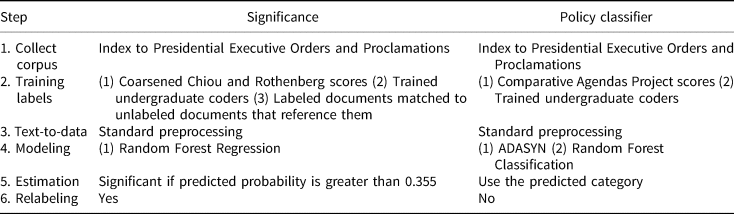
Following standard practices, our procedure consists of six steps: (1) collect a training corpus with variability along the dimension of interest, (2) label each document in the corpus corresponding to its location along the dimension of interest, (3) convert the corpus to a data set, (4) train a supervised model on the data set and training labels, (5) use the model to predict the labels for out-of-sample documents, which are the ultimate quantity of interest,Footnote 10 and (6) examine the validity of the resulting estimates. We list these steps in Table 1 and briefly describe each. We provide more extensive documentation in Appendix B.
Overview of document processing and classification
Training data
The CIS Index to Presidential Executive Orders and Proclamations, as described above, provides the text of each directive.
Document labeling
We create initial training labels for both significance and policy domains. To develop significance labels, we take three complementary approaches. First, for numbered executive orders from 1947 to 2003, we match significance estimates from Chiou and Rothenberg (Reference Chiou and Rothenberg2017) to the text of the corresponding executive order. The estimates from Chiou and Rothenberg (Reference Chiou and Rothenberg2017) are continuous from roughly –1 to 3; we coarsen them to create a binary indicator of significance at the threshold of 0.5.Footnote 11 Second, we use undergraduate research assistants, trained with a data set of labeled significant and ceremonial orders, to triple-code each numbered proclamation issued through 2018 in a dichotomous fashion on the basis of whether it was “ceremonial” and aggregate their results for each directive.Footnote 12 Finally, we manually identify a set of documents other than numbered executive orders that were included in the Chiou and Rothenberg (Reference Chiou and Rothenberg2017) data and are substantively related to numbered executive orders—these orders often enact policy “pursuant to” a specified numbered EO—and assign to these new documents a significance score equal to the average significance of all numbered executive orders to which they are related. These 11,033 documents and their matched significance estimates constitute the training set; the remaining 48,015 documents comprise our test set.Footnote 13
To develop labels for policy domains, we combine two approaches: for numbered executive orders issued between 1945 and 2020, we rely on the CAP's issue codings (Executive Orders, 2021). These labels associate each executive order to one of 20 policy areas. For a random sample of the remaining documents, we use trained research assistants to label documents according to the same coding scheme. Altogether we have policy domain training labels for 21,429 documents.
Text to data
We convert the training set and test set into a data object using the documents in our corpora to create term-document matrices (TDM). Each document is a row in a matrix, and each unique lexical feature is represented in a column. Entries in this matrix indicate how many times lexical object j occurs in document i. In this case, columns include unigrams, which are single words, and bigrams, which are ordered pairs of words. Consider Executive Order 13123, the Preamble of which begins: “The Federal Government, as the Nation's largest energy consumer, shall significantly improve its energy management in order to save taxpayer dollars and reduce emissions that contribute to air pollution and global climate change.” The unigrams in this document include, among others, “energy,” “consumer,” “management,” “save,” “dollars,” “emissions,” “pollution,” and “climate”; bigrams include “energy consumer,” “energy management,” “taxpayer dollars,” “air pollution,” and “climate change.” As additional preprocessing, we remove punctuation, numbers, and symbols, as well as all terms which do not occur in at least 500 documents. In total, our significance training TDM has 11,033 unique documents and 29,718 terms. Our topic area TDM has 21,429 documents and 29,718 terms.
Modeling
Next, we model the relationship between lexical features and document significance or policy domain. Using k-fold cross-validation (Mozer and others, Reference Mozer, Miratrix, Kaufman and Anastasopoulos2020), we find that the random forest model performs best. It successfully identifies whether a document is below or above our significance threshold 98.76 percent of the time, with little observable heterogeneity across significance levels and with roughly equal false-positive and false-negative rates (for more details, see Appendix B). This provides confidence that although we are estimating documents’ significance with error, that error is unlikely to bias our substantive results.
In producing a policy area estimation model, we confront a class imbalance problem: since we have many training documents belonging to some policy areas and relatively few belonging to others, we risk misclassifying documents at different rates. To address this concern, we rebalance our policy area training set using Adaptive Synthetic Sampling (He et al., Reference He, Bai, Garcia and Li2008).
Estimation
Finally, we use the random forest model to estimate the both policy significance and policy domain for the documents in our test set. The significance random forest model produces for each document in the test set a probability that it is significant;Footnote 14 the policy domain random forest model produces each document's most likely policy category.
Because of uncertainty in the modeling procedure, rather than using the predicted probabilities of significance we distinguish significant unilateral actions as those whose probability of significance are greater than 0.355, the value that equalizes the false-positive and false-negative rates. This threshold distinguishes 10,069, or roughly 17 percent, of the directives in our data as policy significant. This appears to represent an appropriate level of selectivity given related scholarship. To contextualize this figure, Howell (Reference Howell2005) characterized 8 percent of executive orders (290 of 3,749) issued between 1945 and 2001 as significant, Bolton and Thrower's (2016) study of “nonceremonial” orders included 97 percent of executive orders issued between 1945 and 2013, and Mayer and Price (Reference Mayer and Price2002) classified 14 percent of a sample of executive orders issued between 1936 and 1999 as significant. Finally, Chiou and Rothenberg (2017) characterize 14, 26, and 44 percent of executive orders as significant based on thresholds of 1, 0.5, and 0, respectively.Footnote 15 Overall, our threshold suggests that our measure is more selective relative to most existing research.
Relabeling
We improve the quality of our supervised learning models using Active (or Adaptive) Learning (Settles, Reference Settles2012; Kaufman and Klevs, Reference Kaufman and Klevs2022). We examine the predicted significance probabilities for a subset of the test set, relabel those documents if their predicted probabilities are incorrect, add them and their corrected labels to the training set, and then repeat the Model Training and Estimation steps. We follow this approach for our policy significance model by identifying 250 randomly selected documents close to our significance threshold—the documents for which the model is least certain—and hand-label them as either significant or not. This provides additional information that the model uses to estimate the importance of the directives in our data and reduces noise around the threshold we use to distinguish significant directives.
Face validity
As an exercise in face validity, we evaluate the significance and topic areas produced by our model for the 140 presidential proclamations issued in 2019.Footnote 16 We hand-code each proclamation to indicate whether it was ceremonial in nature, as previous research has characterized ceremonial directives as the complement of significant orders (Bolton and Thrower, Reference Bolton and Thrower2016). We compare the significance probabilities from our model between ceremonial and nonceremonial directives. If our estimates do a reasonable job of distinguishing important directives, we expect that nonceremonial proclamations will have higher probabilities of significance. Moreover, we evaluate the reasonableness of the estimates of policy domain.
The full list of proclamations and their accompanying estimates is shown in Table B.3. In both years, the average probability of significance among the 15 nonceremonial proclamations was greater than 0.5 while the average probability of the 125 ceremonial proclamations was near zero. With respect to issue area, proclamations associated with the border with Mexico (e.g., 9842 and 9844) and entry restrictions for certain residents of other countries (e.g., 9931, 9932, and 9945) are classified as immigration policy, while proclamations associated with imports and tariffs (e.g., 9886, 9888, 9893, and 9894) are classified as trade. Overall, then, our measurement approach appears to reasonably distinguish directives on the basis of their significance and issue domain.Footnote 17
To recapitulate, we assess directive importance by building upon the estimates developed by Chiou and Rothenberg (Reference Chiou and Rothenberg2017). We supplemented their estimates with original hand-coding, coarsened the estimates of document significance, and identified the relationship between the text of the directives and their estimated significance. We then apply this procedure to generate probabilities of significance for the remaining directives in our data based on the words and phrases contained in them. To illustrate, a proclamation in our data that was issued in 1902 and contains the same text as an executive order issued in 2002 in the Chiou and Rothenberg (Reference Chiou and Rothenberg2017) data will have the same significance estimate. Our approach for estimating a document's policy domain follows much in parallel, relying on the Comparative Agendas Project's expert codings of contemporary executive orders. Since these too are available only for a subset of unilateral directives, we model the relationship between a document's text and its policy domain, then use that model to extrapolate to the full set of unilateral actions.
2.2 Model accuracy
We evaluate the accuracy of our model through two main procedures. In short, we find that our model's predictive success in classifying significant documents compares well with the best results that apply machine learning to political text. Moreover, we compare our model's results with what might be obtained from a more conventional approach to document coding and show that the model's success rate exceeds the predictive success rate from well-trained undergraduate coders. Even so, we acknowledge several potential threats to our model's applicability, including inaccurate document transcription, changes in language over time, unrepresentativeness of the training set, and heteroskedastic prediction accuracy. We detail these threats, and provide a suite of robustness checks to evaluate them, in Appendix B.
3. Patterns of significant unilateral action, 1877–2020
Figure 1a shows the annual number of significant directives from 1877 to 2020. Overall, presidents issued an average of 64 significant directives per year. The endpoints of the time span are suggestive of the aggregate trend. President Rutherford Hayes issued fewer than ten significant directives in each year of his term (1877–1881), while President Donald Trump issued 318 significant directives in 2020. Yet there is considerable variation between these dates. As other research argues (e.g., Howell, Reference Howell2003), presidents have generally made increasing use of unilateral powers to achieve significant policy goals over the latter half of the 20th century. The number of significant directives has increased particularly rapidly in recent decades. For example, presidents between Eisenhower and Carter (inclusive) issued an average of 49 significant directives per year, which more than doubled (to 110) for presidents Reagan through Trump.
Significant executive actions, 1877—2020, (a) annual number of significant directives, (b) comparison with other measures, (c) variation across directive type.
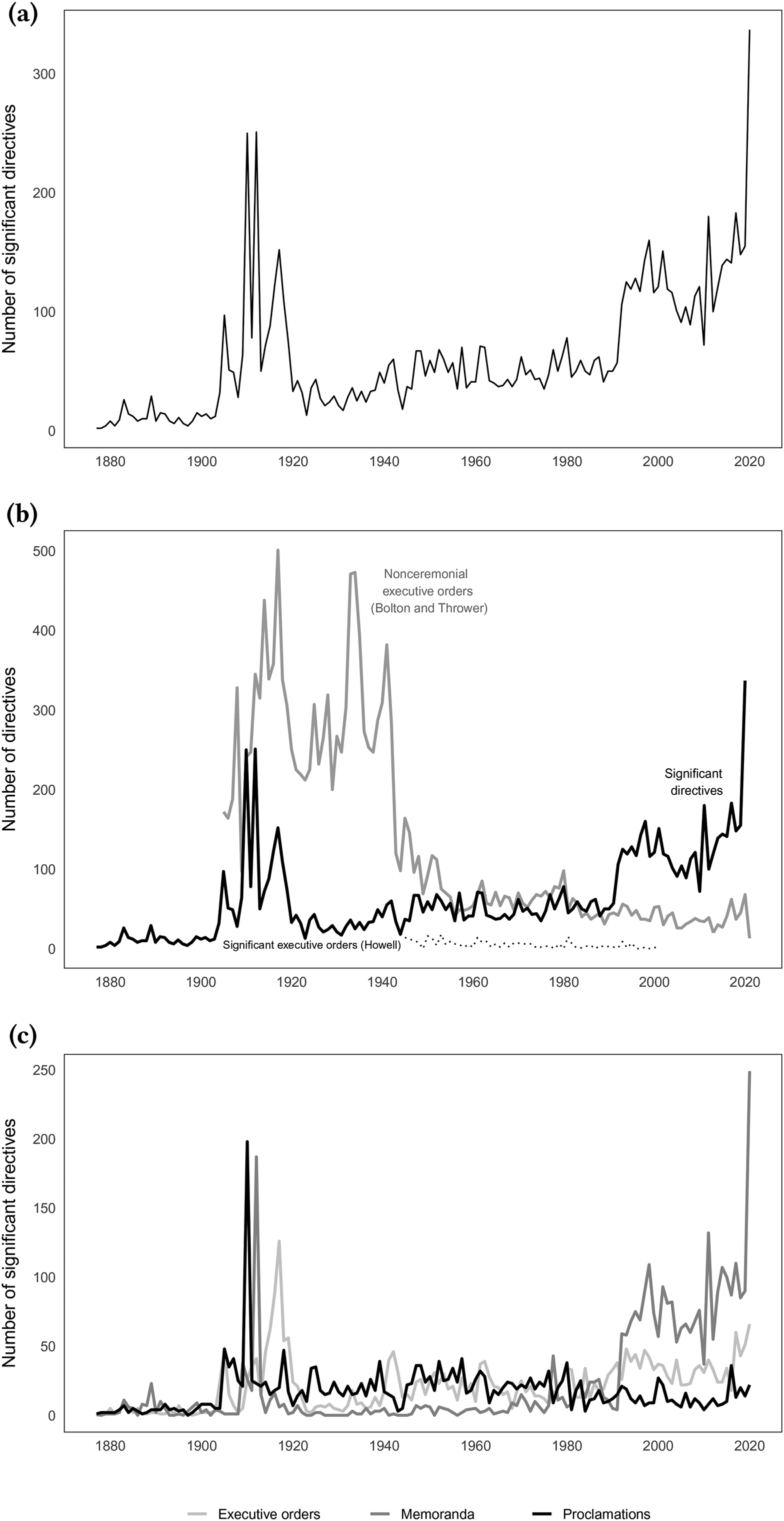
Figure 1b compares the patterns from our data to other measures of significant unilateral action. Compared with Howell (Reference Howell2005), our measure identifies substantially more significant actions than we would observe if we focused only on executive orders. Our measure also indicates that while presidents in the first half of the 20th century issued executive orders relatively frequently, many of the directives were not substantively important. Presidents between Taft and Franklin Roosevelt issued plenty of “nonceremonial” executive orders, yet our estimates indicate that the number of significant directives was far smaller.
Figure 1c shows how the distribution of significance varies across various unilateral tools. Between 1877 and 2020, executive orders comprised 35 percent of significant unilateral actions, while memoranda and proclamations accounted for 36 and 29 percent, respectively. These aggregate statistics obscure substantial variation across time. Consistent with Lowande (Reference Lowande2014), the recent rise in significant unilateral action is driven largely by memoranda. Before 1980, memoranda comprised 16 percent of the number of significant actions; since then, however, memos have comprised 57 percent of them. The increased prominence of memoranda among significant unilateral directives has come largely at the expense of proclamations, which comprised 44 percent of significant unilateral actions before 1980 but only 12 percent since then.
3.1 Presidential policymaking across issue areas
Figure 2 shows patterns in significant unilateral action across issue areas. The figure shows, perhaps unsurprisingly, that presidents address some issues more frequently than others. Consider the ranges of the y-axes. While no more than six important directives per year address civil rights, economic, education, housing, or social welfare policy, presidents have issued dozens of important directives in a given year to address defense policy, international affairs, public lands, or government operations. Because the former group of policies typically is more politically salient than the latter, these patterns suggest that unilateral power is most commonly exercised to address issues of lower public concern and/or on which the public and congressional lawmakers are more likely to delegate to the president.
Significant actions by issue area, 1877–2020.
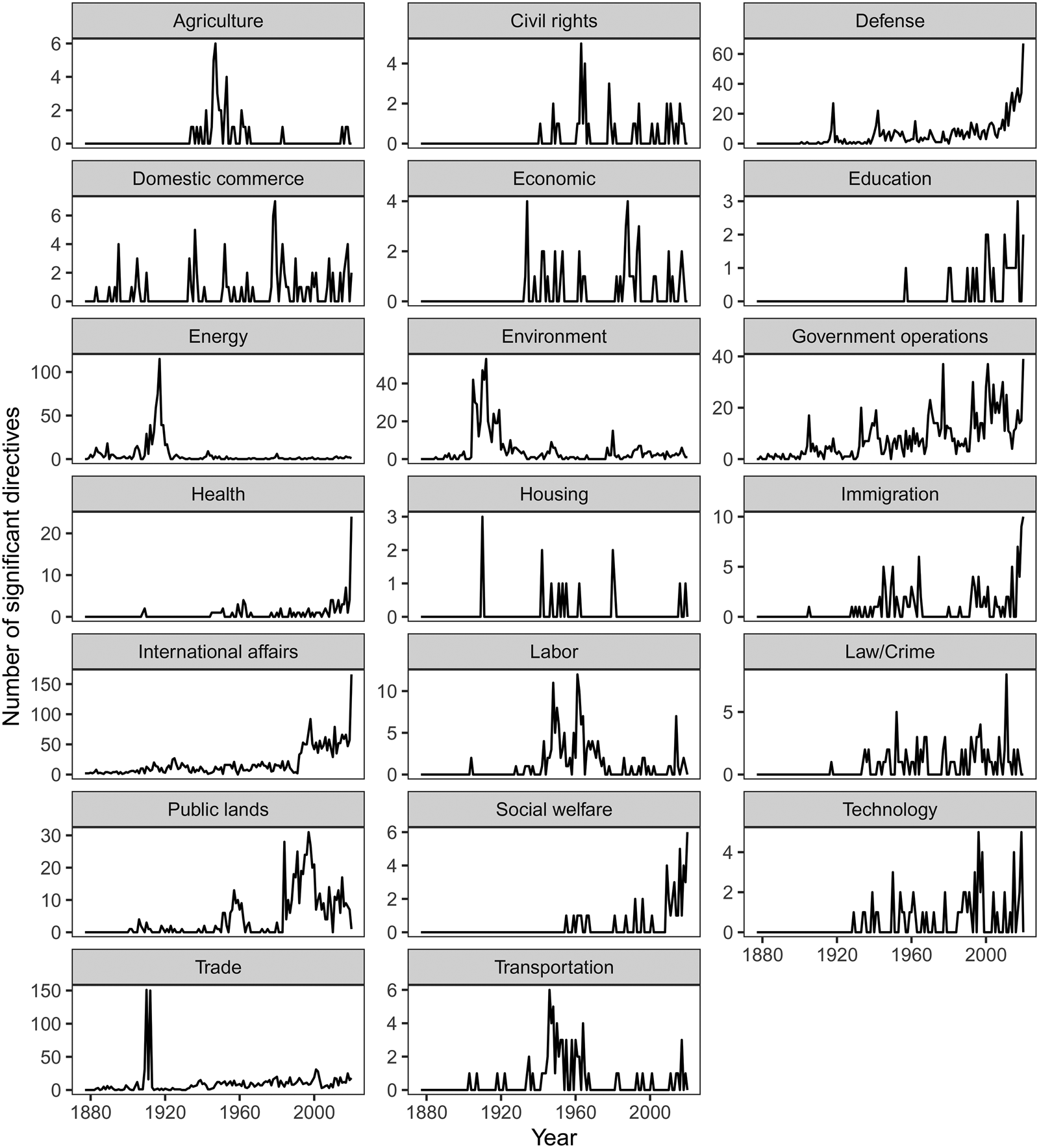
The figure also shows variation in issue attentiveness across time. Over the last several decades presidents have issued increasing numbers of directives to address national defense and international affairs, which contribute disproportionately to the overall increase in unilateral activity during this period. The number of immigration directives has also increased over the last decade, perhaps reflecting the public salience and lack of congressional activity in this area.
3.2 Temporal variation in directive choice
Given the diversity of directive types in our data, we evaluate how presidents choose among them. Lowande (Reference Lowande2014) raises the possibility of substitution between directives, as unilateral tools vary not only in what they can achieve but also in the political costs and benefits to issuing them. If these costs and benefits differ across tools, presidents may have incentives to issue systematically different kinds of directives to achieve different goals.
Our new measures are well-suited for examining variation in the means through which presidents have created unilateral policies. Rather than measure rates of unilateral activity, we study how presidents have selected among unilateral tools conditional on their decisions to issue significant directives. We model the share of important directives issued via each unilateral tool as a cubic expression of time.Footnote 18
Figure 3 shows the fitted proportions of significant directives that were issued as executive orders, proclamations, or memoranda for each year. The left plot aggregates directives from all issue areas and indicates that presidents have created important unilateral policies through somewhat different means across time. The predicted share of important directives issued as executive orders increased to a peak just above 40 percent by the middle of the 20th century but since has decreased to around 20 percent in recent years. The plot shows a similar pattern for proclamations, though the decrease in use has been more stark. The plot also suggests the role of memoranda as substitutes for executive orders (and, potentially, proclamations), as the temporal patterns are roughly inverted.
Directive use across policy areas, 1877–2020. Note: Plots show fitted proportions of important directives that were issued as executive orders, proclamations, or memoranda for each year. Fitted estimates are from a model that predicts the share of important directives issued as each directive type as a cubic function of time.
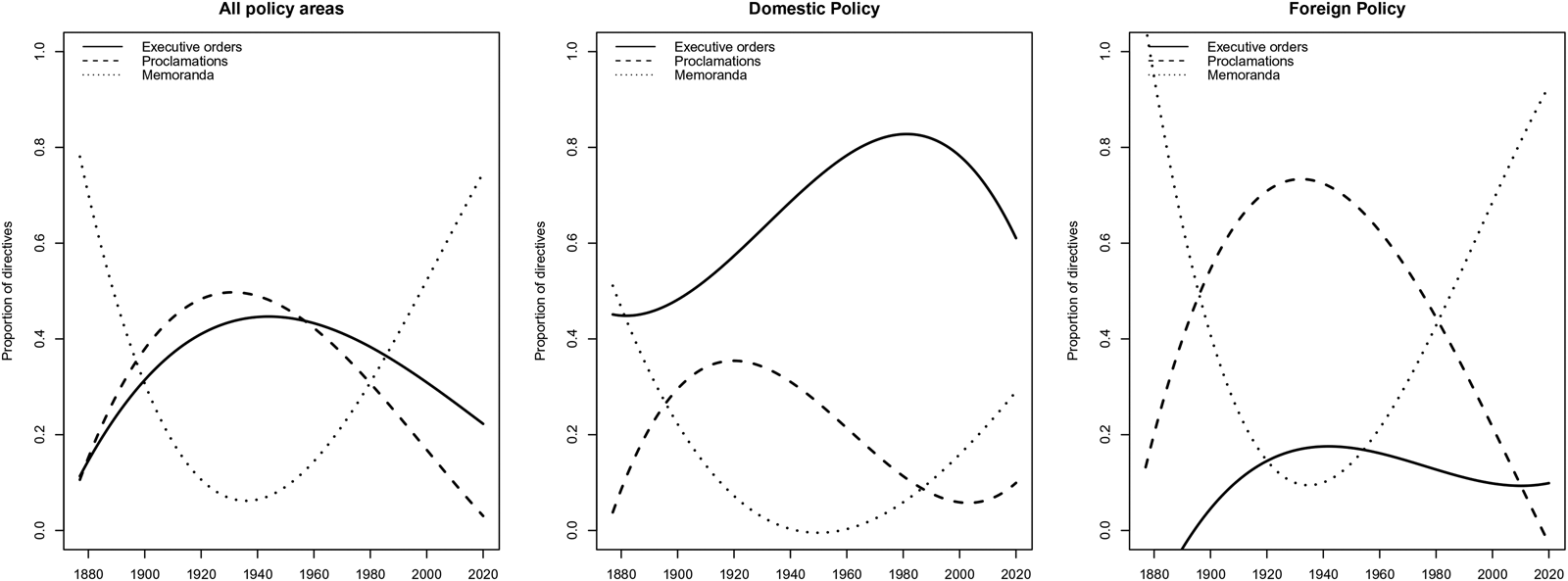
The middle and right plots in Figure 3 show how these patterns vary between domestic and foreign policy issues.Footnote 19 Over the time period we study, the middle plot shows that executive orders, and to some degree memoranda, have displaced proclamations as means of unilateral policymaking on domestic issues. Similarly, the right plot shows that while proclamations were the dominant tool used in foreign policy for much of the 20th century, they have been almost entirely displaced by memoranda in recent decades. Not only are contemporary presidents issuing substantially more foreign policy directives than their predecessors, but they are also using directives that are subject to the weakest transparency and reporting requirements. While a fuller examination is beyond the scope of this paper, these developments invite further scrutiny for assessing the president's foreign policy making influence.
Our data and measures generate new descriptive findings about unilateral activity by American presidents over nearly a century and a half. Presidents have made many more significant policies via unilateral power than previously understood, and particularly over the last several decades. We also show that the means through which presidents have created unilateral policies have changed in important and unappreciated ways. These patterns suggest that analyses focused on executive orders or any other single unilateral tool miss key information about unilateral policymaking.
3.3 Structural change in unilateral activity
Next, we formally evaluate historical variation in significant unilateral activity. Accounts of the institutional evolution of the presidency associate unilateral power with the institutionalization of the presidency. According to Greenstein (Reference Greenstein1978), “From a presidency that normally exercised few unilateral powers, there has been a shift to one that is provided… with many more occasions for direct policy making through executive orders and other actions not normally ratified by Congress.”
Relatively little research systematically identifies distinctive periods of unilateral activity. Dodds (Reference Dodds2013, 24) goes furthest, positing that
Four areas of this picture of the development of executive orders seem to stand out: (1) a period of very low usage of executive orders from the founding of the country through the 19th century, (2) a sharp rise under Theodore Roosevelt, (3) a less dramatic but steady increase from Taft through FDR, and (4) a marked decline in usage after World War II.
However, Dodds does not formally test whether these periods correspond to distinctive regimes of unilateral activity, and his observations are based on executive orders rather than the larger pool of unilateral directives.
We identify structural breaks (or change points) in the issuance of significant unilateral directives, similar to Spirling (Reference Spirling2012), who studies changes in treaty-making between the US government and Native Americans. Following that work, we use a linear regression framework to identify the temporal stability of annual patterns of unilateral action.Footnote 20 When fitting the model, we require a minimum segment length of four years. Substantively, this allows us to identify whether patterns in unilateral action vary systematically across individual presidents. Following Bai and Perron (Reference Bai and Perron2003), we identify the number and locations of structural breaks using BIC as an indicator of model fit.
Figure 4 shows the results. Points indicate the annual number of significant unilateral actions, dashed vertical lines show the years corresponding to estimated change points, and the solid horizontal lines show the average number of directives per year issued in each period. The best-fitting model identifies five breaks, corresponding to 1904, 1909, 1918, 1991, and 2016.Footnote 21
Structural change in presidential unilateralism, 1877–2020. Note: Vertical dashed lines are the estimated change point locations. Solid horizontal lines are the average annual number of significant directives issued within each period.

The results provide several new findings. First, the locations of the first few breaks suggest that Progressive Era presidents sharply contrasted with their predecessors in issuing unilateral directives. The first break corresponds with the Theodore Roosevelt presidency, which Dodds (Reference Dodds2013, 123) argued “marked a significant change in both the number and the nature of [important unilateral] directives.” The continuation and escalation of this pattern by his immediate successors also support Dodd's (2013, 152) interpretation that Roosevelt's “practice of frequently issuing unilateral presidential directives stuck and became the new norm” among other Progressives. While most other 20th-century presidents did not issue directives at the same rates as Taft and Wilson, it is clear that a new baseline was established in the century's first decades.
Second, despite the centrality of Franklin Roosevelt in accounts describing the emergence of the modern presidency (Greenstein, Reference Greenstein1978), we find no evidence that Roosevelt was a turning point in the use of unilateral powers. Between 1919 and 1991, presidents issued an annual average of 46 significant directives, which suggests continuity with the rate established by Theodore Roosevelt (51 per year) rather than a clear break.
Third, the last two breaks, 1991 and 2016, suggest a sharply upward trajectory in over the last three decades. These breaks correspond roughly to the beginnings of the Clinton and Trump presidencies (though we make these claims cautiously given the uncertainty associated with the estimated breaks). Nevertheless, the data are consistent with Howell's (2005) claim about presidents’ increased use of unilateral power in recent decades, with the change points suggesting that presidents Clinton, Bush, and Obama made significantly greater use of unilateral action on average than their 20th century predecessors and which increased further still under President Trump.
3.4 Revisiting studies on public opinion and unilateral action
In a final set of analyses, we revisit and extend the results from three studies on public opinion and unilateral action. The first, Jones et al. (Reference Jones, Larsen-Price and Wilkerson2009), evaluates the links between public priorities and policymaking activity through a variety of channels. We focus specifically on their findings related to unilateral action. The second, Christenson and Kriner (Reference Christenson and Kriner2019), examines the relationship between presidential popularity and unilateral power. The third, Djourelova and Durante (Reference Djourelova and Durante2022), studies the strategic timing of executive orders.
These studies provide important evidence about the links between public opinion and unilateral power. Because each study uses executive orders as the primary data source for unilateral action,Footnote 22 we extend their analyses to include the broader set of unilateral directives described here.Footnote 23 We limit our attention to empirical extensions of their work and accept the authors’ theoretical arguments and empirical strategies on their terms.
3.4.1 Public issue priorities and unilateral policymaking
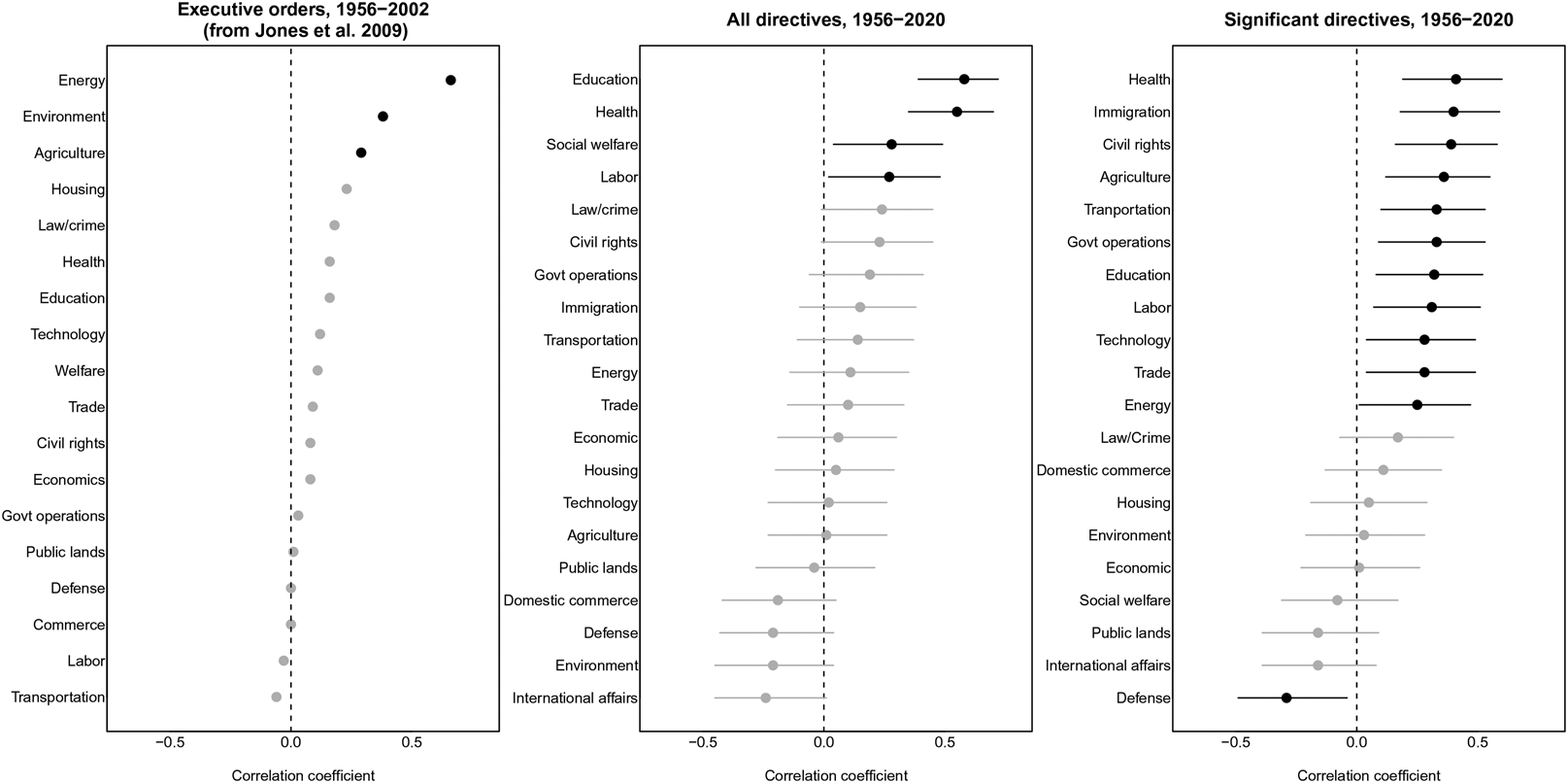
Jones et al. (Reference Jones, Larsen-Price and Wilkerson2009) study the correlation between the annual number of executive orders that address a particular issue and the salience of that issue area, measured with responses to the Gallup “most important problem” question. Jones et al. (Reference Jones, Larsen-Price and Wilkerson2009, Table 5) show that while the average correlation between salience and unilateralism across issue areas is 0.14, on some issues (especially energy, the environment, and agriculture) presidents are particularly responsive to public priorities. We use data from the CAP to characterize annual issue salience and correlate them with measures with the volume of unilateral activity across the same issues areas in our data. We begin in 1956 (like Jones et al. Reference Jones, Larsen-Price and Wilkerson2009) and extend our analysis through 2020.
Figure 5 shows the results. The left plot shows correlations between salience and the number of unilateral actions for each issue area as reported in Jones et al. (Reference Jones, Larsen-Price and Wilkerson2009).Footnote 24 The middle plot shows the correlations for all directives in our data, and the right plot shows correlations for significant directives according to our measure (Jones et al. (Reference Jones, Larsen-Price and Wilkerson2009) do not distinguish directive significance). As in Jones et al. (Reference Jones, Larsen-Price and Wilkerson2009), the average correlation is relatively low but stronger for significant directives (0.17) than it is when considering all directives (0.10). Similar to Jones et al. (Reference Jones, Larsen-Price and Wilkerson2009), the issue-specific correlations are positive and statistically significant for only four issues when evaluating all directives. However, when focusing on significant directives, the correlations are positive and statistically significant for 11 issue areas. Interestingly, the correlations tend to be most negative for defense and international affairs—areas in which unilateral action has increased most substantially. The results in Figure 5 largely support and strengthen those from Jones et al. (Reference Jones, Larsen-Price and Wilkerson2009) and suggest that presidential unilateralism is more responsive to public priorities on some issues than others.
Issue importance and unilateral policymaking, 1956–2020. Note: Points show the correlations between issue attention and the volume of unilateral activity in each issue area. Horizontal segments are the 95 percent confidence intervals and the dashed vertical line represents the null hypothesis of no correlation. Statistically significant correlation coefficients are shown in black.
[
3.4.2 Presidential approval and unilateral action
Christenson and Kriner (Reference Christenson and Kriner2019, 1071) test the hypothesis that “the president's approval rating affects the frequencies with which presidents advance their policy agendas unilaterally.” To do so, they create monthly measures of significant unilateral activity from 1953 to 2018 and link them with presidents’ monthly approval ratings. The main analyses use vector autoregression to show that presidential approval Granger causes unilateral action.They find no evidence that executive orders affect subsequent changes in presidential approval. We reproduce these results in the top panel of Table 2.
Granger-causality tests: presidential approval and unilateral directives, 1953–2018
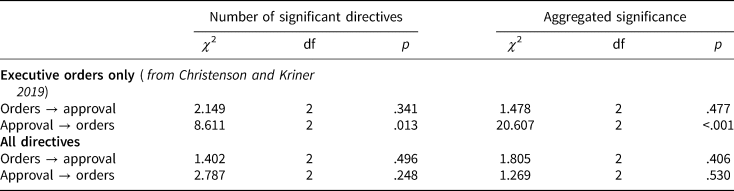
Entries show results from Granger causality tests conducted with coefficients from vector autoregression models.
The rows labeled Orders → approval examine the hypothesis that unilateral action Granger causes presidential approval by testing whether the coefficients on two lags of unilateral directives are jointly zero. The rows labeled Approval → orders examine the hypothesis that presidential approval Granger causes unilateral action by testing whether the coefficients on two lags of unilateral directives are jointly zero. The left side of the table shows results when using the monthly count of significant directives and the right side shows results when using the summed significance of directives issued in a month. The top panel reproduces the results using executive orders reported in Christenson and Kriner (2019) while the bottom panel shows results using all directives in our data for the same time period and model specifications.
Following Christenson and Kriner (Reference Christenson and Kriner2019), our dependent variables characterize the monthly count of significant directives and the monthly sum of directive significance. The lower panel of Table 2 shows results using our measures of significant unilateral directives for the same time period.Footnote 25 Our results differ from Christenson and Kriner (Reference Christenson and Kriner2019) in that we find no evidence that approval ratings Granger cause unilateral action when studying all significant directives in our data. However, when limiting our analysis to the significant executive orders in our data (see Table E.2), our results strongly support the conclusions from Christenson and Kriner (Reference Christenson and Kriner2019). While accounting for a wider range of directives provides less evidence for the argument that presidential popularity is an accelerant on unilateralism, the finding that higher approval ratings temporally precede the issuance of executive orders but not other directives raises the possibility that the politics of unilateral action varies with directive type.
3.4.3 Media pressure and the strategic timing of unilateral action
Djourelova and Durante (Reference Djourelova and Durante2022) argue that presidents have incentives to issue directives to minimize news attention, as controversial unilateral actions can generate criticism and undermine the president's political standing. Djourelova and Durante (Reference Djourelova and Durante2022) construct a daily measure of news pressure from 1979 to 2016, which characterizes the volume of news attention given to issues other than unilateral action,Footnote 26 and use lagged and lead values of this measure to show that presidents are more likely to issue executive orders on the eve of days with high news pressure, with these findings concentrated in periods of divided government. The authors conclude that presidents strategically time unilateral activity to circumvent potential negative reactions to them.
We focus on the core analyses of Djourelova and Durante (Reference Djourelova and Durante2022), which are estimated with executive orders. We specify two dependent variables based on our measures: an indicator for whether the president issued at least one directive on a given day and an indicator for whether president issued at least one significant directive (according to our threshold) on a given day. The left two columns of Table 3 reproduce the findings from columns 3 and 4 in Djourelova and Durante (Reference Djourelova and Durante2022, Table 3) for the purposes of comparison. Using the same model specifications, the middle columns show results using our data on all directives and the right columns show results using our significant directives. The key independent variable is NP (t+1), which indexes the level of news pressure on the day after the date on which a directive was issued.Footnote 27
News pressure and the timing of unilateral action (1979–2016)
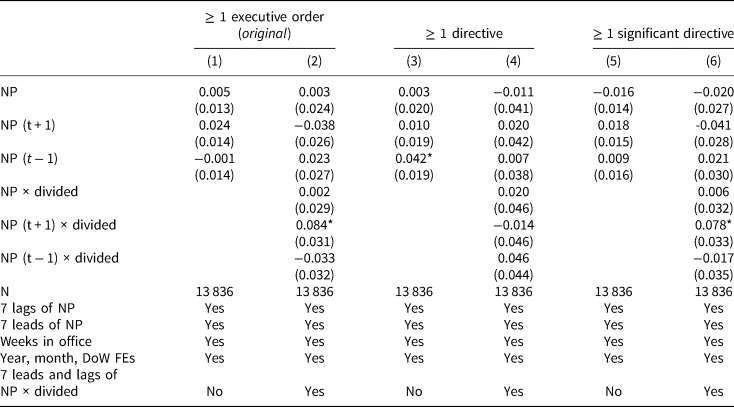
NP, news pressure; DoW, day of week; FEs, fixed effects.
Columns (1) and (2) reproduce columns 3–4 from Djourelova and Durante (2022, Table 3).
The dependent variable is an indicator for the signing of any executive order (columns 1–2), any directive (3–4), or a significant directive (5–6). OLS regressions in all columns. Standard errors clustered on month x year. *p < 0.05.
Overall, Table 3 provides mixed support for the findings reported in Djourelova and Durante (Reference Djourelova and Durante2022). The coefficients for NP (t + 1) in columns 3 and 5 are small in magnitude and neither is statistically significant. When using all directives, column 4 provides no evidence that the relationship between news pressure and executive action is meaningfully different in divided government, where Djourelova and Durante (Reference Djourelova and Durante2022) find the largest positive relationship. When focusing on significant directives in column 6, we do find such evidence, which is consistent with the findings reported in column 4 of Djourelova and Durante (Reference Djourelova and Durante2022, Table 3). As we show in columns 5–7 of Panel B in Table E.3, we also find evidence of increased unilateralism on the eve of significant news days when focusing specifically on the context of divided government, though this finding is limited to significant directives. Across an expanded dataset of directives, our findings reinforce the conclusion that presidents strategically time the issuance of important directives to shield them from public view.
Figure 5 and Tables 2 and 3 show the usefulness of our data and measures for testing claims about when presidents issue unilateral directives. Our findings suggest that the politics of executive orders may differ from other directives. To the degree that directive categories vary in salience and/or visibility, presidents may have different incentives to use them based on their expectations about how the public and other political actors may respond. These are only speculations, but they suggest the importance of accounting for a wider range of unilateral directives when making conclusions about the politics of unilateral power.
4. Conclusion
Presidents can change policies through a variety of unilateral tools. We present new data on across a range of these tools over nearly a century and a half and introduce a new methodological approach for analyzing them. Using these data, we uncover new empirical patterns of presidential unilateralism and reassess prominent scholarly claims about when it occurs.
Our findings contribute to several contemporary debates. First, we show that unilateralism has increased in recent decades. While this could be interpreted as evidence of an imperial presidency, it could also represent increased delegation of authority to presidents in an era where Congress has been fragmented and gridlocked. This latter interpretation is supported by our finding that increases in unilateral action are driven largely by foreign affairs, where Congress more often defers to presidents. Second, increased unilateralism through more obscure forms raises questions about transparency and accountability. For example, if memoranda are increasingly used for important unilateral policies but are less available to and/or covered by the media, there may be fewer opportunities to hold presidents accountable for the policies they create through this tool.
Our data permit new empirical investigations into individual issue areas, across longer periods of American history, and among specific types of directives. For example, future work could use the data introduced here to study how constraints on presidential unilateralism vary across directives, issues, and time. These analyses could point toward new explanations for the use of unilateral power and its contributions to presidential policy influence.
Finally, our methods for analyzing unilateral directives could be extended to other institutions and contexts. Text-based documents are issued by virtually every government entity and future research could use strategies like ours to characterize the policy outputs from presidents, bureaucracies, courts, and legislatures across time and levels of government. Moreover, these documents could be classified according to a host of criteria beyond policy significance or issue area. Combining methodological advancements in text-based analysis with increased availability of government documents may be a particularly fruitful approach for scholars interested in historical research.
Supplementary material
The supplementary material for this article can be found at https://doi.org/10.1017/psrm.2024.15. To obtain replication material for this article, https://doi.org/10.7910/DVN/6SGSTI
Acknowledgements
We thank Joshua Berry, Vivian Fernandez, Joshua Florence, Jeffrey Gu, Darwin Peng, Sapna Rampersaud, Enrique Rodriguez, Corban Ryan, Michael Scherr, Grant Schwartz, Melvin Woo, Jenny Yoon, and Andrew Zucker for excellent research assistance. We are also grateful to Avidit Acharya, Traci Burch, Brandice Canes-Wrone, Dan Carpenter, Jamie Druckman, Dan Galvin, Elisabeth Gerber, Sandy Gordon, Laurel Harbridge, Greg Huber, Jeff Jenkins, Christina Kinane, Doug Kriner, Kenneth Lowande, Greg Martin, Nolan McCarty, Julie Lee Merseth, Pablo Montagnes, Daniel Moskowitz, Anne Joseph O'Connell, Yu Ouyang, Paul Peterson, Pia Raffler, Andrew Reeves, Andrew Rudalevige, Josh Ryan, Maya Sen, Chuck Shipan, Chris Skovron, Arthur Spirling, Sharece Thrower, Chloe Thurston, Robert Ward, Hye Young You, and participants at the 2017 Annual Meeting of the American Political Science Association, the American politics workshop at Northwestern University, the Political Institutions and Political Economy Conference at the University of Southern California, the Emory Political Economy Conference, the Presidency and the Administrative State workshop at Princeton, the Center for the Study of American Politics at Yale University, and the Political Science Speaker Series at Utah State University for generous and helpful feedback. Finally, we acknowledge the helpful comments from the Editor and two anonymous reviewers.
Financial support
This material is based upon work supported by the National Science Foundation under grant no. SES-1946922. Financial sponsors had no role in the design, execution, analysis and interpretation of data, or writing of the study.
Competing interest
None.


 Open access

