




Introduction
Yellowjackets in the genus Vespula Thomson (Hymenoptera: Vespidae) are significant pests (Akre et al. Reference Akre, Greene, MacDonald, Landolt and Davis1980; de Jong Reference de Jong, Morse and Nowogrodzki1990; Beggs et al. Reference Beggs, Brockerhoff, Corley, Kenis, Masciocchi and Muller2011). They frequently sting humans, causing thousands of visits to hospitals every year (Langley et al. Reference Langley, Mack, Haileyesus, Proescholdbell and Annest2014), often because of life-threatening anaphylactic shock (Bonay et al. Reference Bonay, Echchakir, Lecossier, Laine, Herman and Hance1997; Faux et al. Reference Faux, Moffatt, Lalvani, Dekker, Warrell and Cookson1997; Vetter et al. Reference Vetter, Visscher and Camazine1999). They also attack hives of honey bees, Apis mellifera Linnaeus (Hymenoptera: Apidae), to feed on honey and bee larvae (Clapperton et al. Reference Clapperton, Alspach, Moller and Matheson1989; de Jong Reference de Jong, Morse and Nowogrodzki1990).
In North America, the western yellowjacket, Vespula pensylvanica (Saussure), is the most abundant and pestiferous native species (Akre et al. Reference Akre, Greene, MacDonald, Landolt and Davis1980). Less common, but also pestiferous and ranging across the continent (Akre et al. Reference Akre, Greene, MacDonald, Landolt and Davis1980), are the invasive German yellowjacket, Vespula germanica Fabricius, and the native northern yellowjacket, Vespula alascensis (Packard), formerly misidentified as the common yellowjacket, Vespula vulgaris Linnaeus (Carpenter and Glare Reference Carpenter and Glare2010). Although the Eurasian common yellowjacket has not yet been found in North America, both it and the German yellowjacket have been introduced into many countries, including some with no native yellowjackets, such as New Zealand, Australia, and Argentina, where they have become widespread and prevalent pests (Beggs et al. Reference Beggs, Brockerhoff, Corley, Kenis, Masciocchi and Muller2011; Masciocchi and Corley Reference Masciocchi and Corley2013). Pestiferous species in other regions of North America include the southern yellowjacket, Vespula squamosa (Drury), and the eastern yellowjacket, Vespula maculifrons (Buysson) (Akre et al. Reference Akre, Greene, MacDonald, Landolt and Davis1980).
Yellowjackets are generalist feeders on both carbohydrate and protein resources. Worker yellowjackets foraging for food for brood larvae have been observed returning to their nest with proteinaceous material, such as the chewed remains of adult flies (Diptera) and lepidopteran larvae (Wagner Reference Wagner1961). Humans have used other types of animal-based proteinaceous foods to attract yellowjackets. Fish and fish-based pet foods may be highly attractive (Wagner and Reierson Reference Wagner and Reierson1969; Grothaus et al. Reference Grothaus, Davis, Rogoff, Fluno and Hirst1973; Ross et al. Reference Ross, Shukle and MacDonald1984; Spurr Reference Spurr1995; Wood et al. Reference Wood, Hopkins and Schellhorn2006). Similar lures include raw and cooked horsemeat (Perissodactyla: Equidae) (Grant et al. Reference Grant, Rogers and Lauret1968; Ross et al. Reference Ross, Shukle and MacDonald1984), cooked hamburger (Artiodactyla: Bovidae) (Grothaus et al. Reference Grothaus, Davis, Rogoff, Fluno and Hirst1973), venison (Artiodactyla: Cervidae) (Spurr Reference Spurr1995), canned and freeze-dried chicken (Galliformes: Phasianidae) (Wood et al. Reference Wood, Hopkins and Schellhorn2006; Reierson et al. Reference Reierson, Rust, Vetter, Robinson and Bajomi2008; Rust et al. Reference Rust, Choe, Wilson-Rankin, Campbell, Kabashima and Dimson2017), and freeze-dried kangaroo (Diprotodontia: Macropodidae) meat (Wood et al. Reference Wood, Hopkins and Schellhorn2006). Unelius et al. (Reference Unelius, El-Sayed, Twidle, Stringer, Manning and Sullivan2014) identified several attractive compounds from green-lipped mussels, Perna canaliculus (Gmelin) (Mytilida: Mytilidae), but although Ross et al. (Reference Ross, Shukle and MacDonald1984) demonstrated a strong attraction of German and eastern yellowjackets to hexane extracts of horsemeat, no attractive volatiles have been identified from sources of fish or meat.
A common carbohydrate foodstuff is overripe fruit (Akre et al. Reference Akre, Greene, MacDonald, Landolt and Davis1980; Edwards Reference Edwards1980; Matsuura and Yamane Reference Matsuura and Yamane1990). Based on the finding that vespid wasps harbour yeasts in their guts and apparently inoculate fruit during feeding (Ibarra Jimenez et al. Reference Ibarra Jimenez, Carroll, Babcock, Derstine, Hadwin, Moore and Gries2017), Babcock et al. (Reference Babcock, Gries, Borden, Palmero, Mattiacci and Masciocchi2017, Reference Babcock, Borden, Gries, Carroll, Lafontaine, Moore and Gries2018) found that adding yeast to fruit-based trap lures significantly increased captures in traps. Much higher attraction can be achieved with synthetic fruit volatiles. Many such compounds have been developed as vespid wasp lures (Landolt Reference Landolt1998; Rust and Su Reference Rust and Su2012), including heptyl butyrate (MacDonald et al. Reference MacDonald, Akre and Hill1973; El-Sayed et al. Reference El-Sayed, Manning, Unelius, Park, Stringer and White2009) and a blend of isobutanol and acetic acid (Landolt Reference Landolt1998, Reference Landolt2000; Landolt et al. Reference Landolt, Reed, Aldrich, Antonelli and Dickey1999, Reference Landolt, Pantoja and Green2005).
Early methods for control of yellowjackets often employed proteinaceous baits laced with an insecticide – for example, cooked horsemeat containing 1% chlordane (Grant et al. Reference Grant, Rogers and Lauret1968). Improved control of western yellowjackets has been achieved by employing mirex-treated fish-flavoured cat food baited with the plant-derived synthetic chemical heptyl crotonate (Wagner and Reierson Reference Wagner and Reierson1969). Davis et al. (Reference Davis, Zwick, Rogoff, McGovern and Beroza1973) used traps baited with heptyl butyrate to capture more than 800 western yellowjackets per trap over 10 days in a peach (Rosaceae) orchard in Oregon, United States of America, effectively eliminating the need for chemical insecticides.
To determine species-specific differences and as a basis for potentially identifying attractive volatiles in proteinaceous baits and for refining the composition and delivery of synthetic chemical lures, we conducted experiments on western, northern, and German yellowjackets in British Columbia, Canada, and on German and common yellowjackets in Rio Negro, Argentina. Our experiments had the following objectives: (1) to compare responses to various types of meat and fish, (2) to compare responses to a proteinaceous bait and a heptyl butyrate–based synthetic chemical lure, and (3) to determine the effect of combining a proteinaceous bait and a heptyl butyrate–based synthetic chemical lure.
Methods
General methodology
Four experiments were conducted during July and August 2015 and 2016 in British Columbia and one in March (the southern hemisphere equivalent of September) 2016 in Argentina. The experiments in British Columbia and Argentina employed jar traps (Fig. 1A) and collapsible bag traps (Fig. 1B), respectively (Contech Enterprises Inc., Victoria, British Columbia, Canada; no longer in business). The 8.6-cm × 22.2-cm (diameter × height) jar traps were derived from “Oak Stump traps” (Peters Reference Peters1989) and had a single cylindrical entry port with a cutout through which yellowjackets entered the central chamber of the trap. The 19-cm × 29-cm (width × height) bag traps (basal span: 8.5 cm at maximum point) were modified further from the original Oak Stump traps by replacing the cylindrical entry port with two offset ports on the front and back faces. The bag traps contained approximately 400 mL of water, and the jar traps contained approximately 200 mL of water. Both trap types also contained 1 g/L of Sparkleen-1 unscented detergent (Fisher Scientific Canada, Toronto, Ontario, Canada) or an equivalent amount of sodium lauryl sulfate added to break the surface tension and drown captured yellowjackets. Exceptions were traps baited with emulsifiable concentrate lures, for which 50 mL of the lure was added to 350 mL (bag traps) or 150 mL (jar traps) of water and the surfactant in the formulation lowered the surface tension. All experiments were set up as 9–12 randomised complete linear blocks (replicates) with the traps suspended 1.0–1.5 m high, with at least 5 m between the traps and replicates. In most cases, dense vegetation occurred between traps, and in many cases, the between-trap distance extended beyond 5 m until a suitable opening was found in which to hang a trap.
A, Jar trap and B, collapsible bag trap used in yellowjacket trapping experiments, and C, the method of separating captured yellowjackets by sieve from the drowning fluid. Note the cylindrical entry port in the jar trap, with a cutout at midpoint allowing yellowjackets to enter the interior chamber of the trap, where they were killed by drowning. A conical entry port is visible penetrating the label of the bag trap. Also note the pan beside the measuring cup and sieve in which yellowjackets were speciated according to abdominal markings (Akre et al. Reference Akre, Greene, MacDonald, Landolt and Davis1980) and counted.

Proteinaceous meat- or fish-based lures were placed either in 15-cm × 15-cm squares of organdy cloth that was then tied with white cotton string into a “bag” or in 6-cm × 6-cm aluminum mesh (window screen) bags. The lures were suspended above the entry ports inside each trap with string (for the organdy cloth) or thin steel wire (for the aluminum mesh bags). The experiments with proteinaceous lures had water control traps with an empty square of organdy cloth tied with string or an empty aluminum mesh bag suspended inside. Rotisserie chicken was purchased just after cooking and was deployed in the field no more than 4 hours later. Canned foodstuffs were deployed within 4 hours of opening the can.
The experiments were evaluated after 2–5 days, when it was judged that, for at least one species, the catch was sufficiently large that differences among the treatments could be detected. The captured yellowjackets were separated from the drowning fluid using a sieve (Fig. 1C), identified to species using abdominal markings (Akre et al. Reference Akre, Greene, MacDonald, Landolt and Davis1980), and counted. If fewer than 10 yellowjackets of a given species were captured, no statistical analysis was performed. Based on the Shapiro–Wilk test for normality, data for all but experiment 4 were transformed by log10 (x + 1) before analysis. Data for experiments with three or four treatments were analysed using two-way analysis of variance, with treatment and replicate as fixed and random effects, respectively, followed by Tukey’s honestly significant difference test. In no instance did two-way analysis of variance disclose an effect of replicate (minimum P = 0.4068), and further statistical results in this category are not given in the Results. Data for pairwise comparisons were analysed using paired t-tests. In all cases, α = 0.05.
Experiments
Experiment 1 (N = 12) in British Columbia was based on a report by Reierson et al. (Reference Reierson, Rust, Vetter, Robinson and Bajomi2008), in which Swanson’s® canned minced white chicken was selected as the preferred lure for western yellowjackets in California, United States of America. We compared three commercial chicken products: Swanson’s White Premium Chunk Canned Chicken Breast (Campbell Soup Co., Camden, New Jersey, United States of America), hereafter referred to as “Swanson’s canned chicken”; Great Value Chunks of Chicken Breast (canned; Walmart Canada, Ltd., Mississauga, Ontario, Canada), hereafter referred to as “Great Value canned chicken”; and Save-On-Foods-Kitchen rotisserie chicken (mixture of white meat, dark meat, and skin cut into small pieces; Save-On-Foods, Ltd., Langley, British Columbia, Canada), hereafter referred to as “rotisserie chicken”. The chicken lures were suspended in 10-g aliquots in aluminum mesh bags in jar traps and tested against unbaited control traps. The traps were placed in rows in a commercial raspberry (Rosaceae) field in Abbotsford, British Columbia (latitude 49.039882°, longitude –122.446992°), with one randomised-block replicate per row and two untreated rows (approximately 12 m) between replicates.
In the same raspberry field in 2016, experiment 2 (N = 12) compared the catches in water control traps against traps baited with organdy cloth bags containing 25 g of rotisserie chicken or 25 g of drained Wild Pacific Canned Sardines (Clupeiformes, Clupeoidei) in water (Raincoast Trading Co., Delta, British Columbia, Canada), hereafter referred to as “canned sardines”.
In both of experiment 3, in British Columbia, and 4, in Argentina, we tested the hypothesis that there would be no difference between catches in traps baited with a proprietary, synthetic-chemical, emulsifiable-concentrate commercial lure (Table 1) developed and sold for seven years by Contech Enterprises, Inc., and catches in traps baited with a proteinaceous lure. In the Contech lure, heptyl butyrate comprised 1.47% of all the components but 77.9% of the 10 plant-derived synthetic-chemical active ingredients. The 50-mL liquid lure (hereafter referred to as “the Contech lure”) was stable when packaged in an impermeable sachet, which was opened and the contents then were poured into a trap before adding 350 mL (bag traps) or 150 mL (jar traps) of water.
Components of a 50-mL emulsifiable concentrate commercial yellowjacket lure (Contech Enterprises, Inc.; no longer in business) used in experiments 3 and 4 (a.i. = active ingredient)

In an attempt to target German yellowjackets, which tend to nest in manmade structures in North America (Akre et al. Reference Akre, Ramsay, Grable, Baird and Stanford1989), experiment 3 in 2015 had three replicates at each of three light-industry urban sites in the Greater Vancouver, British Columbia, metropolitan area (latitude 49.224489°, longitude –122.884384°; latitude.49.214560°, longitude –122.907199°; and latitude 49.278620°, longitude –122.858753°). Two treatments were tested in jar traps: the Contech lure and 10 g of rotisserie chicken in aluminum mesh bags.
Experiment 4 (N = 12) in Argentina compared bag traps baited with Contech lures against traps baited with 25 g of Whiska’s sardine-flavoured cat food (Mars, Inc., McLean, Virginia, United States of America), hereafter referred to as “Whiska’s”, in organdy bags. The traps were hung from tall shrubs or perimeter fences in untended brushland in a nature preserve and on a farm near San Carlos de Bariloche (latitude –41.105730°, longitude –71.393896°).
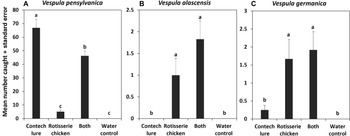
In the same British Columbia location used for experiments 1 and 2, experiment 5 (N = 12) was conducted in 2015 to determine whether any interaction occurred between an effective synthetic chemical lure and an effective proteinaceous bait. In addition to water controls, three treatments were deployed in jar traps: the Contech lure, rotisserie chicken (20 g in an aluminum mesh bag), and the Contech lure plus rotisserie chicken.
Results
Trap catches in British Columbia indicated moderately high populations of yellowjackets in mid-summer but not extreme levels, as occur in some years. In most cases, catches were sufficiently high to discriminate among treatments. However, when fewer than 10 wasps of a given species were caught in an experiment, as could occur for northern and German yellowjackets, the catches in different treatments are not reported. In contrast, trap catches of German and common yellowjackets in Argentina were very high.
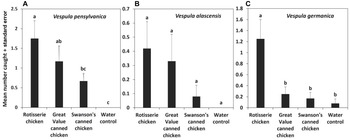
In experiment 1, significant differences were found in catches in traps loaded with different types of chicken for western (F 3,33 = 8.0111, P < 0.0001) and German (F 3,33 = 8.0327, P = 0.0004), but not northern (F 3,33 = 2.0087, P = 0.1318), yellowjackets (Fig. 2). Traps baited with rotisserie chicken caught the highest numbers of all three species. For German yellowjackets, traps baited with rotisserie chicken caught significantly more wasps than did traps baited with the other two types of chicken, neither of which caught significantly more wasps than did unbaited water control traps. Low catches of northern yellowjackets, with many traps catching no wasps, precluded statistical differences among treatments. Western yellowjackets were caught in significantly higher numbers in traps baited with rotisserie chicken than in traps baited with Swanson’s canned chicken and unbaited control traps, whereas traps baited with Great Value canned chicken caught numbers intermediate between the other two chicken treatments.
Comparison of catches for experiment 1 in jar traps baited with different types of chicken or a water control in British Columbia for A, native western yellowjackets, B, native northern yellowjackets, and C, invasive German yellowjackets. Bars with the same letter above are not significantly different, Tukey’s honestly significant difference test, P ≤ 0.05.

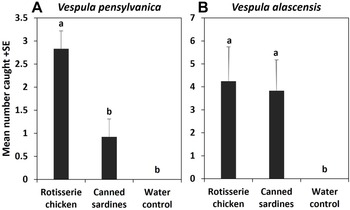
In British Columbia, rotisserie chicken was more attractive in experiment 2 to western yellowjackets than canned sardines were, and both lures were more attractive than the water controls (F 2,22 = 21.6347, P < 0.0000; Fig. 3A). For northern yellowjackets, the two lures were both more attractive than water controls but were not different from each other (F 2,22= 8.2848, P = 0.0021; Fig. 3B). Only one German yellowjacket was caught in this experiment.
Comparison of catches for experiment 2 in jar traps baited with chicken, sardines, or a water control in British Columbia for A, western yellowjackets and B, northern yellowjackets. Bars with the same letter above are not significantly different, Tukey’s honestly significant difference test, P ≤ 0.05.

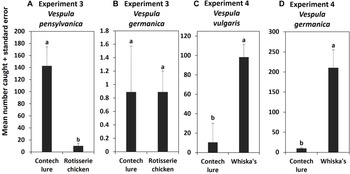
Western yellowjackets showed a clear preference for traps baited with the heptyl butyrate–based synthetic chemical lure (Contech lure) over traps baited with rotisserie chicken in experiment 3 (t 8 = 7.4164, P < 0.0001; Fig. 4A). German yellowjackets, however, showed no preference (t 8 = 1.1942, P = 0.266; Fig. 4B). Only seven V. alascensis were caught in this experiment. In experiment 4 in Argentina, both common (Fig. 4C) and German (Fig. 4D) yellowjackets were caught in much higher numbers in traps baited with the fish-based Whiska’s lure than in traps baited with the Contech lure (V. vulgaris: t 11= 7.1331, P < 0.00001; V. germanica: t 11 = 4.5448, P = 0.0008).
Comparison of catches for experiment 3 in British Columbia in jar traps baited with a 10-component synthetic chemical lure (Contech lure) or rotisserie chicken for A, native western yellowjackets and B, invasive German yellowjackets, and of catches in experiment 4 in Argentina comparing traps baited with the Contech lure or Whiska’s sardine-flavoured cat food for catches of C, common yellowjackets and D, German yellowjackets. Bars with the same letter above are not significantly different, t-test, P ≤ 0.05.

In experiment 5, western yellowjackets were caught in high numbers in traps baited with the Contech lure and in very low numbers in traps baited with rotisserie chicken; catches in traps baited with both lures were significantly higher than those in the traps baited with rotisserie chicken but were significantly lower than those in traps baited with the Contech lure (F 3,33 = 237.9651, P < 00001; Fig. 5). In contrast, traps baited with both lures or with rotisserie chicken alone caught significantly more northern and German yellowjackets than did traps baited with the Contech lure or water (F 3,33 = 13.333, P < 0.0001 and F 3,33 = 6.880, P = 0.0010, respectively; Fig. 5).
Comparison of catches for experiment 5 in British Columbia in jar traps baited with synthetic chemical Contech lures, rotisserie chicken, both together, or a water control for A, native western yellowjackets, B, native northern yellowjackets, and C, invasive German yellowjackets. Bars with the same letter above are not significantly different, Tukey’s honestly significant difference test, P ≤ 0.05.

Discussion
The high trap catches for German yellowjackets in Argentina reflect the major pest problem that they pose in that country (Masciocchi and Corley Reference Masciocchi and Corley2013). The similarly high catches of common yellowjackets suggest that, by 2016, this species had rapidly achieved pest status in the six years since its initial detection in Argentina (Masciocchi et al. Reference Masciocchi, Beggs, Carpenter and Corley2010).
The low and inconsistent trap catches for German yellowjackets in British Columbia suggest that, despite its rapid range expansion into the northern Pacific Coast region of North America (Akre et al. Reference Akre, Ramsay, Grable, Baird and Stanford1989), the species’ establishment in British Columbia is both patchy and at low population levels. For example, 15 German yellowjackets were caught in traps baited with rotisserie chicken in experiment 1 in 2015 (Fig. 2C), but in experiment 2 in the same location in the following year, only one German yellowjacket was caught in traps with the same lure.
The results of experiment 1 indicate variability in attractiveness among different types of cooked chicken. The preference for rotisserie chicken shown by western and German yellowjackets, the apparent (but not significant) preference expressed by northern yellowjackets, and the poorer performance of the two types of canned chicken suggest that the process for cooking rotisserie chicken either retains or creates attractiveness, whereas the canning process may diminish it. Notably, the results indicate that there are more attractive types of chicken lures for yellowjackets than the Swanson’s canned chicken used by Reierson et al. (Reference Reierson, Rust, Vetter, Robinson and Bajomi2008).
The results of experiment 2 (Fig. 3) indicate that western yellowjackets have a pronounced preference for rotisserie chicken over canned sardines, but northern yellowjackets show no difference in preference between the two types of proteinaceous foodstuffs. Attraction of northern yellowjackets to traps baited with either chicken or fish is the first record of a response to protein-based foods by this species. All four species are in the vulgaris species group (Akre et al. Reference Akre, Greene, MacDonald, Landolt and Davis1980), yet the results suggest that their taxonomic relatedness may not reflect similar preferences for foodstuffs. When the plant- and heptyl butyrate–based Contech lure and chicken- or fish-based lures were offered in the same experiment, western yellowjackets were most strongly attracted to the Contech lure when given a choice between it and rotisserie chicken (Fig. 4A). The reverse was true for German and common yellowjackets in Argentina when they were given a choice between the Contech lure and a fish-based cat food (Fig. 4C, D). German yellowjackets in British Columbia showed no preference between the Contech lure and rotisserie chicken. Similarly, Babcock et al. (Reference Babcock, Gries, Borden, Palmero, Mattiacci and Masciocchi2017) found that, in Argentina, German and common yellowjackets were significantly attracted to traps baited with the heptyl butyrate–based Contech lure, but catches of both species in traps baited with a fruit-powder-plus-yeast composition were more than eight-fold higher. Thus, preferences for different types of lures are not absolute. This interpretation agrees with an analysis by Landolt and Zhang (Reference Landolt and Zhang2016), who noted that western yellowjackets are attracted to both heptyl butyrate and a composition of isobutanol plus acetic acid but that northern and German yellowjackets are attracted only to isobutanol plus acetic acid.
The reduced catch of western yellowjackets in traps baited with both the Contech lure and rotisserie chicken compared to the Contech lure alone (Fig. 5A) aligns with the results of Liang and Pietri (Reference Liang and Pietri2017), who found that, when 50 µL of heptyl butyrate was placed outside of traps baited with 1 g of chicken meat extract, catches of western yellowjackets were far higher than when both lures were inside the traps. They hypothesised that, at close range, heptyl butyrate interfered with the wasps’ ability to perceive and respond to the proteinaceous bait. This phenomenon did not occur in the present study for either northern or German yellowjackets (Fig. 5B, C), for which catches in traps baited with the combined stimuli were slightly (but not significantly) higher than those in traps baited with rotisserie chicken alone, and both were significantly higher than in traps baited with the Contech lure alone. In contrast to Liang and Pietri (Reference Liang and Pietri2017), Borden et al. (Reference Borden, Branca and Banfield2024) found heightened catches of western yellowjackets when a specific fish meal fertiliser (Lighthouse Fish Meal 9-4-0, Wilbur Ellis Company LLC, Yakima, Washington, United States of America) was combined with a heptyl butyrate–based lure.
It is unlikely that resolution of the conflicting results with proteinaceous attractants will occur unless the attractive volatiles in red meat, poultry, and fish are identified and can be tested experimentally, alone and in combination with heptyl butyrate. Demonstration of attraction of yellowjackets to ethanol extracts of horsemeat (Ross et al. Reference Ross, Shukle and MacDonald1984) and a dichloromethane extract of chicken (Liang and Pietri Reference Liang and Pietri2017), as well as identification of a suite of attractive volatiles from green-lipped mussels (Unelius et al. Reference Unelius, El-Sayed, Twidle, Stringer, Manning and Sullivan2014), suggest that such critical chemical research would be feasible and fruitful and might also lead to improved synthetic chemical lures for multiple pestiferous yellowjacket species.
Acknowledgements
The authors thank Ron Horvat for welcoming experiments on his farm; Luis Palmero, Analía Mattiacci, Maité Masciocchi, Juan Corley, and Gerhard and Regine Gries for advice and assistance; and the Natural Sciences and Engineering Research Council of Canada (NSERC), Contech Enterprises Inc., and Scotts Canada Ltd. for financial support.
Competing interests
Tamara L. Trottier has no competing interests. John H. Borden was employed by Scotts Canada Ltd. during completion of this project. The company had no input into how the research was conducted or how the results were interpreted.



 Open access

