


Symbols

Introduction
Confining pressure alters the mechanical behavior of sand–ice materials primarily by its influence on sliding friction, particle re-orientation, and reduction in dilatancy effect. Particle crushing under high pressures serves to increase sand density with a corresponding increase in shear strength. For low sand contents and particles not in contact, the frozen soil behavior is dependent on the properties of the ice matrix (Reference Goughnour and AnderslandGoughnour and Andersland, 1968). Confining pressures limit or reduce crack and cavity formation and alter accommodation cracking and distortion along grain boundaries within the ice. With confining pressures greater than 62 MN/m2 and ice saturated sand materials, pressure melting and ice/water phase changes are responsible for a decrease in shear strength (Reference Chamberlain, Chamberlain, Groves and PerhamChamberlain and others, 1972). Increased pore pressures and no drainage reduce effective intergranular contacts thereby reducing sliding friction. Other factors responsible for altering the mechanical behavior include strain-rate, temperature, stress history, and the presence of impurities such as air bubbles, salts, or organic matter in the ice matrix (Reference ScottScott, 1969; Reference TsytovichTsytovich, 1959, p. 108–52).
To provide additional information on the influence of confining pressure on the shear strength and creep behavior of sand–ice materials, a series of constant axial strain-rate tests and uniaxial, confined and step-stress creep tests were performed using triaxial apparatus (Reference AlkireAlkire, unpublished).
Test Materials and Sample Preparation
A pure silica (Ottawa) sand with particle diameters from 0.59 mm to 0.84 mm was used for all sand–ice test samples. Sand–ice samples, 2.87 cm in diameter by 5.74 cm high, were prepared by pouring sand into an aluminum mold and vibrating until the predetermined amount of sand was level with the top of the mold. Precooled, distilled, de-ionized, and deaired water was next poured into the sand and frozen at a temperature close to −18° C. A few sand particles were lost dependent on the amount of trimming needed to permit uniform seating of the loading cap. Hence void ratios computed on the basis of trimmed sample volume, oven dry weight of sand, and specific gravity of the sand did show a small scatter. Since vacuum saturation was not used, a few air bubbles trapped in the sand lowered the degree of ice saturation to about 97%. An intermediate degree of ice saturation, close to 55%, gave approximately equal amounts of ice (less than 4% difference) in the upper and lower halves of the frozen sand–ice sample when prepared in a similar manner. After a 24 h freezing period the samples were trimmed, removed from the mold, and weighed in air and kerosene. Density of the polycrystalline ice within the sand pores ranged from 0.854 Mg/m3 to 0.918 Mg/m3. Friction reducers were placed at each end of the sample prior to mounting in a precooled high-pressure triaxial cell. Three or more thin rubber membranes protected the sample from the coolant liquid. Immediate placement in a cold bath and storage for 12 h before testing permitted temperature equalization throughout the sample and cell.
Equipment and Test Procedures
The triaxial cell was immersed in a coolant mixture of ethylene glycol and water maintained at a constant temperature of −12° C by coolant circulation through an adjacent portable refrigerated bath. Sample temperatures during a test varied by no more than ±0.05 deg. Axial loads were measured by means of a force transducer mounted in the base of the triaxial cell, thereby avoiding ram friction in load observations. Axial deformations, determined by means of a linear differential transformer, were recorded with an accuracy better than ±10−3 cm. Confining pressures up to 7 MN/m2 were applied to test samples via pressurized nitrogen acting on the coolant liquid in the triaxial cell. Constant axial deformation rates were applied to the loading ram of the triaxial cell by means of a variable-speed mechanical loading system. Axial loads for creep tests were applied to the ram and sample by means of a load frame supporting a dead load of lead bricks. Confining pressure was removed or added to produce step changes in deviator stress. During sample deformation, a constant unit stress was maintained by adding lead shot to the dead weights to compensate for the small increase in sample area. Constant sample volume was assumed for this correction.
Experimental results
Constant axial strain-rate tests
Typical stress–strain curves for sand–ice samples deformed at 0.002 66 min−1 are shown in Figure 1. For convenience and clarity, only selected data points are shown. These were based on a continuous record obtained using load and displacement transducers (Reference AlkireAlkire, unpublished). For the higher confining pressures, the curves show an initial yield followed by a second, approximately linear, portion leading to failure at a larger deviator stress. The first yield occurs at around 0.01 axial strain which is close to that observed for yield of polycrystalline ice (Reference Goughnour and AnderslandGoughnour and Andersland, 1968). The peak stress occurs at larger strains and appears to be related to the increase in frictional resistance. This behavior has also been observed for unfrozen clay soils in which the cohesion component of strength develops to its maximum value at small axial compression strains, while the frictional component of strength requires larger strains to fully develop (Reference Schmertmann and OsterbergSchmertmann and Osterberg [1961]).

It is essential that samples with similar void ratio be used in making the above comparisons. Stress–strain curves for three sand–ice samples with slightly different initial void ratios are shown in Figure 2. For the same confining pressure, 4.826 MN/m2, a change in void ratio of less than 0.03 results in a significant change in the stress–strain curve.

The influence of reduced ice content on stress–strain curves is shown in Figure 3 for the same axial strain-rate and temperature. For an ice saturation of 55%, the initial yield followed by a second linear portion again develops at higher confining pressures. The peak deviator stress has been reduced in comparison to the curves on Figure 1 with similar confining pressures. This is an indication of the reduced load-carrying capacity for samples with smaller amounts of ice in the void spaces.

Creep tests
Step-stress creep data shown in Figure 4 include three levels of deviator stress D = (σ 1 − σ 3), and seven levels of confining pressure σ 3. Minimum creep rates and the percent of maximum deviator stress are given for each section of the curve. The jump in strain at each increase in confining pressure corresponds to cell expansion as recorded by the displacement transducer. Step-stress creep data shown in Figure 5 include two levels of deviator stress and seven levels of confining pressure for an ice saturation of 60%. For the same deviator stress, comparison with Figure 4 shows a much larger creep strain with the reduced ice content. The per cent of maximum deviator stress shown on Figures 4 and 5 refer to the maximum shear strength based on the constant axial strain-rate tests.


Interpretation of results
To interpret the experimental results, several factors need to be discussed. They include confining pressure, void ratio, reduced ice content, failure criteria, and creep behavior.
Confining pressure
Constant axial strain-rate tests summarized in Figure 1 show that confining pressure has a substantial strengthening effect on the sand–ice samples. The curves show that the cohesive component of strength due to the ice matrix develops to its maximum value at axial compression strains close to 0.01, while the frictional component of strength continues to develop to its maximum value at a much larger axial strain. Failure strains up to 0.06 correspond to the higher confining pressures. As the confining pressure is increased the material appears to become increasingly dependent on the frictional nature of the sand. This fact is more clearly shown in Figure 6 where the maximum principal stress ratio has been plotted against confining pressure. Comparisons with data for unfrozen silica sand shows that the cohesive component becomes very small when confining pressures approached 7 MN/m2. For the low ranges of confining pressure, the behavior of sand–ice material depends primarily on the cohesive nature of the ice matrix.

Void ratio
The large influence which small changes in initial void ratio have on the stress–strain behavior of sand–ice material is shown in Figure 2. For a constant confining pressure of 4.826 MN/m2 the sliding friction and particle reorientation effect should be relatively constant. Particle crushing is negligible for silica sand for the range of confining pressures used in this study (Reference Lee and SeedLee and Seed, 1967). Therefore, the dilatancy component would appear to be primarily responsible for the change in the stress–strain curves. For unfrozen sand dilatancy increases the shear strength by requiring energy to move particles up and over one another. For a sand–ice material energy is required to overcome the forces of adhesion between the ice and sand, hence it would be expected that the increase in deviator stress for a small change in void ratio would be greater than for unfrozen sand. Equipment limitations did not permit measurement of volume changes during the triaxial tests, however volume measurements taken before and after each test, given in Figure 7, show a volume increase for all samples tested at the lower confining pressures. Data from Reference Lee and SeedLee and Seed (1967) given in Figure 7 for unfrozen silica sand show that the dilatancy factor is suppressed with increased confining pressure. A similar trend is noted for the sand–ice material.

Reduced ice content
A comparison of stress–strain curves in Figures 1 and 3 show a reduced deviator stress for sand–ice samples with an ice saturation of 55%. A summary of these data shown in Figure 8 suggests that the reduction in deviator stress is in proportion to the amount of ice in the sand voids. Only two levels of ice saturation are included because of difficulty in obtaining a uniform ice distribution within the samples at other ice contents. For the four levels of confining pressure and small differences in void ratio, the parallel lines indicate that the reduction in peak deviator stress is due primarily to a decrease, in cohesion of the ice matrix. A similar relationship has been reported by Reference KaplarKaplar (1971) and Reference VyalovVyalov (1959). A linear extrapolation of the lower curve to zero deviator stress suggests that about 18% ice saturation is required to develop any significant strength for zero confining pressure. The curves do not extend beyond 100% ice saturation.

Failure criteria
Constant strain-rate data are summarized in Figure 9 in terms of the maximum shear stress at failure. It was convenient to let

and

represent the coordinates of a stress point. The normal stresses, σ 1 and σ 3, represent the major and minor principal stresses at failure, respectively. A series of tests with different confining pressures define K f-lines as shown in Figure 9 for silica sand at two levels of ice saturation.

The slope angle α appears to be reasonably constant for the range of normal stresses considered and the intercept a is dependent on the degree of ice saturation. Geometric transformation gives

and

where ϕ is the angle of internal friction and c the cohesion. Using the Mohr–Coulomb failure law (Reference Lambe and WhitmanLambe and Whitman, 1969; Reference WuWu, 1966) the shear strength of the sand–ice material will be

where τ ff is the shear stress on the failure surface at failure and σ ff the normal stress on that plane at failure. The apparent angle of internal friction, ϕ, for the high ice saturation, equal to 31.4°, is less than the friction angle of 37° for the unfrozen sand (Reference AlkireAlkire, unpublished). The ice interferes with full development of frictional resistance, perhaps by limiting effective intergranular contact between sand particles. Using the K f-line for unfrozen sand as a basis for separating the frictional and cohesive components of shear strength, the data also suggest a decrease in the cohesion as confining pressures increase, in agreement with data shown in Figure 6.
The above analysis, by necessity, must be based on total stresses. When the ice saturation approaches 100% the sand–ice behavior may be analogous to undrained tests on saturated soil where the slope angle α would decrease to zero. Evidence of this behavior has been given by Reference Chamberlain, Chamberlain, Groves and PerhamChamberlain and others (1972). Their data show a decrease in strength when confining pressure becomes large enough to induce pressure melting and ice/water phase changes in ice-saturated sand. The development of excess pore-water pressures reduces intergranular contacts, thereby reducing sliding friction.
Creep behavior
Step-stress creep tests were used by Reference Andersland and AlNouriAndersland and AlNouri (1970) to show that a linear relationship exists between secondary creep rate and a term which included both deviator stress, D = (σ
1− σ
3), and mean stress, 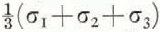 . Using the same test techniques, the data shown in Figures 4 and 5 extend the range of confining pressures to 6.89 MN/m2. The new data confirm earlier results for confining pressures up to about 1.38 MN/m2. At higher pressures the observed strain-rates are greater than would be predicted on the basis of data taken at low confining pressures.
A plot of deviator stress versus axial strain-rate for each level of confining pressure, as shown in Figure 10, illustrates their inter-relationship. Time dependency has been eliminated by using the minimum strain-rates observed at the end of each hour during step loading. The decrease in strain-rate with increase in confining pressure corresponds to the decrease in slope of the family of lines. The axial creep rate  , may be expressed as


Taking the logarithm of both sides of Equation (4) gives

where (0.4343m) is the absolute value of the slope of the lines of equal confining pressure, D is the deviator stress equal to (σ 1 − σ 3), and b is the time-dependent intercept on the ordinate. Values of m versus confining pressure plotted in Figure 11 give a bilinear relationship with the equation

where C i is the intercept and G i the slope for the respective segment. The two lines intersect at a confining pressure of 1.38 MN/m2. Combining Equations (4) and (6) gives

where b(t) equals 4.7 × 10⁻⁶ min−1 for time intervals equal to 60 min during step-stress loading. For σ 3 ⩽ 1.38 MN/m2, C 1 equals 0.432 min−1 (MN/m2)−1 and G 1 equals 0 .127 min−1 (MN/m2)−2; and for σ 3 > 1.38 MN/m2, C 2 equals 0.282 min−1 (MN/m2)−1 and G 2 equals 0.020 min−1 (MN/m2)−2. Equation (7) shows that creep rates are more responsive to confining pressures below 1.38 MN/m2. The term b(t) presumably is related to the structural changes which occur in the sand–ice material during creep.

For the reduced ice content step-stress creep data shown in Figure 5, Equation (7) is also applicable. The deviator stress for the reduced ice content D L is set equal to the deviator stress for the high ice content D H times the degree of ice saturation J expressed as a decimal. Substitution into Equation (7) gives

The parameters b(t), C i , and G i for the low degree of ice saturation approximate the values based on the high degree of ice saturation. Calculated and experimental strain-rates were in excellent agreement (Reference AlkireAlkire, unpublished).
Summary and conclusions
Constant strain-rate tests and step-stress creep tests show the effect of confining pressure on the mechanical behavior of sand–ice samples prepared from 0.59 to 0.84 mm diameter silica sand at a temperature of −12° C. Reduced ice contents help show the dependence of cohesion on the ice matrix and the dependence of the frictional component of strength on the sand material. Conclusions given below reflect the findings of this investigation.
-
1. The mechanical properties of frozen silica sand (initial void ratio of 0.59) in a confined stress condition are dependent on the cohesion of the ice matrix and the sliding friction, particle reorientation, and dilatancy effect of the sand grains. After the ice matrix fails at an axial strain close to one per cent, the sand resistance becomes a function of the normal stress. Development of frictional resistance may be reduced when sand pores are fully saturated with ice.
-
2. For confining pressures approaching 7 MN/m2 and relatively dense sand samples, the cohesive component of strength appears to become very small.
-
3. Small changes in initial void ratio of the sand have a large influence on the stress–strain relationship of confined sand-ice materials.
-
4. Reduced ice contents appear to affect only the cohesion due to the ice matrix. For a constant temperature, the linear relation between degree of ice saturation and peak deviator stress suggests that decrease in strength is directly related to the area of ice in a cross-section of the sand–ice material.
-
5. Creep rates decrease exponentially and creep strength increases with an increase in confining pressure. Reduced ice contents appear to reduce the area of ice effective in the creep process without altering the basic creep process.
Acknowledgements
This study was supported by the National Science Foundation and the Division of Engineering Research, Michigan State University. Their support is gratefully acknowledged.



