

1. Introduction
Intuitively, the ends of a graph capture the different directions in which the graph expands towards infinity. The simplest case is given by the class of (rooted) trees. Here, the ends correspond to the different rays starting at the root, and their end spaces are precisely the completely ultrametrisable spaces, see e.g. [
Reference Hughes29
]. The concept of an end generalises naturally from trees to arbitrary graphs. Following Halin [
Reference Halin25
], an end of a graph G is an equivalence class of rays where two rays are equivalent if for every finite set X of vertices they eventually belong to the same component of $G-X$
. The set of ends of G can be turned into the end-space
$G-X$
. The set of ends of G can be turned into the end-space $\Omega(G)$
by equipping it with the following topology: for every finite
$\Omega(G)$
by equipping it with the following topology: for every finite $X\subseteq V(G)$
and every component C of
$X\subseteq V(G)$
and every component C of $G-X$
, one declares the set of ends represented by the rays in C to be basic open, and takes the topology generated by all these basic open sets. For example, infinite cliques and the
$G-X$
, one declares the set of ends represented by the rays in C to be basic open, and takes the topology generated by all these basic open sets. For example, infinite cliques and the $ \mathbb{Z} \times \mathbb{Z} $
grid have a single end, while the end-space of the infinite binary tree is homeomorphic to the Cantor set.
$ \mathbb{Z} \times \mathbb{Z} $
grid have a single end, while the end-space of the infinite binary tree is homeomorphic to the Cantor set.
Ends play a crucial role in extending results about finite graphs to infinite graphs, see for example [ Reference Aurichi and Real2 , Reference Carmesin, Hamann and Miraftab11 , Reference Diestel15 , Reference Georgakopoulos21 , Reference Gollin and Heuer24 , Reference Joó30 ]. Perhaps surprisingly, ends have recently been used for the converse as well: by studying the structure of finite graphs through their covering spaces [ Reference Carmesin10 , Reference Carmesin, Kontogeorgiou, Kurkofka and Turner12 , Reference Diestel, Jacobs, Knappe and Kurkofka18 , Reference Georgakopoulos22 ]. In Bass–Serre theory [ Reference Serre47 ], Stallings’ theorem uses ends to detect product-structure in groups such as amalgamated free products or HNN-extensions [ Reference Stallings50 , Reference Stallings51 ].
However, despite significant advances in our understanding of end spaces [
Reference Diestel14
,
Reference Diestel and Kühn19
,
Reference Kurkofka and Melcher35
,
Reference Kurkofka, Melcher and Pitz36
,
Reference Polat44
,
Reference Polat45
,
Reference Sprüssel49
], we still have no complete picture of their precise topological characteristics. Indeed, end spaces of graphs are significantly more complex than end spaces of trees. For example, let G be obtained from an uncountable clique K by disjointly adding new rays $R_v$
, one for each vertex v in K, and identifying the first vertex of each
$R_v$
, one for each vertex v in K, and identifying the first vertex of each $R_v$
with v. Then
$R_v$
with v. Then $\Omega(G)$
is not first countable at the end that contains the rays in K, and hence
$\Omega(G)$
is not first countable at the end that contains the rays in K, and hence $\Omega(G)$
is not metrisable. Thus, end spaces of graphs cannot be represented by trees, and the following natural question arises: is there a narrow class of graphs just wide enough to represent as their end spaces all topological spaces that arise as end spaces of graphs?
$\Omega(G)$
is not metrisable. Thus, end spaces of graphs cannot be represented by trees, and the following natural question arises: is there a narrow class of graphs just wide enough to represent as their end spaces all topological spaces that arise as end spaces of graphs?
Our representation theorem offers an affirmative answer to this question. We recall the following concepts: An order-tree is a partial order $T=(T,\leqslant)$
with a least element called the root such that all chains in T are well-ordered by
$T=(T,\leqslant)$
with a least element called the root such that all chains in T are well-ordered by $\leqslant$
. An order-tree T is special if T can be partitioned into countably many antichains. A path in T is a down-closed chain. A path without maximal element is a high-ray. By identifying paths with their characteristic function, the set
$\leqslant$
. An order-tree T is special if T can be partitioned into countably many antichains. A path in T is a down-closed chain. A path without maximal element is a high-ray. By identifying paths with their characteristic function, the set $\mathcal{P}(T)$
of all paths of T is a closed, hence compact subspace of
$\mathcal{P}(T)$
of all paths of T is a closed, hence compact subspace of ${\left\lbrace {0,1} \right\rbrace}^{T}$
. The space
${\left\lbrace {0,1} \right\rbrace}^{T}$
. The space $\mathcal{P}(T)$
is the path space associated with T. The ray space
$\mathcal{P}(T)$
is the path space associated with T. The ray space $\mathcal{R}(T)$
is the subspace of
$\mathcal{R}(T)$
is the subspace of $\mathcal{P}(T)$
consisting of all high-rays of T.
$\mathcal{P}(T)$
consisting of all high-rays of T.
Brochet and Diestel [
Reference Brochet and Diestel5
] formalised when a graph resembles a given order-tree: a T-graph is a graph with vertex-set T in which edges run between comparable vertices only, so that each successor node is adjacent to its immediate predecessor, and so that limit nodes are adjacent to cofinally many of their predecessors. See [
Reference Pitz41
] for a survey. Diestel and Leader defined that a T-graph G is uniform if for every limit-node $t\in T$
there are finitely many nodes
$t\in T$
there are finitely many nodes $t_1\lt\cdots \lt t_n$
below t such that every edge between a node
$t_1\lt\cdots \lt t_n$
below t such that every edge between a node $\lt t$
and a node
$\lt t$
and a node $\gt t$
starts in a
$\gt t$
starts in a $t_i$
; see [
Reference Diestel and Leader20
].
$t_i$
; see [
Reference Diestel and Leader20
].
Theorem 1 (Representation theorem). The following are equivalent for a topological space X:
-
(1) X is homeomorphic to the end space of a graph;
-
(2) X is homeomorphic to the end space of a uniform T-graph on a (special) order tree T;
-
(3) X is homeomorphic to the ray space of a special order tree T.
As T-graphs on special order trees do not contain uncountable clique minors, we conclude as an application of (2) that every end space can be represented by a graph without an uncountable clique minor. See Section 9 for further applications.
Assertion (3) has a different flavour, as it describes a topological space associated with an order tree to represent end spaces of graphs. By moving from graphs to order trees, we trade ends, i.e. fairly complicated equivalence classes of rays, for high-rays in T, obtaining a canonical representation system for the ends of the graph if you will. Diestel asked in 1992 for a topological characterisation of end-spaces of graphs [ Reference Diestel13 , 5·1]. The statement of (3) will be used by the second author as a key ingredient to give such a characterisation [ Reference Pitz43 ].
We now describe some of the ingredients that go into the proof of Theorem 1. The implication $\mathrm{(3)} \Rightarrow \mathrm{(2)}$
follows from a canonical method due to Diestel and Leader [
Reference Diestel and Leader20
, Theorem 6·2] to build, from a special order tree T with antichain partition
$\mathrm{(3)} \Rightarrow \mathrm{(2)}$
follows from a canonical method due to Diestel and Leader [
Reference Diestel and Leader20
, Theorem 6·2] to build, from a special order tree T with antichain partition $\{U_n\;:\;n \in \mathbb{N} \}$
, a uniform graph G on T: Successors in T are connected to their predecessors, and given a limit
$\{U_n\;:\;n \in \mathbb{N} \}$
, a uniform graph G on T: Successors in T are connected to their predecessors, and given a limit $t \in T$
, recursively pick down-neighbours
$t \in T$
, recursively pick down-neighbours $t_0 \lt t_1 \lt t_2 \lt \cdots\lt t$
with
$t_0 \lt t_1 \lt t_2 \lt \cdots\lt t$
with $t_i \in U_{n_i}$
so that each
$t_i \in U_{n_i}$
so that each $n_{i}$
is smallest possible subject to
$n_{i}$
is smallest possible subject to $t_{i-1} \lt t_i \lt t$
. See Theorem 4·6 below for a thorough discussion. While G depends on the exact choice of
$t_{i-1} \lt t_i \lt t$
. See Theorem 4·6 below for a thorough discussion. While G depends on the exact choice of $\{U_n \;:\;n \in \mathbb{N} \}$
, we show that any two uniform graphs on the same order tree T have end spaces naturally homeomorphic to each other and to
$\{U_n \;:\;n \in \mathbb{N} \}$
, we show that any two uniform graphs on the same order tree T have end spaces naturally homeomorphic to each other and to $\mathcal{R}(T)$
. For the converse
$\mathcal{R}(T)$
. For the converse $\textrm{(2)} \Rightarrow \textrm{(3)}$
, we additionally prove that the existence of a uniform graph on an order tree T implies that T must be special.
$\textrm{(2)} \Rightarrow \textrm{(3)}$
, we additionally prove that the existence of a uniform graph on an order tree T implies that T must be special.
The implication $\textrm{(2)} \Rightarrow \textrm{(1)}$
is trivial, and the main difficulty in the proof of Theorem 1 is the implication
$\textrm{(2)} \Rightarrow \textrm{(1)}$
is trivial, and the main difficulty in the proof of Theorem 1 is the implication $\textrm{(1)} \Rightarrow \textrm{(2)}$
, i.e. to construct for an arbitrary graph G a uniform T-graph H on a special order-tree T such that
$\textrm{(1)} \Rightarrow \textrm{(2)}$
, i.e. to construct for an arbitrary graph G a uniform T-graph H on a special order-tree T such that $\Omega(G)$
is homeomorphic to
$\Omega(G)$
is homeomorphic to $\Omega(H)$
. Indeed, the majority of this paper is concerned with the proof of this implication. For this, we prove a structure theorem for all connected graphs in terms of partition trees, a new concept that we introduce in this paper and which is inspired by the work of Brochet and Diestel [
Reference Brochet and Diestel5
]. Roughly speaking, a partition tree is a substructure of a graph G that takes the shape of an order-tree T and combines key aspects of both algorithmic depth-first search trees and tree-decompositions from the theory of graph-minors. Formally, a partition tree of G is a pair
$\Omega(H)$
. Indeed, the majority of this paper is concerned with the proof of this implication. For this, we prove a structure theorem for all connected graphs in terms of partition trees, a new concept that we introduce in this paper and which is inspired by the work of Brochet and Diestel [
Reference Brochet and Diestel5
]. Roughly speaking, a partition tree is a substructure of a graph G that takes the shape of an order-tree T and combines key aspects of both algorithmic depth-first search trees and tree-decompositions from the theory of graph-minors. Formally, a partition tree of G is a pair $(T,\mathcal{V})$
of an order-tree
$(T,\mathcal{V})$
of an order-tree $T=(T,\leqslant)$
and a partition
$T=(T,\leqslant)$
and a partition $\mathcal{V}=(V_t \;:\; t\in T)$
of V(G) into connected vertex-sets
$\mathcal{V}=(V_t \;:\; t\in T)$
of V(G) into connected vertex-sets $V_t$
such that:
$V_t$
such that:
-
(i) the contraction-minorFootnote 1 $G/\mathcal{V}$
is a T-graph;
$G/\mathcal{V}$
is a T-graph; -
(ii) for every successor-node
$t\in T$
the neighbourhood of
$\bigcup_{t'\geqslant t}V_{t'}$
in G is finite; and -
(iii)
$|V_t|=1$
for all non-limits
$t\in T$
.


Roughly speaking, we say that $(T,\mathcal{V})$
displays the ends of G if a canonical correspondence between the ends of G and the high-rays of T is bijective. And we say that
$(T,\mathcal{V})$
displays the ends of G if a canonical correspondence between the ends of G and the high-rays of T is bijective. And we say that $(T,\mathcal{V})$
is sequentially faithful if this canonical correspondence respects convergence of sequences. The structure theorem states:
$(T,\mathcal{V})$
is sequentially faithful if this canonical correspondence respects convergence of sequences. The structure theorem states:
Theorem 2. Every connected G has a sequentially faithful partition tree that displays all its ends.
Besides being a crucial step in proving Theorem 1, this structure theorem may prove useful in other situations, too. In Section 9 we present a variation on Halin’s end-faithful spanning tree conjecture, as well as a short derivation of Carmesin’s result [ Reference Carmesin9 , 5·17] that every graph admits a nested set of finite-order separations that distinguishes every two ends of the graph.
As an ingredient to the proof of Theorem 2, we introduce a new method called enveloping an arbitrary vertex-set $U\subseteq V(G)$
, which intuitively enables one to maximally expand U without changing which ends can be separated from U by finitely many vertices. This envelope method has already found further applications since the completion of our paper, see e.g. [
Reference Aurichi, Júnior and Real1
,
Reference Koloschin, Krill and Pitz34
,
Reference Pitz42
].
$U\subseteq V(G)$
, which intuitively enables one to maximally expand U without changing which ends can be separated from U by finitely many vertices. This envelope method has already found further applications since the completion of our paper, see e.g. [
Reference Aurichi, Júnior and Real1
,
Reference Koloschin, Krill and Pitz34
,
Reference Pitz42
].
Organisation of this paper
Section 2 recalls notation and facts on end spaces and T-graphs. In Section 3 we introduce the method of enveloping vertex-sets. In Section 4 we discuss an alternative perspective on uniform T-graphs and establish an equivalence between uniformity and special order-trees. In Section 5 we give investigate end-spaces of uniform T-graphs in terms of T, and show that they are naturally homeomorphic to the ray space $\mathcal{R}(T)$
, completing the proof of the equivalence
$\mathcal{R}(T)$
, completing the proof of the equivalence $\textrm{(2)} \Leftrightarrow \textrm{(3)}$
in Theorem 2. In Section 6 we introduce partition trees and prove core properties. We prove the structure theorem, Theorem 2, in Section 7. In Section 8, we derive from Theorem 2 the remaining implication
$\textrm{(2)} \Leftrightarrow \textrm{(3)}$
in Theorem 2. In Section 6 we introduce partition trees and prove core properties. We prove the structure theorem, Theorem 2, in Section 7. In Section 8, we derive from Theorem 2 the remaining implication $\textrm{(1)} \Rightarrow \textrm{(2)}$
in Theorem 1. Lastly, in Section 9 we have included some applications.
$\textrm{(1)} \Rightarrow \textrm{(2)}$
in Theorem 1. Lastly, in Section 9 we have included some applications.
2. End spaces and T-graphs: a reminder
For graph theoretic terms we follow the terminology in [
Reference Diestel16
], and in particular [
Reference Diestel16
, chapter 8] for ends of graphs and the end spaces $\Omega(G)$
. A function
$\Omega(G)$
. A function $f \colon X \to Y$
is finite-to-one if
$f \colon X \to Y$
is finite-to-one if $f^{-1}(y)$
is finite for all
$f^{-1}(y)$
is finite for all $y \in Y$
.
$y \in Y$
.
2·1. End spaces
A 1-way infinite path is called a ray and the subrays of a ray are its tails. Two rays in a graph $G = (V,E)$
are equivalent if no finite set of vertices separates them; the corresponding equivalence classes of rays are the ends of G. The set of ends of a graph G is denoted by
$G = (V,E)$
are equivalent if no finite set of vertices separates them; the corresponding equivalence classes of rays are the ends of G. The set of ends of a graph G is denoted by $\Omega = \Omega(G)$
. Usually, ends of graphs are denoted by
$\Omega = \Omega(G)$
. Usually, ends of graphs are denoted by $\omega$
, but here we will denote ends by
$\omega$
, but here we will denote ends by $\varepsilon$
or
$\varepsilon$
or $\eta$
to avoid confusion with ordinals such as
$\eta$
to avoid confusion with ordinals such as $\omega_1$
. If
$\omega_1$
. If $X \subseteq V$
is finite and
$X \subseteq V$
is finite and $\varepsilon \in \Omega$
is an end, there is a unique component of
$\varepsilon \in \Omega$
is an end, there is a unique component of $G-X$
that contains a tail of every ray in
$G-X$
that contains a tail of every ray in $\varepsilon$
, which we denote by
$\varepsilon$
, which we denote by $C(X,\varepsilon)$
. Then
$C(X,\varepsilon)$
. Then $\varepsilon$
lives in the component
$\varepsilon$
lives in the component $C(X,\varepsilon)$
. If C is any component of
$C(X,\varepsilon)$
. If C is any component of $G-X$
, we write
$G-X$
, we write $\Omega(X,C)$
for the set of ends
$\Omega(X,C)$
for the set of ends $\varepsilon$
of G with
$\varepsilon$
of G with $C(X,\varepsilon) = C$
, and abbreviate
$C(X,\varepsilon) = C$
, and abbreviate $\Omega(X,\varepsilon) \;:\!=\; \Omega(X,C(X,\varepsilon))$
. Finally, if
$\Omega(X,\varepsilon) \;:\!=\; \Omega(X,C(X,\varepsilon))$
. Finally, if $\mathscr{C}$
is any collection of components of
$\mathscr{C}$
is any collection of components of $G-X$
, we write
$G-X$
, we write $\Omega(X,\mathscr{C}) \;:\!=\; \bigcup\,\{\Omega(X,C) \colon C \in \mathscr{C}\}$
.
$\Omega(X,\mathscr{C}) \;:\!=\; \bigcup\,\{\Omega(X,C) \colon C \in \mathscr{C}\}$
.
The collection of all sets $\Omega(X,C)$
with
$\Omega(X,C)$
with $X\subseteq V$
finite and C a component of
$X\subseteq V$
finite and C a component of $G-X$
forms a basis for a topology on
$G-X$
forms a basis for a topology on $\Omega$
. This topology is Hausdorff, and it is zero-dimensional in that it has a basis consisting of closed-and-open sets.
$\Omega$
. This topology is Hausdorff, and it is zero-dimensional in that it has a basis consisting of closed-and-open sets.
A crucial property of end spaces is that they are Fréchet-Urysohn: this means that closures are given by convergent sequences, i.e. $x \in \overline{X}$
for some subset
$x \in \overline{X}$
for some subset $X \subseteq \Omega(G)$
if and only if there are
$X \subseteq \Omega(G)$
if and only if there are $x_n \in X$
with
$x_n \in X$
with $x_n \to x$
(as
$x_n \to x$
(as $n \to \infty$
). In particular, this implies that a function f between two end spaces is continuous if and only if f is sequentially continuous; later in this paper, we will therefore only check for sequential continuity.
$n \to \infty$
). In particular, this implies that a function f between two end spaces is continuous if and only if f is sequentially continuous; later in this paper, we will therefore only check for sequential continuity.
Note that when considering end spaces $\Omega(G)$
, we may always assume that G is connected; adding one new vertex and choosing a neighbour for it in each component does not affect the end space.
$\Omega(G)$
, we may always assume that G is connected; adding one new vertex and choosing a neighbour for it in each component does not affect the end space.
Recall that a comb is the union of a ray R (the comb’s spine) with infinitely many disjoint finite paths, possibly trivial, that have precisely their first vertex on R. The last vertices of those paths are the teeth of this comb. Given a vertex set U, a comb attached to U is a comb with all its teeth in U, and a star attached to U is a subdivided infinite star with all its leaves in U. Then the set of teeth is the attachment set of the comb, and the set of leaves is the attachment set of the star.
Lemma 2·1 (Star-comb lemma). Let U be an infinite set of vertices in a connected graph G. Then G contains either a comb attached to U or a star attached to U.
Let us say that an end $\varepsilon$
of G is contained in the closure of M, where M is either a subgraph of G or a set of vertices of G, if for every finite vertex set
$\varepsilon$
of G is contained in the closure of M, where M is either a subgraph of G or a set of vertices of G, if for every finite vertex set $X\subseteq V$
the component
$X\subseteq V$
the component $C(X,\varepsilon)$
meets M. Equivalently,
$C(X,\varepsilon)$
meets M. Equivalently, $\varepsilon$
lies in the closure of M if and only if G contains a comb attached to M with its spine in
$\varepsilon$
lies in the closure of M if and only if G contains a comb attached to M with its spine in $\varepsilon$
. We write
$\varepsilon$
. We write $\partial_{\Omega} {M}$
for the subset of
$\partial_{\Omega} {M}$
for the subset of $\Omega$
that consists of the ends of G lying in the closure of M.
$\Omega$
that consists of the ends of G lying in the closure of M.
2·2. Normal trees
Given a graph H, we call a path P an H-path if P is non-trivial and meets H exactly in its endvertices. In particular, the edge of any H-path of length 1 is never an edge of H. A rooted tree $T\subseteq G$
is normal in G if the endvertices of every T-path in G are comparable in the tree-order of T, cf. [
Reference Diestel16
]. The rays of a normal tree T that start at its root are its normal rays.
$T\subseteq G$
is normal in G if the endvertices of every T-path in G are comparable in the tree-order of T, cf. [
Reference Diestel16
]. The rays of a normal tree T that start at its root are its normal rays.
Since their invention due to Jung [ Reference Jung32 ], normal trees have developed to be perhaps the single most useful structural tool in infinite graph theory. Positive results include a characterisation due to Jung when normal spanning trees exist [ Reference Jung33 ], Halin’s result that graphs without a (fat) subdivision of a countable clique have normal spanning trees [ Reference Diestel17 , Reference Halin and Bollobás27 , Reference Pitz37 , Reference Pitz40 ] as well as results about forbidden minors for normal spanning trees [ Reference Bowler, Geschke and Pitz4 , Reference Diestel and Leader20 , Reference Halin28 , Reference Pitz38 , Reference Pitz39 ]. For applications of normal trees that are not necessarily spanning, see [ Reference Bürger and Kurkofka6 , Reference Kurkofka, Melcher and Pitz36 ].
Lemma 2·2. Let G be any connected graph and let $v\in G$
be any vertex. Then there exists an inclusionwise maximal normal tree
$v\in G$
be any vertex. Then there exists an inclusionwise maximal normal tree $T\subseteq G$
rooted at v. Every component of
$T\subseteq G$
rooted at v. Every component of $G-T$
has an infinite neighbourhood, and the down-closure in T of each such neighbourhood determines a normal ray of T.
$G-T$
has an infinite neighbourhood, and the down-closure in T of each such neighbourhood determines a normal ray of T.
Proof. Inclusionwise maximal normal trees $T\subseteq G$
rooted at v exist by Zorn’s lemma. By the defining property of a normal tree, the neighbourhood of every component of
$T\subseteq G$
rooted at v exist by Zorn’s lemma. By the defining property of a normal tree, the neighbourhood of every component of $G-V(T)$
forms a chain in the tree-order on T. We claim that all such neighbourhoods are in fact infinite, thus determining a unique normal ray of T. Indeed, suppose for a contradiction that some component C of
$G-V(T)$
forms a chain in the tree-order on T. We claim that all such neighbourhoods are in fact infinite, thus determining a unique normal ray of T. Indeed, suppose for a contradiction that some component C of $G-V(T)$
has finite neighbourhood. Let t be maximal in the tree-order on T amongst all neighbours of C. Then we can extend T to a larger normal tree rooted in v by adding any t–C edge, a contradiction.
$G-V(T)$
has finite neighbourhood. Let t be maximal in the tree-order on T amongst all neighbours of C. Then we can extend T to a larger normal tree rooted in v by adding any t–C edge, a contradiction.
2·3. T-graphs
A partially ordered set $(T,\leqslant)$
is called an order tree if it has a unique minimal element (called the root) and all subsets of the form
$(T,\leqslant)$
is called an order tree if it has a unique minimal element (called the root) and all subsets of the form $\lceil t \rceil = \lceil t \rceil_T \;:\!=\; \{t' \in T\;:\; t'\leqslant t\}$
are well-ordered. Write
$\lceil t \rceil = \lceil t \rceil_T \;:\!=\; \{t' \in T\;:\; t'\leqslant t\}$
are well-ordered. Write $\lfloor t \rfloor = \lfloor t \rfloor_T \;:\!=\; \{t' \in T\;:\; t\leqslant t'\}$
. We abbreviate
$\lfloor t \rfloor = \lfloor t \rfloor_T \;:\!=\; \{t' \in T\;:\; t\leqslant t'\}$
. We abbreviate $\mathring{\lceil t\rceil}\;:\!=\;\lceil t\rceil\setminus\{t\}$
and
$\mathring{\lceil t\rceil}\;:\!=\;\lceil t\rceil\setminus\{t\}$
and  $\;:\!=\;\lfloor t\rfloor\setminus\{t\}$
. For subsets
$\;:\!=\;\lfloor t\rfloor\setminus\{t\}$
. For subsets $X\subseteq T$
we abbreviate
$X\subseteq T$
we abbreviate $\lceil X\rceil\;:\!=\;\bigcup_{t\in X}\lceil t\rceil$
and
$\lceil X\rceil\;:\!=\;\bigcup_{t\in X}\lceil t\rceil$
and $\lfloor X\rfloor\;:\!=\;\bigcup_{t\in X}\lfloor t\rfloor$
.
$\lfloor X\rfloor\;:\!=\;\bigcup_{t\in X}\lfloor t\rfloor$
.
A maximal chain in T is called a branch of T; note that every branch inherits a well-ordering from T. The height of T is the supremum of the order types of its branches. The height of a point $t\in T$
is the order type of
$t\in T$
is the order type of $\mathring{\lceil t\rceil}$
. The set
$\mathring{\lceil t\rceil}$
. The set $T^i$
of all points at height i is the ith level of T, and we write
$T^i$
of all points at height i is the ith level of T, and we write $T^{\lt i} \;:\!=\; \bigcup\{T^j\;:\; j \lt i\}$
as well as
$T^{\lt i} \;:\!=\; \bigcup\{T^j\;:\; j \lt i\}$
as well as $T^{\leqslant i} \;:\!=\; \bigcup\{T^j\;:\;j \leqslant i\}$
. If
$T^{\leqslant i} \;:\!=\; \bigcup\{T^j\;:\;j \leqslant i\}$
. If $t \lt t'$
, we use the usual interval notation such as
$t \lt t'$
, we use the usual interval notation such as $(t,t') = \{s \colon t\lt s \lt t'\}$
for nodes between t and t
′. If there is no point between t and t
′, we call t
′ a successor of t and t the predecessor of t
′; if t is not a successor of any point it is called a limit. An order tree is special if it can be partitioned into countably many antichains, and semi-special if its successor nodes can be partitioned into countably many antichains.
$(t,t') = \{s \colon t\lt s \lt t'\}$
for nodes between t and t
′. If there is no point between t and t
′, we call t
′ a successor of t and t the predecessor of t
′; if t is not a successor of any point it is called a limit. An order tree is special if it can be partitioned into countably many antichains, and semi-special if its successor nodes can be partitioned into countably many antichains.
A top of a down-closed chain $\mathscr{C}$
in an order tree T is a limit
$\mathscr{C}$
in an order tree T is a limit $t\in T\setminus\mathscr{C}$
with
$t\in T\setminus\mathscr{C}$
with $\mathring{\lceil t\rceil}=\mathscr{C}$
. Note that a chain
$\mathring{\lceil t\rceil}=\mathscr{C}$
. Note that a chain $\mathscr{C}\subseteq T$
may have multiple tops.
$\mathscr{C}\subseteq T$
may have multiple tops.
An order tree T is normal in a graph G, if $V(G) = T$
and the two endvertices of any edge of G are comparable in T. We call G a T-graph if T is normal in G and the set of lower neighbours of any point t is cofinal in
$V(G) = T$
and the two endvertices of any edge of G are comparable in T. We call G a T-graph if T is normal in G and the set of lower neighbours of any point t is cofinal in $\mathring{\lceil t\rceil}$
. We mention the following standard results about T-graphs, and refer the reader to [
Reference Brochet and Diestel5
, Section 2] for details.
$\mathring{\lceil t\rceil}$
. We mention the following standard results about T-graphs, and refer the reader to [
Reference Brochet and Diestel5
, Section 2] for details.
Lemma 2·3. Let $(T,\leqslant)$
be an order tree and G a T-graph.
$(T,\leqslant)$
be an order tree and G a T-graph.
-
(i) For incomparable vertices t, t′ in T, the set
$\lceil{t}\rceil \cap \lceil{t'}\rceil$
separates t from t
′ in G. -
(ii) Every connected subgraph of G has a unique T-minimal element.
-
(iii) If
$T' \subseteq T$
is down-closed, the components of
$G - T'$
are spanned by
$\lfloor{t}\rfloor$
for t minimal in
$T\setminus T'$
. -
(iv) For any two vertices
$t\leqslant t'$
in T, the interval [t, t′] is connected in G.


3. Envelopes and concentrated sets of vertices
An adhesion set of a set of vertices or a subgraph $U \subseteq G$
is any subset of the form N(C) for a component C of
$U \subseteq G$
is any subset of the form N(C) for a component C of $G-U$
. The set or subgraph U is said to have finite adhesion in G if all its adhesion sets are finite.
$G-U$
. The set or subgraph U is said to have finite adhesion in G if all its adhesion sets are finite.
Let G be a connected graph. An envelope for a set of vertices $U \subseteq V(G)$
is a set of vertices
$U \subseteq V(G)$
is a set of vertices $U^* \supseteq U$
of finite adhesion such that
$U^* \supseteq U$
of finite adhesion such that $\partial_{\Omega} { U^*} = \partial_{\Omega} {U}$
. We will show in Theorem 3·3 below that envelopes exist.
$\partial_{\Omega} { U^*} = \partial_{\Omega} {U}$
. We will show in Theorem 3·3 below that envelopes exist.
We need a preliminary lemma. A set of vertices U is concentrated (in its boundary $\partial_{\Omega} {U}$
) if for every finite vertex set
$\partial_{\Omega} {U}$
) if for every finite vertex set $X\subseteq V$
only finitely many vertices of U lie outside of
$X\subseteq V$
only finitely many vertices of U lie outside of $\bigcup_{\varepsilon \in \partial_{\Omega} {U}} C(X,\varepsilon)$
. We say that a set of vertices U is concentrated in an end
$\bigcup_{\varepsilon \in \partial_{\Omega} {U}} C(X,\varepsilon)$
. We say that a set of vertices U is concentrated in an end $\varepsilon$
to mean the case
$\varepsilon$
to mean the case $\partial_{\Omega} {U} = {\left\lbrace {\varepsilon} \right\rbrace}$
.
$\partial_{\Omega} {U} = {\left\lbrace {\varepsilon} \right\rbrace}$
.
Recall that a subset X of a poset $P=(P,{\leqslant})$
is cofinal in P, and
$P=(P,{\leqslant})$
is cofinal in P, and ${\leqslant}$
, if for every
${\leqslant}$
, if for every $p\in P$
there is an
$p\in P$
there is an $x\in X$
with
$x\in X$
with $x\geqslant p$
. We say that a rooted tree
$x\geqslant p$
. We say that a rooted tree $T\subseteq G$
contains a set U cofinally if
$T\subseteq G$
contains a set U cofinally if $U\subseteq V(T)$
and U is cofinal in the tree-order of T. Note that such trees are easily constructed: any inclusion-minimal subtree T of G with
$U\subseteq V(T)$
and U is cofinal in the tree-order of T. Note that such trees are easily constructed: any inclusion-minimal subtree T of G with $U \subseteq V(T)$
will contain U cofinally—no matter which vertex of T we choose as root.
$U \subseteq V(T)$
will contain U cofinally—no matter which vertex of T we choose as root.
Lemma 3·1. Let G be any graph, let $U\subseteq V(G)$
be a set of vertices, and suppose
$U\subseteq V(G)$
be a set of vertices, and suppose $T\subseteq G$
is a rooted tree that contains U cofinally. Then the following assertions hold:
$T\subseteq G$
is a rooted tree that contains U cofinally. Then the following assertions hold:
-
(i)
$\partial_{\Omega} {T} = \partial_{\Omega} {U}$
; -
(ii) if U has finite adhesion, then so does T;
-
(iii) if U is concentrated, then so is T.

Proof. Assertions (i) and (ii) already have been observed in [
Reference Bürger and Kurkofka6
, Lemma 2·13] and [
Reference Pitz39
, Lemma 4·3]. For convenience of the reader, we give a self-contained argument for all three properties (i)–(iii) at once. For this, suppose $T\subseteq G$
is a rooted tree that contains U cofinally.
$T\subseteq G$
is a rooted tree that contains U cofinally.
Claim 3·2. If X is a finite set of vertices and $\mathscr{C}$
a collection of components of
$\mathscr{C}$
a collection of components of $G-X$
such that V(T) meets
$G-X$
such that V(T) meets $\bigcup \mathscr{C}$
infinitely, then already U meets
$\bigcup \mathscr{C}$
infinitely, then already U meets $\bigcup \mathscr{C}$
infinitely.
$\bigcup \mathscr{C}$
infinitely.
To see the claim, suppose for a contradiction that for some finite set of vertices X and some collection $\mathscr{C}$
of components of
$\mathscr{C}$
of components of $G-X$
we have that
$G-X$
we have that $\bigcup \mathscr{C}$
meets U finitely, but V(T) infinitely. By increasing X, we may assume that
$\bigcup \mathscr{C}$
meets U finitely, but V(T) infinitely. By increasing X, we may assume that $\bigcup \mathscr{C} \cap U = \emptyset$
. Since V(T) is infinite but
$\bigcup \mathscr{C} \cap U = \emptyset$
. Since V(T) is infinite but $\lceil{X}\rceil$
is finite, there exists
$\lceil{X}\rceil$
is finite, there exists $t \in (T \setminus \lceil{X}\rceil) \cap \bigcup \mathscr{C}$
. Then
$t \in (T \setminus \lceil{X}\rceil) \cap \bigcup \mathscr{C}$
. Then $\lfloor{t}\rfloor \subseteq \bigcup \mathscr{C}$
avoids U, a contradiction to the assumption that U is cofinal in T.
$\lfloor{t}\rfloor \subseteq \bigcup \mathscr{C}$
avoids U, a contradiction to the assumption that U is cofinal in T.
Now to see (i), consider any end $\varepsilon \notin \partial_{\Omega} {U}$
. Then there is a finite set of vertices X such that
$\varepsilon \notin \partial_{\Omega} {U}$
. Then there is a finite set of vertices X such that $C(X,\varepsilon)$
avoids U. By Claim 3·2, also V(T) intersects
$C(X,\varepsilon)$
avoids U. By Claim 3·2, also V(T) intersects $C(X,\varepsilon)$
finitely, witnessing
$C(X,\varepsilon)$
finitely, witnessing $\varepsilon \notin \partial_{\Omega} {T}$
. The argument for (iii) is similar. Finally, for (ii), consider a component C
′ of
$\varepsilon \notin \partial_{\Omega} {T}$
. The argument for (iii) is similar. Finally, for (ii), consider a component C
′ of $G-T$
. Then there is a component C of
$G-T$
. Then there is a component C of $G-U$
with
$G-U$
with $C' \subseteq C$
. Assuming that U has finite adhesion,
$C' \subseteq C$
. Assuming that U has finite adhesion, $X=N(C)$
is finite. Claim 3·2 applied to X and C yields that V(T) intersects C finitely. Then
$X=N(C)$
is finite. Claim 3·2 applied to X and C yields that V(T) intersects C finitely. Then $N(C') \subseteq X \cup (V(T) \cap V(C))$
is finite, so T has finite adhesion.
$N(C') \subseteq X \cup (V(T) \cap V(C))$
is finite, so T has finite adhesion.
Theorem 3·3. Any [concentrated] set U of vertices in a connected graph G has a connected [concentrated] envelope $U^*$
. Moreover, the connected envelope
$U^*$
. Moreover, the connected envelope $U^*$
can be chosen such that
$U^*$
can be chosen such that $U^* \cap C$
is connected for every component C of
$U^* \cap C$
is connected for every component C of $G-U$
.
$G-U$
.
Proof. Let U be a given set of vertices in a connected graph G. By Zorn’s lemma, there is an inclusionwise maximal set of combs attached to U with pairwise disjoint spines. Write $\mathcal{R}$
for this collection of spines. Let S be the set of all centres of (infinite) stars attached to U. We will show that
$\mathcal{R}$
for this collection of spines. Let S be the set of all centres of (infinite) stars attached to U. We will show that
 $$U^* \;:\!=\; U \cup \bigcup_{R \in \mathcal{R}} V(R) \cup S$$
is an envelope for U. The verification relies on the following claim:
Claim 3·4. If X is a finite set of vertices and $\mathscr{C}$
a collection of components of
$\mathscr{C}$
a collection of components of $G-X$
such that
$G-X$
such that $U^*$
meets
$U^*$
meets $\bigcup \mathscr{C}$
infinitely, then so already does U.
$\bigcup \mathscr{C}$
infinitely, then so already does U.
To see the claim, consider some finite set of vertices X, and assume that $\mathscr{C}$
is a collection of components of
$\mathscr{C}$
is a collection of components of $G-X$
such that U meets
$G-X$
such that U meets $\bigcup \mathscr{C}$
finitely. Then S avoids
$\bigcup \mathscr{C}$
finitely. Then S avoids $\bigcup \mathscr{C}$
. Consider next a spine
$\bigcup \mathscr{C}$
. Consider next a spine $R \in \mathcal{R}$
that meets
$R \in \mathcal{R}$
that meets $\bigcup \mathscr{C}$
. Since R eventually lies in a component
$\bigcup \mathscr{C}$
. Since R eventually lies in a component $C \notin \mathscr{C}$
, we have that R meets
$C \notin \mathscr{C}$
, we have that R meets $\bigcup \mathscr{C}$
finitely. Moreover, R also meets X, and since the spines in
$\bigcup \mathscr{C}$
finitely. Moreover, R also meets X, and since the spines in $\mathcal{R}$
are pairwise disjoint, there are at most
$\mathcal{R}$
are pairwise disjoint, there are at most $|X|$
spines from
$|X|$
spines from $\mathcal{R}$
that meet
$\mathcal{R}$
that meet $\bigcup\mathscr{C}$
, and each does so finitely. Hence
$\bigcup\mathscr{C}$
, and each does so finitely. Hence $\bigcup_{R \in \mathcal{R}} V(R)$
meets
$\bigcup_{R \in \mathcal{R}} V(R)$
meets $\bigcup \mathscr{C}$
finitely, too, and the claim follows.
$\bigcup \mathscr{C}$
finitely, too, and the claim follows.
Now to see $\partial_{\Omega} {U^*} = \partial_{\Omega} {U}$
, consider any end
$\partial_{\Omega} {U^*} = \partial_{\Omega} {U}$
, consider any end $\varepsilon \notin \partial_{\Omega} {U}$
. Then there is a finite set of vertices X such that
$\varepsilon \notin \partial_{\Omega} {U}$
. Then there is a finite set of vertices X such that $C(X,\varepsilon)$
avoids U. By Claim 3·4, also
$C(X,\varepsilon)$
avoids U. By Claim 3·4, also $U^*$
intersects
$U^*$
intersects $C(X,\varepsilon)$
finitely, witnessing
$C(X,\varepsilon)$
finitely, witnessing $\varepsilon \notin \partial_{\Omega} {U^*}$
. The argument that if U is concentrated, then so is
$\varepsilon \notin \partial_{\Omega} {U^*}$
. The argument that if U is concentrated, then so is $U^*$
, follows similarly from Claim 3·4.
$U^*$
, follows similarly from Claim 3·4.
To see that $U^*$
has finite adhesion, suppose for a contradiction that there is a component C of
$U^*$
has finite adhesion, suppose for a contradiction that there is a component C of $G-U^*$
with infinite neighbourhood. Then by a routine application of Theorem 2·1, we either find a star or a comb attached to
$G-U^*$
with infinite neighbourhood. Then by a routine application of Theorem 2·1, we either find a star or a comb attached to $U^*$
whose centre v or spine R is contained in C. Then for all finite sets of vertices X (chosen disjoint from v in the star case), the centre v or a tail of R lives in a component of
$U^*$
whose centre v or spine R is contained in C. Then for all finite sets of vertices X (chosen disjoint from v in the star case), the centre v or a tail of R lives in a component of $G-X$
that meets
$G-X$
that meets $U^*$
infinitely, and hence also U by Claim 3·4. But then it is straightforward to inductively construct a star with centre v or a comb with spine R attached to U, violating the choice of S or
$U^*$
infinitely, and hence also U by Claim 3·4. But then it is straightforward to inductively construct a star with centre v or a comb with spine R attached to U, violating the choice of S or $\mathcal{R}$
respectively.
$\mathcal{R}$
respectively.
To get a connected envelope for U that also satisfies the moreover-part, note that there are inclusionwise minimal subtrees of G containing $U^*$
which satisfy that
$U^*$
which satisfy that $T \cap C$
is connected for every component C of
$T \cap C$
is connected for every component C of $G-U$
: Take a spanning tree
$G-U$
: Take a spanning tree $T_C$
for every component C of
$T_C$
for every component C of $G-U$
, and extend the forest
$G-U$
, and extend the forest $\bigcup_C T_C$
to a rooted spanning tree T of G. Then the down-closure of
$\bigcup_C T_C$
to a rooted spanning tree T of G. Then the down-closure of $U^*$
in T can serve as the desired envelope by Theorem 3·1.
$U^*$
in T can serve as the desired envelope by Theorem 3·1.
For a concept that is somewhat stronger than our notion of envelopes (but whose existence proof is significantly more involved) see Polat’s multiendings from [ Reference Polat45 ]; a precursor to our notion of envelopes has been used in Bürger and the first author’s proof of [ Reference Bürger and Kurkofka7 , Theorem 1].
Recall that a sequence $(x_n)_{n \in \mathbb{N} }$
in a topological space X is said to converge to a subset
$(x_n)_{n \in \mathbb{N} }$
in a topological space X is said to converge to a subset $A \subseteq X$
, denoted by
$A \subseteq X$
, denoted by $x_n \to A$
(as
$x_n \to A$
(as $n \to \infty$
) if every open set containing A also contains almost all
$n \to \infty$
) if every open set containing A also contains almost all $x_n$
. Note that if
$x_n$
. Note that if $A= {\left\lbrace {x} \right\rbrace}$
is a singleton, then this reduces to the usual notion of convergence
$A= {\left\lbrace {x} \right\rbrace}$
is a singleton, then this reduces to the usual notion of convergence $x_n \to x$
.
$x_n \to x$
.
We will apply the following lemma for a single end only. However, for future reference we state it in its optimal form for a compact collection of ends.
Lemma 3·5. Let U be a concentrated vertex set of G of finite adhesion. Assume further that $\partial_{\Omega} {U}$
is compact. Let
$\partial_{\Omega} {U}$
is compact. Let $(\varepsilon_n)_{n\in \mathbb{N} }$
be any sequence of ends in
$(\varepsilon_n)_{n\in \mathbb{N} }$
be any sequence of ends in $\Omega(G) \setminus \partial_{\Omega} {U}$
, and write
$\Omega(G) \setminus \partial_{\Omega} {U}$
, and write $D_n$
for the unique component of
$D_n$
for the unique component of $G-U$
in which
$G-U$
in which $\varepsilon_n$
lives.
$\varepsilon_n$
lives.
Then $\varepsilon_n \to \partial_{\Omega} {U}$
(as
$\varepsilon_n \to \partial_{\Omega} {U}$
(as $n \to \infty$
) if and only if the map
$n \to \infty$
) if and only if the map $ \mathbb{N} \ni n\mapsto N_G(D_n)$
is finite-to-one.
$ \mathbb{N} \ni n\mapsto N_G(D_n)$
is finite-to-one.
Proof. First, suppose that for some finite $X \subseteq U$
there are infinitely many
$X \subseteq U$
there are infinitely many $n\in \mathbb{N} $
with
$n\in \mathbb{N} $
with $N_G(D_n) = X$
. Write
$N_G(D_n) = X$
. Write $\mathscr{C}$
for the collection of components of
$\mathscr{C}$
for the collection of components of $G-X$
containing an end from
$G-X$
containing an end from $\partial_{\Omega} {U}$
. Then
$\partial_{\Omega} {U}$
. Then $\Omega(X,\mathscr{C})$
is an open neighbourhood around
$\Omega(X,\mathscr{C})$
is an open neighbourhood around $\partial_{\Omega} {U}$
avoiding infinitely many
$\partial_{\Omega} {U}$
avoiding infinitely many $\varepsilon_n$
, witnessing
$\varepsilon_n$
, witnessing $\varepsilon_n \not\to \partial_{\Omega} {U}$
.
$\varepsilon_n \not\to \partial_{\Omega} {U}$
.
Now assume that the map $ \mathbb{N} \ni n\mapsto N_G(D_n)$
is finite-to-one, and let us suppose for a contradiction that the sequence
$ \mathbb{N} \ni n\mapsto N_G(D_n)$
is finite-to-one, and let us suppose for a contradiction that the sequence $\varepsilon_0,\varepsilon_1,\ldots$
does not converge to
$\varepsilon_0,\varepsilon_1,\ldots$
does not converge to $\partial_{\Omega} {U}$
in the end space of G. Then there exists an open set around
$\partial_{\Omega} {U}$
in the end space of G. Then there exists an open set around $\partial_{\Omega} {U}$
avoiding infinitely many
$\partial_{\Omega} {U}$
avoiding infinitely many $\varepsilon_n$
, and by compactness of
$\varepsilon_n$
, and by compactness of $\partial_{\Omega} {U}$
we may find a finite vertex set
$\partial_{\Omega} {U}$
we may find a finite vertex set $X\subseteq V(G)$
such that infinitely many
$X\subseteq V(G)$
such that infinitely many $\varepsilon_n$
live outside of
$\varepsilon_n$
live outside of $\bigcup_{\varepsilon \in \partial_{\Omega} {U}} C(X,\varepsilon)$
. Since the map
$\bigcup_{\varepsilon \in \partial_{\Omega} {U}} C(X,\varepsilon)$
. Since the map $n\mapsto D_n$
has finite fibres, we may assume without loss of generality that the finite vertex set X meets none of the components
$n\mapsto D_n$
has finite fibres, we may assume without loss of generality that the finite vertex set X meets none of the components $D_n$
in which these ends live. Hence, infinitely many neighbourhoods
$D_n$
in which these ends live. Hence, infinitely many neighbourhoods $N_G(D_n)$
avoid
$N_G(D_n)$
avoid $\bigcup_{\varepsilon \in \partial_{\Omega} {U}} C(X,\varepsilon)$
. But each of these neighbourhoods consists of vertices in U, and since the fibres of the map
$\bigcup_{\varepsilon \in \partial_{\Omega} {U}} C(X,\varepsilon)$
. But each of these neighbourhoods consists of vertices in U, and since the fibres of the map $n\mapsto N_G(D_n)$
are finite, the union of these neighbourhoods is an infinite subset of U that lies outside of
$n\mapsto N_G(D_n)$
are finite, the union of these neighbourhoods is an infinite subset of U that lies outside of $\bigcup_{\varepsilon \in \partial_{\Omega} {U}} C(X,\varepsilon)$
, contradicting the assumption that U is concentrated.
$\bigcup_{\varepsilon \in \partial_{\Omega} {U}} C(X,\varepsilon)$
, contradicting the assumption that U is concentrated.
4. Uniform T-graphs and special order trees
Definition 4·1. A T-graph G has:
-
(i) finite adhesion if for every limit ordinal
$\sigma$
all components of
$G-T^{\leqslant\sigma}$
have finite neighbourhoods; -
(ii) uniformly finite adhesion, or for short, is uniform if for every limit
$t\in T$
there is a finite
$S_t\subseteq\mathring{\lceil t\rceil}$
such that every
$t'\gt t$
has all its down-neighbours below t inside
$S_t$
.


The property for a T-graph to be uniform has been introduced by Diestel and Leader in [ Reference Diestel and Leader20 ], and it has proven useful in [ Reference Geschke, Kurkofka, Melcher and Pitz23 ] as well. Our next two lemmas illuminate the relation between finite and uniformly finite adhesion.
Lemma 4·2. The following are equivalent for a T-graph G:
-
(i) G has finite adhesion;
-
(ii) for every ordinal
$\sigma$
all components of
$G-T^{\leqslant\sigma}$
have finite neighbourhoods; -
(iii) every vertex set of the form
$\lfloor{t}\rfloor$
for a successor
$t\in T$
has finite neighbourhood in G.


Proof. (i) $\Rightarrow$
(ii). For limits
$\Rightarrow$
(ii). For limits $\sigma$
, this holds by assumption, so suppose that
$\sigma$
, this holds by assumption, so suppose that $\sigma$
is a non-limit and consider any component C of
$\sigma$
is a non-limit and consider any component C of $G-T^{\leqslant\sigma}$
. Let us assume for a contradiction that C has infinitely many neighbours. Using that these form a well-ordered chain and that
$G-T^{\leqslant\sigma}$
. Let us assume for a contradiction that C has infinitely many neighbours. Using that these form a well-ordered chain and that $\sigma$
is a non-limit, we find an
$\sigma$
is a non-limit, we find an $\omega$
-chain of infinitely many neighbours
$\omega$
-chain of infinitely many neighbours $t_0\lt t_1\lt\cdots$
of C and a limit
$t_0\lt t_1\lt\cdots$
of C and a limit $t\in T^{\lt\sigma}$
such that
$t\in T^{\lt\sigma}$
such that $t_n\lt t$
for all
$t_n\lt t$
for all $n\lt\omega$
. Let
$n\lt\omega$
. Let $\mu$
denote the height of t and note that
$\mu$
denote the height of t and note that $\mu$
is a limit. Then the component of
$\mu$
is a limit. Then the component of $G-T^{\leqslant\mu}$
which contains C has infinite neighbourhood, contradicting our assumption that G has finite adhesion.
$G-T^{\leqslant\mu}$
which contains C has infinite neighbourhood, contradicting our assumption that G has finite adhesion.
(ii) $\Rightarrow$
(iii). Suppose t is a successor, and let
$\Rightarrow$
(iii). Suppose t is a successor, and let $\sigma$
be the height of the predecessor of t. By Theorem 2·3 (iii), the unique component of
$\sigma$
be the height of the predecessor of t. By Theorem 2·3 (iii), the unique component of $G-T^{\leqslant \sigma}$
containing t is spanned by
$G-T^{\leqslant \sigma}$
containing t is spanned by $\lfloor{t}\rfloor$
, so has finite neighbourhood.
$\lfloor{t}\rfloor$
, so has finite neighbourhood.
(iii) $\Rightarrow$
(i). Let
$\Rightarrow$
(i). Let $\sigma$
be a limit ordinal. By Theorem 2·3 (iii), the components of
$\sigma$
be a limit ordinal. By Theorem 2·3 (iii), the components of $G-T^{\leqslant \sigma}$
are spanned by
$G-T^{\leqslant \sigma}$
are spanned by $\lfloor{t}\rfloor$
for
$\lfloor{t}\rfloor$
for $t \in T^{\sigma+1}$
, so have finite neighbourhoods by assumption (iii).
$t \in T^{\sigma+1}$
, so have finite neighbourhoods by assumption (iii).
Lemma 4·3. The following are equivalent for a T-graph G:
-
(i) G has uniformly finite adhesion;
-
(ii) every vertex set of the form
for a limit
$t\in T$
has a finite neighbourhood in G; -
(iii) every vertex set of the form
has finite neighbourhood in G.

Proof. (i) $\Rightarrow$
(ii). If G has uniformly finite adhesion, then every vertex set of the form for a limit
$\Rightarrow$
(ii). If G has uniformly finite adhesion, then every vertex set of the form for a limit $t\in T$
has all its neighbours in the finite set
$t\in T$
has all its neighbours in the finite set $S_t\cup\{t\}$
.
$S_t\cup\{t\}$
.
(ii) $\Rightarrow$
(iii). Let us assume for a contradiction that some has infinitely many neighbours. Then we find an
$\Rightarrow$
(iii). Let us assume for a contradiction that some has infinitely many neighbours. Then we find an $\omega$
-chain of infinitely many neighbours
$\omega$
-chain of infinitely many neighbours $t_0\lt t_1\lt\cdots$
of and a limit
$t_0\lt t_1\lt\cdots$
of and a limit $\ell\leqslant t$
such that
$\ell\leqslant t$
such that $t_n\lt\ell$
for all
$t_n\lt\ell$
for all $n\lt\omega$
. But then also
$n\lt\omega$
. But then also 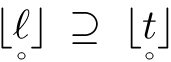 has infinite neighbourhood, a contradiction.
(iii) $\Rightarrow$
(i). Let t be a limit node of T. Then
$\Rightarrow$
(i). Let t be a limit node of T. Then  is as desired.
Comparing Theorem 4·2 (iii) with Theorem 4·3 (iii) explains the name ‘uniform’ and in particular shows that uniformly finite adhesion implies finite adhesion.
Lemma 4·4. If G is a T-graph of finite adhesion and $t\in T$
is a limit, then the down-neighbours of t form a cofinal
$t\in T$
is a limit, then the down-neighbours of t form a cofinal $\omega$
-chain in
$\omega$
-chain in $\mathring{\lceil t\rceil}$
.
$\mathring{\lceil t\rceil}$
.
Proof. The down-neighbours of t form an infinite chain $\mathscr{C}\subseteq\mathring{\lceil t\rceil}$
. Since G has finite adhesion, below every successor in
$\mathscr{C}\subseteq\mathring{\lceil t\rceil}$
. Since G has finite adhesion, below every successor in $\mathring{\lceil t\rceil}$
there are only finitely many elements of
$\mathring{\lceil t\rceil}$
there are only finitely many elements of $\mathscr{C}$
. It follows that
$\mathscr{C}$
. It follows that $\mathscr{C}$
must be an
$\mathscr{C}$
must be an $\omega$
-chain.
$\omega$
-chain.
Our next result characterises on which order trees T there exist T-graphs of (uniformly) finite adhesion in terms of whether T is special or semi-special, respectively. For these classes of order trees, it is helpful to have the following classic characterisation in mind. Recall from [
Reference Baumgartner3
] that a partial order P is said to embed into a partial order Q if there is a map $f \colon P \to Q$
such that
$f \colon P \to Q$
such that $p \lt p'$
implies
$p \lt p'$
implies $f(p) \lt f(p')$
(in particular, such maps are not required to be injective).
$f(p) \lt f(p')$
(in particular, such maps are not required to be injective).
Theorem 4·5 (Baumgartner and Galvin [
Reference Baumgartner3
, Section 4·1]). Let $(T,\leqslant)$
be an order tree.
$(T,\leqslant)$
be an order tree.
-
(i)
$(T,\leqslant)$
is special if and only if
$(T,\leqslant)$
embeds into
$(\mathbb{Q},\leqslant)$
. -
(ii)
$(T,\leqslant)$
is semi-special if and only if
$(T,\leqslant)$
embeds into
$(\mathbb{R},\leqslant)$
.


We now state the promised characterisation:
Theorem 4·6. Let $(T,\leqslant)$
be an order tree.
$(T,\leqslant)$
be an order tree.
-
(i) There exists a T-graph of uniformly finite adhesion if and only if
$(T,\leqslant)$
is special. -
(ii) There exists a T-graph of finite adhesion if and only if
$(T,\leqslant)$
is semi-special.


Proof. (i) Suppose first that T is special with antichain partition $\{U_n\colon n \in \mathbb{N} \}$
. Following Diestel, Leader and Todorcevic [
Reference Diestel and Leader20
], we construct a T-graph as follows: successors are connected to their predecessors, and given a limit
$\{U_n\colon n \in \mathbb{N} \}$
. Following Diestel, Leader and Todorcevic [
Reference Diestel and Leader20
], we construct a T-graph as follows: successors are connected to their predecessors, and given a limit $t \in T$
, pick down-neighbours
$t \in T$
, pick down-neighbours $t_0 \lt_T t_1 \lt_T t_2 \lt_T \cdots\lt_T t$
with
$t_0 \lt_T t_1 \lt_T t_2 \lt_T \cdots\lt_T t$
with $t_i \in U_{n_i}$
recursively such that
$t_i \in U_{n_i}$
recursively such that $t_{i-1} \lt t_i \lt t$
and each
$t_{i-1} \lt t_i \lt t$
and each $n_{i}$
is smallest possible. We claim that the resulting T-graph G has uniformly finite adhesion. Indeed,
$n_{i}$
is smallest possible. We claim that the resulting T-graph G has uniformly finite adhesion. Indeed, $S_t$
may be chosen to consist of all elements of
$S_t$
may be chosen to consist of all elements of $\mathring{\lceil t \rceil}$
contained in an antichain with smaller index than the antichain containing t.
$\mathring{\lceil t \rceil}$
contained in an antichain with smaller index than the antichain containing t.
Conversely, suppose that there is a T-graph G of uniformly finite adhesion with root r, say. We argue that there exists a regressive function $f \colon (T - r) \to T$
such that each fibre can be covered by countably many antichains (then T itself is special by a well-known observation of Todorcevic [
Reference Todorcevic53
, Theorem 2·4]). Indeed, map all successors to their unique predecessor, and map a limit t to any of its neighbours in
$f \colon (T - r) \to T$
such that each fibre can be covered by countably many antichains (then T itself is special by a well-known observation of Todorcevic [
Reference Todorcevic53
, Theorem 2·4]). Indeed, map all successors to their unique predecessor, and map a limit t to any of its neighbours in $(\textrm{max}\, S_t,t)$
. This regressive map is
$(\textrm{max}\, S_t,t)$
. This regressive map is ${\leqslant}2-1$
on branches of T: Indeed, suppose for a contradiction that there are two limits
${\leqslant}2-1$
on branches of T: Indeed, suppose for a contradiction that there are two limits $t\lt t'$
with
$t\lt t'$
with $f(t) = f(t')$
. Since
$f(t) = f(t')$
. Since $t' \gt t \gt f(t) = f(t')$
we have
$t' \gt t \gt f(t) = f(t')$
we have $f(t') \in S_t$
. But then
$f(t') \in S_t$
. But then $f(t) \in S_t$
, a contradiction.
$f(t) \in S_t$
, a contradiction.
(ii) Suppose that the successors of T admit an antichain partition $(U_n)_{n \in \mathbb{N} }$
. Following the same procedure as above, we construct a T-graph as follows: successors are connected to their predecessors, and given a limit
$(U_n)_{n \in \mathbb{N} }$
. Following the same procedure as above, we construct a T-graph as follows: successors are connected to their predecessors, and given a limit $t \in T$
, pick down-neighbours
$t \in T$
, pick down-neighbours $t_0 \lt_T t_1 \lt_T t_2 \lt_T \cdots\lt_T t$
with
$t_0 \lt_T t_1 \lt_T t_2 \lt_T \cdots\lt_T t$
with $t_i \in U_{n_i}$
recursively such that
$t_i \in U_{n_i}$
recursively such that $t_{i-1} \lt t_i \lt t$
and each
$t_{i-1} \lt t_i \lt t$
and each $n_{i}$
is smallest possible. We claim that the resulting T-graph G has finite adhesion. Indeed, for any limit ordinal
$n_{i}$
is smallest possible. We claim that the resulting T-graph G has finite adhesion. Indeed, for any limit ordinal $\sigma$
and any component C of
$\sigma$
and any component C of $G-T^{\leqslant\sigma}$
we have
$G-T^{\leqslant\sigma}$
we have $C = \lfloor{s}\rfloor$
for a unique successor node s of some limit
$C = \lfloor{s}\rfloor$
for a unique successor node s of some limit $t \in T^\sigma$
by Theorem 2·3 (iii). Hence, N(C) is finite, as all elements of
$t \in T^\sigma$
by Theorem 2·3 (iii). Hence, N(C) is finite, as all elements of $N(C) \cap \mathring{\lceil t\rceil}$
belong to antichains with smaller indices than the antichain containing s.
$N(C) \cap \mathring{\lceil t\rceil}$
belong to antichains with smaller indices than the antichain containing s.
Conversely, suppose that there is a T-graph G of finite adhesion. Let $L\subseteq T$
consist of all limits of T that have successors in T, and for every limit
$L\subseteq T$
consist of all limits of T that have successors in T, and for every limit $\ell\in L$
let the set
$\ell\in L$
let the set $S(\ell)$
consist of all the successors of
$S(\ell)$
consist of all the successors of $\ell$
in T. We obtain a new order tree T
′ from T as follows: First, add for each
$\ell$
in T. We obtain a new order tree T
′ from T as follows: First, add for each $\ell\in L$
and
$\ell\in L$
and $s\in S(\ell)$
a new node
$s\in S(\ell)$
a new node $v(\ell,s)$
that we declare to be a successor of
$v(\ell,s)$
that we declare to be a successor of $\ell$
and a predecessor of s. Then delete L. Note that there is a natural epimorphism
$\ell$
and a predecessor of s. Then delete L. Note that there is a natural epimorphism $\varphi\colon T' \to T$
which is the identity on
$\varphi\colon T' \to T$
which is the identity on $T\setminus L$
and which sends each
$T\setminus L$
and which sends each $v(\ell,s)$
to
$v(\ell,s)$
to $\ell$
. Clearly, this epimorphism has the property that any two distinct elements of
$\ell$
. Clearly, this epimorphism has the property that any two distinct elements of $\varphi^{-1}(\ell)$
are mutually incomparable.
$\varphi^{-1}(\ell)$
are mutually incomparable.
Let G
′ be the T
′-graph with $V(G')\;:\!=\;T'$
and
$V(G')\;:\!=\;T'$
and
 $$E(G') \;:\!=\; \{tt'\;:\;t \lt t' \in T' \; \wedge \; \varphi(t)\varphi(t') \in E(G)\}.$$
Consider a limit $t=v(\ell,s)$
of T
′. Since G has finite adhesion,
$t=v(\ell,s)$
of T
′. Since G has finite adhesion, $\lfloor{s}\rfloor_T$
has finite neighbourhood say
$\lfloor{s}\rfloor_T$
has finite neighbourhood say $S_s$
in G. Since every
$S_s$
in G. Since every $t' \gt t$
in T
′ satisfies
$t' \gt t$
in T
′ satisfies $\varphi(t') \in \lfloor{s}\rfloor_T$
, the set
$\varphi(t') \in \lfloor{s}\rfloor_T$
, the set $S_t=\varphi^{-1}(S_s) \cap \lceil t\rceil_{T'}$
witnesses that G
′ has uniformly finite adhesion. (To see that
$S_t=\varphi^{-1}(S_s) \cap \lceil t\rceil_{T'}$
witnesses that G
′ has uniformly finite adhesion. (To see that $S_t$
is finite, note that since the elements of
$S_t$
is finite, note that since the elements of $\varphi^{-1}(\ell)$
are mutually incomparable, we have
$\varphi^{-1}(\ell)$
are mutually incomparable, we have $|\varphi^{-1}(\ell) \cap \lceil t\rceil_{T'}| \leqslant 1$
for each
$|\varphi^{-1}(\ell) \cap \lceil t\rceil_{T'}| \leqslant 1$
for each $\ell \in S_s$
.) It follows from (i) that T
′ is special, so admits a countable antichain partition. This induces an antichain partition on the successors of T
′.
$\ell \in S_s$
.) It follows from (i) that T
′ is special, so admits a countable antichain partition. This induces an antichain partition on the successors of T
′.
Corollary 4·7. If G is a T-graph of finite adhesion, then all branches of T are countable.
Proof. If G is a T-graph of finite adhesion, then combining the previous theorems shows that T embeds into $( \mathbb{R} ,\leqslant)$
. In particular, for every branch B of T there is an order-preserving injection from
$( \mathbb{R} ,\leqslant)$
. In particular, for every branch B of T there is an order-preserving injection from $(B,\leqslant)$
into
$(B,\leqslant)$
into $( \mathbb{R} ,\leqslant)$
. Since B is well-ordered but
$( \mathbb{R} ,\leqslant)$
. Since B is well-ordered but $ \mathbb{R} $
contains no uncountable well-ordered subsets, it follows that B is countable.
$ \mathbb{R} $
contains no uncountable well-ordered subsets, it follows that B is countable.
5. End spaces of T-graphs of finite adhesion
Recall from the introduction that a down-closed chain $\mathscr{C}$
in an order tree T is called a high-ray of T if its order-type is a limit ordinal (equivalently: if
$\mathscr{C}$
in an order tree T is called a high-ray of T if its order-type is a limit ordinal (equivalently: if $\mathscr{C}\,$
has no maximal element). We denote the set of all high-rays of T by
$\mathscr{C}\,$
has no maximal element). We denote the set of all high-rays of T by $\mathcal{R}(T)$
. In this section, we show that the end space of a T-graph of finite adhesion can be understood through the high-rays of T. Note that in this set-up, all high-rays in T have cofinality
$\mathcal{R}(T)$
. In this section, we show that the end space of a T-graph of finite adhesion can be understood through the high-rays of T. Note that in this set-up, all high-rays in T have cofinality $\omega$
due to Theorem 4·7.
$\omega$
due to Theorem 4·7.
For this, let G be any T-graph of finite adhesion. Every $t\in T$
induces a bipartition
$t\in T$
induces a bipartition $\{\lfloor{t}\rfloor\,,\,T\setminus\lfloor t\rfloor\}$
of T. Since T is the vertex set of G, it follows that
$\{\lfloor{t}\rfloor\,,\,T\setminus\lfloor t\rfloor\}$
of T. Since T is the vertex set of G, it follows that $\Omega(G)=\partial_{\Omega} {\lfloor{t}\rfloor}\cup\partial_{\Omega} {(T\setminus\lfloor{t}\rfloor)}$
. For every end
$\Omega(G)=\partial_{\Omega} {\lfloor{t}\rfloor}\cup\partial_{\Omega} {(T\setminus\lfloor{t}\rfloor)}$
. For every end $\varepsilon$
of G, let us put
$\varepsilon$
of G, let us put
 \begin{align*} \sigma(\varepsilon)\;:\!=\;\{t\in T\mid \varepsilon\in\partial_{\Omega} {\lfloor{t}\rfloor}\setminus\partial_{\Omega} {(T\setminus\lfloor{t}\rfloor)}\}.\end{align*}
Clearly, $\sigma(\varepsilon)$
is a down-closed chain in T. At the end of the next section, we will see that
$\sigma(\varepsilon)$
is a down-closed chain in T. At the end of the next section, we will see that
Lemma 5·1. The map $\sigma$
is a bijection between the end space
$\sigma$
is a bijection between the end space $\Omega(G)$
and the set
$\Omega(G)$
and the set $\mathcal{R}(T)$
of all high-rays of T, for each T-graph G of finite adhesion.
$\mathcal{R}(T)$
of all high-rays of T, for each T-graph G of finite adhesion.
We now characterise convergent sequences $\varepsilon_n \to \varepsilon$
for ends of a uniform T-graph in terms of combinatorial behaviour of their corresponding high rays in T. Let
$\varepsilon_n \to \varepsilon$
for ends of a uniform T-graph in terms of combinatorial behaviour of their corresponding high rays in T. Let $(x_n)_{n\in \mathbb{N} }$
be a sequence (in some topological space) and
$(x_n)_{n\in \mathbb{N} }$
be a sequence (in some topological space) and $A\subseteq \mathbb{N} $
. We say that we have convergence
$A\subseteq \mathbb{N} $
. We say that we have convergence $x_n\to x$
for
$x_n\to x$
for $n\in A$
and
$n\in A$
and $n\to\infty$
, if A is infinite and the subsequence
$n\to\infty$
, if A is infinite and the subsequence $(x_{n})_{n\in A}$
converges to x.
$(x_{n})_{n\in A}$
converges to x.
Lemma 5·2. Let G be a uniform T-graph. Let $\varepsilon$
and
$\varepsilon$
and $\varepsilon_n$ $(n \in \mathbb{N} )$
be ends of G, and let
$(n \in \mathbb{N} )$
be ends of G, and let $\varrho\;:\!=\;\sigma(\varepsilon)$
and
$\varrho\;:\!=\;\sigma(\varepsilon)$
and $\varrho_n\;:\!=\;\sigma(\varepsilon_n)$
be the corresponding high-rays in T. Let
$\varrho_n\;:\!=\;\sigma(\varepsilon_n)$
be the corresponding high-rays in T. Let $A\subseteq \mathbb{N} $
consist of all numbers n for which
$A\subseteq \mathbb{N} $
consist of all numbers n for which $\varrho \subsetneq \varrho_n$
, and let
$\varrho \subsetneq \varrho_n$
, and let $B\;:\!=\; \mathbb{N} \setminus A$
.
$B\;:\!=\; \mathbb{N} \setminus A$
.
-
(i) We have convergence
$\varepsilon_n \to \varepsilon$
in
$\Omega(G)$
for
$n \in A$
and
$n\to\infty$
if and only if A is infinite and for every top t of
$\varrho$
there are only finitely many
$n \in A$
with
$t \in \varrho_n$
. -
(ii) We have convergence
$\varepsilon_n \to \varepsilon$
in
$\Omega(G)$
for
$n \in B$
and
$n\to\infty$
if and only if B is infinite and for every successor node
$t \in \varrho$
there are only finitely many
$n \in B$
with
$\varrho \cap \varrho_n \subseteq \mathring{\lceil t\rceil}$
.


Proof. (i) We show the forward implication indirectly. For this, suppose that there is a top t of $\varrho$
such that
$\varrho$
such that $t\in\varrho_n$
for infinitely many
$t\in\varrho_n$
for infinitely many $n\in A$
. Then the finite vertex set
$n\in A$
. Then the finite vertex set $S_t\cup\{t\}$
separates
$S_t\cup\{t\}$
separates $\varepsilon$
from
$\varepsilon$
from $\varepsilon_n$
for infinitely many
$\varepsilon_n$
for infinitely many $n\in A$
at once, a contradiction.
$n\in A$
at once, a contradiction.
For the backward implication, let $X\subseteq V(G)$
be any finite vertex set; we have to find a number
$X\subseteq V(G)$
be any finite vertex set; we have to find a number $N\in \mathbb{N} $
such that
$N\in \mathbb{N} $
such that $\varepsilon_n$
lives in
$\varepsilon_n$
lives in $C(X,\varepsilon)$
for all
$C(X,\varepsilon)$
for all $n\in A$
with
$n\in A$
with $n\geqslant N$
. Let Y be the set of all tops t of
$n\geqslant N$
. Let Y be the set of all tops t of $\varrho$
for which
$\varrho$
for which $\lfloor t\rfloor$
meets X. By assumption, we find a large enough
$\lfloor t\rfloor$
meets X. By assumption, we find a large enough $N\in \mathbb{N} $
such that all high-rays
$N\in \mathbb{N} $
such that all high-rays $\varrho_n$
with
$\varrho_n$
with $n\in A$
and
$n\in A$
and $n\geqslant N$
avoid Y. We claim that all corresponding ends
$n\geqslant N$
avoid Y. We claim that all corresponding ends $\varepsilon_n$
live in
$\varepsilon_n$
live in $C(X,\varepsilon)$
. For this, let any
$C(X,\varepsilon)$
. For this, let any $n\in A$
with
$n\in A$
with $n\geqslant N$
be given. Let
$n\geqslant N$
be given. Let $t'_0\lt t'_1\lt\cdots$
be a cofinal
$t'_0\lt t'_1\lt\cdots$
be a cofinal $\omega$
-chain in the high-ray
$\omega$
-chain in the high-ray $\varrho_n$
such that
$\varrho_n$
such that $t'_0$
is a top of
$t'_0$
is a top of $\varrho$
. Let
$\varrho$
. Let $t_0\lt t_1\lt\cdots$
be a cofinal
$t_0\lt t_1\lt\cdots$
be a cofinal $\omega$
-chain in the high-ray
$\omega$
-chain in the high-ray $\varrho$
such that X has no vertex on
$\varrho$
such that X has no vertex on $\varrho$
above or equal to
$\varrho$
above or equal to $t_0$
and
$t_0$
and $t_0$
is a neighbour of
$t_0$
is a neighbour of $t'_0$
. Using that the intervals
$t'_0$
. Using that the intervals $[t_k,t_{k+1}]$
and
$[t_k,t_{k+1}]$
and $[t'_k,t'_{k+1}]$
of the T-graph G are connected for all
$[t'_k,t'_{k+1}]$
of the T-graph G are connected for all $k\in \mathbb{N} $
by Theorem 2·3 (iv), we find rays
$k\in \mathbb{N} $
by Theorem 2·3 (iv), we find rays $R\in\varepsilon$
and
$R\in\varepsilon$
and $R_n\in\varepsilon_n$
which start in
$R_n\in\varepsilon_n$
which start in $t_0$
and
$t_0$
and $t'_0$
, respectively, and avoid X. Since
$t'_0$
, respectively, and avoid X. Since $t_0 t'_0$
is an edge of G, it follows that
$t_0 t'_0$
is an edge of G, it follows that $\varepsilon_n$
lives in
$\varepsilon_n$
lives in $C(X,\varepsilon)$
.
$C(X,\varepsilon)$
.
(ii) We show the forward implication indirectly. For this, suppose that there is a successor node $t\in \varrho$
such that
$t\in \varrho$
such that $\varrho\cap\varrho_n\subseteq\mathring{\lceil t\rceil}$
for infinitely many
$\varrho\cap\varrho_n\subseteq\mathring{\lceil t\rceil}$
for infinitely many $n\in B$
. Then
$n\in B$
. Then $N_G(\lfloor t\rfloor)$
is a finite vertex set by Theorem 4·2, and it separates infinitely many
$N_G(\lfloor t\rfloor)$
is a finite vertex set by Theorem 4·2, and it separates infinitely many $\varepsilon_n$
from
$\varepsilon_n$
from $\varepsilon$
simultaneously.
$\varepsilon$
simultaneously.
For the backward implication, let any finite vertex set $X\subseteq V(G)$
be given. Let
$X\subseteq V(G)$
be given. Let $t\in\varrho$
be any successor such that
$t\in\varrho$
be any successor such that $X\subseteq V_{\mathring{\lceil t\rceil}}$
. By assumption, we find a large enough number
$X\subseteq V_{\mathring{\lceil t\rceil}}$
. By assumption, we find a large enough number $N\in B$
such that
$N\in B$
such that $t\in\varrho_n$
for all
$t\in\varrho_n$
for all $n\geqslant N$
(with
$n\geqslant N$
(with $n\in B$
). Let
$n\in B$
). Let $t_0\lt t_1\lt\cdots$
be a cofinal
$t_0\lt t_1\lt\cdots$
be a cofinal $\omega$
-chain in the high-ray
$\omega$
-chain in the high-ray $\varrho$
with
$\varrho$
with $t_0\;:\!=\;t$
. Since the intervals
$t_0\;:\!=\;t$
. Since the intervals $[t_n,t_{n+1}]\subseteq\varrho$
are connected in G by Theorem 2·3 (iv), we find a ray
$[t_n,t_{n+1}]\subseteq\varrho$
are connected in G by Theorem 2·3 (iv), we find a ray $R\in\varepsilon$
in
$R\in\varepsilon$
in $G-X$
which starts in t. Similarly, we find a ray
$G-X$
which starts in t. Similarly, we find a ray $R_n\in\varepsilon_n$
in
$R_n\in\varepsilon_n$
in $G-X$
which starts in t, for every
$G-X$
which starts in t, for every $n\geqslant N$
. Hence
$n\geqslant N$
. Hence $\varepsilon_n\in\Omega(X,\varepsilon)$
for all
$\varepsilon_n\in\Omega(X,\varepsilon)$
for all $n\geqslant N$
.
$n\geqslant N$
.
We now show that for uniform T-graphs, the topology described in Theorem 5·2 is the topology of $\mathcal{R}(T)$
. The definition of
$\mathcal{R}(T)$
. The definition of $\mathcal{R}(T)$
as a subspace of
$\mathcal{R}(T)$
as a subspace of ${\left\lbrace {0,1} \right\rbrace}^T$
in the introduction is equivalent to the assertion that the topology of
${\left\lbrace {0,1} \right\rbrace}^T$
in the introduction is equivalent to the assertion that the topology of $\mathcal{R}(T)$
is the smallest topology in which all sets of the form
$\mathcal{R}(T)$
is the smallest topology in which all sets of the form $[t] = \{x \in \mathcal{P}(T)\;:\; t \in x\}$
and their complements
$[t] = \{x \in \mathcal{P}(T)\;:\; t \in x\}$
and their complements $[t]^\complement = \{x \in \mathcal{P}(T) \;:\; t \notin x\}$
are open.
$[t]^\complement = \{x \in \mathcal{P}(T) \;:\; t \notin x\}$
are open.
Lemma 5·3. For ray spaces, a local neighbourhood base $\mathscr{C}(x)$
at some high-ray
$\mathscr{C}(x)$
at some high-ray $x \in \mathcal{R}(T)$
is given by sets of the form
$x \in \mathcal{R}(T)$
is given by sets of the form
 \begin{align*} [t,F'] \;:\!=\; [t] \setminus \bigcup_{s \in F'} [s] = [t] \setminus [F'],\end{align*}
where $t \in x$
and F′ is a finite set of tops of x.
$t \in x$
and F′ is a finite set of tops of x.
Proof. By definition of our subbase, every open set U with $x \in U \subseteq \mathcal{R}(T)$
contains a basic set B of the form
$x \in U \subseteq \mathcal{R}(T)$
contains a basic set B of the form
 \begin{align*} x \in B = \bigcap_{t \in E} [t] \cap \bigcap_{s \in F'} [s]^\complement= \bigcap_{t \in E} [t] \setminus \bigcup_{s \in F'} [s] \subseteq U\end{align*}
for some finite sets $E,F' \subseteq T$
. Pick B with
$E,F' \subseteq T$
. Pick B with $|E| + |F'|$
of minimal size. Since
$|E| + |F'|$
of minimal size. Since $x \in B$
implies
$x \in B$
implies $E \subseteq x$
, we could replace E by its maximum. Hence,
$E \subseteq x$
, we could replace E by its maximum. Hence, $|E| \leqslant 1$
. Next, we claim that for every
$|E| \leqslant 1$
. Next, we claim that for every $s\in F'$
there is a top
$s\in F'$
there is a top $\tilde s$
of x with
$\tilde s$
of x with $\tilde s \leqslant s$
. Indeed, if say
$\tilde s \leqslant s$
. Indeed, if say $\lceil s_0\rceil \cap x \subsetneq x$
, pick
$\lceil s_0\rceil \cap x \subsetneq x$
, pick $t \in x \setminus (E \cup \lceil s_0\rceil)$
to obtain
$t \in x \setminus (E \cup \lceil s_0\rceil)$
to obtain
 \begin{align*} x \in [t] \setminus \bigcup_{s \in F'_0} [s] \subseteq B\end{align*}
for $F'_0 = F' \setminus {\left\lbrace {s_0} \right\rbrace}$
, contradicting the minimality of
$F'_0 = F' \setminus {\left\lbrace {s_0} \right\rbrace}$
, contradicting the minimality of $|E|+|F'|$
. Hence, for every
$|E|+|F'|$
. Hence, for every $s\in F'$
there is a top
$s\in F'$
there is a top $\tilde s$
of x with
$\tilde s$
of x with $\tilde s \leqslant s$
, and by setting
$\tilde s \leqslant s$
, and by setting $F = \{\tilde s \;:\; s \in F'\}$
, we obtain
$F = \{\tilde s \;:\; s \in F'\}$
, we obtain
 \begin{align*} x \in [t,F] \subseteq B \subseteq U \subseteq \mathcal{R}(T)\end{align*}
with $t \in x$
and F a finite set of tops of x as desired.
$t \in x$
and F a finite set of tops of x as desired.
The following result yields the equivalence $\textrm{(2)} \Leftrightarrow \textrm{(3)}$
in our Representation Theorem 1.
$\textrm{(2)} \Leftrightarrow \textrm{(3)}$
in our Representation Theorem 1.
Proposition 5·4. The endspace of a uniform T-graph is naturally homeomorphic to $\mathcal{R}(T)$
.
$\mathcal{R}(T)$
.
Proof. Let G be a uniform T-graph. Then T is special by Theorem 4·6. By Theorem 5·2, the end space $\Omega(G)$
is naturally homeomorphic to the topology
$\Omega(G)$
is naturally homeomorphic to the topology $\tau_{seq}$
on
$\tau_{seq}$
on $\mathcal{R}(T)$
that is given by describing the convergent sequences as follows: Let x and
$\mathcal{R}(T)$
that is given by describing the convergent sequences as follows: Let x and $x_n$
(
$x_n$
( $n \in \mathbb{N} $
) be high-rays in a special order tree T. Let
$n \in \mathbb{N} $
) be high-rays in a special order tree T. Let $A\subseteq \mathbb{N} $
consist of all numbers n for which
$A\subseteq \mathbb{N} $
consist of all numbers n for which $x \subsetneq x_n$
, and let
$x \subsetneq x_n$
, and let $B\;:\!=\; \mathbb{N} \setminus A$
.
$B\;:\!=\; \mathbb{N} \setminus A$
.
-
(i) We have convergence
$x_n \to x$
for
$n \in A$
and
$n\to\infty$
if and only if A is infinite and for every top t of x there are only finitely many
$n \in A$
with
$t \in x_n$
. -
(ii) We have convergence
$x_n \to x$
for
$n \in B$
and
$n\to\infty$
if and only if B is infinite and for every node
$t \in x$
there are only finitely many
$n \in B$
with
$x \cap x_n \subseteq \mathring{\lceil t\rceil}$
.


Write $\tau$
for the standard topology on the ray space
$\tau$
for the standard topology on the ray space $\mathcal{R}(T) \subseteq {\left\lbrace {0,1} \right\rbrace}^T$
. In order to verify that
$\mathcal{R}(T) \subseteq {\left\lbrace {0,1} \right\rbrace}^T$
. In order to verify that $\tau$
and
$\tau$
and $\tau_{seq}$
induce the same closed sets, given
$\tau_{seq}$
induce the same closed sets, given $X \subseteq \mathcal{R}(T)$
we need to show that
$X \subseteq \mathcal{R}(T)$
we need to show that $x \in \overline{X}$
with respect to
$x \in \overline{X}$
with respect to $\tau$
if and only if there is a sequence
$\tau$
if and only if there is a sequence $(x_n) \subseteq X$
such that
$(x_n) \subseteq X$
such that $x_n \to x$
in
$x_n \to x$
in $\tau_{seq}$
.
$\tau_{seq}$
.
For the forwards implication, suppose that $x \in \overline{X} \setminus X$
. If there are infinitely many tops
$x \in \overline{X} \setminus X$
. If there are infinitely many tops $s_n$
(
$s_n$
( $n \in \mathbb{N} $
) of x such that
$n \in \mathbb{N} $
) of x such that $[s_n] \cap X \neq \emptyset$
then select
$[s_n] \cap X \neq \emptyset$
then select $x_n \in [s_n] \in X$
and note that
$x_n \in [s_n] \in X$
and note that $x_n \to x$
in
$x_n \to x$
in $\tau_{seq}$
according to (i). Hence, we may suppose that there are only finitely many tops
$\tau_{seq}$
according to (i). Hence, we may suppose that there are only finitely many tops $F = {\left\lbrace {s_1,\ldots, s_k} \right\rbrace}$
of x such that
$F = {\left\lbrace {s_1,\ldots, s_k} \right\rbrace}$
of x such that $X \cap [s_i] \neq \emptyset$
. Let
$X \cap [s_i] \neq \emptyset$
. Let $X' = X \setminus [F]$
. Since
$X' = X \setminus [F]$
. Since $[F] \not\ni x$
is clopen, it follows that
$[F] \not\ni x$
is clopen, it follows that $x \in \overline{X'}$
. Let
$x \in \overline{X'}$
. Let $t_n$
be an increasing, cofinal sequence in x (which exists since T is special). Since
$t_n$
be an increasing, cofinal sequence in x (which exists since T is special). Since $\bigcap_{n \in \mathbb{N} }[t_n] \cap X' = \emptyset$
but
$\bigcap_{n \in \mathbb{N} }[t_n] \cap X' = \emptyset$
but $[t_n] \cap X' \neq \emptyset$
, we can choose pairwise distinct
$[t_n] \cap X' \neq \emptyset$
, we can choose pairwise distinct $x_n \in X' \cap [t_n]$
, and we have convergence
$x_n \in X' \cap [t_n]$
, and we have convergence $x_n \to x$
in
$x_n \to x$
in $\tau_{seq}$
according to (ii).
$\tau_{seq}$
according to (ii).
For the backwards implication, suppose $x_n \to x$
in
$x_n \to x$
in $\tau_{seq}$
. We show that
$\tau_{seq}$
. We show that $x \in \overline{X}$
with respect to
$x \in \overline{X}$
with respect to $\tau$
. Let [t, F] be a standard basic open neighbourhood of x where
$\tau$
. Let [t, F] be a standard basic open neighbourhood of x where $t \in x$
and F a finite set of tops of x. If
$t \in x$
and F a finite set of tops of x. If $x_n \to x$
according to (i), then only finitely many members of
$x_n \to x$
according to (i), then only finitely many members of $\{x_n \;:\; n \in \mathbb{N} \}$
lie above F, so infinitely many
$\{x_n \;:\; n \in \mathbb{N} \}$
lie above F, so infinitely many $x_n$
belong to [t, F]. If
$x_n$
belong to [t, F]. If $x_n \to x$
according to (ii), then only finitely many members of
$x_n \to x$
according to (ii), then only finitely many members of $x_n$
do not contain t, so infinitely many
$x_n$
do not contain t, so infinitely many $x_n$
belong to [t, F].
$x_n$
belong to [t, F].
Open problem 5·5. Find a combinatorial characterisation when two special trees represent the same end space.
6. High-rays and partition trees that display ends
Inspired by the normal partition trees from [ Reference Brochet and Diestel5 ], in this section we introduce our main structuring tool called ‘partition tree’, and discuss how it helps in capturing the end space of a graph.
If $\mathcal{V}=(V_t\colon t\in T)$
is a partition of V(G) whose classes are indexed by the points of an order tree T, then for every subset
$\mathcal{V}=(V_t\colon t\in T)$
is a partition of V(G) whose classes are indexed by the points of an order tree T, then for every subset $T'\subseteq T$
we write
$T'\subseteq T$
we write $V_{T'}\;:\!=\;\bigcup\,\{V_t\mid t\in T'\}$
. Sometimes, when T
′ is given by a long formula, we will write
$V_{T'}\;:\!=\;\bigcup\,\{V_t\mid t\in T'\}$
. Sometimes, when T
′ is given by a long formula, we will write $V\restriction T'\;:\!=\;V_{T'}$
instead.
$V\restriction T'\;:\!=\;V_{T'}$
instead.
Definition 6·1. A partition tree of G is a pair $(T,\mathcal{V})$
where T is an order tree and
$(T,\mathcal{V})$
where T is an order tree and $\mathcal{V}=(V_t\colon t\in T)$
is a partition of V(G) into connected vertex sets
$\mathcal{V}=(V_t\colon t\in T)$
is a partition of V(G) into connected vertex sets $V_t$
(also called parts) such that the following conditions hold:
$V_t$
(also called parts) such that the following conditions hold:
-
(PT1) the contraction minor
$\dot{G}\;:\!=\;G/\mathcal{V}$
(with all arising parallel edges and loops deleted) is a T-graph; -
(PT2)
$(T,\mathcal{V})$
has finite adhesion in that
$N_G(V_{\lfloor t\rfloor})$
is finite for all successors
$t\in T$
; -
(PT3) all parts
$V_t$
with t not a limit are required to be singletons.


The first condition implies that only connected graphs can have partition trees. The second condition implies by Theorem 4·2 (iii) that the T-graph $\dot{G}$
has finite adhesion. However, the backward implication fails: the T-graph
$\dot{G}$
has finite adhesion. However, the backward implication fails: the T-graph $\dot G$
can have finite adhesion while (PT2) fails. To see this, let
$\dot G$
can have finite adhesion while (PT2) fails. To see this, let $T\;:\!=\;\{t_\alpha\;:\;\alpha\in\omega+2\}$
with the natural well-ordering, let
$T\;:\!=\;\{t_\alpha\;:\;\alpha\in\omega+2\}$
with the natural well-ordering, let $V_{t_\alpha}\;:\!=\;\{\alpha\}$
for all
$V_{t_\alpha}\;:\!=\;\{\alpha\}$
for all $\alpha\in T\setminus\{\omega\}$
and let
$\alpha\in T\setminus\{\omega\}$
and let $V_{t_\omega}\;:\!=\;\{v_n\;:\;n\in \mathbb{N} \}$
be disjoint from all other
$V_{t_\omega}\;:\!=\;\{v_n\;:\;n\in \mathbb{N} \}$
be disjoint from all other $V_{t_\alpha}$
. Put
$V_{t_\alpha}$
. Put $\mathcal{V}\;:\!=\;(V_{t_\alpha}\;:\;\alpha\in T)$
. Let G be the graph on
$\mathcal{V}\;:\!=\;(V_{t_\alpha}\;:\;\alpha\in T)$
. Let G be the graph on $\bigcup_{\alpha\in T}V_{t_\alpha}$
in which every
$\bigcup_{\alpha\in T}V_{t_\alpha}$
in which every $\alpha\lt\omega$
is joined by an edge to its successor, every
$\alpha\lt\omega$
is joined by an edge to its successor, every $v_n$
is joined to all
$v_n$
is joined to all $\alpha\lt\omega$
, and
$\alpha\lt\omega$
, and $\omega+1$
is joined to all vertices
$\omega+1$
is joined to all vertices $v_n$
. Then
$v_n$
. Then $\dot G$
is a T-graph of finite adhesion. But
$\dot G$
is a T-graph of finite adhesion. But $(T,\mathcal{V})$
fails (PT2) as
$(T,\mathcal{V})$
fails (PT2) as $N(V_{\lfloor \omega+1\rfloor})=V_{t_\omega}$
, so
$N(V_{\lfloor \omega+1\rfloor})=V_{t_\omega}$
, so $(T,\mathcal{V})$
is no partition tree of G.
$(T,\mathcal{V})$
is no partition tree of G.
Note that if G is a T-graph of finite adhesion, then T defines a partition tree $(T,\mathcal{V})$
of G if we let
$(T,\mathcal{V})$
of G if we let $V_t\;:\!=\;\{t\}$
for all
$V_t\;:\!=\;\{t\}$
for all $t\in T$
.
$t\in T$
.
Lemma 6·2. If $(T,\mathcal{V})$
is a partition tree of a graph G, then all branches of T are countable.
$(T,\mathcal{V})$
is a partition tree of a graph G, then all branches of T are countable.
Proof. Since $(T,\mathcal{V})$
has finite adhesion, so does the T-graph
$(T,\mathcal{V})$
has finite adhesion, so does the T-graph $\dot{G}$
, and we may apply Theorem 4·7 to
$\dot{G}$
, and we may apply Theorem 4·7 to $\dot{G}$
.
$\dot{G}$
.
Recall more generally from the previous section that we already know exactly how the end space of the T-graph $\dot G$
looks like. We now investigate the relationship between the ends of G and the ends of
$\dot G$
looks like. We now investigate the relationship between the ends of G and the ends of $\dot{G}$
.
$\dot{G}$
.
Let G be any graph, and let $(T,\mathcal{V})$
be any partition tree of G. Each
$(T,\mathcal{V})$
be any partition tree of G. Each $t\in T$
induces a bipartition
$t\in T$
induces a bipartition $\{V_{\lfloor t\rfloor},V_{T\setminus\lfloor t\rfloor}\}$
of V(G), hence
$\{V_{\lfloor t\rfloor},V_{T\setminus\lfloor t\rfloor}\}$
of V(G), hence $\Omega(G)=\partial_{\Omega} {V_{\lfloor t\rfloor}}\cup \partial_{\Omega} {V_{T\setminus\lfloor t\rfloor}}$
follows for all t. For every end
$\Omega(G)=\partial_{\Omega} {V_{\lfloor t\rfloor}}\cup \partial_{\Omega} {V_{T\setminus\lfloor t\rfloor}}$
follows for all t. For every end $\varepsilon$
of G let us put
$\varepsilon$
of G let us put
 \begin{align*} O(\varepsilon)\;:\!=\;\{t\in T\mid \varepsilon\in\partial_{\Omega} {V_{\lfloor t\rfloor}}\setminus \partial_{\Omega} {V_{T\setminus\lfloor t\rfloor}}\}.\end{align*}
Clearly, $O(\varepsilon)$
is a non-empty down-closed chain in T, and it is countable because all branches of T are countable by Theorem 6·2. If
$O(\varepsilon)$
is a non-empty down-closed chain in T, and it is countable because all branches of T are countable by Theorem 6·2. If $O(\varepsilon)$
has no maximal element, then
$O(\varepsilon)$
has no maximal element, then $O(\varepsilon)$
is a high-ray of T and we say that
$O(\varepsilon)$
is a high-ray of T and we say that $\varepsilon$
corresponds to this high-ray. Otherwise
$\varepsilon$
corresponds to this high-ray. Otherwise $O(\varepsilon)$
has a maximal element t. Then we say that
$O(\varepsilon)$
has a maximal element t. Then we say that $\varepsilon$
lives at t and in the part
$\varepsilon$
lives at t and in the part $V_t$
.
$V_t$
.
Lemma 6·3. If $O(\varepsilon)$
has a maximal element t, then t must be a limit with
$O(\varepsilon)$
has a maximal element t, then t must be a limit with $V_t$
infinite and such that every ray in
$V_t$
infinite and such that every ray in $\varepsilon$
has a tail in
$\varepsilon$
has a tail in $G[V_{\lfloor t\rfloor}]$
and meets
$G[V_{\lfloor t\rfloor}]$
and meets $V_t$
infinitely often.
$V_t$
infinitely often.
Proof. Since t is contained in $O(\varepsilon)$
, the end
$O(\varepsilon)$
, the end $\varepsilon$
does not lie in the closure of
$\varepsilon$
does not lie in the closure of $V_{T\setminus\lfloor t\rfloor}$
, i.e., every ray in
$V_{T\setminus\lfloor t\rfloor}$
, i.e., every ray in $\varepsilon$
has a tail in
$\varepsilon$
has a tail in $G[V_{\lfloor t\rfloor}]$
. Let
$G[V_{\lfloor t\rfloor}]$
. Let $s_i$
(
$s_i$
( $i\in I$
) be the successors of t in T. Since no
$i\in I$
) be the successors of t in T. Since no $s_i$
is contained in
$s_i$
is contained in $O(\varepsilon)$
and
$O(\varepsilon)$
and $(T,\mathcal{V})$
has finite adhesion, every ray in
$(T,\mathcal{V})$
has finite adhesion, every ray in $\varepsilon$
meets each vertex set
$\varepsilon$
meets each vertex set $V_{\lfloor s_i\rfloor}$
only finitely often. As
$V_{\lfloor s_i\rfloor}$
only finitely often. As $V_t$
pairwise separates all vertex sets
$V_t$
pairwise separates all vertex sets $V_{\lfloor s_i\rfloor}$
in the subgraph
$V_{\lfloor s_i\rfloor}$
in the subgraph $G[V_{\lfloor t\rfloor}]$
which contains a tail of every ray in
$G[V_{\lfloor t\rfloor}]$
which contains a tail of every ray in $\varepsilon$
, it follows that every ray in
$\varepsilon$
, it follows that every ray in $\varepsilon$
meets
$\varepsilon$
meets $V_t$
infinitely often. In particular,
$V_t$
infinitely often. In particular, $V_t$
is infinite, so t must be a limit.
$V_t$
is infinite, so t must be a limit.
Consider the map $\tau\colon\Omega(G)\to \mathcal{R}(T)\sqcup T$
that takes each end of G to the high-ray or point of T which it corresponds to or lives at, respectively. We say that
$\tau\colon\Omega(G)\to \mathcal{R}(T)\sqcup T$
that takes each end of G to the high-ray or point of T which it corresponds to or lives at, respectively. We say that $(T,\mathcal{V})$
displays a set
$(T,\mathcal{V})$
displays a set $\Psi$
of ends of G if
$\Psi$
of ends of G if $\tau$
restricts to a bijection
$\tau$
restricts to a bijection $\tau\restriction\Psi\colon\Psi\to\mathcal{R}(T)$
between
$\tau\restriction\Psi\colon\Psi\to\mathcal{R}(T)$
between $\Psi$
and the high-rays of T and maps every end that is not contained in
$\Psi$
and the high-rays of T and maps every end that is not contained in $\Psi$
to some point of T.
$\Psi$
to some point of T.
Lemma 6·4. Let $(T,\mathcal{V})$
be a partition tree of G with a high-ray
$(T,\mathcal{V})$
be a partition tree of G with a high-ray $\varrho\subseteq T$
, let
$\varrho\subseteq T$
, let $u_0,u_1,\ldots$
be vertices of G, and let
$u_0,u_1,\ldots$
be vertices of G, and let $t_0\lt t_1\lt\cdots$
be a cofinal
$t_0\lt t_1\lt\cdots$
be a cofinal $\omega$
-chain in
$\omega$
-chain in $\varrho$
such that
$\varrho$
such that $u_n\in V_{t_n}$
for all
$u_n\in V_{t_n}$
for all $n\in \mathbb{N} $
. Then
$n\in \mathbb{N} $
. Then $G[\,V\restriction\{t\in\varrho\colon t\geqslant t_0\}\,]$
contains a comb attached to
$G[\,V\restriction\{t\in\varrho\colon t\geqslant t_0\}\,]$
contains a comb attached to $\{u_n\mid n\in \mathbb{N} \}$
. Moreover, the spine of this comb belongs to an end
$\{u_n\mid n\in \mathbb{N} \}$
. Moreover, the spine of this comb belongs to an end $\varepsilon$
of G which corresponds to
$\varepsilon$
of G which corresponds to $\varrho$
(in that
$\varrho$
(in that $O(\varepsilon)=\varrho$
).
$O(\varepsilon)=\varrho$
).
Proof. Since $\dot{G}$
is a T-graph, each interval
$\dot{G}$
is a T-graph, each interval $[t_n,t_{n+1}]$
is connected in it by Theorem 2·3 (iv), so in particular it contains a ray R with
$[t_n,t_{n+1}]$
is connected in it by Theorem 2·3 (iv), so in particular it contains a ray R with $V(R)\subseteq\varrho$
that traverses all
$V(R)\subseteq\varrho$
that traverses all $t_n$
in the correct order. Using that the induced subgraphs
$t_n$
in the correct order. Using that the induced subgraphs $G[V_t]$
with
$G[V_t]$
with $t\in T$
are connected, it is straightforward to construct the desired comb from R.
$t\in T$
are connected, it is straightforward to construct the desired comb from R.
Lemma 6·5. Let $(T,\mathcal{V})$
be a partition tree of G, and let
$(T,\mathcal{V})$
be a partition tree of G, and let $\varepsilon$
be any end of G that corresponds to a high-ray
$\varepsilon$
be any end of G that corresponds to a high-ray $\varrho\subseteq T$
. Then
$\varrho\subseteq T$
. Then
 \begin{align*}\bigcap_{t\in\varrho}\partial_{\Omega} {\,}\big(\bigcup\,\{V_s\mid s\in\varrho\text{ and }s\geqslant t\}\,\big)=\{\varepsilon\}.\end{align*}
In particular, no other end of G corresponds to $\varrho$
.
$\varrho$
.
Proof. First, we show that $\varepsilon$
is contained in the intersection on the left-hand side of the equation. For this, let any
$\varepsilon$
is contained in the intersection on the left-hand side of the equation. For this, let any $t\in\varrho$
be given and put
$t\in\varrho$
be given and put $X\;:\!=\;\bigcup\,\{V_s\mid s\in\varrho\text{ and }s\geqslant t\}$
. Assume for a contradiction that
$X\;:\!=\;\bigcup\,\{V_s\mid s\in\varrho\text{ and }s\geqslant t\}$
. Assume for a contradiction that $\varepsilon$
is not contained in
$\varepsilon$
is not contained in $\partial_{\Omega} {X}$
. Then
$\partial_{\Omega} {X}$
. Then $\varepsilon$
contains a ray R which avoids X. Since
$\varepsilon$
contains a ray R which avoids X. Since $t \in \varrho$
implies
$t \in \varrho$
implies $\varepsilon \notin \partial_{\Omega} {V_{T\setminus\lfloor t\rfloor}}$
, a tail (so without loss of generality all) of R avoids
$\varepsilon \notin \partial_{\Omega} {V_{T\setminus\lfloor t\rfloor}}$
, a tail (so without loss of generality all) of R avoids $V_\varrho$
. By Theorem 2·3 (iii), the components of
$V_\varrho$
. By Theorem 2·3 (iii), the components of $G-V_{\varrho}$
are of the form
$G-V_{\varrho}$
are of the form $V_{\lfloor{r}\rfloor}$
for r minimal in
$V_{\lfloor{r}\rfloor}$
for r minimal in $T-\varrho$
, and since
$T-\varrho$
, and since $\varepsilon$
corresponds to
$\varepsilon$
corresponds to $\varrho$
, the component of
$\varrho$
, the component of $G-V_{\varrho}$
containing R has to be of the form
$G-V_{\varrho}$
containing R has to be of the form $G[V_{\lfloor{r}\rfloor}]$
for r a top of
$G[V_{\lfloor{r}\rfloor}]$
for r a top of $\varrho$
.
$\varrho$
.
This last statement implies $\varepsilon\in\partial_{\Omega} {V_{\lfloor{r}\rfloor}}$
. By definition of
$\varepsilon\in\partial_{\Omega} {V_{\lfloor{r}\rfloor}}$
. By definition of $O(\varepsilon) = \varrho$
, the fact
$O(\varepsilon) = \varrho$
, the fact $r\notin\varrho$
implies
$r\notin\varrho$
implies $\varepsilon\in\partial_{\Omega} {V_{T\setminus \lfloor{r}\rfloor}}$
, and so we can extend R to a comb in G which is attached to
$\varepsilon\in\partial_{\Omega} {V_{T\setminus \lfloor{r}\rfloor}}$
, and so we can extend R to a comb in G which is attached to $V_{T\setminus \lfloor{r}\rfloor}$
. However, since
$V_{T\setminus \lfloor{r}\rfloor}$
. However, since $\dot{G}$
is a T-graph and
$\dot{G}$
is a T-graph and $(T,\mathcal{V})$
has finite adhesion, it follows that all but finitely many of the paths that have been added to R in order to obtain this comb must pass through X, which gives
$(T,\mathcal{V})$
has finite adhesion, it follows that all but finitely many of the paths that have been added to R in order to obtain this comb must pass through X, which gives $\varepsilon\in\partial_{\Omega} {X}$
, a contradiction.
$\varepsilon\in\partial_{\Omega} {X}$
, a contradiction.
It remains to show the forward inclusion of the equation. For this, let $\delta$
be an element of the intersection on the left. We have just shown that
$\delta$
be an element of the intersection on the left. We have just shown that $\varepsilon$
is an element of this intersection as well. Pick rays
$\varepsilon$
is an element of this intersection as well. Pick rays $R\in\varepsilon$
and
$R\in\varepsilon$
and $S\in\delta$
. We show that R and S are equivalent in G. Let
$S\in\delta$
. We show that R and S are equivalent in G. Let $t_0\lt t_1\lt\cdots$
be a cofinal
$t_0\lt t_1\lt\cdots$
be a cofinal $\omega$
-chain in the high-ray
$\omega$
-chain in the high-ray $\varrho$
, and put
$\varrho$
, and put $X_n\;:\!=\;\bigcup\,\{V_s\mid s\in\varrho,s\geqslant t_n\}$
. We extend both R and S to combs
$X_n\;:\!=\;\bigcup\,\{V_s\mid s\in\varrho,s\geqslant t_n\}$
. We extend both R and S to combs $C_R$
and
$C_R$
and $C_S$
in G with teeth
$C_S$
in G with teeth $u_R^n$
and
$u_R^n$
and $u_S^n$
in
$u_S^n$
in $X_n$
for each
$X_n$
for each $n\in \mathbb{N} $
, respectively. Using that all intervals
$n\in \mathbb{N} $
, respectively. Using that all intervals $[t_n,t_{n+1}]$
of the T-graph
$[t_n,t_{n+1}]$
of the T-graph $\dot{G}$
are connected by Theorem 2·3 (iv), we find infinitely many pairwise disjoint
$\dot{G}$
are connected by Theorem 2·3 (iv), we find infinitely many pairwise disjoint $\{u_R^n\mid n\in \mathbb{N} \}$
–
$\{u_R^n\mid n\in \mathbb{N} \}$
– $\{u_S^n\mid n\in \mathbb{N} \}$
paths in G, which shows that R and S are equivalent as desired.
$\{u_S^n\mid n\in \mathbb{N} \}$
paths in G, which shows that R and S are equivalent as desired.
Lemma 6·6. Every partition tree $(T,\mathcal{V})$
of G displays the ends of G that correspond to the high-rays of T.
$(T,\mathcal{V})$
of G displays the ends of G that correspond to the high-rays of T.
Proof. Every high-ray of T has some ends of G corresponding to it by Theorem 6·4. Every high-ray of T has at most one end of G corresponding to it by Theorem 6·5.
Lemma 6·7. Let $(T,\mathcal{V})$
be a partition tree of G and
$(T,\mathcal{V})$
be a partition tree of G and $t\in T$
a limit. Then
$t\in T$
a limit. Then $N(V_{\lfloor t\rfloor})$
is concentrated in the unique end of G that corresponds to the high-ray
$N(V_{\lfloor t\rfloor})$
is concentrated in the unique end of G that corresponds to the high-ray $\mathring{\lceil t\rceil}$
.
$\mathring{\lceil t\rceil}$
.
Proof. Using Theorem 6·6 we may let $\varepsilon$
be the unique end of G that corresponds to the high-ray
$\varepsilon$
be the unique end of G that corresponds to the high-ray $\mathring{\lceil t\rceil}$
. To show that
$\mathring{\lceil t\rceil}$
. To show that $N(V_{\lfloor t\rfloor})$
is concentrated in
$N(V_{\lfloor t\rfloor})$
is concentrated in $\varepsilon$
, it suffices to show that for every infinite set U of neighbours of
$\varepsilon$
, it suffices to show that for every infinite set U of neighbours of $V_{\lfloor t\rfloor}$
there exists a comb in G attached to U with its spine in
$V_{\lfloor t\rfloor}$
there exists a comb in G attached to U with its spine in $\varepsilon$
. For this, let U be any infinite set of neighbours of
$\varepsilon$
. For this, let U be any infinite set of neighbours of $V_{\lfloor t\rfloor}$
. Since
$V_{\lfloor t\rfloor}$
. Since $\mathring{\lceil t\rceil}$
is a high-ray, it contains a cofinal
$\mathring{\lceil t\rceil}$
is a high-ray, it contains a cofinal $\omega$
-chain
$\omega$
-chain $t_0\lt t_1\lt\cdots$
, and since
$t_0\lt t_1\lt\cdots$
, and since $(T,\mathcal{V})$
has finite adhesion, by Theorem 4·4 all but finitely many of the vertices of U are contained in
$(T,\mathcal{V})$
has finite adhesion, by Theorem 4·4 all but finitely many of the vertices of U are contained in $V\restriction\{t'\in T\mid t_n\leqslant t'\lt t\}$
for each
$V\restriction\{t'\in T\mid t_n\leqslant t'\lt t\}$
for each $n\in \mathbb{N} $
. Hence we find a cofinal
$n\in \mathbb{N} $
. Hence we find a cofinal $\omega$
-chain
$\omega$
-chain $t'_0\lt t'_1\lt\cdots$
in
$t'_0\lt t'_1\lt\cdots$
in $\mathring{\lceil t\rceil}$
such that
$\mathring{\lceil t\rceil}$
such that $V_{t'_n}$
contains a vertex
$V_{t'_n}$
contains a vertex $u_n$
of U for all
$u_n$
of U for all $n\in \mathbb{N} $
. Applying Theorem 6·4 to
$n\in \mathbb{N} $
. Applying Theorem 6·4 to $\{u_n\mid n\in \mathbb{N} \}$
yields the desired comb.
$\{u_n\mid n\in \mathbb{N} \}$
yields the desired comb.
Suppose now that T is any order tree and that G is a T-graph of finite adhesion. Then T defines a partition tree $(T,\mathcal{V})$
of G if we let
$(T,\mathcal{V})$
of G if we let $V_t\;:\!=\;\{t\}$
for all
$V_t\;:\!=\;\{t\}$
for all $t\in T$
. By Theorem 6·3, no end of G can live in a part of this partition tree, so every end of G corresponds to a high-ray of T via
$t\in T$
. By Theorem 6·3, no end of G can live in a part of this partition tree, so every end of G corresponds to a high-ray of T via $\tau$
. Then
$\tau$
. Then $(T,\mathcal{V})$
displays all the ends of G by Theorem 6·6. To distinguish this special case from the general case, we denote the bijection
$(T,\mathcal{V})$
displays all the ends of G by Theorem 6·6. To distinguish this special case from the general case, we denote the bijection $\Omega(G)\to\mathcal{R}(T)$
by
$\Omega(G)\to\mathcal{R}(T)$
by $\sigma$
in this case. This proves Theorem 5·1.
$\sigma$
in this case. This proves Theorem 5·1.
7. Sequentially faithful partition trees that display all ends
For any uniform T-graph G, Theorem 5·2 allows us to fully understand the topology of $\Omega(G)$
through the combinatorial behaviour of high-rays in T. In this section, we generalise this lemma from uniform T-graphs to arbitrary connected graphs: We show that every connected graph G admits a partition tree
$\Omega(G)$
through the combinatorial behaviour of high-rays in T. In this section, we generalise this lemma from uniform T-graphs to arbitrary connected graphs: We show that every connected graph G admits a partition tree $(T,\mathcal{V})$
for which we can prove an analogue of Theorem 5·2. The partition trees that we construct will have two additional properties which are necessary to obtain that analogue of Theorem 5·2. The first property is that the partition tree displays all the ends of the underlying graph. The second property, called ‘sequentially faithful’, is slightly more technical, but we will see in Theorem 7·1 below that this property precisely captures what we need.
$(T,\mathcal{V})$
for which we can prove an analogue of Theorem 5·2. The partition trees that we construct will have two additional properties which are necessary to obtain that analogue of Theorem 5·2. The first property is that the partition tree displays all the ends of the underlying graph. The second property, called ‘sequentially faithful’, is slightly more technical, but we will see in Theorem 7·1 below that this property precisely captures what we need.
Suppose that G is any graph and that $(T,\mathcal{V})$
is a partition tree of G. As in the previous section, let
$(T,\mathcal{V})$
is a partition tree of G. As in the previous section, let $\tau\colon\Omega(G)\to \mathcal{R}(T)\sqcup T$
denote the map that takes each end of G to the high-ray or point of T which it corresponds to or lives at, respectively. An end
$\tau\colon\Omega(G)\to \mathcal{R}(T)\sqcup T$
denote the map that takes each end of G to the high-ray or point of T which it corresponds to or lives at, respectively. An end $\varepsilon$
of G lives at
$\varepsilon$
of G lives at $\lfloor t\rfloor\subseteq T$
and in
$\lfloor t\rfloor\subseteq T$
and in $V_{\lfloor t\rfloor}$
if either the point
$V_{\lfloor t\rfloor}$
if either the point $\tau(\varepsilon)$
is contained in
$\tau(\varepsilon)$
is contained in $\lfloor t\rfloor$
or the high-ray
$\lfloor t\rfloor$
or the high-ray $\tau(\varepsilon)$
contains t. We call
$\tau(\varepsilon)$
contains t. We call $(T,\mathcal{V})$
sequentially faithful at an end
$(T,\mathcal{V})$
sequentially faithful at an end $\varepsilon$
of G if
$\varepsilon$
of G if $\varepsilon$
corresponds to a high-ray of T and for every sequence
$\varepsilon$
corresponds to a high-ray of T and for every sequence $(\varepsilon_n)_{n\in \mathbb{N} }$
of ends of G that live in the up-closures
$(\varepsilon_n)_{n\in \mathbb{N} }$
of ends of G that live in the up-closures $\lfloor s_n\rfloor$
of successors
$\lfloor s_n\rfloor$
of successors $s_n$
of tops of
$s_n$
of tops of $\tau(\varepsilon)$
we have convergence
$\tau(\varepsilon)$
we have convergence $\varepsilon_n\to\varepsilon$
in
$\varepsilon_n\to\varepsilon$
in $\Omega(G)$
as soon as for every finite vertex set
$\Omega(G)$
as soon as for every finite vertex set $X\subseteq V(G)$
there are only finitely many numbers
$X\subseteq V(G)$
there are only finitely many numbers $n\in \mathbb{N} $
with
$n\in \mathbb{N} $
with $N_G(V_{\lfloor s_n\rfloor})=X$
. If
$N_G(V_{\lfloor s_n\rfloor})=X$
. If $(T,\mathcal{V})$
is sequentially faithful at every end of G that corresponds to a high-ray of T, then we call
$(T,\mathcal{V})$
is sequentially faithful at every end of G that corresponds to a high-ray of T, then we call $(T,\mathcal{V})$
sequentially faithful.
$(T,\mathcal{V})$
sequentially faithful.
Indeed, if a connected graph admits a partition tree which both displays all its ends and is sequentially faithful, then we can prove an analogue of Theorem 5·2:
Lemma 7·1. Let G be any connected graph and let $(T,\mathcal{V})$
be a sequentially faithful partition tree of G that displays all the ends of G. Let
$(T,\mathcal{V})$
be a sequentially faithful partition tree of G that displays all the ends of G. Let $\varepsilon$
and
$\varepsilon$
and $\varepsilon_n$ $(n\in \mathbb{N} )$
be ends of G, and let
$(n\in \mathbb{N} )$
be ends of G, and let $\varrho\;:\!=\;\tau(\varepsilon)$
and
$\varrho\;:\!=\;\tau(\varepsilon)$
and $\varrho_n\;:\!=\;\tau(\varepsilon_n)$
be the corresponding high-rays in T. Let
$\varrho_n\;:\!=\;\tau(\varepsilon_n)$
be the corresponding high-rays in T. Let $A\subseteq \mathbb{N} $
consist of all numbers n for which
$A\subseteq \mathbb{N} $
consist of all numbers n for which $\varrho\subsetneq\varrho_n$
, and let
$\varrho\subsetneq\varrho_n$
, and let $B\;:\!=\; \mathbb{N} \setminus A$
. For each
$B\;:\!=\; \mathbb{N} \setminus A$
. For each $n\in A$
we write
$n\in A$
we write $s_n$
for the successor in
$s_n$
for the successor in $\varrho_n$
of the top of
$\varrho_n$
of the top of $\varrho$
in
$\varrho$
in $\varrho_n$
.
$\varrho_n$
.
-
(i) We have convergence
$\varepsilon_n\to\varepsilon$
in
$\Omega(G)$
for
$n\in A$
and
$n\to\infty$
if and only if A is infinite and for every finite vertex set
$X\subseteq V(G)$
there are only finitely many
$n\in A$
such that
$X=N_G(V_{\lfloor{s_n}\rfloor})$
. -
(ii) We have convergence
$\varepsilon_n\to\varepsilon$
in
$\Omega(G)$
for
$n\in B$
and
$n\to\infty$
if and only if for every successor node
$t\in\varrho$
there are only finitely many
$n\in B$
with
$\varrho\cap\varrho_n\subseteq\mathring{\lceil t\rceil}$
.


Proof. (i) The forward implication is evident. The backward implication follows from the assumption that $(T,\mathcal{V})$
is sequentially faithful.
$(T,\mathcal{V})$
is sequentially faithful.
(ii) We prove the forward implication by contradiction. So assume for a contradiction that $\varepsilon_n\to\varepsilon$
for
$\varepsilon_n\to\varepsilon$
for $n\in B$
and
$n\in B$
and $n\to\infty$
while there are a successor node
$n\to\infty$
while there are a successor node $t\in\varrho$
and an infinite subset
$t\in\varrho$
and an infinite subset $B'\subseteq B$
such that
$B'\subseteq B$
such that $\varrho\cap\varrho_n\subseteq\mathring{\lceil t\rceil}$
. Then
$\varrho\cap\varrho_n\subseteq\mathring{\lceil t\rceil}$
. Then $X\;:\!=\;N_G(V_{\lfloor t\rfloor})$
is finite by (PT2). For every
$X\;:\!=\;N_G(V_{\lfloor t\rfloor})$
is finite by (PT2). For every $n\in B'$
, the end
$n\in B'$
, the end $\varepsilon_n$
lives outside of
$\varepsilon_n$
lives outside of $C(X,\varepsilon)$
as
$C(X,\varepsilon)$
as $\varrho\cap\varrho_n\subseteq\mathring{\lceil t\rceil}$
. As B
′ is infinite by assumption, this contradicts that
$\varrho\cap\varrho_n\subseteq\mathring{\lceil t\rceil}$
. As B
′ is infinite by assumption, this contradicts that $\varepsilon_n\to\varepsilon$
for
$\varepsilon_n\to\varepsilon$
for $n\in B$
and
$n\in B$
and $n\to\infty$
.
$n\to\infty$
.
For the backward implication, we have to prove that $\varepsilon_n\to\varepsilon$
for
$\varepsilon_n\to\varepsilon$
for $n\in B$
and
$n\in B$
and $n\to\infty$
. For this, let
$n\to\infty$
. For this, let $X\subseteq V(G)$
be any finite vertex set. Let
$X\subseteq V(G)$
be any finite vertex set. Let $t\in\varrho$
be any successor node such that
$t\in\varrho$
be any successor node such that $X\subseteq V_{\mathring{\lceil t\rceil}}$
. By assumption, we find a large enough number
$X\subseteq V_{\mathring{\lceil t\rceil}}$
. By assumption, we find a large enough number $N\in \mathbb{N} $
such that
$N\in \mathbb{N} $
such that $t\in\varrho_n$
for all
$t\in\varrho_n$
for all $n\in B$
with
$n\in B$
with $n\geqslant N$
. We claim that
$n\geqslant N$
. We claim that $\varepsilon_n\in\Omega(X,\varepsilon)$
for all
$\varepsilon_n\in\Omega(X,\varepsilon)$
for all $n\in B$
with
$n\in B$
with $n\geqslant N$
. Indeed, consider any such n, and pick any vertex
$n\geqslant N$
. Indeed, consider any such n, and pick any vertex $v\in V_{t}$
. Theorem 6·4 yields a ray
$v\in V_{t}$
. Theorem 6·4 yields a ray $R_n\in\varepsilon_n$
that is included in
$R_n\in\varepsilon_n$
that is included in $G[\,V\restriction\{t'\in\varrho_n\colon t'\geqslant t\}\,]$
and starts at v. Similarly, Theorem 6·4 yields a ray
$G[\,V\restriction\{t'\in\varrho_n\colon t'\geqslant t\}\,]$
and starts at v. Similarly, Theorem 6·4 yields a ray $R\in\varepsilon$
that is included in
$R\in\varepsilon$
that is included in $G[\,V\restriction\{t'\in\varrho\colon t'\geqslant t\}\,]$
and starts at v. Then
$G[\,V\restriction\{t'\in\varrho\colon t'\geqslant t\}\,]$
and starts at v. Then $R_n\cup R$
is a double ray in G which avoids X with one tail in
$R_n\cup R$
is a double ray in G which avoids X with one tail in $\varepsilon_n$
and another in
$\varepsilon_n$
and another in $\varepsilon$
, yielding
$\varepsilon$
, yielding $\varepsilon_n\in\Omega(X,\varepsilon)$
.
$\varepsilon_n\in\Omega(X,\varepsilon)$
.
In the remainder of this section, we prove that every connected graph admits a partition tree with these two properties, Theorem 2. For the proof we need the following lemma:
Lemma 7·2. Let G be any connected graph and let C be any connected induced subgraph of G whose neighbourhood is concentrated in an end $\varepsilon$
of G. Then there exists a non-empty connected vertex set
$\varepsilon$
of G. Then there exists a non-empty connected vertex set $U\subseteq V(C)$
that satisfies all of the following conditions:
$U\subseteq V(C)$
that satisfies all of the following conditions:
-
(i) U is either finite or concentrated in
$\varepsilon$
; -
(ii) every component of
$C-U$
has finite neighbourhood in G; -
(iii) every sequence
$(\varepsilon_n)_{n\in \mathbb{N} }$
of ends of G, where each
$\varepsilon_n$
lives in a component
$D_n$
of
$C-U$
so that the map
$ \mathbb{N} \ni n\mapsto N_G(D_n)$
is finite-to-one, converges to
$\varepsilon$
; -
(iv)
$N_G(U)\cap N_G(C)$
is infinite.


Proof. Let $G_C$
be the graph that is obtained from
$G_C$
be the graph that is obtained from $G[C\cup N(C)]$
by removing all the edges that run between any two vertices in N(C). By the star-comb lemma (2·1),
$G[C\cup N(C)]$
by removing all the edges that run between any two vertices in N(C). By the star-comb lemma (2·1), $G_C$
contains either a star or a comb Z attached to N(C). Let
$G_C$
contains either a star or a comb Z attached to N(C). Let $G^+_C$
be the supergraph of
$G^+_C$
be the supergraph of $G_C$
in which we make N(C) complete. Let
$G_C$
in which we make N(C) complete. Let $\varepsilon^+$
be the end of
$\varepsilon^+$
be the end of $G^+_C$
containing the rays from the clique induced by N(C), and note that
$G^+_C$
containing the rays from the clique induced by N(C), and note that $N(C)\cup Z$
is concentrated in
$N(C)\cup Z$
is concentrated in $\varepsilon^+$
in the graph
$\varepsilon^+$
in the graph $G^+_C$
. Now apply Theorem 3·3 inside
$G^+_C$
. Now apply Theorem 3·3 inside $G^+_C$
to find a connected envelope
$G^+_C$
to find a connected envelope $U^*$
for
$U^*$
for $N(C) \cup Z$
that is concentrated in
$N(C) \cup Z$
that is concentrated in $\varepsilon^+$
and so that
$\varepsilon^+$
and so that $U\;:\!=\; U^* \cap C$
is connected. We verify that U satisfies (i)–(iv).
$U\;:\!=\; U^* \cap C$
is connected. We verify that U satisfies (i)–(iv).
(i) Suppose that U is infinite. We need to show that for any finite set X of vertices of G, almost all vertices of U are contained in $C(X,\varepsilon)$
. By assumption, almost all vertices of N(C) are contained in
$C(X,\varepsilon)$
. By assumption, almost all vertices of N(C) are contained in $C(X,\varepsilon)$
, and by increasing X if necessary, we may assume that
$C(X,\varepsilon)$
, and by increasing X if necessary, we may assume that $C(X,\varepsilon)$
is the only component of
$C(X,\varepsilon)$
is the only component of $G-X$
containing vertices of N(C). Now since
$G-X$
containing vertices of N(C). Now since $U^*$
is concentrated in
$U^*$
is concentrated in $\varepsilon^+$
, it follows that almost all vertices of
$\varepsilon^+$
, it follows that almost all vertices of $U^*$
can be connected to N(C) in
$U^*$
can be connected to N(C) in $G^+_C - X$
. Then the same is true in
$G^+_C - X$
. Then the same is true in $G - X$
, and so all these vertices belong to
$G - X$
, and so all these vertices belong to $C(X,\varepsilon)$
. Thus, we have shown that almost all vertices of
$C(X,\varepsilon)$
. Thus, we have shown that almost all vertices of $U^*$
(and hence of U) belong to
$U^*$
(and hence of U) belong to $C(X,\varepsilon)$
, as desired.
$C(X,\varepsilon)$
, as desired.
(ii) Every component of $C - U$
is also a component of
$C - U$
is also a component of $G_C^+ -U^\ast$
, and so has finite neighbourhood by the definition of an envelope. Note that it does not matter here whether we take the neighbourhood in G or in
$G_C^+ -U^\ast$
, and so has finite neighbourhood by the definition of an envelope. Note that it does not matter here whether we take the neighbourhood in G or in $G_C^+$
, because
$G_C^+$
, because $N_G(C)$
is included in
$N_G(C)$
is included in $U^\ast$
.
$U^\ast$
.
(iii) Given a sequence $(\varepsilon_n)_{n\in \mathbb{N} }$
as in the statement of (iii), note first that U must be infinite. Hence U is concentrated in
$(\varepsilon_n)_{n\in \mathbb{N} }$
as in the statement of (iii), note first that U must be infinite. Hence U is concentrated in $\varepsilon$
by (i), and so the claim follows by Theorem 3·3.
$\varepsilon$
by (i), and so the claim follows by Theorem 3·3.
(iv) $N_G(U)\cap N_G(C)$
is infinite by the choice of
$N_G(U)\cap N_G(C)$
is infinite by the choice of $Z \subseteq U^*$
.
$Z \subseteq U^*$
.
Theorem 1·2. Every connected graph has a sequentially faithful partition tree that displays all its ends.
Proof. Let G be any connected graph. We will use the following notation. Suppose that $(T_1,\mathcal{V}_1)$
and
$(T_1,\mathcal{V}_1)$
and $(T_2,\mathcal{V}_2)$
are two partition trees of G and that
$(T_2,\mathcal{V}_2)$
are two partition trees of G and that $T_1$
has a final level. Furthermore, suppose that
$T_1$
has a final level. Furthermore, suppose that $\mathcal{V}_1=(V_t^1\mid t\in T_1)$
and that
$\mathcal{V}_1=(V_t^1\mid t\in T_1)$
and that $\mathcal{V}_2=(V^2_t\mid t\in T_2)$
. We write
$\mathcal{V}_2=(V^2_t\mid t\in T_2)$
. We write $(T_1,\mathcal{V}_1)\leqslant (T_2,\mathcal{V}_2)$
if the following two conditions are met:
$(T_1,\mathcal{V}_1)\leqslant (T_2,\mathcal{V}_2)$
if the following two conditions are met:
-
(i)
$T_2$
extends
$T_1$
so that all the points of
$T_2\setminus T_1$
lie above the final level of
$T_1$
; -
(ii)
$V^1_t=V^2_t$
for all
$t\in T_1$
below the final level, and
$V_t^1=V^2_{\lfloor t\rfloor}$
for all
$t\in T_1$
in the final level.


We will transfinitely construct a sequence $((T_i,\mathcal{V}_i))_{i\leqslant\kappa}$
of sequentially faithful partition trees
$((T_i,\mathcal{V}_i))_{i\leqslant\kappa}$
of sequentially faithful partition trees $(T_0,\mathcal{V}_0)\lt (T_1,\mathcal{V}_1) \lt \cdots$
, where
$(T_0,\mathcal{V}_0)\lt (T_1,\mathcal{V}_1) \lt \cdots$
, where $\kappa$
will be an ordinal
$\kappa$
will be an ordinal $\kappa\leqslant\omega_1$
. Each
$\kappa\leqslant\omega_1$
. Each $T_i$
will have a final level
$T_i$
will have a final level $F_i$
of limit height at least i, and each
$F_i$
of limit height at least i, and each $(T_i,\mathcal{V}_i)$
will display all the ends of G that do not live at points in
$(T_i,\mathcal{V}_i)$
will display all the ends of G that do not live at points in $F_i$
. In the construction, we shall ensure that each point
$F_i$
. In the construction, we shall ensure that each point $C\in F_i$
is a connected induced subgraph of G and
$C\in F_i$
is a connected induced subgraph of G and $V^i_C$
is equal to the vertex set of this subgraph, i.e.,
$V^i_C$
is equal to the vertex set of this subgraph, i.e., $V^i_C=V(C)$
. We will terminate the construction at the first ordinal
$V^i_C=V(C)$
. We will terminate the construction at the first ordinal $\kappa$
with
$\kappa$
with $T_{\kappa+1}=T_\kappa$
. In the end, we will argue that
$T_{\kappa+1}=T_\kappa$
. In the end, we will argue that $(T_\kappa,\mathcal{V}_\kappa)$
is the desired partition tree.
$(T_\kappa,\mathcal{V}_\kappa)$
is the desired partition tree.
To start the construction, we use Theorem 2·2 to let $T_0$
be the order tree that arises from an inclusionwise maximal normal tree
$T_0$
be the order tree that arises from an inclusionwise maximal normal tree $T_0'\subseteq G$
by declaring each component C of
$T_0'\subseteq G$
by declaring each component C of $G-T_0'$
a top in
$G-T_0'$
a top in $T_0$
of the down-closed
$T_0$
of the down-closed $\omega$
-chain
$\omega$
-chain $\lceil N(C)\rceil_{T_0'}$
. We let
$\lceil N(C)\rceil_{T_0'}$
. We let $V^0_t\;:\!=\;\{t\}$
for all
$V^0_t\;:\!=\;\{t\}$
for all $t\in T_0'$
and
$t\in T_0'$
and $V^0_C\;:\!=\;V(C)$
for all components C of
$V^0_C\;:\!=\;V(C)$
for all components C of $G-T_0'$
. Then
$G-T_0'$
. Then $(T_0,\mathcal{V}_0)$
is sequentially faithful since
$(T_0,\mathcal{V}_0)$
is sequentially faithful since $T_0$
contains no successors of limits. And it displays all the ends of G that do not live in any part
$T_0$
contains no successors of limits. And it displays all the ends of G that do not live in any part $V_C^0$
by Theorem 6·6.
$V_C^0$
by Theorem 6·6.
At a general step $0\lt i \lt \kappa$
, suppose we have already constructed
$0\lt i \lt \kappa$
, suppose we have already constructed $(T_j,\mathcal{V}_j)$
for all
$(T_j,\mathcal{V}_j)$
for all $j\lt i$
such that
$j\lt i$
such that $(T_j,\mathcal{V}_j)\lt(T_k,\mathcal{V}_k)$
for all
$(T_j,\mathcal{V}_j)\lt(T_k,\mathcal{V}_k)$
for all $j\lt k\lt i$
. Then we put
$j\lt k\lt i$
. Then we put $T\;:\!=\;\bigcup\,\{T_j\mid j\lt i\}$
. We consider two cases, that i is a successor or a limit.
$T\;:\!=\;\bigcup\,\{T_j\mid j\lt i\}$
. We consider two cases, that i is a successor or a limit.
Case 1. In the first case, i is a successor ordinal $i=j+1$
. Then
$i=j+1$
. Then $T=T_j$
has a final level
$T=T_j$
has a final level $F_j$
of limit height. Consider any point
$F_j$
of limit height. Consider any point $C\in F_j$
. The point C is a top of a high-ray
$C\in F_j$
. The point C is a top of a high-ray $\varrho$
of T, and for the high-ray
$\varrho$
of T, and for the high-ray $\varrho$
there is a unique end
$\varrho$
there is a unique end $\varepsilon$
of G with
$\varepsilon$
of G with $\tau(\varepsilon)=\varrho$
by Theorem 6·6. Furthermore, C is a connected subgraph of G whose neighbourhood is concentrated in
$\tau(\varepsilon)=\varrho$
by Theorem 6·6. Furthermore, C is a connected subgraph of G whose neighbourhood is concentrated in $\varepsilon$
by Theorem 6·7. We apply Theorem 7·2 to
$\varepsilon$
by Theorem 6·7. We apply Theorem 7·2 to $C\subseteq G$
and
$C\subseteq G$
and $\varepsilon$
to find a non-empty connected vertex set
$\varepsilon$
to find a non-empty connected vertex set $U_C\subseteq V(C)$
that satisfies the following conditions:
$U_C\subseteq V(C)$
that satisfies the following conditions:
-
(i)
$U_C$
is either finite or concentrated in
$\varepsilon$
; -
(ii) every component of
$C-U_C$
has finite neighbourhood in G; -
(iii) every sequence
$(\varepsilon_n)_{n\in \mathbb{N} }$
of ends of G, where each
$\varepsilon_n$
lives in a component
$D_n$
of
$C-U$
so that the map
$ \mathbb{N} \ni n\mapsto N_G(D_n)$
is finite-to-one, converges to
$\varepsilon$
; -
(iv)
$N_G(U_C)\cap N_G(C)$
is infinite.


In each component D of $C-U_C$
we use Theorem 2·2 to pick an inclusionwise maximal normal tree T(C, D) rooted in a vertex that sends an edge to
$C-U_C$
we use Theorem 2·2 to pick an inclusionwise maximal normal tree T(C, D) rooted in a vertex that sends an edge to $U_C$
. Then the neighbourhood in G of every component K of
$U_C$
. Then the neighbourhood in G of every component K of $D-T(C,D)$
is included in
$D-T(C,D)$
is included in $U_C\cup T(C,D)$
, where the proportion
$U_C\cup T(C,D)$
, where the proportion $N(K)\cap U_C$
is finite (because N(D) is finite by (ii)) while
$N(K)\cap U_C$
is finite (because N(D) is finite by (ii)) while $N(K)\cap T(C,D)$
is infinite; and in fact the infinitely many neighbours of K in T(C, D) determine a normal ray R(K) of T(C, D).
$N(K)\cap T(C,D)$
is infinite; and in fact the infinitely many neighbours of K in T(C, D) determine a normal ray R(K) of T(C, D).
We obtain the tree $T_i$
from T in two steps, as follows. First, we add for each C in the final level
$T_i$
from T in two steps, as follows. First, we add for each C in the final level $F_j$
of
$F_j$
of $T=T_j$
and every component D of
$T=T_j$
and every component D of $C-U_C$
the order tree defined by T(C, D) directly above the point C so that the root of T(C, D) becomes a successor of C. Second, we add for each C and D every component K of
$C-U_C$
the order tree defined by T(C, D) directly above the point C so that the root of T(C, D) becomes a successor of C. Second, we add for each C and D every component K of $D-T(C,D)$
as a top of the high-ray
$D-T(C,D)$
as a top of the high-ray $\lceil R(K)\rceil_{T_i}$
. The family
$\lceil R(K)\rceil_{T_i}$
. The family $\mathcal{V}_i$
is defined as follows.
$\mathcal{V}_i$
is defined as follows.
-
(i) For each
$t\in T-F_j$
we let
$V^i_t\;:\!=\;V^j_t$
. -
(ii) For each
$C\in F_j$
we let
$V^i_C\;:\!=\;U_C$
. -
(iii) For each
$t\in T(C,D)$
we let
$V^i_t\;:\!=\;\{t\}$
. -
(iv) For each K in the final level of
$T^i$
we let
$V^i_K\;:\!=\;V(K)$
.


Clearly, $(T_j,\mathcal{V}_j)\leqslant (T_i,\mathcal{V}_i)$
if
$(T_j,\mathcal{V}_j)\leqslant (T_i,\mathcal{V}_i)$
if $(T_i,\mathcal{V}_i)$
is a partition tree. We claim that
$(T_i,\mathcal{V}_i)$
is a partition tree. We claim that $(T_i,\mathcal{V}_i)$
is a partition tree of G. (PT1) follows with (iv). Condition (ii) ensures that
$(T_i,\mathcal{V}_i)$
is a partition tree of G. (PT1) follows with (iv). Condition (ii) ensures that $(T_i,\mathcal{V}_i)$
has finite adhesion (PT2). (PT3) holds by construction.
$(T_i,\mathcal{V}_i)$
has finite adhesion (PT2). (PT3) holds by construction.
To see that the partition tree $(T_i,\mathcal{V}_i)$
is sequentially faithful, let any end
$(T_i,\mathcal{V}_i)$
is sequentially faithful, let any end $\varepsilon$
of G be given that corresponds to a high-ray
$\varepsilon$
of G be given that corresponds to a high-ray $\tau(\varepsilon)$
of
$\tau(\varepsilon)$
of $T_i$
. Here,
$T_i$
. Here, $\tau$
is defined with regard to
$\tau$
is defined with regard to $(T_i,\mathcal{V}_i)$
. If the order-type of the high-ray
$(T_i,\mathcal{V}_i)$
. If the order-type of the high-ray $\tau(\varepsilon)$
is equal to the height of
$\tau(\varepsilon)$
is equal to the height of $F_i$
, then
$F_i$
, then $(T_i,\mathcal{V}_i)$
is sequentially faithful at
$(T_i,\mathcal{V}_i)$
is sequentially faithful at $\varepsilon$
for the trivial reason that all tops of
$\varepsilon$
for the trivial reason that all tops of $\tau(\varepsilon)$
lie in the final level
$\tau(\varepsilon)$
lie in the final level $F_i$
and therefore have no successors. Hence we may assume that
$F_i$
and therefore have no successors. Hence we may assume that $\tau(\varepsilon)$
is included in
$\tau(\varepsilon)$
is included in $T_j\subseteq T_i$
. If the order-type of
$T_j\subseteq T_i$
. If the order-type of $\tau(\varepsilon)$
is less than the height of
$\tau(\varepsilon)$
is less than the height of $F_j$
, then all successors of the tops of
$F_j$
, then all successors of the tops of $\tau(\varepsilon)\subseteq T_i$
are present in
$\tau(\varepsilon)\subseteq T_i$
are present in $T_j$
. Hence
$T_j$
. Hence $(T_i,\mathcal{V}_i)$
is sequentially faithful at
$(T_i,\mathcal{V}_i)$
is sequentially faithful at $\varepsilon$
because
$\varepsilon$
because $(T_j,\mathcal{V}_j)\leqslant (T_i,\mathcal{V}_i)$
is. Otherwise, the order-type of
$(T_j,\mathcal{V}_j)\leqslant (T_i,\mathcal{V}_i)$
is. Otherwise, the order-type of $\tau(\varepsilon)$
is equal to the height of
$\tau(\varepsilon)$
is equal to the height of $F_j$
. Then the successors of the tops of
$F_j$
. Then the successors of the tops of $\tau(\varepsilon)\subseteq T_i$
are missing in
$\tau(\varepsilon)\subseteq T_i$
are missing in $T_j$
. To see that
$T_j$
. To see that $(T_i,\mathcal{V}_i)$
is sequentially faithful at
$(T_i,\mathcal{V}_i)$
is sequentially faithful at $\varepsilon$
, let any sequence
$\varepsilon$
, let any sequence $(\varepsilon_n)_{n\in \mathbb{N} }$
of ends of G be given that live in the up-closures
$(\varepsilon_n)_{n\in \mathbb{N} }$
of ends of G be given that live in the up-closures $\lfloor s_n\rfloor$
of successors of tops of
$\lfloor s_n\rfloor$
of successors of tops of $\tau(\varepsilon)$
such that the map
$\tau(\varepsilon)$
such that the map $ \mathbb{N} \ni n\mapsto N_G(V_{\lfloor s_n\rfloor})$
is finite-to-one. By construction, each successor
$ \mathbb{N} \ni n\mapsto N_G(V_{\lfloor s_n\rfloor})$
is finite-to-one. By construction, each successor $s_n$
is the root of a normal tree
$s_n$
is the root of a normal tree $T(C_n,D_n)$
. Let
$T(C_n,D_n)$
. Let $X\subseteq V(G)$
be any finite vertex set. We have to find a number
$X\subseteq V(G)$
be any finite vertex set. We have to find a number $N\in \mathbb{N} $
such that all ends
$N\in \mathbb{N} $
such that all ends $\varepsilon_n$
with
$\varepsilon_n$
with $n\geqslant N$
live in the component
$n\geqslant N$
live in the component $C(X,\varepsilon)$
. Only the vertex sets of finitely many tops C of
$C(X,\varepsilon)$
. Only the vertex sets of finitely many tops C of $\tau(\varepsilon)$
meet X, all others must be included in
$\tau(\varepsilon)$
meet X, all others must be included in $C(X,\varepsilon)$
. This partitions the successors
$C(X,\varepsilon)$
. This partitions the successors $s_n$
, and hence the sequence
$s_n$
, and hence the sequence $\varepsilon_n$
, into finitely many subsequences: the first subsequence is formed by all ends
$\varepsilon_n$
, into finitely many subsequences: the first subsequence is formed by all ends $\varepsilon_n$
that already live in
$\varepsilon_n$
that already live in $C(X,\varepsilon)$
, and the other subsequences are formed by all ends
$C(X,\varepsilon)$
, and the other subsequences are formed by all ends $\varepsilon_n$
that live in C for a common top C of
$\varepsilon_n$
that live in C for a common top C of $\tau(\varepsilon)$
. Applying (iii) to all these subsequences except the first yields N.
$\tau(\varepsilon)$
. Applying (iii) to all these subsequences except the first yields N.
To show that $(T_i,\mathcal{V}_i)$
displays all the ends of G that do not live at points in
$(T_i,\mathcal{V}_i)$
displays all the ends of G that do not live at points in $F_i$
, it suffices by Theorem 6·6 to show that every end
$F_i$
, it suffices by Theorem 6·6 to show that every end $\varepsilon$
of G with
$\varepsilon$
of G with $\tau(\varepsilon)\in T_i$
lives at some
$\tau(\varepsilon)\in T_i$
lives at some $K\in F_i$
(i.e. satisfies
$K\in F_i$
(i.e. satisfies $\tau(\varepsilon)=K$
). Here,
$\tau(\varepsilon)=K$
). Here, $\tau$
is defined with regard to
$\tau$
is defined with regard to $(T_i,\mathcal{V}_i)$
. Let any end
$(T_i,\mathcal{V}_i)$
. Let any end $\varepsilon$
of G be given with
$\varepsilon$
of G be given with $\tau(\varepsilon)\in T_i$
, and recall that
$\tau(\varepsilon)\in T_i$
, and recall that $\tau(\varepsilon)$
must be a limit. Then
$\tau(\varepsilon)$
must be a limit. Then $\tau(\varepsilon)$
cannot be a point of
$\tau(\varepsilon)$
cannot be a point of $T-F_j$
, because
$T-F_j$
, because $(T_j,\mathcal{V}_j)$
displays all the ends of G that do not live at points in
$(T_j,\mathcal{V}_j)$
displays all the ends of G that do not live at points in $F_j$
. And
$F_j$
. And $\tau(\varepsilon)$
cannot be a point
$\tau(\varepsilon)$
cannot be a point $C\in F_j\subseteq T_i$
, because this would imply
$C\in F_j\subseteq T_i$
, because this would imply $\varepsilon\in\partial_{\Omega} {U_C}$
(by Theorem 6·3) where by (i) the end
$\varepsilon\in\partial_{\Omega} {U_C}$
(by Theorem 6·3) where by (i) the end $\varepsilon$
would then be sent to the high-ray
$\varepsilon$
would then be sent to the high-ray $\mathring{\lceil C\rceil}_{T_i}$
instead of C. Therefore,
$\mathring{\lceil C\rceil}_{T_i}$
instead of C. Therefore, $\tau(\varepsilon)\in F_i$
is the only possibility, as desired.
$\tau(\varepsilon)\in F_i$
is the only possibility, as desired.
Case 2. In the second case, i is a limit, so T has no final level (or else the construction would have terminated for some $j\lt i$
). Then for every
$j\lt i$
). Then for every $t\in T$
there is a least ordinal
$t\in T$
there is a least ordinal $j(t)\lt i$
for which t is contained in
$j(t)\lt i$
for which t is contained in $T_{j(t)}$
but not in the final level
$T_{j(t)}$
but not in the final level $F_{j(t)}$
, so
$F_{j(t)}$
, so $V_t^j=V_t^{j(i)}$
for all
$V_t^j=V_t^{j(i)}$
for all $j\in [j(t),i)$
. We let
$j\in [j(t),i)$
. We let $V_t^i\;:\!=\;V_t^{j(t)}$
for all
$V_t^i\;:\!=\;V_t^{j(t)}$
for all $t\in T$
. If C is any component of
$t\in T$
. If C is any component of $G-\bigcup_{t\in T}V_t^i$
, then for each
$G-\bigcup_{t\in T}V_t^i$
, then for each $j\lt i$
there is a unique point
$j\lt i$
there is a unique point $C_j\in F_j$
with
$C_j\in F_j$
with $C\subseteq C_j$
, and
$C\subseteq C_j$
, and $B(C)\;:\!=\;\{C_j\mid j\lt i\}$
is a branch T. We obtain
$B(C)\;:\!=\;\{C_j\mid j\lt i\}$
is a branch T. We obtain $T_i$
from T by adding each component C as a top of the branch B(C) of T. Letting
$T_i$
from T by adding each component C as a top of the branch B(C) of T. Letting $V_C\;:\!=\;V(C)$
for all these tops completes the definition of
$V_C\;:\!=\;V(C)$
for all these tops completes the definition of $(T_i,\mathcal{V}_i)$
.
$(T_i,\mathcal{V}_i)$
.
To ensure that $(T_i,\mathcal{V}_i)$
is a partition tree, we have to show that each C has cofinal down-neighbourhood in
$(T_i,\mathcal{V}_i)$
is a partition tree, we have to show that each C has cofinal down-neighbourhood in $G/\mathcal{V}_i$
. Since
$G/\mathcal{V}_i$
. Since $(T_i,\mathcal{V}_i)$
has finite adhesion, it suffices to show that the collection
$(T_i,\mathcal{V}_i)$
has finite adhesion, it suffices to show that the collection $T_C$
of all points of T whose parts contain neighbours of C is an infinite subset of B(C). The inclusion
$T_C$
of all points of T whose parts contain neighbours of C is an infinite subset of B(C). The inclusion $T_C\subseteq B(C)$
is immediate from the fact that each
$T_C\subseteq B(C)$
is immediate from the fact that each $G/\mathcal{V}_j$
with
$G/\mathcal{V}_j$
with $j\lt i$
is a
$j\lt i$
is a $T_j$
-graph in which
$T_j$
-graph in which $C_j$
is a maximal vertex. So assume for a contradiction that
$C_j$
is a maximal vertex. So assume for a contradiction that $T_C$
is finite and consider any
$T_C$
is finite and consider any $j\lt i$
with
$j\lt i$
with $T_C\subseteq T_j-F_j$
. Then
$T_C\subseteq T_j-F_j$
. Then $C=C_j$
since otherwise
$C=C_j$
since otherwise $C\subsetneq C_j$
has a neighbour in
$C\subsetneq C_j$
has a neighbour in $C_j$
that is contained in no part
$C_j$
that is contained in no part $V_t$
with
$V_t$
with $t\in T_C$
, contradicting the definition of
$t\in T_C$
, contradicting the definition of $T_C$
. But then
$T_C$
. But then $C_j$
has finite neighbourhood, contradicting the fact that
$C_j$
has finite neighbourhood, contradicting the fact that $C_j\in F_j$
is a vertex at limit height in the
$C_j\in F_j$
is a vertex at limit height in the $T_j$
-graph
$T_j$
-graph $G/\mathcal{V}_j$
.
$G/\mathcal{V}_j$
.
To see that $(T_i,\mathcal{V}_i)$
is sequentially faithful, consider any end
$(T_i,\mathcal{V}_i)$
is sequentially faithful, consider any end $\varepsilon$
of G for which
$\varepsilon$
of G for which $\tau(\varepsilon)$
is a high-ray of
$\tau(\varepsilon)$
is a high-ray of $T_i$
. If
$T_i$
. If $\tau(\varepsilon)$
is a high-ray of any
$\tau(\varepsilon)$
is a high-ray of any $T_j$
with
$T_j$
with $j\lt i$
, then we are done because
$j\lt i$
, then we are done because $(T_j,\mathcal{V}_j)$
is sequentially faithful at
$(T_j,\mathcal{V}_j)$
is sequentially faithful at $\varepsilon$
by assumption. Otherwise
$\varepsilon$
by assumption. Otherwise $\tau(\varepsilon)$
is a branch of T with all tops in
$\tau(\varepsilon)$
is a branch of T with all tops in $F_i$
, so
$F_i$
, so $(T_i,\mathcal{V}_i)$
is sequentially faithful at
$(T_i,\mathcal{V}_i)$
is sequentially faithful at $\varepsilon$
for the trivial reason that these tops have no successors in
$\varepsilon$
for the trivial reason that these tops have no successors in $T_i$
.
$T_i$
.
To show that $(T_i,\mathcal{V}_i)$
displays all the ends of G that do not live at points in
$(T_i,\mathcal{V}_i)$
displays all the ends of G that do not live at points in $F_i$
, it suffices by Theorem 6·6 to show that every end
$F_i$
, it suffices by Theorem 6·6 to show that every end $\varepsilon$
of G with
$\varepsilon$
of G with $\tau(\varepsilon)\in T_i$
satisfies
$\tau(\varepsilon)\in T_i$
satisfies $\tau(\varepsilon)\in F_i$
. Let us assume for a contradiction that G has an end
$\tau(\varepsilon)\in F_i$
. Let us assume for a contradiction that G has an end $\varepsilon$
such that
$\varepsilon$
such that $\tau(\varepsilon)\;=\!:\;t\in T_i$
is a point below
$\tau(\varepsilon)\;=\!:\;t\in T_i$
is a point below $F_i$
. Then t lies below
$F_i$
. Then t lies below $F_j$
for
$F_j$
for $j\;:\!=\;j(t)\lt i$
, contradicting our assumption that
$j\;:\!=\;j(t)\lt i$
, contradicting our assumption that $(T_j,\mathcal{V}_j)$
displays all the ends of G that do not live at points in
$(T_j,\mathcal{V}_j)$
displays all the ends of G that do not live at points in $F_j$
.
$F_j$
.
We terminate the construction at the first ordinal $\kappa$
with
$\kappa$
with $T_{\kappa+1}=T_{\kappa}$
. Then
$T_{\kappa+1}=T_{\kappa}$
. Then $\kappa\leqslant\omega_1$
because each
$\kappa\leqslant\omega_1$
because each $(T_\alpha,\mathcal{V}_\alpha)$
defines a
$(T_\alpha,\mathcal{V}_\alpha)$
defines a $T_\alpha$
-graph
$T_\alpha$
-graph $G/\mathcal{V}_\alpha$
of finite adhesion that has a final level
$G/\mathcal{V}_\alpha$
of finite adhesion that has a final level $F_\alpha$
of height at least
$F_\alpha$
of height at least $\alpha$
, and these
$\alpha$
, and these $T_\alpha$
-graphs cannot have uncountable branches by Theorem 4·7. By assumption,
$T_\alpha$
-graphs cannot have uncountable branches by Theorem 4·7. By assumption, $(T_\kappa,\mathcal{V}_\kappa)$
is a sequentially faithful partition tree of G that displays all the ends of G which do not live at points in
$(T_\kappa,\mathcal{V}_\kappa)$
is a sequentially faithful partition tree of G that displays all the ends of G which do not live at points in $F_\kappa$
. We claim that
$F_\kappa$
. We claim that $(T_\kappa,\mathcal{V}_\kappa)$
displays all the ends of G. For this, it suffices to show that no end
$(T_\kappa,\mathcal{V}_\kappa)$
displays all the ends of G. For this, it suffices to show that no end $\varepsilon$
of G lives at a point in
$\varepsilon$
of G lives at a point in $F_\kappa$
. And indeed, no end of G can live at a point in
$F_\kappa$
. And indeed, no end of G can live at a point in $F_\kappa$
, because otherwise the construction would not have terminated. Therefore,
$F_\kappa$
, because otherwise the construction would not have terminated. Therefore, $(T_\kappa,\mathcal{V}_\kappa)$
is the desired partition tree.
$(T_\kappa,\mathcal{V}_\kappa)$
is the desired partition tree.
8. Proof of Theorem 1
Proof of Theorem 1. First note that Theorem 4·6 and Theorem 5·4 establish the equivalence $\textrm{(2)} \Leftrightarrow \textrm{(3)}$
in Theorem 1. Hence, it only remains to show the implication
$\textrm{(2)} \Leftrightarrow \textrm{(3)}$
in Theorem 1. Hence, it only remains to show the implication $\textrm{(1)} \Rightarrow \textrm{(2)}$
: Every end space is homeomorphic to the end space of a uniform graph G′ on some order tree T
′.
$\textrm{(1)} \Rightarrow \textrm{(2)}$
: Every end space is homeomorphic to the end space of a uniform graph G′ on some order tree T
′.
Let $\Omega(G)$
be any end space and recall that we may assume G to be connected. By Theorem 2 we find a sequentially faithful partition tree
$\Omega(G)$
be any end space and recall that we may assume G to be connected. By Theorem 2 we find a sequentially faithful partition tree $(T,\mathcal{V})$
of G that displays all the ends of G. Without loss of generality all non-limits
$(T,\mathcal{V})$
of G that displays all the ends of G. Without loss of generality all non-limits $t\in T$
are named so that
$t\in T$
are named so that $V_t=\{t\}$
.
$V_t=\{t\}$
.
Construction of $\boldsymbol{T'}$
and
$\boldsymbol{T'}$
and $\boldsymbol{G'}$
. Intuitively, we obtain T
′ from T by splitting up limit nodes of T in a careful manner. Formally, we define an order tree T
′ and an epimorphism
$\boldsymbol{G'}$
. Intuitively, we obtain T
′ from T by splitting up limit nodes of T in a careful manner. Formally, we define an order tree T
′ and an epimorphism $\varphi\colon T'\to T$
as follows. Let
$\varphi\colon T'\to T$
as follows. Let $L\subseteq T$
consist of all the limits of T that have at least one successor in T, and for every
$L\subseteq T$
consist of all the limits of T that have at least one successor in T, and for every $\ell\in L$
let the set
$\ell\in L$
let the set $S(\ell)$
consist of all the successors of
$S(\ell)$
consist of all the successors of $\ell$
in T. For a non-limit
$\ell$
in T. For a non-limit $t\in T$
we write
$t\in T$
we write $N_t$
for the finite neighbourhood of
$N_t$
for the finite neighbourhood of $V_{\lfloor t\rfloor}$
in G. For each limit
$V_{\lfloor t\rfloor}$
in G. For each limit $\ell\in L$
we put
$\ell\in L$
we put $\mathcal{N}_\ell\;:\!=\;\{N_t\colon t\in S(\ell)\}$
. We obtain the order tree T
′ from T as follows. First, add for each
$\mathcal{N}_\ell\;:\!=\;\{N_t\colon t\in S(\ell)\}$
. We obtain the order tree T
′ from T as follows. First, add for each $\ell\in L$
and
$\ell\in L$
and $X\in\mathcal{N}_\ell$
a new node
$X\in\mathcal{N}_\ell$
a new node $v(\ell,X)$
that we declare to be a successor of
$v(\ell,X)$
that we declare to be a successor of $\ell$
and a predecessor of all
$\ell$
and a predecessor of all $t\in S(\ell)$
with
$t\in S(\ell)$
with $N_t=X$
. Then delete L.
$N_t=X$
. Then delete L.
We let the epimorphism $\varphi\colon T'\to T$
be the identity on
$\varphi\colon T'\to T$
be the identity on $T\setminus L$
and we let it send each
$T\setminus L$
and we let it send each $v(\ell,X)$
to
$v(\ell,X)$
to $\ell$
. Then
$\ell$
. Then $\varphi$
is onto. Further, it is a homomorphism (i.e.
$\varphi$
is onto. Further, it is a homomorphism (i.e. $t' \lt s'$
in T
′ implies
$t' \lt s'$
in T
′ implies $\varphi(t') \lt \varphi(s')$
in T) that is non-injective only at limits, i.e. if
$\varphi(t') \lt \varphi(s')$
in T) that is non-injective only at limits, i.e. if $t' \neq s'$
but
$t' \neq s'$
but $\varphi(t') = \varphi(s')$
, then t
′ and s
′ are limits of T
′ (with
$\varphi(t') = \varphi(s')$
, then t
′ and s
′ are limits of T
′ (with $\lceil \mathring{t}'\rceil = \lceil \mathring{s}'\rceil$
, by the homomorphism property). In particular,
$\lceil \mathring{t}'\rceil = \lceil \mathring{s}'\rceil$
, by the homomorphism property). In particular, $\varphi$
defines a bijection
$\varphi$
defines a bijection $\varrho\mapsto\varphi[\varrho]$
between the high-rays of T
′ and T, which we denote by
$\varrho\mapsto\varphi[\varrho]$
between the high-rays of T
′ and T, which we denote by $\Phi$
.
$\Phi$
.
Finally, let G
′ be the graph with $V(G')\;:\!=\;T'$
and
$V(G')\;:\!=\;T'$
and
 $$E(G') \;:\!=\; \{tt' \;:\; t \lt t' \in T' \; \wedge \; \varphi(t)\varphi(t') \in E(\dot{G})\}.$$ $G'$
is a uniform
$G'$
is a uniform ${T'}$
-graph. First, we verify that G
′ is a T
′-graph. From the definition of E(G
′) it is clear that the end vertices of any edge in E(G
′) are comparable in T
′. Hence, it remains to show that the set of lower neighbours of any point
${T'}$
-graph. First, we verify that G
′ is a T
′-graph. From the definition of E(G
′) it is clear that the end vertices of any edge in E(G
′) are comparable in T
′. Hence, it remains to show that the set of lower neighbours of any point $t\in T'$
is cofinal in
$t\in T'$
is cofinal in $\lceil \mathring{t}\rceil$
. Towards this end, let
$\lceil \mathring{t}\rceil$
. Towards this end, let $t' \lt t$
in T
′ be arbitrary. We need to find some
$t' \lt t$
in T
′ be arbitrary. We need to find some $x \in T'$
with
$x \in T'$
with $t' \leqslant x \lt t$
and
$t' \leqslant x \lt t$
and $xt \in E(G')$
. Since
$xt \in E(G')$
. Since $\varphi$
is a homomorphism,
$\varphi$
is a homomorphism, $\varphi(t') \lt \varphi(t)$
. Since
$\varphi(t') \lt \varphi(t)$
. Since $\dot{G}$
is a T-graph, there is
$\dot{G}$
is a T-graph, there is $y \in T$
with
$y \in T$
with $\varphi(t') \leqslant y \lt \varphi(t)$
and
$\varphi(t') \leqslant y \lt \varphi(t)$
and $y \varphi(t) \in E(\dot{G})$
. Since
$y \varphi(t) \in E(\dot{G})$
. Since $\varphi$
is onto and level-preserving, there is a unique
$\varphi$
is onto and level-preserving, there is a unique $x \in T'$
with
$x \in T'$
with $t' \leqslant x \lt t$
and
$t' \leqslant x \lt t$
and $\varphi(x) = y$
. Then
$\varphi(x) = y$
. Then $xt \in E(G')$
as desired.
$xt \in E(G')$
as desired.
Then we verify that the T
′-graph G
′ is uniform. For this, let $t = v(\ell,X)$
be any limit of T
′. Recall that X is a finite set of vertices in G, and we write
$t = v(\ell,X)$
be any limit of T
′. Recall that X is a finite set of vertices in G, and we write $\dot{X} \subseteq T$
for the finitely many nodes in T whose parts intersect X non-trivially. We claim that
$\dot{X} \subseteq T$
for the finitely many nodes in T whose parts intersect X non-trivially. We claim that $S_t \;:\!=\; \varphi^{-1}(\dot{X}) \cap \lceil \mathring{t}\rceil$
is as desired. First of all, since
$S_t \;:\!=\; \varphi^{-1}(\dot{X}) \cap \lceil \mathring{t}\rceil$
is as desired. First of all, since $\varphi$
is a homomorphism,
$\varphi$
is a homomorphism, $S_t$
is finite. Now we argue that any
$S_t$
is finite. Now we argue that any $t'\gt t$
in T
′ has all its down-neighbours below t inside
$t'\gt t$
in T
′ has all its down-neighbours below t inside $S_t$
. So consider some
$S_t$
. So consider some $x \lt t \lt t'$
with
$x \lt t \lt t'$
with $xt' \in E(G')$
. Then
$xt' \in E(G')$
. Then $\varphi(x) \lt \varphi(t) \lt \varphi(t')$
and
$\varphi(x) \lt \varphi(t) \lt \varphi(t')$
and $\varphi(x) \varphi(t') \in E(\dot{G})$
. Now
$\varphi(x) \varphi(t') \in E(\dot{G})$
. Now $t' \gt v(\ell,X)$
in T
′ implies by construction that
$t' \gt v(\ell,X)$
in T
′ implies by construction that $\varphi(x) \in \dot{X}$
, and hence
$\varphi(x) \in \dot{X}$
, and hence $x \in S_t$
as desired.
$x \in S_t$
as desired.
The end spaces are homeomorphic. Since $(T,\mathcal{V})$
is a sequentially faithful partition tree for G, we have a natural bijection
$(T,\mathcal{V})$
is a sequentially faithful partition tree for G, we have a natural bijection $\tau\colon\Omega(G)\to\mathcal{R}(T)$
from the ends of G to the high-rays of T such that Theorem 7·1 provides a combinatorial description of convergence of a sequence of ends
$\tau\colon\Omega(G)\to\mathcal{R}(T)$
from the ends of G to the high-rays of T such that Theorem 7·1 provides a combinatorial description of convergence of a sequence of ends $\varepsilon_n \to \varepsilon$
in terms of their associated high-rays
$\varepsilon_n \to \varepsilon$
in terms of their associated high-rays $\tau(\varepsilon_n)$
and
$\tau(\varepsilon_n)$
and $\tau(\varepsilon)$
.
$\tau(\varepsilon)$
.
Similarly, since G
′ is a uniform T
′-graph, we have a natural bijection $\sigma\colon\Omega(G')\to\mathcal{R}(T')$
from the ends of G
′ to the high-rays of T
′ such that Theorem 5·2 provides a combinatorial description of convergence of a sequence of ends
$\sigma\colon\Omega(G')\to\mathcal{R}(T')$
from the ends of G
′ to the high-rays of T
′ such that Theorem 5·2 provides a combinatorial description of convergence of a sequence of ends $\varepsilon'_n \to \varepsilon'$
in terms of their associated high-rays
$\varepsilon'_n \to \varepsilon'$
in terms of their associated high-rays $\sigma(\varepsilon'_n)$
and
$\sigma(\varepsilon'_n)$
and $\sigma(\varepsilon')$
.
$\sigma(\varepsilon')$
.
To complete the proof, we show that the bijection $\Phi \colon \mathcal{R}(T') \to \mathcal{R}(T)$
lifts to a homeomorphism
$\Phi \colon \mathcal{R}(T') \to \mathcal{R}(T)$
lifts to a homeomorphism
 $$f\;:\!=\; \tau^{-1} \circ \Phi \circ \sigma \colon \Omega(G') \to \Omega(G)$$
as in the following diagram:

Towards this aim, consider ends $\varepsilon'_n$
(for
$\varepsilon'_n$
(for $n \in \mathbb{N} $
) and
$n \in \mathbb{N} $
) and $\varepsilon'_\star$
in
$\varepsilon'_\star$
in $\Omega(G')$
, with images
$\Omega(G')$
, with images $\varepsilon_s \;:\!=\; f(\varepsilon'_s)$
in
$\varepsilon_s \;:\!=\; f(\varepsilon'_s)$
in $\Omega(G)$
for
$\Omega(G)$
for $s \in \mathbb{N} \cup \{\star\}$
. We show that
$s \in \mathbb{N} \cup \{\star\}$
. We show that $\varepsilon'_n \to \varepsilon'_\star$
in
$\varepsilon'_n \to \varepsilon'_\star$
in $\Omega(G')$
if and only if
$\Omega(G')$
if and only if $\varepsilon_n \to \varepsilon_\star$
in
$\varepsilon_n \to \varepsilon_\star$
in $\Omega(G)$
. Write
$\Omega(G)$
. Write $\varrho'_s\;:\!=\;\sigma(\varepsilon'_s)$ $\mathcal{R}(T')$
and
$\mathcal{R}(T')$
and $\varrho_s\;:\!=\;\tau(\varepsilon_s)$
in
$\varrho_s\;:\!=\;\tau(\varepsilon_s)$
in $\mathcal{R}(T)$
for
$\mathcal{R}(T)$
for $s \in \mathbb{N} \cup \{\star\}$
for the associated high-rays. By definition of f, we have
$s \in \mathbb{N} \cup \{\star\}$
for the associated high-rays. By definition of f, we have $\varrho_s \;:\!=\; \Phi(\varrho'_s)$
for all
$\varrho_s \;:\!=\; \Phi(\varrho'_s)$
for all $s \in \mathbb{N} \cup \{\star\}$
. By definition of
$s \in \mathbb{N} \cup \{\star\}$
. By definition of $\Phi$
, we have
$\Phi$
, we have
 $$\{n \in \mathbb{N} \;:\; \varrho_\star \subsetneq \varrho_n\} = A = \{n \in \mathbb{N} \;:\; \varrho'_\star \subsetneq \varrho'_n\}.$$
For each $n\in A$
let
$n\in A$
let $s_n$
denote the successor in
$s_n$
denote the successor in $\varrho_n$
of the top of
$\varrho_n$
of the top of $\varrho$
in
$\varrho$
in $\varrho_n$
. Then
$\varrho_n$
. Then $\varepsilon'_n \to \varepsilon'_\star \in \Omega(G')$
as
$\varepsilon'_n \to \varepsilon'_\star \in \Omega(G')$
as $n \to \infty$
for
$n \to \infty$
for $n \in A$ $\Leftrightarrow$ $|A| = \infty$
and for every top
$|A| = \infty$
and for every top $t=v(\ell,X)$
of
$t=v(\ell,X)$
of $\varrho'_\star$
there are only finitely many
$\varrho'_\star$
there are only finitely many $n \in A$
with
$n \in A$
with $t \in \varrho'_n$ $\Leftrightarrow$ $|A| = \infty$
and for every finite
$|A| = \infty$
and for every finite $X\subseteq V(G)$
there are only finitely many
$X\subseteq V(G)$
there are only finitely many $n\in A$
with
$n\in A$
with $X=N_{s_n}$ $\Leftrightarrow$ $\varepsilon_n \to \varepsilon_\star \in \Omega(G)$
as
$\varepsilon_n \to \varepsilon_\star \in \Omega(G)$
as $n \to \infty$
for
$n \to \infty$
for $n \in A$
,
$n \in A$
,
where the first equivalence is Theorem 5·2 (i) and the third is Theorem 7·1 (i). To see the backward implication of the second equivalence, consider any top $t=v(\ell,X)$
of
$t=v(\ell,X)$
of $\varrho'_\star$
. For each
$\varrho'_\star$
. For each $\varrho'_n$
with
$\varrho'_n$
with $t\in\varrho'_n$
, we have that (
$t\in\varrho'_n$
, we have that ( $\ell$
is the predecessor of
$\ell$
is the predecessor of $s_n$
and)
$s_n$
and) $N_{s_n}=X$
by definition of
$N_{s_n}=X$
by definition of $\Phi$
. Since there are only finitely many
$\Phi$
. Since there are only finitely many $n\in A$
with
$n\in A$
with $X=N_{s_n}$
by assumption, the latter implies that there are only finitely many
$X=N_{s_n}$
by assumption, the latter implies that there are only finitely many $n\in A$
with
$n\in A$
with $t\in\varrho'_n$
. To see the forward implication of the second equivalence, consider any finite
$t\in\varrho'_n$
. To see the forward implication of the second equivalence, consider any finite $X\subseteq V(G)$
. For each
$X\subseteq V(G)$
. For each $\varrho_n$
we have that
$\varrho_n$
we have that $N_{s_n}$
meets
$N_{s_n}$
meets $V_{\ell_n}$
where
$V_{\ell_n}$
where $\ell_n$
is the top of
$\ell_n$
is the top of $\varrho$
in
$\varrho$
in $\varrho_n$
, but
$\varrho_n$
, but $N_{s_n}$
avoids
$N_{s_n}$
avoids $V_\ell$
for all other tops
$V_\ell$
for all other tops $\ell$
of
$\ell$
of $\varrho$
, because
$\varrho$
, because $\dot{G}$
is a T-graph. Hence
$\dot{G}$
is a T-graph. Hence $N_{s_n}=X$
for some
$N_{s_n}=X$
for some $n\in A$
implies that only those
$n\in A$
implies that only those $\varrho_m$
with
$\varrho_m$
with $\ell_m=\ell_n$
can possibly satisfy
$\ell_m=\ell_n$
can possibly satisfy $N_{s_m}=X$
. Therefore, we have
$N_{s_m}=X$
. Therefore, we have $N_{s_m}=X$
if and only if
$N_{s_m}=X$
if and only if $v(\ell_n,X)\in\varrho'_m$
, and by assumption there are only finitely many such m as desired.
$v(\ell_n,X)\in\varrho'_m$
, and by assumption there are only finitely many such m as desired.
Similarly, setting $B= \mathbb{N} \setminus A$
, we get
$B= \mathbb{N} \setminus A$
, we get $\varepsilon'_n \to \varepsilon'_\star \in \Omega(G')$
as
$\varepsilon'_n \to \varepsilon'_\star \in \Omega(G')$
as $n \to \infty$
for
$n \to \infty$
for $n \in B$ $\Leftrightarrow$ $|B| = \infty$
and for every successor
$|B| = \infty$
and for every successor $t\in\varrho'_\star$
there are only finitely many
$t\in\varrho'_\star$
there are only finitely many $n\in B$
with
$n\in B$
with $\varrho'_\star \cap\varrho'_n\subseteq\mathring{\lceil t\rceil}_{T'}$ $\Leftrightarrow$ $|B| = \infty$
and for every successor
$|B| = \infty$
and for every successor $t\in\varrho_\star$
there are only finitely many
$t\in\varrho_\star$
there are only finitely many $n\in B$
with
$n\in B$
with $\varrho_\star\cap\varrho_n\subseteq\mathring{\lceil t\rceil}_T$ $\Leftrightarrow$ $\varepsilon_n \to \varepsilon_\star \in \Omega(G)$
as
$\varepsilon_n \to \varepsilon_\star \in \Omega(G)$
as $n \to \infty$
for
$n \to \infty$
for $n \in B$
,
$n \in B$
,
where the first equivalence is Theorem 5·2 (ii), the second is evident by the properties of $\Phi$
, and the third is Theorem 7·1 (ii). Together, we have
$\Phi$
, and the third is Theorem 7·1 (ii). Together, we have $\varepsilon'_n \to \varepsilon'_\star$
in
$\varepsilon'_n \to \varepsilon'_\star$
in $\Omega(G')$
if and only if
$\Omega(G')$
if and only if $\varepsilon_n \to \varepsilon_\star$
in
$\varepsilon_n \to \varepsilon_\star$
in $\Omega(G)$
as desired.
$\Omega(G)$
as desired.
9. Applications
9·1. Applications of Theorem 2
Recall that a subgraph H of G is end-faithful if mapping every end of H to the end of G including it defines a bijection between the ends of H and G. Halin conjectured that every connected graph has an end-faithful spanning tree as a subgraph. Halin confirmed his conjecture for all countable graphs, and Polat confirmed it for all graphs without a subdivision of the $\aleph_1$
-regular tree [
Reference Polat46
], see also [
Reference Bürger and Kurkofka8
]. However, Halin’s conjecture was refuted in the early 1990’s, independently by Seymour and Thomas [
Reference Seymour and Thomas48
] and by Thomassen [
Reference Thomassen52
].
$\aleph_1$
-regular tree [
Reference Polat46
], see also [
Reference Bürger and Kurkofka8
]. However, Halin’s conjecture was refuted in the early 1990’s, independently by Seymour and Thomas [
Reference Seymour and Thomas48
] and by Thomassen [
Reference Thomassen52
].
Carmesin [ Reference Carmesin9 ] showed that Halin’s conjecture becomes true if one asks the spanning tree only to be faithful to ends of a specific type: those that appear as points at infinity in the Freudenthal boundary. This raises the question whether there is another way to amend Halin’s conjecture, one that works for the full array of ends of graphs.
Using Theorem 2, we provide a positive answer: we show that Halin’s end-faithful spanning tree conjecture becomes true if we relax ‘trees’ to ‘T-graphs’ and ‘subgraph’ to ‘contraction-minor’, but keep all ends. Let H be a minor of G with branch sets $V_h$
(
$V_h$
( $h\in V(H)$
). A ray
$h\in V(H)$
). A ray $h_0 h_1\ldots$
in H tracks a ray
$h_0 h_1\ldots$
in H tracks a ray $v_0 v_1\ldots$
in G if
$v_0 v_1\ldots$
in G if $v_{n_k}\in V_{h_k}$
for some subsequence
$v_{n_k}\in V_{h_k}$
for some subsequence $(v_{n_k})$
of
$(v_{n_k})$
of $(v_n)$
. By standard arguments, for every end
$(v_n)$
. By standard arguments, for every end $\varepsilon$
of H there exists a unique end
$\varepsilon$
of H there exists a unique end $\hat\varepsilon$
of G such that every ray in
$\hat\varepsilon$
of G such that every ray in $\varepsilon$
tracks a ray in
$\varepsilon$
tracks a ray in $\hat\varepsilon$
. We say that H is an end-faithful minor of G if the map
$\hat\varepsilon$
. We say that H is an end-faithful minor of G if the map $\varepsilon\mapsto\hat\varepsilon$
is a bijection
$\varepsilon\mapsto\hat\varepsilon$
is a bijection $\Omega(H)\to\Omega(G)$
. And we say that H is a topologically end-faithful minor of G if the map
$\Omega(H)\to\Omega(G)$
. And we say that H is a topologically end-faithful minor of G if the map $\varepsilon\mapsto\hat\varepsilon$
is a homeomorphism
$\varepsilon\mapsto\hat\varepsilon$
is a homeomorphism $\Omega(H)\to\Omega(G)$
.
$\Omega(H)\to\Omega(G)$
.
Corollary 9·1. Every connected graph contains a T-graph of finite adhesion as an end-faithful contraction-minor for some semi-special order-tree T.
Proof. Let G be a connected graph; we are to show that G contains a T-graph of finite adhesion as an end-faithful contraction minor for some semi-special order tree T.
By Theorem 2 we find a sequentially faithful partition tree $(T,\mathcal{V})$
of G that displays all the ends of G. Let
$(T,\mathcal{V})$
of G that displays all the ends of G. Let $\dot G=G/\mathcal{V}$
be the contraction minor of G with vertex-set T and branch sets
$\dot G=G/\mathcal{V}$
be the contraction minor of G with vertex-set T and branch sets $V_t$
(
$V_t$
( $t\in T$
). Then
$t\in T$
). Then $\dot G$
is a T-graph by (PT1), and it has finite adhesion (as pointed out below Theorem 6·1). Hence T is semi-special by Theorem 4·6.
$\dot G$
is a T-graph by (PT1), and it has finite adhesion (as pointed out below Theorem 6·1). Hence T is semi-special by Theorem 4·6.
To see that the contraction minor $\dot G$
of G is end-faithful, we consider the usual map
$\dot G$
of G is end-faithful, we consider the usual map $\sigma\colon\Omega(\dot G)\to\mathcal{R}(T)\sqcup T$
, and let
$\sigma\colon\Omega(\dot G)\to\mathcal{R}(T)\sqcup T$
, and let $\dot\varepsilon$
be any end of
$\dot\varepsilon$
be any end of $\dot G$
. As
$\dot G$
. As $\dot G$
is a T-graph of finite adhesion,
$\dot G$
is a T-graph of finite adhesion, $\sigma$
restricts to a bijection
$\sigma$
restricts to a bijection $\Omega(\dot G)\to\mathcal{R}(T)$
by Theorem 5·1. Let
$\Omega(\dot G)\to\mathcal{R}(T)$
by Theorem 5·1. Let $\varrho\;:\!=\;\sigma(\dot\varepsilon)$
be the high-ray of T that
$\varrho\;:\!=\;\sigma(\dot\varepsilon)$
be the high-ray of T that $\dot\varepsilon$
corresponds to. We choose a cofinal
$\dot\varepsilon$
corresponds to. We choose a cofinal $\omega$
-chain
$\omega$
-chain $t_0\lt t_1\lt\cdots$
in
$t_0\lt t_1\lt\cdots$
in $\varrho$
arbitrarily. By Theorem 2·3 (iv), there is a ray
$\varrho$
arbitrarily. By Theorem 2·3 (iv), there is a ray $\dot R\subseteq \dot G[\varrho]$
that traverses the nodes
$\dot R\subseteq \dot G[\varrho]$
that traverses the nodes $t_i$
in increasing order. Then
$t_i$
in increasing order. Then $\dot R\in \dot\varepsilon$
as the end of
$\dot R\in \dot\varepsilon$
as the end of $\dot R$
corresponds to
$\dot R$
corresponds to $\varrho$
(as
$\varrho$
(as $\dot\varepsilon$
does) and
$\dot\varepsilon$
does) and $\sigma$
is injective. By Theorem 6·4, there is a ray
$\sigma$
is injective. By Theorem 6·4, there is a ray $R\subseteq G[V_\varrho]$
that is tracked by
$R\subseteq G[V_\varrho]$
that is tracked by $\dot R$
and which corresponds to
$\dot R$
and which corresponds to $\varrho$
. Hence
$\varrho$
. Hence $\tau(\varepsilon)=\varrho$
for the end
$\tau(\varepsilon)=\varrho$
for the end $\varepsilon\in\Omega(G)$
that contains R, where
$\varepsilon\in\Omega(G)$
that contains R, where $\tau\colon\Omega(G)\to\mathcal{R}(T)\sqcup T$
. In total,
$\tau\colon\Omega(G)\to\mathcal{R}(T)\sqcup T$
. In total, $\dot R\in\dot\varepsilon$
tracks
$\dot R\in\dot\varepsilon$
tracks $R\in\varepsilon$
and
$R\in\varepsilon$
and $\varepsilon\in\tau^{-1}(\sigma(\dot\varepsilon))$
. As
$\varepsilon\in\tau^{-1}(\sigma(\dot\varepsilon))$
. As $(T,\mathcal{V})$
displays all ends of G, the map
$(T,\mathcal{V})$
displays all ends of G, the map $\tau$
restricts to a bijection
$\tau$
restricts to a bijection $\Omega(G)\to\mathcal{R}(T)$
, and we saw above that
$\Omega(G)\to\mathcal{R}(T)$
, and we saw above that $\sigma\colon\Omega(\dot G)\to\mathcal{R}(T)$
is bijective, so
$\sigma\colon\Omega(\dot G)\to\mathcal{R}(T)$
is bijective, so $\tau^{-1}\circ\sigma\colon\Omega(\dot G)\to\Omega(G)$
is bijective. Therefore,
$\tau^{-1}\circ\sigma\colon\Omega(\dot G)\to\Omega(G)$
is bijective. Therefore, $\dot G$
is an end-faithful minor of G.
$\dot G$
is an end-faithful minor of G.
Open problem 9·2. Does every connected graph G contain a T-graph H as a topologically end-faithful minor for some (semi-)special order-tree T?
A separation of a graph G is an unordered pair $\{A,B\}$
such that
$\{A,B\}$
such that $A\cup B=V(G)$
and there is no edge in G between
$A\cup B=V(G)$
and there is no edge in G between $A\setminus B$
and
$A\setminus B$
and $B\setminus A$
. We refer to
$B\setminus A$
. We refer to $A\cap B$
as the separator of
$A\cap B$
as the separator of $\{A,B\}$
. The cardinal
$\{A,B\}$
. The cardinal $|A\cap B|$
is the order of
$|A\cap B|$
is the order of $\{A,B\}$
. If
$\{A,B\}$
. If $\{A,B\}$
has finite order, then
$\{A,B\}$
has finite order, then $\{\partial_{\Omega} {A},\partial_{\Omega} {B}\}$
is a clopen bipartition of
$\{\partial_{\Omega} {A},\partial_{\Omega} {B}\}$
is a clopen bipartition of $\Omega(G)$
. Two separations
$\Omega(G)$
. Two separations $\{A,B\}$
and
$\{A,B\}$
and $\{C,D\}$
of G are nested if, possibly after exchanging the name A with B or C with D, we have
$\{C,D\}$
of G are nested if, possibly after exchanging the name A with B or C with D, we have $A\subseteq C$
and
$A\subseteq C$
and $B\supseteq D$
. Let M be a set of separations of G. We say that M is nested if its elements are pairwise nested. We say that M distinguishes two ends
$B\supseteq D$
. Let M be a set of separations of G. We say that M is nested if its elements are pairwise nested. We say that M distinguishes two ends $\varepsilon_1,\varepsilon_2$
of G if there is a finite-order separation
$\varepsilon_1,\varepsilon_2$
of G if there is a finite-order separation $\{A,B\}\in M$
with
$\{A,B\}\in M$
with $\varepsilon_1\in\partial_{\Omega} {A}$
and
$\varepsilon_1\in\partial_{\Omega} {A}$
and $\varepsilon_2\in\partial_{\Omega} {B}$
or vice versa.
$\varepsilon_2\in\partial_{\Omega} {B}$
or vice versa.
Theorem 2 implies the following deep result by Carmesin [ Reference Carmesin9 , 5·17] which he proved on 30 pages.
Corollary 9·3. Every graph G has a nested set M of finite-order separations such that M distinguishes every two ends of G.
Proof. Without loss of generality, G is connected. By Theorem 2, G has a sequentially faithful partition tree $(T,\mathcal{V})$
. For every successor
$(T,\mathcal{V})$
. For every successor $t\in T$
we let
$t\in T$
we let
 \begin{align*} S_t\;:\!=\;N_G(V_{\lfloor t\rfloor})\quad\text{and}\quad A_t\;:\!=\;V_{\lfloor t\rfloor}\cup S_t\quad \text{and}\quad B_t\;:\!=\;V\restriction (T\setminus\lfloor t\rfloor).\end{align*}
Then $\{A_t,B_t\}$
is a finite-order separation of G with separator equal to
$\{A_t,B_t\}$
is a finite-order separation of G with separator equal to $S_t$
by (PT2).
$S_t$
by (PT2).
We claim that the set M of all these finite order separations $\{A_t,B_t\}$
is nested. If
$\{A_t,B_t\}$
is nested. If $t\lt t'$
then
$t\lt t'$
then $A_{t'}\subseteq A_t$
, and so
$A_{t'}\subseteq A_t$
, and so $B_{t'}\supseteq B_t$
. If t and t
′ are incomparable, then
$B_{t'}\supseteq B_t$
. If t and t
′ are incomparable, then $A_t\subseteq B_{t'}$
and
$A_t\subseteq B_{t'}$
and $B_t\supseteq A_{t'}$
. Hence M is nested.
$B_t\supseteq A_{t'}$
. Hence M is nested.
Finally, we show that M distinguishes every two ends of G. For each $\{A_t,B_t\}$
let
$\{A_t,B_t\}$
let $\Omega_t\;:\!=\;\partial_{\Omega} {A_t}$
. Since
$\Omega_t\;:\!=\;\partial_{\Omega} {A_t}$
. Since $(T,\mathcal{V})$
is sequentially faithful, the map
$(T,\mathcal{V})$
is sequentially faithful, the map $\tau$
is a bijection between
$\tau$
is a bijection between $\Omega(G)$
and
$\Omega(G)$
and $\mathcal{R}(T)$
. Each set
$\mathcal{R}(T)$
. Each set $\Omega_t$
consists precisely of those ends
$\Omega_t$
consists precisely of those ends $\varepsilon$
of G whose corresponding high-ray
$\varepsilon$
of G whose corresponding high-ray $\tau(\varepsilon)\subseteq T$
includes
$\tau(\varepsilon)\subseteq T$
includes $\lceil t\rceil$
as an initial segment. Now let
$\lceil t\rceil$
as an initial segment. Now let $\varepsilon_1,\varepsilon_2$
be two distinct ends of G. Without loss of generality,
$\varepsilon_1,\varepsilon_2$
be two distinct ends of G. Without loss of generality, $\tau(\varepsilon_1)$
is not included in
$\tau(\varepsilon_1)$
is not included in $\tau(\varepsilon_2)$
. Let t
′ be the least element of
$\tau(\varepsilon_2)$
. Let t
′ be the least element of $\tau(\varepsilon_1)\setminus\tau(\varepsilon_2)$
, and let t be the successor of t
′ in the high-ray
$\tau(\varepsilon_1)\setminus\tau(\varepsilon_2)$
, and let t be the successor of t
′ in the high-ray $\tau(\varepsilon_1)$
. Then
$\tau(\varepsilon_1)$
. Then $\varepsilon_1\in\Omega_t$
while
$\varepsilon_1\in\Omega_t$
while $\varepsilon_2\notin\Omega_t$
, so
$\varepsilon_2\notin\Omega_t$
, so $\{A_t,B_t\}$
distinguishes
$\{A_t,B_t\}$
distinguishes $\varepsilon_1$
and
$\varepsilon_1$
and $\varepsilon_2$
.
$\varepsilon_2$
.
9·2. Applications of Theorem 1 assertion (2)
Corollary 9·4. Forbidding uncountable clique minors does not reduce the complexity of end spaces, i.e., every end space is homeomorphic to the end space of a graph without an uncountable clique minor.
Proof. By Theorem 1 (2), every end space is homeomorphic to the end space of a uniform T-graph on an order tree T, and this T must be special by Theorem 4·6. It suffices to show that uniform graphs on special order trees do not contain uncountable clique minors. Suppose otherwise that some T-graph of finite adhesion contains an uncountable clique minor. By a result due to Jung [
Reference Jung31
], this graph would also contain a subdivision of an uncountable clique. By Theorem 4·7, some pair of branch vertices v, w of this clique must be incomparable in T. By Theorem 2·3 (i) the set $\lceil v \rceil \cap \lceil w \rceil$
is a countable separator between v and w, a contradiction.
$\lceil v \rceil \cap \lceil w \rceil$
is a countable separator between v and w, a contradiction.
In contrast, forbidding a subdivision of a countably infinite clique gives a normal spanning tree by a result of Halin [ Reference Halin and Bollobás27 , Theorem 10·1], and so in this case the end space is metrisable.
The degree of an end is the supremum of the sizes of collections of pairwise disjoint rays in it; Halin [ Reference Halin26 ] showed that this supremum is always attained.
Corollary 9·5. Forbidding ends of uncountable degree does not reduce the complexity of end spaces, i.e., every end space is homeomorphic to the end space of a graph in which every end has countable degree.
Proof. By Theorem 1 (2), every end space is homeomorphic to the end space of a uniform T-graph on an order tree T. So it suffices to show that all ends of uniform graphs on order trees have just countable degree. Let G be a T-graph of finite adhesion, and let $\varepsilon$
be an end of G. Put
$\varepsilon$
be an end of G. Put $\varrho\;:\!=\;\sigma(\varepsilon)$
, and assume for a contradiction that
$\varrho\;:\!=\;\sigma(\varepsilon)$
, and assume for a contradiction that $\{R_i\mid i\lt\aleph_1\}$
is a collection of uncountably many pairwise disjoint rays in the end
$\{R_i\mid i\lt\aleph_1\}$
is a collection of uncountably many pairwise disjoint rays in the end $\varepsilon$
. Since
$\varepsilon$
. Since $\varrho$
has cofinality
$\varrho$
has cofinality $\omega$
due to Theorem 4·7, and since G has finite adhesion, it follows that all but countably many rays
$\omega$
due to Theorem 4·7, and since G has finite adhesion, it follows that all but countably many rays $R_i$
are included in
$R_i$
are included in $G[\,\lfloor U\rfloor\,]$
where U is the set of all tops of
$G[\,\lfloor U\rfloor\,]$
where U is the set of all tops of $\varrho$
. Pick any ray
$\varrho$
. Pick any ray $R_i\subseteq G[\,\lfloor U\rfloor\,]$
. Then
$R_i\subseteq G[\,\lfloor U\rfloor\,]$
. Then $R_i$
has a unique T-minimal vertex by Theorem 2·3 (ii), so
$R_i$
has a unique T-minimal vertex by Theorem 2·3 (ii), so $R_i$
has a tail
$R_i$
has a tail $R_i'$
which avoids U. In particular, there is a vertex
$R_i'$
which avoids U. In particular, there is a vertex $s\in T$
that is a successor of a top of
$s\in T$
that is a successor of a top of $\varrho$
and satisfies
$\varrho$
and satisfies $R_i'\subseteq G[\,\lfloor{s}\rfloor\,]$
. But then the neighbourhood
$R_i'\subseteq G[\,\lfloor{s}\rfloor\,]$
. But then the neighbourhood $N_G(\lfloor{s}\rfloor)$
– which is finite by Theorem 4·2 – separates
$N_G(\lfloor{s}\rfloor)$
– which is finite by Theorem 4·2 – separates $R_i'$
from
$R_i'$
from $\varepsilon$
, a contradiction.
$\varepsilon$
, a contradiction.
9·3. Applications of Theorem 1 assertion (3)
A discrete expansion of length $\sigma$
of a topological space X is an increasing sequence
$\sigma$
of a topological space X is an increasing sequence $(X_i \colon i \lt \sigma)$
of non-empty closed subsets of X such that:
$(X_i \colon i \lt \sigma)$
of non-empty closed subsets of X such that:
-
(1)
$X = \bigcup_{i \lt \sigma} X_i$
; -
(2)
$X_0$
and
$X_{i +1} \setminus X_i$
are discrete for all
$i+1\lt\sigma$
; and -
(3)
$X_\ell = \overline{\bigcup_{i \lt \ell} X_i}$
for all limits
$\ell \lt \sigma$
.


It is trivial that every Hausdorff space X has a discrete expansion of length $|X|$
, see [
Reference Polat45
, Remark 7·3]. The following remarkable theorem that end spaces have “short” expansions is a deep result by Polat [
Reference Polat45
, Theorem 8·4] which he proved on twenty pages.
$|X|$
, see [
Reference Polat45
, Remark 7·3]. The following remarkable theorem that end spaces have “short” expansions is a deep result by Polat [
Reference Polat45
, Theorem 8·4] which he proved on twenty pages.
Corollary 9·6. Every end space admits a discrete expansion of length at most $\omega_1$
.
$\omega_1$
.
Proof. By Theorem 1(3) it suffices to show the assertion for ray spaces $\mathcal{R}(T)$
of special order trees T. For every limit
$\mathcal{R}(T)$
of special order trees T. For every limit $\ell \lt \omega_1$
let
$\ell \lt \omega_1$
let $X_\ell \subseteq \mathcal{R}(T)$
be the set of high-rays that belong to
$X_\ell \subseteq \mathcal{R}(T)$
be the set of high-rays that belong to $T^{\lt\ell}$
. Since each high-ray of T has countable order type,
$T^{\lt\ell}$
. Since each high-ray of T has countable order type, $\mathcal{R}(T) = \bigcup_\ell X_\ell$
is an increasing cover of closed sets. To get a discrete development, for every limit
$\mathcal{R}(T) = \bigcup_\ell X_\ell$
is an increasing cover of closed sets. To get a discrete development, for every limit $\ell \lt \omega_1$
and every
$\ell \lt \omega_1$
and every $n \in \mathbb{N} $
we now define a set
$n \in \mathbb{N} $
we now define a set $X_{\ell + n}$
with
$X_{\ell + n}$
with $X_{\ell} \subseteq X_{\ell + n} \subseteq X_{\ell + \omega}$
as follows: For every node t of
$X_{\ell} \subseteq X_{\ell + n} \subseteq X_{\ell + \omega}$
as follows: For every node t of $T^{\ell + n}$
choose, if possible, one high-ray
$T^{\ell + n}$
choose, if possible, one high-ray $\varrho_t \in X_{\ell+\omega}$
with
$\varrho_t \in X_{\ell+\omega}$
with $t \in \varrho_t$
(equivalently:
$t \in \varrho_t$
(equivalently: $\varrho_t \in [t]$
in the language of Theorem 5·3). Let
$\varrho_t \in [t]$
in the language of Theorem 5·3). Let $X_{\ell + n}$
consist of all high-rays in the previous set
$X_{\ell + n}$
consist of all high-rays in the previous set $X_{\ell + n -1}$
together with all the chosen
$X_{\ell + n -1}$
together with all the chosen $\varrho_t$
.
$\varrho_t$
.
Then $ (X_i \colon i \lt \omega_1) $
is the desired discrete development. Indeed, all sets are closed by construction,
$ (X_i \colon i \lt \omega_1) $
is the desired discrete development. Indeed, all sets are closed by construction, $X_{i+1} \setminus X_i$
is discrete by construction, and
$X_{i+1} \setminus X_i$
is discrete by construction, and $X_\ell = \overline{\bigcup_{i \lt \ell} X_i}$
for all limits
$X_\ell = \overline{\bigcup_{i \lt \ell} X_i}$
for all limits $\ell \lt \omega_1$
.
$\ell \lt \omega_1$
.
Acknowledgement
We thank Ruben Melcher for fruitful discussions on the topic of end spaces which have led to the statement of Theorem 3·3.


 Open access

