1 Creativity and Poetry
1.1 Introduction
This Element is concerned with creativity and its relationship with cognitive poetics, a sub-discipline of both cognitive linguistics and stylistics that has traditionally been used to support the analysis of texts. Our starting point and the central premise of the Element is that we also believe that a knowledge of cognitive poetic principles and of language more generally can provide useful tools for writers at the various stages of the creative process. In this Element, we specifically articulate and explore this relationship by integrating cognitive poetics’ more traditional concern with reading with our own interest as poets to examine the overall cycle of conceiving, drafting, editing, reading, and interpreting poetry.
In the remainder of Section 1, we provide a theoretical overview and set of working parameters for the remainder of the Element by examining some fundamental beliefs about human creativity (and specifically related to writing and reading poetry), positioning them within cognitive poetic principles. We introduce some key concepts and theories from cognitive linguistics and cognitive poetics, namely figure-ground, image schemas, conceptual metaphor theory, cognitive grammar, text world theory, and attention, aligning them with ideas about literary creativity and the dual processes of production and interpretation that we conceive as part of a poetic cycle.
Given that this Element appears in the Elements in Cognitive Linguistics series, we write with an assumption that readers will be familiar with most of the linguistic principles and methods we outline in this section. We hope that for those readers, our application of cognitive linguistics to literary discourse, and specifically to various aspects of the creative writing process, will provide a novel and interesting extension of work in the field. Conversely, we hope that the Element will be of interest to other audiences: to cognitive stylisticians looking for further examples of how ideas can be applied to writing as well as reading poetry; to literary scholars interested in a practical example of how linguistics and literary studies may come together; and to creative writers interested in linguistic approaches to creativity and the relationship between poetry and cognition.
Overall, our Element makes several important contributions to existing knowledge. First, it provides the first extended cognitive poetic account of both writing and reading poetry. Second, it offers a unique insight into how we as poets, as well as academic linguists/stylisticians, may draw on cognitive poetic principles to support the various creative, interpretative, and analytical work that we undertake in these roles. Third, our inclusion of reader response data in Section 4 provides a novel way of comparing and connecting the responses of other readers not just with our own (now a fairly standard practice in cognitive stylistics), but with our thoughts as poets as we reflect on the drafting and revising stages of our work.
1.2 Linguistics, Cognitive Poetics, Poetry
Despite our intentions for this Element, it would be fair to say that linguistics and poetry are not usually recognised as complementary. For a start, poetry tends to be seen as the most artistic, aesthetic, and subjective of all verbal art forms, while linguistics may be viewed as scientific, objective, and too explanatory. Such a perceived disconnect between the world of art and of science is neatly captured in Keats’ poem ‘Lamia’, a poem which focusses on the love affair between Lycius and Lamia, ruined when Lamia is revealed by the rational science of the philosopher Apollonius to be a serpent, resulting in both of the lovers’ deaths.
Keats’ famous phrase ‘Unweave a rainbow’ is most likely a reference to Newtonian science and its explanation of refraction whereby sunlight decomposes into various colours. The sentiment expressed here also aligns with Keats’ concept of ‘Negative Capability, that is, when man is capable of being in uncertainties, mysteries, doubts, without any irritable reaching after fact & reason’ (Keats, Reference Keats and Colvin1925: 48). Despite Keats’ own medical training, and presumably therefore a sensitivity to medical science, he clearly felt that an attempt to explain impoverished rather than improved our understanding both of poetry and of poetic creativity.
And yet explaining is the essence of stylistics, a sub-discipline of linguistics which forms the background for this Element. Stylistics is concerned with the production, reception, and interpretation of texts and draws on linguistic theories and methods to explain the significance of particular language choices. Stylistics (when applied to literary texts) is thus similar to more traditional literary criticism in its concerns with interpretation but, importantly, diverges in respect to its insistence that all analyses should be linguistically driven and not simply intuitive or impressionistic. Stylistics is generally then a much more objective and empirically oriented discipline; stylisticians often refer to the 3Rs, ‘rigorous, retrievable, and replicable’ (Simpson, Reference Simpson2025: 4) to differentiate their methods. More specifically, we are stylisticians who work in cognitive stylistics or cognitive poetics (for ease, we will adopt this latter term for the remainder of the Element), a discipline that adopts methodologies and methods from cognitive linguistics. As Stockwell (Reference Stockwell2020: 2) puts it:
As explorers, how can we talk about these intertwined, invisible, subconscious, rich, and complex natural phenomena [of literary texts]? It comes down to a plain and incontrovertible truth: literature is made of language, so the best way of understanding it is to draw on our current best understanding of language and mind. In our era, that means cognitive linguistics.
Aligned with the ‘cognitive turn’ in the humanities more broadly, cognitive poetics is now an established field in its own right, evident in a substantial number of publications that have connected literary studies, linguistics, and cognition (e.g., Gavins, Reference Gavins2007; Gavins and Steen, Reference Oatley, Gavins and Steen2003; Gibbons and Whiteley, Reference Gibbons and Whiteley2019; Giovanelli and Harrison, Reference Giovanelli and Harrison2024, Stockwell, Reference Stockwell2009, Reference Stockwell2020). Much of the focus of cognitive poetics, however, has tended to be on the text and reader aspects of the traditional author-text-reader (see Figure 1) triad. Indeed, Stockwell (Reference Stockwell2020: 12) argues that ‘The object of study of cognitive poetics is […] the experience of reading a text’ (added emphasis).

Figure 1 Author, text, reader
Of course, readerly activity is a form of creativity as well, and the separation of ‘reading’ and ‘writing’ is problematic. Oatley (Reference Oatley, Gavins and Steen2003), for example, prefers to conceptualise reading and writing as an interdependent reciprocal pairing, a notion that he terms ‘writingandreading’ for acts of writing usually involve some kind of reflective, critical reading either ad hoc or as part of an editing (rewriting) process. Some cognitive poetic studies have examined this kind of readerly creativity, for example, in responses to ekphrastic poetry (Gavin, Reference Gavin, Drewniok and Kuzniak2024), creative ways of framing responses to literature (Nuttall and Harrison, Reference Nuttall, Harrison, Ringrow and Pihlaja2020), attitudes to and experiences of pandemic reading (Boucher et al., Reference Boucher, Giovanelli, Godfrey, Harrison and Love2024), and the reframing of political and ideological texts (Browse, Reference Browse, Giovanelli, Harrison and Nuttall2021). However, an emphasis on reading and how texts are analysed has resulted in less of a focus on the writerly end of the spectrum. In fact, and more generally, a review of the main textbooks published in stylistics during recent years highlights that drawing attention to how linguistic and cognitive poetic knowledge might support writers in creative practice has not generally been a primary consideration.Footnote 1
A notable exception is the work of Jeremy Scott, a cognitive stylistician who is also a creative writer. Scott (Reference Scott2023) argues that writing can be taught (and learnt) through a focus on ‘craft’ and that ‘craft’ can be made visible ‘from the perspective of a discipline rooted in linguistics’ (Reference Scott2023: 2). Furthermore, the playful, yet critical, nature of deliberately ‘intervening’ (Pope, Reference Pope1995) with a text allows readers to understand the possible effects of different lexical and grammatical configurations. And as creativity is a feature of all human communication (Carter and Nash, Reference Carter and Nash1990; Carter, Reference Carter2004), it follows that everyone’s creative practices may potentially be enhanced by drawing on linguistic ideas. In other words, the previous imbalance of stylistic (and cognitive poetic) applications to the readerly aspect of a text can be redressed through what Scott calls ‘doing stylistics from the inside’ (Reference Scott2023: 3).
Nigel McLoughlin is another cognitive stylistician and creative writer whose work has often explicitly argued for a productive relationship between the two disciplines. For example, in McLoughlin (Reference McLoughlin, Harper and Kroll2020: 83), he specifically argues for the value of cognitive poetics in the drafting process:
Understanding the cognitive processes the reader uses is worthwhile because the initial drafting process is often instinctive, done on what the writer feels is interesting and pleasing to them, and where their work with language is often dependent on an internalised system of expertise that is difficult to articulate, and which proceeds on the basis of an educated ear and facility with language. The revision process is different. Here there already exists a base text to work from, an initial draft which has usually been left for a period of time before being approached again, or has been rejected from a first submission and a process of improvement is required.
We take the central idea suggested by both Scott and McLoughlin, that explicit awareness of cognitive poetics can support creative writing, as a starting point for the remainder of this section in which we outline some key concepts and methods from cognitive linguistics and cognitive poetics, consider ways that they might help us conceive of creativity, and conceptualise how writers may keep readers in mind as they write. Together, these focusses connect the central strands of production, reception, and interpretation as related to poetry, and provide a platform for more detailed analytical treatments of these in relation to our own writing in the remaining sections of this Element.
1.3 A Cognitive Poetic Toolkit
In the following sub-sections, we take some central ideas in cognitive linguistics that have now become established tools in cognitive poetics. These are the methods that we use to analyse each other’s poems in Section 3, and align with our own autoethnographic accounts of writing and redrafting that we outline in Section 2. In what follows, we briefly outline each of these ideas and tools.
1.3.1 Figure-Ground
One of the central ideas in stylistics is that texts highlight or foreground certain features which are then recognised as salient by readers and, in turn, give rise to specific interpretative effects. This principle of foregrounding (e.g., Mukařovský, Reference Mukařovský and Garvin1964; Short, Reference Short1996) has been used to account for the ways that textual features either set up patterns (parallelism) or break those patterns (deviation). Both parallelism and deviation may be understood as attention-forming in that they reconfigure a reader’s focus. In cognitive poetics, foregrounding has been reconceptualised and framed within the notion of figure-ground, a concept deriving from early twentieth-century Gestalt psychology. The notions of the figure (the foregrounded aspect) and the ground (the backgrounded aspect) allow for an explanation of perceptual organisation in vision but, in cognitive poetic terms, have been used to account for textual organisation. Put simply, a text is organised in ways that present some aspects as salient and others as less so. This relationship is dynamic in that an initial figure can become the ground when it is displaced by another textual entity that has attentional prominence. In other words, the ground contains everything that is not the figure at any given stage. Stockwell (Reference Stockwell2020: 36) suggests the following features of a figure:
it will be regarded as a self-contained object or feature in its own right, with well-defined edges separating it from the ground;
it will be moving in relation to the static ground;
it will precede the ground in time or space;
it will be a part of the ground that has broken away, or emerges to become the figure;
it will be more detailed, better focused, brighter, or more attractive than the rest of the field;
it will be on top of, or in front of, or above, or larger than the rest of the field that is then the ground.
In cognitive poetic terms, these features are linguistically realised and therefore available for interrogation and analysis. For example, we can identify figures through repeated mentions, being in subject positions, as the origins of direct speech and movement that draw attention to them and so on (see also our later discussion of attention). Conversely, deliberately keeping some aspect of a text in the background, in what is known as ‘burying’ (Emmott and Alexander, Reference Emmott, Alexander, Stockwell and Whiteley2014), has strong possible interpretative effects. In each case, we would argue that these can be interesting ways for writers to consider what they want their readers’ attention to be drawn towards.
1.3.2 Image Schemas
Image schemas are conceptual templates that arise from our interaction with the immediate physical environment and may be extended to other domains of knowledge to provide a structure for understanding complex conceptual content. Some examples include (see Evans and Green, Reference 68Evans and Green2006: 190 for a full list):
space, for example, up-down, front-back
containment, for example, container, in-out
locomotion, for example, source-path-goal
balance, for example, up-down, front-back
force, for example, compulsion, blockage, removal of restraint
unity, for example, merging, part-whole
existence, for example, bounded space, object, process
Image schemas are useful in cognitive poetics in a number of ways. First, different participant configurations can be examined to identify interpretative patterns across a text such as with spatial prepositions where one entity is defined in relation to another, for example ‘the book on the table’ (see, for example, Stockwell Reference Stockwell2020: 43–47 on Ted Hughes’ poem ‘Hill-Stone Was Content’). Second, metaphors may be examined in terms how they draw on image schemas, for example in the case of the common conceptual metaphor life is a journey, which is underpinned by a source-path-goal schema. And third, since modality may be understood as different manifestations of a force schema, the interpretative effects of different kinds of modal patterns may be explored in literary texts (see Giovanelli, Reference Giovanelli2013; Johnson, Reference Johnson1987: 143–144). These insights are, we would argue, just as useful for writers as they are for those undertaking stylistic analyses of texts.
1.3.3 Conceptual Metaphor
The classic treatment of metaphor comes from Lakoff and Johnson, who argue that ‘metaphor is primarily a matter of thought and action and only derivatively a matter of language’ (Reference Lakoff and Johnson1980: 153). Their central argument is that while metaphors are linguistic occurrences, they are also mental processes that have the power to shape our perception of the world – this is the foundation of Conceptual Metaphor Theory (henceforth CMT). CMT’s key principle is that one concept, typically abstract or unique (known as the ‘target domain’), is understood in terms of another more concrete one (the ‘source domain’). The cross-domain mapping between these domains is a conceptual metaphor and can be labelled as a is b. For example, the sentence ‘Darcy had never been so bewitched by any woman as he was by her’ (Austen Reference Austen1813/2023)Footnote 2 uses magic (source domain) with the term ‘bewitched’ to convey love (target domain), emphasising its powerful take on Mr Darcy. This thus generates the conceptual metaphor love is magic, and illustrating how metaphors can be used to express emotions in literature. Another example can be observed in the phrases ‘to liquid assets’, ‘to pour money down the drain’, or ‘cash flow’, as all involve comparing money (the target domain) as a liquid (the source domain), thus generating the metaphor money is a liquid. Each of these metaphorical expressions share the same conceptual metaphor, which makes it a ‘master metaphor’ (Kövecses, Reference Kövecses2004, Reference Kövecses and Gibbs2008: 382). This also shows that although typically CMT involves a more abstract target domain, it is also possible for the source and target domains to both be concrete, as it is the case for money and liquids.
Metaphor is a powerful tool for writers because the choice of one source domain over another will always be significant. While some metaphors are conventional, others may be deliberately chosen for a specific effect. For example, Carol Ann Duffy’s poem ‘Valentine’Footnote 3 draws on the metaphor love is an onion, which is a very different representation of love than love is magic discussed earlier.
1.3.4 Cognitive Grammar
Cognitive Grammar (Langacker Reference Langacker1987, Reference Langacker1991, Reference Langacker2008; and henceforth CG) is a theory of language and one of several cognitive grammars (see Giovanelli et al., Reference Giovanelli, Nuttall and Harrison2020: 1–6 for an overview). CG has been variously applied by stylisticians to account for both a writer’s style (Stockwell, Reference Stockwell2009; Harrison et al., Reference Harrison, Nuttall, Stockwell and Yuan2014; Harrison, Reference Harrison2017; Nuttall, Reference Nuttall2018; Giovanelli et al., Reference Giovanelli, Nuttall and Harrison2020 Giovanelli Reference 69Giovanelli2018, Reference Giovanelli2019, Reference Giovanelli2022a, Reference Giovanelli, Drewniok and Kuzniak2024) and the effect of that style on readers (Harrison and Nuttall, Reference 70Harrison, Nuttall, Neurohr and Stewart-Shaw2019; Giovanelli, Reference Giovanelli2022b, Reference Giovanelli, Drewniok and Kuzniak2024). A central claim of CG is that grammatical patterns are inherently meaningful and that the way that a discourse event is framed or ‘construed’ (Langacker, Reference Langacker2008: 55) may position a reader or hearer in a particular way, giving rise to specific interpretative effects. A straightforward example of the effect of different construals may be seen in the following examples:
1) The boy smashed the glass
2) The glass was smashed by the boy
In (1) the use of the active voice construes its content in such a way to foreground agency (‘The boy’ is in subject position), while the use of the passive voice downplays agency by ‘defocusing’ (Shibatani, Reference Shibatani1985) it and relegating it to the end of the clause to foreground instead the patient of the clause (‘The glass’), which assumes clausal subject position and is figured for attention. The difference in these construals may therefore also be understood in terms of contrasting figure-ground configurations.
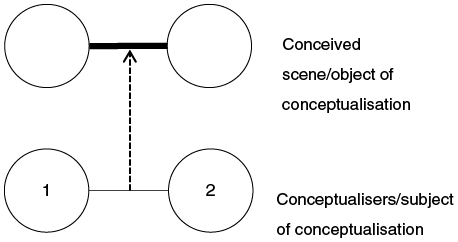
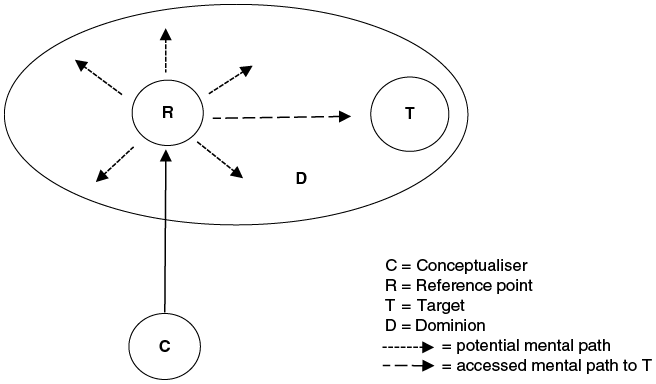
CG also frequently makes use of perceptual analogies to highlight how conceptualisers take on the roles of writer-speaker or reader-hearer. One specific example is that of the theatre whereby conceptualisers view a scene with certain content being placed on-stage via a process of co-ordinated mental attention. This relationship is modelled in Figure 2.

Figure 2 The construal configuration,
Adopting Langacker’s model, Giovanelli and Harrison (Reference Giovanelli and Harrison2024: 34) highlight three ‘construal phenomena’. Each phenomenon is concerned with a different relationship within Figure 2: specificity and focusing/prominence highlight construals within the scene itself (the bold horizontal line), while perspective highlight construals that concern the relationship of the conceptualisers to the scene (the vertical dashed line).
Specificity: the level of descriptive detail (more granular or schematic)
Focusing/prominence: the part(s) selected for attention
Perspective: the position from which viewing takes place
Taken together, these construal phenomena offer ways for accounting for different representations and can be used to examine the likely effects of any reconstrual (see Giovanelli, Reference Giovanelli2022a: 152–154 for discussion); for example, what might be the effect of describing ‘awful rainbow’ (from Keats’ ‘Lamia’) with greater granularity, such as ‘awful, bright-coloured, magnificent rainbow’ or with greater schematicity, such as ‘thing in the sky’? Consequently, different construals, we would also argue, may be used to consider writerly choices and their possible effects.
1.3.5 Text World Theory
Text world theory (Werth, Reference Werth1999, Gavins, Reference Gavins2007; and henceforth TWT) is a cognitive discourse grammar that has been widely used in cognitive poetic treatments of literary texts (Stockwell, Reference Stockwell2009; Gavins, Reference Gavins2011, Reference Gavins2020; Gibbons, Reference Gibbons2011; Giovanelli, Reference Giovanelli2013; and see Gavins and Lahey, Reference Gavins and Lahey2016 for an extensive overview). Text world theory has a layered structure starting with the discourse world, which is the context surrounding the communicative event which acts as the background for text production and reception as writers/readers and speakers/listeners draw on various kinds of knowledge. The second layer is the text-world, mental representations that are co-constructed by discourse participants through linguistic prompts fleshed out by various types of knowledge. These types of knowledge may include general and cultural knowledge shared by groups and communities, more personal knowledge, linguistic knowledge, as well as perceptual and experiential knowledge that is relative to a particular moment or context in which discourse takes place (see Werth, Reference Werth1999: 94–101 for more discussion).
Text-worlds are set up initially through world-builders (WB) which outline the deictic parameters of time (e.g., date) and space (e.g., location) and may also include initial objects and enactors (mental representations of a particular character). The author/narrator and reader may also be conceptualised as enactors. Text-worlds are further fleshed out via function-advancing (FA) propositions which outline verbal actions, events, and descriptions. Text-worlds are maintained unless some diversion in attention means we conceptualise a new text-world through a world-switch (time and space) or a modal world (some aspect of probability, possibility, obligation, or desire). Other shifts in world attention occur through metaphors, direct speech and thought, negation and hypotheticals. Once a shift in attention takes place, the previous text-world then moves into the background but can become the focus of attention again, for example, a quick flashback in a novel or poem may only last a line or two.
Text world theory offers a useful way of accounting for the ways in which readers are asked to build mental representations of fictional worlds and for how their attention might be manipulated, for example, through diversions in time, space, negative representations, and hypotheticals. Additionally, because it is a context-sensitive theory, it can account for the different types of knowledge in the discourse world that readers may draw on to build text-worlds. It can therefore capture readerly differences in interpretation in a systematic way. And all of these ideas can be inverted to consider writing as well as reading.
1.4 Conceptualising Creativity and Cognition
Although research on creativity more generally has demonstrated that creative practice is embedded in all kinds of discourse, including everyday speech (Carter, Reference Carter2004), there is little doubt that writers (and probably especially poets) feel a heightened sense of creative purpose. We now draw on some ideas about creativity to examine how they often are framed within powerful metaphors and image-schematic representations. Our aim here is to demonstrate how cognitive poetics may be useful in highlighting these representations and their patterns of embodiment. In turn, we argue that these conceptualisations offer interesting insights into how poets view the creative process and may be drawn on by writers.
A common idea, particularly in the Romantic period of the early nineteenth century, is that poetry is a type of energy and the poet a creative vehicle for this energy, either consciously or subconsciously. For example, both Keats’ famous dictum that ‘That if poetry comes not as naturally as the leaves to a tree, it had better not come at all’ (Keats, Reference Keats and Colvin1925: 78) and Shelley’s ‘ode to the West Wind’ in which the speaker calls on the wind to ‘Drive my dead thoughts over the universe’ (Shelley, Reference Shelley and Webb1977: 78) may be understood as realisations of a force image schema, specifically here an enablement schema (Johnson, Reference Johnson1987: 47) in which inspiration flows through the poet’s body resulting in poetic creation. More recently, Khairani Barokka (Reference Barokka and Humphreys2021: 146) also construes the creation of a poem through the lens of the force schema, drawing on metaphorical construals of the poem as a series of powerful energies:
Poem-making is not constrained to the act of sounding out or writing or signing poems – it’s everything that leads up to the spark of the poem pushing through, to that open door where it feels like you’re shaping the soul of something. And it’s everything during those lulls when you think you’re ‘doing nothing’, when really a poem is brewing its storm and reeling you in, the long game (added emphases).
A similar representation occurs in Mary Oliver’s essay ‘Of Power and Time’ in which the poet draws on a force image schema to articulate the sense of creative duty – and necessity, ‘Neither is it possible to control, or regulate, the machinery of creativity. One must work with the creative powers’ (Reference 73Oliver2016: 27). In her essay, Oliver compartmentalises various different selves: two ‘ordinary’ selves of the past (specifically childhood) and the present; and the poetic self which is ‘out of love with the ordinary’ (Reference 73Oliver2016: 17), existing beyond the normal boundaries of everyday obligation and awareness. Here Oliver utilises a divided person metaphor (Lakoff, Reference Lakoff, Fauconnier and Sweetser1996), specifically the notion of a split self where different aspects are realised as ‘inconsistent aspects of oneself’ (Lakoff, Reference Lakoff, Fauconnier and Sweetser1996: 105; see also Emmott, Reference Emmott, Semino and Culpeper2002; Demjén, Reference Demjén2011). This metaphorical construal provides a way of conceptualising and articulating poetic identity; indeed, Oliver uses it to argue that her poetic ‘self’ necessarily has a different set of impulses and behaviours to the selves of the ‘ordinary’ world.
A focus on poetic identity is commonly described using metaphor. Daniel Sluman’s essay (Reference Sluman and Humphreys2021: 94) on writing his third poetry collection draws on two metaphors A poem is a building and a poet is a builder to articulate the movement between different poetic selves as ‘building my voice from scratch’. William Wordsworth’s long autobiographical poem The Prelude, which charts the journey from childhood to mature poet, is underpinned by the same metaphor as well as a source-path-goal image schema and its associated journey metaphor, explicitly evident in its subtitle ‘growth of a poet’s mind’ (Wordsworth, Reference Wordsworth1904), while John Wieners, in his essay ‘The lanterns along the wall’ (Wieners, Reference Wieners2015: 181), also frames poetry within a construction metaphor, arguing that ‘Poetry [creates] a life-style for its practitioners, that safeguards and supports them’. The poem, then, is framed as a physical space, providing a refuge for the writer.
Another interesting idea about poetic creativity is Gregory Orr’s notion of the ‘bisected circle of the self’ (Orr, Reference Orr2013). Like Wieners, Orr conceives the self as existing in physical space, here used a metaphor for time.
Imagine the self as a small circle in the middle of a blank page. This circle of self is bisected by a dotted vertical line that stands for the present moment, the moment we are inhabiting right now. This present moment is all that we ever really have – it is where we exist and the only place we exist. This circle of self will move forward (towards the right margin) into a succession of present moments. Behind the circle of self (toward the left margin), are all the past moments it has lived – they are gone, they have become what I’d call the vanished past. All the joys and terrors, the boring days, and the Kodak moments – all up in smoke and the smoke itself drifted away into the blue of oblivion that is the Vanished Past. Even as you read this line, the moment in which you read the last one is irrevocably gone and with it all that you thought and felt.
And what about the future, that space to the right of the circle of the self? What about the moment that is approaching you now? […] But how little we really know about the future, which I choose to call the Unknowable Next?
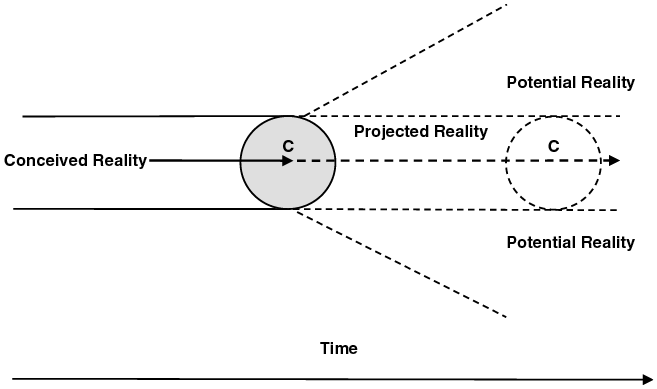
Orr’s idea is a neat one in terms of relating the self and it stories, memories and anticipations that may provide poetic inspiration. Interestingly, Orr’s work aligns with Cognitive Grammar’s model of the ‘conception of reality’ (Langacker, Reference Langacker2008: 301), illustrated in Figure 3, in which a conceptualiser (C) moves along a path (time), with an awareness at any given moment of conceived reality (past events which are known to have happened). To the right, and ahead, is Orr’s ‘Unknowable Next’, defined in CG terms as two types of pathways, projected and potential reality.

The difference between the two pathways is one of likelihood: both are as yet unrealised but projected reality represents a more certain sets of affairs. And this difference may be visible linguistically through the use of modality. For example, in the following, the strong epistemic modal auxiliary verb ‘will’ indexes projected modality while the weaker ‘may’ indexes potential reality.
1) The stars will shine on me tomorrow.
2) The stars may shine on me tomorrow.
We would argue, as with the other examples in this section, that a theory like Orr’s is enhanced when viewed through a linguistics lens. That is, the linguistic lens, here CG, provides a set of ideas about language that outline how a writer may draw on and manipulate various kinds of modal constructions to represent the self in time and space.
1.5 Conceptualising the Reader
Writers also keep their readers in mind. In traditional stylistic scholarship, the term ‘implied reader’ (Booth Reference Booth1983) has been used to identify the author’s mental representation of the literary text’s recipient or, more explicitly, to whom the text is directed and addressed. In cognitive poetics, this concept is framed within Stockwell’s notion of ‘mind modelling’ (Stockwell, Reference Stockwell2009), which firmly positions the anticipation of a readerly figure as a cognitive construct.Footnote 4 Cognitive poetics also provides useful tools for examining how readerly attention may be guided or manipulated. For example, TWT (discussed in Section 1.3.5), in its notions of the world-switch and various types of modal-world, offers a framework for the poet/writer to consider the likely effects of particular shifts in time, space, point of view, hypotheticals, and so on. A similarly powerful concept for understanding how readers’ attention may be manipulated and their interpretative stance positioned is Stockwell’s ‘attention-resonance’ model (Stockwell, Reference Stockwell2009), which has been used widely in cognitive poetics, including in the analysis of poetry (Gunn, Reference Gunn2023). Using the premise of figure-ground as a starting point, Stockwell’s model makes an analogy between the ‘conceptual space generated by reading a literary work […] and most visual encounters’ (Reference Stockwell2009: 20) to explain the ‘moment-by-moment adjustment in which certain elements of the space distract the attention of the reader [become the figure] and others are relatively neglected [form the ground]’ (Reference Stockwell2009: 20). Those elements that capture the reader’s attention are attractors, which may be maintained (e.g., through repetition or the absence of a new attractor) as attentional figure or else fade into the ground through being textually occluded and replaced by another attractor/figure. Alternatively, a reader may actively disengage with an established attractor, shifting their attention to another part of the text, irrespective of textual patterning. Stockwell also provides a list of ‘good textual attractors’ (Reference Stockwell2009: 25), qualities that are likely to be characteristic of figures in literary reading. All of these, outlined further, may be thought of as a set of characteristics (realised either linguistically or conceptually) along a cline, or in some cases a binary pair.
newness (newly mentioned>>mentioned a long time ago)
agency (engaging in action>>passive)
topicality (subject position in clause>>object position)
empathetic responsibility (human>>animal>>object>>abstraction)
definiteness (definite>>indefinite)
activeness (active verbs>>verbs of cognition and being)
brightness (bright colours>>dimness)
fullness (intensity>>emptiness)
largeness (large>>small)
height (relatively high>>relatively small or overseen)
noisiness (audible>>non-audible)
aesthetic distance from the norm (unconventional>>conventional)
We return to these discussions of cognitive poetic methods and what we believe are their associated values for the creative writer in Sections 2 and 3.
As we discuss conceptualising the reader, it is worth highlighting that this term is not used consistently in cognitive poetics (Thomas, Reference Thomas, Bell, Browse, Gibbons and Peplow2021; for an extended review of types of readers, see Adam, Reference Adam2026). Often the term ‘Real readers’ (Iser, Reference Iser1978, Reference Iser1980) is used to draw attention to the study of non-academic readers, whose responses to texts are studied empirically using naturalistic or experimental methods, which can yield both qualitative and quantitative data (Van Peer, Reference Van Peer1986; Swann and Allington, Reference Swann and Allington2009; Gibbons and Whiteley, Reference Gibbons and Whiteley2019). In recent years, studies of non-academic readers, including those in book groups (Peplow, Reference Peplow, Chapman and Clark2014; Stradling, Reference 75Stradling2019), online book-based social cataloguing platforms (Nuttall and Harrison, Reference Nuttall, Harrison, Ringrow and Pihlaja2020; Doche and Ross, Reference Doche and Ross2023; Pager-McClymont, Reference Pager-McClymont2022b), have become increasingly commonplace, often complementing introspective critical analyses by the researcher. The term ‘real reader’ is, however, we feel problematic given that all readers, including academics are ‘real’.Footnote 5 In order to avoid this problem but to retain the distinction between academic and non-academic readers, we prefer Stockwell’s (Reference Stockwell, Gavins and Lahey2016: 149) term ‘civilian reader’ to refer to ‘non-academic readers’, and this is the phrasing we use henceforth for clarity.
A final useful distinction is between reading and interpreting. Whilst the definition of each of these terms is not consistently agreed on in cognitive poetics, the idea that they represent is. According to Jeffries’ (Reference Jeffries, Stockwell and Whiteley2014) interpretation, though text-centred and more consensual, is distinct from the more personal and ideologically influenced process of reading. While reading may be shaped by the reader’s own knowledge and personal experiences in the form of various schema or schemata (Rumelhart, Reference Rumelhart, Spiro, Bruce and Brewer1980; Schank, Reference Schank1982), interpretation tends to be more consistent among readers due to the presence of textual cues that are available to all. Jeffries (Reference Jeffries, Stockwell and Whiteley2014: 480) suggests that while reading varies among individuals, interpretation involves processing that is shared by most competent readers. Despite the fluid boundaries between these processes, they serve as prototypes for text processing. Schematic knowledge, influenced by time and experience, impacts the reading process but does not necessarily alter textual interpretation. Jeffries (Reference Jeffries, Stockwell and Whiteley2014: 478) illustrates this with an example from Northanger Abbey, where a reader’s knowledge of Bath might be salient and add personal meaning, yet an overall interpretation consistent with other readers remains possible. Thus, interpretation is not uniquely tied to individual experiences, but these experiences may enrich the reader’s mental representation, a similar argument to Short (Reference Short and Watson2008: 13–14), who claims that while texts may have multiple interpretations, the range of substantially different interpretations is limited. Differences between interpretations often involve minor variations rather than entirely distinct meanings.
Conversely, whilst Stockwell (Reference Stockwell2020) equally makes the distinction between reading and interpretation, his use of the terms is in opposition to Jeffries and Short. Stockwell (Reference Stockwell2020) aligns interpretation with understanding and reading with a more refined analysis. He states:
A recognition of the literary text in its entirety is an act of interpretation – a holistic understanding of the literary work that begins in our culture even before we begin to read the actual text. This act of interpretation, or primary understanding, is what all readers do when encountering literature, when the experience is ongoing and as yet unexpressed. As soon as readers become aware of what they are doing, this more analytical stage of recognition can be differentiated as reading. Critical analysis and discussion is part of reading in this sense. It is at the stage of reading that interpretations are rationalised and salient attributes picked out for attention and prominence.
To mitigate any discrepancy in terminology as highlighted earlier, going forward we label the primary act of understanding textual meaning as ‘first level of textual engagement’ and the act of analysing to deepen understanding as ‘second level of textual engagement’.
1.6 The Contents of This Element
So far, we have highlighted concepts, methods, and tools from contemporary cognitive poetics that we believe are useful both for reflecting on and for writing poetry. As stated at the beginning of this section, our belief is rooted in the premise that knowledge about language more generally is useful for creative writers and that cognitive poetic approaches specifically offer a helpful platform to inform writing practice. Although we are not arguing that a knowledge of linguistics or cognitive poetics is essential to be a creative writer (which would clearly be an untenable position to adopt), and although we appreciate, as McCullough (Reference McCullough and McGlone2023: 22) states, ‘a poem starts from many different routes’, we aim to show in the rest of this Element how linguistic knowledge has informed our work as poets. Subsequently, we highlight, through connecting the strands of writing, reading, and interpretation, how cognitive poetic methods more generally may shed light on the entire cycle of poetry, from the initial idea of a poem to its final version, and to readers identifying and explaining its meaning. Our Element thus moves across the remaining sections, connecting a focus on our writing to our own reading of each other’s work to civilian readers engaging with our poems.
The sections that follow thus exemplify this cycle. We start in Section 2 by each using our own poems to reflect on the creative process as poets but also as academics working in cognitive poetics. Here, we take an autoethnographic approach as we individually examine the production of our own poems. Drawing on our own notes and reflections as writers working within the parameters of cognitive linguistics, we provide a set of observations that covers the entire writing process from initial ideas to drafting, to editing, to final versions. Uniquely, we argue – and demonstrate through our analysis – that it is our knowledge of cognitive poetics that informs many of our decisions. This section thus aims to practically demonstrate, through our own reflections, how writers might draw on linguistics in a meaningful and productive way and how some key ideas and methods from cognitive poetics may prove useful for the creative practitioner-researcher.
In Section 3, we present cognitive poetic analyses of each other’s poems. By employing analytical methods and frameworks that we have discussed in this current section, we demonstrate the utility of contemporary cognitive poetics in understanding the complexities of literary texts. Our approach is grounded in the premise that these linguistic tools provide a structured lens through which various aspects of poetic composition can be deconstructed and comprehensively examined. The distinctiveness of this section lies in the coherence established between the act of composition and subsequent interpretative efforts. Building upon the groundwork established in Section 2, where the process of composition was documented and reflected upon, we establish a contiguous thread connecting the creative writing process and the stylistic examination of poetry.
In Section 4, we exemplify how cognitive poetic methodologies integrate reader response data, empirically demonstrating how civilian readers engage with poetry. We focus here on readers’ reactions to and interpretations of our own poems, aligning these responses with our writing process detailed in Section 2 and stylistic analysis in Section 3. This approach sheds light on the cyclical interplay between writing and reading poetry, observing how participants engage with thematic ideas discussed in Section 2 and linguistic features analysed in Section 3. In this section, we emphasise the importance of reader response data in accounting for how readers think and express their responses to poetry, showcasing how textual features that resonate with readers may be examined and explained using cognitive poetic tools.
2 Recording the Writing Process
2.1 Introduction
This section employs an autoethnographic approach to examine the creation of a poem, exploring the entire writing process – from conception to editing to the final version – through the lens of cognitive poetics. Emphasising our unique position within this field, we demonstrate through our reflections the extent to which linguistic ideas and principles significantly influence our creative decisions. This section begins with an overview of autoethnography aligned to our research design and methods, before Giovanelli’s analysis of his two poems ‘New Colour’ (2.3) and ‘Elusive’ (2.4), and Pager-McClymont’s analysis of her two poems ‘Catacombs’ (2.5) and ‘Evergreen’ (2.6). We frame each set of analyses within short and relevant autobiographical notes.
2.2 Autoethnography
As Stigler (Reference Stigter2016: 228) explains:
Autoethnography is a self-reflexive qualitative research method from the social sciences which foregrounds the researcher’s subjectivity. Reflexivity refers to the mutually affecting or cyclic relationship between cause and effect […] Autoethnography is thus directed towards dialogue and critical thinking
Blending autobiographical elements with ethnographic inquiry, autoethnographers, as Jones et al. (Reference Jones, Adamas and Ellis2013: 10) state, ‘observe ourselves observing’. When applied to poetry, autoethnography involves ‘the analysis of materialised memory [the poem]’ (Gardner, Reference Gardner2014: 237) as a way of exploring poetic expressions in their personal, cultural, and social contexts. This method allows poets to critically reflect on and examine (Mcilveen, Reference McIlveen2008) their own stories, experiences, and identities, using their unique perspectives to shed light on the self(ves) objectified in their poems. As Gardner (Reference Gardner2014: 235) argues, ‘The focal point of autoethnographic research is systematic interrogation of an artefact created by the researcher’. With its dual focus on epistemology and ontology, poetry is intricately intertwined with language but holds a distinctive and esteemed position, given its general exploration of identity, intimately connected to the scrutiny and comprehension of the self; see, for example, Maurino’s (Reference Maurino2016) exploration of masculine identity in poetry.
Autoethnographic research incorporating poetry and narrative as data sources (see Blinne, Reference Blinne2010; Ellis, Reference Ellis2004; Hanauer, Reference Hanauer2012) has been recognised for its transformative potential in research (Custer, Reference Custer2014). Indeed, numerous researchers have acknowledged poetry as a valid form of data, aligning with the perspectives of Gergen and Gergen (Reference Gergen, Gergen, Bochner and Ellis2002), Holman Jones (Reference Holman Jones2016), Lahman et al. (Reference Lahman, Geist, Rodriguez, Graglia, Richard and Schendel2010); Muncey (Reference Muncey2005), and Shapiro (Reference Shapiro2004). These scholars argue for the equal standing of poetry alongside more established datasets. Leavy (Reference 72Leavy2015: 165) goes so far as to argue that poets can be considered ‘human scientists’, examining their relationship with language to explore personal experiences.
Both mental health and introspection can be considered as inherent aspects of autoethnographic research since a writer’s state of mind and motivations for writing are foregrounded in critical reflection. The value of reading and writing poetry for mental well-being has been demonstrated to be ‘an effective therapeutic tool’ (Kempler, Reference Kempler2003: 217, see also Jensen and Blair, Reference Jensen and Blair1997; Ingram, Reference Ingram2003; Alvarez and Mearns, Reference Alvarez and Mearns2014). For example, Miller (Reference Miller, Grolnick and Barkin1978) notes the positive impact of poetry in a treatment protocol for patients with psychosis. Chan (Reference Chan2003) also demonstrates that poetry can help students relax and alleviate their stress during their doctoral studies. In addition, Croom (Reference Croom2015) develops Seligman’s proposal that psychological well-being consists of ‘PERMA: positive emotion, engagement, relationships, meaning, and accomplishments’ (Seligman, Reference Seligman2011: 24) and can be used to empirically study factors impacted by poetry in a therapeutic context. Their findings show that:
the practice of reading, writing, and reciting poetry with others on a regular basis is not a merely passive and ineffective activity, but rather an active and productively effective one that typically involves engaging a variety of different intrapersonal cognitive-emotional components (such as those involving memory, sensorimotor tasks, and positive effect) as well as interpersonal social partners (such as the authors one reads or listens to, the partners one writes or recites with, and the audience one reads or recites for), and that practicing poetry is therefore a truly productive activity that is fully capable of positively influencing both our personal and social lives.
In 2020, a global pandemic arose due to COVID-19, and several lockdowns were imposed throughout the world. This led to an increased number of mental health issues (Sorkin et al., Reference Sorkin, Janio, Eikey, Schneider, Davis, Schueller, Stadnick, Zheng, Neary, Safani and Mukamel2021; Kumar and Nayar, Reference Kumar and Nayar2021), and thus led to a rise in the use of mental well-being tools such as guided meditations, or poetry as a form of therapy. Research emerging during and after the pandemic demonstrates the positive impact of poetry on mental well-being (see, for instance, Sharma, Reference Sharma2021, Reference Sharma2024; Caleshu et al., Reference 67Caleshu, Waterman and Kemp2024). Another common example of autoethnographic research in poetry is to examine creative decisions as a way of understanding very personal contexts, where the introspective ‘turn’ can lead to a greater awareness of issues and offer these as learning points for a more general audience. For example, Thatcher (Reference Thatcher2021) uses an autoethnographic approach to critically examine her creative decisions in the light of her own personal context of family substance addiction in her collection More than you were (Thatcher, Reference Thatcher2017), suggesting that her work might well lead to greater public awareness of bereavement by addiction.
Our approach in this section is to apply autoethnographic tools of close reading and reflection as ways to reveal our own cognitive processes and artistic purposes as we move across three different versions of our poems: an initial draft, a second draft, and a final draft. At each stage we critically reflect on our creative choices and ground these in our positions as academic linguists working in cognitive poetics. That is, our research method is novel because it combines the critical reflexivity of autoethnography with a stylistic sensitivity to language, offering a way of highlighting how language awareness more generally may be an important aspect of the autoethnographic process.
2.3 ‘New Colour’ By Marcello Giovanelli
This is a very personal poem and was written about my eldest daughter from the perspective of her father seeing her grow up. Some of my fondest memories of our time together were bedtime, where I would always read her countless stories and we would talk, just the two of us, about and enjoy them in what seemed like an escape into a magical world. By 2020, she was ten years old and I was struck by just how quickly children grow up and although our time together was special in a different way, I felt genuinely sad about those shared bedtime experiences being a thing of the past. Point of view then is important to the poem, as was my own attempt to make sense, through writing, of the shifting stance of the speaker of the poem.
The poem’s initial title, with the use of the first-person plural ‘we’, emphasised the togetherness of the experience; the immediacy of the physical space of her room was marked through the use of ‘this room’. In my mind the proximal deictic demonstrative was an attempt to maintain the present whilst being aware that it was gradually slipping away. As I wrote this first draft, I had in mind an acute sense of loss. Paradoxically, writing the poem did help me to understand my own feelings and was therapeutic in a way but I distinctly remember this being a very sad poem to write. Given these points, I drew on some key cognitive poetic ideas to give the poem structure. The first was to make use of colour as strong attractors of attention to figure them and their associated emotions against the ground of the room. Thus ‘sad orange’, ‘slow yellow light’, and ‘greying now’ all emphasise change from the speaker’s perspective, a temporal contrast to ‘imagine/this room in colour’. Here I also had in mind Cognitive Grammar’s notion of construal as a way, through more schematic description, of showing the speaker’s increasing sense of movement away from a previous time and set of experiences. Construal was also a key feature in the metaphors I used: seeing is understanding (‘hard to see those fingers/reaching out’) and the pair light is good/dark is bad (‘greying now’). More generally, I drew on a path schema and its associated conceptual metaphor life is a journey as a way of structuring the section beginning ‘And this is change/how things must grow and die’. I think the initial writing of the poem I wanted to emphasise what must have been a very acutely felt sense of loss that, now, looking back on this draft, the ending seems very weak. My reflections on the poem’s ending were that it needed to be much stronger and end with something positive; as it stood, it reflected a set of feelings but only partially.
It seemed then that the path schema was insufficient as a template for the poem; what I really needed was something that emphasised difference but in a positive way. My thinking was influenced by a different image schema, that of a cycle (Johnson Reference Johnson1987: 119–121), which involves some kind of progression but a return to an initial state, here understood as changed but open to the cycle repeating itself. That seemed to me a much more helpful way of conceptualising what I was thinking than the unidirectional path schema. Given this change, the next draft of the poem begun with a new title to emphasise this cyclical nature (see Bartl and Lahey, Reference Bartl and Lahey2023 for discussion of the cognitive foregrounding of titles). Equally, I decided to play down some of the emphasis on colour symbolism and instead focus on construals that drew attention to the speaker’s own experiences.
The more granular construals in ‘memory’s shade/an echo of books/chorus-read in cotton/pink and black’ described the process of reading books, with a reference to my daughter’s favourite pink and black pyjamas that she used to love when she was younger. Although ‘colour’ is mentioned, it is modified by ‘new’ as a way of highlighting the father and daughter looking forward, inspired by and holding memories but not necessarily saddened by them. The specific lexical choices ‘echo’ and ‘reverb’ are also underpinned by the cycle schema to suggest a sense of return and renewal. I did, however, keep the section, with slight amendments, ‘all is greying now’, probably because they seemed aesthetically appealing.
The end of the poem changed significantly. I wanted the construal to be shared, so again the first-person plural pronoun ‘we’ was used in ‘this is how we change’. I removed ‘die’ from ‘grow and die’ to emphasise the positive aspect of change, an aspect I also wanted to emphasise through another specific construal ‘the silver arm across our back’, which referred to a photograph of father and daughter together; the ‘arm’ being the photograph’s stand but also potentially referring to a renewed closeness over time. This was also reflected in the final couplet through which I aimed to show a movement forwards. The structure of the poem also changed to couplets, a form I often use, and I deliberately omitted any punctuation. These structural changes, which seemed on reflection to downplay some essential uncertainties and pauses in the poem were reversed in the final draft, ‘New colour’.
In the final draft, I made some minor changes to foreground specific aspects of perspective. The line ‘the startle of your mind’ seemed a particularly striking and apt image and I wanted to build it into the poem replacing ‘echo’, which I thought was still covered by ‘endless reverb of my voice’. The main changes were to the final verse paragraph. Here I shifted the tense from the present to the future to highlight that change is continuous; in this respect I wanted to show that the speaker’s acceptance of change is not confined to this particular episode but is part of a broader realisation of the inevitability of experiences and relationships being renewed and reconfigured as we grow older. The ‘silver arm across our backs’ was reconstrued to ‘silver on our backs’ and the foregrounding of change but in the sense of growth was emphasised in the lexical items ‘nurture’ and ‘flowering’. The use of relationships are plants metaphor seemed to emphasise the organic nature of change and look forward to the future rather than simply mourn the loss of the past. This aligned well with my use of the cycle schema as a planning template and, by the end of the drafting stages of the poem, helped me make sense of my own situation which had prompted me to initially write the poem.
2.4 ‘Elusive’ By Marcello Giovanelli
I often write in scenes, coming up with an initial idea and developing that, then seeing how other ideas and scenes I might have had fit into it to create a coherent whole. This poem began in this way, with my imagining two people in the middle of a conversation (the first part down to ‘Sunday mornings’). I wanted to capture something mysterious and elusive about their relationship and so focused on the contrast between the direct speech of the speaker and the actions of the addressee. In my mind, I was also trying to capture the sense of a disconnect in time between the ‘here and now’ and the ‘then and there’. This contrast depends on a series of deictic shifts; here I drew on TWT to move the reader’s attention away from the matrix text-world to a previous time frame (marked by the verb ‘remember’) and implied movement back to another previous time frame ‘you’d plan/Sunday mornings’. I’d had this opening for a while and never been able to add much to it. It seemed to demand a backstory (or even a forwards direction) that I just couldn’t seem to provide. Sometime later, I had begun working on another poem. This was a more deliberate attempt to make sense of trying to recapture the past and was based around a place near where I was born and grew up in South London. Shooter’s Hill is one of the highest points in London and at top of the hill were some woods as well as a gothic revival water tower and an eighteenth-century castle! When I was young, it seemed a magical and strange place. When I was older, I would spend evenings sitting with friends at the top of the hill from where much of London was visible. Looking back many years later, most of the memories of those nights merge into one, but I still vividly remember one occasion when there was a huge storm. The poem was then an attempt to re-imagine part of that night centred around the relationship of the speaker and the addressee within it. My own fictionalising of this relationship was again informed by some cognitive poetic principles, based around TWT. I aimed to build up an initial text-world with world-building elements ‘park bench’, ‘across the hill’ and a whole series of function-advancing propositions that mapped out the movement, actions, and relationship of the speaker and addressee to the point of ‘who had walked up from the town’, which was the initial end of the poem. I then stitched together this poem to the ‘do you remember the ghost’ lines and another fragment, ‘we’re so close to the snow…’ to create the first draft, ‘sometimes we need to talk’. Although these parts were initially unconnected, they seemed to fit in a way that matched the ambiguous, mysterious atmosphere I wanted to create and to try to capture what for me was becoming the main thrust of the poem: the difficulty of recapturing the past. I was conscious that the different enactors (Emmott, Reference Emmott1997; Gavins, Reference Gavins2007) in the poem probably didn’t fit quite right and so used this issue as the basis to begin my redrafting.
The second draft of the poem sought to make the connection and cohesion between the different sections neater, largely through deletion of what now seemed superfluous material and compression into one stanza.
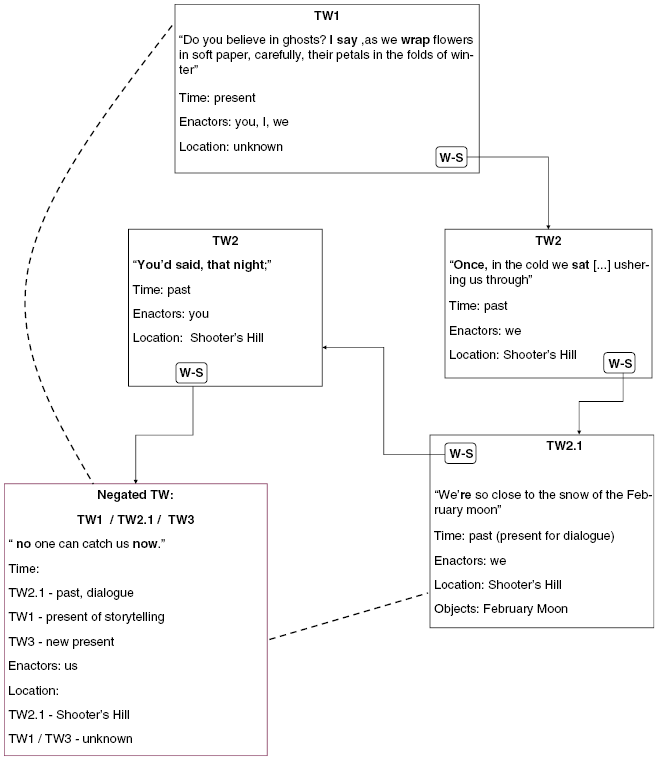
I liked the conversational feeling of the opening but omitted ‘at the house’ to make the question a more general one and shifted the agency of the wrapping of flowers from the second person to the first person plural to highlight the connection between the speaker and addressee more effectively. Although the initial draft of the ‘Shooter’s Hill’ section of the poem had focused on an incident (‘your sister was sick’) that was based on my memory of a specific person, I deliberately wanted to make the poem more abstract so that it focused on the difficulty of trying to recall rather than my memories of a particular person per se. This second draft then, almost immediately, became ‘Elusive’, a title that I thought resonated with the ending of the poem and world-building elements through the poem moved towards the more abstract ‘the half-shadow of your hair…reaching through/thick bone dust, skeleton trees/parting their hands, ushering us through’. In this draft, I also wanted to stress the temporal shift a little more; the earlier fragments were initially conceived around the theme of time and, in the case of the ‘Shooter’s Hill’ part, my own memories of being associated with that place when younger. So, I used the much more explicit temporal deictic shift from ‘we talk of that night/when we looked down’ to introduce the section on Shooter’s Hill, which was then followed by a temporal world-switch back to ‘we’re so close to the snow/of the February moon’ pair of couplets that end the poem. In my mind, drawing on TWT’s notion of attentional shifting between worlds. For me the ambiguity of the final couplets partly arrives because the reader’s attention is manoeuvred back to the opening present of the initial text-world of the poem.
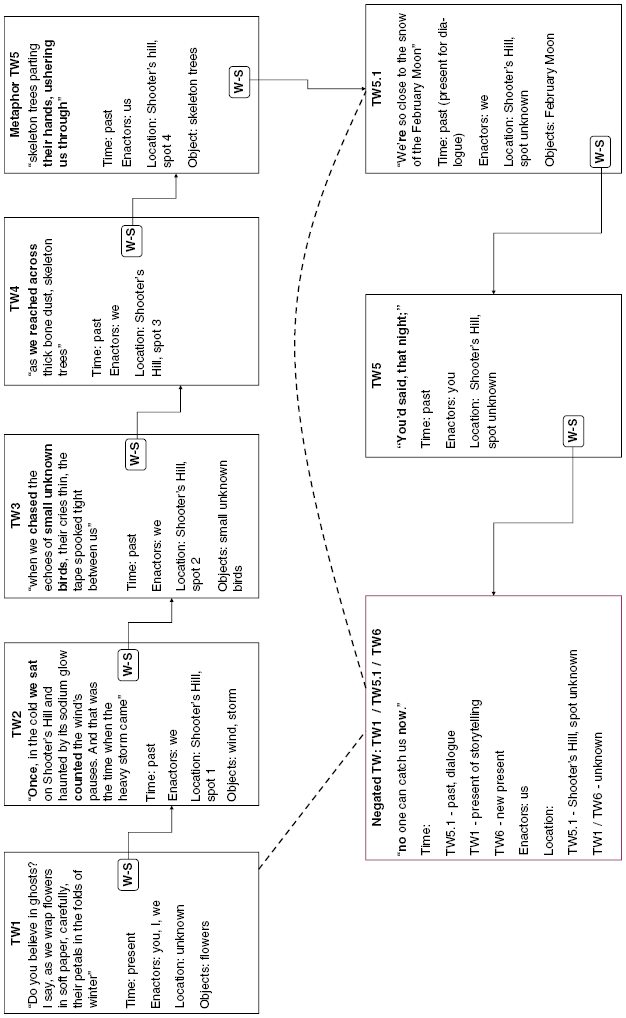
In the final draft of the poem, I made less extensive changes but consciously tried to thread the fragments more carefully together. I’ve always liked the structure and symmetry of couplets, and write quite frequently in this style, and in this instance the splicing of the poem into pairs of lines seemed to foreground more closely the richness of the different text-worlds in the poem. Some other changes included the removal of the ‘half-shadow of your hair’ part and the re-instatement of ‘we chased the echoes/of small unknown birds’; the verb ‘chased’, I felt, resonated well with the title of the poem and the overall sense of trying to rediscover the past.
2.5 ‘Catacombs’ by Kimberley Pager-McClymont
I wrote ‘Catacombs’ after walking around Le Père-Lachaise cemetery in Paris, which is known for artistic tombs of renowned individuals. I had passed Anna de Noailles’s tomb (French poet), where her headstone reads ‘C’est là que dort mon coeur, vaste témoin du monde’ (meaning ‘here is where my heart rests, vast witness of the world’). I enjoy her poems because they portray mundane thoughts of everyday life, which makes them relatable. I stopped near the grave and thought particularly of one of her poems: ‘Plainte’,Footnote 6 which deals with love and loss, as does the quote on the headstone. ‘Plainte’ uses the second person to address a lover or the reader, and combined with themes of death and love, it formed an image in my mind: someone visiting their lover’s grave, expressing heartache, grief, and eventually moving on. I drafted the following poem to capture it:
I used imagery of water and waves in the first stanza to contrast with the image of fire and flames in the second one. By using running lexical fields (meaning occurring throughout the poem), I aimed to develop and mark the mental processes of water and fire in relations to grief. Indeed, water is often associated with grief, and the following metaphor can be expressed: grief is a tidal wave because of the pattern it has when affecting individuals, as the emotion is at times greater than others (Taladay-Carter and Gunning, Reference Taladay-Carter and Gunning2024). The concept of water is also often used by Anna de Noailles when exploring heartache (e.g., ‘Le tumulte des eaux’ in Plainte). Furthermore, the lexical field of fire is also used to convey anger over the loss of the loved one, as it can be underpinned by the metaphor anger is fire (Kövecses, Reference Kövecses2004: 170), and anger is the second of the five stages of grief (denial, anger, bargaining, depression, acceptance; see Kübler-Ross and Kessler, Reference Kübler-Ross and Kessler2014). I wrote the stanzas in this order, first using sadness and water, then anger and fire to reflect the sequencing of stages of grief and show that the evolution of emotion is progressive. Although bargaining is not depicted itself in a stanza, lexis alluding to bargaining in grief is used: ‘drowned instead’, ‘I wish I had burnt with it’.
The last stanza was written to play with the idea of acceptance of grief (the last stage), and compartmentalising the emotions described in the previous stanzas, but not forgetting the love shared as conveyed by the play on words ‘my beloved remains’, to mean ‘my love does not disappear’ but also ‘my loved one’s bones’ or ‘my cherished bones’. The lexical field of funeral is used with phrases alluding to locking of an urn or coffin (‘buried’, ‘locked away’, ‘dirt of your ashes’), as well as the repetition of EN+past participle in the sixth line (‘envaulted, entombed’).
When redrafting the poem, I wanted to emphasise (see in bold) the prevalence of the emotion, for instance changing ‘a sad day’ to ‘the saddest day’ with the use of the superlative. I also portrayed the violence of grief with phrases like ‘ripped apart pieces of me’ instead of ‘took pieces of me’ or ‘crashing over me’ instead of ‘swallowing me’, to provide a stronger mental representation of grief. In the last stanza, I changed ‘my mind fell silent’ to ‘silence fell’ to convey that being able to live life with grief is not a conscious choice, but a phenomenon that happens slowly without any agency from individuals.
Furthermore, this poem is an example of having a picture of an imaginary scenario in mind and wanting to portray it to others, using elements of reality to build this fictional scenario, and I drew on my lived experiences to convey emotions and portray them to others. Imagery is an inherent part of this process (Citron et al., Reference Citron, Cacciari, Kucharski, Beck, Conrad and Jacobs2015: 93), as I employ lexis and figures of speech related to senses (e.g., ‘smell’, ‘skin’, ‘silence’, and ‘smile’) to enable readers to create a rich and vivid mental representation of the scene described (see Dancygier, Reference Dancygier, Stockwell and Whiteley2014; Pager-McClymont, Reference Pager-McClymont2022a for a discussion on the role of imagery and the senses in readers’ mental representation).
2.6 ‘Evergreen’ by Kimberley Pager-McClymont
I started writing poetry in 2020 during the COVID-19 pandemic to help me manage my mental health. I first used prompts from a workshop and kept a record of any drafts to be able to revisit moments once they had passed and to reflect on these emotions and observe any progress or departure from them. This is a habit I have kept, and ‘Evergreen’ is an example of this writing practice for mental health purposes.Footnote 7
I wrote ‘Evergreen’, drawing on my own lived experience and as a means to capture a decisive moment: I was visiting Aberdeenshire with my husband to decide on a potential move there. On the last night of our visit, we sat in the hot tub in the garden of the cottage we rented which, was surrounded by pine trees. In the sky we saw a fleeting green light: northern lights (which is not a rare event this far north in autumn, but it was new to us), and it gave me the feeling that I was meant to be right where I was. The following text is the first draft of the poem:
The original draft was written with a singular first-person perspective, but upon reflection, it did not accurately portray the scene, as my husband was as much a part of this experience as I was. I thus redrafted the poem to the plural first-person viewpoint and added the emphasised phrases:
My last rewrite of this poem took place several weeks after our visit to Scotland, as I was organising aspects of our move. I felt overwhelmed and wanted to re-read my poem to help me concentrate. I decided to add more specific imagery, as well as rhymes, so that the description of the scene could be as vivid as the experience was. I thus added the phrases and rhymes emphasised further:
I chose words to add movements to the scene, such as ‘twinkling’ and ‘sparkling’, both in the lexical field of light, to mirror the epiphany I had had. I also focussed on senses to depict how I felt or perceived the scene (sense of touch: ‘hot water’, ‘hot water on my skin’, ‘you pulled me’; sense of taste: ‘wine, sparkling’; sense of sight: ‘looking’, ‘gazing’, ‘I didn’t blink’, ‘reflected’). Additionally, these additions change the focus of the lines from the subject ‘I’ or ‘You’ to the objects ‘stars’ and ‘wine’ by using a present participle in separate clauses, which mirror the ‘looking’ of line 2 and indicate a lasting action, almost as slow motion. The same structure is repeated, creating a parallelism between the third and fourth lines. I changed ‘made’ for ‘built’ to indicate the labour that came with such a decision and added the phrase ‘a cottage of encores’. ‘Encore’ is French for ‘once more’, and I wanted to feature a French word that would also make sense in English (meaning repeated performance). Here the meaning works in both languages: this is a cottage we aspired to return to, but we also spotted several northern lights, a repeated performance of light in the sky. Thus, the use of ‘encore’ can also be considered as unmarked intertextuality (Mason, Reference Mason2019: 79) in this context, as the Northern lights are associated with a performance, which can be linked to Shakespeare’s quote from As You Like It (Act II Scene VII): ‘All the world’s a stage/And all the men and women merely players’ (Shakespeare, Reference 74Shakespeare1599/2015), showing that the world around us runs the performance and we must play our part, which mirrors how I felt when I saw the aurora. To convey this feeling, I also use the present participle ‘colouring’ to indicate the perceived length of the action, as well as to mirror the previous use of the participle in lines 2, 3, and 4. I also added the last sentence as a rhetorical question (‘But was it but a dream?’) to convey how distant the memory felt at the time of rewriting, but also to highlight how fleeting the green of the northern lights had been visible in the moment. The sentence is foregrounded by internal deviation because it is the only question of the poem, and it also contrasts with the elongated action created throughout the poem.
Lastly, I used the lexical field of the colour green (‘garden, filled with trees’, ‘evergreen’, ‘tones of evergreen’, and ‘green colouring’) to convey the prevalence of nature in the scene and the importance of the surroundings in the scene because of how they impacted my emotions in the moment. Natural elements are one of my main sources of inspiration. I find that thinking about words and phrases to describe moments in nature and how they make me feel is almost as therapeutic in easing my anxiety as actually being in nature, as I focus on small details, akin to brush-stroke on a painting. One of my main research interests is pathetic fallacy, or the mirroring of emotions onto the surroundings (see Pager-McClymont, Reference Pager-McClymont2021, Reference Pager-McClymont2022a), and here rendering the surroundings prevalent to showcase their impact on the scene is a way to allude to pathetic fallacy. Another instance of pathetic fallacy featured in the poem is the mapping uncertainty is obscurity as the terms ‘black silhouettes’, and ‘steam’ convey the mental representation of unknown development being ‘in the dark’ or ‘foggy’.
This poem is an example of reflective writing used as a way to convey emotions and a lived experience to readers. It also evidences the importance of context in the production of a poem: the poem can be appreciated for its language or for the scene it portrays, but the relevance and importance of the moment described are more likely to be perceived with the reflective context provided. Additionally, ‘evergreen’ is also an example of creative writing (here of poetry) as a form of therapy: it was written to manage stress and anxiety before being redrafted and later on shared with others.
2.7 Conclusion
In this section we have taken an autoethnographic approach to reflect on the writing process from initial draft through editing to final version, explaining how we have drawn on cognitive poetic concepts and methods as an integral part of the creative process. We now move to the next stage of the cycle in Section 3, where we provide detailed cognitive poetic readings of each other’s poems.
3 Poetry Through the (Cognitive) Looking-Glass
3.1 Introduction
This section extends the discussion of the creative process behind our poems that appeared in Section 2. Here we take the final version of each other’s two poems and provide a cognitive poetic analysis drawing on one particular concept or framework, introduced in Section 1, per poem. In this way, we articulate how cognitive poetic concepts may be used to explore interactions with and responses to poems. We begin with Pager-McClymont’s analysis of ‘New Colour’ (3.2) and ‘Elusive’ (3.3) by Giovanelli. We then continue with Giovanelli’s analysis of ‘Catacombs’ (3.4) and ‘Evergreen’ (3.5) by Pager-McClymont. In this section, we number the lines of the final draft of each poem to support our analyses.
3.2 ‘New Colour’
Figurative language is often used in literature and poetry for the aesthetic layer it adds to the texts, as well as for the correspondence between certain concepts it creates, especially when emotions or experiences are involved. Indeed, emotions are typically expressed through figurative language because of their unique and abstract nature (Abbott, Reference Abbott2008: 118; Citron et al., Reference Citron, Cacciari, Kucharski, Beck, Conrad and Jacobs2015: 93), and as there is no way of testing that individuals experience emotions similarly to one another, they draw on their own experiences to understand others. One way in which emotions are expressed is through metaphor; I thus draw on conceptual metaphor theory, discussed in Section 1.3.3, to analyse ‘New Colour’.
In the case of the poem ‘New Colour’, I argue that the metaphor people are plants (Kövecses, Reference Kövecses, Gibbs and Steen1999: 174) is omnipresent through different elements of language and syntax, especially to illustrate children growing up. This is shown by the phrases ‘everything must grow’ (line 16), ‘nurture us in the heat’ (line 19), and ‘between each flowering year’ (line 20). These phrases create a cross-domain mapping between children developing and plants blooming, emphasising the need for ideal conditions (i.e., ‘sky’, ‘rain green-thin’, and ‘heat’). This cyclical passage of time showcasing children growing up is also conveyed through the passage of time, which is expressed through lexis and syntax in the poem. Indeed, capital letters signpost the cycles and passage of time: lines 1 to 9 occur in the past, lines 10 to 14 represent the present which is indicated by ‘now’ and use of present tense. Lines 15 to 20 indicate the future, evidenced by the use of future tense ‘we’ll change’. The first three stanzas (lines 1 to 9) are in the present tense despite depicting past events, potentially indicating that children continuously are viewed as infants by their parents, as well as indicating nostalgia for that period. This is further evidenced by the length of each section: the section in the past is longer (three stanzas out of five), depicting the infant stage as endless from a parent’s perspective, which contrasts with the one stanza respectively for the present (lines 10 to 14) and future stages (lines 15 to 20), showing that children grow up too fast, thus the structure of the poem mimics the passage of time from a parent’s perspective. The last stanza represents the future and contains the deontic modal verb ‘must’, illustrating that growing up is a necessity that cannot be avoided or changed. Lastly, the third stanza has a repeated structure of the determiner ‘the’ followed by noun phrases on lines 7, 8, and 9, a list elaborating the repetition of actions and routine built to help children develop (such as bedtime stories as suggested by lines 5–6, ‘the memory of books/read in cotton’, whilst also emphasising time passing by through those repeated actions.
The parent’s perspective of children being precious or fragile, akin to plants, is also conveyed through the lexical field of anatomy, particularly in reference to children: ‘warm hands’, ‘little fingers’, ‘arms’, ‘eyebrow’, and ‘backs’. This contrasts with the lexical field of mind, especially associated with the parent viewpoint (‘imagine’, ‘memory’, ‘mind’, and ‘thoughts’). The contrast between those two lexical fields further contributes to the narrative of parents’ distorted perception of time thinking about their children and the children themselves physically growing up. Moreover, the lexical field of fragility and handling something precious is also featured (‘faint’, ‘quietly’, ‘cotton’, ‘slow’, ‘little fingers’, ‘slowly and carefully’), further emphasising that children are precious and so is time spent with them whilst watching them grow. The last key lexical field that sheds light on the holistic aspect of the parent’s perspective is the omnipresence of senses throughout the poem: sight (‘new colour’, ‘pink and black’, ‘light’, ‘greying’, ‘green-thin’), touch (‘trace’, ‘warm’, ‘cotton’), and sound (‘voice’, ‘quietly’). This shows that not only is the parent’s viewpoint conveyed through syntax and lexis of time and surrounding children, but it is also expressed through all aspects of sensory experiences.
In fact, the sense of sight is crucial, as there is a shift in the colours throughout the poem. The section in the past is described as full of ‘new colour’, such as ‘pink and black’ and ‘light’, whereas the next stanzas allude to the acceleration of time passing as colours fading away into unknown times. This is expressed through line 10 ‘yet all seems greying now’ which is a metaphorical expression for the conceptual metaphor uncertainty is grey (Pager-McClymont, Reference Pager-McClymont2021: 272; Pager-McClymont, Reference Pager-McClymont, Pager-McClymont, McClure and Doche2026). This is an instance of pathetic fallacy, as parents’ uncertain perceptions of their child’s future are communicated through the colour grey. The phrase ‘the sudden rain green-thin’ also further contributes to the passage of time being represented as a loss of colour. Indeed, the thinning of the green colour being washed away by the rain, discoloured, shows the passage of time, almost erosion-like. The idea of erosion reoccurs in the final stanza with the simile ‘like silver on our backs’ on line 17 which could be a comparison with a metal object, ‘silver’ eroding to green with time.
The poem ends with the lines ‘nurture us in the heat, just there, between each flowering year’, which was discussed earlier with the metaphor people are plants in relation to time and processes such as growing. However, it is also possible to observe the notion of time (‘year’) as a spatial container (‘in’, ‘just there’, ‘between’), thus generating the conceptual metaphor time is a container (Lakoff and Johnson, Reference Lakoff and Johnson1980), moments watching children grow become pockets of time passed and gone. This sheds further light on the parental experience of wanting to keep time still or contain precious moments spent with children. Another interpretation could also be that time spent with children is a container one keeps fondly, similarly to a precious object. Overall, the poem presents the impact of time on the parent–child relationship, creating rich mental images for readers of this bond, through conceptual metaphors linking time, plants, containers, and colours to paint a linguistic picture.
3.3 ‘Elusive’
‘Elusive’ is a poem that deals with recollection of past events in the form of storytelling (with markers such as ‘once’, which can be linked to fairytale openings such as ‘once upon a time’). Two individuals (I, you, we) are together when a past event is recalled: wandering on a stormy cold February night through Shooter’s Hill, potentially its cemetery based on terms such as ‘ghost’, ‘skeleton’, ‘haunted’, and ‘bone’. Shooter’s Hill is a real location as one of the highest points in the London area. It is referred to in literary works such as Dickens’ A Tale of Two Cities (‘lumbering up Shooter’s Hill’) or Stoker’s Dracula (‘under a furze bush at the Shooter’s Hill side of Hampstead Heath’), which might resonate with readers. The cemetery in that area of London is historical with monumental and Gothic headstones and tombs (Leach, Reference Leach1912). The location can be used as a reference in space, thus allowing readers to have a clear mental representation of the scene, especially if they have prior knowledge of it. Another element of Gothic literature that could be alluded to is present in line 7, ‘haunted by its sodium glow’, evoking the light coming from the city in the dark. The chemical component of sodium (Na) generates a yellow tint when burning and, when combined with the scientific nature of the phrase, might thus be associated by readers with the Gothic novel Frankenstein, in which the monster is consistently described as yellow (i.e., ‘the dull yellow eye of the creature’, ‘his yellow skin’), but also has themes of science and chemistry (Caldwell, Reference Caldwell, Hadfield, Rainsford and Woods1999). Readers might perceive this pattern of language as a cue of intertextuality.
Moreover, the poem portrays themes of cold and death, represented by its intertwined lexical fields. Indeed, it features the lexical field of cold (‘winter’, ‘cold’, ‘wind’, ‘storm’, ‘snow’, ‘February moon’), as well as the lexical field of white (‘ghosts’, ‘white’, ‘bone’, ‘skeleton’, ‘snow’, ‘February moon’) and the lexical field of death (‘ghosts’, ‘winter’, ‘bone dust’, ‘skeleton’, ‘February moon’). This last lexical field is emphasised by the phrase ‘we wrap flowers in soft paper’, which can be considered as an analogy for a shroud, in which the flowers’ fragile nature is compared to that of a body, and the soft paper to the fabric lining a coffin. In addition, in Western culture (assumed here with set location), it is typical to lay flowers on graves as a sign of respect for the dead. The three lexical fields have elements that belong in several of them, highlighting the thematic overlap and potentially resulting in the rich mental representation of the scene by readers. To further analyse the poem, I draw on TWT, discussed in Section 1.3.5, to showcase how the richness and aesthetics of the language can give rise to particular interpretative effects.
At the discourse world level, ‘Elusive’ features two participants: the author (Marcello Giovanelli) and the reader. The discourse world is ‘split’ as the reader and author do not share the same spatial or temporal locations, and as such the text is the primary means of communication between them (Werth, Reference Werth1999: 54–55). I apply TWT to analyse ‘Elusive’, focusing particularly on time (Figure 4) and space (Figure 5). Indeed, the poem features several text-worlds, and I argue that the last sentence of the poem, ‘no one can catch us now’, creates an ambiguous situation as it can fit in different text-worlds: this can refer to the characters in the present as they recall the story, the characters in the past (in the story), or signpost a new text-world in which the characters transitioned as they died. To illustrate this, I first focus on time in the poem (Figure 4) before analysing the different spaces present (Figure 5). By presenting both aspects of the analysis, I not only demonstrate how world-switches occur and impact the conceptualisation of a text, but I also evidence that the last sentence of the poem is equally ambiguous through both the lenses of time and space.
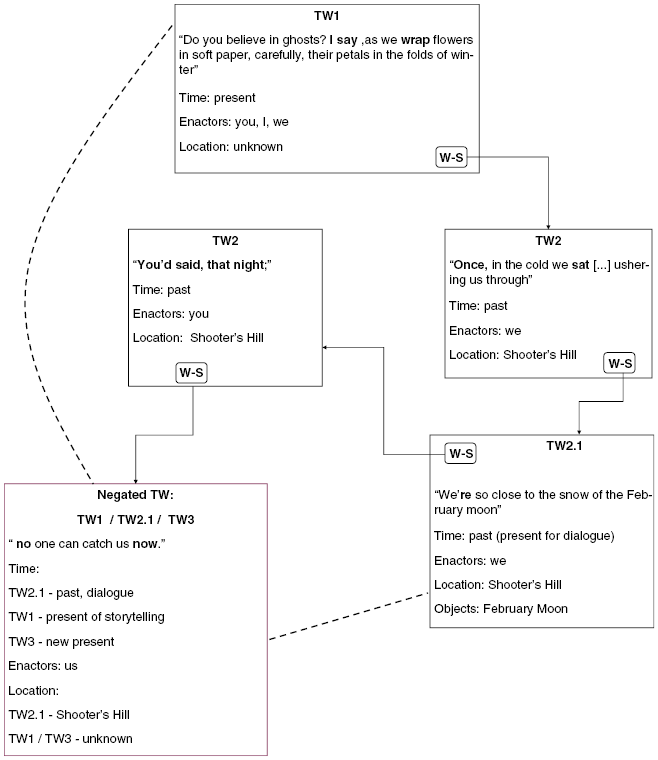
Figure 4 TWT diagram of Elusive, focusing on time
TW1 exists in lines 1 to 4, which are set in the present (‘I say’, ‘we wrap’), and introduce the characters: ‘I’ and ‘you’. The first line is a direct question, which could be at first considered to address the reader, but the phrase ‘we wrap flowers’ evidences that it addresses another person with the first person speaker. Line 5 departs from TW1 as the past tense and markers of storytelling are used: ‘once’ and ‘we sat’. There is also a change in location, as in TW1 the location is unknown, and in TW2 the events occur on Shooter’s Hill. This world-switch indicates a recalling of events and their description, which lasts until line 16. Lines 17–18, ‘We’re so close to the snow/of the February moon’, shift to the present tense, thus creating a world-switch from TW2. ‘February moon’ is also called the ‘snow moon’ or the ‘bone moon’ because the cold temperatures lead to the death or dormant state of nature and historically led to famines due to lack of food sources in the wild. This reinforces the theme of cold and white in the poem through the notions of snow and bones. Lines 17–18 indicate dialogue (as further evidenced by line 19 ‘you’d said’) and as such, although there is a world-switch in tense used, the departure from TW2 is minimal, changes from description of events to speech, and can thus be seen as a world-switch (here attitudinal belief world), hence the TW2.1 numbering. Line 19 returns to TW2 with the use of past tense and deictic shift ‘that night’. The last line (20) of the poem ‘no one can catch us now’ features the world-switch of negation ‘no’ and thus triggers a new negated text-world. In negation, for each P proposition that is true, another ~P proposition exists that is false (Lyons, Reference Lyons1977; Hidalgo-Downing, Reference Hidalgo-Downing2000a, Reference Hidalgo-Downing2000b; Giovanelli, Reference Giovanelli2013), meaning that readers first process the positive proposition in order to understand its negative. The last line also features a deictic shift with the word ‘now’, which departs from line 19 ‘that night’. This world-switch and departure from TW2 can be conceptualised in three ways:
1. The world-switch triggers a return to TW2.1, and line 20 is part of the dialogue that follows lines 17–18.
2. The world-switch triggers a return to TW1, which was also in the present tense, with the original speaker concluding the recalling of the story with this dialogue, as they had opened the poem with ‘do you believe in ghosts?’ in line 1.
3. The world-switch triggers a new present text-world, TW3. Indeed, throughout the poem, the characters shift spaces and move around the location, and the use of a specific lexical field of death combined with metaphors could be interpreted as the two characters’ death, the spirit plan becoming TW3, signposted by ‘now’, the last word of the poem.
To further evidence how this third interpretation can be conceptualised, as well as to support the shifts in worlds throughout the poem, I now focus on space in the poem, as shown by Figure 5.

Figure 5 TWT diagram of Elusive, focusing on space
Lines 1–2 are set in the present and within the same space (though the location is unknown), they are thus part of TW1, as discussed earlier. Lines 2 to 10 form TW2 set on position 1 of Shooter’s Hill, triggered by the switch to past tense and storytelling markers (‘once’). Line 11 from ‘when we chased’ to line 14 ‘between us’ triggers a new text-world, TW3, due to the introduction of new objects (‘small unknown birds’), as well as a change in space signposted by ‘we chased’, this is thus spot 2 in Shooter’s Hill. Similarly, a new text-world (TW4) is triggered from line 14 ‘as we reached across’ to line 15 ‘thick bone dust’ as it indicates another switch in space as per the action ‘we reached’, which is spot 3 on Shooter’s Hill.
TW5 is triggered by the metaphor (metaphor world) in lines 15–16 ‘skeleton trees/parting their hands, ushering us through’, which also reinforces the omnipresent theme of death throughout the poem, and nominal personification is used as hands, typically human attributes, are allocated to trees. The shape of the trees is associated with ‘skeleton’ – this is an ‘image metaphor’ (Lakoff and Turner, Reference Lakoff and Turner1989: 89), as the shape of the trees and their bare, leafless nature due to winter is associated with the bare and bony nature of skeletons. Furthermore, the phrase ‘ushering us through’ is also a form of verbal personification mirroring the trees’ movements in the wind as an usher showing the duo where to go. It could also potentially be understood as signposting of the characters’ transition into the afterlife. Indeed, so far the characters have been running at night in a cold and stormy location (perhaps a cemetery), and this phrase might suggest that they have died from exposure, and the skeleton trees are ushering them through to the spirit world. Because of the change of space with ‘ushering through’, TW5 is located in spot 4 of Shooter’s Hill.
Lines 17–18 shift to the present tense and thus trigger a new text-world: TW5.1. As discussed earlier, the switch to the present indicates dialogue, as such TW5.1 is a world-switch of TW5, occurring within the same time and space, but moving from description to dialogue. Line 19, ‘You’d said that night’, returns to TW5 with the past tense and reference to ‘that night’ and the last location of the speakers (here spot 4 of Shooter’s Hill).
The last line (20) ‘no one can catch us now’ of the poem departs from TW5 with negation ‘no’ (negated world), as well as switch to the present tense with ‘now’ and ‘can catch us’, which also shows epistemic modality. As previously discussed, there are three potential interpretations that could be made with this last line:
1. The world-switch triggers a return to TW5.1, and line 20 is part of the dialogue that follows lines 17–18.
2. The world-switch triggers a return to TW1 which was also in the present tense, with the original speaker concluding the recalling of the story with this dialogue, as they had opened the poem with ‘do you believe in ghosts?’ in line 1.
3. The world-switch triggers a new present text-world, TW6. This would align with the metaphor-world featured in TW5, where the characters can be perceived as passing on to the spirit world after dying from exposure to the harsh elements.
3.4 ‘Catacombs’
In what follows, the cognitive linguistic notion of figure-ground and Stockwell’s (Reference Stockwell2009) ‘attention-resonance’ model, both of which were discussed in Section 1.3.1, form the basis for my analysis of ‘Catacombs’. In Stockwell’s model, we can identify ‘attractors’ that form the conceptual figure and thus capture the reader’s attention at the expense of others that remain in the ground. As previously discussed, Stockwell’s model offers a dynamic conceptualisation of literary reading, providing a way of examining how textual cues are likely to position readers to give interpretative significance to salient textual features.
The initial attractor in ‘Catacombs’ is textually realised in the first noun clause of the opening line. Here, ‘day’ is pre-modified by the definite article ‘The’, which acts as a strong attractor and then post-modified by ‘you left me’. The reader’s attention is thus shifted to the poem’s participants (addressee and speaker), connected by the verb ‘left’ which denotes an active movement away from one to the other. The newness of movement, which reconfigures the figure–ground relationship, is reversed at the end of the first line as the copular ‘was’ introduces another noun phrase ‘the saddest day’, again marked for definiteness and, through the use of the superlative adjective ‘saddest’, a strong attractor along the dimension of brightness. The shifting in attention, overall, across the first line is given a neat symmetry through the repeated use of ‘day’ towards the beginning and end of the line.
The poem continues to draw on attractors across several dimensions. ‘You’ is positioned once more as a strong attractor at the start of line 2 and maintained through the activeness of ‘ripped apart’ in the main clause. In contrast, the representation of speaker is downplayed through the use of the cognition verb ‘know’ and the negation, which emphasises its lack of fullness. This pattern continues in line 3, where ‘pain’ assumes the subject position in the clause, and in line 4, where the simile ‘Like the sea crashing over me’ has the sea as clausal subject and a verb denoting strong action ‘crashing’. Both of these lines feature non-human subjects, conventionally low on the empathy scale, but their metaphorical use (the personification of ‘pain’, the metaphor of emotion as a kind of weight ‘bear’, and the simile of the sea) profiles them as strong attractors in comparison to the human speaking ‘I’, which is either the ground in relation to the abstraction of pain or the recipient of the ‘crashing’, and in this instance has ground status conferred by the preposition ‘over’. The poem controls the relative status of participants, entities, and abstractions in the final two lines of the first verse paragraph. Here, attention does shift to the speaking ‘I’, but the verb processes denote a lack of activeness, first in the negated ‘did not fight’, where attention is given to the action but then instantly occluded, and secondly in ‘I gave up on swimming, and drowned instead’, where the inherent negation of gave up is followed by the strong downwards movement of ‘drowned’ and its notion of death. Together, these lines maintain attention and a strong thematic focus on the relationship between the participants.
In the second verse paragraph, the first line of the poem is repeated, restoring this previously occluded line/image as an attractor within the same parameters as before. A similar pattern emerges in the interplay of addressee and speaker as attractors and attentional figures. Initially, a contract is offered between types of active verbs, ‘stole’ and ‘drawn’, the former seeming greater in its activeness, richness, and potential conceptual effect. Equally, the abstractions and use of metaphor in lines 9 and 10 replicate similar representations and textual attractors as those found in the first verse paragraph. In line 11, various attractors of heat, brightness, and upwards movement appear in ‘went up in flames’, and the poem arguably positions its readers to strongly align with the speaker’s feelings through the use of the strong boulomaic modal form ‘I wish’, emphasising agency and volition, and the extended metaphor of burning, which again is a strong attractor along the dimensions of agency, activeness, fullness, and through its non-conventional depiction of the speaker’s desire.
The final verse paragraph offers a new first line and, therefore, a new distraction/textual attractor. In this instance, the intensity, brightness, and noise of the previous verse paragraph is dimmed down and recedes into the ground. The lack of pace here is accentuated by the intransitive clause with ‘silence’ as subject that denies agency, the time adverb ‘eventually’, and the sibilant /s/ sounds. Out of this dimmed-down background, the speaker again appears as a textual attractor, in subject position but again within co-text that accentuates what is not there, ‘numb’, ‘absence’, and ‘ashes’ together with the green patterning of ‘buried’ and the repetition of the abstract noun pain, although this time in the object position in the clause ‘I buried my pain’. The following post-qualification consists of two embedded prepositional phrases, the final one consisting of the noun phrase ‘your ashes’, once more bringing the addressee to the forefront of the poem, a pattern which is repeated in line 15 with the parallel noun phrases each pre-modified with the possessive determiner ‘your’.
The poem ends by extending several key features of previous lines, moving systematically from an active verb, ‘threw’, with the speaker maintained as textual attractor and figure through the co-ordinating conjunction ‘and’, to an attentional shift to containment, death, and a downwards movement in the last four lines. The absence of any finite verb in these final lines dims down and softens that background to allow for the final resonant, metaphor ‘catacombs of my heart’, with its emphases on depth, intensity, and richness. The orientational language and its representations of the speaker and addressee provide a coherent link to the earlier parts of the poem and its concerns of love and loss, and various kinds of agency. The poem’s final word, ‘Père-Lachaise’, is a strong attractor given its definiteness as a proper noun and its fame as a cemetery and a ‘resting’ place for the dead, a place both of burial and of remembering. The poem’s profiling of different emotional, physical, and metaphorical movements thus reaches its conclusion in a final image of stasis and its implications of enduring yet slow resonance. It seems to me that this final verse paragraph and its attentional patterning capture precisely the impact of the loss that the speaker mourns earlier in the poem. Reading ‘Catacombs’ then is a process of working through the landscape of the human experience of love, charting its potential for heightened emotion and for those emotions to remain as reverberations even when the initial intensity has diminished.
3.5 ‘Evergreen’
My analysis of ‘Evergreen’ draws on Langacker’s theory of Cognitive Grammar, which was discussed in Section 1.3.5, and begins by examining the perspective from which the scene in ‘Evergreen’ is construed. The use of the first-person plural subject pronoun ‘we’ presents a construal from a particular (plural) vantage point that we, as readers, are invited to share. In CG terms, the use of a first-person pronoun gives rise to a more ‘egocentric’ (Langacker, Reference Langacker1987: 130) or ‘subjective’ (Nuttall, Reference Nuttall2018: 47) construal of a scene since the conceptualising presence is objectified and explicitly ‘on stage’. In this instance, the conceptualiser construes the scene with a more explicit self-awareness (compare a version of the first line without the pronoun). ‘We’ also has multiple potential referents and thus may be understood within Langacker’s (Reference Langacker, Radden, Köpcke, Berg and Siemund2007: 179) concept of ‘delimitation’: ‘We’ may designate two people (high delimitation), a larger group (mid-delimitation), or everyone (low delimitation). Although, the degree to which ‘we’ is delimited is an empirical question, depending on the interpretation assigned by a reader (Giovanelli, Reference Giovanelli, Drewniok and Kuzniak2024), my own reading of the poem strongly is that ‘We’ is highly delimited; that is, I read the opening line as being viewed from the vantage point of a shared experience of two individuals, one of whom is the poem’s speaker.
The first line of the poem is also highly specific, as the hot tub is described using a noun phrase ‘swirling hot water’, with its head noun containing two pre-modifiers. The granular description here seems to reflect the mental activity of the speaker remembering the vivid memory depicted in the poem. ‘Swirling’ also establishes a pattern of -ing forms in the poem, in the form of both noun modifiers in either pre- (‘swirling’) or post-qualifying (‘twinkling’) positions and as the head of an adverbial clause (‘gazing at the stars’). There are also some interesting interpretative effects of these -ing forms. In CG, -ing forms, like all non-finite verb forms, impose summary scanning on a scene, presenting conceptual content in a cumulative fashion as though looking at a multi-exposure photograph. Using a visual analogy, -ing forms also impose a limited ‘immediate scope’ within an overall ‘maximal scope’ of the process and thus provide an ‘internal perspective’ (Langacker, Reference Langacker2008: 120) on the scene. The effect here is to position the reader as close to the action as though peering in on a portion of the scene, which is profiled for attention (see Verspoor, Reference 76Verspoor, Putz and Dirven1996; Giovanelli, Reference Giovanelli, Harrison, Nuttall, Stockwell and Yuan2014, Reference Giovanelli2022a).
This readerly phenomenon shifts to a more finely grained focus on the speaker from line 3. Again, the use of the first person maintains the more subjective construal of the scene; in this instance there is a kind of conceptual splicing as the presumed referents of ‘we’ (speaker and addressee) are now indexed through the single pronouns ‘I’ and ‘you’. ‘You’ has the potential to broaden out its range of referents to include multiple potential speech event participants, both within and outside of the textual world and also to be doubly deictic (Herman, Reference Herman1994) in referring to both intra- and extra-textual participants at the same time. Each pronoun begins its own line (‘I’ line 3; ‘You’ line 4) and assumes the role of clausal agent and primary focal participant, in CG terms the ‘trajector’, against a secondary grounded participant or ‘landmark’. Furthermore, a distinction is made between the types of activities each trajector undertakes; the speaker in line 3 is the subject in a process of cognition, marked through the reflexive clause ‘I lost myself’, and thus an ‘experiencer’ in a thematic process denoting a more passive, internal activity. In contrast, ‘You’ is the subject in a more dynamic process, ‘You pulled me close’, a clause in which an agent acts as a ‘energy source’ and a patient as the recipient of that energy or ‘energy sink’ (see Langacker, Reference Langacker2008: 354–373 for a full discussion of these phenomena). This contrast in profiling one kind of activity over another seems significant in the context of the splicing of ‘we’ and the assigning of specific types of activity (the pensive, insular speaker and the dynamic addressee). This contrast may also be significant in light of the highly specific construal of the ‘garden, filled with trees of black silhouettes’ in line 5, where the foregrounded, highly granular construal of the post-modifier seems to accentuate the effect of the surroundings on the speaker’s mental state. The use of the singular first-person ‘I’ extends into line 6, again foregrounding the speaker’s pensive nature. Interestingly, the line also contains two explicit instances and types of negation: the syntactic negation of ‘I didn’t’ and the inherent negation of ‘forget’ and arguably ‘scared’. Since in CG – and in cognitive linguistics more generally – negation ‘evokes as background the positive conception of what is being denied’ (Langacker, Reference Langacker2008: 59), their use leaves a subtle resonance of these positive counterparts.
In line 7, the poem reverts back to the first person plural ‘We’, maintaining a subjective construal but now emphasising both speaker and addressee. In this line an overarching metaphor (see Section 3.3) life is a building is used, with a more local elaboration life is a cottage. CG treats metaphor as a specific kind of construal where the target domain is framed within the construing parameters of the source domain. The mappings from source to target domain can then, in CG terms, be examined along any of the three construal phenomena. The metaphorical realisations in line 7 thus move from more schematic ‘life’ to more ‘specific’, to more definite ‘our life’ to indefinite ‘a cottage’, and from more subjectively construed ‘our life’ to more objectively construed ‘a cottage’. The choice of life is a building seems appropriate in a poem that is about a relationship. The metaphor draws on a common way of understanding life as a couple as a type of joint endeavour where singularity is fused into a co-constructed and managed sense of purpose in the metaphor the love is a unity (of two complementary parts) (Kövecses, Reference 71Kövecses1988). The more granular life is a cottage also draws on the primary metaphor (Grady, Reference Grady1997) intimacy is closeness in articulating a togetherness that is framed within the parameters of the closed space that a cottage entails and its associated notions of security and romance. These metaphors thus underpin the sentiment expressed in the following line 8 of the poem.
In line 9, the noun phrase ‘hot water’ echoes the same phrase used in line 1, thus creating a cohesive thread. CG can theorise how readers make this connection through its notion of reference point relationships which models how we mentally access an entity through invoking another. The first entity invoked acts as a reference point which affords access to many different potential targets, known collectively as a ‘dominion’ (Langacker, Reference Langacker2008: 83–84), from which one actual target is selected. This relationship is modelled in Figure 6.

In the context of ‘Evergreen’, ‘hot water’ acts as a reference point, providing access to a dominion that contains any aspect readily associated with it (for example, hot water to make a drink and hot water in a shower). In this instance the poem also relies on a second reference point relationship, where the possessive determiner ‘my’ provides access to its own target ‘skin’ (as opposed to anything else associated with the speaker in the dominion), to position the reader to select the hot water of the hot tub, and consequently provide a discourse cohesion back across the poem, as the target. This discourse chaining (van Hoek, Reference Van Hoek and Tomasello2003; Stockwell, Reference Stockwell2009) returns the speaker (and reader) explicitly to the vantage point assumed at the beginning of the poem (although a crucial difference is in the use of the first-person singular ‘I’), also evident in the near repetition of ‘looking [gazing] at the sky’.
In the final three lines, the speaker’s sense of uncertainty is increasingly foregrounded in the movement towards the final line. The sky is ‘now of green colouring’, and since the events of the poem take place at night, we can assume this ‘green-ness’ is a symbolic construal, perhaps in opposition to the previously mentioned ‘black silhouettes’ of the garden. This colour (or feeling) is reflected on the water of the hot tub, moving ‘through the steam’. This latter construal relies on two specific instantiations: first, a path schema realised in the prepositional phrase, where the ‘Evergreen’ acts as a trajector moving into and then, crucially, beyond the landmark of the bounded area represented by the steam; and second, the steam itself which may be understood as a realisation of the metaphorical construal love is a physical/natural entity and thus emphasising the transition that water undergoes when it evaporates and become steam – and hence inviting the reader to make a connection (again a kind of reference point relationship) between the steam and the speaker and addressee of the poem. Equally, however, it is possible to view the source and target domains as framing another metaphorical construal emotion is heat, which of course provides a quite different interpretative effect.
The final line may provide an answer, although I would suggest that the speaker’s drawing specifically on a ‘dream’ to construe their final thoughts leaves a real sense of ambiguity. The ending reminds me very strongly of Keats’ ‘Ode to a Nightingale’, where the speaker asks ‘Was it a vision, or a waking dream?/Fled is that music: – Do I wake or sleep?’
Echoes of Keats’ poem can also be found, I think, in ‘Evergreen’s references to nature, love, wine, the hints of darkness, and so on. And, to use a very non-technical term, ‘Evergreen’ really is a very ‘dreamy’ poem in its almost complete lack of action processes, its reliance on verbs of cognition, and in its pairs of end-of-line half rhyme that drive the poem forwards, a pattern that is halted by a third half rhyme in line 13, a deviation which serves as the waking moment of the dream and positions both speaker and reader at a new vantage point external to the scene depicted in the poem’s first twelve lines.
3.6 Conclusion
This section builds on our autoethnographic approach to analysing our own verse in Section 2 by outlining how cognitive poetics may be used to provide extended literary critical readings. We now move to the next stage of the cycle, the interpretations of ‘civilian readers’ in Section 4.
4 Readers and Poems
In this fourth section, we draw on reader response data to complete the final part of the production–interpretation cycle, aligning the responses of civilian readers with our own autoethnographic accounts of writing in Section 2 and with our cognitive poetic analyses in Section 3.
4.1 Survey Study: Data Generation and Analysis
Our methodology, which we outline in this section, is empirical in that we generate data through two specific types of tool to examine the responses of civilian readers to our poems. First, our study employed a think-aloud protocol, in which our readers were asked to write down their responses to the poems as they read them. Think-Aloud protocols have both naturalistic and experimental (Swann and Allington Reference Swann and Allington2009) characteristics and so allow participants to articulate their thoughts freely and independently, whilst retaining some degree of researcher control. Although articulating thoughts whilst reading is atypical of the natural reading process, we mitigated this by presenting the complete poems, including paratextual features, and allowing participants the freedom to read them in their preferred context (see Kuzmičová et al., Reference Kuzmičová, Mangen, Støle and Begnum2017; Fernandez-Quintanilla, Reference Fernandez-Quintanilla2018, Reference Fernandez-Quintanilla2020; Stradling and Pager-McClymont, Reference Stradling and Pager-McClymont2023; Pager-McClymont and Stradling, Reference Pager-McClymont, Stradling, Drewniok and Kuzniak2024). Second, we used open-ended reflective questions after participants completed reading the poems and provided them with our reflections of the writing process for each of the poems. In cognitive linguistics and stylistics, Think-Aloud protocols are used to gain real-time insight into how readers process and interpret texts. By expressing their thoughts whilst reading, participants express how they engage with the text, including their thought processes, emotional reactions, and the interpretations. This method allows researchers to explore how specific textual features influence meaning-making, providing empirical data that supports or challenges stylistic analyses. It also highlights individual variation in interpretation and bridges the cognitive and affective dimensions of reading, making it a valuable tool for understanding the dynamic interaction between text and reader.
In total, our survey consisted of seven questions for two of our poems: ‘Evergreen’ (questions 1–3) and ‘Elusive’ (questions 4–6). The survey was designed as follows, using a phrasing akin to Stradling and Pager-McClymont (Reference Stradling and Pager-McClymont2023) and Pager-McClymont and Stradling (Reference Pager-McClymont, Stradling, Drewniok and Kuzniak2024):
Question 1 and question 4 provided participants with the poem to read with the following instruction: ‘Please read the poem and jot down in the box below the poem any feelings, thoughts, images, impressions, or memories that come into your mind as you read it. You can write as much as you would like to and in whatever form you like. Short notes and bullet points are just as fine as full sentences’. These questions were designed to get participants’ initial responses without being prompted to focus on any specific aspects of the poems. This allows for participants to express their thoughts freely and to potentially draw on their own experiences.
Question 2 and question 5 asked participants, ‘What elements of the text (if any) did you find interesting? You can write as much as you would like to and in whatever form you like. Short notes and bullet points are just as fine as full sentences’. These two questions were designed to ask participants to focus on specific elements of language that stood out to them and to comment on them. The aim of this is to observe any foregrounded linguistic elements, especially to compare them with the poets’ reflections on those linguistic choices (see Section 2) or to compare them with the analyses conducted in Section 3 and observe any crossovers.
Question 3 and question 6 provided the participants with a short summary of the poets’ reflections (see Section 2 for full reflections) and asked participants, ‘How does the poet’s reflection impact on your understanding of the poem? Are there any elements of the reflection that you find interesting? You can write as much as you would like to and in whatever form you like. Short notes and bullet points are just as fine as full sentences’. These questions prompted participants with the poets’ reflections on their own poems with aims to observe if and/or how these reflections influenced the participants.
Question 7 asked participants if they had any further comments about the poems, their reading experience, or the study.
The survey was shared on social media. The study was granted ethical approval by Aston University and all participants provided informed consent before the research began.Footnote 8 Anyone over the age of eighteen could take part and the survey was available from May to June 2024. Overall, we collected eight responses, which we acknowledge is a smaller sample; however, the intention was not solely to gather a wide range of reader reactions. Rather, the primary aim was to explore the viability of a novel methodological approach (one that, to our knowledge, has not yet been applied to the specific poetry cycle under investigation in this Element). This framework not only allows for an initial exploration of reader engagement but also lays the groundwork for future research that connects reader responses with the poet’s own autoethnographic and analytical reflections, offering a more integrated perspective than is typically found in stylistic analysis.
The following sections showcase the data and findings for each type of questions and for the two poems.
4.2 Questions 1 and 2: ‘Evergreen’
Participants’ answers for the poem ‘Evergreen’ have been manually coded to identify themes they share across questions 1 and 2. These themes and their frequency can be observed in Table 1:
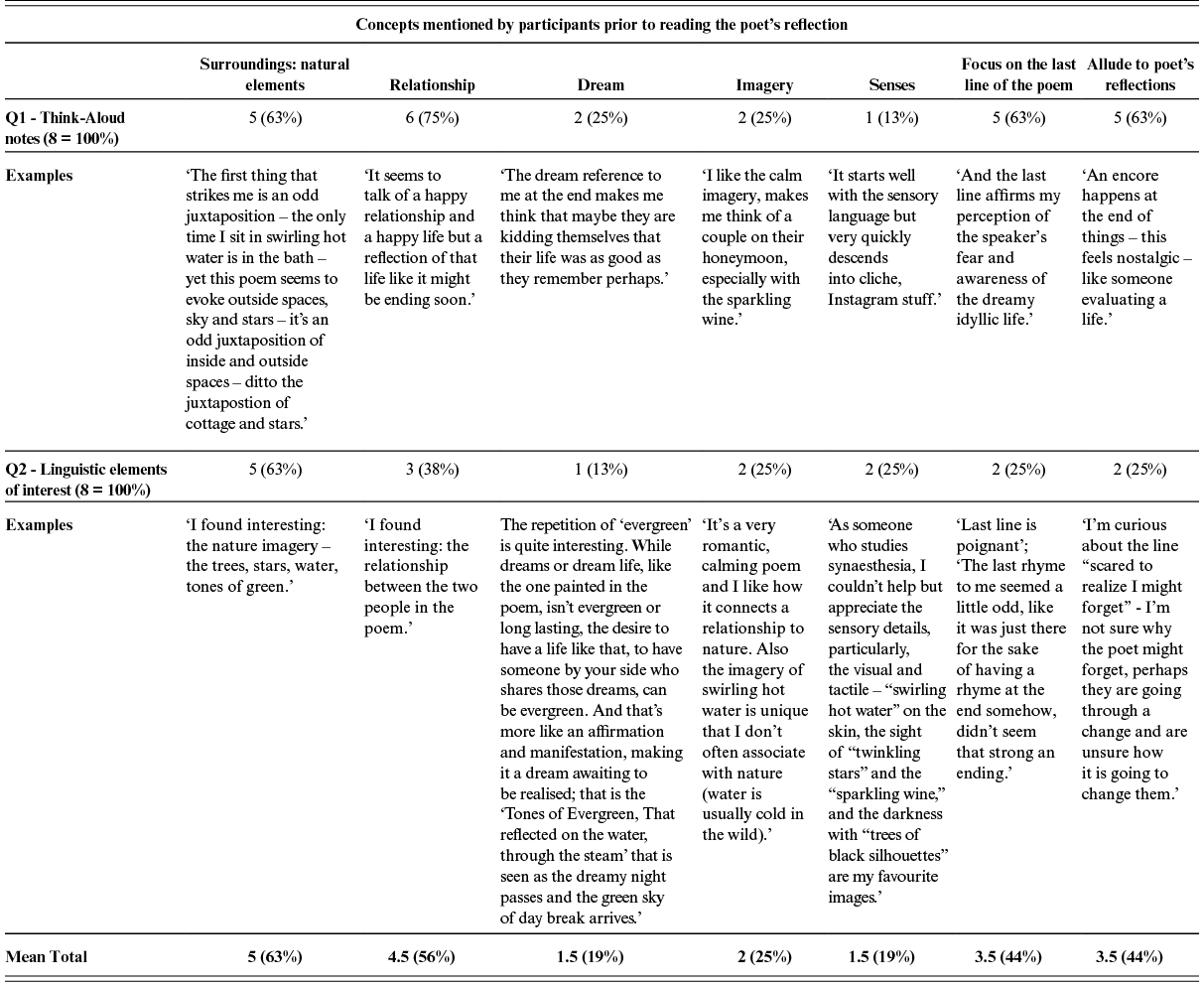
Table 1Long description
Table summarising participants’ coded responses to two questions about the poem ‘Evergreen’. It presents seven conceptual themes: Surroundings (natural elements), Relationship, Dream, Imagery, Senses, Focus on the last line, and Allusion to poet’s reflections. For each theme, the table shows how many participants mentioned it in Q1 (Think-Aloud Notes) and Q2 (Linguistic Elements of Interest), with percentages and illustrative quotes. Mean totals across both questions are also provided. The most frequently mentioned themes are Surroundings (63%), Relationship (56%), and Focus on the last line/Allusion to poet’s reflections (both 44%). Examples highlight participants’ interpretations of nature imagery, emotional tone, and poetic structure.
Sixty-three percent (mean of Q1 + Q2) of participants discussed the prevalence of the surroundings in the poem, either because they enjoyed its description (‘The poem evokes a dreamy image at first. Swirling hot water – reminds me of the comfort of a hot water spring’), or because they found the description surprising (‘The first thing that strikes me is an odd juxtaposition – the only time I sit in swirling hot water is in the bath – yet this poem seems to evoke outside spaces, sky and stars’; ‘The “black silhouettes” have ominous connotations, although I’m not sure it’s meant to be scary in this context’). Fifty-six percent (mean of Q1 = 75%/Q2 = 38%) discussed how they perceived the relationship (‘we’) between the poet (‘I’) and the addressee (‘you’), with phrasing such as ‘passion’, ‘romantic’, ‘love’, or ‘a partner, someone with whom you share an ‘evergreen’ sort of love and friendship’ being used to describe it. The notion of dream is also present in the poem and discussed by participants in two ways: the relationship described or in allusion to the poet’s reflections prior to participants having read it (i.e., ‘The poem as a whole makes me want a dreamy and comfortable life with someone I can share my dreams with. But while looking at a future, it makes me want to stay grounded in the present. The poet persona’s awareness of the entire imagery being a dream helps’). Imagery, based on participants’ responses and existing research, can be defined as a form of figurative language that emphasises sensory elements, thereby facilitating a rich and vivid mental representation of a scene for the reader (Dancygier, Reference Dancygier, Stockwell and Whiteley2014; Pager-McClymont, Reference Pager-McClymont2021). Indeed, the concepts of imagery and use of sensory language are used by participants to further discuss the themes of nature, relationship, and dreams, showing how their emphasis was stylistically embedded in the poem and thus foregrounded.
4.3 Questions 4 and 5: ‘Elusive’
For the poem ‘Elusive’, participants’ answers have been manually coded and represented thematically across questions 4 and 5, as shown in Table 2, which presents a comparison of concepts identified by participants before reading a poet’s reflection:

Table 2Long description
Table comparing participants’ thematic responses to the poem ‘Elusive’ across questions 4 and 5. It displays six conceptual themes: Death/Ghosts, Surroundings (especially whiteness), Ambiguity, Time/Space, Relationship (‘we’), and Focus on the final line. For each theme, the table shows how many participants mentioned it in Q4 and Q5, with percentages and illustrative quotes. Mean totals across both questions are also included. The most frequently mentioned themes are Death/Ghosts (38%), Relationship (38%), and Final Line (38%). Examples reflect participants’ interpretations of haunting imagery, emotional ambiguity, and narrative structure, often linking the poem’s language to memory, loss, and escape.
Overall, 38% (mean of Q4 + Q5) of participants highlighted themes of death and ghosts, emphasised by imagery such as ‘bone dust’ and ‘skeleton trees.’ The lexical field of surroundings, particularly of whiteness, was also noted by 25% (mean of Q4 = 38%/Q5 = 13%) and this was also associated with the idea of death or winter (i.e., ‘There is a death in the poem – perhaps a recent death which is reminding them of a past death or deaths. They may be wrapping white flowers for a pending funeral or visit to a grave, and words such as Shooter’s Hill, bone dust, skeleton trees, and winter suggest past deaths to me’). The poem was perceived as ambiguous by 31% (mean of Q4 = 13%/Q5 = 50%) of participants who either mentioned their difficulty to mentally represent the scene (i.e., ‘[I’m] confused), or they appreciated poem’s openness to interpretation, encouraging readers to infer unsaid details (‘It seems more ambiguous, which is always good in a poem’). Time and space were both perceived by 19% of participants. The concept of ghosts is linked to memories or the non-linear aspect of time (‘Interesting how it starts in the present but never returns there’), as well as being linked to Shooter’s Hill as a ‘haunting’ location. The relationship of the ‘we’ was a focus for 38% of participants in Q4, exploring the dynamics between characters, possibly siblings, and their shared history (i.e., ‘I enjoy what is unsaid – the reader has to imagine who these 2 people might be, what their shared past has involved, and what might have happened recently’). The final line’s importance was noted by 38% of participants in Q5, suggesting themes of escape or unresolved issues were key to understanding the poem (‘The final line – no one can catch us now – seems to be key to making sense of this – suddenly I reinterpret everything in terms of someone running away from something – trying to forget or escape their past (and their ghosts)’).
4.4 Questions 3 and 6: Reactions For ‘Evergreen’ and ‘Elusive’
An analysis of participants’ reactions to poets’ reflections on ‘Evergreen’ and ‘Elusive’ can be found in Table 3. Here we examine the degree of alignment between the participants’ interpretations and the poets’ reflections.

Table 3Long description
Table comparing participants’ reactions to the poet’s reflections on two poems, ‘Evergreen’ and ‘Elusive’, based on responses to questions 3 and 6. It presents three categories for each poem: participants who perceived the poem as the poet’s reflection, those who did not, and those who referred to their own memories during the Think-Aloud protocol. For ‘Evergreen’, 75% aligned with the poet’s reflection—split evenly between themes of life change and relationship—while 25% did not. For ‘Elusive’, 63% aligned—13% citing relationship and 50% citing time/space—while 38% did not. In both cases, 25% of participants referred to personal memories. Example quotes illustrate how participants interpreted themes and language, with ‘Evergreen’ prompting more personal associations than ‘Elusive’. Mean totals across both poems show 69% perceived alignment with the poet’s reflection, 31% did not, and 25% referred to personal memories.
For ‘Evergreen’ (Q3), 75% of participants perceived the poem in accordance with the poet’s reflection. Within this group, 38% perceived the poem’s themes of life changes and decision making, whereas another 38% mostly perceived the importance of the relationship presented between the ‘you’ and ‘I’. Overall, participants felt a sense of confirmation in their interpretation, particularly appreciating the depiction of personal transformation and the comforting role of nature in this realisation. In contrast, 25% of participants did not perceive a congruence between the poem and the poet’s reflection.
For ‘Elusive’ (Q6), 63% of participants recognised the poet’s reflections in the poem, with 13% focusing on aspects related to relationships and 50% focusing on time and space (particularly Shooter’s Hill). In contrast, 38% of participants did not fully identify the poet’s reflections in the poem, likely due to its ambiguous nature, as noted by both the poet and some of the participants (see Section 4.2).
Overall, the data reveals a stronger alignment with the poet’s reflection in the case of Evergreen compared to ‘Elusive’, suggesting that ‘Evergreen’ was more readily interpreted in line with the poet’s intended message. This might be due to the more ambiguous nature of ‘Elusive’, though both poems share similar linguistic devices such as a temporal shift from past to present, the use of first person (singular and/or plural) and second person, as well as imagery to describe surroundings. Ultimately, as a participant notes in Q7, poetry and ‘reader response is very personal and could change from day to day to be honest. There are no definites in poetry due to its personal nature both from the poet’s perspective and the readers’ who draw on their own unique experiences when reading. In fact, as part of the Think-Aloud protocol, it is interesting to note that 50% of participants related ‘Evergreen’ to their own memories and alluded to their personal experiences, often drawing on familiar landscapes (evergreen pine trees or hot springs) or their lived experiences, such as seeing the Northern lights. For ‘Elusive’, although some of the participants disclosed not knowing that Shooter’s Hill was a real location, they did not link elements of the poem with their own memories as they had with ‘Evergreen’, which might be explained by the more explicit nature of the relationship portrayed, as it could allow for a more personal connection with readers.
It is also worth noting that some participants referred to their own experiences (e.g., ‘Evergreens and cottages and outdoor hot tubs remind me of home’; ‘This just reminded me that I didn’t get to see the northern lights in England a week ago and now I’m jealous of the author’; ‘As someone who studies synaesthesia, I couldn’t help but appreciate the sensory details, particularly, the visual and tactile’), and some used some specific terminology in their responses (e.g., ‘poet persona’, ‘enjambment’, ‘imagery’, and ‘rhyme scheme’). Whilst our study is anonymous and we do not have details on our participants’ backgrounds, we acknowledge that some may not be ‘civilian readers’ (Stockwell, Reference Stockwell, Gavins and Lahey2016: 149). Most of these comments from participants occurred when they were asked to either identify specific elements of language in the poems (questions 2 and 4), or when prompted by sharing the poet’s reflections (questions 3 and 6). This likely indicates that whilst the Think-Aloud protocol (questions 1 and 3) triggered in participants the ‘first level of textual engagement’ (meaning the primary act of understanding textual meaning), the other prompted questions triggered a ‘second level of textual engagement’ (the act of analysing to deepen understanding; see Section 1.5).
4.5 Cognitive Poetics and Participants’ Responses
Cognitive poetics tools can be used to analyse participants’ answers, thus further conveying how they processed the poems they read. Drawing on image schemas (see Section 1.3.2) and conceptual metaphors (see Section 1.3.3) to represent mental processes, we observe the following patterns in participants’ responses:
1. path schema
‘It starts well with the sensory language but very quickly descends into cliché’ (also example of bad is down orientational metaphor)
‘Somehow the memory part of it didn’t come through although the title partly reveals it’
2. time is something moving
‘The dreamy night passes and the green sky of day break arrives’
‘A feeling of nostalgia, wondering where the time went’
‘Interesting how it starts in the present but never returns there’
These first two mental processes highlight how participants conceptualise experiences or processes as a journey along a path, with a starting point, an endpoint, and various stages in between, and combined with the metaphor time is something moving, the idea of motion becomes part of that journey in the process.
3. force schema
‘The first thing that strikes me is an odd juxtaposition’
‘Last line hit my heart’
‘[the end] didn’t impact me the same way it did the poet’
‘The experience of going through a change with a loved one, drawing strength or reassurance from nature came through clearly in the poem’
4. creating is making
‘The capitalisation of E of “Evergreen” sort of makes me read it as synonymous with perfection’
‘And that’s more like an affirmation and manifestation, making it a dream awaiting to be realised’
‘I can’t make much of the poem’
‘Sodium glow creates a sense of mystery’
In examples 3 and 4, the use of force schema conveys the impact linguistic elements incorporated in the poems have had on the participants, giving focus to those elements whilst the participants are passive and reacting to them. Similarly, the creating is making metaphor primarily occurs with the verb ‘makes me’, a causative verb further evidencing the participant’s reaction to the language of the poems.
5. linked objects schema
‘It’s a very romantic, calming poem and I like how it connects a relationship to nature’
‘We built our life – this implies to me that “we” are old – there’s a link here with risk of forgetting’
‘White flower petals contrast with the cold and darkness the poem evokes – can’t seem to perceive a connection though’
‘The first line and the last line – it’s connection with the title of the poem’
‘The speaker and the listener are close and share a bond’
6. ideas are objects
‘There is a sense of shared melancholy’
‘Someone I can share my dreams with’
‘I don’t know where Shooter’s Hill is, but I like that it anchors the events in a specific place’
‘The poet’s reflections are deep and important, but that doesn’t square with the poem’
‘It fits well with the poem’
In examples 5 and 6, the concept of objects is used as a representation for ideas (i.e., themes, emotions) in the poems and how they interact with other elements of the texts. Indeed, example 5 specifically demonstrates that ideas in the poems are processed as links, thus emphasising the association of these objects in participants’ minds. Example 6 illustrates that abstract concepts such as emotions (‘melancholy’) or aspirations (‘dream’) are mapped onto concrete objects (‘anchors’), illustrating the physical nature of participant’s processing of the poems. This can also be linked to example 7:
7. understanding is touching
‘The poem does hold and convey to me this feeling of safety’
‘Lovely love poem, captures that magic bubble two can build’
‘The question at the end suggests to me the way the passage of time is so hard to grasp’
8. understanding is feeling
‘I felt like the poem was more romantic and relationship based’
‘I felt like the poem was looking back and evaluating’
‘I feel like ghosts refers to memories’
Example 7 further exemplifies the physical element of participants’ processing of the poems. Indeed, the idea of touching or grasping is prevalent in showing that the act of understanding aspect of the texts is perceived through physical touch. This example can also be linked to the metaphor ideas are containers as the poems hold elements to be read and interpreted. Example 8 is another metaphor with understanding as a target domain, though in this instance, the source domain is more abstract and subjective as it is linked to emotions. Whilst conceptual metaphors typically map abstract concepts onto concrete ones, it is not always the case, and in this example, it can be explained by participants working through their interpretations of the poems, being more tentative with their ideas as opposed to certain.
Our analysis demonstrates that readers frequently draw on schemas and metaphorical concepts to articulate their responses to poetry. By tapping into these cognitive structures, readers often employ similar frames to express their interpretations, revealing common patterns in how they understand and engage with poems. This supports the argument that cognitive poetics provides not only a valuable set of tools for examining the creation and structure of poetry (as discussed in Sections 2 and 3), but also provide a set of concepts and metalanguage for describing how readers frame their responses to literary texts. Through cognitive poetics, we can gain insights into the underlying processes that shape participants’ conceptualisation of ideas, allowing us to trace how specific linguistic elements influence their perceptions and interpretations. This approach underscores the interplay between language, thought, and meaning in both the production and reception of literary works, offering a deeper understanding of how readers interact with and make sense of poetry.
4.6 Discussion and Conclusion
Our reader response study has evidenced that participants generally identified linguistic elements planned by the poets, likely due to their foregrounded nature as specific textual elements become prominent by deviating from or repeating the norm of the surrounding text (Short, Reference Short1996). Indeed, empirical studies have demonstrated that the theory of foregrounding is effective in explaining the textual effects observed by readers, it allows for a deeper understanding of how textual features can evoke specific and nuanced responses or interpretations (Miall and Kuiken, Reference Miall and Kuiken1994: 393–395; Miall Reference Miall2007, 162; Van Peer, Reference Van Peer2007: 99–101). Our participants were able to identify themes and linguistic elements that were planned and reflected on by the poets in Section 2, as well as allude to some prevalent points of analysis made in Section 3. Despite this, some participants demonstrated having a different mental representation of the ones described, and some of them also drew on their own experiences as part of the Think-Aloud protocol. Overall, this resonates with the argument put forward in Section 1.5: readers drew on textual cues from the poems to form their second level of textual engagement; whereas their first level of textual engagement was unique and tied to their own experiences. Furthermore, the majority of participants also perceived elements of the poet’s reflections and motivation for writing the poems, some of which showed such perception prior to reading the reflections. This shows that each step of the poetry cycle – drafting, rewriting, and reflecting – impacts and is manifested in the readerly experience of the final poem. In fact, some of the participants also responded to the Think-Aloud protocol to allude to their own personal experiences, which in themselves could generate more poetic inspiration and reflections.
Overall, our reader response study that we have outlined in this section provides an understanding of the cyclical interplay between the processes of composing and consuming poetry. It offers an analysis of the extent to which participants in our pilot engaged with the thematic and linguistic elements discussed in Section 2, in conjunction with the prominent linguistic features highlighted in Section 3. The Think-Aloud methodology employed allowed us to observe how readers interact with specific textual elements. This engagement provides insights into how readers perceive and interpret the linguistic choices made by poets, thereby offering a richer understanding of the reader’s cognitive and emotional engagement with poetry. Moreover, this section emphasised the value of reader response data to illuminate how readers think and articulate their responses to poetic texts. By analysing these responses, we gained a greater understanding of the cognitive processes involved in poetic interpretation.
5 Concluding Remarks
In this Element, we have demonstrated the value of cognitive poetics not only as a theoretical framework for text analysis but also as a method for understanding the creative process of poetry, both in terms of providing tools and concepts that can be used by writers and for explaining the ways that readers frame their engagement with poems, therefore highlighting the dynamic relationship that exists between text and reader.
Our own reflections on the writing process (which we outlined in Section 2) provide a detailed analysis of the connections we made between our dual identities as linguists/stylisticians and poets, whilst our analyses of each other’s poems in Section 3 showcase the analytical power of cognitive poetics. And our analysis of reader response data in Section 4 draws attention both to how participants respond to foregrounded features and to how we can articulate those responses in cognitive poetic terms. Although our reader response study is a small, self-selecting sample with only eight participants, which may, of course, limit our claims of the significance of our findings, the purpose of this study was not only to obtain reader responses but also to test the viability of this approach, given that there is no other study, to our knowledge, that has observed the cycle of poetry that we have outlined. Our approach also offers a framework for more extensive studies that focus not just on reader responses (now common, as we have discussed, in stylistics) but align those responses to the poet’s own autoethnographic and analytical work. Overall, this Element showcases an approach to writing and reading that is effective in providing a well-rounded account of how poetry is perceived not just by poets themselves or academics, but also by civilian readers. Our focus on the utility of linguistic knowledge more generally highlights what we think is an important point: that creativity can be considered as a process that can be observed, planned and demonstrably ordered through language rather than simply some mystical power only available to a select few.
Our focus in this Element has been on the writing of poetry, but there are other areas and fields of study that we feel could benefit from adopting cognitive poetic tools. Clearly there remains scope for our approach in this Element to be used in examining the production, reception, and interpretation of other forms of verbal and non-verbal creativity beyond literary texts, such as professional and business writing, as well as areas such as translation studies (e.g., Boase-Beier, Reference Boase-Beier2020; Pager-McClymont and Giovanelli, Reference Pager-McClymont and Giovanelli2023) and education (e.g., Mason and Giovanelli, Reference Mason and Giovanelli2021) that have already begun to integrate ideas from cognitive linguistics and cognitive poetics. Our central message remains that writers (and readers) of all kinds of texts could benefit from considering language production in a more reflective and holistic way using cognitive poetic tools.
Sarah Duffy
Northumbria University
Sarah E. Duffy is Senior Lecturer in English Language and Linguistics at Northumbria University. Her research examines how people use metaphor to understand and reason about abstract concepts, with a particular focus on time and individual variation. More broadly, she investigates how metaphor and temporal framing operate in institutional contexts, including education and the legal system. Her work appears in journals such as Cognitive Linguistics, Journal of Experimental Psychology: Learning, Memory, and Cognition, and Metaphor and Symbol, and she is co-author (with Michele Feist) of Time, Metaphor, and Language: A Cognitive Science Perspective (Cambridge University Press, 2023).
Editorial Board
Heng Li, Sichuan International Studies University
John Newman, University of Alberta (Edmonton)
Kimberley Pager-McClymont, University of Aberdeen
Katie J. Patterson, University of Granada
Nick Riches
James Street, Northumbria University
Lexi Webster, University of Southampton
Xu Wen, Southwest University
About the Series
Cambridge Elements in Cognitive Linguistics offers high-quality and accessible works by leading and emerging scholars. Grounded in the cognitive sciences, it extends the theoretical and methodological boundaries of cognitive linguistics by advancing established research and engaging new areas of inquiry in service of the field and its sub-disciplines.