

4 Public commemorations and republican politics
The previous two chapters have analysed the set of ideas and recollections that framed the war remembrance of Reichsbanner members, and their significance within the wider associational culture of the republican veterans’ league. It appeared that socialist working-class veterans were able to rework their front-line experiences, guided by the ideas of the Reichsbanner, and to situate the specific trajectory of their own wartime service and post-war reintegration in the larger framework of the competing veterans’ leagues. In all these endeavours, however, the Reichsbanner members by and large kept to themselves. As the example of Fritz Einert demonstrates, socialist veterans had an in-depth knowledge of their counterparts in the nationalist camp, based on daily face-to-face encounters. But the speeches, talks and tableaux vivants presented in internal branch meetings and the contributions to the membership journal only spoke to those who already belonged to the socialist milieu. These cultural representations expressed the war memories, the Kriegserinnerungen, of Reichsbanner members. They did not directly, however, make claims in the wider sphere of commemorations of war, the rhetoric of Kriegsgedenken. In these public rituals and speeches, the death of the fallen soldiers was invoked as an example for the living, and more general conclusions about the current state of the German polity and the future of the German nation were drawn.
It was not only in Germany that the key sites for the public commemoration of the fallen soldiers were war memorials. These memorials contributed, as Reinhart Koselleck has argued in a seminal article, to the ‘identity formation of the survivors’, allowing them to frame the meaning of the past and to connect the fallen to political collectives in the present.1 War memorials were a ubiquitous site in Weimar Germany, yet the pattern, political context and style of the memorial cult showed wide regional variations. As with regard to other aspects of Weimar’s history, regional variety is a qualitative factor that has to be taken seriously.2 In predominantly rural regions such as southern Bavaria, even very small villages had already unveiled a memorial of some kind by the early 1920s, before the hyper-inflation in 1923 eroded the available funds for larger figural sculptures.3 For reasons outlined below, larger cities saw a proliferation of various memorial projects throughout the 1920s and early 1930s. In Bielefeld, an industrial city in Westphalia with a strong Social Democrat presence, more than 20 memorials were built from 1919 to 1933, commemorating the approximately 2,300 fallen soldiers from the city and its vicinity.4 In Hanover, which had endured and needed to commemorate the violent deaths of 12,000 local citizens, a staggering 150 war memorials – including all memorial plaques – were planned and mostly also unveiled during the Republic.5
Given the sheer range and number of local memorial projects across Weimar Germany, this chapter can make no pretence at a comprehensive coverage of the artistic, symbolic and ritualistic aspects of the cult of the fallen soldiers in the period until 1933.6 It rather aims to analyse the interventions of pro-republican forces, and of the socialist labour movement in particular, in the contested field of commemorations at war memorials. Were Social Democrat war veterans able to influence or even determine the figuration of war memorials, and thus the symbolism of their architecture? Was the socialist camp, and its veterans’ associations in particular, an active participant in the public ceremonies that actualised and re-enacted the meaning of death year by year? How did moderate socialists articulate the meaning of war and violent death in their commemorative rhetoric? More generally, is it true that the cult of the fallen soldiers remained, despite the interventions from Reichsbund and Reichsbanner, a ‘monopoly of the political right’?7
In the immediate post-war period, regimental associations were often the first to unveil commemorative plaques or even sculptured memorials. The cult of the fallen in the regimental associations was clearly marked by a continuation of hierarchical patterns of differentiation, in which officers were honoured separately from their subaltern NCOs and soldiers.8 During the early years of the Republic, Social Democrats usually watched these and other commemorative practices from the sidelines. In the town of Constance, a regimental association of the former 114th Infantry Regiment was established in early 1921, and shortly afterwards organised a regimental day, which was attended by more than 1,000 war veterans. As was the case during similar events in the following years, the commemorative speeches stressed the memory of comradeship in the wartime army, and praised the close community between the ranks as an example of attempts to heal the nation’s woes in the post-war period. Local Social Democrats merely covered this event in a series of articles in their newspaper. They denounced the notion of comradeship as a myth, as the officers had always addressed private soldiers only with ‘zoological epithets’. Portraying comradeship in nostalgic terms, the Social Democrat newspaper argued, only served to make people forget about the hatred against the officers that had pervaded the wartime army. As a consequence, workers were asked not to attend such regimental days. Thus, Social Democrats could only passively observe how the town was decked in black–white–red flags, which were even displayed at the local Reichswehr barracks.9 Yet this was far from the only time that the army of the Republic took part in commemorative events that clearly served a monarchist or even revanchist tendency, and that were decorated in the old imperial colours. Leading Social Democrats such as Otto Braun, the Prussian prime minister, intervened to try to stop this practice, but to no avail.10
Nationalist ceremonies and their critics
Social Democrats had obvious reasons to be suspicious about the ideological agenda behind commemorations organised by regimental associations or by the local branches of the Kyffhäuserbund, the national-conservative league of veterans’ associations. But in the early years of the Republic, there was another major reason why moderate socialists were reluctant to engage with public acts and symbols for the remembrance of the fallen soldiers. Their standard response was to denounce the huge sums that were spent on memorials at a time when hundreds of thousands of war widows, orphans and disabled veterans, living on meagre state pensions, were desperately trying to make ends meet. When preparations for a central municipal war memorial in Munich commenced in 1921, the Social Democrat Münchener Post resented the projected expenditure for a ‘pile of stones worth millions’ (Millionensteinhaufen). What was required was not a memorial that would ‘boast’ about the spilled blood of the fallen soldiers, but rather a ‘memorial of charity’ (Denkmal der Nächstenliebe) in the shape of financial aid and affordable food for the ‘survivors’.11
Arguments like these were mirrored and reinforced by the Reichsbund of disabled veterans and war dependants. There is in fact reason to believe that the Social Democrat position with regard to the commemoration of the fallen was, until 1923, heavily influenced by the Reichsbund, which was not only a mass organisation, but also the most important stakeholder in this field within the socialist camp. As early as November 1919, the parameters of this discourse were established on the occasion of Totensonntag, the last Sunday before Advent, which had been traditionally used by German Protestants to commemorate the dead. As the Reichsbund journal stressed, ‘all dying’ was nothing else than a ‘formidable indictment against war’. It was paramount to remember the ‘sacrifice’ of the fallen, but the members of the Reichsbund were sure that the ‘fallen would not want memorials built of stone and iron ore, [and] did not want any glorification of the battles in which they had died’. What the fallen really demanded was ‘justice’ for their next-of-kin.12 This call for justice was repeated in the following years, as the Reichsbund observed how commemorations were often abused to honour primarily generals and other high-ranking officers. Any participation of local Reichsbund branches in joint remembrance rituals was subject to another condition: they had to include a ‘profession against war’, as this was a statutory premise of the Reichsbund’s activism based on the disastrous consequences of the First World War.13
Social Democrats did not simply watch from the sidelines as regimental associations and other nationalist organisations claimed to represent the legacy of the fallen soldiers in their commemorative practices. They also faced severe setbacks in any attempts to shape the design of the war memorials that were built during the 1920s. The reasons for this failure, however, differed in larger towns from those in the countryside. In the latter, decisions about the appropriate design and overall style of a communal war memorial were based on a consensus, which was usually brought forward by the parish priest, or by the local branch of the Kyffhäuserbund, or by both working together. Other community representatives or the local council then usually rubberstamped the chosen design.14 Even if local Social Democrats had wanted to suggest a different design, they were usually not in a strong enough position to challenge this consensus. In larger towns and cities, on the other hand, consensus was lacking from the outset, or complicated procedures and time-consuming competitions led to delays until any leeway for compromise had evaporated. The city of Bielefeld is a good example to illustrate these problems.
In Bielefeld, local politics were initially based on a cooperation between the Social Democrats and the moderate bourgeois parties. As early as 1920, the municipal authorities had agreed on the need to devise a central war memorial. After two time-consuming artistic competitions, the parties had finally settled in 1924 for the sculpture of a grieving woman, mourning the death of her relatives. This design had clear civic connotations, and disappointed those who hoped for an openly militaristic symbolism, in line with the hegemonic current in the German memorial cult. Local elections in 1924, however, produced a majority for a right-wing coalition against the Social Democrats. The design of the ‘stern woman’ was immediately abandoned, and in 1927 the city council launched a competition for a concert hall, which would also serve to memorialise Rudolf Oetker, who had died in Verdun in 1916, and his comrades. Private sponsorship by the Oetker family, who had based their fortune on the production of baking powder, thus allowed the opening of the ‘Oetker Hall’ in 1930, which henceforth served as a site for a nationalist commemoration of the fallen soldiers.15 In Bielefeld and many other cities, the total lack or belated unveiling of a central memorial site contributed towards the proliferation of memorials that were designed and sponsored by firms, various local associations, schools and parish communities. Social Democrats made their voice heard in debates about municipal memorial projects, as for instance Social Democratic Party (SPD) Councillor Allenbach in Saarbrücken. When the debate started in 1928, he argued in favour of building a municipal welfare house for the ‘poorest of the poor’, and thus keeping the ‘remembrance of the fallen of the World War’ alive by serving ‘living human beings’. Such a project, he argued, would also curb the ‘spirit of war’, and foster ‘reconciliation between the peoples’.16 Yet in Saarbrücken, as in other cities, such pacifist ideas did not materialise owing to the lack of a Social Democrat majority in the city council.17
Pacifist memorials
Consequently, only very few war memorials that were unveiled in Weimar Germany specifically displayed the intention to serve a pacifist cause. They were mostly situated in small towns in which a socialist majority was able to push through its preferences, or, alternatively, privately sponsored.18 In either case, they rested on the strong presence and unified will of the socialist camp to defend such a design. In Annweiler in the Rhenish Palatinate, the inscription of the privately sponsored memorial, unveiled in 1922, read ‘No more war’. It expressed, as a newspaper article explained, the deep-felt ‘resentment against any war’ amongst the local working-class population.19 From its planning stage, the memorial had faced intensive criticism, but the socialist parties were able to withstand such pressure, and it was only after the Nazi seizure of power that the memorial was demolished in April 1933. As in other examples of memorials with an outright pacifist message, the chosen design was a simple pyramid.20 This choice indicates another inherent problem in any attempts to encapsulate a pacifist commemoration of the fallen in stone: while traditional sculptural designs were deemed to be inappropriate for such an endeavour, modernist designs by Weimar’s avant garde architects such as Walter Gropius or Mies van der Rohe were controversial even among labour movement activists. In addition, their artistic ideas did not necessarily have direct political implications. Architect Bruno Taut suggested in 1921 the building of public reading rooms that could serve as war memorials, but his designs remained a blueprint.21 In the town of Völklingen in the Saar region, the local memorial displayed a female figure made of black marble in the pose of a pietà. The peaceful connotations of this design were emphasised by the inscription – ‘To all victims’ – which had been pushed through in the local assembly by the joint action of Social Democrats and Communists in 1925. This implied respect for the victims in other belligerent nations and thus had an internationalist appeal.22
Bielefeld was perhaps the only German city in which more than one pacifist sculptural design was realised during the Weimar Republic. Local war widows unveiled a ‘peace fountain’ as early as October 1919, and in 1931, the pacifist Vereinigung ehemaliger Kriegsgefangener (VeK) presented its own memorial. It was dedicated to those POWs who had not returned, and showed a group of three men embracing each other, in search of help, symbolising the suffering they had endured. In its funding appeal, the VeK branch had stressed the same thought, that those held in captivity and their tremendous ‘suffering’ should not be forgotten, and that those who had ‘luckily returned home’ had the duty to remember their comrades ‘in the service of peace for mankind’.23 The opening ceremony was attended by a vast crowd of mostly working-class people. A detachment of local Reichsbanner members was present, and the speeches drove home the key message: ‘A new human right must emerge; not hatred, but love should reign the world.’24
For a number of reasons, Social Democrats were not actually willing and able to gain a stake in local commemorative practices during the early post-war years. A preference for welfare for the disabled veterans and a lack of consensus in city councils were the two most important of these reasons. As a result, commemoration remained by and large a monopoly of nationalist associations until 1923. In addition, the design of local war memorials in Weimar Germany had, despite many regional variations, a strong inclination towards a heroic nationalism that represented the serviceman as a warrior. Local war memorials in France, by comparison, stressed the civic qualities of the homecoming poilu, representing him as a citoyen, a citizen in uniform.25 It should be stressed, however, that the overall lack of pacifist memorials was no German peculiarity. War memorials with an outright pacifist message such as ‘No more war!’ were never consensual in Germany, and were thus only realised in a very small number of towns; but the same applies to France. As historian Annette Becker has noted, only six of the French local war memorials from the 1920s bear ‘truly pacifist messages’.26
With the founding of the Reichsbanner in 1924, however, the field of commemorative practices was fundamentally changed. From its inception, the republican veterans’ league made it clear that it wanted to have a stake in this field, and that it was determined not to leave the cult of the fallen soldiers to the political right. These interventions did not translate into a straightforward success story. But they demonstrate the drive and tenacity of the Reichsbanner in its attempts to claim the legacy of the fallen for the republican cause. Both the urgency of these endeavours and the obstacles they faced are highlighted by events that took place in Munich in 1924. On 7 July, the founding meeting of the Reichsbanner took place in the Bürgerbräukeller.27 Adolf Dichtl, head of the association in Munich, alluded in his opening remarks to the symbolism of this particular place. Pointing to the bullet holes in the ceiling, he marked it as the site of the putsch staged by ‘reactionary’ elements in November 1923, which would now see the founding of a league ‘of republican servicemen’.28 Next on the agenda was a speech by Erhard Auer on the aims of the association. Highlighting the defence of the Republic as one main purpose, he metaphorically described the Reichsbanner as a ‘dam’ at which ‘the spirit of dictatorship, of putsch and murder’ would ultimately be ‘shattered’. Auer also referred to the youth as the ‘bearers of the future’, and explained that social justice had to be injected into the republican state to secure its existence.29
The Reichsbanner and local commemorations
Yet this was only a brief rhetorical tribute to the possible future of the Republic as a ‘horizon of expectation’.30 Auer was in fact much more concerned with the past. As Reichsbanner members, he explained, ‘we want to revitalise the spirit of the trenches’. The millions of fallen soldiers had ‘not fought for kings and rulers, but for the German people and the fatherland’. Their legacy was at stake, and should guide the new league. All the fallen who would ‘rest in foreign soil’, as those who lay in cemeteries at home, should be honoured. At this point, the audience members rose from their seats, ‘paying tribute’ to the fallen.31 It was then left to Adolf Dichtl, lithographer by training and wartime NCO, to expand on the practical implications of these remarks. Dichtl received ‘a stormy round of applause’ when he demanded that the Reichsbanner should be an official participant at the unveiling of the central municipal war memorial, in order ‘to honour its dead’. The possessive pronoun indicates that Dichtl was primarily interested in the symbolic capital of this commemorative ritual. Proponents of the opposite political camp, he explained, had ‘no right to claim the fallen for themselves alone, and to use them for political bargaining’.32
On this occasion, however, the Reichsbanner failed in its attempt to be treated as a legitimate representative of the legacy of the fallen soldiers. The memorial for the approximately 12,000 fallen soldiers from Munich, situated in front of the army museum in the Hofgarten, displayed a recumbent ‘sleeping warrior’. Notwithstanding the modern uniform and helmet, the sculpture conjured up reminiscences of the medieval greatness of the Holy Empire.33 Yet despite repeated interventions, the Reichsbanner was not admitted to the unveiling of the monument, which took place on 14 December 1924. The Bayerischer Kriegerbund, the Bavarian section of the conservative Kyffhäuserbund, was in charge of the ceremony. It first did not respond, and then excluded the republican league from the ceremony on the grounds that it was a partisan organisation. Both local Kameradschaften and the leadership of the Reichsbanner in Munich discussed possible reactions and the fallout of this decision. One leader had suggested that individual Reichsbanner members should attend the ceremony on their own, but Dichtl strongly advised against such practice, as it could lead to verbal and physical confrontation and thus create a ‘scandal’.34
Another setback was that the police had even prohibited attempts to hold a separate Totenehrung, or ‘tribute to the fallen’, in closed venues such as the Odeon or Tonhalle for Reichsbanner members only. This triggered the urge to sue the police for an offence against the ‘Law for the Protection of the Republic’, legislation enacted in July 1922 in the wake of public outrage over the assassination of Walther Rathenau.35The whole course of events was disappointing for the Reichsbanner, yet in another branch meeting the speaker reassured the audience that it would remain an exception. Trying to inject some optimism, he admitted that the episode showed how everyone was keen to ‘suppress’ the league, ‘but to no avail’. He was firmly convinced that the Reichsbanner would count four million members in the next year, and thus be more than able to overcome such problems.36 This final remark is indicative of a widespread tendency in the Reichsbanner to measure strength and political success in numerical terms, and not as the product of convincing arguments or, with regard to the fallen soldiers, appropriate symbolism. But the episode in Munich also made clear that the Reichsbanner had to take the initiative, as former general Berthold von Deimling, whose Reichsbanner activism we will discuss in Chapter 6, concluded in a newspaper article. Citing a line from Ludwig Uhland’s famous poem ‘I had a comrade’ (1809), the staple of every right-wing commemoration ceremony, Deimling scorned the Kyffhäuserbund for the exclusion of the republican veterans.37
The cult of the fallen in Weimar Germany was marked by many local variations, not only in the design of the memorial, but also with regard to the setting of the performative rituals that surrounded it. On a number of occasions, the Reichsbanner could either successfully challenge the hegemony of right-wing leagues or cooperate with them on equal terms in commemorative rituals. An example of the former was the town of Wetzlar in Hesse, where the Reichsbanner branch comprised many highly skilled and well-educated workers who manufactured optical instruments for local firms. They faced the first test of their determination to defend the Republic in public only a few months after the founding of their branch, when a memorial for the fallen Rhenish Jaeger was about to be unveiled in autumn 1924. Rumour had it that right-wing leagues – the Jungdo in particular – planned to transform this ceremony into a demonstrative ‘anti-republican rally’. In direct response, the Reichsbanner announced it would celebrate its Bannerweihe, the formal consecration of the black–red–gold flag of the local chapter, on the very same day. The aim of this move was not to block the unveiling, which it supported in principle. Rather, the republican veterans aimed to put pressure on the local authorities and the ceremony’s organising committee. And successfully so! After negotiations with the Reichsbanner, the invitations to the Stahlhelm and Jungdo were rescinded, and police hindered Jungdo members from joining the ceremony anyway. The unveiling of the memorial and the Bannerweihe went ahead on the same day, the latter including a tribute to the fallen, a festive concert and a procession through town.38 This was a remarkable triumph for the local republicans, who had prevailed over attempts to hijack the memorial cult for right-wing purposes.
In other towns and cities, the Reichsbanner was able to cooperate with right-wing leagues. One example occurred in Halle in late December 1925. After a heated internal debate, the board of the Protestant Johannisgemeinde had taken a majority decision to invite representatives from the Reichsbanner alongside those of the Stahlhelm and the Kyffhäuserbund to the unveiling of a memorial plaque in their church. In order to avoid further conflicts, lots were cast to decide the order in which the three detachments should join the procession from the parish centre to the church.39 In Vegesack, a suburb of Bremen, representatives of both Reichsbanner and Kyffhäuserbund gave speeches when the memorial was unveiled in June 1925. An article in the Reichsbanner journal used this opportunity to remind the members that a ‘politics of abstinence’ on these occasions would lead to nothing. Rather, republicans should ensure that right-wing circles could not claim the fallen for themselves alone.40 Another turn of events occurred in Reutlingen in 1926. Here, as in many other towns, the building works subcommittee of the municipal authority was in charge of the planning process. It decided to invite the Reichsbanner to the opening ceremony, on the grounds that it was an ‘association of republican front-line fighters’. In response, some of the right-wing military associations decided to boycott the unveiling of the memorial, and the bourgeois press commented that actually the Reichsbanner as a political group could not legitimately claim to be represented.41
Limits of republican representation
Overall, authorities in Bavaria took the most repressive stance against attempts by the Reichsbanner to commemorate the fallen soldiers. For a Gau meeting in Bamberg in 1924, a brief tribute to the fallen was scheduled to take place in the local cemetery. Yet the local police prohibited this plan, and while the district government revoked this decision on appeal, this was not communicated in time, so the ceremony could not take place.42 Explaining the decision, the Bavarian Ministry of the Interior pointed out that ‘political gatherings’ in open spaces were currently not allowed, following temporary regulations on a state of emergency.43 While this position was formally correct, it revealed a similar point of view to the press reactions in Reutlingen. Although the sole purpose of the Reichsbanner was to support the Republic, even its commemorative activities were deemed to be ‘political’, a charge that was never levelled against comparable activities of the right-wing leagues. These interventions clearly reveal the hypocritical double standard applied by conservative civil servants and nationalist observers, and demonstrate the extent to which every act of war commemoration in Weimar Germany had – directly or indirectly – political implications.
Yet the exclusion of representatives of the left from the commemoration of the fallen was not only a deliberate strategy of the right-wing camp. To some extent, it was also the result of a self-exclusion, indicating that Reichsbanner functionaries and members were ambivalent about how to deal with moderate conservative veterans, and the Kyffhäuserbund in particular. In the Franconian town of Frankenwinheim, for instance, the local ‘Krieger- und Kampfgenossenverein’ explicitly invited the Reichsbanner branch in 1925 to attend the unveiling of the war memorial, a festive event that should also include the flag consecration of the conservative veterans’ association. According to police informers, the leaders of the Reichsbanner Gau of Lower Franconia, who discussed the situation in a meeting, were not sure how to respond to this invitation. Some were sceptical about the prospect of a joint celebration with other ‘black–white–red’ organisations. Even more troubling was the prospect that ‘a large part of those workers who have yet to be won over’ for the Reichsbanner might be deterred by joint activities. Another consideration was the increased likelihood of violent brawls on such occasions.44 Violent clashes could indeed occur when a strong labour movement presence was used to challenge public outings of the Kyffhäuserbund, as was the case in Neunkirchen in the Saar in July 1926.45 In the case of Frankenwinheim, a decision was postponed until further inquiries into the local situation had been made.46
As this episode indicates, the joint presence of the Reichsbanner and right-wing associations at war memorials could put in jeopardy what was apparently the primary aim of the league in the eyes of many of its functionaries: to maximise mobilisation within the socialist camp, rather than trying to engage with war veterans in the moderate conservative camp and to relay the relevance of the Republic to them. This task was, ironically, left to individual Reichsbanner members. In Bavaria, as in other regions, quite a few members of the republican league also held membership in a local Kriegerverein. But shortly after the founding of the Reichsbanner, the Kyffhäuserbund declared a principled incompatibility between membership in the veterans’ associations and in the republican league.47 The Reichsbanner responded by formally recommending that individual rank-and-file members who were threatened with exclusion should fight it with all procedural means provided by the by-laws of the Kyffhäuserbund and its local branches. They should also try to engage the members in their local branch, and if possible win them over for the Reichsbanner. In public, however, the Reichsbanner would never pronounce opposition against the Kriegerbund, in order to uphold the façade of political neutrality.48 This decision clearly left individual rank-and-file members in an untenable position. Rather than being able to rely on the collective might of the republican league, they were asked to drum up support for the Republic on their own. Ultimately, concerns about the internal strength and coherence of the socialist milieu trumped the Reichsbanner’s interest in a mobilisation of all republican forces.
As the episode in Munich in 1924 had made clear, the Reichsbanner wanted to have a stake in official commemorations or, if that was not possible, stage its own ceremonies.49 Decisions about the form and content of these ceremonies were left to those local or regional bodies who were responsible for setting them up. Only in the autumn of 1932 did the Reichsbanner executive board ask all branches to hold Totengedenkfeiern on All Saints’ Day (1 November) or All Souls’ Day (2 November) in Catholic or Protestant states respectively. On this occasion, it also issued detailed instructions on how to stage these ceremonies. First, they should involve mass demonstrations that would underscore the fact that many ex-servicemen stood in the republican camp. Secondly, speakers were meant to stress the patriotic attitude displayed by all ‘democratic organisations’ – i.e. the SPD – during the war. Yet the instructions stipulated that not only patriotic commitment and strength should be on display, but also the reasons why republicans were committed to honour the fallen soldiers. For this purpose, thirdly, the order of groups in a marching column was detailed: at the front, Reichsbanner members in uniform; in a second echelon, disabled war veterans; and in a third group, war widows and orphans in black clothes, followed again by uniformed Reichsbanner members.50 Highlighting disabled veterans and widows, this particular marching order placed the themes of bereavement and trauma alongside those of patriotism and wartime service.
The Reichsbund as a stakeholder
Yet the inclusion of mutilated veterans and widows also suggests that these ceremonies were usually held in collaboration with the Social Democrat Reichsbund of disabled veterans and war dependants. From 1924 onwards, it was standard practice for these two mass organisations to stage joint rallies or commemorative events. In a less pronounced form of commemoration, a local Reichsbund functionary would speak at a ceremony for the fallen that was organised by the Reichsbanner.51 But the Reichsbanner embraced a wider coalition of progressive and pacifist forces that also included the Deutsche Friedensgesellschaft (German Peace Society, or DFG). Founded in 1892, the DFG was the established core of the moderate bourgeois peace movement in Germany, with about 30,000 members in the mid 1920s. There was widespread consensus in the DFG that the Reichsbanner should find its unequivocal support, for instance among the representatives of local branches from Schleswig-Holstein who gathered in September 1924.52 At this point, even the former captain-at-sea Heinz Kraschutzki (1891–1982), then head of the DFG branch in Itzehoe and, until his death, one of the most radical and outspoken German pacifists, was singing the praises of the Reichsbanner, which he had joined in 1925.53 Writing in 1926, he commended the Reichsbanner as a ‘bulwark of peace’. Some of the leaders of the republican league, he admitted, would overly stress its readiness to defend the fatherland. But the bulk of the rank-and-file members, Kraschutzki insisted, were deeply influenced by the horrors of the past war. Upon their return home in 1918 they ‘had decided in their heart’ that this had to be the last war, and almost unanimously joined in the call for ‘no more war!’.54
Based on these perceptions among bourgeois pacifists and on overlapping aims, the DFG and the Reichsbanner co-organised a variety of public ceremonies throughout the mid 1920s in an alliance that often also included the Reichsbund. Some of these events were anti-war rallies such as a torchlight procession under the heading ‘No more war!’ in Itzehoe on Constitution Day, 11 August 1926.55 Others directly confronted the right-wing rhetoric of commemoration used by ‘nationalist-capitalist “benefactors of the people”’ during the Volkstrauertag, or National Day of Mourning, in January, such as a jointly staged event in Hanover in 1926.56 Yet as was the case during the ‘no more war’ movement in the early 1920s, this cooperation between bourgeois pacifists and Social Democrat Reichsbanner functionaries was never an easy one. Many of the latter were suspicious about the ulterior motives of the former, convinced that the DFG was simply desperate to drum up mass support for its cause, which it was so obviously lacking.57 The simmering tensions could at first be contained,58 but they did finally burst into the open in 1928, when the SPD – and the Reichsbanner in its wake – reluctantly supported the government decision to build the ‘Battle Cruiser A’ fleet. These were four armed ships, built within the limits on German armaments set by the Treaty of Versailles. Former general Paul von Schoenaich, a Reichsbanner member, was not the only pacifist who turned against the SPD government ministers, using aggressive rhetoric to accuse them of being influenced by financial circles. As he delivered his rant in mass meetings that were safeguarded by local Reichsbanner groups, members of the republican league were disappointed, to say the least.59 Otto Hörsing used this opportunity to settle the scores with the radical pacifists in the Reichsbanner once and for all. During the AGM in 1928, he turned against draft resistance and other radical pacifist ideas, and against Otto Lehmann-Rußbüldt and Paul von Schoenaich in particular.60 While these two pacifists remained in the republican league, Kraschutzki left both the Reichsbanner and the SPD, of which he had been a member since 1925.61
Severing the ties with radical pacifists?
Such a decisive severing of any ties with organised radical pacifism was, however, not necessarily implemented at the grassroots level. Even as late as 1927, the Reichsbanner executive was prohibiting local branches from staging joint events with the DFG,62 but on a number of occasions Reichsbanner branches continued to cooperate not only with their regular partner, the Reichsbund, but with the DFG as well. One anti-war rally, jointly staged by these three organisations, took place in Hanover on 4 August 1929, and was attended by a crowd of 20,000 people. Both in its timing and symbolism, and with the broad coalition standing behind it, the rally continued the tradition of the ‘no more war’ movement during the early 1920s. The slogan itself was repeatedly used in the speeches, not least by a certain ‘comrade’ Elle, a war-blinded representative of the Gau executive of the Reichsbund. Elle urged the gathered crowd to join in the fight against those who portrayed the ‘human mass murder’ (Massenmorden) of war in a ‘rose-tinted light’, trying to seduce the youth in order to ‘lead them as victims to the slaughter of the next war’. And he was keen for the people to empower themselves, not only to pay ‘lip service’ to the motto ‘No more war!’, but to work actively and with force towards it. Such activism, he was sure, could be fuelled by recollections of the autumn of 1918, ‘when the people took their destiny in their own hands and crowns rolled into the dust’.63
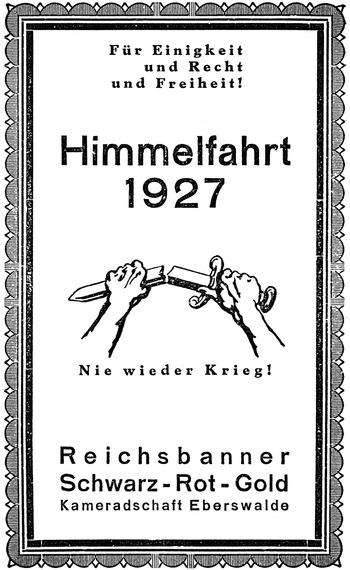
Figure 6 The Reichsbanner branch in Eberswalde, a town close to Berlin, displays the breaking of a sword as a symbol of proletarian anti-militarism, together with the slogan ‘No more war!’. From the cover of Himmelfahrt 1927: Reichsbanner Schwarz–Rot–Gold, Kameradschaft Eberswalde (Eberswalde: n.p., 1927).
Elle’s forceful invocation of the motto ‘No more war!’ was anything but exceptional. The slogan encapsulated the pacifist underpinnings of war commemorations by both Reichsbund and Reichsbanner, and was frequently used at all levels of these organisations and across the Reich.64 Reichsbund members from Berlin adorned their lorry with the slogan when they took to the outskirts of the city on Constitution Day, 11 August 1931, in order to drum up support for their cause.65 As these examples indicate, the two pro-republican veterans’ associations followed a different schedule in their invocation of the past war and their commemoration of fallen soldiers. Other stakeholders in the national discourse of commemoration had made their claims earlier and more forcefully, and had thus gained a head start. From its inception in 1919/20, the Volksbund deutsche Kriegsgräberfürsorge (People’s League for German War Graves) had campaigned to celebrate a Volkstrauertag (national day of mourning) on Reminiscere, the second Sunday during Lent.66 With a peak middle-class membership of 138,000 in 1930, mostly either war veterans or bereaved, the Volksbund was a powerful nationalist pressure group that successfully lobbied the Reich government to support a heroic style of commemoration.67 The Reichsbund immediately recognised that the epithet ‘national’ for this holiday would only be a pretence to indulge in right-wing nationalism and revanchism. A national day of mourning, it argued, would only be justified once proper provision for disabled veterans had been guaranteed. Meanwhile, it was preferable to celebrate popular citizenship and a ‘declaration of loyalty’ to the new Republic, a demand that implied the form of a constitution day.68 But nationalist circles clearly had much better leverage in the complicated negotiations about a national day of mourning, which had to take the interests of the Länder into account. From 1925 onwards, although not legally binding, Volkstrauertag was officially celebrated on Reminiscere across the Reich. Only Bavaria was an exception. Here, the Catholic majority continued to mourn the fallen on All Souls’ Day.69
Throughout the Weimar Republic, the celebration of the Volkstrauertag employed a clearly discernible revanchist rhetoric, which also demanded that differences of class, party and confession be abandoned during the mourning, in favour of a unified people’s community.70 Social Democrat newspapers did not mince their words in their mockery of the – in their view pathetic – formulas that were used to conjure up the notion of national unity during the Volkstrauertag. Unity – ‘in what spirit? That is the issue!’ commented the Volkswille in Hanover in 1926. Any commemoration of the fallen would only make sense if it ensured that men were never again to die on the battlefield, and thus made days of mourning in the future superfluous.71 In 1930, Otto Braun, the Social Democrat Prussian prime minister and Reichsbanner member, used a speech in remembrance of the successful popular fight against the Kapp putsch to lash out at the right-wing underpinnings of the Volkstrauertag. He would not accept a ‘prescribed day and hour’ at which he should mourn the fallen of the First World War, even less so as the ceremonies of the ‘private association for Kriegsgräberfürsorge’ would raise the ‘suspicion that the remembrance of our dead was abused to nourish and keep alive a certain pernicious idea of revenge’.72
This critique was spot on, in particular as it highlighted the dubious way in which the organisation of a national holiday was left to a private pressure group. The Reichswehr minister, Wilhelm Groener, was furious, and complained in a letter to SPD chancellor Hermann Müller.73 But both Reichswehr and Reich government supported the celebration of the Volkstrauertag. Republican activists thus had to look for alternative dates on which they could mourn and commemorate the fallen. A representative of the Reichsbanner head office hinted in 1925 that the league might throw its weight in support of 11 November into the debate on the national day of mourning.74 But important as this date was as a day of liberation for republican veterans, among a wider public it was tainted with the stigma of defeat and hence impossible to implement. In practice, Reichsbanner activists thus had three options to celebrate the remembrance of their fallen comrades.
First, they included a brief tribute to the war dead whenever they celebrated a Bannerweihe, the festive event during which the red–black–gold banner of a local branch was consecrated. Secondly, Reichsbanner members mourned the fallen when they gathered for the annual celebration of the Republic on 11 August. As Constitution Day, this was an official holiday from 1921 onwards, which the government and all pro-republican organisations used to represent the inclusive citizenship rights underpinned by the Weimar Republic by symbolic means.75 Thirdly, Reichsbanner branches held separate events dedicated to the commemoration of the fallen on Totensonntag; another option was All Saints’ Day, 1 November, in Catholic regions.76 Both dates allowed the Reichsbanner to tap into the sombre autumn mood when the leaves were falling, and thus to foreground the earnest ‘solemnity’ of their commemorations as a key distinguishing feature.77 Such rhetoric marked a direct contrast to the Volkstrauertag, situated in spring, which deliberately tied the remembrance to the need for a cyclical rebirth of the nation amidst its alleged post-Versailles despair.78
A fourth option was, to my knowledge, systematically used only by Social Democrats in the Saar region, and then only for the short period from 1925 to 1928. At any rate, the Saar was a special case, as the Treaty of Versailles had put it under a mandate of the League of Nations until a referendum would decide whether it be included in France or Germany. Meanwhile, the French could exploit the coal mines in the region, and integrated it into a customs union. This specific political setting and their undisputed strength encouraged the Social Democrats in the region to organise ‘anti-war days’ in various towns. They took place on 1 or 3 August, thus commemorating the onset of the Great War as a historical catastrophe. But it was not only the date that was meant to drive home frontal opposition to war; the speeches were too. What was special about these ceremonies was that Else Stratmann-Braun – the wife of Max Braun, later the head of the SPD in the Saar – gave speeches, in which she vividly described the horrors of war and highlighted females’ mission to act as ‘defenders of life’. The strong female presence during these events was also marked by the inclusion of mixed choirs, while all other elements of the ritual, including its situation in front of the local war memorial, closely resembled the pattern described below.79
Republican rituals of commemoration
Whenever local Reichsbanner branches mourned the fallen soldiers, often in conjunction with their Reichsbund comrades, their rituals followed a highly circumscribed pattern, which was repeated year after year.80 In marching columns, the republican veterans would head towards a memorial stone or plaque in a local cemetery, or to the graves of soldiers who had died at the front. If the local branch had been able to set up a band, it would march in front of the column. The black–red–gold banners, carried in the midst of the detachment, were adorned with a black crape. Lined up in front of the memorial stone, those attending would then often listen to the tune of the ‘Old Dutch Thanksgiving Prayer’ (‘Altniederländisches Dankgebet’). This song was originally written by Adrianus Valerius in the early seventeenth century, and referred to the Dutch campaign against the Spanish in 1597. In 1877, the Viennese Joseph Weyl translated the text into German, in a version that was later rendered as ‘We Gather Together’ by Theodore Baker in English. In the German text, the three verses invoke the notion of God’s support for a righteous battle, and were thus a potent and widely used symbol of the close alliance between Protestant Church and the Hohenzollern in imperial Germany. Despite the collapse of the monarchy in 1918, the song retained its potency and was a staple of right-wing commemorations throughout Weimar, with clear anti-republican connotations.81 Devoted republicans obviously did not share the political implications of the text. But they apparently liked the tune, written by the Viennese composer Eduard Kremser, which had been popular among front-line soldiers during the war, and which alone was played during Reichsbanner memorial ceremonies.82
Next on the agenda of a republican commemoration was often another brief musical interlude, usually presented by a choir of local Arbeitersänger. Founded in 1908, the Deutsche Arbeiter-Sängerbundwas part and parcel of the socialist working-class milieu, with a peak membership of 263,000 during the Weimar years. Its main purpose was to foster the convivial practice of four-part singing in male choirs. To some extent, the artistic practice of the Arbeitersänger tried to emulate the highbrow ideals of German classical music, and idolised Beethoven in particular. Obviously, though, socialist proletarian choral singing also had a strong political impetus, and stood in direct competition to the male choirs in the nationalist camp. Throughout the Weimar Republic, the Arbeitersänger were immersed in attempts to express their ambivalent feelings about the Great War in verse and song. Their symbolic expressions of the war experience vacillated between praise and reverence for the sacrifice of the soldiers, and bitter indictments against the cruelty of a war machine driven by capitalist interests and Prussian militarism.83 Socialist labour movement choirs understood themselves as opponents of war, and as such they were an almost natural ally for the Reichsbanner and its commemorative rituals.
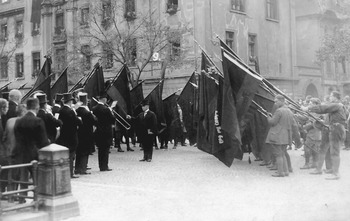
Figure 7 Reichsbanner members in Weißenfels, a town in the Prussian province of Saxony, lower their banners during a commemorative ceremony (c. 1927).
After the choral section, short speeches followed, usually delivered by a Reichsbund and a Reichsbanner representative. Then, a laurel wreath with black–red–gold ribbon was laid down at the memorial site, to which the banners of the Reichsbanner branch were lowered in honour of the fallen. This tribute was completed to the tune of ‘I Had a Comrade’. Written by the Romantic poet Ludwig Uhland in 1809, the song encapsulated the grief caused by the death of a close comrade. It was a staple of all nationalist commemorative rituals throughout the Weimar Republic.84 The fact that Reichsbanner rituals used it as well is indicative of the extent to which republican veterans also tapped into the discourse of comradeship, although they usually only sang the first stanza, which did not, as the second, invoke mythical comradeship even beyond the death of one comrade.85 It should also not be overlooked that the Reichsbanner often used a slightly different version, which included the following lines:
Rather than articulating the notion of male bonding in the wake of shared sacrifice in battle, as Uhland’s version, this verse conjured up an entirely different set of connotations. Here, the accent was on shared activism and on peaceful convivial pastimes such as hiking, all meant to underpin the one thing that mattered most for Reichsbanner members: their unequivocal support for the republican colours. On some occasions, the song of the good comrade was followed by another performance by the Arbeitersänger. This was usually the funeral chorale ‘Silent Sleeps the Singer’, for which the original nineteenth-century lyrics by Thomas Moore had been adapted in a version that was widely used in the socialist choral movement.87 After that, the ceremony was concluded, and the crowd dispersed.
These rituals were a crucial element of the cult of the fallen soldiers: an element whose significance and performative qualities are often not fully appreciated.88 As all rituals, they were repetitive, hardly ever changing their form over time, as their main purpose was to create a certainty that specific expectations were not going to be disappointed. This core function goes a long way to explain the apparent similarities between republican ceremonies for the mourning of the dead and those of the right-wing veterans’ associations. Rituals cannot be understood in terms of a means–ends rationality. Rather, they helped to open up the participants for an emotional journey, to make them receptive to the experience of the sublime. In that perspective, even a song such as the ‘Dutch Thanksgiving Prayer’ could have its place in a republican and predominantly secular ceremony, as it brought back recollections and feelings the veterans had had on the battlefield. The bodily and sensual registers of experience were pivotal for the enactment of a ritual, and the music and choral singing served to support these elements. The content of the songs, however, was either firmly situated in the socialist camp, or had been, like the song of the ‘good comrade’, adapted for that context. While the mourning of dead comrades was the primary purpose of these ceremonies, they also served to ‘endorse the valency’ of specific values by symbolic means, and to translate mythological notions into a sequence of actions.89 And in the context of Reichsbanner ceremonies, the core values were the rejection of war as a political means and the support for the Republic, also epitomised by the use of the republican colours.
Verbal elements of commemoration
In the context of the commemorative ritual, verbal elements apart from the chorales had only a limited space, and the speeches were thus usually short. In the most abridged form of delivery, they basically admonished the living not to forget the fallen.90 In more elaborate versions, they drove home at least three major points. A Reichsbund representative would express the pain of losing a father, brother or son, and would describe how the ‘scars’ would ‘bleed again’ on a day that was devoted to their memory. Then, the Reichsbanner representative would invoke the ‘horror’ of war, highlight the mourning among the families, and stress that both losers and victors had been ravaged by the war. He would also insist that the struggle for peace was an obligation vis-à-vis the fallen comrades and their sacrifice.91 He would sometimes add that the remembrance of the war dead should include all those who had ‘fallen for the German Republic’, and close with the words that ‘We declare our loyalty to the cause of peace!’92 On most other occasions, the speaker would end with the call ‘No more war!’.93 Such a basic pacifist statement could be expanded or qualified in various directions. In cities where the Majority Social Democrats (MSPD) had been the stronger wing during the years from party break-up in 1917 to reunification with the Independent Social Democratic Party (USPD) in September 1922, some Reichsbanner speakers would stress that Social Democrats were in principle supporters of justified national defence. Yet in regions like Saxony, which had previously had a strong USPD tradition, the justification of national defence was never, ever mentioned, and speakers would instead focus on the need for international reconciliation as the key lesson of the Great War.94 But even the Bavarian SPD leader Erhard Auer, firmly positioned on the right wing of the party, never highlighted the need for national defence as one of the key lessons of the Great War in his many speeches in remembrance of the fallen. At the founding meeting of the Munich branch in July 1924, those who attended rose from their seats when he paid tribute to the fallen, insisting that they had not fought for the ‘rulers and kings, but for the German people’. On this occasion, Auer also argued that Germany had not lost the war alone, but in fact ‘all of Europe’ had, as governments were struggling to respond to the post-war crisis.95 Speaking in 1927 at the flag consecration of a Reichsbanner Kameradschaft in Munich, Auer stressed that the fallen had sacrificed their lives ‘for a Germany that was freer and more just in terms of social equality’.96
Quite often, strong rhetorical support for national defence in Reichsbanner ceremonies was actually offered by leading German Democratic Party (DDP) members of the republican league. During a tribute to the fallen in the Königsberg branch in 1924 for example, Ferdinand Friedensburg (1886–1972) spoke. Then a county executive (Landrat) in West Prussia, a Reichsbanner member and DDP candidate for the Reichstag election, Friedensburg later became a leading Christian Democrat in the post-war Federal Republic. Speaking in 1924, he insisted that the moral ‘corruption’ of the German people during the war had only begun when the ‘poison of greed for profit’ had started to undermine the ‘notion of defence’ and the cohesion of the national community. Yet on the same occasion Horst Bärensprung, the Social Democrat Reichsbanner managing director from Magdeburg, steered clear of such blatantly nationalist rhetoric. In a tribute to the local giant of idealist philosophy, he instead referred to Kant’s notion of ‘perpetual peace’ and insisted, in accordance with Kant’s treatise on this topic, that ‘the constitution of each state [had] to be republican’ in order to abolish war for good.97
Repeatedly, speakers at Reichsbanner events turned the remembrance of the fallen into an elaborate and detailed rhetorical swipe against warmongers and the nationalist right. On Sunday 22 February 1925, a year after the founding call for the Reichsbanner had been issued, the branch in Bremen called for a festive celebration of republican values. The day began at 9am with a memorial service to the fallen in the Protestant Martini Church. After the first ritual elements – tribute to the black–red–gold banners that stood next to the altar, the chorus ‘Silent Sleeps the Singer’ – Emil Felden went up to the pulpit. Felden (1874–1959) was not only the pastor of St Martini, but also a libertarian, progressive theologian on the left wing of the Lutheran Church. In 1919, he had joined the SPD, for which he briefly served as Reichstag deputy in 1923/4.98 Felden spoke only briefly to the 2,000 people who attended this ceremony, reciting a poem called ‘No More War’. After another musical interlude, First Lieutenant Benno Georges of the Hamburg police mounted the pulpit as the main speaker. He denounced the ‘black–white–red’ camp as ‘warmongers’ who would never dare show the true face of war. To make his point, he mentioned those severely mutilated veterans with a face like a ‘hole’ who were still hidden in hospitals. It struck the police constable who filed a report on this gathering as particularly noteworthy that Georges claimed ‘the dead of the World War for the labouring people alone’, without ever mentioning that also ‘other circles of the German people’ had to mourn their dead. Georges thus invoked a higher, transcendent meaning for their death, but it was confined to the socialist working class. In the final section of his speech, Georges turned from commemoration to direct political indictment against the war profiteers, referring to industrial firms who had exported steel, but could not meet the demand for barbed wire as the war dragged on. This was a gap that the workers then ‘had to fill with their bodies’.99
With their commemorative rituals, Reichsbund and Reichsbanner reaffirmed moderate pacifist values and claimed, as the example of Benno Georges demonstrates, the remembrance of the fallen soldiers for the labouring people. In some respects, such a rhetoric was more exclusive than that of right-wing commemorations. During these, the speakers always stressed that the fallen had made their sacrifice as part of a larger collective, the German nation, and that their example could thus help to overcome the deplorable fault-lines and political divisions within Germany. Yet on the other hand, republican commemorations were far more inclusive than their right-wing counterparts. They did not treat the ordinary soldiers as mere ‘extras’, as the right-wing camp did, in rituals that were dominated by former officers.100 And they reached out to the former enemies and tried to foster international bonds of solidarity. These activities were an important part of what historian John Horne has described as ‘cultural demobilisation’. In these endeavours, German war veterans tried to find appropriate ‘gestures, words and practices of reconciliation’ that would allow them to face their former enemies in personal encounters. Rather than continuing to dehumanise the enemies, as the radical proponents of the right-wing camp did, republican veterans tried to reach out to their counterparts in shared revulsion against war itself as the real atrocity.101
Reaching out to French war veterans
As such, bonds of solidarity and reconciliation between the former enemies could be extended to all the former belligerent nations. In practice, though, the Social Democrat war veterans in the Reichsbund and the Reichsbanner prioritised close relations with French veterans above everything else. The reasons for this preference were never explicitly mentioned, but it is fair to assume that one important point was the availability of clearly defined counterparts on the other bank of the Rhine. With the mass mobilisation of French veterans who were – among others – organised in the Union fédérale, German republicans could rely on a partner to which they could address their hopes for reconciliation.102 Attempts to understand the predicament of the French people during and after the war permeated the cultural practices and sociability of Reichsbund and Reichsbanner at all levels.
In the press of both leagues, many articles conveyed impressions of journeys to the former battlefields in France. Trying to raise empathy with the plight of the civilians who lived in the former war-zone, they detailed the devastation caused by the war, but also noted the fact that nature had, over time, been able to ‘heal almost all wounds of the earth’.103 Overall, the former battlefields ‘symbolised the exhortation to gain peace’.104 During their regular social events, local Reichsbanner chapters heard talks about the situation in France. On one occasion in Munich in 1929, a Reichsbanner member who had been living in France before the war was keen to debunk some of the most common myths. The French had not held any hatred against the Germans, he insisted, and had not prepared a war against them. Also, there had not been any displays of enthusiasm for war in August 1914. In the army, relations between privates and officers were characterised by mutual trust, and even service in the often loathed Foreign Legion was still better than the drill in German army barracks.105
In the Reichsbanner branch in Vegesack, Paul Günzel, a teacher from nearby Bremen, regularly gave talks on his war experiences, at which he showed photos using a reflecting projector. In 1928, he talked about a recent ‘peace journey to French battlefields’. Among his audience were not only war veterans, but also women and children, and Günzel gave such a vivid description of the plight of the French population that the latter also got an idea of the ‘terror and horror’ of war. Towards the end of his talk, Günzel referred to the brothers Fritz and Franz von Unruh as two exemplary role models for the necessary conversion to the cause of peace. Both had volunteered in August 1914, but had soon, under the impact of their war experiences, turned to outright ‘proponents of the idea of peace’.106
Fritz von Unruh (1885–1970) in particular had a firm place in the list of authors who were associated with the ideas of the Reichsbanner. Coming from an aristocratic family with a long tradition of army service, Unruh served as an active cavalry officer before the war, while also kick-starting a career as a playwright, on which he focused after resigning from his military post in 1912. But in 1914 he joined the army again as a volunteer. His front-line experiences started a complicated and drawn-out process of disillusionment and inner reflection. Ultimately, the counter-revolutionary violence exerted by government troops in Berlin in January 1919 turned him into an outspoken pacifist, who devoted both some of his literary works and many speeches to the cause.107 Unruh was also a Reichsbanner member, and served on the non-executive board of the league.108 It was indeed highly pertinent to mention Fritz von Unruh in a talk about a journey to former battlefields in France, as Günzel had done. From the mid 1920s onwards, reconciliation with France stood at the heart of Unruh’s pacifist writings, and he often referred to his ‘Verdun oath’ – ‘returning from the trenches of death’ – as the reason why he had been converted to the pacifist cause. It does not diminish his activism that his pretentious prose was loathed by critics, and that – according to the diplomat and writer Harry Count Kessler – the snobbish tone of his writings on France was not well received in Paris.109
At the official level of involvement in international veterans’ politics, the two republican associations followed a different trajectory. First inaugurated by a conference in 1925, veterans’ associations across Europe started to cooperate in a more formal manner with the founding of the CIAMAC (Conférence internationale des associations de victimes de la guerre et anciens combattants) in 1926. This network included associations of both disabled soldiers and veterans, mostly from the moderate bourgeois and moderate socialist end of the political spectrum. Representing twenty-four associations from ten countries, it also included the Reichsbund.110 Prior to these multilateral links, the disabled veterans of the Reichsbund had already been in contact with the French Union fédérale in 1921. The first meeting took place on neutral ground in Geneva, based on an initiative by Henri Pichot, the long-serving head of the Union fédérale. Pichot later recalled the awkward feelings among his delegation, as ‘the war had not been over for so long’. In their view, ‘the Germans were still the “boches”’ and now ‘they were supposed to shake their hands?’.111 But the ice was broken, and even the Ruhr crisis in 1923 brought these contacts only to a temporary halt.
For the Reichsbanner, it was more difficult to become a regular member of the network of veterans provided by the CIAMAC. French veterans were initially reluctant to cooperate with the Reichsbanner, as they noted the paramilitary elements in its public appearance with some suspicion, and also perceived it as driven by the political interests of one particular party.112 From the Reichsbanner’s point of view, the CIAMAC was not a perfect match, as it was predominantly concerned with the more technical interests of disabled war veterans and war widows in welfare state provision. Nonetheless, the Reichsbanner was first invited to a CIAMAC meeting in Vienna in 1927. On this occasion, a representative from the Magdeburg head office renewed the commitment to international reconciliation in the framework of the League of Nations. The specific interests of the disabled veterans aside, the most important issue was ‘to organise the peace’.113 With observer status, Reichsbanner delegations attended subsequent meetings of the CIAMAC, before the league finally joined as a regular member in 1932.114 But the Reichsbanner also established direct links to French veterans’ associations: to the Union fédérale and the much smaller Fédération nationale in particular. From the late 1920s, leading representatives of French veterans’ leagues – including René Cassin and André Liautey, a member of the CIAMAC executive and head of its French committee – regularly appeared at Reichsbanner gatherings. In return, functionaries of the republican league travelled to France. The driving force behind these links, and their main representative, was the former staff officer Karl Mayr, who was ultimately recognised for these efforts with an honorary membership of the Fédération nationale.115
The various high-level contacts between representatives of the two German republican associations and the anciens combattants had at least three distinguishable aims: first, they provided a platform for the advancement of the pacifist ideas of socialist veterans; secondly, they allowed the Reichsbund in particular to stress that even disabled and severely mutilated veterans were not simply victims of war, but had also been soldiers;116 and thirdly, they provided popular resonance for the politics of reconciliation between France and Germany that Gustav Stresemann and Aristide Briand had inaugurated in 1925. This support continued even during the early 1930s, at a time when the Brüning government pursued a tough stance vis-à-vis France and effectively abandoned the western orientation of German foreign politics.117 Ultimately, though, the contacts between French and German war veterans served to drive home the key message that narrow-minded nationalist agendas were inadequate to shape a peaceful post-war world, and to emphasise the internationalism of the republican veterans on both sides.
The rhetoric of international reconciliation
As the members of Reichsbund and Reichsbanner were convinced, international reconciliation had to be built on respect for the war memories of the other side, and they thus enacted symbolic gestures encapsulating this respect. One example was the photo of a Reichsbund delegation in Paris in 1930, paying tribute at the tomb of the inconnu under the Arc de Triomphe.118 Another took place in Darmstadt the same year. The local Reichsbund branch had organised a screening of a film commissioned by the league, which first showed the horrors of trench warfare before illustrating the tireless efforts for the disabled veterans since the founding of the Reichsbund in 1917. Prior to the screening, a tribute to the fallen took place, and the wreaths were then placed in the local cemetery next to graves of both German and French soldiers. After a couple of days, however, the ribbons with the slogan ‘No more war!’ were cut out by unknown vandals, leaving only ‘more war!’ as a message. The Reichsbund journal described this act of vandalism as a ‘disgrace’ for Germany.119 When the veterans’ functionary and pacifist Henri Dumont, founder of the society Pour supprimer ce crime: la guerre, spoke in various German cities in spring 1929, the Reichsbund not only made sure that thousands listened to him; wherever he spoke, it also adorned the rostrum with a tricolore, and a ‘republican’ orchestra played the ‘Marseillaise’. In the Saxonian city of Zwickau, a band accompanied him all along the way from the station to the meeting hall.120
In the eyes of republican war veterans, support for internationalism and reconciliation with France in memory of the horrors of war did not imply an outright rejection of patriotism. Rather, internationalism and patriotism had to be reconciled or, more precisely, the latter had to be turned into a springboard for the former, as various veterans’ representatives tried to explain in language that was heavily loaded with metaphors. In July 1929, Erich Roßmann, head of the Reichsbund, spoke at the annual gathering of the Union fédérale in Brest. He rejected the revanchist notion that love for one’s fatherland would necessarily imply deep-felt enmity towards other countries. The congress rose to a storm of applause when he explained his vision with the words: ‘We do not want to get rid of the nations and the love of one’s own fatherland; rather, we want to place them like gems in the central sun of mankind so that they can fully develop their gloss and their richness in colour and shape.’121 The following year, René Cassin, university professor, French delegate to the League of Nations and leading member of the Union fédérale came to the annual gathering of the Reichsbund in Mannheim. His visit was meant to stress the bonds of solidarity across the borders between war victims, Cassin explained. And he called for concerted efforts to tame the ‘forces of hatred’, both in material and in intellectual terms, and thus to develop an ‘organised Europe’.122
In 1930, Martha Harnoß spoke as a German delegate at a meeting of veterans’ representatives from twelve nations at the Chemin des Dames. She was the Reichsbund executive in charge of all issues relating to widows and orphans, and it was the first occasion on which a woman could address such a veterans’ meeting. Her tribute to the French and German dead stressed that although they had died as ‘enemies, representing these two great nations’, they were now ‘united as brothers in their graves’. And as such, they were the ‘seed grains for a peaceful Europe’.123 The rhetoric of these cross-border gatherings tapped into a humanist discourse, trying to reconcile it with respect for one’s own fatherland. Such symbolic gestures of international reconciliation made an important contribution to the cultural demobilisation between former belligerent nations, even though they failed to convince the radical nationalist right in Germany. In early 1930, the Reichsbanner floated the idea of a peace gathering of French and German veterans on the battlefield at the Chemin des Dames. Karl Mayr was the driving force behind this venture, using his well-established contacts in the Fédération nationale. National Socialists and right-wing combat leagues loathed the plan as a betrayal of German interests.124 Right-wing commentators considered the plan to be indicative of a grave lack of ‘pride’ and ‘self-esteem’ on behalf of the republican league.125 The meeting was ultimately abandoned. Yet the failure to stage this event was at least partly the Reichsbanner’s own fault. It had publicised its plans way ahead of the scheduled date, thus also allowing radical nationalist circles in France to drum up public sentiment against it, which forced the French government to intervene against the plan.126
The republican forces in Weimar Germany certainly did not leave the cult of the fallen to the political right, as Reinhart Koselleck and other historians have stated.127 Yet they started to intervene in the contested field of public commemorations rather belatedly. Only once the Reichsbanner was established in 1924, five years after the ultimately short-lived Republic had been founded, did moderate socialists make concerted efforts to represent the meanings they attached to violent death in the Great War. These efforts were not in vain, and they changed the playing field of public rituals around war memorials. Republicans were rarely able to shape the architecture and iconographic symbolism of war memorials, and hence only very few memorials with an outright pacifist message were built. But they could represent republican values in the annual commemorative rituals around the memorials, sometimes in official municipal events. If that was not possible, they staged their own ceremonies. It is one of the arguments of this chapter that the repetitive rituals that were annually held at war memorials, and the rhetoric that was employed on these occasions, were centrally important elements of the cult of the fallen. They determined the overall symbolic function of these memorials at least as much as their iconography.128
Ultimately, the outcome of pro-republican commemorative efforts depended on the political landscape in a municipal context. Only where Social Democrats, sometimes jointly with Communists, held a majority in the local council, could they place a pacifist message at the centre of the cult of the fallen. Even such a majority, however, could not solve the underlying problem, which the architect Bruno Taut had already identified in 1922. ‘A memorial is only possible’, Taut argued, when it rests on a symbolic idea that has ‘perfect and clear general validity … Yet the attitude of the German people to the past war is such a highly differentiated one, that the universal validity of a symbol’ was impossible to ascertain.129 Heroism and glorification of sacrifice on the one hand, and the gruesome memory of the horrors of war on the other, were strictly irreconcilable ideas. All that Social Democrats could do in such a situation was to develop a range of rhetorical patterns and ritual elements that could express their own interpretation of violent death. These republican commemorations included some elements that were also a staple of nationalist ceremonies, in particular music such as ‘I Had a Comrade’. Yet despite these similarities, Reichsbanner rituals at war memorials did not simply copy those of the Stahlhelm and Kyffhäuserbund; they rather mirrored them. The latter used the remembrance of the fallen to compensate for German defeat.130
Ascribing meaning to violent death
Historians have argued that the socialist labour movement developed a highly rationalist and emotionally cold rhetoric that did not offer an answer to questions about the meaning of death, and was hence not able to satisfy the metaphysical needs of its rank-and-file members, and to accommodate the need for a reworking of war experiences.131 For the Weimar Republic, this argument is not convincing. To be sure, Social Democrats were reluctant to ascribe any higher meaning to the horrors of violent death – not even the need for defence of their own country – and insisted that the main aim of many of the fallen had been to survive the war unharmed.132 But despite this reluctance, they did ascribe some meaning to violent death, mostly the urgent need for international reconciliation as the key lesson. Karl Bröger insisted that the Reichsbanner not only remembered comrades in their own uniform, but also the dead of the ‘other side’ who shared a grave with them. Citing a stark metaphor coined by Henri Barbusse, Bröger declared as the real ‘truth’ that ‘two belligerent armies are in fact one that is committing suicide’.133
Thus, the republican cult of the dead offered consolation and also encouragement. It tried to reinstate the dignity of the individual, which was a pertinent task, given the fact that the ‘radical devaluation of the individual’ was one of the most substantial effects of mass death in the First World War.134 At the heart of the republican cult of the fallen stood the slogan ‘No more war!’. With this motto, Reichsbund and Reichsbanner functionaries continued a pacifist tradition that had been inaugurated in the immediate post-war period by the Friedensbund der Kriegsteilnehmer. And they tapped into the anti-militarist and anti-war sentiment that was apparently still widespread among socialist workers even by the late 1920s. Yet snappy, emotional and confrontational as this slogan was, its widespread use in the republican remembrance of the fallen was not free of ambivalences. By the early 1930s, the constant repetition of ‘No more war!’ had turned the slogan into a set phrase that was full of pathos, but ran the risk of becoming the centrepiece of an empty, ossified ritual. On a rare occasion, critique of the annual calendar of commemorative events was voiced from within the Reichsbund. Writing during the autumn season of 1931, the deputy head of a local branch in the Rhineland argued that these events had to be rejected when they simply repeated ‘the traditional, completely dated’ sequence of ritual elements. In order to liven up the rigid formulaic pattern of events, he recommended the inclusion of poetic elements that were apparently designated to offer a much more diversified and reflexive pronunciation of socialist anti-militarist ideas. As possible examples, the Reichsbund functionary mentioned the recital of poems and spoken choruses by authors such as Ernst Toller – and here namely his Hinkemann, the play about the tragedy of a soldier who returned home with his genitals shot off – Heinrich Lersch, Ernst Preczang or Bruno Schönlank.135
Representing extremely diverse political positions and artistic ideas in the broad spectrum of Weimar’s socialist literature, works of all four authors were widely read and performed in the socialist choral movement and the Volksbühnen, popular theatre companies that were supported by socialist trade unions and the SPD.136 Thus, this critique pointed to the fact that the republican remembrance of the fallen could have included a much more differentiated set of artistic ideas. In different forms, poems and plays by these authors reflected and contemplated the existential problems of labouring men who had experienced the horror of trench warfare, the crucial role of technology for total war in the years from 1914 to 1918, or the longing for a peaceful life amidst the post-war class struggles. Yet while there was certainly potential for a much more elaborate symbolism of republican commemorations, there were also good reasons why they ultimately retained their rather formulaic character. The very purpose of rituals is to be ritualistic, as only their repetitive nature ensures that they perform their core function: to overcome the contingency of elaborate verbal communication with a set sequence of mostly non-verbal gestures and actions.137 Only as such, republican commemorative rituals conformed to the expectation of their participants that they might help to bring closure to a liminal experience. And apart from public recognition of their own suffering, closure was surely the most important effect republican war veterans expected from the memorial cult.
1 Koselleck, ‘War Memorials’.
2 See Ziemann, ‘Weimar was Weimar’, pp. 566f.
3 Ziemann, War Experiences, pp. 252–68.
4 Kruse and Kruse, ‘Kriegerdenkmäler in Bielefeld’, p. 106.
5 Gerhard Schneider, ‘Nicht umsonst gefallen’? Kriegerdenkmäler und Kriegstotenkult in Hannover (Hanover: Hahn, Reference Schneider1991), p. 191.
6 As an excellent short survey see Sabine Behrenbeck, ‘Heldenkult oder Friedensmahnung? Kriegerdenkmale nach beiden Weltkriegen’, in Gottfried Niedhart and Dieter Riesenberger (eds.), Lernen aus dem Krieg? Deutsche Nachkriegszeiten 1918 und 1945 (Munich: C. H. Beck, Reference Niedhart and Riesenberger1992), pp. 344–64.
7 Rohe, Reichsbanner, p. 156; see also Albrecht Lehmann, ‘Militär und Militanz zwischen den Weltkriegen’, in Dieter Langewiesche and Heinz-Elmar Tenorth (eds.), Handbuch der deutschen Bildungsgeschichte, 6 vols., Vol. V: Die Weimarer Republik und die nationalsozialistische Diktatur (Munich: C. H. Beck, Reference Lehmann, Langewiesche and Tenorth1989), pp. 407–29 (p. 420).
8 See the critique in BVZ, 16 July 1919: BArch, R 8034 II, 7691, fo. 8.
9 See Schott, Konstanzer Gesellschaft, pp. 352–5 (quote on p. 353).
10 See Otto Braun to Chancellor Hans Luther, 19 November 1925: BArch, R 43/I, 710, fos. 248f.
11 Article in the Münchener Post, 7 October 1921: BArch, R 8034 II, 7691, fo. 92.
12 ‘Unseren Toten: Zum Totensonntag am 23. November 1919’, Reichsbund no. 44, 15 November 1919.
13 ‘Wie ehren wir das Andenken der Toten?’, Reichsbund no. 21, 1 November 1920; see also ‘Nie wieder Krieg!’, ibid. 7 (1924), no. 7.
14 Ziemann, War Experiences, pp. 254f.
15 Kruse and Kruse, ‘Kriegerdenkmäler in Bielefeld’, pp. 107–9 (quote on p. 108).
16 Quoted in Ludwig Linsmayer, Politische Kultur im Saargebiet 1920–1932: Symbolische Politik, verhinderte Demokratisierung, nationalisiertes Kulturleben in einer abgetrennten Region (St Ingbert: Röhrig, Reference Linsmayer1992), pp. 75f.; see also Ute Scherb, ‘Kriegerdenkmäler in Freiburg: Von der Gründerzeit bis nach dem Zweiten Weltkrieg’, in Christian Geinitz, Volker Ilgen and Holger Skor, Kriegsgedenken in Freiburg: Trauer–Kult–Verdrängung (Freiburg: Haug, Reference Scherb and Geinitz1995), pp. 12–60 (pp. 41ff.).
17 See Linsmayer, Politische Kultur, p. 77.
18 See the example of Hörlitz-Flur, a brown coal-mining town, in which the socialist miners unveiled their memorial in July 1921, and invited the anarchist and pacifist Ernst Friedrich to speak at the unveiling ceremony. See the report in Freiheit, 6 July 1921: BArch, R 8034 II, 7691, fo. 79.
19 Münchener Morgenpost, no. 140, 20 June 1922: BHStA/II, MK 51030.
20 Jeismann and Westheider, ‘Totenkult’, p. 29; see Hans Joachim Teichler and Gerhard Hauk (eds.), Illustrierte Geschichte des Arbeitersports (Bonn: J. H. W. Dietz, Reference Teichler and Hauk1987), pp. 82f.
21 See Behrenbeck, ‘Heldenkult’, pp. 351f.
22 Linsmayer, Politische Kultur, p. 45.
23 Kruse and Kruse, ‘Kriegerdenkmäler in Bielefeld’, p. 113.
24 Ibid., p. 114.
25 See the comparison by Jeismann and Westheider, ‘Totenkult’, pp. 36–42.
26 Annette Becker, ‘Der Kult der Erinnerung nach dem Grossen Krieg: Kriegerdenkmäler in Frankreich’, in Koselleck and Jeismann, Der politische Totenkult, pp. 315–24 (p. 322).
27 Speeches at the gathering are covered in ‘Gründungsversammlung des Bundes Republikanischer Kriegsteilnehmer’, PND no. 458, 7 July 1924: StAM, Pol. Dir. 6886; and in ‘Reichsbanner Schwarz–Rot–Gold’, Münchener Post no. 156, 8 July 1924.
28 ‘Gründungsversammlung des Bundes Republikanischer Kriegsteilnehmer’.
29 Cited in Münchener Post no. 156, 8 July 1924.
30 Koselleck, ‘“Space of Experience” and “Horizon of Expectation”’.
31 ‘Gründungsversammlung des Bundes Republikanischer Kriegsteilnehmer’.
32 ‘Reichsbanner Schwarz–Rot–Gold’.
33 Goebel, Great War, pp. 261–3.
34 PND report no. 488, ‘Versammlung des Reichsbanners Schwarz–Rot–Gold, Kameradschaft Nordend’, 12 December 1924: StAM, Pol. Dir. 6887.
35 Ibid.; see Mommsen, The Rise and Fall of Weimar, pp. 125–7.
36 PND no. 489, ‘Kameradschaftsabend des Reichsbanners’, 20 December 1924: StAM, Pol. Dir. 6887.
37 Berthold von Deimling, ‘Die Verfemung des Reichsbanners’, Berliner Tageblatt no. 18, 11 January 1925.
38 Gündisch, Arbeiterbewegung, pp. 257f.
39 ‘Monatsbericht Halle’, n.d. [filed 4 January 1926]: StAM, Pol. Dir. 6888.
40 ‘Denkmalsweihe’, RB no. 12, Beilage, 15 June 1925.
41 and (eds.), Wir lernen im Vorwärtsgehen! Dokumente zur Geschichte der Arbeiterbewegung in Reutlingen 1844–1949 (Heilbronn: Distel-Verlag, 1990), pp. 280–3 (quote on p. 281).
42 Reichsbanner Bundesvorstand to Bavarian Ministry of the Interior, 30 October 1924: BArch, R 1501, 113501, fos. 46f.
43 Bavarian Ministry of the Interior to Reich Ministry of the Interior, 10 January 1925: ibid., fo. 49.
44 Report dated 2 April 1925, n.a.: StAM, Pol. Dir. 6888.
45 Linsmayer, Politische Kultur, p. 80.
46 Report dated 2 April 1925, n.a.: StAM, Pol. Dir. 6888.
47 ‘Die Neutralität der Kriegervereine’, Vorwärts no. 472, 7 October 1924.
48 See the report on a decision taken by the Reichsbanner executive, ‘Lagebericht’, Pol. Dir. Munich, 5 February 1925: StAM, Pol. Dir. 6889. See also report, Pol. Dir. Munich, 9 October 1925 on a meeting of the Reichsbanner Gau leadership for Upper Bavaria: StAM, Pol. Dir. 6888.
49 From 1927 onwards, joint commemorations of local branches with other veterans’ leagues were only allowed with permission by the Gau executive; Rohe, Reichsbanner, p. 349. Individual members equally needed permission to join events staged by other combat leagues in uniform. See ‘2. Gaukonferenz am 21. und 22. September in München’: BArch, SAPMO, Ry 12/II 113, 2, fos. 8f.
50 ‘Rundschreiben des Gaus Oberbayern-Schwaben no. 22’, 13 October 1932, referring to a directive of the Bundesvorstand: BArch, SAPMO, Ry 12/II 113, 3, fo. 99.
51 ‘Die Gefallenenehrung des Reichsbanners’, Münchener Post no. 254, 2/3 November 1929; ‘Totenehrungen zu Allerheiligen’, Münchener Post no. 253, 3 November 1930. Both in StAM, Pol. Dir. 6886.
52 Björn Marnau, ‘“Wir, die wir am Feuer von Chevreuse die Hand erhoben haben …”: Itzehoer Pazifisten in der Weimarer Republik’, Demokratische Geschichte 10 (Reference Marnau1996), 141–66 (pp. 144f.).
53 See Helmut Donat, ‘Kapitänleutnant a.D. Heinz Kraschutzki (1891–1982): Ein Offizier im Kampf für ein “anderes” Deutschland’, in Wette and Donat, Pazifistische Offiziere, pp. 339–62 (p. 350).
54 Cited in Marnau, ‘Itzehoer Pazifisten’, pp. 145–7.
55 See ibid., p. 149.
56 Schneider, ‘Nicht umsonst gefallen’?, pp. 178f.
57 See ‘Friedlose Pazifisten’, RB no. 21, 1 November 1925.
58 See the conciliatory tone in the article by , ‘Reichsbanner und Pazifismus’ (1925), in Schoenaich, Zehn Jahre, pp. 115–18.
59 For the example of a Schoenaich talk in Bremen on 26 September 1928, see ‘Ausschnitt aus dem Lagebericht Nr. 12 vom 6.10.1928’: StA Bremen, 4, 65, 1146, fos. 38f.
60 Rohe, Reichsbanner, pp. 182–8; on context, see , Weimar: Die überforderte Republik 1918–1933. Leistung und Versagen in Staat, Gesellschaft, Wirtschaft und Kultur (Stuttgart: Klett–Cotta, 2008), pp. 358–63.
61 See Donat, ‘Kraschutzki’, p. 352.
62 Rohe, Reichsbanner, p. 186.
63 ‘Denn die Menschen wollen Frieden, Frieden jedes Menschenherz’, Reichsbund no. 16, 25 August 1929, Beilage Heim und Garten. This was only one of a number of similar events in August 1929 in Hanover. See Schneider, ‘Nicht umsonst gefallen’?, p. 179n98.
64 For example in Stuttgart, with Kurt Schumacher, the post-1945 SPD leader, as a main speaker: ‘Nie wieder Krieg! Die Gedächtnisfeier der Kriegsopfer Groß-Stuttgarts’, Schwäbische Tagwacht no. 182, 5 August 1924: HStASt, E 130b, Bü 3846.
65 See the photo in Reichsbund no. 17, 5 September 1931, p. 187. For the use of this slogan in the Reichsbund press see ‘Die Kriegsopfer zum 11. August’, ibid. no. 15, 1 August 1927, p. 147.
66 Fritz Schellack, Nationalfeiertage in Deutschland von 1871 bis 1945 (Frankfurt am Main: Lang, Reference Schellack1990), pp. 150f.
67 See Goebel, Great War, p. 22; Alexandra Kaiser, Von Helden und Opfern: Eine Geschichte des Volkstrauertags (Frankfurt am Main: Campus, Reference Kaiser2010), pp. 45–9 (figure on p. 47).
68 ‘Brauchen wir einen nationalen Trauertag?’, Reichsbund no. 4, 15 February 1921; see ‘Stellungnahme der Hinterbliebenen zum nationalen Trauertag’, ibid. no. 7, 1 April 1921.
69 Schellack, Nationalfeiertage, pp. 204, 231–41.
70 See Janina Fuge, ‘“Ohne Tod und Sterben kein Sieg”: Die gefallenen Soldaten des Ersten Weltkrieges in der Hamburger Erinnerungskultur der Weimarer Republik’, Historical Social Research 34 (Reference Fuge2009), 356–73 (pp. 360–7); Kaiser, Von Helden und Opfern, pp. 58–63.
71 Cited in Schneider, ‘Nicht umsonst gefallen’?, p. 177; see ‘Totenfest in Magdeburg’, Volksstimme no. 273, 22 November 1927; ‘Eine “neutrale” Gedenkfeier’, Volksstimme, no. 276, 26 November 1929; Fuge, ‘Soldaten’, pp. 368f.
72 The speech was covered in Vorwärts on 17 March 1930, and is cited in a letter by Wilhelm Groener to Chancellor Hermann Müller, 24 March 1930: BArch, R 43/I, 712, fos. 54f.
73 Ibid.
74 ‘Reichsbanner Schwarz–Rot–Gold’, Münchner Neueste Nachrichten no. 276, 6 October 1925.
75 See Achilles, ‘Celebrating’.
76 See the sceptical commentary ‘Der Totensonntag’, Lübecker Volksbote no. 275, 25 November 1929.
77 ‘Totenehrungen zu Allerheiligen’; ‘Novembergedanken’, RB no. 22, Gaubeilage, 15 November 1927.
78 Schellack, Nationalfeiertage, p. 192.
79 Linsmayer, Politische Kultur, pp. 78f.
80 For the following, see for instance the descriptions in ‘Die Gefallenenehrung des Reichsbanners’; ‘Totenehrungen zu Allerheiligen’; and ‘Totenehrung in Karlshorst’, RB no. 1, Gaubeilage Berlin-Brandenburg, 1 January 1927. For Saxony, see Voigt, Kampfbünde, p. 345; see also Harter, ‘Bürgertum’, pp. 281–3; and ‘Totensonntag in Magdeburg’, Volksstimme no. 278, 27 November 1928. For a slightly different procedure in a ritual that took place in the Protestant Martini Church in Bremen on 22 February 1925 – the first anniversary of the foundation of the Reichsbanner – see ‘Bericht über die Veranstaltung des Reichsbanners’, 23 February 1925: StA Bremen, 4, 65, 1028, fos. 75–7. On some occasions, the Reichsbund in Magdeburg organised commemorative events not in the cemetery, but in a banqueting hall, accompanied by classical music. See ‘Totenfest in Magdeburg’; and ‘Totensonntags-Feiern’, Volksstimme no. 274, 24 November 1931.
81 Kaiser, Von Helden und Opfern, pp. 39–41. The Nazis, to be sure, had to change the song, as it included as the final line the words ‘God give us freedom’; George L. Mosse, The Nationalization of the Masses: Political Symbolism and Mass Movements in Germany from the Napoleonic Wars through the Third Reich (Ithaca, NY; London: Cornell University Press, Reference Mosse1991), p. 147.
82 See explicitly ‘Toten-Gedächtnisfeiern’, Münchener Post no. 253, 2 November 1931; ‘Totenehrungen zu Allerheiligen’.
83 See Dietmar Klenke and Franz Walter, ‘Der Deutsche Arbeiter-Sängerbund’, in Dietmar Klenke, Peter Lilje and Franz Walter, Arbeitersänger und Volksbühnen in der Weimarer Republik (Bonn: J. H. W. Dietz, Reference Klenke, Walter, Klenke, Lilje and Walter1992), pp. 73–85, 91, 122–5, 153.
84 Kühne, Belonging, p. 18.
85 ‘Gründungsfeier des Reichsbanners Schwarz–Rot–Gold, Ortsgruppe Hermelingen’, Bremer Volkszeitung no. 255, 30 October 1924.
86 ‘Wir hatten einen Kameraden. / Er zog mit uns auf Fahrt. / Er war mit auf dem Plane. / Er stand mit um die Fahne, / um Schwarz–Rot–Gold geschart.’ Cited by Mintert, ‘Sturmtrupp’, p. 17.
87 See Verzeichnis der im Bundesverlage erschienenen Männer-, Frauen-, gemischten und Kinderchöre (Berlin: Deutscher Arbeiter-Sängerbund, n.d. [1930]), p. 17.
88 See the pertinent remarks by , Der Kult um die toten Helden: Nationalsozialistische Mythen, Riten und Symbole 1923 bis 1945 (Vierow: SH-Verlag, 1996), pp. 50–7.
89 Ibid., pp. 51f.
90 ‘Die Gefallenenehrung des Reichsbanners’.
91 See the template speech provided for the Reichsbanner commemorative rituals: (ed.), Reden für republikanische Gelegenheiten und für Reichsbanner-Veranstaltungen (Berlin: Hoffmann, 1926), pp. 31f.
92 ‘Totenehrungen zu Allerheiligen’.
93 ‘Totensonntag in Magdeburg’; Wilke, Reden, p. 32.
94 Voigt, Kampfbünde, pp. 345f.
95 ‘Gründungsversammlung des Bundes Republikanischer Kriegsteilnehmer’.
96 See Münchener Post, no. 240, 17 October 1927: StAM, Pol. Dir. 6887.
97 ‘Fahnenweihe des Reichsbanners Schwarz–Rot–Gold in Königsberg’, Vossische Zeitung, 24 November 1924: BArch, R 8034 II, 2869, fo. 133. In Magdeburg, Erich Roßmann, head of the Reichsbund, reminded the audience how, during the war, people had despaired about the notion of national defence; ‘Totenfest in Magdeburg’, Volksstimme no. 273, 22 November 1927.
98 ‘Bericht über die Veranstaltung des Reichsbanners’, 23 February 1925: StA Bremen, 4, 65, 1028, fo. 75. On Felden see Horst Kalthoff, ‘Felden, Emil’, in Biographisch-Bibliographisches Kirchenlexikon, ed. Friedrich Wilhelm Bautz, 33 vols., Vol. XXII (Nordhausen: Bautz, Reference Kalthoff2003), pp. 316–19.
99 ‘Bericht über die Veranstaltung des Reichsbanners’, fos. 75f. Georges had used similar pacifist rhetoric on an earlier occasion in Hermelingen; see ‘Gründungsfeier des Reichsbanners Schwarz–Rot–Gold, Ortsgruppe Hermelingen’.
100 Überegger, Erinnerungskriege, p. 152.
101 See Horne, ‘Kulturelle Demobilmachung’, pp. 142f.
102 There had been initial contacts in 1924 with the Fédération Interalliée des Anciens Combattants (FIDAC), then headed by Sir Ian Hamilton, president of the British Legion. See ‘Der Kongreß der FIDAC’, RB no. 10, 1 October 1924. In 1927, the Reichsbanner accepted an official invitation to a FIDAC congress in Luxembourg, but that was a one-off, and was not followed up. See Rohe, Reichsbanner, pp. 147f.
103 ‘Auferstandenes Land: Verwischte Spuren’, Reichsbund no. 8, 20 April 1931; see Walter Hammer, ‘Verdun: Eine Woche in Frankreich, Juli 1926’, RB no. 21, 1 November 1926; Ernst Glaeser, ‘Im Lande der Gefallenen’, RB no. 41, Beilage, 25 November 1928; ‘Das größte Schlachtfeld des Krieges: Eine Verdun-Fahrt’, RB no. 30, Beilage, 27 July 1929; and ‘Zwischen Verdun und den Argonnen’, RB no. 14, Beilage, 4 April 1930.
104 B. Fehl, ‘Auf den Schlachtfeldern von Verdun’, RB no. 24, Gaubeilage Berlin-Brandenburg, 14 June 1930.
105 ‘Versammlung der Kameradschaft Schlachthausviertel’, 13 March 1929: StAM, Pol. Dir. 6887.
106 ‘Eine Friedensreise über Frankreichs Schlachtfelder’, Bremer Volkszeitung, 20 October 1928: StA Bremen, 7, 88, 50/2.
107 See Hans-Joachim Schröder, ‘Fritz von Unruh (1885–1970): Kavallerieoffizier, Dichter und Pazifist’, in Wette and Donat, Pazifistische Offiziere, pp. 319–37.
108 ‘Polizeidirektion Nürnberg-Fürth, Sonderbericht Nr. 162/II/29, Anlage’, 24 October 1929: StA Bremen, 4, 65, 1034; see his speech in Berlin, cited in Vossische Zeitung, 19 January 1932: GStA, I. HA, Rep. 77, Tit. 4043, no. 352, fo. 6.
109 Schröder, ‘Fritz von Unruh’, pp. 331f.
110 Christian Weiß, ‘“Soldaten des Friedens”: Die pazifistischen Veteranen und Kriegsopfer des “Reichsbundes” und ihre Kontakte zu den französischen anciens combattants 1919–1933’, in Hardtwig, Politische Kulturgeschichte, pp. 183–204 (pp. 190f.).
111 See ibid., pp. 188f. The quote is from an article by the conservative journalist Paul H. Distelbarth, who established his early contacts with France in the context of the Reichsbund. See , ‘Die Kriegsteilnehmer’ (1936), in Das andere Frankreich: Aufsätze zur Gesellschaft, Kultur und Politik Frankreichs und zu den deutsch–französischen Beziehungen 1932–1953, ed. (Berne: Peter Lang, 1997), p. 216.
112 Elliot Pennell Fagerberg, ‘The “Anciens combattants” and French Foreign Policy’, Ph.D. dissertation (University of Geneva, Reference Fagerberg1966), pp. 155, 170.
113 Karl Mayr, ‘Die “CIAMAC” in Wien: Auf dem Wege zu einer internationalen Einheitsfront der Kriegsteilnehmer’, RB no. 20, 15 October 1927.
114 Rohe, Reichsbanner, p. 147; see Karl Mayr‚ ‘Totengedächtnis und Wahlkampf: Reichsbanner tritt dem europäischen Kriegsteilnehmerbund Ciamac bei’, RB no. 44, 29 October 1932.
115 ‘Französische Kameradenworte’, RB no. 37, 14 September 1929; Rohe, Reichsbanner, pp. 151f. On Mayr’s biography see Chapter 6. On Cassin and veterans’ politics, see Antoine Prost and Jay Winter, René Cassin et les droits de l’Homme: Le projet d’une génération (Paris: Fayard, Reference Prost and Winter2011), pp. 50–78, 88–93.
116 Weiß, ‘Soldaten des Friedens’, pp. 195f.
117 See for instance Karl Mayr, ‘Hoch der Frieden! Hoch Briand!’, RB no. 39, 26 September 1931; on context see Mommsen, The Rise and Fall of Weimar, pp. 381f.
118 ‘Reichsbündler am Grab des unbekannten Soldaten in Paris’, Reichsbund no. 15, 10 August 1930.
119 ‘Deutschlands Schmach: Schändung unserer gefallenen Kameraden’, Reichsbund no. 23, 10 December 1930.
120 Weiß, ‘Soldaten des Friedens’, p. 200.
121 Erich Roßmann, ‘Eine Friedensreise durch Frankreich’, Reichsbund no. 14, 25 July 1929.
122 ‘Das Parlament der Kriegsopfer’, Reichsbund no. 11, 10 June 1930; see ‘Um die Zukunft Europas’, Reichsbund no. 21, 10 November 1930.
123 ‘Gelöbnis der Kriegerhinterbliebenen aller Länder: Die Rede unserer Kameradin Harnoß an den Gräbern von Soupir’, Reichsbund no. 16, 25 August 1930.
124 ‘Reicht euch die Bruderhand! Das Treffen am Chemin des Dames’, RB no. 4, 25 January 1930; ‘Ein Verdunkämpfer über die Frankreich-Fahrt’, RB no. 12, 22 March 1930; Rohe, Reichsbanner, p. 152.
125 ‘Des Reichsbanners Zug an die Westfront’, Fränkischer Kurier no. 101, 11 April 1930: StAM, Pol. Dir. 6889.
126 Osterroth, ‘Erinnerungen 1900–1934’, p. 196; ‘Die Frankreichfahrt: Warum sie verschoben werden musste’, RB no. 19, 10 May 1930.
127 Koselleck, Zur politischen Ikonologie, p. 39; Lehmann, ‘Militär’, p. 420.
128 A relative neglect of these ritualistic elements is one of the limitations of the iconographic approach by Koselleck and other scholars. See Koselleck, Zur politischen Ikonologie; and Goebel, Great War. For pertinent criticism and an excellent analysis of commemorative rituals see Überegger, Erinnerungskriege, pp. 144–80.
129 Cited in Behrenbeck, ‘Heldenkult’, p. 345.
130 See ibid., p. 357, and the critique by Erwin Frebe, ‘Das Heer der Toten’, RB no. 44, Beilage, 20 October 1932.
131 Erhard Lucas, Vom Scheitern der deutschen Arbeiterbewegung (Frankfurt am Main: Roter Stern, Reference Lucas1983), pp. 96–100, 182–5.
132 See the balanced reflection by Erwin Frebe, ‘Die Toten Deutschlands: Gedanken zum Totensonntag’, RB no. 47, 23 November 1929.
133 Karl Bröger, ‘Worte auf ein Massengrab: Allen Toten des Weltkrieges’, RB no. 47, 22 November 1930.
134 Michael Geyer, ‘Das Stigma der Gewalt und das Problem der nationalen Identität in Deutschland’, in Christian Jansen, Lutz Niethammer and Bernd Weisbrod (eds.), Von der Aufgabe der Freiheit: Politische Verantwortung und bürgerliche Gesellschaft im 19. und 20. Jahrhundert (Berlin: Akademie, Reference Geyer, Jansen, Niethammer and Weisbrod1995), pp. 673–98 (p. 679).
135 ‘Festkultur der Kriegsopfer’, Reichsbund no. 22, 20 November 1931.
136 Trommler, Sozialistische Literatur, pp. 235f., 396–404, 450–3; see , ‘Der deutsche Hinkemann’ (1923), in Gesammelte Werke, 5 vols., Vol. II (Munich: Carl Hanser, 1978), pp. 191–248.
137 Behrenbeck, Der Kult um die toten Helden, p. 50.
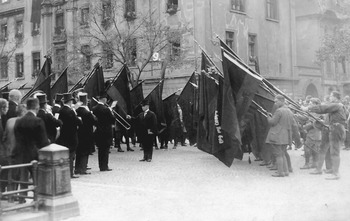

 Open access