




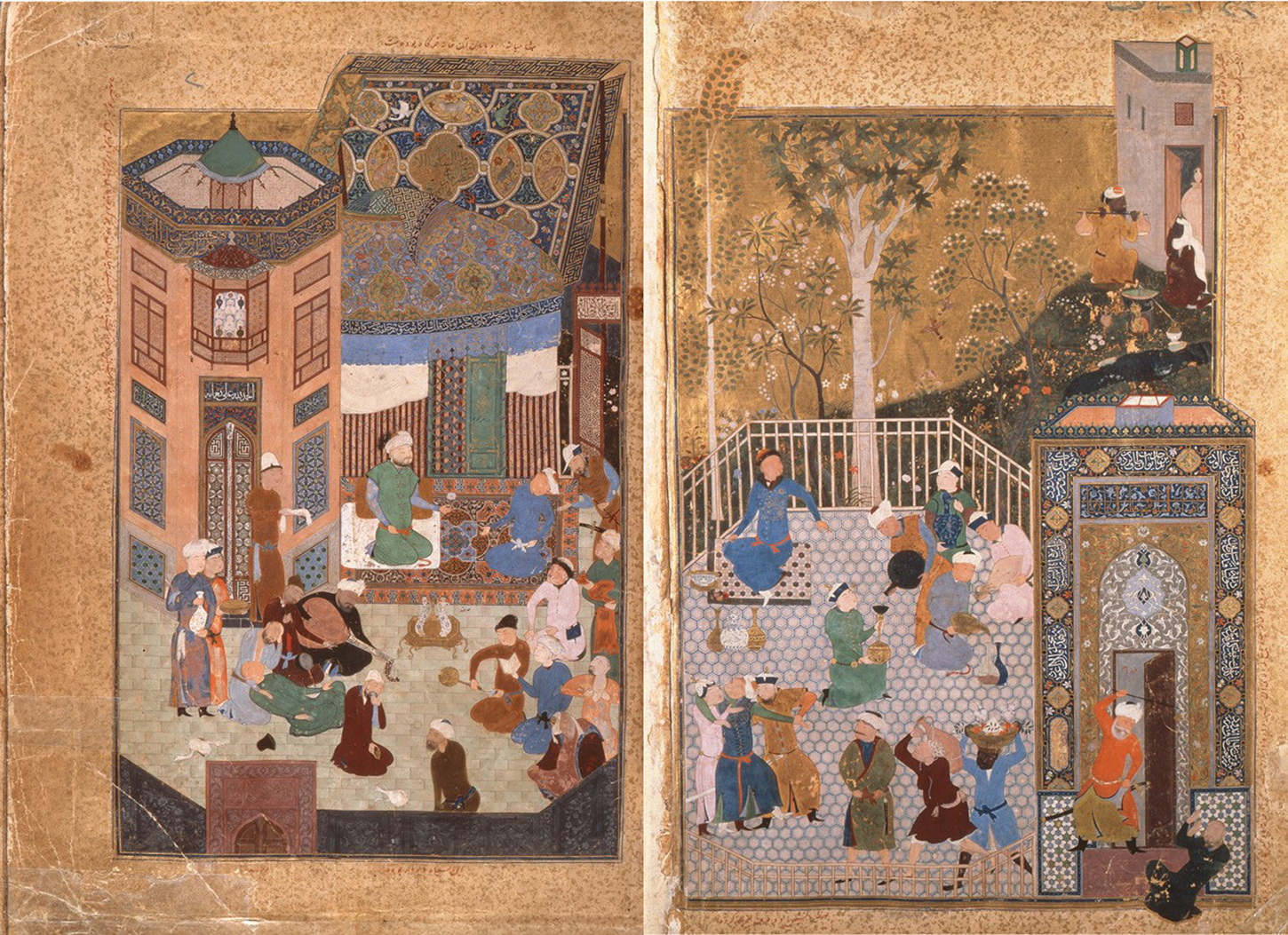
The double-page frontispiece to the manuscript of Saʿdi's Būstān transcribed for the penultimate Timurid ruler Sultan Husayn (r. 1469–1506) and now in the National Library of Egypt (Adab Farisi 22; see Figure 1) is well-known and oft-published. Reproduced repeatedly since the turn of the twentieth century,Footnote 1 the illustration has become part of the canons of Persian painting,Footnote 2 Timurid art,Footnote 3 works by the artist Bihzad and his circle,Footnote 4 masterpieces in the Cairo Library,Footnote 5 and more.Footnote 6 Scholars regularly cite its period details, from metalwork vessels to trellis tents.Footnote 7
Double-page frontispiece (folios 1b–2a) in a manuscript of Saʿdi's Būstān produced at Herat in 893–94/1488–89. Source: Cairo, Dar al-Kutub, ms. Adab Farisi 22.
Barbara Brend, the scholar we honour in this volume, who has written so evocatively about Persianate painting, analysed the identity and pose of several figures in it.Footnote 8 Here I should like to continue this lengthy isnād by examining the frontispiece in the context of the manuscript to which it belongs, first structurally as the opening spread in a codex, then literarily as the introduction to a specific text, and finally, historically as a pictorial encomium to the princely patron for whom the manuscript was produced. My point is to pose, if not necessarily answer, questions about three different ways of reading this and other pictorial frontispieces,Footnote 9 to suggest reasons why such information can be useful, and to show how erudite this particular example is.
Codicology
In contrast to the long-standing interest in miniature painting, codicology—broadly defined as the study of the book as a physical object—is a relatively new focus in the study of manuscripts made in the Islamic lands. The first manual about it was published only at the start of the twenty-first century, a hundred years after the earliest reproductions of the Būstān frontispiece.Footnote 10 The codicological method has quickly gained traction, as shown by two very recent and very weighty publications that illustrate contrasting methods of applying it to manuscripts that bracket the Cairo Būstān chronologically: Nourane Ben Azzouna's overview of 125 manuscripts made under the Timurids’ predecessors, the Ilkhanids and Jalayirids; and Elaine Wright's monograph on a single, large, and exquisitely decorated Qurʾan manuscript produced by the calligrapher Ruzbihan at Shiraz in the mid-sixteenth century under the Timurids’ successors, the Safavids.Footnote 11 These publications and other recent studies show how codicology can inform us not only about how a manuscript was made but also about how it was used and preserved.Footnote 12
The Cairo Būstān confirms the novelty of the codicological approach, because—in contrast to the many reproductions and discussions of the frontispiece—relatively little information has been published about the codex itself.Footnote 13 It is a fair size (30.5 × 21.5 cm, about the same dimensions as modern typing paper) but slender (54 folios) volume.Footnote 14 Virtually nothing has been reported about the paper on which the text was copied, but it is likely very fine, like that used in many other high-quality manuscripts of the Timurid period such as the contemporary copy of ʿAttar's Manṭiq al-Ṭayr completed on 1 Jumada 892/25 April 1487 (Metropolitan Museum of Art 63.210).Footnote 15
To prepare the paper for writing, the bifolios in the Būstān were ruled with a masṭar, a set of strings stretched over a frame to provide a grid for writing.Footnote 16 Following the pictorial frontispiece and a double-page of illumination with blank octafoils in the centre, perhaps intended for the poem's title or the patron's name (fols. 2b–3a), the text proper opens on folios 3b–4a with an elaborately decorated spread.Footnote 17 Each regular page has four columns with 23 lines. This layout is typical of other contemporary manuscripts of the same size and quality such as the Manṭiq al-Ṭayr, which has 22 lines in a manuscript now of similar size (33 × 21 cm). This arrangement allowed the 4,110 lines of Saʿdi's poem to fit comfortably within the codex's 103 text pages.
The next step in preparing the manuscript was to gather the sheets into quires. Since the manuscript has been rebound, we do not know the original arrangement, but it was likely quaternions (gatherings of four bifolios). They were the most common arrangement in fifteenth-century Persian manuscripts, although quinions (gatherings of five bifolios) were also used.Footnote 18 It would be useful to have an accurate collation, since some adjustment must have been made to reach the requisite number of 54, which is not a multiple of eight (nor of ten). It is theoretically possible that the frontispiece was added by laminating a sheet to the original text block, as the opening folios of a manuscript are often adjusted when it changes hands or is rebound. For example, when the poems in a well-known copy of Khwaju Kirmani's Khamsa made for the Jalayirid prince Ahmad passed to the Safavids, a new large dedicatory roundel (shamsa) was added on what had been folio 1a and a new heading (ʿunwān) added on folio 1b.Footnote 19 In the case of the Timurid Manṭiq al-Ṭayr, the opening two folios were replaced when it was rebound in the Safavid period.Footnote 20
These changes can become even more complicated when a manuscript is repeatedly moved. Close examination of a large Qurʾan manuscript once thought to be a product of mid-fifteenth century Timurid Herat, but actually an early Safavid work that travelled to the Deccan, showed that the opening was a composite of parts, hands, and eras: both folios of the frontispiece are laminates, the right a triple laminate and the left a double.Footnote 21 In the case of the Būstān, it is highly unlikely that the double frontispiece was added since the style of painting fits so well with the date of the manuscript, but for many manuscripts with a complicated history, it is a subject worth investigating.
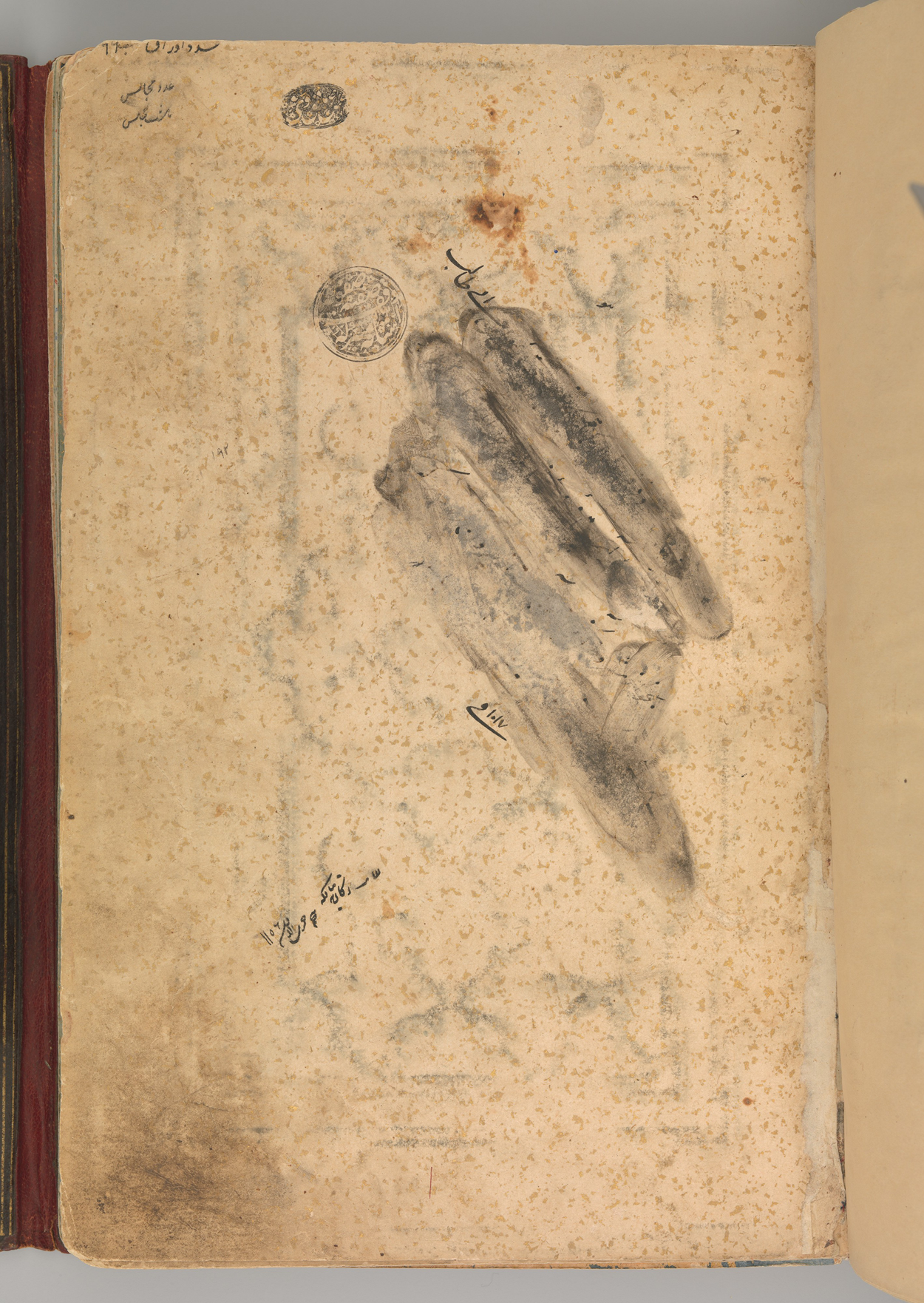
Likewise, nothing has been published about the opening page (fol. 1a) of the Būstān. It was often the place for notes by later readers or owners. This is the case not only with contemporary Manṭiq al-Ṭayr (see Figure 2), but also with a copy of Saʿdi's Gulistān finished by the same calligrapher in Muharram 891/January 1486, whose opening and closing pages are covered with later inscriptions and seals showing the manuscript's warm reception at the Mughal court.Footnote 22
Opening page (folio 1a) from a copy of ʿAttar's Manṭiq al-Ṭayr produced at Herat in 892/1487. Source: New York, Metropolitan Museum of Art 63.210.
Once the codex for the Cairo Būstān was prepared, the next step was to transcribe the text on it. We have more information here, as the manuscript ends with a detailed colophon at the bottom of folio 54b saying that the poor, sinful slave Sultan ʿAli al-Katib, may God forgive his sins and pardon his faults, finished it at the end of Rajab 893/early July 1488.Footnote 23 Despite the humility used, the calligrapher was a favourite at Sultan Husayn's court who had transcribed the Gulistān and Manṭiq al-Ṭayr manuscripts in the preceding two years.Footnote 24 Several scholars have argued that the lack of phrases such as the “royal calligrapher” (al-kātib sulṭānī) or “for the treasury of Sultan Husayn” in these manuscripts suggest that they were made not for the sultan but for his vizier and boon companion, ʿAli Shir Navaʾi.Footnote 25 Such arguments seem less convincing in face of the wording in the colophon of the Būstān, probably the finest manuscript indubitably made for the prince. This phraseology was typical, and the humility on the part of the calligrapher should be seen as a coy conceit, particularly as calligraphers were typically deemed the artists with the highest status.
In copying the Būstān, Sultan ʿAli left space for four nearly full-page illustrations: “Dara and the Herdsman” (fol. 10a), “A Beggar in a Mosque” (fol. 26a), “A Discussion at a Qadi's Court” (fol. 30a), and “The Seduction of Yusuf” (fol. 52b). To get the appropriate break-lines that encapsulate the subject for each illustration, the calligrapher wrote some verses on the preceding pages on the diagonal, as he had done in other manuscripts. For example, on folio 43b of the Manṭiq al-Ṭayr) (see Figure 3b), Sultan ʿAli penned seven verses diagonally so that they took up the equivalent of 12 lines on a regular page. He manipulated the text in this way so that the anecdote about the man who fell into the water starts on the facing page, just above the miniature depicting that subject (see Figure 3a).Footnote 26
Double-page spread (folios 43b–44a) from a copy of ʿAttar's Manṭiq al-Ṭayr produced at Herat in 892/1487, with text on the right describing the anecdote about the man who fell into the water and the illustration on the left. Source: New York, Metropolitan Museum of Art 63.210.

Sultan ʿAli manipulated the text in the same way in the Būstān manuscript to provide the appropriate break-lines for the first painting of Dara, the left side of a double spread.Footnote 27 It illustrates the poem's second tale, which begins at the bottom of the facing page on the right.Footnote 28 The story recounts that one day while hunting, Dara was separated from his entourage. A herdsman rushed toward him, and fearing lest he be an enemy, Dara drew his bow and arrow. After the man explained that he was in charge of the royal horses, Dara calmed and admonished the herdsman that he was lucky not to have been shot. To this, the herdsman retorted that good counsel cannot be withheld from a benefactor. The herdsman continues with the moral of the story (the text is on the reverse side of the folio) that it is neither laudable nor good judgement when a king cannot distinguish friend from foe and that since he, as a herdsman, can recognise all the king's horses, the king in turn should be able to recognise his own flock.
To have the lines of dialogue between king and herdsman bracket the painting on the left page, the calligrapher wrote two lines of text sloping upwards on the diagonal in the middle of the right page to fill an area normally occupied by six lines of text. These diagonal lines not only space out the text, but their forward slant also directs the reader's eye toward the centre of the blank space left for illustration on the facing page. The painter took advantage of the arrangement by filling that area with the torsos of Dara and the herdsman, the protagonists of the scene. Text and image therefore work together to enhance meaning.
In laying out the following three illustrations, Sultan ʿAli manipulated the text in the Būstān differently by inserting lines on the diagonal around or in the areas left for illustration. The final illustration showing “The Seduction of Yusuf” provides a telling example (see Figure 4).
Folio 52b with a scene of Yusuf fleeing Zulaykha in a manuscript of Saʿdi's Būstān produced at Herat in 893–94/1488–89. Source: Cairo, Dar al-Kutub, ms. Adab Farisi 22.

The horizontal lines at the top of the painting contain the end of the previous tale about a man surprised in a guilty act.Footnote 29 The story of Yusuf and Zulaykha begins in the diagonal line in the middle of the image.Footnote 30 It says that Zulaykha, drunk with the wine of love, hung by her hand onto Yusuf's skirts. The next line of the poem, written diagonally at the bottom left of the space for illustration, continues that she had so yielded to appetite's demon that she fell on Yusuf like a wolf. The painter took up the verbal clue of these two lines, depicting exactly that scene of Zulaykha clinging to Yusuf's skirts.Footnote 31 This arrangement of text and image of Zulaykha clutching Yusuf's robe struck a chord, for it is repeated very closely in another manuscript of the Būstān perhaps transcribed at Herat but illustrated several decades later in Bukhara, a place where the paintings in the Cairo Būstān seem to have had particular resonance.Footnote 32
To judge from their locations within the text of the Cairo Būstān,Footnote 33 the four paintings are not equally distributed throughout the codex but appear at irregular intervals, likely in different quires. The arrangement suggests that the subjects of illustration were not random but chosen wilfully to illustrate specific points, in the same way as those in the contemporary copies of the Gulistān and the Manṭiq al-Ṭayr.Footnote 34
The last two paintings in the Būstān are also dated, and combining their dates (894/1488–89 and 893/1487–88, respectively) with the date in the colophon, we can estimate that making the codex was a two-year project. Work must have begun early in 893/1488 to allow several months for the atelier to prepare the paper and text block and for Sultan ʿAli to finish the transcription by late Rajab/early July of that year. Adding the paintings continued into the following year, after which the illumination and binding must have been completed.
The dates on the paintings in the Būstān tell us, furthermore, that they were not done in sequential order: the fourth image of “The Seduction of Yusuf” is dated one year before the third showing “A Discussion at a Qadi's Court”. In manuscripts made previously for the Jalayirids, paintings were often added sequentially,Footnote 35 so it would be helpful to ascertain whether Timurid ateliers followed a standard procedure. This is particularly interesting as in the case of the Manṭiq al-Ṭayr, the last four illustrations are contemporary with the copying, but the first four were added or replaced in the Safavid period.Footnote 36
Codicological information in the Būstān also helps us track the manuscript's later peregrinations. The codex passed from the Timurid royal library to the Safavids, where several changes took place.Footnote 37 One was the addition at the end of the text block of a page with excerpts from Nizami's Khamsa copied at Urdubad al-Tabriz on 15 Muharram 919/23 March 1513 by Shams al-Din Muhammad al-kātib al-kirmānī (fol. 55a).Footnote 38 A renowned calligrapher who worked at the court of Shah Tahmasp, he is mentioned in the prefaces to several albums assembled for the Safavids and in the chronicle of court practice written for the Mughal emperor Akbar.Footnote 39 The artist transcribed both calligraphic specimens and complete manuscripts, including a copy of the Būstān dated to the first day of 1509/21 April 1509, with space for three illustrations.Footnote 40 In preparing it, he might have examined the Cairo Būstān as exemplar.
The page bound into the Cairo Būstān, however, seems to be a calligraphic specimen, not part of a complete manuscript. The text comes from the Sharafnāma, the first part of the Alexander tale (Iskandarnāma), the fifth book in Nizami's Khamsa. The page contains most of the story of Alexander and the Chinese slave girl, but the last two distiches at the bottom left contain the invocation to the cupbearer (sāqīnāma) from a much earlier section of the poem.Footnote 41 The text, furthermore, is laid out most unusually, with extremely lengthy paratextual information about the scribe scattered around the page in triangular boxes. In a manuscript, by contrast, a colophon usually comes in a single block at the end of a complete poem, as is the case with the Cairo Būstān. And, most tellingly, there is no text on the reverse side of the page with verses penned by Muhammad al-Kirmani.
We do not know why or where Muhammad al-Kirmani's calligraphic specimen dated 919/1513 was added to the text block of the Cairo Būstān. One might speculate that, had the calligrapher consulted the earlier manuscript as exemplar, he might inadvertently have left the loose calligraphic page in the manuscript into which it was later bound, but this is just a conjecture.Footnote 42 The date of Muhammad al-Kirmani's calligraphic specimen, however, provides a terminus post quem for other changes to the Būstān manuscript that took place in the Safavid period.Footnote 43 One was to re-margin all the folios, including that with Muhammad al-Kirmani's calligraphic specimen, with gold-flecked paper, likely made by stippling with a brush.Footnote 44 The gold-flecked margins are carefully fitted around the illustrations, as in the tip of the tree in the right side of the frontispiece (see Figure 1b) and the finials of the cupolas in the “Seduction of Yusuf” (see Figure 4). At the same time, the manuscript may have been rebound in the present binding of pressure-moulded and stamped brownish-red leather with gold tooling and doublures of leather filigree (munabbatkārī) cut in a floral grid and pasted against a multi-colour ground.Footnote 45 This combination was popular in the Safavid period, used for the rebinding of other fine manuscripts such as the Timurid copy of the Manṭiq al-Ṭayr, refurbished by the Safavids circa 1600.Footnote 46
The re-margining and binding of the Cairo Būstān must have taken place before the mid-seventeenth century, for the reverse side of Muhammad al-Kirmani's calligraphic specimen (fol. 55b) bears the impression of an octagonal seal in the name of Pir Budaq, slave (ghulām) of Shah ʿAbbas II, with the date 1053/1643–44.Footnote 47 The seal suggests that the manuscript had moved to Isfahan, seat of the Safavid court since the turn of the seventeenth century. It also shows that the manuscript was not part of the royal collection, but was in the hands of a ghulām, a new type of courtier who rose to power in the later Safavid period.Footnote 48 Such courtiers, who often served as provincial governors, were also wealthy collectors and patrons. For example, Qarachaqay Khan, an Armenian whom ʿAbbas I had appointed as governor of Khurasan, owned a collection of fine Chinese porcelain that was endowed to the shrine at Ardabil, along with that of the monarch himself. Other slaves patronised the arts of the book. At some point, likely when the rebound Būstān codex was in Safavid hands, someone carefully added glosses in and around the paintings in a fine nastaʿlīq script, different from the shikasta used in later, particularly Qajar, times.
From Iran, the Būstān manuscript moved west to Cairo where it entered the collection of the Khedival Library, founded in 1870 and later the National Library of Egypt, as shown by an undated circular stamp in purple also on folio 55b.Footnote 49 The caption to the frontispiece in Gayet's publication attests that the manuscript was there by 1895.Footnote 50 While in the collection, a librarian used blue pencil to write the shelf number Adab Fa[risi] 22 on the upper corner of the frontispiece (fol. 1b) and foliation numerals in the upper left corners of the rectos of all the folios. The librarian also added a note in Arabic in the upper right corner of folio 55b saying that “the number of its folios is 55”, followed by an illegible name. Copyists in the Islamic lands rarely foliated their manuscripts, and the earliest examples often display alphanumeric (abjad) numerals.Footnote 51 The ones in the Būstān are written using digits typical of the Ottoman lands, the same type found on many manuscripts in the Topkapı Library.Footnote 52
These internal clues show that the Būstān's peregrinations were quite different from those of its Timurid contemporaries, the Manṭiq al-Ṭayr and the Gulistān, both of which also passed to the Safavids but then travelled east to India.Footnote 53 The Manṭiq al-Ṭayr belonged to Shah ʿAbbas I when the codex was revamped circa 1600 with the addition of 15 folios, the first four illustrations, and a binding.Footnote 54 A large round seal on folio 1a, reading waqf-i āstāna-i mutabarrika-i ṣafiyya-i ṣafaviyya (waqf of the blessed, pure shrine of [Shaykh] Safi[uddin]), alongside a defaced inscription mentioning the Prophet's son ʿAli b. Abi Talib and ending with the year 1017/1608 (see Figure 2), shows that the codex was part of the collection of illustrated manuscripts that Shah ʿAbbas bequeathed to the dynastic shrine at Ardabil.Footnote 55 Another oval seal with a few undecipherable words written diagonally was also added in the Safavid period.Footnote 56
The Manṭiq al-Ṭayr manuscript did not remain in the Ardabil shrine until its sacking by the Russians in 1826, as is sometimes suggested.Footnote 57 By the eighteenth century the manuscript was in a private collection, since a note in the middle of folio 1a says that on 5 Jumada I 1156 (27 July 1743), it was owned by (mālikuhu) someone whose name is illegible.Footnote 58 The manuscript was likely in the Indian subcontinent by this time, as the figure 6 in the date leans over in typical Indian style. While in India, someone else added other notes in the upper left corner that the number of folios is 66 and the number of illustrations is eight. The way of writing hasht (“eight”) is Indian, and the note uses the term majālis (sing. majlis), standard in the region for crowd scenes but used here to refer to illustrations in general. The codex then passed to the collection of someone named Farid Parbanta, whose surname is surely a variant of the Indian surname Pravanta. He sold it at Sotheby's London on 9 December 1963 (Lot 111), when it was purchased by the Metropolitan Museum.
The contemporary Gulistān had a more straightforward trajectory.Footnote 59 It was acquired by Akbar's mother, Hamida Banu, perhaps while she was in exile at the Safavid court in the 1540s with her husband Humayun. She gave it to her son Akbar, and the codex was annotated by several Mughal court librarians. In 1913 an Armenian dealer Monsieur Yermant of the Telefian Company bought it “for export”, presumably to Europe, where it passed to the Rothschilds and then to the American bibliophile John Goelet from whom it was acquired by the Art and History Trust Collection. These prize codices thus travelled far and wide, but following different pathways.
Content
In addition to looking at a frontispiece as the opening spread in a codex, one can also examine it as the pictorial introduction to a specific text, in this case the Būstān, the moralistic and anecdotal poem that Shaykh Muslih al-Din Saʿdi completed in 655/1257 for the atabeg of Shiraz, Abu Bakr ibn Saʿd ibn Zangi.Footnote 60 The poem, whose name is often translated as “Kitchen Garden” or “Orchard”,Footnote 61 belongs to the genre known as a “mirror for princes”, didactic tales intended to give advice to rulers and inculcate a code of conduct, combining the realistic and pragmatic with the mystical and high-minded. Its 4,110 couplets are divided into ten chapters on justice and good government, beneficence, earthly and mystic love, humility, acceptance, contentment, and other excellences. The morals in them develop out of 160 tales, and the poem's immediacy and originality have made it a favourite, regularly read in primary schools and mined for its pithy epigrams.
Already in the Ilkhanid period, painters had tailored some frontispieces to the texts they open, particularly in the case of the traditional author or literary topos.Footnote 62 A good example is the double-page illustration at the end of the introduction (fols. 3b–4a) in a copy of the Rasāʾil Ikhwān al-Ṣafāʾ (Epistles of the Sincere Brethren) transcribed at Baghdad and finished in Shawwal 686/November 1287.Footnote 63 The five figures with turbans depicted in the double story-arcade can be identified as the five philosophers who compiled the text, including the one responsible for the book (alfāẓ al-kitāb), al-Maqdisi, the figure on the left side of the right page writing it down. The sixth figure, the one in the centre of the right side who wears different headgear (a shawl), must be the type of revered figure from whom the sages collected their information orally.Footnote 64
By the early fourteenth century a new type of frontispiece had become standard in Persian manuscripts: the princely topos that shows an enthroned prince on the left and various princely courtiers and activities, especially hunting, on the right.Footnote 65 Perhaps inspired by the popularity of the Shāhnāma, the Persian national epic that recounts the history of Iran from creation to the Arab conquests, this type of frontispiece was also used in other manuscripts, including fables and the “mirror for princes” genre.
The double frontispiece in the Būstān is an elaboration of the royal topos that riffs on the text of the Būstān (and the historical setting in which it was made: see ‘Setting’ below). Like earlier double frontispieces of this type, it shows the prince on the left and courtly activities on the right, but the scene has been updated to a palace beside a stream in a garden with flowering trees and bushes, a botanical setting that recalls the title of the poem. The prince, positioned in the centre of the inner courtyard, kneels on a carpet. In front, his boon companions gather in a circle. Musicians play a kamānchay (a type of spike fiddle) and an oud (a lute),Footnote 66 while a beardless youth holds an open book, an allusion to the manuscript in which the scene is depicted. Some courtiers listen in rapt attention, but many are overcome by emotion. One rips open his shirt, while another sobs into his kerchief. A third has fainted, his turban cloth and skull cap tumbled to the ground. An elderly man has nodded off. They are all reacting to the emotional power of the text.
The sultan's pose can be “read” as a visual allusion to the name of the poem: he is not enthroned, facing frontally, but rather kneeling sideways proffering a rose, a pun on the literal meaning of the title Būstān, a place of fragrance. The same allusion occurs in another double-page painting that shows the sultan reclining in a garden holding a rose.Footnote 67 The painting is now detached from its parent manuscript and mounted in the Gulshan Album in Tehran, but Brend astutely suggested that it had been prepared several years earlier for a copy of the Gulistān for which the Būstān would have followed as a companion piece.Footnote 68
The courtiers in the outer courtyard on the right of the Būstān frontispiece extend the bucolic scene. Servants carry out another companion overcome with emotion, or perhaps with the red wine that is being liberally decanted from skins and vessels into glass and metal bottles. Another courtier holds an elaborate blue ewer decorated with a flowering vine. In the foreground, servants tote in more provisions, including a basket of fancy fruit. Two scenes beyond the palace courtyard recall the type of tales that form the structural backbone of the poem. In the upper right a black couple distil alcohol in front of a wine-house. In the bottom right, an aged gatekeeper thrashes a poor man to prevent him from entering the palace. These are the type of action scenes illustrated in the Būstān paintings, and one can easily imagine the morals that these stories might evoke.Footnote 69
Even the architectural setting of the palace in the frontispiece echoes the structure of the poem.Footnote 70 The scene is constructed around a series of gateways, in Persian bāb, the same word Saʿdi used for the ten chapters in his Būstān. One enters the outer courtyard as architecture, the painting as illustration, and the poem as text at the bottom right. The text over the doorway plays on the idea of gateways: “the gates of kings are where one turns in need” (abwāb al-mulūk qiblat al-ḥājāt).Footnote 71 The viewer's gaze continues to the left side of the painting, where a courtier in another doorway bows towards the palace's inner courtyard. It is accessible also by a third reddish portal in the front that is inscribed “O, opener of Gates” (yā mufattiḥ al-abwāb), a reference to God but also to the gates of the palace and the opening of the text. The metaphor of doorways continues in the final illustration in the manuscript (see Figure 4), in which Yusuf miraculously flees through the seven gateways of Zulaykha's palace. The painters deliberately underscore the links between the two illustrations, the first and the last in the manuscript:Footnote 72 the artists give both palaces similar paved and walled courtyards with reddish entrance portals and inscribe the entrance to the courtyard of Zulaykha's palace with the phrase “God and none but Him” (allāhu wa-lā sawāhu), the same one inscribed on the right panel of the hexagonal pavilion in the frontispiece.
Verbal and visual analogies interweave through these first and last paintings in the codex. The outer gateway on the right in the frontispiece has cartouches inscribed with verses saying that the paving (farsh) below the arch (ṭāq) is so high that it surpassed the seven gem-studded ceilings, referring to the seven climes. The frieze below the hexagonal pavilion on the left evokes the palace (qaṣr) and the brick (khisht) of its pavement (farsh). The cartouches on Zulaykha's palace pick up the metaphor of gateway, with the couplet: “If a spectator were to pass through there, he would drool from being deprived [of it]. In it were only lover and beloved and no one else—no fear of being disturbed by the police or interrupted by the nightwatchman”.Footnote 73 The line recalls the scene in the lower right of the frontispiece in which a gatekeeper prevents a poor man from entering.
Altogether then, the painters of both the frontispiece and the other illustrations in the Cairo Būstān encourage the reader to meditate on the text by adding sophisticated visual and verbal glosses to the words that these pictures embellish. They encourage the reader to go back and forth between text and image, and in this way, they set the stage for the elaborate architecture inscriptions added to the paintings in the most ambitious illustrated manuscript of the Safavid period, the Shāhnāma prepared for Shah Tahmasp in the early sixteenth century.Footnote 74
Setting
A third way of reading the frontispiece to the Būstān is to place it in its contemporary context. Already in the Ilkhanid period, painters had adapted some frontispieces to fit the architectural settings in which the manuscripts were produced. In the author portraits at the beginning of the Rasāʾil Ikhwān al-Ṣafāʾ dated 686/1287, for example, the painters updated the locale from the tenth-century Basra of the text to a thirteenth-century brick building with segmented arches in the upper story that is set next to a river, possibly an allusion to the major centre of learning in Ilkhanid Baghdad, the Mustansiriyya Madrasa.Footnote 75
Two hundred years later, the artists of the Būstān frontispiece made even more specific references to the contemporary setting, not only geographical and architectural but also societal and personal. The scene is set in a riparian garden estate (bāgh), the type that developed in the Timurid period northeast of Herat along the new Royal Canal (jū-yi sulṭānī) that Sultan Husayn's predecessor Abu Saʿid (r. 1459–69) had built and which led to the shrine of the mystic ʿAbdallah Ansari (1006–88) at Gazur Gah.Footnote 76 The brilliantly glazed portal on the right side of the frontispiece is typical of the Timurid architectural style, as is the polygonal pavilion on the left, whose rows of vases over the doorway evoke the type of chīnī-khāna (“house of porcelain”) known from historical sources.Footnote 77 The tent and accoutrements are not only typical of the period, but even depict known objects: there are many similar pouring bowls of the type used to decant the wine in the frontispiece, including one dated 893/1487–88, the year mentioned in the Būstān's colophon, and the blue-and-white flask faithfully depicts a unique example from the early Ming period now in the Percival David Collection or a now-lost counterpart.Footnote 78
The architectural setting in the Būstān frontispiece clearly resonated with the reader who added the glosses in the Safavid period. These glosses enumerate the major elements in the paintings. For example, the line beneath “Dara and the Herdsman” says “Image of the prince and a depiction of the herdsman, the dugh [a drink of fermented yogurt] sack, the mountains, and the plain” (ṣūrat-i malikzāda u taṣvīr-i īlqībān u khek-i dogh u koh u hāmūn). These all enumerate people or things readily identifiable in the image.
In the frontispiece, the glosses describe architectural elements exclusively. Beginning in the lower right, the open door is inscribed “entrance” (dāramād). To the right of the portal the vertical inscription reads “in the gateway to the charbagh, over which is a lattice, and in the middle of the lattice is a structure like a windcatcher, and on top of that …” (dar dārakhāna-i chārbāgh ki bālā-yi ān shabaka dārad u dar miyān-i shabaka hamchun khāna bādgīr numā karda u bālā-yi …). Above it, another vertical inscription says “lattice above the room that is located on one side of the chahārbāgh” (shabaka-i bālā-yi khāna ki dar yak taraf-i chahārbāgh wāqi’ shuda). The gloss below the outer courtyard identifies it as a “platform or sitting place with a balustrade” (ṣuffa yā nishīman du taraf-i panjara karda).
The glosses on the left half identify even more architectural elements. At the top, the construction is described as “a canopy, and below that is a domed tent (shāmiyāna u pāyān-i ān, khāna-i khargāh budast)”, and the pole supporting the canopy is labelled “tent pole” (sulūq-i shāmiyāna). The green doorway is identified as the “door of the domed tent” (dar-i khargāh), and the word ṣuffa (raised platform) is written beneath the rug. The building on the left side of the courtyard is termed “a two-storey hexagonal building with lattice on the upper story, on top is a windcatcher, and the top of the windcatcher is covered with green canvas” (dar dārakhāna shish du-āshyāna bālā shabaka miyān-i ān bādgīr karda, bālā-yi bādgir-rā ba-karbās-i sabz poshīda). At the bottom is the sentence “this black is the wall” (īn siyāh dīvār būda), and the text below the portal seems to repeat the word “entrance” (dāramād).
Whereas in the case of “Dara and the Herdsman”, the later reader was able to rattle off the major elements, this was not the case with the frontispiece. Comments such as “this black is the wall” show that he had difficulty “reading” space. Having puzzled it out, he then took pains to explain it for others. His comments point out how unusual this frontispiece is.
The elaborate architectural complex depicted in the frontispiece provides the setting for a literary soirée (majlis or ṣuḥbat) at which the sultan and his courtiers traded intricate riddles (muʿammā), often veiled in literary allusions.Footnote 79 Mystical poetry was popular at Sultan Husayn's court, especially that of the Naqshbandi shaykh ʿAbd al-Rahman Jami (1414–92).Footnote 80 He was such a close companion of the ruler and his vizier Mir ʿAli Shir Navaʾi that the three men are said to have constituted a religious, military, and administrative “triumvirate” governing Khorasan. In the early 1480s, a few years before the Būstān manuscript was made, Jami had completed his seven long mathnavīs known collectively as the Haft Awrang (“The Seven Thrones” or “The Constellation of the Great Bear”). It is the source of the two lines decorating the cartouches on the iwan of Zulaykha's palace (see Figure 4),Footnote 81 and inscribing them there connects Jami to his predecessor Saʿdi. The year before this manuscript of the Būstān was begun, Jami had completed his Bahāristān, an anecdotal and moralistic work of belles-lettres modelled on Saʿdi's Būstān.Footnote 82 The cartouches at the top and bottom of the elaborately illuminated opening text page of the Būstān manuscript (fol. 2a) are inscribed: ṣurat-i būstān-u tadhhībish / az gulistān namūdārī (“the form of the Būstān and its illumination point to the Gulistān”).Footnote 83 The artists may well have intended the analogy to extend to Jami's Bahāristān whose verses are inscribed on Zulaykha's palace, the final illustration in the codex.
The figures at the majlis depicted in the Būstān frontispiece represent real people. The protagonist is Sultan Husayn, identifiable as he wears his distinctive plumed turban and silk robe and sits beneath a canopy inscribed with praises to him.Footnote 84 He presents a rose to his beloved, named as one Mir Baba in the Majālis al-‘ushshāq (“Gatherings of lovers”), a Sufi treatise composed in 1503.Footnote 85 Brend identified the figure wearing a gold-embroidered blue robe and fur-trimmed hat on the right side of frontispiece as the sultan's eldest son Badiʿ al-Zaman, arguing that the prince's isolation, tense posture, and averted face underscore his estrangement from his father, an enmity that culminated in Badiʿ al-Zaman's rebellion in 1506.Footnote 86 The frontispiece not only shows contemporary actors, but also underscores the political tensions at Sultan Husayn's court and sets the scene for the manuscript's following four illustrations chosen to show the sources of his princely authority: the hunt,Footnote 87 the mosque, the judiciary, and the palace.Footnote 88
Along with the real people depicted in the Būstān frontispiece, the manuscript contains an unusual number of informal ‘signatures’ by artists, written in different sizes.Footnote 89 In addition to the colophon mentioning the calligrapher Sultan ʿAli, the opening page contains a teeny-weeny ‘nano’ signature of the illuminator Yari, likely Yari Haravi, the master illuminator working at Herat who also signed the illumination in several contemporary manuscripts copied by Sultan ʿAli, including the Gulistān.Footnote 90 The inscription “work of Bihzad” is included on all four paintings: two ‘micro’ signatures on the quiver in “Dara and the Huntsman” and on the book in a “A Beggar in a Mosque”, and two ‘mini’ signatures in the architectural revetment in “A Discussion at a Qadi's Court” and “The Seduction of Yusuf” (see Figure 4). The architectural revetment on the entrance portal on the right frontispiece also ended in a ‘mini’ signature that is now defaced. Arménag Bey Sakisian, who saw the painting in 1931 when it was being exhibited in London, made out the words ʿamal (work of) and naqqāsh (painter/designer) and suggested that the inscription contained the name Mirak.Footnote 91 A calligrapher, illuminator, and painter, he is said to have been the director of Sultan Husayn's atelier and Bizhad's mentor.Footnote 92 The name Mirak would make sense following Ada Adamova's suggestion that the first painting in a manuscript was often attributed to a major artist in the court studio, typically of the older generation.Footnote 93 Putting Bihzad's name on the following paintings then illustrates the master-pupil chain of transmission that chroniclers used in album prefaces to record the histories of calligraphy and painting.Footnote 94 Dust Muhammad, librarian and calligrapher at the Safavid court, composed the most famous of these prefaces in 951/1544–45 for an album dedicated to the prince Bahram Mirza, but such album prefaces were already being written at the Timurid court in the late fifteenth century. The earliest known is that composed by Murvarid in 897/1491–92 for an album for the Timurid vizier Mir ʿAli Shir.Footnote 95 Through careful analysis of these albums, David Roxburgh showed that the authors arranged the varied material in their albums to pictorially complement the chains of transmission described in the prefaces.Footnote 96 The signatures of Mirak and Bihzad in the Būstān would illustrate a similar chain of transmission, especially as Mirak's occurs on the portal opening the frontispiece and would have been particularly appropriate given the multiple contemporary references in it.
Artists’ informal signatures typically occur on expensive objects made for courtly patrons,Footnote 97 but the Cairo Būstān is unusual among manuscripts in having so many—and one can question why.Footnote 98 One clue may be the exactitude of the events depicted in the frontispiece: it shows not only a contemporary setting but also many identifiable figures and recognisable objects. Such specificity suggests that the manuscript may well have been made at a given moment for a particular purpose. This suggestion provokes two corollaries: might other figures or objects in the frontispiece represent specific people or things, and might other objects with multiple signatures similarly have been made to mark specific events? This is certainly the case with the splendid minbar commissioned by Nur al-Din Zangi in 564/1168–69 and signed by four artisans: it was ordered as an ex-voto for the Aqsa Mosque in Jerusalem in the hope of retaking the city from the Christians.Footnote 99 Scholars of Timurid history might profitably explore the exact time at which the Būstān manuscript was created, and scholars of Islamic art might investigate similar explanations for other objects with multiple signatures.
Brend's detailed analysis of the pose and identity of figures in the frontispiece to the Cairo Būstān opens a window into ways of looking not just at frontispieces in Persianate manuscripts but also of thinking about other objects made across the Islamic lands over the centuries. Examining in detail the codicology, content, and setting of the Būstān and its contemporaries by the same calligrapher—the Manṭiq al-Ṭayr and the Gulistān—shows how much information can be gleaned from the manuscript itself. Some information, such as paper quality and collation, require first-hand examination, but other facts such as owners’ notes and seals can be read, even at times more easily, from photographs. The reproductions need to show entire folios, as minor details written at the extreme edges of the folios, such as the style of writing or numbering in foliation, can inform us about later provenance.Footnote 100 It is also essential to publish spreads (not just illustrated pages), as sophisticated calligraphers took pains to organise the text on facing pages. This is the view readers see when perusing an open book, a leitmotif in this manuscript. In the left side of the frontispiece, the courtier holding the open book gazes directly at the sultan, with the diagonal line of the book's gutter pointing directly to the sultan's face. The open book reappears in a vignette in “The Beggar at the Mosque”, where the connection between books in general and this very manuscript is cemented by the artist's signature “work of Bihzad” written on the open pages and coyly highlighted by the reader's pointed finger.Footnote 101 As Brend perspicaciously showed, manuscripts—and other objects—have much to say.


 Open access

