

In the spring of 2020, the response to COVID-19 quickly became politicized (Green et al. Reference Green, Edgerton, Naftel, Shoub and Cranmer2020). As a result, researchers began to find that partisan identification was a strong predictor of whether Americans reported complying with stay-at-home orders and social-distancing guidelines (Allcott et al. Reference Allcott, Boxell, Conway, Gentzkow, Thaler and Yang2020; Gadarian, Goodman, and Pepinsky Reference Gadarian, Goodman and Pepinsky2021). These findings were corroborated by behavioral data that showed a substantial partisan gap in compliance with stay-at-home guidelines (Allcott et al. Reference Allcott, Boxell, Conway, Gentzkow, Thaler and Yang2020; Lipsitz and Pop-Eleches Reference Lipsitz and Pop-Eleches2020). Numerous studies documenting how partisanship shaped Americans’ response to the pandemic followed.
Nevertheless, as we show in this article, this intense focus on partisanship blinded scholars to important elements of the picture. Partisanship, of course, matters, but it is reinforced by and interacts with a range of other factors that shape how people think and behave in the context of a pandemic. In this study, we focus on the role of local norms, which we define as a place-specific form of social pressure regarding appropriate or inappropriate attitudes and behavior that is changed once a person steps outside their door and begins to observe or interact with the people in their immediate community.Footnote 1 We show these norms remain an important element in shaping ideas and behavior even in the current partisan era.
Building on literature in both social and political psychology, we use a combination of survey and experimental data to show how local norms interact with partisanship to shape Americans’ attitudes and behavior in the context of the COVID-19 pandemic. The results of our nationally representative online survey of more than 2,400 adults in June 2020, during the height of the COVID-19 pandemic, demonstrates that Republicans and independents were especially sensitive to local norms. To address the possibility that norms are endogenous to the local partisan context, we implemented a pre-registered survey experiment in March–April 2021.Footnote 2 It confirms that Republicans—and especially independents—who are exposed to information about increased mask usage in their state report a stronger intention to wear masks than those not exposed to information about high mask usage levels. These effects are considerably larger in low-mask-usage communities. Democrats are less responsive because their mask usage is already quite high and because they tend to live in places with high mask usage, where the treatment provides less surprising information.
While these studies confirm that local norms mattered as much as, if not more than, partisanship in shaping behavioral and attitudinal responses to the pandemic, one might question whether perceptions of norms are themselves shaped by partisanship. In the final section of this analysis, we use results from our experiment and an analysis of Google mobility data to confirm that respondents’ perceptions of norms were indeed shaped by what was happening around them, though this effect was stronger for independents than partisans.
Thus, what follows is a close examination of how individual partisanship and place-specific social pressure interact. While we show that local norms matter most for independents, we also show that partisans are not immune to what those around them are doing, especially when they are receiving mixed messages from party leaders. While we illustrate this interaction between norms and partisanship in just one context—the United States during the COVID-19 pandemic—we argue that there is good reason to believe that norms and partisanship interact in a similar fashion across a range of issues in the United States and elsewhere.
Norms, Health Behaviors, and Polarization
Social psychologists have long posited that subjective norms, defined as “social pressure to perform or not to perform [a] behavior,” are an important element in explaining individual action (Ajzen Reference Ajzen1991, 188). Scholars have debated the sources of this social pressure with different views placing emphasis on the consequences of breaching norms (Ullmann-Margalit Reference Ullmann-Margalit1978), on social roles and the implications for behavior that follow (Elster Reference Elster1989), and on the nature of the relations between actors (Horne Reference Horne2009). Debates have also focused on whether punishment for breaching norms, that is, norm enforcement, is an essential part of the definition of a norm (Horne and Mollborn Reference Horne and Mollborn2020).
Norms have been of particular interest to scholars working on issues of public health (Tankard and Paluck Reference Tankard and Paluck2016). An individual’s understanding of what is typical behavior of those around them (descriptive norms) or of what is normatively approved of by appropriate reference groups (injunctive norms) can significantly affect health-related behaviors, including gambling (Larimer and Neighbors Reference Larimer and Neighbors2003), extra-dyadic sex (Buunk and Bakker Reference Buunk and Bakker1995), and college drinking (Borsari and Carey Reference Borsari and Carey2003). In the context of the COVID-19 pandemic, research has found that “civic norms”—a component of social capital—were positively associated with social distancing (Bai et al. Reference Bai, Du, Jin and Wan2023), while citizens’ perceptions of their country’s norms regarding compliance with pandemic regulation affected their assessment of whether someone like themself would engage in social distancing (Bicchieri et al. Reference Bicchieri, Fatas, Aldama, Casas, Deshpande, Lauro, Parilli, Spohn, Pereira and Wen2021).
However, social norms are likely to vary widely within a single country and especially within those that are large and diverse. In recent decades, scholars have suggested that measures of subjective norms, which typically ask respondents if individuals who are important to them would approve of their behavior, may fail to capture normative pressure arising from people sharing the same spatial context (Passafaro, Livi, and Kosic Reference Passafaro, Livi and Kosic2019, 2). Fornara et al. (Reference Fornara, Carrus, Passafaro and Bonnes2011) offer a response to this by introducing the concept of “local norms” which arise “from social interactions that are localized in the specific places where the behaviors are actually performed” (625). As evidence of the term’s validity, they point out that an entire subfield in psychology—environmental psychology—is predicated on the idea that many psychological processes and behaviors have a “place-specific nature” (625). Fornara and colleagues then show that “local norms” explain variation in behavior beyond measures of subjective norms. Others have built on this work, showing that the effect of local norms on behavior varies as a function of the spatial proximity of an individual’s reference groups to their place of residence (Passafaro, Livi, and Kosic Reference Passafaro, Livi and Kosic2019).
Local norms have been found to affect individual health outcomes (Carroll et al. Reference Carroll, Paquet, Howard, Coffee, Adams, Taylor, Niyonsenga and Daniel2017); recycling (Passafaro, Livi, and Kosic Reference Passafaro, Livi and Kosic2019; Fornara et al. Reference Fornara, Carrus, Passafaro and Bonnes2011); gender pay gaps (Janssen, Sartore, and Backes-Gellner Reference Janssen, Sartore and Backes-Gellner2016); charitable giving (Agerström et al. Reference Agerström, Carlsson, Nicklasson and Guntell2016), and whether companies provide employee training (Kuhn, Schweri, and Wolter Reference Kuhn, Schweri and Wolter2022). Even before the Fornara et al. study, scholars had established that people are affected by the behavior of those around them, even when those people are strangers. For example, Goldstein, Cialdini, and Griskevicius (Reference Goldstein, Cialdini and Griskevicius2008) showed “provincial norms,” that is, “the norms of one’s local setting and circumstances,” are more effective for promoting environmental behavior than non-spatially specific descriptive norms (476). Even earlier, Cialdini, Kallgren, and Reno’s field experiments on littering in the early 1990s showed that people infer local norms from evidence of how people treat shared public spaces (Cialdini, Reno, and Kallgren Reference Cialdini, Reno and Kallgren1990; Cialdini, Kallgren, and Reno Reference Cialdini, Kallgren and Reno1991). These scholars may not have used the term “local norm” for the type of social pressure they were examining, but the term fits what they were describing.
Based on this literature, we posit that individuals residing in places where local norms are more supportive of compliance with COVID-19 regulations should be more inclined to comply, while those living in communities that are more hostile to them should be less so.
Hence, we expect that:
H1a: As the perception that local norms support COVID-19 health guidelines increases, individual compliance with those norms will also increase.
However, there is reason to believe that it is easier to change behaviors than attitudes, so local norms should have more of an effect on how people behave than what they think (Tankard and Paluck Reference Tankard and Paluck2016, 183).
H1b: As the perception that local norms support COVID-19 health guidelines increases, individual support for government measures aimed at stopping the spread of COVID-19 will also increase but these changes will be smaller than changes in compliance.
These straightforward expectations, however, are complicated by the reality of polarization in the United States and the politicization of the pandemic. Partisanship has become a form of social identity for most Americans (Greene Reference Greene1999; Green, Palmquist, and Schickler Reference Green, Palmquist and Schickler2004; Huddy, Mason, and Aarøe Reference Huddy, Mason and Aarøe2015; Iyengar, Sood and Lelkes Reference Iyengar, Sood and Lelkes2012). The fact that partisans are so attached to their parties means that party leaders can affect how supporters behave by establishing standards for typical or desirable behavior. For example, Clayton et al. (Reference Clayton, Davis, Nyhan, Porter, Ryan and Wood2021) demonstrate how President Trump’s words and deeds undermined support for democratic norms among his supporters. More generally, citizens respond to political leaders’ attitudinal cues (Zaller Reference Zaller1992; Carmines and Stimson Reference Carmines and Stimson1989); when leader messaging on salient issues diverges between the parties, the opinions of their supporters typically follow (Lenz Reference Lenz2013; Berinsky Reference Berinsky2009; Zaller Reference Zaller1992). The divergence in citizen opinion is usually confined to partisans, especially those who are politically aware (Layman and Carsey Reference Layman and Carsey2002). As new issues emerge and elite cues diverge, partisans adopt positions that align with their party identification.
COVID-19 was a highly salient issue in the spring of 2020 and party elite messaging regarding the pandemic quickly diverged, both in terms of the amount of time party leaders spent discussing COVID-19 and how they substantively framed that discussion (Green et al. Reference Green, Edgerton, Naftel, Shoub and Cranmer2020). Numerous polls from that period demonstrate that partisan attitudes began to diverge at the same time (e.g., Funk and Tyson Reference Funk and Tyson2020) with some studies linking this bifurcation in public opinion and behavior to the divergence in elite messaging (Bisbee and Lee Reference Bisbee and Lee2022; Goldstein and Wiedemann Reference Goldstein and Wiedemann2021).
While elite cues regarding COVID-19 diverged, Republicans received a less consistent message from their party leaders than Democrats (Goldstein and Wiedemann Reference Goldstein and Wiedemann2021). Some Republican governors broke ranks with the national party, emphasizing the severity of the pandemic and adopting strict social-distancing and masking guidelines. Early in the pandemic, Trump himself communicated a mixed message to Americans, sending out both reassuring and alarmist Tweets within days of each other (Bisbee and Lee Reference Bisbee and Lee2022). In contrast, Biden sounded the alarm on COVID-19 early and consistently communicated its threat (Farley Reference Farley2020) and other Democratic leaders fell in line.
The politicization of the pandemic, combined with the largely divergent messages partisans received from their political leaders, suggests that Democrats would mostly comply with health guidelines regarding the pandemic while Republicans would be less likely to do so (Lenz Reference Lenz2013; Berinsky Reference Berinsky2009; Zaller Reference Zaller1992). A spate of studies has borne out these expectations (Goldstein and Wiedemann Reference Goldstein and Wiedemann2021; Clinton et al. Reference Clinton, Cohen, Lapinski and Trussler2021; Gadarian, Goodman, and Pepinsky Reference Gadarian, Goodman and Pepinsky2021, Reference Gadarian, Goodman and Pepinsky2022; Barrios and Hochberg Reference Barrios and Hochberg2020; Grossman et al. Reference Grossman, Kim, Rexer and Thirumurthy2020). Because pure independents are, by definition, less attached to political parties, the messages communicated by party leaders should matter less for them. This suggests they will be less likely than Democrats and more likely than Republicans to support and comply with COVID-19 restrictions (Clinton et al. Reference Clinton, Cohen, Lapinski and Trussler2021).
Consequently, we expect that:
H2a: Self-reported mask wearing and social distancing should be lower among Republicans than independents, which in turn will be lower than among Democrats.
H2b: Support for mask mandates and government social-distancing policies should be lower among Republicans than independents, which in turn will be lower than among Democrats.
The coexistence of partisan polarization and local norms creates the possibility—indeed for many the reality—of norm-conflict (McDonald, Fielding, and Louis Reference McDonald, Fielding and Louis2013). This is particularly true for Republicans residing in communities where compliance with pandemic-related health guidelines is high and Democrats residing in places where support for health guidelines is low. However, as we note earlier, Republicans received more of a mixed message from their party leaders than Democrats. Therefore, we expect to see weaker norm conflict and higher rates of compliance with local norms among Republicans than among Democrats.
Since pure independents do not identify with either the Republican or Democratic Party, their behavior should be more responsive to local norms. In addition, independents have been found to be high in self-monitoring relative to partisans (Klar and Krupnikov Reference Klar and Krupnikov2016). Self-monitors are more likely to change their behavior to make a good impression and have been found to be especially responsive to perceived norms (Gangestad and Snyder Reference Gangestad and Snyder2000; Snyder Reference Snyder1974). For instance, self-monitors are more likely than others to express racial attitudes consistent with the cultural norm of racial equality even though they might hold different beliefs privately (Weber et al. Reference Weber, Lavine, Huddy and Federico2014; Feldman and Huddy Reference Feldman and Huddy2005; Berinsky Reference Berinsky2004).
As a result, we expect:
H3a: The effects of local norms on individual compliance will be strongest for independents and weakest for Democrats.
H3b: The effects of local norms on support for government measures aimed at stopping the spread of COVID-19 will be strongest for independents and weakest for Democrats.
Data and Methods
Our observational data were collected using a survey administered from June 4 to June 18, 2020, by Qualtrics to a nationally representative sample of 2,404 American adults. In June 2020, Americans were recovering from the first wave of COVID-19 and the average number of cases was low relative to other periods of the pandemic—approximately 22,000 per day. By this time, the pandemic had been thoroughly politicized and the partisan gap in compliance with COVID-19 restrictions was growing (Clinton et al. Reference Clinton, Cohen, Lapinski and Trussler2021; Lipsitz and Pop-Eleches Reference Lipsitz and Pop-Eleches2020).
We use two main dependent variables. The first is a social-distancing behavior index that includes the following: 1) self-reported change in visits to three types of non-essential business (restaurants, retail shops, and entertainment venues); and 2) the frequency of four types of common actions aimed at preventing the spread of the virus, including washing hands, keeping six feet of distance from others in public places, wearing a mask in public, and staying at home.Footnote 3 The second outcome variable is a social-distancing policy support index that includes support for four types of government policies meant to contain the pandemic: 1) ordering people to wear masks that cover the nose and mouth when outside the home; 2) requiring people to stay at home for non-essential activities; 3) ordering non-essential businesses to close; and 4) having police officers monitor public spaces such as roads, parks, and beaches to prevent access as necessary.Footnote 4 These two indices capture a respondent’s behavior and attitudes, respectively.
Our independent variables of interest include measures of partisan identification, as well as local norms. The former is measured by asking respondents “Generally speaking, do you usually think of yourself as a Democrat, a Republican, an Independent, or what?” Those identifying with a party were asked about their strength of attachment while independents were asked if they lean towards one of the two major parties. Because independent leaners typically behave like partisans, only pure independents are included in the independent category (Klar and Krupnikov Reference Klar and Krupnikov2016; Keith et al. Reference Keith, Magleby, Nelson, Orr, Westlye and Wolfinger1986). Leaners were grouped with weak and strong party identifiers yielding three categories: Republicans, pure independents, and Democrats.Footnote 5
An individual’s understanding of local norms depends on what is normatively approved of by reference groups in one’s community and what they observe the people around them doing. We measure an individual’s perception of local norms by asking respondents, “To what extent do each of the following support or oppose social-distancing actions such as staying at home or wearing a mask when you leave the house? 1) Your friends and family members 2) people in your community who are not friends and family members.”Footnote 6 The responses range on a 5-category Likert scale from “Mostly oppose” to “Mostly support” with “Neither support nor oppose” in the middle. Although friends and family might include people who do not live in one’s community, those living in close proximity to respondents arguably became more important for informing norm perceptions during the pandemic, since it encouraged people to interact with a narrower set of friends and family, e.g., in “pods”. Since the responses to the two questions are highly correlated, we combine the responses into a perceived local norms index (Cronbach’s alpha .75).Footnote 7
To account for the possibility that local norms, partisanship, and social-distancing behavior and attitudes could be correlated with other demographic characteristics, our regression models control for respondents’ age, gender, race, education, and income levels. Furthermore, to control for differences in governmental social-distancing regulations across states, we include an index capturing a broad range of official COVID-19 restrictions in place on the day of the survey in the state in which a given respondent resided in the model (Fullman et al. Reference Fullman, Bang-Jensen, Reinke, Magistro, Castellano, Erickson, Walcott, Dapper, Amano, Wilkerson and Adolph2021).Footnote 8 We also control for another potential confounder—the severity of the epidemic in the respondent’s area at the time of the survey—by including an indicator of the county-level COVID-19 deaths per capita in the seven-day-period before the interview (Dong, Du, and Gardner Reference Dong, Du and Gardner2020).Footnote 9
To confirm that local norms affect social-distancing behavior, we embedded an experiment in a survey administered in March-April 2021.Footnote 10 Respondents were randomly assigned to a treatment group or a control group.Footnote 11 The former was shown a prompt that read “According to a study by researchers at Carnegie Mellon University, in recent weeks a majority of Americans from all states, and a majority in your state reported wearing a mask most or all of the time when in public.” The prompt was followed by a series of questions about support for mask usage in the respondent’s locality, and then by behavioral and attitudinal questions related to mask usage.Footnote 12 The control group did not see a prompt of any kind.
This treatment should alter the respondent’s sense of what the norms are in their community. In addition, it does not involve any deception. A Carnegie Mellon study had indeed found that a majority of people in every state reported wearing a mask most or all of the time. A manipulation check reveals that the treatment worked in changing perceived norms, i.e., respondents in the treatment group were significantly more likely to say that people in their community support mask usage (see figure 6 and model 5 of table A6 in the online appendix).
Results
As a first step, we test the first two sets of hypotheses using observational data from the June–July 2020 survey. In figure 1, we present the predicted social-distancing behavior (left panel) and social-distancing policy preferences (right panel) for respondents exposed to different local norms and with different partisanship. In line with Hypotheses 1a and 1b, the results in figure 1 confirm the importance of local norms in shaping both social-distancing behavior and attitudes. Respondents who believe their immediate community strongly favors social distancing are much more likely to report both that they engage in social-distancing behavior and are supportive of government actions to enforce social distancing than respondents who report weaker local support. The differences are not only highly statistically significant (p>.001) but substantively larger than the effects of partisanship.Footnote 13 It does not appear that the effect of local norms on attitudes is smaller than it is for behavior, however. If anything, it is larger, which runs counter to Hypothesis H1b .
Partisanship versus local norms: Behavioral and attitudinal effects
Notes: Predicted values and 95% confidence intervals. All regressions control for demographics and a state-level index of social distancing restrictions. Refer to table A3 in the online appendix for full regression results.

The patterns in the lower part of the two panels confirm the predictions of Hypotheses 2a and 2b (and of much of the prior literature) by showing that the tendency to engage in social-distancing behavior and support restrictive COVID-19 policies varied across partisanship by the beginning of summer 2020. Specifically, figure 1 shows that Republicans and Democrats differed significantly in terms of both their behavior and their policy preferences, though the magnitude of the partisan effect was somewhat larger for policy preferences (.57 of a standard deviation) than for behavior (.36 of a standard deviation). It is also worth noting that independents occupied an intermediate position in terms of attitudes (right panel), but their behavior was substantively similar and statistically indistinguishable from Democrats (left panel).
To test Hypotheses 3a and 3b about the role of partisanship in moderating individual responses to local norms, we ran models that included interaction terms between the partisanship and norm indicators and present the results graphically in figures 2a and 2b. The patterns are strongly supportive of our theoretical predictions: while local norms had a positive and statistically significant effect on both behavior and policy preferences for all respondents, the two graphs clearly demonstrate that local norms had a substantively larger impact on Republicans and, especially, independents than on Democrats.
Partisanship, perceived local norms, and social-distancing behavior

Partisanship, perceived local norms, and social-distancing support
Notes: Figures 2a and 2b show predicted values and 95% confidence intervals. All regressions control for demographics, county-level COVID deaths per capita and a state-level index of social distancing restrictions. Refer to table A4 in the online appendix for full regression results.

The two graphs also offer a more nuanced perspective on the role of partisanship in shaping social-distancing behavior and preferences. When local social-distancing norms are contested (around the mid-point of the local social-distancing support index) we see the “standard” partisan pattern—Democrats and Republicans have clearly different behavior and preferences and independents occupy a statistically distinctive in-between position. However, the picture is more nuanced if we look at the two extremes of the local norms spectrum: when respondents believe local norms oppose social-distancing behaviors, partisan differences between Democrats and Republicans are very large, while independents are indistinguishable from Republicans in terms of both their behavior and their policy preferences. By contrast, when respondents believe local norms strongly favor such behavior, we see a clear behavioral and attitudinal convergence across individuals of different partisan loyalties with a significant reduction in the differences between Democrats and Republicans in both panels. Meanwhile, independents continue to occupy a mid-point between the two partisan points with respect to their policy preferences (right panel), but they behave more like Democrats (left panel). Thus, despite the pandemic’s politicization, these findings suggest that local norms significantly moderated the impact of individual-level partisanship on attitudes and behavior.
Alternative Explanations and Robustness Tests
The results so far indicate that both partisan identification and local norms matter for COVID-19-related behavior and attitudes, and that they also interact in important ways. Independents and Republicans are more affected by local norms than Democrats, who were highly compliant with and supportive of COVID-19 restrictions irrespective of the local context. Independents were especially responsive to norms, which results in them mimicking Republican behavior where communities do not favor compliance and the behavior of Democrats in communities that do. While we have interpreted these patterns as reflecting differences in the degree to which local norms reinforce or conflict with partisan identification, we now address three alternative explanations for why we may see different reactions to norms among Democrats, independents, and Republicans.
One alternative explanation for why independents may be more responsive to local norms is that they might consume less political information (Krupnikov and Ryan Reference Krupnikov and Ryan2022; Prior Reference Prior2007), and therefore less information about COVID-19, which would allow for norms to play a more influential role. To test this possibility, we use an index that measures the extent to which respondents paid attention to news about COVID-19 from a variety of information sources. While it is indeed true that independents (and to a lesser extent Republicans) paid less attention to COVID-related news than Democrats, and that norms had a stronger effect on respondents with less information about the virus, the partisan differences in how norms affect social-distancing behavior and attitudes are robust to controlling for the interaction between COVID-19 information and norms.Footnote 14
A second alternative account focuses on how the consumption of conservative media might affect the impact of norms. Given that conservative news outlets, such as Fox News, were a significant source of ambiguous information about the pandemic, it is possible that news consumption rather than partisan identity drives the differences in norm effects between independents, Republicans, and Democrats. To test this possibility, we ran a model that includes an indicator of trust in conservative news outletsFootnote 15 and its interaction with local norms. This test revealed that norms matter more for those who trust conservative media sources but, more importantly, confirm that, even controlling for conservative media reliance, the different partisan responses to norms persist for both social-distancing behavior and attitudes.Footnote 16
The final alternative we considered focuses on the possibility that the dynamics we observe may be driven by broader local partisan dynamics rather than the more specific COVID-19 norms we focus on in this paper. If this is true, then we should expect the partisan differences in norms to diminish/disappear once we control for differences in local partisan context, which we measured as the county-level vote share for Donald Trump in the 2016 election. Once again, the results in table A5 confirm the robustness of our main finding: local norms matter and moderate the effects of partisan identification.
Survey Experiment Results
While our analysis so far has been strongly supportive of our hypotheses regarding the importance of local norms in driving social-distancing behavior and attitudes during the pandemic, we now turn to experimental evidence to address potential concerns about the endogeneity or misperception of local norms. In figure 3, we present the marginal effects of the informational treatment—exposing respondents to the Carnegie-Mellon study findings—on our dependent variables both for the overall sample (to test Hypotheses 2a and 2b ) and by individual partisanship (to test Hypotheses 3a and 3b ).
The left panel in figure 3 reveals clear support for Hypothesis 2a : respondents who received the treatment are more likely to report that they intend to wear a mask in the immediate future (p<.005). This effect is substantively modest (roughly 12% of a standard deviation in the dependent variable), but that is not surprising given that the information treatment is not particularly strong, especially for individuals living in places with high mask usage.
The right panel in figure 3 reveals somewhat weaker support for Hypothesis 2b : while respondents who received the experimental treatment express stronger support for a mask mandate, the effect falls short of achieving statistical significance at conventional levels. The weaker effect may be due to some respondents in the treatment group reasoning that a mask mandate is not necessary if a majority of people in their community are wearing masks anyway.Footnote 17
The patterns in the lower part of the left panel in figure 3 are broadly supportive of the theoretical predictions of Hypothesis 3a . As in the observational data in figure 2a, independents have a much stronger behavioral response to local norms than Democrats (p<.05). For Republicans, the treatment effects are also slightly stronger than for Democrats (in line with Hypothesis 3), but the difference is not statistically significant. The patterns in the right panel of figure 3 are also compatible with the predictions of Hypothesis 3b —the experimental intervention has a larger attitudinal effect on independents and Republicans than on Democrats, but the statistical significance of these differences falls well short of conventional levels.
Local norms experiment effects
Notes: The figure shows the marginal effect and 95% confidence intervals (one-tailed) of the mask information treatment on mask usage intentions and mask mandate support for different groups. For full results refer to table A6 in the online appendix.

Since it is likely the information treatment was more surprising—and, therefore, more likely to move norm perceptions—in settings with less widespread mask usage, we re-ran the described tests on a subsample of individuals living in states with below-the-median reported mask usage.Footnote 18 As reflected in figure 4, for this subsample the average experimental treatment effect on mask usage intentions is 50% higher, and the impact on mask mandate support is almost three times larger than for the total sample (p<.05). It is also worth noting that in low-mask-usage states the mask treatment had a much larger, and statistically significant, effect on both mask usage intentions and mask mandate support among Republicans. This suggests that even in the partisan and highly polarized environment of the United States, surprising factual information from a non-partisan source can affect both attitudes and behavioral intentions of partisan respondents.
Local norms experiment effects in low-mask states
Notes: The figure shows the marginal effect and 95% confidence intervals (one-tailed) of the mask information treatment on mask usage intentions and mask mandate support for different groups. For full results refer to table A7 in the online appendix.

Partisanship and Perceptions of Local Norms
In figure 1, we showed that both respondents’ social-distancing behavior and their support for social-distancing policies are related to their perceptions of local norms. Figures 2a and 2b suggest that while these norms are more influential for independents, they also affect both the social-distancing behavior and the attitudes of partisans. In this final section, we address the question of where these local norm perceptions come from, and to what extent they are driven by what is actually going on locally, as opposed to being shaped by partisan priors.
The public health literature has identified three types of norm misperceptions (Berkowitz Reference Berkowitz2004): 1) pluralistic ignorance (when people wrongly assume that they are in a minority); 2) false consensus (when people wrongly assume that others think and behave the same as they do); and 3) false uniqueness (when people wrongly assume they are different from everyone else). The most interesting of these in this context is false consensus. This refers to the tendency of people to assume that their own behaviors and attitudes are common while differing attitudes and behaviors are rare (Ross, Greene, and House Reference Ross, Greene and House1977). The underlying mechanism behind false consensus is often thought to be self-justifying thinking. For example, false consensus is often a product of motivated reasoning on the part of heavy drinkers or smokers, seeking justification for their behavior (Agostinelli and Miller Reference Agostinelli and Miller1994; Sherman et al. Reference Sherman, Presson, Chassin, Corty and Olshavsky1983).
Partisan motivated reasoning can also be a source of false consensus (Fabrigar and Krosnick Reference Fabrigar and Krosnick1995). When people process information, they may do so to achieve a desired goal, seeking out information that reinforces their preexisting preferences and discounting information that does not (Lodge and Taber Reference Lodge and Taber2013; Kunda Reference Kunda1990). Such directionally motivated cognitive processing is common for partisans (Bolsen, Druckman, and Cook Reference Bolsen, Druckman and Cook2014; Taber and Lodge Reference Taber and Lodge2006). In the case of compliance with COVID-19 social-distancing restrictions, partisans should be directionally motivated to assume that others in their community behave similarly. Independents ought to lack such directional motivation and, as a result, should be less prone to false consensus. This should allow them to perceive the norms in their community more accurately than partisans.
We address the issue of norm perception in two ways. First, we use an objective measure of local behavior to assess how it affects perceived norms among independents, Democrats, and Republicans. Second, we return to our survey experiment to evaluate the extent to which the information treatment affected norm perceptions. In both cases, we expect that independents’ perceptions should be more affected than those of Democrats or Republicans.
Our objective behavioral measure uses Google mobility data, which the company collects from individuals who have turned on their cell phone or tablet’s “Location History” to use an app, such as Google Maps. The anonymized data tell us how many people in a county have visited a certain kind of location. These categories are not very fine-grained, however. Google lumps visits to grocery stores and pharmacies together into one category, and virtually every other type of business into another category called “retail and recreation.” While this latter category may include some businesses, such as liquor stores and dry cleaners, which were classified as “essential” during the pandemic, it contains all those deemed “non-essential.” Presumably, visits to non-essential businesses were affected most during the pandemic. Thus, we use change in the frequency of “retail and recreation” visits from before the pandemic to the day of the survey to create our county-level social-distancing measure. While this measure has its limitations—ideally, we would measure mobility at the locality rather than the county-level and capture other social-distancing measures besides mobility—it nevertheless allows us to test whether individual norm perceptions are correlated with an objective indicator of behavior at the local level.
Figure 5 presents the results of two models in which we regressed perceived local norms on the Google mobility reduction indicator (rescaled to 0–1 with higher values indicating larger reductions), while controlling for partisanship and the standard demographic indicators used in our earlier regression models. The results from the non-interactive model at the top of figure 5 (“All respondents”) indicate that survey respondents from counties with larger mobility reductions during the pandemic were more likely to think that others in their community were in favor of social distancing. The effects are not only statistically significant (p<.01) but substantively large: the marginal effect of the Google mobility reduction measure was equivalent to three-quarters of a standard deviation and was roughly three times larger than the difference between Democrats and Republicans (refer to model 5 in table A4). Given the aforementioned limitations of the Google mobility measure, and the fact that individual perceptions of local community boundaries often do not overlap with administrative boundaries (Wong et al. Reference Wong, Bowers, Williams and Simmons2012), these results arguably represent a lower bound of the impact of objective behavior and are, therefore, reassuring about the ability of Americans to gauge local social-distancing norms fairly accurately.
Local behavior, partisanship, and perceived norms
Notes: The figure shows the marginal effect and 95% confidence intervals (one-tailed) of county-level mobility changes since the start of the pandemic on perceived local norms for different groups. For full results refer to table A4 in the online appendix.

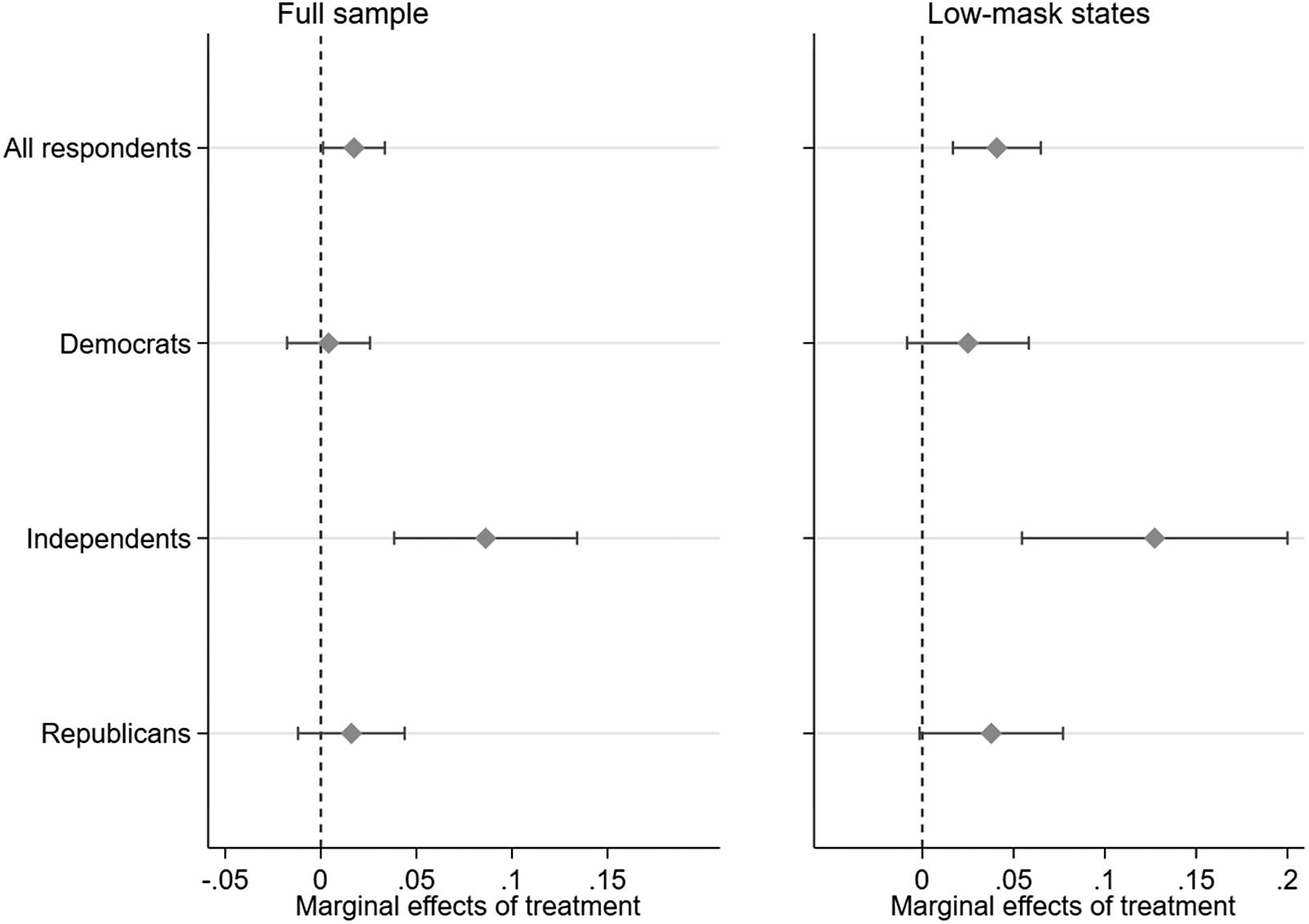
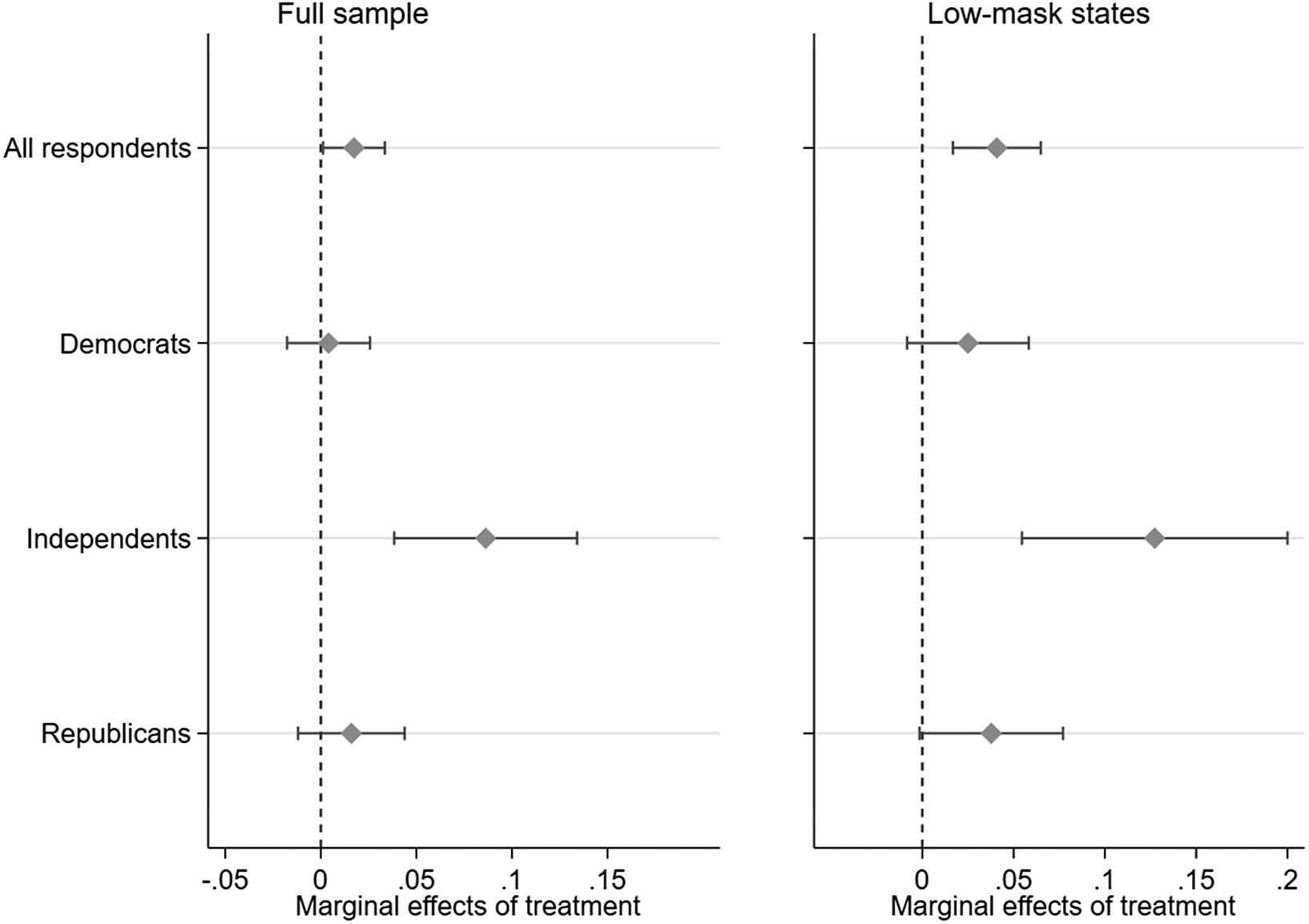
Next, we tested whether an individual’s partisan identification shapes their perception of what people are doing around them by including an interaction term for the Google mobility reduction measure and partisanship in the model. The estimates in the lower part of figure 5, present the marginal effects of local mobility reductions as a function of partisanship. The results suggest that, as expected, the effects appear to be substantively largest for independents, though the difference in the size of effects between independents and partisans is not statistically significant at conventional levels. The effects of objective mobility patterns on norm perceptions are very similar and statistically indistinguishable for Democrats and Republicans. Just as importantly, norm perceptions for both Democrats and Republicans were clearly shaped by the actual behavior of those around them and not just by partisan echo chambers or various biases. While the effect falls short of statistical significance among Republicans, this is largely due to their smaller sample size: the magnitude of the effect is virtually identical to that of Democrats.
For our second test, we return to the mask information experiment to analyze how the information about state-level mask usage affected perceptions of local mask usage norms among different respondents. Despite the fact that the information treatment mentions the state rather than the county or locality level, the estimates at the top of the two panels confirm that the treatment significantly increases the perceived local-level mask support. Unsurprisingly, the effects were twice as large and statistically stronger in states with below-the-median mask usage, where the information in the experimental intervention was arguably more surprising.
When we examine how partisans’ and independents’ perception of local norms is affected by information about high mask usage in their state, we find that, as expected, the impact of new information was substantively much larger and statistically more significant for independents than for either Democrats or Republicans. In fact, the results for the full sample in the left panel of figure 5 suggest that the effects for partisans, while positive, were very small and statistically inconclusive. In low-mask states, however, the effects are substantively larger across all groups and become at least marginally significant for Republicans (despite the larger standard errors due to the reduced sample size). Meanwhile, the effects for Democrats fall short of achieving statistical significance even in low-mask states, though this may be driven by ceiling effects since Democrats are more likely to live in communities with widespread mask usage.
These analyses demonstrate that an individual’s perception of local norms is driven at least in part by the behavior of those around them, and that information about the local context—even a single sentence about the mask usage of people in one’s state—can also affect a person’s perceptions. This is especially true of independents, but the analysis shows that partisans’ perceptions of local norms are also affected by the behavior of people in their community. Information can also affect their behavior, especially if they live in a context where that information is surprising or unexpected.
Conclusion
During the COVID-19 pandemic, local norms surrounding appropriate and inappropriate behavior affected Americans more than partisanship. While norms were important in promoting social-distancing compliance among Republicans and independents in places with strongly supportive local norms, it is important to underscore that the influential role of local norms may not have always served public health objectives: if local norms discouraged social distancing and compliance with mask usage, individuals in such communities were less likely to follow public health guidelines. Independents were especially responsive to local norms because of the absence of partisan cues, but Republicans and Democrats were also affected by the behavior of those around them.
This study makes two main contributions. Most narrowly, our work contributes a different perspective to the literature on the public’s response to the COVID-19 pandemic in the United States. While we confirm the prevailing view that partisanship mattered, we show that local norms matter more and that ignoring their effect leads to an oversimplified picture of reality that neglects the importance of social context. Ignoring norms could also lead to poor public policy. Our evidence suggests that when targeting independents, messaging about local norms favoring compliance with public health objectives should be effective in itself. Indeed, the results of our experiment suggest that providing basic information about the pervasiveness of mask usage can have quite a large effect in communities with low mask usage, i.e., precisely the types of communities where these types of interventions are most important from a public health perspective. Such messaging is less likely to move strong partisans, however, especially when those partisans think their party opposes those public health objectives. In this case, public health messages might focus instead on weakening the effect of partisanship by highlighting the heterogeneous nature of views within the party. In other words, for strong partisans, it would be important to provide information about varying opinions within their party in addition to stressing the consensus among the local community.
On a broader theoretical level, we have brought together two literatures that developed largely independently of one another: the literatures on norms and partisanship. We argue that norms and partisanship interact in two important ways. First, the effects of norms on attitudes and behavior are strongest for non-partisans and partisans who receive mixed or confusing party messages. While we have demonstrated this interaction between norms and partisanship in just one context—that of the COVID-19 pandemic—it seems highly likely that norms and partisanship will interact in similar ways across many issues in the United States and elsewhere.
Second, we have shown that while partisanship affects norms perceptions, it does not blind people to what is happening around them. On the one hand, in line with the literature on motivated reasoning, we find that partisans are less responsive than independents to both the actual behavior of those around them (as measured by the Google mobility data) and to informational interventions (in the context of our survey experiment). On the other hand, we also show that even partisans’ perceptions of norms are not entirely divorced from reality or information, particularly in low mask wearing contexts. More research on what shapes norm perceptions—whether it is factors like education and gender, or something else—in politicized contexts would be an important next step.
There are, of course, limitations to the analysis. In our experiment, for ethical reasons, we only manipulated the respondent’s perception of what people in their community were doing—which is sometimes referred to as a descriptive norm. It may be that manipulating injunctive norms—beliefs about what people should do as opposed to what they are actually doing—would yield different results. However, as we noted, much of the literature suggests that different kinds of norms influence one another.
Perhaps the most important limitation or scope condition for our study is that our findings are drawn from one country—the United States. Like most places, the United States has its own particularities. From the perspective of this article, one of the most prominent is the high level of partisan polarization in the country. Of course, elevated or growing levels of partisan polarization are common in many countries around the world, but the details of how partisan identities and norms interact are likely to depend on the details of the positions taken by different parties with respect to COVID-19. In an edited volume covering populist regimes across much of the globe, Ringe and Rennó (Reference Ringe and Rennó2023) have shown that even across populist governments, there was considerable variation in the policies that governments promoted. Consequently, the interaction between local norms and partisanship is likely to play out in different ways outside the United States depending on the positions political leaders take. Some populist leaders, like Jair Bolsonaro in Brazil, dangerously downplayed the seriousness of the virus, while others, like Viktor Orban in Hungary, amplified the threat as cover for expanding authoritarian control over the country.Footnote 19 Comparative research considering the effects of different leadership strategies on norms and behavior would be highly instructive.
Supplementary Material
To view supplementary material for this article, please visit http://doi.org/10.1017/S1537592723002864.




 Open access

