

The Marielle Franco Institute (MFI) was founded in 2018, after the assassination of Marielle Franco, an Afro-Brazilian lesbian city councilwoman and activist, and her driver Anderson Gomes. The MFI centers Black women and addresses intersecting identities, including LGBTQIA+ people, and uses its national reach to promote political candidates with progressive policy agendas. Largely led by Black women, the MFI has rapidly become one of the best-known organizations in Brazil that promotes and supports Black women political candidates. This article focuses on the MFI’s digital strategies to mobilize Afro-Brazilian voters.
This article’s emphasis on the MFI makes several theoretical and empirical contributions. First, scholars have increasingly devoted research to examining the role of social media in mobilizing voter support for the right-wing former president, Jair Bolsonaro. This article focuses on the role of social media in mobilizing Afro-Brazilian voter support for progressive politicians. Second, the research on racial appeals in Brazilian politics has yielded mixed findings. Scholarship that has focused on strategies to appeal to Afro-Brazilian voters has found evidence that in experimental settings, Black Brazilians vote along race. However, most scholarship demonstrates that they do not vote along racial lines even though they tend to support the Worker’s Party. Yet, because Brazilians may self-identify in a different racial or color category than how others identify them, there are cases in which politicians change or “switch” their race or color from one election year to another. This “switching” is an effort to gain support from Afro-Brazilian voters (Janusz Reference Janusz2021). Politicians may also rely on racial symbols and discourse during their campaigns (Mitchell Reference Mitchell2009). Considering that social media plays a role in mobilizing voters throughout the African diaspora, this study is interested in which strategies a nonpartisan organization, the MFI employs to mobilize Afro-Brazilian voters. This study contributes to Black politics studies that examine Get Out the Vote (GOTV) strategies. This research is driven by the following questions: What social media strategies are employed in Brazil to increase support for progressive politicians and policies? Which strategies does the Marielle Franco Institute use to appeal to Afro-Brazilian voters? These questions are important to scholars interested in how Brazilian nonpartisan organizations employ social media strategies to increase Black voter support of progressive Black politicians. Understanding the use of social media is important as it lowers the barrier of entry to political campaigns.
There are studies that focus on social media to engage in activist mobilization (Bonilla and Rosa Reference Bonilla and Rosa2015; Cox Reference Cox2017; Jackson et al. Reference Jackson, Bailey and Welles2020) and social media’s role in making visible social justice issues (Costa et al. Reference Costa, Rios and Baldraia2023; Freelon et al. Reference Freelon, McIllwain and Clark2018). This study is a departure as it focuses on the MFI’s social media strategies to mobilize Afro-Brazilian voters. Although the MFI is engaged in activism, this article focuses on electoral mobilization rather than social justice mobilization.Footnote 1 It is not the only organization involved in promoting Black candidates or Black women’s issues. This article only focuses on the MFI, but other Black women’s organizations also have a social media presence and sometimes utilize their platforms to promote progressive policies and issues.Footnote 2 The MFI has employed innovative digital strategies to mobilize voters that make it an interesting organization to focus on in this study. The MFI uses digital media to promote electoral engagement. Studying the ways in which it engages Afro-Brazilian voters is an important starting point to consider the strategies of other Black Brazilian and African Diaspora organizations to mobilize Black voters. Throughout this article, I use the terms Black and Afro-Brazilian interchangeably. Both categories include census category Pretos (Blacks) and Pardos (Browns). Preto is a census category denoting Black, and Pardo denotes Brown or mixed-race people.Footnote 3
The MFI is a nonpartisan organization, although it is heavily skewed to the left given that it promotes Marielle Franco’s legacy and political agenda. She was affiliated with the Socialism and Liberty Party (PSOL). Nonpartisan groups play a key role in promoting Black politicians and rallying votes in Brazil. Historically, groups such as the United Black Movement, founded in 1978 (Covin Reference Covin2015), and Ile Aiye, a Salvador-based Afro-Brazilian carnival group founded in 1974, have supported progressive Black politicians in Brazil. However, this project focuses on a recently created, nonpartisan, Black woman-led organization. Nonpartisan organizations are important as political parties in Brazil have sought Black votes, but Black Brazilians do not have the same influence as white Brazilians in political parties (Campos and Machado Reference Campos and Machado2018; Mitchell Reference Mitchell-Walthour2018).
Changes in the electoral laws in 2020 mandated that political parties devote equitable resources to Black and white candidates, and before this implementation, laws had required equitable resources between men and women political candidates (Veleci Reference Veleci2022). Kristin Wylie (Reference Wylie2020) has shown that these financial resources have aided in increasing more women politicians, especially Black women candidates, and it has also empowered them to challenge longstanding beliefs that women cannot be politicians. There has been an increase in Black and Brown candidates and among Black women, from 2016 to 2020, there was an increase in Black and Brown women city council candidates throughout Brazil from 15.5 to 17%. In this same period, there was an increase in Black and Brown women city council members elected from 5% to 6.3% (Campêlo Reference Campêlo2023). In terms of congress, there has been an increase in Black and Brown candidates running for the Brazilian Council of Deputies or what is the equivalent of the House of Representatives in the United States. There was a 36.25% increase in Black and Brown candidates from 2018–2022. In 2022, 134 Pretos and Pardos were elected compared to 123 elected in 2018 (Souza Reference Souza2022). The number of Preto and Pardo women elected increased from 13 in 2018 to 29 in 2022 (Cassela Reference Cassela2022).
Even though there has been a significant increase in Afro-Brazilian politicians, they are still underrepresented in congress considering they are 56% of the population. Political parties are important but not sufficient as a strategy for increasing the number of Afro-Brazilian woman politicians. Nonpartisan Black organizations encourage Afro-Brazilian voters to support progressive politicians, especially Afro-Brazilian politicians. One of the challenges Afro-Brazilian politicians face is that Afro-Brazilian politicians have fewer financial resources than white politicians. Bueno and Dunning (Reference Bueno and Dunning2017) find that campaign financial resources explain gaps in the successful election of Black candidates compared to white candidates. Janusz (Reference Janusz2021) examines Brazilian mayoral elections and finds that discrepancies between Black and white electoral success are due to both resources to run for office and voters’ preferences for white candidates. White candidates receive more support from individual donors and political party elites. In addition, even when controlling for resources such as campaign expenditures, voters prefer white candidates.
Beyond resources, it is important to consider progressive political candidates’ agency and the strategies they take to appeal to like-minded voters. Black candidates sometimes engage in racial appeals. Appeals can be made relying on aesthetics which play an important role in Brazilian political mobilization beyond electoral politics. For example, Costa et al. (Reference Costa, Rios and Baldraia2023) find that the Black Coalition for Rights, a group made up of over 200 social movement organizations, helped bring visibility to Black Brazilians using the intersectional identities of the various social movement groups included under this umbrella organization, aided in policy agenda setting, and mobilized Black Brazilians. They find that aesthetics played a key role in antiracist knowledge. The Coalition aided in politicizing Black bodies and contributed to ensuring that Black aesthetics were part of Black people’s rights (Costa, Rios, and Baldraia, 684). In other words, social movements prioritize embracing a non-European way of expressing oneself within Black social movement activism. Similarly, some progressive Black politicians believe embracing a Black aesthetic is essential in Brazilian electoral politics (Mitchell Reference Mitchell2009). Black women political candidates in the USA are also acutely aware of the importance of aesthetics, especially concerning their hair. Black women political candidates and politicians are aware that voters may perceive them in different ways depending on whether they wear their hair straight or natural (Brown and Lemi 2021). They are generally viewed as more professional when wearing their hair straight. Brown and Lemi are careful to point out that political science studies must include the politics of hair when considering perceptions of Black women politicians as well as their effectiveness when elected.
In Brown and Lemi’s (Reference Brown and Lemi2021) elite interviews of Black women political candidates and politicians, they examine their decisions for wearing certain hairstyles and they also examine the perceptions they think voters have of them. They find a range of experiences from women believing that wearing one’s hair naturally is not a political statement to wearing natural hair as a form of empowerment, to wearing one’s hair straight because of awareness of how voters perceive them and some wear their hair straight simply out of convenience. Some of the candidates also distinguish the practice of respectability politics among Black constituents who believe that Black women politicians must wear their hair straight to be taken seriously. They know that wearing it straight will lead some voters to view them as professional, and others believe that changing their hair or wearing it natural may lead to voters identifying with them or eventually accepting them and their hair. These findings contrast with Afro-Brazilian women politicians and political candidates who more openly engage in wearing their hair natural as a strategy to make voters more conscious of Black hair aesthetics and that Black women belong in spaces of power (Mitchell Reference Mitchell2009). In the 2020 documentary, “Sementes: Mulheres Pretas no Poder (Seeds: Black Women in Power), Leonardo Cortana and Ethel Oliveira (Reference Cortana, Oliveira and Mariano2020) show how Black women politicians such as Taliria Petrone, Renata Souza, and others ran for office after the assassination of Marielle Franco and through their progressive agendas and Black woman aesthetics challenged very white spaces of political power. Many of these women continue to wear bright colors in spaces where others wear muted dark colors. Marielle Franco also wore bright colors and sometimes wore headscarves, thus resisting more toned-down European ways of dress in the legislative assembly in Rio de Janeiro. Through social media, Black women political candidates may signal a Black aesthetic through their hair to mobilize voters and offer a counternarrative to how politicians should look.
Studies on voter mobilization and the role of social networks in Brazil have been dominated by research on the role of social media in support of conservative politicians such as far-right former president Jair Bolsonaro (Almeida Reference de Almeida2019; Braga Reference Braga2021; Gracino Jr., Goulart, and Frias Reference Júnior, Paulo and Frias2021). Although face-to-face partisan contact is the most effective means of voter mobilization in the United States (Gerber et al. Reference Gerber, Green and Larimer2008; Stevens and Bishin Reference Stevens and Bishin2010), today, social media and digital platforms play an important role in engaging voters, especially younger voters (Cohen Reference Cohen2012; Haenschen Reference Haenschen2016; Jones et al. Reference Jones, Bond, Bakshy, Eckles and Fowler2017; Vitak et al. Reference Vitak, Zube, Smock, Carr, Ellison and Lampe2010). In fact, the literature on voter mobilization in the United States has found that social media plays an impact on campaign participation, but traditional face-to-face canvassing has more of an effect on voter mobilization. Scholars of American politics have found that digital platforms can increase political participation and voting (Jones et al. Reference Jones, Bond, Bakshy, Eckles and Fowler2017; Vitak et al. Reference Vitak, Zube, Smock, Carr, Ellison and Lampe2010). Haenschen (Reference Haenschen2016) finds that social pressure via social media can also increase voter turnout. In an experiment, they find that tagging Facebook users to encourage voting can lead to feelings of shame or pride and these feelings can be elicited to increase voter turnout. Thus, these elicited feelings, rather than civic duty increased voter turnout. The importance of social media on voter turnout in the U.S. is an important area of study but is less relevant to Brazil where voting is mandatory. However, scholars must examine how social media can influence voters to choose certain candidates.
Social media has served to mobilize voters in Brazil (Bastos and Nemer Reference Bastos and Nemer2025; Mundim and Vasconcellos Reference Mundim and Vasconcellos2023; Pinto and Figureia Reference Pinto and Figueira2025). Political candidates use social media platforms in different ways. Pinto and Figureira (Reference Pinto and Figueira2025) find that during the 2018 and 2022 elections, Bolsonaro’s use of social media was different from his 2018 opponent and Worker’s Party candidate, Fernando Haddad and his 2022 political rival, Worker’s Party candidate, Lula da Silva. They find that Bolsonaro posted less frequently on Facebook and Twitter than Haddad and Lula. While Haddad and Lula produced professional looking posts which included text, video, and photos, Bolsonaro’s posts were less polished. Mundim and Vasconcellos (Reference Mundim and Vasconcellos2023) found that Brazilian respondents that used Facebook, WhatsApp, and YouTube as a source of information were nearly twice as likely to vote for Bolsonaro. These studies do not solely focus on progressive Black politicians’ digital strategies to mobilize voters. I am interested in how the MFI uses digital platforms to promote progressive politicians that would appeal to Black Brazilian voters.
Literature Review
Studying the role of social media on voter mobilization in Brazil is critical as it has been used as a tool for disseminating political information about candidates and policies. Moreover, social media has democratized political advertising for Black political candidates. Historically, Afro-Brazilians have been excluded in mainstream media. Social media has aided in democratizing access to media. Afro-Brazilians were underrepresented in media and continue to be underrepresented in comparison to their presence in the general population. Recently, there has been an increase in Afro-Brazilians in the media (Mitchell Reference Mitchell2020). Gillam (2022) has shown how Afro-Brazilians have increased their visibility by creating their own narratives by making short films available on platforms such as YouTube. Considering how social media is used in Brazil can offer new ways for scholars of U.S. Black politics to study voter mobilization. There are many studies focused on social media to mobilize protests (Bonilla and Rosa Reference Bonilla and Rosa2015; Jackson et al. Reference Jackson, Bailey and Welles2020; Taylor Reference Taylor2016). However, there is less literature on the impact of social media on increasing Black voter turnout in the USA. The literature on voter mobilization of African Americans in the USA includes GOTV efforts, the role of Black churches, the role of symbolic representation in increasing voter turnout, and the impact of voter suppression on turnout (Bejarano and Smooth Reference Bejarano and Smooth2022; Gillespie Reference Gillespie2015; McDaniel Reference McDaniel2008; Panagopoulos Reference Panagopoulos2013; Scott et al. Reference Scott, Michelson and DeMora2021; Stokes-Brown and Dolan Reference Stokes-Brown and Dolan2010). This study will contribute to the literature on mobilizing Afro-Diasporic communities as social media has been used to promote Black candidates in the USA and Brazil.
Studies show the impact of social media on political mobilization including the use of social media by groups such as the Landless Worker’s Movement (MST), Brazil’s largest organized social movement that fights for land rights. Scholars have found that social media has been a tool in mobilizing protest efforts, yet some members of these movements are ambivalent about their use. For example, Sartoretto (Reference Sartoretto2016) finds that some of the MST members who work on communications do not want social media to impede collective decision-making. Social media often focuses on an individual’s efforts, which contrast with the ethos of the organization. This study is not about the use of social media on social activism, rather the focus is on mobilizing voters. In the literature review, I first discuss Afro-Brazilians political exclusion, followed by an examination of how Black politicians reach out to Black voters. I subsequently discuss the challenges Black politicians and political candidates face when running for office.
Afro-Brazilian Voter Exclusion
Before examining the strategies to appeal to Black voters in Brazil, I provide historical context. Historically, voting in the USA differs from Brazil, because of voter suppression of Black Americans as a racial group. In Brazil, disenfranchisement largely targeted illiterate people, who were barred from voting until 1985. Because of Brazil’s history of enslavement, many emancipated enslaved people were illiterate. The legacy of Afro-descendants making up most of the illiterate population continues to the present. According to the Brazilian Institute of Geography and Statistics, in 2010, of the nearly 14 million illiterate people in the country, the highest proportion of illiterate people were found in municipalities of at least 50,000 habitants in the Northeast. The Northeast is predominantly Afro-Brazilian. Given that many illiterate citizens were Afro-Brazilians, the literacy requirement had a disproportionate impact on Afro-Brazilians. Enfranchising illiterate people had a racialized effect in enfranchising Afro-Brazilians. For this reason, it is detrimental to distinguish between the Black histories of enslaved people throughout the Americas as political marginalization may have had a racialized impact on Afro-descendants, but the methods of political marginalization differed. In today’s context, attempts to mobilize and empower Black voters throughout the Americas are interestingly similar despite different political systems such as Brazil’s mandatory voting compared to the United States which does not have obligatory voting. Yet Black politicians in the USA and Brazil face similar challenges of inequality in their access to campaign financial resources compared to their white counterparts.
Black Voter Outreach and Racial Voting in Brazil
Much of the literature on Afro-Brazilians and voting focuses on underrepresentation of Afro-Brazilian candidates (Bueno and Dunning Reference Bueno and Dunning2017; Machado, Campus and Recch Reference Machado, Campos and Recch2019; Janusz Reference Janusz2018; Johnson Reference Johnson1998; Oliveira Reference Oliveira1997) and candidates’ appeals to Afro-Brazilian voters (Janusz Reference Janusz2022; Mitchell Reference Mitchell2009). Experimental research has found that ballot design can result in co-ethnic or racial voting (Aguilar et al. Reference Aguilar, Cunow, Desposato and Barone2015). Aguilar et al. (Reference Aguilar, Cunow, Desposato and Barone2015) find that when presented with a short list of candidates, white and Pardo (mixed race) voters in Brazil do not cast their votes along racial lines. However, when presented with a long list of candidates, white and Pardo Brazilians demonstrated racial voting. Meanwhile, Pretos were shown to be more likely to support Preto candidates regardless of whether they were presented with a long or short ballot structure (Aguilar et al. Reference Aguilar, Cunow, Desposato and Barone2015). There is research on nonpartisan groups such as the Evangelical church and candidate support (Freston Reference Freston1993; Junior et al. Reference Junior, Goulart and Frias2021; Machado and Burity Reference Machado and Burity2014), and scholars have also examined how religious discourse mobilizes support for evangelical candidates (Duarte Reference Duarte2020; Gracino, Goulart, and Frias Reference Junior, Goulart and Frias2021). However, this work does not specifically examine Afro-Brazilian voters. Some politicians have used racial appeals as a strategy to gain Afro-Brazilian votes (Mitchell Reference Mitchell2009) and even switched their race to identify as a different race (Janusz Reference Janusz2023) to gain votes.
Generally, Afro-Brazilian voters are not mobilized by co-ethnicity and do not vote based on the racial background of political candidates (Janusz Reference Janusz2023; Souza Reference de Souza1971; Valente Reference Valente1986). However, some candidates have made racial appeals to voters, and in some cases, they were successfully elected (Mitchell Reference Mitchell2009; Soares and Silva Reference Soares and do Valle Silva1987). In addition, in contemporary elections, politicians run campaigns such as the 2020 “Eu Voto Em Negra” or “I Vote in Black campaign”. In 2024, some Afro-Brazilian political candidates and politicians utilized the “Não Vote em Branco, Vote Em Preta” slogan which translates as “Do Not Vote in White, Vote in Black.” The double meaning is that voting in white means that someone goes to the polling booth but leaves the ballot blank. The second meaning is do not vote for a white candidate and instead vote for a Black candidate. There is a long history of politicians seeking a racial vote in Brazil. In a study of São Paulo, Salvador, and Rio de Janeiro, Mitchell-Walthour (Reference Mitchell-Walthour2018) found that Afro-Brazilians that demonstrate Black linked fate or Black (Negro) racial group identity were more likely to vote for Black candidates and that it is linked fate not simply racial identification that determines vote choice. Michael Mitchell (Reference Mitchell1999) also found a positive relationship between Black racial consciousness and voting in Brazil. Andrew Janusz (Reference Janusz2021) found that political candidates switch their race, usually from white to Pardo, in populations with a substantial Afro-Brazilian population, as they believe that co-ethnic or racial voting is a viable political strategy. Yet, switching one’s race can lead to less voter support (Janusz Reference Janusz2023). In summary, these findings show that in an experimental or survey setting, racial identification plays a role in voting. Some political candidates believe co-ethnicity mobilizes voters. Yet, there is little research showing that co-ethnicity is an effective strategy to gain Afro-Brazilian votes. Research findings demonstrate that racial consciousness or a sense of Black group identity is a greater predictor of Black candidate support than co-ethnicity.
Black Political Candidates’ Challenges
Janusz and Campos (Reference Janusz and Campos2021) find that, relying on the Horário Gratuito de Propaganda Eleitoral or free electoral hour (HGPE) which allows candidate advertisements on television for the 45 days leading up to election, Afro-Brazilian candidates are more likely than white candidates to discuss racial inequality in their advertisements. Moreover, they find that political party elites give white political candidates more airtime even controlling for qualifications. Janusz and Campos attribute this difference to racial discrimination. Consequently, unequal advertisement time may contribute to increased underrepresentation of Afro-Brazilian politicians. Sacchet et al. (Reference Sacchet, Aflalo, Alves and Chaves2025) find that timing of disbursement of funds and allocation of funds to candidates in political parties lead to inequality in outcomes. They find that the type of funding has an impact on election outcomes. Candidates have greater autonomy with cash funds suitable to their campaigns. Whereas cash equivalent funds are more restricted. Depending on the level of the elections such as federal versus state or local, their study showed differences in cash funds. For higher-level offices such as federal and state deputy, in 2018 and 2022, except for the office of state deputy in 2018, white men were less likely to receive cash equivalent funding than white women, Black men, and Black women. White men were more likely to receive cash funding. In summary, the type of funding and differences in campaign airtime can lead to differences in electability which in turna impact Black political underrepresentation. While most scholarship on voting and race in Brazil focuses on Black political underrepresentation, it is important to also examine partisan and nonpartisan outreach (Campos and Machado Reference Campos and Machado2018; Janusz and Campos Reference Janusz and Campos2021; Johnson Reference Johnson1998; Mitchell Reference Mitchell2009; Oliveira Reference Oliveira1997).
Partisan and Nonpartisan Get Out the Vote Strategies in Brazil
There are few research studies of partisan mobilization of Afro-Brazilian voters. Afro-Brazilians are politically diverse, as they support leftist, centrist, and conservative political parties. Although many Afro-Brazilians voted for President Lula da Silva in 2006 (Mitchell-Walthour Reference Mitchell-Walthour2018), based on intended votes for the second round of the 2018 presidential election, the Brazilian Institute of Political Opinion and Statistics found that 47% of Afro-Brazilians intended to vote for Bolsonaro, while only 41% planned to vote for the Workers Party candidate, Fernando Haddad (Costa Reference Costa2018). Nonetheless, Haddad won in the predominantly Afro-Brazilian northeast, with 69.7% of the vote compared to Bolsonaro’s 30.3%. Considering the 2022 presidential election, Firpo and Martins (Reference Firpo and Martins2022) examined intended votes, and found that Afro-Brazilians were more likely than non-Afro-Brazilians to declare a vote for Lula. After the first round of the presidential election, Datafolha found that 58% of the poorest voters, measured as a family monthly income of up to 2 minimum salaries ($2,424 Reais) which is approximately $466USD, intended to vote for Lula while only 36% intended to vote for Bolsonaro (Rocha Reference Rocha2022). Like the 2018 election in which Haddad received heavy support from the Northeast, in 2022, 67% of those in the Northeast supported Lula compared to only 28% that voted for Bolsonaro. Although over the last 20 years, Afro-Brazilians have largely supported Workers Party (PT) presidential candidates, including Dilma Rousseff, Fernando Haddad, and Lula, they do not consistently vote as a racial bloc given their high level of support for Bolsonaro.
Most of the scholarship on candidate and political party mobilization of voters ignores racial identification (Borges and Vidigal Reference Borges and Vidigal2018; Samuels and Zucco Reference Samuels and Zucco2014; Singer Reference Singer2009). In her study of Afro-Brazilian women Auxilio Brasil beneficiaries in the Brazilian state of Bahia, Mitchell-Walthour (Reference Mitchell-Walthour2023) found that they display both petismo and lulismo. Auxilio Brasil was implemented during the Covid-19 pandemic to pay a monthly stipend to families living at and below the poverty line. It was similar to the conditional cash transfer program, Bolsa Familia, but did not require conditions such as taking children to regular medical checkups and school attendance. Bolsonaro changed the Bolsa Familia program during his time in office by expanding it to include students that play sports and compete in science competitions. The study of Auxilio Brasil beneficiaries differed from the extant literature on petismo and lulismo, as it focused on race, class, and gender. Petismo is a concept in which voters support the Worker’s Party and mainly explains more sophisticated voters who vote based on their ideological stances while lulismo is a concept that explains that support for Lula is due to his charisma and voters’ affection for him. Unlike the underlying implication that poor Black voters are lulistas, Mitchell-Walthour (Reference Mitchell-Walthour2023) finds that Auxilio Brasil beneficiaries display petismo and lulismo. This means that lower-income Afro-Brazilian women vote based on the ideological stances of a political party, in this case a leftist party, but also may vote based on the charisma of leftist political candidates.
The PT has appealed to Afro-Brazilian voters through some of their programs, yet conservative political parties have also made appeals to Afro-Brazilians (Mitchell Reference Mitchell2009). Scholarship on partisan appeals mainly center class rather than race and ignore debates about racial appeals in favor of debates about whether social welfare programs are a form of clientelism of the PT (Fried Reference Fried2012; Samuels and Zucco Reference Samuels and Zucco2014; Sugiyama and Hunter Reference Sugiyama and Hunter2013; Zucco and Power Reference Zucco and Power2013). The significance of the clientelism debate is that it focuses on social welfare voters without considering that most beneficiaries are Afro-Brazilian. Examining the strategies of leftist parties and in particular leftist candidates can contribute to a better understanding of how they mobilize Afro-Brazilian voters.
Social Media and Voter Mobilization
I now examine how political candidates use social media to gain voter support. One of the explanations for Bolsonaro’s 2018 presidential win was the influence of social media and phone applications on voter support for Bolsonaro (Almeida Reference de Almeida2019; Braga Reference Braga2021; Gracino Jr., Goulart, and Frias Reference Junior, Goulart and Frias2021). Braga (Reference Braga2021) found that in Brazil, campaigns relying on social media had more impact than traditional television campaigns. Fake news also plays a role in the spread of news capturing many people’s attention which can impact candidate support. Relying on a DataFolha study, Braga shows that 65% of the voting population has a WhatsApp account and that 24% share news about politics and elections on WhatsApp. Political candidates and politicians use social media to have direct access to their supporters and potential supporters (Tucci and Gouveia Reference Tucci and Gouveia2025; Rossini, Mont’Alverne and Kalogeropoulos Reference Rossini, Mont’Alverne and Kalogeropoulos2023). When Bolsonaro was a 2018 presidential candidate and was stabbed in the state of Minas Gerais, the news was shared on social media, and he gave a speech after the stabbing that was streamed on Facebook. The number of his social media followers increased dramatically following the stabbing. Social media has played an important role in shaping voter preferences by how it portrays political candidates. Conservative voters who believe fake news are more likely to support right-wing candidates such as Bolsonaro. Voters who rely on social media as a main source of news may be more susceptible to disinformation (Rossini et al. Reference Rossini, Mont’Alverne and Kalogeropoulos2023).
Civil society also employs social media to inform voters about political candidates. Mitchell-Walthour and Gillam (2022) examined the role of Afro-Brazilian women and Afro-Brazilian gay YouTubers during the 2018 presidential election between the two frontrunners Haddad, and Bolsonaro. The study included Ad Jr., a Black gay man, whose channel is called Ad Junior, Xan Ravelli, a Black woman based in São Paulo, Marco Antonio’s Pretinho Mais Que Basico (A Little Black More than Basic), Gabriela Oliveira, a Black woman who is the creator of Gabi de Pretas, Maristela Rosa and Natalia Romualdo’s channel Papo de Pretas (Black Woman’s Chat). These Black social media influencers discussed the candidates’ policy proposals and Bolsonaro’s racist and sexist discourse. They also provided links to their platforms. After Bolsonaro’s win, these YouTubers discussed his potential impact as well as recommended self-care actions for themselves and voters. Moreover, these influencers discussed the potential impact of Bolsonaro’s win on Afro-Brazilians, LGBTQ+ people, women, and poor people. These social media influencers explicitly warned voters about the dangers of Bolsonaro. In this way, social media was used to sway voters to support progressive candidates.
Nonpartisan Voter Mobilization
In the 2022 presidential election, Afro-Brazilian politicians and activists engaged in nonpartisan mobilization of Afro-Brazilian voters in support of Lula. Unfortunately, there is little political science scholarship on the role and political strategies of nonpartisan groups to mobilize Afro-Brazilian voters to support progressive candidates. Groups such as Mulheres Negras Decidem (Black Women Decide), Eu Voto em Negra (I Vote in Black), and Coalizão Negra por Direitos (the Black Coalition for Rights) all ran digital and in-person campaigns to encourage Afro-Brazilian voters to support progressive Black political candidates. This study will contribute to the academic literature on the role of nonpartisan Black woman-led groups’ digital strategies to mobilize Afro-Brazilian voters’ support of progressive candidates.
In summary, co-ethnic or racial voting has been utilized by politicians, but beyond experimental studies, racial voting has not determined vote choice among Black Brazilians. Afro-Brazilians tend to vote for the leftist presidential candidate in presidential elections, especially when they live in regions of the country that are heavily Afro-Brazilian such as the Northeast. Yet, as the 2018 presidential election of Bolsonaro demonstrated, a significant number of Afro-Brazilians voted for the far-right candidate, Bolsonaro. Yet, Black non-partisan groups seek to mobilize Black voters to vote for progressive candidates. Similarly, social media influencers and nonpartisan groups rely on social media platforms to mobilize Black Brazilians to vote for progressive candidates. These GOTV strategies are useful to studies on GOTV strategies to mobilize Black voters in the USA as they highlight how nonpartisan groups may support progressive Black politicians who do not always have the same financial resources as their white counterparts.
Methodology
This study focuses on the MFI’s social media strategies to mobilize Afro-Brazilian voters to support progressive candidates by relying on a qualitative approach that analyzes content on digital platforms such as the MFI’s websites and Instagram accounts. I read the MFI’s information available to users on websites and Instagram accounts that involved supporting political candidates in elections. However, the analysis is mainly based on the MFIs website. I focused on the MFI websites’ mission, goals, and methods of Black voter outreach. The analysis includes an examination of the MFI’s Antiracist Elections Platform, an interactive platform that allowed users to search for political candidates running in their region in the 2022 elections. The Antiracist platform included candidates with political platforms similar to that of Marielle Franco. Some of the main platform issues were women’s issues and rights, the rights of LGBTQ+ people, accessibility for disabled people, and Black rights. I examine postings from 2022–2023.
Background of the Marielle Franco Institute
Marielle Franco’s sister, Anielle Franco, was the MFI’s founding director. After Anielle Franco was appointed as the Minister of Racial Equality, a federal position, Lígia Batista was appointed as the MFI’s director. In 2025, Luyara Franco, Marielle Franco’s daughter became the director. Marielle Franco fought on behalf of Black people, poor people, youth, favela residents, women, and LGBTQIA+ people. She was vocally opposed to the police occupation of favela communities as there are many cases of innocent residents being killed by police because of these occupations. These communities are predominantly Black and low income. In October 2025, there was a megaoperation of 2,500 military police and elite squads in search for drug gangs. They killed 117 citizens in the favelas Complexo da Penha and Complexo da Alemão. Unfortunately, innocent residents, including children have been killed in these ongoing operations. Franco’s master’s thesis addressed the ongoing takeovers of Rio’s favelas. After Franco’s assassination, the world exploded in protests and several organizations were created to increase the number of Black women politicians. The MFI is the most well-known organization dedicated to her legacy, social justice, and preserving her memory. Moreover, its mission is to empower Black women, LGBTQIA+ people, and people living in the periphery. The Institute has created campaigns such as the 2020 “Antiracist Elections,” a campaign to support Black rights including challenging inequalities in campaign funding and political advertisements. Along with other groups, such as the Black Coalition of Rights, and well-known politicians such as Benedita da Silva, the MFI advocated that Black political candidates receive the same financial resources to run political advertisements as their non-Black counterparts. In 2020, the Supreme Electoral Court ruled that beginning in 2022, the electoral funds and TV time for free electoral advertisements must be proportional to the total number of Black candidates.
The MFI’s physical office is in Rio de Janeiro, and it actively engages social justice groups through their participation in domestic and international conferences. They also rely on social media to disseminate information about the organization and their activities. As shown in the report of their 2020 activities, the Institute sent 1.7 million emails to its supporters; 170,000 people subscribed to take part in one of their actions; 150 movements, collectives, and organizations were engaged in an act with the Institute; and 83,483 messages were exchanged on WhatsApp (https://www.institutomariellefranco.org/2020). The MFI also advocates for the security protection of Black women political candidates and politicians. An example of a Black woman political candidate requiring security is Ana Lúcia Martins, the first Black woman city councilwoman elected in Joinville, Santa Catarina, located in southern Brazil. The MFI led a campaign on Martins’ behalf resulting in more than 5,000 emails that were sent to local authorities asking for her protection as she suffered from threats. The Institute is concerned with political violence and conducted their own survey with Black political candidates, finding that of the 142 candidates with a Marielle Franco Agenda—an agenda focused on human rights and marginalized groups—98% suffered some form of political violence including online threats. Dandara Oliveira, Program Manager of Democracy and Justice Programs, described the purpose of the agenda saying, “Our proposal is to create a network of politicians dedicated to carrying out Marielle Franco’s political legacy. We aim to build a group of leaders—expanding with every election cycle—who are deeply committed to her agenda, which focuses on human rights and the protection of vulnerable communities. A core objective for us is to keep her memory alive within the halls of power she sought to occupy, while empowering other Black women and young leaders to achieve the goals she could not complete due to her tragic murder. We firmly believe that advancing her political agenda is the most meaningful way to honor her memory (Oliveira, D., 2026 personal email communication, April 20).” Beyond the agenda, the MFI is concerned with violence against women including Black trans women. Scholars have discussed the disproportionate number of Black femicide in Brazil (Costa and Santos Reference Costa and Santos2024) and because of misogynoir, this spills over into politics. While this is not a central subject of this article, it is important given that the MFI was founded due to Franco’s assassination and violence against Black women serves as a barrier to entering politics.
Some of the MFI’s Instagram and X posts, including campaigns, have been shared, so its reach goes beyond their followers. There are limits to social media given the digital divide in Brazil. There are 36 million residents that do not have internet access at home, and 58% self-identify as Black (Negro) (Peres Reference Peres2023). Yet most people who access the internet rely on a cellular phone. In addition, people are sometimes able to access the internet even when they do not have it at home. For example, some public plazas, malls, and even some restaurants and cafés provide free internet. For this reason, it is possible for people to access websites and digital platforms such as X and Instagram without an internet connection at home.
Analysis
In this analysis, I describe the digital voter mobilization efforts of the MFI and its strategies to influence Black voters to vote for progressive politicians, especially Black politicians. Considering the use of this social media is useful for studies of GOTV efforts of African Diaspora communities such as Black Brazilian communities as findings reveal some of the strategies employed are promoting intersectional issue agendas, highlighting a Black woman aesthetic, creating coalitions with other Black-led nonpartisan organizations and racial appeals through Afro-Brazilian religions.
The analysis of the digital voter mobilization strategies is based on the MFI’s “Marielle Franco Agenda Platform.” In 2020 and 2022, the Institute led a digital mobilization effort that allowed voters to access the political platforms of candidates with a Marielle Franco agenda. Political candidates could register if they had a platform that complied with the agenda. The Institute selected political candidates whose agendas met their requirements. The MFI’s digital platform allowed political candidates and organizations to apply if they had an agenda that included key ideas of Marielle Franco’s progressive agenda. Her agenda was anitiracist, antisexist, antihomophobic and fought against police brutality, and she sought to empower poor people, Black people, youth, and favela residents. Candidates were required to apply by September 2022. Those chosen were featured on the platform and during the election, users could access the platform to learn about the candidates. In 2020, according to the MFI, of the 762 candidates from 300 cities throughout Brazil that committed to a Marielle Franco Agenda, 81 people from 54 cities and 13 states were elected and 253 were suplentes or runners-up. While it is significant that 11% of the women they promoted won and an additional 33% were runners up, it is beyond the scope of the article to examine these individual candidates. Nonetheless it is noteworthy that 44% of these progressive candidates selected were elected or runners-up.
In 2022, the MFI selected candidates whose platforms aligned with the Marielle Franco agenda. In 2024, the Institute similarly supported political candidates with such an agenda. This article focuses on the 2022 efforts of the Institute. The first digital strategy is that the MFI features candidates they believe align with the Marielle Franco agenda. After the election, users could access the website to see which candidates were elected. In 2022, out of a total of 145 political candidates committed to the Marielle Franco Agenda, 44 candidates or 30% were elected from four regions of Brazil and seven states, while 86 candidates or 59% were runners-up. Considering those listed on the website, 52% of candidates were affiliated with the Socialism and Liberty Party (PSOL), 31% were affiliated with the Worker’s Party (PT), 5% with the Communist Party of Brazil (PCdoB), and 4% with the Socialist Brazil Party (PSB). Some of the remaining candidates were affiliated with the Green Party, the Progressive Party, and the Social Democratic Party (PSD). The high percentage of progressive parties that are often associated with social movements is no surprise given that candidates were chosen with a similar mandate as Marielle Franco, a former activist. Essentially 89% of those with a Marielle Franco Agenda were elected or were runners-up. This high percentage could be a result of selection bias such that those who applied and were selected by the MFI, were already strong candidates and possibly well-connected to social movements and organizations. The importance of the MFI is that it serves as a nonpartisan Black woman-led organization that promotes progressive politicians and moreover demonstrates that studies of Black nonpartisan organizations should be included in studies of African Diasporic politics.Footnote 4
On the website, these candidates were also identified with symbols designating issue areas of the Marielle Franco agenda. The symbols included disabled people, women, and LGBTQIA+ people. On the platform, a Black power fist means Black people, a rainbow or rainbow flag means LGBTQIA+, a purple and green heart together means cis women, pink and blue hearts or a pink and blue flag signify trans people, NB symbolized nonbinary people, and the combined emojis of a person in a wheelchair and a blind person with a cane symbolized disabled people. These symbols with explanations were available on the webpage. Users were encouraged to share the link so that others could see which elected politicians were committed to the Marielle Franco agenda. It was also shared by other organizations, such as Estamos Prontas (We Are Ready), which had 2,837 followers on their Instagram as of May 29, 2025, and Mulheres Negras Decidem (Black Women Decide) which had 31,700 followers. Twenty-one of 119 or 18% of those featured on the Marielle Franco agenda website were endorsed by Estamos Prontas.Footnote 5 Sixty people shared Estamos Prontas post. Users could read more about candidates’ profiles and learn more about their campaigns by clicking on their personal Instagram, Facebook, or Twitter links. These additional links allowed for more political education of the candidates.
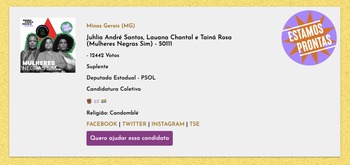
MFI’s second digital strategy is racial appeals via African religions. The MFI website includes pictures of candidates, the number of votes won (post-election), their agenda issues, and identifying candidates who are Candomblé or Umbanda practitioners. Christian candidates are not identified. Candomblé and Umbanda are African-derived religions practiced in Brazil. According to the 2022 census, 1% of the Brazilian population practiced Candomblé or Umbanda. Examining the list of candidates with an MFI agenda reveals that 18% of these candidates are practitioners of African-derived religions. Although practitioners are not exclusively Afro-Brazilian and most practitioners are white, among Black activists, practicing the religion demonstrates a reclamation of Black Brazilian and African culture. Thus, including this Afro-Brazilian religion signals to voters that these political candidates embrace Blackness even though these religions are often stigmatized in Brazil. In fact, throughout the country and especially in cities such as Rio de Janeiro and Salvador, temples have been attacked and even destroyed; some practitioners have been attacked and, in extreme cases, killed. Signaling candidates who are practitioners of these religions, as a digital strategy, indicates that the MFI assumes its users do not stigmatize these practitioners and may wish to support them. Figure 1 shows an example from the website listing Candomblé as the religion for the collective group Mulheres Negras Sim (Yes, Black Women).
Collective Group Mulheres Negras Sim.

Figure 1. Long description
The image features three women standing together with the text ‘Mulheres Negras Sim’ prominently displayed. The background includes various symbols and badges. The text provides details about their candidacy for the state of Minas Gerais, including the names Juhlia André Santos, Lauana Chantal, and Tainá Rosa, their party affiliation (PSOL), and their collective candidacy number (50111). It also mentions they have received 12442 votes and are running as suplente (substitute) candidates. The image includes symbols representing their religious affiliation (Candomblé) and social media links (Facebook, Twitter, Instagram, TSE). A button at the bottom reads ‘Quero ajudar essa candidata’ (I want to help this candidate).
In Brazil, collectives can run for political office. In this case, this group ran for State Deputy in Minas Gerais. As indicated by the symbols, the collective is concerned with Black people, trans people, and LGBTQ+ people. Debora Almeida (Reference Almeida2023) finds that collective mandates have allowed social movements to bring their participatory structures to politics. She states that “representation as participation” through collective mandates, change the notion of political representation. Almeida recognizes that scholars find the collective mandates allow for intersectional representation (Campos and Matos Reference Campos and Matos2023) and an increase in excluded groups and those concerned with social justice (Fonseca Reference Fonseca2020). These groups fundamentally challenge the idea of representation as it is usually defined as an individual person’s belief that they are politically represented by the individual candidate they support. Collectives are intersectional thereby representation is intersectional and collective. In addition, Almeida finds of the 66 politicians who were in her study, 65% participated in protests. They view themselves as militants but realize as electoral officials, they participate in change through institutional mechanisms in electoral politics, which allows protest politics to be included in electoral politics.
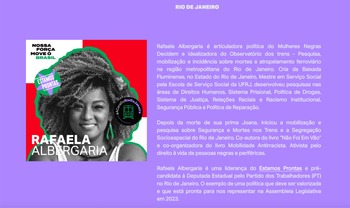
A third digital strategy is an endorsement by Estamos Prontas (We Are Ready), another Black woman led nonpartisan organization, indicated by a button on the website next to the candidate. Clicking on the button takes the user to the group’s website. The user can find additional information on political candidates. Estamos Prontas describes itself as a group that supports Black woman candidates. They chose the group’s name to reflect the fact that historically, Black women have moved the country and since colonial times have been responsible for the life of the community. The website reads, “We are ready. We are ready to build a political project out of the radical political imagination of Black women. We are ready to ignite outdated notions of power (estamosprontas.org).” First, the user on the MFI’s website would see the graphic shown in Figure 2. If they click on the Estamos Prontas label, they would be directed to the Estamos Prontas website (See Figure 3).
Rafaela Albergaria.
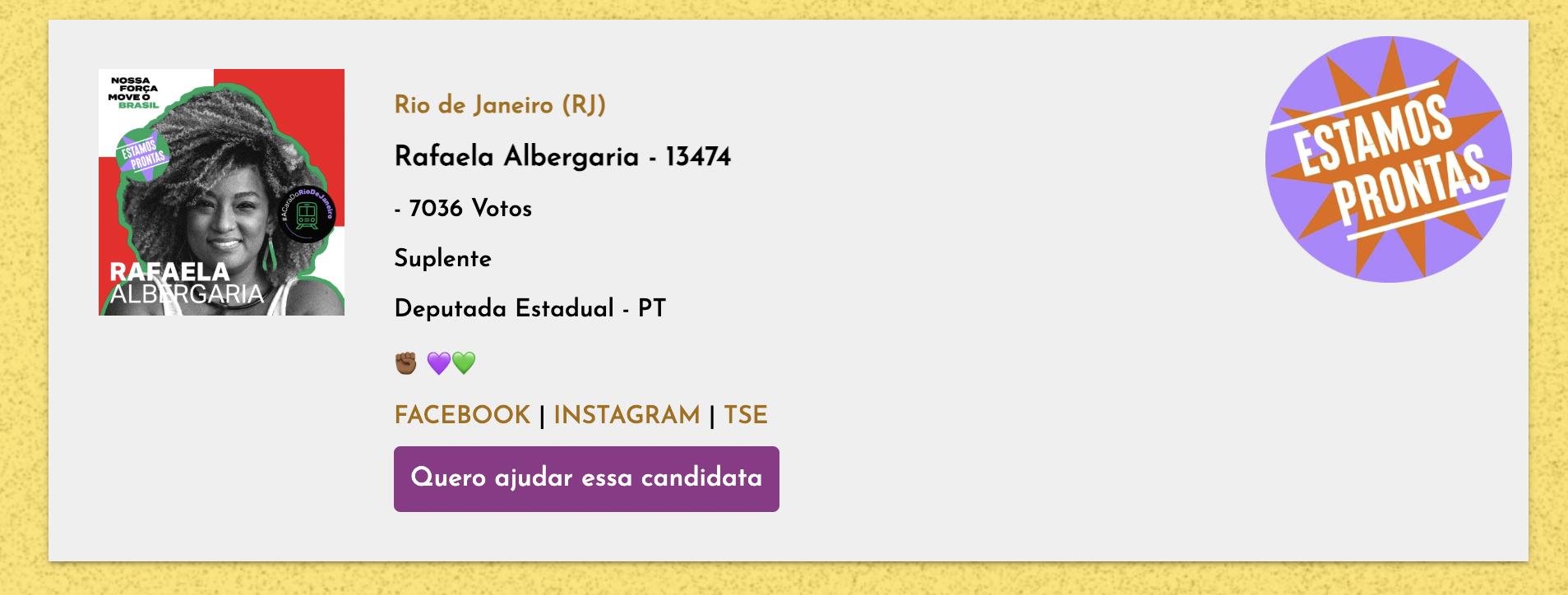
Figure 2. Long description
The image features a promotional graphic for Rafaela Albergaria, a candidate for Deputy Estadual in Rio de Janeiro. It includes her photograph, name, party affiliation (PT), and the number of votes she has received. The graphic also indicates that she is a substitute candidate and includes social media icons for Facebook, Instagram, and TSE. Additionally, there is a button with the text ‘Quero ajudar essa candidata’ and a logo that reads ‘Estamos Prontas‘.
Rafaela Albergaria Featured on Estamos Prontas Website.
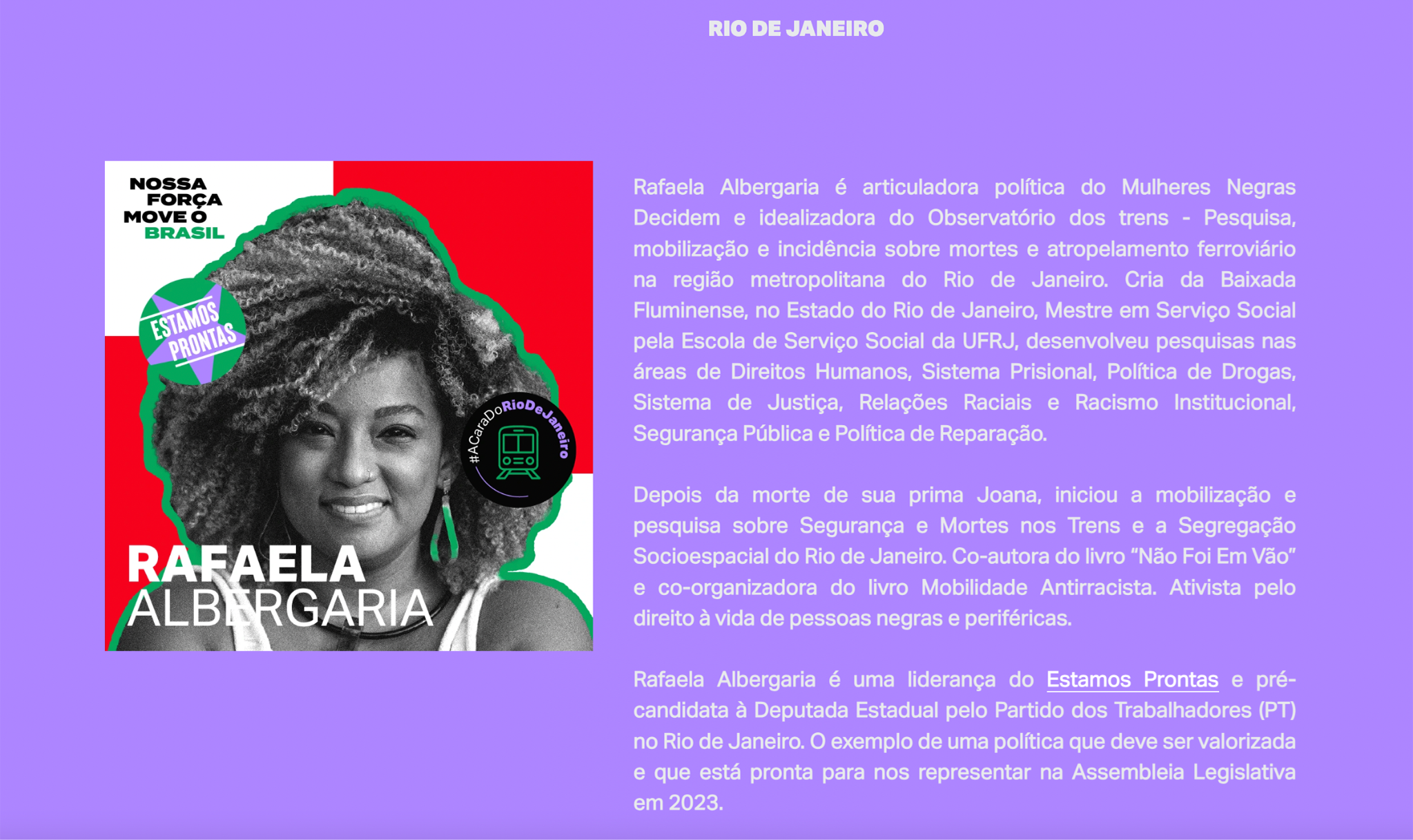
Figure 3. Long description
A portrait of Rafaela Albergaria, a political articulator for Mulheres Negras Decidem and the creator of the Observatório dos trens. She is depicted with a colorful background featuring text in Portuguese. The image includes elements such as a green and red background with text that reads ‘Nossa Força Move o Brasil’ and ‘Estamos Prontas’.
The strategy of another non-partisan group endorsing candidates demonstrates the MFI’s partnerships with other Black woman-led organizations. Not only is it a coalitional nonpartisan effort but it gives these candidates additional exposure and voters are also made aware of the political work of Estamos Prontas. An example of a candidate endorsed by Estamos Prontas on the MFI’s website is Rafaela Albergaria. Through symbols, the MFI’s interactive website demonstrates that Rafaela Albergaria is affiliated with the Worker’s Party (PT) and is running for state deputy of Rio de Janeiro. She supports cis women and Black people. The page also features clickable tabs such as her Facebook, Instagram, and the Superior Electoral Court (TSE), which is the entity through which all candidates register. The TSE lists demographic information such as occupation, marital status, and political party affiliation. Albergaria holds a master’s degree in social work from the Federal University of Rio de Janeiro and is a member of the organization Mulheres Negras Decidem.Footnote 6 She is concerned with passenger safety on trains and was inspired to do this work because of her cousin’s death. She is also concerned with sociospatial segregation in Rio de Janeiro. Her educational record demonstrates her qualifications to hold office, and her issue concerns may appeal to potential voters. This additional information about Albergaria is made available to MFI users because of their partnership or coalitional partnership with Estamos Prontas. These nonpartisan Black woman-led groups bring more exposure to candidates who may not receive as much exposure as their white counterparts.
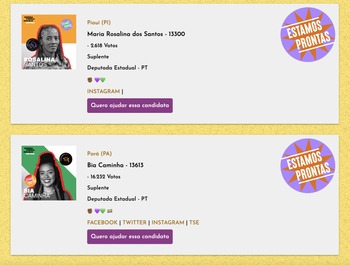
A fourth digital strategy to increase Black votes, especially among Black women candidates and the MFI, is to highlight these candidates, and to normalize a Black woman aesthetic that contrast with a European aesthetic. It is worth noting that in many of the photos of Black woman candidates—as seen in Figures 1–3 above and Figure 4 below—Black women wear their hair in natural hairstyles and braids. This challenges predominant anti-Black woman hairstyles such as straight hair (Caldwell Reference Caldwell2003). Embracing blackness through hair in Brazil is a political choice as it further demonstrates one’s blackness and challenges the assumption that straight or loosely curled hair is superior (Goins Reference Goins2021; Means Reference Means2020). In Brown and Lemi’s (Reference Brown and Lemi2021) study of Black women political candidates and politicians, they conducted elite interviews to examine their decisions for wearing certain hairstyles and they also examine the perceptions they think voters have of them. They find a range of experiences from women believing that wearing one’s hair natural is not a political statement to wearing natural hair as a form of empowerment. Additionally, some women wear their hair straight because of awareness of how voters perceive them, and some wear their hair straight simply out of convenience. Some of the candidates also mention respectability politics among Black constituents who believe that Black woman politicians must wear straight hair to be viewed seriously. These interviews reveal that Black woman candidates are also concerned with being professional in their work as well as being perceived as professional. Some of their findings contrast with Afro-Brazilian woman politicians and political candidates who more openly engage in wearing their hair natural as a strategy to make voters more conscious of Black hair aesthetics and to challenge the idea that Black aesthetics do not belong in spaces of power (Mitchell Reference Mitchell2009). In the 2020 documentary, “Sementes: Mulheres Pretas no Poder (Seeds: Black Women in Power),” Leonardo Cortana and Ethel Oliveira show that Black woman politicians such as Taliria Petrone and Renata Souza ran for office after the assassination of Marielle Franco. Through their progressive agendas and Black woman aesthetics they challenged very white spaces of political power. Many of these women continue to wear bright colors in state legislative assemblies and congressional spaces where many other politicians wear muted dark colors. Marielle Franco also wore bright colors and sometimes wore headscarves thus resisting more toned-down European ways of dress in the legislative assembly in Rio de Janeiro.
Candidates with Natural Hairstyles.

Figure 4. Long description
The first image features Maria Rosalina dos Santos, a candidate from Piauí (PI) with 2,618 votes. She is running as a substitute for State Deputy from the PT party. The second image showcases Bia Caminha, a candidate from Pará (PA) with 16,232 votes. She is also running as a substitute for State Deputy from the PT party. Both images include social media icons and a button to support the candidates.
As one scrolls through the MFI website’s page of political candidates, the user can view photos of candidates with natural hairstyles. These images of Black women normalize a Black aesthetic that perhaps appeal to some voters or that make them aware that Black woman politicians can wear their natural hair. In 2015, Brazil had its first Black Woman’s Natural Hair March in São Paulo, which has since taken place in several cities in the country. Women proudly marched displaying natural hairstyles. These marches signal changing Black cultural politics in the country.
In summary, the MFI’s digital strategy includes featuring progressive candidates they selected, especially Black women with a political platform like Marielle Franco’s. A second strategy is to highlight candidates practicing African-based religions. A third is collaboration with another nonpartisan organization that supports Black woman candidates. Finally, a pro-Black woman aesthetic among political candidates is a strategy to appeal to voters who also embrace this aesthetic. It is beyond the scope of this project to examine the effectiveness of their platform. Yet, shedding light on the MFI’s digital strategy can serve as a jumping-off point for further studies. Although not all website users are Afro-Brazilian, this innovative digital platform was an effort to mobilize Afro-Brazilian voters’ support of progressive politicians. Given the success of those featured on the interactive Marielle Franco Agenda platform, the MFI contributed to political candidates who were either already well-connected and well-known or helped increase exposure on the digital media platforms of multiple organizations, which could have aided in their successful political elections or runners-up status.
Conclusion
The Marielle Franco Institute, a Black woman-led, non-partisan organization, engaged digital strategies to mobilize Black voters. The purpose of the MFI’s Marielle Franco agenda was to increase the visibility of progressive politicians’ platforms in Brazil. The use of digital platforms in Black voter mobilization strategies is an important new area of study that contributes to comparative analysis of media, politics, and African Diaspora studies. The MFI engaged digital efforts to promote progressive political candidates including Black women. Although Preto and Pardo voters do not have the same voting patterns, they are similar in terms of consistently supporting progressive presidential candidates.Footnote 7 Surveys have shown differences in voting patterns between Afro-Brazilians voters who self-identify as Pardo versus those identifying as Preto. For example, Datafolha found that between the first round and second round of the 2022 presidential election, Pardo support for Lula rose from 49% to 52%. Preto support rose from 57% to 59% (Globo Reference Globo2022). During both time periods, Pretos had higher levels of support for Lula. Conversely, Pardo support for Bolsonaro decreased from 43% to 42%, while this support fell from 35% to 34% among Pretos. During both time periods, Pardos were more likely to support Bolsonaro than Pretos. Neither Pretos nor Pardos supported Bolsonaro at rates as high as whites whose support rose from 50% to 51%. Mitchell-Walthour (Reference Mitchell-Walthour2018) finds that, even though there are slight differences between Pretos and Pardos when considering voting and support for racial policies, the greatest predictor of support is Black (Negro) linked fate. Afro-Brazilians with higher levels of Negro linked fate are more likely to vote for Black candidates. De Micheli (Reference Mitchell-Walthour2023) shows that the interaction of education and race lead to different outcomes. Regarding the 2018 presidential election, he found that the interaction of education and racial identification resulted in highly educated Afro-Brazilians compared to highly educated whites being less supportive of Bolsonaro and more supportive of Haddad. Given these survey results and experiments, it is likely that as the number of Afro-Brazilians with college degrees increases, and racial consciousness or Black linked fate increases, progressive candidates with campaigns focusing on racial issues and that embrace a Black aesthetic will increasingly appeal to Afro-Brazilian voters, especially voters that self-identify as Preto. This article builds on and extends research on the role of social media in activist mobilization (Freelon et al. Reference Freelon, McIllwain and Clark2018; Jackson, Moya, and Welles Reference Jackson, Bailey and Welles2020; Bonilla and Rosa 2015) to analyze social media’s role in voter mobilization. In focusing on the MFI’s social media strategies to mobilize Afro-Brazilian voters, this study reveals the importance of the role of a Black woman-led nonpartisan organization’s social media to advance progressive political candidates. These politicians and nonpartisan organizations promote a specific type of Black consciousness that is antihomophobic, antisexist, embracing of African derived religions and disabled people. Thus, both play a role in using political campaigns to promote a Black aesthetic and racial consciousness. Future studies should examine how voters respond to these efforts.
Digital mobilization may serve as an additional strategy to fill the gap where political party elites are less likely to utilize resources for Afro-Brazilian political candidates. While legislation in Brazil was meant to provide more political party resources in proportion to Black and white candidates, individual Black candidates are more likely to lack the resources available to their white counterparts to run competitive elections and legislation to equalize funding has not resulted in equal funding as it is disbursed at different times for candidates and cash funds verse cash equivalents are also unequal. Additionally, even the free electoral hours are not equally distributed as political party elites are discriminatory towards Afro-Brazilian candidates granting them less time than white politicians. These ongoing inequalities point to the need for nonpartisan organizations and the use of digital strategies they use to support progressive Afro-Brazilian candidates.
Funding statement
This research received no specific grant from any funding agency in the public, commercial, or not-for-profit sectors.
Appendix
Websites of Digital Platform and Select Candidates’ Instagram and Estamos Prontas websites



 Open access

