


Impact statement
This paper examines an underappreciated form of extinction: an attempt to induce the extinction of a parasite. By doing so, it historicises extinction, demonstrating that anthropogenic extinctions are driven by specific social, economic and ecological configurations, not by any one single ‘humanity’. It further adopts a novel interdisciplinary method, extending both epidemiology and medical history, thereby bridging both and bringing two very different approaches into dialogue. This approach aims to speak to both disciplines and thereby have some impact on both fields. It demonstrates that diseases are influenced by a complex combination of social, environmental and individual factors, something always worth highlighting in a world where social medicine is now only remembered by historians and biomedicine is individualised to the point where its futuristic dream is ‘personalised medicine’. Finally, it extends historical understanding, by elaborating on the medical landscape of an understudied period in Jamaican history: the period between the 1865 Morant Bay Rebellion and the 1938 Labour Rebellion.
Introduction: Induced extinction
While biology defines extinction as a single event, it is now commonly held in extinction studies that extinction is more of an ongoing process of unknotting webs, as ecological, cultural and emotional entanglements fall apart; even after the last individual of a species has died, memorialisation recapitulates extinction, and extinct species live on as ghosts in the ecological and cultural spaces they once inhabited (van Dooren, Reference van Dooren2014; Heise, Reference Heise2016; Jørgensen, Reference Jørgensen2017; Rose et al., Reference Rose, van Dooren and Chrulew2017; McCorristine and Adams, Reference McCorristine and Adams2019). Extinction, therefore, has no end. But where does extinction begin?
Most studies of extinction focus on unintended losses of species, biodiversity and cultures. This paper, however, offers an interdisciplinary perspective on an attempt to induce the extinction of a parasite: human hookworm. It aims firstly to elucidate a socioeconomic driver of extinction – the perceived effects of hookworm on labour productivity within a plantation system – using discursive historical analysis. Secondly, the interactions of the socioeconomic/socioecological institution of the plantation with environmental factors in shaping the prevalence of hookworm are explored through spatial epidemiology. Finally, this paper turns to the worm burden, the number of hookworms within individuals, in order to comment upon how far socioecological conditions can be said to determine the pathology of hookworm disease.
These will be studied through the records created by the Jamaica Hookworm Commission (JHC) of 1919–1936. The JHC was launched in 1919 (Jones, Reference Jones2013) as a cooperative endeavour between the colonial government and the Rockefeller Foundation (RF), which viewed hookworm as a convenient ‘wedge’ to induce foreign governments to build up public health systems (Birn and Solórzano, Reference Birn and Solórzano1999; Farley, Reference Farley2004). The RF was founded by Standard Oil baron John D. Rockefeller and absorbed his business-minded outlook; it aimed to cheaply build up public health systems and believed that hookworm eradication campaigns part-funded by local governments offered good returns in public health for a relatively small investment (Ettling, Reference Ettling1981; Farley, Reference Farley2004). Initially headed by Powell Gardener, the JHC was soon taken over by fellow RF doctor Benjamin Earl Washburn.Footnote 1 It was absorbed by the colonial government in 1933 but continued until 1936 when the ‘hookworm units’ were reconfigured as ‘mobile health units’ focussing mainly on yaws (Treponema pallidum pertenue infection).Footnote 2
Jamaica in 1919 was the largest of the British West Indies, and remained a regional centre, but was neglected by the imperial government (Jones, Reference Jones2013). Following emancipation and the end of slavery in 1838, and more importantly the ending of British tariff protections for West Indian sugar in 1846, the sugar industry which had made Jamaica’s planter classes rich crashed (Bryan, Reference Bryan2000). As the imperial government focused on India and Africa, Jamaica became a backwater colony, receiving no financial aid and few medical doctors from Britain (Heuring, Reference Heuring2011). Kingston constituted the only major city, but several smaller towns were scattered around the island (Moore and Johnson, Reference Moore and Johnson2011). Despite the decline of the sugar industry, many plantations remained, growing cash crops such as sugar, bananas and coffee, and employing day-labour as well as indentured labourers from India (Shepherd, Reference Shepherd1994; Bryan, Reference Bryan2000). Much of the population consisted of ‘small settlers’: subsistence farmers who had established their own smallholdings after emancipation (Moore and Johnson, Reference Moore and Johnson2011). The urban poor crowded into subdivided houses and communal yards, while the urban middle class possessed significant political influence (Moore and Johnson, Reference Moore and Johnson2011) which they used to influence health efforts according to their social and political goals (Heuring, Reference Heuring2011). Access to biomedicine was limited, and many relied on a rich tradition of folk medicine (Payne-Jackson and Alleyne, Reference Payne-Jackson and Alleyne2004; Jones, Reference Jones2013).
Hookworm disease is caused by parasitic nematodes of the family Ancylostomatidae; the main parasites of humans are Ancylostoma duodenale and Necator americanus (Brooker et al., Reference Brooker, Bethony and Hotez2004). Adult hookworms attach to the wall of the small intestine, where they feed on haemoglobin from red blood cells (haematophagy) (Shalash et al., Reference Shalash, Hussein, Skwarczynski and Toth2021). They copulate and lay eggs in the small intestine, which are then passed in the faeces (Loukas et al., Reference Loukas, Hotez, Diemert, Yazdanbakhsh, McCarthy, Correa-Oliveira, Croese and Bethony2016). Eggs hatch in the soil into saprophytic L1 larvae, before moulting into L2, then L3, larvae in 5–10 days (Brooker et al., Reference Brooker, Bethony and Hotez2004; Loukas et al., Reference Loukas, Hotez, Diemert, Yazdanbakhsh, McCarthy, Correa-Oliveira, Croese and Bethony2016). L3, the infective stage, move towards heat and movement, actively seeking hosts, and entering them percutaneously through hair follicles (Gaze et al., Reference Gaze, Bethony and Periago2014). Once inside the body, they migrate through the capillaries into the lungs, ascending the trachea until involuntary coughing moves them into the gastrointestinal tract where they are swallowed, thereby entering the alimentary canal (Loukas et al., Reference Loukas, Hotez, Diemert, Yazdanbakhsh, McCarthy, Correa-Oliveira, Croese and Bethony2016; Chapman et al., Reference Chapman, Giacomin, Loukas and McCarthy2021). Host blood loss is directly dependent on burden; infection with a small number of hookworms is often asymptomatic, but higher burdens can produce iron deficiency anaemia (Loukas et al., Reference Loukas, Hotez, Diemert, Yazdanbakhsh, McCarthy, Correa-Oliveira, Croese and Bethony2016; Chapman et al., Reference Chapman, Giacomin, Loukas and McCarthy2021). It is, therefore, necessary to distinguish between infection – the presence of live parasites within a host – and disease – an illness caused by the parasite. In the early 20th century both infection and disease were widespread across the circum-Caribbean region, from the American South to Suriname (Pemberton, Reference Pemberton2003; Hoefte, Reference Hoefte, de Barros, Palmer and Wright2009; Tikasingh et al., Reference Tikasingh, Chadee and Rawlins2011).
By 1919, the RF had largely retreated from its earlier rhetoric of ‘eradication’ in favour of ‘control’, having realised that ‘though the problem of complete eradication seems simple in theory, it is not so in fact’ (Howard, Reference Howard1919).Footnote 3 But they still envisaged ‘control’ as a step along the way to extinction: in his initial pitch to the Jamaican colonial government in 1915, Hector Howard (RF International Health Board director for the West Indies) urged that his proposed measures be adopted so that hookworm could be ‘controlled and ultimately eradicated’.Footnote 4 Margaret Jones and James Riley have both noted the 1920s as an important period in the changing medical landscape of Jamaica, as life expectancy, access to sanitation, public health services and health education were improved (Riley, Reference Riley2005; Jones, Reference Jones2013). Both credit Washburn and the JHC with a role in this, though both emphasise the crucial role played by Jamaican groups and individuals in shaping their own health. Resurveys of areas in which the JHC had operated between 1919 and 1922 showed a dramatically reduced prevalence of infection following treatment of those found infected by JHC mass-testing (Figure 1), indicating that humans were rapidly disentangling themselves from hookworms, perhaps inching this obligate parasite in the direction of extinction. With the reduction in control efforts at the end of the RF programmes, there is some evidence of a rebound in hookworm prevalence, but only very limited data are available (Tikasingh et al., Reference Tikasingh, Chadee and Rawlins2011). More recent surveys show hookworm to be now uncommon, with reported prevalence in the 1990s ranging from 0 to 6% (Tikasingh et al., Reference Tikasingh, Chadee and Rawlins2011). The JHC was an important event in the extinction story of hookworm, even though it did not intend to bring about its immediate demise.
Results of prevalence surveys for hookworm infection in seven districts of Vere, St Catherine, pre- and post-JHC campaign, 1919–1922. Data from NA CO/141/85 85 ‘Report of the Jamaica Hookworm Campaign for 1921’ Sup. Jam. Gaz. 45:21 (1922) and NA CO/141/87 ‘Report of the Jamaica Hookworm Commission’, Sup. Jam. Gaz. 47:2 (1924).

This study explores the environmental and social influences on hookworm infection and describes how the planned extinction of hookworms was initiated as a result of the effect it was perceived to have on working capacity. Eugene Richardson has criticised epidemiology for the ‘appalling silence of mathematical models’ that privilege proximate risk factors and conceal a major cause of disease and death in the Global South: historical colonial and continuing neocolonial extraction (Richardson, Reference Richardson2020). This current paper, by contrast, uses spatial epidemiology to integrate environmental and social analysis, demonstrating that temperature, rainfall, vegetation and the presence of plantations all shaped the prevalence of hookworm infection. Steven Palmer has argued that plantations led to increased burdens, and therefore increased pathogenicity, of hookworm (Palmer, Reference Palmer2010); this paper explores the interactions of environment, hookworm and plantations as well as variations in burden between individuals.
Ideological and economic drivers of extinction: Hookworm as a labour problem
This section explores how hookworm was viewed by the RF and the colonial authorities as a threat to labour productivity, necessitating hookworm eradication. It uses reports and correspondence from the UK Colonial Office (CO) to examine the ways in which officials, doctors and plantation managers viewed hookworm, and why they desired its treatment and ultimate extinction.
As early as 1915, Howard wrote to the colonial secretary that ‘the prevalence of ankylostomiasis among the labouring classes causes an enormous economic loss each year’, a point which an anonymous official highlighted by means of a pen-drawn line to the left of the paragraph.Footnote 5 The CO found Howard’s report ‘far from reassuring’.Footnote 6
By this point, the Jamaican government was already interested in hookworm. From at least 1913, it published monthly reports on hookworm from the public general hospitals, asked for reports on sanitation from its local medical officers and began embarking on efforts to deworm prisoners, estate labourers and immigrants arriving from India as indentured labourers.Footnote 7 The settings of this ‘thymolising’ (thymol was the drug used to purge hookworm) are revealing – they are not only spaces where the state could enforce treatment through coercion but also spaces which revolved around work. Prisons and indenture alike enforced regular working patterns to maximise productivity, and hookworm treatment formed a part of this. Deworming immigrants did not prevent hookworms from becoming established on the plantations – it already was – but it ensured that labourers arrived on the plantations able to work at maximum capacity.
In 1920 Washburn wrote that ‘Hookworm dissase [sic] is an important economic problem in Jamaica the control of which will result in increased health and wealth for the people’.Footnote 8 Inability to work became a specific symptom of hookworm disease: Washburn asserted that a hookworm victim
feels weak and is unable to do a full day’s work because his knees become tired, his back aches and he cannot carry a load, and his poor work leads people to think that he is lazy.Footnote 9
The blood loss and anaemia arising from the heavy burdens of hookworm are biological processes, but this linkage to the inability to work showcases that the symptomatology of a disease is shaped by the preoccupations of the society in question.
The JHC absorbed a societal preoccupation with work. The Jamaican upper classes (largely white) and middle classes (largely light-skinned people of mixed heritage; for a full discussion of the relationship between class and colour in Jamaica see Altink (Reference Altink2019) combined the metropolitan view of work as inherently virtuous with racist anxiety about the need to ‘civilise’ the darker-skinned working classes (Moore and Johnson, Reference Moore and Johnson2011). Ken Post has explained this in terms of a contest between peasant (small settler) and capitalist (plantation) modes of production (Post, Reference Post1978). Jamaican elites felt that small settlers and labourers should prioritise paid work on plantations rather than shaping their working patterns around their own economic needs (Moore and Johnson, Reference Moore and Johnson2011), but the labouring classes valued economic independence, land ownership, and the freedom these provided, irrespective of elite accusations of laziness (Smith, Reference Smith2004). ‘In the Caribbean’, Brian Moore and Michelle Johnson argue, ‘civilisation equalled hard work on the plantations’ (Moore and Johnson, Reference Moore and Johnson2011). Juanita de Barros has similarly noted that in the Caribbean ‘the effects of hookworm disease…on labor productivity convinced medical researchers and those who funded their work that it had to be eradicated’ (de Barros, Reference de Barros2014).
The doctors working on the hookworm campaign valued work and economic productivity. They frequently referred to plantation managers benefitting from hookworm treatment producing more productive labour, using phrases such as ‘the estate managers have expressed themselves as highly pleased with the benefits of the treatment…and the increased working ability of their employees’; ‘estate labourers can do more and better and more regular work after being treated for hookworm disease’; and ‘treatment for hookworm disease results in a noticeable increase in the working capacity of individual labourers’.Footnote 10 These reports also often include letters from plantation managers, who also viewed hookworms in primarily economic terms. H.B. Walcott, manager of the Amity Hall Estates, wrote that:
Many individual labourers have had their health improved and this has resulted in their ability to do more regular work. Formerly there was a great deal of time lost from sickness, but since the hookworm campaign, it has been rare to find a labourer who is unable to give full-time. This is the most important economic factor resulting from the campaign…Footnote 11
Washburn attributed improvements in (and enforcement of) sanitation by the plantations of lower Clarendon to the JHC demonstrating the ‘great economic importance’ of hookworm and sanitation.Footnote 12
The pathology arising from loss of blood to hookworm was principally understood in economic terms. Hookworm became an economic threat to both the social and individual bodies, as it was understood to inhibit the host’s ability to work. This represented both an economic threat and an ideological one, as plantation work was deemed inherently ‘civilising’ by the colonial authorities. Thus hookworm was defined as a major problem, necessitating control measures and placing it on the path to extinction. The fact that hookworm was viewed as a threat to work necessitated its destruction across society, as promoting work was a societal, even civilizational, concern for the colonial elites.
Parasites, environment and plantations
But what was the relationship between hookworms and the plantations valued by the colonial elites? Palmer has argued that plantations turned benign hookworm infections into hookworm disease, as plantations provided large densities of hosts, poor sanitation, and thus ‘ideal ecologies’ for the parasite’s transmission, facilitating greater worm burdens (Palmer, Reference Palmer2010). This section uses spatial epidemiology to untangle the relationship between parasites, environment and plantations, using data collected by the JHC across Jamaica.
The JHC eradication methodology was the RF ‘intensive method’ (Howard, Reference Howard1919). After securing cooperation and funding from the local Parochial Board, an area of operations was selected, and divided into ‘districts’ of around 500 people.Footnote 13 The Commission took a census of the number of people in a district before testing as many people as possible across all ages and genders for hookworm using salt flotation or centrifuging of faecal samples.Footnote 14 As well as adult workers, the JHC thought it important to test children, on whom they felt hookworm had ‘dire effects’, stunting growth and hindering their education and therefore their future opportunities and economic usefulness (this was another reason why hookworm’s extinction was thought desirable).Footnote 15 Those whose samples were found infected with hookworm were treated with anthelmintics, usually thymol and chenopodium.Footnote 16 Previous epidemiological studies of hookworm using data collected by the RF have focused on the United States, where the ‘dispensary method’ was used alongside surveys of schoolchildren (Anderson and Allen, Reference Anderson and Allen2011; Elman et al., Reference Elman, McGuire and Wittman2014). These dispensaries were local spectacles, held in a public place and attempting to draw the local population to come forward for testing and treatment (Ettling, Reference Ettling1981). Though successful at drawing crowds, the dispensaries did not aim to survey entire communities: dispensary and school-based records of hookworms therefore form a less complete sample than was obtained by the JHC. This is the first study to use historical data on hookworm prevalence collected by the intensive method.
The numbers of individuals examined and infected with hookworm from 368 districts were located in monthly and annual reports found in the Jamaica Gazette between 1919 and 1931 in the UK National Archives, Kew, and from the annual reports of the Island Medical Department between 1932 and 1936, accessed in the University of the West Indies Medical Library, Kingston. The hookworm commission eventually worked in all parishes, but data was only available for districts in nine parishes, including a single district in Westmoreland.
To assign a latitude and longitude to each district, the namesake towns or villages of the district were searched for firstly on a 1901 map of the island, and secondly on an 1895 map.Footnote 17 If a district could be located from these maps, a pin was dropped on the same location in Google Maps, and the latitude and longitude of the pin were used. If a district could not be located from the older maps, the name of the district was searched for in Google Maps and the location of the present-day town was used. If no town was found, the coordinates of a church, school, police station or road bearing the name of the district were used. Three hundred and nine districts were located this way and 21 districts were located by consulting maps held in the National Archives according to the same method.Footnote 18 In total 330 districts were located, in which 169,380 people were tested for hookworm.
Environmental data were extracted from WorldClim 2.0 (https://www.worldclim.org/; Precipitation and Temperature), ISRIC (www.soilgrids.org; Soil Sand Content, Soil Grain Size and Soil Water pH) and NASA MODIS (https://terra.nasa.gov/data/modis-data; Normalised Difference Vegetation Index (NDVI)). Values were averaged across a circle with a 500 m diameter centring on the coordinates assigned to the district using an extract from the raster R package. The presence of a plantation was taken from the list of estates in the 1919 Handbook of Jamaica – if a district name was found listed as the location of one or more plantations, this was noted in the dataset as both a binary indicator and as a categorical variable of the crops grown.Footnote 19 Districts which encompassed plantations were not always named after them, but in the absence of any information about the boundaries of the districts, a namesake plantation strongly suggests that the plantation formed a major component of the district. Fifty-five districts had associated plantations, mostly in the parishes of St Catherine (13) and St Mary (25).
The prevalence of hookworm infection was analysed after logit transformation to normalise residuals. A generalised least squares model with an exponential correlation coefficient of distance to account for spatial autocorrelation (gls from the nlme R package, see supplementary materials) was created to describe how prevalence varied across districts. Models using untransformed, log, and 2nd and 3rd-order polynomial transformations of temperature and precipitation were created and Akaike Information Criterion (AIC) values were used to select the best fit. To select one precipitation and temperature variable each from the range of possible variables, models using these transformations were fitted to mean monthly temperature, minimum temperature, temperature of the coldest month and temperature of the hottest month alongside mean monthly precipitation, total annual precipitation, precipitation of the wettest month and precipitation in the driest month in all possible combinations of one rainfall and one temperature variable. The best-fit model included precipitation in the driest month (as a second-order polynomial) and temperature of the coldest month (as a second-order polynomial).
Transformations of the remaining environmental variables were selected according to the same method by comparing models using untransformed, log and polynomial transformations using AIC values. NDVI and soil sand content were left untransformed, but soil pH fitted best when log-transformed and soil grain size as a second-order polynomial. Following this, the function dredge (from the MuMIn R package) was used to find the model which best described how the prevalence of hookworm infection varied with environmental factors.
JHC census data was available for 343 of the 368 districts; across these districts, 99.2% of those censused (n = 176,836) were tested for hookworm infection. Hookworm was most prevalent in the central mountains, and less prevalent along the southern coast (Figure 2). Prevalence ranged from 8.29% infected (n = 712) in Hayes Cornpiece, Clarendon, to 96.7% (n = 489) in Leinster, St Mary. The mean prevalence was 63.4% across all districts and 62.3% across all located districts.
Prevalence of hookworm infection in 330 districts of Jamaica, 1919-1936. Data from NA CO/141/83-93 Jamaica Gazette; CO/137/781-797 ‘Hookworm Reports’; UWI, Medical Department Annual Reports. Dots are scaled according to the number of individuals examined in each district. Redder dots indicate a higher prevalence of infection, larger dots indicate more individuals were tested.

The resulting model (Table 1) showed that hookworm was more prevalent in districts with a namesake plantation, more prevalent in wetter areas and had a curvilinear relationship with temperature (Figure 3). NDVI, a measure of vegetation quantity, was positively associated with hookworm prevalence, suggesting that hookworm was more prevalent in more rural areas.
Generalised Least Squares Model of the prevalence of hookworm infection to various environmental variables in 330 districts of Jamaica, 1919–1936

Logit-transformed prevalence of hookworm infection against mean temperature, mean precipitation, and NDVI, and violin plots showing prevalence of infection across districts with and without a namesake plantation, Jamaica, 1919–1936. The line represents a Loess smoothing of model predictions for each district.

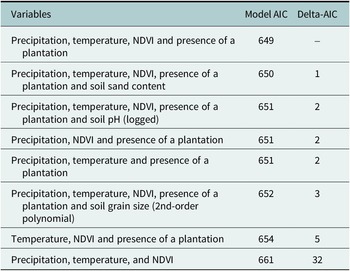
The selected model provided the best fit to the data with the fewest variables. Neither the addition of soil sand content or soil water pH, nor the removal of temperature or NDVI significantly changed model performance (delta-AIC < 3; Table 2). However, the removal of precipitation or presence of a plantation, or the addition of soil grain size significantly impaired model performance; this suggests precipitation and plantations were of greater importance than temperature or vegetation. Generalised Variance Inflation Factors for the selected model (calculated using vif from the car R package) indicated only modest collinearity between variables included in the final model (GVIF < 5; Table 3).
Comparison of selected model with models incorporating fewer or additional environmental variables

Note: Transformations of precipitation, temperature and NDVI as in Table 1.
Generalised variance inflation factors of variables in the model shown in Table 1

The positive relationship between prevalence and precipitation in the driest month is consistent with desiccation killing hookworm larvae in the soil, thereby reducing transmission (Mudenda et al., Reference Mudenda, Malone, Kearney, Mischler, Nieto, McCarrol and Vounatsou2012; Elman et al., Reference Elman, McGuire and Wittman2014; Loukas et al., Reference Loukas, Hotez, Diemert, Yazdanbakhsh, McCarthy, Correa-Oliveira, Croese and Bethony2016; Wardell et al., Reference Wardell, Clements, Lal, Summers, Llewellyn, Campbell, McCarthy, Gray and Nery2017; Ajjampur et al., Reference Ajjampur, Kaliappan, Halliday, Palanisamy, Farzana, Manuel, Abraham, Laxmanan, Aruldas, Rose, Kennedy, Oswald, Pullan, Galagan, Asbjomsdóttir, Anderson, Muliyi, Sarkar, Kang and Walson2021). Hookworm was least prevalent in the hottest areas, which was unexpected, as hookworm eggs and larvae typically survive temperatures up to 35–40°C (Udonsi and Atata, Reference Udonsi and Atata1987; Mudenda et al., Reference Mudenda, Malone, Kearney, Mischler, Nieto, McCarrol and Vounatsou2012; Yaro et al., Reference Yaro, Kogi, Luka, Nassan, Kabir, Opara, Hetta and Batiha2021). This may be because the hotter coastal plains of Jamaica were also drier, less densely vegetated, and more exposed to sunlight, leading to hookworm larvae dying from desiccation in hot, dry soils at temperatures which were themselves insufficient to kill them. In 1927 Washburn attributed his observation that ‘more people are infected with hookworms in mountainous districts than in the dry sandy plains near the coast’ to desiccation.Footnote 20 Temperature scales inversely with elevation; the colder, wetter mountains appear to have been more hospitable to hookworms. Vegetation has been found important in other studies as leaves shade soil thereby protecting hookworm larvae from desiccation (Mudenda et al., Reference Mudenda, Malone, Kearney, Mischler, Nieto, McCarrol and Vounatsou2012; Wardell et al., Reference Wardell, Clements, Lal, Summers, Llewellyn, Campbell, McCarthy, Gray and Nery2017; Ajjampur et al., Reference Ajjampur, Kaliappan, Halliday, Palanisamy, Farzana, Manuel, Abraham, Laxmanan, Aruldas, Rose, Kennedy, Oswald, Pullan, Galagan, Asbjomsdóttir, Anderson, Muliyi, Sarkar, Kang and Walson2021). Greater exposure to L3 among rural small settlers and agricultural labourers was also likely important.
Hookworm was more prevalent in districts with a namesake plantation, even after accounting for temperature, rainfall and vegetation. Ironically for those who defined civilization by plantation labour, the labour-hindering hookworm was more prevalent around plantations. These results support Palmer’s hypothesis insofar as they suggest that working conditions in plantations spread hookworm infection. This model assesses how likely people are to be infected, but Palmer’s argument hinges on the worm burden (how intensely people are infected). Nevertheless, the mean intensity of infection typically increases with prevalence, though this relationship is nonlinear (Anderson and May, Reference Anderson and May1992). However, worm burdens typically also vary greatly between individuals, as is explored in the following section.
Worm burden
This section examines the limited available evidence about burdens of hookworm in early 20th-century Jamaica, focusing mainly on quantitative evidence, but also discussing some of the qualitative evidence provided by the JHC. In most cases, the JHC only recorded whether hookworm was present or absent in an individual, but there is some limited data available on the burdens of hookworm during this period.
Worm counts on samples of 20–30 people were carried out in 1915, 1924 and 1931 (Figure 4). Two of these involved groups of people living together (orphans and prisoners), with a third carried out on hookworm-positive patients drawn from the general public. In each case, hookworm is markedly overdispersed, with most patients carrying only small numbers of worms (typically <100), and a small number of individuals carrying much larger burdens. The dispersal parameter k is used in epidemiology to describe the degree of parasite aggregation (Anderson and May, Reference Anderson and May1992). A k close to zero indicates many parasites infecting few individuals, while a parasite population becomes more randomly dispersed as k approaches infinity. It was possible to calculate both k and the mean worm burden for the orphanage and prison samples as these included uninfected individuals; k was calculated by fitting a negative binomial generalised linear model with no explanatory variables (glm.nb in the MASS R package).
Numbers of hookworm expelled by treatment of: 31 prisoners (1915, a, k = 0.491), 22 boys in Cross Keys Orphanage (1931, b, k = 0.862) and 27 residents of Richmond (1924, c). Data from Annual Medical Reports, NA CO/141/79 Sup. Jam. Gaz. 34:14 (Sep. 7, 1916); NA CO/141/88 Sup. Jam. Gaz. 48:7 (Apr. 23, 1925); NA CO/141/94 Sup. Jam. Gaz. 54:21 (Nov. 12, 1931). 1915 study on prisoners in the General Penitentiary used treatment of three days of a ‘low diet’ with thymol (60 ‘grains’ in two doses) followed by chenopodium (50 ‘minims’ in three doses) against the same dosages of both in reverse order. For the purposes of this study, the two groups were amalgamated. The 1924 study in Richmond used one dose of thymol followed by one dose of chenopodium only on infected individuals; the 1931 study does not explain its treatment methodology.

The mean intensities of infection were 46.6 for the prisoners and 68 among the orphans. k = 0.862 (95% CL 0.362–1.36) among the orphans and k = 0.491 (95% CL 0.267–0.714) among the prisoners. These k-values lie within the expected range of 0.1–10 for both hookworm and human macroparasites more generally, indicating strong overdispersion (Anderson and May, Reference Anderson and May1992), but the mean worm burdens are higher than those reported from studies reviewed by Brooker et al., which all report mean burdens <20 (Brooker et al., Reference Brooker, Bethony and Hotez2004).
It can be assumed that all the residents of the orphanage lived together and shared very similar living conditions, but they still hosted very different burdens of hookworm. The number of months a resident had lived in the orphanage was not correlated with their burden (Spearman’s Correlation, S = 1411, rho = −0.238, p = 0.327). Similarly, prisoners lived and worked in close proximity, but one unfortunate prisoner nevertheless hosted 427 worms, while most had <20. As it is not known how long they had been imprisoned, it is possible that the majority of their worm burden was acquired before their imprisonment, but this itself demonstrates the risks of attributing burden to the socioecological conditions of a particular place when people could and did move between locations. The pathogenicity of hookworm is influenced by socioeconomic and socioecological factors, but individuals living in much the same conditions experienced hookworm very differently. A similarly high variation in burden despite similar environment has been reported from other studies of human helminths and is likely to result from the aggregated distribution of infective stages in the environment, combined with inter-individual variation in genetic and behavioural susceptibility to infection (Wong et al., Reference Wong, Bundy and MHNn1991; Quinnell et al., Reference Quinnell, Pullan, Breitling, Geiger, Cundill, Correa-Oliveira, Brooker and Bethony2010).
This overdispersion and variation in disease is also qualitatively attested in medical reports. In 1931, Washburn noted that in Cross Keys, ‘very few patients exhibited symptoms or signs of hookworm disease: the vast majority are carriers of, rather than sufferers from the disease’.Footnote 21 Before the JHC, in 1914 the District Medical Officer for Moneague remarked that many of those infected with hookworm ‘not feeling sick in any way other than the general lassitude and weakness from anaemia…are unwilling to go 10 miles to hospital’ for treatment.Footnote 22 At the same time, a number of people did suffer terrible illnesses arising from hookworm. In 1915, while attempting to secure support for an eradication programme, Howard informed the CO that ‘the severe types of the disease are quite common, deaths having been reported from several districts’.Footnote 23
While hookworm infection for many Jamaicans passed unnoticed, for the smaller number of individuals who carried large burdens, hookworm infection would have had a significant impact on their quality of life. This further helped persuade doctors and colonial officials that it had to be eradicated. Even in similar socioecological circumstances, however, hookworm burdens, and therefore pathology, varied significantly.
Discussion
This paper has demonstrated that the prevalence of hookworm in interwar Jamaica was influenced by the environment (rainfall, temperature and vegetation) and also by socioeconomic institutions in the form of plantations. As John McNeill has most famously shown, the rise of sugar plantations transformed the ecology of the Caribbean, providing new opportunities for species such as Aedes and Anopheles mosquitoes, and consequently parasites such as malarial Plasmodia and the yellow fever Flavivirus (McNeill, Reference McNeill2010). At least one species of hookworm, N. americanus, is thought to have been introduced to the Americas via transatlantic slavery (Hawdon and Johnson, Reference Hawdon and Johnson1996). Plantations, drawing labourers into close proximity with limited sanitation remained significant sources of hookworm infection into the 20th century.
Palmer (Reference Palmer2010) has argued that while hookworm infection has been historically ubiquitous in tropical and warm temperate areas, hookworm disease (i.e. high-burden infections) became vastly more prevalent in the second half of the 19th century due to workers working in close proximity amidst ‘ideal ecologies for the reproduction of the parasite in mines, railroad beds, and plantation soils’. Jamie Lorimer has extended this argument, dubbing hookworm a ‘pathobiont’, which, depending on the socioecological context, can be harmful, harmless, or even beneficial (assuming that hookworm’s modulation of their host’s immune system protects against allergic and autoimmune disease; Lorimer, Reference Lorimer2020). These arguments are partially supported by this study, which indicates that plantations did indeed promote the spread of hookworm infection. However, socioecological conditions were not the sole determinant of burden, which, as is typical of macroparasites, varied significantly even between individuals living together or in the same area. This resulted in varying levels of sickness, with some individuals seriously ill and others asymptomatic; hookworm varied according to both individual and socioecological factors. This paper supports the contention that plantations increased hookworm infections but complicates it by demonstrating that individuals living in very similar conditions still hosted highly varied burdens of hookworm. Though hookworm remains a significant health problem worldwide, in Jamaica it was placed on the path of extinction because it was seen as a threat to labouring capacity; but the conditions of labour also shaped the distribution of hookworm. Plantations both spread and problematized hookworms, driving efforts to bring them to extinction.
Black scholars have long seen in the plantation a geographic prototype (McKittrick, Reference McKittrick2011) shaping Black lives in the Americas, and in recent years the plantation has also become emblematic of capitalist modernity and multispecies exploitation in the environmental humanities (these literatures are usefully reviewed by Chao et al. (Reference Chao, Wolford, Ofstehage, Guttal, Gonçalves and Ayala2023) and Davis et al. (Reference Davis, Moulton, Sant and Williams2019)). ‘Plantationocene’ has even been posited as an alternative to ‘Anthropocene’ (Haraway, Reference Haraway2015), though it is unclear whether this refers to a geological or historical era. Within the Caribbean, the plantation is often regarded as the defining institution of the region’s history (Watts, Reference Watts1987; Burnard and Garrigus, Reference Burnard and Garrigus2016) and scholars continue to grapple with its long-term effects on Caribbean societies (e.g. Beckford, Reference Beckford1972; Patterson, Reference Patterson2023).
The post-emancipation plantation of the early 20th century seldom features in these literatures, which generally focus on the slave plantation or the contemporary plantation. In this study, we find that 20th-century plantations had an ambivalent relationship with hookworm. Hookworm profited from the plantation, which aided its reproduction and transmission, but it was also expelled and killed by doctors anxious to render their patients fit for plantation work. Plantation work, that is, facilitated both hookworm’s entry into and forced exit from human bodies. Sophie Chao has noted in her study of West Papuan oil palm plantations that monoculture allows parasites of the crop to thrive (Chao, Reference Chao2021); here we find that the plantation, in regimenting and concentrating human bodies alongside vegetal ones, made human bodies vulnerable to parasites as well. In West Papua parasites of the oil palm have become symbols of resistance to the colonisation embodied by the plantation (Chao, Reference Chao2021). Hookworm, however, made its home not in the invading crop plant, but in the bodies of workers. In this light, hookworm infection could be considered another form of racialised violence inflicted upon Black and South Asian workers by the light-skinned colonial elites, who promoted plantation work they themselves would never perform. This was also then multispecies violence, with hookworm both as instrument and ultimately victim, killed when the time came for infections to be treated. As Katherine McKittrick has argued, however, scholars should, when naming the anti-black violence of the plantation, avoid naturalising it (McKittrick, Reference McKittrick2011, Reference McKittrick2013). Hookworm shows this clearly: infection was widespread but not universal, it was not inevitable and it was treatable. The plantation did not condemn everyone to hookworm disease and experiences of hookworm varied widely.
We do not view the plantation as the singular space where people contracted hookworm; our data show that hookworm could be encountered across Jamaica, and was influenced by environmental, as well as human, factors. Rather, the plantation, in concentrating human bodies, amplified hookworm transmission within their ambit, further spatializing infection. At the same time, the plantation, requiring the kind of alienated paid labour colonial elites promoted, sat at the heart of the ideological desire to drive hookworm extinct in order to create a more productive labour force. This, for us, epitomises the ambivalent complexities of extinction: scholars and public alike desire a neat ‘extinction story’ (Rose et al., Reference Rose, van Dooren and Chrulew2017) with a tragic ‘endling’ (Jørgensen, Reference Jørgensen2017) and a clear moral lesson (Heise, Reference Heise2016), but history is rarely so tidy. Instead, we find extinction is historically contingent, driven by particular social, economic and ecological configurations, which may, as in this case, begin an extinction but disappear before the extinction is completed.
Open peer review
To view the open peer review materials for this article, please visit http://doi.org/10.1017/ext.2024.15.
Supplementary material
The supplementary material for this article can be found at http://doi.org/10.1017/ext.2024.15.
Acknowledgements
This research was made possible by the generous assistance of many people including John Lindo, Tereza Richards, and the Medical Library staff at the University of the West Indies; Margaret Williams Pryce and the staff of the Jamaica Archives; John Grahame; Elen Simpson and the archive staff at Bangor University; the staff at the National Library of Jamaica and the staff of the UK National Archives. We would also like to thank the senior common room at Mona Campus, UWI for the warm welcome and all the friendly assistance they gave Jon in Jamaica, and Darcy Heuring and Henrice Altink for the assistance they gave Jon in planning his trip.
Author contribution
Conceptualisation: J.D.R., A.M.D., L.L.W., G.H. and R.J.Q.; Statistical design: J.D.R., R.J.Q. and A.M.D.; Archival research, data collection and curation: J.D.R.; Investigation: J.D.R., A.M.D., L.L.W., G.H. and R.J.Q.; Writing – original draft: J.D.R.; Writing – reviewing, critiquing and editing: J.D.R., A.M.D.; L.L.W., R.J.Q. and G.H.
Financial support
This research was funded by the Leverhulme Trust as part of the Extinction Studies Doctoral Training Programme at the University of Leeds.
Competing interest
The authors have no conflicting interests to declare.




 Open access


Comments
No accompanying comment.