


I. Introduction
The year 2024 marked a turning point for EU tort law (hereafter – delict law),Footnote 1 as the EU adopted a new Product Liability DirectiveFootnote 2 to replace the 1985 Product Liability DirectiveFootnote 3 (hereafter – the PLD/Directive). This decision has already attracted significant scholarly attention, particularly regarding how the PLD departs from its predecessor of 1985 and how its new provisions should be clarified and conceptualised, questions that this author has also addressed in earlier work.Footnote 4 This article, however, intervenes in a different debate.
To explain the contribution of this article, it must first be noted that doctrinal commentary usually approaches the new PLD as a set of rules governing claims brought by persons harmed by defective products.Footnote 5 In that sense, the PLD is typically understood as a private-law instrument occupying a particular place within that system. That place is remedial. The Directive provides the legal framework for natural persons to seek redress for the damage they have suffered. On this account, the function of the Directive, and of delict law more broadly, is infrastructural, in that it enables and supports economic and personal relationships: it provides ready-made rules that actors would otherwise have to create at high cost.Footnote 6 From this perspective, the Directive belongs to a sphere distinct from public law, which is concerned with regulation, including the efficient deterrence of risks and the pursuit of other socio-economic behaviour-steering objectives. Such a view likewise reflects the classical nineteenth-century understanding of the divide between private and public law, shaped above all by the major continental codifications – the Code Napoléon and the German Civil Code.
This article challenges such an account. It argues that the PLD can no longer be understood solely as an instrument serving traditional private-law functions. In that sense, it engages with a wider debate that has recently gained greater prominence in Europe. Namely, that the divide between private and public law, especially in EU private law, is increasingly blurring.Footnote 7 More precisely, in light of that debate, this article defends the position that the PLD likewise increasingly performs regulatory (behaviour-steering) functions previously associated exclusively with public law. And while the claim that private law is becoming more regulatory is not in itself new, this article advances that debate in three respects. First, it demonstrates how that regulatory function is expressed in one of the EU’s most recent instruments of private law, namely the Product Liability Directive. More precisely, it argues that this function is evident in the Directive’s expressly stated internal-market objective in Article 1,Footnote 8 as well as in recital-level objectives relating to innovation, research and access to new technologies, including the uptake of AI, and to more sustainable and circular patterns of production and consumption. A further regulatory objective may also be identified: strengthening private enforcement in support of EU product-safety and market-surveillance rules. Although that objective is not stated as explicitly as innovation or the circular economy, it also follows from the broader logic of EU law and the case law of the European Court of Justice,Footnote 9 and is hinted at in Recital 4.
The second novel contribution to the ongoing discussion on the expanding regulatory role of private law is that the Directive, albeit a private-law instrument, should be interpreted differently where its regulatory, behaviour-steering dimension is relevant to the dispute. More precisely, the provisions that give effect to the Directive’s regulatory function should not be interpreted solely through the classic backwards-looking, ex post logic of private law, focused on whether damage was caused and should be compensated.Footnote 10 They should also be interpreted in the light of the forward-looking, ex ante logic of regulatory objectives, which concerns the capacity of liability rules to steer behaviour. This requires an additional interpretive step: asking which reading of the provision best serves the objectives the Directive is intended to pursue, namely encouraging innovation, supporting circular practices and promoting a level playing field across the internal market.
The third, and most important, contribution concerns how to determine whether that regulatory function is relevant to the interpretation and application of the Directive. The article does not offer a universal solution applicable to all private law instruments that assume regulatory functions. It suggests that such a model may, in principle, be developed, but that any such model must be tailored to the particular instrument, since objectives and legal regimes differ. The basic idea is that, while all of the Directive’s objectives are relevant to understanding the instrument as a whole, not all of them are relevant to the interpretation of every provision. The task, therefore, is to identify which provisions give effect to which objectives. That can be done through reading the operative provisions in light of the recitals and the wider logic of the instrument. This article seeks to do precisely that, proposing a model for determining whether a regulatory objective is relevant in the case at hand.
Therefore, to conclude the introductory remarks, the aim of this article is not only to explain why delict law, and therefore the PLD, came to be understood as serving a regulatory function (Section II), and to examine the specific regulatory goals expressed in the Directive and the provisions through which they are implemented, showing how those provisions should be interpreted in the light of this forward-looking regulatory dimension (Section III), but ultimately to propose, in the Conclusions, a prima facie model for identifying when regulatory goals may become relevant and what interpretive consequences follow from that qualification.
II. The rationale behind the regulatory function of delict law
As the Introduction has already hinted, EU private law can no longer be understood solely as a paradigmatic private-law instrument, since, from the late 1990s onwards, it has increasingly incorporated a regulatory dimension.Footnote 11 This, however, was not always so. To explain that shift, it is necessary to begin with the role originally assigned to private law in the great nineteenth-century codifications. That role, in a paradigmatic Lockean account, was mainly facilitative (or infrastructural): to provide the framework for horizontal dealings between private parties.Footnote 12 From that standpoint, scholars such as Weinrib argued that the point of private law is simply “to be private law”Footnote 13 – and, as Gardner further put it, “the development of private law [could only] be for reasons which are themselves specifically private law reasons.”Footnote 14 On this view, private law (and delict law, naturally) was often presented as isolated from politics and concerned chiefly with corrective justice, grounded in first-order principles of personal freedom and the will theory, as Bartl observes.Footnote 15
Over time, however, that portrayal became harder to sustain once scholars began to take seriously what private law rules do beyond the individual dispute. This shift unfolded in two stages. First, attention moved to “meso-level” effects, focusing on private law’s impact on particular groups.Footnote 16 Supposedly “neutral” private-law rules came to be seen as unfairly distributing power and vulnerabilityFootnote 17 across consumers, employees and injured persons facing institutional tortfeasors. This reframing helped justify labour and consumer protection reforms, and it supported the expansion of strict liability as a way to rebalance relationships where bargaining power is structurally unequal.Footnote 18 Second, attention then widened to the “macro-level,” focusing on the effects of private law on the economy.Footnote 19 Private law came to be understood as a tool for structuring – and sometimes correcting – markets. In the EU, this is visible in the extensive body of internal market private law legislation, where even consumer protection (a “meso-level” category) is defended in internal market terms (a “macro-level” category).Footnote 20 Against this background, the Product Liability Directive can also be seen as playing a macro-level role in steering the internal market by minimising divergence across national liability regimes. It is within this market-structuring role that additional regulatory goals, such as innovation and the circular economy, also find their place.
Yet, to see more clearly why delict law can plausibly be understood in these terms – as a body of rules capable of steering behaviour and, in that way, structuring markets – it is not enough to rely on this historical overview alone. We also need an account of why and how liability rules can steer conduct in the first place. That account is provided most clearly through the lens of law and economics. From the 1970s onwards, first in the United States,Footnote 21 law and economics legitimised the view of tort law as a tool for steering behaviour, more precisely as a means of preventing accidents and achieving “optimal deterrence.”Footnote 22 It therefore provides a natural starting point for explaining why the Product Liability Directive can perform a regulatory function. The law and economics approach to why delict law can steer behaviour rests on a simple microeconomic premise: actors decide whether and to what extent to pursue an activity by weighing expected benefits against expected costs.Footnote 23 Liability is part of those expected costs, so the structure of liability can influence behaviour. More precisely, it can either internalise accident costs, as with strict liability, because it is easier to establish, meaning that the actors themselves pay for the harm. Or it can externalise costs if liability is organised around fault, which makes it harder to hold a person liable, leaving those costs with victims or society. Accordingly, if costs are internalised – because the situation is governed by a strict liability regime – actors have incentives to invest in precautions, since safer design may be cheaper than repeatedly paying damages.Footnote 24 If costs are externalised, for example, because fault is hard to prove or claims are unlikely,Footnote 25 the opposite incentive can arise: it may be rational to keep an unsafe design because expected liability is lower than the cost of prevention.Footnote 26
In the sense just described, law and economics can explain why delict law may assume a regulatory function: it does so because liability rules create incentives that steer behaviour in one direction rather than another. That said, using law and economics to explain the regulatory goals of the Product Liability Directive involves a difficulty. Traditionally, law and economics is framed around a single regulatory goal – prevention or, more precisely, deterrence. The Directive, however, does not present itself in those terms, since it does not pursue deterrence as one of its objectives. It is therefore necessary to take a further step and ask whether law and economics remain relevant when conceptualising such other regulatory goals of delict law that are directly relevant to the Directive, such as sustainability, environmental protection or the facilitation of private enforcement of safety law. The answer to that question is both yes and no. On the one hand, law and economics remains useful because it explains the mechanism by which liability can serve regulatory goals: by changing incentives. Liability rules change the expected costs of different courses of action, making some choices more attractive than others. For instance, if the goal is innovation, law and economics explain why excluding free and open-source software (Article 2(2)) from strict liability reduces expected liability exposure and can make its development and distribution “cheaper,” supporting innovation.Footnote 27 By contrast, if the goal is to improve compliance, establishing rules that attach liability consequences to breaches of safety standards raises the expected cost of non-compliance by increasing the likelihood that resulting harm will be internalised. On the other hand, law and economics incentive analysis alone cannot determine which legal goals should take precedence. While it can illustrate the consequences of prioritising, for instance, innovation over sustainability (or vice versa), it cannot provide a justification for that order. The justification for such choices lies in normative views such as distributive justice, which consider how the burdens (such as the duty to pay compensation) and benefits (the right to receive compensation) arising from liability are allocated throughout society.Footnote 28 Accordingly, any attempt to explain not only why delict law can steer behaviour, but also why it should steer it in one direction rather than another, must draw on theories beyond law and economics, which lie beyond the scope of this article.
III. Analysis of the regulatory goals of the product liability directive
After explaining why and how delict rules can serve a regulatory purpose and how this clarifies the PLD’s shift to behaviour steering, this section explores the particular regulatory goals within the revised PLD. It does so in three steps. It first considers the Directive’s internal market goal (Section 1). Then it turns to other contemporary regulatory aims, including environmental and innovation-related objectives (Section 2). Finally, it addresses a goal that is not explicitly stated in the Directive’s text but can be inferred from the wider context: the role of delict law in the (private) enforcement of safety rules (Section 3).
1. Internal market objective
The internal market objective is found in the Directive’s opening article. It also happens to be the legal basis for enacting the Directive at the EU level, since the Directive is adopted under Article 114 TFEU, which empowers the EU to take measures for the “establishment and functioning of the internal market.” From this, it is clear – the “internal market” objective is as regulatory as it gets. It is not directed at the delict law’s bilateral task of correcting the injustice but addresses a different concern: how to ensure that liability rules do not hinder the free movement of products (and related services) in their cross-border circulation across Member States.
To clarify what the Directive’s internal market goal implies, it helps to start with the concept of the internal market itself.Footnote 29 In EU law, the internal market is the Union’s core economic project: a borderless area where persons, capital, goods and services move freely.Footnote 30 Of these four freedoms, the Directive is primarily linked to the free movement of goods and, to a limited extent, to the free movement of services when they are product-related. Its basic idea is that trade within the EU should operate as smoothly across Member State borders as it does within a single state.Footnote 31 Accordingly, in simplified terms, if a product is marketed across the EU, its producer should not have to adjust its design, warnings, packaging or other regulatory requirements each time it enters a different national market.
Against that background, it is not only product safety requirements that matter for the implementation of that free-movement project when it comes to goods, but liability rules as well. Product liability rules also influence the conditions under which products are placed on the market. As explained in Section II, strict liability creates stronger incentives to invest in product safety because claims are easier to establish and expected liability costs are higher.Footnote 32 Fault liability, by contrast, creates weaker safety incentives, since claims are harder to establish and liability is less likely.Footnote 33 It follows that, if liability rules differ across Member States, firms may face different liability risks, compliance costs and incentives in each national market. In response, producers may have to adapt their products and practices to the relevant liability regime or avoid markets where such adaptation would be too costly or impracticable, much as they would in response to divergent product requirements.Footnote 34 This logic also finds expression in the law and economics concept of “activity levels.” As Posner, drawing on DiamondFootnote 35 and Shavell,Footnote 36 argued, strict liability may reduce accidents not only by inducing greater care but also by lowering activity: when due care cannot eliminate risk, actors may rationally do less of the risky activity.Footnote 37 As he puts it, “one way to avoid a highway accident is to drive more carefully, but another is to drive less.”Footnote 38 From the perspective of the internal market, that matters because divergent incentive structures of this kind may impede intra-EU trade by undermining “economies of scale” and distorting competition. If rules differ by country, companies cannot make a single large, cheap batch of products for everyone, so production becomes more expensive for consumers.Footnote 39 They also create additional compliance costs, which do not affect all firms equally. Dalton highlights that these costs are more manageable for large, established companies compared to small businesses and startups. Consequently, rules designed as consumer protections might actually benefit existing firms and reduce competitive pressure.Footnote 40 Different national liability regimes may also favour local firms, which are already familiar with their own legal systems.Footnote 41
Therefore, to conclude the explanation of the Directive’s role in the wider internal market project, the PLD, as an instrument harmonising product liability rules, may be understood as addressing a specific market problem: the risk that divergent incentive structures for how products should be designed, labelled, etc., may fragment the market, contrary to the aims of the internal market. Put differently, the internal market objective helps explain why this instrument exists in the first place as an EU-wide harmonising measure of secondary law. That, however, does not mean that the internal market objective is relevant only at this general level. As noted in the Introduction, all of the Directive’s objectives help explain the instrument as a whole. The internal market objective, in particular, helps explain why harmonisation is pursued at the EU level, but it may also become relevant in a more specific category of cases, namely those concerning the extent of harmonisation. To explain this point, disputes under the Directive concern not only substantive provisions, such as the elements of liability and available defences, but also questions as to when Member States may depart from the Directive, including by adopting more claimant-friendly rules, and how far they may regulate matters left to national procedural autonomy. It is precisely in such cases that the objective of internal market harmonisation becomes relevant.
The role of the internal market goal in such cases is to support the reading that favours uniformity, unless the Directive clearly permits divergence. That interpretive role, in fact, may already be illustrated by the ECJ’s case law. Skov and Bilka (C-402/03),Footnote 42 in particular, show how the internal-market objective supports a reading of the Directive that favours uniformity and limits Member State divergence. In that case, the ECJ relied, in substance, on an internal-market argument: it considered the consequences of allowing a Member State to depart from the uniform rule, namely broader insurance cover, higher product prices and a chain of recourse actions up the supply chain.Footnote 43 The internal market argument can therefore support adjudication in other cases too by explaining the practical consequences of allowing harmonised rules to diverge.
2. Contemporary policy goals of innovation and circular economy
Another set of the Directive’s regulatory goals differs from the internal-market goal because they better clarify the specific design choices and provisions of the Directive. They run along two tracks: (1) supporting innovation, research and access to new technologies, and (2) promoting sustainable and circular forms of production and consumption. Taken together, they reveal a more affirmative side of the Directive: from a regulatory perspective, it is not only meant to steer market behaviour to facilitate the free movement of goods across the Union, but also to guide how that free movement is facilitated – by aligning it with “contemporary” policy priorities. The discussion that follows turns to these priorities and examines how they are given effect in the Directive’s provisions, i.e., explains certain design choices within the Directive. This section begins this assignment with the goal of innovation.
a. Innovation
The goal of innovation is articulated in Recitals 3, 14, 35 and 54, which also refer to “research and access to new technologies.” That goal is not relevant in every dispute. It becomes relevant only where innovation forms part of the case. This is, prima facie, so where the product at issue is innovation-driven, as is often the case with digital products and new technologies such as AI. But, more precisely, it becomes relevant where the dispute concerns the Directive’s provisions specifically directed at innovative products or may affect innovative practices. In such cases, the goal of innovation should be considered when interpreting the relevant provisions, that is, by incorporating forward-looking considerations into the interpretive analysis, including, more specifically, the likely effects of different interpretations on incentives for innovation, research and access to new technologies.
That said, incorporating this forward-looking perspective is not straightforward. Quite apart from the general difficulty that an adjudicator must move beyond the perception of the Product Liability Directive as a “private,” and therefore usually apolitical, instrument, there is a more specific challenge: the recital-level goal of innovation may conflict with the article-level aim of guaranteeing a high level of consumer protection (Article 1), since strict liability rules are often said to “dampen firms’ appetite for innovation.”Footnote 44 Accordingly, if the aim of analysing the innovation goal is to examine its regulatory character and to show how it is pursued through specific provisions (and therefore how those provisions should be read), it is necessary first to address their relationship with this Directive’s non-regulatory aim, since a provision cannot simultaneously give full effect to both innovation and a “high level of protection” where those aims pull in opposite directions.
That relationship, accordingly, can be described, first, by observing that the Directive itself appears to manage the tension between promoting innovation and guaranteeing a high level of protection for natural persons by locating these aims in different parts of the instrument. The non-regulatory aim of securing a high level of protection is set out in Article 1, whereas innovation is mentioned only in the recitals (Recitals 3, 14, 35 and 54). Because these are not equal sources – operative provisions are binding, while recitals are notFootnote 45 – the “high level of protection” objective has greater normative weight and is more likely to guide the Directive’s practical operation. That said, this does not mean that recital-level aims are always overridden by goals established in the provisions. Recitals, while non-binding, can still explain the instrument’s purpose and rationale and may inform the scope of operative rules.Footnote 46 Where a recital is clear, but an operative provision is open to more than one reading, the recital may help resolve the ambiguity.Footnote 47 In the Directive, this is the case for several provisions whose innovation-oriented rationale is set out in Recitals 14, 35 and 54. To start with, the first provision that gives effect to the goal of innovation is Article 2(2). It excludes free and open-source software from the Directive’s scope. This narrows the Directive’s victim-protective reach, since persons harmed by excluded software cannot rely on the strict product liability regime. Yet, as Recital 14 clarifies, this limitation is intended to “contribute to research and innovation on the market,” meaning that the goal of innovation better explains the provision than the goal of a high level of protection.
The second provision that gives effect to the goal of innovation lies in Article 7(3): a product is not defective “for the sole reason” that a better product – including updates or upgrades – has already been, or is subsequently, placed on the market or put into service. As with the first example, this too narrows victim protection, since claimants cannot rely on this argument alone when establishing defectiveness. For the same reasons, the goal of innovation better explains this choice. Recital 35 shows that the limitation is intentional and innovation-oriented. That limitation, more precisely, is meant to ensure that manufacturers are not discouraged from improving products over time, since treating later improvements as proof of earlier defectiveness could chill innovation. The third provision, which gives effect to the goal of innovation, is established in Article 12(2). It allows smaller software manufacturers to agree that an integrating manufacturer will not seek recourse against them for harm caused by a defective software component. As Recital 54 indicates, this follows the same innovation-oriented logic for the software sector: because “a high degree of innovation is particularly necessary in the software sector,” and such a tool is presented as a way to preserve incentives to innovate and to participate in software value chains.
b. Sustainability
Just as innovation goals matter for provisions (and consequently products) linked to innovation, new technologies and sustainability goals matter most where the product is (or can be) designed to be durable, repairable, reusable or upgradable and is likely to be modified after being placed on the market (Recital 39–40).Footnote 48 The rationale for incorporating this circular economy goal is also identical: liability rules allocate risk and costs, thereby guiding incentives and making repair, refurbishment, reuse and upgrades more or less attractive.Footnote 49 When analysing the circular-economy objective and the provisions that give effect to it, it is useful to keep in mind that any legislative strategy intended to guide market behaviour must address both sides of the market: the supply and demand sides. The same holds for the circular market. Circular practices depend not only on the willingness of economic operators and other market participants to offer more durable products and circular services, but also on consumers’ willingness to choose them.Footnote 50 Accordingly, if a liability regime is to support circular practices, it must create the right incentives for both the users and economic operators. Against that background, the relevant provisions of the Directive may likewise be analysed in those terms. At the same time, such analysis must also take account of the necessary balancing exercise, since measures favouring supply and measures favouring demand may pull in opposite directions.
Turning first to the demand side, namely consumers and natural persons, this side is central because they decide whether to reuse, repair or refurbish a product rather than replace it. The way in which the Directive may steer consumers towards circular practices is relatively simple: by extending its protective liability regime to such “second life” practices. In that respect, unlike the innovation objective discussed above, which may at times come into tension with the Directive’s commitment to a high level of victim protection, the circular-economy objective aligns with it. To investigate the provisions that give effect to the goal of the circular economy, we can start with its rules on a product’s substantial modification – i.e., cases where a product is changed after it is placed on the market (repair, refurbishment, upgrades, etc.). Where the modification is substantial, the Directive treats the modified item as a “new product” and the person who carried out the modification as a “new manufacturer” (Article 4(6)(a)(ii) and Article 4(18), read with Article 8(2)). This has two clear consumer-protective consequences. First, the modified product is subject to a new ten-year expiry period running from the date on which it is placed on the market or put into service after the modification (Article 17). Second, if such a product causes damage, the defectiveness, an element of liability, which replaces fault, is assessed at the time of the substantial modification, which means the assessment is made against a more recent scientific and technical baseline and is therefore more favourable to the injured person (Article 7(2)(e)).Footnote 51
Turning, second, to the supply side, namely economic operators and other actors relevant to the circular economy, two groups of provisions may be identified. The first concerns incentives for designing and marketing more durable products. A relevant rule is Article 7(3), which provides that a product is not defective “for the sole reason” that a better product, including through updates or upgrades, has already been, or is subsequently, placed on the market or put into service. This rule may be read as supporting the circular economy because it prevents economic operators from being “penalised” merely for improving a product over time. It therefore guards against hindsight-driven reasoning that could treat later improvements as evidence of defectiveness.Footnote 52 In the context of circularity, that matters because updates and upgrades are among the main ways to extend a product’s life and reduce replacement purchases.Footnote 53 Second, an equally important condition for a functioning circular economy is the supply of repair, refurbishment and upgrading services and the ability to provide them at a reasonable cost.Footnote 54 Those services can indeed become more expensive if operators engaging in repair and refurbishment are exposed to strict liability, since liability risk translates into higher compliance and insurance costs. For that reason, the Directive draws a line between, on the one hand, ordinary, non-substantial repairs and similar operations, which fall outside its scope of the Directive (Recital 39), and, on the other, substantial modification, which is covered.Footnote 55
A final point concerning these contemporary goals operates at a higher level of generality. The provisions relating to innovation and sustainability may appear either as exceptions to the Directive’s general commitment to a high level of protection, as in the case of some innovation-related provisions, or, more broadly, as pointing to an additional dimension that must be considered. Taken together, however, they also reflect something more systemic. More precisely, that the Directive is not only an instrument for extending the product liability regime to circular and digital products, but also one for redesigning that regime so that liability does not undermine innovation and encourage circular practices. In the case of innovation, Recital 3 supports that reading, as it presents the reform as contributing to the “roll-out and uptake of new technologies, including AI.” That does not mean, however, that these goals become relevant in every case merely because a product can be described as innovative or linked to circular practices. Such an approach would go too far.Footnote 56 Yet, a narrower point can still be made. Where a product is genuinely innovation-driven or connected to circular practices, and where the relevant provision is open to more than one reading, those goals may legitimately be considered alongside the Directive’s other objectives.
3. The goal of private enforcement
Unlike the EU Damages Directive, which expressly frames damages actions in its recitals as part of an “effective system of private enforcement,”Footnote 57 the 2024 Product Liability Directive does not present itself in those explicit terms. This section argues, however, that the Directive may nonetheless be understood as enabling private enforcement, for example, in relation to compliance with instruments such as the AI Act, which provides a timely and relevant illustration, and for that reason will be used in this section.
The argument that the Directive may be understood as pursuing such a private-enforcement function rests on four points. First, Recital 4 explicitly links the 2024 product liability reform to “coherence and consistency with product safety and market surveillance legislation,” signalling that product liability is meant to complement the product safety framework. Second, the Directive repeatedly ties liability to safety rules by referring to them across the defectiveness test, the presumptions and the defences.Footnote 58 In that regard, Article 7(1) is particularly important because it sets out a new defectiveness test: a product is defective if it does not provide the safety “that is required under Union or national law.” This most clearly lowers the barriers to relying on breaches of safety rules in liability litigation and can be read as making liability a more effective enforcement mechanism. Third, the CJEU has long linked damages actions to the effectiveness of EU law, treating private claims as one way to safeguard Union rules – most clearly in competition law.Footnote 59 Fourth, emerging commentary on the revised Directive likewise places it within an integrated “ex ante safety/ex post liability” structure for digital products and modern supply chains.Footnote 60 However, the very idea is even older: private claims have long been understood as complementing administrative oversight and supporting compliance with regulatory rules in the EU academic debate.Footnote 61
Just as with the other regulatory goals discussed above, the goal of private enforcement becomes relevant only where the dispute concerns the kind of rules to which it relates – here, safety law. Such rules do not govern every case. Damage may arise not from a breach of safety requirements, but, for example, from a failure to meet consumer expectations, which is itself a basis for defectiveness under Article 7(1). In some cases, however, safety rules may indeed be relevant, and where that is so, the private enforcement goal likewise becomes relevant. It is important to note that safety law may matter not only where it lays down direct and precise obligations, but also where duties are framed in more open-ended terms. The AI Act provides a useful example. Its Article 10 sets out relatively general requirements concerning the data used to train high-risk AI systems, and non-compliance with those duties could support a finding that the system is defective. It follows that, when resolving product-liability cases, it is necessary to consider whether relevant safety rules were breached. This matters not only for identifying when the private enforcement goal becomes relevant, but also because it may affect the outcome of the dispute by influencing the assessment of defectiveness (Articles 7(1) and 7(2)(f)), the evidentiary rules, including presumptions applied in the case of non-compliance (Article 10(2)(b)), and possible exemptions from liability where compliance with mandatory requirements is invoked (Articles 11(1)(d)).
The implication of treating such a dispute as one involving the private enforcement of product-safety law is that product liability likewise does more than provide a remedy between the parties. In such cases, it also operates as a channel through which EU safety duties are made effective by attaching civil consequences to non-compliance. This has concrete teleological consequences for how such disputes should be resolved: interpretation and application should not turn the underlying safety obligations into “paper rules” – formally binding, but not workable in practice. This approach is also often supported by invoking the principle of effectiveness (effet utile). And while this principle is used across many types of disputes, it has also served to limit national autonomy in the design and operation of remedies for breaches of EU law,Footnote 62 so that those remedies ensure EU rules remain effective in practice.
IV. Conclusions: towards a regulatory goals test
The Product Liability Directive is often viewed as a private law tool designed primarily to provide remedies, specifically to compensate those harmed by a defective product. On that view, its logic is ex post and backwards-looking. It is focused on whether damage was caused and whether it should be compensated. This article has argued that the Directive cannot be fully understood without taking seriously the regulatory objectives it establishes. The internal market objective outlined in Article 1, along with the innovation and circular-economy goals in the recitals and the Directive’s role in enforcing EU product-safety rules through private liability claims, show that this Directive aims to do more than just compensate victims. It allocates risks and costs in a manner that influences market behaviour – aiming to foster innovation, support circular practices, ensure a fair playing field within the internal market, and secure compliance with EU safety laws.
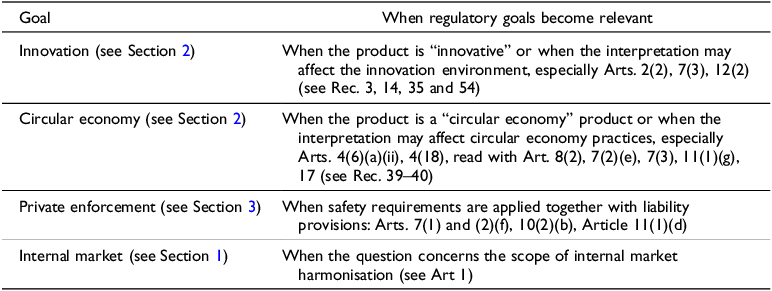
Recognising that dual character has clear interpretive implications, when a dispute involves a provision that advances a regulatory goal, the interpretive approach should go beyond merely considering the logic of retrospective compensation. It must also incorporate the Directive’s future-oriented, behaviour-guiding aspect by evaluating which interpretation of the provision most effectively promotes the Directive’s intended objectives. Not every product liability dispute, however, raises a “regulatory issue” in the sense that it calls for this forward-looking adjudicative perspective. Regulatory objectives become relevant only where the dispute touches the Directive’s explicitly stated behaviour-steering concerns. To assess whether those concerns become relevant, we can apply the simple three-step test (see Table 1). The test shows that the Directive’s “ordering” of goals – that is, identifying which objective does the main explanatory and interpretative work for a given provision – is not only provision-specific, but also context-specific.
Regulatory goals of the product liability directive.

First, whether regulatory objectives are relevant, and if so, which ones, may prima facie depend on the type of product that caused the damage. Where the product is AI-enabled or otherwise innovation-driven, objectives relating to innovation, research, access to new technologies and the uptake of AI may become relevant. Where the product is circular, refurbished or otherwise linked to circular-economy strategies, sustainability and circular-economy objectives may become relevant. Accordingly, where the dispute concerns damage caused by an innovation-driven or sustainability-linked product, this is a prima facie indication that the Directive’s regulatory, behaviour-steering dimension should be considered.
Second, regulatory objectives can become relevant when the Directive is applied alongside other EU legislation, such as safety legislation. If that is indeed the case, the Directive not only serves as a remedial framework but also acts as a mechanism for enforcing public-law obligations through private litigation. Although that task is usually associated with public authorities, it may also be carried out by private individuals who bring claims before civil courts and seek personal remedies. In such cases, when civil courts assess compliance with safety rules in product liability disputes, they determine the civil consequences of non-compliance. For that reason, where safety rules are in play, the regulatory objective of guaranteeing the effective enforcement of EU law – most importantly, its effet utile – becomes relevant.
Lastly, regulatory objectives can also be relevant when a product liability dispute involves an internal-market harmonisation issue. Disputes under the Directive address not only its remedial framework (such as liability elements and defences), but also the conditions under which Member States may deviate from it – such as implementing more claimant-friendly rules – and the extent to which they may regulate matters left to national procedural autonomy. In such cases, the dispute has a regulatory dimension because the court’s decision may affect the free movement of products (goods) and product-related services. That, in turn, requires taking seriously the Directive’s function as a harmonising, free-movement-facilitating instrument, under which divergence is permitted only to the extent the Directive allows it.
Finally, the analysis of the Product Liability Directive has wider consequences that extend beyond the Directive itself. It shows one way in which the traditional divide between private and public law is blurring, and how private law, especially at the EU level, is increasingly displaying a regulatory dimension.

 Open access

