





Introduction
Developmental Language Disorder (DLD), previously referred to as Specific Language Impairment (SLI), is a neurodevelopmental condition that affects approximately 7.5% of children (Norbury et al., Reference Norbury, Gooch, Wray, Baird, Charman, Simonoff, Vamvakas and Pickles2016; Tomblin et al., Reference Tomblin, Records, Buckwalter, Zhang, Smith and O’Brien1997). Recent studies suggest that DLD affects boys and girls at similar rates (Calder et al., Reference Calder, Brennan-Jones, Robinson, Whitehouse and Hill2022; Norbury et al., Reference Norbury, Gooch, Wray, Baird, Charman, Simonoff, Vamvakas and Pickles2016). It is characterized by significant and lasting difficulties in acquiring and developing oral language that cannot be explained by other medical conditions such as hearing impairment, intellectual disability, autism, neurological disorders, or genetic syndromes (Bishop et al., Reference Bishop, Snowling, Thompson, Greenhalgh and Consortium2016). Additionally, DLD frequently co-occurs with other neurodevelopmental disorders, including attentional problems (ADHD), motor problems (developmental coordination disorder or DCD), reading and spelling problems (developmental dyslexia), speech problems, limitations of adaptive behavior, and/or behavioral, and emotional disorder (Bishop et al., Reference Bishop, Snowling, Thompson and Greenhalgh2017).
Children diagnosed with DLD frequently face significant challenges in both understanding and producing spoken language. These difficulties span various domains of language and cognition, including phonology, morphology, syntax, semantics, vocabulary, pragmatics, discourse, and verbal learning and memory (Bishop et al., Reference Bishop, Snowling, Thompson and Greenhalgh2017; Leonard, Reference Leonard2014). Extensive research has examined morphological difficulties in children diagnosed with DLD. These children often have trouble using inflectional morphology correctly, particularly with verb tense and subject-verb agreement (e.g. Abel et al., Reference Abel, Rice and Bontempo2015; Van der Lely & Ullman, Reference Van der Lely and Ullman2001). Moreover, several studies have also found that children with DLD frequently leave out functional words such as articles, prepositions, and pronouns (e.g. Bedore & Leonard, Reference Bedore and Leonard2001; Coloma et al., Reference Coloma, Araya, Quezada, Pavez and Maggiolo2016; Restrepo & Gutierrez-Clellen, Reference Restrepo and Gutierrez-Clellen2001; Sanz-Torrent et al., Reference Sanz-Torrent, Serrat, Andreu and Serra2008). In relation to pronouns, several cross-linguistic studies have shown that children with DLD struggle with the production of different kinds of pronouns. Previous research has documented a higher incidence of errors in pronoun case marking for third-person singular pronouns (e.g., him runs vs. he runs) in English-speaking children with DLD compared to their same-age peers (e.g., Loeb and Leonard, Reference Loeb and Leonard1991; Moore, Reference Moore1995, Reference Moore2001). In French children with DLD, Jakubowicz et al. (Reference Jakubowicz, Nash, Rigaut and Gerard1998) found that they produced significantly fewer clitics in object position than clitics in subject position and reflexive pronouns. Additionally, Paradis et al. (Reference Paradis, Crago and Genesee2006) replicated these difficulties in the domain of object clitics in French–English bilingual children with DLD. The same difficulties have been found in Italian (Bortolini et al., Reference Bortolini, Arfé, Caselli, Degasperi, Deevy and Leonard2006; Cipriani et al., Reference Cipriani, Bottari, Chilosi and Pfanner1998) and Greek children with DLD (Stavrakaki, Reference Stavrakaki, Kakouriotis and BollaMavrides1999; Stavrakaki & Van der Lely, Reference Stavrakaki and Van der Lely2010). In Spanish, a null-subject language in which personal pronouns can appear either explicitly or as null forms, children with DLD produce a higher rate of null subject expression from spontaneous production than TD children (Grinstead et al., Reference Grinstead, Lintz, Pratt, Vega-Mendoza, De la Mora, Cantú-Sánchez and Flores-Avalos2018). Additionally, children with DLD produce fewer overt subject pronouns in switch-reference contexts—situations where the subject of the preceding finite verb differs from the subject of the current clause—compared to TD peers (Dickinson et al., Reference Dickinson, Ortiz-Ramírez, Arrieta-Zamudio, Grinstead and Flores-Ávalos2023).
However, while numerous studies have investigated different aspects of pronoun production development in children with DLD, relatively little attention has been given to pronoun resolution (Abbott et al., Reference Abbott, Nip and Love2024; Rakhlin et al., Reference Rakhlin, Kornilov, Reich and Grigorenko2015; van der Lely & Stollwerck, Reference Van der Lely and Stollwerck1997). Pronoun resolution is a key component of language comprehension and discourse processing. It involves identifying the antecedent—the word or phrase to which a pronoun relates (anaphor). This process enables listeners and readers to maintain coherence across sentences and larger discourse units. In this sense, pronouns pose a unique challenge because they are inherently underspecified and rely heavily on contextual cues for interpretation.
Previous studies have found that children with DLD have difficulties with correct pronoun reference assignment. Van der Lely and Stollwerck (Reference Van der Lely and Stollwerck1997) investigated the intrasentential assignment of reference to pronouns (him, her) and reflexives (himself, herself) in 9–12-year-old English-speaking children with DLD in a picture–sentence pair judgment task. Participants were presented with pictures containing two characters (e.g., Mowgli and Baloo Bear). Then, an introductory sentence was spoken by the experimenter (e.g., “This is Mowgli; this is Baloo Bear”), which was followed by the experimental test sentence (e.g., “Is Mowgli tickling him?”) to which the children had to reply yes/no as appropriate. Children with DLD had difficulty identifying the correct antecedent for pronouns and reflexives when relying solely on syntactic cues. However, their performance improved notably when they could rely on semantic gender cues based on sex distinctions to identify the referent, particularly in scenarios where the introductory sentence presents two characters of different sexes (e.g., “This is Peter Pan; this is Wendy. Is Peter Pan touching her?”). This finding apparently contrasts with results from other studies showing that children with DLD often struggle with grammatical gender and other morphosyntactic cues. For instance, Bedore and Leonard (Reference Bedore and Leonard2001) reported such difficulties in Spanish-speaking children with DLD, highlighting persistent challenges in using gender agreement and other grammatical markers. Taken together, these observations suggest that while children with DLD can effectively draw on semantic gender information—where gender distinctions map onto real-world categories such as biological sex—their ability to rely on grammatical gender, which is more arbitrary and morphosyntactic in nature, remains inconsistent and limited.
Similarly, Rakhlin et al. (Reference Rakhlin, Kornilov, Reich and Grigorenko2015) examined intrasentential reference assignment to pronouns and reflexives in 5–10-year-old native-Russian-speaking children with DLD on a picture selection task. The study revealed that children with DLD performed worse overall than their TD peers, with pronouns and reflexives being relatively similar in difficulty for the DLD, but not the TD group which showed more difficulties in pronouns than reflexives. Additionally, the challenges the children faced were not only due to the existence of anaphoric relationships, but also, in part, to the increased syntactic complexity of the sentences involved (e.g., “The boy patted him” vs. “The boy sees him dancing.”). More recently, Abbott et al. (Reference Abbott, Nip and Love2024) examined pronominal resolution during real-time sentence processing and overt comprehension and whether the rate of speech impacted access to that knowledge in 6–11-year-old English-speaking children with DLD in two experiments. In the first experiment, participants performed a binary picture-matching task during uninterrupted auditory sentence processing, with response times (RTs) measured at the onset of pronouns, reflexives, or control nouns. To assess facilitative priming, RTs in the pronoun condition were compared against the control noun baseline across two speech rates. While children with DLD exhibited no evidence of real-time pronoun-antecedent priming at a regular speech rate, they demonstrated significant facilitative priming when the auditory stimuli were slowed. The second experiment used a sentence-picture matching task to assess comprehension accuracy of similar sentences containing a pronoun. Children with DLD performed at chance levels for pronoun comprehension, regardless of the speech rate. Therefore, slowing the speech helped children with DLD with real-time processing, but not with overall comprehension accuracy.
Although some studies have explored pronoun resolution in children with DLD, there is still a lack of systematic research examining how these children use different linguistic and cognitive cues to resolve pronoun dependencies. In contrast, linguistic and psycholinguistic research has extensively examined the mechanisms guiding pronoun interpretation in both TD children and adults, highlighting the interaction of structural, cognitive, and pragmatic factors. Children begin producing pronouns early in development, but accurate interpretation emerges more gradually. Initial strategies show a robust preference for linking pronouns to the subject or first-mentioned entity, often referred to as a prominence heuristic or agent bias (MacWhinney & Bates, Reference MacWhinney and Bates1989; Song & Fisher, Reference Song and Fisher2005), even when the discourse-preferred antecedent is not the subject. Eye-tracking studies reveal that children aged 4–5 do not yet integrate syntactic and pragmatic cues in an adult-like way. For example, Arnold et al. (Reference Arnold, Brown-Schmidt and Trueswell2007) found that children did not exhibit anticipatory fixations toward likely referents and instead relied heavily on gender congruence, indicating a dependence on surface-level features rather than deeper structural or discourse information. In null-subject languages like Spanish, children exhibit early sensitivity to language-specific patterns: null pronouns are typically interpreted as referring to subjects, while overt pronouns (e.g., él, ella) tend to be linked with non-subjects (Filiaci & Baldo, Reference Filiaci and Baldo2009; Grüter, Reference Grüter2006). This reflects early awareness of pragmatic conventions, where null pronouns maintain topic continuity and overt pronouns often mark a topic shift. However, the acquisition of this referential system is protracted due to the low frequency of overt pronouns in child-directed input, limiting opportunities for probabilistic learning. Longitudinal studies in two very close languages, such as Spanish and Catalan (Bel et al., Reference Bel, Perera and Salas2010; Bel & Albert, Reference Bel, Albert, Perera, Aparici, Rosado and Salas2016), confirm that children do not consistently use structural and discourse cues to establish coreference in extended narratives until around 10–12 years of age, mirroring findings from other languages (Hickmann, Reference Hickmann, Strömqvist and Verhoeven2004; Serratrice, Reference Serratrice2007; Shin & Cairns, Reference Shin and Cairns2012). This protracted development reflects the multifaceted nature of referential interpretation, which necessitates the integration of morphosyntactic, pragmatic, and cognitive resources, such as Theory of Mind (Hendriks et al., Reference Hendriks, Koster and Hoeks2014).
In adults, pronoun interpretation is characterized by a more refined weighting and rapid integration of the same grammatical, cognitive, and pragmatic cues that children are still learning to coordinate. Features such as gender and number contribute to identifying antecedents (Carreiras et al., Reference Carreiras, Garnham and Oakhill1993; Crawley et al., Reference Crawley, Stevenson and Kleinman1990), and visual-world eye-tracking studies show that adults make anticipatory fixations based not only on gender cues (Arnold et al., Reference Arnold, Eisenband, Brown-Schmidt and Trueswell2000) but also on morphosyntactic structure. Two well-established strategies—subject preference and first-mention bias—play key roles: the former reflects the syntactic prominence of subjects, while the latter captures a cognitive tendency to link pronouns to the first-mentioned entity (Bader & Portele, Reference Bader and Portele2019; McDonald & MacWhinney, Reference McDonald and MacWhinney1995; Stevenson et al., Reference Stevenson, Crawley and Kleinman1994). Although these strategies often align, they are driven by distinct mechanisms—structural versus linear order. Studies in languages with flexible word order have helped disentangle these influences. In Finnish, subject preference tends to emerge earlier (Järvikivi et al., Reference Järvikivi, Van Gompel, Hyönä and Bertram2005; Kaiser & Trueswell, Reference Kaiser and Trueswell2003), while recent findings in Catalan (Bel et al., Reference Bel, Guerra, Ahufinger, Andreu and Sanz-Torrent2026) suggest a stronger role for order of mention. Pragmatic factors such as topic and focus also shape referent prominence. Sentence structure—including canonical versus non-canonical forms and constructions like clefts—affects how antecedents are processed. While some studies suggest that focus enhances referent salience (Káldi & Babarczy, Reference Káldi and Babarczy2021), others indicate that increased prominence does not automatically translate into a referential preference; for instance, clefting can actually reduce the likelihood of a referent being linked to a pronoun, producing an “anti-focus effect” (Colonna et al., Reference Colonna, Schimke and Hemforth2015; de la Fuente, Reference de la Fuente2015; Hert et al., Reference Hert, Järvikivi and Arnhold2024; Patterson et al., Reference Patterson, Esaulova and Felser2017). In Spanish, de la Fuente (Reference de la Fuente2015) found that null pronouns are more likely to refer to non-clefted antecedents, underscoring the role of pragmatic structure. However, findings on the effect of clefts are mixed, with some studies reporting no significant impact (Colonna et al., Reference Colonna, Schimke and Hemforth2015; Järvikivi et al., Reference Järvikivi, Pyykkönen-Klauck, Schimke, Colonna and Hemforth2014). Altogether, these studies indicate that adults rely on a nuanced integration of morphosyntactic, semantic, and pragmatic cues to resolve pronouns efficiently—a capacity that contrasts with the slower, more limited strategies observed in children.
The present study examines how children with DLD interpret pronouns in real time using eye-tracking within the Visual World Paradigm (VWP; Tanenhaus et al., Reference Tanenhaus, Spivey-Knowlton, Eberhard and Sedivy1995). Real-time eye-tracking measures of spoken language processing can provide valuable insights into how children with DLD resolve referential ambiguity. This method enables the capture of moment-by-moment gaze patterns as children listen to sentences that describe a visual scene (Trueswell, Reference Trueswell, Sekerina, Fernández and Clahsen2008). In comparison with previous offline studies that used picture-selection tasks (Rakhlin et al., Reference Rakhlin, Kornilov, Reich and Grigorenko2015; Van der Lely & Stollwerck, Reference Van der Lely and Stollwerck1997) and the earlier online study employing a cross-modal picture priming task (Abbott et al., Reference Abbott, Nip and Love2024), the VWP offers clear advantages. It integrates the presentation of spoken input with a near-continuous, naturalistic measure of comprehension—namely, participants’ eye movements toward relevant referents. Furthermore, because the task does not require explicit responses such as pointing or button pressing, it is particularly well-suited for studying children with DLD. As noted by Schul et al. (Reference Schul, Stiles, Wulfeck and Townsend2004), these children often exhibit slower visual–motor responses but preserved visual–attentional shifting, indicating that eye-tracking can reveal online language processing mechanisms without the confounding effects of motor demands.
Research questions and hypotheses
The present study investigates the real-time processing of third-person personal pronouns in Spanish-speaking children with DLD. We focus specifically on subject-position pronouns, which in Spanish can be realized as either overt (él/ella) or null (ø) forms. We address the following research questions and hypotheses across three experiments:
Research Question 1 (Experiment 1)
To what extent do children with DLD utilize local semantic cues, specifically grammatical gender, to resolve pronoun dependencies in unambiguous contexts?
-
• Hypothesis 1: Based on findings that children with DLD can leverage salient surface features (Arnold et al., Reference Arnold, Brown-Schmidt and Trueswell2007; Van der Lely & Stollwerck, Reference Van der Lely and Stollwerck1997), we hypothesize that they will successfully use gender cues to assign referents when the two potential antecedents differ in gender.
Research Question 2 (Experiment 2)
How do children with DLD utilize structural and linear cues, specifically subjecthood and order of mention, when interpreting overt pronouns?
-
• Hypothesis 2: Drawing on evidence of reduced referential accuracy in DLD populations (Rakhlin et al., Reference Rakhlin, Kornilov, Reich and Grigorenko2015), we hypothesize that children with DLD will struggle to integrate these abstract cues. Specifically, we predict they will not exhibit a consistent first-mention bias or subject-preference when resolving overt pronouns, showing less sensitivity to discourse prominence than TD peers.
Research Question 3 (Experiment 3)
Do children with DLD demonstrate sensitivity to language-specific pragmatic conventions when resolving null pronouns?
-
• Hypothesis 3: Given the protracted development of the null-subject system and the multifaceted nature of topic continuity, we hypothesize that children with DLD will show delayed or inconsistent use of structural and discourse cues (such as the subject-bias for null forms) compared to the more robust patterns expected in TD children.
Experiment 1
Method
Ethics statement and data availability
The research protocol was approved by the Ethics Committee of the Universitat Oberta de Catalunya (UOC). Parents or legal guardians of all participating children provided written informed consent for both data collection and analyses. The materials, data, and scripts used in this study are available on the Open Science Framework (OSF) at the following link: https://osf.io/gh68q/.
Participants
Participants included a sample of 48 children (16 girls and 32 boys) that was divided into three groups: 16 children with DLD (5 girls and 11 boys; age range = 4;07–12;03 years, average = 7 years and 8 months; hereafter “DLD group”), 16 typically developing age-matched children (6 girls and 10 boys; age range = 4;02–12;00 years, average = 7 years and 8 months; hereafter “Age group”), and 16 younger children matched by mean length of utterance by words (MLU-w) and sex with the DLD group (5 girls and 11 boys; age range = 4;00–7;06 years, average = 5 years and 7 months; hereafter “MLU group”). All children resided in the metropolitan area of Barcelona, where both Catalan and Spanish are spoken. In Catalonia, both Catalan and Spanish are recognized as official languages, and children generally achieve native or near-native proficiency in each. Consequently, truly monolingual speakers are rare, except among recent arrivals. Bilingualism in this setting is typically balanced, as most people display comparable competence in both languages relative to monolingual peers of the same age. Catalan serves as the main medium of instruction in schools, with Spanish also taught as part of the curriculum. Despite Catalan’s strong institutional promotion and official status, Spanish continues to play a dominant role in everyday communication. Both languages are used freely across social contexts. Participants met the following inclusion criteria: (1) normal hearing as reported by parents; (2) normal or corrected-to-normal vision as reported by parents; (3) normal oral and speech motor abilities; and (4) native bilingual Catalan–Spanish speakers as reported by parents. Information about each child’s bilingual background and language use was collected through a questionnaire completed by parents. They indicated the main language used by both the mother and the father when interacting with the child, as well as the child’s dominant language and the total number of languages spoken at home. All families reported that their children were able to both speak and understand Catalan and Spanish. This allowed researchers to obtain a comprehensive overview of each child’s linguistic exposure within the home environment. Moreover, before the formal assessment, research assistants carried out a short preliminary task involving around ten minutes of spontaneous conversation with each child. Using visual prompts related to familiar themes—such as family life, school activities, and personal interests—this procedure facilitated the collection of natural speech samples and enabled the evaluation of comprehension and expressive language in both Catalan and Spanish. This assessment served as an inclusion criterion; while several potential candidates were excluded during this initial screening for not meeting proficiency requirements in both languages, only the 48 children who demonstrated adequate understanding and verbal production in both Catalan and Spanish were included in the final sample reported here. In addition, Children with biomedical conditions linked to genetic or neurological causes—such as autism, intellectual disability, or Down or Williams syndromes—were excluded from the study.
All participants were assessed with cognitive and language standardized tests: The Kaufman Brief Intelligence Test (KBIT, Spanish version; Kaufman & Kaufman Reference Kaufman and Kaufman2004), the Peabody Picture Vocabulary Test Spanish version—Third Edition (PPVT-III; Dunn et al. Reference Dunn, Dunn and Arribas2006), and the Comprehension Test of Grammatical Structures (CEG; Mendoza et al., Reference Mendoza, Carballo, Muñoz and Fresneda2006) that is a Spanish adaptation of the TROG—Test for Reception of Grammar (Bishop, Reference Bishop2003). Additionally, grammatical expressive complexity was assessed by calculating the MLU-w (mean length of utterance in words) for each child based on their spontaneous speech productions.
DLD group status confirmation
Children in the DLD group included those with a prior diagnosis of DLD as well as those with language difficulties referred by speech-language therapists from schools and hospitals. Participants were recruited from three distinct institutions: (1) UTAE (Learning Disorders Unit at Sant Joan de Déu-Barcelona Children’s Hospital) that is a specialized unit that provides evaluation, diagnosis, and personalized interventions for children and adolescents with language, cognitive and behavioral difficulties that affect learning; (2) CREDA (Centers of Resources for Language-and Hearing-Impaired Children) that are public teams of speech and language pathologists that collaborate with schools across Catalonia to assess, identify and provide intensive intervention to the children with DLD; and (3) ATELCA (Catalan Association for Developmental Language Disorder), an association of families with children who have DLD.
The criteria to confirm the participants’ DLD status were based on multiple data sources and were confirmed by two trained investigators specialized in child language development. First, children in the DLD group had to score a non-verbal intellectual quotient (NVIQ) ≥ 70 (Nonverbal Kaufman Brief Intelligence Test [K-BIT; Kaufman & Kaufman, Reference Kaufman and Kaufman2004]) following Bishop et al. (Reference Bishop, Snowling, Thompson, Greenhalgh and Consortium2016). Second, for language status, they had to demonstrate oral language difficulties based on scores at least 1.25 SD below the mean (Leonard, Reference Leonard1998) in the language standardized tests: expressive vocabulary (KBIT-VOC); receptive vocabulary (Peabody) and/or grammatical abilities (CEG), and/or language difficulties evidenced by oral language sample analyses using the Spanish protocol for the Evaluation of Language Delay (AREL; Pérez & Serra-Raventós, Reference Pérez and Serra-Raventós1998). Language profiles derived from spontaneous speech transcripts provided information about children’s morphosyntactic abilities in language production, and indicated a delay of at least 1 year (Bishop, Reference Bishop1997). Additionally, case histories completed by parents/caregivers reported concerns about oral language difficulties.
AGE and MLU group (control groups) status confirmation
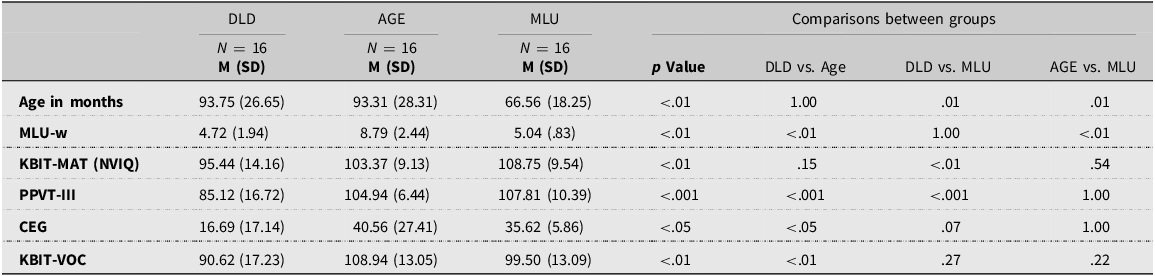
Children in the Age and MLU groups were recruited from a public school in the metropolitan area of Barcelona. The children in the Age and MLU groups also had to score a normal non-verbal intellectual quotient (NVIQ) ≥ 70 (Nonverbal Kaufman Brief Intelligence Test [K-BIT; Kaufman & Kaufman, Reference Kaufman and Kaufman2004]). For language status, participants had to demonstrate normal oral language abilities based on scores within the mean in at least two of the three standardized language tests: expressive vocabulary (KBIT-VOC), receptive vocabulary (Peabody), and grammatical abilities (CEG). Additionally, children were at grade level in school, had no history or diagnosis of language learning disability, and had never received speech and language services as reported by parents. The age-matched control group was matched in age to their DLD counterparts, while each child in the MLU group was paired with a child from the DLD group based on mean length of utterance in words (MLU-w; ±.5 words). Age, NVIQ, MLU, and language scores for each group are reported in Table 1:
Descriptives and comparison between DLD, Age and MLU groups in Age, NVIQ, MLU, and language scores

Table 1. Long description
The table presents a comparison of age, non-verbal IQ (NVIQ), mean length of utterance (MLU), and language scores among three groups of children: those with Developmental Language Disorder (DLD), age-matched controls (Age), and MLU-matched controls (MLU). The table includes data for 16 participants in each group, with mean values and standard deviations provided for each variable. Key comparisons between the groups are highlighted with p-values indicating statistical significance. Notable trends include significant differences in age, MLU in words, NVIQ, receptive vocabulary (PPVT-III), grammatical abilities (CEG), and verbal IQ (KBIT-VOC) among the groups. For instance, children in the Age group have higher mean scores in NVIQ, PPVT-III, and KBIT-VOC compared to the DLD group, while the MLU group shows intermediate scores. The table underscores the variations in language and cognitive abilities among the different groups of children.
Note: For each variable, the age-scaled scores have a mean of 100 and a SD of 15 (except CEG that are percentiles with mean 50 and age in months). MLU-w = Mean Length of Utterance by word count; NVIQ = non-verbal intellectual quotient; PPVT-III = Peabody Picture Vocabulary Test—Third Edition; CEG = Comprehension Test of Grammatical Structures (Test de Comprensión de Estructuras Gramaticales); KBIT VOC = Kaufman Brief Intelligence Test—Verbal Vocabulary.
Stimuli
Given that all three experiments share the same rationale, in this section, we describe them together in detail. The three experiments investigated the interpretation of subject pronouns in Spanish, each with a distinct methodological focus. The first two focused on overt subject pronouns with either different-or same-gender character pairs, while the third examined null pronouns. The stimuli across the three experiments followed a similar overall structure, consisting of two juxtaposed sentences paired with a visual stimulus. Experiment 1 served as a baseline and control experiment for the role of gender, in line with Arnold et al. (Reference Arnold, Eisenband, Brown-Schmidt and Trueswell2000, Reference Arnold, Brown-Schmidt and Trueswell2007). In this experiment, the linguistic context was unambiguous, as the two human characters introduced in the first sentence differed in gender, allowing grammatical gender to function as a disambiguating cue for personal pronoun resolution. By contrast, Experiments 2 and 3 examined gender-ambiguous contexts in which both characters matched in gender, preventing gender from serving as a cue.
In the initial sentence, two human characters were introduced using definite noun phrases in subject and object positions. To prevent the most recently mentioned entity (typically the object) from influencing pronoun resolution, an inanimate element was appended through a prepositional phrase at the end of the first sentence, functioning as a buffer. The second sentence began with a subject pronoun—overt in Experiments 1 and 2 and null in Experiment 3—and included a semantically minimal verb (either llevar “to bring/wear” or tener “to have”) followed by an object noun phrase. In Experiments 2 and 3, the sentence remained ambiguous until the object noun phrase of the second clause was encountered; this element, together with the accompanying image, disambiguated the intended referent of the pronoun. In contrast, Experiment 1 did not maintain this ambiguity, since gender marking on the pronoun already identified the intended referent.
To preserve referential ambiguity as much as possible prior to the onset of the critical second sentence, the verbs in the first sentence were carefully selected to minimize implicit causality biases that could favor one referent over the other. All verbs were taken from the normative ratings reported in Goikoetxea et al. (Reference Goikoetxea, Pascual and Acha2008), and only those with near-neutral implicit causality scores were included (i.e., verbs favoring the subject between 37.5% and 62%; e.g., asustar “to scare,” saludar “to greet”). By restricting the materials to verbs with minimal bias, we sought to prevent the preceding context from providing cues that might guide pronoun interpretation before participants encountered the critical elements in the following juxtaposed sentence. Because relatively few verbs met these neutrality criteria, each verb was used twice across items.
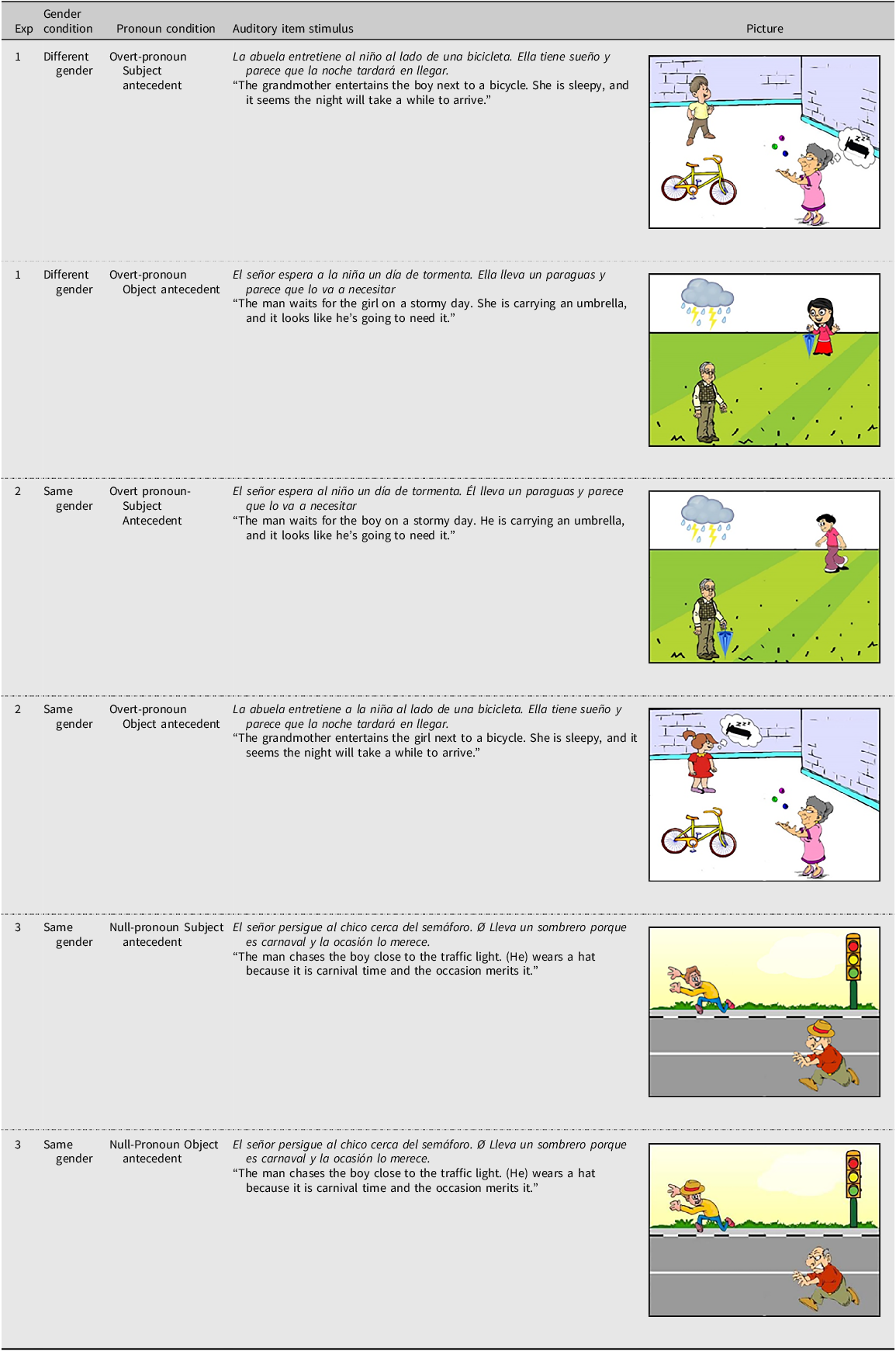
For every experiment, sixteen utterances were constructed. Experiment 1 used overt pronouns and character pairs with different grammatical genders, allowing the pronoun’s referent to be unambiguously identified through gender agreement. Although the syntactic role of the antecedent (subject vs. object) varied, gender was not manipulated as an experimental variable but was instead built into the stimuli to ensure disambiguation. This experiment served as a diagnostic baseline to observe interpretation preferences in the absence of referential ambiguity. Experiments 2 and 3 introduced ambiguity by using same-sex character pairs, removing gender as a cue. In Experiment 2, overt pronouns were used, and interpretation depended solely on the syntactic role of the antecedent. Experiment 3 followed the same structure but tested null pronouns instead. In both cases, the syntactic function of the antecedent was the only variable manipulated, allowing for a focused comparison of pronoun resolution under ambiguous conditions. Table 2 outlines examples from all three experiments.
Example stimuli in each experiment
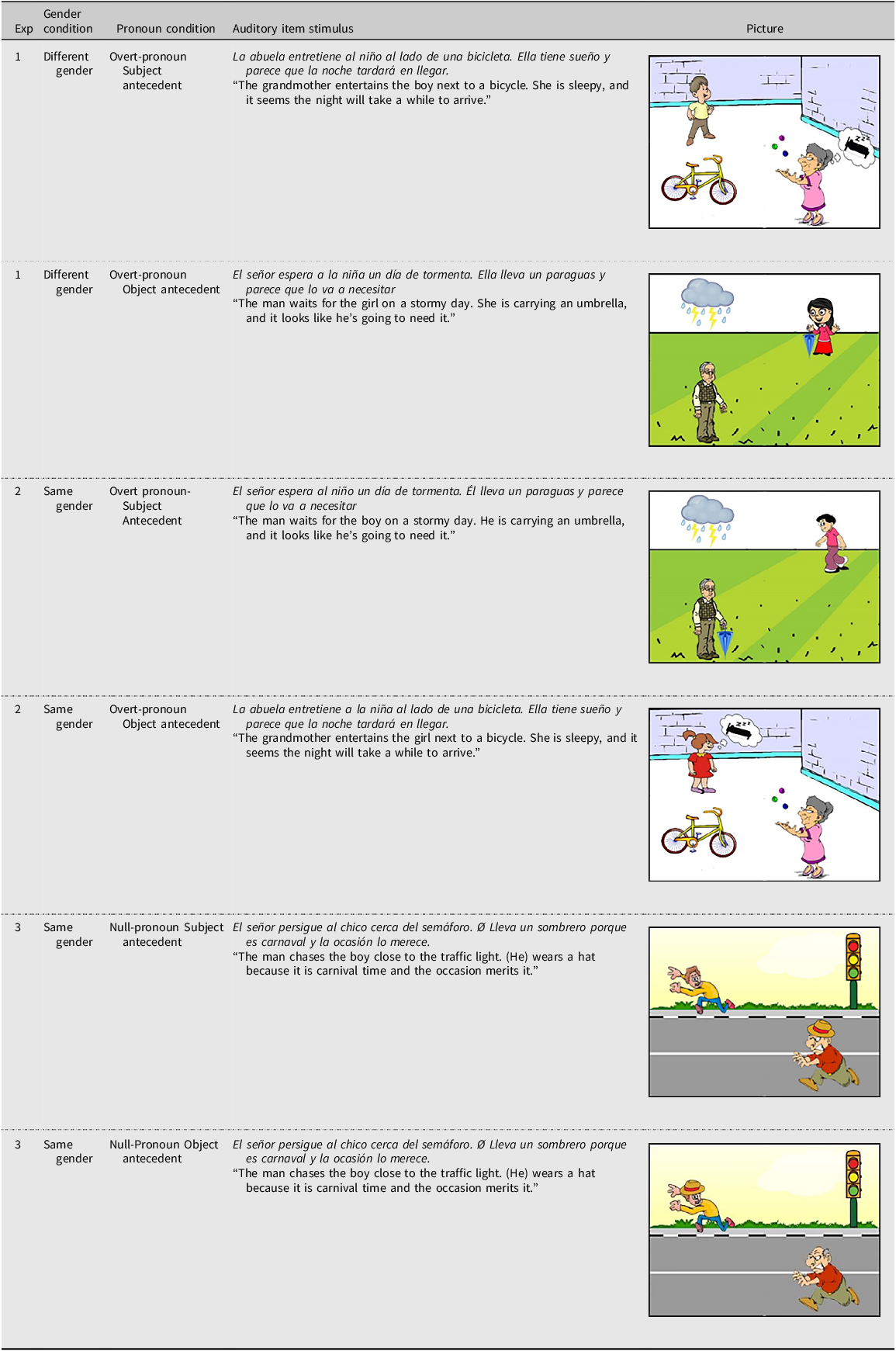
Table 2. Long description
A table displaying examples of stimuli used in three experiments. The table includes columns for experiment number, gender condition, pronoun condition, auditory item stimulus, and picture reference. Each row provides specific details for different experiments, showing how overt and null pronouns are used with varying gender conditions and syntactic roles of antecedents. The auditory item stimulus column contains descriptions in Spanish, while the picture column references corresponding images.
All sentences were recorded by a native Spanish-speaking female and sampled at 44.1 kHz. Recordings were edited so that the second sentence began precisely 6000 milliseconds after the start of the first, ensuring temporal consistency across items. The recordings maintained natural prosody and were perceived as unaltered by native adult listeners.
Corresponding to each sentence, a visual image was constructed and paired with each utterance. Each image consisted of a scene that was created using a clip art software and featured two characters and one distractor object (see Table 2). Sex representation was evenly distributed, with half of the items depicting female characters and the other half male. The placement of characters (target and competitor) varied between subject and object positions across items and was counterbalanced to prevent positional bias across the four screen areas, as defined by dividing the screen into quadrants (top left, top right, bottom left, and bottom right). Audio and visual elements were merged into a video file. In each video, the onset of the spoken utterance coincided with the onset of the visual stimuli. The 16 video clips created for each experiment were organized into two experimental lists (List 1 and List 2). Each list contained an equal number of trials (eight), with a balanced distribution of antecedent syntactic functions (Subject vs. Object, or First vs. Second mention). In Experiment 1, which included overt pronouns in gender-different contexts, the items differed from those used in Experiments 2 and 3 because they involved character pairs of different genders. In this case, List 1 contained items 1–8 and List 2 contained items 9–16 (see Sentences Experiments 1, 2, and 3 in the OSF). For Experiments 2 and 3, which involved same-gender character pairs, the items were rotated across the two experiments. Specifically, in Experiment 2, List 1 contained the odd-numbered items and List 2 the even-numbered items, whereas in Experiment 3 this assignment was reversed (List 1 contained even-numbered items and List 2 odd-numbered items). Participants completed either List 1 or List 2 in both experiments, ensuring that no participant was exposed to the same lexical item or visual scene more than once (see Sentences Experiments 1, 2, and 3 in the OSF). Additionally, each list included five filler trials—comprising both congruent (n = 1) and incongruent (n = 4) items—as well as two congruent practice items to familiarize participants with the task structure.
Procedure
Children completed two testing sessions (60 minutes each) separated by. These sessions were part of a larger study, providing natural buffers between the experiments reported here. Experiment 1 was administered at the start of Session 1, followed by unrelated morphological tasks, concluding with Experiment 2. Experiment 3 was administered at the end of Session 2. Rest periods were provided throughout to minimize fatigue and carry-over effects. The time allocated to carry out the experiments of the current study was approximately 20 minutes per child. The evaluation sessions were conducted individually at the children’s schools by two research assistants specifically trained for this purpose.
Participants were positioned roughly 22 inches away from a Tobii T120 eye tracker, which featured a built-in 17-inch TFT display. At the start of the experiment, a 9-point calibration was performed. Tobii Studio software automatically assessed the calibration quality, and if necessary, the experimenter could repeat the procedure to improve accuracy. The calibration process typically lasted about 20 seconds. The software was also used to display the stimuli and record eye-tracking data. Stimuli videos were created from 800 × 600 pixel images and shown on a screen with a resolution of 1024 × 768 pixels. Audio associated with the stimuli was delivered through a mono signal split between two speakers placed on either side of the monitor.
During the task, participants’ eye movements were tracked while they watched the visual scenes and listened to two independent sentences describing the images. Eye position data were collected at a sampling rate of 120 Hz (approximately every 8 milliseconds). Participants were asked to determine whether the story matched the image and to respond verbally with “yes” or “no.” While all experimental test items were congruent, the inclusion of four incongruent filler trials per list ensured that participants could not rely on a “yes” response strategy. These filler trials served to maintain attention and verify that the children were actively processing the relationship between the audio and visual stimuli. Responses were monitored by research assistants to ensure task engagement, though they were not recorded for formal statistical analysis, as the primary measure was real-time gaze position. Before beginning the actual trials, each participant completed two practice rounds to familiarize themselves with the procedure. Participants were randomly divided into two groups, each receiving a different list of stimuli presented in randomized order. Each trial began with a fixation cross displayed for about 2000 milliseconds, which participants were instructed to focus on to ensure consistent initial gaze direction from the center of the screen.
Data analysis
To characterize how gaze patterns evolved over time, we employed a non-parametric two-stage cluster-based permutation framework (Barr et al., Reference Barr, Jackson and Phillips2014; Maris & Oostenveld, Reference Maris and Oostenveld2007), an approach used in previous studies with comparable populations and paradigms (Christou et al., Reference Christou, Andreu, Coloma, Guerra, Araya, Rodriguez-Ferreiro and Sanz-Torrent2022a, Reference Christou, Coloma, Andreu, Guerra, Araya, Rodriguez-Ferreiro and Sanz-Torrent2022b; Coloma et al., Reference Coloma, Guerra, De Barbieri and Helo2024; Giberga et al., Reference Giberga, Guerra, Ahufinger, Igualada, Aguilera and Esteve-Gibert2025a, Reference Giberga, Guerra, Ahufinger, Igualada, Aguilera and Esteve-Gibert2025b; Helo et al., Reference Helo, Guerra, Coloma, Reyes and Rämä2022). This method is well-suited for autocorrelated eye-tracking time-series data because it controls the family-wise error rate without requiring independence across adjacent time bins or spatial independence between objects that are presented in the visual context at the same time. Analyses were conducted separately for the two linguistic orders—trials in which the target noun preceded the competitor and trials in which it followed.
Before the cluster analysis, raw gaze data were mapped onto two predefined areas of interest (AOIs) corresponding to the locations of the target and competitor pictures in the visual display. Fixation samples were time-locked to the onset of the critical verb phrase in the second sentence. By design, the earliest point at which referential information could influence processing differs across experiments: Experiment 1 includes a gender-marked pronoun that could trigger earlier disambiguation, Experiment 2 features an overt pronoun in a gender-neutral context, and Experiment 3 contains a null subject. To ensure comparability across experiments, all eye-tracking analyses were aligned to the verb onset in the second sentence.
Each millisecond sample was coded as a binary indicator (1 = fixation within the AOI; 0 = fixation elsewhere or track loss), and data were then aggregated into successive 50-ms time bins for each participant × item × AOI × bin cell. This means that some time bins could have an average of zero, faithfully reflecting what actually happened during the trial–i.e., the absence of looks is incorporated in the proportion of fixation calculation. Thus, no trials or participants were excluded from the analyses. Descriptive statistics, including participant-level means and within-subject 95% confidence intervals adjusted following Cousineau and O’Brien (Reference Cousineau and O’Brien2014) and Morey (Reference Morey2008), are presented in the time-course figures.
As the first step of cluster permutation analysis, each 50 ms time bin was examined using a linear mixed-effects model with the lmerTest package (Kuznetsova et al., Reference Kuznetsova, Brockhoff and Christensen2017) with fixation proportion as the dependent variable and Object Type as a contrast-coded fixed effect. Participant and Item were entered as random intercepts, with by-participant random slopes for Object Type to capture individual variability in the target–competitor contrast. Bins yielding a significant effect of Object Type (two-tailed p <.05) were flagged. Consecutive flagged bins sharing the same direction of effect and spanning a minimum of 200 ms (≥4 bins) were concatenated into candidate clusters. Finally, we computed a mass statistic defined as the sum of the t-values across all constituent bins for each candidate cluster.
The second step involved a Monte Carlo permutation procedure. For each linguistic order condition, we generated 2000 permuted datasets by randomly shuffling the target and competitor labels within each time bin, thereby eliminating any systematic difference between objects. The full modeling and clustering pipeline was applied to each permuted dataset, yielding a null distribution of maximum cluster-mass statistics. An observed cluster was deemed significant if its mass exceeded the 97.5th percentile of the null distribution, corresponding to a two-tailed α =.05 corrected for multiple temporal comparisons. For each significant cluster, we report the time extent, the observed cluster mass (sum of t-values), and the exact permutation p-value. Following conventions in language-mediated visual attention research, the magnitude and practical relevance of effects are characterized by three complementary indicators, the last two visible in the time-course figures: (a) the cluster mass statistic itself, which reflects both the strength and temporal persistence of the effect; (b) the vertical distance between target and competitor fixation proportion curves within significant clusters, representing the probability differential; and (c) the temporal extent of each cluster, where sustained attentional biases on the order of several hundred milliseconds are considered substantial in spoken language processing (see Barr et al., Reference Barr, Jackson and Phillips2014).
Results
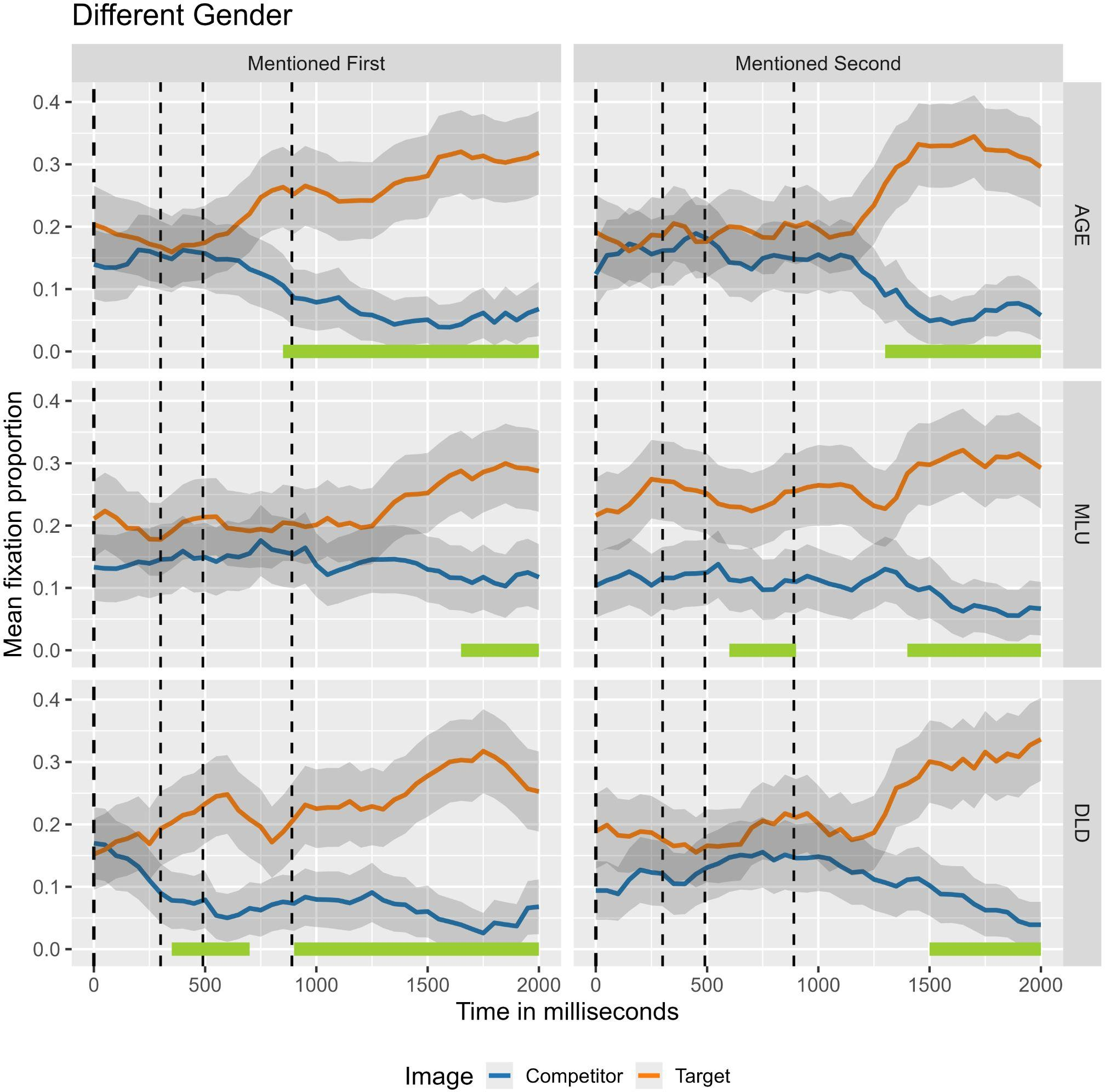
Figure 1 shows the time-course of gaze behavior for the three groups—Age-controls, MLU-controls, and DLD. For every panel in the figure, solid curves depict mean fixation proportions to the target and the competitor characters, surrounded by 95% within-subject confidence-interval ribbons (shaded area); green horizontal bars identify time intervals in which cluster-based permutation tests revealed a significant preference for one character over the other. All traces are aligned to the verb onset (0 ms; lleva “is carrying” in Table 2), and vertical dashed lines mark the onset of the determiner (un “an”), the onset of the head noun (paraguas “umbrella”), and the offset of that noun, respectively.
Overt pronouns in different-gender contexts.
Note: Proportion of looks to target (subject in first-mention condition; object in second-mention condition) and competitor (object in first-mention condition; subject in second-mention condition). On the x-axis, zero ms indicates the onset of the verb (second clause; first dashed line). The second dashed line marks the onset of the object complement; third and four dashed lines mark the onset and the offset, respectively, of the head noun object (the disambiguating word).

Figure 1. Long description
The image contains six line graphs arranged in a 3x2 grid, each showing mean fixation proportion over time in milliseconds. The graphs compare target and competitor images in different-gender contexts where the target is mentioned first or second. The y-axis represents mean fixation proportion, ranging from 0 to 0.4, while the x-axis represents time in milliseconds, ranging from 0 to 2000. The graphs are divided into three rows labeled AGE, MLU, and DLD, and two columns labeled Mentioned First and Mentioned Second. Each graph includes two lines: an orange line representing the target and a blue line representing the competitor. Shaded areas around the lines indicate variability or confidence intervals. Green horizontal bars highlight specific time intervals of interest. The graphs illustrate how fixation proportions change over time for different conditions and groups, with notable differences between target and competitor images.
AGE group. The mentioned-first trials yielded a robust cluster extending from 850 to 2000 ms after verb onset (observed t = 70.52; p <.001), indicating sustained target preference. In the mentioned-second condition, a later cluster emerged between 1300 and 2000 ms (observed t = 44.7; p <.001), again favoring the target.
MLU group. No early preference was detected when the target was mentioned first, but a late cluster from 1650 to 2000 ms revealed a delayed shift toward the target (observed t = 21.06; p <.001). Conversely, mentioned-second trials produced an initial target preference cluster between 600 and 900 ms (observed t = 16.16; p <.001) and a second, longer cluster from 1400 to 2000 ms (observed t = 38.69; p <.001), also for the preference of the target.
DLD group. Two clusters characterized the mentioned-first condition: an early, short-lived advantage for the target from 350 to 700 ms (observed t = 19.39; p <.001), followed by a prolonged window from 900 to 2000 ms (observed t = 63.81; p <.001) where the target was preferred. In mentioned-second trials a single late target preference cluster appeared between 1500 and 2000 ms (observed t = 32.34; p <.001).
Discussion
Experiment 1 examined whether children with DLD and typically developing controls (matched on age and on MLU) could use gender cues in pronouns to resolve reference in real time. In the First-Mention condition, the DLD group displayed a surprisingly efficient use of gender cues. Their eye movements showed a sharp increase in fixations on the target referent immediately after verb offset, well before the disambiguating lexical information became available (≈0 ms vs. 500 ms). This early divergence suggests that children with DLD were able to recruit gender information in real time to anticipate the intended referent. By contrast, both control groups—age-matched and particularly the MLU-matched group—did not exhibit the same sensitivity to pronoun gender. Their fixations on the target subject only rose after the onset of the disambiguating word, with no reliable early differentiation. This finding is striking in light of the commonly reported vulnerabilities of DLD children in the domain of grammatical gender and gender agreement (Bedore & Leonard, Reference Bedore and Leonard2001; Leonard, Reference Leonard2014). A plausible explanation is that the cues at stake in this task were not instances of arbitrary grammatical gender but rather of semantic gender, grounded in the sex of animate and human referents. As Corbett (Reference Corbett1991) argues, such cases differ in nature from purely formal gender categories because they map directly onto conceptual knowledge. The present results suggest that DLD children may actually benefit from the salience of sex-based distinctions, which provide a reliable semantic anchor that supports rapid reference resolution, while control children, and especially younger MLU controls, did not exploit these cues as effectively in real time.
The Second-Mention condition, which posed a greater processing challenge, further differentiated the groups. The DLD group showed some early sensitivity to gender cues, as indicated by a modest divergence in fixations shortly after verb offset. However, they were unable to fully resolve the referent until after the disambiguating information was available. The MLU group displayed an early divergence in fixations toward the target referent just before the onset of the disambiguating lexical cue. In contrast, the age-matched control group showed no evidence of using gender cues—either early or later—with resolution occurring only well after the offset of the disambiguating word. The DLD group exhibited an intermediate pattern between the two control groups: although they showed a weak early tendency toward the target referent, successful resolution occurred only after disambiguation, slightly later than in the MLU group and later still than in the age-matched group. These findings suggest that some children with DLD can process gender-related information but do so less efficiently and with slower real-time integration.
Taken together, the findings from Experiment 1 indicate that while typically developing children—particularly those matched on age—cannot effectively use gender cues in overt pronouns to guide reference resolution, children with DLD show some ability to exploit such cues, clearly grounded in sex contrasts. In unambiguous contexts where gender clearly signals the intended referent, children with DLD seem able to integrate this semantic information during online processing. This efficiency likely contributes to mitigating some of their difficulties in discourse comprehension and anaphora resolution. More broadly, this pattern resonates with psycholinguistic evidence that listeners are generally faster and more accurate when processing cues that are conceptually transparent and semantically predictable (e.g., animacy hierarchies, thematic role plausibility).
The ability of children with DLD to take advantage of semantic gender thus highlights a relative processing strength: when morphosyntactic information is reinforced by conceptual salience, their performance can even surpass that of typically developing peers matched for age or MLU. Such results underscore the importance of distinguishing between formal, arbitrary gender systems and semantically grounded gender in understanding both the challenges and compensatory strategies of children with DLD.
Experiment 2
This experiment focused on the resolution of overt pronouns in ambiguous same-gender contexts.
Method
Participants
The same participants who took part in Experiment 1 took part in Experiment 2.
Stimuli
Details can be found in Experiment 1.
Procedure
The same procedure as in Experiment 1 was used.
Data analysis
The same procedure as in Experiment 1 was used.
Results
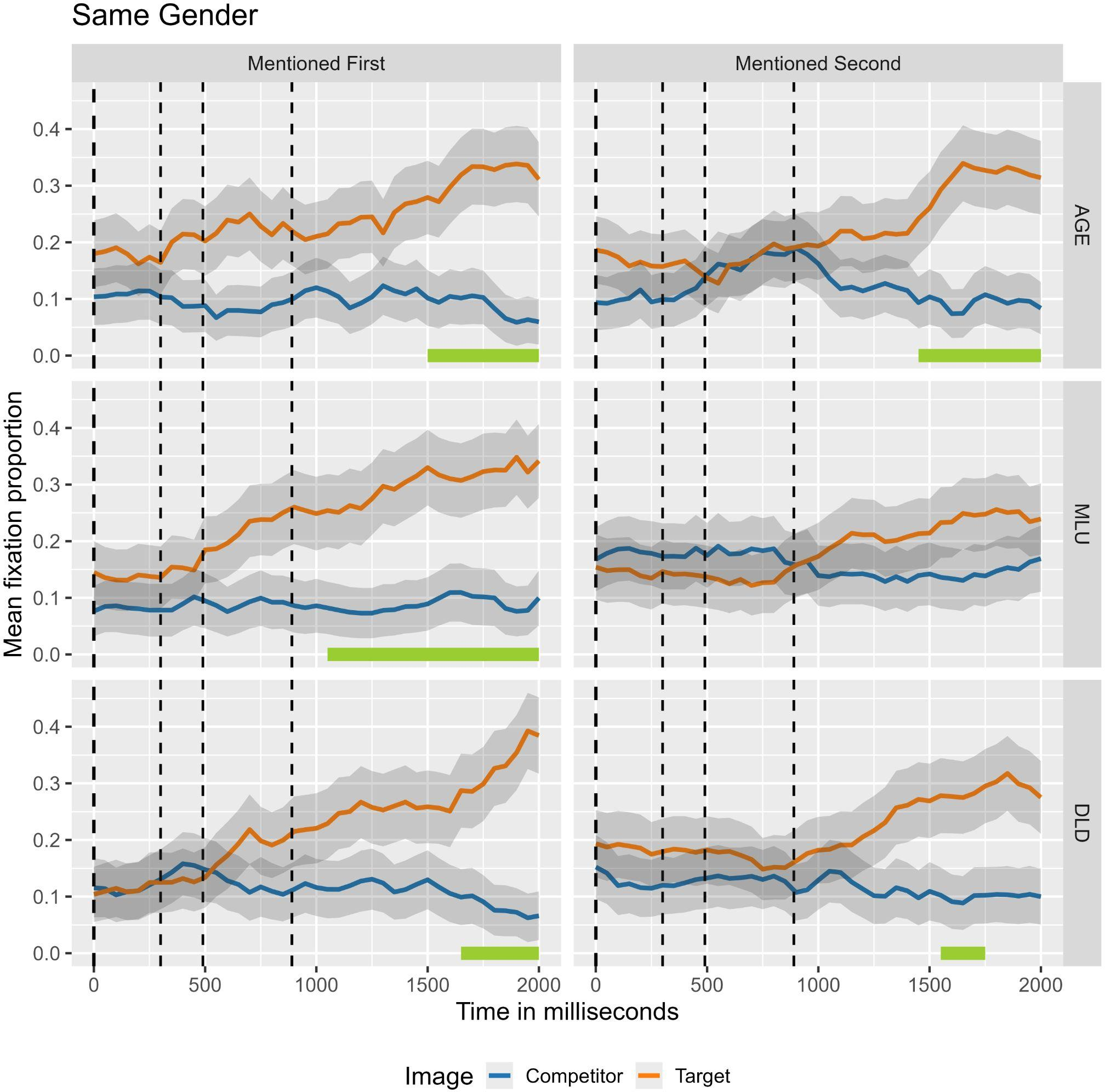
Figure 2 presents the gaze-contingent time courses for the three child groups. As in Experiment 1, solid lines represent mean fixation proportions to the target and the competitor, with 95% within-subject confidence-interval ribbons; green horizontal bars indicate periods in which cluster-based permutation tests detected a significant object preference. The data were time-locked to the verb onset (ms; lleva “is carrying” in Table 2), and vertical dashed lines successively mark the determiner onset (un “an”), the head-noun onset (paraguas “umbrella”), and the noun offset.
Overt pronouns in same-gender contexts.
Note: Proportion of looks to target (subject in first-mention condition; object in second-mention condition) and competitor (object in first-mention condition; subject in second-mention condition). Zero is the onset of the pronoun. The second dashed line marks the onset of the object complement; third and four dashed lines mark the onset and the offset, respectively, of the head noun object (the disambiguating word).

Figure 2. Long description
The image contains six line graphs arranged in a 3x2 grid, each showing mean fixation proportion over time in milliseconds for children with Developmental Language Disorder (DLD) in same-gender contexts. The graphs compare target and competitor images mentioned first and second across three conditions: Age, MLU (Mean Length of Utterance), and DLD. Each graph has two lines, one for the target image in orange and one for the competitor image in blue. The y-axis represents the mean fixation proportion, ranging from 0.0 to 0.4, while the x-axis represents time in milliseconds, ranging from 0 to 2000. The graphs show that the mean fixation proportion for the target image generally increases over time, especially when mentioned first. The competitor image maintains a relatively stable fixation proportion. The green bars at the bottom of each graph indicate the time window during which the target and competitor images are mentioned. The graphs illustrate that children with DLD have different fixation patterns depending on whether the target image is mentioned first or second and the specific condition being measured. All values are approximated.
AGE group. When the target was mentioned first, a single late cluster emerged from 1500 to 2000 ms after verb onset, signaling a sustained bias toward the target (observed t = 30.12; p <.001). The mentioned-second condition yielded a comparable but slightly earlier cluster spanning 1450 to 2000 ms, again favoring the target (observed t = 34.03; p <.001).
MLU group. Only the mentioned-first condition elicited a significant cluster (1050–2000 ms, observed t = 50.59; p <.001), revealing an extended late shift toward the target. No reliable clusters were detected when the target was mentioned second, indicating the absence of systematic preference under that ordering for this group.
DLD group. In the mentioned-first trials, the DLD children displayed a delayed yet prolonged cluster between 1650 and 2000 ms (observed t = 23.31; p <.001) with a preference for the target. By contrast, the mentioned-second trials produced a shorter cluster confined to 1550–1750 ms, suggesting a more transient discrimination when the target followed the competitor (observed t = 12.97; p <.001).
Discussion
Experiment 2 explored how children interpret third-person subject pronouns when both antecedents share the same grammatical gender. In this context, children could not rely on semantic cues like semantic gender and instead had to draw on discourse-level cues such as order of mention and grammatical role. This allowed us to investigate the extent to which children with DLD, children with typical development, and children matched by MLU-w can use these higher-level cues to resolve pronominal reference.
In the First-Mention condition, all three groups eventually showed a bias toward the first-mentioned referent, as reflected in a cluster indicating a preference for the target over the competitor. However, this preference emerged at different time points across groups. The earliest cluster appeared in the MLU group (around 1050 ms), followed by the Age group (around 1500 ms), and finally the DLD group (around 1650 ms). Thus, although participants showed sensitivity to the discourse prominence of the first-mentioned referent, this preference did not arise immediately after pronoun onset. Importantly, none of the groups fully resolved the referent until disambiguating information became available. This is reflected in the fact that differences between looks to the target and the competitor only reached statistical significance after the disambiguating lexical cue was presented, as indicated by the green horizontal bars marking significant preferences for one character over the other. These results suggest that while children are sensitive to discourse prominence cues such as first mention, the successful resolution of pronoun reference continues to rely on explicit linguistic information. The overall tendency to interpret ambiguous pronouns as referring to first-mentioned entities is consistent with previous findings in typically developing children as well as Spanish adults, which show that first-mentioned or subject antecedents are more accessible in memory and therefore more likely to be selected as referents. Interestingly, the DLD group also showed this early subject bias, favoring the first-mentioned referent almost immediately after pronoun onset. However, they were the slowest group to clearly resolve the pronoun reference, doing so well after the disambiguating information—later than both the Age and MLU groups.
In the Second-Mention condition, children faced a greater interpretive challenge, as the correct referent was not the first-mentioned entity. In this context, none of the groups showed a clear preference for either referent until well after the offset of the disambiguating word. Children with DLD displayed a pattern similar to that of the Age group, showing a very late preference toward the target referent. In contrast, the MLU group did not show a reliable preference for either the target or the competitor at any point during the resolution process, maintaining a more underspecified interpretation until the end of the sentence, which suggests greater difficulty with pronoun resolution in this condition.
The results suggest that children in all groups exhibited a bias toward the first-mentioned antecedent when interpreting pronouns, particularly in cases where both potential referents shared the same grammatical gender, and the pronoun was explicit, yet full resolution occurred only once disambiguating information was provided.
Experiment 3
In this experiment, we shifted our focus from overt to null pronouns, investigating their resolution in ambiguous same-gender contexts.
Method
Participants
The same participants that in Experiment 1 took part in Experiment 3.
Stimuli
Details can be found in Experiments 1 and 2.
Procedure
The same procedure as in Experiments 1 and 2 was used.
Data analysis
The same procedure as in Experiments 1 and 2 was used.
Results
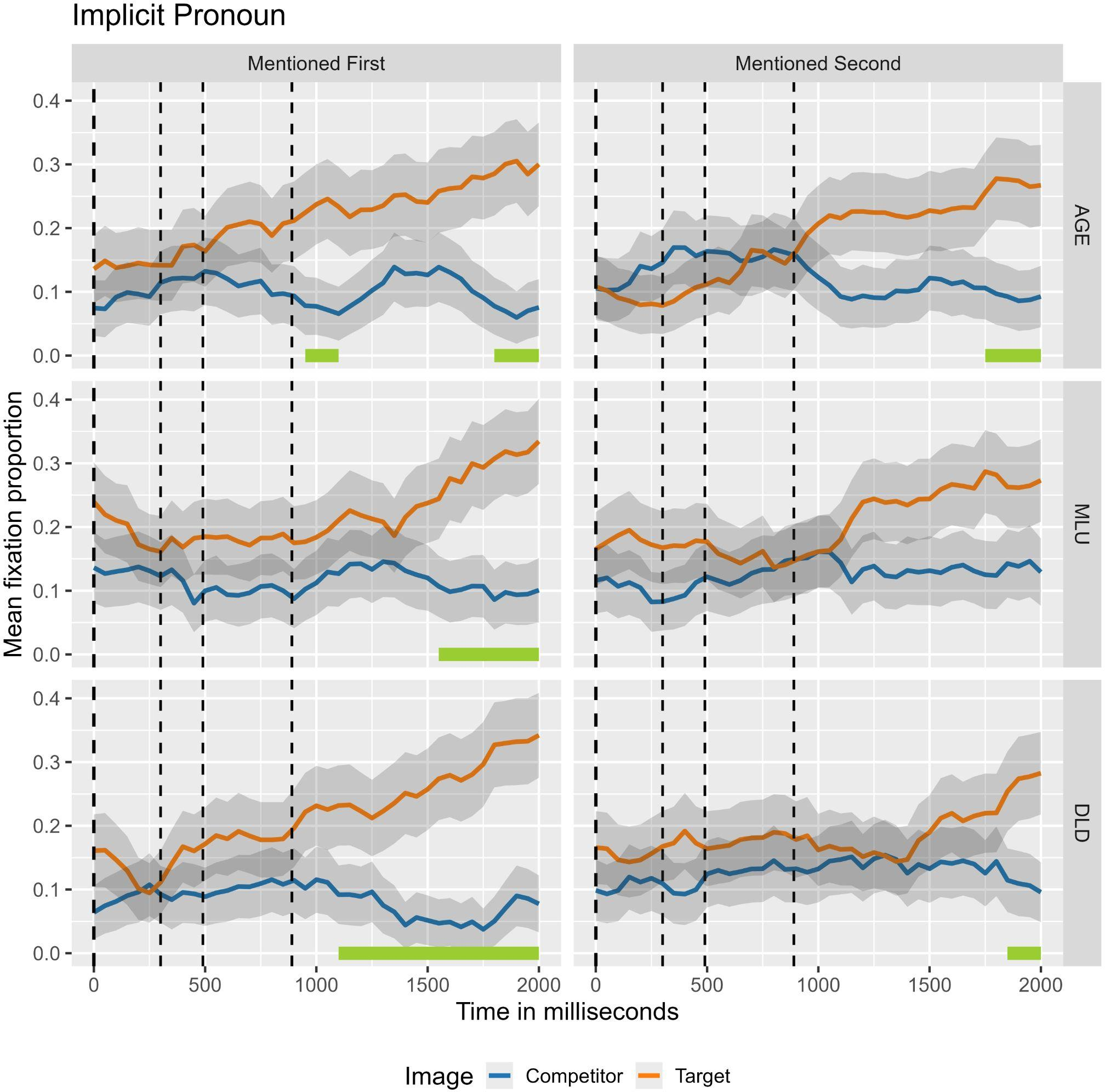
Figure 3 depicts the fixation time courses for Age-controls, MLU-controls, and DLD children under the two noun-order conditions. As in the previous experiments, solid curves show mean fixation proportions to the target and competitor, shaded areas around them represent 95% within-subject confidence interval; colored horizontal bars mark the extent of the cluster that reached a significant object preference. As in previous plots, data are aligned to verb onset (0 ms; lleva “is wearing” in Table 2), with vertical dashed lines denoting, in order, determiner onset (un “a”), head-noun onset (sombrero “hat”), and noun offset.
Null pronouns in same-gender contexts.
Note: Proportion of looks to target (subject in first-mention condition; object in second-mention condition) and competitor (object in first-mention condition; subject in second-mention condition). On the x-axis, 0 ms indicates the onset of the verb (the beginning of the second clause; marked by the first dashed line). The second dashed line marks the onset of the object complement; third and four dashed lines mark the onset and the offset, respectively, of the head noun object (the disambiguating word).

Figure 3. Long description
The image contains six line graphs arranged in a 3x2 grid. Each graph plots mean fixation proportion on the y-axis against time in milliseconds on the x-axis. The graphs are divided into two columns: "Mentioned First" and "Mentioned Second." Each row represents a different group: AGE, MLU, and DLD. The lines represent two conditions: Target (orange) and Competitor (blue). The graphs show how fixation proportion changes over time for each group and condition. The shaded areas around the lines indicate variability or confidence intervals. Vertical dashed lines and green bars mark specific time points or intervals of interest. The graphs illustrate differences in fixation patterns based on the order of mention and the group.", "EDH": "Null pronouns in same-gender contexts.
AGE group. When the target was mentioned first, two distinct clusters emerged: an early window from 950 to 1100 ms (observed t = 9.34; p <.001) and a late, longer window from 1800 to 2000 ms after verb onset (observed t = 12.91; p <.001), demonstrating a biphasic shift toward the target. In the mentioned-second condition, a single late cluster spanned 1750–2000 ms (observed t = 14.85; p <.001), mirroring the sustained late bias to the target object seen in Experiments 1 and 2.
MLU group. A single late cluster appeared when the target preceded the competitor, beginning at 1550 ms and persisting to 2000 ms (observed t = 24.82; p <.001), revealing a delayed but sustained shift toward the target. No reliable clusters were observed when the target was mentioned second, again reflecting the group’s limited ability to establish referential certainty under that ordering.
DLD group. Mentioned-first trials produced one prolonged cluster extending from 1100 to 2000 ms (observed t = 54.52; p <.001), signaling a delayed yet steady preference for the target. In the mentioned-second condition, a shorter late target preference cluster was detected between 1850 and 2000 ms (observed t = 9.73; p <.001), indicating that reference resolution was achieved only near the end of the time window.
Discussion
Experiment 3 examined how children interpret null third-person subject pronouns in Spanish when both antecedents shared the same grammatical gender. Since Spanish allows subject pronouns to be omitted, listeners must rely more heavily on discourse-level cues, such as order of mention and grammatical role, to resolve reference. This experiment thus tested children’s ability to interpret null pronouns using structural information alone, without the support of overt semantic or morphological cues.
In the First-Mention condition, all three groups showed a tendency to favor the first-mentioned referent, reflecting a subject bias in the interpretation of the null pronoun. However, this preference only emerges after the disambiguating word region has been reached, suggesting delayed bias in the time course of processing. Overall, these results indicate that children across groups were sensitive to discourse-level cues—such as subjecthood and linear order—when interpreting the null pronoun. However, as in Experiment 2, they were unable to fully resolve the referent until after the disambiguating information was available; nonetheless, a preference for the subject was maintained during the ambiguous region, as indicated by the proportion of fixations (with the orange line consistently remaining above the blue line). The DLD group’s performance in this condition was particularly noteworthy: their early and sustained preference for the first-mentioned referent mirrored that of the typically developing age group. In contrast, the MLU group exhibited a delayed and more uncertain response. Their fixations were relatively flat until approximately 1250–1300 milliseconds after verb offset, indicating a delayed commitment to a referent. This finding supports the pattern attested in Experiment 2 with overt pronouns and suggests that younger children matched on expressive language level are still developing the ability to integrate structural cues efficiently during online processing, even when semantic information is not required.
The Second-Mention condition presented a greater challenge, as it required children to override the default subject bias and assign the pronoun to the second-mentioned entity. In this condition, the age group initially showed a subject preference, but began to shift toward the correct referent just before the offset of the disambiguating word—around 1000 milliseconds. This suggests that even typically developing children needed time and additional contextual information to override the strong, inherent subject bias of null pronouns when it was not consistent with the intended referent. The MLU group showed an interesting pattern: they exhibited an early preference for the second-mentioned referent, possibly reflecting recency effects as a consequence of not yet having developed a subject antecedent bias with null pronouns, as noted above. However, this early preference did not translate into consistent referent identification until just after the disambiguating information was fully processed. The DLD group showed the most delayed response in this condition. They did not display a clear preference for the appropriate referent until well after the disambiguating word had been fully processed—around 1250 to 1300 milliseconds—suggesting difficulty in suppressing the subject bias when it conflicted with the intended interpretation. This pattern further underscores a core limitation in the DLD group’s processing: while they can successfully rely on structural defaults when those align with the correct selection, they struggle to revise or override initial interpretations in more demanding conditions that require flexible use of contextual information.
In sum, the findings from Experiment 3 reinforce and extend those of Experiment 2. Both experiments reveal a subject or first-mentioned bias across all groups, albeit less evident in the MLU-w group, indicating that the first-mentioned discourse strategy is still developing. However, while the DLD group performed similarly to the Age group when the correct referent matched their default strategy (i.e., in the First-Mention condition), they exhibited marked difficulties when this strategy led to an inaccurate interpretation (i.e., in the Second-Mention condition). These results highlight a key characteristic of sentence processing in children with DLD: a reliance on default cues based on discourse-syntactic structure paired with a limited ability to revise initial interpretations when more complex discourse integration is required.
General discussion
This study investigated how Spanish-speaking children with DLD interpret third-person subject pronouns during real-time sentence processing. By employing the Visual World Paradigm across three experiments, we aimed to determine how these children weigh semantic and structural cues. Below, we revisit our initial hypotheses and discuss the theoretical implications of the observed bias patterns.
Semantic gender cues (Experiment 1)
Our first hypothesis predicted that children with DLD would successfully exploit sex-based gender cues to resolve pronoun referents in unambiguous contexts. This hypothesis was confirmed. The results demonstrate that children with DLD can effectively use grammatical gender when antecedents differ in biological sex. In fact, this effect was more pronounced in the DLD group than in TD controls, suggesting an over-reliance on salient conceptual “anchors” to compensate for broader processing difficulties. However, the fragility of this effect in the Second-Mention condition indicates that while the information is available, the processing remains resource-dependent.
Structural cues in overt pronouns (Experiment 2)
Based on prior evidence of reduced accuracy in DLD (Rakhlin et al., Reference Rakhlin, Kornilov, Reich and Grigorenko2015), we predicted that children with DLD would not exhibit a consistent first-mention or subject-preference bias. This hypothesis was disconfirmed. Contrary to our expectations, children with DLD displayed a clear, early bias toward the first-mentioned subject, mirroring TD patterns. This suggests the “subject-bias” heuristic is fundamentally intact, though the DLD group lacked the flexibility to revise this default when faced with conflicting late-arriving cues.
Structural cues in null pronouns (Experiment 3)
We posited that children with DLD would show inconsistent use of structural cues for null pronouns. This hypothesis was partially confirmed. While the DLD group showed a robust early subject bias in congruent (First-Mention) contexts, they displayed significantly delayed and inconsistent resolution in incongruent (Second-Mention) contexts. This confirms that the difficulty lies not in the presence of the default bias, but in the sophisticated integration required to manage non-canonical discourse.
The overt vs. null contrast: subject bias in real-time
A particularly striking finding in this study—and one that warrants further clarification—is the observation of a subject/first-mention bias for both overt (Exp 2) and null (Exp 3) pronouns. In null-subject languages like Spanish, the Position of Antecedent Strategy (PAS) (e.g., Sorace et al., Reference Sorace, Serratrice, Filiaci and Baldo2009) typically predicts a division of labor: null pronouns prefer subject antecedents, while overt pronouns (él, ella) prefer non-subjects (e.g., objects). However, our real-time data suggests that at the earliest stages of processing, both forms initially trigger a search for the most prominent discourse entity (the subject).
This apparent contrast with the PAS can be explained by the difference between initial processing heuristics and final interpretive conventions. Our results suggest that:
-
1. General Prominence: At the moment of pronoun encounter, children (both TD and DLD) apply a “prominence heuristic” (Song & Fisher, Reference Song and Fisher2005) that favors the subject/first-mention, regardless of the pronoun’s phonetic realization.
-
2. Delayed Differentiation: The language-specific pragmatic convention (where overt pronouns signal a topic shift to the non-subject) may emerge later in the processing window or require more cognitive resources to implement than the universal subject-preference.
For children with DLD, this results in a “double-edged sword.” Their intact subject-bias allows them to process canonical null-subject sentences efficiently, but their rigid adherence to this bias makes the non-subject preference typically associated with overt pronouns much harder to access in real time.
Synthesis and theoretical implications
Taken together, these findings reveal a consistent pattern: children with DLD are not “cue-blind.” Instead, they demonstrate a rigid reliance on default heuristics (gender congruence and subjecthood). While such heuristics are foundational to the probabilistic interpretive system used by TD children (Blything et al., Reference Blything, Azpiroz, Allen, Hert and Järvikivi2022), the children with DLD in our study showed a marked inability to inhibit or revise these defaults.
This rigid processing style differs from the findings of Van der Lely and Stollwerck (Reference Van der Lely and Stollwerck1997) and Rakhlin et al. (Reference Rakhlin, Kornilov, Reich and Grigorenko2015). We attribute this divergence to our use of real-time eye-tracking. While offline tasks often highlight a total failure in grammatical principles, our online data shows that the initial biases are present, but the integration and revision processes are what ultimately fail. This suggests that the core deficit in DLD pronoun resolution is a limitation in the dynamic, real-time integration of multiple linguistic and cognitive resources.
Limitations and future directions
This study explored how children with DLD interpret pronouns in real time using eye-tracking within the Visual World Paradigm. Nonetheless, there is room for future improvement. Although efforts were made to recruit a large number of participants, the sample included 48 children, with 16 diagnosed with DLD, 16 typically developing age-matched children, and 16 younger children matched by MLU-w. The sample size in the present study aligns with those reported in earlier research on pronoun resolution in children with DLD (Abbott et al., Reference Abbott, Nip and Love2024; Rakhlin et al., Reference Rakhlin, Kornilov, Reich and Grigorenko2015; Van der Lely & Stollwerck, Reference Van der Lely and Stollwerck1997). However, our study included participants ranging from 4;00 to 12;03 years, representing a diverse age range. Although previous studies also included participants with a wide range of ages across all groups—4;00 to 12;03 years (Van der Lely & Stollwerck, Reference Van der Lely and Stollwerck1997), 5;01 to 10;11 years (Rakhlin et al., Reference Rakhlin, Kornilov, Reich and Grigorenko2015), and 6;02 to 11;08 years (Abbott et al., Reference Abbott, Nip and Love2024)—using narrower age ranges and larger sample sizes could yield more precise information on the development of pronoun reference assignment.
Another limitation is the absence of explicit offline measures assessing pronoun antecedent identification. As a result, we have visual data reflecting the process of pronoun resolution but no explicit information about participants’ final decisions. An explicit task like the one used in the second experiment of Abbott et al. (Reference Abbott, Nip and Love2024) would reveal children’s final pronoun reference assignment. Such data could provide insight into the ultimate interpretation of the pronoun antecedent, particularly in cases where the eye-tracking results do not offer a clear attribution. Future research should combine online and offline measures to examine the moment-by-moment processing of pronouns while also determining the ultimate assignment of pronoun reference.
Replication package
The materials, data, and scripts used in this study are available on the Open Science Framework (OSF) at the following link: https://osf.io/gh68q/.
Acknowledgments
This work was supported by the Spanish State Research Agency (grant numbers EDU2013-44678-P and PID2020-114690RB-I00, PI: Llorenç Andreu; FFI2016-75082-P and FFI2012-35058, PI: Aurora Bel), and by the Agència de Gestió d’Ajuts Universitaris i de Recerca (AGAUR, Generalitat de Catalunya) (grant numbers 2021 SGR 00472; 2017 SGR 1028; 2021 SGR 01102; 2017 SGR 387). Funding from ANID/Support 2024AFB240004 (to Ernesto Guerra) is gratefully acknowledged. Funding from ANID CIAE CIA250005 is gratefully acknowledged.

 Open access

