


Introduction
Within the context of the Antarctic Treaty System, there is a fundamental commitment “…to the comprehensive protection of the Antarctic environment and dependent and associated ecosystems…” (Protocol 1991, Article 2) which must underlie all Antarctic activities, including the primary activity of scientific investigation and cooperation toward that end. Supporting Antarctic scientific investigation is the job of the national Antarctic programmes, the government entities charged with delivering their countries’ Antarctic research strategies. This requires sustained investment in people, innovative technologies, Antarctic infrastructures, and vessels with icebreaking capabilities. The global fleet of vessels with Polar Class (PC) certification is limited, with the mean age of that fleet considered ageing or mature. The recent endorsement of the IMO Polar Code 2015 means that countries must address challenges related to an ageing vessel fleet. In response, many countries have recently invested in and begun, or completed, builds on new icebreaking Polar research vessels. These vessels incorporate innovative technologies to increase fuel efficiency by introducing improved energy systems, to reduce noise output under normal operations, and to address ways to protect proactively the Antarctic environment and dependent and associated ecosystems in their design. In recent times, environmental advocates have pointed towards reduction in the use of vessels to reduce our footprint in the Antarctic, while, on the other hand, the scientific community has confirmed a strong requirement for vessel use and access in Antarctica. New fleet capabilities mean countries have an opportunity to appease both views and are considering ways to support science and protect the Antarctic environment with their new vessels. This paper is a result of a Council of Managers of National Antarctic Programs (COMNAP) project on new vessel builds which began at COMNAP Annual General Meeting (AGM) XXX (2018), Garmisch-Partenkirchen, Germany. It considers the recent vessel builds of Australia’s RSV Nuyina, China’s MV Xue Long 2, France’s L’Astrolabe, Norway’s RV Kronprins Haakon, Peru’s BAP Carrasco, and the United Kingdom’s RRS Sir David Attenborough. The paper provides examples of purposeful consideration of science support requirements and environmental sustainability in their vessel designs and operations.
Background
The COMNAP is an international association of 31 member national Antarctic programmes. Those programmes are the governmental entities responsible for leading the delivery of their country’s Antarctic strategy. The programmes work closely with other governmental operators, such as the military, and with contracted non-governmental operators. As an organisation, COMNAP’s primary mission is to develop and promote best practice in managing the support of scientific research in Antarctica (COMNAP, 2008).
The COMNAP achieves this goal through a range of activities. One such activity is by way of endorsing and delivering on projects that have been approved by the COMNAP Membership. As a follow-up from the COMNAP Icebreaker Workshop 2013 that was held on-board the S. A. Agulhas II, Cape Town, South Africa, from 21 through 23 October, and the vessel poster session at COMNAP AGM XXX (2018) in Garmisch-Partenkirchen, Germany, to showcase the range of new research vessel builds for Polar waters, COMNAP endorsed a project to publish information on the most recent vessel builds to demonstrate that national Antarctic programmes are considering and incorporating fuel savings, noise reduction, and other environmental operations technologies into their new vessel builds and to showcase new marine research capabilities. The South African vessel S. A. Agulhus II is a fine example of new marine vessel capability which considered science and environmental protection requirements. A PC 5 vessel, launched on 21 July 2011, was the first ship of its kind built to the IMO International Convention for the Safety of Life at Sea (SOLAS) 2009 rules for passenger ships, leading to several unique factors in its design.
In 2018, at the COMNAP AGM XXX, members shared information by way of a poster session on their plans for new vessel capability. The poster session highlighted the significant number of new vessel builds that COMNAP members were planning or making progress towards, with many of the new builds involving innovative technologies to address fuel efficiency and other environmental concerns. As a result of the information shared at the poster session, COMNAP members supported a project to share information on new vessel builds by way of a peer-reviewed publication. This article is a result of the project work.
Methodology of the project
The goal of this project is to describe and publish information on innovative technologies in new icebreaking vessel builds with a focus on technologies incorporated especially to address environmental and science support considerations. Sharing of the information is important within the context of the IMO Polar Code, in light of the obligations prescribed in the Protocol and bearing in mind relevant conclusions of the COMNAP Antarctic Roadmap Challenges (ARC) project (Kennicutt II, Kim, & Rogan-Finnemore, Reference Kennicutt, Kim and Rogan-Finnemore2016), which were as follows:
-
The preponderance of observations and measurements to date, other than those by satellite-based sensors and autonomous observatories, has been made during the austral summer, due to the difficult operating environment during other times of the year. Many scientific questions will require year-round continent and oceanwide access.
-
Icebreakers are essential for some ship-based activities, such as high-resolution bathymetry mapping and deep-sea drilling in ice-covered areas. They provide access to coastal research sites and logistics support for interior stations/logistic hubs.
-
Polar research vessels provide access to coastal sites, enable deployment of Autonomous Underwater Vehicles (AUVs), Remotely Operated Vehicles (ROVs), sensor networks, and seabed drilling systems, and serve as platforms for coring/drilling and surveys of the marine environment. Ships capable of launching ROVs/AUVs in ice-infested waters may be needed.
At the date of this writing, the COMNAP database holds information on 51 “in service” vessels that national Antarctic programmes have used in support of their science or operations. Initially, out of those 51 vessels, there were 14 considered for inclusion in the project. To manage the project and reduce the number, the following inclusion selection criteria were adopted:
-
(1) Include only vessels launched since 1 January 2013. This point in time was chosen to coincide with the period immediately following the COMNAP Icebreaker Workshop.
-
(2) Include only PC (International Association of Classification Societies (IACS)) ships, so PC 1 (highest) through PC 7 only, or equivalent (taking into consideration that Russian ships are assigned ice classes only according to the requirements of the Russian Maritime Register of Shipping, which is a parallel system to that of IACS).
Based on these criteria, five vessels are presented in detail. Those vessels are Australia’s RSV Nuyina, China’s MV Xue Long 2, France’s L’Astrolabe, Norway’s RV Kronprins Haakons, Peru’s BAP Carrasco, and the United Kingdom’s RRS Sir David Attenborough.
Policy considerations
All SOLAS vessels that navigate in Polar waters, including those research vessels used to carry out Antarctic science, have to comply with the IMO Polar Code’s safety and environmental requirements. For Category A and Category B vessels as defined under the Polar Code, icebreaking or ice-strength is required (Category C vessels do not have such a requirement). By definition, an “icebreaker” refers to any ship having an operational profile that includes escort or ice management functions, having powering and dimensions that allow it to undertake aggressive operations in ice-covered waters (Bureau Veritas, 2017). Ice class refers to a notation assigned by a classification society or a national authority to denote the additional level of strengthening as well as other arrangements that enable a ship to navigate through sea-ice. Many classification societies exist, and there was disharmony between their classification systems. The IACS developed the Unified Requirements for Polar Class Ships to harmonise the ice class rules between different classification societies and complement the IMO Guidelines for “Ships Operating in Arctic Ice Covered Waters.” IACS PC Ships can be assigned one of seven PCs ranging from PC 1 for year-round operation in all Polar waters to PC 7 for summer and autumn operation in thin first-year ice (Fig. 1).
IACS Polar Class (PC) and ice descriptions.
Source: IACS Requirements Concerning Ice Class 2019.

There are prescribed structural design requirements for all PC ships and other requirements for ships with the additional notation of icebreaker. There are various rules as to when and under what conditions these vessels can operate, and there are very prescriptive design details that must be considered in any new vessel that is going to be classed as icebreaking. Those detailed design considerations are not the focus of this paper, but rather the unique design features that were considered by the various operators either to address an environmental consideration, a science need or a unique aspect of Antarctic operations and logistics.
The ice class affects vessel parameters including the hull strength and weight of the vessel and sets requirements for power for propulsion. Any increase in strength is coupled with an increase in weight that affects performance, cargo carrying capacity, and noise outputs. For any new ship build, in the planning stages, it is necessary to balance the icebreaking capabilities of the ship with these other issues, all while bearing in mind science requirements and costs associated with all high performance or specific design features. It is easy to see the level of consideration that must go into the planning of any new icebreaking PC research vessel.
Within the context of Antarctic Treaty System policy, the Antarctic Treaty Consultative Meeting (ATCM) has recognised that the IMO is the competent organisation to deal with shipping regulations (ATCM, 2014). All Antarctic Treaty Consultative Party States are signatory States to the IMO. Nonetheless, the general principles of the Antarctic Treaty (Antarctic Treaty 1959) and of the Protocol are fundamental to all activity in the Antarctic Treaty area, and so promotion of the pillars of freedom of scientific investigation and commitment to the comprehensive protection of the Antarctic environment and dependent and associated ecosystems are applicable to ship-related Antarctic Treaty area activity. The Protocol’s Annex IV Prevention of Marine Pollution provides the most comprehensive Antarctic Treaty System reference to ships operating in the Antarctic Treaty area with some specific guidance. Beyond that, there are no specific instructions as to ship design for Antarctic scientific or environmental protection performance within the Antarctic Treaty System.
National Antarctic programmes give consideration to science need and environmental performance along with fuel economy in order to keep running costs as low as possible when planning new vessel builds. Reducing emissions and marine noise, and incorporating improved dynamic positioning in ice are common environmental and scientific considerations in many of the recent vessel builds. The IMO’s Polar Code covers the full range of design, construction, equipment, operational, training, search and rescue, and environmental protection matters relevant to ships operating in the inhospitable waters surrounding the two geographic poles.
The new Antarctic fleet
Against the backdrop of international regulations and in the context of the Antarctic Treaty System, we provide a snapshot of new Antarctic vessels and their capabilities with special reference to scientific and environmental protection capabilities that were implemented as part of the design and construction stage of the new build. Ship technology is developing, offering increased safety, lessening environmental impacts, and offering enhanced possibilities for research in new areas with more efficient vessels (Aker Arctic Technology, 2019). Bailey (Reference Bailey2017) commented “Modern research vessels are typically the most quiet vessels on the water.” Any new additions to the Antarctic fleet, especially those that are replacements for ageing assets, will contribute to reducing impacts while continuing to support globally important Antarctic research.
The new vessels are considered in launch date order. There are several other vessels in the acquisition phase or under construction by Antarctic Treaty nations with planned deployments in support of Antarctic research activity in the near future.
BAP Carrasco (BOP-171), Peru Navy
IMO 9770464/MMSI 760139000
Polar Class 7, launched 7 May 2016
In compliance with Peru’s National Antarctic Policy and commitment as a Member State of the Antarctic Treaty, the BAP Carrasco (Fig. 2) supports Peru’s Antarctic scientific, logistic, and operational activities that were previously carried out by the BIC Humboldt from 1988.
(Left) BAP Carrasco in Antarctica. (Right) Graphic illustrating specific design features and capabilities.
Source: Peru Navy.
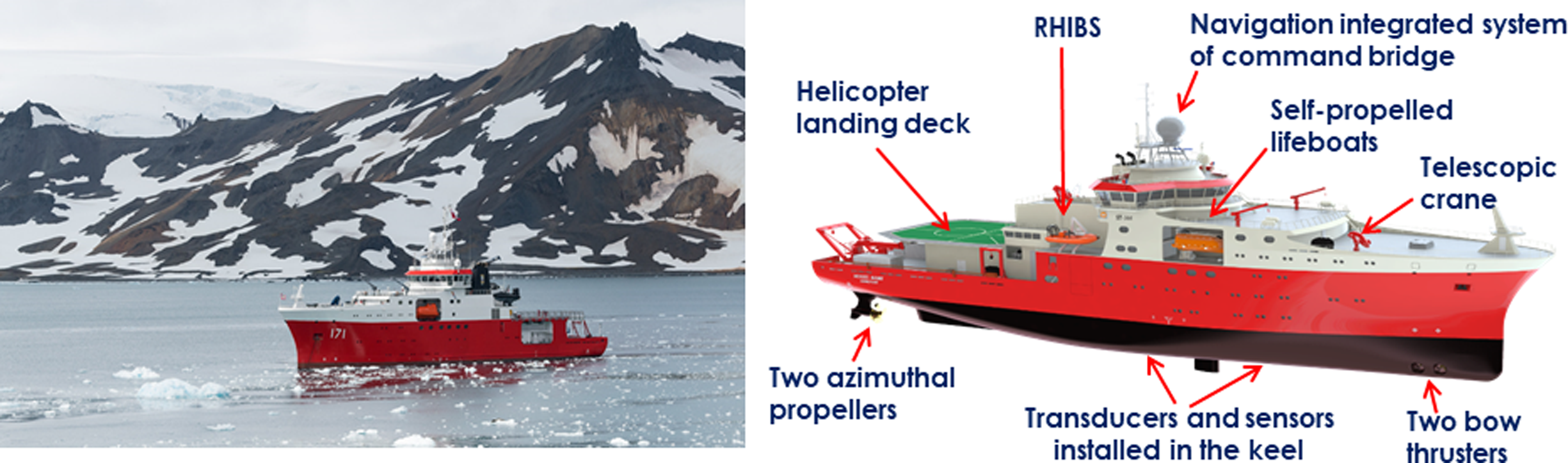
The BAP Carrasco vessel has a PC 7 rating, allowing operations during the Antarctic summer and autumn months, in seas with the presence of recently formed fine ice (up to one year old). The vessel’s technical details are as follows: Length 95.30 m; Beam 18 m; Hold depth 9.20 m; and Maximum draught 5.95 m.
The vessel is capable of autonomy at sea for 51 days and can reach a maximum speed of 16.50 knots and a cruising speed of 12 knots. With capacity of up to 110 people, including crew in 38 cabins, passengers have the comfort of three dining rooms, two restrooms, a library, kitchen, laundry facilities, and two gyms. There are also medical capacities for general medical provision and for dental care. For education and training purposes, the vessel has a 54-seat auditorium and two meeting rooms with audio-visual capabilities.
For propulsion, BAP Carrasco is powered by a diesel-electric propulsion plant with two azimuth aft thrusters and two transverse bow thrusters, with low emissions. It has a DP2 Dynamic Positioning System. It also has an automated system for monitoring and controlling the engineering and fault control equipment. The vessel was built in accordance with the safety standards of the IMO Polar Code.
In regard to underwater noise, the vessel is rated SILENT-A class, reducing environmental impact and improving the gain and quality of data collection. This makes it possible to control operating noise levels for the benefit of the crew and passengers on-board and for marine biodiversity.
The vessel has significant scientific research capabilities in the areas of hydrography, oceanography, marine meteorology, and marine geology. It has one multi-beam echo sounder for hydrographic surveys between 10 m and 11,000 m deep, two hydrographic boats with multi-beam echo sounders for shallow waters, one fishing echo sounder for biological studies, one deepwater sub-bottom profile, two AUVs with 24-hour navigation capability and operation up to 3,000 m deep, two oceanographic rosettes for water sampling with sensors for temperature, salinity, conductivity, sea currents, one piston corer sediment sampler, and one ROV to operate up to 1,000 m in depth. It also has eight laboratories for hydrographic surveys, chemical, physical, and biological oceanography research and marine geology, amongst other research uses.
In addition to science activity, the vessel is used for logistical operations, with the capability to transport two 20-foot (ft) International Organization for Standardization (ISO) cargo containers, sometimes also referred to as Twenty-foot Equivalent (TEU) containers. It also has one helicopter carrier deck and a hangar for airborne operations. The vessel carries two Rigid Hull Inflatable Boats (RHIBs) for Search and Rescue (SAR) operations when required.
L’Astrolabe , French Southern and Antarctic Lands Administration
IMO 9797539/MMSI 228090600
Polar Class 5, launched 22 December 2016
The French vessel L’Astrolabe (Fig. 3) was designed in order to support a range of needs from the South Indian Ocean fisheries patrol, to navy logistics and exercises, and for Antarctic supply and science support campaigns. Crewed by the French Navy (Marine Nationale) and owned by the Austral and Antarctic French Territories (TAAF), the new ship takes over the role historically performed by two vessels. The vessel has a PC 5 rating, and as such, it can operate year-round in medium, first-year ice conditions. The vessel’s technical details are as follows: Length overall 72 m; Breadth 16 m; Draft 5.3 m; and Gross tonnage 2,620 GT.
(Left) L’Astrolabe at ice edge in Antarctica. (Right) Concept design sketch of starboard side of vessel.
Source: Institut Polaire Français Paul Emile Victor (IPEV).
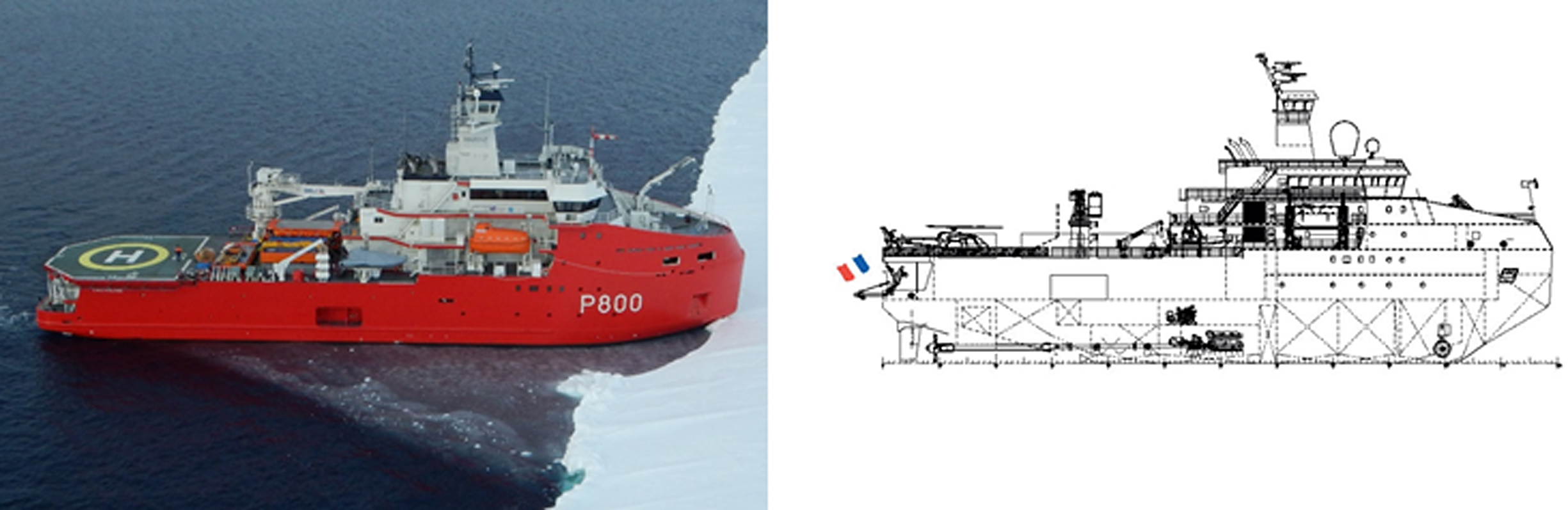
The vessel has a standard configuration capacity of 60 passengers, with possible extension to 64 passengers maximum. This corresponds to 21 crew and 39 to 43 expeditioners. The accommodation units are designed to new standards and provide improved accommodation for expeditioners.
The vessel is compliant with the IMO Polar Code, and its double-hull reduces the risk of environmental impact from pollution should an incident occur. High emission standards are met, and fossil fuel use is reduced due to an electronic injection system, so that the vessel operates to a high standard level of 200 g/KWh with four Wärtsilä 20 engines. The configuration with four engines allows for a large range of set-up options that can be utilised to optimise fuel efficiency. Typical consumption is 1200l/h at 14 knots to 710 l/h at 12 knots. Selective catalytic reduction using ammonia neutralises nitrogen oxide emissions.
In addition to fuel efficiency technologies, the vessel utilises improved waste management technologies. Grey and black water waste are treated and can be stored at −20°C. Heated ballasts are exposed to ultraviolet water treatment procedures to guarantee no micro-organism development and ballast water that is clean when released. In order to anti-foul the vessel hull, an efficient ultrasonic system avoids the use of harmful paints that might chip off.
The vessel has a helideck with allowance for two helicopters. The purposeful versatility of the vessel allows for differing missions and mission goals. The vessel is used as a training unit for navigation in the pack-ice with an experienced ice pilot on-board the vessel for the duration of the season. There is a proposal to equip the ship with strain-gauges on future Antarctic voyages in order to gain a better understanding of the constraints on the hull in the pack-ice. Such understanding will improve ice navigation techniques with quantitative measurements and will allow the vessel operators to make decisions on optimal routing which all leads to greater fuel efficiency and improved consumption performance.
The vessel is equipped and able to collect data and make measurements during inter-continental journeys, that is, between Australia, its usual point of departure to Antarctica, and the French Dumont d’Urville station in Antarctica. Those capabilities include Partial Pressure of Carbon Dioxide (PCO2) in the water column measurements, salinity temperature, conductivity profiles in the water column with eXpendable BathyThermograph (XBT) probes. There are also capacities to deploy moorings and recover sensors close to the pack-ice. Scientific containers can easily be carried on-board in order to focus on particular research during specific scientific campaigns.
Containers for supplies, cargo, and equipment for station resupply can also be carried on-board with twenty 20-ft ISO containers slots inside and eight on the deck. A heavy crane is available for lifting. This is a higher number of container slots as compared to previous vessel capacities, thus improving carrying capacity and efficiency for loading and unloading operations. These improvements in carrying capacity and improved efficiency have resulted in a significant reduction of days required for logistics operation. Meaning, the chartering period has been reduced by 20 days each year (currently 120 days as opposed to the previous requirement for 140 days).
RV Kronprins Haakon , Norwegian Polar Institute
IMO 9739587/MMSI 257275000
Polar Class 3, launched 3 March 2017
Norway built the RV Kronprins Haakon (Fig. 4) to serve as a platform for research in the Arctic and the Antarctic. Owned by the Norwegian Polar Institute (NPI), ship-time is divided between that Institute and two other principle users: the University of Tromsø (most frequent user) and the Norwegian Institute of Marine Research as the third entity and the partner who operates the vessel.
(Left) The RV Kronprins Haakon in ice covered waters. (Right) Graphic illustrating specific design features and capabilities.
Source: NPI.

The vessel has a PC 3 rating, and as such, it can operate year-round in ice-covered waters. The vessel’s technical details are as follows: Length overall 100 m; Breadth 21 m; Draft 8.5 m; and Gross tonnage 9,145 GT.
Designing a research icebreaker is not an easy task. On the one hand, you have the demand for a silent vessel with minimum Underwater Radiated Noise (URN) and bubble-free zones for all transducers, and on the other hand, there is the need for extreme force when breaking ice. The hull form of the RV Kronprins Haakon is optimised for low noise and reduced resistance. The vessel is built in accordance with the IMO Polar Code safety regulations, as well as incorporating engine configurations with low emissions output. The vessel is specified according to International Council for the Exploration of the Seas (ICES) 209 as “Relaxed ICES 209,” meaning it is considered relaxed in the fish response low-frequency zone (ICES, 1995).
The ship has a double hull, to prevent tanks from being breached should the vessel run aground, therefore reducing risk of environmental damage in case of an incident. The ship was designed with research in mind and has fifteen laboratories on-board that can be configured for a range of investigations. There are three additional container labs, four cold stores, and two freezer rooms to store samples. The vessel is equipped with sonar that can provide detailed seabed information. The vessel carries a ROV that can go down to a depth of 6,000 m, it has a helicopter deck, seismic, and trawling equipment and has the ability to support weather balloon launches for atmospheric profiling. Equipped with a moon pool, the design allows for deployment of submersibles such as ROVs and AUVs for data collection in rough weather or while the ship is surrounded by ice.
The ship endurance is 65 days at cruising speed and can accommodate up to 55 persons in 38 cabins. The crew size is 15 to 17 people. An auditorium with capacity to seat 50 people provides a venue for on-board education and training facilities.
In addition to meeting research and education requirements, the vessel is used for operations and logistics, station support, and SAR. There is a hangar for two small/medium helicopters, and the deck is dimensioned for large SAR helicopters. There is a diving workboat with dual compressors with a filling station and a hyperbaric chamber.
RRS Sir David Attenborough , Natural Environment Research Council Research Ship Unit
IMO 9798222
Polar Class 4, launched 14 July 2018
The RSS Sir David Attenborough (Fig. 5) was designed to be a state-of-the-art platform for Polar science. In October 2020, the vessel began sea trials and scientific equipment testing.
(Left) Aerial view of RSS Sir David Attenborough. Source: Cammell Laird and the British Antarctic Survey (BAS). (Right) Graphic illustration of the starboard side of the vessel.
Source: Rolls-Royce and the BAS.
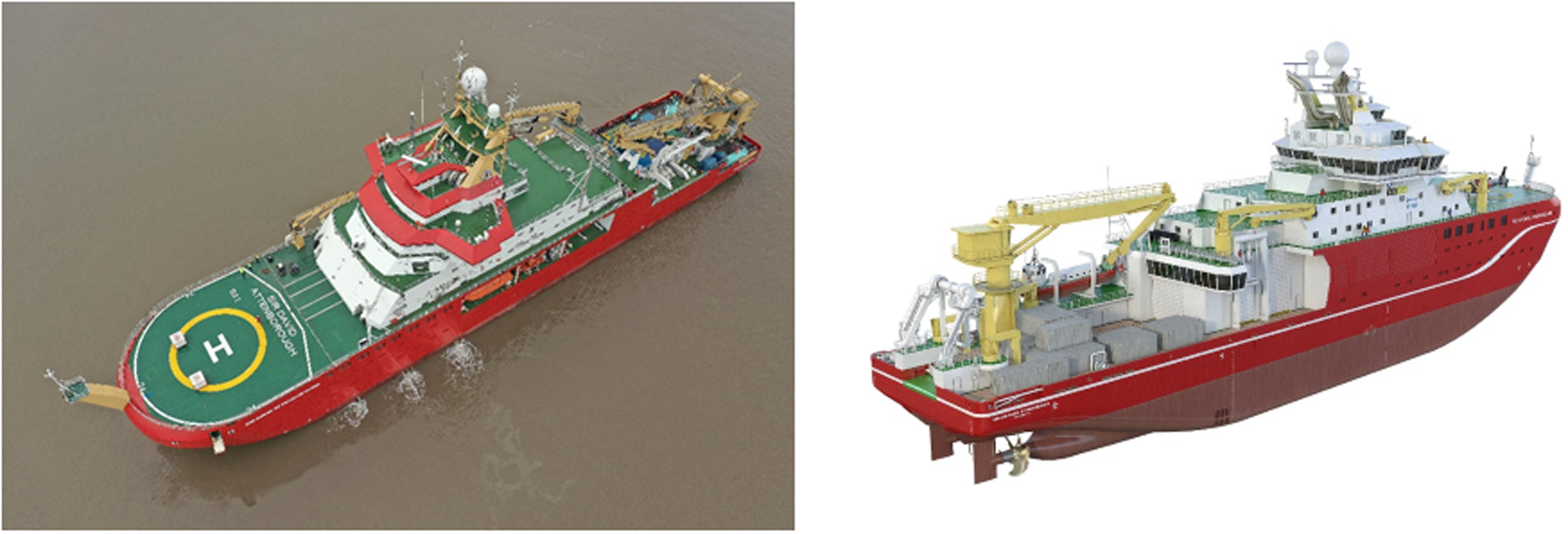
The first British Polar research ship to include a moon pool, the vessel has a PC 4 hull rating and a PC 5 rated propulsion system. The vessel’s technical details are as follows: Length overall 128.9 m; Breadth 24 m; Draft 7 m; and Gross tonnage 15,000 GT. With a top speed of 17.5 knots, cruising speed of 13 knots, and 3 knots in 1-metre thick ice, the vessel is well suited to Antarctic conditions.
The ship design considered comfort for the 29 crew and up to 60 passengers for voyages of up to a 60-day duration. The design also considered operations and logistics with a flexible cargo hold allowing for up to 2100m3 hold volume capacity of 20-ft ISO containers and bulk cargo alike. Several service cranes and two science cranes support daily operations and investigations while at sea.
The vessel is built as a mobile research platform; therefore, a range of scientific investigation is possible. Broadly speaking, these include investigation in the fields of atmospheric science, biology, geology, geophysics, and oceanography, all possible from 750 m2 of built-in laboratory space. There is also room for exchangeable, containerised laboratories so that the platform can be configured for specific science cruise needs.
The moon pool allows for deployment of a range of equipment in both sea-ice and open water. The on-board acoustics systems can operate in deep (to 11,000 m) or shallow (to 2,800 m) water. Biological multi-beam sonar can be used to quantify and identify pelagic organisms in 3 dimensions and estimate biomass, so that we can visualise a whole school in one “ping.”
The vessel is equipped with small boating facilities and carries two smaller vessels on-board, the survey workboat Erebus and the cargo tender Terror. The vessel carries three RHIBs each 4 m in length that can be used for rough shore landings. It also has a helicopter deck and a hangar for two mid-sized helicopters.
MV Xue Long 2 , Polar Research Institute of China
IMO 9829241
Polar Class 3, launched 10 September 2018
The construction of China’s first domestically built Polar research icebreaker, MV Xue Long 2 (Fig. 6) began in 2016. The MV Xue Long 2 entered into service in 2019, joining forces with MV Xue Long. Together, they operate in the Antarctic in support of China’s Antarctic research strategy and to provide operations and logistics support to China’s four Antarctic research stations.
The MV Xue Long 2 navigating in Polar waters.
Source: Polar Research Institute of China (PRIC).
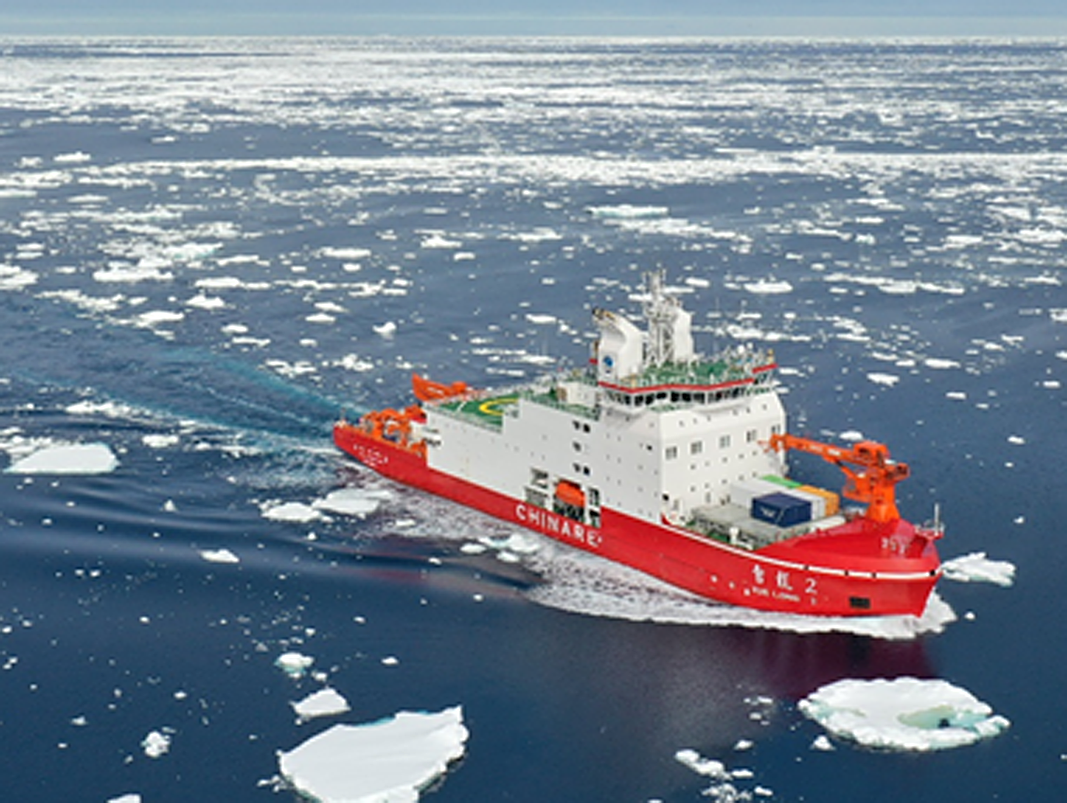
The vessel has a PC 3 rating, and as such, it can operate year-round in ice-covered waters. The vessel’s technical details are as follows: Length overall 122.5 m; Breadth 22.3 m; Draft 8.3 m; and a full load displacement of 14,300 t.
Incorporating innovative technology, the MV Xue Long 2 uses two 7.5 MW icebreaking pod thrusters and is the world’s first use of ahead and astern two-way icebreaking technology in a research icebreaker. Bidirectional icebreaking means that the ship can break 1.5 m of ice and 0.2 m of snow with a speed of between 2 and 3 knots. The clean design means the ship’s exhaust pipes are equipped with Selective Catalytic Reduction devices that reduce nitrogen oxide emissions. Noise and vibration reduction were also considered in the ship’s design, to meet the classification society designation of COMF (NOISE 2), COMF (VIB 2), and the ICES 209 standard for URN.
The vessel has capacity for 90 people and considers passenger comfort in its design, which includes thermal insulation and an advanced anti-rolling tank system. The living area includes a reading room and a gymnasium.
Built for research, the ship is equipped with a deep and medium water depth multi-beam system, deep-sea shallow stratigraphic profiler, underwater omni-directional sonar, baseline underwater navigational system, a 10,000 m sounder, and other acoustic equipment to carry out detailed seabed measurements. The design of the bottom box keel of the bow ship ensures that the acoustic transducer is protected from bubbles and shredded ice, while ensuring the economy of the ship’s navigation. The bow science mast is equipped with a 6 m2 platform for atmospheric observation and sampling. At mid-ship, there is a 160 m2 moon pool workshop and a truck-integrated crane for equipment transportation, and conductivity, temperature, depth (CTD) instrumentation, and other needs. The moon pool measures 3.2 m × 3.2 m and allows for CTD operation in a region of ice or in rough sea conditions. The vessel has more than 580 m2 of experimental space that includes two wet, one dry, and one low-temperature laboratories, with all labs having a flexible design.
The ship stern is equipped with an open working deck of 60 m2, a 30 ton tail A-frame for equipment retraction and trawl operations, and a column-shaped sampling and retrieving device with starboard pi-frames for 22 m long column gravity-piston sampling tubes. There are eight slots for standard 20-ft container laboratories on the afterdeck. In addition, a 50 ton hydraulic telescopic crane and a working boat in the forecastle, along with two cranes with ratings of 24 and 6 tons for lifting materials and other auxiliary operations means the ship is well designed to support logistics and operations. The ship can carry 30 ISO 20-ft containers and 750 tons of Polar oil to supplement the resupply of China’s Antarctic research stations.
RSV Nuyina, Australian Antarctic Division
IMO 9797060
Polar Class 3, launched September 2018
Launched in September 2018, RSV Nuyina (Fig. 7) is a true multipurpose vessel that will support primary roles of annual station resupply and scientific research. The vessel will be the main lifeline to Australia’s Antarctic and sub-Antarctic research stations and will be the central platform of Australia’s Antarctic scientific research for the next thirty years. The RSV Nuyina replaces the RSV Aurora Australis, which serviced Australia’s Antarctic programme since 1990. The vessel has a PC 3 rating, and as such, it can operate year-round in ice-covered waters. The vessel’s technical details are as follows: Length overall 160.3 m; Breadth 25.6 m; Draft 9.3 m; and a full load displacement of 25,500 t.
(Left) RSV Nuyina under tow leaving shipyards. Source: Damen. (Right) Graphic illustrating port side design features of the vessel.
Source: Australian Antarctic Division (AAD).
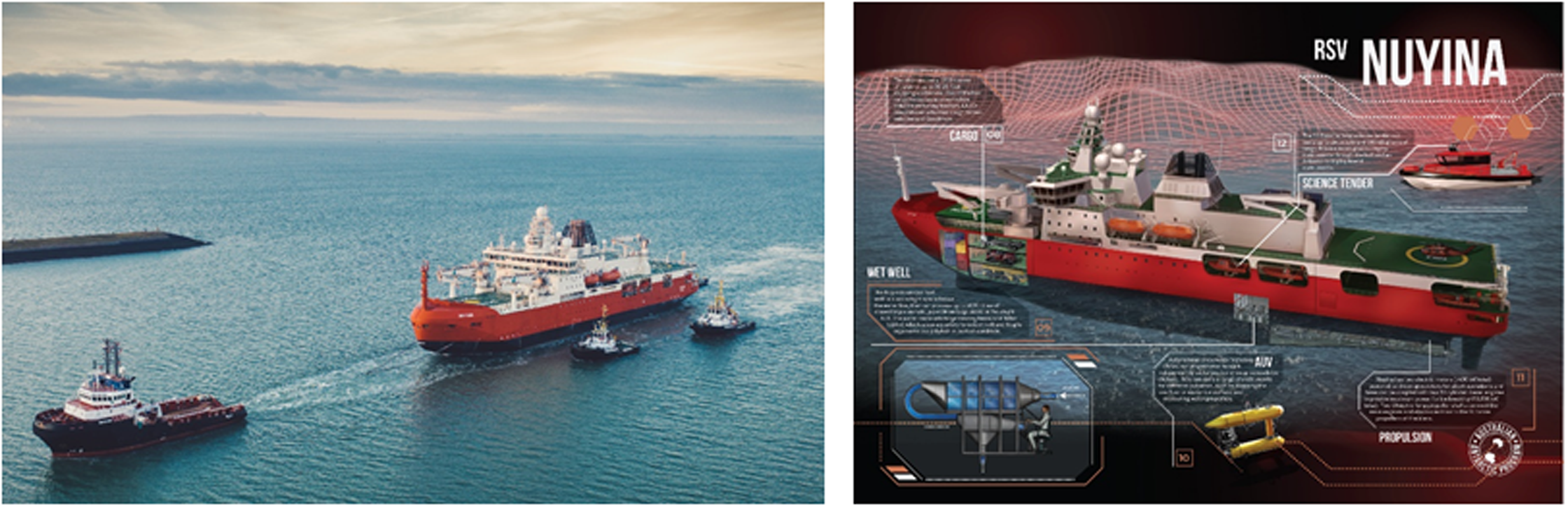
The RSV Nuyina is designed to achieve a 90 days endurance requirement. At the open water, economical transit speed of 12 knots the vessel will have a range in excess of 30,000 nautical miles. The vessel provides three times the internal volumetric cargo capacity of the RSV Aurora Australis, represented by a cargo hold capacity of 96 ISO 20-ft containers, and a bulk cargo fuel storage capacity of 1.9 million litres. These capabilities will enable a two station resupply in a single voyage reducing overall fuel use as compared to previous Antarctic seasons.
The propulsion system is a combination of diesel and diesel electric (CODLED) system. The system was designed to provide maximum flexibility and fuel efficiency, to enable the vessel to support a wide range of different propulsion modes ranging from dynamic positioning, to silent transit, to open water transit and icebreaking. The icebreaking model tests have demonstrated that RSV Nuyina will be able to break level ice of 1.65 m thickness at a continuous speed of 3 knots.
The RSV Nuyina will operate under Lloyd’s Register class and will be assigned Lloyd’s Register Environmental Protection (ECO class) notation. The specification of the various ECO notations places additional requirements on biofouling management, ballast water treatment, grey water treatment, nitrogen and sulphur oxide emissions, integrated bilge water treatment system, oily water treatment, and protection of oil tanks. This acknowledges the high level of consideration that environmental protection was given during the design stage. The vessel will also carry Lloyd’s Register certification for Inventory of Hazardous Materials and the Ship Energy Efficiency Management Plan, and vessel operations will be certified under ISO 50001 (Energy Management). As part of the assignment of ECO notation, the vessel will also be enrolled in the Lloyd’s Register Ship Emergency Response Service (SERS).
In accordance with Australia’s domestic legislation, the AAD completed an Initial Environmental Examination (IEE) to address the interaction of the vessel’s operations within the natural environment in Antarctica including but not limited to ice, water and atmosphere quality, wildlife, habitats, and ecological communities.
In support of the IEE process, the design and construction of a range of environmental risk mitigations are in addition to the ECO notations. Two examples of the types of such mitigations are a closed loop fresh water shaft lubrication system for the stern tube to minimise risk of oil leakage, and the means to eliminate light emission from the vessel during hours of darkness to minimise risk of bird strike.
As a scientific research vessel, there is a fundamental requirement for RSV Nuyina to have low radiated noise and low self-noise. These noise characteristics are achieved through compliance with radiated noise thresholds defined by Det Norske Veritas (DNV) “SILENT-R” notation and additional self-noise thresholds across certain frequencies defined by the AAD at sensitive acoustics transducer locations. The strictest level of URN requirement in the SILENT class notation is the SILENT-R notation with the “R” being a research notation. In support of multi-disciplinary scientific research, RSV Nuyina has an expansive and fully serviced sheltered science working deck and trawl ramp, and a large CTD hangar capable of supporting deployments over the side of the vessel or down through a moon pool. There are two drop keels, an array of underwater and topside sensors and instruments, and a range of science laboratory and support facilities connected through a central passageway connecting the aft working deck to the forward cargo holds.
In addition to the normal class sea trials, RSV Nuyina will undergo URN testing, deepwater science trials (acoustics and deployment systems), and icebreaking and low-temperature tests in the northern and southern hemispheres. It is anticipated that RSV Nuyina will be ready to support the 2021/22 Antarctic summer season.
Summary and conclusion
When most people think of the Antarctic, they think of a vast continent covered in ice. In fact, the Antarctic region also includes a large depth and breadth of ocean with its associated bathymetry, distinct ocean chemistry, and marine ecosystems. Relative to the rest of the world, we know very little about this ocean. Understanding this large and important area of the planet requires sustained research within the context of high environmental protection and considerable investment by Antarctic Treaty governments in the infrastructure needed to acquire in situ and remotely sensed data.
With the adoption of the IMO Polar Code, the national Antarctic programmes are carefully considering the design of new Antarctic vessels and are setting the bar high for these marine assets in terms of environmental considerations and ability to support a range of research.
The COMNAP ARC identified the critical access, infrastructure, and extraordinary logistics requirements required to enable and deliver key science objectives through research in and from the Antarctic region in the next two decade and beyond. The Antarctic science community clearly recognises the importance of the Antarctic marine environment with four of the seven thematic Antarctic Science Horizon Scan clusters (Kennicutt II et al., Reference Kennicutt, Chown, Cassano, Liggett, Peck, Massom, Rintoul and Sutherland2014) depending on research results related to that marine environment. The ARC outcomes identify research needs stretch from the deep ocean, across the continental shelf, to near-shore environments with “access to the deep ocean for sampling and emplacement of observatories” as the second highest priority (Kennicutt II et al., Reference Kennicutt, Kim and Rogan-Finnemore2016). Thus, there is an expectation from the Antarctic research community that Antarctic Treaty governments will continue to invest not only in land-based infrastructure in support of science but also in moveable assets, such as icebreaking capable vessels, that will allow for greater investigation of the marine environment and to contribute to operations, logistics, and SAR.
There is complexity that requires balancing scientific requirements against the challenges presented by an ageing fleet and the new safety and environmental protection requirements of the IMO Polar Code. Many of the new vessels incorporate fuel savings, noise reduction, and anti-pollution technologies that largely go unnoticed by the wider community, yet each improvement in design contributes to reducing our direct impact in the Antarctic Treaty area while delivering globally important data.
We need to ensure we reflect on the role these assets, their crew, and their science and science support communities play in delivering globally important data and information into policy-making bodies. We also need to continue to support international collaboration in the form of maximising the use of available vessel capacity on each voyage and sharing collected data and results of voyages. All this in addition to the balancing act that investment in such infrastructures requires us to consider.
As the ARC outcomes noted “Ultimately, success will be dependent on national investment in technology advances, provision of greater access region-wide and year-round, and the availability of logistics and infrastructure that allows researchers to do their best work where it must be performed. It has never been more important that the global Antarctic community find new ways to work together that leverage national assets and investments in Antarctica” (Kennicutt II, Kim & Rogan-Finnemore, Reference Kennicutt, Kim and Rogan-Finnemore2016).
The new Antarctic fleet coming online presently, and in the near future, have taken care to consider the fundamental requirements of internationally collaborative science and environmental protection and will significantly add to our community’s ability to deliver observations and results from the Antarctic Treaty area that are of global importance.
Acknowledgement
The authors express their appreciation for the critical review by an anonymous reviewer whose comments greatly improved the clarity of our paper.
Disclosure statement
No potential competing interest was reported by the authors.


 Open access

