

At the end of May 1381, disagreements about the payment of the royal poll tax in the English county of Essex sparked off a violent uprising that would soon spread across other parts of the country and would become known as the Peasants’ Revolt.Footnote 1 On 13 June, the rebels, including both townsmen and people from rural communities, entered the city of London and attacked symbols of royal authority. The next day, the Flemish community living in the capital was massacred. The bloodshed was recorded both by chroniclers and in administrative sources such as the letter books of the city of London.Footnote 2 These accounts are remarkably unanimous and allow us to reconstruct the main course of events: following several isolated incidents involving Flemish residents in Southwark and Holborn the day before and earlier on the same day, thirty-five to forty Flemings were dragged out of churches and houses in the city's Vintry Ward, near the River Thames, and summarily beheaded.
Unfortunately, none of the medieval authors elaborated on the attackers’ reasons for turning against the Flemings. As even the most concise amongst the commentators found it necessary to highlight that all victims originated from Flanders, it is safe to assume that they were specifically targeted. According to one fifteenth-century chronicler, the perpetrators used the inability to pronounce the shibboleth “bread and cheese” to single out Flemish people.Footnote 3 Yet there is seemingly no connection between the murders of members of this specific group and the more general concerns that inspired the participants in the Peasants’ Revolt––centered on the abolition of villeinage, the specifics of English labor legislation, and the right to rent land at low rates. In a recent study, Erik Spindler has stated that the rebels asserted their English identity by opposing and violently excluding those who were nearest to, but different from them, the Flemings.Footnote 4 However, there is no evidence other than the language test to support these claims. Len Scales has drawn on the contemporary silence about the motivations of the 1381 murderers to argue that the idea of eradicating other ethnic groups was so central to medieval thought that it did not require any explanation.Footnote 5
The most widely accepted interpretations of the massacre of June 1381 take into account the economic context of the Flemish presence in fourteenth-century London. In his introduction to André Réville's unfinished work on the Great Rising, Charles Petit-Dutaillis suggested that the victims in Vintry Ward were weavers from the Low Countries living and working in the city. Their murderers were London's native cloth workers, dissatisfied with the competition of the newcomers from abroad.Footnote 6 Both groups of workers did have a long history of often violent opposition. In response to lower levels of violence, between 1337 and 1369, at least seven proclamations ordered the English weavers to stop molesting their Flemish colleagues.Footnote 7 According to a 1377–78 petition, attacks equally resulted in the loss of Flemish lives, if not the carnage reported in 1381.Footnote 8 Rodney Hilton's Bond Men Made Free developed Petit-Dutaillis's views by adopting a class conflict perspective. The attack, Hilton argued, could have been orchestrated by either English master weavers jealous of the privileges bestowed upon their alien counterparts or by English apprentices and journeymen at daggers drawn with their Flemish masters.Footnote 9 Further scholars have since argued that the victims were Flemish textile workers, whose presence had jeopardized the livelihoods of the city's English artisans.Footnote 10
This article revisits the economic arguments advanced by Hilton and others by considering them in their full political context. It inquires why, if native weavers were frustrated about the presence of Flemish competitors and the privileges they received, this escalated into anti-alien violence. Throughout the fourteenth century, Parliament provided a political forum where issues like these could be addressed. The London trade and craft guilds, including the guild of native weavers, were eager to petition the crown to take action on a wide array of matters.Footnote 11 We examine why the royal government was unable to deal with the cloth workers’ dissatisfaction in Parliament. Although the rivalry between English and Flemish weavers in London has been the subject of several studies, no author so far has accounted adequately for the role of the monarch in the continuous disputes. Whereas most historians have acknowledged that, at times, the king privileged alien over native cloth workers, none has recognized the consistency in the crown's position during the tree decades that preceded the events of 1381.Footnote 12
In what follows we argue that, throughout most of the fourteenth century, the native weavers in London were facing a government that was not an unprejudiced mediator in a dispute between two groups of craftsmen, but an interested party with an original and well-developed perspective on the role of alien-born skilled artisans in key sectors of the English economy. That perspective was both the cause of the friction and the reason why a solution through the usual channels of political communication was so hard to reach. The massacre of the Flemings not only was the climax of a conflict between different groups of workers in fourteenth-century London, but it also helps us understand the royal government's economic policy and its relationship with both its native and alien populations. The concerns of London's native weavers were thus inextricably linked with the many other frustrations over the crown's policy that emerged at national and local levels during this period, coming to a boil during the Peasants’ Revolt of 1381.
The Crown's New Immigration Policy
It was in the late thirteenth century that the English crown had first felt the need to consider a more systematic approach toward those born overseas but now living within its borders. In 1294, the relative harmony that had characterized the relationship between the houses of Plantagenet and Capet for several decades came to an end, and disagreements about the feudal status of Aquitaine escalated into open Anglo-French warfare.Footnote 13 As a result, the government was forced to address the potential threat to national security posed by the significant numbers of French people resident in England. Its response was uncompromising: the property of all Frenchmen, as well as those under the suzerainty of the French king, such as Flemings and Bretons, was confiscated. Restitutions were allowed only in select cases and after years of often protracted proceedings. Causing severe economic disruption across the realm, the campaign revealed how deeply rooted in English society the alien visitors were. When war with France broke out again in 1328, the government took renewed action against French interests in England but also mitigated their impact by issuing letters of protection that exempted many from the confiscations. Probably under pressure from the localities, Westminster ceased to consider immigrant residents solely as a security threat and came to appreciate the economic benefits that many of them could bring to English society. Even though further hostilities with France from 1337 onwards presented the crown with much more serious concerns than the campaigns in 1294 and 1328 had done, the consequences for the French, and for other immigrants, in England were minimal, and would continue to be so for the remainder of the Hundred Years’ War.Footnote 14
In concert with its attempts to preserve and safeguard the immigrants’ contribution to the English economy, the government embarked on a more active immigration policy. From the 1330s onwards, Edward III tried to attract skilled artisans from abroad in order to boost the development of local industries, most notably the cloth industry. The same protections used to exempt alien residents from the effects of wartime measures were now granted either to individual cloth workers or to groups of craftsmen who came from Flanders, Brabant, and, occasionally, Zeeland, regions with a well-established, high-quality drapery industry.Footnote 15 In 1337, a statute was passed that invited textile workers from all foreign parts and promised them the necessary legal franchises.Footnote 16 Here, too, evidence suggests that the crown's policy, if not initiated at the request of the local communities, received the approval of part of the English population. In 1333, the Commons in Parliament petitioned Edward to protect the alien cloth workers from arrest and prosecution, so that they could “teach the people of this land to work the cloth.”Footnote 17
Not everyone within the realm however was as enthusiastic about the government's initiatives as the parliamentary representatives. In 1337, the king had to order the citizens of London to stop injuring immigrant cloth workers.Footnote 18 In 1339, a similar proclamation was issued.Footnote 19 In 1344, the crown even threatened to send those Londoners who were still attacking Flemish artisans to Newgate Prison.Footnote 20 Outside the capital, only the weavers of York are known to have contested the immigration of textile workers from the Low Countries, in 1342.Footnote 21 London's resistance did not lead Edward to abandon his policy, however. Protections for Flemish and Brabantine craftsmen continued throughout the 1340s.Footnote 22 In 1351, the government even stepped up its efforts to attract alien skill in response to developments on the other side of the English Channel.
London and the Flemish Exiles
At the start of the Hundred Years’ War, the Flemish count Louis of Nevers decided to honor his feudal obligations toward his suzerain, King Philip VI of France. His pro-French policy met with opposition from Flanders’ powerful cities, whose all-important production of luxury cloth crucially depended on the import of high-quality English wool.Footnote 23 In Ghent, the county's most prominent urban center, the radical textile guilds led by James of Artevelde managed to gain control of the magistracy, after which similar regimes were installed in Bruges and Ypres. Together, the “three cities” took over the government of the surrounding countryside and in 1339 forced Louis of Nevers to leave the county. They forged an alliance with the English and, in 1340, recognized Edward III as suzerain and king of France. After 1345, however, following Artevelde's death and the absence of effective English support, the rebellious regime disintegrated and Nevers’ son Louis of Male was able gradually to reconquer the county. In January 1349, a bloody battle in the streets of Ghent eliminated the last pockets of resistance.Footnote 24
Louis of Male, the new Flemish count, launched an investigation intended to bring his father's challengers to justice.Footnote 25 In England, Edward III anticipated the potential persecution of hundreds of skilled artisans who had been involved in the revolt. In May 1350, he issued letters of protection to those Flemings who, following the failure of the rebellion, had emigrated to London, Canterbury, Norwich, Salisbury, Lynn, and other English cities and towns. Very similar to those granted to a number of French residents in England during the same years, the documents qualified the Flemings as incolas, a term derived from Roman law to denote permanent inhabitants born outside the kingdom.Footnote 26 As a reward for their loyalty during the Flemish conflict, they were allowed to live in the realm and trade their goods. Officers were instructed to protect them against physical aggression and their property against confiscation.Footnote 27 One of those to whom Edward's letters applied was Peter Medinhoe the Elder, a weaver from Bruges. His name appears on the lists of military musters for his city's militia in 1340,Footnote 28 suggesting he must have been involved in the hostilities against the Flemish count. In August 1351, the mayor of London informed his Bruges colleagues that Medinhoe had died in the English capital.Footnote 29 Flemish rebels had thus moved to London before the investigation in their home county was completed.
In October 1351, Louis of Male's inquiry was concluded and those who had compromised themselves during the years of rebellion were permanently exiled from Flemish soil. Lists of those banished in 1351 and of those eligible for a pardon drawn up in 1359 make clear that at least 1,364 people––mostly from Ghent, Bruges, and the rural district of the Liberty of Bruges––were convicted. Of the 316 exiles whose occupations were given, 137 were weavers, fifty-nine were fullers, and twenty-one belonged to the smaller drapery guilds.Footnote 30 Given the composition of the urban regimes between 1338 and 1349, it is probable that the majority of those without listed occupations were also textile workers. Confronted with the forced departure of such numbers of experienced cloth makers, Edward III was even more determined to capitalize on the diplomatic situation and its economic potential. On 25 September 1351, before the result of the investigation was made public, he issued new, more open-ended letters of protection, inviting all those who had been banished from Flanders and were willing to work to his kingdom.Footnote 31
There is no comprehensive evidence that establishes how many of those convicted accepted the offer and moved to England. An earlier study by the present authors has demonstrated that in the fifteen years following the exile, 126 immigrants from the Low Countries settled with their wives and children in the middle-sized town of Colchester in the county of Essex, possibly adding about 10 per cent to its population. At least twenty-seven of them figured on the lists of Flemish exiles in 1351. Most new arrivals were found working in Colchester's production and sale of cloth, both of which grew exponentially in those same decades. In the thirty years that followed, no signs of anti-alien hostility were recorded.Footnote 32
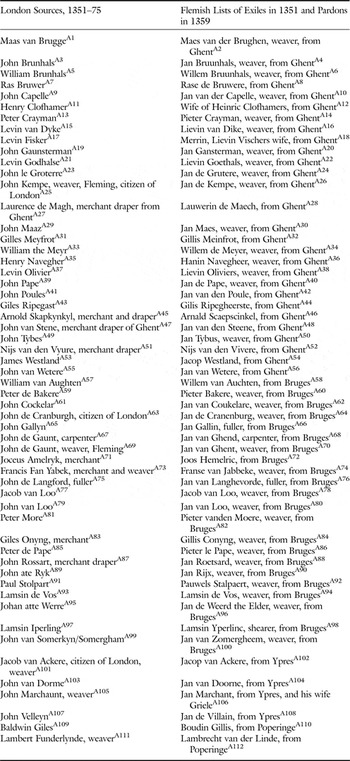
The only other place in England where Edward III's letters of protection are known to have had a considerable impact is London.Footnote 33 Many of the exiles settled in the city, which was soon to become the most important cloth market in the kingdomFootnote 34 and enjoyed strong links with the Low Countries.Footnote 35 Many of the exiles settled in the city and became involved in its cloth production. While London's native textile workers struggled, the Flemings would thrive. The names of fifty-six people included in the 1351 lists of banishments match almost exactly with those of Flemish artisans who, according to the city's letter books, the memoranda and fine rolls, the aulnage accounts, and a variety of other sources, were dwelling in the capital during the twenty-five years following the investigation (see the appendix).Footnote 36 Whereas some of the exiles in Colchester came from smaller Flemish towns and villages, nearly all of those found in London originated from the large cities of Ghent, Bruges, and Ypres. The only exceptions were Baldwin Giles and Lambert Funderlynde, who hailed from the small center of Poperinge. In thirty-six of the fifty-six cases, the Flemish lists of exiles provide us with an occupation. Only one of them, carpenter John de Gaunt from Bruges, had no connection to the textile sector. John de Langford and John Gallyn worked as a fuller; Lamsin Iperling was a shearer. The remaining thirty-one immigrants were all banished weavers. Many of the exiles in London had occupied key positions in Flanders during the years of the revolt. Levin Fisker had served as alderman of Ghent in 1343 and 1347, Levin Godhalse in 1348,Footnote 37 months before the city had fallen to the Flemish count. Giles Ripegast had been one of the city captains in Ghent,Footnote 38 John de Cranburgh in Bruges.Footnote 39 Lamsin de Vos was one of Bruges’ most important drapers and had acted as dean of its weavers guild in 1347.Footnote 40 In the same year, John de Langford had been in charge of the city's fullers guild.Footnote 41 Exiles John Cockelar and Lamsin Iperling had sold large quantities of cloth and fabric for linings to the Bruges city government throughout the 1340s.Footnote 42 Unlike Colchester, London attracted the top layer of Flanders’ reputed textile industry. Their prominent roles during the years of the rebellion had cost them most of their political leverage, but they brought economic and social capital with them to England.
Sometimes the London sources allow us to establish whether the Flemish exiles were accompanied by their wives and children. In 1353, Lamsin Iperling was sued together with his spouse Agnes in an intrusion case before the Court of Common Pleas.Footnote 43 Only one exile, John Marchaunt of Ypres, figures on the 1351 lists with his wife. It does not necessarily follow that the others immigrated alone, as the case of Henry Clofhamer shows. Clofhamer, banished from Ghent, appears repeatedly in the London sources throughout the 1350s and 1360s.Footnote 44 In 1359, his anonymous wife, who had never been mentioned before, was pardoned and recalled to Flanders,Footnote 45 which implies she had been in England during the previous years. In 1375, a Flemish weaver named Ralf Clofhamer appears in the London records,Footnote 46 possibly Henry's son. Levin Fisker's wife Merrin was also allowed to return to Ghent in 1359,Footnote 47 while her husband remained in the English capital.Footnote 48 Peter Medinhoe the Elder, who died in London before the formal sentence by the Flemish count, appeared in the 1340 military musters of Bruges together with his son Peter Medinhoe the Younger.Footnote 49 Peter the Younger's name does figure on the lists of exiles of October 1351,Footnote 50 although there are no sources that confirm he moved to England. Some of the exiles in London, such as John and William Brunhals from Ghent or Jacob and John van Loo from Bruges, bear the same surnames and may have been related to each other. When John de Cranburgh was exiled in 1351, his wife Katherine stayed behind in Bruges. In 1354, the Bruges authorities refused to pay her a compensation for pulling down some of her husband's properties in the city without the latter's assent. John called on the mayor and aldermen of London, who informed their colleagues in Flanders of his approval.Footnote 51 Other banished Flemings in England maintained contact with friends and relatives on the other side of the Channel. According to a verdict by the Ghent bench of aldermen, for example, John van Wetere received annual visits from Ghent money changer Feyns de Backer in his house in London at the end of the 1350s.Footnote 52 Here again, it appears that most of the exiles in the capital were established and well-acquainted artisans, rather than isolated journeymen or apprentices.
Evidence on where in London the Flemish exiles lived is limited. The plaint for intrusion brought against Lamsin Iperling and his wife in 1353 related to a free tenement in the parish of All Hallows Barking, in the city's Tower Ward.Footnote 53 When Peter Medinhoe the Elder died in August 1351, he resided in the house of Maud Aleyn, a citizen of London, in St Botolph's parish in Billingsgate Ward, near the Thames.Footnote 54 In 1362 Francis Fan Yabek stayed in the property of fellow exile John Kempe, whose location, unfortunately, was not specified.Footnote 55 At least from 1362 onwards, the Flemings held their congregations and hired apprentices in the churchyard of St. Laurence Pountney in Candlewick Ward.Footnote 56 Cloth workers from Brabant, who migrated to London increasingly from the second half of the 1350s onwards, met in the churchyard of St Mary Somerset, in Queenhithe Ward.Footnote 57 However thin, the evidence thus suggests that the Flemish exiles frequented the city's central wards and those closest to the Thames, as well as the neighborhoods where the production and sale of cloth were concentrated.Footnote 58
The aulnage accounts, which record the payment of a fee for the measurement and sealing of woolen cloth, make clear that the Flemings in London focused on the production of rays, medium-quality fabrics with striped bands or checks dyed in the yarn, and coloreds, the most expensive, heavily finished kind of cloth.Footnote 59 Between 1374 and 1377, the only years for which particulars of account have survived for the capital, the separate membranes devoted to these types of textiles contain almost exclusively names of Flemish artisans.Footnote 60 Nine of them were people exiled from Flanders in 1351. John van Dorme, from Ypres, brought eight short ray cloths and two scarlets, the most luxurious kind of woolen dyed with kermes, to the aulnager on 13 December 1374. On 28 September 1376 he aulnaged nine short rays, and on 17 February 1377 he had another three rayed cloths sealed.Footnote 61 John Capelle, an exile from Ghent, paid the fee for six short rays on 12 October 1374 and for another eighteen rayed cloths six days later.Footnote 62 John van Loo took fourteen pieces of rayed cloth to the aulnager on 2 October 1376.Footnote 63
The Flemish arrivals in London operated their business on the same capitalist basis as they were accustomed to do in their home county.Footnote 64 Eight of the exiles are referred to in the London sources as either merchants or merchant-drapers. John Kempe, John de Cranburgh and Jacob van Ackere acquired citizenship, which, according to London's charter granted by Edward II in 1319, was required in order to trade retail in the city.Footnote 65 The amounts of fabric the Flemings aulnaged were consistently very high and exceeded the capacities of individual weavers, whose average output during this period ranged between ten and fifteen cloths a year.Footnote 66 By contrast, the other types of woolens recorded in 1374–77 were invariably brought to the aulnager by large numbers of English fullers in much smaller quantities.Footnote 67 Given the elevated economic status of many immigrants before their banishment, it is likely that some of them possessed the capital to organize the whole production process and subcontracted stages of the work to their fellow Flemings or their families. The presence of only two fullers and the absence of dyers among the exiles suggests they must have entrusted the finishing stages to local workers, while marketing the finished product themselves. The arrival of an unprecedented number of skilled Flemish artisans clearly had an immediate impact on London's cloth production. Unlike Colchester, the capital had had a cloth industry of its own since the twelfth century, and the Flemings’ interests was bound to clash with those of London's native cloth workers.
Political Failure and Anti-Flemish Aggression
The oldest known chartered craft in London, the native weavers had received privileges from King Henry II in 1155, stating that they alone had the right to produce cloth in the city.Footnote 68 They were organized in a guild and paid an annual farm to the crown for their franchises. In 1352, they petitioned the king and his council in Parliament in protest against the fact that, in breach of those privileges, the alien cloth workers worked outside their guild and did not contribute to their farm. The petition itself is lost, but an entry on the plea rolls makes clear that Edward III referred the matter to his Court of the Exchequer, where delegates from both parties were invited to attend. Representatives of the native guild presented their 1155 charter and a resolution by their city's Court of Aldermen made in 1347 that all newcomers should be ruled in the same way as English weavers.Footnote 69 The Flemish delegation reminded the Barons of the Exchequer of Edward's 1337 statute, which guaranteed them unrestricted franchises; they obtained a stay of proceedings.Footnote 70
The Londoners would not back down so easily. Again in 1352, the Flemish cloth workers petitioned the king and council complaining that they continued to be harassed by the guild of native weavers. They wanted a confirmation of their freedom to work in England, as promised in 1337, and the authority to elect two of their own men to supervise their work. The response of the crown, written on the dorse, that is, the back, of the document, could hardly be clearer:
Because this petition touches the common profit of all the realm of England and of the lands specified in it, our lord the king, with the assent of the prelates, earls and barons, and other great men in this full parliament, grants for himself and his heirs to all and singular alien cloth workers … who then resided in this kingdom … and should thereafter come and abide there and follow their craft … that they may safely abide in the realm under the king's protection, and may freely follow their craft; without being answerable to the members of the guild of weavers of London, natives, or of other cloth workers of this realm, or liable to pay any sums of money by reason of such guild.Footnote 71
Not only could the Flemish textile workers organize themselves in any way they preferred, but new artisans from overseas were encouraged to join them. On 8 February 1352, the king's decision was enacted on the patent rolls.Footnote 72
Such strong royal endorsement, with reference to the interest of the whole realm, is remarkable, especially given the Flemings’ petition had never been adopted by the Commons in Parliament.Footnote 73 What was at stake, however, was not only the private interests of the Flemish weavers, but also the crown's own policy. In a recent article, Mark Ormrod has shown that in English political discourse during the fourteenth century, the notion of the common profit functioned as an effective device by which good governance that benefited the material prosperity of the realm was framed.Footnote 74 By adopting the attraction of Flemish cloth workers as part of this program, the crown's immigration policy was presented as an asset to England's economy that outweighed the interests of particular groups.
The royal endorsement of the Flemish petition had an immediate effect. In October 1352, eight months after the enrolment of the letters patent, London's native and alien cloth workers struck an agreement––including exiles John and William Brunhals, Henry Clofhamer, Levin Godhalse, John Kempe, John van Loo, Levin Olivier, Giles Ripegast, John van Somergham, and John atte Were. The English weavers acknowledged the Flemings’ freedom to work in the city and promised no longer to attempt to incorporate them within their guild. The Flemish textile workers agreed to contribute to the annual farm to the Exchequer and accepted joint supervision of their looms. They would refrain from further legal action against their English colleagues.Footnote 75 The agreement implied the de facto recognition of the alien weavers as a separate guild. From late 1352 onwards, the names of their bailiffs, among whom were exiles such as Lambert Funderlynde, John le Gurterre, and Henry Navegher, were recorded regularly in the city's letter books.Footnote 76 The compromise was not the only indication of a rapprochement during these years. In 1356, exile John Kempe from Ghent obtained the citizenship status he needed to sell retail in the city by joining the guild of native weavers. Three of his sureties were John Payn, Richard atte Boure, and John Bennet, London cloth workers who had brokered the 1352 agreement.Footnote 77 Soon enough, however, the more conciliatory voices within the native guild lost out. Confronted with the emphatic expression of royal support for the alien cloth workers, the natives abandoned their political action and turned on the immigrants once more.
In a later petition, the Flemings claimed that because of the privileges granted to them in 1352, the English had “murdered, wounded, and horribly trampled down” some of their members.Footnote 78 In June 1355, the king told the mayor and sheriffs of London to intervene. The text referred explicitly to the exiles, condemning the molestation of the “men of Flanders … banished from those parts for adhering to the king.”Footnote 79 In 1359, Edward III had to forbid the physical aggression against those from the Low Countries twice.Footnote 80 According to a decree by the mayor in 1362, Flemings, Brabanters, and Zeelanders felt so unsafe they constantly carried knives and other weapons with them.Footnote 81
In the course of the 1360s, attention in most of the sources temporarily shifted from the violence between native and immigrant cloth workers to the internal problems within the guild of alien weavers in London. For a number of years, disputes increased between Flemings and Brabanters, who may have arrived following Louis of Male's invasion of their duchy in 1356, and between Flemish masters and journeymen.Footnote 82 It would be wrong, however, to consider the struggles within the alien guild and the Anglo-Flemish conflicts as unrelated. The native weavers’ resistance to the Flemings’ self-governance undermined the latter's authority to regulate their craft. When issues transcended the interests of the particular guild, the Flemish weavers depended on the goodwill of their London rivals. Inspired by the greater opportunities for laborers in post-Plague England, Flemish journeymen––among whom were the exiles John and Peter Pape, and John Tybes––refused to work for less than seven pence a day and threatened their own bailiffs in 1355. The mayor ordered a joint committee of native and alien weavers, including the banished Giles Ripegast, Henry van the Rothe, John van Somergham, and John atte Were, to negotiate appropriate wages but enmity between both groups prevented them from reaching a compromise.Footnote 83 Represented by exiles Henry Clofhamer, John Gaunsterman, and John van Wetere, the guild of alien cloth workers had its ordinances approved in 1362, and again in 1366,Footnote 84 but, unlike the native weavers, who had enjoyed their private court or “soke” since their first charter in 1155,Footnote 85 was not granted its own jurisdiction. This made it hard for the Flemish bailiffs to control the collective actions of guild members that continued to occur throughout the decade.Footnote 86
Fear of the Londoners’ aggression had not completely disappeared either. In 1364, a number of alien cloth workers, including exiles James Westeland and John de Langford, appeared in the London Court of Husting to obtain an inspeximus confirmation of Edward III's letters patent of May 1350, which had promised protection against attacks and swift redress in court for all Flemings settling in the realm.Footnote 87 In 1369, when the failure of the English king's attempts to marry his son to the Count of Flanders’ daughter might have resulted in a climate more favorable to anti-Flemish concerns,Footnote 88 the assaults effectively returned. Having “heard by frequent report of several that evil and insult is by the people of the said city daily inflicted on the … men and the merchants [of Flanders] dwelling there and coming thither,” Edward III again insisted that bloodshed should stop.Footnote 89
It is simplistic to interpret the constant attacks by the London weavers in Parliament and in the streets throughout the 1350s and 1360s as a function of general anti-alien sentiment or even of the fear of being outcompeted by the Flemings.Footnote 90 To fully understand the native textile workers’ frustrations, it is essential to take into account the developments in the London cloth market during the second half of the fourteenth century. The Black Death had not reduced the demand for the middling and high-quality types of cloth being produced by the Flemish weavers in the capital. The market for luxury colored textiles may even have expanded, as living standards rose and substantial quantities could be sold to noble households and the royal court. In 1350–51, the king's Great Wardrobe spent 53.8 per cent of its money for drapery purchases on coloreds.Footnote 91 Flemish exiles also maintained contacts with the London drapers, who monopolized these sales to the court.Footnote 92 In 1367, for example, Arnold Skakpynkyl and Nys van de Vyure from Ghent sued draper Nicholas Rouse for a debt of £9 19s.Footnote 93 During the 1350s, cloths imported from abroad, which were usually the higher-quality varieties, constituted the majority of textiles sealed by the aulnager in London.Footnote 94 By the second half of the 1370s, when the Flemings were aulnaging vast amounts of fabrics, all but a few of these imports had disappeared.Footnote 95 Edward III's policy of encouraging Flemish craftsmen thus had an effect.
At the same time, there continued to be a domestic market for rays, the other strength of the Flemings. The court's growing interest in cloth dyed in the piece did not significantly affect its demand for striped and checked fabrics until the end of this period.Footnote 96 In 1362–63, the royal Wardrobe still bought 108 rayed cloths, a number only inferior to the 201 long and short coloreds purchased that year. Whereas most of these rays were also supplied by London drapers, one Fleming, Jacob Bone from Ghent, sold twenty-eight directly to the court.Footnote 97 In the period 1392–95, the relative importance of rayed cloth had dropped compared to that of long and short coloreds, with 134 pieces bought of the former and 872 of the latter, but it remained the Wardrobe's second most sought-after cloth type.Footnote 98 Other wealthy consumers also carried on purchasing rays until at least the end of the fourteenth century.Footnote 99
There are even indications that a small part of the Flemings’ output was exported. Between 1362, the year in which the guild of alien weavers had its first ordinances approved, and 1366, the new category of “cloth of Flemish manufacture” figured among the exported cloth types in London's enrolled petty customs accounts.Footnote 100 Unfortunately, there are no particulars of account that allow us to identify the exporters. Banished Flemings dealt with London mercers, who, during this period, were among the leading traders of English cloth abroad.Footnote 101 In 1364, John van Stene, an exile from Ghent, sued mercers John Peutre and Henry Forester for debts of £23 0s. 3d. and £4 17s.Footnote 102 The Flemings’ woolens may have been sold in Gascony, one of the principal markets for English cloth during the fourteenth century.Footnote 103 Cloth produced in England was officially banned from Flanders,Footnote 104 but some of the exiles, who benefited from a cheaper and more secure supply of wool than their competitors across the Channel, may have used their ambiguous backgrounds to export to their county of origin anyway. In 1362 John Kempe and Francis Fan Yabek, banished from Ghent and Bruges, were caught by the London searcher for sending two pieces of cloth uncustomed to Flanders.Footnote 105
We do have particulars of account detailing the payment of wool customs during these years. From this evidence it appears that, in 1365–66, three exiles exported raw materials from England: John van Dorme took fifty sacks of wool and 1,440 woolfells out of the country in October and November 1365 and September 1366. Levin Fisker and John Capelle exported eleven and three sacks of wool respectively in October 1365 and November 1365.Footnote 106 The shipment abroad of unshorn woolfells was compatible with the Flemings’ own sale of luxury cloth: they were commonly used for the production of lower-quality fabrics and, until a reorganization of the customs system in 1368, were subject to relatively low tax rates.Footnote 107 Yet the customs on the export of wool were exorbitantly high, adding up to thirty-three percent of the cargo's market value for alien exporters.Footnote 108 Why would van Dorme, Fisker and Capelle, who were charged the alien rates, have paid these duties and supplied producers who may have competed with their own finished products? It must be stressed that, apart from van Dorme's shipment in September 1366, all exports were concentrated in a period of only two months in 1365 and were probably made to compensate for a temporary dip in the Flemings’ cloth sales. The only other goods the exiles are known to have traded in England is linen cloth, a Low Countries specialty,Footnote 109 sold by Laurence de Magh and John Rossart to a London citizen in 1367.Footnote 110
The fortunes of London's native weavers contrasted sharply with those of the Flemish exiles. During the second quarter of the fourteenth century, the city's English cloth workers had experienced a revival as they had been able to extricate themselves from the dominance of the burellers and technological advancement had enabled them to broaden their range from semi-worsteds to cheap, coarse full woolens. The Black Death did reduce the demand for lower-quality cloth, although not as much as the drop in the population figures might suggest.Footnote 111 In 1364, the native weavers were also denied the retail sale of their own products, as only drapers now had the right to market cloth in the city. This did not automatically mean these drapers would buy from local cloth workers. In 1351, London's exemption from the Statute of York, which, in 1335, had allowed all merchants to trade freely throughout England,Footnote 112 was lifted. Provincial weavers able to work at lower cost were thus in a position to flood the city with less expensive textiles. While London developed into the kingdom's most important cloth market, its native cloth workers became uncompetitive. Many moved out of the city to escape payment of the farm to the crown. They elected members to the Common Council, the representative assembly of the city's mysteries, but, dominated by the mercantile guilds, their political influence was limited.Footnote 113
Switching to the types of cloth in which the Flemings specialized, and where demand was sufficient and provincial competition less fierce, might have solved some of the native weavers’ problems. However, they lacked the specialist weaving and shearing skills required to produce rayed cloth.Footnote 114 Making coloreds demanded even more specific know-how, mostly in the preparation of the yarn, which no English producers yet possessed.Footnote 115 The natives’ lack of capital and control over the complete production cycle also prevented them from following up on the preferences of the end customers, who determined the colors and other specifications of the rays; it also precluded them from imposing the very high quality standards needed for manufacturing colored cloth. This explains, at least in part, why the London weavers pursued their claims to supervision of the guild of alien cloth workers with such determination: with the Flemings’ incorporation came their expertise, their capital, and their unique selling proposition. The Flemish weavers may already have been refusing to hire English apprentices and servants as they would do in the late fifteenth century in order to avoid the dissemination of their skills.Footnote 116
When the native weavers deplored in a 1376 petition to the king that the “Flemings, Brabanters, and other aliens have at present, and for a long time have had, the great part of the said mystery,”Footnote 117 they were, thus, not principally targeting a group of artisans who had conquered their segment of the market: the Flemish weavers produced different kinds of cloth and provided no direct competition. The native weavers were instead expressing their desperation at the lack of support from the English royal government in the face of challenging trends in the cloth making business after the middle of the fourteenth century. With the king's backing, the incorporation of a group of exiled immigrant workers could have given them access to new sections of the market and ameliorated problems with the payment of the farm. Yet the English monarch, who argued to work for the common profit of his realm, continued to dismiss the claims of the native weavers and preferred to court the Flemings.
The Petitions War of 1376–78
During the second half of the 1370s, a number of changes provided the native cloth workers with a context that must have given them new hope of finding a political solution for their problems. Most importantly, the once solid regime of King Edward III, for four decades a determined sponsor of the guild of Flemish artisans, had all but collapsed. Struggling with ailing health, the monarch no longer had the authority to deal with the growing frustrations within the realm, which erupted dramatically in the so-called Good Parliament of 1376.Footnote 118 Secondly, the breakdown of the Truce of Bruges in 1375 and the threat of a French invasion had created an atmosphere in which the presence of substantial numbers of aliens in the kingdom was no longer taken for granted: some even petitioned that all Frenchmen resident in the realm should be expelled in order to protect national security.Footnote 119 Finally, since 1371, petitions that promoted the private interests of specific groups or communities had been incorporated more easily into those presented by the Commons in Parliament than had been the case before, thus securing a better chance of receiving a definitive answer.Footnote 120
In 1376, the native weavers of London petitioned the king in Parliament by repeating the claims they had made at the start of the 1350s: whereas his progenitors had granted them a charter that gave their guild alone the right to practice their craft in the city, Edward III had allowed Flemings, Brabanters, and other aliens who had newly come into England to do the same. They therefore asked that the aliens’ charter of 1352 be annulled and theirs confirmed or, alternatively, that they be discharged from the annual payments of their fee.Footnote 121 Probably no decision had been reached when Edward died in June 1377; two near-duplicate petitions were submitted to the new king, Richard II, later in the year.Footnote 122 The Flemish weavers sent a counter-request to the young monarch and his council, asking for the confirmation of their 1352 charter.Footnote 123 The crown's decision was recorded on the dorse of one of the native cloth workers’ petitions. Whereas other complaints about the presence of immigrants in the kingdom were discussed at the Bad Parliament of January to March 1377, and while the request to expel all French residents was granted,Footnote 124 the bill about the alien weavers found much less support. It was sent into the Chancery, where a special tribunal summoned the Flemings and Brabanters and investigated their 1352 charter.Footnote 125 Even though this was not an uncommon procedure, the crown was obviously not keen to address the criticisms of its economic immigration policy in Parliament.Footnote 126 Twice the London weavers had asked the king to restrict the privileges of the immigrant artisans: in 1352 their requests had been sidetracked to the Exchequer, in 1376 to the Chancery. The contrast with the aliens’ petition of 1352, which, despite the lack of parliamentary backing, had received the strongest possible royal endorsement and had been granted by letters patent, was telling.
We have no direct documentary evidence as to what happened subsequently, but we do know that the Flemings rallied additional support. Later in 1377 or in 1378, they sent a petition to Richard II's uncle John of Gaunt.Footnote 127 They explained how the English cloth workers were trying to have their charter, granted by John's father Edward, withdrawn in the Chancery and they asked for his help. The Flemings must have considered him an obvious champion for their cause. Even though he was excluded from the Regency Council, John of Gaunt held considerable influence in the kingdom during the minority of his nephew.Footnote 128 Related to the house of Hainault through his mother, he also cherished close links with the princes of the Low Countries and he then hoped to exploit these connections in order to secure a military alliance. Gaunt, too, incurred the anger of the London citizens in a dispute over their liberties, in 1377.Footnote 129 According to the author of the Anonimalle Chronicle, the Londoners vented their frustrations about his actions by circulating the highly insulting rumor that the Ghent-born prince was the son of a Flemish butcher rather than of Edward III and “loved Flemings twice as much as Englishmen.”Footnote 130 That these allegations were made at the same time as the petition in which the Flemish weavers complained to Gaunt about the maneuvers of their London rivals could imply that the conflict between alien and native cloth workers had become entangled with other issues simmering in the capital. Had the news about the Flemings’ attempt at obtaining his collaboration gone public and added to the Londoners’ existing anger toward him, or did the Flemish textile workers approach him exactly because the conflict had highlighted his links with the Low Countries? Without a more precise dating of the Flemish petition, it is impossible to say.
The language used in the petitions reveals a difference in the strategies adopted by both groups of cloth workers. Both in their request to Richard II and the one to John of Gaunt, the Flemings underlined the wider importance of their case by borrowing the crown's own rhetoric of immigration for the common profit.Footnote 131 In the earlier petition they asked for a confirmation of their privileges, “so they could use their mystery so well for the profit of the realm as for themselves.”Footnote 132 In the latter petition the very last words were to reassure John that they were only interested in the “profit of the realm.”Footnote 133 Whereas the notion of common profit was also eagerly embraced by others during this period,Footnote 134 the native cloth workers never appealed to the wider interests of the kingdom. Their requests showed more concern for their own material benefit, emphasizing how the rejection of their earlier petitions had resulted in the “great impoverishment of their estate.”Footnote 135
In anticipation of a verdict from the Chancery, the English weavers tried to mobilize political action in London. At the Parliament of October 1377, it had been decided that no alien in England should run a hostel and, in a further attempt to curb the mobility of laborers after the Black Death, a stricter control of the wages earned by servants was imposed.Footnote 136 The native cloth workers now asked the London Common Council to entrust them with the supervision of the earnings of immigrant journeymen in the cloth industry and to make sure that no alien weavers were hostel keepers. In language that is more explicit than that used earlier and betrays growing frustration, they left little doubt who the real targets of their actions were: “the foreigners and strangers being for the most part exiled from their own country as notorious malefactors, and unwilling to place themselves under the rule of the free weavers.” The Common Council made clear to the weavers that no changes could be made until malpractices were actually observed.Footnote 137 Dominated by the mercantile mysteries, which had no interest in restricting competition among the city's producers,Footnote 138 the assembly's support for the native weavers’ particular concerns was, obviously, limited.
There are indications that the native cloth workers’ political failures again resulted in physical aggression against their Flemish colleagues. On 11 April 1377, Katherine, the English wife of the Flemish weaver Gilbert Strynger, sued London weaver Richard Bone in the King's Bench for the murder of her husband. Bone was summoned to appear in person on the following octave of St. Martin (November 1377). After failing to obey the summons three times, he was outlawed.Footnote 139 On 19 April 1379, however, Bone bought a royal pardon for the murder and had his penalty canceled. Although the writ delivered by the Privy Seal Office, which was usually based on the supplicant's petition, specified that Strynger was Flemish, the entry on the King's Bench plea rolls did not do so.Footnote 140 Apparently Bone found it expedient to emphasize his victim's origins in order to obtain mercy, suggesting a context in which aggression against Flemings could be justified.
On 4 March 1380, the outcome of the Chancery investigation was enacted on the patent rolls. The objections of the native cloth workers were rejected once more and the privileges of the Flemish weavers, including the right to work outside the Londoners’ guild, were confirmed.Footnote 141 An agreement between both groups about the payment of the farm and the supervision of the looms was made a few days later, but, again, was largely ignored.Footnote 142 Fifteen months later, the Peasants’ Revolt provided an outlet for many groups in English society who, for decades, had been frustrated with the inadequacies of government policy. On 14 June 1381, a day after the Revolt had hit London, up to forty Flemings were taken out of St. Martin Vintry, situated halfway between the churches where Flemish and Brabantine weavers usually held their congregations, and were slaughtered. In the weeks and months that followed, collective pardons were granted absolving those who had participated in the rebellion of their punishment.Footnote 143 They included groups of London's native weavers,Footnote 144 the artisans who, during the three decades that led up to the events, had continuously denounced the liberties of the Flemish cloth workers, had repeatedly attacked them physically, and, one year earlier, had concluded that their problems with the aliens would never be solved politically. Among those pardoned, on 23 June 1381, or only nine days after the bloodshed in Vintry Ward, was Richard Bone, the man who had murdered the Flemish weaver Gilbert Strynger in 1377.Footnote 145
Conclusions
The massacre of the Flemings in London in June 1381 must be placed in the context of the English weavers’ growing discontent over the previous decades. The native guild had tried in vain to reach a political solution for its problems with the Flemish cloth workers for over thirty years; the attacks happened only months after its ultimate attempt had been rejected by the crown. It is the nature of the English cloth workers’ discontent that links the economic hostility with the upheavals of the Peasants’ Revolt. The native weavers’ frustrations had much in common with the feelings that drove the rebels in 1381. If the cloth workers’ concerns were quite specific, so, too, were a number of other issues that erupted during the rebellion. One of the more striking features of the Peasants’ Revolt was precisely the fact that the general turmoil allowed more specific, localized tensions to descend into violence. In Cambridge, inhabitants ransacked Corpus Christi College and the Church of St. Mary the Great, and burnt the university library and archives. What angered the insurgents most of all were the extensive privileges the university had received from the crown, allowing its clergy staff to completely dominate the town.Footnote 146 In York, two of the city's political factions competing for control of the mayoralty violently assaulted each other. The main source of friction were the crown's financial demands upon the city, and the way in which the ruling elites had handled them.Footnote 147
The London weavers shared with other 1381 rebels––both those involved in local issues as well as those inspired by matters that concerned the whole realm––a profound dissatisfaction with the ways in which the royal government dealt with fundamental problems that threatened their interests. What antagonized the native cloth workers was not the competition of the immigrated Flemish weavers, but the incapacity of the crown to give them what they felt they were due. The concerns of both the London textile workers and the other rebels had been fermenting for several decades, manifesting more openly during the second half of the 1370s as Edward III lost control over the government. And, again like other issues at the heart of the Peasants’ Revolt, the questions that had emerged during the conflict between London's native and Flemish weavers would not disappear after 1381.Footnote 148 The tensions between the rights of the kingdom's native population and the privileges accorded to groups of newcomers surfaced repeatedly in the decades that followed, both in the cloth making business and elsewhere.Footnote 149 Resentment over the treatment of immigrant artisan labor resulted in further riots during the second half of the fifteenth century.Footnote 150 For the duration of the medieval period, economic immigration and its impact on the material prosperity of the realm remained a key issue on England's political agenda.
APPENDIX
Names of Flemings appearing both in the London sources between 1351 and 1375 and on the lists of exiles of 1351 and those pardoned in 1359


 Open access

