




Westminster has long been recognized as a centre for forgery, where the monks repeatedly forged documents as a means of protecting or developing the abbey’s interests. The idea that forgery was common in the abbey’s archive first appears around the end of the nineteenth century,Footnote 1 and it has been developed by other writers since, most notably Florence Harmer and Pierre Chaplais.Footnote 2 The status and authenticity of individual documents from the Westminster archive have been debated at length by many of the leading scholars of early medieval England.Footnote 3 The Westminster forgeries are important not only in themselves, as revealing the work and culture of a large and influential medieval monastic house, but also because they form one of the most numerous collections of forgery. This means that patterns can be identified and ideas generated here which can form models to help shape how other, less abundant, monastic archives are understood.
In an important and much-cited essay published in 1962, Pierre Chaplais set out an analysis of the Westminster forgeries and of how they were made. In this, he made a distinction between the composition of the texts and the writing of the documents. He suggested that the mind of Osbert of Clare could be detected in many of the Westminster forgeries by the presence of certain ideas and stylistic features,Footnote 4 and that many of these also appeared in his Life of St Edward, which securely linked the forgeries to Osbert.Footnote 5 Even though he composed the texts, Osbert did not write all of them, for the surviving pseudo-originals studied by Chaplais were in the hands of four different scribes. These scribes were identified by comparison between the forgeries and authentic original deeds in the names of the abbots of Westminster which were written by the same scribes, where the abbatial charters represented the usual, unaffected hands of the scribes, and so gave a benchmark against which the more artificial hands of the forgeries could be assessed. Chaplais named these four scribes from the places represented in the authentic abbatial charters, calling them the ‘Powick’, ‘Islip’, ‘Lewes’ and ‘Hurley’ scribes.Footnote 6 Among these, the ‘Lewes’ scribe had a clear primacy, for this scribe produced the majority of the forgeries linked with Osbert. The identification of the work of the scribes in the abbatial charters and the forgeries had various effects on the historiography about Westminster Abbey. It cemented the perception of Osbert as the driving force behind the forgeries,Footnote 7 for it allowed so many to be linked to him; it settled the debate permanently about the status of these documents as forgeries, because scribes active in the 1150s could scarcely have been involved in writing royal charters in the 1060s; and it did much to shape how documents from Westminster Abbey have been read, in the light of the perception of the house as a centre for forgery.
Osbert was clearly a very important figure in shaping how forgery was carried out at Westminster Abbey in the middle of the twelfth century, but he was only a part of the story. There are forgeries which cannot be linked to Osbert, due to the absence of ideas and phrases characteristic of Osbert’s work, or because the scribes who wrote out Osbert’s work were not involved. Even among the scribes associated with Osbert, there is a clear distinction between those forgeries which were based on Osbert’s composition and those which were not. Forgery at Westminster was not simply centred on Osbert, but much less is known about the forgeries which did not involve him, or how the forgeries related to each other. Forgery had a broad base within Westminster Abbey in the twelfth century, and involved the work of many individuals, presumably monks, in its making.
Hitherto, analysis of the Westminster forgeries has tended to focus on text and script, and to assume that the scribes had relatively little agency in the making of the forgeries. Yet, there is considerable evidence for the contribution of the scribes which has not been examined previously, and which suggests that the scribes had much influence on how the forgeries were made. Thus, there are marked differences in how the scribes prepared and shaped the parchments, and these seem to indicate different assumptions about how the documents would be used. Most significantly, there were multiple forged seal matrices in circulation at Westminster, and there are patterns in their use which have not been observed before; generally, the use of individual seal matrices was associated with the writing of particular scribes, which raises questions about how they were made and used. Finally, the various scribes had different approaches in how far they used imitative or archaizing scripts to make their forgeries, indicating that the scribes had a measure of agency over their work. Most importantly, the Westminster documents show how far the making of forgeries differed from the making of authentic charters, because the scribes made different assumptions about how the documents would be used, and those assumptions shaped how they prepared their documents. They also show that there is much information to be derived from attributes of forgery which have not hitherto attracted sustained attention, especially the materiality of the documents.
The number of forgeries from Westminster is large, and this essay will look at a selection rather than all of them. Only pseudo-originals will be considered here – that means, those documents which survive as single sheets of parchment, sometimes with seals or evidence of sealing attached, and which could have been used like or alongside authentic originals. There are many others which survive as copies in the Westminster cartularies,Footnote 8 but these have been excluded from consideration here because they provide much less information than the pseudo-originals. The evidence of script, seal and parchment is missing from those which survive as copies, and those attributes form the basis for analysis here. Most importantly, this discussion will consider only writs and related documents in letter form such as writ-charters and charters,Footnote 9 for these formed a coherent tradition with distinct conventions. Very different conventions applied to diplomas, which took the form of a statement rather than a letter, and so are not included in this study.Footnote 10 The writ and diploma traditions were so distinct in how information was presented and in how they were used that comparison would not be especially meaningful, even where some of the forgeries were not based on distinct precedents or examples.Footnote 11
The Scribes and Their Forgeries
Perhaps the most important and fundamental point about the Westminster forgeries is that they were clearly the work of many individuals, presumably monks or agents of Westminster Abbey, and that they were produced through the co-ordination of those individuals rather than through the secret labours of one worker. The evidence for the involvement of multiple people starts with the work of Chaplais discussed above, for he recognized the work of four distinct scribes,Footnote 12 but he only considered those scribes whose hands could be found in other Westminster documents.
Information about this is set out in Table 1 below, which covers all the forged writs, writ-charters and charters from this period. It gives the archival references, which will be used throughout this essay to cite the forgeries, and their numbers in various editions and handlists. It then indicates the identity of the scribe following Chaplais’s analysis, and the location of the analysis supporting this. For the two most prolific scribes, the ‘Lewes’ scribe and the ‘Hurley’ scribe, the information in the table follows that set out by Chaplais and Bishop,Footnote 13 with only the addition of National Archives (TNA) E40/15911.Footnote 14 Chaplais identified one hand in an abbatial charter as the ‘Powick’ scribe, and attributed the forged Westminster Abbey Muniments (WAM) xxiii to him; this scribe’s hand has distinctive features which can also be seen in British Library (BL) Cotton charter xvi 30, apparently not known to Chaplais and also a forgery in the name of William the Conqueror, and this has been attributed to this scribe here.Footnote 20
Overview of the forged writs and related documents from Westminster, 1050–c. 1154
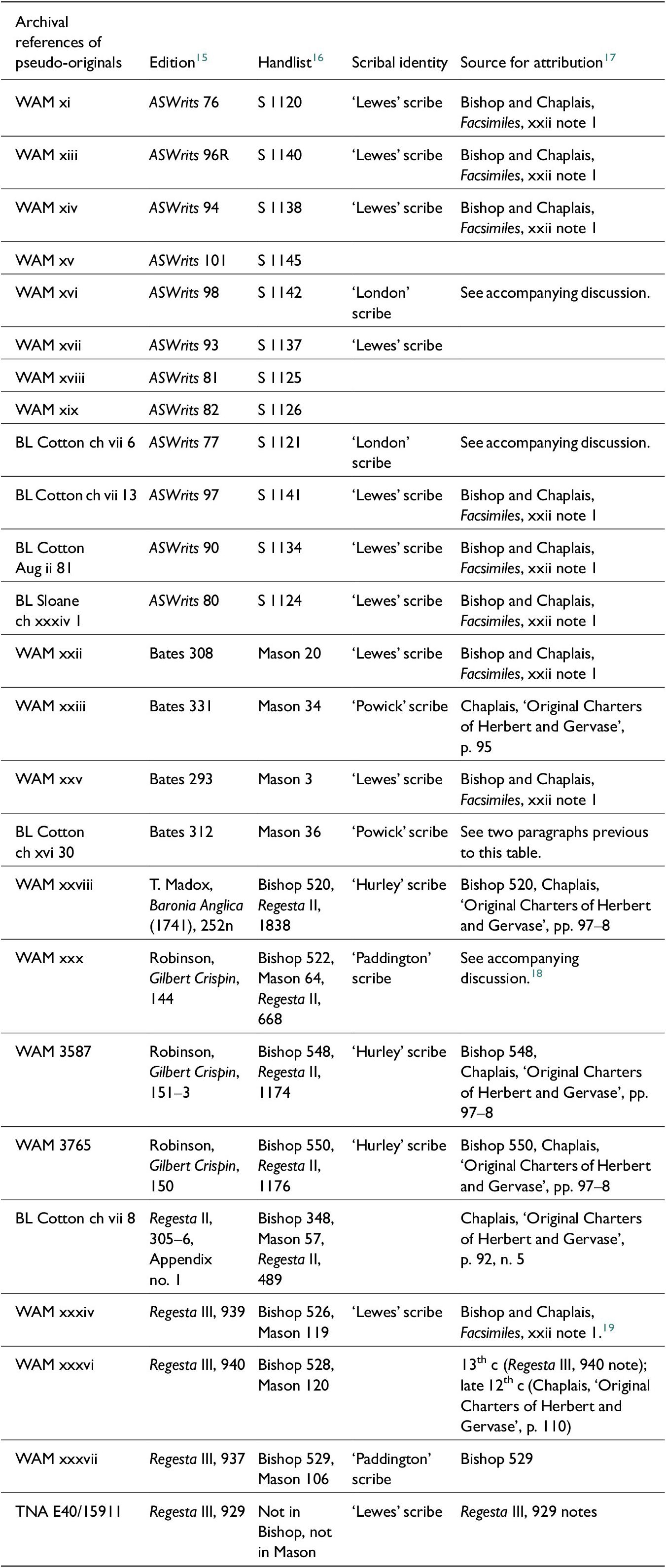
Chaplais’s analysis was based on identifying a scribal hand among the abbatial charters, and then hunting for that hand elsewhere. There are a few more identifications which can be made from identifying the same hand in more than one forgery, even where there is no abbatial charter to help define the hand. These identifications go beyond Chaplais’s methodology, but allow some more scribal identities to be recovered. There are two documents (WAM xxx, WAM xxxvii) which were linked by Bishop, who thought that one might have been imitated from the hand of the other. The script in each is very similar, and it might be simpler to assume that the two documents were written by the same scribe. This hand will be labelled here as the ‘Paddington’ scribe, following the nomenclature established by Chaplais, who identified scribes through the places most often named in their documents. Likewise, WAM xvi and BL Cotton charter vii 6 share very similar features and many similarities, and both are written fluently as though the scribe was accustomed to writing Old English.Footnote 21 This hand is of the later eleventh or earlier twelfth centuries, and thus before the larger group of mid twelfth-century forgeries.Footnote 22 Both documents concern Westminster’s rights in London, and might have been in some sense complementary. This hand will be called the ‘London’ scribe, because both of these documents concern Westminster’s rights in the City.
Only four pseudo-originals are in the hands of scribes who seemingly did not otherwise forge for Westminster: two in the name of Edward the Confessor, WAM xv and WAM xviii, which are in clear and confident but distinct Old English hands, and the damaged WAM xix; BL Cotton charter vii 8 in the name of Henry I, and the later WAM xxxvi in the name of Stephen, which Cronne and Davis plausibly attributed to the thirteenth century.Footnote 23
Parchment
In discussions and analyses of charters, the parchment which forms the surface and foundation for the text is rarely mentioned. Yet there are reasons why it should be considered, for the parchment was not merely a vehicle for the text, but also a tool which could be adapted for different purposes. As will be shown below, forging a document involved some different activities from writing an authentic one, and traces of these survive on the parchments themselves. Some features might even be considered as diagnostics of forgery. More generally, analysis of the way that parchments were prepared for writing has become established in studies of manuscript books, where different formats expose a scribe’s intentions for how a book should be used and read. This is often described as mise-en-page, and as a technique it has great potential for thinking about documentary and record sources of all kinds.Footnote 24
This section of the essay is divided into three subsections, which each contain an analysis of an attribute of the parchments and show how they expose some of the work of the forging scribes and how they made choices about their work and brought verisimilitude to their forgeries. The first concerns the use of ruled lines to aid their work; the second the use of wrapping-ties; and the third the shaping of the parchment itself.
Ruled lines
In general, authentic royal writs and similar documents were not provided with ruled lines. They were written in a cursive script which gives the impression of fluency and speed, and which can be elegant and calligraphic in the hands of its more accomplished users. They were written onto clean parchment, and the more skilled scribes could use the freedom offered by such a blank slate to create patterns of ascenders and suspensions; conversely, less skilled scribes could produce cramped and irregular script if they were unable to make full use of the freedom of the unstructured format. There are a few cases where royal writs from the eleventh century were ruled, so that the scribes worked within a framework of lines which had been ruled in drypoint to guide their activities,Footnote 25 but even then this was not the norm; most eleventh- and twelfth-century writs were written on unstructured parchment. The lack of ruled lines is linked to the relatively informal nature of these documents, which were meant to be used rather than preserved for posterity, and to their small size, which meant that irregularities in their lines would be less apparent; diplomas were often ruled, because they were meant to be visually pleasing and impressive, and because of their greater size.
Yet most of the forged writs from Westminster were ruled with lines. All the products of the ‘Lewes’ scribe were ruled,Footnote 26 as were both in the hand of the ‘London’ scribe,Footnote 27 and one each in the hand of the ‘Hurley’ scribe and an unidentified scribe.Footnote 28 The ruling was done in drypoint, that is, using a blunt stylus to make a scored line rather than a more prominent inked line, and it was usually done on the dorse of the parchment, so that it was less noticeable. Perhaps the clearest example is WAM xxii in the hand of the ‘Lewes’ scribe, which is illustrated here as Fig. 1. The ruled lines can be seen at the left of the document where the parchment is dirty, but the dirt has rubbed off on the peaks of the lines. In most cases, it is only the horizontal lines which are now visible, but in one case a vertical line is observable on the left side of the parchment.Footnote 29 The ruling indicates that the scribe did not intend to produce a fluent, freehand document in the style of contemporary royal scribes, but rather that his intention to write in an unfamiliar and archaizing hand meant that the lines were needed to maintain control of the script and layout of the document. Yet ruled lines also appear in a charter the ‘Lewes’ scribe wrote for Abbot Gervase of Westminster,Footnote 30 so this may simply have been part of his standard working practice. Meanwhile, the ‘Hurley’ scribe used ruled lines on one forged charter in a large format, but chose not to use it on two small forged writs.Footnote 31 The use of these was presumably meant to allow for better control of layout and script, and perhaps this was necessary; this scribe produced one conspicuously untidy forged writ without them in WAM xxviii. If so, then the provision of ruled lines was linked closely to the intentions of the forging scribes.
WAM xxii, a forged pseudo-original in the name of William the Conqueror, written by the ‘Lewes’ scribe in the middle of the twelfth century. Copyright: Dean and Chapter of Westminster.

As will be discussed below in the section on script, the ‘Lewes’ scribe was the one among the Westminster forgers who took the most care to write his documents in hands which were more appropriate for the time when they were meant to have been written. This meant that he wrote Old English documents using Insular characters where appropriate, but also that he used features such as Insular g in Latin texts in the name of William the Conqueror, such as in Fig. 1, where Insular g appears in Angl’, the third word on the first line, and in Anglis, the fourth word in the second line; contrast this with the Caroline g in legibus, the third word in line 5, and cognatus, the third word from the end in the sixth line. In these cases, it seems that Insular g and similar features were used to give an impression of age. For a scribe active into the middle of the twelfth century, these features would presumably have been artificial, and the lines may have been meant to allow sustained control over an unfamiliar script. Some other scribes wrote in hands which may have felt more natural to them, and thus did not need the support of lines.
It was clearly fundamental to his practice, and it is something which he took with him when he made forgeries for other great churches. This suggests that ruled lines were made at his initiative, not at the direction of superiors. Three pseudo-originals survive in his hand for other institutions, two for Coventry Cathedral Priory and one for Gloucester Abbey.Footnote 32 All of these are lined, exactly like the ones from Westminster, in drypoint on the dorse of the parchments. While the pattern at Westminster is clear, only examination of other archives with forgeries could establish how common these patterns were.
Wrapping-ties
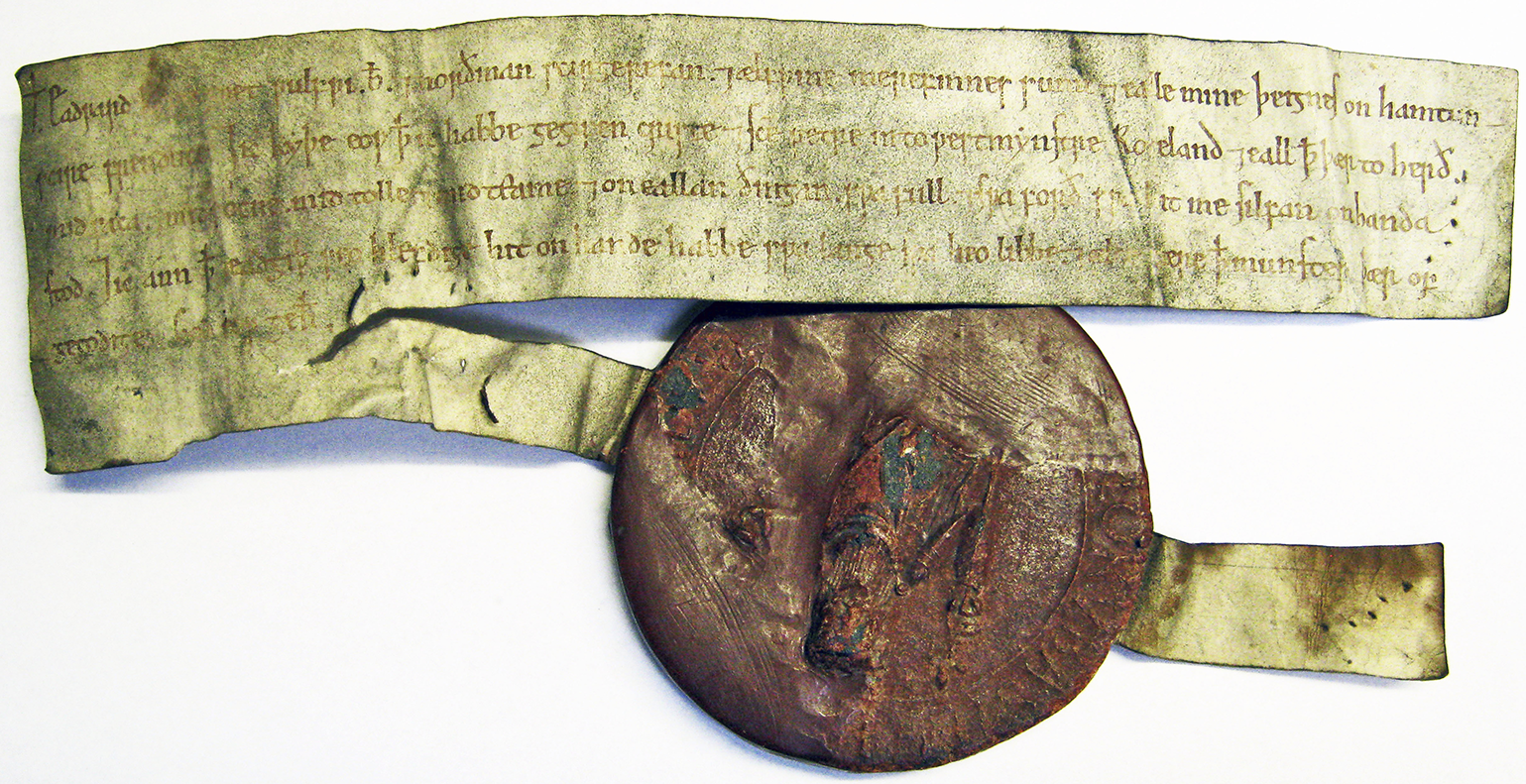
The ability of the scribes to produce forged documents which matched the presentational techniques used on the authentic originals also included the preparation of the parchment to allow for the attachment of the seal. In authentic writs from the eleventh and early twelfth centuries, this was almost always done through cutting the parchment itself to produce two ribbons attached at the bottom left, and which ran parallel to the lines of the text itself. This arrangement can be seen in Figs. 1 and 2. One, usually the thicker of the two, is now conventionally designated as the tongue, and the seal was attached by passing the tongue through the wax before it was shaped by the seal matrix. The second and smaller one was used as a wrapping-tie; once the document was complete, the main part of the parchment was folded small and placed above the seal, and the wrapping-tie was used as a lace to enclose both parchment and seal and so prevent their becoming detached from each other. The wrapping-tie was important for maintaining the integrity of the document when in transit, and documents were sometimes kept folded and bound by the wrapping-tie when stored afterwards. Even then, tongues and ties were easily ripped or damaged, and many of the pseudo-originals now only bear a tear at the bottom left of the parchment, where once something was attached. This means that information about the use of tongues and ties can only be seen on a minority of the pseudo-originals.Footnote 33
WAM xiv, a forged pseudo-original in the name of Edward the Confessor, written by the ‘Lewes’ scribe in the middle of the twelfth century. Copyright: Dean and Chapter of Westminster.
It has been observed before that forgers often omitted the wrapping-tie because it was not essential to the later use of the document.Footnote 34 This is not the case at Westminster, where most of the pseudo-originals have a wrapping-tie as well as a tongue. This suggests that there was some concern to create as close an approximation to the appearance of authentic originals as possible. As with so many of the features in the Westminster pseudo-originals, the pattern is heavily influenced by the identity of the scribe. All of the pseudo-originals in the hand of the ‘Lewes’ scribe which have surviving evidence for the method of sealing have both tongue and wrapping-tie exactly as on the authentic originals;Footnote 35 the same arrangement can be seen in two pseudo-originals in the hands of unidentified scribes.Footnote 36 In contrast, there are three pseudo-originals which lack wrapping-ties entirely, one by an unidentified scribe and two by the ‘Hurley’ scribe.Footnote 37
The presence of wrapping-ties can be linked to an unusual reference in one of the forgeries, which shows how the forger understood the use of these documents. In BL Sloane charter xxxiv 1, the text states that the gift would come into force as soon as it was read: ‘And I will that it be brought under my control as soon as this present letter has been read, so that the matter may be settled’.Footnote 38 This refers to the process by which these writs were made effective; after they were written, they were taken to whichever shire court or official had jurisdiction, where they were read out publicly so that all present would know the will of the king. The wrapping-ties were a part of this process, for they were meant to allow the parchment to be tied securely to the seal, to reduce the chances that it might be damaged and torn off. Perhaps untying the tie was done publicly as part of that process. The inclusion of this reference shows that the scribe, in this case the ‘Lewes’ scribe again, knew and understood this process, and so provided wrapping-ties on all his pseudo-originals as a marker of the process by which the writs were delivered, publicized and enacted. His forging work was based on a detailed understanding of how these documents were used, which determined how he shaped his forgeries. Yet his methods were not universal; other forging scribes either lacked knowledge of this, or chose not to use it in forming their documents. These forgers would surely have known that their forged documents would never be delivered, untied and read in the usual way, and so did not provide wrapping-ties.
The making of tongues and ties interacts with one other notable feature of the pseudo-originals. As noted above, the ‘Lewes’ forger ruled his parchments in drypoint before writing; he also used the lines to determine the size of the tongue and tie by using them as guidelines. This means that the cuts in the parchment for tongue and tie follow the drypoint lines. This can be seen in cases where the cut to divide the tongue from the rest of the parchment is at the same level as the bottom of the lowest line of writing.Footnote 39 In these cases, the tongue is the width of two or three lines, and the tie the width of one. In some of the pseudo-originals, the stub which sits at the lower left of the parchment and which forms the basis for the tongue and tie is clearly ruled in drypoint like the rest of the parchment, showing that the ruling was done before there was a clear sense of how long the text would be, and before arrangements for sealing had been planned.Footnote 40 All this can be seen clearly in Fig. 1.
Format
There were clear conventions for how writs should be laid out. Authentic writs from the later eleventh or earlier twelfth centuries consistently use a ‘landscape’ format, in which the parchment is rectangular and the writing parallels the longer side of the rectangle, which is a multiple of the height. At the bottom of the parchment, below the writing, there are usually two strips which run along most of the length of the document, one of which was meant to bear a seal and the other to act as a wrapping-tie, as discussed above. On the parchment, the writing is restricted to the space above the two ribbons, and in writs the writing fills the space with only small margins of unused parchment around it. The writing was meant to fill the space, so that the size of the parchment was proportionate to the amount of writing involved in each document; this indicates that each was written onto a larger sheet which was then cut down to size. Presumably this was meant to make it harder to add extra words to a document. From Stephen’s reign, more formal charters became more common, and these included texts which were longer than those of writs; scribes responded by making parchments larger and squarer.
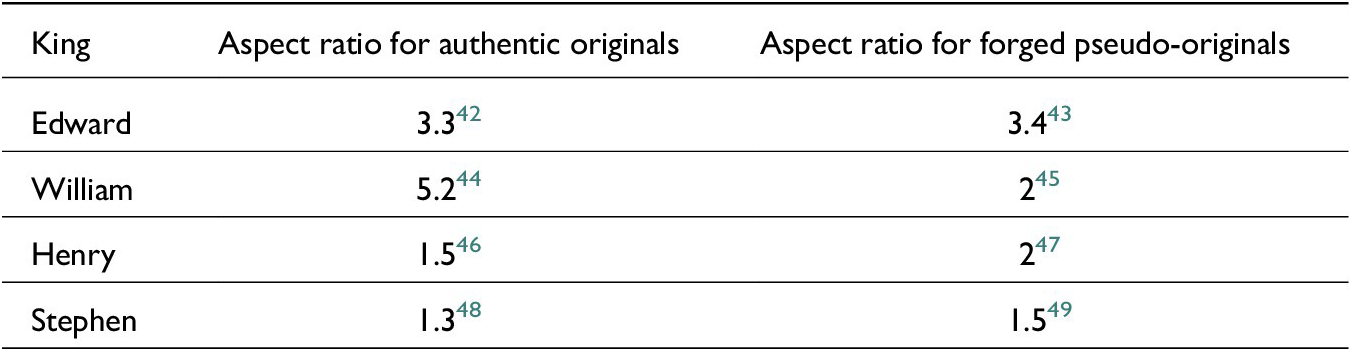
There has been little work on the formats used for royal writs in this period, or how the formats of the parchment can best be described and analysed. The orientation of the parchment is clearly one fundamental matter, for all authentic originals and most of the forged ones used the ‘landscape’ format.Footnote 41 Yet the dimensions and proportions of the documents are also distinctive, and help to set the writs apart from the diplomas. The analysis in Table 2 is based on collecting measurements for the pseudo-originals and authentic originals from Westminster, and assessing the proportions of the document by calculating aspect ratios (identified as a/r in the footnotes here) for the documents. These involved dividing the horizontal dimension by the vertical one, as a means of describing the proportions of each document. The calculations cover both the pseudo-originals and the authentic ones, so that they can be compared. The authentic ones from the Westminster archive formed the most accessible models available to the Westminster forgers, and so comparison between the two is meaningful. The following table sets out the results of the analysis of the pseudo-originals and the authentic ones:
Comparison of aspect ratios for authentic originals and forged pseudo-originals from the Westminster archive
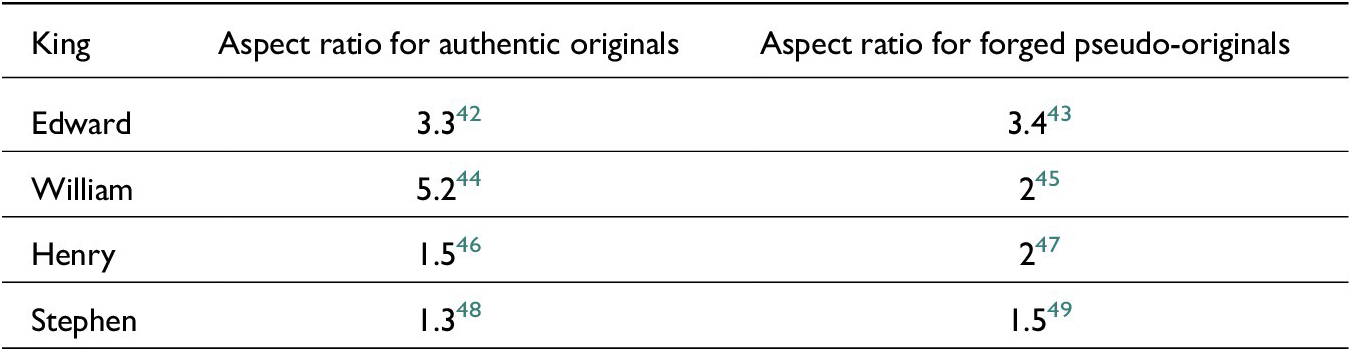
There is a clear pattern which emerges from these calculations. It shows that there was a progression from the later eleventh century to the middle of the twelfth century in authentic documents, in which writs and associated documents on average became squarer over time. The forgers had clearly analysed the formats of the authentic originals in some detail, and reproduced the overall impression as part of making their forgeries. This meant that, as shown in the table above, there was a clear transition from rectangular to squarer formats; the transition is smoother for the forgeries than for the originals. There is little variation among the scribes in these matters of format and proportion, which suggests that understanding of these matters was shared quite widely among those scribes who forged.
Seals
Seals were fundamental to most kinds of charter, and shaped how contemporaries viewed them; they were an essential part of providing credibility for the forged documents. Assessments of the authenticity of charters usually started with the seal.Footnote 50 Seals were assigned this high value because they were the usual means by which the consent or approval of the grantor was represented by the middle of the twelfth century.Footnote 51 Given the importance of seals, and the significance attributed to them by users, forging seals was a grave act, and was potentially punished capitally.Footnote 52 Yet the forgeries needed seals to support their validity, and there were two methods for doing so; either forgers could make a forged seal matrix, and use that to add seals to their forgeries, or they could take authentic seal impressions from other, authentic, charters, and apply them to the forgeries.
The monks of Westminster used multiple forged seal matrices, two in the name of Edward the Confessor, and one each in the names of William the Conqueror, Henry I and Stephen. In addition, there is at least one instance where they added a genuine impression of Henry I’s fourth seal to a pseudo-original. Seals survive on many of the Westminster forgeries, but the majority have lost their seal impressions. This is because seals were fragile, and could be shattered, but also because they were fixed to the parchments using tongues or cords which could easily be ripped off. Thus, the analysis of seals in this section is based on fewer examples than were analysed for parchment or which will be analysed for script.
The pattern of surviving seal impressions from Westminster is notable, for it shows the intensity of forging activity at Westminster; the number of forged seal matrices from this period is not large, so Westminster’s forged seals are a significant part of what survives, and maybe of what ever existed. The two forged matrices of the Confessor’s seal, and the one of the Conqueror’s, are the only known forged matrices in the names of those kings, and they were used at Westminster among other centres. The identification of these seals was carried out in the 1950s by Bishop and Chaplais,Footnote 53 but these identifications have not been matched with other features of the documents. What this comparison shows is that there is a very strong correlation between scribal hands and the use of the forged seals. This means that particular seal impressions are associated with individual scribes, and with the use of particular colours of wax and different means of attaching the seals to their parchments. This has substantial implications for how the documents as a whole can be read; it suggests that the same mind made the choices about script and about how the seal was presented.
These patterns raise considerable questions about how the production and use of forged seals was managed within Westminster. If a senior figure among the monks had commissioned forged seal matrices for a campaign of forgery, then it might be expected that they would appear on documents in the hands of multiple scribes; yet the pattern at Westminster does not match this, for most seal impressions appear on documents written by one scribe only. Perhaps the scribes controlled the seal matrices personally. This matches evidence from about the same time at St Albans, where the production of a seal matrix by one of the monks and its discovery in an incomplete state was a surprise to Abbot Ralph, who deposed Alcuin as prior because of it:
Iste quoque Radulphus priorem suum Alquinum virum commendabilem, secus quam deceret, deposuit; pro eo scilicet quod invenit unum sigillum super mensam aurifabrilem Anketilli monachi sui et aurifabri non insculptam, et timebat illud fieri ad incommodum suum…Footnote 54
The St Albans case emphasizes that the preparation of seal matrices was something which could be done in relatively secret conditions, and that it involved skills and locations within the abbey which may not have been as closely regulated as others. This at least provides a possible context for the presence of multiple seal matrices associated with different hands at Westminster.
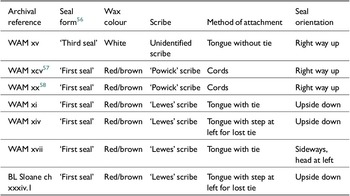
In the case of Edward the Confessor, there was only one genuine seal matrix in use during his reign, and this is now paradoxically known as the ‘second seal’.Footnote 55 Two forged seal matrices have been identified in the name of this king, and they both survive only through impressions on Westminster documents. This analysis of the seals has not been correlated against other data for the production of the documents before, and the results are set out in Table 3.
The use of forged seals of Edward the Confessor
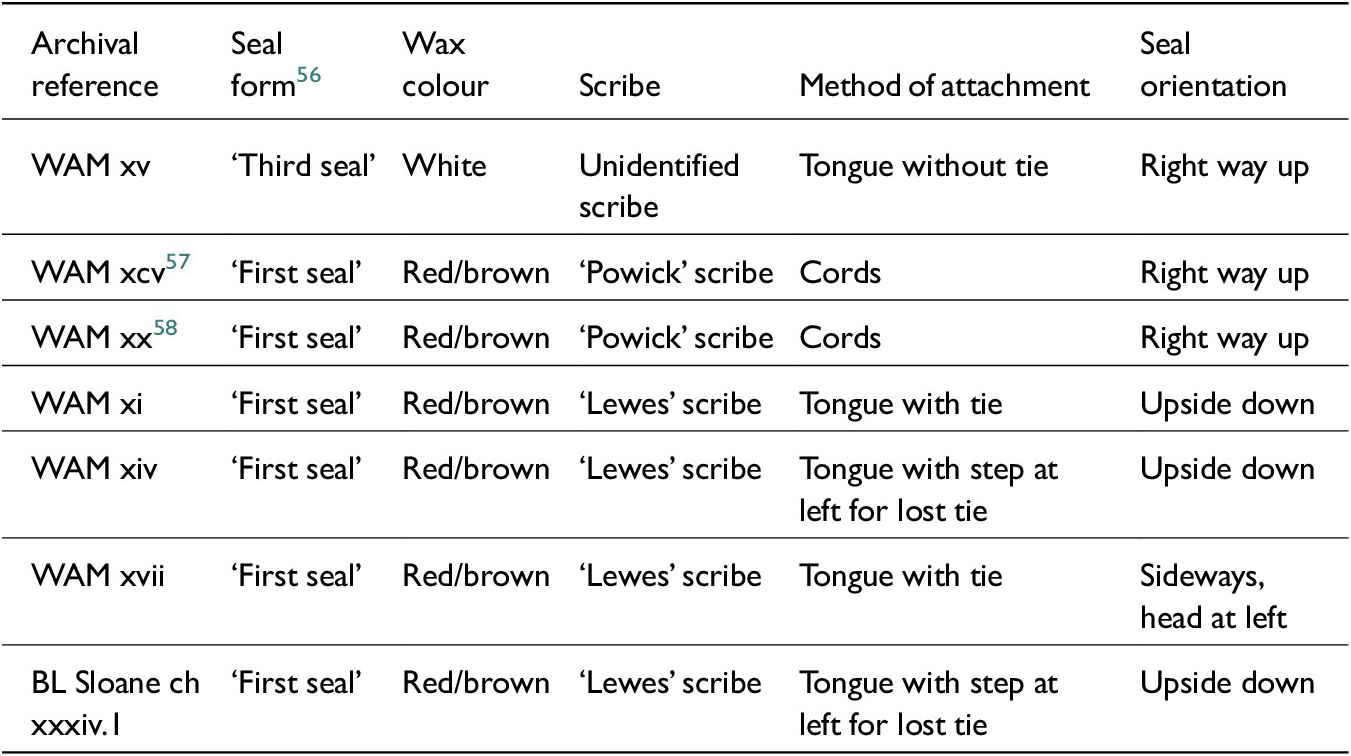
It seems likely that the two seal matrices were used consecutively rather than simultaneously, and that there may have been a gap in time between their periods of use. The ‘third seal’ was probably the earlier of the two, because the document to which it is attached, WAM xv, is written in an earlier hand than those of the scribes who used the ‘first seal’. The hand is fluent and lacks traces of artificiality or archaising seen in the others; it was perhaps written by someone who was accustomed to writing in Old English. Florence Harmer suggested that the hand was of the later eleventh century,Footnote Footnote Footnote Footnote 59 and that seems entirely likely. If so, then the ‘third seal’ and its use here represents an earlier phase of forgery at Westminster, prior to the widely recognized twelfth-century phase, and the two seem to be disconnected; the ‘third seal’ only appears on this one early document, and might have appeared on other early forgeries such as those by the ‘London’ scribe, but no more; it might be assumed that the forged matrix no longer existed when the twelfth-century forgers began their work.
The use of the ‘first seal’ can be dated more precisely; it appears on the two surviving diplomas in the name of Edward the Confessor, which were prepared as part of the 1138–9 canonization campaign, and drew on the Life of that king by Osbert of Clare, which was presented to the Cardinal-Legate Alberic of Ostia in 1138.Footnote 60 The seals were integral to these charters, for they include references to sealing in their corroboration clauses.Footnote 61 Given that it seems that the old matrix for the ‘third seal’ was no longer available, and that the forged 1138 diplomas referred to seals, there is a strong likelihood that the ‘first seal’ matrix was made for the 1138 forgeries. While the ‘Powick’ scribe prepared a number of the forgeries linked to the 1138 canonization campaign,Footnote 62 this scribe was not responsible for most of the impressions made from the ‘first seal’ matrix; most documents bearing this seal are in the hand of the ‘Lewes’ scribe, who was active into the 1150s,Footnote 63 so that many of these impressions may be somewhat later than the big diplomas made by the ‘Powick’ scribe. When the ‘Powick’ and ‘Lewes’ scribes used the seal, they did so in ways which were distinctive to themselves. The ‘Powick’ scribe attached the seals on cords, but without the use of turnups, as was standard with cords or tags from the middle of the twelfth century. The ‘Lewes’ scribe, meanwhile, had a number of distinctive practices in using the forged seal matrix. This scribe formed his parchments with tongues for the seal rather than cords; the seals were made in a red-brown wax rather than in the white wax usually used at this time; and most of the impressions were upside-down, so that, in the image of the king, the king’s head was at the bottom rather than on the same orientation as the writing on the parchment. This can be seen in Fig. 2. It is not clear why this scribe arranged the seals in this way. These consistent patterns in script and sealing show that the forging scribes at Westminster were responsible for all aspects of the material forgeries, from preparing the parchments to adding the seals. This may follow how writs were prepared in the eleventh century, but from the twelfth century the preparation of royal writs came to be divided among distinct specialists.Footnote 64
It is possible that the seal matrix in the name of the Confessor was in the possession of the ‘Lewes’ scribe, for there is a forged document in the name of Edward the Confessor in this scribe’s hand for the monks of Coventry, which possesses ruled lines as with the other productions of the ‘Lewes’ scribe, and which has cords for sealing in the manner of the ‘Powick’ scribe, even if there is no seal impression attached to it now.Footnote 65 Presumably it once had an impression of the ‘first seal’, for clearly the ‘Lewes’ scribe had some control over this matrix.
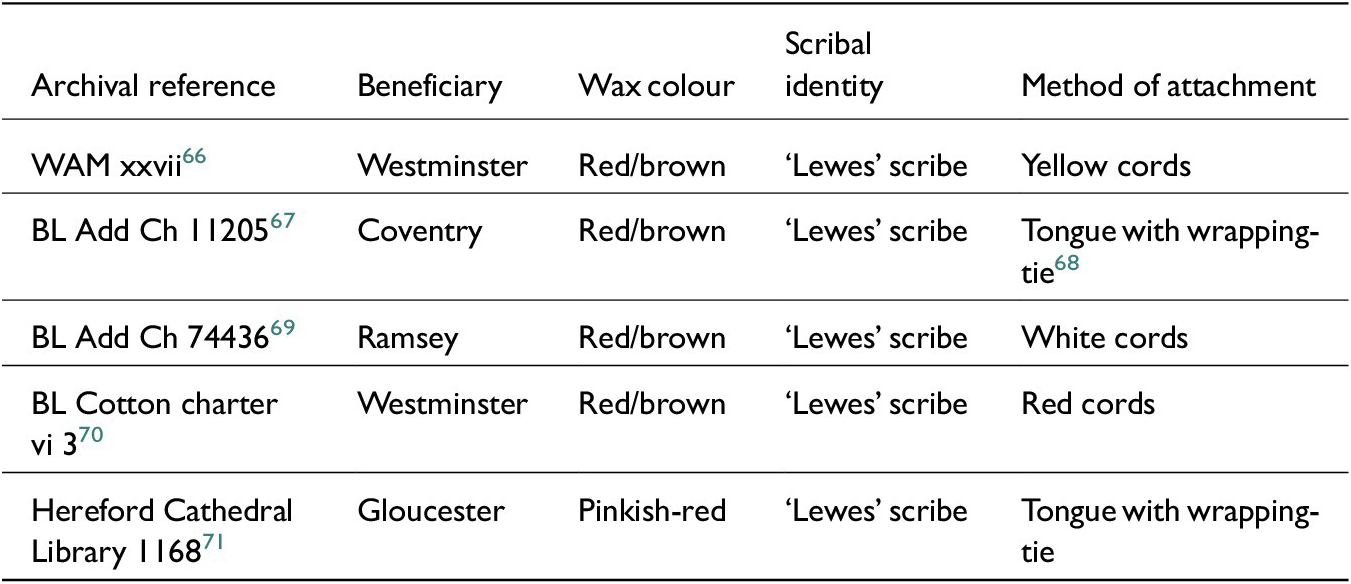
The Westminster forged writs and writ-charters in the name of William the Conqueror do not have seals any more, but there was a forged seal matrix in the name of the Conqueror at Westminster. The seal made from this matrix appears on one forged diploma in the name of that king, WAM xxvii, with traces on another forged diploma, BL Cotton charter vi 3. What is notable is that some of the patterns which characterized the use of the forged seals of Edward the Confessor can also be seen here. Once again, there is a strong link to an identifiable scribe, the ‘Lewes’ scribe, and the way in which the seal matrix was used parallels how the ‘first seal’ in the name of the Confessor was used. The pattern of usage of the forged seal in the name of the Conqueror is set out in Table 4:
The use of the forged seal of William the Conqueror
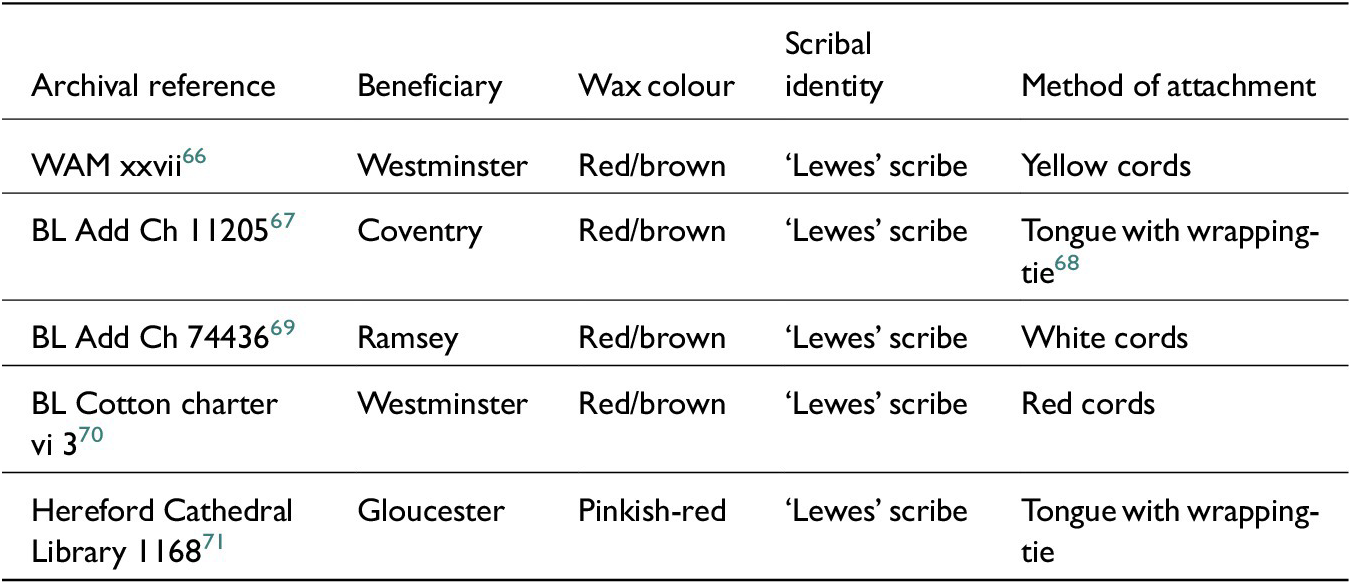
The forged seal matrix in the name of the Conqueror is harder to date than the matrix in the name of the Confessor, for there are no datable external references to its use comparable to those in Osbert’s Life. It must have been produced to provide some pseudo-authentication for the forgeries in the name of the Conqueror, and so it can best be evaluated in relation to those documents. The forged documents in the Conqueror’s name were not part of the canonization process, and are not named in the Life. Instead, they show the continuity of the Confessor’s legacy, especially through the Abbey’s sustained possession or exercise of the assets and rights he had granted; they build on the forgeries in the name of the Confessor rather than being integral to their creation. There are therefore some grounds for thinking that the Conqueror forgery is later than the forged Confessor matrix of about 1138. Additionally, the Conqueror matrix was used by the ‘Lewes’ scribe, who was active into the 1150s, much later than the ‘Powick’ scribe who produced the 1138 forgeries in the name of the Confessor.Footnote Footnote Footnote Footnote Footnote Footnote Footnote 72 It has been suggested that the sculpting of the seal matrix in the name of the Conqueror appears to be the work of another hand than that which produced the forged matrix in the name of the Confessor.Footnote 73
This forged seal matrix was consistently used by one scribe, and the matrix was handled consistently in the making of the seal. The red/brown wax is notable in nearly all of these, and this feature is accompanied by attributes on the parchment such as the ruling which was characteristic of the ‘Lewes’ scribe.Footnote 74 The major difference is that some of these documents are diplomas, and so they are sealed in a different manner from the writs. These are sealed on cords, which are passed through the parchment in a distinctive way; even where there is a turnup to give greater strength to the parchment through double thickness, the cords are passed through the single thickness of the parchment above the turnup, before passing through holes within the turnup. This method is similar to that used by the ‘Powick’ scribe, perhaps indicating that one instructed the other. This is unusual, for most documents which used cords had them passed through the more secure double thickness.Footnote 75
The pattern for forged charters in the name of Henry I is quite different. Here, there was an impression in circulation within the networks of Westminster Abbey, though it had very different uses from the impressions for earlier kings. It appears on two pseudo-originals, WAM xxviii and WAM 3587, and both of these are in the hand of the ‘Hurley’ scribe.Footnote 76 The impression is based on the fourth seal of Henry I, and so must have been prepared after that seal matrix came into use soon after 1120.Footnote 77 The ‘Lewes’ scribe produced one surviving forged pseudo-original in the name of Henry I, but that did not use the forged impression of the ‘Hurley’ scribe; instead, it carries a damaged and reattached genuine impression of the fourth seal of Henry I.Footnote 78 This might indicate that the ‘Hurley’ scribe’s matrix was only used at Westminster’s dependent priory of Hurley in Berkshire, and that the ‘Lewes’ scribe had no access to a forged matrix in the name of Henry I, because there was no central control of the forged seal matrices at Westminster. WAM xxxi is in the name of Henry I and in the hand of the royal scribe known as scriptor vii,Footnote 79 but its seal shows signs of bending and twisting, as though it has been manipulated at some point. This might again be a hint that it was harder to find plausible seal impressions of Henry I at Westminster than it was for other kings.
The pattern for forged charters in the name of Stephen is different again. Here, there is a version of Stephen’s second seal which seems to be forged, and which appears once on WAM xxxiv. This is an expanded or inflated version of another, genuine, charter of Stephen, which is datable between 1149 and 1152, so the forgery must necessarily be subsequent to that.Footnote 80 This means that is at least fifteen years or so younger than the forged ‘first seal’ impression of Edward the Confessor. It is in the hand of the ‘Lewes’ scribe, but the wax used was in a pinkish red colour, lighter than the red/brown used elsewhere, but still noticeably different from the white wax seen in Stephen’s genuine seals; it is seen otherwise in the work of the ‘Lewes’ scribe only in the forgery for Gloucester in the name of the Conqueror. The forged Stephen matrix may have been used elsewhere by the ‘Lewes’ scribe, for there is a forged document in Stephen’s name in his hand which has the white cords seen in some of his other work, but the seal impression is missing.Footnote 81 The matrix of the Stephen seal is unusual in that, uniquely among these forged impressions, it was used much later, into the thirteenth century in the late WAM xxxvi,Footnote 82 which suggests that custody of it may have been managed differently from the other forged matrices. In contrast, the forged matrices in the names of Edward the Confessor or William the Conqueror were not used after the middle of the twelfth century, or no longer existed.
Overall, seals were fundamental to the making of the forgeries, and forgery at Westminster mostly involved the use of forged matrices, with a couple of examples of transferring genuine seals from authentic documents to forged ones. From the analysis above, it seems that access to the forged matrices was quite limited, so that some were only used on documents written by one scribe, and in such cases they were handled identically in terms of how they were presented and attached to the parchment. The ‘Lewes’ scribe clearly had easy access to the forged matrices in the names of the Confessor and the Conqueror, and could use both of those for forgeries outside Westminster, but for a forgery in the name of Henry I had to use a genuine impression taken from an authentic document, even though there was a forged matrix elsewhere within the networks of the abbey. It is possible that the forgers were not solely valued as scribes, and that classifying them as such misrepresents their role; instead, they were the keepers and maybe makers of forged matrices. The pattern of seal use also points to how the Westminster forgeries might represent the views of different groups within the networks of the abbey, rather than a single institutional voice.
Script
Parchment and sealing were important in creating documents which had verisimilitude, but the Westminster scribes also expended much effort in creating imitative scripts which aimed at representing the kinds of writing that were used in older documents. This is particularly apparent in those cases where the scribes forged a writ in Old English in the name of Edward the Confessor, and so imitated the Insular script which was appropriate for that language, and which can be seen in the surviving charters from Westminster and elsewhere. When they did so, these scribes from the twelfth century were presumably writing a script which was not their usual one, even if it may have been for the scribes of some of the earlier forgeries, such as WAM xv, which is probably of the later eleventh century. In the twelfth century, Caroline or Romanesque hands would have been the norm, and the Insular script would have required extra planning and effort. There are traces of this in some of the forgeries; in WAM xi, shown in Fig. 2, the strokes are sometimes not clean and consistent, but have small deviations, as if the scribe wrote the letters carefully and slowly, without the confidence of a scribe for whom this script was more natural. It is possible that the ruled lines discussed above were meant to help scribes writing unfamiliar scripts, when their usual techniques in writing were less useful. Some letter forms are also inconsistent in the forgeries, especially where the letter form was one distant from Caroline or Romanesque forms.
The Westminster forgers had a clear sense of how scripts had changed and developed over time, and used this to form scripts that suggested that their forgeries were older than they actually were. Yet their efforts were not simply imitative, for in some cases they combined features in patterns not seen in authentic originals.Footnote 83 The approach used by the Westminster forgers was to choose particular features, and use them to suggest the antiquity of the forgeries; forgeries attributed to the more distant past contained more of them than more contemporary ones. Thus, forgeries from the very recent past were written in standard Caroline or Romanesque hands, which presumably represented the usual hand of the scribes. This can be seen in documents such as BL Cotton charter vii 8, the forgery in the name of Henry I which confirmed to the abbey its privileges in relation to royal coronations. Yet, for documents a generation older, the forgers introduced features which were meant to suggest distance between their own times and the times when these documents were written. One clear example of this is the Insular g, briefly discussed above in relation to Fig. 1.
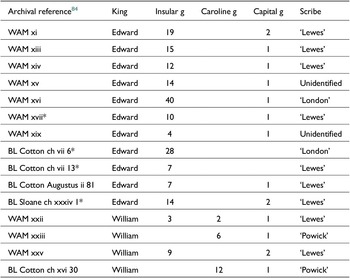
Here, the Insular and Caroline forms of the letter were quite distinct; the Insular form consists of a horizontal crossbar with an s-shaped stroke beneath, reaching below the line; meanwhile, the Caroline form looks more like a modern g, with a circle from which a curled stroke descends below the line. The Insular form was used consistently in the pseudo-originals in the name of the Confessor, such as in Fig. 2, and it appears inconsistently in the pseudo-originals in the name of the Conqueror, such as in Fig. 1, and not at all in the pseudo-originals in the names of Henry I and Stephen. They used Insular g as a means of indicating that this was an older document. The patterns for the use of different forms of g are set out in the following table:
Clearly, the use of different forms of g had real meaning for these scribes. All the Westminster forgers who wrote such writs used it in documents written in Old English, where it was clearly seen as an essential part of the script, alongside thorn, wynn and other characters necessary for that language, as seen in Table 5. Yet ‘Lewes’ used the Insular g in forgeries in Latin, even though it does not appear in genuine originals in the Conqueror’s name. ‘Lewes’ was presumably guided by a sense that this letter was appropriate to the time period, even if his use of it went beyond the authentic originals. In contrast, Insular g was not used by the ‘Powick’ scribe, even though he probably wrote at an earlier time than ‘Lewes’. Following this, there are no occurrences of Insular g in the pseudo-originals in the names of Henry I and Stephen.
Occurrences of forms of g in forged writs from Westminster
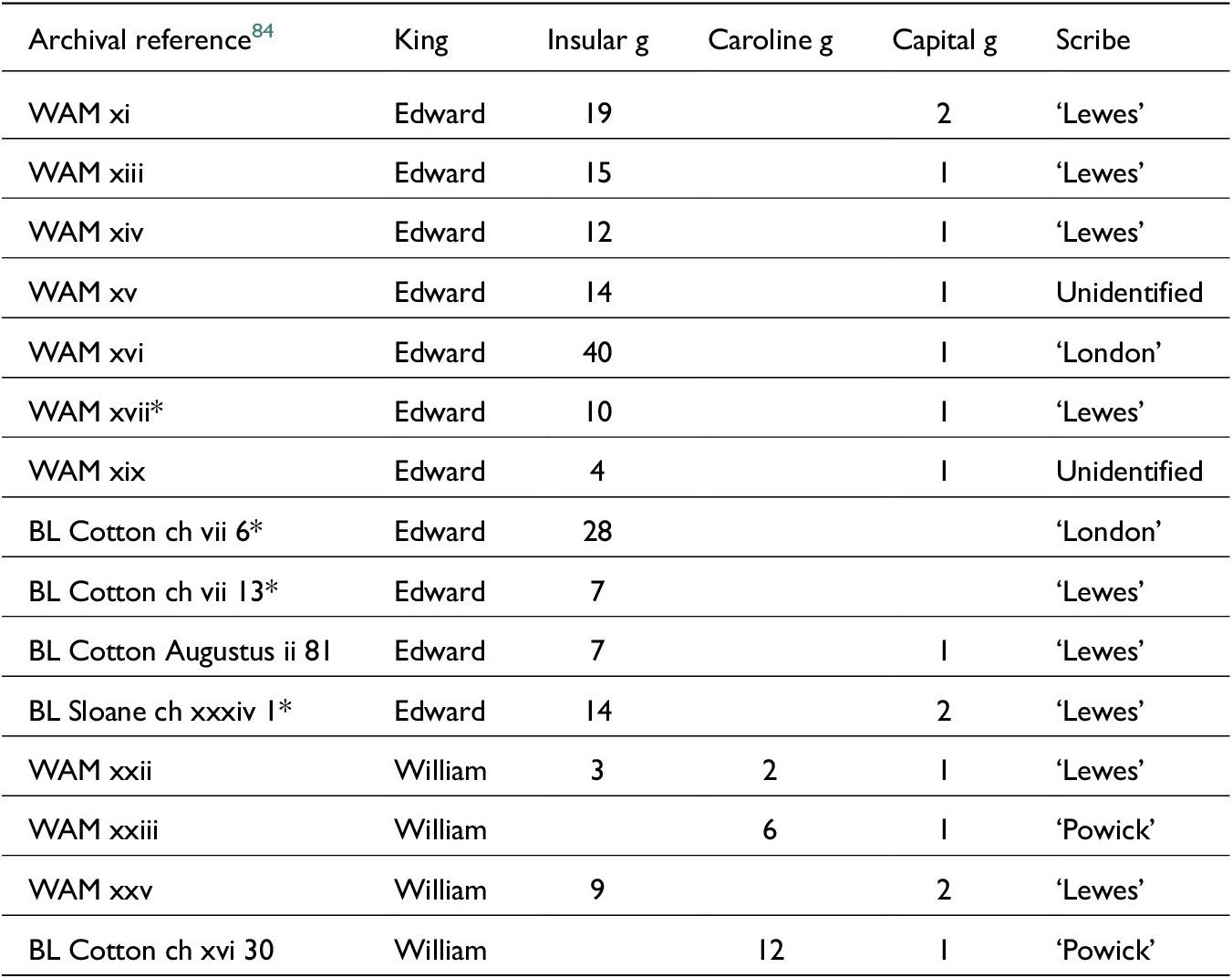
The idea that letter forms were used artfully by the Westminster forgers to suggest that the document was older than it was can be seen in some other features, even if not as consistently as the pattern in relation to Insular g and Caroline g. These often appear early in the documents, as if they were meant to set the tone for what followed. Thus, in WAM xxii, depicted in Fig. 1, the ‘Lewes’ scribe used a form of d with a diagonal ascender, something like an Old English d, in Odoni in line 1, and in quod in line 2, where usually his ds were conspicuously upright, as in de in line 1; the diagonal d can also be seen used in WAM xxiii, by the ‘Powick’ scribe. The same patterns can also be seen in the ‘Lewes’ scribe’s work beyond Westminster, for Insular g is used in exactly the same way in his writs for Gloucester and Coventry.Footnote Footnote 85
The use of features which would have been less usual or familiar from the perspective of the middle of the twelfth century was presumably meant to ‘distance’ the script from contemporary readers, through the introduction of features which would require some thought to understand. For example, the forged diploma in the name of King Edgar for Westminster uses a tall, bulging form of the letter e, which is an artificial character as used here, but has parallels with some Insular letter-forms from before the early eleventh century.Footnote 86 Among many of the forgers there was a shared sense of how script developed in documents which purportedly originated in the eleventh century.
Overview
Forgery at Westminster has previously been viewed, more or less, as the story of Osbert of Clare and his ambitions for the abbey. His mind has been detected behind many of the forgeries made to support the bid for the canonization of Edward the Confessor around 1138, especially through the inclusion of words, phrases and ideas taken from the Life he wrote in support of it. The Life, and Osbert’s devotion to the Confessor, have been the keys used to open the meaning and significance of the forgeries, and have made the story of the forgeries seem centred upon Osbert. The focus on Osbert was made possible by the ways in which the Westminster forgeries have been analysed, which focusses on only some of the attributes of the forgery, especially text and script.
The analysis above has recovered some small part of how forgeries were made and managed within Westminster Abbey in the eleventh and twelfth centuries. It shows that the forgers had certain shared assumptions or aims in making their forgeries, and that they all tried to produce documents which imitated the formats, scripts and overall ‘look’ of authentic originals through the use of similar techniques.Footnote 87 Yet there are also clear signs within the forgeries themselves that there were practices which were specific to particular scribes, and even practices specific to those scribes when they were making forgeries. Probably the most important result is that scribal identities are closely linked to sealing, which suggests that scribes were linked to the forged seal matrices and how they were used. The pattern for which scribes had access to which seal matrices and impressions, especially that of Henry I, is the real crux for this argument. In the example from St Albans discussed earlier, a monk with relevant expertise made a forged seal matrix without authorization from his superiors, and perhaps something similar took place at Westminster, which might explain the pattern of usage of the forged seal matrices. It may be that the forgers usually characterized as scribes were also experts in metalworking.
While the Westminster forgers took much care to produce documents which looked like authentic ones, they also used some practices which marked out their pseudo-originals from authentic ones. In particular, their conception of palaeographical development, their anomalous use of ruled lines to support archaizing script, and the methods used for attaching seals were features that set apart their forgeries from authentic documents. Forgers had different aims from the scribes of authentic documents, for they tried to impersonate another voice and imitate the conventions of an earlier age, among other matters, and generally those aims were more complicated and more ambiguous; these differences can be observed in the documents, but more clearly in their material attributes than in their texts.
These observations about the pseudo-originals show much about how forging was organized at Westminster. Attention to the materiality of the forged pseudo-originals gives a disaggregated view of forging, in which the most impactful attributes of the forgeries – their appearance and fidelity to their models – were delegated to individual forgers who set their own standards and working practices. The separate tasks of preparing, writing and sealing the forgeries were undertaken by individual forgers, who only had access to some of the forged matrices made at Westminster. Some of the forging activity seems to have been carried out in isolation, even within the abbey’s networks; the use of a forged seal matrix of Henry I by the ‘Hurley’ scribe but not the ‘Lewes’ scribe suggests that the forgers may have worked separately, and may not have known about the work of the other forgers. In this way, some of the forgers may have been acting on their own behalf or for particular interest groups within the abbey rather than for the abbey as a whole, reflecting micropolitics among groups of monks. Indeed, the aims of the forgers may have evolved, for some seem to have forged over an extended period of time. It may be better to view the forgeries as driven by disparate aims rather than as a coherent campaign.
This article also has a broader methodological point about how forgeries might be studied further. Forgeries in the archives of other major churches have been studied in ways similar to those seen at Westminster, where text and script have been emphasized as the main attributes of forgery, with some consideration of the seals. This discussion has instead emphasized the material aspects of the forgeries, with analysis of how the parchments were shaped and used, and how the seals were made and attached. There is evidence for scribal behaviour on the parchments which has not been considered widely, even though it shows something about how forgery was managed and executed at Westminster. There is potential for similar studies of the material aspects of forgery in other archives, and these may show much about how the forgeries were made and how they were organized, and how far the patterns match those seen at Westminster.
Acknowledgements
The author is grateful to the Neil Ker Memorial Fund of the British Academy for financial support which made this project possible, to the Dean and Chapter of Westminster for providing permission to reproduce images of items among the Westminster muniments, and to Professor David Bates, Dr Richard Mortimer, and the reviewers of EMEN for comments on a draft.



 Open access

