


Introduction
On January 6, 2021, the world watched as thousands of protesters stormed the U.S. Capitol, attempting to overturn the results of a democratic election. This event took place after a months-long campaign by Trump and his Republican allies to delegitimize the results of the presidential election. In his speech to the insurrectionists on that day, Trump connected a wide range of voting reforms to the supposedly illegitimate election outcome: “There’s only one reason the Democrats could possibly want to eliminate signature matching, opposed voter ID, and stop citizenship confirmation… because they want to steal the election.”Footnote 1 This shocking event, and subsequent polling showing widespread tacit support for the insurrection among Republicans, laid bare a crisis in American democracy: the acceptance of anti-democratic beliefs among a significant portion of the population (Barreto et al. Reference Barreto, Alegre, Bailey, Davis, Ferrer, Nguy, Palmisano and Robertson2023).Footnote 2 While conventional wisdom often attributes these attitudes to unwavering loyalty to Donald Trump and his “stolen election” narrative, our research suggests a more complex and deeply rooted explanation.
This study investigates the prevalence, interconnectedness, and racial underpinnings of anti-democratic beliefs among white Americans. We investigate five research questions: (1) Have anti-democratic beliefs become more prevalent among white Americans over the past decade?; (2) To what extent are various anti-democratic beliefs interconnected?; (3) Have these anti-democratic beliefs become more interconnected over time?; (4) Are racial attitudes predictive of anti-democratic beliefs among white Americans?; and (5) How has the racialization of democratic attitudes changed over the past decade? To address these questions, we analyze data from several large-scale surveys conducted between 2012 and 2022, including the Political Unrest Study, the Collaborative Multiracial Post-Election Survey (CMPS), Democracy Fund + UCLA Nationscape, the Survey of the Performance of American Elections (SPAE), and the American National Election Studies (ANES). Our study combines observational and experimental evidence to provide a nuanced examination of the relationship between racial attitudes and anti-democratic beliefs.
Our findings reveal that while the overall prevalence of anti-democratic beliefs has remained relatively stable between 2012 and 2022, these beliefs have grown more interconnected over time. Additionally, we find strong evidence that out-group attitudes, including racial resentment, anti-immigrant sentiment, and perceived threats to white status, are key drivers of anti-democratic beliefs, even after controlling for partisanship, ideology, and support for Donald Trump. Further, racial resentment and white status threat have become increasingly explanatory over time. However, we find little evidence that the in-group racial attitudes such as favorability towards whites, support for white nationalism, or belief in white replacement theory explain anti-democratic attitudes (Filindra Reference Filindra2022).
This study builds upon previous research on the racialization of political attitudes in American politics. While scholars such as Tesler (Reference Tesler2013, Reference Tesler2016) have demonstrated the increasing link between racial attitudes and partisanship, our work follows recent scholarship examining the racial contours of support for democratic principles (Barreto et al. Reference Barreto, Alegre, Bailey, Davis, Ferrer, Nguy, Palmisano and Robertson2023; Enders and Thornton Reference Enders and Thornton2022; Filindra Reference Filindra2022; Morris and Shapiro Reference Morris and Shapiro2024; Vaughan Reference Vaughan2021). By examining this relationship over time and across multiple datasets, we provide a more comprehensive understanding of how racial attitudes shape support for anti-democratic measures.
The implications of our findings are profound, suggesting that efforts to address the erosion of democratic norms in the United States must grapple with deep-seated racial attitudes among white Americans, especially the perception that they are losing their privileged status in modern society. As the country becomes increasingly diverse and Trump returns to the White House for another four years, understanding these underlying racial dynamics will be crucial to preserve America’s democracy.
The Prevalence and Consequences of Anti-Democratic Beliefs
Anti-democratic beliefs encompass a wide range of attitudes and preferences that undermine the core principles and practices of democracy. There is no single definition of anti-democratic beliefs that is universally accepted among scholars. Existing research alternatively defines anti-democratic beliefs as: support for violence against political opponents and support for institutions that prevent participation by political opponents (Holliday et al. Reference Holliday, Iyengar, Lelkes and Westwood2024; Thompson Reference Thompson2021), refusing to commit to participatory inclusiveness and political equality (Hall and Druckman Reference Hall and Druckman2023), opposition to democratic contestation and rule of law (Clayton et al. Reference Clayton, Davis, Nyhan, Porter, Ryan and Wood2021), opposition to democratic governance over alternatives like military rule or unaccountable executives,Footnote 3 low professed support for democracy combined with support for authoritarian actions (Malka and Costello Reference Malka and Costello2023), and support for unitary presidential action (Touchton, Klofstad, and Uscinski Reference Touchton, Klofstad and Uscinski2023).
The prevalence of anti-democratic beliefs in the United States has been a subject of increasing concern, particularly in the wake of the Trump presidency and the events surrounding the 2020 election. Levitsky and Ziblatt (Reference Levitsky and Ziblatt2018) argue that anti-democratic sentiments have increased significantly in recent years, pointing to the erosion of democratic norms and institutions. However, other scholars suggest a more nuanced picture. Norris (Reference Norris2017) finds that while trust in democratic institutions has declined in many advanced democracies including the United States, support for democratic principles remains relatively high. Additionally, Graham and Svolik (Reference Graham and Svolik2020) find that most Americans claim to support democracy in the abstract but many are willing to sacrifice democratic principles when doing so benefits their party. This suggests that the prevalence of anti-democratic beliefs may be context-dependent and influenced by partisan motivations.
Past research has shown that the consequences of anti-democratic attitudes can be significant. Widespread anti-democratic attitudes can threaten the stability of the political system (Norris Reference Norris2019). These attitudes can also be used to justify the passage of voting restrictions and the rollback of voting expansions, which may lead to lower turnout, especially among marginalized groups. Some scholars have found that voter ID laws disproportionately affect racial minorities, low-income individuals, and the elderly (Hajnal, Lajevardi, and Nielson Reference Hajnal, Lajevardi and Nielson2017; Barreto, Nun˜o, and Sanchez Reference Barreto, Nuño and Sanchez2009). Conversely, policies that expand access to voting such as universal vote-by-mail (Bonica et al. Reference Bonica, Grumbach, Hill and Jefferson2021; Thompson et al. Reference Thompson, Wu, Yoder and Hall2020), automatic voter registration (McGhee, Hill, and Romero Reference McGhee, Hill and Romero2021), early in-person voting (Kaplan and Yuan Reference Kaplan and Yuan2020), Election Day on weekends (Mattila Reference Mattila2003), and Election Day registration (Highton Reference Highton2004; Grumbach and Hill Reference Grumbach and Hill2022) appear to increase voter turnout and can improve minority representation. Even if such laws have no measurable effect on overall turnout or turnout of racial minorities (Grimmer et al. Reference Grimmer, Hersh, Meredith, Mummolo and Nall2018; Grimmer and Hersh Reference Grimmer and Hersh2024), their intent appears clearly targeted at these goals (Bentele and O’Brien Reference Bentele and O’Brien2013; Morris Reference Morris2023), undermining the principle of an inclusive democracy.
Previous literature disagrees over whether anti-democratic beliefs have become more common over time, and it has not yet addressed how closely various anti-democratic beliefs fit together. Our study builds on this literature by examining the prevalence of anti-democratic beliefs over time. We focus on attitudes that undermine the democratic principles of inclusive participation and acceptance of election results (Dahl Reference Dahl1989; Urbinati and Warren Reference Urbinati and Warren2008). Specifically, we define anti-democratic beliefs as the set of attitudes that include support for voting restrictions such as voter ID laws or roll-backs of convenience provisions, opposition to voting expansions such as same-day registration and expanded no-excuse absentee voting, belief in widespread voter fraud, and endorsement of actions that subvert the legitimacy of democratic elections. This definition captures the core idea of a modern inclusive democracy, including supporting the right and ability of all eligible citizens to vote (Hall and Druckman Reference Hall and Druckman2023), supporting the legitimacy of the electoral process (Norris Reference Norris2014), and accepting the results of democratic elections (Clayton et al. Reference Clayton, Davis, Nyhan, Porter, Ryan and Wood2021). We show that these beliefs have not become more prevalent over time, but that they have formed into an increasingly coherent construct underpinned by a single latent dimension. By examining these anti-democratic beliefs over a decade-long period, our study contributes to the ongoing debate about the prevalence and nature of anti-democratic attitudes in the United States.
The Racialization of White Anti-Democratic Attitudes
A growing body of research suggests that anti-democratic attitudes are deeply intertwined with racial attitudes among white Americans, particularly in response to perceived threats to established racial hierarchies. This pattern reflects what Levitsky and Ziblatt (Reference Levitsky and Ziblatt2024) describe as a fundamental tension between multicultural democracy and the preservation of traditional social hierarchies. This tension manifests in what they term a “tyranny of the minority,” where democratic institutions are weaponized to maintain political power despite demographic change.
The connection between race and voting restrictions in the United States has been well-documented (Keyssar Reference Keyssar2009; Bentele and O’Brien Reference Bentele and O’Brien2013), with recent studies showing that support for voting restrictions and belief in fraud claims are heavily racialized (Banks and Hicks Reference Banks and Hicks2016; Gronke et al. Reference Gronke, Hicks, McKee, Stewart III and Dunham2019; Sheagley and Udani Reference Sheagley and Udani2021; Udani and Kimball Reference Udani and Kimball2018; Wilson and Brewer Reference Wilson and Brewer2013, Reference Wilson and Brewer2016; Wilson et al., Reference Wilson, Leo Owens and Davis2011). Support for voting restrictions such as voter ID requirements, while often framed as ensuring election integrity, correlates strongly with racial resentment and anti-immigrant sentiment (Banks and Hicks Reference Banks and Hicks2016; Wilson and Brewer Reference Wilson and Brewer2013). These policies are intended to disproportionately affect minority turnout and reshape the composition of the electorate in ways that preserve existing power structures (Morris Reference Morris2023). Opposition to voting expansions likely follow the same racial contours as support for restrictive voting laws (Venetis Reference Venetis2019), especially given the evidence that convenience laws can increase electoral participation from racial minorities and other underrepresented groups (Bonica et al. Reference Bonica, Grumbach, Hill and Jefferson2021; Herron and Smith Reference Herron and Smith2014; Grumbach and Hill Reference Grumbach and Hill2022).
Voter confidence and belief in election integrity have become increasingly tied to racial and xenophobic beliefs (Appleby and Federico Reference Appleby and Federico2018; Buyuker and Filindra Reference Buyuker and Filindra2020; Enders and Thornton Reference Enders and Thornton2022; Wilson and King-Meadows Reference Wilson and King-Meadows2016). Belief in widespread voter fraud, despite its thorough empirical debunking (Eggers, Garro, and Grimmer Reference Eggers, Garro and Grimmer2021; Minnite Reference Minnite2011), has also become racialized and is used to justify voting restrictions aimed at reducing minority participation (Morris and Shapiro Reference Morris and Shapiro2024; Piven, Minnite, and Groarke Reference Piven, Minnite and Groarke2009). Additionally, white Americans’ out-group racial attitudes such as racial grievance, anti-Black stereotypes, and racial resentment have become intertwined with their distrust in electoral institutions (Filindra Reference Filindra2022; Filindra, Kaplan, and Buyuker Reference Filindra, Kaplan and Buyuker2022) and satisfaction with democracy (Enders and Thornton Reference Enders and Thornton2022).
Anti-immigrant sentiment has emerged as a significant predictor of support for anti-democratic attitudes and actions. Vaughan (Reference Vaughan2021) finds that anti-immigrant attitudes are associated with increased support for illiberal democratic preferences and decreased importance placed on living in a democracy. Furthermore, Barreto et al. (Reference Barreto, Alegre, Bailey, Davis, Ferrer, Nguy, Palmisano and Robertson2023) find that negative attitudes toward immigrants predict support for the January 6th insurrection.
The role of perceived threats to white status appears particularly significant in explaining anti-democratic beliefs (Thompson Reference Thompson2021). White Americans with a strong sense of racial solidarity are more inclined to favor authoritarian leadership, a sentiment rooted in historical efforts to restrict democracy in a multiracial society (Jardina and Mickey Reference Jardina and Mickey2022). Jardina (Reference Jardina2021) finds that out-group racial attitudes such as racial resentment are more explanatory of whites’ candidate evaluations in recent elections than in-group racial identity. Concerns about discrimination against whites and other sources of ethnic antagonism are strong predictors of Republican support for using force to preserve the American way of life (Bartels Reference Bartels2020). When white Americans are exposed to projections showing non-white populations becoming the numerical majority, they experience heightened anger and fear towards ethnic minorities and greater sympathy for their own racial in-group (Outten et al. Reference Outten, Schmitt, Miller and Garcia2012), as well as increased support for anti-democratic policies (Major, Blodorn, and Major Blascovich Reference Major, Blodorn and Major Blascovich2018).
While previous scholarship has shed light on how various anti-democratic beliefs are racialized, we still know little about which racial attitudes are most explanatory of anti-democratic beliefs and how the racialization of these beliefs has evolved over time. Our study confirms that anti-democratic beliefs are underpinned by racial attitudes. We analyze two distinct categories of racial attitudes that may shape anti-democratic beliefs among white Americans: out-group-oriented attitudes such as racial resentment, anti-immigrant sentiment, and white grievance; and in-group-oriented attitudes such as pro-white racial identity and white nationalism. Footnote 4 We find that out-group attitudes predict anti-democratic beliefs and have become substantially more explanatory over time, while in-group-oriented attitudes show no consistent relationship with these beliefs. Making the racial implications of voting reforms explicit increases support for voting restrictions and reduces support for voting expansions, providing causal evidence for the role of racial attitudes in shaping democratic backsliding.
Data and Methodology
This research combines data from multiple publicly available large-scale surveys of American adults fielded over the past 10 years: the 2020 Cooperative Multiracial Post-Election Survey (CMPS); the January 21–February 3 2021 parallel wave of the Democracy Fund + UCLA Nationscape survey; the 2012, 2016, 2020, and 2022 Surveys of the Performance of American Elections (SPAE); and the 2012, 2016, and 2020 waves of the American National Election Studies (ANES). We also utilize an original large-scale survey of American adults fielded in 2022, the Political Unrest Study (Barreto et al. Reference Barreto, Alegre, Bailey, Davis, Ferrer, Nguy, Palmisano and Robertson2023). We identified surveys that asked questions about respondents’ anti-democratic beliefs (including belief in widespread voter fraud, support for voting restrictions, opposition to voting expansions, belief in the “Big Lie” of a stolen presidential election, and support for overturning democratic election results) and their racial attitudes. We also looked for surveys that asked the same set of questions over multiple years to study changes in the connection between various anti-democratic beliefs and in the relationship between anti-democratic beliefs and racial attitudes over time. To our knowledge, we have included all major publically available surveys that solicit both anti-democratic beliefs and racial attitudes.
For all surveys, we subset responses to non-Hispanic white Americans. We include survey weights to allow inferences to apply to the adult white U.S. population. Finally, we standardize all dependent and independent variables so results can be interpreted as effect sizes.
We run multivariate linear regressions with each anti-democratic belief used as a separate dependent variable. We also pool the available anti-democratic attitudes into a single index of anti-democratic beliefs. We capture the following racial attitudes in each survey: racial resentment, anti-immigrant sentiment, racial grievance, and pro-white attitudes. Controls include a COVID-related proxy measure for conspiratorial beliefs, Trump favorability, party affiliation, ideology, education, gender, age, income, and evangelicalism. We also run regressions of survey samples split by Trump favorability to examine whether the connection between anti-democratic attitudes and racial beliefs is shaped by favorability towards President Trump.
We measure the relationship between various anti-democratic beliefs using confirmatory factor analysis, Cronbach’s alpha, and principal component analysis. We use a framing experiment embedded in the Political Unrest Study to provide causal evidence for the link between racial attitudes and anti-democratic beliefs.
Anti-Democratic Beliefs Among White Americans Have Not Become More Prevalent
Have anti-democratic beliefs concerning belief in widespread fraud, opposition to voting expansions, and support for voting restrictions become more prevalent over the past decade? In this section, we utilize the Survey on the Performance of American Elections (SPAE) to answer this question. The SPAE has asked an identical set of questions about these beliefs in 2012, 2016, 2020, and 2022, allowing us to examine their prevalence among white Americans over time. We construct an index for belief in widespread fraud by combining perceptions of the frequency of illegal multiple voting, ballot tampering, impersonation at the polls, non-citizen voting, absentee mail fraud, and official vote count manipulation. We construct an anti-voting expansions index by combining respondents’ opposition to all-mail elections, automatic voter registration, same-day registration, an Election Day weekend, and making Election Day a national holiday. Only a single voting restriction was consistently asked in the survey: support for voter identification laws. To construct component indices, responses to each constituent question were standardized, added together, and then rescaled between 0 and 1. The support for voter ID question was also rescaled between 0 and 1. To construct an anti-democratic belief index, the three scales were added together and the resultant measure was rescaled once more between 0 and 1. This method gives equal weight to the three components, regardless of the number of questions comprising each one.
Figure 1 shows descriptive means of anti-democratic beliefs among white respondents in the SPAE between 2012 and 2022. The leftmost panel shows the overall anti-democratic beliefs index, and the other three panels show its constituent components. There is no evidence of an overall increase in anti-democratic beliefs among white Americans over the past decade. In fact, the mean of the anti-democratic beliefs index has inched downward over time, from .52 in 2012 to .48 in 2022. Support for voter ID is high and has increased slightly since 2012. However, the fraud index has declined (from .33 to .30) and the index of opposition to voting expansions has significantly decreased (from .55 to .44).
Average anti-democratic beliefs among white Americans are decreasing over time (SPAE, 2012-2022). This figure displays indices of anti-democratic beliefs of Americans using SPAE data from 2012, 2016, 2020, and 2022. All indices are scaled to between 0 and 1. The leftmost panel shows the overall anti-democratic belief index. Its constituent three components are displayed in the other panels: a belief in voter fraud index, an opposition to expansive voting laws index, and support for restrictive voter ID laws. Upper and lower bounds signify 95% confidence intervals.
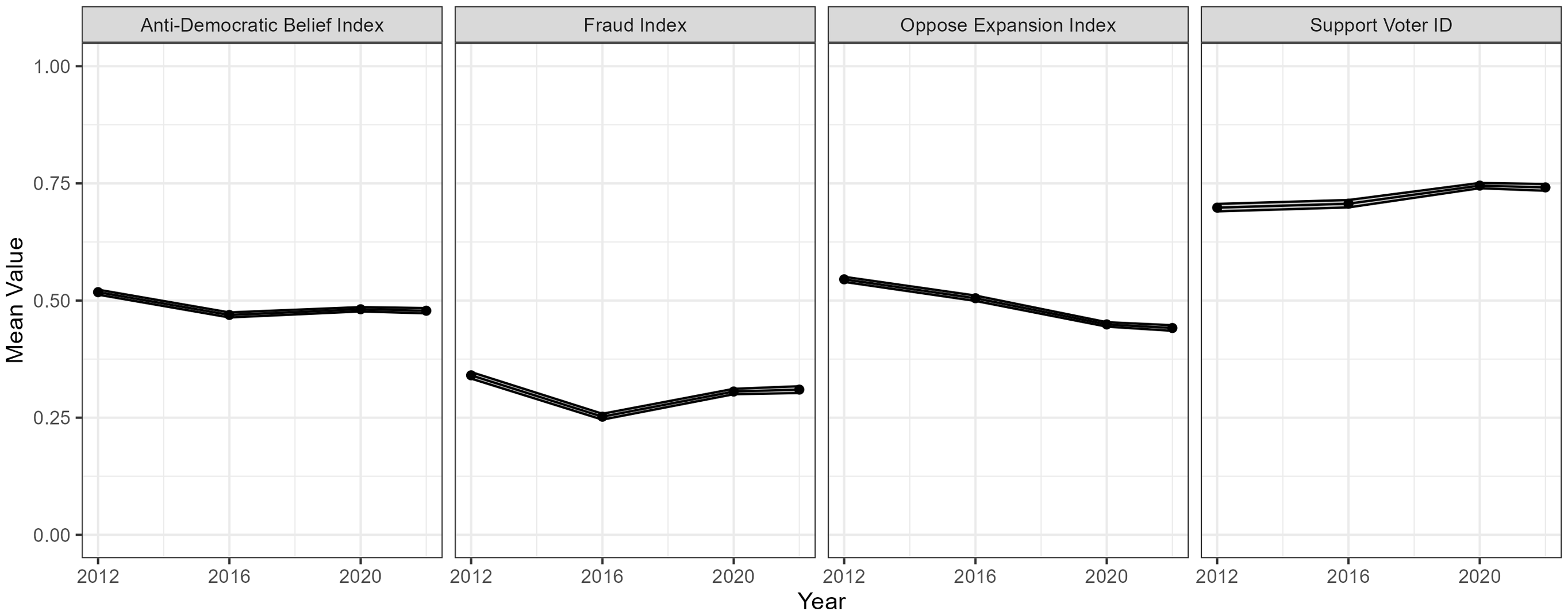
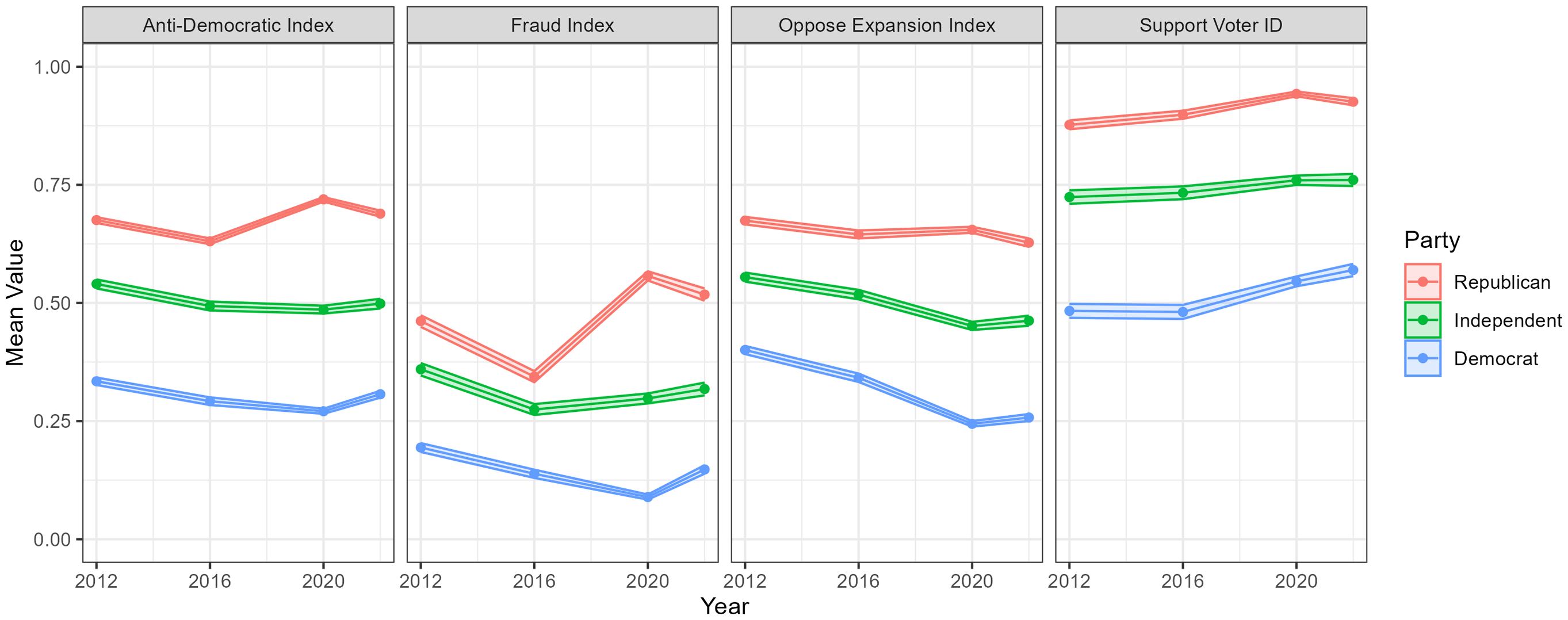
Figure 2 breaks down these trends further by party to investigate the degree to which they are the result of increasing polarization. There is modest evidence of increasing polarization. The gap between Democrats and Republicans on both the index of fraud beliefs and opposition to voting expansions has grown from .27 to .37. The overall gap in anti-Democratic beliefs between Republicans and Democrats has increased from .34 to .38. However, the partisan gap in support for voter identification has decreased slightly (from .39 to .36). Additionally, Democratic and Republican beliefs have moved in the same direction on two of these dimensions. Both Democrats and Republicans have grown more accepting of voting expansions, as well as of voter ID laws. Overall, the descriptive evidence does not suggest a wholesale partisan resorting based on anti-democratic beliefs.
Average anti-democratic beliefs among white Americans are decreasing over time—by party (SPAE, 2012-2022). This figure displays the anti-democratic index and its three component indices using SPAE data from 2012, 2016, 2020, and 2022, broken out by political party identity. The components are a belief in voter fraud index, an opposition to expansive voting laws index, and support for restrictive voter ID laws. Each component is scaled to between 0 and 1. Upper and lower bounds signify 95% confidence intervals.
In summary, there is little evidence for broad increases in white Americans’ anti-democratic beliefs and only limited evidence for increasing polarization. However, it still might be the case that there has been sorting in the distribution of these beliefs. In other words, those that hold at least one anti-democratic opinion might now be more likely to hold multiple anti-democratic opinions. We investigate this possibility in the following section.
Anti-Democratic Beliefs Held by White Americans Have Become More Closely Related
Using four nationally representative surveys fielded between 2012 and 2022, this section examines how closely related support for voting restrictions, opposition to voting expansions, and belief in widespread voter fraud are among white Americans; whether they are explained by a single underlying dimension; and whether these beliefs have become more closely connected over time.
We focus on the relationship between five variables in the Political Unrest Study: the belief that preventing fraud is more important than ensuring all eligible voters can vote, support for requiring voter ID, opposition to expanding the option for permanent vote-by-mail, the belief that fraud changed the 2020 election results, and support for state legislatures having the power to overturn democratic election results. For the 2020 CMPS, we use agreement with four statements to capture anti-democratic beliefs: fraud changed the 2020 presidential election results, ineligible votes are worse than eligible people being prevented from voting, the Voting Rights Act is no longer necessary, and the Republican members of Congress who attempted to stop the certification of President Biden’s electoral victory were protecting democracy. We use the January 21–February 3 2021 parallel wave of the Democracy Fund + UCLA Nationscape survey, since it was the only wave that asked multiple questions probing respondents’ anti-democratic beliefs. We identify five relevant variables: the belief that fraud changed the 2020 presidential election results, approval of the events of January 6, 2021, support for requiring voter identification at the polls, opposition to expanding vote-by-mail, and support for leaders bending the rules when necessary.
Table 1 displays the results of confirmatory factor analysis for each study, showing the strength of the relationship between anti-democratic beliefs and the goodness-of-fit of a unidimensional model. Cronbach’s alpha is a measure of internal consistency for a scale, with scores greater than 0.7 generally considered acceptable and greater than 0.8 considered a good score (Peterson Reference Peterson1994). We use five metrics in confirmatory factor analysis to evaluate the quality of fitting a unidimensional model to the data. Root means square error of approximation (RMSEA) and standardized root mean square residual (SRMR) are absolute fit indices (Fabrigar et al. Reference Fabrigar, Wegener, MacCallum and Strahan1999). Values of less than 0.1 are considered acceptable and values less than 0.05 are considered good for the fitting of a model assuming a single underlying dimension. The comparative fit index (CFI) and the Tucker-Lewis Index (TLI) are both incremental fit indices (Bentler Reference Bentler1990). Scores greater than 0.9 indicate a well-fitting unidimensional model. Finally, common variance explains how much variance among the set of items is shared (Hair et al. Reference Hair, Babin, Black and Anderson2019). Values above 50% typically indicate closely related items. We employ two additional analyses: Eigenvalue decomposition and principal component analysis. A large gap between the first and second Eigenvalues in a decomposition suggests that the variables are unidimensional. We also report the amount of variation explained by the first component in principal component analysis, with values above 50% indicating a better-fitting unidimensional model.
Confirmatory factor analysis of a single dimension to anti-democratic beliefs
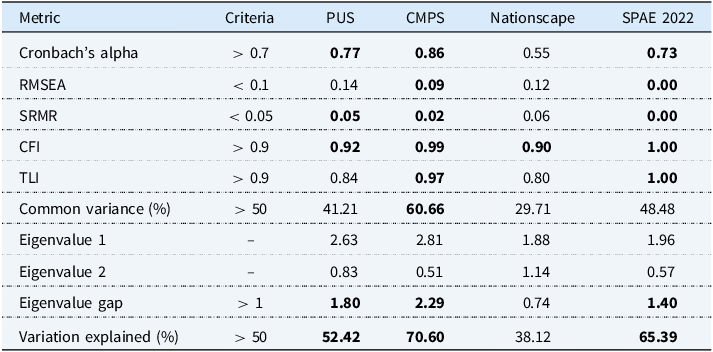
Note: Bolded values meet criteria for the unidimensional model.
Overall, factor analysis of four independent studies shows strong evidence that belief in widespread voter fraud, support for voting restrictions, opposition to voting expansions, and support for overturning democratic election results are all closely related beliefs. Additionally, these anti-democratic beliefs appear to load onto a single underlying dimension in three of the four studies—the Political Unrest Study, the 2020 CMPS, and the 2022 SPAE. Unidimensionality means that belief in the “Big Lie,” support for overturning democratic election results, concerns for illusionary fraud at the expense of ensuring all eligible voters can participate, support for increasing barriers to voting, and opposition to reducing barriers to participation all tap into the same underlying mental impulse antithetical to an inclusive modern democracy in America. This analysis prompts the question: have these beliefs always been tightly connected, or have recent events and Trump’s inflammatory statements coalesced beliefs that were previously unrelated?
Anti-Democratic Beliefs Are Growing More Closely Connected Over Time
To explore whether anti-democratic beliefs have coalesced over time, we utilize the 2012, 2016, 2020, and 2022 waves of the Survey of the Performance of American Elections (SPAE). The SPAE has asked consistent questions about support for voting expansions and voting restrictions and belief in the prevalence of voter fraud since 2012, allowing us to conduct an identical confirmatory factor analysis across the ten-year period. Importantly, 2012 was before Trump became a Republican presidential candidate, enabling us to examine how closely these beliefs were connected prior to his emergence as a central figure in American politics as well as afterward. We employ similarly constructed indices of belief in fraud, opposition to voting expansions, and support for voting restrictions as described in Section 6.
Table 2 shows the results for each wave. The internal consistency, as indicated by Cronbach’s alpha, has increased from 0.64 in 2012 (95% bootstrapped confidence interval of .62–.65) to 0.74 (95% bootstrapped confidence interval of .72–.75) in the 2022 wave, a statistically significant increase. Goodness-of-fit metrics for a unidimensional model have consistently indicated a good fit, with shared variance across the three factors increasing from 43% (95% confidence interval of .41–.44) in 2012 to 56% in 2020, before going down to 49% (95% confidence interval of .47–.50) in 2022. The gap between the first and second Eigenvalues has also grown by a statistically distinguishable amount. Principal component analysis returns similar results, with a single component explaining 59% of the variation in the 2012 survey (95% confidence interval of 58.6–60.3) and increasing to 65% in 2022 (95% confidence interval of 64.5–66.2).
Factor analysis of anti-democratic beliefs in SPAE over time
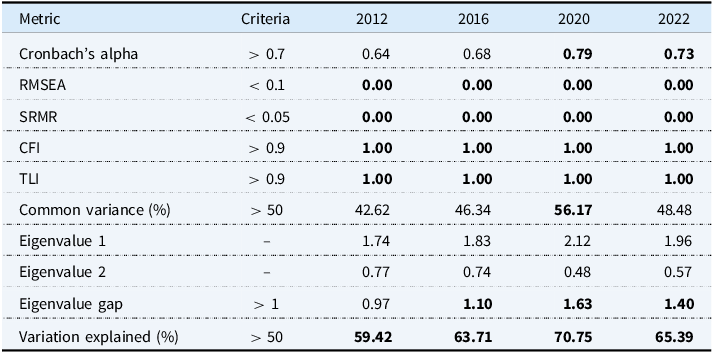
Note: Bolded values indicate unidimensional model.
In summary, every SPAE survey shows strong evidence that anti-democratic beliefs are closely related. They also provide some evidence that these beliefs have grown more closely connected over time, with anti-democratic beliefs most intertwined in 2020. This is congruent with the explanation that Trump’s rhetoric coalesced anti-democratic beliefs in the minds of his white supporters.
Anti-Democratic Beliefs Held by White Americans Are Racialized
We have demonstrated that anti-democratic beliefs are closely intertwined among white Americans. In this section, we show that these attitudes are also highly racialized. Specifically, white Americans who are racially resentful, hold negative attitudes about immigrants, and are concerned with discrimination against whites are most likely to espouse anti-democratic sentiments. We show these relationships across three large-scale surveys: the Political Unrest Study, the Collaborative Multiracial Post-Election Survey (CMPS), and the Democracy Fund + UCLA Nationscape.
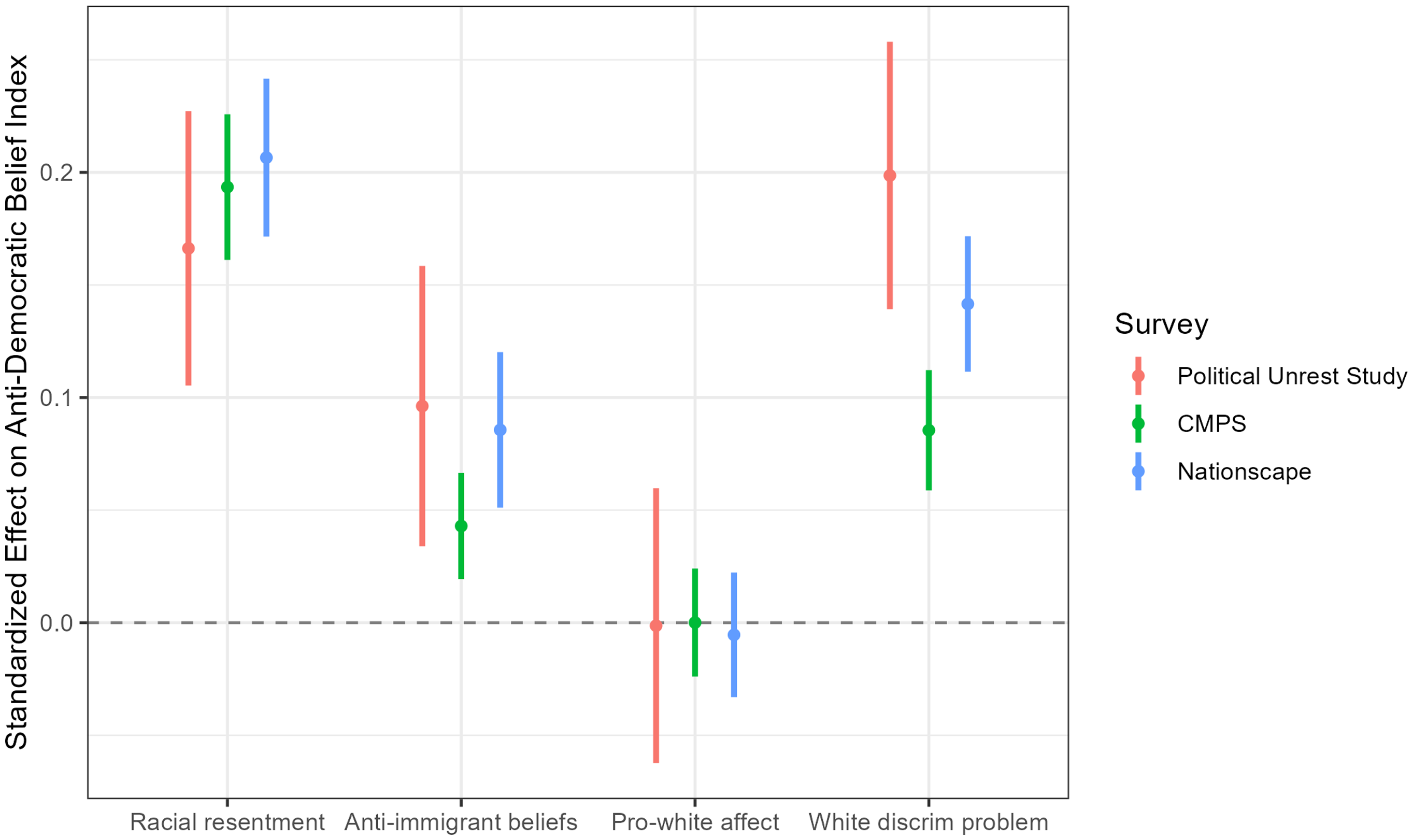
Figure 3 summarizes the results of our analysis across all surveys. We find strong support for a sizable relationship between racial resentment, anti-immigrant beliefs, and white racial grievances, on the one hand, and anti-democratic beliefs on the other hand, even after accounting for a wide range of political and demographic controls. Additionally, we find little evidence of a relationship between pro-white affect and democratic beliefs. Finally, the strength of these relationships is similar across the three independent surveys, regardless of the specific variables used to operationalize anti-democratic and racial beliefs. In short, white Americans’ attitudes towards racial and ethnic out-groups explain their support for an inclusive democracy.Footnote 5
Anti-democratic beliefs are closely connected to racial beliefs among White Americans. This figure displays the standardized coefficient estimates of the effect of racial resentment, anti-immigrant beliefs, pro-white affect, and belief that white discrimination is a problem across three major surveys: the Political Unrest Study, the 2022 CMPS, and an early 2021 wave of the Democracy Fund + UCLA Nationscape study. Anti-democratic beliefs are composed of support for voting restrictions, opposition to voting expansions, belief in widespread fraud, and support for overturning democratic election results. Pro-white affect is measured as belief in the white replacement theory for the Political Unrest Study and as support for white nationalism in the CMPS. Upper and lower bounds signify 95% confidence intervals. All surveys include controls for conspiratorial beliefs, Trump favorability, party identification, ideology, education, gender, age, income, and evangelicalism.
We now turn to an in-depth examination of each study and the relationship between anti-democratic beliefs and racial attitudes.
Political Unrest Study
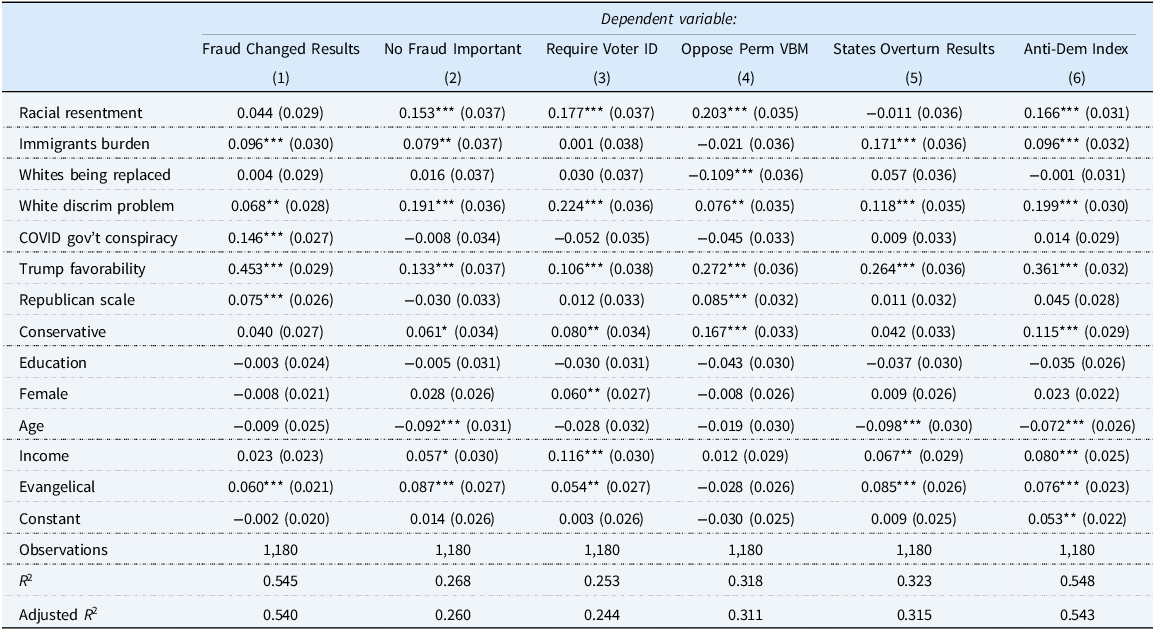
The Political Unrest Study, fielded in 2022, was designed to test the link between opposition to the Black Lives Matter movement and support for the January 6, 2021 capital insurrection (Barreto et al. Reference Barreto, Alegre, Bailey, Davis, Ferrer, Nguy, Palmisano and Robertson2023). As such, it includes a range of questions probing anti-democratic beliefs as well as a suite of racial attitudes. We focus on four explanatory variables of interest: racial resentment, anti-immigrant sentiment, adherence to white replacement theory, and the belief that white discrimination is a problem. We proxy conspiratorial attitudes with a question that probes the belief that COVID-19 was a government conspiracy. In this and all other observational analyses, we include controls for Trump favorability, partisan identification, political ideology, education, gender, age, income, and evangelicalism. The results of linear regressions are reported in Table 3. Both independent and dependent variables are standardized, so all point estimates can be interpreted as the effect size of one standard deviation change in the explanatory variable. The maximum variance inflation factor across explanatory variables is 2.24, well below the conventional threshold of 5 that would indicate problematic multicollinearity.
Racial attitudes predict anti-democratic beliefs (Political Unrest Study)
Note: *p < 0.1; **p < 0.05; ***p < 0.01.
We observe a strong relationship between the belief that white discrimination is a problem and support for anti-democratic beliefs. The relationship is statistically significant across all five anti-democratic beliefs—the belief that fraud changed the 2020 presidential election results, prioritizing fraud prevention over ensuring all eligible voters can vote, supporting voter identification laws, opposing vote-by-mail expansion, and supporting the ability of state legislatures to overturn democratic election results—as well as in the pooled anti-democratic belief index (column 5). The effect size in the anti-democratic index is 0.2, indicating a modest but substantively meaningful effect. Only favorability towards former President Trump is more explanatory of anti-democratic beliefs, all else equal.
We find less consistent but still strong evidence for racial resentment and anti-immigration sentiment (proxied by the belief that immigrants are a burden on the country). Both variables are explanatory for three of the five dependent variables, and both are also explanatory in the anti-democratic index. The effect size for racial resentment is .167 and is therefore more explanatory than partisan identification or any other control variable besides Trump favorability. Anti-immigrant sentiment has an effect size of 0.096 and thus is about half as explanatory as the belief that discrimination against whites is a problem.
Notably, we fail to find any evidence that belief in white replacement theory explains support for anti-democratic beliefs. The only significant relationship observed is a negative correlation between belief in white replacement and opposition to permanent vote-by-mail. In other words, the more respondents adhere to white replacement theory, the more supportive they are of making vote-by-mail permanent.
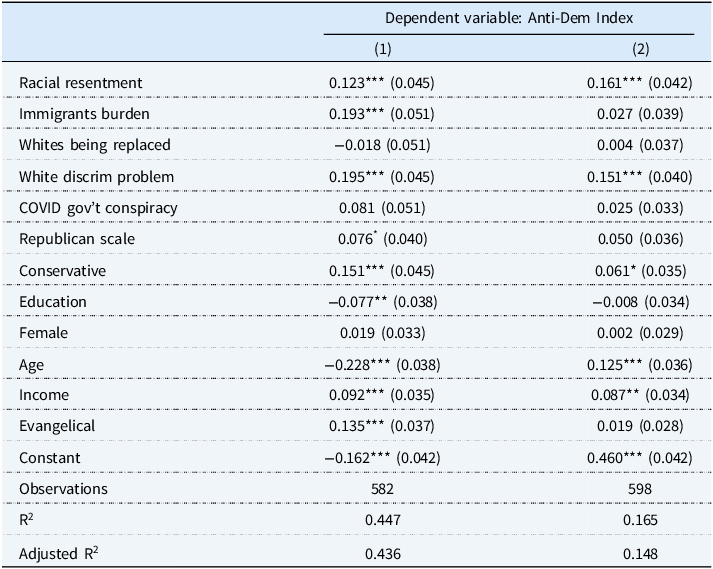
In Table 4 we investigate the strength of the relationship between racial attitudes and anti-democratic beliefs across levels of Trump favorability. We cut our sample of white Americans into two categories: those that hold very or somewhat unfavorable opinions of Trump (column 1) and those that hold very or somewhat favorable opinions of Trump (column 2). This is similar to an interaction analysis of Trump favorability and all other independent variables. White discrimination and racial resentment are equally explanatory factors for both those who hold favorable opinions of Trump and those who hold unfavorable views of him. Additionally, belief in white replacement theory is not explanatory in either group. Anti-immigrant beliefs are only explanatory for those who hold unfavorable views of Trump. In sum, both racial resentment and belief in white discrimination (racial grievance) explain anti-democratic beliefs above and beyond favorability towards Trump. This is evidence that the racialization of beliefs antithetical to an inclusive democracy is not just an artifact of polarization or the “Trumpification” of modern politics.
Racial attitudes predict anti-democratic beliefs, regardless of favorability towards Trump (Political unrest study)
Note: *p < 0.1; **p < 0.05; ***p < 0.01.
Each column subsets the survey sample to a binary Trump favorability, with 1 being unfavorable and 2 being favorable.
CMPS
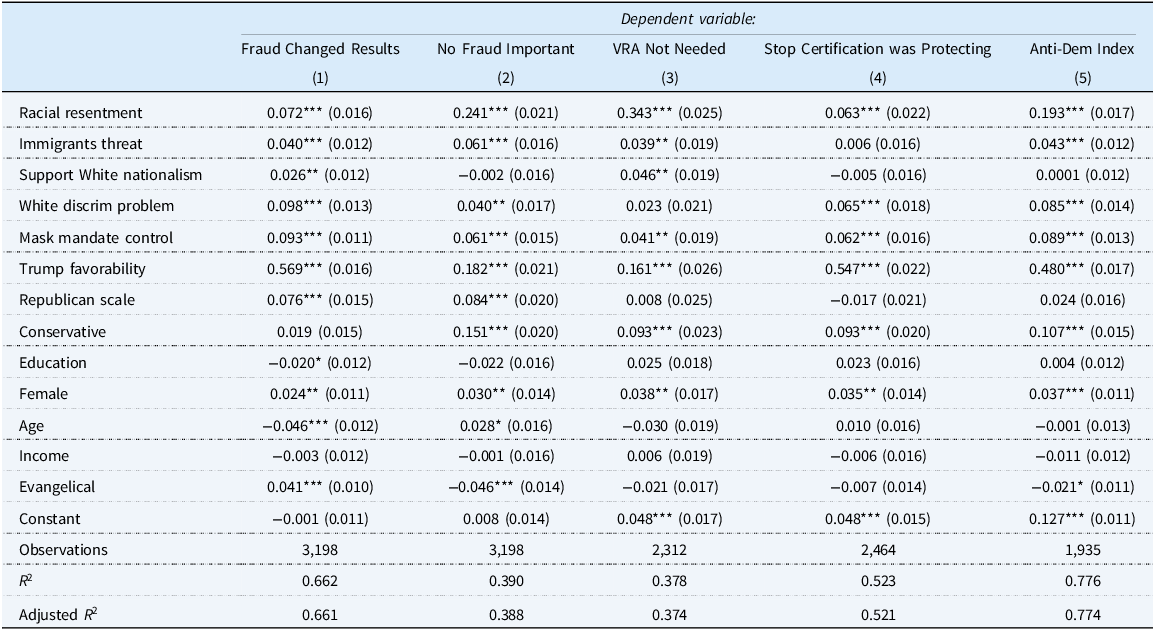
For the 2022 CMPS, our anti-democratic index is composed of four variables: belief in the “Big Lie,” privileging reducing fraud over ensuring all eligible voters can vote, the belief that the Voting Rights Act is no longer needed, and the belief that Republican members of Congress who stopped the certification of Joe Biden’s electoral victory were protecting democracy. The controls employed are identical to those used for the Political Unrest Study, except conspiratorial thinking is proxied by the belief that COVID mask mandates were government attempts at “controlling” the population and anti-immigrant sentiment is measured by a question asking whether immigrants pose a threat. In-group white affect is measured by support for white nationalism. The maximum variance inflation factor is 2.33, well below the conventional threshold that would indicate multicollinearity issues.
The results, displayed in Table 5, are congruent with those in the Political Unrest Study. Racial resentment is the strongest predictor of anti-democratic beliefs among racial variables. It is significant in all regressions and is double the effect size of ideology. Belief that white discrimination is a problem is statistically significant across three of the four dependent variables and in the anti-democratic beliefs index. However, it is less explanatory than in the Political Unrest Study. Anti-immigrant sentiment is significant in three of the four dependent variables and the anti-democratic beliefs index, but its effect size is small (0.04). As with the Political Unrest Study, there is only mixed evidence for a link between white nationalism and anti-democratic beliefs. This variable is significant in two of the four dependent variables but not for the overall anti-democratic belief index, and the effect sizes are substantively small.
Racial attitudes predict anti-democratic beliefs (CMPS)
Note: *p < 0.1; **p < 0.05; ***p < 0.01.
All effects are dwarfed by Trump favorability. The degree to which white respondents like Trump is more than twice as explanatory as racial resentment, more than five times as explanatory as white discrimination, and more than ten times as explanatory as anti-immigrant sentiment in explaining variation in anti-democratic beliefs. The strength of Trump favorability in describing these beliefs may be an artifact of the timing of the survey, which was fielded immediately after President Trump’s election defeat and the January 6, 2021 insurrection.
As with the Political Unrest Study, in Table 6 we test anti-democratic beliefs separately for those who hold unfavorable (column 1) and favorable (column 2) views of Trump. White discrimination, racial resentment, and anti-immigrant beliefs are explanatory across Trump favorability. White discrimination is especially explanatory of anti-democratic beliefs among those with an unfavorable opinion of Trump whereas racial resentment is especially explanatory among those with favorable views of Trump. Support for white nationalism is only explanatory among those with unfavorable views of Trump.
Racial attitudes predict anti-democratic beliefs, regardless of favorability towards Trump (CMPS)
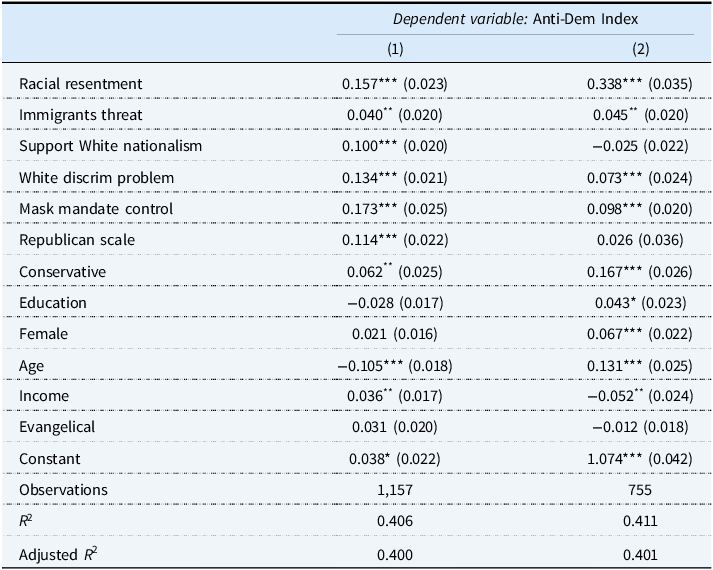
Note: *p < 0.1; **p < 0.05; ***p < 0.01.
Each column subsets the survey sample to a binary Trump favorability, with 1 being unfavorable and 2 being favorable.
Nationscape
We replicate the same analysis on the parallel wave of the Democracy Fund + UCLA Nationscape survey fielded between January 21 and February 3, 2021. We use five dependent variables: belief that fraud changed the results of the 2020 presidential election, support for the January 6 insurrection, support for requiring voter identification to vote, opposition to vote-by-mail, and support for leaders to bend the rules when necessary. Anti-immigrant sentiment is proxied by support for deporting undocumented immigrants, pro-white beliefs are captured by a white favorability feeling thermometer, and conspiratorial thinking is proxied by an index of responses indicating opposition to government and personal action to mitigate the COVID-19 pandemic. As with the other surveys, the maximum variance inflation factor across explanatory variables (1.88) is below the conventional threshold of 5 that would indicate multicollinearity issues. The results are displayed in Table 7.
Racial attitudes predict anti-democratic beliefs (Nationscape)
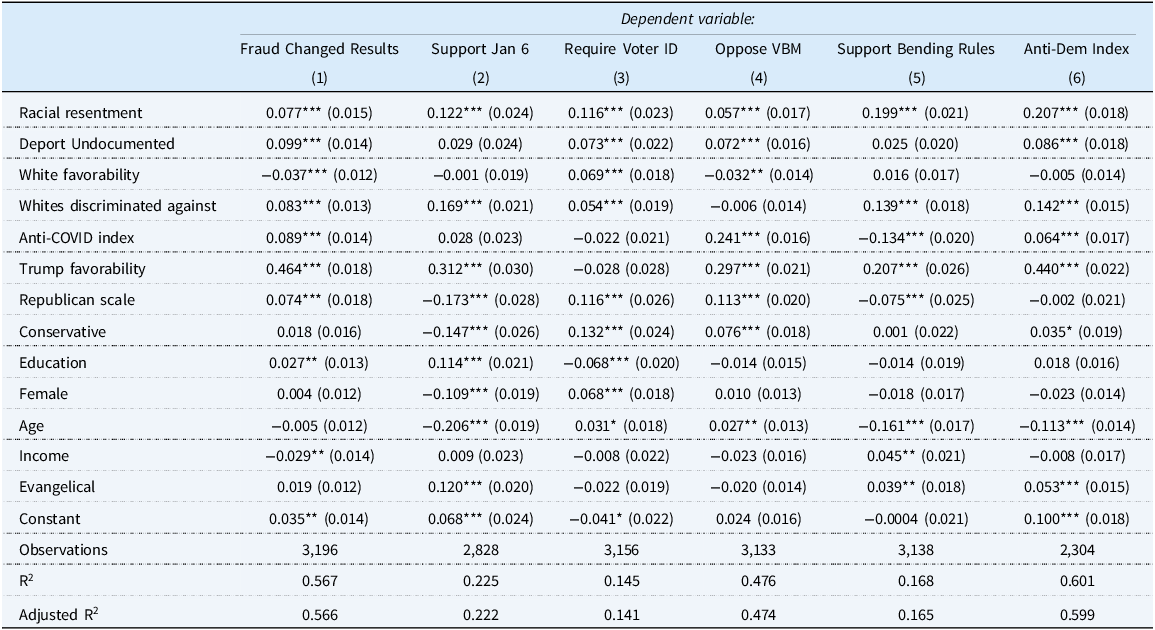
Note: *p < 0.1; **p < 0.05; ***p < 0.01.
Racial resentment is significant in all five regressions and is also the most explanatory among the racial variables tested. Its effect size is 0.2 in the anti-democratic index regression (column 6), half the effect of Trump favorability but nearly six times more explanatory than ideology. White discrimination is significant in four of the five dependent variables tested and in the anti-Democratic index. Although slightly less explanatory than racial resentment, it is still four times as powerful as ideology in explaining anti-demographic beliefs. Anti-immigrant sentiment is significant for three of the five dependent variables and the anti-democratic belief index, though the effect size is relatively small. Finally, white favorability is positively correlated with one anti-democratic belief and negatively correlated with two. It holds no explanatory power on the summary anti-democratic belief index.
Table 8 splits respondents by Trump favorability. Racial resentment, anti-immigrant sentiment, and white discrimination are all significant for both groups whereas white favorability is insignificant for both. Only white grievance varies in strength across those who hold favorable views of Trump and those who hold unfavorable views of the former president. The belief that whites are discriminated against is twice as explanatory of anti-democratic beliefs in the latter group.
Racial attitudes predict anti-democratic beliefs, regardless of favorability towards Trump (Nationscape)
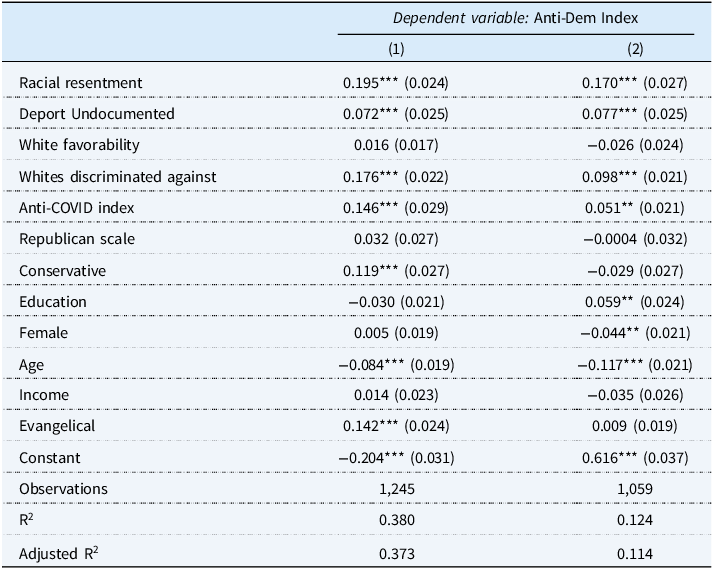
Note: *p < 0.1; **p < 0.05; ***p < 0.01.
Each column subsets the survey sample to a binary Trump favorability, with 1 being unfavorable and 2 being favorable.
Framing Experiment Shows Causal Evidence for Link Between Anti-Democratic Beliefs and Racial Attitudes
In order to provide causal evidence for the link between anti-democratic beliefs and racial attitudes, we analyze two framing experiments embedded in the Political Unrest Study to test whether explicitly racial frames of election policies sway white Americans’ opinions in an anti-democratic direction. We manipulate the presentation of information regarding limiting Sunday voting and opposing absentee/early voting expansion, introducing race-neutral and explicitly racial frames to the descriptions of these voting restrictions.
The first framing experiment concerns Sunday voting. The control group read the following statement: “Historically, many communities have utilized Sunday afternoon voting as a community empowerment event after attending church. Some state legislatures have tried to block or limit access to Sunday voting. Would you support efforts to limit Sunday afternoon voting?” The treatment group read an identical description, except the word “Black” was inserted before the word “communities.” This small change makes the racial connotations of the voting restriction explicit.
In the second framing experiment, we manipulate the presentation of information surrounding absentee and early voting. The control condition read this statement: “Many Americans rely on absentee (vote-by-mail) and early voting, especially elderly voters who have trouble making it to the polls and overseas military personnel serving our country. Would you support making absentee ballots and early voting more accessible?” The treatment condition altered the first sentence to read: “Many Americans rely on absentee (vote-by-mail) and early voting, especially working-class communities of color and immigrants, who often do not have time in their day to make it to the polls.” As with the first experiment, this treatment introduces an explicitly racial frame into an ostensibly race-neutral policy.
Table 9 shows standardized regression results for the effect of treatment on support for the voting restriction. Columns 1 and 3 display univariate regressions and columns 2 and 4 include controls to account for any potential imbalances in the randomized groups and improve precision. In both experiments, framing the voting restrictions in explicitly racial terms increases white Americans’ support for these anti-democratic policies. The results are largely unchanged with the inclusion of political and demographic controls. The point estimates are also substantively meaningful, ranging between 0.1 and 0.2 standard deviations. In other words, clarifying the negative racial impact of these laws moves white opinion in favor of a more exclusionary version of American democracy. This suggests the correlational evidence shown above may be causal in nature. Racially conservative whites do not just happen to hold anti-democratic beliefs, but rather whites who learn about the racial implications of election policies become more supportive of anti-democratic measures.
Experiment: racialized voting reform frames increase support for restrictions

Note: *p < 0.1; **p < 0.05; ***p < 0.01.
Racial Attitudes Have Become More Predictive of Anti-Democratic Beliefs Over Time
Thus far, we have shown both observational and causal evidence that anti-democratic beliefs are racialized. In this section, we explore how the strength of these relationships has changed over time. The surveys used in previous sections either have no significant temporal coverage on democratic attitudes (CMPS, Nationscape, Political Unrest Study) or do not ask questions about racial attitudes (SPAE). We therefore turn to the American National Election Survey (ANES), which asked respondents about their racial attitudes as well as one relevant question probing anti-democratic beliefs in the 2012, 2016, and 2020 waves: “In your view, how often are votes counted fairly in this country’s elections?” This question is analogous to belief in widespread voter fraud used throughout the rest of the paper. Table 10 shows the output of regressions similar in nature to those shown in Section 7. Anti-immigrant attitudes are measured using a question of government policy towards undocumented immigrants and pro-white feelings are measured using a feeling thermometer. Three covariates have been omitted due to inconsistent coverage in the ANES over this period: Trump favorability, conspiratorial thinking, and evangelicalism.
Racial resentment and racial grievance have become more predictive of White Americans’ Anti-democratic beliefs over time (ANES, 2012–2020)
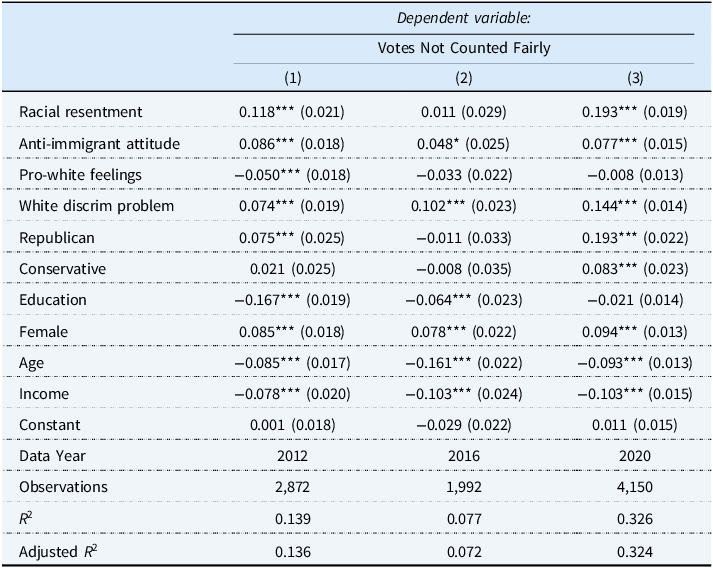
Note: *p < 0.1; **p < 0.05; ***p < 0.01.
There are two main takeaways from these results. First, anti-democratic beliefs were already racialized in 2012. We observe statistically significant and meaningful positive relationships between racial resentment, anti-immigrant sentiment, and racial grievance on the one hand and belief that votes are not counted accurately on the other hand, even after accounting for political and demographic controls. Second, anti-democratic beliefs have grown more racialized over time. Racial resentment and belief that white discrimination is a problem were roughly twice as explanatory of anti-democratic beliefs in 2020 than in 2012. Anti-immigrant sentiment has been consistently correlated albeit to a weaker degree. Pro-white feelings were negatively correlated with the belief that votes are not counted fairly in 2012 and have become uncorrelated, consistent with Filindra (Reference Filindra2022). The 2022 ANES results align closely with the results of other major surveys shown in Section 7. Combined with our findings on the growing connection between anti-democratic beliefs, this evidence suggests that part of the reason for this coalescence is the priming of deep-seeded racial attitudes (Tesler Reference Tesler2016; Valentino and Sears Reference Valentino and O Sears2005).
Discussion
We investigate the prevalence, interconnectedness, and racialization of anti-democratic attitudes, such as support for voting restrictions, opposition to voting expansion, belief in voter fraud, and support for overturning democratic election results. We find that, contrary to conventional wisdom, anti-democratic beliefs have not become more prevalent among white Americans over the past decade, nor have they become significantly more polarized. However, anti-democratic beliefs are interconnected and have grown more so over time. Additionally, these anti-democratic beliefs are highly racialized. White Americans who are concerned about white discrimination, who are racially resentful, and who hold negative views of immigrants are most likely to support voting restrictions, oppose voting expansions, believe in widespread fraud, and endorse claims that the 2020 presidential election was stolen. The results hold even after controlling for partisanship, ideology, and Trump favorability; for both supporters and critics of the former president; and across multiple surveys conducted with different samples and at different times. Additionally, racial attitudes are twice as predictive of anti-democratic beliefs today as they were a decade ago. Taken together, our evidence suggests that opposition to democratic norms and practices is not solely a partisan, ideological, or even Trump issue, but rather is deeply rooted in racial biases towards out-groups.
In survey experiments, the introduction of racial frames in the context of voting reforms exacerbated anti-democratic beliefs. White Americans showed increased support for restrictions and reduced support for expansions when these reforms were presented as particularly benefiting communities of color and immigrants. These results follow prior scholarship showing negative white attitudes in response to racialized frames of voting reforms (Banks and Hicks Reference Banks and Hicks2016; Wilson and Brewer Reference Wilson and Brewer2013, Reference Wilson and Brewer2016; Wilson et al., Reference Wilson, Leo Owens and Davis2011) and provide experimental evidence beyond the observational studies showing that racial attitudes influence support for anti-democratic measures. While we find strong evidence for the relationship between anti-democratic beliefs and out-group attitudes such as racial resentment, racial grievance, and anti-immigrant sentiment, our findings do not support a consistent relationship with white in-group identity (Jardina Reference Jardina2019). If anything, over time evidence from the ANES indicates that white in-group favorability was negatively correlated with anti-democratic beliefs in the early 2010s and has become uncorrelated. This finding aligns with Filindra (Reference Filindra2022), who finds that those high in white identity/consciousness tend to have greater trust in elections. Our findings suggest that perceived threats to white status play an increasingly significant role in shaping anti-democratic attitudes compared to in-group identity.
Our research highlights the need to consider racial attitudes in discussions about democracy and voting reforms, not just partisanship (Touchton, Klofstad, and Uscinski Reference Touchton, Klofstad and Uscinski2023) or support for Donald Trump (Littvay, McCoy, and Simonovits Reference Littvay, McCoy and Simonovits2024). The demonstrated intersection of racial biases and anti-democratic beliefs suggests that efforts to protect and strengthen democracy must also address underlying racial attitudes. Future research should continue to explore the evolving relationship between race and anti-democratic attitudes, particularly in the context of increasing racial diversity and political polarization. Interventions aimed at reducing racial resentment and promoting inclusive democratic values could play a vital role in safeguarding the democratic process.
This is especially true considering all indications point to a continued commitment by some political elites to undermine the legitimacy of America’s democratic elections. Footnote 6 With Trump’s return to the presidency, these concerns take on renewed urgency. Only by confronting the racial underpinnings of anti-democratic sentiments head-on can we hope to build a more inclusive and resilient democracy that truly represents and serves all its citizens.
Supplementary material
The supplementary material for this article can be found at https://doi.org/10.1017/rep.2025.1
Acknowledgments
For helpful discussion and comments, the authors thank Matt Barreto, Daniel Thompson, and participants in the 2023 Notre Dame Keeping the Republic Conference and the 2024 UCLA January 6 CMPS Conference. Competing interests: The authors declare none. This research did not receive any specific financial support.


 Open access

