




Among the Maya of the Classic period (ca. a.d. 250–900), ideas regarding power and rulership were grounded in elaborate conceptions involving other-than-human beings, such as gods and ancestors. Classic Maya sovereign kings were typically titled k’uhul, “god-like,” or “holy,” arguably suggesting that such high-ranking rulers were close to the gods (k’uh) (Houston and Stuart Reference Houston and Stuart1996:295–296; Martin Reference Martin2020:71–73; Mathews Reference Mathews and Culbert1991:25–26). Even those nobles who were not called “divine” or “god-like” were considered to have close relationships with divine forces. For example, rulers often performed rituals “in the presence of” or “in the sight of” the gods, while royal lineages and even individual lords tended to have their “own” gods, that is, patron deities, overseeing their actions (Houston and Stuart Reference Houston and Stuart1996:301, 304–305).
One of the recurrent features of Classic Maya rulership was deity impersonation, the concept that a person could intentionally embody a divine entity. This practice played a significant role in rituals performed by Classic Maya nobles and was a crucial part of religious life and the ideology of power (Houston and Stuart Reference Houston and Stuart1996:297–300; López Oliva Reference López Oliva2025:213–248; Nehammer Knub et al. Reference Nehammer Knub, Thun, Helmke, Fort, Gardiol, Matteo and Helmke2009:187–188, 190–193).
The epigraphic cases examined in this article exemplify how deity impersonation was used in elite narratives to articulate rulers’ identities and the nature of rulership during the Classic period. These examples present a pattern that—beyond “elevating” particular lords and emphasizing their association with the gods—served to conceptualize rulership itself by delineating its core aspects and linking them to specific divine entities. This analysis provides a glimpse into how the Late Classic Maya understood what it meant to be a ruler and how the relationship between rulership and the gods operated through deity impersonation.
In what follows, I first outline fundamental terms and concepts regarding Classic Maya deity impersonation and then turn to a detailed epigraphic analysis of the final section of the ninth-century hieroglyphic stairway from Sabana Piletas (Campeche, Mexico), a key case study for my general argument. I situate this passage within the broader inscription and compare it with a ceramic vase from Cuychen (Belize) and a mural painting from Xultun (Guatemala), which present shorter but closely parallel hieroglyphic passages linking the impersonation of deities to key components of royal authority.
Classic Maya deity impersonation: Terms and concepts
Arild Hvidtfeldt (Reference Hvidtfeldt1958) was the first to address the Mesoamerican phenomenon of deity impersonation in his study of Aztec religion. Although the religious worldviews and practices of the various Mesoamerican peoples are not identical, their evident cultural parallels have led scholars to apply Hvidtfeldt’s assumptions about the Aztec concept of ixiptlatli or teixiptla (“image,” typically attributed to divine impersonators [Hvidtfeldt Reference Hvidtfeldt1958:98]; see also its interpretation as “localized embodiment” [Basset Reference Basset2015]) to the emerging study of impersonation among the Maya, where the phenomenon is attested in both ancient imagery and writing (Houston and Stuart Reference Houston and Stuart1996; López Oliva Reference López Oliva2025; Nehammer Knub et al. Reference Nehammer Knub, Thun, Helmke, Fort, Gardiol, Matteo and Helmke2009; Stone Reference Stone, Robertson and Fields1991). In discussing this phenomenon, Stephen Houston has introduced the term “deity concurrence” as an alternative to “deity impersonation” (Houston Reference Houston, Inomata and Coben2006:148). This formulation highlights the practice’s presumed nature: an embedded “duality of identity and agency” (Matsumoto Reference Matsumoto2024:4) in which a human and a deity appear concurrent in “a layering of identities,” rather than an impersonator being “displaced” by an impersonated entity (Earley Reference Earley2019:16; Houston Reference Houston, Inomata and Coben2006:145–149; Matsumoto Reference Matsumoto2024:4–5).
Stephen Houston and David Stuart (Reference Houston and Stuart1996:297–300) have identified a specific expression used to describe impersonation in hieroglyphic texts. It reads as ˀub’aahil ˀaˀn (or ˀub’aah ˀaˀn), “his/her/its ‘embodiment’ (of a deity),” as further shown by subsequent studies (López Oliva Reference López Oliva2015, Reference López Oliva2018a, Reference López Oliva2018b, Reference López Oliva2025; Nehammer Knub et al. Reference Nehammer Knub, Thun, Helmke, Fort, Gardiol, Matteo and Helmke2009; Velásquez García Reference Velásquez García and Ruiz2010). In most cases, the impersonation formula in Classic Maya inscriptions includes the component ˀub’aahil ˀaˀn.
The term “impersonation formula” (Boot Reference Boot2008:29) refers to the standard construction found in records of impersonation. Following Nehammer Knub et al. (Reference Nehammer Knub, Thun, Helmke, Fort, Gardiol, Matteo and Helmke2009), I also use the term “impersonation statement” as a synonym for “impersonation record” to refer to the whole phrase consisting of the impersonation formula and the impersonator’s name.
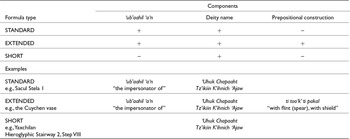
I do not consider the impersonator’s name to be a part of the impersonation formula. The essential part of the formula’s structure is the name of the deity, the only element of the formula that is never omitted in glyphic records. The Classic-period Maya tended to impersonate a wide variety of deities, so this name differs from case to case. A group of examples demonstrates that ˀub’aahil ˀaˀn can be omitted so that the theonym itself constitutes a short impersonation formula (Beloborodov Reference Beloborodov2020, Reference Beloborodov2025; for an indirect mention of impersonation via a theonym in a Yaxchilan king’s name, see also Tokovinine Reference Tokovinine2002:3). Impersonation formulae can also include a prepositional construction, which follows the deity’s name and indicates the context or setting related to that deity (Helmke et al. Reference Helmke, Awe, Morton, Iannone, Golden, Houston and Skidmore2015:24). For the purposes of analysis, I distinguish three types of impersonation formulae, which differ in how concise or “unfolded” they are. Their structure is outlined in Table 1, which labels them as standard, extended, and short impersonation formulae.
Three types of impersonation formulae in Classic Maya inscriptions
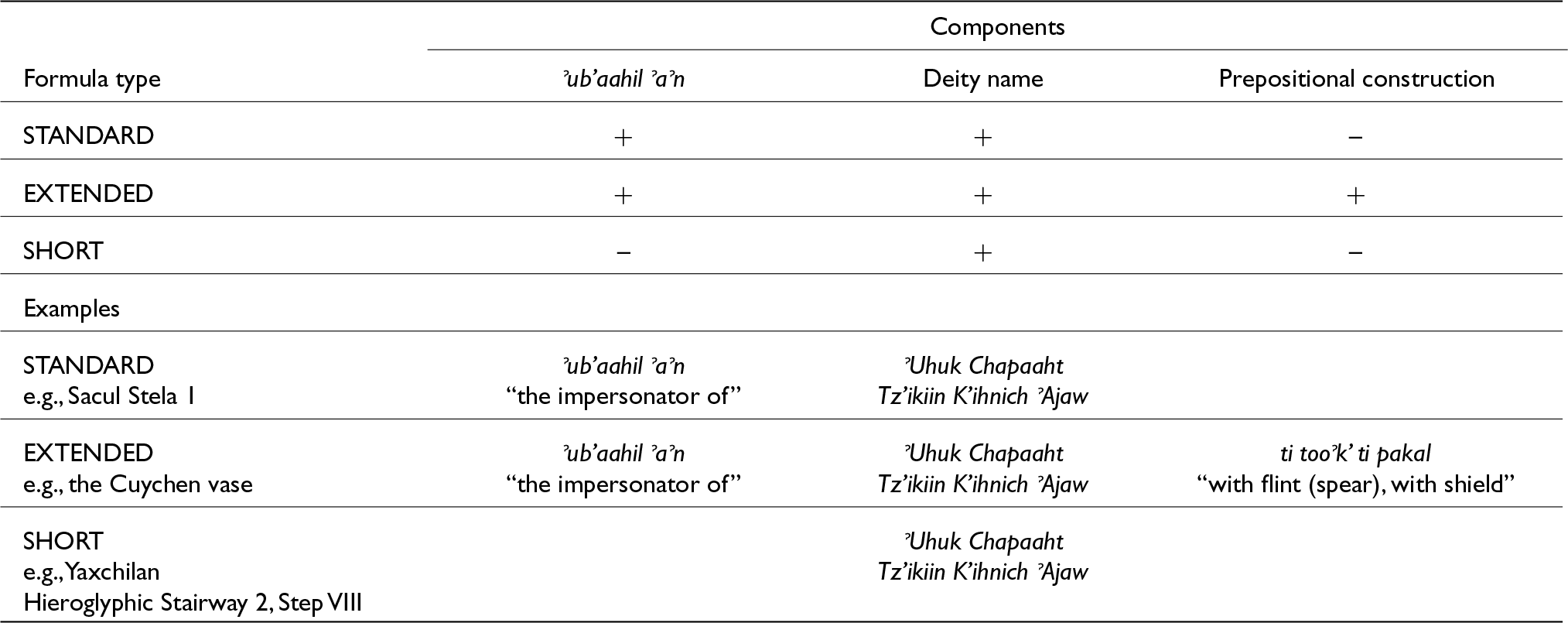
Table 1 Long description
The table categorizes three types of impersonation formulae found in Classic Maya inscriptions: Standard, Extended, and Short. Each type is analyzed based on the presence of three components: “ˀub’aahil ˀaˀn,” deity name, and prepositional construction. The Standard and Extended types include both “ˀub’aahil ˀaˀn” and deity names, but only the Extended type includes a prepositional construction. The Short type lacks “ˀub’aahil ˀaˀn” and prepositional construction, featuring only the deity name. Examples include Sacul Stela 1 for Standard, the Cuychen vase for Extended, and Yaxchilan Hieroglyphic Stairway 2, Step VIII for Short. This analysis highlights the variability in formulae structure and the role of prepositional constructions in Extended types.
These formulae, incorporating ˀub’aahil ˀaˀn (almost always), a deity name (always), and a prepositional construction (sometimes), appear before or after the impersonator’s name. They tend to function as part of the impersonator’s honorific titulary, sometimes being listed between other names and titles (e.g., see Dos Pilas Hieroglyphic Stairway 4, Step V: the name and titles of B’ajlaj Chan K’awiil at blocks H2–N2 [Houston Reference Houston1993:Figure 4-11]). Notably, such formulae do not tend to explicitly reference particular events involving ritual acts. Rather, they operate as what may be called “impersonation titles” (Nehammer Knub et al. Reference Nehammer Knub, Thun, Helmke, Fort, Gardiol, Matteo and Helmke2009:187) or, perhaps more cautiously, “impersonation appellations.” While in some cases it is possible to reconstruct an “impersonation ritual” based on matching epigraphic and iconographic data, an impersonation formula per se describes an impersonator, that is, a human embodying a deity, not an act of impersonation.
Because the evidence is limited, it remains unclear how Classic Maya nobles acquired such “impersonation appellations,” whether necessarily through specific rituals performed at some point in their lives or potentially through conditions determined by birth, origin, or rank. The possibility of the latter may be supported by the example of a pair of ceremonial rattles from Naranjo, now in the collection of the Ethnological Museum of Berlin (Grube and Gaida Reference Grube and Gaida2006:213): The inscription on the rattles features the impersonation formula of ˀUhuk Chapaaht Tz’ikiin K’ihnich that is ascribed to k’uhul Saˀil ˀajaw (an alternative transcription, Sa’aal, is also common [see, e.g., Tokovinine Reference Tokovinine, Isendahl and Persson2011, Reference Tokovinine2013; Tokovinine and Fialko Reference Tokovinine and Fialko2007]), “the holy/divine lord of [Naranjo],” without specifying the exact king’s name.
The Hieroglyphic Stairway of Sabana Piletas: An overview
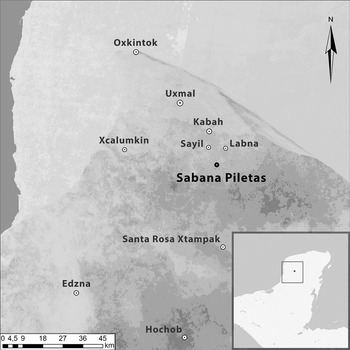
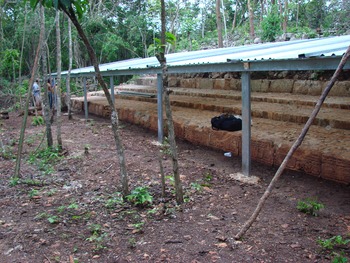
The Hieroglyphic Stairway of Sabana Piletas was discovered by members of the projects Mantenimiento Menor de Zonas Arqueológicas No Abertas al Público (MANZANA) and Acervo Jeroglífico e Iconográfico Maya-Instituto Nacional de Antropología e Historia (AJIMAYA-INAH) in 2007–2008 (Grube et al. Reference Grube Nikolai and Castillo2008, Reference Grube Nikolai, Castillo and Merk2011). Located in the Mexican state of Campeche (Figure 1), it is a unique epigraphic piece, as hieroglyphic stairways are uncommon in the monumental tradition of northern Yucatan (Grube et al. Reference Grube Nikolai, Castillo and Merk2011:251). The region is famous for its relatively concise “name tags” (Grube Reference Grube and Prem1994), and most hieroglyphic inscriptions in the northwestern Yucatan Peninsula are dedication or ownership tags on architectural objects (Grube et al. Reference Grube Nikolai, Castillo and Merk2011:261). In contrast, the Sabana Piletas stairway consists of 136 glyph blocks arranged across two long steps (Figure 2), making it the most extensive single text found in the northern Yucatan Peninsula (Grube et al. Reference Grube Nikolai and Castillo2008:86, Reference Grube Nikolai, Castillo and Merk2011:251). The stairway is dated to December a.d. 858, making it one of the latest known Maya epigraphic inscriptions (Grube et al. Reference Grube Nikolai, Castillo and Merk2011:252–253). The character of the inscription is in line with the broader regional tradition of the Classic-period northern lowlands, as it is a self-referential text serving as a foundation for the ritual dedication of the monument itself (Grube et al. Reference Grube Nikolai, Castillo and Merk2011:261). Unfortunately, many blocks are heavily eroded, although Nikolai Grube and colleagues succeeded in identifying the major semantic clusters (Grube et al. Reference Grube Nikolai and Castillo2008:86, Figure 5).
The location of Sabana Piletas (main map by Alexander Safronov, lightly amended by the author; inset map by the author). Based on the geolocation data provided in Benavides Castillo and Novelo Osorno (Reference Benavides Castillo and Osorno2008) and Merk (Reference Merk and Merk2011).
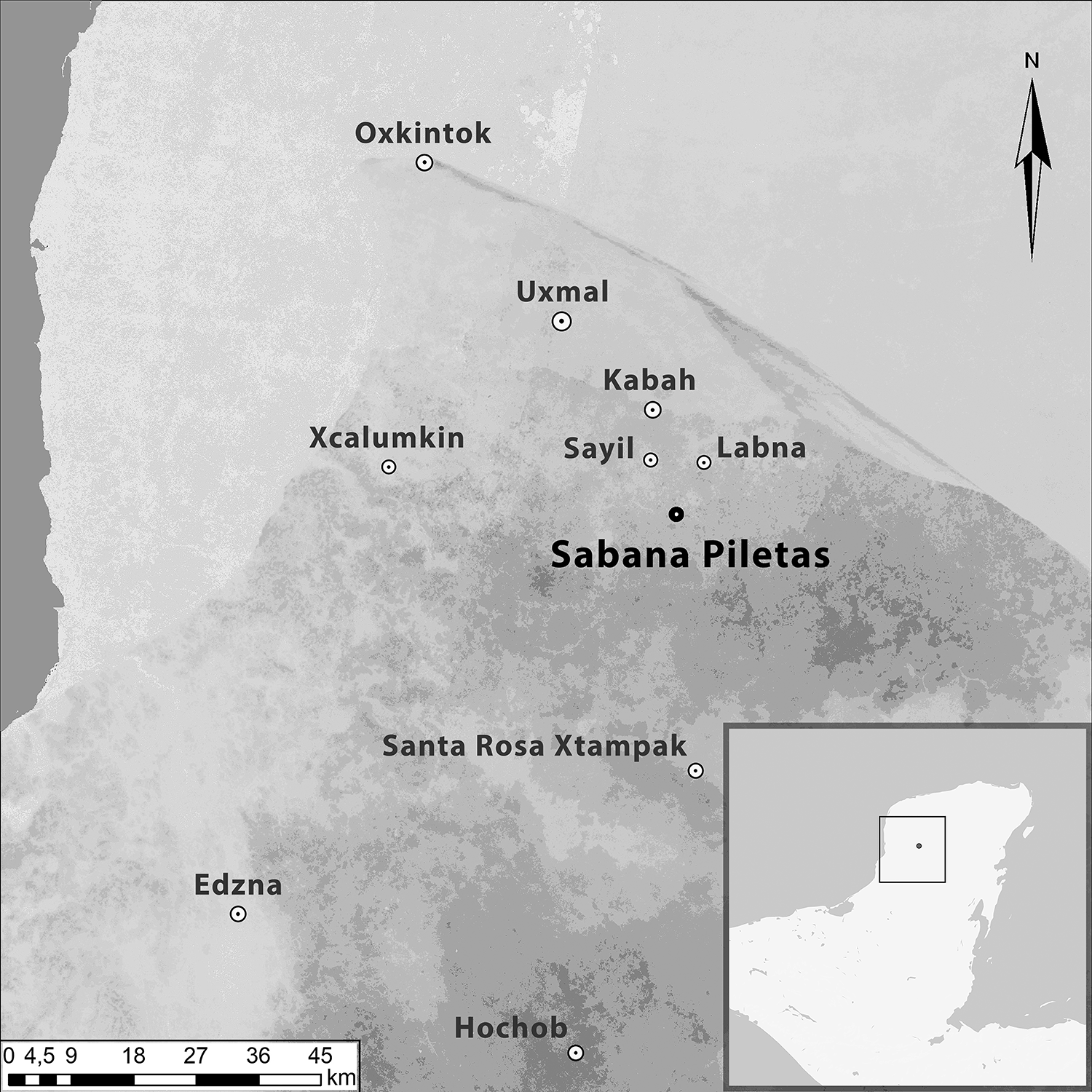
Figure 1 Long description
The map displays various locations in the Yucatan Peninsula, with Sabana Piletas prominently marked. Surrounding sites include Oxkintok, Uxmal, Kabah, Xcalumkin, Sayil, Labna, Santa Rosa Xtampak, Edzna, and Hochob. An inset map provides a broader view of the region, highlighting the area where these sites are located. A scale bar at the bottom indicates distances in kilometers and a compass rose in the top right corner shows the north direction.
The Sabana Piletas Hieroglyphic Stairway in situ. Image by Eduardo Salvador Rodríguez, 2007, courtesy of Project AJIMAYA-INAH, National Archaeology Coordination (INAH), Mexico (used with permission).
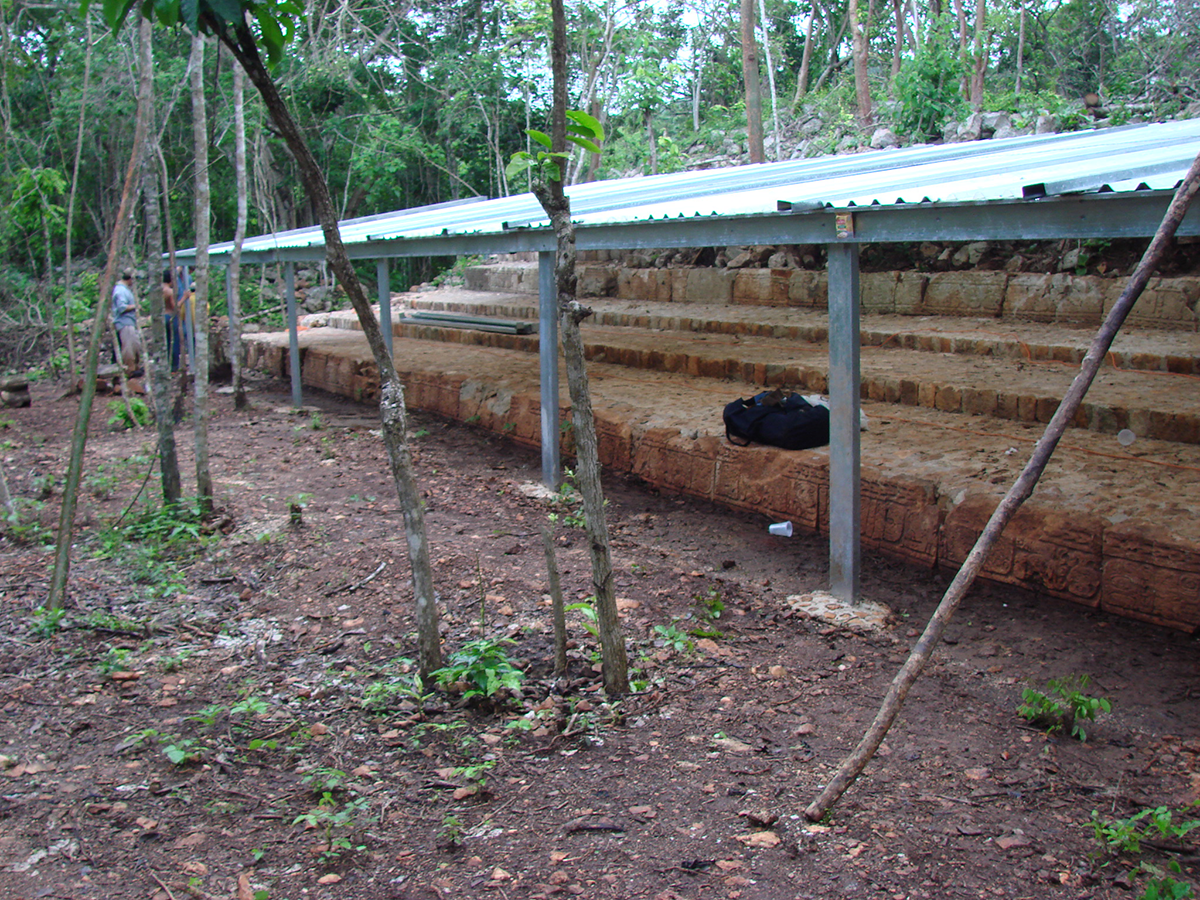
Figure 2 Long description
The image shows a hieroglyphic stairway covered by a metal roof supported by metal beams. The stairway consists of multiple steps made of stone blocks. Two people are visible in the background, standing near the stairway. The area is surrounded by trees and vegetation, indicating a forested environment. The ground is covered with soil and small plants. A black bag is placed on one of the steps of the stairway.
Grube and colleagues have argued that the stairway can be understood as “a symbolic ballcourt similar to other such ballcourts from Yaxchilan and Copan, which had a strong association with war and the sacrifice of captives” (Grube et al. Reference Grube Nikolai, Castillo and Merk2011:260–261). The theme of war, which dominates the stairway alongside ballgame references, anticipates the militaristic imagery that characterizes the iconography at various Puuc sites and, about a century later, at Chichen Itza (Grube et al. Reference Grube Nikolai, Castillo and Merk2011:261).
The final section of the text represents a tripartite record of deity impersonation as part of an extended name phrase. This article reconsiders this section to clarify the role of deity impersonation in the stairway’s ideological narrative. It also contributes to our understanding of how the impersonation of deities was used to conceptualize integral facets of Classic Maya rulership. Given recent epigraphic findings, it is now possible to analyze hieroglyphic blocks in greater detail. A key issue is the identification of the impersonated deities and the corresponding contexts. The third impersonation formula, at blocks B59–B63, is the most difficult to analyze, but the other two also merit comment because of their importance for formulating the impersonator’s identity as a ruler.
Epigraphic analysis of the impersonation section
Identifying the impersonator
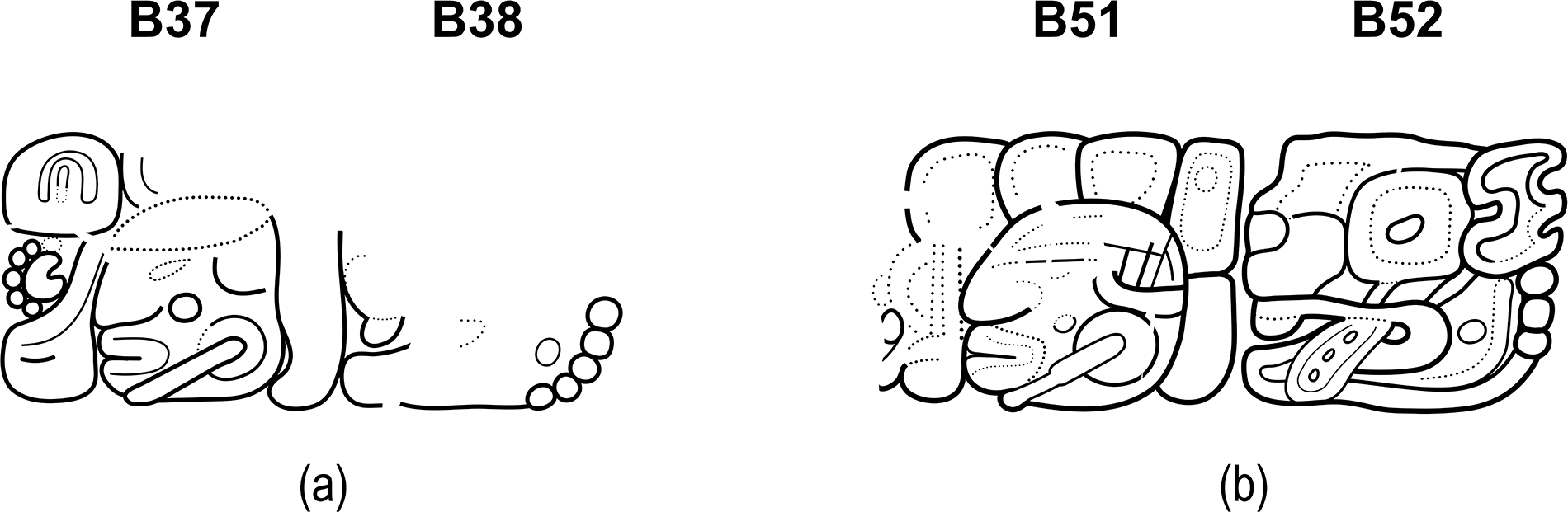
The passage, occupying blocks B39–B68 (for photographic documentation of the blocks, see Grube et al. Reference Grube Nikolai, Castillo and Merk2011:Plates 1–4), arguably functions as the subject of a clause describing ceremonial events surrounding the stairway’s dedication. The three impersonation formulae that are part of this passage do not seem to reference separate ritual events. In the typical manner described earlier, these function as “impersonation appellations” appearing alongside other elements of the impersonator’s extended name phrase, such as his title ch’ak ˀohl b’aahteˀ (Grube et al. Reference Grube Nikolai, Castillo and Merk2011:260) and personal name. The latter consists of two blocks, with B51 read as ˀa-ˀAJAW-wa ˀajaw.Footnote 1 B52 presents an unclear zoomorphic logogram with a tripartite ear, perhaps TZ’UTZ’ tz’uutz’, “coati” (cf. Helmke and Vepretskii Reference Helmke and Vepretskii2022:5–7, Figures 3–4; Stone and Zender Reference Stone and Zender2011:180–181). Grube and colleagues proposed the reading “TAAK?” for block B52, resulting in the plural form ˀajawtaak, “lords,” which would imply that the impersonation might involve several lords simultaneously (Grube et al. Reference Grube Nikolai, Castillo and Merk2011:259–260). Such an interpretation is unlikely. Indeed, the sequence at blocks B51–B52 is the same as at B37–B38 (Figure 3). In both cases, the word ˀajaw is followed by a zoomorphic head, which appears different from the head variant of TAK (cf. A40, A42; for photographs of all numbered blocks of the Sabana Piletas inscription referenced in this article, see Grube et al. Reference Grube Nikolai, Castillo and Merk2011:Plates 1–4). Furthermore, the ˀajawtaak phrases at blocks A33–A42 are all characterized by the phonetic complement ˀa (always the same variant T0012)Footnote 2 followed by the logograms ˀAJAW and TAK, with ˀAJAW placed above TAK (Grube et al. Reference Grube Nikolai, Castillo and Merk2011:256). This pattern differs from the spelling shared by the two records of the proposed impersonator’s name (Figure 3). Additionally, there are no other examples of a single-deity impersonation performed by several impersonators at once, which adds to the implausibility of a “group impersonation” at Sabana Piletas (López Oliva Reference López Oliva2025:188). Another possible reading for B52 and B38 could be SUTZ’, “bat,” but the other examples of similar bat-headed signs at Sabana Piletas, namely xu at A10 and B10, differ markedly from this one in paleography. Whatever the reading of the head sign, it seems to be a word for an animal. There is, consequently, no plural noun and no reason to suggest a group of impersonators.
The two records of the ruler’s name at Sabana Piletas. ˀa(T0229)-ˀAJAW-wa (?)TZ’UTZ’: (a) blocks B37–B38; (b) blocks B51–B52 (drawings by the author). Based on photographs by Carlos Pallán Gayol, 2007, AJIMAYA-INAH, National Archaeology Coordination (INAH), Mexico (used with permission).
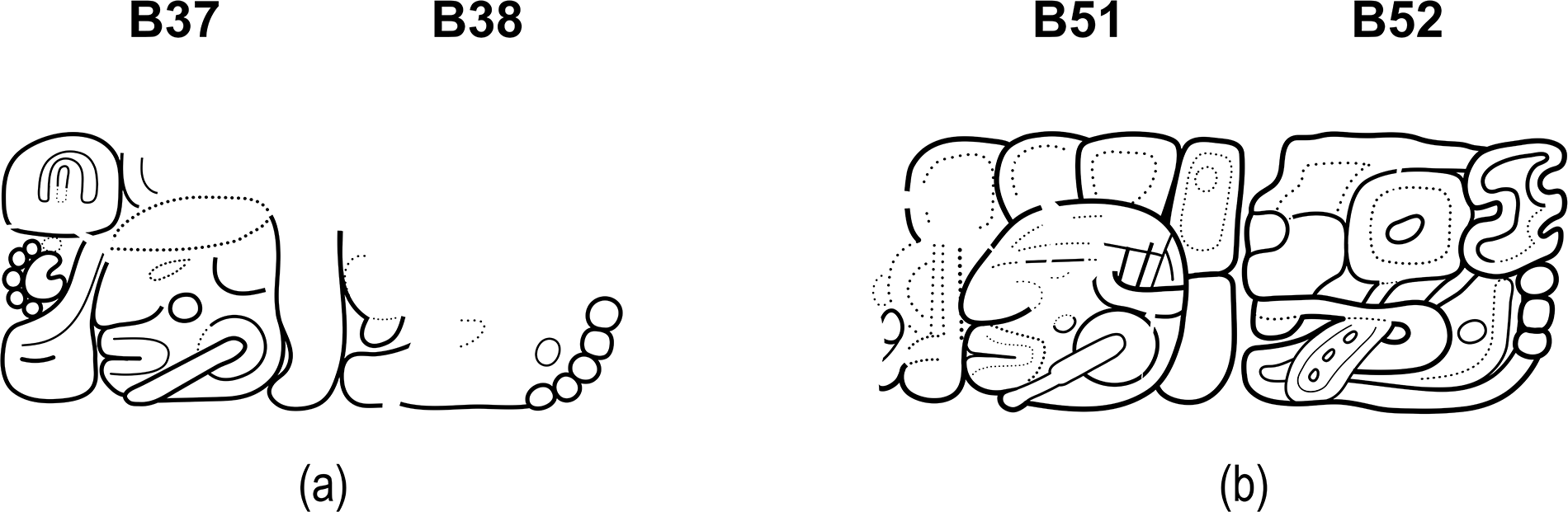
Figure 3 Long description
The image shows two drawings of hieroglyphic blocks. The first drawing, labeled B37 and B38, features intricate designs with various shapes and patterns. The second drawing, labeled B51 and B52, also contains complex glyphs with detailed elements. Both sets of blocks display unique artistic features typical of hieroglyphic writing.
I propose the name ˀAjaw Tz’uutz’ for the impersonator and apparent protagonist mentioned in the Sabana Piletas inscription. This name can be translated as “The coati is a lord” or “Lord-coati.” Although such a structure is not widespread in Classic Maya onomastic traditions, a very similar pattern appears in the name of a Terminal Classic king at La Amelia, ˀAjaw B’ot (Martin and Grube 2008[Reference Martin and Grube2000]:64–65; Vepretskii and Davletshin Reference Vepretskii and Davletshin2021:2–4; Zender Reference Zender2004:4). ˀAjaw Tz’uutz’ also holds the title ch’ak ˀohl b’aahteˀ. This title can be roughly translated as “heart-chopping b’aahteˀ” or “war-hearted b’aahteˀ” (Grube et al. Reference Grube Nikolai, Castillo and Merk2011:259), with b’aahteˀ, “head (first/main) stick (shaft/staff),” being either a military rank or a term for bailiff (Houston Reference Houston2008). The segment preceding the ruler’s extended name phrase contains the construction tub’aahteˀ ˀAjaw Tz’uutz’, “for/as the b’aahteˀ of ˀAjaw Tz’uutz’.” This hints at a hierarchical relationship between a lower-ranking b’aahteˀ and a higher-ranking ch’ak ˀohl b’aahteˀ.
All three impersonation formulae are attributed to this single impersonator. Within the impersonator’s extended name phrase, the three impersonation formulae are arranged in two segments. The first initiates the name phrase and precedes the impersonator’s ch’ak ˀohl b’aahteˀ title and his personal name ˀAjaw Tz’uutz’. The name is, in turn, followed by the remaining two impersonation formulae. After the third formula comes the sequence that ends the inscription: the parentage statement “the son of Chim/Chilam(?) Jol” at B64–B66 and the local ruler’s title ˀUsiij ˀajaw, “lord of ˀUsiij,” with the toponym ˀUsiij likely referring to Sabana Piletas, at B67–B68 (Grube et al. Reference Grube Nikolai, Castillo and Merk2011:260–261), both of which are attributable to the impersonator. Each impersonation formula is analyzed separately in the following sections.
Impersonation of the Sun God: War
The first impersonation formula underscores the Sun God’s close association with war, a link widely attested in epigraphic and iconographic evidence from the Classic period. The passage in question appears at blocks B39–B48 (Figure 4): ˀu-B’AH-hi-li ˀa-ˀAN ˀu 7-CHAPAT-TZ’IKIN K’INICH-ˀAJAW-wa K’IN-ni-TAN-na K’EW-we-la ta-to-TOK’ ta-pa-ka-la (ˀub’aahil ˀaˀn ˀUhuk Chapaaht Tz’ikiin K’ihnich ˀAjaw K’in Tahn K’eweˀl ta tooˀk’ ta pakal). For the logogram transliterated here as TZ’IKIN (Boot Reference Boot2005:252–253), David Stuart (Reference Stuart2024) has recently proposed an alternative reading, MEN, whereby the theonym would read Wuk Chapaht Men(?) K’inich Ajaw. This article follows the reading TZ’IKIN, as it is still the most widely agreed upon, at least outside calendrical contexts. The transcription also includes the aspiration in the word K’ihnich (instead of K’inich), following the analysis by Søren Wichmann (Reference Wichmann and Behrens2004:78–80). ˀUhuk Chapaaht Tz’ikiin K’ihnich ˀAjaw is a common manifestation of the Sun God (Boot Reference Boot1999, Reference Boot2005:250–259; Helmke et al. Reference Helmke, Awe, Morton, Iannone, Golden, Houston and Skidmore2015:23; Nehammer Knub et al. Reference Nehammer Knub, Thun, Helmke, Fort, Gardiol, Matteo and Helmke2009:189; Taube Reference Taube1992:50–56, Reference Taube, Ruiz, Sosa and de León2003:410). In some instances of ˀUhuk Chapaaht Tz’ikiin, the phonetic sign ˀu is infixed in the “seven” sign, resulting in ˀu-7-CHAPAT-TZ’IKIN (Boot Reference Boot2005:253–254). The reading Huk ˀUchapaaht Tz’ikiin, “Seven are the centipedes of the eagle,” might be syntactically plausible, since it resembles the structure of some theophoric regnal names and theonyms, such as Waxaklajuˀn ˀUb’aah K’awiil, “Eighteen are the heads of K’awiil,” or Waxaklajuˀn ˀUb’aah Kaan, “Eighteen are the heads of the snake” (see, e.g., Helmke and Awe Reference Helmke and Awe2016:10; for Classic Maya onomastic patterns, see also Colas Reference Colas2003, Reference Colas2004, Reference Colas, Helmke and Sachse2014). However, the evidence at Sabana Piletas supports the previously suggested reading ˀUhuk Chapaaht Tz’ikiin (Boot Reference Boot2005; Nehammer Knub et al. Reference Nehammer Knub, Thun, Helmke, Fort, Gardiol, Matteo and Helmke2009). This inscription clearly demonstrates that the prefix ˀu- is linked to huk rather than chapaaht, as the phonetic sign ˀu occupies a separate glyphic block preceding the sequence 7-CHAPAT-TZ’IKIN (Beloborodov Reference Beloborodov2020:240). The name therefore contains the ordinal ˀuhuk, “the seventh,” yielding “Seventh Centipede Eagle.”
The Sabana Piletas Hieroglyphic Stairway, Step B, blocks 39–48 (drawing by the author). Based on photographs by Carlos Pallán Gayol, 2007, AJIMAYA-INAH, National Archaeology Coordination (INAH), Mexico (used with permission).

Figure 4 Long description
A series of hieroglyphic blocks labeled from B39 to B48. Each block contains intricate designs and patterns, characteristic of ancient script. The symbols vary in shape and complexity, depicting figures and abstract forms. The arrangement suggests a sequence or narrative across the blocks.
Additionally, ˀUhuk Chapaaht Tzʼikin Kʼihnich ˀAjaw is referred to as Kʼin Tahn Kʼeweˀl, the name of one of the wahyoob’—“humanimal” (Houston and Scherer Reference Houston and Scherer2020) companion spirits or co-essences (Houston and Stuart Reference Houston and Stuart1989)—attested on ceramic vessels, a jaguar-like creature related to the Sun (Grube and Nahm Reference Grube, Nahm, Kerr and Kerr1994:687–688; Zender et al. Reference Zender, Beliaev and Davletshin2016:47–50). It is possible that such an entity was considered a wahy of the Sun God himself. Yet at Sabana Piletas, Kʼin Tahn Kʼeweˀl is part of the Sun God’s extended name phrase, likely implying, at least in this context, a complex but single entity.
This impersonation formula ends with the expression ta tooˀk’ ta pakal, “with flint (spear), with shield,” a couplet that has been analyzed as a “diphrastic kenning” (Knowlton Reference Knowlton2002) or difrasismo (Davletshin Reference Davletshin and Gister2009; Lacadena García-Gallo Reference Lacadena García-Gallo2009). It consists of the nouns tooˀk’, “flint,” and pakal, “shield” (Houston Reference Houston1983; Kelley Reference Kelley1968:257–258; Lacadena and Wichmann Reference Wichmann and Behrens2004:156). This couplet most commonly appears as the object of a clause in the possessive construction ˀutooˀk’ ˀupakal, “his flint (spear), his shield,” normally followed by a possessor (Helmke et al. Reference Helmke, Awe, Grube, LeCount and Yaeger2010:104). It has been regarded as a term for weapons (Lacadena García-Gallo Reference Lacadena García-Gallo2009:43) and is widely attested in passages describing military defeat as part of the phrase jub’uuy ˀutooˀk’ ˀupakal, “the ‘flint-and-shield’ of [so-and-so lord] gets brought/knocked down” (Bassie-Sweet et al. Reference Bassie-Sweet, Hopkins, Josserand, Hull and Carrasco2012:201; Martin Reference Martin2020:211). In most cases, the tooˀk’-pakal couplet likely denoted a manifestation of military power (Martin Reference Martin2020:157, 209), sometimes perhaps embodied by actual troops (Martin Reference Martin2020:209) or an effigy (Bassie-Sweet et al. Reference Bassie-Sweet, Hopkins, Josserand, Hull and Carrasco2012:201; see also Bassie-Sweet Reference Bassie-Sweet2019).
The presence of this couplet in the impersonation formula emphasizes the deity’s martial nature, which the ruler shares through the deity–human concurrence that impersonation entails. Regardless of whether it denotes an army, martial might, personified weapons, or actual military attire, most epigraphic mentions of tooˀk’-pakal involve its downfall or destruction, whereas the Sun God retains the flint-tipped spear and shield. This idea seems crucial to the impersonation of the Seventh-Centipede-Eagle Sun God, which is by far the most common manifestation of the solar deity in impersonation contexts (Nehammer Knub et al. Reference Nehammer Knub, Thun, Helmke, Fort, Gardiol, Matteo and Helmke2009:189). As an embodiment of this divine entity, the impersonator shared the deity’s wahy-related name, Kʼin Tahn Kʼeweˀl, and was considered to hold the Sun God’s “flint-and-shield.” By extending the impersonation formula and highlighting the deity’s association with war, the inscription celebrates the military power of the ruler himself.
Impersonation of the Water Serpent: Lordship
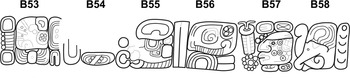
The impersonation of the second deity mentioned on the stairway is tied to the Classic Maya concept of lordship. The formula features the deity Yax Chiit Juˀn Witzʼ Naah Kaan (Figure 5): ˀu-B’AH-hi-ˀAN-nu YAX-[CHIT]-ta 1-WITZ’ NAH-KAN-nu ta-ˀAJAW-wa li-le (ˀub’aah ˀaˀn Yax Chiit Juˀn Witz’ Naah Kaˀn/Kan/Kaan ta ˀajawlel/ˀajawlil-eˀ[?]). This is the so-called Water Lily Serpent or Water-lily Monster (Schele and Miller Reference Schele and Miller1986:46), also known simply as the Water Serpent (Houston and Stuart Reference Houston and Stuart1996:299; Stuart Reference Stuart2025), an entity associated with animate bodies of running water such as streams or rivers (Coltman Reference Coltman2015; Helmke et al. Reference Helmke, Awe, Morton, Iannone, Golden, Houston and Skidmore2015:23; Stuart Reference Stuart2007).
The Sabana Piletas Hieroglyphic Stairway, Step B, blocks 53–58 (drawing by the author). Based on photographs by Carlos Pallán Gayol, 2007, AJIMAYA-INAH, National Archaeology Coordination (INAH), Mexico (used with permission).
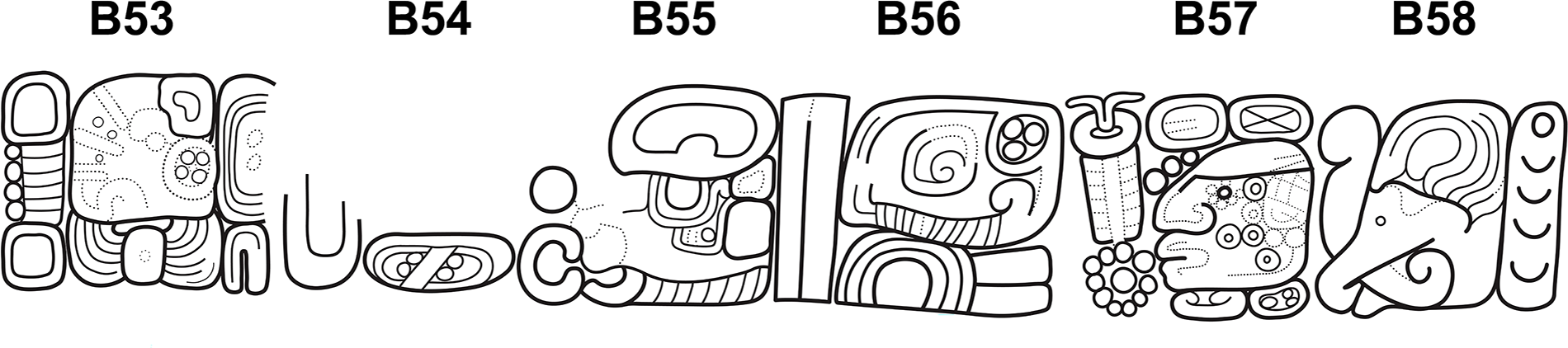
Figure 5 Long description
The illustration shows six hieroglyphic blocks labeled B53 to B58. Each block contains intricate designs, with varying shapes and patterns. Block B53 features a combination of geometric shapes and curved lines. Block B54 includes circular and oval elements. Block B55 displays a prominent curved shape with detailed internal patterns. Block B56 has swirling designs and layered elements. Block B57 features a combination of circular motifs and detailed textures. Block B58 includes elongated shapes and circular patterns. The blocks are arranged in a linear sequence, showcasing a variety of artistic elements typical of hieroglyphic inscriptions.
The deity’s name is followed by the expression ta ˀajawlel or ta ˀajawlil-eˀ, which may be translated as “in lordship” (Bíró Reference Bíró2011a:46–52; Helmke et al. Reference Helmke, Awe, Morton, Iannone, Golden, Houston and Skidmore2015:23; Houston et al. Reference Houston, Robertson and Stuart2001:22–23). It is unclear whether the spelling li-le at the end of the sequence implies a Yucatecan enclitic -eˀ along with a -lil(?) suffix or simply represents local orthographic convention; in either case, similar final -Ce signs in disharmonic spellings occur on the Sabana Piletas stairway and at other sites throughout northern Yucatan (Lacadena and Wichmann Reference Lacadena, Wichmann, Blos, Cobos and Robertson2002:287–288). For the sake of convenience, this article will follow the transcription ta ˀajawlel for the Sabana Piletas example. Furthermore, the variation of prepositions (ti in some cases, ta in others) in this expression across the Maya Lowlands can be explained by language variation (Macri Reference Macri and Fields1991, Reference Macri2021).
The expression ti/ta ˀajawlel appears in descriptions of accession ceremonies in Classic Maya writing, where the phrase chumlaj/chumwaan ti ˀajawlel, “sat in lordship,” conveys enthronement. Similarly, a typical entry marking a ruler’s anniversary might read tzutzuuy juˀn winikhaab’ ti ˀajawlel, “it got ended, one (the first) score of years in lordship” (Lacadena García-Gallo Reference Lacadena García-Gallo2004:91–92). The impersonation of Yax Chiit Juˀn Witz’ Naah Kaan explicitly references the deity’s close connection with lordship and the fact that the impersonator is a lord (ˀajaw).
The link to the notion of lordship is particularly apparent given the association of the Naah Kaan entity with other concepts of power. The name K’an Chiit Naah Kaan on Ceibal Stela 9 (Graham Reference Graham1996:29) refers to the “celestial band,” specific regal insignia similar in function to kʼawiil-scepters (Davletshin Reference Davletshin, Borodatova and Tishkov2006, Reference Davletshin, López, Rivera and González2014): ˀilaˀ ˀub’aah ti K’an Chiit Naah Kaan, “his self is seen with K’an Chiit Naah Kaan.” The name translates as “The First Serpent is the Yellow Chiit.” The meaning of the word chiit remains unclear. The Ceibal stela portrays the lord Watʼul Kʼatel holding the “celestial band” with the heads of K’awiil at its edges (Schele and Mathews Reference Schele and Mathews1998:175–196). The name Yax Chiit Naah Kaan, in turn, means “The First Serpent is the Green Chiit.” Another “colored Chiit” can be found in the Postclassic Dresden Codex (Plate 46), where the name Chak Chiit, “Red Chiit,” can be identified (Davletshin Reference Davletshin, López, Rivera and González2014:13). This could be a case of Mesoamerican color symbolism—if so, there could be even more such entities, including white and black ones. Such a “color code” (Davletshin Reference Davletshin, Borodatova and Tishkov2006:162) was particularly characteristic of gods associated with rain and thunder, sometimes labeled as “quadripartite rain and thunder deities” (Wrem Anderson and Helmke Reference Wrem Anderson and Helmke2013:169–177). Each color was linked to one of the four cardinal directions, while the center—the fifth core element of the quincunx representation of the cosmos—was also marked with a color, most frequently green (Davletshin Reference Davletshin, Borodatova and Tishkov2006:162; DeBoer Reference DeBoer2005:172; Wrem Anderson and Helmke Reference Wrem Anderson and Helmke2013:177–179). In such a scheme, the “Green Chiit” could be associated with the center. The “Green Chiit” serpent is also named a wahy of Kʼawiil on Yaxchilan Lintel 15 (Graham and Von Euw Reference Graham and Euw1977:39). Given K’awiil’s importance to royal power, creatures regarded as this god’s co-essences would likely be linked to it as well.
Although the evidence is limited, epigraphic records suggest that impersonating Yax Chiit Juˀn Witz’ Naah Kaan was the prerogative of those bearing ˀajaw-derived titles, including royal women (ˀix ˀajaw). The famous Ix “K’ab’el” of Waka’ is shown impersonating the deity’s feminine form, ˀIx Yax Chiit Juˀn Witzʼ Naah Kaan, on El Peru Stela 34 (Wanyerka Reference Wanyerka1996:Figures 1, 10; see also López Oliva Reference López Oliva2018b:152–168). Calakmul Stela 9 (Ruppert and Denison Reference Ruppert and Denison1943:Plate C) provides another impersonation formula featuring ˀIx Yax Chiit Juˀn Witz’ Naah Kaan. On a lintel from the Yaxchilan region now in the collection of the Los Angeles County Museum of Art (Stevens and Butler Reference Stevens and Butler2003:133), a royal woman appears inside a moon sign, bearing a Water Serpent headdress (Chinchilla Mazariegos Reference Chinchilla Mazariegos, Mazariegos, Doyle and Pillsbury2022:79–81). The accompanying inscription describes her as the impersonator of ˀIx Juˀn Witz’(?) Naah Kaan. Additionally, the theonym ˀIx Yax Chit Juˀn Witz’ Naah Kaan also occurs as a short impersonation formula (i.e., without ˀub’aahil ˀaˀn: see Table 1) in the name phrase of a noblewoman on Bonampak Stela 2 (Beloborodov Reference Beloborodov2025; Bíró Reference Bíró2011b:4; Mathews Reference Mathews and Robertson1980:62, Figure 2).
The impersonation of the Water Serpent, especially with the mention of ˀajawlel “lordship,” underscores the impersonator’s capability to govern, that is, to be an ˀajaw. This brings us back to the local ruler’s title, ˀUsiij ˀajaw, “lord of Usiij,” which has been attributed to the person mentioned in the parentage statement, named Chim Jol or Chimil Jol, or perhaps Chilam Jol (Grube et al. Reference Grube Nikolai, Castillo and Merk2011:260; López Oliva Reference López Oliva2018b:678, Reference López Oliva2025:188). I suggest that the impersonator’s father is instead mentioned only by name, while the title ˀUsiij ˀajaw pertains to the impersonator himself. This would align with the idea that the Water Serpent impersonations were likely restricted to ˀajaw-titled individuals and help explain why this person embodies Yax Chiit Juˀn Witz’ Naah Kaan “in lordship.”
Impersonation of Jun Ajaw: The ballgame
As discussed later, the third and final impersonation formula, appearing in blocks B59–B63, conceptually aligns with the previous two, in this case highlighting yet another major responsibility of a Classic Maya ruler, namely participation in the ballgame. I propose the following reading: ˀu B’AH-hi-li-ˀAN-nu 7-sa-wa-na 1-ˀAJAW ta-pi-tzi[-ji?] (ˀub’aahil ˀaˀn Huk Sawan Juˀn ˀAjaw ta pitz).
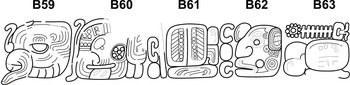
Grube and colleagues initially suggested the reading “u BAAH [A’AN]-nu? 7-sa-wa?-ni? 1-AJAN ta-?” (Grube et al. Reference Grube Nikolai, Castillo and Merk2011:259–260), which would result in the theonym Huk Sawaan Juˀn ˀAjan accompanied by a prepositional construction beginning with ta, the same structure as ta tooˀk’ ta pakal and ta ˀajawlel in the two other impersonation formulae. However, the main sign at B62 is not the logogram ˀAJAN, “corncob” (Grube et al. Reference Grube Nikolai and Castillo2008:91; Stone and Zender Reference Stone and Zender2011:21–22; Zender Reference Zender2008, Reference Zender2014), which often forms part of the Maize God’s name records, but rather the logogram ˀAJAW, “lord.” This variant of the logogram represents the head of “God S,” associated with Jun Ajaw, a Classic Maya counterpart of Hunahpu, a K’iche’ mythic hero from the Popol Vuh (Taube Reference Taube1992:115–119; see also Chinchilla Mazariegos Reference Chinchilla Mazariegos2017:173–174, Figures 79–81; Helmke and Nielsen Reference Helmke and Nielsen2015:30; Stone and Zender Reference Stone and Zender2011:45). Block B62 thus reads as 1-ˀAJAW Juˀn ˀAjaw (Figure 6; cf. the record of this figure’s name on a renowned Codex-style plate now in the collection of the Museum of Fine Arts, Boston [Kerr Maya Vase Database No. 1892]). Oswaldo Chinchilla Mazariegos has hypothesized an alternative Classic Maya name for God S or Hunahpu as Juun Pu’w or “One Pus,” based on an enigmatic name tag on a painted ceramic vase (Kerr Maya Vase Database No. 7727; Chinchilla Mazariegos Reference Chinchilla Mazariegos2020). This article will refer to the deity as Jun Ajaw, as this name is widely attested in epigraphic evidence and more commonly accepted among researchers. However, it is worth noting that Maya gods often appear under several names and epithets, so it is possible that both Juˀn ˀAjaw and Juˀn Puˀw were in use during the Classic period (Chinchilla Mazariegos Reference Chinchilla Mazariegos2020:8). Whatever the actual phonetic reading, the presence of this mythological figure at Sabana Piletas can be regarded as secure, since block B62 features what Chinchilla Mazariegos has identified as “the God S logogram” (Reference Chinchilla Mazariegos2020:6).
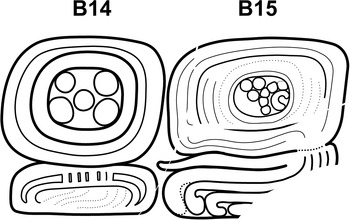
The main part of the theonym, Juˀn ˀAjaw, is preceded by an extension at B61. The bottom sign of the block is not the syllabic ni, as Grube and colleagues proposed, but the syllabic na. This identification is supported by comparing the paleography of other examples of ni and na on the stairway (cf., e.g., B14–B15 [Figure 7], B45 [Figure 4]). Block B61 should read as 7-sa-wa-na (Huk Sawan) (Figure 6). The word sawan (sa-wa-na) appears in the name K’ihnich Sawan B’ahlam (or perhaps K’ihnich Sawan Hix) on Tonina Monument 168, although the “sa-na-wa sanaw” interpretation of that sequence of syllabic signs is also possible (Nielsen et al. Reference Nielsen, Helmke, Stuart and Sánchez Gamboa2019:6–7). Given the similar positioning of the signs in the block, it is possible to propose that both inscriptions provide the same word. If the reading is taken to be sa-na-wa at Tonina, as suggested by Nielsen and colleagues (Reference Nielsen, Helmke, Stuart and Sánchez Gamboa2019:6), then the reading Huk Sanaw Juˀn ˀAjaw is possible at Sabana Piletas. In either case, the etymology and meaning of the word remain unclear. I take the reading sa-wa-na sawan as my working hypothesis based on the reading order at Sabana Piletas.
The Sabana Piletas Hieroglyphic Stairway, Step B, blocks 59–63 (drawing by the author). Based on photographs by Carlos Pallán Gayol, 2007, AJIMAYA-INAH, National Archaeology Coordination (INAH), Mexico (used with permission).
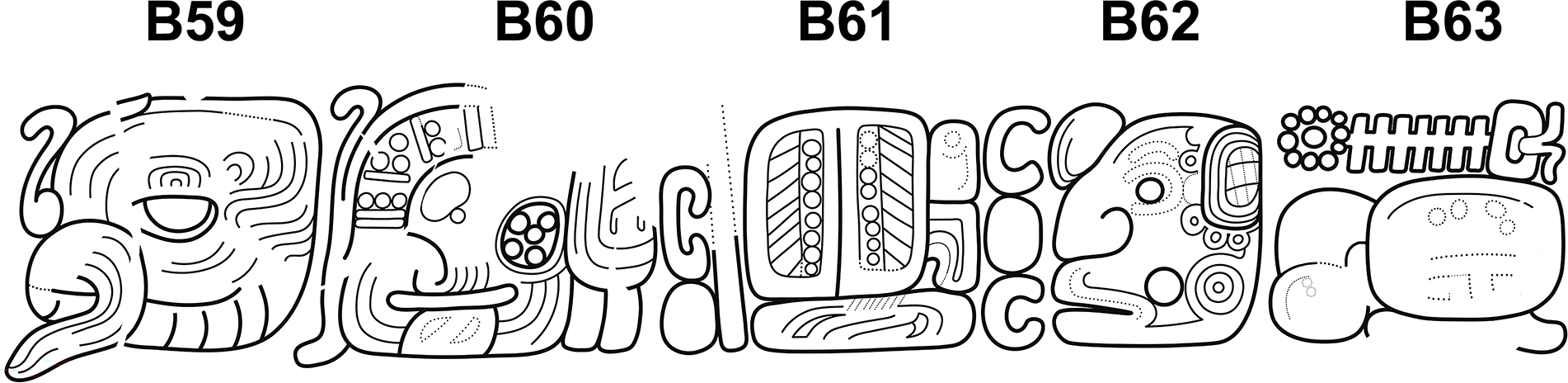
Figure 6 Long description
The image shows hieroglyphic blocks labeled B59 to B63 from the Sabana Piletas Hieroglyphic Stairway. Each block contains intricate Maya designs and figures. Block B59 features a stylized face with decorative elements. Block B60 includes circular motifs and abstract shapes. Block B61 displays vertical patterns and geometric designs. Block B62 shows a profile of a face with detailed ornamentation. Block B63 contains a combination of circular and linear patterns, completing the sequence. The blocks are arranged horizontally, showcasing the complexity and artistry of Maya hieroglyphics.
K’AN-na TUN-ni. A reference example of na and ni on the Sabana Piletas Hieroglyphic Stairway, Step B, blocks 14–15 (drawing by the author). Based on photographs by Carlos Pallán Gayol, 2007, AJIMAYA-INAH, National Archaeology Coordination (INAH), Mexico (used with permission).
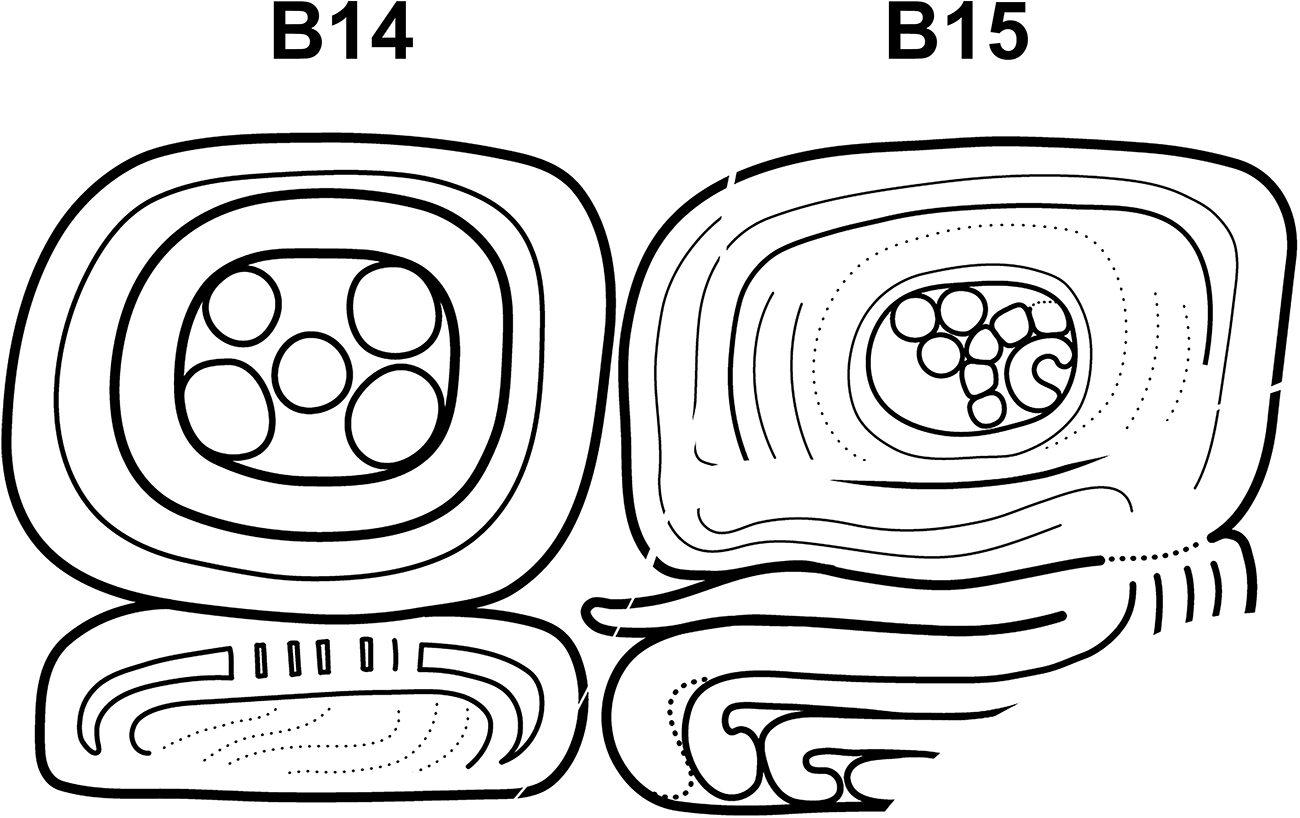
Figure 7 Long description
The illustration shows two hieroglyphic blocks labeled B14 and B15. Block B14 features a central design with four circular elements surrounded by concentric lines. Below this, there are linear patterns and dotted lines. Block B15 displays a central design with multiple circular elements, also surrounded by concentric lines. Below this, there are curved lines and patterns. Both blocks exhibit intricate and detailed designs typical of hieroglyphic art.
The state of preservation of the prepositional construction at B63 is far from perfect, but the reading ta-pi-tzi[-?ji] ta pitz/pitzij, “in ballplay,” is most plausible. The drawing in Figure 6 shows that the left-hand glyph is very similar in outline to the phonetic sign pi, and the main sign can be matched with examples of syllabic tzi from other inscriptions of northern Yucatan (e.g., the Xcalumkin Columns and Jamb 6; Chichen Itza Lintel 1). An unclear syllabic sign seems to be rendered below tzi but is now missing due to the stone’s erosion. The presence of ji or la is plausible, although it is also possible that this outline is simply a graphic support for tzi.
The Classic Maya considered Jun Ajaw to be one of the ballgame’s patrons (Tokovinine Reference Tokovinine2002:2–3). In the Popol Vuh, the famous K’iche’ text recorded during the colonial era, the so-called Hero Twins, Hunahpu and Xbalanque, are closely associated with the ballgame and play ball in Xibalba, the underworld (see, e.g., Tedlock Reference Tedlock1996:119–129). Some elements of this mythic motif are also found in sources of the Classic period (Coe Reference Coe1978:58–60; Coe Reference Coe1989; Kowalski Reference Kowalski1989:17; Schele and Miller Reference Schele and Miller1986:251–253, 257). The idea of a one-to-one correspondence between the Classic pair and the Hero Twins of the Popol Vuh has been critically reassessed by Oswaldo Chinchilla Mazariegos, considering, in particular, the lack of indications concerning the two figures’ relationship to each other—let alone twinship—in Classic-period sources (Chinchilla Mazariegos Reference Chinchilla Mazariegos2017:172). However, these deities, who can be cautiously labeled “Headband Gods” (Chinchilla Mazariegos Reference Chinchilla Mazariegos2017:170–172; see also Coe Reference Coe1973, Reference Coe1978, Reference Coe1989), tend to appear—although not exclusively—together in Classic imagery, and at least one of them, Jun Ajaw (God S), seems to be consistently associated with the ballgame (Chinchilla Mazariegos Reference Chinchilla Mazariegos2017:175).
Simon Martin and colleagues have suggested that Naranjo Stela 47 portrays the renowned sixth-century king Aj Numsaaj as Jun Ajaw’s impersonator (Martin et al. Reference Martin, Fialko, Tokovinine, Ramírez, Arroyo, Salinas and Álvarez2016:616, Figure 5). The inscription on that stela presents the phrase JOY-ti-pi-tzi johyaj (joyaj?) ti pitz, “he ‘dressed’ for the ballgame” (Martin et al. Reference Martin, Fialko, Tokovinine, Ramírez, Arroyo, Salinas and Álvarez2016:617). The depictions of bones and disembodied eyes in the ruler’s attire, as well as the sign ˀAK’AB’ (“darkness, night”) on his pectoral, mark a link to the world of the dead, likely suggesting that the impersonation was performed during a ritual that reproduced the mythical ballgame played in the underworld (Martin et al. Reference Martin, Fialko, Tokovinine, Ramírez, Arroyo, Salinas and Álvarez2016:616, 626). On Naranjo Altar 1 (Graham Reference Graham1978:103), the same king is called Juˀn ˀAjaw K’uh, “Jun Ajaw the Deity” (see blocks H3–I4 of Altar 1; cf. an alternative spelling of this glyphic sequence on Vase K1004 [Chinchilla Mazariegos Reference Chinchilla Mazariegos2020:Figure 4]). The theonym appears as a “short impersonation formula,” presenting the Naranjo king as the embodiment or manifestation of Jun Ajaw (Beloborodov Reference Beloborodov2020:241, 245). It was apparently the ballgame-related impersonation described on Stela 47 that enabled Aj Numsaaj to acquire the name of Jun Ajaw on Altar 1. Copan Stela 63 (Schele Reference Schele1990:Figure 2) arguably provides another example of the impersonation of Jun Ajaw (Nehammer Knub et al. Reference Nehammer Knub, Thun, Helmke, Fort, Gardiol, Matteo and Helmke2009:189). The side inscription on the monument contains the standard impersonation formula, with an ambiguous glyph for the deity name. The sign depicts a head quite similar to that of Jun Ajaw: While this Early Classic example is unclear, such a dot on a young male face is usually an iconographic mark of that deity.
The impersonation of Huk Sawan Juˀn ˀAjaw at Sabana Piletas can be considered another manifestation of Jun Ajaw’s association with the ballgame, an association supported by both colonial and Classic sources. By embodying the divine ballplayer, the impersonator likely proclaims his own dedication to the ceremonial game, in parallel with the other two cases in which he emphasizes his military might and ability to rule. By listing this alongside the Sun God and Water Serpent impersonations, the inscription on the stairway appears to crystallize the “ruler-as-ballplayer” concept and demonstrate the importance of the ballgame for building the ruler’s identity.
The section in context
Internal context
The content of the deity impersonation section echoes the thematic focus of the stairway inscription, emphasizing warfare, the ballgame, and the impersonator’s status as a lord. The identification of the third impersonated deity as “Huk Sawan Juˀn ˀAjaw in ballplay” clarifies how the section fits within the overall narrative, complementing the earlier ballgame-related references in this text. The parallel glyphic passages at A16–A18 and B16–B18 present the same sequence, ˀe-ˀEB’ 3/HUX “BALLCOURT”-na, featuring ˀehb’, “stair,” and a ballcourt-related term of unknown reading. This glyphic record resembles references to “three-conquest” or “three-awakening” (huux ˀahaal) stairs and ballcourts that appear in texts throughout the Maya region and describe an important mythical ballgame event (Grube et al. Reference Grube Nikolai and Castillo2008:88, Reference Grube Nikolai, Castillo and Merk2011:254; Houston et al. Reference Houston, Stuart and Taube2006:93; Martin and Grube 2008[Reference Martin and Grube2000]:130; Tokovinine Reference Tokovinine2002:1, Figure 1).
Architecturally, the stairway itself may have been designed to evoke ballgame-related structures, in alignment with the inscription’s content. Grube and colleagues have noted that the context and location of the Sabana Piletas Hieroglyphic Stairway are reminiscent of the Reviewing Stand of Structure 12 at Copan and Hieroglyphic Stairway 2 from Temple 33 at Yaxchilan (Grube et al. Reference Grube Nikolai and Castillo2008:88, Reference Grube Nikolai, Castillo and Merk2011:254). Both structures are far removed from the actual ballcourts (Martin and Grube 2008[Reference Martin and Grube2000]:130; Schele and Freidel Reference Schele and Freidel1990:322–323). Nonetheless, at Copan, “the architects had created a symbolic space that contains many elements of ballcourt imagery, marking the plaza in front of the Reviewing Stand as an underworld location” (Grube et al. Reference Grube Nikolai, Castillo and Merk2011:253). Yaxchilan Hieroglyphic Stairway 2, in turn, provides a detailed description of the ballgame myth of huux ˀahaal and a relief image of Yaxuun B’ahlam (“Bird Jaguar IV”) playing with a ball supposedly made from the body of a Lakamtuun lord (Martin and Grube 2008[Reference Martin and Grube2000]:130). The structures at Copan and Yaxchilan may exemplify symbolic, or “false,” ballcourts, as may the stairway at Sabana Piletas (Grube et al. Reference Grube Nikolai, Castillo and Merk2011:253–254, 261). Considering its presumed association with the symbolic ballcourt complex, the purpose of mentioning the impersonation of “Jun-Ajaw-as-ballplayer” might be to consecrate the monument, reinforcing the symbolic status of the stairway.
Ritual architecture of this kind also tends to be associated with human sacrifice and war (Grube et al. Reference Grube Nikolai, Castillo and Merk2011:261), which aligns with the impersonation of ˀUhuk Chapaaht Tz’ikiin K’ihnich ˀAjaw “with flint (spear) and shield.” A lengthy description of war-related events appears at A33–A64, occupying much of the first step. The glyphic blocks that have survived erosion lack any detail regarding the dates and actors involved but do mention the “destruction of the earth” of the “south lords,” “east lords,” “north lords,” and “west lords,” suggesting a series of conflicts on a regional scale or even beyond (Grube et al. Reference Grube Nikolai, Castillo and Merk2011:256). Whether this indicates a real event or a mythic-ritualistic reference, the inscription’s focus on a war narrative may explain why the name phrase at the end of the text begins with the impersonation of the Sun God.
The Sabana Piletas case shows that the ballgame was considered to be as essential to rulership as the ability to exercise lordship or wage war. The impersonation section not only articulates the stairway’s ritual and ceremonial role but also legitimizes the impersonator’s authority. Such legitimation is conveyed through his association with the divine figures seen as the patrons or manifestations of certain roles and activities considered fundamental to rulership, and the ballgame was clearly among them.
External context
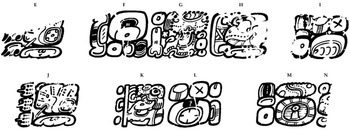
Grouped impersonations of particular divine beings, as well as those beings’ recurrent ties to major royal activities, are found well beyond Sabana Piletas. The triplet from the stairway is notably similar to the passage inscribed on a Late Classic ceramic vase from Cuychen, Belize (Helmke et al. Reference Helmke, Awe, Morton, Iannone, Golden, Houston and Skidmore2015). The dedicatory rim inscription refers to the vase’s owner as the impersonator of the Water Serpent and the Sun God (Figure 8): (1, E–I) ˀub’a[a]h ˀan Yax Chit Juˀn Witz’ Nah Kan ti ˀajawle[l] (ˀu-B’AH-ˀAN-na YAX-CHIT-ti 1-WITZ’ NAH-KAN-na ti-ˀAJAW-le), and (2, J–M) ˀub’a[a]h ˀan [ˀU]huk Chapaht Tz’ikiin K’i[h]nich ˀAjaw ti tooˀk’ ti pakal (ˀu-B’AH-ˀAN-na 7-CHAPAT-TZ’IKIN K’IN-ˀAJAW-wa ti-TOK’-PAKAL) (Helmke et al. Reference Helmke, Awe, Morton, Iannone, Golden, Houston and Skidmore2015:23). There are some differences in the glyphic spelling of names and prepositional constructions. Whereas the long vowel is transcribed in Chiit (based on the disharmonic phonetic complement ta) in the Sabana Piletas example, the Cuychen inscription contains the short vowel (with the synharmonic spelling CHIT-ti resulting in Chit). Instead of the common glottalized ˀaˀn, as seen at Sabana Piletas (ˀAN-nu), the Cuychen vase features ˀan, without glottalization (ˀAN-na). The Cuychen inscription therefore reflects the loss of vowel length and glottalization (Lacadena and Wichmann Reference Wichmann and Behrens2004; Wichmann Reference Wichmann2006). Additionally, the preposition is ta at Sabana Piletas and ti at Cuychen, which signals different local traditions and language variation (Macri Reference Macri and Fields1991, Reference Macri2021).
The two impersonation formulae in the inscription on the Cuychen vase (drawing by Christophe Helmke, after Helmke et al. Reference Helmke, Awe, Morton, Iannone, Golden, Houston and Skidmore2015:Figure 15).
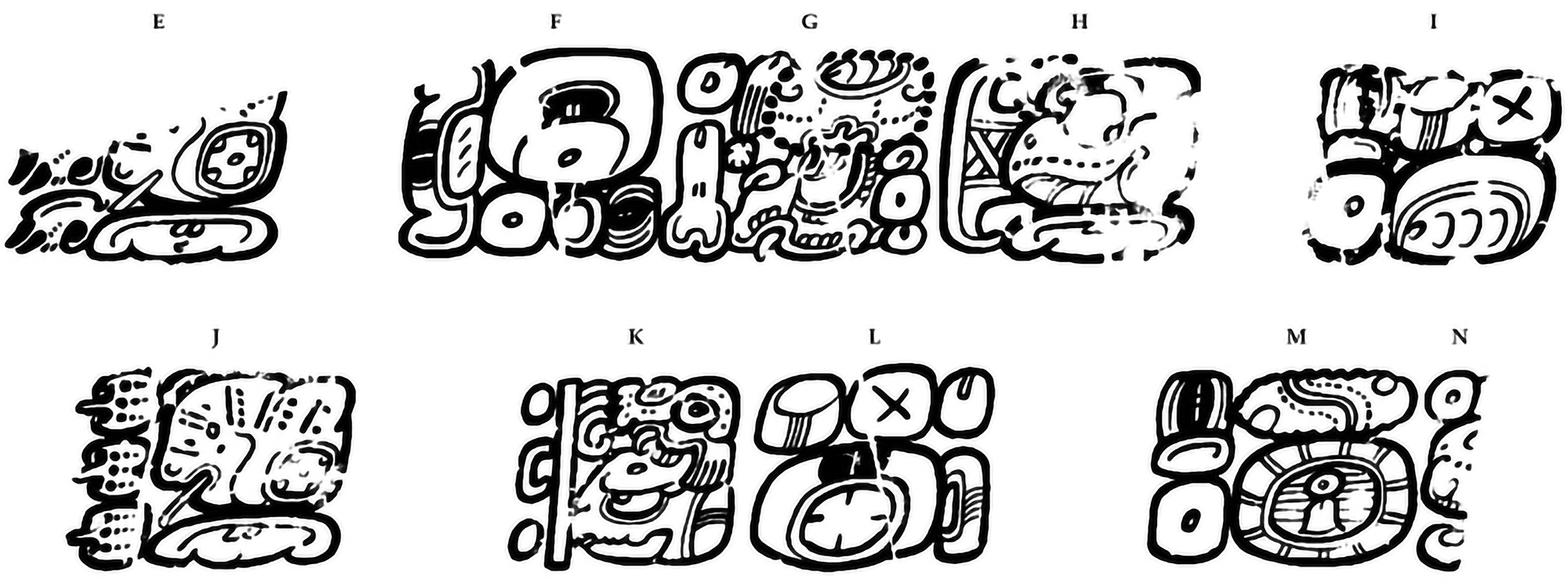
Figure 8 Long description
The image shows ten glyphs labeled E to N. Each glyph contains unique designs and patterns. Glyph E features curved lines and circular shapes. Glyph F includes circular and oval elements. Glyph G displays intricate designs with various shapes. Glyph H has abstract patterns and curved lines. Glyph I contains circular and cross-like figures. Glyph J features linear and circular elements. Glyph K includes complex designs with circular shapes. Glyph L has cross and circular designs. Glyph M displays circular and grid-like patterns. Glyph N features circular and abstract designs.
Despite the dissimilar order of the deities and the absence of the K’in Tahn K’eweˀl part in the name phrase of the Sun God in the Cuychen inscription, the resemblance to the Sabana Piletas example is clear. In both cases, the impersonation of ˀUhuk Chapaaht Tz’ikiin K’ihnich ˀAjaw includes a reference to tooˀk’-pakal, while the impersonation of Yax Chiit Juˀn Witz’ Naah Kaan is linked to ˀajawlel, a parallel construction that highlights the martial setting for one deity and the regal setting for another (Helmke et al. Reference Helmke, Awe, Morton, Iannone, Golden, Houston and Skidmore2015:24). Lordship and warfare were among the primary responsibilities of any Classic Maya ruler. Christophe Helmke and colleagues have noted that the appearance of the vase’s owner in the guise of the two deities mainly associated with these areas emphasizes “the two idealized and complementary aspects of ancient Maya rulership” (Helmke et al. Reference Helmke, Awe, Morton, Iannone, Golden, Houston and Skidmore2015:25). The same can be said of the impersonations at Sabana Piletas, with the difference that the stairway provides not two but three “idealized and complementary aspects,” with the ballgame as the third.
The three pertinent deities are well attested in the written records of impersonation. ˀUhuk Chapaaht Tz’ikiin K’ihnich ˀAjaw is the most impersonated deity in inscriptions (Nehammer Knub et al. Reference Nehammer Knub, Thun, Helmke, Fort, Gardiol, Matteo and Helmke2009:189), appearing in at least 21 instances, five of which include a reference to the “flint-and-shield,” emphasizing the god’s association with war (Helmke et al. Reference Helmke, Awe, Morton, Iannone, Golden, Houston and Skidmore2015:24). The second most impersonated deity is the Water Serpent, Yax Chiit Juˀn Witz’ Naah Kaan (Helmke et al. Reference Helmke, Awe, Morton, Iannone, Golden, Houston and Skidmore2015:23; Nehammer Knub et al. Reference Nehammer Knub, Thun, Helmke, Fort, Gardiol, Matteo and Helmke2009:190). Two of at least 12 records (Nehammer Knub et al. Reference Nehammer Knub, Thun, Helmke, Fort, Gardiol, Matteo and Helmke2009:190) include the expression “in lordship/kingship” (Bíró Reference Bíró2011a:46–52, 67; Helmke et al. Reference Helmke, Awe, Morton, Iannone, Golden, Houston and Skidmore2015:23). In total, there are at least seven attested impersonation formulae involving Jun Ajaw-related entities, including Huk Sawan Juˀn ˀAjaw and Hukteˀ(?) [Juˀn] ˀAjaw (Nehammer Knub et al. Reference Nehammer Knub, Thun, Helmke, Fort, Gardiol, Matteo and Helmke2009:189). The constructions ti/ta pitz and ti lajchaˀ nahb’ sometimes appear in these cases, serving as an explicit link to a ballgame setting (Zender Reference Zender2004).
The mural painting from Structure 10K2 at Xultun, Guatemala, provides a parallel case of the “complementary impersonations” pattern, albeit with a different set of deities. The ruler Yax Weˀnel Chan K’ihnich is described as follows (Figure 9): ˀu-B’AH-ˀAN-nu 1-ˀIK’-ˀIXIM?-ma? ti-ta … ˀIK’-“T0533” ti-12-NAB’ (ˀub’aah[il] ˀaˀn Juˀn ˀIk’ ˀIxiim ti ta[aj] … ˀik’ … ti lajchaˀ nahb’) (Saturno et al. Reference Saturno, Rossi, Stuart and Hurst2017:428). William Saturno and colleagues suggested the name Juˀn ˀIk’ ˀIxiim ti taaj, “First Wind-Maize with Obsidian,” for the impersonated deity (Saturno et al. Reference Saturno, Rossi, Stuart and Hurst2017:428–429). The theonym Juˀn ˀIk’ ˀIxiim is followed by the prepositional construction ti taaj, arguably referring to a sacrificial obsidian blade. The next impersonation formula seems to occur immediately after the ti taaj block. The deity is called ˀIk’ “T0533,” or “Black T0533,” where T0533 stands for an undeciphered logogram. The formula is specified by the prepositional construction ti lajchaˀ nahb’, “with 12 handspans” (Saturno et al. Reference Saturno, Rossi, Stuart and Hurst2017:429). The latter usually appears alongside Hukteˀ(?) Juˀn ˀAjaw (Nehammer Knub et al. Reference Nehammer Knub, Thun, Helmke, Fort, Gardiol, Matteo and Helmke2009:189) in other examples and operates as a marker of the ballgame context, since the expression lajchaˀ nahb’, “12-handspan,” refers to the physical size of rubber balls (Eberl and Bricker Reference Eberl and Bricker2004; Zender Reference Zender2004). On a vase from the Naranjo-Holmul area (Kerr Maya Vase Database No. 2358), “Black T0533” is accompanied by the phrase ti pitz, “in ballplay,” an alternative indication of a ballgame setting (Saturno et al. Reference Saturno, Rossi, Stuart and Hurst2017:429). There, “Black T0533” is arguably the final glyph of a long theonym within what appears to be an extended impersonation formula, starting with the expression ˀub’aahil ˀaˀn and ending with the prepositional construction ti pitz. I suggest that the Xultun caption’s eroded block B1, preceding this “Black T0533” name, also hides ˀub’aahil ˀaˀn. The mural’s caption may thus provide a sequence of impersonations resembling those of the Sabana Piletas Hieroglyphic Stairway and the Cuychen vase. The text connects the wind-maize deity to sacrificial rituals and the enigmatic “Black T0533” to the ceremonial ballgame (Saturno et al. Reference Saturno, Rossi, Stuart and Hurst2017:429–430).
The niche caption of the Structure 10K2 mural painting at Xultun, Guatemala (drawing by David Stuart, Proyecto Regional San Bartolo-Xultun, after Saturno et al. Reference Saturno, Rossi, Stuart and Hurst2017:Figure 7).
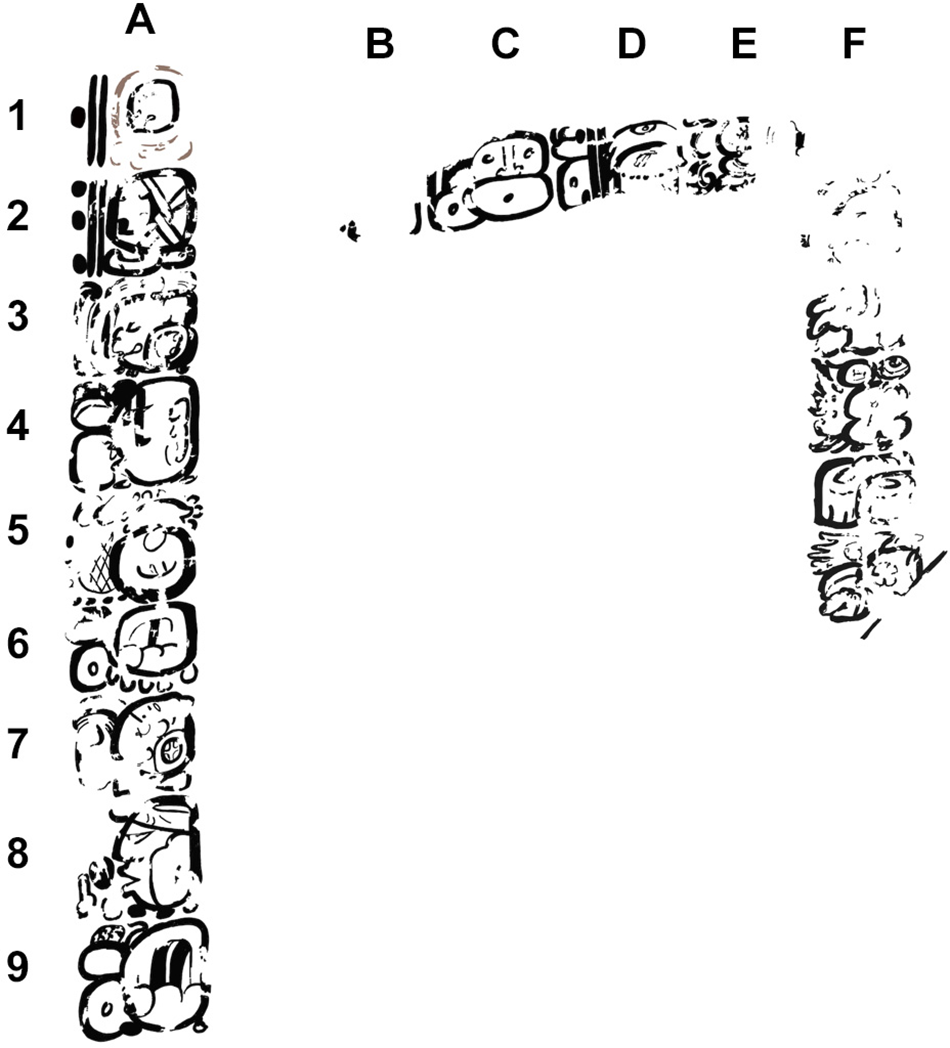
Figure 9 Long description
The illustration shows hieroglyphic text arranged in two columns. The left column is labeled A and contains nine numbered glyphs from 1 to 9. The right column is labeled B to F and contains six numbered glyphs from 1 to 6. Each glyph is uniquely designed, featuring intricate patterns and marks typical of hieroglyphic writing. The layout suggests a structured sequence, with each glyph occupying a distinct position within its respective column.
In Classic Maya inscriptions, there are other cases of extended impersonation formulae connecting deities to certain contexts. A representative example is a form of the god ˀAhkan named Juˀn Pik ˀAhkan (or perhaps Huux Pik ˀAhkan, according to Grube Reference Grube, Graña-Behrens, Grube, Prager, Sachse, Teufel and Wagner2004:63), whose impersonation is marked with the prepositional construction ti ˀuk’ chih, or “[in] drinking pulque,” on Copan Altar U (Grube Reference Grube, Graña-Behrens, Grube, Prager, Sachse, Teufel and Wagner2004:62–63). Another extended formula—on a polychrome vase presumably from the Naranjo region (Kerr Maya Vase Database No. 2777)—involves a deity with the prepositional construction ti tz’ihb’, or “in writing.” However, outside the discussed impersonation triplet from Sabana Piletas and two couplets from the Xultun mural and the Cuychen vase, such extended impersonation formulae occur singly rather than in groups, making the rare instances of grouped extended formulae particularly significant.
These three sets of impersonation formulae—from Xultun, Cuychen, and Sabana Piletas—not only reveal fundamental features of particular deities but also foreground major activities of the rulers. The parallel listing of the corresponding constructions likely served to delineate the boundaries of concepts such as “rulership-as-waging-war,” “rulership-as-exercising-lordship,” and “rulership-as-playing-ball” (the quoted phrases are interpretations, not direct translations). This structure implies that these manifestations represent related yet distinct aspects of Classic Maya rulership. This focus on the ruler’s roles is particularly clear at Sabana Piletas, where three such aspects are listed together and integrated into the overall narrative.
The Sabana Piletas case shares this idealized interconnection between the gods and their impersonators with other motifs involving deity impersonation, such as the ritual replication of mythic narratives at Palenque (Stuart Reference Stuart2005:59–108), the schematic representation of cosmic order at Laxtunich (Houston et al. Reference Houston, Stuart, Taube and Houston2021), and the celestial juxtaposition of deceased royal parents at Yaxchilan (Fash et al. Reference Fash, Tokovinine and Graham2022:208–209, 220–221, 238–239, 240, 246–247, 281; Houston Reference Houston, Mazariegos, Doyle and Pillsbury2022:106).
Conclusion
Alongside the cases of Cuychen and Xultun, the set of deity impersonation formulae from Sabana Piletas reveals apparently consistent pairings of certain deities with specific prepositional constructions indicating mythological and religious contexts. An emphasis on the essential qualities of the impersonated gods likely allowed the impersonator to highlight fundamental components of his own identity as a ruler, be that the role of military leader, lord, ballplayer, or performer of sacrifice.
The analysis presented here can be particularly useful considering the Sabana Piletas stairway’s very late date. Composed in the mid-ninth century, this inscription is one of the latest Classic Maya texts, not only in the Puuc region but in the corpus more broadly. On the one hand, this late date highlights the conceptual continuity between the robust Late Classic tradition of the Lowlands and the notions presented in the epigraphic data of a later Puuc-region polity. Equally significant, on the other hand, is that this exact pattern of deity impersonation is attested only very late.
Notably, all known extended impersonation formulae are Late Classic or Terminal Classic, predominantly dated to the eighth century, with no Early Classic examples. The Cuychen, Xultun, and Sabana Piletas cases—where extended formulae are grouped in a conceptual couplet or triplet—are among the latest known overall. The Sabana Piletas stairway is dated around a.d. 858; the inscription on the Cuychen vase was presumably produced between a.d. 791 and 820 (Helmke et al. Reference Helmke, Awe, Morton, Iannone, Golden, Houston and Skidmore2015:27); the Xultun niche caption provides a mid-eighth-century date, most likely a.d. 749 (Saturno et al. Reference Saturno, Rossi, Stuart and Hurst2017:426).
This may point to a later development in how power and the idealized images of deities were represented, perhaps reflecting ideological concerns typical of periods of crisis. Amid the significant political turmoil at the end of the Late Classic period, when traditional regional dynamics shifted and well-established polities sometimes yielded to rulers of questionable descent or even explicitly foreign origin (Martin Reference Martin2020:277–299), some lords may have sought new ways to articulate what, in practice, constituted their authority.
In a context where rulership may have been less readily construed as a unified and continuous whole, the notion that it was instead a composite of specific activities or roles associated with particular gods might have functioned as a powerful ideological device. A ruler could empower himself by impersonating or embodying these deities, thereby completing an idealized picture of one who legitimately held the power to rule. Notably, ˀajawlel, “lordship,” associated with the Water Serpent, appears as one facet, equal in status to warfare and the ballgame, rather than as a kind of “umbrella concept” one might expect.
This interpretation remains tentative. The scarcity of data does not permit a fuller explanation of why this innovation in records of deity impersonation occurred or what additional factors may have shaped it. The challenge is compounded by the fact that Xultun, Cuychen, and Sabana Piletas are geographically far apart, and we have yet to find other comparable cases.
Despite these issues, the Sabana Piletas case provides one of the most detailed examples of how impersonating deities could enable rulers to articulate their authority and legitimize their position within the cosmic order, as well as clarify what rulership itself meant to the Late Classic nobility. Further research on deity impersonation records of this kind will also deepen our understanding of how particular gods were perceived by the Classic Maya and what roles they played within elite ideological discourse.
Acknowledgements
This article grew from a paper presented at the 10th Knorozov Readings in Moscow in 2019. Since that presentation, my initial observations have developed substantially through conversations with my mentors and colleagues. I am deeply grateful to Sergei Vepretskii for his insightful comments and moral support. I sincerely thank Alexander Safronov and Dmitri Beliaev for discussing many of these ideas with me and generously responding to my questions. I am indebted to Albert Davletshin for enriching my understanding of the broader Mesoamerican context. I am grateful to Alexandre Tokovinine for commenting on my findings and sharing his observations on Yaxchilan stelae. I also thank Mallory Matsumoto for her thoughtful suggestions during the final revision. I owe particular thanks to Carlos Pallán Gayol, who kindly provided me with the original photographs of the Sabana Piletas Hieroglyphic Stairway taken under the auspices of the AJIMAYA-INAH project. These photographs helped me see more details of the inscription and make drawings of the fragments discussed in this article. I wish to thank the anonymous reviewers whose constructive criticism has contributed significantly to the improvement of the manuscript. At Ancient Mesoamerica, I thank Bruce Bruschi for facilitating the technical side of the submission process and Sarah “Stacy” Barber for her invaluable editorial assistance.
Competing interests
The author declares none.
Data availability statement
The author confirms that the data supporting the findings of this study are available within the article [and/or its supplementary materials].



 Open access

