


Introduction
Concerns about a possible divide between political elites and citizens of EU member states (MSs) on European integration have loomed large since the identification of a ‘sleeping giant’ of unrepresented Eurosceptic mass attitudes (Van der Eijk and Franklin, Reference Van der Eijk, Franklin, Marks and Steenbergen2004). Ushered in by the Maastricht Treaty, heightened issue salience and Eurosceptic issue entrepreneurs progressively brought the European dimension into the mainstream (Hooghe and Marks, Reference Hooghe and Marks2009; Hutter et al., Reference Hutter, Grande and Kriesi2016; De Vries and Hobolt, Reference De Vries and Hobolt2020). Within this new political framework, research on ‘EU issue congruence’ identified a significant discrepancy between supportive pro-European political elites and more cautious citizens (Mattila and Raunio, Reference Mattila and Raunio2006, Reference Mattila and Raunio2012; McEvoy, Reference McEvoy2012; Real-Dato, Reference Real-Dato2017; Vogel and Göncz, Reference Vogel, Göncz, Conti, Göncz and Real-Dato2019; Pareschi et al., Reference Pareschi, Giglioli and Baldini2023).
In this context, Italy represents an interesting case (Cotta et al., Reference Cotta, Isernia and Verzichelli2005), having displayed a particularly intense shift from ‘permissive consensus’ to ‘constraining dissensus’ (Hooghe and Marks, Reference Hooghe and Marks2009; Conti et al., Reference Conti, Marangoni and Verzichelli2020a). During the ‘First Republic’ (1946–1994), the eventual ‘conversion’ of left-wing parties to the European cause heralded a period of widespread pro-Europeanism. Once regarded as a bulwark of support for European integration – perhaps even an ‘outlier’ – Italy may have become a ‘forerunner’ of anti-EU sentiment. The country's Europhilia began to wane during the ‘Second Republic’ era, largely due to dissatisfaction with the Maastricht convergence criteria and the challenges posed by the Eastern enlargements. The ‘polycrisis’ of the 2010s further fuelled the rise and consolidation of several Eurosceptic forces (Conti et al., Reference Conti, Pedrazzani and Russo2020b). While these political actors may have highlighted a perceived mass-elite mismatch on European integration, the question remains whether Italy's (in)congruence exhibits distinct characteristics compared to other countries.
To address this question, we map and compare support for European integration in the EU-9 over time. Combining a wide array of mass and elite surveys between 1979 and 2016, we investigate the extent and evolution of EU mass-elite congruence in the Italian case vis-à-vis other longstanding MSs. In doing so, we innovate the extant body of knowledge in three respects. First, we provide an innovative longitudinal analysis spanning four decades, while most congruence studies investigate a single time point. Our multi-level models (MLM) test the presence of a mass-elite gap (plus several possible determinants of congruence in the Supplementary material). Second, we contribute to the literature by examining the dynamics of EU issue congruence within both pro-European and Eurosceptic macro-groups (Bakker et al., Reference Bakker, Jolly and Polk2018; McDonnell and Werner, Reference McDonnell and Werner2018). Third, we observe the Italian country-specific patterns vis-à-vis the rest of the EU-9 to ascertain any potential divergence.
Our results confirm that candidates and elected officials hold significantly more positive views of the integration process than the general public across the EU-9 over time. More importantly, our study proves the existence of a double-sided gap. Mass-elite incongruence in the pro-European camp mimics the patterns first assessed at the general level. In contrast, albeit with less consistency, political elites of Eurosceptic parties have significantly more negative attitudes toward integration vis-à-vis their voters. When examining the Italian case, our findings reveal a more nuanced picture. Despite still displaying a pro-EU elite bias overall, Italy does not mirror the general EU-9 pattern with respect to the presence of the double-sided gap.
Theory: EU mass-elite congruence
Analyses of EU mass-elite congruence are rooted in the tradition of congruence studies (Miller and Stokes, Reference Miller and Stokes1963). While citizens and political elites form their opinions in cognitively different ways, their mutual tendency to interpret issues through broad evaluative dimensions supports the feasibility of mass-elite comparisons. Over decades, congruence has developed into ‘an extensive literature on substantive representation, which […] takes a well-established place in research on representation’ (Walczak and Van der Brug, Reference Walczak and Van der Brug2013, 4; see also Powell, Reference Powell2004). Such studies are informed by the notion that mass-elite congruence constitutes a substantial component of representative democracy (Dahl, Reference Dahl1971; Karyotis et al., Reference Karyotis, Rüdig and Judge2014). Hence, opinion correspondence normatively matters per se. Furthermore, specific mass-elite gaps have been empirically related to lower voter turnout and satisfaction with democracy (Lefkofridi, Reference Lefkofridi, Rohrschneider and Thomassen2020). Opinion incongruence can pose challenges for the political system as a whole and for individual parties, depending on varying issue salience and party competition dynamics (Van der Eijk and Franklin, Reference Van der Eijk and Franklin1991; Karyotis et al., Reference Karyotis, Rüdig and Judge2014).
In this research field, the investigation of attitudes towards European integration has paralleled its gradual transformation into an autonomous political dimension in national politics (Costello et al., Reference Costello, Thomassen and Rosema2012; Bakker et al., Reference Bakker, Jolly and Polk2018). Since the pioneering work by Van der Eijk and Franklin (Reference Van der Eijk and Franklin1991), numerous studies have sought to assess the degree of opinion congruence between political elites and citizens along the European dimension. The polycrisis, coupled with the politicisation of EU matters by partisan issue entrepreneurs (De Vries and Hobolt, Reference De Vries and Hobolt2020), has further amplified scholarly attention within individual EU MSs (Karyotis et al., Reference Karyotis, Rüdig and Judge2014) and across Europe.
EU mass-elite congruence studies largely share a family resemblance of sorts (Shim and Gherghina, Reference Shim and Gherghina2020; Pareschi et al., Reference Pareschi, Giglioli and Baldini2023). Even when nurturing explanatory aims, they typically involve descriptive approaches. They exploit opinion surveys, ideally asking identical questions to samples of national populations and parliamentarians/candidates. Survey responses are typically aggregated at the country level, to compare elected legislators with the general public, or at the party level, to contrast party elites with their supporters/voters. In the absence of elite surveys, party positions are often inferred from voters’ perceptions or expert assessments (Ecker et al., Reference Ecker, Jenny, Müller and Praprotnik2022). Despite growing attention to the multidimensionality of EU-related attitudes,Footnote 1 congruence is usually measured along a general dimensional scale gauging whether ‘European unification has already gone too far’ or ‘should be pushed further.’ Averages or medians are frequently employed as indicators. Reliance on cross-national surveys most often results in assessments of congruence in multiple countries at a single time point.
Regarding the findings, EU mass-elite congruence is reported to have generally declined since the 1990s. Initially, high levels of congruence were observed regarding general European integration (Van der Eijk and Franklin, Reference Van der Eijk and Franklin1991; Marsh and Wessels, Reference Marsh and Wessels1997; Thomassen and Schmitt, Reference Thomassen, Schmitt, Schmitt and Thomassen1999; Schmitt and Thomassen, Reference Schmitt and Thomassen2000). By the 2000s, a clear divide emerged between pro-European political elites and warier citizens (Mattila and Raunio, Reference Mattila and Raunio2006, Reference Mattila and Raunio2012; Costello et al., Reference Costello, Thomassen and Rosema2012; McEvoy, Reference McEvoy2012). Subsequent analyses (Dolný and Baboš, Reference Dolný and Baboš2015; Real-Dato, Reference Real-Dato2017; Bakker et al., Reference Bakker, Jolly and Polk2018; Vogel and Göncz, Reference Vogel, Göncz, Conti, Göncz and Real-Dato2019; Pareschi et al., Reference Pareschi, Giglioli and Baldini2023) broadly confirmed this ‘pro-EU elite bias.’ However, recent methodological innovations have expanded the avenues for mass-elite comparison, resulting in new ambiguities (Real-Dato, Reference Real-Dato2017; Shim and Gherghina, Reference Shim and Gherghina2020). As remarked by Müller et al. (Reference Müller, Jenny, Ecker, Best, Lengyel and Verzichelli2012, 169–170), this body of research exhibits a ‘peaceful coexistence of research results and conclusions,’ which ‘could remain as long as different methods of comparing mass and elite attitudes were applied to different data sets.’
This peaceful coexistence cautions against overinterpreting previous attempts to explain country-level or party-level congruence, especially given the variation in the dependent variable's (DV) specification.Footnote 2 Research examining the impact of country-specific independent variables (IVs) has yielded, at best, mixed findings. Party-system fragmentation may supply a wider range of choices, leading to higher congruence, yet past studies found no confirmation (Marsh and Wessels, Reference Marsh and Wessels1997; Mattila and Raunio, Reference Mattila and Raunio2006, Reference Mattila and Raunio2012; Dolný and Baboš, Reference Dolný and Baboš2015). The same goes for ideological range, party polarisation (Mattila and Raunio, Reference Mattila and Raunio2006; Dolný and Baboš, Reference Dolný and Baboš2015), and EU salience (Mattila and Raunio, Reference Mattila and Raunio2012). Electoral system characteristics have also predominantly yielded negative findings (Marsh and Wessels, Reference Marsh and Wessels1997; Walczak and Van der Brug, Reference Walczak and Van der Brug2013; Dolný and Baboš, Reference Dolný and Baboš2015). Differences in party systems between older and newer EU MSs informed additional hypotheses, which met with inconsistent outcomes (Mattila and Raunio, Reference Mattila and Raunio2006, Reference Mattila and Raunio2012; Walczak and Van der Brug, Reference Walczak and Van der Brug2013; Real-Dato, Reference Real-Dato2017). Lastly, Real-Dato (Reference Real-Dato2017) reported no systematic change in EU issue congruence throughout Europe during the Great Recession, not even for ‘crisis countries.’ Conversely, Vogel and Göncz (Reference Vogel, Göncz, Conti, Göncz and Real-Dato2019) registered a general decrease, with political elites withdrawing their support for European integration less than the public during the polycrisis.
Similarly, conflicting findings were gathered concerning the influence of party traits separating ‘mainstream’ political forces from ‘niche’ or ‘challenger’ parties. Two similar studies (Mattila and Raunio, Reference Mattila and Raunio2006, Reference Mattila and Raunio2012) diverged on whether political formations in opposition ensured tighter party-voter representation or not. They found that electorally larger parties display lower congruence, yet McEvoy (Reference McEvoy2012) obtained the opposite result. Finally, while all these investigations (Mattila and Raunio, Reference Mattila and Raunio2006, Reference Mattila and Raunio2012; McEvoy, Reference McEvoy2012) found left-wing parties to exhibit higher congruence on European integration, according to Walczak and Van der Brug (Reference Walczak and Van der Brug2013), radical right parties performed the best. Given these premises, it is worth re-examining EU mass-elite congruence and its drivers in a long-term timeframe.
European integration and congruence: the Italian case
Italy holds particular significance in the context of European integration and its influence on domestic political attitudes over the decades, especially since the country's trajectory has seen a notable shift from deep-rooted Europhilia to pronounced Euroscepticism.
In fact, in the late 1940s and early 1950s, Italy was not characterised by permissive consensus (Serricchio, Reference Serricchio2012). At the time, only a plurality supported the ‘choice of Europe,’ which was closely linked to the country's pro-Atlantic positioning (Cotta et al., Reference Cotta, Isernia and Verzichelli2005). In the following decades, however, public and partisan support for European integration gradually grew into a near-unanimous consensus, as the common market's first steps accompanied the ‘economic boom’ of the late 1950s–1960s. The Italian Socialist Party, which had previously abstained over EEC membership, began shifting toward pro-Europeanism roughly in step with its entry into national government during the 1960s. Public opinion, domestic legitimisation, and changing international scenarios also contributed to the Italian Communist Party's eventual conversion to ‘Eurocommunism.’ In an advisory referendum held in 1989, 88% of voters – on a turnout of 81% – endorsed granting constituent powers to the European Parliament. The event cemented Italy's reputation as one of the most distinctively Europhile members of the European Communities.
With the watershed moment constituted by the Maastricht Treaty, the EU was born as such, and its political significance with regard to MSs’ domestic policies came to light (Brack and Startin, Reference Brack and Startin2015). In Italy, the early 1990s saw a wholesale collapse of the party system, with the major historical political forces being replaced by successor parties or novel political contenders. The so-called Second Republic, revolving around the struggle between a centre-right and a centre-left coalition, saw notable fissures in Italy's pro-European stance. As in other EU MSs, the national population's pro-European sentiments significantly hinged on perceived benefits for the country while being weakened by perceptions of threats to cultural identities (Serricchio, Reference Serricchio2012; Di Mauro, Reference Di Mauro2014). The constraints imposed by the Economic and Monetary Union (EMU), combined with the redistributive and cultural tensions arising from the Eastern enlargements, gradually eroded the citizenry's positive attitudes. Public wariness of the EU found political outlets within the centre-right coalition: Silvio Berlusconi's Euro-pragmatism; Go Italy and the National Alliance's mixture of functional pro-Europeanism and soft Euroscepticism; and the Northern League's more pronounced Euroscepticism (Conti, Reference Conti2003; Conti et al., Reference Conti, Marangoni and Verzichelli2020a). Within the centre-left, notwithstanding the Euroscepticism of the Communist Refoundation Party, pro-Europeanism was integral to the coalition's outlook. Still, the harsh repercussions of the Great Recession eventually undermined its electorate's faith in the EU as a source of prosperity (Di Mauro, Reference Di Mauro2014).
Heralding another transformation in the Italian political system, the polycrisis saw a major shift in EU-related attitudes. The 2010s saw increasing polarisation in the Italian public sphere, particularly following the disruptive 2013 general election which brought the issue to the forefront (Giannetti et al., Reference Giannetti, Pedrazzani and Pinto2016), alongside a surge in Euroscepticism. From a partisan perspective, Eurosceptic forces – the Five Star Movement, the League, and Brothers of Italy – collectively commanded over 50% of the vote in the decade's second half (Conti et al., Reference Conti, Pedrazzani and Russo2020b).Footnote 3 From a public opinion perspective, the Italian population's trust in the EU dropped from almost 60% in 2003 to less than 40% in 2018 (Balfour and Robustelli, Reference Balfour and Robustelli2019). Believers in a better future outside the EU became a plurality in 2016–2017 (Eurobarometer 2017), exacerbating a long-term trend (Conti et al., Reference Conti, Di Mauro and Memoli2022). Linked to each other, public-based and party-based Euroscepticism resembled two sides of the same coin (Conti et al., Reference Conti, Marangoni and Verzichelli2020a). The relatively more positive public attitudes attested in the early 2020s do not necessarily entail any restoration of Italian Europhilia, as the crises may have left a more substantial mark on Italy than on other European MSs (Teperoglou and Belchior, Reference Teperoglou and Belchior2020).
Given these premises, it is unsurprising that Italy was frequently included in cross-national studies of EU issue congruence. Evidence points to a ‘pro-EU elite bias,’ although the gap's size has proved less stable from a comparative perspective. Different analyses have alternately found congruence in Italy to be more pronounced (Marsh and Wessels, Reference Marsh and Wessels1997; Dolný and Baboš, Reference Dolný and Baboš2015), somewhat weaker (Müller et al., Reference Müller, Jenny, Ecker, Best, Lengyel and Verzichelli2012), and close to average (Sanders and Toka, Reference Sanders and Toka2013) when compared to other countries. Real-Dato (Reference Real-Dato2017) observed a comparative decline of Italian mass-elite congruence in 2009–2014, as its population – unlike its elected legislators – became tangibly less pro-European. Most recently, Pareschi et al. (Reference Pareschi, Giglioli and Baldini2023) showed the pro-EU elite bias in Italy to be slightly lower than average on the general dimension and slightly higher along various subdimensions.
Evidence on Italy can also be gathered from party-level analyses. Contrary to earlier evidence (Van der Eijk and Franklin, Reference Van der Eijk and Franklin1991), later research (Thomassen and Schmitt, Reference Thomassen and Schmitt1997; Costello et al., Reference Costello, Thomassen and Rosema2012) showed specific Italian parties to exhibit pro-EU elite bias – similar to European trends. Mattila and Raunio (Reference Mattila and Raunio2006, Reference Mattila and Raunio2012); McEvoy (Reference McEvoy2012) found the Italian party system to display overall pro-EU elite bias, comparable in size to the average surveyed country. Nevertheless, it is worth noting that none of these analyses exploited actual elite surveys when deriving party positions.
Overall, past research supplies little evidence portraying Italy's degree of EU issue congruence as idiosyncratic, let alone an outlier. However, the current state of the literature calls for a re-examination of this matter due to interrelated reasons. The diverse approaches, methodologies, and datasets used in past studies hinder the attainment of definitive conclusions. Furthermore, earlier studies – which included different subsets of EU MSs, thus complicating the identification of an EU ‘mainstream’ – only observed a single time point (though see Real-Dato, Reference Real-Dato2017; Vogel and Göncz, Reference Vogel, Göncz, Conti, Göncz and Real-Dato2019). This issue warrants further exploration through a longitudinal analysis, whose design is specifically aimed at shedding light on the unique characteristics of Italy within a broader comparative framework.
Hypotheses
We propose two sets of hypotheses to tackle the paper's stated aims. The first set deals with mass-elite gaps on European integration in the EU-9, their evolution over time, and their separate dynamics among pro-Europeans and Eurosceptics. The second one relates the hypotheses to the Italian case. Additionally, we consider possible drivers of EU issue congruence identified by previous works.
Our first hypothesis (H1A) posits the existence of ‘pro-EU elite bias’ in support for European integration. The expectation, directly informed by the constraining dissensus of postfunctionalist theory (Hooghe and Marks, Reference Hooghe and Marks2009), is underpinned by manifold congruence assessments performed especially since the 2000s (among others, Thomassen and Schmitt, Reference Thomassen, Schmitt, Schmitt and Thomassen1999; Mattila and Raunio, Reference Mattila and Raunio2012; Real-Dato, Reference Real-Dato2017; Bakker et al., Reference Bakker, Jolly and Polk2018; Vogel and Göncz, Reference Vogel, Göncz, Conti, Göncz and Real-Dato2019). This would entail the presence of a mass-elite gap along the general dimension of European integration, with parliamentarians/candidates exhibiting significantly more pro-European attitudes than their voters. While INTUNE researchers found the gap in every country surveyed in 2007 (Best et al., Reference Best, Lengyel and Verzichelli2012), we only suggest that it may manifest in most MSs and at most time points. Hence:
H1A. Support for European integration is significantly higher among political elites than the public.
Expectations regarding the size of the gap over time remain somewhat open-ended. According to existing accounts, European citizens may have distanced themselves from European integration more than political elites at two critical junctures. Discrepancies may have widened after the Maastricht Treaty, with masses becoming more divided and less supportive (Down and Wilson, Reference Down and Wilson2008) as they shifted from permissive consensus to constraining dissensus. Vogel and Göncz (Reference Vogel, Göncz, Conti, Göncz and Real-Dato2019) also suggest that congruence may have worsened in the early 2010s (see Real-Dato, Reference Real-Dato2017), as a result of a comparatively sharper decrease in pro-European commitment among national populations. Thus, we posit that:
H2A. The elite bias in support for European integration significantly increased over time.
H3A and H4A focus on specific political ‘elite bias’ possibly characterising different macro-groups. On the pro-European side (H3A), we expect EU mass-elite congruence to follow a pattern similar to the overall trend. The pro-European ‘mainstream’ parties of established Western democracies, having constituted for decades a considerably larger grouping than their Eurosceptic counterpart, have presumably driven the overall presence of ‘pro-EU elite bias’ – which we posit as per H1A. Political elites of pro-European parties have likely maintained a more positive stance on EU matters than their voters, which underpinned the prediction that awakening the ‘sleeping giant’ of mass Euroscepticism (Van der Eijk and Franklin, Reference Van der Eijk, Franklin, Marks and Steenbergen2004) would spell trouble for them. This assumption is empirically supported by previous research targeting mainstream political formations across multiple time points (Thomassen and Schmitt, Reference Thomassen and Schmitt1997, Reference Thomassen, Schmitt, Schmitt and Thomassen1999; Costello et al., Reference Costello, Thomassen and Rosema2012; Bakker et al., Reference Bakker, Jolly and Polk2018). Therefore:
H3A. Support for European integration is significantly higher among political elites of pro-European parties than their voters.
In principle, support for Eurosceptic parties may stem from either ‘an expression of citizens’ policy preferences or a non-ideological backlash against the mainstream’ (Lefkofridi and Casado-Asensio, Reference Lefkofridi and Casado-Asensio2013, 94). These distinct scenarios lead to differing expectations regarding the degree of EU issue congruence within the Eurosceptic macro-group (H4A). While past studies suggest higher congruence among ideologically radical parties (Mattila and Raunio, Reference Mattila and Raunio2006, Reference Mattila and Raunio2012; McEvoy, Reference McEvoy2012; Walczak and Van der Brug, Reference Walczak and Van der Brug2013), degrees of incongruence may still be present. Recent studies reveal that contemporary Eurosceptic actors often hold more extreme views than their supporters, be they radical right populist parties (McDonnell and Werner, Reference McDonnell and Werner2018) or party families positioned at the edges of the political spectrum (Bakker et al., Reference Bakker, Jolly and Polk2018). Accordingly, we frame our hypothesis as follows:
H4A. Support for European integration is significantly lower among political elites of Eurosceptic parties than their voters.
If both H3A and H4A were to be confirmed, our findings would detect directional dynamics along the European dimension, with political elites on both sides magnifying their constituents’ respective positions. Nevertheless, the extent of incongruence within the two macro-groups may not be identical.
Furthermore, we also explore potential country-specific and party-specific determinants of EU issue congruence. Given our research focus, we refrain from introducing additional hypotheses. However, our expectations regarding the causal impact of these variables – or lack thereof – stem from theoretical notions explored by previous literature.
Our second set of hypotheses (H1B, H2B, H3B, H4B) parallels the first while specifically targeting the Italian context. It is worth noting that Italy's early pro-Europeanism, as well as the recent onset of Euroscepticism, regards both the mass and the elite level, rather than signalling evident imbalances. Consequently, the idiosyncratic opinion patterns observed in Italy do not necessarily translate into distinctive trends in opinion congruence. In fact, previous congruence assessments encompassing Italy have generally confirmed its alignment with general trends (Marsh and Wessels, Reference Marsh and Wessels1997; Mattila and Raunio, Reference Mattila and Raunio2006, Reference Mattila and Raunio2012; Costello et al., Reference Costello, Thomassen and Rosema2012; Sanders and Toka, Reference Sanders and Toka2013; Real-Dato, Reference Real-Dato2017; Pareschi et al., Reference Pareschi, Giglioli and Baldini2023). In the absence of major sources of deviation from the above baseline hypotheses, we investigate whether Italy's trends align with the broader patterns of the other EU-9 countries. Hence, we frame our exploratory hypotheses accordingly:
H1B. In Italy, support for European integration is significantly higher among political elites than the public.
H2B. In Italy, the elite bias in support for European integration significantly increased over time.
H3B. In Italy, support for European integration is significantly higher among political elites of pro-European parties than their voters.
H4B. In Italy, support for European integration is significantly lower among political elites of Eurosceptic parties than their voters.
Data and methods
Given the methodological pitfalls associated with congruence studies (Müller et al., Reference Müller, Jenny, Ecker, Best, Lengyel and Verzichelli2012; Real-Dato, Reference Real-Dato2017; Shim and Gherghina, Reference Shim and Gherghina2020), it is essential to clearly outline our research decisions, designed to ensure rigorous criteria. After assembling a comprehensive set of elite and mass datasets spanning 40 years, we focus on evidence from a stable subset of European democracies to conduct a longitudinal analysis anchored in a consistent approach.
Regarding the datasets, we have compiled the broadest possible array of cross-national mass and elite surveys – targeting national populations, (supra)national candidates, and elected officials – relevant to the research question. Originating from sources such as the EES, INTUNE, ENEC, and EUENGAGE projects – plus the EPRG and the EurobarometerFootnote 4 – these datasets encompass eight time points spanning from 1979 to 2016.
The logic behind case selection, which positions Italy within a comparative framework, is of the utmost importance given the focus of this special issue. Our empirical analysis includes eight of the EU-9 countries: Belgium, Denmark, France, Germany, Ireland, Italy, the Netherlands, and the United Kingdom.Footnote 5 Analysing Italy within the EU-9 context allows for a comparative examination of a group of established Western democracies having followed relatively similar trajectories – at least from the first European elections until 2016.
Within countries, we set our unit of analysis at the party level. While EU mass-elite congruence can be operationalised in multiple ways, this approach is essential to probe congruence separately in the pro-European and Eurosceptic macro-groups (H3–H4). Thus, we sort political elites and citizens according to their parties. While the task is self-explanatory regarding political elites, citizens are classified through prospective vote intention.Footnote 6 In line with established literature, we restrict our analysis to parties represented by at least 25 citizens and 2 politicians in a given dataset (on elite thresholds in congruence studies, see Dalton, Reference Dalton2017; Ecker et al., Reference Ecker, Jenny, Müller and Praprotnik2022; Pareschi et al., Reference Pareschi, Giglioli and Baldini2023).
Another necessary clarification regards the nature of political elites. Supranational and national candidates, MPs, and MEPs are not the same. The datasets hardly allow for robustness checks, as none contains sufficiently large numbers of any two elite groups. The one exception is the 1994 EES, whereby the similar attitudes exhibited by MPs and MEPs had warranted their joint consideration in subsequent studies (Thomassen and Schmitt, Reference Thomassen, Schmitt, Schmitt and Thomassen1999; Schmitt and Thomassen, Reference Schmitt and Thomassen2000). We contend on theoretical grounds that the three aforementioned elite groups can all be treated as ‘party elites’ for the purposes of this study, allowing us to place parties accordingly. Although national and European parliamentarians operate in different legislatures, both groups are elected in contests primarily fought in ‘national’ arenas, where national parties and their recruitment dynamics hold substantial sway. Furthermore, recent research highlights that EP candidates’ career trajectories also position them as ‘top-level party elites’ (Dalton, Reference Dalton2017, 611).
Our empirical analyses, inspired by recent endeavours (Vogel and Göncz, Reference Vogel, Göncz, Conti, Göncz and Real-Dato2019), rely on models whose main DV is support for European integration, understood as a political dimension. In line with EU issue congruence scholarship, it is operationalised as an 11-point continuous variable where 0 posits that European unification ‘has already gone too far’ and 10 posits that it ‘should be pushed further’.Footnote 7 We aggregate 2646 elite data points and 48843 mass data points across 234 parties in eight countries over eight time points. We then compute the average position within each party for political elites and citizens separately, resulting in 468 cases (N).
Our IVs primarily include four key factors underpinning this study. Cohort Group is a binary variable (mass/elite status). Euroscepticism (1–7) is a continuous variable based on the POSITION and EU_POSITION data from the 1984–1996 Ray-Marks-Steenbergen survey (RMSS) (Steenbergen and Marks, Reference Steenbergen and Marks2007) and the 1999–2019 Chapel Hill Expert Survey (CHES) (Jolly et al., Reference Jolly, Bakker, Hooghe, Marks, Polk, Rovny, Steenbergen and Vachudova2022). We also employ a dichotomised version, Euroscepticism (0–1), as an alternative specification.Footnote 8 Year encompasses the eight time points corresponding to survey years, which enables the exploration of longitudinal trends.Footnote 9 Finally, Italy is a dichotomous variable whereby all observations related to the Italian case are labelled as 1 (0 otherwise).
Additionally, we include several variables tested to varying degrees in the relevant literature (Marsh and Wessels, Reference Marsh and Wessels1997; Mattila and Raunio, Reference Mattila and Raunio2006, Reference Mattila and Raunio2012; Walczak and Van der Brug, Reference Walczak and Van der Brug2013; Dolný and Baboš, Reference Dolný and Baboš2015). Government is a binary variable (in opposition/in government). Party Size reflects a party's electoral support in the general election preceding a survey.Footnote 10 Left-Right (0–10) is an 11-point continuous variable based on the LRGEN variable of both RMSS and CHES. Gallagher Index is a continuous variable based on the available data from the Election Indices Dataset (Gallagher, Reference Gallagher2024). Laakso-Taagepera Index, or the effective number of electoral parties (ENEP), is a continuous variable drawn from the Comparative Political Data Set 1960–2021 (Armingeon et al., Reference Armingeon, Engler, Leemann and Weisstanner2023).
The estimation approach underpinning our models allows data to be hierarchically nested within specific countries, resulting in a two-level MLM analysis. The lower level (Level 1) comprises the DV, the main IVs, and all other potential determinants and control variables, for which we expect to produce fixed effects; the upper level (Level 2) consists of the eight countries observed. We rely on the Restricted Maximum Likelihood (REML) with a Kenward-Roger approximation to account for the overall low values of both the sample size and the clusters (for more, see Luo et al., Reference Luo, Li, Baek, Chen, Lam and Semma2021).
We run seven separate models: the first four (M1–M4) test the hypotheses related to the EU-9, while the second set (M5–M7) examines the hypotheses related to the Italian case. The first model (M1) comprises the Cohort Group variable and control variables, testing whether support for European integration is significantly higher among political elites (H1A). The second (M2) comprises the Cohort Group variable, Year, and the controls, as well as an interaction between the two IVs to ascertain whether pro-EU elite bias significantly increased over time (H2A). The third and fourth models (M3–M4) include Cohort Group and Euroscepticism plus controls, as well as interactions between the first two IVs to test whether support for European integration is significantly higher among political elites in both the Eurosceptic and pro-European macro-groups (H3A–H4A). Euroscepticism (0–1) is utilised in M3, while Euroscepticism (1–7) is used in M4. In so doing, we provide an additional check on H3A and H4A, operationalising Euroscepticism in both a basic and a fine-grained fashion.
Finally, the last three models explore whether the evidence that emerged in the first four hypotheses can also be confirmed for Italy. This is performed by interacting the Italy variable respectively with: Cohort Group (M5, H1B); Cohort Group and Year (M6, H2B); and Cohort Group and Euroscepticism (1–7) (M7, H3B–H4B).
Empirical results
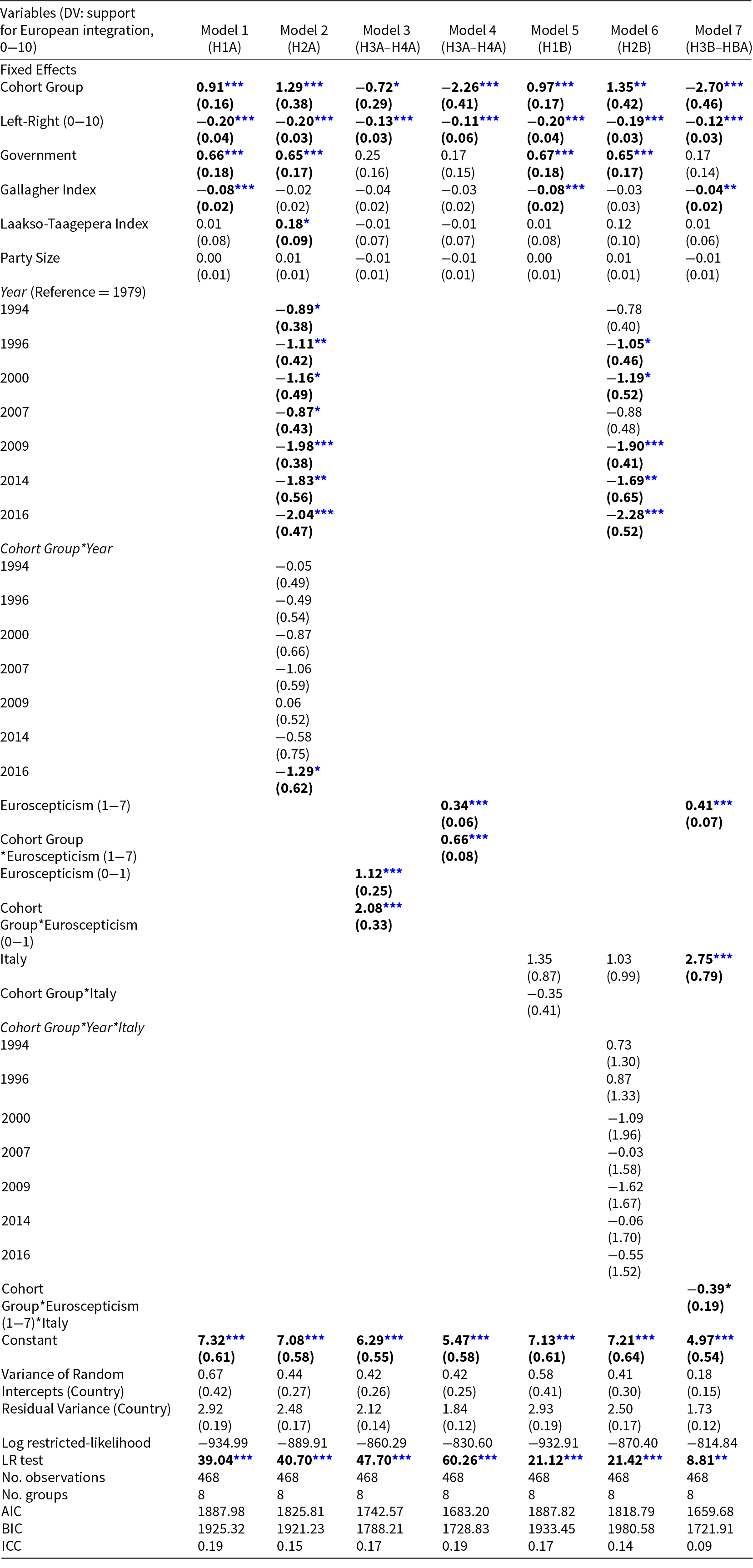
Table 1 presents the results of our analysis on the EU-9 data from 1979 to 2016, encompassing seven models. The coefficient of Cohort Group in M1—the baseline model — is positive (0.91, P ≤ 0.001), highlighting significantly higher support for European integration among political elites vis-à-vis national publics (H1A).
Table 1. Effects of predictors on support for European integration (1979–2016)

*** Note: The table presents fixed and random effects estimations and standard errors in parentheses. Significance levels: *** at P ≤ 0.001; ** at P ≤ 0.01; * at P ≤ 0.05.
In terms of idiosyncratic country effects (see the Supplementary material), Italy and France show significantly more positive attitudes towards European integration; the reverse is true for Denmark. None of the other effects across subsamples reach significance.
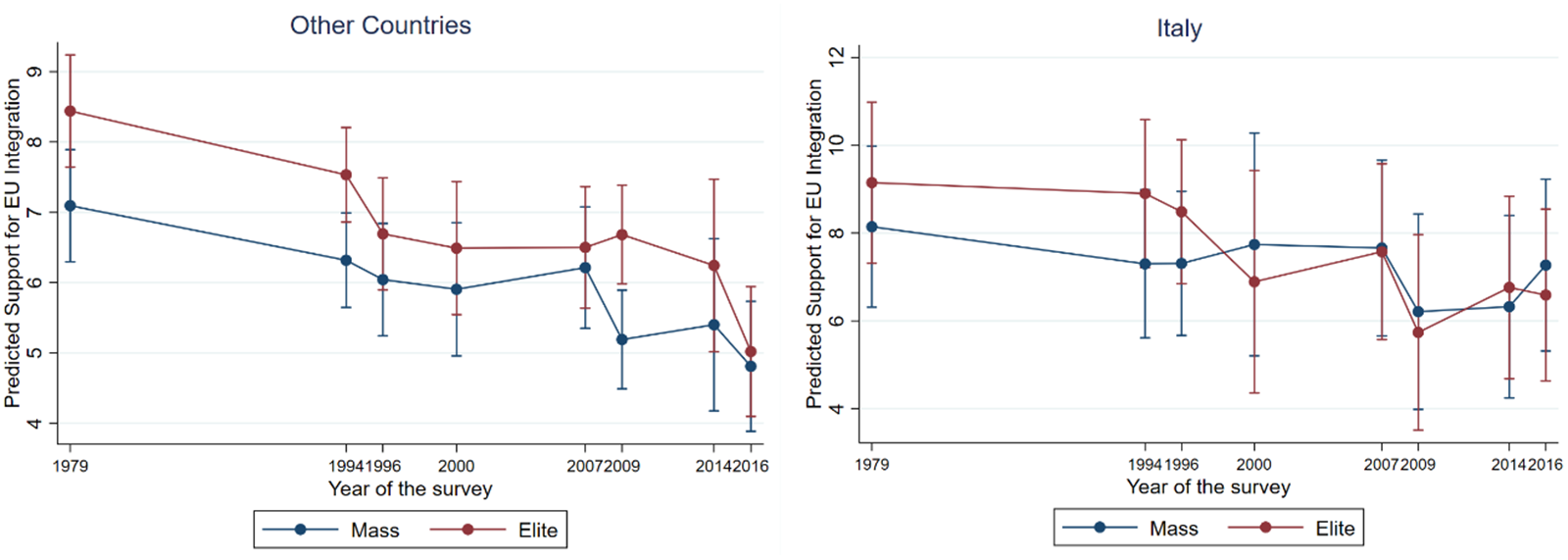
The findings from M1 regarding Cohort Group are reinforced by the results of the same variable from M2 (1.29, P ≤ 0.001), which simultaneously reveal additional insights into the longitudinal trends. The model shows how support for European integration steadily declined over the decades, except for 2007. More importantly, though, the evidence from the interaction between Cohort Group and Year does not provide any support for the idea that pro-EU elite bias significantly increased over time (H2A). In fact, the only interaction term whose coefficient is significant (i.e. the EUENGAGE survey) indicates that the gap in support for European integration between the Elite and Mass categories of Cohort Group decreased in 2016, compared to the baseline year of 1979.
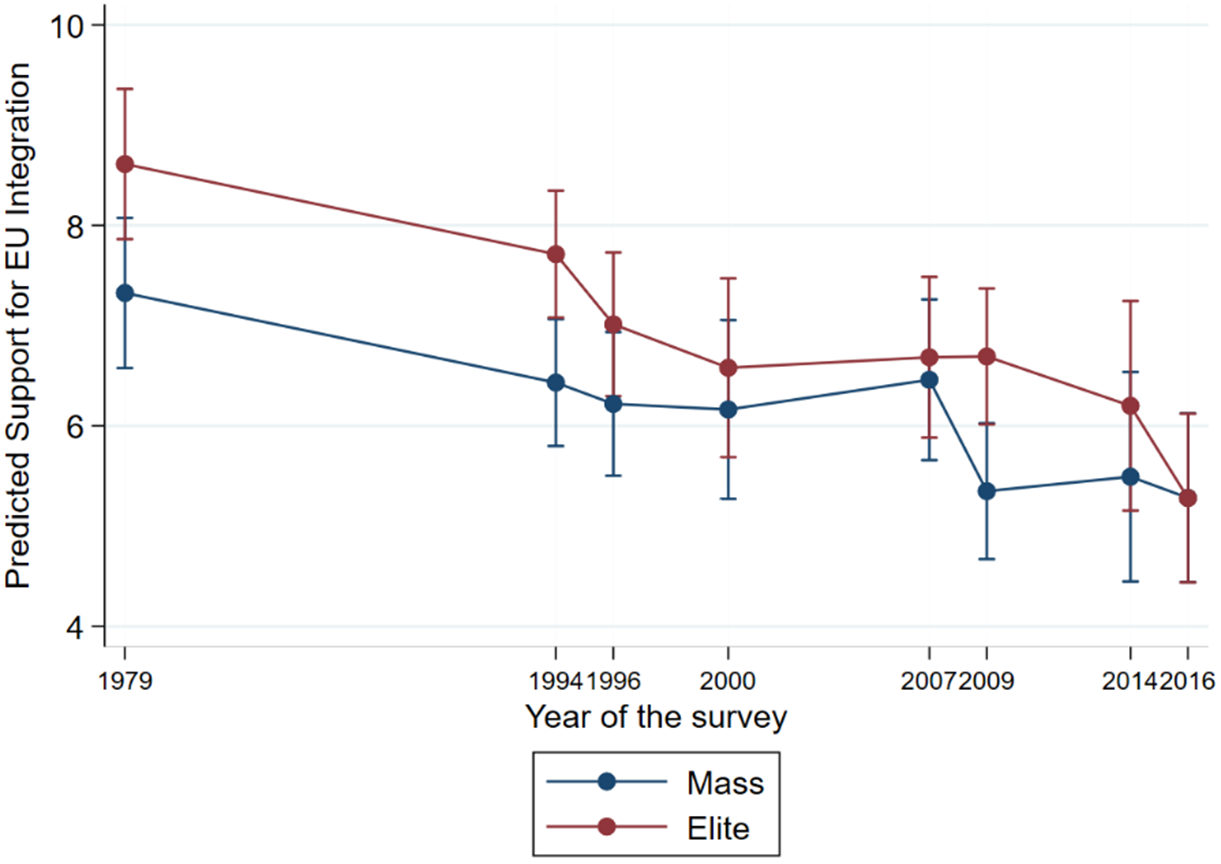
As highlighted by numerous scholars, however, directly interpreting the substantive meaning of interaction terms can often be challenging and potentially unclear (Brambor et al., Reference Brambor, Clark and Golder2006; Berrington de González and Cox, Reference Berrington de González and Cox2007). To address this issue, we also evaluate the actual significance of these effects by visualising their predictive margins. Relatedly, the evidence from Figure 1 only serves as further refutation of H2A, as the predictive margins for support for European integration reveal no statistically significant differences. Despite visible trends in the predicted margins, the overlapping confidence intervals indicate that the observed differences are likely due to random variation rather than a meaningful interaction effect. This finding challenges the notion that mass-elite incongruence was produced by attitudinal shifts drawing political elites and national populations apart at critical junctures.

Figure 1. Predicted support for European integration by Cohort Group and Year (1979–2016).
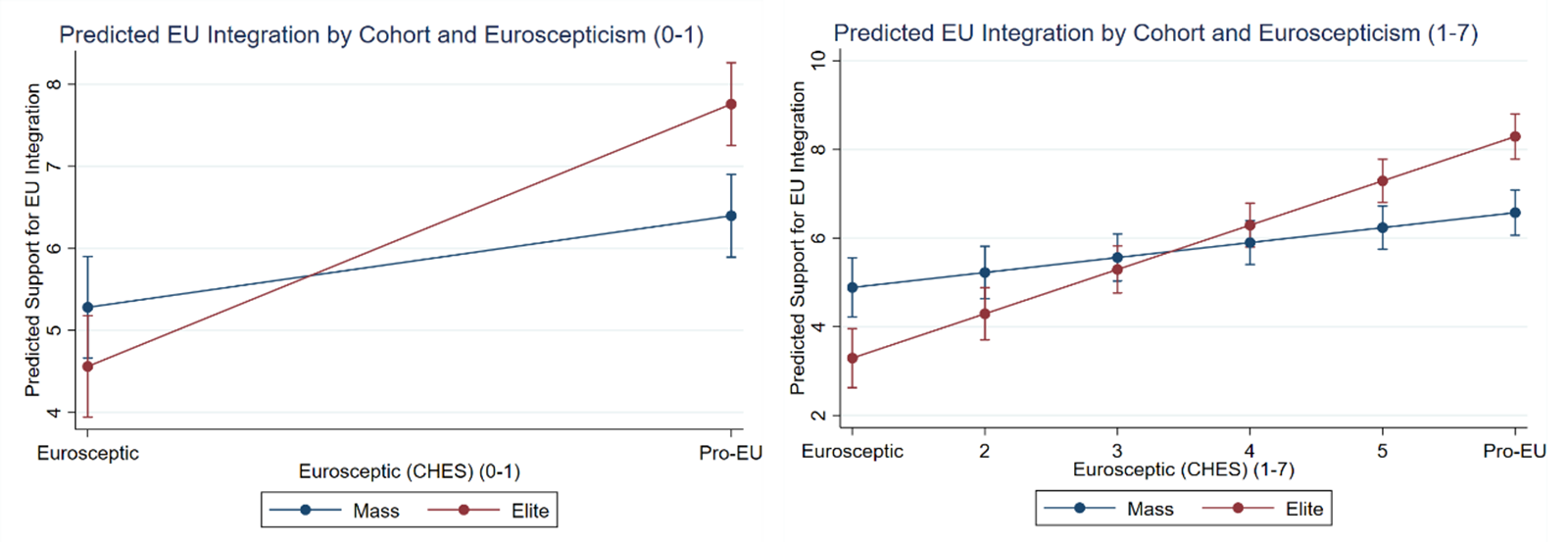
The evidence exhibited in M3 and M4, which refers to the opinion gap within the pro-European and Eurosceptic macro-groups (H3A–H4A), conforms to the literature's general assumptions, on the one hand, and provides novel findings, on the other. The predictive margins presented in Figure 2 (left) – interacting Cohort Group and Euroscepticism (0–1) in M3 – offer two key findings. Political elites of pro-European parties are significantly more likely than their voters to support European integration. At the same time, no discernible evidence is detected for Eurosceptics. Ideally, this would support H3A while rejecting H4A, underscoring notable differences in how political elites of the two macro-groups relate to their respective voters’ attitudes.

Figure 2. Predicted support for European integration by Cohort Group and Euroscepticism (1979–2016).
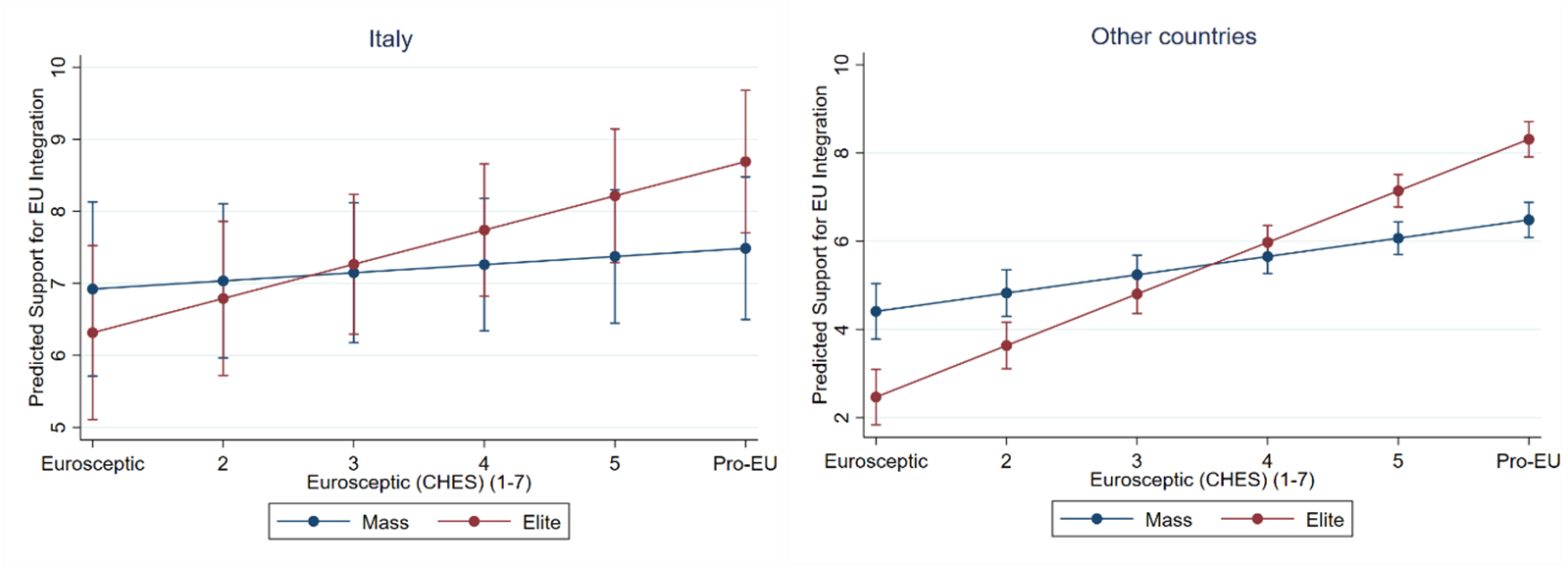
However, this assumption is challenged by the interaction of Cohort Group and Euroscepticism (1–7) in M4 (Figure 2, right), which reveals more nuanced mass-elite alignment and divergence patterns. While the interaction confirms the pro-EU elite bias resulting from M3 within the pro-European macro-group, it also demonstrates that candidates and elected officials from strongly anti-EU political forces (e.g. National Front, Red-Green Unity List) hold significantly less pro-European attitudes than their voters. This finding partially supports H4A, as this pattern does not consistently extend to all Eurosceptic parties. When viewed within the context of the Eurosceptic macro-group, the overall proportion of ‘incongruent’ Eurosceptic party elites remains comparatively small – but by no means negligible.
Evidence on possible determinants of EU issue congruence is gathered through interaction terms between Cohort Group and each one of them. To avoid improper construction of models and misestimation, each model features a single interaction term and, thus, an individual variable (see Table A14 in the Supplementary material). Analysis of predictive margins reveals how government parties and right-wing formations exhibit higher congruence, whereas party size appears irrelevant. Systems with fewer parties and higher electoral disproportionality would seemingly be associated with higher congruence. However, the design of our MLM analysis cautions us against drawing strong conclusions from said models (for more, see the Supplementary material).
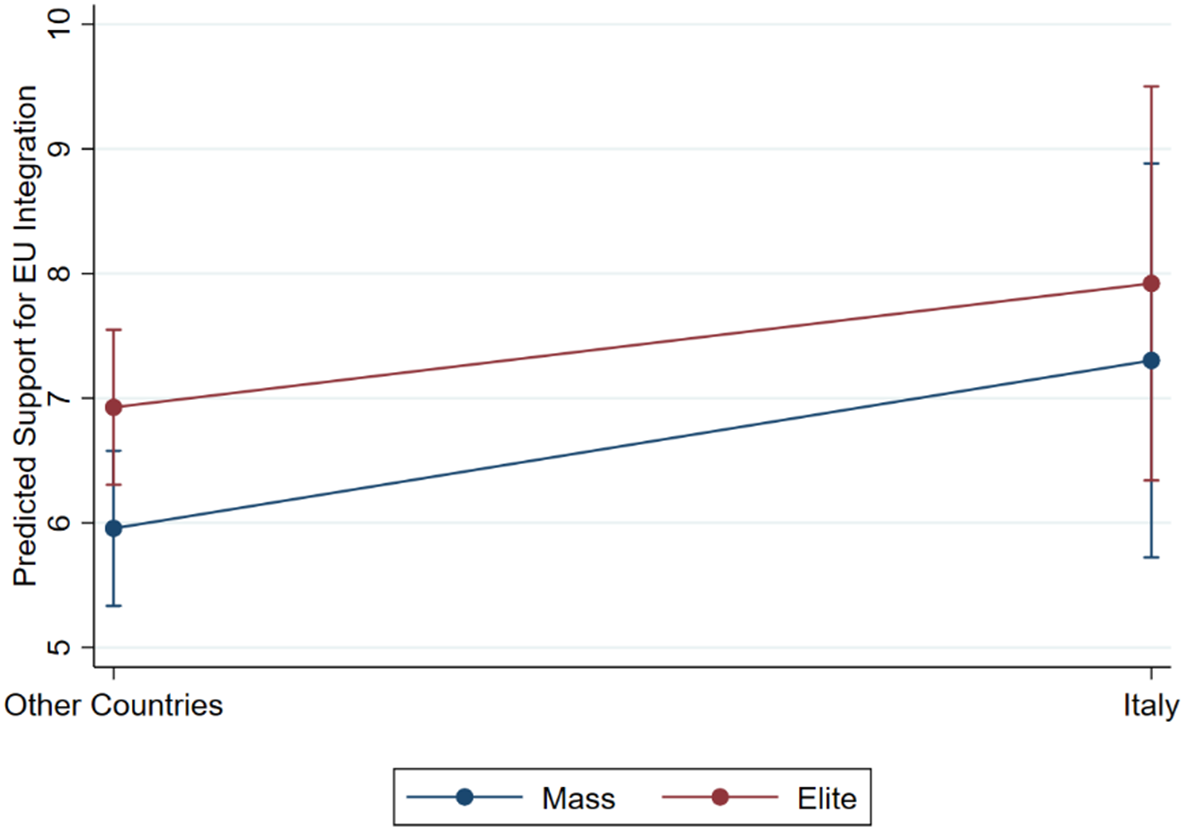
As for the Italian case, patterns generally align with the evidence observed across the EU-9 with respect to the first two hypotheses. On the one hand, the absence of significance in the interaction between Cohort Group and Italy in M5 shows that the country's mass-elite gap with respect to European integration aligns with the rest of the EU-9 (Figure 3), thus confirming H1B. Furthermore, the findings displayed in M6 and the predictive margins of the interaction between Cohort Group, Italy, and Year (Figure 4) reject the notion that pro-EU elite bias in Italy significantly increased over time (H2B).

Figure 3. Predicted support for European integration by Cohort Group and Italy (1979–2016).

Figure 4. Predicted support for European integration by Cohort Group, Italy, and Year (1979–2016).
In contrast, the evidence emerging from M7 provides intriguing insights into the relationship between the two cohort groups, Euroscepticism, and support for European integration.Footnote 11
In particular, examining the predictive margins presented in Figure 5 by interacting Cohort Group, Italy, and Euroscepticism (1–7) reveals no significant divergence between Italian political elites and the public on either side of the European dimension. This, in turn, can be explained by the comparatively higher level of pro-Europeanism displayed by Italian parliamentarians/candidates and public opinion within the Eurosceptic macro-group vis-à-vis the rest of the EU-9 (for more, see the Supplementary material). Taken together, the other observed countries seemingly exhibit an even more pronounced version of the double-sided gap than the trends first presented in Figure 2 (right). This result positions Italy as an outlier on mass-elite congruence with respect to European integration, as the comparatively tighter alignment between Italian elites and the public ultimately leads to the rejection of both H3B and H4B.

Figure 5. Predicted support for European integration by Cohort Group, Italy, and Euroscepticism (1–7) (1979–2016).
While representing a relevant first step, these results need building upon. We have been compelled to exclude certain political forces from our analysis to maintain consistent operationalisation criteria. Regarding data analysis, our three-way interactions aptly capture complex relationships between variables, yet other angles may provide more easily interpretable evidence. Moreover, while the dummy variable we exploit to address our hypotheses on Italy effectively serves our purpose, further research is needed to fully unpack the complexity of the Italian case.
Conclusions
Our study provides a comprehensive longitudinal analysis of mass-elite congruence in support for European integration across eight EU-9 countries from 1979 to 2016. This work represents a first attempt to assess this oft-cited opinion divide over multiple decades comprehensively. Our stated aim was to examine the evolution of the gap over time, investigate its determinants, and shed light on EU issue congruence concerning the Italian case. Long regarded as a Europhile ‘outlier’ – and recently as a possible Eurosceptic ‘forerunner’ – Italy constitutes a potential case of interest. Lastly, our analysis has sought to innovate the literature by originally inspecting opinion gaps on EU matters on both sides of the European political dimension.
The study has yielded several findings, some of which open further lines of inquiry. Our general result corroborates the literature's broad notion of a significant incongruence between relatively pro-European political elites and a comparatively more sceptical public (H1A).
Contrary to our expectations (H2A), however, the extent of this ‘pro-EU elite bias’ does not appear to have increased across the decades, as the rise of public Euroscepticism heralded the transition from the era of permissive consensus to constraining dissensus. The reason behind the lack of significant shifts in congruence during critical junctures – such as the ratification of landmark treaties and the polycrisis – remains unexplained. Future studies should focus on country-specific and time-sensitive factors that our analysis may not be equipped to capture.
Traces of a directional disconnect emerge when examining the pro-European and Eurosceptic macro-groups separately. If Euroscepticism is treated as a dichotomous variable, the political elites of pro-European parties are significantly more likely to support European integration than their supporters (H3A), whereas no gap appears with respect to Eurosceptics (against H4A). However, a more nuanced operationalisation of Euroscepticism reveals that strongly anti-EU parties also hold more extreme positions than their voters. Consequently, a double-sided gap – albeit an uneven one – exists along the European dimension. Additional research should relate this finding to the specificities of national contexts, including EU issue salience, party strategies, and the dynamics of party competition.
The study also supplies some evidence on drivers of EU mass-elite congruence. On a long-term timeframe, it reinforces past results – only partially confirmed by extant work – whereby parties in opposition and right-wing political forces exhibit higher congruence (Mattila and Raunio, Reference Mattila and Raunio2006; Walczak and Van der Brug, Reference Walczak and Van der Brug2013), whereas a party's electoral support seems not to matter. Given the design of our MLM analysis, we do not overstate tentative findings on electoral disproportionality and number of parties. Testing causal linkages in a multivariate setting would be the coherent next step.
Compared to the other EU-9 countries, Italy stands out as an outlier of sorts in one respect, insofar as its political elites and citizens displayed comparatively higher levels of support for European integration. This did not prevent the emergence of ‘pro-EU elite bias,’ as was observed across the EU-9 (H1B). With regard to the gap's evolution across time, too, our MLM analysis does not significantly draw Italy apart from the rest of the EU-9 (H2B). Still, the relatively pro-European positions associated with Italian respondents across the board are a presumable reason why mass-elite gaps – over the surveyed period – do not attain significance within either the pro-European or the Eurosceptic macro-groups. Further studies might pose the same question concerning the most recent and forthcoming years.
Altogether, our study offers new insights into EU issue congruence, providing a more fine-grained picture of its evolution across time, countries, and political macro-groups. We acknowledge the presence of certain limitations in our study, which, in turn, highlight important avenues for future research. First, while our work has focused on support for European integration as a broad dimension, the latter may also be interpreted as a measure of diffuse support. Future research might yield different conclusions by examining its subdimensions (Pareschi et al., Reference Pareschi, Giglioli and Baldini2023). Second, having derived our data from the attitudes of candidates and lawmakers, our findings may reflect stances deviating from official party positions. For a complete picture, researchers might compare party supporters to both the ‘party in public office’ and the ‘party in central office’ (see Conti et al., Reference Conti, Marangoni and Verzichelli2020a). Finally, additional evidence may be uncovered by building upon our efforts. This could be done by incorporating additional data from national election studies, increasing the number of observed countries, and adding more time points from future mass-and-elite surveys to push beyond 2016. These enhancements would provide a clearer understanding of a topic that, despite extensive academic scrutiny, still reveals more than meets the eye.
Funding
This research received financial support from the project ‘The REpresentative DIsconnect: diagnosis and strategies for RECTification’ (HORIZON-CL2-2022-DEMOCRACY-01/HORIZON-RIA, Grant no. 101095142) funded by the European Union's Horizon Europe research and innovation programme. For information, see: http://redirect.unisi.it.
Data
The replication dataset is available at http://thedata.harvard.edu/dvn/dv/ipsr-risp.
Supplementary material
The supplementary material for this article can be found at https://doi.org/10.1017/ipo.2025.9.
Acknowledgements
The authors would like to thank the anonymous Reviewers and the Editors for their valuable suggestions. Additionally, we extend our gratitude to Prof. Giliberto Capano and Prof. Susan E. Scarrow, Guest Editors of the Special Issue ‘Outlier or Forerunner? Discussing the Role and Relevance of the Italian Case in a Broader Context of Democratic Crisis,’ for their efforts in curating this collection. Lastly, we thank the researchers who took part in the workshop ‘Outlier or Forerunner?’ in Rome in November 2023: their advice effectively contributed to the development of this article. The authors are listed in alphabetical order and contributed equally to this work.
Competing Interests. The authors declare none.


 Open access

