


Introduction
Infection and colonization with antibiotic-resistant organisms (AROs)—also known as multidrug-resistant organisms (MDROs) or organisms which develop antimicrobial resistance—is known to be associated with negative patient outcomes including longer hospital lengths of stay and higher mortality. Reference Siegel, Rhinehart, Jackson and Chiarello1 The most studied organisms include methicillin-resistant Staphylococcus aureus (MRSA), vancomycin-resistant enterococci (VRE), and gram-negative bacteria such as extended-spectrum β-lactamase producing Enterobacterales (ESBL-E). The prevalence of antimicrobial-resistant organisms (AROs) also continues to grow, partly due to antibiotic overuse, increased morbidity of chronic disease associated with lower immune status, and the widespread use of indwelling medical devices. Reference Enninger, Schmidt, Hasan, Wager and Zernikow2 In the hospice and palliative care unit (PCU) setting, the prevalence of MRSA colonization, for example, is reported in the range of 3%–11.6%. Reference Enninger, Schmidt, Hasan, Wager and Zernikow2–Reference Prentice, Dunlop, Armes, Cunningham, Lucas and Todd5 PCUs are typically inpatient units integrated into hospitals, where hospital admission criteria apply. These units may not always be closed, meaning that patients admitted under other medical services—such as internal medicine or surgery—may also be cared for within the same unit. Hospices, by contrast, are usually freestanding facilities that focus primarily on nursing and comfort care for patients at the end of life.
Infection prevention and control protocols typically employ a multifaceted bundled approach to control transmission of AROs, including antibiotic stewardship, active surveillance, contact or barrier precautions, environmental decontamination, and decolonization. Reference Khader, Thomas and Huskins6 Contact precautions (CPs) are one method used to prevent transmission of AROs, and typically involve the isolation of patients in private rooms and using physical barriers (gowns and gloves) for all healthcare personnel and visitors when entering the room as defined by the Centers for Disease Control, Reference Siegel, Rhinehart, Jackson and Chiarello7 however may also be facility-specific. They are widely used despite limited evidence supporting their efficacy from a small number of cluster-randomized clinical trials and systematic reviews in the acute non-palliative setting. Reference Khader, Thomas and Huskins6,Reference Maechler, Schwab and Hansen8–Reference Cohen, Cohen and Shang12 The evidence base for CPs is often limited by a focus on outbreak scenarios causing performance bias, selection bias toward specific AROs (eg, MRSA, VRE), failure to study CPs independently from bundled Infection prevention and control interventions, inadequate compliance monitoring, and underrepresented infection risk factors (eg, immunocompromised status and indwelling devices). Reference Cohen, Cohen and Shang12 CPs are also known to impose significant burdens and harms for patients, including social isolation, delays in care, and reduced interaction with healthcare workers, as well as additional financial costs to the healthcare system. Reference Enninger, Schmidt, Hasan, Wager and Zernikow2,Reference Kirkland and Weinstein13–Reference Roth, Hornung-Winter and Radicke15 These issues are very relevant in palliative care, where patient comfort and dignity are paramount.
The objective of this scoping review is to characterize the effectiveness of contact precautions alone against transmission of AROs in adult and pediatric patients receiving palliative care in any care setting, in addition to patient-centered outcomes including quality of life and social connectedness. A scoping review approach is ideal for synthesizing diverse evidence, identifying knowledge gaps, and guiding future research to align CP protocols with the principles of palliative care.
Methods
Protocol and registration
The protocol for this scoping review is registered on the Open Science Framework. It can be accessed at the following link: https://doi.org/10.17605/OSF.IO/TV3KC. The Preferred Reporting Items for Systematic reviews and Meta-Analyses extension for Scoping Reviews (PRISMA-ScR) guideline was followed during the article writing phase, and the completed checklist can be found in Appendix A within the Supplemental Materials. Reference Tricco, Lillie and Zarin16
Eligibility criteria
The eligibility criteria for this scoping review include studies published in English, with no restrictions on publication type or status, that explore the impact of CPs on both adult and pediatric patients receiving palliative care. There were no restrictions on medical comorbidities.
Search strategy
The search was conducted in Ovid MEDLINE (1946–December 20, 2024) and Ovid Embase (1974–December 20, 2024) databases with the help of a university librarian, using a combination of subject heading terms and keywords such as “antimicrobial drug resistance,” “contact precautions,” and “palliative care,” targeting study titles, abstracts, and keywords. Detailed electronic search strategies can be found in Appendix B within the Supplemental Materials.
Screening process
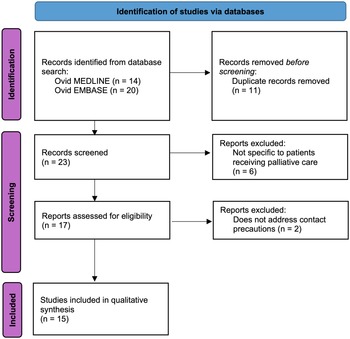
Studies were screened by the primary author (HH) to determine whether they met the inclusion and exclusion criteria. All reasons for exclusion were recorded. Once included, a full text review conducted by the primary author (HH) identified study characteristics including study design, aim, population, comparative groups, relevant findings, and limitations. A PRISMA flow diagram is shown in Figure 1 documenting the selection process.
PRISMA flow diagram. Template source: Page MJ, et al BMJ 2021;372:n71. doi: 10.1136/bmj.n71 .

Data items
Extracted data items included the first author and year of citation, the country of the study, study design (including methodology and period), and population characteristics. Key findings were recorded, focusing on infection control outcomes, patient experience, and quality of care, along with study limitations such as small sample sizes, single-site data, or any potential biases. Assumptions included considering studies mentioning contact precautions in palliative or end-of-life care as relevant, treating synonymous terminology (eg, “barrier precautions”) as interchangeable, and interpreting findings across healthcare systems while acknowledging policy variations. Simple percentages were used to report study characteristics without any formal statistical analysis, as the focus was on mapping existing literature rather than drawing inferential conclusions.
Results
The search strategy described in the Methods returned 34 publications (Ovid MEDLINE: 14, Ovid EMBASE: 20). After 11 duplicate studies were excluded, 23 studies underwent title and abstract screening. Of these, 6 studies did not meet the inclusion criteria as they were not specific to patients receiving palliative care. Reference Orlovic and Smego17–Reference Mody, Gontjes and Cassone22 The remaining 17 studies underwent full-text review, and 2 studies were excluded as they did not address contact precautions. Reference Ghanem, Abou-Alia and Alsirafy4,Reference Datta, McManus, Topal, Quagliarello and Juthani-Mehta23
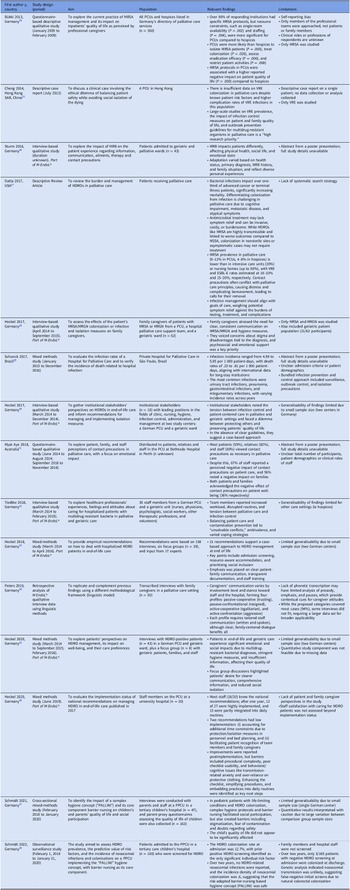
Fifteen studies were ultimately included in this review, Reference Bükki, Klein and But24–Reference Schmidt, Hasan and Mauritz38 with details summarized in Table 1. A notable proportion of the included studies (11 out of 15, 73%) were conducted in Germany. Of these, 8 were part of the “MRSA in End-of-Life Care” (M-EndoL) interdisciplinary project, funded by the German Federal Ministry of Education and Research Reference Sturm and Sieber26,Reference Heckel, Sturm, Herbst, Ostgathe and Stiel28,Reference Heckel, Herbst and Adelhardt30,Reference Tiedtke, Stiel and Heckel32–Reference Heckel, Illig, Brunner and Ostgathe36 and two focused on the “PALLINI” hygiene concept for pediatric patients. Reference Schmidt, Hartenstein-Pinter, Hasan, Stening, Zernikow and Wager37,Reference Schmidt, Hasan and Mauritz38 Only one review article originated from North America. Reference Datta and Juthani-Mehta27 The majority of studies (12/15, 80%) employed qualitative or mixed-methods designs, primarily using questionnaires or interviews, alongside a descriptive case report, Reference Benjamin Cheng, Sham and Chan25 a review article, Reference Datta and Juthani-Mehta27 and an observational surveillance study. Reference Schmidt, Hasan and Mauritz38 Fourteen studies (93%) involved patients in adult or pediatric PCUs or hospices, with half also including geriatric ward patients. One study lacked clarity regarding the setting, Reference Schunck, Jacque and Salman29 and three were project abstracts with limited details available. Reference Sturm and Sieber26,Reference Schunck, Jacque and Salman29,Reference Myat Aye and Bulsara31
Study characteristics

Abbreviations: *M-EndoL, “MRSA in End-of-Life Care” interdisciplinary project funded by the Federal Ministry of Education and Research; MRSA, methicillin-resistant Staphylococcus aureus; MSSA, methicillin-sensitive Staphylococcus aureus; VRE, vancomycin-resistant Enterococci; MRB, multidrug-resistant bacteria; MRGN, multi-resistant gram-negative bacteria; MDRO, multidrug-resistant organism; PCU, palliative care unit; PPCU, pediatric palliative care unit.
Contextualizing ARO prevalence in palliative care settings
Although most included studies did not directly assess the prevalence of AROs, a few provided contextual data relevant to understanding the broader landscape of ARO exposure in palliative care. For example, Datta and Juthani-Mehta noted that bacterial infections affect over one-third of patients with advanced cancer or terminal illness and are associated with increased mortality, although differentiating colonization from infection is often challenging in this population due to cognitive impairment, metastatic disease, and atypical symptoms. Reference Datta and Juthani-Mehta27 While not the primary focus of this review, limited prevalence estimates were available: MRSA prevalence ranged from 9%–12% in PCUs and 4%–8% in hospices, which was lower than in intensive care units (20%) and nursing homes (up to 50%). Reference Datta and Juthani-Mehta27 VRE and ESBL-E prevalence rates were estimated at 10%–33% and 15%–20%, respectively. Reference Datta and Juthani-Mehta27 In pediatric palliative care units, Schmidt et al reported a 12.7% ARO colonization rate at admission. Reference Schmidt, Hartenstein-Pinter, Hasan, Stening, Zernikow and Wager37
Definitions of contact precautions
Definitions of contact precautions in the literature are inconsistent, and this variation in terminology was reflected in the included studies. For example, the M-EndoL study described precautions and isolation measures as “all measures applied with the intention to avoid transmission and spreading of MDRO in hospitals.” These included personal protective equipment (eg, gloves, eye protection, protective clothing, caps, filtering facepiece respirators), cleansing agents, disinfectants, single-room accommodation, and hand hygiene. Reference Heckel, Sturm, Herbst, Ostgathe and Stiel28,Reference Heckel, Stiel and Herbst33,Reference Heckel, Sturm and Stiel35,Reference Heckel, Illig, Brunner and Ostgathe36 In the PALLINI studies, a “barrier nursing-based hygiene concept” was described to involve strict barrier nursing practices, the use of gowns, rigorous hand disinfection, and maintaining physical distance (1–1.5 m) from others during group activities such as music therapy or communal meals. Inside patient rooms, doors could remain open, and personal protective equipment was required only for staff during close contact—not for patients or their family members. Reference Schmidt, Hartenstein-Pinter, Hasan, Stening, Zernikow and Wager37,Reference Schmidt, Hasan and Mauritz38 Other studies did not provide explicit definitions and used various terms, including “close contact isolation,” Reference Benjamin Cheng, Sham and Chan25 “patient isolation and contact precautions,” Reference Datta and Juthani-Mehta27 “contact precautions,” Reference Sturm and Sieber26,Reference Myat Aye and Bulsara31 “isolation measures,” Reference Tiedtke, Stiel and Heckel32,Reference Peters, Dykes, Heckel and Ostgathe34 and “isolation precautions.” Reference Schunck, Jacque and Salman29
Prevalence of contact precautions
While most studies reported bundled approaches, Bükki et al categorized individual MRSA management policies from 229 German PCUs and hospices, and reported their prevalence. Reference Bükki, Klein and But24 In total, over 90% of PCUs and hospices had specific MRSA protocols. Isolation of MRSA-positive patients was reported by 99% of PCUs and 76% of hospices, while activity restrictions were noted by 96% of PCUs and 66% of hospices. Common precautionary measures included the use of gloves, gowns, face masks, handwashing, and hand disinfection. Mandatory precautions for staff were reported by 99% of PCUs and 100% of hospices, and recommended precautions for visitors were reported by 98% of both PCUs and hospices. Reference Bükki, Klein and But24
Efficacy of contact precautions
The included studies did not directly assess the efficacy of contact precautions in reducing the transmission of AROs. However, one observational surveillance study conducted in a pediatric PCU in Germany reported no ARO-related nosocomial infections over a two-year period following the implementation of a “barrier nursing-based hygiene concept”. Reference Schmidt, Hasan and Mauritz38 Of 165 patients with negative ARO screening at admission, three were found to be colonized at discharge (one with MRSA, one with VRE, and one with multidrug-resistant Escherichia coli). Whole-genome sequencing indicated no close genetic relatedness between isolates, suggesting that nosocomial transmission was unlikely and that initial false-negative screening results may have been responsible.
Perceptions on contact precautions
Myat Aye and Bulsara reported that while most patients (55%), relatives (82%), and staff (89%) viewed CPs as necessary in palliative care, significant concerns about their impact were noted. Reference Myat Aye and Bulsara31 Among staff, 67% reported a perceived negative effect on patient care, and 56% noted a negative impact on families. Similarly, both patients and families acknowledged the adverse effects of CPs on patient well-being (36% respectively). Reference Myat Aye and Bulsara31
Impact of AROs and contact precautions
Bükki et al reported that compared to hospices, PCUs more frequently isolated patients with MRSA and restricted their activities, which was associated with a higher negative impact on patient quality of life. Reference Bükki, Klein and But24
Heckel’s M-EndoL project revealed the profound impact of AROs on patients, family caregivers, healthcare providers, and institutional stakeholders through rich interview data. Reference Sturm and Sieber26,Reference Heckel, Sturm, Herbst, Ostgathe and Stiel28,Reference Heckel, Herbst and Adelhardt30,Reference Tiedtke, Stiel and Heckel32,Reference Heckel, Sturm and Stiel35 Patients on CPs for AROs expressed ignorance (“I do not know anything about the germ, except that I have it”), indifference (“so many other fears are dominant for me—the cancer diagnosis. That is why the germ does not bother me much”), and fear (“The [MDRO] takes my life away”), with isolation exacerbating loneliness (“You feel like a leper”) and disrupting intimacy (“We did not touch each other anymore. No kisses. That was not nice”). Reference Heckel, Sturm and Stiel35 Family caregivers faced confusion over inconsistent protocols (“One time he had to wear a protective garment, the next time he didn’t have to. I didn’t really know what was going on”) and emotional strain, with some prioritizing mental well-being (“I don’t want to know too much about MRSA. I have formed a concept, and I am fairly okay with it”). Reference Heckel, Sturm, Herbst, Ostgathe and Stiel28 Peters et al conducted a linguistic analysis of these caregiver interviews and concluded that caregivers’ communication varies by involvement and stance, and formed four profiles: passive-cooperative (trusting), passive-confrontational (resigned), active-cooperative (egalitarian), and active-confrontational (aggressive). Reference Peters, Dykes, Heckel and Ostgathe34 Each profile required tailored staff communication; however clear, family-centered dialogue benefitted all.
Healthcare providers grappled with balancing infection control and compassion, noting the emotional toll of precautions (“You can touch him, but with gloves it’s something completely different. That’s an additional constraint which isn’t nice, especially at the end of life”) and the need for individualized care (“I think an individual approach is the best we can offer these patients”). Reference Tiedtke, Stiel and Heckel32 Interdisciplinary team members reported increased workload, disrupted routines, and tension between palliative care and infection control, leading to “unsolvable conflicts,” ambivalence, and varied coping strategies. Institutional stakeholders emphasized the tension between emotional needs (“There are issues such as talking to the family, relationships, interpersonal closeness and so forth that play a completely different role”) and strict measures (“To me it is important that everyone sticks to the isolation measures which are based on scientific findings”), advocating for flexibility (“Sometimes I rather get a phone call asking, ‘How can I handle this situation correctly?’ instead of adhering to the guidelines”). Reference Heckel, Herbst and Adelhardt30
Recommendations for managing AROs in palliative care
The included studies suggest several recommendations for managing AROs in palliative care. Datta and Juthani-Mehta’s review highlighted the conflict between CPs and palliative care principles, which can cause distress and complicate bereavement, prompting calls for their removal and advocating for infection management aligned with goals of care. Reference Datta and Juthani-Mehta27 For example, antimicrobial treatment for AROs like MRSA may lack symptom relief and can be invasive or burdensome, suggesting that colonization in nonsterile sites or asymptomatic cases may not always require treatment. Heckel et al developed 21 recommendations for managing AROs in end-of-life care, grounded in qualitative data and expert consensus, with an overarching emphasis on case-based application of protection and isolation measures. Reference Heckel, Stiel and Herbst33 Implementation data of these recommendations on a national level in Germany showed awareness and at least partial integration of most of these recommendations after one year, however isolation-related time constraints, procedural complexity and transmission anxiety were identified as persistent challenges. Reference Heckel, Illig, Brunner and Ostgathe36 In the pediatric setting, Schmidt et al found that a more liberal barrier nursing focused hygiene protocol enabled social participation but introduced challenges such as stigmatization and safety concerns, and did not significantly impact quality of life. Reference Schmidt, Hasan and Mauritz38
Discussion
To the authors’ knowledge, this is the first systematic scoping review to examine the use of CPs to prevent ARO transmission and infection in the palliative care setting. The findings of this review highlight the complex interplay between infection control measures and palliative care principles. Balancing the need to reduce morbidity and mortality from ARO infections with the potential harms of infection control interventions—such as CPs, which can increase social isolation and emotional distress for patients, families, and healthcare professionals—presents a significant challenge. This complexity is further compounded by resource limitations and the varied responses and experiences of all stakeholders. The literature generally recommends a case-based approach to ARO management including the use of CPs, emphasizing clear communication and staff training. However, research in this area remains limited, with most studies originating from Germany, which restricts the generalizability of the findings.
This review has several limitations. The small number of studies included in the review and difficulty in identifying unpublished studies or institutional policies precluded us from an assessment of publication bias. The decision to include only English-language studies was due to limited resources for professional translation, which may have led to the exclusion of relevant studies published in other languages. Additionally, variations in terminology and reporting styles across studies may have affected data extraction and synthesis. The absence of formal quality assessment or risk of bias, as is standard in scoping reviews, means that the strength of the evidence could not be critically appraised. Finally, geographic representation was limited, making it unclear how findings translate to different healthcare systems and cultural contexts.
While this review aimed to specifically identify contact precautions, most included studies described bundled Infection prevention and control interventions that combined contact precautions with other measures such as patient isolation, hand hygiene, and environmental disinfection. This reflects a common challenge in infection prevention and control research, where interventions are implemented as multifaceted bundles, making it difficult to isolate the effects of individual components. Further complicating this is the inconsistent and interchangeable use of terminology across studies, with terms such as “barrier precautions,” “isolation measures,” and “contact precautions” often used non-specifically. Notably, none of the included studies directly evaluated the efficacy of contact precautions in reducing the transmission of AROs, despite this being one of the stated objectives of the review. However, one observational surveillance study in a pediatric PCU suggested that implementing a more liberal contact and isolation protocol was associated with no observed nosocomial ARO infections or colonizations.
Further research is needed to inform evidence-based CP protocols in palliative care, with attention to patient quality of life. Mixed-methods studies may offer valuable insights by integrating infection control outcomes with the perspectives of patients, caregivers, and healthcare providers. Locally conducted research can support the development of context-specific policies that address both safety and care values. Future work that combines epidemiological evidence with lived experiences may contribute to CP protocols that are clinically appropriate while also minimizing potential harms.
Supplementary material
The supplementary material for this article can be found at https://doi.org/10.1017/ash.2025.10096.
Financial support
The study was conducted as part of the Enhanced Skills in Palliative Care Residency Program at the University of British Columbia, for which $100 CAD of internal funding is provided to cover nominal expenses.
Competing interests
All authors report no conflicts of interest relevant to this article.


 Open access

