


1. Introduction
A very active ice fallFootnote * comprises part of the Vaughan Lewis Glacier which is located in the Juneau Icefield north-east of Juneau, Alaska. This ice fall is fed by a névé zone, at a mean altitude of 1680 m with a total accumulation area of approximately 26 km2. The ice fall is approximately a kilometer wide and drops through 500 m where it meets two other glaciers; on the left an unnamed glacier and the Gilkey Glacier on the right. These three ice streams merge and flow down-stream for about approximately r o km to the glacier terminus.
A very well developed set of wave ogives is found at the base of the Vaughan Lewis Icefall. An excellent aerial photograph of the ice fall and ogives was published by Reference MillerMiller (1963).
While doing field work in the ogive region we were impressed with the activity of the ice fall. It was decided that an interesting statistical study could be made in a rather short observation period. Consequently, observations were recorded from 20 August to 27 August 1967, but with some interruptions caused by other field activities. We were interested in obtaining information concerning the following items: (1) the relative frequency of occurrence of avalanches of various magnitudes, (2) possible correlation of ice-fall activity with diurnal temperature changes or rate of change of temperature and, (3) the effect of a given ice fall in aiding the onset of a second ice fall which occurs shortly thereafter.
2. Observational Methods
Data were collected in a very straightforward fashion. When an avalanche was observed, the time and an estimate of its magnitude were both recorded. It was found that recording the time to half minute intervals was of sufficient accuracy. Whenever possible the approximate location of the avalanche and pertinent weather conditions were noted and recorded.
The magnitude scale was set in a rather elementary fashion. A very large avalanche was the first to be recorded and it was given a magnitude of “5”. A relatively small avalanche was then given a rating of “1”. However, it was found necessary to use half intervals such as “1–2”, “3–4”, etc. This effectively gave a scale with to divisions. Although this seems crude, it was found by experience to be rather precise. Visitors to our area were quickly “calibrated” to our magnitude scale after observing only a few avalanches. As glacier travel and work require at least two in a party, all of the magnitude estimates were based on the judgment of at least two observers. In all cases there was never more than one unit difference between the magnitudes suggested by the various observers.
3. Results
Frequency–magnitude. A total of 186 avalanches were observed. During the most active day (24 h) a total of 55 avalanches were recorded. On the least active day only 26 events were observed.
Figure 1 is a plot of the relative frequency against the magnitude of the avalanche. Note that the data have a very small scatter about the smooth curve and, as expected, an inverse relationship is seen there.
Observed variation of relative frequency f with avalanche magnitude m. Dotted curve is given by the equation: f = 0.23 m3/2.

A plot of the relative frequency f against avalanche magnitude m on log–log coordinates, shows a small scatter about a straight line with a slope of −1.5. This gives a relation of the form f = 0.23/m3/2 when in can take all integer and half integer values from 0.5 to 5.
At higher magnitudes the data have a little more scatter. This is attributed to the relatively small number of avalanches observed at the larger magnitudes. In addition, the number of “0–1” magnitude avalanches appears to fall below the “best curve” drawn through the data. This effect may be due to the increased difficulty of detecting marginal movements in the ice fall. External effects such as wind noise, rain pelting on tents and parkas, the crunching of crampons on ice, cooking noises, conversation, etc., all contribute to obscuring a minimal avalanche from detection. It should be noted in this regard that the majority of the observations were only heard and not seen. This was the case as many avalanches were heard at night and under poor visibility conditions such as heavy rains or “white-outs”.
Three zones of avalanche activity were delineated. On the right-hand side of the glacier, looking down-stream, hanging ice often broke loose and cascaded over a rock cliff (approximately 75 m high) to a lower position on the glacier. Activity in this area accounted for approximately 40 per cent of all avalanches observed. A similar cliff was located on the left-hand side and this location accounted for another 5 per cent. The remainder of the avalanches were found in the central portion of the ice fall or were not located because of restricted visibility conditions.
Diurnal variation of avalanche frequency
Data were collected into hourly intervals independent of magnitude. The raw data are given in Table I. Figure 2 shows the average number of avalanches per hour observed for each of the 24 hours of the day. The smaller number of observations of the various hour intervals requires that appropriate statistical tests be applied to the data to see if the data indicate statistically significant variations or if the differences could be merely due to small sample size and consequent random scatter.
Diurnal variation of avalanche frequency. Dashed lines indicate statistical confidence (95%) intervals. Dotted line during 04.00–05.00 h period indicates average value of adjacent intervals.

Number of Avalanches Observed in Hourly Intervals

A Poisson type distribution should adequately describe the number of avalanches observed on different days at any given hour interval of the day unless the weather changes are considerable, e.g. in comparing summer and winter days. The criteria which must be satisfied for the application of Poisson statistics are the following:
-
Events occurring in any given time interval are independent of those occurring in all other time intervals.
-
The probability of observing an event is proportional to the duration of the observation period.
-
It is unlikely that two or more events occur in the same time interval for the case of vanishingly small time intervals.
These conditions are all approximately satisfied in the case of ice-fall avalanches. Thus the probability p that a given number of avalanches x will be observed in some time interval is given by

where μ is the mean value expected for the interval in question.
It is possible to compute confidence intervals for the data given in Table I. Based on the Poisson model, a confidence interval at the 0.95 probability level was computed for each of the hourly periods and plotted as the dotted lines in Figure 2. (Appendix A gives the details of the computational method.)
As noted in Figure 2, the confidence intervals for the largest and smallest values are non-overlapping. This indicates that at least the extreme values of the mean avalanche frequency are significantly different.
Another method may be utilized to test for significant diurnal variations in the avalanche rate. The waiting time between successive ice falls is computed and then analyzed by methods suggested in Reference MaguireMaguire and others (1952). If the expectation E of ice falls per unit time is constant during some period the waiting times Δt are exponentially distributed

Figure 2 indicates that the periods 05.00–09.00 h and 17.00–21.00 h should have considerably different values of E. If we assume that the mean value of E may be treated as a constant value and also has a different magnitude during the two aforementioned intervals, we can then compute confidence intervals for the expectation rates based on the respective values of Δt . In addition we can also calculate the ratio of the two E values. Details of these computations may be found in Appendix B.
Confidence intervals at the 0.95 probability level are 10.2 min ⩽ 1/E m ⩽ 19.5 min and 19.7 min ⩾ 1/E e ⩾ 43.3 min, where E m and E e refer to the aforementioned morning and evening periods respectively. In addition the ratio E m/E e⩽ 1.3 at the 0.95 significance Ievel. Thus we are confident that Figure 2 does represent a real diurnal variation in avalanche frequency.
The trend of Figure 2 shows only one maximum in the daily variation of avalanche frequency. We originally anticipated a morning and evening peak associated with the daily heating and cooling during these periods. This same opinion was also expressed by other scientists working in the vicinity of ice falls in the Alaska Range (personal communication from C. Thompson, 1967). However, they did not quantitatively record their observations. The only effect which seems to explain the single diurnal maximum in the avalanche frequency is the reduction of the air temperature below freezing.
This last effect was vividly demonstrated when a cloudy sky began to clear at approximately 03.00 h one morning. Radiation cooling quickly dropped the air temperature and the ice-fall activity increased from 2 per hour to 4–5 per hour for the next several hours before returning to normal. Ice formation on crevasse pools indicated that the air temperature had fallen below freezing.
Another unique incident was a period of overcast sky followed by a partly cloudy sky condition which finally was terminated by a light drizzle. Under the overcast sky the activity was 1–2 per hour while the intermittent sunlight produced rates of and 5 per hour. With the onset of rain, the activity returned to 2 per hour. Unfortunately, this sequence of weather conditions was only observed on one occasion. Thus it is not possible to conclude if this was a real phenomenon or just due to a fortuitous observation.
Induced avalanches
The question of induced ice-fall activity was perhaps the most interesting question we hoped to answer. Two opposing schools of thought were found among our colleagues. Both sides agreed that avalanches widely spaced in time should be completely uncorrelated. However, one school reasoned that a given ice fall removes loose and unstable material and thus the probability of another ice fall following soon thereafter is reduced. The opposing camp stated that the vibration associated with a given ice fall should loosen additional material which is then primed for the next ice fall. Thus one fall should induce another in short order.
Figure 3 supports the second contention. The probability of an avalanche occurring within the first minute is more than double the mean probability for the minute intervals from 4 to 15 min after the initial avalanche. In reducing the data, each avalanche was successively considered as an initial avalanche. The time interval to subsequent avalanches was calculated and recorded. Dividing the number of avalanches in any one minute time interval by the total number of avalanches considered gives the probability of an avalanche during that period. For example, Figure 3 shows that the probability of an avalanche during the 0–1 min interval after the initial ice fall is 0.14. During the interval from 2–3 min the probability is reduced to 0.038.
Probability of avalanche during minute intervals following an initial avalanche. Data based on 159 initial events.

The statistical significance of the differences in probabilities shown in Figure 3 can be readily seen if a mean Poisson distribution is assumed for the number of avalanches observed in all time intervals. The mean number of avalanches for the intervals between 4 and 15 min is approximately 10. Using this value of μ in the Poisson distribution we can estimate the probability of observing 23 or more avalanches as found in the 0–1 min interval. From standard tables this result is

Thus it is very probable that the value of μ for the 0–1 min period is considerably greater than to. Similarly the probability that the 2–3 min interval should contain 6 or fewer avalanches is

and this interval is also significantly different from the long-time mean.
If there were no correlation between any ice falls the probability would be equal for all periods. This seems to be the case for the periods from 4 to 15 min after the initial avalanche. No further change in the probability is anticipated for all later periods. The 2–3 min interval is significantly lower than the 4–15 min mean probability. This seems to indicate that the second avalanche which occurs in the 0–1 or 1–2 min interval succeeds in removing the material loosened by the first avalanche. Consequently, a relative dearth of avalanches is observed in the 2–3 min interval. As the probability is again at the mean value in the 3–4 min interval, the characteristic “memory” time of the ice fall is on the order of 3 to 4 min.
4. Conclusions
The relative avalanche frequency varies inversely with the magnitude of the avalanche. A single maximum was found for the diurnal variation of avalanche activity. This peak was apparently associated with a reduction in the air temperature below the freezing level. Vibration and the associated loosening of material caused by a given ice fall aids in producing another ice fall within the ensuing 2 min interval. After 4 min the effect of a given avalanche is erased from the ice fall’s memory.
It would be very interesting to observe other ice falls to see if they exhibit the same characteristics as the Vaughan Lewis Icefall. As the observational procedures are relatively simple, the required data could be acquired by scientists performing other tasks in the vicinity of ice falls.
5. Acknowledgements
The author wishes to thank Dr M. M. Miller, Director of the Glaciological and Arctic Sciences Institute for providing the opportunity and support required in making this study. Logistical support was provided through Michigan State University’s affiliated National Geographic Society Alaskan Glacier Commemorative Project; field facilities by the Foundation for Glacier Research. Special thanks are also due to Mr Art Twomey who helped collect the field data and Mr Harte Bressler who aided in the preliminary data reduction. Dr John F. Nye of the University of Bristol is thanked for his review and comments on an earlier draft of this manuscript. It is with appreciation that we cite the indirect aid given by all the members of the 1967 Glaciological and Arctic Sciences Institute.
Appendix A Poisson Distribution Confidence Intervals
If x 1, x 2, …, x n are n samples taken from some Poisson distribution then the best estimate for the mean of the unknown distribution is

A range for  can be determined if a certain confidence level is specified. As the confidence level is given by 1−α, where α is the significance level, then the confidence interval is
 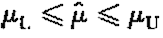 where,


and  is the integrated chi-squared density function.
Details of this standard calculation are given by Reference GuentherGuenther (1965).
Appendix B Statistical Tests Based on Waiting Times
Reference MaguireMaguire and others (1952) have shown that 2nE
Δt
is distributed as  where n is the number of samples used in computing Δt
. Thus it follows that
where n is the number of samples used in computing Δt
. Thus it follows that

at the α significance level. This result may be rewritten to find the confidence interval for 1/E:

In calculating E m and E e the following values were utilized:

If the waiting times found during two different periods are distributed both independently and exponentially and if the expectation values E are different during the two periods then the ratio E 1 Δt 1/E 2 Δt 2 has an F distribution with 2n 1 and 2n 2 degrees of freedom. Thus it follows that

at the 1−α probability level. And hence at this same confidence level

With the values given above and α = 0.05, Equation B4 was used to calculate the result E m/E e ⩾ 1.30 which was quoted in the text.



