


Studies of differing forms of intensive case management (ICM) (Reference Holloway, Oliver and CollinsHolloway et al, 1995; Reference Holloway and CarsonHolloway & Carson, 1998; Reference Mueser, Bond and DrakeMueser et al, 1998; Reference Thornicroft, Wykes and HollowayThornicroft et al, 1998) have increasingly failed to replicate the highly significant advantages over standard care demonstrated in early American (Reference Stein and TestStein & Test, 1980) and Australian work (Reference Hoult, Reynolds and Charbonneau-PowisHoult et al, 1983). Several possible reasons for this have been proposed, including ambiguity over terms, differences in control services and, more recently, a failure in European services to replicate the critical components of the earlier, successful experimental services. The core features of assertive community treatment (ACT) (the specific form of ICM subjected to the most intense research exercise) have been described in detail (Reference Teague, Bond and DrakeTeague et al, 1998). Concern with ‘programme fidelity’ has received impetus from work showing that even in well-conducted trials there can be overlap in the practice between intensive and standard teams, and that these differences in practice relate to outcome (Reference McHugo, Drake and TeagueMcHugo et al, 1999). The failure of European trials of ICM to demonstrate differences in outcome could, therefore, be due to a failure to vary the process of care. We have prospectively measured the process of care in intensive and standard case management services subjected to a randomised controlled trial (RCT) (UK700 Group, 1999a , b ) to test the questions: is the process of care clearly different in the two services and if so in what ways, and also do site differences interact with any treatment group effects?
METHOD
Patient and staff samples
Subjects were recruited from four inner-city mental health services (South Manchester, and Brixton, Paddington and Wandsworth in London). Aged between 18 and 65, they suffered from psychotic illnesses with a minimum of two hospital admissions, the most recent within 2 years. They were randomly allocated to either ICM (case-load 1:10-15) or standard case management (SCM) (case-load 1:30-35). Details of the baseline characteristics (UK700 Group, 1999c ), the process of randomisation and outcomes at 2 years have been published (UK700 Group, 1999a ).
Staff for the two services were broadly comparable. The Manchester site was unable to collect SCM data and is therefore excluded from this study. A total of 550 patients were eligible (196 from St George's Hospital, 201 from St Mary's Hospital and 153 from King's College Hospital). Five patients were excluded: two because of failed allocation, two moved away and one was referred to another agency before any activity. Staff involved in data collection in St George's included all 169 members of six community mental health teams (CMHTs) (including the intensive case managers), 73 staff in King's and 39 in St Mary's.
Process of care (activity) data
Collecting prospective treatment data over 2 years on 550 patients requires cooperation from a wide range of hard-pressed mental health staff. The process of data collection needed to be as simple and straightforward as possible, in particular the categories of care to be recorded needed to be immediately obvious. A modified Delphi process was conducted with the ICM staff at St George's to derive the treatment categories (Reference Bale, Fiander and BurnsBale et al, 1997; Reference Fiander and BurnsFiander & Burns, 2000), which were adopted across the four sites.
Most staff members were mental-health trained nurses, but also included were psychologists, occupational therapists, social workers and doctors (UK700 Group, 1999a ). Staff were required to fill out an ‘event record’ for each contact, failed contact or prolonged telephone conversation with ‘the patient or family and prolonged contact with other agencies. This event record noted the focus of the care event, the duration (with and without travelling time) and location.
Recording of contacts
We wished to understand the process of care over time for the average (or representative) patient. Overall rates of contact were derived from the total per site and treatment group, but for process measures we have calculated mean contact frequencies and proportions of the different types of contact for the average patient per 30 days.
Five types of event were recorded: (a) face-to-face patient contact; (b) telephone contact (> 15 minutes); (c) carer contact (> 15 minutes); (d) coordination (contact with other professional agencies) (> 15 minutes); (e) attempted (failed) face-to-face contact.
For all face-to-face contacts, the primary focus of the event was categorised into 11 types: (a) housing; (b) occupation and leisure; (c) finance; (d) daily living skills; (e) criminal justice system; (f) carers and significant others; (g) engagement; (h) physical health; (i) specific mental health intervention or assessment; (j) medication; (k) case conference.
Staff were trained in the use of the event records, and provided with detailed written guidelines. They met frequently with M.F. to solve problems and monitor performance. The completeness of data collection was verified by case-note audits. Data collection took place from February 1994 to December 1998.
Processing of activity data
Medical out-patient data could not be accurately obtained and so has been excluded from the analysis. Patients who moved away from the area permanently (27) or who were discharged from randomised care and transferred to the care of another mental health team not involved in the study (21) had their participation periods reduced accordingly, similarly for patients who died during the study.
Statistical methods
Mean rates of care activities were compared between the two types of case management using t-tests; regression analyses were implemented to examine site-by-group interaction effects. Separate t-tests of outcome were performed for each site to calculate within-site estimates and confidence intervals for differences between the case management groups. Formal tests of normality revealed that most of the care activity outcomes were highly skewed.
The ‘bootstrap’ (Reference Efron and TibshiraniEfron & Tibshirani, 1993), a computation-based method for assigning measures of accuracy to statistical estimates, was used to validate the confidence intervals yielded by the t-tests. Where bootstrap analyses yielded similar results to the t-tests the latter are presented, otherwise bias-corrected accelerated confidence intervals from the bootstrap analyses are used. Frequencies of interventions were calculated as rates per 30 days and the mean rates and mean proportions presented are those for the average patient. Where they are summed in this paper, the ‘average patient’ for each intervention has been independently calculated and so the figures may be slightly different from those derived from overall rates of contact.
RESULTS
Intervention effect (ICM v. SCM)
A total of 39 025 care events were recorded for the 545 patients. Of these, 29 390 were face-to-face contacts. ICM patients received just over twice as much care, with a mean of 4.41 events per 30 days (total 26 841) as opposed to 1.94 in the standard arm (total 12 184). In ICM, 77.3% (16 067 of the total 20 788) of face-to-face contacts were ‘in-vivo’ (i.e. not conducted in a service setting). In SCM, the rate was a strikingly similar 76.5% (6577 out of 8602). The mean duration of face-to-face contacts was 40.6 minutes (s.d.=30.3) ICM and 37.4 minutes (s.d.=24.8) SCM. This mean difference of just over 3 minutes achieves high statistical significance (P < 0.001) because of the sample size but is of little clinical import.
Table 1 lists the mean frequencies of the five event types and the 11 focuses of the face-to-face contacts by group for patients per 30 days. A substantial and highly statistically significant difference is found for all five types of event. ICM patients receive one face-to-face contact per 9 days compared to one per 21 days for SCM patients. Other types of contact were between 2.3 and 3.6 times more common in ICM apart from failed contacts, which were over 4 times more common.
Mean activity rates per subject per 30 days: intensive case management v. standard case management

| Care event | Intensive | Standard | Total n | Difference (intensive — standard) | ||||||
|---|---|---|---|---|---|---|---|---|---|---|
| Mean | (s.d.) | n | Mean | (s.d.) | n | Estimate | (95% CI) | P | ||
| Type of event | ||||||||||
| T1 Face-to-face | 3.35 | (3.21) | 272 | 1.46 | (0.77) | 273 | 545 | 1.90 | (1.50 to 2.29) | <0.001 |
| T2 Telephone | 0.13 | (0.23) | 272 | 0.05 | (0.11) | 273 | 545 | 0.08 | (0.05 to 0.11) | <0.001 |
| T3 Carer | 0.13 | (0.29) | 272 | 0.04 | (0.09) | 273 | 545 | 0.10 | (0.06 to 0.13) | <0.001 |
| T4 Coordination | 0.39 | (0.66) | 272 | 0.14 | (0.21) | 273 | 545 | 0.25 | (0.17 to 0.34) | <0.001 |
| T5 Attempted face-to-face | 0.18 | (0.36) | 272 | 0.04 | (0.10) | 273 | 545 | 0.14 | (0.10 to 0.18) | <0.001 |
| Focus of face-to-face event (no. per 30 days) | ||||||||||
| F1 Housing | 0.23 | (0.41) | 272 | 0.08 | (0.16) | 273 | 545 | 0.15 | (0.10 to 0.20) | <0.001 |
| F2 Occupation and leisure | 0.34 | (0.53) | 272 | 0.08 | (0.16) | 273 | 545 | 0.26 | (0.19 to 0.32) | <0.001 |
| F3 Finance | 0.18 | (0.33) | 272 | 0.04 | (0.11) | 273 | 545 | 0.13 | (0.09 to 0.17) | <0.001 |
| F4 Daily living skills | 0.10 | (0.26) | 272 | 0.03 | (0.06) | 273 | 545 | 0.08 | (0.04 to 0.11) | <0.001 |
| F5 Criminal justice system | 0.01 | (0.06) | 272 | 0.00 | (0.01) | 273 | 545 | 0.01 | (0.003 to 0.02) | 0.006 |
| F6 Carers and significant others | 0.07 | (0.18) | 272 | 0.03 | (0.07) | 273 | 545 | 0.04 | (0.02 to 0.07) | <0.001 |
| F7 Engagement | 0.44 | (0.52) | 272 | 0.20 | (0.27) | 273 | 545 | 0.25 | (0.18 to 0.32) | <0.001 |
| F8 Physical health | 0.08 | (0.21) | 272 | 0.01 | (0.04) | 273 | 545 | 0.07 | (0.04 to 0.09) | <0.001 |
| F9 Specific mental intervention/assessment1 | 1.26 | (1.28) | 272 | 0.82 | (2.47) | 273 | 545 | 0.44 | (-0.23 to 0.65) | NS |
| F10 Medication | 0.69 | (1.04) | 272 | 0.48 | (1.22) | 273 | 545 | 0.20 | (0.01 to 0.40) | 0.04 |
| F11 Case conference | 0.01 | (0.06) | 272 | 0.01 | (0.03) | 273 | 545 | 0.01 | (-0.003 to 0.01) | 0.20 |
The frequency of events with each individual focus is also significantly higher in ICM apart from the most common (‘specific mental health intervention/assessment’), which accounts for just under half the total contacts (42% in ICM) (44% in SCM), and for the least common (‘case conference’), which accounts for 1% in each group.
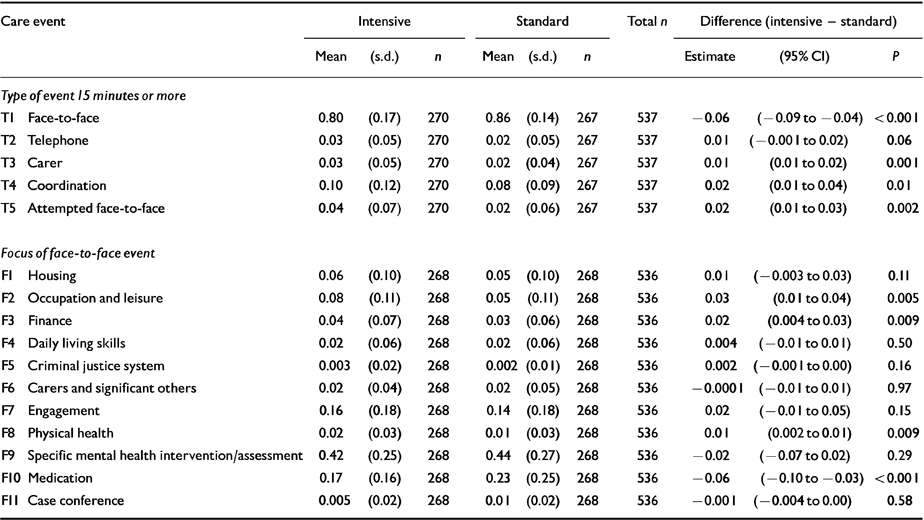
Table 2 displays the mean proportions of types of events and the focuses of face-to-face events in the two treatment groups. This controls for the impact of the higher frequency of all contacts in ICM. ICM staff performed proportionately more ‘non-face-to-face’ contacts, significantly more carer contact, coordination and attempted face-to-face contacts. ICM staff dedicated a greater proportion of contacts to help with occupation and leisure, finance and also physical health care. This was balanced by a smaller proportion of medication activities (although the overall absolute number of medication contacts was still greater in ICM).
Mean proportions of activities per subject: intensive case management v. standard case management
| Care event | Intensive | Standard | Total n | Difference (intensive - standard) | ||||||
|---|---|---|---|---|---|---|---|---|---|---|
| Mean | (s.d.) | n | Mean | (s.d.) | n | Estimate | (95% Cl) | P | ||
| Type of event 15 minutes or more | ||||||||||
| T1 Face-to-face | 0.80 | (0.17) | 270 | 0.86 | (0.14) | 267 | 537 | -0.06 | (-0.09 to ‒0.04) | <0.001 |
| T2 Telephone | 0.03 | (0.05) | 270 | 0.02 | (0.05) | 267 | 537 | 0.01 | (-0.001 to 0.02) | 0.06 |
| T3 Carer | 0.03 | (0.05) | 270 | 0.02 | (0.04) | 267 | 537 | 0.01 | (0.01 to 0.02) | 0.001 |
| T4 Coordination | 0.10 | (0.12) | 270 | 0.08 | (0.09) | 267 | 537 | 0.02 | (0.01 to 0.04) | 0.01 |
| T5 Attempted face-to-face | 0.04 | (0.07) | 270 | 0.02 | (0.06) | 267 | 537 | 0.02 | (0.01 to 0.03) | 0.002 |
| Focus of face-to-face event | ||||||||||
| F1 Housing | 0.06 | (0.10) | 268 | 0.05 | (0.10) | 268 | 536 | 0.01 | (-0.003 to 0.03) | 0.11 |
| F2 Occupation and leisure | 0.08 | (0.11) | 268 | 0.05 | (0.11) | 268 | 536 | 0.03 | (0.01 to 0.04) | 0.005 |
| F3 Finance | 0.04 | (0.07) | 268 | 0.03 | (0.06) | 268 | 536 | 0.02 | (0.004 to 0.03) | 0.009 |
| F4 Daily living skills | 0.02 | (0.06) | 268 | 0.02 | (0.06) | 268 | 536 | 0.004 | (-0.01 to 0.01) | 0.50 |
| F5 Criminal justice system | 0.003 | (0.02) | 268 | 0.002 | (0.01) | 268 | 536 | 0.002 | (-0.001 to 0.00) | 0.16 |
| F6 Carers and significant others | 0.02 | (0.04) | 268 | 0.02 | (0.05) | 268 | 536 | -0.0001 | (-0.01 to 0.01) | 0.97 |
| F7 Engagement | 0.16 | (0.18) | 268 | 0.14 | (0.18) | 268 | 536 | 0.02 | (-0.01 to 0.05) | 0.15 |
| F8 Physical health | 0.02 | (0.03) | 268 | 0.01 | (0.03) | 268 | 536 | 0.01 | (0.002 to 0.01) | 0.009 |
| F9 Specific mental health intervention/assessment | 0.42 | (0.25) | 268 | 0.44 | (0.27) | 268 | 536 | -0.02 | (-0.07 to 0.02) | 0.29 |
| F10 Medication | 0.17 | (0.16) | 268 | 0.23 | (0.25) | 268 | 536 | -0.06 | (-0.10 to ‒0.03) | <0.001 |
| F11 Case conference | 0.005 | (0.02) | 268 | 0.01 | (0.02) | 268 | 536 | -0.001 | (-0.004 to 0.00) | 0.58 |
Site effect
St George's ICM had a case-load size of 1:12, the other two sites 1:15. Event rates were twice as high per patient in St George's ICM (6.7 per 30 days) as in St Mary's (3.2 per 30 days) and in King's (3.1 per 30 days). SCM rates showed little variation (1.9 for St George's 1.9 for St Mary's and 2.2 per 30 days for King's).
There were substantial differences between the three sites in the rates of types of activity, as is shown in Table 3. This reflects some local differences in service configuration. There is a significant site-by-group interaction for face-to-face contacts, carer contacts and attempted contacts performed per average patient because of significantly higher rates in St George's ICM. Site-by-group interaction effects for the rates of focus of face-to-face activity are not presented but, predictably, the impact of site on group differences was significant for all categories apart from specific mental health intervention/assessment and case conferences, with carer contact showing only low significance (P=0.04). However, when proportions, rather than rates, of care activities were examined there was no significant impact of site on patterns of work between ICM and SCM.
Mean rates of types of care activity (lasting 15 minutes or more): per patient per 30 days: intensive case management v. standard case management

| Variable | Intensive | Standard | Difference (intensive - standard) | ||||||
|---|---|---|---|---|---|---|---|---|---|
| Mean | (s.d.) | n | Mean | (s.d.) | n | Estimate | (95% Cl) | P 1 | |
| T1 Face-to-face contact | |||||||||
| St George's | 4.907 | (2.457) | 97 | 1.387 | (0.861) | 99 | 3.520 | (2.9970 to 4.0425) | |
| St Mary's | 2.347 | (1.446) | 98 | 1.411 | (0.653) | 101 | 0.936 | (0.6198 to 1.2521) | <0.001 |
| King's | 2.677 | (4.640) | 77 | 1.610 | (0.795) | 73 | 1.066 | (-0.0020 to 2.1346) | |
| T2 Telephone contact | |||||||||
| St George's | 0.174 | (0.254) | 97 | 0.057 | (0.156) | 99 | 0.117 | (0.0572 to 0.1764) | |
| St Mary's | 0.086 | (0.147) | 98 | 0.047 | (0.078) | 101 | 0.039 | (0.0057 to 0.0719) | 0.07 |
| King's | 0.131 | (0.268) | 77 | 0.027 | (0.088) | 73 | 0.103 | (0.0394 to 0.1672) | |
| T3 Carer contact | |||||||||
| St George's | 0.237 | (0.421) | 97 | 0.049 | (0.121) | 99 | 0.188 | (0.1001 to 0.2762) | |
| St Mary's | 0.053 | (0.086) | 98 | 0.035 | (0.063) | 101 | 0.017 | (-0.0039 to 0.0381) | <0.001 |
| King's | 0.101 | (0.205) | 77 | 0.021 | (0.045) | 73 | 0.079 | (0.0317 to 0.1269) | |
| T4 Coordination | |||||||||
| St George's | 0.453 | (0.542) | 97 | 0.111 | (0.258) | 99 | 0.342 | (0.2213 to 0.4621) | |
| St Mary's | 0.279 | (0.371) | 98 | 0.133 | (0.153) | 101 | 0.146 | (0.0664 to 0.2265) | 0.13 |
| King's | 0.463 | (0.990) | 77 | 0.186 | (0.180) | 73 | 0.277 | (0.0484 to 0.5052) | |
| T5 Attempted face-to-face contact | |||||||||
| St George's | 0.317 | (0.485) | 97 | 0.039 | (0.122) | 99 | 0.278 | (0.1776 to 0.3787) | |
| St Mary's | 0.104 | (0.172) | 98 | 0.035 | (0.073) | 101 | 0.069 | (0.0314 to 0.1061) | <0.001 |
| King's | 0.095 | (0.301) | 77 | 0.040 | (0.083) | 73 | 0.055 | (-0.0158 to 0.1260) | |
Table 4 shows the mean proportions for the focus of face-to-face events and demonstrates differences in the pattern of this direct work with the patient, which may be due to higher contact frequency. Within an overall higher frequency of contact in the St George's ICM, the proportion of contacts for specific mental health interventions/assessments is significantly less than the ICM in the other sites. St Mary's ICM appears to have made a substantially smaller proportion of face-to-face contacts dedicated to engagement than its SCM counterpart, although greater than the other two ICMs. St George's ICM devoted proportionately more face-to-face contacts on physical health and on occupation and leisure than the other ICMs. Case-conference activity was recorded very infrequently. This reflects the restriction of this category to specific case conferences with external agents.
Mean proportions of focus of face-to-face activity per patient: intensive case management v. standard case management

| Variable | Intensive | Standard | Difference (intensive - standard) | ||||||
|---|---|---|---|---|---|---|---|---|---|
| Mean | (s.d.) | n | Mean | (s.d.) | n | Estimate | (95% CI) | P 1 | |
| FPI Housing | |||||||||
| St George's | 0.092 | (0.119) | 96 | 0.074 | (0.143) | 96 | 0.018 | (-0.0191 to 0.0556) | |
| St Mary's | 0.047 | (0.083) | 98 | 0.042 | (0.062) | 101 | 0.005 | (-0.0156 to 0.0252) | 0.71 |
| King's | 0.041 | (0.066) | 74 | 0.021 | (0.042) | 71 | 0.020 | (0.0013 to 0.0377) | |
| FP2 Occupation and leisure | |||||||||
| St George's | 0.144 | (0.130) | 96 | 0.089 | (0.150) | 96 | 0.055 | (0.0151 to 0.0950) | |
| St Mary's | 0.059 | (0.081) | 98 | 0.044 | (0.074) | 101 | 0.015 | (-0.0066 to 0.0369) | 0.05 |
| King's | 0.028 | (0.068) | 74 | 0.023 | (0.047) | 71 | 0.005 | (-0.0140 to 0.0245) | |
| FP3 Finance | |||||||||
| St George's | 0.070 | (0.086) | 96 | 0.039 | (0.079) | 96 | 0.032 | (0.0080 to 0.0551) | |
| St Mary's | 0.025 | (0.040) | 98 | 0.026 | (0.057) | 101 | 0.000 | (-0.0138 to 0.0138) | 0.06 |
| King's | 0.037 | (0.074) | 74 | 0.022 | (0.040) | 71 | 0.015 | (-0.0050 to 0.0341) | |
| FP4 Daily living skills | |||||||||
| St George's | 0.037 | (0.067) | 96 | 0.032 | (0.055) | 96 | 0.005 | (-0.0125 to 0.0224) | |
| St Mary's | 0.024 | (0.059) | 98 | 0.013 | (0.030) | 101 | 0.011 | (-0.0020 to 0.0241) | 0.31 |
| King's | 0.006 | (0.023) | 74 | 0.014 | (0.096) | 71 | -0.008 | (-0.0311 to 0.0142) | |
| FP5 Criminal justice system | |||||||||
| St George's | 0.007 | (0.024) | 96 | 0.002 | (0.010) | 96 | 0.005 | (-0.0005 to 0.0099) | |
| St Mary's | 0.001 | (0.010) | 98 | 0.001 | (0.005) | 101 | 0.001 | (-0.0017 to 0.0028) | 0.05 |
| King's | 0.000 | (0.002) | 74 | 0.002 | (0.006) | 71 | -0.001 | (-0.0031 to 0.0001) | |
| FP6 Carers and significant others | |||||||||
| St George's | 0.020 | (0.034) | 96 | 0.028 | (0.067) | 96 | -0.008 | (-0.0227 to 0.0076) | |
| St Mary's | 0.026 | (0.048) | 98 | 0.019 | (0.039) | 101 | 0.007 | (-0.0047 to 0.0195) | 0.22 |
| King's | 0.007 | (0.020) | 74 | 0.007 | (0.017) | 71 | 0.000 | (-0.0062 to 0.0061) | |
| FP7 Engagement | |||||||||
| St George's | 0.170 | (0.178) | 96 | 0.077 | (0.140) | 96 | 0.093 | (0.0474 to 0.1384) | |
| St Mary's | 0.181 | (0.170) | 98 | 0.262 | (0.200) | 101 | -0.082 | (-0.1336 to ‒0.0300) | <0.001 |
| King's | 0.135 | (0.186) | 74 | 0.057 | (0.106) | 71 | 0.078 | (0.0281 to 0.1271) | |
| FP8 Physical health | |||||||||
| St George's | 0.033 | (0.044) | 96 | 0.013 | (0.035) | 96 | 0.020 | (0.0086 to 0.0315) | |
| St Mary's | 0.007 | (0.019) | 98 | 0.009 | (0.023) | 101 | -0.003 | (-0.0084 to 0.0033) | <0.001 |
| King's | 0.006 | (0.017) | 74 | 0.004 | (0.014) | 71 | 0.002 | (-0.0030 to 0.0072) | |
| FP9 Specific mental health intervention/assessment | |||||||||
| St George's | 0.239 | (0.181) | 96 | 0.405 | (0.292) | 96 | -0.167 | (-0.2358 to ‒0.0972) | |
| St Mary's | 0.426 | (0.215) | 98 | 0.344 | (0.198) | 101 | 0.083 | (0.0250 to 0.1403) | <0.001 |
| King's | 0.633 | (0.197) | 74 | 0.625 | (0.252) | 71 | 0.008 | (-0.0667 to 0.0822) | |
| FP10 Medication | |||||||||
| St George's | 0.184 | (0.148) | 96 | 0.230 | (0.287) | 96 | -0.046 | (-0.1106 to 0.0196) | |
| St Mary's | 0.203 | (0.174) | 98 | 0.240 | (0.189) | 101 | -0.037 | (-0.0881 to 0.0137) | 0.12 |
| King's | 0.095 | (0.122) | 74 | 0.218 | (0.263) | 71 | -0.123 | (-0.1915 to ‒0.0553) | |
| FP11 Case conference | |||||||||
| St George's | 0.003 | (0.015) | 96 | 0.011 | (0.035) | 96 | -0.008 | (-0.0156 to ‒0.0001) | 0.002 |
| St Mary's | 0.000 | (0.000) | 98 | 0.000 | (0.000) | 101 | 0.000 | (0.0000 to 0.0000) | |
| King's | 0.013 | (0.024) | 74 | 0.006 | (0.012) | 71 | 0.007 | (0.0004 to 0.0127) | |
DISCUSSION
Impact on contact frequency
This study confirms that case-load size does have a direct effect on levels of patient contact. For two of the sites (St Mary's and King's), that increase in contact, derived from the total figures, was marginally greater (2.2 times) than would have been expected had the staff simply continued their previous working patterns and distributed the visits between a smaller group of patients. For the third site (St George's), the contact frequencies in ICM were substantially greater, nearer 4 times than in SCM. This reflects the lower case-load size in St George's (1:12 v. 1:15 in St Mary's and King's) but also commitment to a model closer to ACT (Reference Kent and BurnsKent & Burns, 1996) aiming for two contacts per week per patient.
Profile of activity
This increase in contact frequency leads to important, although limited, changes in the profile of care. The intensive service not only had significantly more face-to-face contacts but also more attempted face-to-face contacts and carer contacts. Thus, smaller case-loads did achieve some of the service goals identified in the National Service Framework for Mental Health (Department of Health, 1999). Case managers with smaller case-loads did strive more vigorously to maintain contact (more telephone calls and failed visits) and they did substantially increase contact with carers in King's and St George's.
How special is outreach?
The major shift to ‘in-vivo’ practice reported in US studies was not found here. Contacts in patients' homes and neighbourhoods comprised 75% of all face-to-face contacts in both standard and intensive services. This is in striking contrast to the office-based practice of some of the earlier US and Australian study controls (Reference Hoult and ReynoldsHoult & Reynolds, 1983) and reflects the established place of home-based services for the severely mentally ill in the UK. Home-based standard practice may explain, in part, the failure of ICM trials to demonstrate significant differences in outcome.
Do CMHTs prioritise?
An unanticipated advantage of the St George's service configuration is that the control patients were dispersed within the case-loads of generic keyworkers in a CMHT. This allowed us to examine whether keyworkers in CMHTs used clinical judgement to prioritise the more disabled patients, thereby providing the same level of contact as in ICM. The figures clearly show that this is not the case. Contact frequencies in the St George's SCM are very similar to those in the other two sites. Indeed, for the face-to-face contacts, the St George's mean rate was at the lower end (1.387 contacts per 30 days) which may weakly suggest that acute patients on the teams' case-loads are prioritised.
Limitations
Although this study answers the two frequently asked important questions about the effect of the introduction of intensive case management on the process of care it has several limitations. First, we are totally reliant on the data collected on-site. Although the completeness of this data was audited at all sites, it is possible that the level of recording varied between them and between ICM and SCM. ICM staff may have been more identified with the study, contact with researchers increasing their diligence. It could also be argued that they had more to prove by ensuring that their difference from the SCM practice was demonstrated. It is equally possible, however, that SCM staff might strive to demonstrate their focused activity with this patient group.
Evidence-based practice
A second major problem with this study is that, although we have measured and compared the process of care comprehensively, we may not have measured those aspects of care which have most relevance to outcome. We still have only anecdotal evidence of which features of ICM are critical to its sustained success. Also, the data collected in this study do not address the increasingly important issue of how frequently appropriate evidence-based interventions were delivered (UK700 Group, 1999a ). Case management is not a treatment but a care structure for delivering treatments, as Holloway has repeatedly highlighted (Reference HollowayHolloway, 1991; Reference Waite, Carson and CullenWaite et al, 1997). We have (apart from depot medication) not measured the rates of any specific treatments which have been previously linked with differences in outcome, such as behavioural family management in schizophrenia (Reference Mari and StreinerMari & Streiner, 1994) or compliance enhancement therapy for maintenance antipsychotics (Reference Kemp, Hayward and ApplewhaiteKemp et al, 1996). Having established, however, that reduction in case-load size does achieve an increased level of contact, it should now be possible for trials to be conducted using that increased contact frequency to deliver evidence-based treatments.
It would be easy to dismiss the finding that reducing the case-load is associated with increased contact frequency as a simple mathematical consequence. Clinical experience in this trial shows that this is not the case. Patients with severe and long-standing psychotic illnesses were often resistant to increasing contact with health-care staff. For many, it took several months to get up to weekly visiting (data on contact patterns over time will be reported separately). That it can be achieved strengthens the case for trials of intensive evidence-based interventions with this patient group in community settings rather than for making repetitive comparisons of different care systems.
Clinical Implications and Limitations
CLINICAL IMPLICATIONS
-
▪ Intensive case management (ICM) with reduced case-loads, does lead to a significant increase in clinical contact with individuals with severe psychosis in the community, and to increased engagement activity and carer support.
-
▪ Such individuals do not receive ICM levels of care in generic community mental health teams and explicit targeting is needed to achieve this.
-
▪ The absence of an outcome difference, despite increased contact, indicates that attention to evidence-based treatments is essential for service-model changes to yield health gain.
LIMITATIONS
-
▪ The process measures used did not include individual treatments.
-
▪ The process categories used, although operationalised, are self-rated and subject to bias.
-
▪ Detailed care-process recording is onerous and requires commitment from clinical staff.
ACKNOWLEDGEMENTS
The UK700 Group is a collaborative study team involving four clinical centres. Manchester Royal Infirmary: Tom Butler, Francis Creed, Janelle Fraser, Peter Huxley, Nicholas Tarrier and Theresa Tattan; King's Hospital/Maudsley Hospital, Brixton, London: Thomas Fahy, Catherine Gilvarry, Kwame McKenzie, Robin Murray, Jim Van Os and Elizabeth Walsh; St Mary's Hospital/St Charles Hospital, London: John Green, Anna Higgitt, Elizabeth van Horn, Donal Leddy, Patricia Thornton and Peter Tyrer; St George's Hospital, London: Robert Bale, Tom Burns, Matthew Fiander, Kate Harvey, Andy Kent and Chiara Samele; Centre for Health Economics, York: Sarah Byford and David Torgerson. London (Statistics): Simon Thompson (Royal Postgraduate Medical School) and Ian White (London School of Hygiene and Tropical Medicine).




eLetters
No eLetters have been published for this article.