




INTRODUCTION
Comprehensive research of prehistoric technologies is essential in order to understand how societies interacted with one another, coped and adapted to the changing landscapes and environment. This is especially relevant to the Baltic region, where, according to the recent studies in lithic and osseous artifacts (e.g., Sørensen et al. Reference Sørensen, Rankama, Kankaanpää, Knutsson, Knutsson, Melvold, Eriksen and Glørstad2013; Damlien et al. Reference Damlien, Berg-Hansen, Zagorska, Kalniņš, Nielsen, Koxvold, Bērziņš and Schülke2018; Zagorska et al. Reference Zagorska, Lõugas, Lübke, Meadows, Pettitt, Macāne and Bērziņš2021), similarities in tool manufacturing techniques show that Early Holocene hunter-gatherer societies maintained intensive communication with one another along the coasts of the Baltic Sea.
Osseous tools constituted a large part of the Holocene hunter-gatherer toolkit in the Baltic region. Intensive studies reveal various aspects of prehistoric behavior, including the choices of raw materials, manufacturing techniques and the ways tools were used (e.g., David Reference David2006; Bergsvik and David Reference Bergsvik and David2017; Orłowska and Osipowicz Reference Orłowska and Osipowicz2018). Organic implements can be directly dated by radiocarbon, providing precise dates for individual objects, and demonstrating continuity and transformations in tool-making traditions of particular implement types (Groß et al. Reference Groß, Lübke, Meadows, Jantzen and Dreibrodt2019; Gummesson and Molin Reference Gummesson and Molin2019; Jensen et al. Reference Jensen, Sjöström, Fischer, Rosengren, Lanigan, Bennike, Richter, Gron, Mackie and Mortensen2020; Wild et al. Reference Wild, Mortensen, Andreasen, Borup, Casati, Eriksen, Frost, Gregersen, Henriksen and Kanstrup2020; Orłowska and Osipowicz Reference Orłowska and Osipowicz2022). Not only osseous finds from settlement layers but also single (stray) finds can contribute relevant data on the hunter-gatherer osseous industry.
The study of hunter-gatherer osseous implements in the eastern Baltic area has always been an important topic of Stone Age research, which has intensified since the end of the 20th century (Vankina Reference Vankina1999; Zagorska and Zagorskis Reference Zagorska and Zagorskis1989; Zagorska Reference Zagorska2006; Galiński 2013). However, these studies were primarily based on typological classification as the basis of chronology. The first radiocarbon dating of stray bone and antler harpoons from Lake Lubāns (Latvia) indicated the continuation of Final Paleolithic technology in the Early Holocene, informing discussion of the transition between the Final Paleolithic and the earliest Mesolithic (Meadows et al. Reference Meadows, Eriksen, Zagorska, Dreves and Simpson2014). More chronological investigations of single osseous artifacts from the eastern Baltic followed, creating typo-chronological models for particular Late Pleistocene and Holocene organic implement technologies (Ivanovaitė et al. Reference Ivanovaitė, Bjørnevad, Philippsen, Hoggard, Enghild, Scavenius, Vasiliauskaitė, Dručkuvienė, Jensen and Maring2018; Philippsen et al. Reference Philippsen, Ivanovaitė, Makhotka, Sauer, Riede and Olsen2019; Zagorska et al. Reference Zagorska, Eriksen, Meadows and Zelčs2019; Rimkus et al. Reference Rimkus, Butrimas, Iršėnas and Meadows2019; Piličiauskas et al. Reference Piličiauskas, Matiukas, Peseckas, Mažeika, Osipowicz, Piličiauskienė, Rannamäe, Pranckėnaitė, Vengalis and Pilkauskas2020). These studies provided many important insights, involving such aspects as when the eastern Baltic region was settled at the end of the Late Glacial and how certain tool types developed in the Holocene.
In this paper, we present the most recent studies of hunter-gatherer bone points from the territory of Lithuania, with the focus on their AMS 14C dating, morpho-technological assessments and ATR-FTIR analysis of the adhesive residues. We describe different types of bone projectiles (n=22), some of which (n=10) have been directly dated by radiocarbon, and report results of spectroscopic analyses of adhesive residues on six bone points. Four specimens come from settlement layers, but most bone points are stray finds. Being single finds, these implements have not been studied and presented properly in modern archaeological literature. Therefore, while the main focus of this paper is the application of modern methods, the undated bone points are also described and discussed. With this study, we aim to continue Stone Age osseous implement studies in the eastern Baltic and discuss the results within the wider Baltic region and improve chronologies of different projectile types.
MATERIAL AND METHODS
Material Characteristics
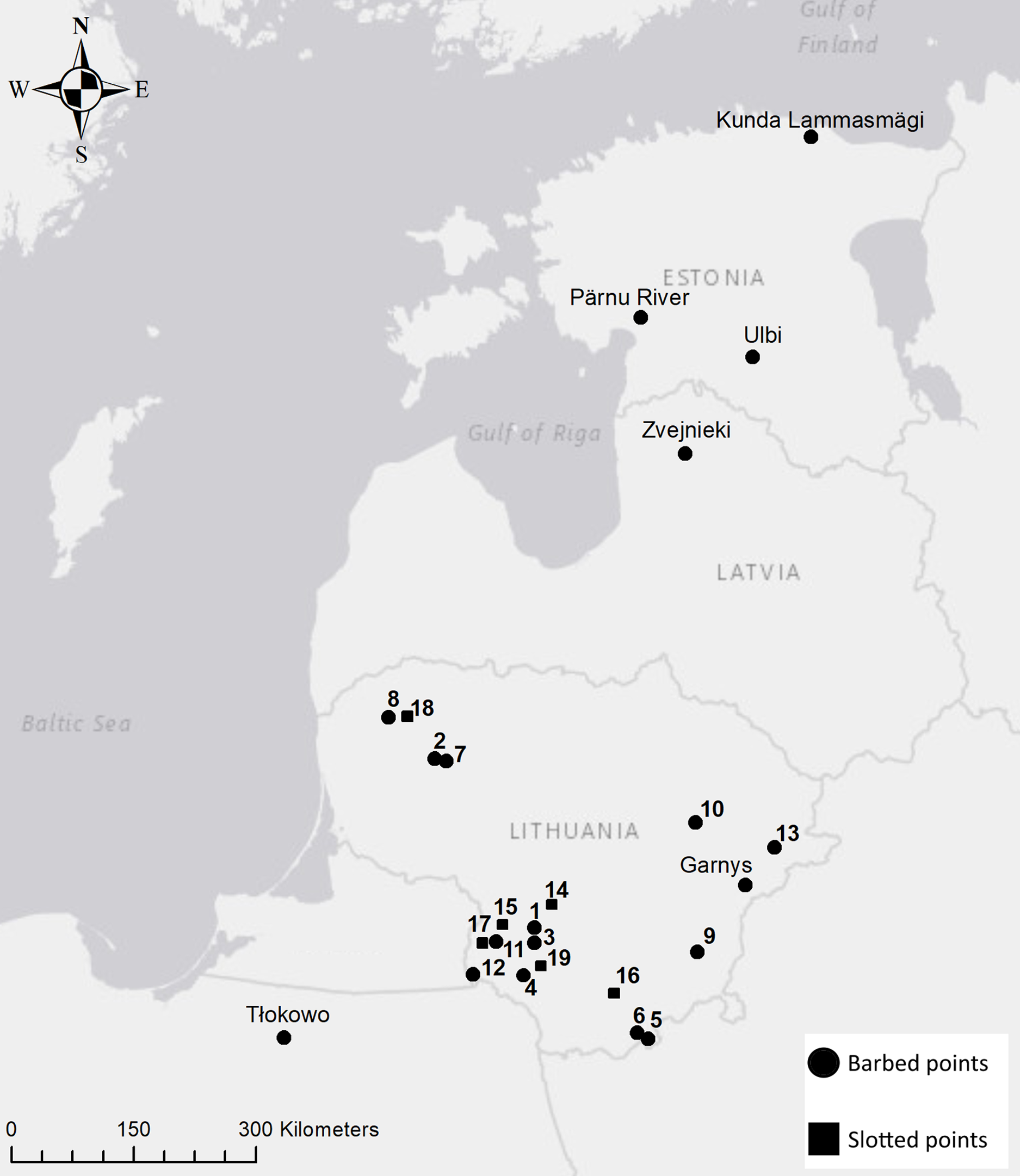
The studied bone points, from the collections of the National Museum of Lithuania (LNM), Vytautas the Great War Museum (VDKM) and Vilkaviškis Regional Museum (VKM), were found in different regions of Lithuania, but most are from the western and southwestern areas of the country (Figure 1). Almost all the single finds described in this paper were published previously, briefly emphasizing their find circumstances, possible chronology and cultural attribution. Bone points from Galubalis wetland, Margiai Island and Vilkaviškis were partly described in the early 20th century (Szukiewicz Reference Szukiewicz1901; Antoniewicz Reference Antoniewicz1928). The majority of single bone artifacts presented in this paper were reported by the Lithuanian archaeologist Puzinas (Reference Puzinas1938), who highlighted the importance of osseous industries during the Mesolithic and Neolithic. A few decades later, Rimantienė (Reference Rimantienė1974) compiled all the known Stone Age finds in the first volume of the Atlas of the Lithuanian Archaeology, including the list of osseous tools. Some of these artifacts have been discussed in recent works on the Final Paleolithic and Mesolithic in the eastern Baltic (e.g., Ostrauskas Reference Ostrauskas1996; Girininkas Reference Girininkas2009; Girininkas and Daugnora Reference Girininkas and Daugnora2015; Šatavičius Reference Šatavičius2016), yet chronological and technological data of osseous points have not been re-evaluated by modern research methods since their first publication, except four artifacts studied by Ivanovaitė et al. (Reference Ivanovaitė, Bjørnevad, Philippsen, Hoggard, Enghild, Scavenius, Vasiliauskaitė, Dručkuvienė, Jensen and Maring2018). Thus, the selection criteria of bone points for this study were based on the variability of types and the lack of research.
Locations of studied bone points and the key Mesolithic sites mentioned in the text: 1. Bebrininkai; 2. Daktariškė 5; 3. Galubalis; 4. Kamšai; 5. Karaviškės; 6. Margiai Island; 7. Pabiržulis; 8. Plateliai; 9. Rūdninkai; 10. Šventoji River; 11. Vilkaviškis; 12. Vištytis Lake; 13. Žemaitiškė 1; 14. Ežerėlis; 15. Opšrūtai; 16. Vaikantonys; 17. Alvitas Lake; 18. Yliai; 19. Žiūrai-Gudeliai.
Most of the 22 bone points examined for this study are isolated finds discovered during peat cutting, draining, or straightening of riverbeds that largely took place in the 20th century (n=18). One barbed point from the settlement site at Daktariškė 5 (western Lithuania) and three from Žemaitiškė 1 (eastern Lithuania) are included in this study. Both sites are located in lacustrine environments with good preservation conditions for organic material. They were excavated in the 1970s and 1980s–1990s, and mainly date to the Middle and Late Holocene (Girininkas Reference Girininkas1990; Butrimas Reference Butrimas2019). Both have quite complex wetland-type stratigraphies that (in the case of Daktariškė 5) have been subject to re-excavation and dating of more contextual material (Piličiauskas Reference Piličiauskas2018). However, there is evidence that some organic implements pre-date the main occupational phase. At Daktariškė 5 this is indicated by the radiocarbon dating of T-shaped antler axes whereas at Žemaitiškė 1, the morphological features of the three bone barbed points stand out from the rest of the osseous artifacts (Girininkas Reference Girininkas1990).
Finally, there is no provenance information regarding one of the Kunda-type bone points held by the VDKM. In the museum’s artifacts book it is labelled as a find from an unknown location, with no date when it was given to the museum. Kunda-type points are unique in their manufacturing technique, so it is included in this study, as its analysis might provide more data on this specific tool type.
Bone Points
The analyzed material can be divided into two bone point categories: (1) barbed points (n=16) (Table 1), and (2) slotted points (n=6) (Table 2). Barbed points are usually sub-divided into narrower types according to the shape and morphology of barbs (e.g., Galiński 2013; Cziesla Reference Cziesla2018; Groß et al. Reference Groß, Lübke, Meadows, Jantzen and Dreibrodt2019), but in this study the barbed points are not split into sub-groups due to (1) the limited number of cases and (2) the fact that only five implements are fully preserved, while the others are damaged and not retaining their full shape. Partial preservation limits the scope of analyses, but their morphology, including the shape of barbs, is discussed in this paper. All barbed points studied here are uniserial, with one exception from Plateliai, which has finely shaped small notches on both sides.
Data of barbed points studied in this paper, with the type of applied laboratory methods in this paper. Abbreviations: LNM – National Museum of Lithuania, VDKM – Vytautas the Great War Museum.

Data of slotted bone points studied in this paper, with the type of applied laboratory methods in this paper. Abbreviations: VDKM – Vytautas the Great War Museum, VKM – Vilkaviškis Regional Museum.

Five unilateral and one bilateral slotted points are addressed in this study. In most cases, the bone part was fully preserved, with no major damages to the proximal, distal, or medial parts. Only the point from Lake Alvitas has a damaged distal end. Vaikantonys, Lake Alvitas and Žiūrai-Gudeliai points retain almost all of the lithic inserts. Only 2 (Opšrūtai) and 3 (Ežerėlis) lithic inserts are preserved in the other points, but according to the length of their slots quite a few inserts are lost. The Yliai point has no remaining inserts at all, although its organic part is fully preserved.
AMS 14C Dating and EA-IRMS
We sampled 16 of the 22 bone points for direct AMS 14C dating. The slotted point from Lake Alvitas was not sampled due to its highly fractured state. Bone samples were taken by drill (for bone powder) and diamond cutting disk (for solid bone) where the object was already damaged. If the artifact was fully preserved, an area of the surface without significant features (e.g., barbs, point, base) was selected for obtaining bone powder. Adhesive residues from grooves were sampled from the slotted bone points using a metal scalpel, without damaging the bone and lithic parts of the artifacts. The sampling equipment was cleaned in acetone after each sampling to prevent cross-contamination. All bone points are made of long bones, but they rarely retain enough diagnostic features to allow morphometric species determination. The long bones of Cervidae and Bovidae species are usually the main raw materials used for hunting tools in the study area (e.g., Lõugas Reference Lõugas2006), so the bone point 14C ages should not be subject to freshwater or marine reservoir effects.
Radiocarbon dating of bone points were conducted at the Leibniz Laboratory for Radiometric Dating and Stable Isotope Research at Kiel University, Germany using standard radiocarbon protocols, including collagen and acid-base-acid extraction, and a type HVE 3MV Tandetron 4130 accelerator mass spectrometer (AMS) (Grootes et al. Reference Grootes, Nadeau and Rieck2004; Bruhn et al. Reference Bruhn, Duhr, Grootes, Mintrop and Nadeau2001; Longin Reference Longin1971). To remove possible consolidants, samples KIA-56407, KIA-56412 and KIA-56413 were first cleaned using hot tetrahydrofuran, dichloromethane, ligroin, acetone, methanol, and water.
Where possible, leftover freeze-dried collagen was analysed by EA-IRMS (Elemental Analysis-Isotope Ratio Mass Spectrometry), to measure %C, %N and the stable isotope ratios δ13C and δ15N. Abundances of carbon and nitrogen are considered diagnostic of collagen preservation (e.g., Guiry and Szpak Reference Guiry and Szpak2020). Three collagen extracts were analysed up to four times each by isolab GmbH, Schweitenkirchen, Germany, following Sieper et al. (Reference Sieper, Kupka, Williams, Rossmann, Rummel, Tranz and Schmidt2006), giving uncertainties <0.1 ‰ for δ13C and δ15N. Five samples were measured in duplicate at the Archaeological Stable Isotope Laboratory, Christian Albrechts University at Kiel, Germany, using an isoprime visION continuous flow isotope ratio mass spectrometer coupled to a vario PYRO cube elemental analyzer. Isotopic ratios relative to VPDB (δ13C) and AIR (δ15N) were calibrated using the glutamic acid standards USGS40 and USGS41a; measurement uncertainty was monitored using internal casein and cattle bone collagen standards. Total analytical uncertainty is better than ± 0.12‰ for δ13C and ±0.21 for δ15N.
ATR-FTIR
1–2 mg of adhesive residues from the proximal parts of two barbed points from Pabiržulis (EM 2391) and Žemaitiškė 1 (Ž1T3), and from the grooves of four slotted points from Žiūrai-Gudeliai (AR 5), Vaikantonys (AR 6), Opšrūtai (AR 7) and Ežerėlis (AR 738) were scraped off by metal scalpel for Attenuated Total Reflectance-Fourier Transform Infrared (ATR-FTIR) spectroscopy. The analysis was focused on the identification of adhesive type used for hafting barbed points and inserts into the slots of the slotted points. ATR-FTIR spectrum results of pine resin and tar, and birch bark tar published by Vahur et al. (Reference Vahur, Kriiska and Leito2011) and Chen et al. (Reference Chen, Vahur, Teearu, Juus, Zhilin, Savchenko, Oshibkina, Asheichyk, Vashanau and Lychagina2022) were used as a reference to compare the obtained spectrum results from six Lithuanian artifacts. According to these studies, the difference between pine resin and tar, and birch bark tar in the ATR-FTIR spectrum are observed in the wave numbers 3000–2500 cm–1 and 1800–1500 cm–1. There also difference in C-H stretching—pine resin and tar have triple, whereas birch bark tar has double stretching. Pine resin and tar also have stretching at 1695 cm–1, while birch bark tar stretches at 1732 and 1705 cm–1. The analysis was conducted using Nicolet 380 FT-IR spectrometer in ATR mode at the Leibniz Laboratory for Radiometric Dating and Stable Isotope Research at Kiel University, Germany.
RESULTS
Diversity in Tool Types and Design
The barbed points in this study are diverse in types (Figure 2).The points from Rūdninkai and Šventoji River are the largest tools in the single barbed points category. They have large barbs 12 to 41 mm apart. The point from Rūdninkai is fully preserved. Large barbs are shaped in the medial part of the point, whereas the smaller ones are in the distal end. The proximal part has a semi-shield shaped base with one barb pointed facing upwards, whereas above it one barb is facing horizontal.
Single barbed points: 1. Bebrininkai; 2. Galubalis wetland; 3. Kamšai; 4. Karaviškės; 5. Margiai Island; 6. Pabiržulis; 7. Plateliai; 8. Rūdninkai; 9. Šventoji River; 10. Unknown location; 11. Vilkaviškis; 12. Vištytis Lake.

The barbed point from Kamšai also shares similarities with the artifacts from Rūdninkai and the Šventoji River. However, its barbs are much finer and the spacing is quite regular, between 18–21 mm. The lower part of this point has three horizontal wide-cut notches. It is likely that they might have been shaped for the hafting techniques into the shaft, but there are suggestions that it might be accidental damaged, formed when the piece was extracted from the sediments (Ivanovaitė et al. Reference Ivanovaitė, Bjørnevad, Philippsen, Hoggard, Enghild, Scavenius, Vasiliauskaitė, Dručkuvienė, Jensen and Maring2018). However, the notches are regular and all share similar morphology, making it more likely that they were made on purpose.
The barbed points from Bebrininkai, Karaviškės and Vištytis Lake are of a simple type of uniserial point, with three to five barbs. In the case of the finds from Bebrininkai and Vištytis Lake, the barbs are shaped with deep oblique incisions, making them more pronounced and longer. The barbs of Karaviškės point, on the other hand, are made with short incisions.
One piece from Vilkaviškis is made of large split bone. It has a single barb in the proximal part, close the point.
The piece from Plateliai stands out in the terms of shape from the other barb point in this group. It is triangular in section and has a narrow pointy tang. Both edges have 16 and 23 short-incised barbs.
Four barbed points from Galubalis wetland, Margiai Island, Pabiržulis and an unknown location are of the so-called Kunda type. They are characterized by the same fine trapezoidal/oval shaped barbs. No detailed technological studies have yet been carried out on them; however, oval-shaped notches are visible in the spacing between the barbs.
Although only six slotted bone points are presented in this paper, their types are quite diverse (Figure 3). The slots are in V shape and between 2 to 3 mm wide. All points are almost fully preserved, only with missing lithic inserts or minor breakage damages in the distal or proximal parts. The lithic inserts are manufactured from light grey flint that is common for the Baltic erratic flint, which outcrops are distributed mainly in southern-southwestern Lithuania (Baltrūnas et al. Reference Baltrūnas, Karmaza, Kulbickas and Ostrauskas2006). The point from Žiūrai-Gudeliai is short, 116 mm long, being the only one of studied slotted point with two rows of lithic inserts on its sides. The artifact has two pointy ends – the one in the proximal part is thicker and flatter compared to the distal part as this part was used for hafting the point. The positioning of the lower parts of the inserts also supplements this, as the upper parts of lithics placed in the proximal part of the bone points slot have been retouched to adapt them to the tapering shape of the piece. The hafting part in the proximal end also contains one horizontal incision on one of its surfaces, that most likely was utilized for hafting purposes.
Slotted points: 1. Ežerėlis; 2. Opšrūtai; 3. Vaikantonys; 4. Yliai; 5. Žiūrai-Gudeliai; 6. Alvitas Lake.

Slotted bone points from Opšrūtai and Vaikantonys are unilateral, with 212- and 244-mm length, respectively. Both have plain shapes with pointy ends in the distal parts. Similar to them but shorter is the point from Alvitas Lake.
The points from Ežerėlis and Yliai are unique in shape. Both are unilateral; however, their slots were shaped not in an entire length of the edges. The distal part of Ežerėlis point is concave-shaped with sharpened edges. It lasts approximately until the medial part of the artifact, until the start of the slot. The Yliai point displays very similar features, yet its concave-shaped pointy end is much shorter and its slot has a greater length compared to the point from Ežerėlis. The point also has one oblique notch in the proximal part that possibly functioned in the hafting system.
Barbed points from Daktariškė 5 and Žemaitiškė 1 sites are quite diverse in types (Figure 4). The bone point from Daktariškė 5 by the shape and size of barbs is somewhat closer to the bone point from Karaviškės, which dating has failed. Two points from Žemaitiškė 1 site (EM 2356: 9 and EM 2356: 8) are identical in terms of morphological features. Both are made from split bones; their distal parts contain large trapezium-shaped barbs, maintaining 14 to 20 mm distance between barbs. The last point from this site (Ž1T3), however, is different. It is a shorter point compared to two previous ones and contains a row of fine small barbs (18 in total) on one of the edges. Its proximal part is broken; however, adhesive residue remains is still preserved on its surface. This might suggest that the point broke when it was still hafted into a shaft.
Barbed points from settlement layers: 1. Daktariškė 5; 2–4. Žemaitiškė 1.

Dating
Six samples, from Bebrininkai, Karaviškės, Margiai Island, Rūdninkai, Vištytis Lake, and Yliai, failed due to low collagen, whereas the remaining 10 were successfully measured. The dating results are presented in Table 3 and Figure 5. Dates were calibrated using OxCal v.4.4.4 (Bronk Ramsey Reference Bronk Ramsey2017) and the IntCal20 atmospheric curve (Reimer et al. Reference Reimer, Austin, Bard, Bayliss, Blackwell, Bronk Ramsey, Butzin, Cheng, Edwards and Friedrich2020) and reported at 95.4% probability. For comparison, we also re-calibrated five previously published radiocarbon dates from two slotted (Ivanovaitė et al. Reference Ivanovaitė, Bjørnevad, Philippsen, Hoggard, Enghild, Scavenius, Vasiliauskaitė, Dručkuvienė, Jensen and Maring2018) and three barbed points (Ivanovaitė et al. Reference Ivanovaitė, Bjørnevad, Philippsen, Hoggard, Enghild, Scavenius, Vasiliauskaitė, Dručkuvienė, Jensen and Maring2018; Butrimas Reference Butrimas2019), which dating was performed in Aarhus (AAR) and Brussels (RICH) AMS laboratories.
AMS 14C dating and EA-IRMS results of bone points from Lithuania.

Calibration plot of radiocarbon dates of directly dated bone points studied in this paper. Blue color indicates the bone point dated for this study. Dates were calibrated using OxCal v4.4.4 (Bronk Ramsey Reference Bronk Ramsey2017) and the Intcal20 atmospheric curve (Reimer et al. Reference Reimer, Austin, Bard, Bayliss, Blackwell, Bronk Ramsey, Butzin, Cheng, Edwards and Friedrich2020).

ATR-FTIR Spectroscopy
The ATR-FTIR spectra of adhesive samples from six bone points are presented in Figure 6. Certain peaks correspond with the reference data of birch bark tar discussed by Vahur et al. (Reference Vahur, Kriiska and Leito2011) and Chen et al. (Reference Chen, Vahur, Teearu, Juus, Zhilin, Savchenko, Oshibkina, Asheichyk, Vashanau and Lychagina2022). Adhesive residues from the grooves of Opšrūtai and Ežerėlis slotted points have strong peaks at 2920 and 2851 cm–1, and at 1731 and 1709 cm–1, respectively. C-H bands are even and have two long stretches. The C-H bands of the slotted point from Vaikantonys have the same wavenumbers and even two stretches as the slotted points from Opšrūtai and Ežerėlis at peaks 2920 and 2851 cm–1, however, at wavenumbers 1800–1500 cm–1 one peak is at 1645 cm–1. Quite similar spectrum results are from Žiūrai-Gudeliai slotted point sample. Its C-H peaks are at 2921 and 2851 cm–1, yet at wavenumbers 1800–1500 cm–1 one peak is at 1646 cm–1. Both samples also have lower peaks at 1711 and 1709 cm–1, respectively. It might suggest that the birch bark used for these tools contains some admixtures of other materials that could have been used to strengthen the adhesive quality of the tar (Chen et al. Reference Chen, Vahur, Teearu, Juus, Zhilin, Savchenko, Oshibkina, Asheichyk, Vashanau and Lychagina2022).
ATR-FTIR spectrum of adhesive residues from two barbed (A) and four slotted points (B and C).

The adhesive samples from barbed points from Pabiržulis and Žemaitiškė 1 site were scraped off from the proximal surface, therefore, some bone particles also might contribute to the ATR-FTIR spectrum. However, C-H stretches of both tool samples at 2918 and 2850 cm–1, and 2919 and 2850–1, respectively. The C=O of both samples have strong stretches at 1732 and 1729 cm–1, respectively. This corresponds quite well with the reference data.
DISCUSSION
The calibrated 14C results of barbed points can be ascribed to two chronological phases: (1) ca. 8500–7500 and ca. 3300–3000 cal BC. The biserial point from Plateliai is apparently the oldest, dating to 8537–8275 cal BC. Previously published dating results of Kamšai and Šventoji River uniserial points (Ivanovaitė et al. Reference Ivanovaitė, Bjørnevad, Philippsen, Hoggard, Enghild, Scavenius, Vasiliauskaitė, Dručkuvienė, Jensen and Maring2018) fall to 8286–7963 cal BC and 8230–7830 cal BC, respectively.
Three uniserial barbed points with small fine shaped barbs, also known as the Kunda-type barbed points, were dated between ca. 7900–7500 cal BC. The earliest of them is the point from Pabiržulis (western Lithuania), dating to 7942–7602 cal BC, whereas the finds from Galubalis wetland in southwestern Lithuania, and the find from an unknown location may be slightly younger with ages of 7940–7596 cal BC and 7711–7530 cal BC, respectively.
One AMS 14C date from single bone points group can be ascribed to the third chronological phase. The point from Vilkaviškis, made from a split bone with single barb in the distal part, was dated to the 3336–3015 cal BC, therefore giving one of the two youngest dates discussed in this paper.
Daktariškė 5 settlement is one of the key hunter-gatherer wetland sites in Lithuania. Its thorough studies have provided much information on human subsistence and adaptation in the landscape during the Middle and Late Holocene (Piličiauskas Reference Piličiauskas2018). According to recent radiocarbon data, the site dates between the 5th and 3rd millennia cal BC, while a few dates also fall into the 2nd millennium cal BC (Piličiauskas Reference Piličiauskas2018). However, a T-shaped antler axe from one of the settlement layers dates to the end of the 6th millennium cal BC. As this period has not been documented during the excavations of the settlement, direct dating of individual artifacts may supplement the site chronology, and a barbed point was therefore dated for this study. However, the result dates it to 3330–2922 cal BC, which corresponds well with the younger hunter-gatherer occupation phase at Daktariškė 5.
The radiocarbon data of three barbed points from Žemaitiškė 1 settlement, on the other hand, shows the opposite. The settlement contains hunter-gatherer artifacts typical to the northeastern European forest zone Neolithic, with three conventional radiocarbon dates falling into the Middle and Late Holocene (Antanaitis-Jacobs and Girininkas Reference Antanaitis-Jacobs and Girininkas2002). According to Girininkas (Reference Girininkas1990), three barbed points were discovered in the lowermost lacustrine layer of the settlement, which already at that time gave rise to doubts on their possible chronology, as their morphologies possibly resembled Mesolithic examples. AMS 14C dating indeed showed that these points must be attributed to the later phase of the Early Holocene. Both points with large trapezoidal-shaped barbs date to ca. 7050–6700 cal BC, whereas the one with one finely shaped row of small barbs could be even older (7311–6828 cal BC). These are the earliest chronological indicators from Žemaitiškė 1, further showing the necessity of directly dating organic finds from wetland settlements.
Adhesive residues from Ežerėlis and Žiūrai-Gudeliai, and bone powder from Yliai slotted bone points were sampled for AMS 14C dating. The sample from Yliai point failed due too low collagen, but both samples from Ežerėlis and Žiūrai-Gudeliai gave reliable results. Both slotted bone points date to the later 8th millennium cal BC. Previously published dates from Opšrūtai and Vaikantonys slotted points (Ivanovaitė et al. Reference Ivanovaitė, Bjørnevad, Philippsen, Hoggard, Enghild, Scavenius, Vasiliauskaitė, Dručkuvienė, Jensen and Maring2018) fall into the same interval. While the calibrated age of finds from Opšrūtai, Vaikantonys and Žiūrai-Gudeliai represent the period between ca. 7500–7200 cal BC, the point from Ežerėlis may be slightly younger.
Radiocarbon dating results revealed that most of the barbed and slotted points studied in this paper date between the 9th–7th millennia cal BC. Two groups of bone points with specific technological features can now be dated more precisely. The first group is Kunda-type barbed points. Many of these have been found at Latvian sites, such as Zvejnieki, as well as in a massive osseous tool collection from Lake Lubāns (Zagorska and Zagorskis Reference Zagorska and Zagorskis1989; Vankina Reference Vankina1999). In Estonia, Kunda-type points are known from Kunda Lammasmägi, the type-site for these barbed points and the eponymous Mesolithic culture. However, until now only two Kunda-type points from Zvejnieki have been dated directly or by secure context. A tip fragment was found in the fill of the early 4th millennium grave No. 316-317 at Zvejnieki. It was directly dated to 7484–7083 cal BC (LuS-8738: 8275±55) (Larsson et al. Reference Larsson, Nilsson Stutz, Zagorska, Bērziņš and Ceriņa2017). Another Kunda point was found as a grave good in the Mesolithic grave No. 305. The point is not directly dated; but the 14C age of human remains (Ua-3634: 8240±70,) (Zagorska Reference Zagorska1997), after a dietary reservoir effect correction (Meadows et al. Reference Meadows, Bērziņš, Legzdiņa, Lübke, Schmölcke, Zagorska and Zariņa2018) would date this specimen to the early 7th millennium cal BC. Three Kunda points from Lithuania were successfully dated in this study. The AMS date (Poz-130204: 8340±50) of another Kunda point from an underwater site in Garnys village was published recently by Piličiauskas et al. (Reference Piličiauskas, Pranckėnaitė, Matiukas, Osipowicz, Peseckas, Kozakaitė, Damušytė, Gál, Piličiauskienė and Robson2023), therefore, so far four such type of barbed points are directly dated in the territory of Lithuania. The number of dated specimens is still moderate, but Kunda-type points could date to 8th millennium cal BC (Figure 7). Two types of Kunda points can be distinguished: (1) points with barbs along the entire edge (Pabiržulis example), and (2) points with barbs on only half of the edge (Galubalis wetland, unknown location and Zvejnieki burial 305 examples). At this stage, it appears that these types existed contemporaneously, but a larger dataset is necessary to study the technological development of Kunda-type barbed points.
Calibration plot of direct radiocarbon dates of the Kunda-type and slotted bone points in the eastern and southeastern Baltic region. Dates were calibrated using OxCal v4.4.4 (Bronk Ramsey Reference Bronk Ramsey2017) and the Intcal20 atmospheric curve (Reimer et al. Reference Reimer, Austin, Bard, Bayliss, Blackwell, Bronk Ramsey, Butzin, Cheng, Edwards and Friedrich2020). The date for Zvejnieki grave 305 is the diet-corrected date proposed by Meadows et al. (Reference Meadows, Bērziņš, Legzdiņa, Lübke, Schmölcke, Zagorska and Zariņa2018).

The second type that dates to a narrower period in this study is slotted points. The Lithuanian slotted point dates (n=4) all fall between ca. 7600–7000 cal BC. However, recent direct dating of slotted bone tools from the sites in Estonia (Kunda Lammasmägi, Pärnu River, Ulbi) and northeastern Poland (Tłokowo) suggest that this technology was already present in the early 8th millennium cal BC, whereas the youngest dates fall in the middle of the 6th millennium cal BC (see Manninen et al. Reference Manninen, Asheichyk, Jonuks, Kriiska, Osipowicz, Sorokin, Vashanau, Riede and Persson2021 for the summarized data). Still, most of the radiocarbon dates fall in the 8th millennium cal BC (Figure 7). AMS dating suggests that unilateral and bilateral slotted tools were manufactured and used in the same period. The same applies to slotted points with specific morphological traits, like the point from Ežerėlis which has sharp edges and a feather-like pointy end.
The technology of slotted bone points is truly one of the masterpieces of the Early Holocene hunter-gatherer craftsmanship. In northeastern Europe, it coincided with the introduction and spread of the pressure flaking technique of flint blade production (e.g., Rankama and Kankaanpää Reference Rankama and Kankaanpää2008; Sørensen et al. Reference Sørensen, Rankama, Kankaanpää, Knutsson, Knutsson, Melvold, Eriksen and Glørstad2013; Damlien et al. Reference Damlien, Berg-Hansen, Zagorska, Kalniņš, Nielsen, Koxvold, Bērziņš and Schülke2018). Archaeological data suggest that pressure flaking was introduced to Lithuania with the post-Swiderian (Pulli) lithic technology and was used in core and microlith technology throughout the Mesolithic (Ostrauskas Reference Ostrauskas2000; Rimkus et al. Reference Rimkus, Ežerinskis, Šapolaitė and Peseckas2020), as well as in the manufacturing of slotted bone points. Therefore, although the four Lithuanian slotted points dated to a narrow 600 years range, without a doubt this type had a much longer currency.
ATR-FTIR results of adhesives of six bone points correspond with the reference results of birch bark tar (Vahur et al. Reference Vahur, Kriiska and Leito2011; Chen et al. Reference Chen, Vahur, Teearu, Juus, Zhilin, Savchenko, Oshibkina, Asheichyk, Vashanau and Lychagina2022). These six bone points dates cover almost the entire Boreal period, when broadleaf forests increased in the eastern Baltic area. In Lithuania, birch was more abundant in the Preboreal than subsequently, but it is still present in pollen diagrams during the Boreal and Atlantic chronozones (e.g., Stančikaitė et al. 2006; Reference Stančikaitė, Gedminienė, Edvardsson, Stoffel, Corona, Gryguc, Uogintas, Zinkutė, Skuratovič and Taraškevičius2019). Birch bark tar was used as far back as Neanderthal times (e.g., Schmidt et al. Reference Schmidt, Blessing, Koch and Nickel2021). Although pine resin was also available in the Mesolithic, birch bark tar was preferred in hunter-gatherer societies. This might not only be due to its adhesive properties, but also for symbolic reasons, and for its black color (Little et al. Reference Little, Needham, Langley and Elliott2022).
CONCLUSIONS
The analysis of bone points in this study demonstrates that such artifacts are important components of hunter-gatherer technologies in the dynamic environment of the Early Holocene. There was a wide variety of bone point types in the eastern Baltic region. Their direct dating has confirmed the date ranges of certain types, and corrected existing chronologies based on typological dating. Although some of the point types were dated to narrow ranges of ca. 300–600 years, it is necessary to continue building up the dataset, which may broaden or even narrow the chronologies of certain types.
Technologically, the dated points from Lithuania are very close to or the same as equivalent tool types found across northeastern Europe. Not only are the forms and technology similar, but the use of birch bark tar for hafting is also a common feature. However, many bone points from key Mesolithic sites in the eastern Baltic lack direct dating. The pressure blade technique and the technology of slotted bone points might be a good example of the transfer and mobility of certain hunter-gatherer technologies.
ACKNOWLEDGMENTS
This study was funded by the Alexander von Humboldt Research Foundation for post-doctoral research (TR). We are thankful to the National Museum of Lithuania, Vytautas the Great War Museum in Lithuania and Vilkaviškis Regional Museum (Lithuania) for fruitful cooperation in artifact studies. Finally, we are grateful to the two anonymous reviewers for the comments on the previous version of this paper.


 Open access

