Introduction
There is no such thing as a Republican judge or a Democratic judge. We just have judges in this country.
Partisanship serves as the primary lens through which many Americans approach politics. Not only do these loyalties help citizens adopt ideological labels (Levendusky Reference Levendusky2009), but partisanship also helps organize how people view policy (Orr and Huber Reference Orr and Huber2020), democracy (Graham and Svolik Reference Graham and Svolik2020), and their fellow citizens (Iyengar and Westwood Reference Iyengar and Westwood2015). Even the perceived legitimacy of social and political institutions falls in line with one’s chosen political identity: Republicans and Democrats evaluate public health officials, the mainstream media, science, and government leaders and politicians in starkly different ways (Neblo and Wallace Reference Neblo and Wallace2021).
Historically, however, the Supreme Court of the United States has resisted a partisan sorting out of public support. A rich judicial public opinion literature dating back to the 1980s demonstrates that Republicans and Democrats alike have traditionally expressed support for the Court’s constitutional authority to debate and rule upon delicate matters of rights and politics (Gibson and Nelson Reference Gibson and Nelson2014).Footnote 2 In fact, there is evidence that even deeply controversial decisions like Bush v. Gore – in which the Supreme Court arbitrated the outcome of a United States presidential election – had limited negative repercussions for how citizens view the Court’s fundamental role in American politics (Gibson, Caldeira, and Spence Reference Gibson, Caldeira and Spence2003).
Yet, the American political landscape has changed much in the intervening years since that controversial 2000 election, which thrust the Supreme Court firmly into the epicenter of the political consciousness of ordinary Americans. In the interim, elite polarization – the ideological rift between elected Republican and Democratic elites – has continued to rise. These deep divisions have not only bottlenecked legislative policymaking processes (McCarty Reference McCarty, Pierson and Skocpol2007) but have also permitted the other branches of government in the American system of checks and balances to fill the void created by an inefficient Congress. While the resulting gridlock has shifted additional power to the presidency, accelerating the way in which the executive branch has entrepreneurially sidestepped an inefficient legislature (Prakash Reference Prakash2020), it has also permitted the judiciary to exert more power over matters of politics (Boston et al. Reference Boston, Carlson, Duck-Mayr and Sasso2024). Indeed, as Brown and Epstein (Reference Brown and Epstein2023, p. 250) document in a recent edition of Presidential Studies Quarterly, “there are increasingly frequent indications that the Court is establishing a position of judicial supremacy over the president and Congress.”
These institutional tensions dovetail with two important developments within the Supreme Court of the United States itself. First, although conservatives and liberals alike have sought to use the Court to maneuver around other institutional bodies throughout the course of American history (Green Reference Green2009), the late Roberts Court is characterized by a historically unusual supermajority that legal scholars have described as “partisan” (Devins and Baum Reference Devins and Baum2017, p. 303; Epstein Reference Epstein2024). That is, contemporary justices’ voting behavior now more closely aligns with the party of the president who nominated them than earlier points in history. Second, as Sumrall and Baumann (Reference Sumrall and Baumann2023, p. 24) argue in a recent law review essay, the current Court’s majority tends to self-aggrandize the judiciary’s role in American politics by “reifying” its stature among the sister branches (Gottlieb Reference Gottlieb2018).
Taken together, these developments are worrisome. If the Roberts Court uses expedient justifications (Emerson Reference Blake2022) to arrive at partisan conclusions (Brown and Epstein Reference Brown and Epstein2023) – which are increasingly at odds with what the average American wants (Jessee, Malhotra, and Sen Reference Jessee, Malhotra and Sen2022) – then the public may lose institutional trust. In fact, although Chief Justice John Roberts (Reference Roberts2024, p. 8) rightly notes that “[i]t is not in the nature of judicial work to make everyone happy,” his Court’s body of work has fallen so low in the eyes of the public that it “lacked sufficient capacity to induce widespread public acceptance of election rulings, especially in the moments it mattered most” (Bartels and Kramon Reference Bartels and Kramon2025, p. 3). If public support for institutions relies on some correspondence between what the average citizen demands and how an institution behaves (Easton Reference 77Easton1965, Reference Easton1975; Norris Reference Norris2011), then the Court may risk losing its wellspring of legitimacy when citizens perceive the existence of such deficits.
Our subject of study in this Element is this delicate relationship. Using a combination of survey and experimental data, we document how ordinary Americans’ perceptions of the Supreme Court have shifted in ways that resemble evaluations of other political bodies. During a period of profound political divisions, judicial public opinion exhibits both partisan sorting and, in some cases, significant polarization.
Outline of the Element
In Section 1, we explore how systems theory guides the study of public support for political institutions. Drawing from this foundation, we connect that literature to legitimacy theory, which has served as the primary theoretical framework for understanding how the mass public evaluates the Supreme Court. We reflect on why support for the Court historically transcended partisan loyalties and preview how a crisis of legitimacy might emerge under certain conditions where the Court’s composition and rulings are perceived to asymmetrically benefit one party over another.
Next, in Section 2, we track how recent developments may have shifted perceptions that the Supreme Court is not “just” a political institution, but a partisan body. Adding two new, nationally representative surveys to our prior work (Davis and Hitt Reference Davis and Hitt2025), we show the durability of the sorting out of Supreme Court legitimacy. Irrespective of survey vendors, timing, or modeling specifications, we find that Republicans consistently exhibit greater diffuse support for the Supreme Court than Democrats. We conclude with a discussion about the microfoundations of these differences and show how partisanship pervades a host of attitudes that have been previously connected to legitimacy. As these attitudes sort, so too does legitimacy.
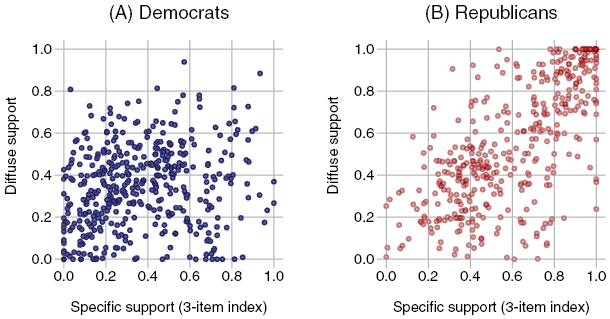
In Section 3, we build on these findings to explore how specific and diffuse support are related. Traditionally, diffuse support has resisted the influence of contemporary politics (Gibson and Nelson Reference Gibson and Nelson2014; Gibson Reference Gibson2024). A growing body of research, however, identifies that affective polarization (Armaly and Enders Reference Armaly and Enders2022), policy disagreement (Badas Reference Badas2019; Bartels and Johnston Reference Bartels and Johnston2013, Reference Bartels and Johnston2020), and even membership in politically consequential social groups (Badas and Schmidt Reference Badas and Schmidt2024; Zilis Reference Zilis2018) shape perceptions of legitimacy. Given the importance of partisan cues (Nicholson and Hansford Reference Nicholson and Hansford2014; Bartels and Johnston Reference Bartels and Johnston2020) and identity (Zilis Reference Zilis2022) in shaping how people think about the Court, our argument for connecting specific and diffuse support places special emphasis on the role of partisanship. If the Supreme Court produces decisions that only sporadically benefit one party – as it did for several decades in the post-Civil Rights era – then partisanship is unlikely to impact diffuse support (Nelson and Tucker Reference 83Nelson and Tucker2021). But, when the Court’s majority shifts lopsidedly toward one ideological pole (Cameron and Kastellec Reference Cameron and Kastellec2023) and produces high-profile rulings that appear partisan (Boston and Krewson Reference Boston and Krewson2024) or procedurally unfair to some citizens (Davis Reference Davis2025), specific support may become sufficiently negative to erode legitimacy.Footnote 3 Drawing from our recent research (Davis and Hitt Reference Davis and Hitt2025) and using newly collected survey data, we validate an index of specific support and propose a simple, three-question index that scholars may use to better operationalize the spirit of these sentiments.
But what about support for the rule of law? Past research has long linked support for democratic processes and values to Supreme Court legitimacy (Gibson Reference 78Gibson2007a). Given what public opinion scholars know about the creative ways in which partisans will excuse antidemocratic behaviors and speech (Graham and Svolik Reference Graham and Svolik2020; Simonovits et al. Reference Simonovits, McCoy and Littvay2022; Cagle and Davis Reference 75Cagle and Davis2024), we suspect that support for the rule of law is no less a casualty to self-serving epistemic protections. To what extent might those attitudes also bear the mark of partisan sorting and, in turn, affect legitimacy?
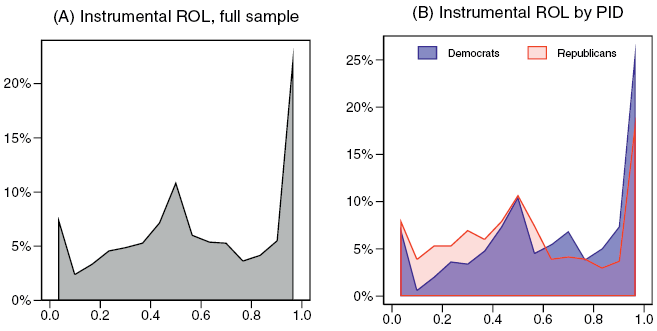
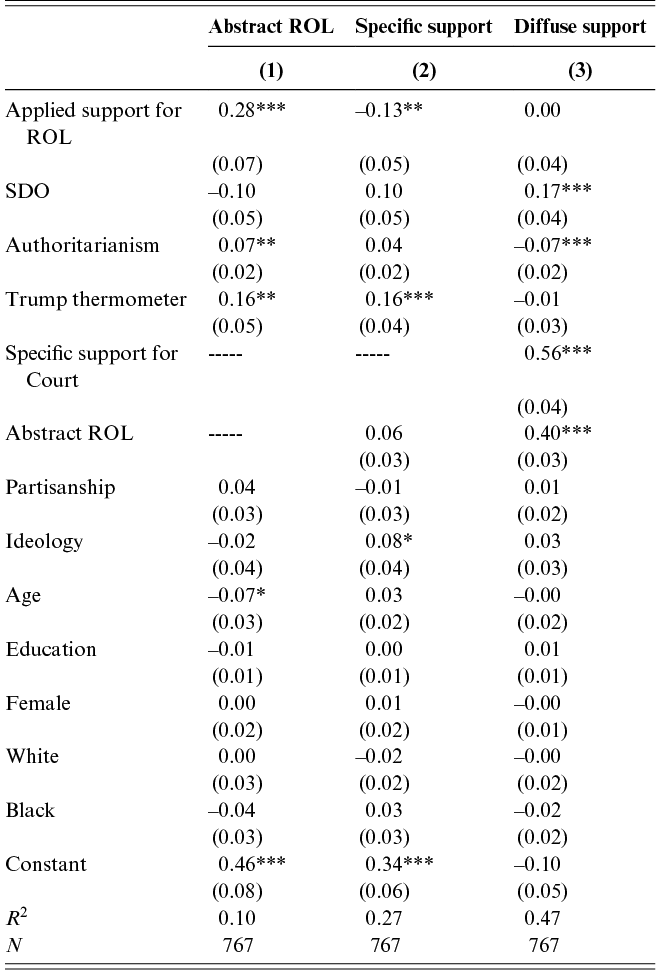
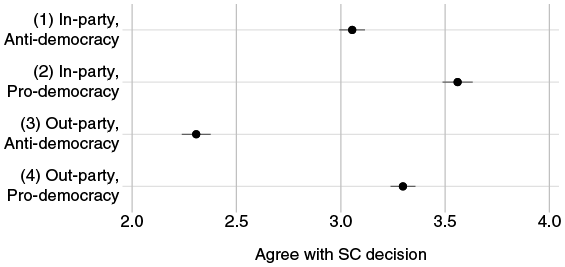
In Section 4, we approach the connection between support for the rule of law and the Court in two ways. First, we model perceptions of legitimacy as both a function of abstract beliefs about the importance of the rule of law and instrumental assessments of recent acts of executive overreach that strain the rule of law. If judicial legitimacy flows from basic normative commitments, then we should expect both episodic and abstract commitments to the rule of law to affect legitimacy in similar ways. Unfortunately, however, we find a thorny paradox: although abstract commitments to the rule of law increase diffuse support, instrumental support for the rule of law decreases it. With these results in mind, we conclude by conducting an original survey experiment to test whether support for the rule of law can be used to bolster support for the Court’s decisions that make the practice of democracy more difficult. In this case, the effect of support for the rule of law on the acceptance of these decisions hinges on whether in- or out-groups benefit from the ruling – offering a final piece of evidence that support for the rule of law flexibly shapes judicial public opinion.
Finally, we end this Element by both summarizing the findings raised in the preceding sections and investigating what they tell us about the demands that Americans have for the Supreme Court of the United States during a moment of profound political upheaval. In the concluding section, we review two decades of public opinion polling involving reforms that would affect how the Court conducts its business. Coming full circle to our earlier analyses, we document that specific and diffuse support affect support for term limits and calls to expand the number of Justices on the bench, and that partisanship constrains these relationships. Still, despite a significant decline in the popularity of and trust in the Court, what remains of its reservoirs of support is probably sufficient to stave off reform.
Conclusion
Taken together, this Element pushes forward the study of support for the Supreme Court by considering how partisanship permeates judicial public opinion. Using both observational survey and experimental data, we summarize our main contributions further:
1. We confirm the continued sorting out of the Supreme Court’s legitimacy with two new, nationally representative surveys and document the stability of these attitudes over time.
2. We validate a recently introduced measure of specific support that taps into evaluations of the Court’s performance (Davis and Hitt Reference Davis and Hitt2025) and propose a simple three-item index for scholars to use moving forward.
3. We show that the connection between support for the rule of law and legitimacy exhibits a thorny principle-implementation gap. Abstract support for the rule of law boosts Supreme Court legitimacy, but attitudes about real material violations of the rule of law undercut perceptions of legitimacy.
The findings presented in this Element imply that how citizens view the Court is essential for understanding what citizens want from government. Democracies are ever chaotic, but one nonnegotiable feature of democratic stability involves the idea that institutions are not built in ways that appear to rig the distribution or exercise of power. In light of legal concerns that the executive branch has used its powers to retaliate against organizations and people that President Donald Trump dislikes (Cassens Weiss Reference Cassens Weiss2025), the Supreme Court now sits as the last player in a high-stakes game of preserving the rule of law on cases ranging from expanding executive control over Congress, election law, the viability of birthright citizenship, and deportations of American citizens to foreign countries (Reuters 2025). For the Court, there is no way to avoid wading into the deeply partisan waters that surround these issues. Although its charge is to weigh the demands of law when it arrives at its decisions, further deference to the executive branch may place the Court in an impossible position where its rulings further fracture what little legitimacy is left among some American citizens. Today, large chunks of the mass public view the Supreme Court critically, and it is unclear whether legitimacy can rebound when the scales of judicial power tilt unevenly.
1 A Systems Theory for Changing Times
The data point not to law but to partisanship all the way down. And that partisanship has manifested itself in both forms of political polarization: a U.S. Supreme Court that is increasingly sorted by party identity and that is marked by partisan antipathy – blue versus red teams.
In the United States, democracy is most closely associated with popular self-rule (Davis, Gaddie, and Goidel Reference Davis, Gaddie and Goidel2022). There is an inherent tension, then, in designing a system of checks and balances in which an unelected, unrepresentative body of judges may potentially override the will of America’s elected legislators (Bickel Reference Bickel1962). While Alexander Hamilton’s belief in a duty of confidence to trust in government is understandable (Federalist 23), no political body can ever appeal to an entire citizenry. In those cases where government disappoints citizens, there must be some underlying wellspring of support that cuts across base allegiances to bind people to their political institutions.
An analogy may help. In some respects, how people view political institutions mirrors how they view the sports teams with which they associate. An individual may be born into a fandom or adopt a team. The development of these psychological loyalties unfolds over time, as fans learn about their team, its history, its players, and its victories. Defeat always stings, yet, for many fans, the fleeting unhappiness associated with defeat is sufficiently idiosyncratic that they do not venture into complete doomerism – that is, they do not reject their fandom even when winning seasons are distant memories. In other words, fans possess an enormous capacity for pain. They love their team, even when it disappoints them.Footnote 4
However, there are limits to this arrangement. When ownership refuses to negotiate with a beloved star player who is later traded away, when defeat becomes routine, and when losing seasons begin to stack up, the foundations of fandom crack apart. Fans face a crossroads: jettison their loyalty to the organization or reduce their expectations.
We believe that support for political institutions follows a similar pattern. If partisans are serial losers or feel that they are structurally disadvantaged by the proverbial rules of the game, then the wellspring of support for their system may be insufficient to mask the negative effects of their anger, sadness, or disappointment. In this section, we lay out the “systems theory” of political support that has been used to study how Americans view political institutions. Drawing predominantly from Easton’s (Reference 77Easton1965, Reference Easton1975) field-setting work, we review the distinction between performance ratings (specific support) and loyalty or trust (diffuse support) and, briefly, how such evaluations are related (we attend to that connection in greater detail in Section 3). We then turn to a brief discussion of the recent, yet dramatic, transformation in the Supreme Court’s composition, which serves as the catalyst for what we argue is an important sea change in how Americans have come to understand the Supreme Court of the United States within this framework.
The Dynamics of Support for the Court
The predominant theoretical lens through which scholars have studied public opinion about the Court involves systems theory, which differentiates between two ways that people tend to think of ruling authorities. In systems of self-rule, citizens cede some of their autonomy to the state in return for certain guarantees about life, liberty, and the pursuit of happiness (Tuckness Reference Tuckness, Zalta and Nodelman2024). In turn, political institutions must be at least minimally responsive to publics to preserve their authority. The sense of trust that develops from governing authorities playing by the rules of the game and operating in the interests of the public is what is known as diffuse support – a durable form of loyalty to the system itself (Easton Reference 77Easton1965).
These attachments are distinct from the performance evaluations that embody specific support. These attitudes can be based upon a variety of factors but most frequently include policy outputs and the behavior of public officials. Citizens may not be attentive bean counters, closely monitoring their political officials and institutions, but when democratic deficits do arise – that is, when democratic institutions fail to meet their promises (Norris Reference Norris2011) – ordinary people tend to take notice (Magalhães Reference Magalhães2014; Grosskopf and Mondak Reference Grosskopf and Mondak1998).
In the context of the Supreme Court, this distinction between specific and diffuse support has been an important one (Gibson and Nelson Reference Gibson and Nelson2015; Nelson and Gibson Reference Nelson and Gibson2020; Gibson Reference Gibson2025b). The Court requires a healthy store of diffuse support to sustain its credibility given that it operates with relative impunity and as an arbiter on difficult and contentious matters of legality. On the one hand, the Court is far removed from democratic accountability by design so that it can perform its job without the taint or pressures of partisan politics (Federalist No. 78). On the other hand, this distance creates problems if the public begins to see the Court as antagonistic to public opinion or when the Court contravenes the actions of other (elected) branches.
In the late twentieth century public support for the Court was maintained thanks to a certain “positivity bias” in how citizens view it (Gibson and Caldeira Reference Gibson and Caldeira2009). A large body of research on judicial public opinion dating back to the 1990s finds that support for the Court is not rooted in, say, partisanship, or even specific support, but in a socialized goodwill rooted in democratic values (Gibson and Nelson Reference Gibson and Nelson2015). For individuals who know something of the Court’s role in democracy and appreciate the importance of the rule of law, diffuse support is robust (Bartels, Johnston, and Mark Reference Bartels, Johnston and Mark2015).Footnote 5
Over time, the relationship between diffuse and specific support has received significant scholarly attention. Gibson and colleagues’ legitimacy theory (Caldeira and Gibson Reference Caldeira and Gibson1992; Gibson and Nelson Reference Gibson and Nelson2014) largely treats specific and diffuse support as functionally independent – which is a departure from the systems theory described earlier even if it borrows a shared vernacular in specific and diffuse support. Citizens may dislike certain rulings, but the Court rarely loses support for its role in the system of checks and balances – in no small part because commitment to democratic values like the rule of law essentially “regenerates” diffuse support when disappointing rulings threaten to chip it away (Mondak and Smithey Reference Mondak and Smithey1997).
Others, however, offer different perspectives on the relationship between the Court’s outputs and its store of legitimacy. Bartels and Johnston (Reference Bartels and Johnston2013), for example, present evidence that people see Court rulings and assess how distant their ideological preferences are to it. In this model, trust in the system is a Bayesian process of updating whether the Court delivers on citizens’ preferences. Strother and Gadarian (Reference Strother and Gadarian2022), in contrast, put forth an even simpler model of judicial updating – people view the Court’s outputs as either fair or political, which, in turn, shapes their support it (see also: Davis Reference Davis2025).
A final approach to the relationship between specific and diffuse support draws closest to Easton’s (Reference Easton1975) view of feedback loops, in which diffuse support changes as specific support accumulates or dissipates over time. This caveat about time is crucial: specific support involves reactions to individual outputs, but it also aggregates over time as idiosyncratic, event-based irritation shifts to a summary reserve of deep dissatisfaction. When certain institutional conditions or outputs become the status quo, performance evaluations become salient and mechanistically spill into thicker diffuse support (Davis and Hitt Reference Davis and Hitt2025; Boston and Kreweson Reference Boston and Krewson2024; Haglin et al. Reference Haglin, Jordan, Merrill and Ura2025). Thus, while it is rare that reactions to individual, yet salient, events will dent diffuse support (Gibson Reference Gibson2025a, Reference Gibson2025b), many negative outputs may so thoroughly sour specific support that diffuse support suffers (Easton Reference Easton1975).Footnote 6
The idea that specific support embodies a summary property of dissatisfaction is one we take seriously in Section 3. For now, however, we would note that research that casts doubt on the “rule, learn, update” model of judicial public opinion has cast an unnecessarily dim view on Eastonian feedback loops (Gibson et al. Reference Gibson, Pereira and Ziegler2017). It strains credulity to think that one-off experimental exposures to disappointing judicial decisions would destabilize diffuse support on surveys, even though these null results are often treated as evidence that specific and diffuse support are largely independent constructs (Gibson Reference Gibson2024, Reference Gibson2025a). In fact, Easton (Reference Easton1975, p. 445, emphasis ours) writes that “if discontent with perceived performance continues over a long enough time, it may gradually erode even the strongest underlying bonds of attachment.” We will argue that, in the context of the United States Supreme Court, that temporal requirement has been reached and that the measure of specific support utilized shapes the conclusions drawn about the relationship between these system attitudes (Section 3).
From a Political to a Partisan Body
To observe that specific and diffuse support are related seemingly requires consistency between how (and how often) the Court rules on important issues and the extent to which those issues (and rulings) map back to the underlying party system. While the Supreme Court has produced highly visible and deeply divisive rulings in the past and lived to see its legitimacy mostly untarnished (Gibson, Caldeira, and Spence Reference Gibson, Caldeira and Spence2003), the political conditions against which these rulings unfolded were distinct from contemporary ones. Consider a very brief recounting of the Court’s history. The Supreme Court of the United States locates its organizational structure not in the Constitution, but in the Judiciary Act of 1789. Enacted during the country’s first official session of Congress, the act established the federal judiciary promised in Article III of the Constitution. This development was not without drama (Holt Reference Holt1989). Indeed, there was conflict over the breadth and powers of such a Court – the Anti-Federalists viewed judicial power as an instrument of national tyranny, while Federalists argued that a Supreme Court could offer a viable buffer against excesses of power that might emerge.
Those debates evolved in time as the political and party system changed. While early Courts lacked much power, the Marshall Court, which presided over a period of dramatic geographic expansion and the growth of the federal bureaucracy, established the modern Court’s power of judicial review. Subsequent Courts would expand this power, but rarely did decisions map well onto the party politics of the day. In the postbellum period, for example, the Court ruled 8-1 that the 14th Amendment could not be utilized to outlaw segregation in private accommodations, helping usher in nearly a century of Jim Crow laws. Yet, the White and Taft Courts would nevertheless incorporate some of the Bill of Rights guarantees against the states (Gitlow v. New York) and uphold the viability and applicability of Congress’ antitrust legislation (Standard Oil Co. of New Jersey v. United States).
The New Deal era, in turn, further expanded the power of judicial review in shaping democracy, albeit with mixed effects initially. The Court would eventually agree that minimum wage laws were constitutional (West Coast Hotel Co. v. Parrish), but it also permitted the cynical and racist internment of Japanese Americans during World War II (Korematsu v. United States). And while that Court was instrumental in eventually sustaining certain portions of Franklin Delano Roosevelt’s New Deal legislation, it also resisted partisan intrusion, fighting off threats to fundamentally reform the Court.
However, a significant and consistent shift in favor of multiracial democracy and the welfare state began with Chief Justice Earl Warren’s appointment, in which the Court took many steps to protect civil liberties throughout the 1950s and 60s (Horwitz Reference Horwitz2025). In Brown v. Board of Education, for example, the Court rejected the legality of segregated schools. Later, the Warren Court’s majority would establish a general right to privacy (Griswold v. Connecticut), a right to counsel (Gideon v. Wainwright), and incorporated most of the Bill of Rights through a series of rulings (beginning, in earnest, with Adamson v. California).
In the aftermath of the Warren Court era – perhaps a high-water mark for “progressive” jurisprudence – later Courts would slowly retrench on some of the rulings produced during this period. The Burger Court (1969–1986) was certainly more conservative than its predecessors, but, even then, the Court’s Justices did not exhibit any consistent partisan-ideological sorting – that is, Justices nominated by Republican and Democratic Presidents routinely voted in ways that could not be simply or reductively tied to partisanship (Hitt Reference Hitt2013). For example, the Court produced a negative right to an abortion (Roe v. Wade) but capitulated on reinstating the death penalty (Gregg v. Georgia). The later Rehnquist Court was similarly mixed, producing a string of decisions that waffled between expanding and retracting rights. While it struck down laws against sodomy (Lawrence v. Texas), it also limited Congress’ ability to regulate interstate commerce (United States v. Lopez). Yet, even in one of its most contentious and well-known cases, Planned Parenthood v. Casey, which limited Roe while still preserving a right to abortion access, the majority in these rulings resisted easy ideological classification.
However, by 2005, we begin to see the shape of a Court that reflects the ongoing ideological sorting that political scientists observe more widely in studies of Congress (Baum and Devins Reference Baum and Devins2019). Over the last seventy years, the United States’ political parties underwent a significant ideological shift. Although political parties are “coalitions of groups with intense preferences on particular policies” (Karol Reference Karol2009), the party system in the United States historically existed in a state of flux. Activists and particular political ideas come and go, and movements are difficult to sustain over time. While that story is better told elsewhere (Grossman and Hopkins Reference Grossman and Hopkins2016; Noel Reference Noel2013), several concurrent developments began to cement a new party system in the aftermath of the Civil Rights era, which has had important implications for the Court.
First, while race has always been a significant social and political cleavage in the United States, the predominantly Southern countermovement against integration and busing purged racially conservative whites from the Democratic Party. As the Republican Party absorbed discontented conservatives, the Democratic Party moved to accommodate demands for racial equality. Second, and concurrently, an activist network of conservative thinkers, ranging from William F. Buckley Jr. to Russell Kirk, promoted cohesion and fusion within intellectual circles involved in the conservative movement. Third, a corresponding religious sorting began with the rise of the Religious Right in the 1980s, pushing conservative evangelicals further to the right (Margolis Reference Margolis2018). These changes to the party system were largely cemented by the mid-2000s, at which point data on congressional voting behavior reveals that the Democratic and Republican Parties are almost wholly distinct. Conservatives became Republicans, and liberals, Democrats (Aldrich, Montgomery, and Sparks Reference Aldrich, Montgomery and Sparks2014).
This sorting out of ideology and partisanship at the Congressional level spilled into nominees for the Court (Baum and Devins Reference Baum and Devins2019). Although justices in past eras could be counted on to engage in intriguing coalitions on certain rulings, no “moderate” or ideologically “flexible” jurists exist today on the Roberts Court – precisely because elite polarization’s zero-sum game has prevented such an outcome. Justices are now counted upon to be good (partisan) team players (Epstein Reference Epstein2024).
Consider Justice David Souter, a George H. W. Bush appointee. Having watched the public humiliation of nominee Robert Bork, Republicans became doubtful of the confirmation prospects of nominating a hardcore ideologue, preferring, instead, someone with a certain amount of plausible ideological deniability to their record. Because confirmation is never assured, nominees who did not appear as firebrands and who produced minimal paper trails during their time within the federal judiciary were presumably easier to get confirmed because there was little philosophical ammunition to gift to Senators who might oppose them during nomination hearings. Souter was a veritable “stealth” candidate – he was intellectually gifted and principled, and he seemed committed to certain important conservative ideals (Rosen Reference Rosen2009). Instead, over time, Souter’s record would appear far more moderate, disappointing conservatives and ensuring that later Republican presidents would take a different approach (Hitt Reference Hitt2013).
Today, of course, there are no more David Souters. As Cameron and Kastellec (Reference Cameron and Kastellec2023, p. 303) document:
…the new politics of Supreme Court appointments let to a partisan sort on the court (emphasis theirs): Republican justices increasingly were conservatives and Democratic justices increasingly liberals, to an extent that earlier appointees were not. In fact, from the 1930s to the 1970s…Republican and Democratic justices spanned the ideological spectrum, as measured by their voting behavior. But later partisan sorting led to crisp distinctions. Today, Republican and Democratic justices sort perfectly by ideology in their policy-making behavior; there is no overlap across party lines.
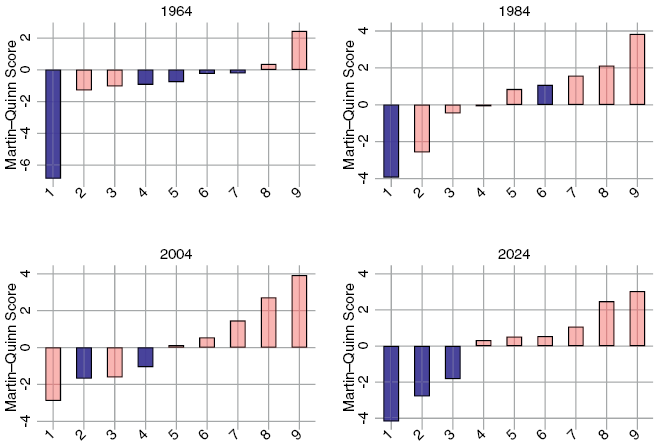
That is a bold claim, but Figure 1 illustrates that it is grounded in observational data. Using Martin-Quinn scores, which permit scholars to array the relative location of Supreme Court justices in left-right (ideological) space based on their voting habits, we can track the composition of the Court at snapshots over time. Although there are many ways to illustrate judicial outputs, we largely follow Cameron and Kastellec’s clever and intuitive visualization of judicial partisan-ideological sorting. In Figure 1, we present a simple comparison of MQ scores among sitting Supreme Court Justices at four points in time (1964, 1984, 2004, and 2024). Beginning in 1964 and moving forward in twenty-year intervals, we can observe the change that Cameron and Kastellec (Reference Cameron and Kastellec2023, Chapter 12) describe as a shift in the ideological structure of the Court. In past eras, the partisanship of the nominating president was weakly associated with the voting patterns of justices; today, in the latest available edition of these data, a durable partisan sorting has created a wedge between two blocs of justices.Footnote 7

Figure 1 Martin-Quinn scores for sitting justices at twenty-year intervals
Notes: Justices are sorted from most liberal to conservative. Bars are shaded according to partisanship of nominating president (dark blue = Democratic president; light red = Republican president). In the 1964, 1984, and 2004 Courts, there are Justices nominated by the opposing party who exhibit “counter-stereotypical” MQ scores. In 2024, the Court is fully sorted such that Democratic-appointed Justices are liberal and Republican-appointed are conservative. For an expanded treatment, see Chapter 12 in Cameron and Kastellec’s (Reference Cameron and Kastellec2023) book Making the Supreme Court.
To that end, Epstein (Reference Epstein2024) argues that the Justices of the Supreme Court now reliably behave like stereotypically good partisans in that there is little evidence to suggest that Republican-appointed (Democratic-appointed) justices will “flip” on votes that closely correspond to Republican (Democratic) priorities. Consider the following list of cases brought before the Court that were all decided by straight “party-line” votes in recent years, which seem to map not onto philosophic debates about the law but demands found in legislative party platforms. The Republican-appointed, right-leaning Supreme Court majority:
Ruled that cities can criminalize unhoused people without access to a shelter for sleeping outside (City of Grants Pass v. Johnson),
Overturned precedent regarding the government’s right to regulate critical areas of public life, which has sweeping, limiting implications for the United States’ administrative capacity (Loper Bright Enterprises v. Raimondo; Relentless v. Department of Commerce),
Stripped the Securities and Exchange Commission of its autonomy to fight securities fraud (Securities and Exchange Commission v. Jarkesy),
Struck down federal bans on “bump stocks,” which can modify semiautomatic weapons into rapid fire ones resembling banned automatic weapons (Garland v. Cargill),
Ruled against a previous decision that South Carolina’s congressional map discriminated against African Americans, which permitted racial gerrymandering (Alexander v. South Carolina Conference of the NAACP),
And, granted absolute criminal immunity to former and future Presidents for acts committed in the course of official duties while serving as President of the United States (Trump v. United States).
In contrast, Democratic-appointed justices voted uniformly against these rulings.
Reasonable people may disagree about the contours of some of these cases, and they represent a small sample of the Court’s work. In fairness, the justices arrive at many unanimous decisions and, occasionally, decisions in which interesting or surprising coalitions emerge. Further, not only are the Court’s actors mindful of how they may be covered in the media (Zilis Reference Zilis2017), but the relative influence of partisanship and ideology on judicial decision-making diminishes substantially (though not entirely) at the lower rungs of the federal judiciary (Pinello Reference Pinello1999) – findings that imply that partisanship has not totally overwhelmed the larger judicial system. Nevertheless, the cases mentioned earlier reveal the Supreme Court’s willingness to intervene in matters once often left to elected rather than unelected officials. Thus, while this is a curated list of cases, it is notable that not only do these rulings map onto existing partisan issue cleavages but also that justices’ votes conform to the partisanship of the president who nominated them – clear evidence of partisan-ideological sorting.
Taken as a whole, we suspect that such nonunanimous decisions – which are covered in distinct ways that identify political fractures and elevate the salience of division (Zilis Reference Zilis2015; Hitt and Searles Reference 80Hitt and Searles2018) – have signaled to the public that the Court has evolved from a political to a partisan body. As we will show in the following sections, not only has a profound partisan gap appeared in public evaluations of the Court but also displeasure with the Court’s trajectory now spills into the legitimacy citizens assign it. Coming full circle to the systems theory framework outlined earlier, if (1) partisans realize who the Court benefits and (2) have adjusted their specific support accordingly, then this may lead to (3) a sorting out of diffuse support.
Conclusion
Legitimacy theory is a framework that emerges from an arrangement peculiar to earlier political periods. Historically, the Court’s business was the Constitution, and whatever the political nature of the conflict that passed before the bench, the Justices themselves were not, strictly speaking, viewed as partisans. Supported by a wider legal profession that approached the study of law as an agnostic task of interpretation and application, the work of the Court was treated as legitimate technical craft (Gibson, Caldeira, and Baird Reference Gibson, Caldeira and Baird1998). Thus, we arrive at the contemporary portrayal of the Court as an “umpire” calling “balls and strikes,” a metaphor that helped to dispense allegations that justices were ideologically motivated actors.
The strength of that façade, however, has struggled under the weight of allegations that the Court has been dramatically transformed into a minoritarian, partisan backstop (Epstein and Posner Reference Epstein and Posner2022; Brown and Epstein Reference Brown and Epstein2023) – Republican presidents have appointed fifteen of twenty openings on the Court over the last fifty-odd years, despite winning the popular vote in only seven of the last fifteen presidential elections. In turn, when the Supreme Court now intervenes in politics, the justices’ opinions often neatly map onto the bitter partisan debates that divide the United States’ ideologically sorted and polarized politics (Cameron and Kastellec Reference Cameron and Kastellec2023; Epstein Reference Epstein2024). Given these developments, it seems appropriate to wonder: Has the Court transformed from a political to a partisan body in the eyes of the public? In the next section, we answer this question, arguing that, yes, the public recognizes these changes and opinion has changed accordingly.
2 The Sorting Out of Supreme Court Legitimacy
Yeah, it’s [the Supreme Court] very partisan right now, basically. It’s always a party vote. I mean, look, the whole country right now is a partisan vote.
The systems theory laid out in Section 1 implies that, in a hyperpolarized political environment, an institution may overspend its store of diffuse support as it pursues outcomes that asymmetrically benefit certain groups over time. In particular, at least two conditions seem to matter for when specific support – or evaluations of these outputs – will spill into perceived legitimacy. First, a single, suboptimal output is probably insufficient to damage the long-term reputation of an institution that has otherwise enjoyed robust public respect; instead, such outputs need to accumulate over time.Footnote 9 Second, for legitimacy to fracture, the lines of conflict ought to dovetail with a social cleavage that can sustain and instantiate the view that an institution is treating a group unfairly.
Does the American public recognize these conditions? The Roberts Court has certainly become an epicenter of legal drama, issuing numerous blockbuster rulings that not only challenge precedent and undercut stare decisis (Stone Reference Stone2008; Bridges Reference Bridges2022; Hosie Reference Hosie2025) but also often benefit one political party at the explicit expense of the other (Devins and Baum Reference Devins and Baum2017; Rosenberg Reference Rosenberg2022; Epstein Reference Epstein2024; Peretti Reference Peretti2024).Footnote 10 Further, as we document in the following text, these decisions dovetail with a fundamental shift in the composition of the Supreme Court that was borne out through a series of contentious and highly salient partisan victories. Given that (1) partisanship is the singular political identity through which ordinary citizens view politics and (2) media coverage predominantly covers the court through partisan frames (Hitt and Searles Reference 80Hitt and Searles2018), grafting an asymmetric partisan judicial superiority onto the most basic of American political cleavages removes the buoys necessary to sustain traditional theories of diffuse support.
In this section, we begin by recounting the recent ideological, if not partisan, transformation of the Court (Brown and Epstein Reference Brown and Epstein2023). We then assemble a dataset of datasets tracking public opinion about the Court over time. We show that Americans’ views of the Supreme Court’s legitimacy have not only sorted but are also stable – Democrats and Republicans exhibit very different levels of diffuse support and, at least for Democrats, their diffuse support appears to have largely bottomed out. We conclude by showing that this partisan sorting is pervasive across many judicial attitudes, which contributes to how scholars should think about the relationship between partisanship and support for the Court.
The Contemporary Supreme Court’s Rightward Turn
Historically, Supreme Court Justices were sufficiently idiosyncratic in their ideological views that their voting behaviors mapped only weakly to the political party of the presidents who appointed them (Enns and Wohlfarth Reference Enns and Wohlfarth2013). In past eras, justices like John Paul Stevens (1975–2010), Sandra Day O’Connor (1981–2006), and Lewis Powell Jr. (1972–1987) operated as ideologically flexible “swing” voters on the Court, occasionally joining the opinions of either the liberal or conservative blocs depending on the merits of individual cases (Enns and Wohlfarth Reference Enns and Wohlfarth2013; Hitt Reference Hitt2013). These justices were instrumental in sustaining a peculiar political equilibrium that helped to mollify accusations that the Court was an instrument of naked power in service of a single political faction (Hitt Reference Hitt2013).
Ruminating on the conditions that characterized that bygone era, Casey (Reference Casey1974, 388) writes,
Justices might make headlines for their personal accomplishments and / or peccadilloes…But the Justices’ newsworthy activities are infrequent and, ordinarily, discreet, and thus appear unlikely to affect judicial mystique adversely. Most of the Court’s decisions are routine and involve not broad public policy considerations but narrowly-defined, specialized issues…
However, Casey goes on to warn that these conditions can change. “Some rulings,” he warns, “nonetheless become controversial issues and…such controversy might threaten the judicial myth.” Indeed, one could argue that American politics is not only awash with such controversy but also that contemporary jurisprudence frequently involves the sort of “highly charged and emotion-laden political issues” that Casey warned could topple the perception that the Court was an agnostic arbiter of the law (388). Today, the Court is bereft of such “moderates,” having all been replaced by consistent ideologues (Hitt Reference Hitt2013; Bonica and Sen Reference Bonica and Sen2021). With the election of Donald Trump, the late 2010s produced a successive series of significant events that eroded the foundations necessary for sustaining past eras’ widely shared judicial “myths” about judicial neutrality.
Borrowing from the comparative politics literature, we describe these changes as a particization of the Court – a transformation of (legal or epistemological) conflicts that have been subsumed by a partisan cleavage. Although ordinary Americans pay too little attention to either politics (Peterson et al. Reference Peterson, Miller, Saunders and McClurg2022) or judicial decisions (Hitt, Saunders, and Scott Reference Hitt2019), we argue that significant compositional changes to the bench may break through to the mass public to signal ideological shifts – especially when such changes happen in quick succession and under controversial circumstances.
Consider the following chain of events. After the unexpected passing of Justice Antonin Scalia, Senate Republicans used the filibuster to prevent then-President Barack Obama’s nominee to the Court, Merrick Garland, from a nomination hearing – a strategic political decision but one that deeply connected the judicial opening to the polarizing partisan presidential election. Wasting little time after his election, President Trump nominated Tenth Circuit Court of Appeals Judge Neil Gorsuch for Justice Scalia’s former seat. Justice Gorsuch was then confirmed in dramatic fashion after Senate Republicans changed the institutional rules to break a Democratic filibuster of his nomination (Tushnet Reference Tushnet2018). Although Democrats under President Obama had previously removed the filibuster for lower Court nominations, confirmation using such a tactic had long been depicted as a “nuclear,” nonviable option – marking a new low point for compromise under conditions of partisan polarization.Footnote 11
Less than two years later, following the strategic resignation of Justice Anthony Kennedy (Deschler and Sen Reference Deschler and Sen2024), President Trump nominated Brett Kavanaugh for his replacement. The confirmation hearings devolved into a public relations catastrophe when Kavanaugh was accused of misconduct that dated back several decades. The most explosive of these allegations unfolded under oath, when Christine Blasey Ford testified that she was sexually assaulted by Kavanaugh during high school. That testimony – and Kavanaugh’s tearful refutation of it – were witnessed in real time by over 20 million Americans (Carrington and French Reference Carrington and French2021). Justice Kavanaugh was subsequently confirmed by a narrow 50–48 margin in the Senate.
Finally, following the surprise passing of Justice Ruth Bader Ginsburg in September, 2020, President Trump nominated, and Senate Republicans confirmed, Justice Amy Coney Barrett by a 52–48 vote. One of the quicker nomination-to-confirmation episodes, her appointment and confirmation refuted Republicans’ previous arguments against appointments in the shadow of a presidential election. With her confirmation, the Court’s conservative shift was undeniable (Brown and Epstein Reference Brown and Epstein2023).
While these high-profile confirmations emphasized that the Republican Party was winning the battle for the Court (Fishkin and Pozen Reference Fishkin and Pozen2018), the Court’s subsequent rulings are no less important in shaping public perceptions that partisan politics had spilled onto the bench. The Roberts Court overturned Roe v. Wade via the Dobbs v. Jackson decision, weakened the administrative state in Loper Bright Enterprises v. Raimondo, and granted expansive immunity to presidents in Trump v. United States. Taken together, these rulings signaled a sharp change within the Court. Absent a positive theory of the law that unifies such rulings, the Court’s decisions reveal a “broad theory of governance” that appears rooted less in a particular jurisprudential philosophy than in rote partisanship (Millhiser Reference Millhiser2024). As professor Lee Epstein (Reference Epstein2024, p. 492) argues, “partisanship has manifested itself in both forms of political polarization: a US Supreme Court that is increasingly sorted by party identity and that is marked by partisan antipathy – blue vs. red teams.”
Coming full circle to Casey’s (Reference Casey1974) warning mentioned earlier, the contemporary Roberts Court could be associated with the very conditions that he warned might undo the legitimizing myths so frequently attached to the Court. With a lopsided imbalance of judicial power that favors one political party and a steady stream of rulings that challenge precedent, it would seem plausible that the public might update their attachments to the Court accordingly. Thus, we anticipate that legitimacy should now show signs of sorting, as Democratic partisans become aware of the conditions described earlier. This argument diverges from both Clark et al. (Reference Clark, Paluck, Westwood, Sen, Malhotra and Jessee2024) and Gibson (Reference Gibson2025a), who focus on abortion attitudes and approval of Dobbs as the primary catalyst for changes in diffuse support. While that event was exceedingly salient, we expect that the loss of perceived legitimacy accumulates in no small part due to how the Court is covered using partisan game frames by the media (Barid and Gangl Reference Baird and Gangl2006; Hitt and Searles Reference 80Hitt and Searles2018) and how the Court’s business is treated by politicians (Carrington and French Reference Carrington and French2021).
If partisanship structures how people view the world around them (Mason Reference Mason2018) and symbolic partisan attachments are central elements in belief systems (Fishman and Davis Reference Fishman and Davis2022), then partisanship may serve a useful tool in organizing how people feel about the Court. Of course, citizens rarely attend to individual Court rulings (Gibson and Caldeira Reference Gibson and Caldeira2009; Hitt, Saunders, and Scott Reference Hitt2019; Gibson Reference Gibson2025b), and they may also struggle to connect Court decisions to policy preferences (Gibson, Caldeira, and Spence Reference Gibson, Caldeira and Spence2003). However, given the dramatic shift in power within the Court during a moment of where polarization is profound, it seems possible that diffuse support might shift – especially when the details of high-profile cases are salient (Boston and Krewson Reference Boston and Krewson2024). Under these conditions, partisan debates and Court politicking may function as an “elite cue” (Zaller Reference Zaller1992; Nicholson Reference Nicholson2012), which facilitates a kind of partisan sorting in how citizens understand the Court. If this occurs, then we should observe a widespread sorting out of judicial public opinion.
Documenting the Sorting Out of Supreme Court Legitimacy
We begin by assembling and analyzing a dataset of surveys that consistently measure legitimacy using the same set of questions over time. Nationally representative survey data on Americans’ attitudes toward the Court from 2012 to 2016 was obtained from The American Panel Survey (TAPS). One survey from September 2020 was incorporated from the Cooperative Election Studies (CES) project. Data from May 2022 to April 2024 comes from our original Supreme Court and Democracy (SCD) Panel Survey. Finally, adding to our previous work, we include two additional original, representative surveys that were fielded by the market survey research firm Verasight in September and December 2024.
These surveys all contain six instruments commonly used in past studies of legitimacy (c.f. Gibson and Nelson Reference Gibson and Nelson2015).Footnote 12 The questions are listed in the following text; responses to them range from 1 (strongly agree) to 5 (strongly disagree) with a neutral midpoint.
If the Supreme Court started making a lot of decisions that people disagree with, it might be better to do away with the Court.
The right of the Supreme Court to decide certain types of controversial issues should be reduced.
The U.S. Supreme Court gets too mixed up in politics.
Justices on the Supreme Court who consistently make decisions at odds with what a majority want should be removed from the court.
The U.S. Supreme Court ought to be made less independent so that it listens a lot more to what the people want.
It is inevitable that the U.S. Supreme Court gets mixed up in politics; thus, we ought to have a stronger means to control its actions.
To construct estimates of Supreme Court legitimacy, we calculated an additive index from responses to these six statements at each survey wave and then rescaled them to range from 0 (low) to 1 (high legitimacy). For presentational purposes, we illustrate these estimates by self-reported partisanship, combining weak/strong partisans and “leaners” together.
Testing for Sorting in Legitimacy
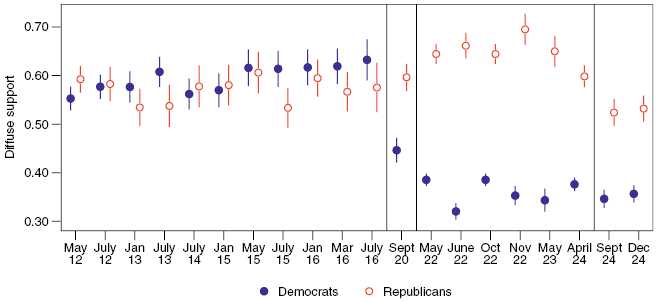
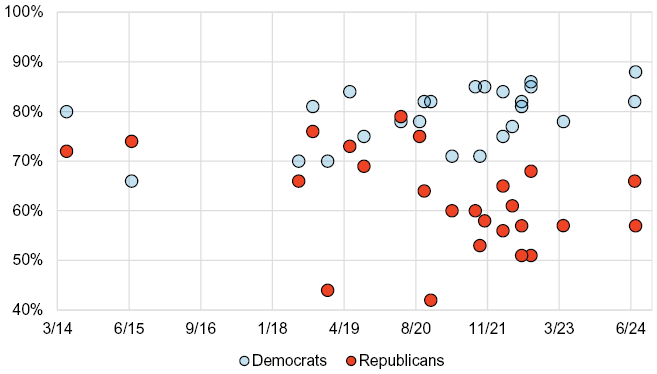
Figure 2 illustrates partisans’ diffuse support for the Supreme Court over time. Beginning with the earliest TAPS surveys, we find few differences between Republicans’ and Democrats’ diffuse support through July 2016. However, as we report elsewhere (Davis and Hitt Reference Davis and Hitt2025), this consensus breaks down in the 2020 CES module. Democrats’ perceived Supreme Court legitimacy dips lower than the legitimacy exhibited by Republicans (b = −0.11, 0.02).

Figure 2 Partisans’ diffuse support for the Supreme Court over time
Notes: Diffuse support values range from 0 (low) to 1 (high legitimacy). Point estimates are bracketed by 95% confidence intervals and were weighted via the supplied weights in the individual survey cross-sections. The figure illustrates diffuse support among Republican and Democratic identifiers; partisan differences between the two groups are significant at *p < 0.05 in the July 2013 and July 2015 waves, as well as every wave from 2020 onward.
That gap widens in the first wave of the SCD Panel Study. After the leaked Dobbs opinion in May 2022, we found that Democrats’ diffuse support dipped considerably compared to the earlier 2020 CES estimates (b = −0.13, s.e. = 0.01). Comparing the May 2022 to June 2022 SCD Panel Study surveys, we found a loss of diffuse support of almost 15 percent (b = −0.07, s.e. = 0.01). Although that initial dip rebounded slightly in the subsequent waves, Democrats’ souring on Supreme Court legitimacy persisted even through the additional surveys we collected in late 2024 and early 2025. Simply put, Democrats’ diffuse support appears to have bottomed out compared to earlier survey waves pre-2020.
Intriguingly, in our panel, Republicans do not shift in their diffuse support after the Dobbs ruling (b = −0.03, s.e. = 0.02). Intuitively, we would have expected a slight increase in support given that the Court delivered on an important conservative cause, but there is little evidence in our data to support that conclusion. Instead, somewhat curiously, by the final wave of the SCD Panel Study, Republicans’ legitimacy actually decreases from its peak. In the Verasight surveys at the end of 2024 and 2025, we find that Republicans exhibit a stable “new” normal somewhat near the early 2010s TAPS surveys.
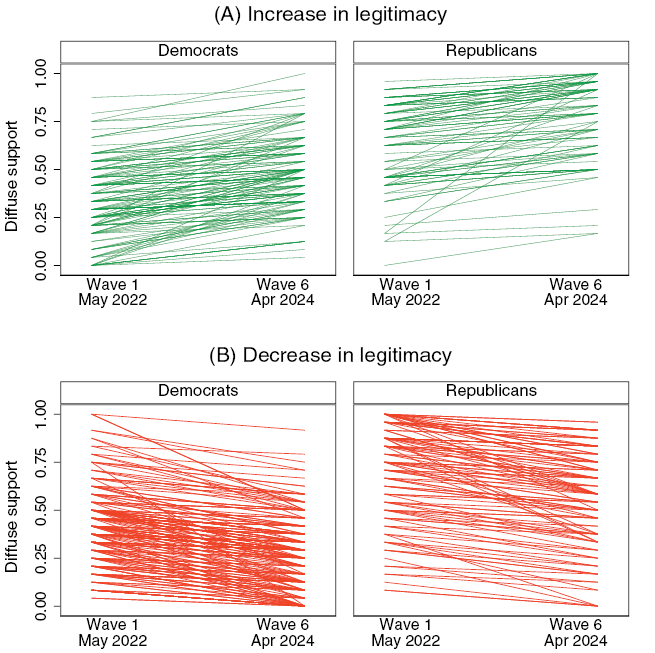
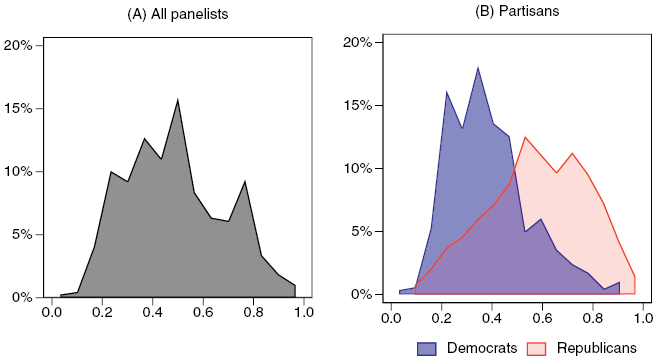
While these aggregate differences within and across parties show a sorting out of legitimacy, they do not show how legitimacy may shift within individuals over time. Although the SCD Panel Study surveys do not document large shifts in the positivity or negativity of Court affect, understanding whose legitimacy shifts over time is helpful. Figure 3 plots the distribution of changes in diffuse support for Republicans and Democrats over different windows of time, breaking apart those whose diffuse support increased (Panel A) and decreased (Panel B).
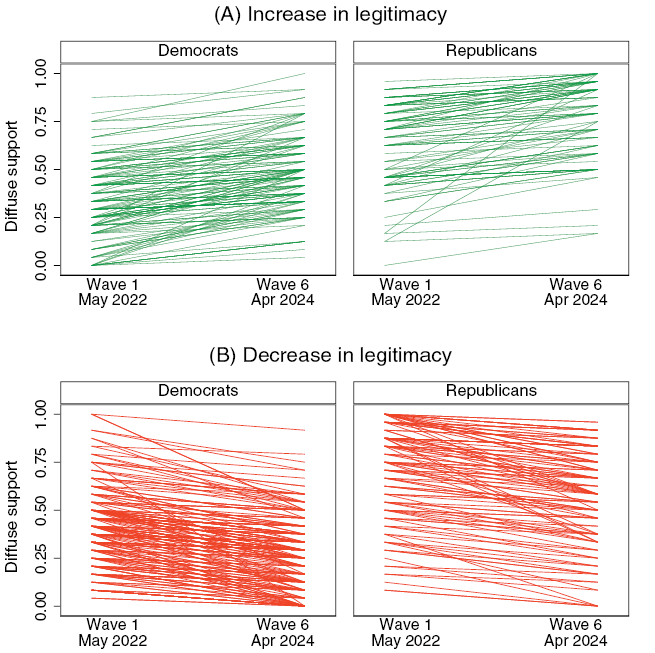
Figure 3 Distribution of individual-level changes in Supreme Court legitimacy over time
Notes: In Panel A, 146 Democratic and 101 Republican panelists either exhibited static or positive changes in legitimacy. In Panel B, 632 Democratic and 375 Republican panelists exhibited a decrease in legitimacy from May 2022 to April 2024.
Although there were questions in the immediate aftermath of the Dobbs decision about the stability of legitimacy (Gibson Reference Gibson2025a), Figure 3 illustrates that panelists’ negative impressions of the Court were sustained over the nearly two-year window in which SCD Panel Study surveys were fielded. Beginning with Panel A, roughly 23 and 26 percent of Democrats and Republicans exhibit static or positive increases in legitimacy over this period. In many cases, these changes are minor, and it is very interesting that we observe only minimal positive changes among Republicans – a finding that perhaps runs counter to theories of identity-based interpretations of diffuse support. Given the sustained success that Republicans enjoyed, it is curious that the Court is not rewarded more among copartisans. In contrast, Panel B illustrates that many more Democrats (77%) and Republicans (74%) exhibited modest negative changes in legitimacy from May 2022 to April 2024. In other words, legitimacy is not entirely stable, but these changes all point downward, suggesting that a loss of legitimacy is not a momentary shift compared to earlier survey toplines.
Partisan Spillover in the Etiology of Diffuse Support
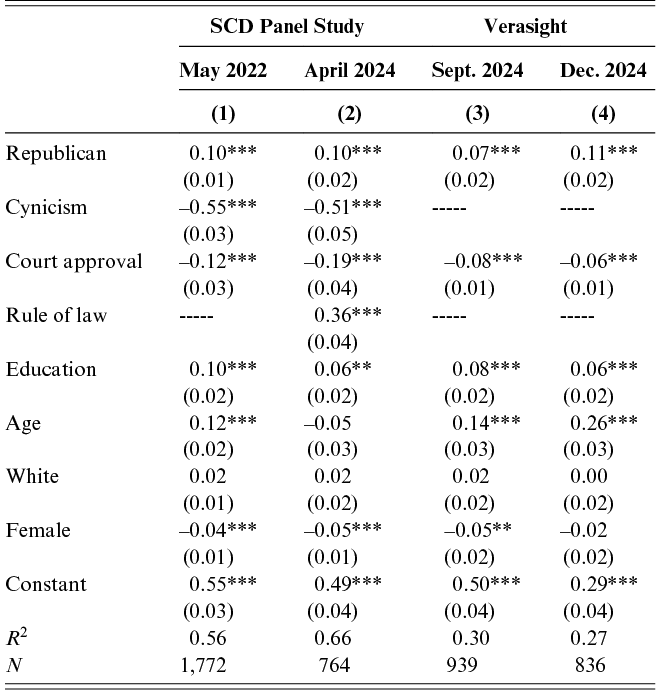
Next, we move beyond bivariate analysis to investigate how partisanship influences attitudes related to Supreme Court legitimacy. For this task, we explore a number of nationally representative surveys that we collected over the last several years from YouGov and Verasight. Several points are worth noting before turning to the analyses depicted in Table 1. First, different attitudes were collected at different survey waves; however, analyzing multiple surveys offers an opportunity to illustrate how the relationship between partisanship and diffuse support may vary under different modeling strategies. Second, this approach allows us to demonstrate the persistence of the direct effect of partisanship on legitimacy (i.e., the coefficient for partisanship is reasonably similar in magnitude and precision across surveys and is not a function of panel attrition).

Notes: Dependent variable is an additive index of diffuse support. For models 1 and 2, additional covariates for political interest, perceived ideology of the Court, and a bevy of abortion attitudes were included. Shaded row conveys effect of partisanship – “Republican” conveys whether respondent conveyed a partisan affiliation. Standard errors in parentheses. *p < 0.05, **p < 0.01, ***p < 0.001.
Table 1Long description
Table 1 depicts a standard regression model of diffuse support using both SCD Panel Study and Verasight Survey data. The dependent variable in Models 1–4 is an additive index of diffuse support. The coefficient associated with partisanship exhibits a modest and statistically significant effect on diffuse support across all four models – even accounting for other judicial attitudes like support for the rule of law and judicial cynicism.
Using the measure of diffuse support described earlier, our models include a variety of attitudes involving judicial cynicism (beliefs about whether justices are robed politicians), support for the rule of law (abstract commitments to following the law), Supreme Court disapproval (specific support), and a battery of demographic attributes into our models (specific measurement details are available in the appendix to this section). Table 1 reports the result of this analysis. Irrespective of survey wave and modeling features, Republicans always express more diffuse support than Democrats – even accounting for a variety of judicial and political preferences. Notably, the magnitude of the coefficient associated with partisanship is remarkably consistent across more than thirty months of time between the first and final survey we analyze. Further, even accounting for judicial cynicism and attitudes about the rule of law – important correlates of legitimacy – the effect of partisanship persists.
However, we believe that this main effect only tells part of the story regarding partisanship’s relationship with Supreme Court legitimacy. Over the past five decades Americans’ policy views (Levendusky Reference Levendusky2009) and political identities have sorted (Mason Reference Mason2018; Davis Reference Davis2019). If partisanship absorbs social and political cleavages, then it functions as a “structuring” identity that constrains other related attitudes, which has consequences for conceptualizing the effect of partisanship on Supreme Court legitimacy. We use Figure 4 to try and unpack this possibility.

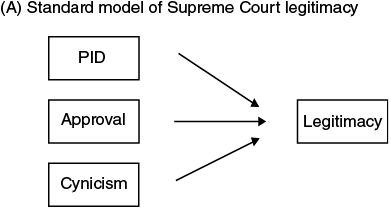
(A) Standard regression model of Supreme Court legitimacy

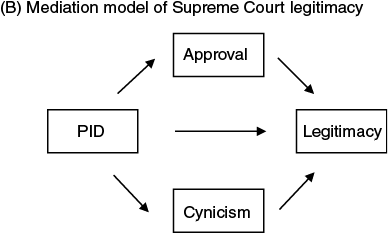
(B) Mediation model of Supreme Court legitimacy
Figure 4 Path models of the relationship between partisanship and diffuse support
Notes: In Panel A, the paths between independent and dependent variable(s) are exogenous. In Panel B, partisanship’s relation to the dependent variable flows through mediator variables approval and cynicism.
Panel A in Figure 4 illustrates the typical path model that researchers assume when employing regression analysis. Here, the “input” (or right-hand side) variables included in a standard regression model are assumed to be functionally independent of each other. However, such an assertion is difficult to make when partisanship functions as a proverbial lens through which people approach politics. Instead, if partisanship pours into other attitudes, then making claims about its effects requires exploring the extent to which it constrains these other attitudes.
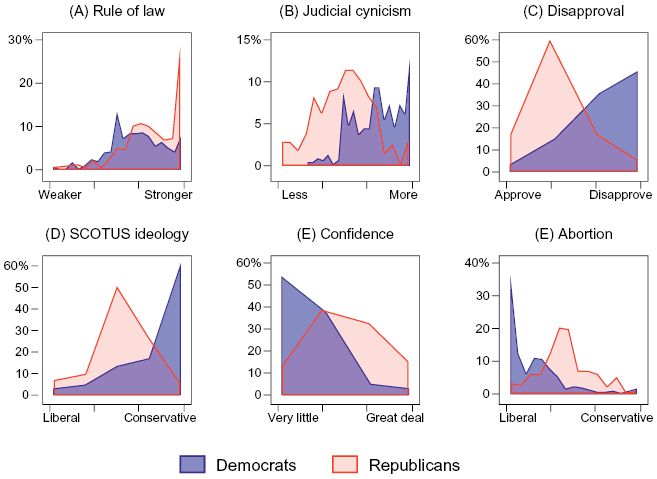
In this case, a more appropriate model for testing the effect of partisanship on legitimacy would involve the type of mediation model portrayed in Panel B. Here, the effect of partisanship is permitted to flow through other attitudes relevant to the Court. Partisanship may still exert a direct effect on an outcome, but its effects may also be channeled through other, related attitudes that exhibit significant partisan divides. To put a finer point on this logic, consider the visual results depicted in Figure 5, which show that partisanship clearly divides how people think about topics that are relevant to modeling diffuse support for the Supreme Court. Compared to Republicans, Democrats exhibit weaker abstract commitments to the rule of law (b = –0.12, s.e. = 0.02), possess considerably more judicial cynicism (b = 0.25, s.e. = 0.01), exhibit more disapproval (b = 0.38, s.e. = 0.02) and confidence in the Court (b = –0.31, s.e. = 0.01), perceive that the Court is more conservative (b = 0.29, s.e. = 0.02), and display more liberal abortion attitudes (b = –0.25, s.e. = 0.02). However, variables corresponding to these attitudes are often incorporated into “full” models of legitimacy without much thought for how they relate to each other, much less partisanship.

Figure 5 Correlates of diffuse support by partisanship
Notes: Shaded areas convey the percentage of partisans across a range of values of independent variable. Question wording for respective survey instruments is available in the accompanying appendix.
If researchers are not interested in extracting the effect of partisanship on diffuse support, then these differences pose no real problem. But when our quantity of interest is partisanship itself, model-based interpretations of substantive and statistical significance will be difficult to draw given the correlation between partisanship and these attitudes (see Hünermund and Louw Reference Hünermund and Louw2023 for a longer discussion about such modeling tensions). Put simply: In our view, partisanship is not merely a nuisance for which to account, but instead fundamentally filters the expression of judicial and political beliefs.
In recent work (Davis and Hitt Reference Davis and Hitt2025), we use mediation analysis of this sort to show that the effect of partisanship on diffuse support does indeed flow indirectly through many of the attitudes listed in Figure 5. Our analysis reveals that almost three-quarters of the gap in diffuse support between Republicans and Democrats can be attributed to these indirect effects. Further, as we will argue in the next section, partisanship critically facilitates the linkage between specific and diffuse support in important ways. For now, however, it is enough to report that – contrary to past eras – partisanship divides the thick support that Americans assign to the Supreme Court.
Conclusion
Although past research has documented remarkable cross-partisan comity among perceptions of Supreme Court legitimacy (Gibson and Nelson Reference Gibson and Nelson2016; Nelson and Tucker Reference 83Nelson and Tucker2021), the findings presented in this section are broadly consistent with an emerging consensus that these attitudes exhibit partisan sorting, too (Clark et al. Reference Clark, Paluck, Westwood, Sen, Malhotra and Jessee2024; Levendusky et al. Reference Levendusky, Patterson, Margolis, Pasek, Winneg and Jamieson2024; Davis and Hitt Reference Davis and Hitt2025). Our original six-wave panel study, coupled with two additional survey waves from late 2024, helps illustrate that this sorting is not a fleeting feature of judicial public opinion. While the Dobbs ruling played a role in the sorting out of diffuse support (Gibson Reference Gibson2024), it is important to recognize that this ruling alone is not responsible for these changes. Rather, a confluence of forces ranging from the consolidation of Republican power on the bench to consistently losing blockbuster cases has cemented Democrats’ status as chronic losers before the High Court.
In turn, many attitudes relevant to the Court’s perceived legitimacy have become bound up in partisanship. Specifying a multivariate model without considering how the relevant right-hand-side instruments are correlated risks underrepresenting how an organizing attribute like partisanship exerts both direct and indirect effects on the outcome of interest. Democrats have become more cynical about the Court, view it as very conservative, and express less specific support for it (i.e., approval). The combination of these differences sharply attenuates Democrats’ support for the Court compared to Republicans.
In the next section, we will pay special attention to this specific support – or lack thereof. Partisanship serves as a structuring identity for interpreting the Court’s outputs, but the nature of this specific support is both undertheorized and underdetermined. In Section 3, we turn to validating a new way of measuring “specific support” that reveals just how powerfully contemporaneous evaluations of the Court eat into its store of diffuse support.
3 Linking Specific Support to Legitimacy
Diffuse support may also, however, derive from experience. If only because this is a source usually associated with specific support, its significance for diffuse support may easily be overlooked or underemphasized.
In the previous section, we tracked a dramatic sea change in diffuse support for the Court over the past several years. Today, partisanship pervades how people think about the law, the motives of justices serving on the Supreme Court’s bench, and the institution itself. As the out-group in matters of judicial politics within the nation’s court of last resort, Democrats’ diffuse support has soured, while Republicans’ trust in the Supreme Court remains robust.
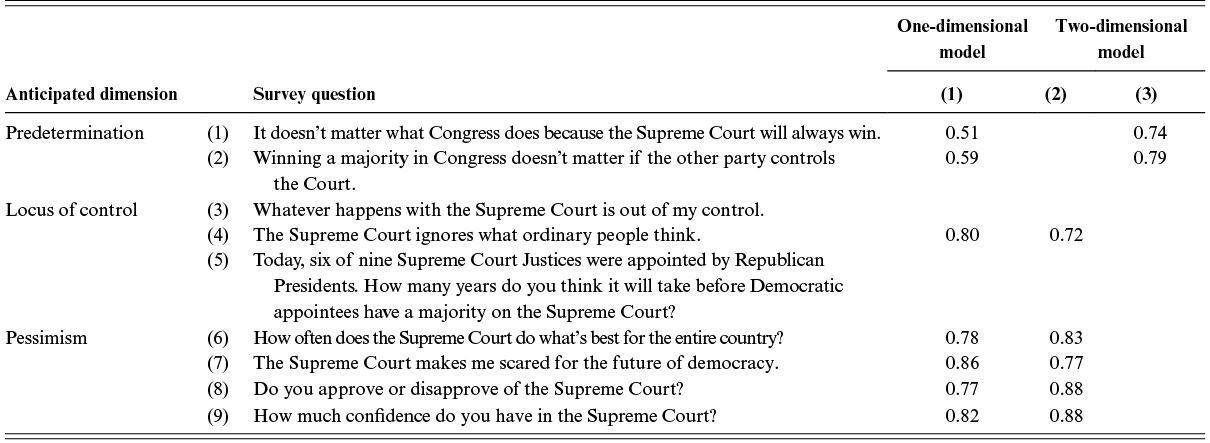
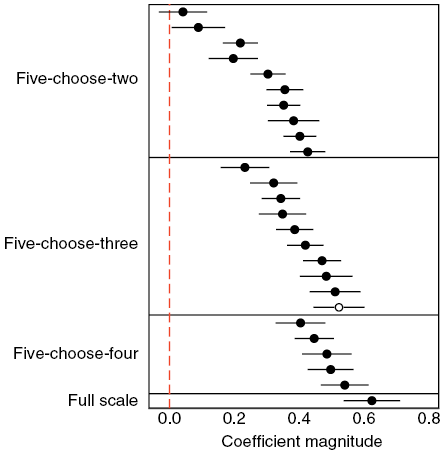
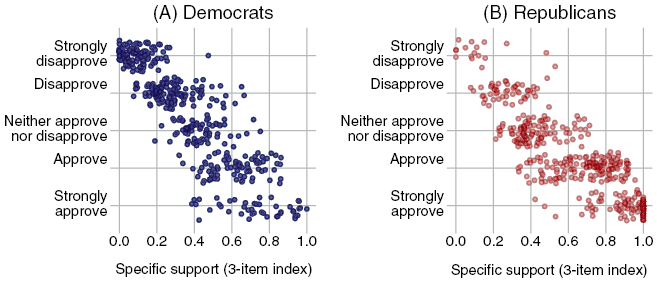
A fundamental component of this story involves the idea that not only has partisanship absorbed temporal dissatisfaction with the Court’s role in politics but also that specific support pervades how partisans think about legitimacy (Davis and Hitt Reference Davis and Hitt2025). To this end, David Easton’s (Reference 77Easton1965) systems theory framework acknowledges that evaluations of an institution’s outputs, or its specific support, are never too far removed from its wellspring of legitimacy, or diffuse support. In this section, we begin by returning to Easton’s system theory to contemplate the conditions under which specific support – embodied by intuitions involving satisfaction, concern, and efficacy – spills into diffuse support. In doing so, we work to validate an alternative way of conceptualizing citizens’ contemporaneous views of the Court’s behavior and, in turn, connect these views to diffuse support. The result is a simple, three-item index that scholars can use to operationalize a robust measure of specific support.
Reassessing the Relationship between Specific and Diffuse Support for the Court
In his field-defining paper titled “A re-assessment of the concept of political support,” Easton (Reference Easton1975, 437) is clear that specific support’s essence involves reactions to the “perceived outputs and performance of the political authorities.”Footnote 13 Such attitudes are “object-specific” and assume that a citizen is paying attention to the news (either directly consuming it or indirectly through conversation or socialization) and that the outputs, policies, or decisions of the authorities are reasonably able to be observed. However, while specific support seems to require that a person recognizes their needs and can connect the fulfillment of those needs to an appropriate authority or institution, these attributions do not necessarily have to be connected to specific outputs or explicit actions but can, instead, involve general social conditions. In other words, intimate knowledge of, say, the Court’s members or a fine-grained understanding of precedent is not required for the average citizen to develop a sense of (dis)satisfaction with the Court. Instead, a general awareness that something is amiss can be meaningful, especially when judicial politics spills into the news (Clark and Kastellec Reference Clark and Kastellec2015) and certain decisions reach critical mass in terms of salience (e.g., Dobbs’s role in overturning Roe; per Gibson Reference Gibson2025a).Footnote 14
As we outlined in Section 1, diffuse support has less to do with performance or behavior than the right of an institution to conduct its business, which encompasses “evaluations of what an object is or represents…not of what it does” (Easton Reference Easton1975, p. 444). In Easton’s (Reference 77Easton1965) telling, diffuse support is “basic,” or an elemental part of what it means to accept being governed under the social contract. Thus, diffuse support for the Court involves acknowledging its legal supremacy and, in turn, a sense of restraint toward reforming it – attitudes that are quite durable over time (Caldeira and Gibson Reference Caldeira and Gibson1992).
In judicial public opinion, these ideas form the backbone of positivity theory (see Gibson Reference Gibson2025b for a succinct review). The prevailing wisdom regarding the relationship between specific and diffuse support for the Supreme Court is well summarized by Gibson and Nelson (Reference Gibson and Nelson2014, p. 208), who write that “it seems that although specific support may have some direct relationship with diffuse support, that relationship is, at best, a small one.” However, although a weak relationship between specific and diffuse support has been previously described as optimal (Gibson and Nelson Reference Gibson and Nelson2015), we would emphasize that functional independence between specific and diffuse support is not required within systems theory. Certainly, diffuse support is more “durable” in Easton’s (Reference Easton1975) rendering; such attitudes are less sensitive to periodic dissatisfaction, especially when underlying political conditions do not signal severe threat or dysfunction. But if specific support were entirely independent of diffuse support, then that would assume that authorities could harm mass publics without any subsequent loss of trust. Easton (Reference Easton1975) writes that
This does not mean that such generalized attachment to political objects never changes or that it may not occasionally even fluctuate within short intervals…. Another and more precise way of stating the same thing is to say that the level of diffuse support will normally be independent of outputs and performance in the short run.
However, these attitudes can collapse during sustained periods of turbulence. Consider the very next passage:
Important qualifications need to be introduced to this hypothesis, however, because of the complicated relationship between outputs and diffuse support. On the one hand, if discontent with perceived performance continues over a long enough time, it may gradually erode even the strongest underlying bonds of attachment. On the other hand, there may be instances not so rare as they might seem, in which the sudden frustration of expectations can so jolt the deeper loyalties of the members of a system that their diffuse support falls into precipitous decline.
What causes this decline? Experience. Ordinary people may reflexively attach value to political objects because they have been socialized, but, so, too do they recognize when (legal) authorities fail to meet their expectations (Tyler Reference Tyler2001). Indeed, if citizens obtained their diffuse support only through the instruction of others, then “diffuse support would have entirely the appearance of a non-rational phenomenon” (Easton Reference Easton1975, 446).
If experience may undercut diffuse support, then what do we make of “positivity bias,” or the process by which becoming familiar with powerful symbols of judicial legitimacy seems to impart a special deference in how citizens view the Court? According to Gibson and Caldeira’s (Reference Gibson and Caldeira2009) work, being familiar with the pageantry, symbolism, and mystique of the Court helps to cement a certain “positivity” toward the institution. They write:
To know more about courts may not always be to love them, but to know them is to learn and think that they are different from other political institutions (and often therefore more worthy of trust, respect, and legitimacy). We contend that this process is one of social learning whereby citizens come to understand and appreciate the role of the judiciary in the American political system.
The tension in this rendering involves when and under what circumstances citizens learn about the Supreme Court. Today, journalists (e.g., Millhiser Reference Millhiser2021, Reference Millhiser2024; Kaplan Reference Kaplan2019), law professors (Adelman Reference Adelman2019; Chemerinsky Reference Chemerinsky2014; Vladeck Reference 86Vladeck2023), and political scientists are increasingly critical about the way that partisanship has spilled into the Supreme Court (Cameron and Kastellec Reference Cameron and Kastellec2024; Baum and Devins Reference Baum and Devins2019; Novkov Reference Novkov2024).Footnote 15 Politicians now regularly disparage it with bombast – a recent decision, for example, was described as “a vile betrayal of our Constitution” (Pellish Reference Pellish2025).Footnote 16 Even federal judges have jumped into the fray to criticize the High Court (Hurley Reference Hurley2025; Young Reference Young2025). Whether or not these complaints are historically unusual (or even particularly valid) is beside the point. Instead, our argument is simple: The totality of these various forms of “elite cues” shapes the information environment, which in turn corrodes specific support and may – with enough consistency – erode perceptions of legitimacy.
Building on recent research that explores the relationship between specific and diffuse support (Gibson Reference Gibson2024; Davis and Hitt Reference Davis and Hitt2025), we will argue further that how scholars approach measuring satisfaction with the Court has dramatic effects on the conclusions that they draw regarding the relationship between these system attitudes.
Rethinking the Nature of Specific Support
Partisans clearly differ in their level of approval toward the Court, but research on the link between specific and diffuse support often relies on either policy disagreement (Bartels and Johnston Reference Bartels and Johnston2013; Christenson and Glick Reference Christenson and Glick2015; Zilis Reference Zilis2018; Strother and Gadarian Reference Strother and Gadarian2022) or single-shot measures of “approval” to give meaning to conceptualizations of specific support. There are at least two shortcomings with these approaches. First, awareness and sophistication play a fundamental role in what survey respondents know about politics, in general (Kinder and Kalmoe Reference Kinder and Kalmoe2017), much less about the Court specifically (Gibson and Caldeira Reference Gibson and Caldeira2009; Hitt, Saunders, and Scott Reference Hitt2019). Asking survey respondents to rate a series of Court decisions presumes that individuals have well-formed beliefs about the Court’s rulings. Some may; others may not. But most individuals should have some affective orientations to the Court. Perhaps citizens do not follow the High Court closely or know much about its docket, but they may be aware that nominations have been controversial, that justices have been accused of ethical indiscretions, or that recent rulings bode ill for their partisan team (i.e., attitudes that are moderate in their level of abstraction; Berinsky Reference Berinsky2017). Put another way, while policy (dis)agreement is valuable to know, it may miss individuals who are unhappy with the Court but do not have the political wherewithal to respond accordingly to these questions.
Second, survey researchers are familiar with the trade-offs involved in balancing tight survey space against fidelity to their concept of interest. However, single-item measures like “approval” are not only potentially less reliable than multi-item ones (a statistical problem), but complex belief constructs like specific support may be poorly represented by single-item measurement approaches (a substantive problem; c.f. Allen, Iliescu, and Greiff Reference Allen, Iliescu and Greiff2022).
In particular, the traditional measure of specific support used in judicial public opinion research cannot disentangle the various belief components that might embody negative affective orientations toward the Court. For example, perhaps some citizens are pessimistic about the Court’s role in democracy, view it as an uncheckable branch, and believe that they will never live to see the institution change political hands – all features that could be reasonably baked into “dissatisfaction” with an institution. Others, in contrast, may dislike the Supreme Court’s rulings, but retain a sense of efficacy – believing that the Court will eventually respond to their preferences with sufficient political pressure. Again, that level of complexity and nuance is impossible to discern using just a single measure of approval.
Because single-item measures of specific support are blunt, we believe creative approaches to measuring these attitudes warrant as much consideration as measuring legitimacy. If diffuse support ought to be measured through a multiple-item scale, then why not specific support, as well? To guide our approach of operationalizing specific support, we borrow from psychology and sociology research on an attitudinal syndrome known as “fatalism,” which involves a blend of cognitive and affective reactions toward frustrating or difficult events. These attitudes incorporate beliefs about predetermination (e.g., Straughan and Seow Reference Straughan and Seow1998), pessimism (e.g., Powe and Johnson Reference Powe and Johnson1995), and luck or the control that one has over their circumstance (e.g., Neff and Hoppe Reference Neff and Hoppe1993). Taken together, these features appear useful in thinking about how people may become oriented to an institution’s performance.
First, predetermination describes a general belief that outcomes are fixed and unavoidable (Plante and Sherman Reference Plante, Sherman, Plante and Sherman2001). These beliefs arise when someone believes that outcomes are foreordained (Florez et al. Reference Florez, Aguirre, Viladrich, Céspedes, Cruz and Abraido-Lanza2009). In the case of the Court, individuals may both view the Court’s ideological shift as an inevitable, now-permanent feature of politics and believe that the Court always prevails over one political “side” when hearing cases.
Second, efficacy (or lack thereof) involves the control that one has over their environment, which incorporates whether someone has the ability to adapt to difficult circumstances. Such attitudes may manifest because the political context demands it, like in authoritarian states (Markova et al. Reference Marková, Moodie, Farr, Drozda‐Senkowska, Erös, Plichtová, Gervais, Hoffmannová and Mullerová1998) or because individuals feel that they do not have control over their well-being (Beck Reference Beck1999). Here, citizens may view the Court’s outputs as simply out of their reach or control.Footnote 17
A final dimension to specific support might involve emotional reactions to one’s circumstances (Diaz et al. Reference Diaz, Blanco, Bajo and Stavraki2015). Pessimism or hopelessness may occur when social or economic conditions seem insurmountable. It is also possible that political institutions contribute to a form of pessimism when citizens come to realize that certain actors are unresponsive to public demands (somewhat akin to low external efficacy). Thus, citizens may sharply disapprove of the Court when it ignores their rights or view it as a threat.
In the section that follows, we show that (1) not only are these ideas are useful in triangulating the ideational material that gives specific support its substance, but also that (2) the measurement of specific support affects conclusions drawn about its relation to diffuse support. The result of this exercise produces a parsimonious and powerful index of specific support that takes minimal survey space.
Operationalizing Specific Support
In the April 2024 wave of the SCD Panel Study, we fielded and pilot-tested a battery of nine survey items to operationalize a composite measure of specific support. Table 2 lists these items, which include two questions about approval of and confidence in the Supreme Court (standard measures of specific support), in addition to seven other statements. Given the importance of partisanship as a structuring identity, we plot some of these questions and break out responses by partisanship in Figure 6 to illustrate the different ways that Republicans and Democrats respond to these questions. For example, Democrats are much more critical than Republicans over whether the Court does what’s best for the country (Panel A) and perceive that the Supreme Court is more powerful than other sister branches (Panel B). Relatedly, Democrats perceive that they have less agency to control the Court (Panel C), which terminates in Democrats conveying more strongly than Republicans that the Supreme Court makes them scared for democracy (Panel D).

Figure 6 Partisan views regarding the Court’s performance
Note: Bars convey percentage of partisans conveying given response. Full question wording for these four items is available in Table 2.

Notes: All questions are asked using agree/disagree response sets, except for questions 5 (responses are estimated years), 6 (frequency), 8 (ranging from approval to disapproval), and 9 (ranging from none at all to a great deal). Estimates in Column 1 convey first-order factor loadings from an exploratory factor analysis that produces a single latent factor (Eigenvalue = 3.95). Estimates for the two-dimensional model of Supreme Court fatalism in Columns 2 and 3 were computed by rotating the factor solution with an oblique rotation, which allows for the resulting factors to be correlated. Loadings lower than 0.50 have been omitted. In Columns 2 and 3, loadings lower than 0.50 have been omitted for interpretive clarity.
Table 2Long description
Table 2 includes nine statements used to measure specific support, broken out into three broad categories including predetermination, locus of control, and pessimism. The column entries convey factor loadings associated with exploratory factor analysis of responses to these statements. Column 1 depicts loadings associated with a one-dimensional model of these attitudes; Columns 2 and 3 convey the factor loadings associated with unique factors after rotation. The primary measure of specific support uses the first dimension, which includes items 4, 6, 7, 8, and 9.
Given the foregoing discussion involving how people evaluate objects, we suspect that these attitudes may load onto different dimensions. Indeed, the exploratory factor analysis presented in Table 2 implies this to be true. Column 2 resembles classical conceptualizations of specific support that invoke approval or dissatisfaction (Cronbach’s alpha = 0.88). Column 3 embodies frustration that the Court is more powerful than Congress, which perhaps taps into a lay expression of institutional fatalism (Column 3; Cronbach’s alpha = 0.72).
Unlike our earlier work (Davis and Hitt Reference Davis and Hitt2025), which investigates specific support through this lens of fatalism, we hone in here on the first dimension produced from this analysis, which should be understood as a composite index of specific support. These attitudes are downstream of perceptions of ideological distance or individual rulings by the Court – which are perfectly reasonable components of specific support. Our decision to use more abstract assessments, however, was purposeful in that these beliefs reflect the sort of generalized performance evaluations that track with Easton’s (Reference Easton1975) rendering of specific support. Critically, the questions have little to do with reform or institutional loyalty. As Caldeira and Gibson (Reference Caldeira and Gibson1992, 638) write, diffuse support is an institutional commitment that reveals an “unwillingness to make or accept fundamental changes in the functions of the institution.” Each of the questions fielded in Table 2, however, simply asks respondents to convey how the Supreme Court makes them feel.Footnote 18 Moreover, a plain reading of the text of these questions should illustrate that these are not at all similar to the questions used to measure diffuse support reviewed in Section 2.
Figure 7 plots the distribution of our composite measure of specific support for all respondents (Panel A) and partisans (Panel B), separately. Despite the normal distribution of scores depicted in Panel A, Panel B reveals the depths by which partisan support for the Supreme Court is sorted and, to a lesser extent, polarized. Democrats exhibit significantly less specific support than Republicans by this measure (b = –0.19, s.e. = 0.01), although there is much more herding toward the low end of the pole among Democrats than there is toward the upper end of support among Republicans.

Figure 7 Partisanship and specific support for the Court
Notes: Specific support is operationalized via the first factor of items presented in Table 2. In Panel B, the darker (blue) distribution is associated with Democrats; the lighter (red) distribution with Republicans.
Next, to formally assess the relationship between specific and diffuse support, we regress perceptions of legitimacy onto our five-item scale of specific support and present the resulting estimates in Table 3. As the coefficient for specific support reveals, these attitudes are tightly bound together. Moving from low to high specific support dramatically increases the amount of diffuse support exhibited by the panelists in our data (b = 0.62, 0.04).
| b | s.e. | |
|---|---|---|
| Specific support | 0.62Footnote *** | (0.04) |
| Rule of law | 0.31Footnote *** | (0.03) |
| SCOTUS knowledge | 0.01 | (0.02) |
| Knows Dobbs | 0.04Footnote *** | (0.01) |
| Dobbs approval | –0.08Footnote *** | (0.02) |
| Abortion preferences | 0.02Footnote *** | (0.03) |
| Judicial cynicism | 0.24Footnote *** | (0.03) |
| Perceived ideology of Court | 0.09Footnote *** | (0.02) |
| Political interest | –0.01 | (0.03) |
| Education | 0.05Footnote *** | (0.01) |
| Age | 0.03Footnote * | (0.02) |
| White | 0.01 | (0.01) |
| Female | –0.01 | (0.01) |
| Partisanship | 0.04 | (0.01) |
| Constant | –0.19Footnote *** | (0.03) |
| N | 1,576 | – |
| R2 | 0.62 | – |
Notes:
* p < 0.05, **p < 0.01, ***p < 0.001
However, to further probe how researcher decisions involving the measurement of specific support affect the conclusions drawn about the relationship between it and diffuse support, we reestimate a series of regressions that deploy different operationalizations of specific support and regress diffuse support onto these scales. From the five instruments that comprise our measure of specific support (per Table 3), we vary the number of items included in composite scales, beginning with a five-choose-two approach and ranging up to five-choose-four combinations. In other words, we take a permutations-based approach to scale building, accounting for all of the possible combinations that an index of specific support could take based on how many input instruments one chooses.
After regressing diffuse support upon these measures, Figure 8 plots the magnitude and sign of the coefficient associated with various combinations of instruments, arraying them from smallest to largest coefficient size within the categories depicted along the y-axis – an approach not uncommon for refining scales (see Bakker and Lelkes [Reference Bakker and Lelkes2018], who conduct a similar analysis on short- and long-form measures of personality). The upshot of this approach is that it permits us to identify the specific instruments that survey researchers might include on surveys when faced with space constraints.
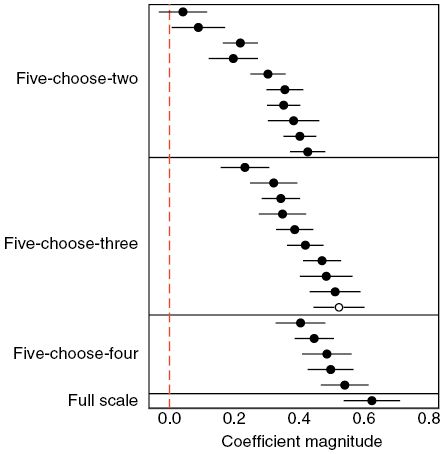
Figure 8 Assessing how different combinations of specific support items affect legitimacy
Notes: Point estimates are regression coefficients that correspond to different combinations of specific support indices upon which diffuse support is regressed. The hollow point estimate is associated with recommended three-item measure of specific support, including responses to questions: (i) “The Supreme Court ignores what ordinary people think,” (ii) “The Supreme Court makes me scared for the future of democracy,” and (iii) “Do you approve or disapprove of the Supreme Court?” All estimates are bracketed by 95% confidence intervals. The models from which these estimates are produced mirror those presented in Table 3, simply exchanging the measure of specific support.
Specific support routinely affects diffuse support regardless of its measurement, save for one case – the combination of “approval” (Table 2, item 8) and “Court does what’s best” (item 6). However, other than this combination, every other index of specific support is statistically related to diffuse support. The most efficient among these – balancing brevity and strength – involves the combination of items (4) “The Supreme Court ignores what ordinary people think” (7), “The Supreme Court makes me scared for the future of democracy,” and (8) “Do you approve or disapprove of the Supreme Court?” The coefficient associated with this three-item index (visually represented via the hollow point estimate) approximates the effect of including additional items under the five-choose-four category and comes very close to producing a coefficient that resembles the one associated with the full scale. Thus, as a matter of “optimality” when balancing thoroughness against survey space, surveying attitudes involving approval, responsiveness, and anxiety give researchers an efficient and powerful form of specific support to survey.
A Short-Form Replication
Given the novelty of this way of expressing specific support, we commissioned a second study to validate the results of the foregoing analysis. To that end, we contracted the market research firm Verasight to field a brief survey questionnaire in late August/early September 2024. The resulting sample of 1,000 respondents was generally representative of the mass public, approximating the targeted parameters of the samples previously collected by YouGov.
We again surveyed a large battery of survey items involving contemporaneous reactions to the Court and the standard legitimacy instruments. Drawing from the preceding section, we first assessed which loaded onto a latent measure of specific support and then constructed a measure of specific support using the three questions we recommend earlier (Cronbach’s alpha: 0.82): classical approval of the Court, whether the Court ignores what people think, and whether the Court makes respondents scared for democracy.
Figure 9 plots the distribution of this measure of specific support against the conventional, single-item measure of specific support found in the judicial public opinion literature, broken apart by respondent partisanship. There is an obvious partisan sorting out of responses to these questions. But, perhaps just as interesting, we see that the five-category measure of approval obscures significant variation in how partisans feel about the Court. Incorporating this additional ideational material helps to distinguish among both Democrats’ and Republicans’ support for the Court and clarifies how single-item measures of specific support may obscure the heterogeneity in opinion that exists. If specific support involves a certain depth of satisfaction, then regressing diffuse support onto a single-item approval measure will obscure the complexity that underlies such beliefs.

Figure 9 Assessing composite vs. a single-item instrument of specific support
Notes: Specific support is constructed via factor analysis of three survey questions: (1) classical approval of the Court, (2) whether the Court ignores what people think, and (3) whether the Court makes respondents scared for democracy. The conventional measure of Supreme Court approval is listed on the y-axis. Point estimates have been lightly jittered for presentational clarity.
In turn, in Figure 10, we plot the relationship between specific support and diffuse support.Footnote 19 We find that the relationship between specific and diffuse support is again very strong (r = 0.64). Breaking the bivariate correlation between these constructs out by partisanship in Panels A and B, we find that there is a clustering of responses in the low-diffuse, low-specific support quadrant among Democrats. For Republicans, however, there is a very linear relationship between these measures of support that travel the full range of values that both diffuse and specific support may take. In the end, specific support matters a great deal for diffuse support, but its effects ebb and flow through partisanship.
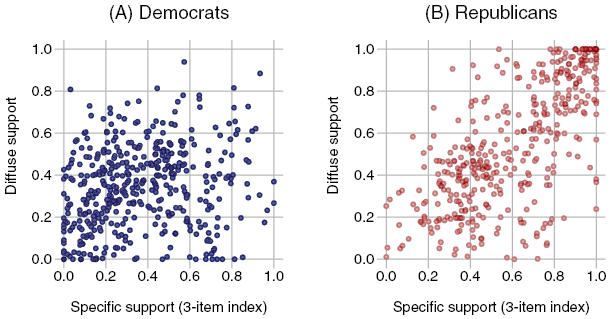
Figure 10 The correlation between specific and diffuse support
Notes: The y-axis constitutes diffuse support; the x-axis conveys specific support and is operationalized via a factor analysis of the three items we recommend for capturing specific support. The figure illustrates that as specific support rises, so, too, does diffuse support. The magnitude of this relationship, however, is stronger for Republicans (r = 0.74) compared to Democrats (r = 0.33), in part because diffuse support is much lower among Democrats.
Conclusion
Past scholarship shows that the relationship between specific and diffuse support has been largely weak and ephemeral (see Gibson and Nelson Reference Gibson and Nelson2017; Gibson Reference Gibson2025b). Yet, because the political conditions that produce these perceptions have dramatically shifted over the last decade, contemporaneous views about the Court’s outputs have spilled into its well of legitimacy. To test this possibility, this study heeds the advice that “…scholars must broaden their understanding of specific support beyond a single-minded focus on ideological disagreement toward a more holistic understanding of the concept” (Nelson and Gibson Reference Nelson, Gibson, Epstein and Landes2017, 141).
This section heeds that recommendation by treating specific support as an attitudinal syndrome rather than a passing sense of satisfaction. We conceptualize, refine, and then validate a theoretically guided strategy to measure specific support, which can be achieved through three short survey questions. These questions implicate how the Court makes citizens feel, and they do not rely on perceived ideological distance or even on specific Court cases or rulings, which place undue burdens on citizens who do not exhibit high levels of political awareness or sophistication. While we acknowledge that there may be many valid approaches to expressing specific support, this approach is both flexible and powerful. By treating specific support as an attitude with a certain amount of depth, we show that conclusions regarding functional independence between specific and diffuse support are not warranted.
4 Support for the Rule of Law and the Supreme Court
Those who love law tend to love the Court.
The rule of law – that is, the extent to which governing authorities follow legal codes and the public obeys them – is essential to stable self-rule (Maravall and Przeworski Reference Maravall and Przeworski2003). In the United States, the burden of systemizing the rule of law is shared among the system of checks and balances. Congress passes laws that the executive branch executes. In turn, the power of judicial review empowers the Supreme Court to both define the appropriate boundaries of the nation’s legal codes and adjudicate whether actors duly enforce and obey them.
If the Court’s rulings shape how citizens experience Constitutional guarantees, then public acquiescence to its decisions is an important reflection of the degree to which a society legitimates its governing institutions. The public may chafe against the Court’s maneuvering, but, because the Court lacks the power to enforce its rulings, acceptance of these decisions is an important ingredient in democratic stability. Thus, public support for the rule of law is often viewed as a precursor to diffuse support: The endorsement of legal procedural values should smooth over temporary angst that citizens may direct toward the Court (Gibson and Nelson Reference Gibson and Nelson2014, Reference Gibson and Nelson2015). If the law must be followed, and the Supreme Court is the final arbiter of the law, then support for the rule of law should stabilize legitimacy despite disappointment in the Court’s decisions.
However, while support for the rule of law ought to be generally agnostic to the substance of legal codes (Gibson Reference Gibson2007b), there are occasions where this logic may fail. When the law permits elites to frustrate democratic processes or the Court protects laws that are unjust, it can be difficult to imagine whether support for procedural values will trump the substantive commitments that underpin institutional trust. If procedural values are in some way connected to the social contract – that is, citizens agree to a set of basic governing values and, in turn, a set of formal legal procedures to adjudicate the conflict that emerges from disagreements over them – then what happens when a judicial body endangers democratic practice under the guise of following the law? How should citizens react then?
In this section, we unpack how support for the rule of law is related to support for the Court. We begin by analyzing new survey data that sheds light on tensions between abstract and episodic commitments to the rule of law. Although symbolic support for the rule of law is associated with higher levels of diffuse support for the Court, attitudes involving instrumental or episodic support for the rule of law are not. By virtue of their relation to specific support, instrumental support for the rule of law is actually negatively related to diffuse support – individuals who are opposed to violations of legal norms and codes exhibit lower rates of diffuse support for the Supreme Court. We then test experimentally whether support for the rule of law can be leveraged to support legal outcomes that make the practice of democracy more difficult. On balance, we find that high levels of support for the rule of law operate contingently: Individuals who report high levels of support for the rule of law are considerably more sympathetic to rulings that benefit their in-group than their out-group, especially when rulings make democracy harder. We conclude with a brief discussion about the meanings of these results for the foundations of legitimacy theory.
Support for the Rule of Law and the Court
The idea that diffuse support finds its source in democratic values has been a bedrock feature of legitimacy theory. Perhaps the most explicit rendering of this empirical relationship is found in Gibson’s (Reference 78Gibson2007a, p. 516) work in the Journal of Empirical Legal Studies:
Those with commitments to individual freedom and other democratic values (perhaps grounded in individualism) are more likely to support minoritarian institutions like courts (Caldeira & Gibson Reference Caldeira and Gibson1992,). This finding is important because it implies that support for the Supreme Court will change only slowly over time (since values themselves change only slowly). Perhaps the most important contribution of this body of work on the etiology of Court support is the evidence that the Supreme Court gets much of its legitimacy from its role in the American democratic process, and, apparently, Americans’ understanding of that role.
Of these “democratic values,” perhaps none is as important as support for the rule of law. Drawing from work on perceptions of legal procedures (Tyler Reference Tyler1988), Gibson (Reference Gibson2007b, p. 594) describes the rule of a law not as “desiderata” but, instead, as “procedures by which governance takes place.” These procedural values help to reject particularism, requiring that political actions are principled and not the product of fleeting self-interest. In instances where majorities and minorities disagree, the rule of law facilitates an agnostic method of resolving such differences.
However, the rule of law is not “just” institutions or a book of statues, but is instead embodied “…in a nation’s culture – the beliefs, expectations, values, and attitudes held by the populace of a country” (598). In some sense, then, support for procedure is bolstered by the culture of law, which implies that support for the rule of law is not value-neutral, per se, but incorporates legitimating moral and political intuitions involving respect, dignity, and accountability. In systems of self-rule, these aesthetic preferences are vitally important – after all, there is nothing inherently noble about a jurisprudential system in a vacuum; the rule of law can indeed be hijacked by entrepreneurial elites to pursue harm (Krygier Reference Krygier1990).
While the rule of law’s relationship to support for the Supreme Court is a bedrock feature of legitimacy theory, we argue that recent political developments may have strained how these connections are made. Today, Republicans and Democrats vary in the extent to which they endorse abstract commitments to the rule of law (Section 2). Given personality differences between American partisans (Feldman, Mérola, and Dollman Reference Feldman, Mérola, Dollman, Sajó, Uitz and Holmes2021), this difference is probably not surprising – traits like openness, need for closure, or comfortability with ambiguity could reasonably explain that gap. But recent political developments involving the way that the rule of law is flexibly used to privilege partisan goals may also help explain these differences.
Consider several recent episodes. The Trump administration has impounded Congressionally appropriated monies (Howe Reference Howe2025), closed offices and programs over which its jurisdiction is traditionally limited (Schultz Reference Schultz2025), and threatened due process rights (Sotomayor Reference Sotomayor2022). In each of these scenarios, norms, statutes, and case law have been used to achieve partisan ends in ways that seemingly clash with popular intuitions about how the rule of law operates – frequently placing the judicial system in a difficult predicament.
Using the law to achieve normatively questionable partisan ends threatens the logic of legitimacy theory. If the spirit of the rule of law draws from democratic values – as some allege – then these episodes highlight a potential point of conflict in linking support for the rule of law to the Supreme Court’s legitimacy, raising thorny questions about how people rationalize their support for the Supreme Court. When taken in conjunction with the Supreme Court’s rulings on cases involving the explicit practice of democracy – ranging from Shelby County to Citizens United to Trump v. United States – we suspect that the connection between support for the rule of law and support for the Court is less straightforward than older research finds. In this section, we reinvestigate this relationship. First, we analyze differences between abstract and instrumental support for the rule of law. Then, we experimentally test whether high levels of support for the rule of law can legitimize rulings that are antagonistic to the practice of democracy. Taken together these results paint a more complicated portrait of the implications of support for the rule of law and its connection to Supreme Court legitimacy.
Support for the Rule of Law and Judicial Public Opinion
In April 2025, we contracted the survey research firm Prodege to collect Census-matched survey data to analyze beliefs about the rule of law and, in turn, its connection to support for the Supreme Court. Following Sections 2 and 3, we measure abstract support for rule of law via five statements; responses to these items were then factor analyzed to construct an index ranging from weak to strong commitments to the rule of law. Next, we measure instrumental or applied support for rule of law via responses to a series of vignettes involving conduct that violates traditional legal norms and codes.Footnote 20 In particular, we focus on recent executive branch overreach, which includes things like the illegal impoundments of Congressionally appropriated monies (Price Reference Price2025), attempts to shutter the Department of Education without Congressional approval (Booth Reference Booth2025), permitting nongovernmental employees access to Social Security databases (American Federation of State, City, and Municipal Employees v. Social Security Administration),Footnote 21 politically motivated inquiries into intelligence officials (CREW 2025; FBIAA 2025), and the firing of Inspectors Generals (New York City Bar Association 2025).Footnote 22
Respondents were asked whether they supported or opposed the following actions:
The Trump administration has impounded (frozen) spending already approved by Congress.
The Department of Government Efficiency (DOGE) has gained access to millions of Americans’ personally identifying information from government agencies.
The Trump administration has issued an executive order to close the Department of Education.
The Trump administration has ordered the FBI to turn over details of employees who worked on the January 6 cases.
The Trump administration fired seventeen Inspectors General who were responsible for tracking government waste, fraud, and abuse.
Trump administration officials have ignored court orders to reinstate funding for organizations that have previously been stripped of funding.
The Trump administration unilaterally halted Congressionally appropriated monies from being sent to Ukraine for its defense against Russia.
Of course, these descriptions of political events may well trigger partisan-motivated reasoning – the vignettes explicitly make mention of Republican President Donald Trump. That concern notwithstanding, these episodes involving the executive branch were chosen deliberately to balance both internal and external validity. First, it is possible that there are different “forms” of instrumental support for the rule of law – one could explore reactions to petty crime, the actions of policymakers, or executive orders that violate statutory prerogatives. To avoid “cheap talk,” however, we want people to grapple with specific acts of disregard for precedent and the law that have serious implications for American politics.Footnote 23 Second, operationalizing a politically neutral measure of instrumental support for the rule of law might be possible in other settings, but not so in the case of executive branch overreach. To the extent that the contemporary rule of law is under threat, the balance of responsibility currently involves the incumbent Republican administration, and we seek to assess whether partisans rise to the difficult standard of holding those politicians accountable.Footnote 24 We factor analyze responses to these statements to construct an index of instrumental support for the rule of law that ranges from weak support (permissive of this conduct; low values) to strong support for the rule of law (rejecting this conduct; higher values).
Figure 11 illustrates the distribution of this instrumental support for the rule of law. First, per Panel A, a substantial share of Americans oppose the behaviors we surveyed, although 40 percent of respondents are either ambivalent (the middle of the scale) or positively disposed to these episodes (lower values). Second, Panel B illustrates that Democrats exhibit more support for the instrumental rule of law than do Republicans (b = 0.17, s.e. = 0.03), although large shares of Democrats and Republicans oppose these activities that threaten the rule of law.Footnote 25
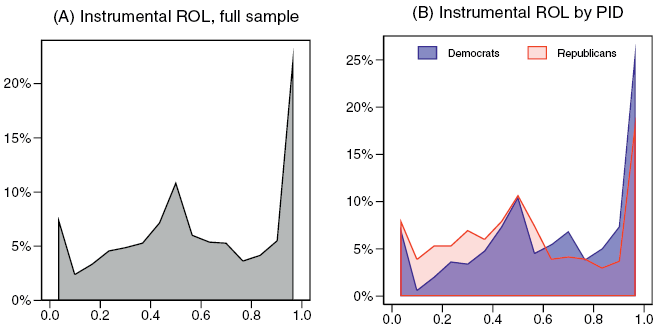
Figure 11 Instrumental support for the rule of law
Notes: Measurement details for instrumental support for the rule of law are embedded in text.
Unpacking the Link between Support for the Rule of Law and Judicial Opinion
How is this measure of applied support for the rule of law related to judicial public opinion? We begin by assessing the way in which instrumental and symbolic support for the rule of law are correlated. To this end, we regress symbolic support for the rule of law on instrumental support for the rule of law, authoritarian preferences, social dominance orientations, political preferences, and a series of demographic controls in Table 4.Footnote 26
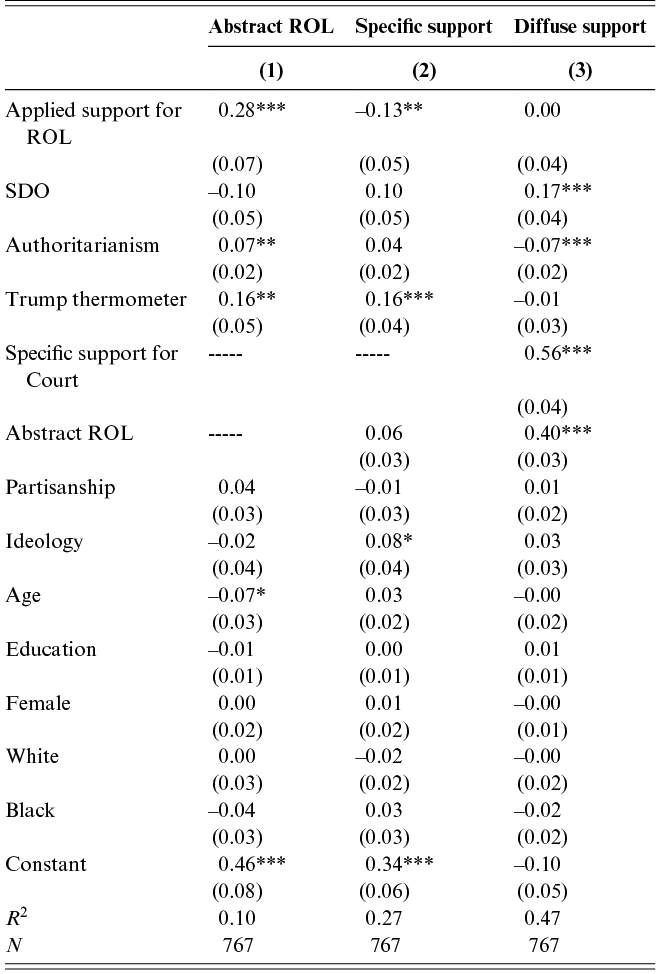
Notes: Measurement details for control variables can be found in footnote 2. Full question wordings are available in the supplementary materials. Iterative proportional fitting was used to establish population weights, which were applied to the data analyzed here.
Table 4Long description
Table 4 depicts the results of a regression model testing the relationship between applied support for rule of law and (1) abstract support for rule of law, (2) specific support, and (3) diffuse support. In models 1 and 2, applied support for the rule of law predicts abstract support for rule of law and specific support. In model 3, the coefficient for applied support for rule of law is insignificant; here, the effect of such attitudes on diffuse support flows indirectly through its relationship to specific support.
Column 1 reveals that higher levels of instrumental support for the rule of law translate into higher levels of support for abstract rule of law preferences. However, there are two normatively perplexing results that emerge from this analysis that should qualify how scholars think about the meaning of abstract support for the rule of law. First, authoritarian preferences positively predict abstract support for the rule of law. These psychological attributes measure individuals’ comfortability with conformity, authority, and control (Federico et al. Reference Federico, Feldman and Weber2026; Stenner Reference 85Stenner2005). Second, the coefficient associated with the Trump thermometer rating is large and positive. Taken together, both findings belie depictions of traditional support for the rule of law as endorsements of “democratic” “values.” Instead, this measure of abstract legal commitments appears to be a blend of partisan affect, attitudes about social groups, and intuitions regarding more banal ideas about legal propriety.
Next, given the previous section’s focus on specific support for the Supreme Court, we might expect that our measure of instrumental support for the rule of law would negatively relate to these attitudes given the Supreme Court’s role in adjudicating lawsuits related to the conduct we surveyed. Indeed, as Column 2 reveals, instrumental but not symbolic support for the rule of law predicts specific support for the Court. We view this result as important for empirical and normative reasons. Given the close correspondence between abstract support for the rule of law and diffuse support, we would ideally observe that the wellspring of specific support would not involve these attitudes. That it does not further validates that our argument that measures of specific and diffuse support are picking up separable constructs with distinct attitudinal sources.
With these findings in mind, we close this analysis with a simple model of diffuse support for the Court, which models such attitudes as a function of instrumental and symbolic support for the rule of law, specific support, and the additional covariates included in Columns 1 and 2. While support for the abstract rule of law and specific support again operate as the primary correlates of legitimacy, we find that instrumental support for the rule of law is not related to diffuse support – implying that a practical measure of support for the rule of law is functionally divorced from institutional evaluations.
However, given the results of Columns 1 and 2, we turn to mediation analysis to uncover whether instrumental support for the rule of law spills into legitimacy indirectly due to its relationship with abstract rule of law preferences and specific support for the Court. That analysis illustrates that, indeed, instrumental support for the rule of law constrains diffuse support via its relation to these other attitudes. Scoring high on instrumental support for the rule of law increases diffuse support by approximately 0.04 points via the relationship between instrumental and abstract support for the rule of law (less than a quarter of a standard deviation in diffuse support); however, scoring at maximal values of instrumental support for the rule of law decreases diffuse support by almost 0.17 points because these attitudes flow through specific support (resulting in a reduction of almost three quarters of a standard deviation in diffuse support). Further, while partisanship’s direct effect is minimal in these analyses, the nature of its role here flows from the earlier sections in this Element: Democrats express more support for the instrumental rule of law (b = 0.17, s.e. = 0.03) and exhibit lower specific support than Republicans (b = –0.08, s.e. = 0.02), which jointly constrain diffuse support – differences that go beyond the simple coefficient entry for partisanship depicted in a large kitchen-sink-style regression analysis.
Reflecting on the Meaning of the Rule of Law
Taken together, the results depicted here illustrate that, while there is robust support for the rule of law in the abstract, these attitudes exhibit a classic tension found in studies of abstract and episodic preferences (e.g., compromise; Davis Reference Davis2019). Abstract support for the rule of law is powerfully constrained by attitudes that reify inequality and authority (Table 4, Column 1). Although instrumental support for the rule of law does help bolster abstract support for the rule of law, the relationship between these attitudes and diffuse support is complex.
Unlike earlier findings showing that attitudes about the rule of law bolster diffuse support, we find evidence here that instrumental support for the rule of law actually decreases diffuse support via its indirect effect on specific support. If specific support is grounded in disapproval over what the Court does – and instrumental support for the rule of law rejects some of the behaviors that the Court has permitted – then these findings offer an important rebuke for thinking about how intuitions about the “law” are related to the Supreme Court’s legitimacy. Today, the rule of law has not only been politicized but also now maps onto the deep partisan divisions that fracture matters of contemporary judicial public opinion.Footnote 27
Does Support for the Rule of Law Affect Reactions to the Court’s Rulings?
Next, we move beyond analyzing the belief structure of support for the rule of law and pivot to exploring how these attitudes may affect reactions to the Court’s decisions. Given the close theoretical correspondence between “democratic values” and “rule of law preferences,” we focus here on issues of ballot access, which are intimately linked to the quality of self-representation.
For this task we turn to an experimental design. By randomly varying the type of decision subjects see, we test the extent to which decisions that protect or harm the practice of democracy causally affect how people think about the Court’s work. This experiment serves an important purpose by allowing us to test whether support for the rule of law operates as an unconditional normative good. If high levels of support for the rule of law are borne from democratic values, then we should expect to observe that decisions that undercut democracy should be viewed with the greatest disfavor by those who are sensitive to the rule of law.
Do People Rationalize Antidemocratic Court Rulings?
Voting is perhaps the most basic political task that citizens living in democracies should perform. In a healthy democracy that takes the protection of these duties seriously, high courts could be expected to protect such rights by rejecting surreptitious attempts by elites to restrict ballot access. However, the 2013 decision in Shelby County v. Holder revealed that the Supreme Court was comfortable letting such protections lapse. In the majority decision, the Court’s Republican-appointed members cast aside a central piece of antidiscrimination policy found in the Voting Rights Act of 1964, ruling that the federal government must cease its policy of preclearance, which required jurisdictions with histories of racial disenfranchisement to “preclear” changes to voting rules with federal authorities.
The fallout from this ruling was swift and severe, with the NAACP proclaiming that “Shelby County v. Holder broke democracy” (NAACP Legal Defense Fund 2025) and political scientists illustrating that the ruling increased the racial gap in turnout (Morris and Miller Reference Morris and Miller2025; Morris and Miller Reference Morris and Millerforthcoming). Within less than twenty-four hours after the ink had dried on the Shelby County ruling, Texas, Mississippi, and Alabama had implemented changes to voting laws that were previously deemed too exclusionary to be approved by federal regulators, including closing polling locations in jurisdictions home to large populations of non-white citizens. In a report issued by the Leadership Conference on Civil and Human Rights in 2019, the authors found that nearly 1,700 polling places in states originally under the jurisdiction of the VRA had been shuttered. In Mississippi alone, more than 40 percent of counties closed polling locations after the Shelby decision (Leadership Conference Education Fund 2019). These changes were particularly pronounced in areas in which minoritized voters are clustered. In Arizona’s Maricopa County, where four of ten residents are persons of color, polling places were reduced by 70 percent, resulting in extreme wait times to vote in the 2016 Presidential Election (Pitzl, Ryman, and O’Dell Reference Pitzl, Ryman and O’Dell2016). In Milwaukee, Wisconsin – the state’s most diverse city – more than 150 polling sites were closed for the 2018 midterm elections, creating hours-long waits for some citizens to cast a ballot; in Atlanta, Georgia, voters were subjected to wait times of up to eight hours just to cast a vote in the 2020 Presidential Election (Klain, Morris, and Ayala Reference Klain, Morris and Ayala2020).
These outcomes pose an interesting predicament. If “the law” makes voting more difficult for citizens, then do high levels of support for the rule of law translate into respecting these rulings?
An Experimental Test
To answer these questions, we contracted the market research firm Prodege to distribute our survey to a Census-matched panel of participants (n = 4,075). After taking a brief pretest, subjects participated in a short survey experiment that involved asking them to read a brief news release associated with a Supreme Court case involving closing polling locations. Using a 2 × 2 experimental matrix, subjects were asked to read a synopsis about a Supreme Court decision that randomly varied both whether the Court’s ruling protected or made democracy “harder” and whether Democrats or Republicans benefitted from the Court’s ruling.
Protect democracy
The Supreme Court recently overturned a lower court ruling in Pennsylvania that would have made voting more difficult for Democrats (Republicans). Although Republicans (Democrats) argued the state had insufficient funds to staff the polling locations in urban areas, the Court ruled that they could not close them.
Make democracy harder
The Supreme Court recently upheld a lower court ruling in Pennsylvania that will make voting more difficult for Democrats (Republicans). Republicans (Democrats) argued that the state had insufficient funds to staff polling locations in urban areas, and the Court ruled that such closures were appropriate.
By varying not just the decision but, critically, the group that benefited from it, we can test the extent to which the beneficiaries of the Court’s rulings affect how partisans react to it. We expect that subjects in the pro-democracy conditions – where the Court rejected polling closures – should exhibit more agreement with the outcome than subjects in the anti-democracy conditions – where the Court permitted polling closures. However, because such decisions can benefit one party at the expense of the other, we suspect that support for these decisions should be strongest when an in-party benefits compared to situations where the decision benefits the out-party.
We collected several pieces of information from our participants that we investigate as outcomes. Our primary outcome of interest was whether subjects agreed with the Court’s decision. Decision agreement was measured on a scale that ranged from “strongly disagreed” (1) to “strongly agreed” with the decision (5).Footnote 28 In the pretest survey, we also asked individuals to report abstract support for the rule of law, which was measured following the practices listed in Sections 2, 3, and described earlier.
Figure 12 plots the results of our survey experiment. To facilitate the interpretation of the experiment, we break subjects into groups according to whether they were assigned to a condition where the in-group or out-group benefitted from the Court’s ruling, as well as whether the decision harmed (anti-democracy) or protected the practice of democracy (pro-democracy). This approach results in four groups, which are arrayed on the y-axis. Beginning with the first group (1), individuals who were randomly assigned to read a story involving a ruling that made voting harder, but that benefited their in-group were noncommittal in their support for the ruling (i.e., responses hover near the midpoint of the scale). Subjects assigned to the group that read the same antidemocratic ruling save for that it benefitted the out-party (3), however, were much less sanguine about the Court’s decision than their peers in Group 1 (b = –0.75, s.e. = 0.05). In other words, antidemocratic rulings by the Court are not necessarily viewed favorably, even when they benefit an in-group; but, when such rulings privilege out-groups, then these rulings are viewed as particularly odious.

Figure 12 Polling closures experiment
Notes: Point estimates are conditional group means bracketed by 95% confidence intervals. Dependent variable in each panel is amount of agreement with the Court’s decision, ranging from 1 “Strongly disagree” to 5 “Strongly agree.” In-group/out-group designation is assigned by matching respondent partisan identification with the party who stood to win or lose in the Court’s decision.
In contrast to these antidemocratic rulings, subjects in both the in-group and out-group conditions in which the Court’s ruling protected polling locations were more positive about the ruling. Of course, again, we find that subjects exhibit more enthusiasm when the ruling benefits their own versus the opposition party (b = 0.27, s.e. = 0.05). Further, when we pool in- and out-group-benefitting decisions together, collapsing the distinction between winners and losers, subjects routinely approved more of the Court when it made protective rather than antagonistic rulings (b = 0.71, s.e. = 0.30).
How does support for the rule of law factor into this equation? Figure 13 tests whether abstract support for the rule of law enhances acceptance of decisions that make the practice of democracy difficult. The results are intriguing. In Panel A, at high levels of support for the rule of law, there is a massive gap between subjects’ reactions to an in-group-benefitting anti-democracy ruling and an out-group one – suggesting that high sensitivity to the law does not disturb subjects when their party wins. In Panel B, we observe that support for the rule of law does not increase acceptance of an out-party victory, but does seem to boost decision acceptance when the ruling benefits the in-party. In both scenarios, we observe that rule of law preferences are not an unalloyed good – they serve as a pretext for accepting the Court’s ruling even when it violates the practice of democracy itself.Footnote 29

Figure 13 Support for rule of law and decision agreement
Notes: Point estimates convey decision agreement at a given diffuse score for subjects assigned to anti- vs. pro-democracy conditions, broken out by whether decision benefited in-party or out-party. These scores were calculated from model accounting for diffuse support for the Court, authoritarianism, knowledge of the Court, and perceived Court ideology, as well as a series of basic demographic attributes. Brackets convey 95% confidence intervals.
Conclusion
The accumulated body of judicial public opinion literature has established a strong empirical link between attitudes about support for the rule of law and support for the Supreme Court. While this relationship is theoretically sensible and previously empirically supported, present political conditions newly complicate this rendering. Although we are sympathetic to the idea that procedural values do facilitate submission to legal authorities (Tyler Reference Tyler2003; Davis Reference Davis2025; Gibson Reference Gibson2007b), there is now ample evidence of elites using the law to achieve ends that appear to make the practice of democracy more difficult. Further, from Crawford v. Marion County Election Board (restrictive voter identification laws), to Rucho v. Common Cause (enabling partisan gerrymandering), and Husted v. A. Philip Randolph Institute (allowing aggressive voter roll purges), the Supreme Court has produced rulings that make it difficult to disentangle the rule of law from banal partisan ends.
This section presents new evidence that support for the rule of law can be operationalized both in the abstract and episodically. Doing so paints a very different picture of the relationship between these attitudes and diffuse support. Here, research on obedience and authority is instructive. Passini and Morelli (Reference Passini and Morselli2010, p. 343) write that “when an apparently legitimate authority issues a seemingly illegitimate request, value-oriented citizens will be more likely to oppose the authority in regard to that demand.” The trouble, of course, is that citizens vary in both their values and their appraisals of whether political actors follow the rules. Given the stress placed on the judiciary by the executive branch, our test of applied support for the rule of law illustrates the dangers associated with such evaluations spilling over from one institution to another. When support for the rule of law becomes sorted, these attitudes may actually undermine rather than bolster institutions that are associated with the rough and tumble of partisan politics. While a logical outcome, it is nevertheless a worrying one for those concerned about the relationship among legitimacy, compliance, and democratic stability. As we turn next to the final section of the Element, we discuss the implications of these findings and consider what they portend not just for attitudes toward the Court, but democracy itself.
Conclusion: A Fragile Status Quo
Former Republican President Donald Trump was reelected to the Oval Office in November 2024. His victory affords the GOP another four years to protect, if not further solidify, their control of the Court. But, just as importantly, it has created what one legal scholar describes as a “constitutional stress test” – a steady stream of executive orders and criticisms that have flooded the legal system with challenges in courts across the country (Burnett and Rivers Reference Burnett and Rivers2025; Brennan Center 2017). Occasionally, these cases have come before the Supreme Court, which has been asked to inveigh on matters ranging from due process rights, to whether a president may dispatch National Guard troops to enforce immigration directives, and to protections found in the Voting Rights Act. While the law remains at the center of these legal debates, the partisan stakes of these debates are not lost on ordinary Americans. Whatever positivity bias once characterized how Americans viewed the High Court has been slowly eaten away – today Democrats and Republicans are deeply polarized in their views of the Supreme Court.
Our contributions in tracing these developments are threefold. First, this Element documents a significant shift in how all Americans think about the Supreme Court. As Section 2 illustrates, aggregate public support for the Court has not only fallen over the last decade but also partisanship now pervades how people view the Court. To study this sorting, we assemble high-quality, nationally representative survey data to illustrate that the first signs of a modest split in how Democrats and Republicans regard the Court’s legitimacy began in the late years of the first Trump presidency. These differences are now profound: Democrats are more concerned than Republicans that the Court is a threat to democracy and doesn’t do what is best for the entire country and exhibit less enthusiasm for the Court’s place in the American system of checks and balances. Today, Supreme Court legitimacy is deeply sorted and polarized.
Second, drawing from our earlier work (Davis and Hitt Reference Davis and Hitt2025), we validated a way of operationalizing dissatisfaction with the Court. Drawing from social psychological research, we argue that single-item measures of specific support are not ideal for expressing the depth of citizens’ displeasure with political institutions. Simply put, conventional measures of specific support miss important variation in how citizens think about the Court’s body of work. Using new survey data, we tested and recommend a modest three-item index of specific support that should serve scholars of judicial public opinion well in mapping the boundaries of support for the Supreme Court.
Finally, we reassess an important plank within traditional legitimacy theory – the idea that citizens connect beliefs about the rule of law to their ratings of the Supreme Court’s legitimacy. Recent research implies that many American citizens exhibit an entrepreneurial approach to democratic norms and the rule of law. That is, some people demonstrate a utilitarian and flexible set of values when commitments to democracy are weighed against the pressures of obtaining or retaining political power (Simonovits et al. Reference Simonovits, McCoy and Littvay2022; Graham and Svolik Reference Graham and Svolik2020; Cagle and Davis Reference 75Cagle and Davis2024; Clayton et al. Reference Clayton, Davis, Nyhan, Porter, Ryan and Wood2021). Analyzing new survey data, we illustrate that instrumental and abstract support for the rule of law are awkwardly related. A great many people who express strong support for abstract statements about the importance of the rule of law nevertheless are hesitant to communicate that executive branch overreach – literal threats to the rule of law – are wrong. In turn, these values relate to diffuse support in different ways. While abstract support for the rule of law bolsters diffuse support for the Court, instrumental support for the rule of law does not.
Whither Reform?
Taken together, the findings presented in this Element may raise questions about public demand for reforming the Supreme Court of the United States. At roughly the time in which we first observe a cracking apart of the Court’s neutrality mythos in 2020, a book coauthored by two political scientists titled Curbing the Court made a provocative claim. Bartels and Johnston’s (Reference Bartels and Johnston2020) work argued that traditional legitimacy theory undersells the public’s appetite for reform. In fact, the public is willing to support constraining the judiciary when doing so brings them closer to realizing their political goals.
However, according to them, the measures that give legitimacy its meaning in the survey context are ill-suited to parse run-of-the-mill displeasure from fury over counter-majoritarianism – especially when the Court behaves in ways that are viewed as undemocratic. In Bartels and Johnston’s story, concepts like institutional legitimacy, diffuse support, and institutional loyalty – terms that are often used synonymously (including in this Element) – are not only definitionally but also operationally unique. These distinctions matter because perceptions of procedural fitness or even trust in the Court to “do the right thing” may be independent of preferences involving reshaping the number of Justices serving on the Court or limiting the Court’s jurisdiction – ideas referred to as “Court curbing.” These attitudes convey the extent to which the public is willing to harm the Court’s powers or alter its structure, revealing a tangible, actionable measure of dissatisfaction with the Court’s behavior.
Drawing from this distinction, Bartels and Johnston then parse calls for Supreme Court reform into different forms: (1) a broad category of abstract penalties – for example, “making the Court less independent” or “removing Justices who defy the will of the people,” and (2) those changes that are more selective or narrow in application, like limiting the Court’s power of judicial review under certain conditions, cases, or issues. Drawing on research in political psychology, they find that Americans are only weakly principled when it comes to the connection between democratic values and views about Court curbing, which implies that the Court’s independence is more fragile than the traditional diffuse support literature finds.
Given the dramatic developments that occurred since Bartels and Johnston’s (Reference Bartels and Johnston2020) book was published, has the public’s appetite for reforming the Court changed? There are several Supreme Court reforms that have been proposed over the intervening years, ranging from the High Court Gift Ban Act – intended to staunch the flow of financial gifts to sitting Justices – to institutional reforms that would reshape the bench itself – for example, term limits or literally expanding the Court. We briefly analyze support for some of these proposals here.
Figure 14 plots partisans’ support for term limits using a series of polls from various vendors and research groups over the last decade. In the years since the 2016 election, we observe a slight downward shift in Republican support for term limits, which makes sense considering their majoritarian status on the bench (why limit terms when your party is firmly in control?). Yet, on balance, it is curious that support for term limiting Justices among Republicans remains net positive over this period. Likewise – and expectedly – support for term limits among Democrats is stable and high over this ten-year window of time.

Figure 14 Public support for term limiting Supreme Court Justices
Notes: See appendix for details regarding poll source and question wording. Differences in question framing include specifying whether term limits include 10-, 15-, or 18-year limits. Presumably, such numeric distinctions matter, but we visualize all questions here as a global snapshot of public opinion.
Figure 15 portrays a more difficult hurdle for reformers who envision reshaping the Court. Despite Democrats being bullish on Court expansion (with support averaging over 60 percent across surveys), Republicans exhibit strong pushback against such reform. This sorting out of court-packing views is, again, not particularly surprising – why should Republicans accept expanding the Court when such a change threatens their control of the federal judiciary? Even during the New Deal era, when Franklin Delano Roosevelt declared that the Court was creating a “‘no-man’s-land’ where no government – state or federal – can function” (Leuchtenburg Reference Leuchtenburg2005), his criticism and the threat to pack the Court were received rather lukewarmly by the public – and he enjoyed a great deal more institutional and public support than reformers today.

Figure 15 Public support for expanding the court
Notes: See appendix for details regarding poll source and question wording. Differences in question framing include specifying whether expanding Court involves increasing justices from nine to thirteen and fifteen, in contrast to alternative framing that asks whether the number of justices should simply be increased.
Although Democratic legislators face different social and political conditions from that era, there is a growing chorus of elected officials who have proposed reforms like these two examples in the wake of allegations that the Court is behaving in a manner unbecoming of its design. While this legislation is of course aspirational in nature – given the simple fact that Democrats do not have enough votes to pass it – recent proposals lay out a broad spectrum of potential reforms ranging from modest (public disclosure of taxes, ethics codes) to structural changes (Court expansion, term limits). Given our interest in the public’s declining support for the Court, we sought to test how specific and diffuse support relate to support for these reforms. Thus, we collected a final wave of survey data after the 2024 presidential election that would permit us to link reforms like term limits and Court expansion to our work here.Footnote 30
Figure 16 illustrates the marginal effect that specific and diffuse support have on support for reform. The operationalizations of these variables adopt the practices we outline in prior sections. Specific support is constructed from a factor analysis of the three-question index we validated in Section 3. Diffuse support is derived from a factor analysis of questions used throughout this Element to express beliefs about legitimacy. In panels A and B, we present a series of three estimates for each covariate on the y-axis: an estimate from a pooled model of all respondents (i.e., dark diamond), alongside estimates of the relationship between the type of support and the outcome for Democrats (solid circle) and Republicans (hollow circle). These estimates convey the effect of moving from minimum to maximum values on the independent variable listed on the y-axis.
Beginning with Panel A, we document that “more” specific and diffuse support works against a demand for packing the Court. However, there are some partisan differences that are noteworthy. Republicans’ specific support for the Court is disconnected from these attitudes, and their diffuse support is much more strongly connected to opposing reform compared to Democrats. In contrast, Democrats low in both specific and diffuse support are more likely to support Court expansion than those with high levels of system support. Given the close correspondence between court-curbing and traditional measures of legitimacy (both falling under the heading of “diffuse support”), it is intriguing that specific support also spills into the attitudes, suggesting, again, that an erosion of confidence can have serious systemic consequences.Footnote 31
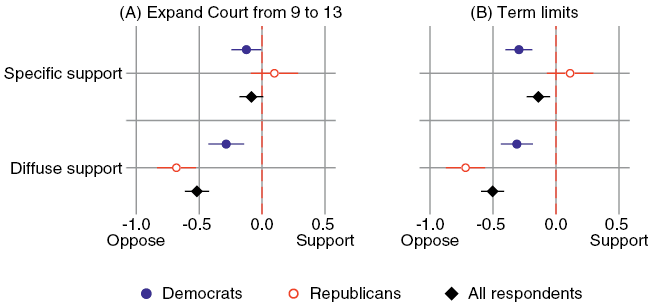
Figure 16 The relationship between support for the Court and reform
Notes: Point estimates derived from a simple OLS model of “support” for given reform, controlling for a series of demographic covariates including race, gender, and education. Estimates bracketed by 95% confidence intervals. In Panel A, we asked, “Do you favor or oppose the following reforms? Over the next 12 years, expanding the number of Supreme Court from 9 to 13 Justices.” In Panel B, we asked respondents whether they approved of term limits, “Do you favor or oppose the following reforms? Applying term limits to Justices’ tenure, where Justices may serve up to a maximum of 18 years.”
Panel B depicts the correlates of support for term limits. Again, partisan asymmetries abound. A less “drastic” form of judicial reform, we nevertheless observe a similar pattern of results in the case of term limits. Democrats who exhibit high levels of specific and diffuse support are much more resistant to reform than those who view the Court with disdain. Meanwhile, Republicans’ diffuse support again is the single predictor of opposition to these reforms.
Taken together, these results offer a window into why the Court has mostly resisted public demands for change. Although specific support bears some relation to demands for reform, it is diffuse support that largely buoys the Court. Given the sorting out of diffuse support, however, it remains unlikely that a critical mass of Americans are sufficiently sympathetic to permit significant structural reform.
Limitations and Future Scholarship
Like most research endeavors, there are limitations to the work presented in this Element. We do not know, for example, whether our three-item measure of specific support ebbs and flows like single-item measures of approval. Neither do we fully understand the scope conditions under which Supreme Court decisions prompt feelings of anger or increase feelings of helplessness – in particular, how “unique” is this period of the Trump presidencies? Future work that fields these questions would be necessary to assess how these attitudes shift over time and whether Court rulings causally produce less specific support measured this way.
Further, while we are confident that specific and diffuse support are now inextricably linked, we are less certain about the role of democratic attitudes. If support for the rule of law remains a significant predictor of diffuse support, then what, precisely, do these attitudes mean? Scrutiny of the questions used to build this scale raises as many questions as answers. Fealty to obeying “a law you consider unjust,” for example, strikes us as a normatively problematic idea. Further, approving government to “bend the law in order to solve pressing social and political problems” doesn’t seem immediately problematic if laws are unjust, confusing, or do not protect citizens. Bureaucracies, in fact, are charged with the interpretation and enforcement of policy; bending the law could be charitably interpreted as the government simply doing its job to ensure that critical problems are solved in a timely manner. For example, cutting checks directly to private citizens, nationwide mandates involving masking, or even forgiving student loan debt are policies that involve discretion and, to varying degrees, bending law to achieve socially optimal outcomes (as the Biden administration argued during the coronavirus pandemic).
Of course, less charitably, attitudes about the rule of law could be taken for more maladaptive orientations about power. Recall that Republicans score higher than Democrats on measures of abstract support for the rule of law. They also score higher on measures involving authoritarian attitudes and social dominance orientations. Those two indices are themselves correlated. Does a preference for the rule of law convey “democratic orientations,” as past judicial public opinion alleges, or, instead, abstract commitments to simply “following the rules?” The latter is an injunctive social norm, but it is not necessarily a “pro-democratic” one in a vacuum. If the Court operates as an undemocratic institution and these rule of law attitudes involve obeying this authority, then how should we interpret these relationships? If the Court and a presidential administration come into conflict over, say, the due process rights of migrants and asylum seekers, or the Constitutionality of the 14th Amendment’s guarantee of birthright citizenship, then how might citizens resolve a desire to follow the law when the law is cynically reinterpreted, or, in some cases, flatly ignored?
Concluding Remarks
For more than thirty years, the study of the etiology of support for the Court has sparked the imagination of scholars of judicial public opinion. Today, the general positivity bias that once marked how citizens thought about the Court has been displaced by a significant and sustained drop in perceived legitimacy. While troubling, that reaction is expected within Easton’s systems theory framework. Moreover, normatively – and with the appropriate caveats – a souring of public opinion toward the Supreme Court could even be viewed as a healthy psychological development among citizens who care about the Court’s role in shaping how citizens experience democracy. After all, why should citizens who are harmed by the Court’s ruling(s) exhibit any deep or sincere loyalty toward it?
Still, the loss of this support – and an asymmetric sorting out of it – do have consequences. Maintaining diffuse support is a long game, and a profound loss of legitimacy constitutes a new status quo that places the Roberts Court in a precarious position. Not only has the Court effectively limited its reach by its very own hand in Trump v. USA, but it possesses no real enforcement mechanism of its rulings by constitutional design. Instead, the Supreme Court, like all judiciaries, relies on (1) political officials to obey its dictates, and (2) the public to pressure such officials to do so (Hitt, Saunders, and Scott Reference Hitt2019). That delicate balance of power seems fraught given the executive branch’s public ruminations about ignoring court orders (Marcus Reference Marcus2025) and the public’s simultaneous sorting out of support. In an absence of consensus support for the country’s apex judicial institution, the Court may find itself under extreme political duress and short of friends.Footnote 32
While we leave open the possibility that the Court’s legitimacy may rebound in the future, bitter divisions among the Court’s justices remain. Further, even if the Trump presidencies are an aberration as they relate to the pressures put upon the rule of law, the Court will not quickly extract itself from the politics of the present. That said, because the American mass public has short memories, it is possible that some regeneration of support could occur by simple virtue of the passage of time. If the Court is not forced into a position to routinely litigate transparently partisan crises, then it is possible that time alone can soften some damage to its legitimacy. Public opinion is often thermostatic, after all (Atkinson, Coggins, and Stimson Reference Atkinson, Coggins, Stimson and Baumgartner2021). But, if our rendering of Eastonian feedback loops cuts both ways, then fully restoring perceived legitimacy would imply that the Court’s outputs temper in a way that balances the ideological, if not partisan, deficits it has created. Barring some unforeseen catastrophe that fundamentally reshapes the membership of the bench, however, such an outcome seems a long time coming.
Acknowledgments
This project builds on decades of labor from a rich group of scholars, and we are grateful for feedback and encouragement from numerous colleagues working in this space. Since embarking on this endeavor in 2022, we have benefited tremendously from the comments and advice of so many individuals, including but not limited to: Andy Stone, Eileen Braman, Vanessa Baird, Brandon Bartels, Kyle Saunders, Dominik Stecuła, Joseph Smith, Michael Nelson, Jim Gibson, and Daniel Weitzel. Our series editor, Dr. Frances Lee, was instrumental in shaping the final version of this Element; we are grateful for her vision and support. Our thanks, too, are due to several reviewers who sharpened (and softened) the arguments made in this project.
This work would not have been possible without generous support from the National Science Foundation (NSF) grant #SES-2226543. In particular, we thank Reggie Sheehan for his service to our discipline as NSF program officer and for his stewardship and support that made the collection of the Supreme Court and Democracy (SCD) Panel Study data possible. Additional thanks are due to the Departments of Political Science at Colorado State University and the University of Alabama for small grant funding used throughout this project. Hitt further gratefully acknowledges the support of the Monfort Professorship at Colorado State University. Hitt dedicates this work to Ted and Caroline Hitt, two supremely excellent young people.
We conclude with an admonition made by one of the Court’s great Justices, Earl Warren, who keenly understood that “it is the spirit and not the form of law that keeps justice alive.”
Frances E. Lee
Princeton University
Frances E. Lee is Professor of Politics at the Woodrow Wilson School of Princeton University. She is author of Insecure Majorities: Congress and the Perpetual Campaign (2016), Beyond Ideology: Politics, Principles and Partisanship in the U.S. Senate (2009), and coauthor of Sizing Up the Senate: The Unequal Consequences of Equal Representation (1999).
Advisory Board
Larry M. Bartels, Vanderbilt University
Marc Hetherington, University of North Carolina at Chapel Hill
Geoffrey C. Layman, University of Notre Dame
Suzanne Mettler, Cornell University
Hans Noel, Georgetown University
Eric Schickler, University of California, Berkeley
John Sides, George Washington University
Laura Stoker, University of California, Berkeley
About the Series
The Cambridge Elements Series in American Politics publishes authoritative contributions on American politics. Emphasizing works that address big, topical questions within the American political landscape, the series is open to all branches of the subfield and actively welcomes works that bridge subject domains. It publishes both original new research on topics likely to be of interest to a broad audience and state-of-the-art synthesis and reconsideration pieces that address salient questions and incorporate new data and cases to inform arguments.