

Introduction
Although metalworking is of importance in Sasanian archaeological research, few studies have dealt with it, especially from a technical perspective (e.g. ore mining, smelting and extraction methods). This article aims to begin addressing this lacuna. A specific motivation was a survey in 2009 of Darabgird (28 41.444N, 54 28.684E), a circular city located in Fars province, 9km south-west of modern-day Darab. During the survey, many metallic fragments were identified from across the city, particularly in the south-western and north-eastern zones (Karimian & Seyedein 2010). This led the authors to believe that such evidence might be found at other nearby Sasanian cities: Bishapour (29 46.695N, 51 34.250E) and Gur (28 51.181N, 52 31.943E). To assess this, new fieldwork was conducted during 2012 demonstrating the same results: metallurgical remains were widely scattered but with particular concentrations. As surface surveys only reveal evidence of metallurgical processes in the case of intensive activity (Reference HauptmannHauptmann 2007: 6), it would seem that metalworking must have occurred on a relatively large scale at these sites. Here, analysis of material from Bishapour and Darabgird considers this possibility.
The first and most important question about this material is whether or not it represents slag from smelting. And, if that is the case, what kind of metal was being smelted? Some historical records refer to the production of iron in this area, especially at Darabgird. Further, archaeological reports (e.g. Reference MorganMorgan 2003: 11–12) suggest that iron smelting is the most probable origin of such material. Archaeometallurgical analysis is, however, needed to resolve these questions.
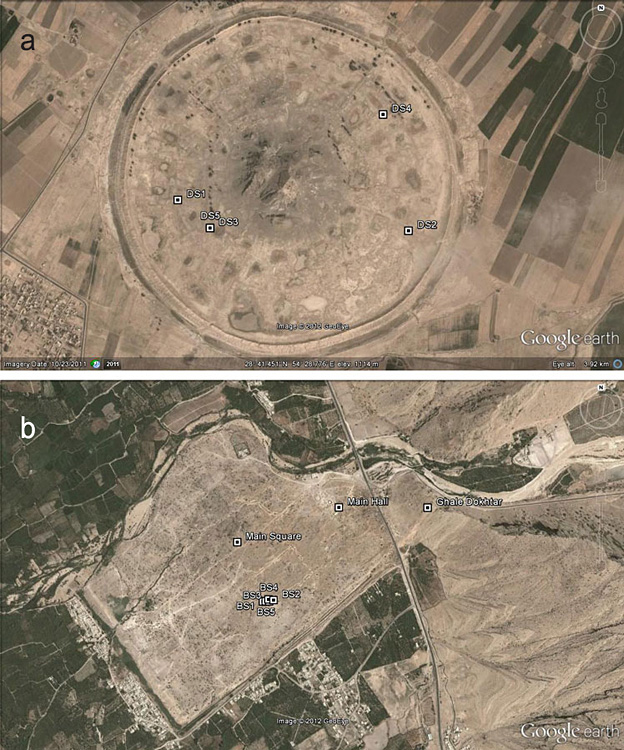
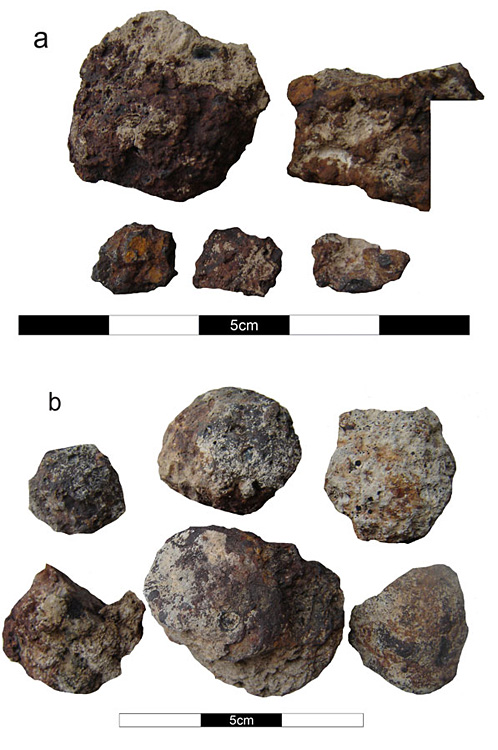
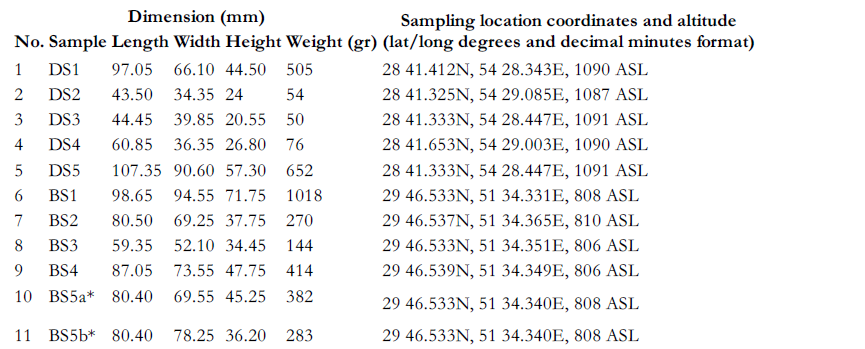
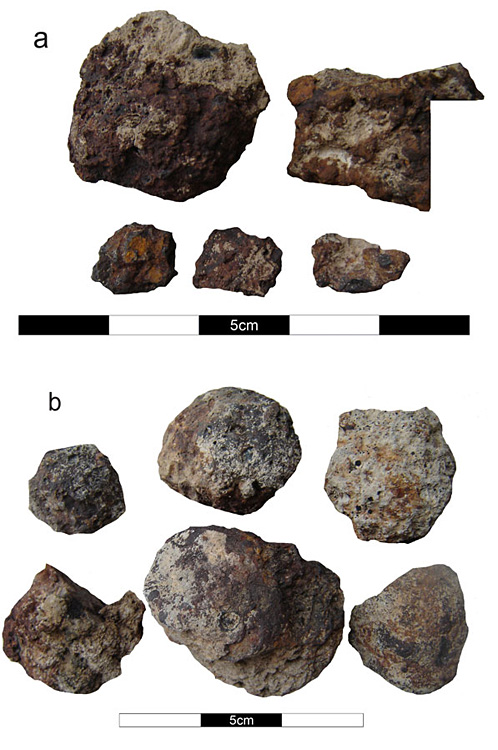
Due to close similarities in appearance and consistency of the material, five samples from each site were selected for analysis: DS1–DS5 from Darabgird and BS1–BS5 from Bishapour. Figure 1 shows the locations from which the samples were collected. Further physical data are presented in Table 1 and Figure 2.
a) Location of selected samples at the surface of Darabgird. b) Location of selected samples at the surface of Bishapour.

a) Macroscopic photograph of selected samples from Darabgird (DS1-DS5). Sample one (DS1, upper right), shows the incision for the preparation of the polished thin section. This should be done through a specific angle and direction so as to enhance the visibility of key minerals such as silicates. b) Macroscopic photograph of selected samples from Bishapour (BS1-BS5). Sample four (BS4, lower left), shows the incision for the preparation of the polished thin section.

* BS5a and BS5b merged together in analysis as they were so close together at the surface of the site.
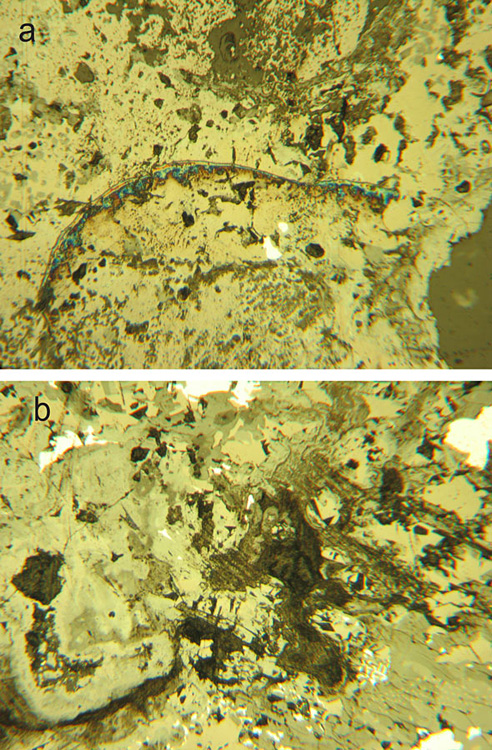
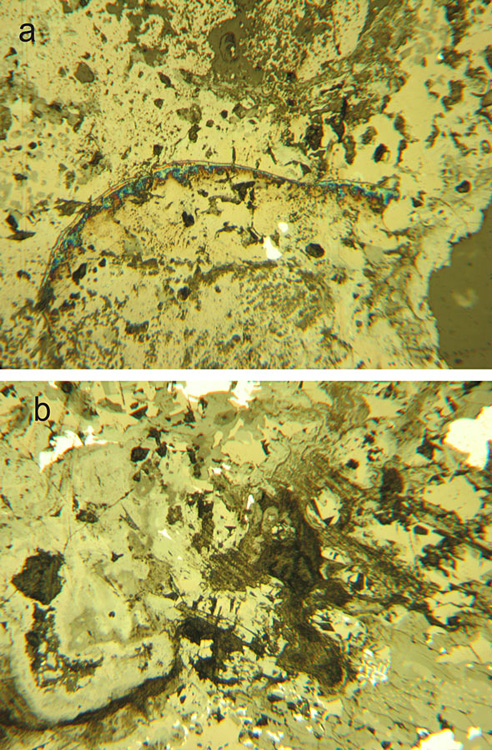
a) Photomicrograph of the polished thin section of DS1 under optical microscope. The bright inclusion in the centre of the photomicrograph is a pyrite vein. b) Photomicrograph of the polished thin section of BS4 under optical microscope.
Analytical methods: petrographic study
Polished thin sections were prepared to determine the structure and to identify composition. Due to the similarity of these 10 samples, only one sample from each site was selected: DS1 and BS4. Examination of both polished thin sections under an optical microscope indicated that the samples contained high levels of iron in the form of magnetite (Fe3O4) which, due to weathering over time, forms goethite ((FeO(OH)) and other similar iron hydroxides (Figure 3). In fact, Morgan already observed this in his earlier report (Reference MorganMorgan 2003: 11–12) simply due to the samples' magnetic properties. It should be mentioned that magnetite, alongside hematite (Fe2O3), is the most well-known iron ore used in ancient metallurgy (Reference AbbasnejadAbbasnejad Seresty 2009: 2). Additionally, some pyrite (FeS2) veins were detected. Most important, however, is the lack of fayalite (Fe2SiO4) and kirschsteinite (FeCaSiO4) which are common in both iron and copper slags. As there is no sign of deformation of compound tissues caused by a high-temperature atmosphere, nor any sign of a crystallisation phase and glassy matrix, we can conclude that these samples have not been subjected to heat.
Analytical methods: chemical composition analysis
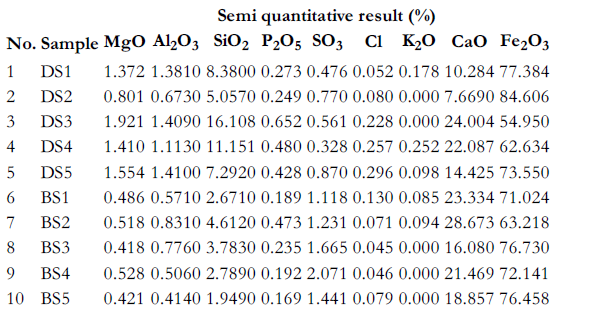
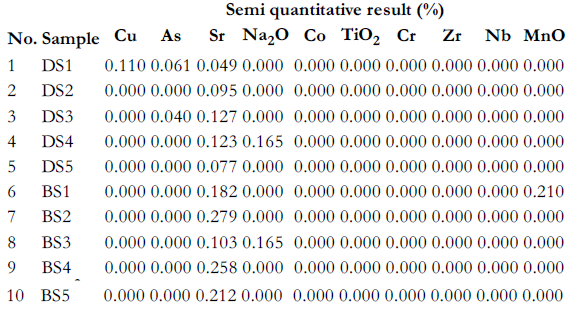
X-ray fluorescence spectrometry analysis (XRF) was used to identify the chemical composition of the samples. It confirmed the presence of high levels of iron, not only in DS1 and BS4, but also in other samples (Table 2). The XRF analysis also confirmed the general similarity of the samples. Table 2 shows Fe2O3 to be the most abundant compound (~71%) followed by CaO (19%), SiO2 (6%) and SO3 (1%). This bulk composition is unusual for metallurgical slags—too high in CaO and too low in SiO2. In some iron bloomery slags from Tell Hammeh, Jordan, there is a high content of CaO (up to 20%), but the level of iron (~50%) is much less than in the current samples, while the SiO2 (~20%) content is much higher (Reference Veldhuijzen, Prudêncio, Dias and WaerenborghVeldhuijzen 2005: 298–99). Hence, the level of iron in the current samples is too high for even iron bloomery slag.
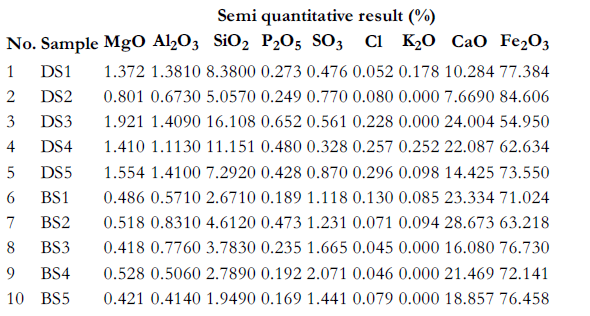
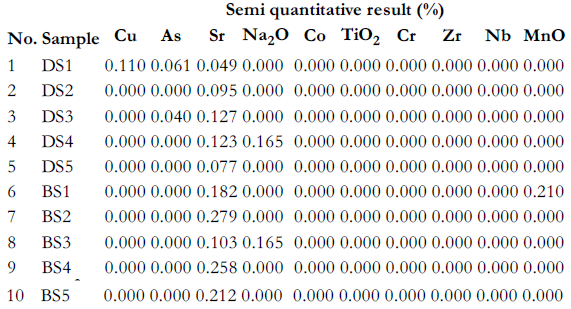
Recent studies on three major iron smelting sites of the Sasanian/early Islamic period in the adjacent province (Kerman) show a much lower iron content in bloomery slags (Gol-e Gohar ~45%, Chah Godar ~48% and Chahak ~43%) (Reference AbbasnejadAbbasnejad Seresty 2009: 10–11). A further factor which argues against a metallurgical origin is the high sulphur content. Although such levels of sulphur are common in copper slags, the current samples have far too little copper to be either copper ores or slags (the latter should have 0.5–1wt% copper) (Severin et al. 2011: 989). Furthermore, high sulphur content also argues against iron smelting because sulphur would make the extracted metal brittle. As noted above, pyrite veins were detected in photomicrographs and these could be a sign of sulphidic ore deposits and gossan, which is formed above this kind of ore. The lack, however, of key elements related to these kinds of deposits (e.g. lead, Severin et al. 2011: 985) and the low copper content (110ppm) invalidates this suggestion. In summary, analysis of the chemical composition of these samples shows no indication that they are of metallurgical origin.
Discussion and conclusion
Based on petrographic and XRF results, we can conclude that these samples are of natural origin. With such high levels of magnetite this material was probably used as an iron ore. Further, the similarities of the bulk chemical composition of all 10 samples would suggest they were collected from a single source. Further provenance studies such as lead isotope analysis (LIA) could help to confirm this. Since a suitable iron ore not only should have sufficient iron, but also low levels of other components such as lime, oxides of magnesium and aluminium and silicon dioxide (Reference RappRapp 2009: 167), with caution, we can consider these ores relatively suitable for ironworking; except for sulphur and calcium oxide, other key compounds are at desirable levels (MgO ~0.95%, Al2O3 ~0.9% and SiO2 ~6%).
As smelting furnace structures can be identified only rarely (Anguilano et al. 2009: 375), finding other metallurgical materials such as slags is the principal way of identifying smelting activities. As these sampled materials are now known to represent iron ores, we should imagine that smelting took place outside the cities at other locations. Dedicated iron smelting sites in Kerman province (Gol-e Gohar, Chah Godar and Chahak) appear to confirm this. It seems we have a well-organised iron ore supply network in the area but, due to high levels of sulphur in the ores—approximately 10 times more than Gol-e Gohar ores (0.1%) (Reference AbbasnejadAbbasnejad Seresty 2009: 9)—it is logical to suggest that these ores were used to produce artefacts which did not need great strength. In any case, more accurate analysis, both petrographic and chemical (such as Scanning Electron Microscopy (SEM)/Energy Dispersive X-ray Spectroscopy (EDS) and Inductively Coupled Plasma spectrometry (ICP)) on a larger number of samples from other Sasanian cities, together with investigation of surrounding territories to locate possible production sites, will help further improve our understanding of Sasanian metallurgy.
Acknowledgements
With special thanks to Professor Thilo Rehren (Institute of Archaeology, University College London) for helpful comments and also to Ms Seyedeh Anahit Kazzazi (University of Sussex).