

PART 1: TOPOGRAPHICAL AND ARCHAEOLOGICAL INTRODUCTION By Vicky Crosby and David Neal
The excavations at Stanwick, Northamptonshire (at national grid reference SP972716)Footnote 1 were carried out by English Heritage between 1984 and 1992, in advance of gravel extraction. Extensive and productive in their own right, in the broader context of the Raunds Area Project the excavations offered a unique opportunity to examine the development of Iron Age and Romano-British rural settlement, economy and society in a landscape setting and in the context of earlier and later monuments, settlement and land use.
The site occupied a gravel terrace on the east bank of the river Nene, west of the modern village of Stanwick (fig. 1). In the Romano-British period, it lay between the river and the Roman road from the small town of Irchester towards Water Newton (Margary 570). Unlike the roadside settlement of Higham Ferrers to its south,Footnote 2 the Stanwick settlement was set back from the road, lying alongside trackways established during the Iron Age. It was one of a series of agricultural settlements along this section of the Nene valley, including Redlands Farm (between Higham Ferrers and Stanwick) and Mallows Cotton to the north.
Location map of the site (by Andrew Lowerre). (© Historic England)

The excavations covered over 30 ha. A Neolithic and Early Bronze Age ritual landscape was succeeded by fields and droveways of Middle to Late Bronze Age date.Footnote 3 The field systems formed the backdrop to scattered occupation from the earliest Iron Age and continued to influence the landscape well into the Romano-British period. An unenclosed settlement developed in an organised landscape from the Middle Iron Age. Trackways and enclosures established in the first century a.d. formed the framework for the development during the late first to third century a.d. of an agricultural village lying between the road and the channels of the river Nene. More complex building types appeared from the mid-third century a.d. One aisled building was increasingly elaborated, finally being incorporated into a winged corridor villa in the late fourth century a.d. This was accompanied by significant change in the settlement layout: a large enclosure in front of the villa cut across existing boundaries and nearby building groups declined or went out of use. Activity around the villa continued well into the fifth century a.d., but with a marked change in the character of occupation at some time in the early fifth century.Footnote 4 See online table 1 in the supplementary material for more detail of the phases of development of the site.
The sculpture and related architectural stone that is the focus of this article was discovered in 1990, the final year of David Neal's excavations, during the investigation of the villa (figs 2 and 3). Sometime after a.d. 364, the aisled hall was extended with wings to the north-east and south-west, and a fronting corridor terminating in projecting wing rooms. The principal rooms of the south-western wing and the porticus had mosaic floorsFootnote 5 and the western room had a channeled hypocaust. A new bath suite was included in the north-eastern wing.
Find-spots of sculpted and architectural stonework on site (by Andrew Lowerre). (© Historic England)

Find-spots of sculpted and architectural stonework from the villa area (by Andrew Lowerre). (© Historic England)

As excavation of the villa proceeded, the stone walls were cleaned using a high-pressure air gun. This worked remarkably well, exposing differences in the construction methods and materials used.
The first piece of sculpture was identified when the quoin in the north-eastern corner of the south-western wing was seen to be a different type of stone and to have a curved edge. Neal thought this was significant, and carefully removed the yellow mortar and irregular herringbone stonework from either side of the quoin. It became apparent that this was a piece of sculpture, and when it was lifted, the carving of a barbarian's head and horse's hoof was revealed (Historic England object number 95467; the four- and five-digit numbers given henceforth are Historic England object numbers; see online table 6 in the supplementary material for a full list and more detail about the sculpted and architectural pieces mentioned in the text).
Excavation of the channeled hypocaust followed a week or two later. As the main flue and channels were excavated, it became apparent that fragments of sculpture had also been built into the channel walls. Once survey and photography had taken place, the walls were dismantled, and a remarkable array of sculptured stones was revealed.
The discovery prompted re-examination of the stone already removed from the robber trenches and hypocaust fill, and systematic observation of all further stone removal. Further pieces of sculpture were discovered in other locations in and around the fourth-century construction.Footnote 6 A massive block with sockets for clamps (95639) was found bridging a water channel and forming the foundation for an overlying wall. Neal felt at the time that the pieces were probably from at least one elaborate monument, with the massive block forming part of its foundation. It seemed clear that the monument(s) had been systematically dismantled, and the stone used in the later fourth-century extensions to the villa.
The discovery created considerable public interest, including both newspaper and television coverage. So much sculpture and related architectural stone was found that a lorry was needed to remove it from the site.
Religious and ritual activity is well represented at Stanwick. From the late second to the mid-third century, a walled enclosure lying east of the aisled hall and north of the access road to it from the Roman road formed a major focus, containing two small shrines.Footnote 7 There must have been an imposing view, looking down from the road towards the substantial (and possibly decorated) gable wall of the aisled hall, with the shrines (and probably the monuments described below) situated to its right. A similar layout can be seen at Claydon Pike in the Upper Thames valley, where a shrine also lay to the right of the approach road to the aisled buildings.Footnote 8
A second focus was the temenos constructed around a Bronze Age barrow to the north of the site. In contrast to the shrines, which were demolished in the late third or early fourth century, the temenos was further enhanced with an encircling stone wall during that period. The numismatic evidence suggests the orientation of the temenos changed after around a.d. 330, and coin deposition appears to have almost ceased at around the time the corridor villa was built.
Some of the wells contained ‘special deposits’ of animal skeletons and pottery, and pottery and metalwork (including a sword and spearhead) had been placed on two further round barrows lying on an island between river channels west of the settlement.Footnote 9 An inhumation cemetery lay between the aisled hall/villa complex and the river, and smaller groups of inhumations were found elsewhere in the settlement, typically associated with boundaries.
PART 2: THE SCULPTED STONEWORK By Martin Henig and Penny Coombe
Significant quantities of sculpted and architectural stonework were recovered from the site during excavations (figs 2 and 3). Numbering approximately 280 separate pieces, the assemblage includes around 30 sculptural stones carved in relief, some almost in the round, two with remains of inscriptions and around 90 with architectural carvings or mouldings. With the exception of one or perhaps two small altars, the remainder are structural blocks. This represents one of the largest assemblages of decorated stone from a single site in the province, but it is also remarkable for the quality of carving and the character of the large monument(s) that the material attests.
The finely carved reliefs probably originated from two large monuments: a tower tomb and another perhaps dedicated to the Capitoline Triad. Stylistic considerations suggest that the structure or structures in which the bulk of the stone was originally used dated to the early third century, placing the monument(s) within Phase 9 (c. a.d. 170–230) or possibly Phase 10 (c. a.d. 230–70) of the site (see online table 1 of the supplementary material). Most of the stone was discovered reused in contexts associated with the development of the site and especially the enlargement of the villa building in the fourth century (Phase 12, c. a.d. 340–70), with the addition of wings to the north and south, and a new eastern front including a portico entrance. It is clear from the fragmentary nature of the remains and the damage to surviving surfaces that the earlier structures were comprehensively taken apart before the stones were reused. Such comprehensive reuse of monuments in a luxurious fourth-century villa, in an area where building stone was readily available (see online table 2) hints at some other powerful motive for destruction.
This report includes discussion of the main sculptural and architectural blocks, proposing reconstruction of the structures in which they were initially used, their style and near comparisons for the carvings, and sheds light on their original use and reuse. Petrological analysis of the stone types and sources is presented and discussed below, as well as pXRF analysis of paint or other preparation surviving on the surface of the stone. Supporting supplementary material is available online, as indicated.
STANWICK SCULPTURE AND MONUMENTS By Martin Henig
The fragments of sculpted, moulded and inscribed stones recovered from the villa building can be divided broadly into three groups. Some pieces were evidently recycled materials from one or two monuments (figs 4–12; see online table 6; online figs 1 and 2). It is likely that the architectural features, columns and pilasters originated in the same structures, although some of the pieces may have graced the villa itself or nearby buildings, and so form another group (see online table 6; online figs 3 and 4). Finally, a complete, small but plain altar (41100; fig. 13) of Millstone Grit is an exception. More commonly found in the north of England, another altar in the same material was found at Springhead in Kent,Footnote 10 and there is a further dated altar, both sculpted and inscribed, from Bordeaux, France.Footnote 11
Half of the sculpted head of a water god (95501). (© Historic England)

Sculpted shell canopy (95745, 95801). (© Historic England)

Cable moulding (95818 (left) and 95751 (right)). (© Historic England)

Sculpted hoof and head of a barbarian (95467). (© Historic England)

Figure of a naked woman in relief with trees in the background, perhaps Hesione (95862 (right), 95921 (left)). (© Historic England)

Male figure with drapery over his arm, perhaps Perseus (91371). (© Historic England)

Sculpted eagle, almost in the round (95997). (© Historic England)

Sculpted figures of Minerva and Jupiter (95746, 95747). (© Historic England)

Cornelian intaglio, depicting Jupiter's eagle; 11 by 9 mm (© Claudia Wagner and the Beazley Archive)

Portable altar, made of Millstone Grit (41100). (© Historic England)

The collection of, mainly relief, sculpture is of great importance for Britain where few such assemblages survive, though it is sparse and very few of the pieces appear to join one another, rendering it next to impossible to suggest anything other than a putative reconstruction. It should be noted that, while much of the sculpture was in the relatively coarse and shelly Blisworth limestone, sculpture in the finer Weldon stone was also present (see ‘Part 3: materials’, below). It is possible that both materials were employed in the same structure, as was the case with the London Arch where some Weldon stone was used alongside Barnack limestone; stone types do not necessarily help in identifying original arrangements.Footnote 12
One of the monuments appears to have been a substantial funerary structure, possibly a tower tomb, as indicated by the presence of a number of sculpted pieces with particularly funerary motifs and imbricated sections that could have formed a ‘roof’ (for instance, 95913; online fig. 2). Such tombs were widespread in the Roman world, including the Roman north-west,Footnote 13 and were not unknown in Britain,Footnote 14 though fragments of imbricated roofs are few and far between in this province.Footnote 15 The Stanwick monument would seem to have been similar to the only complete surviving example of a tower tomb in the Moselle region at Igel near Trier, Germany (fig. 14)Footnote 16 as well as others reconstructed from blocks found reused in the foundations of the late Roman walls of Neumagen, also in Germany.Footnote 17 Although mythological scenes, several of which we appear to have at Stanwick, are present in these monuments, especially in the pediments, most of the reliefs depict scenes of daily life, which are to all intents and purposes absent from the surviving remains from Stanwick.
The tomb monument for the Secundinii family, in situ at Igel, Germany. (© Penny Coombe)

This monumental tomb would appear to have stood on a massive foundation of blocks held together by heavy metal clamps (95639 measures 1.33 by 0.6 m, and was perhaps one of four or six blocks like it; online fig. 1). The monument was crowned by a pyramidal structure of Weldon stone ornamented with imbrication. Comparison with such ‘roofing’ may be made with a block from Verulamium,Footnote 18 but that is a single piece, while, to judge from two surviving fragments (90853, 95913), the Stanwick example was composed of a number of blocks. It rose in all probability to a considerable height and, even if it was smaller than the Igel monument, which stands at an impressive 23 m, it would still have been a commanding feature in the Northamptonshire landscape. Other monumental tombs from the area around Trier are known in association with villas; though now mostly destroyed or fragmentary, remaining foundations are of significant size (for example 3.8 by 3.5 m, up to 13.75 by 5.5 m).Footnote 19
There are a number of decorative blocks and fragments of blocks that would have been appropriate embellishments for a tomb, and they combine to offer an accumulation of evidence supportive of the type of structure proposed, though none of them would have been decisive on its own. The large block of Blisworth stone depicting the right side of the head of a mature male, with flowing beard (95501; fig. 4), is perhaps most potent in this context. He may be identified as a marine or river god, probably Oceanus or Neptune,Footnote 20 and presumably another block, now lost, would have completed the left side of the mask. Such heads are found in funerary art, where they are generally symbolic of the watery realm over which the dead had to pass to the Blessed Isles.Footnote 21 Such mask-like faces feature on a number of other funerary sculptures. A head of Oceanus graces the pediment of the recently excavated tombstone of Bodicacia from CirencesterFootnote 22 and a free-standing head of Oceanus from SouthwarkFootnote 23 was perhaps also from a funerary monument. The bust of a bearded god is depicted on another block from a tomb at Earith, Cambridgeshire.Footnote 24 That head, with its neater beard, however, looks much more like Jupiter than Oceanus, although it presumably had the same apotropaic significance and is tentatively identified as Jupiter's brother Pluto. The mask depicted on a tomb pediment from Chester seems to conflate Oceanus or Neptune with the gorgon.Footnote 25 From Germania, the head of the god on a block, from a tomb from Bonn, sprouts a bull's horns.Footnote 26 Often indicative of a personification of the might of the river Achelöos and more generally the rushing current of a river, here it probably represents the Rhine. Since all rivers debouch into Ocean,Footnote 27 there may be some association with this funerary watery realm.
The largest sculpted piece from the site, the upper part of an elaborate and beautifully carved shell canopy flanked by dolphins, of which one remains, is also most likely funerary (95745, 95801; fig. 5). The dolphin depicted above a similar shell canopy on a tomb relief from ChesterFootnote 28 and the dolphins flanking Neptune's trident on the grave stele of Titus Valerius Pudens at LincolnFootnote 29 may be mentioned in this connection. The foot intriguingly carved on the upper side of the niche might be that of a cupid, as on a tomb relief from Arlon, Belgium, where he is depicted flying above the shell.Footnote 30 Cupids in such reliefs, often riding sea creatures (there is a small fragment (95799) depicting a chubby leg surmounting a curving feature which perhaps shows this), probably represented the soul of the deceased voyaging over the sea to the Isles of the Blessed.Footnote 31 There is a fragment of another shell canopy (95915), perhaps from the side of the monument. Of course, shell canopies in themselves were not confined to tombs; for instance, large-scale shell canopies were a feature of the screen of the Four Seasons at Bath.Footnote 32 However, the associated dolphin on the Stanwick block is more suggestive of funerary interpretation. It is worth noting that we also have part of a pediment, with slim cable moulding, amongst the assemblage (95751 and 95818; fig. 6). A carved block of Blisworth limestone, reused in the flooring of a Roman building at Irthlingborough, a few kilometres from Stanwick, was recently excavated by Oxford Archaeology, and should be mentioned in this context, both as representing (presumably) another built tomb and because its subject, a nereid riding upon a hippocamp, likewise represents the journey of the soul over the sea to felicity in the Isles of the Blessed.Footnote 33
Also of potential funerary significance is the relief of a horse, presumably originally with a rider seated upon it, treading down a giant or barbarian, although only the foreleg and hoof of the horse and the anguished head of the giant now remain (95467; fig. 7). The origin of such a scene would have been the Hellenistic gigantomachy, symbolising the triumph of order over chaos. The motif was also employed for Roman auxiliary tombstones and (always in the round) surmounting the capitals of Jupiter-Giant columns. However, this is neither a military grave stele nor can it be Jupiter riding down a giant, unless, uniquely, the theme is here depicted in relief. Its nearest parallel, also from eastern Britain, is a relief from Stragglethorpe, Lincolnshire,Footnote 34 showing a mounted Mars in the act of spearing a serpentine creature, doubtless derived ultimately from representations of gigantes but here symbolising the chthonic realm. Several bronze figurines, amongst them those from the shrine at Brigstock, Northamptonshire,Footnote 35 and from near Brough, Nottinghamshire,Footnote 36 depict the same deity, as does one fragmentary but inscribed example from Martlesham, Suffolk, with an equestrian Mars treading down a barbarian.Footnote 37 The accompanying inscription identifies him as Mars Corotiacus. On a different scale and in a different material, bronze figurines of a horse and rider are seen particularly in southern and central England, and identified again as a local version of Mars.Footnote 38 A concentration of figurines found at the Roman temple at Brigstock, Northamptonshire (around 15 km north of Stanwick), could even point to a cult centre nearby.Footnote 39 Brooches with horse-and-rider motifs are also concentrated in this south-central region, particularly in East Anglia, and are especially found at religious sites in rural areas or small towns, suggesting again a local and religious significance.Footnote 40 These comparanda strongly suggest that this relief depicts a local Romano-British, and probably regional, deity.
Mythological scenes are often featured in funerary contexts.Footnote 41 One block from Stanwick depicts a naked female figure, her arms behind her back, in a landscape setting, as is designated by trees (95862, 95921; fig. 8). A similar captive is depicted on a block from a built tomb at Chester, where her rescuer is Hercules, thus identifying the maiden as Hesione.Footnote 42 Two blocks at Stanwick depict well-muscled male figures. The one most likely to be related is similarly in low relief and depicts a young man wearing a chlamys (91371; fig. 9), suggesting Perseus rather than Hercules; in which case, the maiden would be Andromeda. Perseus rescuing Andromeda is, incidentally, the theme of a tomb relief from ArlonFootnote 43 and also of one of the scenes on the Igel monument.Footnote 44 The differences in scale suggest that these pieces are not directly associated and thus we may have both episodes apparent on the monument.
It is possible that the other torso, in higher relief (95509), is from an image of Hercules, though, if from the same tomb, it was presumably in another register, in which case he may have appeared performing another of his labours. Comparison in that case might be made with a torso of Hercules from Ludgate Hill, London, though this is carved in the round.Footnote 45 As, however, it was excavated in the same context as the eagle in relief found nearby (95997; fig. 10), likewise of Weldon stone, it is more probably part of an image of Jupiter.Footnote 46 It is then tempting to ascribe it to another monument, dedicated to Jupiter or the entire Capitoline Triad, as discussed below.
The reason such themes were employed on tombs and sarcophagi, as J.M.C. Toynbee pointed out, may sometimes have been to signify the uncertainties of life and in other instances to indicate the salvation of the soul, but in every case they demonstrate the paidea of the deceased or of his or her heirs.Footnote 47 Mythological reliefs of this nature are comparatively rare in Britain. Best known are a few relief blocks from tombs at Chester, which, apart from the portrayal of Hercules and Hesione, cited above,Footnote 48 consist of depictions of Acteon being attacked by his houndsFootnote 49 and the dying Adonis,Footnote 50 all probably from the same monument, and a spirited relief of Lycurgus brandishing his axe.Footnote 51 In southern Britain comparable material is also sparse and was recognised only fairly recently. A relief from Aldgate in London depicts Helen of Troy and the Dioscuri as infants, born from an egg after Zeus deflowered Leda.Footnote 52 More spectacular, in that it depicts a dramatic sequence from a play by Euripides, is a cylindrical drum, carved from a large block of French limestone, discovered at Fittleworth in Sussex and depicting scenes from the myth of Iphigenia in Tauris; the likely context here is again funerary.Footnote 53 A block from Calne, Wiltshire, depicting the three Morai, or Fates of Greek myth, also doubtless came from a tomb.Footnote 54 The Stanwick pieces, fragmentary as they are, thus add considerably to the slender corpus of mythological grave reliefs from the province.
One might have expected a tomb to have also exhibited figured representations of the deceased, but these could have been free-standing within the shell canopy, much as is the case in the fragmentary funerary relief from Chester, mentioned above,Footnote 55 where a portrait of the deceased is shown against the background of the shell. The identity of the individual or individuals commemorated is unknown, but two boldly cut letters on a fragment of Weldon stone (96039) were perhaps part of the funerary inscription.Footnote 56
There would seem to have been another monument, suggested in the first instance by an inscription carved on a slab of Alwalton marble: in honorem domus divinae (1008).Footnote 57 It is tempting to associate what appear to be relief carvings of Minerva, Jupiter and Juno (95746, 95747, 95741; fig. 11), that is the Capitoline Triad, with this. The upper part of Minerva, who is depicted holding her circular shield, remains; the right arm of a stocky male figure next to her is, presumably, that of Jupiter and beyond him may be the shoulders and neck of another goddess, surely Juno. The Capitoline Triad is often figured as a group in art, although such sculptures are comparatively rare in the north-western provinces. There may have been a free-standing group of Jupiter, Juno and Minerva at Somerford Keynes in Gloucestershire, suggesting to Alex Smith ‘a capitolium, possibly indicating some official interest either within or near the site’, although all that was recovered of the group were Minerva's shield and the lower fold of her mantle and Jupiter's eagle.Footnote 58 A marble relief from Trier depicts Minerva, Jupiter and Juno in the same order as appears to be the case here,Footnote 59 while the three deities stand in a niched aedicule carved on the front of an altar from Xanten, also in Germany.Footnote 60 The monument may have been a substantial altar, the base of a Jupiter column or more probably a monument like that of the Nautae Parisiaci in ParisFootnote 61 of Tiberian date or the example in Chichester that is probably Domitianic,Footnote 62 both dedicated to Jupiter in honorem domus divinae. Such a monument would most likely have been surmounted by a statue of Jupiter with his eagle; the eagle in Weldon stone (95997; fig. 10) from Stanwick might well have been the survivor of such a sculpture of the god, together, plausibly, with Jupiter himself, if the torso of a nude and well-modelled male figure (95509) represents that deity.Footnote 63 The Somerford Keynes eagle mentioned above, as well as those from Cirencester and Cole's Hill in Gloucestershire,Footnote 64 was most probably associated with images of Jupiter, although of course the splendid image of an eagle devouring a serpent recently found at the Minories, London,Footnote 65 will have stood alone and was evidently from a funerary context. Although we cannot rule out the possibility that the Stanwick eagle and the torso of a well-muscled male figure found in the same context were likewise from the tomb, it seems more plausible that they were part of this dedication to the state cult of Jupiter Optimus Maximus. A cornelian intaglio of exceptionally high quality, depicting an eagle holding a wreath in its beak and a palm in its right foot, was also found at Stanwick (fig. 12). One can imagine it set in the signet ring of someone of consequence, an official perhaps. If so, it provides important supporting evidence, alongside the sculpture and fragmentary inscription, for an official cult of Jupiter, linked to the imperial cult, here, such as would have been associated with a procuratorial estate.
There are a few other sculptural items that need to be considered. First there is the lower part of a relief depicting two human legs (91369), carved in Weldon stone, probably those of a young god or hero standing in a relaxed pose, such as Ganymede feeding the eagle, which is a common funerary motif, represented for example by statues from Bonn and Cologne.Footnote 66 The stance of the youth, with one leg bent and his weight on the other, is derived from the Doryphoros, a famous statue by the fifth-century BC Argive sculptor Polykleitos, and was very widely employed in Graeco-Roman art for all manner of images of gods and heroes, for example Hercules discovering the infant Telephos on the Telephos frieze of the Great Altar of Zeus at Pergamum.Footnote 67 Amongst reliefs from Roman Gaul it brings to mind the relief of Apollo from the sanctuary at Champlieu,Footnote 68 though in that representation, as in those of most others, the figure has his right leg relaxed and the left bent, in contrast to the Stanwick relief where the left leg bears the weight of the body. A relief figuring the head and upper torso of a figure of Mercury, nude apart from the chlamys draped over his left shoulder, which was found in excavations at the Bath Gate, Cirencester, most probably ornamented the gate, though as guide of souls it could have come from a built tomb outside.Footnote 69 It probably depicted the god in a rather similar relaxed stance.
There are also two hands carved in the round, one of them clasping clothing (95907) and the other holding an urn or perhaps a cup (91370, 91739). The identity of the statue from which they came is uncertain. Again, Ganymede comes to mind, and such a figure could have stood at the top of the pillar tomb, though the hands, of coarser Blisworth stone, cannot be associated with the Stanwick eagle (95997; fig. 10), which is carved in the superior Weldon. More likely, the hands represent another subject altogether; it may be pointed out that Venus and water nymphs are often depicted with an urn, for example, as at Wroxeter, where it was part of a fountain.Footnote 70
There are a number of other pieces, now very abraded, that might also have carried relief sculpture, perhaps of further figures with drapery and landscape elements. A further tree in addition to that forming the background to the bound female figure can be made out on one piece (95881) and a three-legged stool or table on another (95841), which it is tempting to associate with a scene of a funerary banquet;Footnote 71 if so, it would be the only example of a depiction of daily life that remains from Stanwick, of a type which may be seen very generally on this kind of large funerary monument.
A portable altar
Although plain and uninscribed, the portable altar (41100; fig. 13) is of interest primarily for its material. It is fashioned from Millstone Grit from Yorkshire and was, presumably, brought to Stanwick from Yorkshire by an individual of some importance, perhaps an army officer, a procurator or a merchant, travelling down from the north.Footnote 72 The altar is small and would have been portable, unlike the larger altar with its base from Springhead,Footnote 73 the only other altar from Britain carved from this material. Neither of these is inscribed. However, a third outlier comes from the maritime port of Bordeaux in Aquitania, is inscribed and richly carved, and was dedicated to the Tutela Boudiga, the protecting deity of that city, by M. Aurelius Lunaris, a sevir Augustalis of both the colonies of York and Lincoln:Footnote 74 Lunaris was evidently a rich merchant engaged in maritime trade, who may well have brought the stone with him. It bears a third-century consular date (a.d. 237); the Stanwick and Springhead altars are probably of similar date.Footnote 75 It should be added that, in addition to the portable altar, another piece of Millstone Grit was recovered from the site (78401). Conceivably it is part of an altar base, as at Springhead, but, in any case, it provides further evidence for a link with the area of York.
Although small, this altar is another important indicator of religious activity on the site. It could have been dedicated in the temenos area, possibly to Jupiter or the Capitoline Triad attested above. It was found distinct from the rest of the assemblage in a well, at the north-eastern edge of the main central part of the site.Footnote 76 This well appears to have gone out of use by the mid-fourth century, or perhaps slightly earlier, and the altar could have acted as a closing deposit. Such practice is known in other locations, and, while more commonly involving pottery or animal skeletons rather than stonework, the stone altars deposited in Coventina's well at Carrawburgh (which would certainly have seen the end of the well's useful life) and in the well of the praetorium at Bar Hill, Newstead, offer some parallels.Footnote 77 This represents an entirely different kind of activity and deposition to the reuse of stonework in construction.
THE ARCHITECTURAL FRAGMENTS By Penny Coombe
Around 90 fragments with architectural mouldings survive, including column shafts, bases and capitals, cornices and worn fragments of other decoration. Where identifiable, the Tuscan order and relatively plain cornices dominate. A small number of the remaining stones suggest that Corinthian mouldings were also sparingly used (90517, 91373, 91406, 95879) but most of these are very fragmentary or worn and not conclusive. Corinthian pilasters are seen on the reconstructed tomb monuments from Neumagen, Germany,Footnote 78 but we may have here a similar, British, example in a different, plainer order, as well as architectural blocks associated with other buildings in the complex. Thomas Blagg noted the decline of use of Corinthian capitals into the third century as few major public buildings were built at this time, and Tuscan columns were more often used in the private domain.Footnote 79
It is possible that some of the pieces would have had their primary use in the villa or the fabric of other buildings and were later reused in a further phase of stone building, rather than necessarily coming from the proposed monuments; such a wealth of architectural stonework is indicative of a substantial stone building of some quality and luxury.Footnote 80 Some pieces, however, may be associated with the tomb monument.
Columns/pilasters
Very few complete circular column pieces survive, suggesting either that the elements more often selected for reuse included those with at least one straight edge (or were remodelled as such) or that pilasters were preferred in their primary setting.
Eight pieces of column or pilaster shaft remain, four of them collared or decorated with an astragal and around 18–22 cm in diameter (90516 (online fig. 4), 95503, 95652, 95816). Ornamented or collared shafts like these are also found nearby at Yarwell, Higham Ferrers and Ashley,Footnote 81 though at Ashley and Yarwell the shafts have slightly larger diameters (Yarwell 23 cm; Ashley 27 cm). Two of the undecorated shafts would have been around 18–22 cm in diameter (90515, 91356–7) and the other two around 28–30 cm (1712, 95749).
There are nine column bases, in approximately three sizes: small ones that would probably have had a shaft around 18–22 cm in diameter (91368, which has shallower mouldings than the slightly deeper 96049, of similar size); a medium-sized type with shaft diameter of around 30–35 cm (91393, 95798, 95905); and larger ones, with shafts around 40–50 cm (95506, 95507, 95903, 95906). The column bases are generally of Blagg's more refined ‘civilian’ type,Footnote 82 and two in particular closely resemble those from the villa at Atworth and Blagg's type V.Footnote 83 This type tends to be restricted to lowland Britain and usually the south-west, but the match is not exact. The type also tends to date from the third to fourth century, though not securely, and we could have here examples at the earlier end of the range: the mortar that still remains on 91368, 95798, 95903 and 96049, examples from across all sizes but with similar mouldings, suggests that those at least belonged to an earlier structure and were reused in the fourth-century villa, rather than ornamenting that phase of the villa building itself.
Apart from the possible Corinthian capitals, the most distinctive part of the architectural assemblage comprises eight fragments of Tuscan capitals (1051, 90494, 90538, 90547, 95645, 95650, 95812, 95870). The shaft diameters are more difficult to determine or extrapolate from some of the capital fragments, but the last few listed above are probably small or medium sized. There are also two moulded pieces that could be either bases or capitals (95869, 95920). The capitals seem to conform most closely with Blagg's type VI B or C, given that those from Stanwick, where it is possible to determine the mouldings, invariably have a single cyma or cavetto.Footnote 84 This type is generally found in south, south-west and central England. That said, it is possible that some of these are also collared columns rather than capitals and are simply broken through the upper part. Locally, the column capital from Yarwell offers a close parallel: the cyma recta-between-fillets sequence on relatively plain collar/neck moulding is similar to 1051, 95645, 95812 and 95816.Footnote 85
The diameters of the Stanwick columns compare well with the three most common size ranges that Blagg found prevalent in Roman Britain.Footnote 86 He showed that those of the smallest size tended to come from sites in the south of the country, with almost half of the known examples coming from the major towns of Bath, Caerwent, Cirencester, Gloucester and Silchester. The medium-sized examples (Blagg notes these at around 27.5–35 cm), by contrast, originated in the main from a handful of major sites in the north: Bar Hill, Chesters, Chester, Corbridge, Housesteads, Ribchester and York. These figures are at the extremes, and, in general, columns ranging from 15 to 35 cm in diameter seem to account for most of the columns in villas, town houses, temples and many auxiliary forts. The Stanwick small and medium columns are of comparable size to the Tuscan columns found nearby at Higham Ferrers, while the base at that site is also of the so-called civilian type.Footnote 87 Otherwise, the Stanwick capitals and bases bear resemblance to the restrained carvings at this site, though they are a little more decorated.
Vitruvius suggests that we can construct the height of the column as seven times the diameter.Footnote 88 Our small shafts, then, would come from columns around 1.40 m tall, the medium ones around 2.20 m tall and the large ones around 3 m tall. There are, however, very few complete columns that would conform in Britain, and Blagg emphasised that these Vitruvian dimensions are rarely borne out in practice.Footnote 89 Instead, he described two groups of miniature Tuscan columns: one group with heights 4.7–5.5 times their diameter (mean average 5.12) from Chedworth, Devizes, Leicester and Nettleton; the other, from Bath, Cirencester, Dorchester, Gloucester and Icklingham, 3.55–4.18 times the diameter in height (mean average 3.9).Footnote 90 If we follow the same principles here (bearing in mind, though, that these rules are based on a small sample), the smallest possible size for the little columns at Stanwick is just 0.64 m; the greatest height for the tall ones is 2.75 m.
Smaller columns may have formed part of a colonnade, perhaps between rooms in the interior of a house, raised up on a low wall in order to allow for human scale, or, as Neal has already suggested, in the construction of an upper storey.Footnote 91 Dominic Perring notes that many Romano-British column shafts from private houses or villas have diameters of no more than 35 cm.Footnote 92 Miniature Tuscan columns, between 0.8 m and 1.2 m high, perhaps designed to stand on a low wall, have been found at other villas, including Bignor in West Sussex, Spoonley Wood and Great Witcombe in Gloucestershire and Westcotes in Leicestershire, and dwarf columns are also seen at Colliton Park, Dorchester, Dorset. Those at Stanwick may have been used in a similar way, though such ornamental columns are also seen on funerary monuments. Since several of these were found reused in the fourth-century hypocaust or the well close to the villa, and with mortar adhering, they clearly were reused from an earlier context and not original parts of the fabric of the fourth-century extensions. Some of the larger column fragments were found similarly reused, though others may be associated with the fabric of the villa at this time. Columns of a larger size tend to come from porticos and colonnades in urban areas or perhaps also from larger houses or temples in a rural setting.Footnote 93 It is worth noting that local examples have been found in reused contexts, dating to the late third or fourth century, and sometimes show signs of burning, for instance at Ashley, Brigstock and Towcester.Footnote 94
All the Stanwick column pieces are of Blisworth stone, with no correlation between the normal and coarser lithotypes of that stone and the size of the columns.
Two other pieces are technically fragments of column, but do not sit well with the rest of the group. First, an Ionic capital (91374) is shown in incised decoration rather than being a functional architectural piece, but is finely finished in good detail. Only a horizontal slice through what appears to be a double mudstone column (90537) remains, to a height of 8 cm. Another piece of the same material (1052) could relate to it, but the pieces appear to be carved in different planes.
Cornices and bases
There are at most around 30 pieces of stepped moulding that could be from cornices or foundation or base pieces. These fragments clearly represent a large number of architectural pieces, since so few of those recovered join together.
All but two of the cornice pieces are plain, and usually comprise a simple cyma or cavetto with fillets above and below. The two decorated sections have very similar mouldings (91398, 95904; online fig. 3): a bead or cable strand above a cavetto and a cyma recta, with leaf-and-tongue mouldings surmounting all. The pieces do not join and, since the cable mouldings twist in the opposite direction, they may be from the same structure but from opposite sides of it; they could relate to the shell niche above which very similar ornament can be seen (95801, 95745; fig. 5). This may be compared with a fragment of moulded cornice from Brixworth, Northamptonshire,Footnote 95 which Blagg proposes also came from a funeral monument such as those at Igel and Neumagen,Footnote 96 suggesting that the grand monument envisaged for Stanwick was not unique to the region (fig. 14). Decorated cornices can be noted from LondonFootnote 97 and Lincoln,Footnote 98 but in these examples are most probably from buildings.
A group of plain cornice pieces can be identified (91402, 91415, 95813, 95854, 95863, 95887, 95909, 95924); most of them come from the vicinity of the villa building, and so most plausibly they should be associated with the conversion of the aisled hall into a winged corridor villa. However, a few were certainly reused in the hypocaust, and, given the similarities between mouldings, it is possible that most of the cornices had their primary use elsewhere. Both the decorated Brixworth cornice and a plain cornice at Towcester, also in Northamptonshire, were recovered from later buildings in which they were reused.Footnote 99 Appropriately for sections that would have remained exposed to the elements, the majority of the Stanwick cornices are carved from a coarse type of Blisworth stone.
Ornament and mouldings
In addition to 91398 and 95904 (online fig. 3), already mentioned, leaf moulding can also be seen on three further pieces (90517, 90853, 95913; online fig. 2), and foliage seems to have inspired carvings on four more (91373, 91406, 95879, 95880).
On 90853 and 95913 (online fig. 2) the imbricated leaves are around 12 cm wide and have central mid-ribs summarily executed as a groove that extends to around three-quarters of the length. While leaf ornament seen in London and Cirencester has long ribs to the tip of the leaf or none at all, these at Stanwick are very similar to leaves seen on the fragment of imbricated column shaft found nearby at Ringstead villa, also in Northamptonshire.Footnote 100 The Stanwick pieces may be identified as pieces of an imbricated roof of the tomb monument, found reused in a fourth-century well. Such imbrication can be seen on pieces of the tomb monument at Neumagen, mentioned above,Footnote 101 and there are also examples from Verulamium and London,Footnote 102 while imbrication is also used on the pilasters of tomb monuments in the east of England.Footnote 103
It is just possible that these imbricated pieces may instead be from a column, perhaps even suggesting that the Jupiter monument from the site took the form of a Jupiter column. Imbrication like this is often seen on the shafts of Jupiter columns, which, though more common in northern Gaul and Germany, may also have existed in Britain, though we have only fragments.Footnote 104 The dedication to Jupiter Optimus Maximus and the Domus Divina from Chichester,Footnote 105 mentioned above, may have come from such a monument, while the imbricated block from Ringstead a few kilometres to the north has also been interpreted in this way.Footnote 106 Some curving is seen on the surface of the Stanwick blocks, especially 90853, and we have in the wider assemblage a number of the ‘typical’ motifs seen on such column monuments, as well as the imbrication: a rider and giant head (though they are usually in the round),Footnote 107 figures of gods in relief together,Footnote 108 figures of gods in relief as on scenes or a baseFootnote 109 and even an eagle.Footnote 110
Pieces 91406 and 95879 could be from a Corinthian capital, but they are too broken and worn to be certain; the curving bands of 95880 could have ornamented an architrave, a rare feature in Romano-British architectural pieces,Footnote 111 and the floral-like tendrils on 91373 also suggest either a frieze or capital.
The leaf-and-tongue and bead mouldings on pieces 91398 and 95904 (online fig. 3) are mentioned above, and there is a further piece with a raised rib of moulding, albeit quite different (91410). Here, a curving band of undulating ribbon moulding protrudes in high relief from the background.
Apart from carved ornament, two of the most interesting pieces are shaped blocks (55099, 55100) that may have been set into the exterior wall of the building as part of a scheme, perhaps a relatively plain one like opus reticulatum or opus incertum, or a more decorative one as can still be seen in the Römerturm of the Augustan wall at Cologne.Footnote 112
The remaining architectural blocks in general display parts of mouldings or hints of decoration, but they are often so worn or the remaining diagnostic pieces so small that firm identifications and reconstruction of the overall sequence is nigh impossible.
Structural blocks and arched openings
The remaining stonework is relatively unadorned, but its use may be ascertained from the shape of some of the pieces.
A number of the blocks recovered are very large and heavy, and were clearly intended to play an important role in the foundations or lower levels of a large structure. Pieces 95639 (online fig. 1) and 95805 have large dovetail-shaped clamp holes where they would have been fixed to neighbouring sections with iron bars. Almost certainly, 95639 formed the base to a large monument and would probably have been one of four or six pieces like it. Thus the base of the structure could have been around 1.2 m deep and up to 4 m wide. Fragment 95805 is smaller, but the dovetail clamp holes, disproportionately large for its current size, suggest that it, too, was once part of a much larger piece.
A series of around 30–40 wedge-shaped voussoir pieces were all found immediately to the west of Rooms 28 and 30 of the villa. Of Weldon stone, which is noted for its lower density, and with a pinky opus signinum preparation remaining on them, they are likely to have come from arches (probably over windows, given the estimation of the curvature from the angles of the remaining blocks) or vaulting. A further handful of base or capital mouldings was found with them. These were most likely from the villa complex itself, rather than reused from a free-standing monument, and may be the remains of an arcade or series of windows on this side of the villa building, from the ground floor or even an upper storey.Footnote 113
PART 3: MATERIALS By Kevin Hayward
No previous attempt has been made to identify the geological characters and sources of the stones used for architectural and sculptural decoration at Stanwick Roman villa. This is surprising, given that building stones from Northamptonshire have been so thoroughly researchedFootnote 114 and the provenance of the Anglo-Saxon architectural stone and decorated ‘Fenland’ grave covers from the nearby excavations at Raunds Furnells have been investigated.Footnote 115 Until recently,Footnote 116 however, our understanding of ‘freestones’ used in Roman sculpture and architectural elements throughout central and southern Britannia had remained at best ambiguous, with generic descriptions such as ‘marble’, ‘limestone’, ‘sandstone’ or even simply ‘British stone’ being seen as sufficient.
Freestones include limestones and sandstones with a soft, open-porous texture, which allows the rock to be worked or carved in any direction and to take inscription.Footnote 117 A majority of these stones outcrop along the 400 km-long Middle Jurassic ridge stretching from Humberside to Dorset, part of which outcrops within 1 km of the Stanwick villa complex.Footnote 118 This position, adjacent to the Middle and Upper Jurassic (Bathonian-Cornbrash) freestone escarpment of south-eastern Northamptonshire,Footnote 119 the source of some of the finest-quality worked stone in the county, such as Blisworth limestone, would have made the quarrying and supply of local quality stone both economical and practical. The site also has a favourable riverside location, along the terrace gravel banks of the river Nene, allowing direct riverine access to quality Middle Jurassic freestone outcrops further north and west, such as those in Cambridgeshire, western Northamptonshire, Rutland and Lincolnshire, as well as older Carboniferous sandstone outcrops. The transportation and source of the stone types used Stanwick villa are considered in greater detail below.
To identify and differentiate the freestone types from Stanwick, sophisticated earth-science analysis (thin-section petrography)Footnote 120 was combined with conventional hand-specimen identification using a hand lens (Gowlland 10). This method was chosen because some of the freestones are too fine grained to rely on macroscopic identification alone and it is only under higher visual resolution using a polarising microscope that the worked stones’ unique petrographic and palaeontological characters can be ascertained. Following on from this, petrological comparison with 150 outcrop slides, prepared from earlier research, was employed to determine the source of the material.Footnote 121
Fifteen different stone types have been identified through petrological analysis of the Stanwick assemblage, though some were employed only structurally, as voussoirs or for utilitarian purposes such as quern stones. The most common types for the carved and architectural pieces are local Lincolnshire limestones. The petrographic results, summarised in online table 2, are explored in greater detail below, as is the use of different stones on site and their relative suitability for carving. The stone types are illustrated as a series of photomicrographs (online figs 5 and 6). A glossary of commonly used geological terms is presented in online table 3.
STONE TYPES AND THEIR USE ON SITE
Detailed hand-specimen and petrological comparative thin-section analyses of the sculptural and architectural stone, including inscriptions as well as partly worked blocks, from Stanwick villa have allowed identification of nine lithotypes (online table 2; online figs 5 and 6) of which two, an open textured Blisworth limestone and Weldon stone, account for 77 per cent of all the carved stone from the site. Set within the wider repertoire of 15 rock types used in quernstones, whetstones, roofing and paving, this is a very diverse and rich assemblage of high-quality limestone used at a single villa site. fig. 15 maps the sources of the stone, which are described in more detail here.
Map of stone source locations. (© Kevin Hayward)

Blisworth limestone: coarse subtypes
The closest available outcrop of freestone to Stanwick, Blisworth limestone, located within 2 km of the villa,Footnote 122 is also the most common, accounting for 133 examples of carving, including 23 sculptural fragments.
This very pale cream-yellow (10YR 8/4),Footnote 123 open-textured, banded, shelly oolitic limestone from the Middle Jurassic (Bathonian) exposures has a high overall porosity (online fig. 5b) and was found to be the most conducive to fine intricate carving. It has large (1–2 mm) hollowed-out, round, carbonate grains called ooids and a rich and diverse fossil content, consisting of complete or nearly complete examples of ribbed rhynchonellid brachiopods, high spired (nerineid) snails and fragmentary yellow-orange and black oyster shell. These features, coupled with an absence of quartz and a very high blue ferroan cement in thin-section (online fig. 5b) are characteristic of outcrop samples taken from the younger (Bathonian) limestone exposures of south-central England rather than the older (Bajocian) limestonesFootnote 124 from the Lincolnshire Limestone Formation, which outcrops much further to the north and west, such as Weldon stone. Although a quarry source has not been pinpointed, it seems likely that the now disused quarries to the south-east of Stanwick village at Netherfield (NGR 977 708) are one possible source.
A rare subtype, comparable to the nearby outcrop of Raunds limestone, just 2 km north-east of Stanwick,Footnote 125 has a compact, broken shelly fauna (online fig. 5a), occasional ooids and a sparry cement, giving the rock a pale grey-cream/yellow hue (10YR 8/3).Footnote 126 It has frequently been mistaken for the much harder Barnack stone,Footnote 127 a rock from the Middle Jurassic (Bajocian) of Cambridgeshire and widely used in late Roman London in monumental architectureFootnote 128 and sarcophagi.Footnote 129
Blisworth limestone: fine grained and oyster rich (Oundle type)
Limited to just 22 moulded rebates from the temenos area at the north of the site, this pale creamy yellow (2.5YR 8/2),Footnote 130 dense shell-fragmentary limestone with black oyster fragments is comparable to Oundle-type limestone.Footnote 131 Outcrops are restricted to within a few kilometres of Oundle, 25 km to the north, including old workings on the banks of the river Nene.Footnote 132 This has a much lower porosity (online fig. 6c) than either the open-textured oolitic Blisworth limestone (online figs 5a and 5b) or the Weldon stone (online figs 5c and 5d). This would have placed limitations on the rock's carvability, as shown by its restricted use for just one standardised architectural form.
Weldon stone
Weldon stone accounts for 82 examples of carved stone from Stanwick villa. This is a light yellow-brown (10YR 7/3 to 10YR 7/4),Footnote 133 soft oolitic limestone sourced to west and south-west Northamptonshire.
In thin-section (online figs 5c and 5d), this prominent-oolitic to shelly-oolitic grainstone is seen to have a very high overall porosity, which elsewhereFootnote 134 has been calculated at 27 per cent. This even-grained, open texture made it conducive to fine intricate carving at Stanwick, as demonstrated by nine sculptural carvings, including the eagle 95997 and male torso 95509, some with fresco. The rock's ensuing low density also made it suitable for vaulting, as shown by 30 examples, coated in waterproof opus signinum and plaster (or paint), from the area to the west of the southern wing of the villa. These properties made it highly prized and sought after, as shown by its use far beyond the confines of the Nene valley in St Albans and London.Footnote 135 However, these very characteristics also limited its ability to take concise, defined lettering, as the worn, incomplete letters on inscription 96039, originally described as greyish marble,Footnote 136 show. One further use was as small rhomboid- and triangular-shaped elements, possibly for opus reticulatum, found in the temenos area at the north of the site.
Any one of a number of candidate outcrops from this district of Northamptonshire, such as the Corby Landfill site, Weldon (at national grid reference SP920875, where comparative geological samples were obtained),Footnote 137 could have supplied the stone for the villa.
Tufa
Thirteen wedge-shaped architectural elements are made from tufa. This geologically recent, durable, low-density, cream-coloured (10YR 8/3),Footnote 138 cavernous, calcareous rock is the product of spring-water deposition in a limestone-rich area. One possible source lies at the intersection of the river Nene and the Blisworth Limestone Formation in the immediate vicinity of the villa itself, although any number of spring-water deposits along the river Nene and at the base of the Northampton Sand FormationFootnote 139 could have supplied suitable dimension stone.
Tufa is always an integral part of the ‘stone-package’ for villa construction in limestone-rich areas, including the Middle Jurassic ridge,Footnote 140 the chalk of southern and eastern England, and the older Permian Magnesian limestone outcrops of Yorkshire. As well as its accessibility, the open texture of the rock (online fig. 6a) made it suitable for sawing into basic, regular ashlar or wedge-shaped blocks, whilst its low density, when coupled with a coating in waterproof opus signinum, made it suitable, along with Weldon stone, as a vaulting material in a villa bath-house. Unlike the Weldon stone examples, however, these fragments were located away from the earlier bath-house, in a well close to the later fourth-century bath-house in the northern wing. It is possible, then, that different materials were employed for the vaulting in each of the bath suites at Stanwick.
Upper Jurassic calcareous sandstones and limestones
A small number of poorer-quality, local, hard-cemented, flaggy, calcareous sandstones (two) and dark-grey, sparry limestones (four) were quarried and worked for use at Stanwick (see online table 2). The fine, flaggy, calcareous sandstone elements, with a high ferroan calcite cement (online fig. 6b), had incised groove decoration and formed parts of two panels – 1052 and 90537; the latter came from an area to the west of the southern wing of the villa. This is perhaps a surprising choice of stone for a sculptural panel, given the material choices made elsewhere in the villa, the stone's very low porosity and fissile character, and the fact that there is an abundance of harder quartz.
The equally hard, fine, dark-grey cemented limestone was used only for very large structural elements such as door pivots (75543) and threshold steps (41223). Durability must have been a determining factor in the choice of this rock; its low porosity would have been not at all conducive to it being used for fine architectural and sculptural carving.
With no fossils, a local Upper Jurassic (Kellaway Sand Member)Footnote 141 source seems the most likely candidate for both material types, especially given the fact that it would have made neither practical nor economic sense to transport such large and poor-quality stone blocks over great distances.
Millstone Grit
A plain altar (41100; fig. 13) and possible base (78401) were carved from a very light-grey (2.5Y 8/1),Footnote 142 coarse, angular, open, sugary-textured, angular quartz sandstone or arenite; this is identical in hand specimen to examples of Millstone Grit Upper Carboniferous (Namurian). Their find-spots lie well away from the rest of the stone assemblage, in an area roughly equidistant (300 m) between the villa and the temenos. Although much harder than limestone, the even-grained texture associated with Millstone Grit and its high overall porosity (9–12 per cent) made it conducive to the carving of a quite ornate, portable votive altar.
The outcrops closest to Stanwick lie approximately 80 km to the north-west in Derbyshire and South Yorkshire. However, given the portability of these objects, as well as the extensive use of Millstone Grit for querns at Stanwick and at villa sites throughout East Anglia, it would have been a quite straightforward process to bring worked consignments of sandstone some distance to Stanwick.
Alwalton marble
One of the inscription pieces (1008) is in Alwalton marble from the Middle Jurassic (Cornbrash) of Cambridgeshire. Alwalton is not a true white marble; it formed part of a group of hard, fossil-rich, condensed native Jurassic limestones (Purbeck marble, Sussex marble) quarried from southern and central England that were used in Roman funerary monuments and monumental inscriptions in southern Britannia.Footnote 143 That they could be polished and take lettering is evident from the crisp impression of each letter in the Stanwick example. These so-called ‘native marbles’ are identifiable in hand specimen, and are a product of excellent fossil preservation of representative fossil groups.
Previously identified as Purbeck marbleFootnote 144, the representative fossil groups in this dark-grey/blue (GLEY 2 4/1)Footnote 145 limestone consist of crowded, broken-up, distinctive, black oyster fragmentsFootnote 146 that are quite different from the much larger, sickle-shaped oyster fragments of Drayton marble;Footnote 147 Alwalton marble also differs from the very local Stanwick and Raunds marbles,Footnote 148 which appear to be far more variable in character and contain brachiopods.
The outcrop on the southern bank of the river Nene near Alwalton, Cambridgeshire, lies some 30 km north of Stanwick and its use has only been identified elsewhere in Roman Britain in mortars from St Albans
Purbeck marble
Although forming only part of a stone mortar (90492) rather than an architectural element or inscription, the presence of Purbeck marble from the Lower Cretaceous of the Isle of Purbeck, Dorset, nevertheless shows what a draw on resources Stanwick villa had. This light-grey/blue (GLEY 2 4/1),Footnote 149 condensed limestone, which is packed full of small black distinctive freshwater gastropods (Paludina cariniferus), has the widest distribution of any limestone type in Britannia. Numerous examples turn up in London,Footnote 150 Colchester and, much further afield, Chester,Footnote 151 but rarely in villa contexts this far (250–300 km) from its source.
PART 4: PORTABLE XRF ANALYSIS OF PIGMENTS By Sarah Paynter
It is increasingly recognised that Roman sculpture was richly decorated; however, this decoration rarely survives, and the traces are difficult to detect.Footnote 152 There have been numerous studies of the painting media and pigments used in the Roman period, and these agree well with the materials mentioned in contemporary texts. Pliny and Vitruvius describe both artificial and naturally occurring pigments, some of which were relatively expensive.Footnote 153 White and red were used as base layers, with other pigments and even gilding applied over the top. Organic binders were combined with pigments to make the paints.
The fragments of sculpted masonry from Stanwick include some with adhering mortar and traces of applied coating or pigment, predominantly white but sometimes red. The white is sometimes present across large areas of the surface, whereas the red has typically survived only in recesses. A few pieces have black areas, although this may be staining. Thus, only red, black and white pigments are considered here.Footnote 154
Red. A range of materials, some organic in origin, were used for red, sometimes in combination to alter the shade. The more common are based on iron minerals (haematite and goethite), such as red ochre. More exotic pigments include realgar (arsenic sulphide) and cinnabar (mercury sulphide). A form of lead oxide is also mentioned in the historical accounts (see n. 153) and an organic red pigment derived from the madder plant was also known.
Black. Black pigments were typically carbon based, often soot, although mineral-based black pigments were known, such as manganese oxide.
White. These pigments are mostly based on calcium carbonate, whether powdered chalk, limestone or shell, although some white ‘earths’ (types of clay) are also described by Pliny and Vitruvius (see n. 153). Calcium was also a major component of limewash and plaster, in the form of lime or gypsum, as well as mortar, with varying degrees of added aggregate, such as sand.
MATERIAL AND METHOD
The analysed fragments are described in online table 4 in the supplementary material. Fragments 90849 and 91369 could not be retrieved from the archive at the time of examination, and so were not analysed. The pigments on 95642 and 95880 (both white) were in recesses, and so could not be accessed. Very little pigment survived on 90854, and 95879 and 95886 were not located.
Due to the large size of the stone fragments and the wish to avoid sampling, the pigments were analysed using a Niton XL3t portable X-ray fluorescence (pXRF) spectrometer. This is a non-destructive technique, and objects can be analysed in situ. The limitations are that light elements cannot be detected, and this inhibits identification of some materials of interest here, such as carbon-based black pigments and organic dyes (plant-based madder) and binders. Furthermore, analyses can be conducted of the surface only, and so may encompass adhered dirt and weathered layers. In addition, some of the surviving pigment is preserved only in recesses, which are not accessible with the machine, and some surfaces are not flat, which can result in low readings. For these reasons, the pXRF analyses are treated as qualitative, rather than quantitative. Nonetheless, despite the limitations, the results give a good indication of the types of pigment probably used.
The pXRF spectrometer was used in spot mode, to enable targeting of the small areas of pigment. The detection limits were better than 0.1 wt per cent for most elements, but poor for light elements, including sodium and magnesium, which could not be detected.Footnote 155 It was used in Cu/Zn mining mode for 30 seconds for the light element range and 10 seconds each for the remaining ranges.
RESULTS
The results (online table 5) are discussed in groups according to the material and pigment colour, since the same groups of elements were detected in each case.
Stone. Areas of bare stone (95799, 90526) were analysed as a background to the pigment analyses. The composition is dominated by calcium, as would be expected for limestone. Slightly elevated sulphur in one reading is likely to be derived from the traces of limewash noted on this piece (90526), which is potentially gypsum based (see the section on ‘White’, below).
Mortar. Areas of mortar, containing large aggregate particles, were adhered to some masonry fragments; this was analysed on fragment 90526. Although, again, calcium dominates, the mortar also contains high levels of potassium and aluminium (indicating a clay component), silicon (from quartz particles) and iron (from the clay or heavy minerals).
White. The white layers are all calcium based, largely calcium carbonate. The sulphur reading is very high for a layer described as whitewash on the front of fragment 95509, and also, but to a lesser extent, for areas on the sides of fragments 95837 and 90526; these are potentially gypsum-containing layers (fig. 16).
Silicon and calcium for the different components; silicon is elevated in the mortar and red pigments (by Sarah Paynter, Historic England).

Red. The red areas, in particular those on 95799 and 91374, have elevated iron contents, but also high aluminium and potassium levels relative to other analyses. These results indicate the intentional use of a red ochre, where the colour is due to oxides of iron. The pigment also contains a clay component, which may have been added as a binder if it was not already present in the ochre (fig. 17; online fig. 7).
Iron and manganese for the different components; iron is elevated in the red pigment, the mortar and one black area; there are traces of manganese in the black areas and some white areas (by Sarah Paynter, Historic England).

Black. Traces of manganese were detected in the two black areas analysed (84615, 95277) along with elevated levels of iron in the former. Although black manganese-based pigments were known in the Roman period, the levels detected here are so minor that they are unlikely to be intentional. Black minerals of manganese and iron cause staining under reducing conditions, and this may account for the black colouration here. Carbon-based pigments were most often used for black in Roman painting, but these would not be detected by this technique (fig. 17).
CONCLUSIONS
There are limitations to pXRF, but the technique has been successful in identifying the ‘sombre’ pigments on these fragments of Roman sculpted masonry from Stanwick. The white pigments are in most cases chalk based. In some instances, gypsum (calcium sulphate) was probably present (on the face of one fragment and the sides of two others), and this may suggest a plaster layer was applied in these areas. The surviving mortar contains a clay component as well as aggregate particles. The red areas that were accessible for analysis probably represent intentionally applied pigment, red ochre, with a clay component. The black colouration noted on some blocks coincides with elevated iron or manganese, and so may be mineral staining rather than intentionally applied black pigment.
PART 5: CONSTRUCTION METHODS By Penny Coombe, Kevin Hayward and Martin Henig
In this section, we attempt to recreate the processes by which the stone would have been sourced, prepared for the monuments and used in construction.Footnote 156
SOURCING AND TRANSPORTING THE MATERIAL
The site at Stanwick was ideally located to receive large consignments of heavy stone. Virtually on the banks of the Nene, it lies within easy access of the enormous Middle Jurassic freestone resource of the East Midlands (fig. 15).
Two-thirds of the worked stone was quarried from outcrops either on site or within a 5 km radius of the villa (see online table 2). The Holocene tufa (11 per cent) used in the vaulting was probably acquired from the adjacent riverbed of the Nene at Stanwick, whilst two types of Blisworth limestone, which account for upwards of 47 per cent of all sculpture and architectural fragments, were quarried locally. Outcrops lie on high ground just 1 km east of the site, with (post-medieval) quarry scars apparent at national grid reference SP976705. Similarly, poorer-quality Upper Jurassic calcareous sandstones and limestones (2.1 per cent) were quarried from the local Kellaway Sand Member for use as rubblestone, door pivots and threshold steps. The acquisition of so much local stone from the hinterland for use in rubblestone construction and freestone embellishment for such a large group of buildings would have made both economic and practical sense. Indeed, transportation of all these large, heavy stone blocks from upland quarry sources immediately to the east by oxen-drawn cart down to the riverside villa would have been achieved with relative ease; the route follows a gradual descent from 70 m to 30 m.
The geological character of a substantial quantity (105 examples) of the worked stone from the villa could be matched with other outcrop material from the Jurassic ridge, but from much further afield. Direct river access to bankside exposures at Oundle (25 km) and Alwalton (35 km) to the north provided alternative and economically viable sources of high-quality freestone and stone suitable for cornice mouldings and inscriptions for the villa. The river Nene would also have been an important gateway to the outcrops of high-quality, open-porous Weldon stone, which lie 35 km NNW from the villa. The Leicester to Godmanchester road that runs through the exposures at Weldon meets the navigable Nene at Thrapston, just 10 km north of Stanwick, thus ensuring a ready supply of the good-quality freestone that forms such an important component (31 per cent) of the sculptural and architectural stone assemblage.
It is surprising that so much worked Millstone Grit is present at the villa, not only as quern but also in the miniature altar and a possible altar base. Indeed, it is not immediately apparent how these items of stone were transported from the older Carboniferous outcrops of northern Derbyshire and South Yorkshire, which lie 80 km to the north-west of the villa as the crow flies. The most probable route was via the Fosse Dyke which connects the river Trent to Lincoln and thence by a series of other canals, such as the Car Dyke, to the Fenland and the river Nene. What is clear is that it was a highly desirable material, not only for grinding and milling but also as a medium for accurate and stylised carving, as shown by its use in an altar from Springhead,Footnote 157 and even on the continent.Footnote 158 Finally, there is the highly sought-after Purbeck marble, from the Dorset coast, which turns up in a mortar.
MAKING THE BLOCKS
Blocks of stone were typically roughed out near the quarry, before being completed and more finely finished at their intended site.Footnote 159 Many of the pieces in the Stanwick assemblage are broken and on some the original surface has been covered with a gravelly mortar preparation associated with their reuse in later building work; keying to accept this mortar can be seen (for instance on 95910). Nonetheless, tool marks are preserved on a few of the remaining blocks, offering some information as to how they were cut and the original reliefs carved.
The tool marks of the initial preparation of the stone or the rough finishing of sides that would not have been visible can be seen on a number of the stones, especially the architectural blocks and the backs or sides of the relief pieces (unnumbered piece from context 46090, 55093, 55096, 55103, 90477, 95276, 95466, 95543, 95639, 95648, 95803, 95805, 95809, 95836, 95842, 95866, 95869, 95879, 95883, 95903, 95912, 95922). Irregular, diagonal striations on some suggest an axe or adze was used (for instance on 90477 and possibly 95879, 95922), but distinguishing definitely between the marks of an axe or adze and those of a point chisel or punch (possibly to be seen on 55093, 95276, 95803, 95836, 95842, 95879, 95883, 95903) can be difficult.Footnote 160 One might expect an axe or adze to have been used to roughly shape or square a piece, before more detailed work was undertaken with a point; but points were used widely and could be employed to good effect in shaping blocks as well as creating more detailed ornament.Footnote 161
A few of the carvings seem to preserve distinctive parallel marks made by a tooth or claw chisel (for instance 1051, 91402, 95837, and perhaps on the background of 95861). However, these could simply represent the ridges left by regular use of a point or flat chisel, given that claw chisels were most effective on harder materials like marble rather than softer British limestone.Footnote 162 Abrasives may have ensured a smooth finish; the striations that can be seen on the breast of the eagle (95997; fig. 10) may be remains of such use, if they are not the marks of a fine claw chisel or, indeed, later damage.
There seems to have been little need for the masons and sculptors of the Stanwick pieces to use a drill or channeling tool to create deeper or more complex detail; few of the carvings are in such high relief or incorporate awkward angles that would not have been possible to create with a chisel. The narrow crevices between the branches of the tree and the limbs and body of the bound female figure (95862, 95921; fig. 8) and some of the pieces of architectural decoration (95880, 95908) are possible exceptions.
At least some of the columns appear to have been turned on a lathe (90516 (online fig. 4), 90547, 91368, 95906, for instance), as their cutting is precise, some rilling or grooves can be seen on the face of the stone and there are dowel holes in the ends.Footnote 163 The technique would have been appropriate for short, plain columns like these.Footnote 164 Note the examples from Chedworth, and how lathe turning can produce crisp carving even on softer freestones.Footnote 165
Elements of the structures were clearly painted or whitewashed, as shown by the results of the pXRF analysis detailed above. Some remains of a pale-coloured preparation may be seen by eye on a number of the pieces (90526, 90853, 90854, 91369, 91374, 91377, 91397, 91406, 95509, 95277, 95799, 95837, 95861, 95879, 95913, 96004, and possibly 95508, 95642, 95853, 95880, 95886). The crossed lower legs (91369) and foot of a rider (95799) carry some red paint, while a white coat was applied to the imbricated roof of the tomb monument (90853), other sculptural reliefs and several architectural fragments. It is possible that more of the pieces once carried pigment, now lost due to the wear of the original surfaces. Traces of whitewash are also known from the London archFootnote 166 and in the grooves of a cornice, also from London, with detail in the latter example picked out in red.Footnote 167
CONSTRUCTING THE MONUMENT(S)
Few of the pieces that remain join to one another, but evidence of methods of construction can be identified in some cases. First, clamp holes remain in several pieces, showing where they would have been joined to others by means of iron bars. Large dovetail clamp holes, measuring up to 19 cm long, can be seen on large blocks (91420, 95639 (online fig. 1), 95805) that were probably foundation pieces. Other blocks also carry clamp holes, often squarer and many now broken or damaged from being cut down for reuse (95809, 95810, 95811, 95845). No trace of the iron struts can now be seen; the metal was probably recovered when the monument was broken up. Lewis holes (the slot into which the pin or ‘legs’ of a lewis mechanism would have been slotted to allow the stone to be lifted by crane, winch or lever) show that the blocks would have been manoeuvred into place.
Only one half of the bearded face of a water god (95501; fig. 4) currently survives, cut vertically through the centre of his face. There must have been another piece with the other side of the face that butted against this one. Perhaps the split was created when the pieces were broken up or perhaps it was carved in situ on blocks that had already been carefully measured and placed in position. Similarly, on the giant or barbarian's head being trodden under hoof (95467; fig. 7), the relief is cut off through the forehead, the rest of the sculpture presumably continuing on the blocks above.
Finally, and perhaps most intriguingly, the figures of Minerva and probably Jupiter join by overlapping (fig. 11), with some attributes on one piece and some on the other. The shield, for instance, which rightly belongs to the female figure of Minerva on the left (95747), is carved on the same block as the male figure (95746), overlapping the shoulder of the goddess to create additional depth.
THE CRAFTSMEN
As with most sculpture from Britain, no record of the masons or craftsmen who quarried and carved the stone at Stanwick survives. Given the architectural types seen in the assemblage, with parallels most commonly found in the lowland, civilian areas of Britain, we are unlikely to be dealing with the output of military stonemasons and sculptors. Skilled ‘in-house’ workers may have operated within estates,Footnote 168 and specialist artisan stone carvers are known to have operated around the east of England in general.Footnote 169 Blagg notes a distinctive style or group of architectural carvings from private houses and Romano-Celtic temples around the Water Newton area, centred on Durobrivae.Footnote 170 We may set the Stanwick assemblage in a local context, since parallels for our pieces, such as they are, tend to come from nearby.
With the near examples for the large tomb monuments focused on the Rhineland and the formulation of one of the inscriptions, in honorem domus divinae, also more commonly seen in that area,Footnote 171 one may consider extrapolating into a later period Blagg's recognition of the influence of north-eastern Gaulish or German stone carvers on early monuments and suggest that the sculptors (and/or indeed the patron) of the Stanwick material were also influenced by the styles of that region.Footnote 172 Further study is required to confirm this.
PART 6: THE REUSE OF THE STONEWORK By Penny Coombe and Martin Henig
PROCESS OF REUSE
By ascertaining the location of the various blocks and identifying where the few joining pieces were reused, it is hoped to be able to build a picture of the processes used and the sequence. Some of this material was recovered from the northern temenos area of the site, but, omitting a few outliers, most notably the small plain altar (41100; fig. 13) found in a well, the vast majority of the architectural stone and almost all of the sculpted fragments were recovered from the fourth-century villa (fig. 3), where they had been used as building material.
The stones were used throughout the villa, but while there are some individual finds of stone from the villa building and its surroundings, the majority of the stonework was found in a few distinct groups.Footnote 173 Four clusters of worked stone were identified in particular: two at the northern and two at the southern ends of the villa wings. To the north, one group of around 20 pieces was encountered reused within a fourth-century well and another of around 20–30 pieces was sporadically employed in the northern fourth-century additions to the villa, including the new bath suite. At the southern end, Room 28 contained the majority of the sculpted fragments and many architectural pieces (mostly of Blisworth limestone), many reused in the hypocaust: in all around 80 pieces. A fourth cluster, mainly voussoir and architectural pieces of Weldon stone and probably not reused from the monument(s) as mentioned above, numbering around 30–40 items was found to the west of Room 30 of the villa building.
Notable exceptions falling outside these main groupings are the blocks with crossed legs (91369), the male torso (95509), the eagle (95997; fig. 10) and the arm and hand holding a cup (91370), as well as the giant/barbarian's head being trampled by a hoof (95467; fig. 7), which are all from contexts associated with the more central portions of the wings added to the villa structure. The large foundation block (95639; online fig. 1) was discovered within the north-eastern perimeter of the villa area; some remains of column shaft or moulded pieces were found at the eastern front (perhaps associated with the new eastern portico entrance way),Footnote 174 while a small group of around ten fragmentary pieces with little or no extant carving was found at the south-eastern corner of the villa building.
The few blocks that join together were found in similar locations: the overlapping Minerva and the contiguous male (probably Jupiter) figures (95747, 95746; fig. 11), and indeed the probably contiguous 95741 (Juno?) were recovered together from Room 28, as were the left and right pieces of a pediment (95751, 95818; fig. 6). The two pieces of the shell canopy (95745, 95801; fig. 5) and the foot of a rider (perhaps a cupid on a dolphin; 95801) were also found in approximately the same area of Room 28, though they were around 5 m apart. The muscular torso (95509) was found in the same context as the eagle (95997), supporting a preferred identification for the male figure as Jupiter, rather than perhaps Hercules.
An exception to this is the two pieces with cable moulding that twist in opposite directions, which may be two sides of the same structure. One was recovered from the hypocaust of the bath suite at the northern end of the villa and the other from Room 28 at the southern end. Either they are from separate monuments or this scenario provides important evidence suggesting that the stone was gathered in one place before reuse, and that these two elements of the villa structure were built at the same or a similar time. Two examples of similar imbricated leaf decoration are also found in different contexts: piece 90853 in the well to the west of the northern bath suite and 95913 again in Room 28, offering a further example.
Otherwise, the close grouping leads to the conclusion that destruction took place relatively close to the time of reuse and construction, and there is little evidence for weathering that may be associated with a long period of storage outside. Interestingly, however, the context for the torso (95509) and eagle (95997) pieces belongs to an earlier phase (Phase 11, c. a.d. 270–340; see online table 1 for phasing summary) than the other instances of reuse in the villa building (most of the stonework was found in Phase 12 contexts, c. a.d. 340–410). This slightly earlier context was the eastern wall of a corridor running north-east from the aisled hall, at a time when a bath suite and cross range were added to it, but before the villa was fully remodelled in the mid- to late fourth century, pushing back the possible date of demolition of at least one of the monuments.
Apart from these two pieces, the position of the areas in which most of the sculpted stones were used at the extremities of the villa is suggestive. Does this mean that the stones from the destruction of the monuments were among the last to be called into use in the building work? Were pieces from nearer the top of the structures used earlier in the central body of the villa, with lower courses of the monuments plundered when other material ran out, and the massive foundation block used finally in the perimeter wall? Construction of the new parts of the villa is unlikely to have taken place all at once, with episodes of building over a brief time frame more likely.Footnote 175 While probably largely reused, it must be remembered that some of the architectural pieces could have been used here in the fabric of the villa for the first time.
Gravelly mortar was widely used in the new building, and remains of it on the carved faces of a number of the pieces shows that they were not intended to be seen in their new contexts. This mortar on the curved sides of some of the half-columns emphasises that it was the straight sides that were selected for smooth walls. Perhaps these were always pilasters or perhaps they were cut down especially for this secondary use.
A very few of the pieces have a pinky tinge on the surface of the stone, as though reddened by fire. This is most likely explained by much of the reused worked stone being built into the hypocaust of the villa and the presence of ovens. However, lack of close correlation between the relevant pieces and hypocaust contexts raises some doubts, and it is possible that fire may have been involved in the destruction of the monuments or that these pieces were subject to heat at another time.
CONTEXT AND EXPLANATION FOR REUSE
The reuse of the sculptures as building material requires some explanation, especially considering that they were probably no more, and perhaps rather less, than a century old.Footnote 176 The structures were clearly dismantled comprehensively, and the relief schemes are now so damaged as to be virtually unidentifiable. Only a small proportion of the sculpture from the structures was recovered: of what must have been a large scene of a horseman treading down a barbarian/giant, only the hoof of the steed and the figure's head remain.
Significant labour would have been involved in dismantling the earlier monuments, but this would have taken considerably less effort than quarrying and transporting quantities of new material. At Escolives Sainte-Camille, 10 km south of Auxerre on the left bank of the river Yonne, a substantial colonnade surmounted by a frieze of third-century date was dismantled in the fourth century and employed as building stone in a villa in much the same way as the monumental stone was used at Stanwick.Footnote 177 Tombstones and even religious monuments were frequently reused in later work: for example, those in the London Bastions and Riverside Wall, the inscriptions employed in the base of the later city wall at Alchester, Oxfordshire, and spectacularly at Chester.Footnote 178 Expediency and economic interests offer strong arguments.Footnote 179
Eberhard Sauer has noted that ‘apart from Mithraic art there is astonishingly little evidence for iconoclasm in Britain’,Footnote 180 though he cites the sculptures from a well at Lower Slaughter, Gloucestershire, as possible exceptions. From London, the finds from the well at Southwark and Isiac sculptures from the Thames offer rare potential additions.Footnote 181 However, even in these cases there may have been other reasons for their disposal within a well. Deliberate deposition and deliberate breakage might be a ritual act. Frequently, the head is not found, as is the case of many of the Stanwick examples, and these could have been separately curated from the rest of the sculpture, as suggested by Ben Croxford.Footnote 182 Furthermore, motivation for destruction, especially where pieces were not defaced can be difficult to prove; changing beliefs and priorities of different kinds, most likely combining, offer an explanation.Footnote 183
Nonetheless, there is precedent for Christian destruction or defacing of tombs: the head of Neptune or Oceanus on a grave stele from Cirencester was deliberately damaged (the eyes scratched through) when the stone was later reused as a grave cover for a Christian burial.Footnote 184 The Jupiter monument, most probably connected with the imperial cult, could have been a target after the sufferings of Christians in the Great Persecution; the tomb less so, though it probably meant little to the owners of the late villa save as a quarry for material. It is possible that part of the tomb was left standing in a denuded state because most tower tombs bear scenes of daily life (only one fragment (95841), possibly showing a table, could belong to such a scene) and portraits of the deceased would not have merited destruction. On the other hand, if the foundation blocks belong to this tomb and not to the Jupiter monument, it would have been completely demolished at one go, and either it lacked domestic scenes or they have not been recovered.
In the context of the fourth century, iconoclasm was not necessarily initiated by decree; it may have been the work of fanatics possibly acting in ways that were even technically illicit. Strictly speaking, the reign of Constantine was a period of toleration, though it did not always transpire in that way and pagan cults certainly came under more pressure in the reigns of his sons. It is not unreasonable to ascribe the demolition of the Jupiter monument, perhaps less than a century after its erection, to Christian iconoclasts who objected to the cult of Jupiter Optimus Maximus, which was so prominent as the vehicle of oppression in the Great Persecution initiated by Diocletian and carried out by his western colleague, Augustus Maximian, and even by his Caesar Constantius I (despite the denials or partial denials of later Christian apologists such as Eusebius and Lactantius writing during the reign of Constantius’ son Constantine). Those accused of being Christians were forced to venerate Jupiter's altar in order to exculpate themselves and, of course, many refused: Alban, the best-known victim of the purge in Britain, was most plausibly martyred at Verulamium, Hertfordshire, at this time, while Julius and Aaron were put to death at Caerleon in south Wales; they will not have been the only victims of the purge in the province.Footnote 185 There is one interesting piece of evidence pointing to a monument to Jupiter having been damaged in the first half of the fourth century but subsequently restored, most probably under Julian. This is the verse inscription on a block from Cirencester recording the restoration of a Jupiter monument erected under the prisca religio by one Lucius Septimius, praeses of the province of Britannia Prima.Footnote 186
Not all statuary was destroyed or used as building material in post-Roman Britain. Surviving reliefs of figures might have an after-life as depictions of saints, as seems to have happened with an image of the Mithraic god Arimanius that was incorporated in the tower of the Anglo-Saxon church of St Peter-at-Gowts, Lincoln.Footnote 187 Furthermore, a relief in the north transept of Peterborough Cathedral depicts a pair of deities, previously interpreted in all probability as mitred abbots, and may have been visible and even venerated in the Anglo-Saxon abbey as well as its Norman successor.Footnote 188
PART 7: THE STANWICK SCULPTURE IN CONTEXT AND ITS SIGNIFICANCE By Penny Coombe, Kevin Hayward and Martin Henig
THE MONUMENT(S) WITHIN THE SITE
The original locations of these monumental structures within the site are not confirmed. The large foundation block (95639) found in the north-eastern perimeter area of the villa might have been the basis either of the proposed tower tomb or the Jupiter monument but unfortunately it was not found in situ. The prime candidate for the original location of the monuments in the second to third century is an area no more than 30 m to the north and east of the later site of the enlarged villa. Two shrines or temples within a walled enclosure next to two roads found there are assigned to the mid-second- to early third-century phase (Phase 9) of the development of the Stanwick complex, and could offer a context.Footnote 189 Location of a large tomb near a road, where passersby could see it and read the inscription, is likely.Footnote 190 One of these temples was further developed during the mid-third century, roughly contemporary with the construction of the aisled building which was later enhanced to become the large villa. Both the temples were cleared to create a courtyard in front of the new continuous eastern façade of the villa in the mid- to late fourth century, contemporary with its construction.Footnote 191 Bancroft villa, near Milton Keynes, offers a parallel for a villa with an associated temple or mausoleum, constructed in the second century and lasting into the fourth century, when it was systematically taken down.Footnote 192
THE TOMB IN CONTEXT
If we are right, the tomb from which the bulk of the sculpture and much of the architectural ornament originates was similar to the tower tombs of Gallia Belgica, as represented by the surviving Igel monument and by other such tombs from Trier, Arlon or elsewhere in north-western Gaul (fig. 14). These vary in detail but are characterised by their distinctive pyramidal imbricated apexes and their rich sculptural embellishment consisting of scenes from the lives of the deceased and mythological reliefs.
The majority of grave monuments from Britain are simple, inscribed and often sculpted stele, though large tombs are known. The earliest certain example is the imposing monument to the procurator Gaius Julius Classicianus from London, dating to the mid-first century, which would seem to have taken the form of a giant funerary altar.Footnote 193 The Colchester sphinxFootnote 194 of Flavian or Trajanic date must have been the focus of a substantial tomb, standing on a base where at the very least the name and perhaps the career of the deceased would have been inscribed. A considerable number of free-standing lions and sphinxes from Britain of varying dates and sizes would also have embellished tombs that were more substantial than simple gravestones and are distributed throughout the province, from the lion reused in the wall of the Saxon Shore fort at Richborough in the south-eastFootnote 195 to the enormous lion-monster from Cramond in Scotland.Footnote 196 Other funerary sculptures include the over-life-sized veiled female head from the West Cemetery at ColchesterFootnote 197 and the twice-life-sized head of a woman from Walcot, Bath,Footnote 198 both of which would seem to have come from commemorative statues. Masks carved in high relief from York,Footnote 199 BathFootnote 200 and Towcester, Northamptonshire,Footnote 201 must have come from important monuments as, in all probability, did a pair of sculptures depicting charioteers from Bedford Purlius also in Northamptonshire.Footnote 202 The sculptures from Towcester and Bedford Purlius are especially significant as they come from the same region as Stanwick, are of local stone and are most probably of similar date.
There are quite a number of relief sculptures that probably come from large built tombs, as is certainly the case with a number of blocks with relief carving of mythological scenes (some of which have already been cited in relation to the Stanwick material), hunting animals or, in one case, a cupid, all of which were recovered with a large number of funerary stele from the northern fortress wall of Chester.Footnote 203 Other examples include the solitary mythological relief from London depicting the egg-birth of Helen of Troy,Footnote 204 the hunting dog with a deer in its jaws from Walcot, Bath,Footnote 205 and the hunting scenes from Bathford, Somerset,Footnote 206 and London,Footnote 207 the latter both depicting a hound coursing a hare.
Scenes from daily life, which are a prominent feature of many of the tombs from Gallia Belgica, are rare in Britain. There is just one fragment, perhaps a table for a funerary feast (95841), amongst the surviving Stanwick sculptures, but the boy charioteer from LincolnFootnote 208 and the funerary banquet on a slab from LondonFootnote 209 perhaps also originate from (built) tombs.
Other mythological or religious scenes in relief, like the lost Hercules from Water NewtonFootnote 210 and a standing nude figure reused in the foundations of the tower of St Michael's Church, Stow,Footnote 211 may well have come from tombs, though they would also have been in place on religious structures such as arches, as most probably were the equestrian Mars from Stragglethorpe, Lincolnshire,Footnote 212 and the two dancing figures, male and female, on a block later reused in Peterborough Cathedral.Footnote 213
The forms of these tombs varied. That some were relatively small is suggested by the block from Earith, cited above, on which the head of Pluto(?) is surmounted by the paws of what must have been a large feline, which must have marked the apex. Others may have been simple pedimented structures, as represented by a pediment from Chester on which was carved the head of a male Gorgon.Footnote 214 In Markus Scholz's discussion of pillar tombs from Britain,Footnote 215 the examples available to him were the probably smaller ones from VerulamiumFootnote 216 and London, of which only the pediments remain, mentioned above.Footnote 217 Of course there may have been others, but it might be suggested that in Britain such tombs were essentially an eastern feature belonging to the part of the province closest to Gaul and were more often seen on the periphery of urban sites. The presence of built tombs at rural villas is known in the Moselle valley region of Gallia Belgica,Footnote 218 and comparisons with those at Neumagen and near Trier have been cited above. In Britain, however, fine sculpture at villa sites is more likely to be decorative or perhaps protective in function: see, for instance, the white marble pieces from Woodchester in Gloucestershire, Bancroft villa at Milton Keynes in Buckinghamshire and Dicket Mead villa in Hertfordshire, or the Caen-stone carving of Fortuna from the villas at Bignor and Chilgrove, both in West Sussex.Footnote 219 A small sculpture in local limestone (Doulting stone from Shepton Mallet) of Hercules wrestling with Antaeus, a version of an earlier Greek statue, from a villa at Dinnington in Somerset may have had a similarly apotropaic function, but was essentially a manifestation of the owner's paideia. Footnote 220 The Stanwick assemblage, defective in so many features as it is, contains some of the best evidence in the province for this kind of monumental tomb.
THE STANWICK MONUMENTS WITHIN THE LOCAL AREA
Monuments such as these are the mark of an important local figure or an official construction, and both of the inscriptions suggest an official aspect. Clearly the tower tomb is not that of the owners of the fourth-century villa, given that it is an earlier construction, but it must have been for an important individual or family and deliberately visible. Perhaps an association with the construction of the aisled hall in the mid-third century is appropriate, recognising the increasing wealth and importance of a local family. This may have been derived from agriculture or industrial activities: the Igel monument near Trier was erected for the Secundinii family, wealthy local cloth merchants (see fig. 14). The banks of the river Nene became, between the second and fourth centuries, home to a number of major villas and agricultural, industrial and economic centres.Footnote 221 It seems likely that these formed the edge of an area of state control of the fens, which may also have further supported the wealth of the area and of local officials with a role in the management of the fenland imperial estate following the post-Hadrianic reorganisation of the region.Footnote 222 A monument dedicated to Jupiter and the divine house would have been entirely appropriate in such a location as an official commission at a procuratorial estate or an official mansio.
It should be noted that the combination of scenes and motifs on the two proposed monuments is not problematic. Dedications addressed to a number of deities, both those that were ‘typically Roman’ and those from local areas, are known. Amongst several possible examples, see: the altar from Auchendavy in Scotland to Mars, Minerva, the goddesses of the parade ground, Hercules, Epona and Victory;Footnote 223 an altar from Aldborough in Yorkshire dedicated to Jupiter Optimus Maximus along with the Mother Goddesses;Footnote 224 another altar to Jupiter Optimus Maximus, Cocidius and the Genius loci from near Housesteads fort on Hadrian's Wall;Footnote 225 and a final example from Cumbria dedicated to Jupiter along with Riocalatis, Toutatis and Mars Cocidius. The discovery of these dedications at military sites is in keeping with the general distribution of epigraphic remains in Britain, but could also speak to an official role for the inhabitant of the buildings at Stanwick. Approaching several gods would not have presented a conflict in theological terms for dedicators; the division between ‘Roman’ and ‘local’ was perhaps not even one that would have occurred to them.
STONE EXPLOITATION IN THE LOCAL AREA
When compared with the freestones used at adjacent Roman sites, it has been shown that there is a great deal of petrological similarity between the Stanwick assemblage and that used in the architectural fragments and sculpture from the nearby roadside settlement and shrine at Higham Ferrers,Footnote 226 4 km to the south, and in a sculpture just across the Nene at Irthlingborough. Hand-specimen petrological comparison conducted for this study has revealed that the Higham Ferrers colonette shafts, capitals, trapezoidal and cuboid blocks, and walling stoneFootnote 227 and the Irthlingborough sculpture were all made from a similar though not identical type of local, open-textured Blisworth limestone, whilst the crude carving of a small, male, nude figureFootnote 228 from Highham Ferrers is of the same type of fine comminuted oyster Oundle limestone seen in the temenos at Stanwick. Finally, there is an unpublished opus signinum-coated, wedge-shaped fragment of Weldon stone at Higham Ferrers, similar to the Stanwick opus reticulatum blocks, again from the temenos. All this points to some sort of late Roman centralised exploitation of high-quality stone reserves from this part of the Middle Jurassic ridge along the banks of the river Nene for local villa construction and decoration as well as sculptural embellishment.
Finally, how typical is such a rich and diverse assemblage of high-quality limestone when compared with other villa sites in southern and eastern Britannia? Recent petrological studies of limestone used at other large villa sites close to or within the Middle Jurassic ridge, such as Dewlish in Dorset, Dinnington in Somerset and Chedworth in Gloucestershire,Footnote 229 also show the use of at least three different freestone types from widely differing outcrops. These material choices very much depended upon the use to which the elements were to be put, as well as the site's accessibility to the different parts of the outcrops. As a rule of thumb, better-quality sculptural stones, which generally come from further afield, such as Doulting limestone at Dinnington or fine Birdlip-type limestone at Chedworth, were employed in more ornate and crisply executed table tops or sculptural elements, while the more rudimentary architectural elements, such as vaulting, stone channels and columns, often employed a number of poorer-quality material choices, such as Ham Hill stone. Larger villas, such as Stanwick, seem to have acted as magnets for a range of quality freestone materials, demonstrating the wealth and prestige of successful villa owners and the influence that they had on the supply of stone.
CONCLUSION
The Stanwick material is a remarkable addition to the corpus of carved stone from Roman Britain, both sculptural and architectural. Eastern Britain has otherwise yielded fragments of carved stone that offer a tantalising glimpse at the original structures and their variety, though little remains complete. However, while we were working on the Stanwick material we were asked to examine an assemblage of Roman cut stone reused in the later Anglo-Saxon and Romanesque abbey at Peterborough, subsequently Peterborough Cathedral. Although little of the recovered or visible stone was sculptural (mostly comprising architectural blocks), there was a high-quality relief depicting two dancing figures, perhaps local deities, maybe a river god and his consort (noted above), and a section of a pilaster carved with vegetal ornament. There was also part of a monumental inscription with a consular date from the mid-second century.Footnote 230 Some of the blocks retained clamp holes, similar to those at Stanwick, implying that they, too, came from a major structure. Much more in the way of tombs and religious structures, such as Jupiter columns, survives on the Continent, notably in the Rhineland and Moselle regions, but what has been revealed both at Stanwick and Peterborough is a further reminder that in the second and third centuries Britain could boast architectural and sculptural monuments of high quality, both religious and funerary.
ACKNOWLEDGEMENTS
The authors would like to thank Historic England and especially Vicky Crosby, for commissioning this work, for making the stonework available for examination and for her help with all of our queries. Many thanks go also to Claudia Wagner, Vicky Crosby, David Neal, Andrew Lowerre and Sarah Paynter, for their important contributions, to the late Thomas Blagg, for his earlier work and insights on the sculpture, and especially to Vicky and David for sharing their experience of the site and for discussion of aspects of this work. Finally, we are grateful for the helpful suggestions and comments from the two anonymous reviewers and all the work of the Britannia editorial team.
SUPPLEMENTARY MATERIAL
For supplementary material for this article, please visit https://doi.org/10.1017/S0068113X21000052. The supplementary material comprises additional figures and tables.


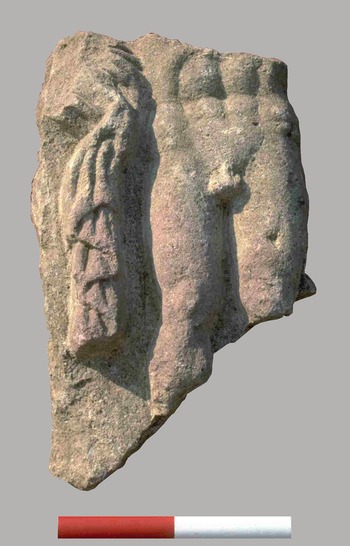


 Open access

