




Impact statement
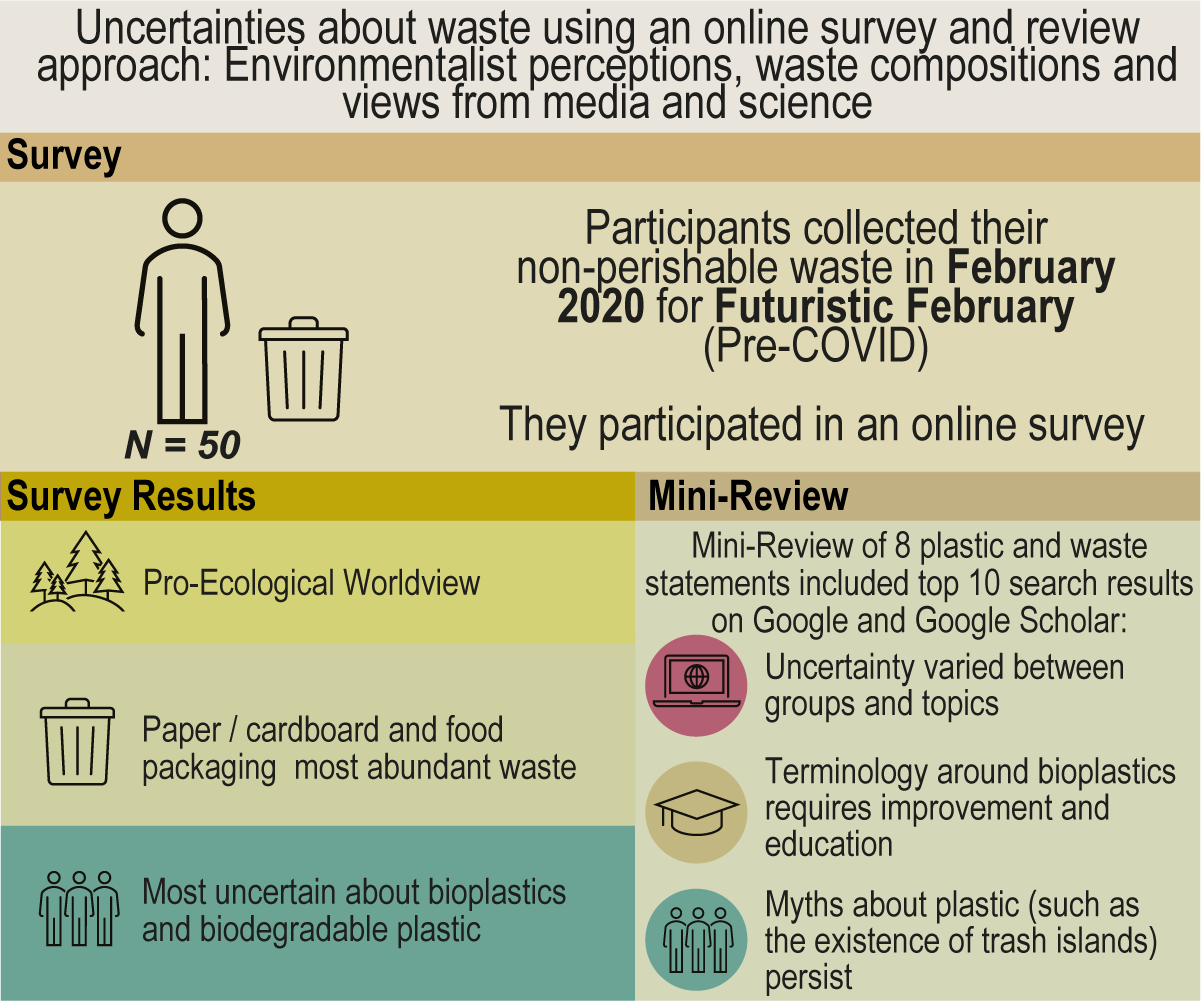
The plastics crisis has far-reaching impacts on human and environmental health. Tackling the plastic and waste problem requires a variety of solutions that are highly dependent on people. How people generate and perceive plastic and waste is exceptionally important when developing policies and educational approaches to tackle the plastic problem. This research aims to further this understanding through an online social media survey. Importantly, this research also addresses the framing of plastic and waste issues in popular media and scholarly articles. Findings from this work will further inform topics of uncertainty among the public that need to be addressed, common sources of waste that require reduction, and potential topics of misinformation or confusion.
Introduction
The overproduction of waste has resulted in increasing pollution to the environment. Waste generation has been associated with negative ecological and human health impacts due to the storage, treatment or burning of waste (Giusti, Reference Giusti2009) as well as the contribution of waste to plastic pollution. It is estimated that 19–23 million metric tons (Mt) of plastic waste were emitted into aquatic environments in 2016, with an anticipated future increase of 53 Mt annually by 2030 associated with increases in plastic production, consumption and improper waste disposal (Borrelle et al., Reference Borrelle, Ringma, Law, Monnahan, Lebreton, McGivern, Murphy, Jambeck, Leonard, Hilleary, Eriksen, Possingham, Frond, Gerber, Polidoro, Tahir, Bernard, Mallos, Barnes and Rochman2020). Waste reduction, in addition to reintegrating and recycling materials, is essential for the protection of human and environmental health. Achieving lasting change in global waste management requires informed decision-making and policy aimed at affecting human behavior.
Plastic pollution, as either macro- (>5 mm) or microplastics (<5 mm), can have both a physical and chemical impact on organisms and their associated environment (Rochman et al., Reference Rochman, Brookson, Bikker, Djuric, Earn, Bucci, Athey, Huntington, McIlwraith, Munno, Frond, Kolomijeca, Erdle, Grbic, Bayoumi, Borrelle, Wu, Santoro, Werbowski, Zhu, Giles, Hamilton, Thaysen, Kaura, Klasios, Ead, Kim, Sherlock, Ho and Hung2019). Plastic pollution can be ingested by organisms or entangle them, resulting in suffocation, death or potential changes in feeding habits (Gall and Thompson, Reference Gall and Thompson2015). Plastics have been detected in a wide range of environments and matrices (Free et al., Reference Free, Jensen, Mason, Eriksen, Williamson and Boldgiv2014; Allen et al., Reference Allen, Allen, Phoenix, Le Roux, Durántez Jiménez, Simonneau, Binet and Galop2019; Ostle et al., Reference Ostle, Thompson, Broughton, Gregory, Wootton and Johns2019; Rillig and Lehmann, Reference Rillig and Lehmann2020; Nelms et al., Reference Nelms, Duncan, Patel, Badola, Bhola, Chakma, Chowdhury, Godley, Haque, Johnson, Khatoon, Kumar, Napper, Niloy, Akter, Badola, Dev, Rawat, Santillo, Sarker, Sharma and Koldewey2021), food and drink (Cox et al., Reference Cox, Covernton, Davies, Dower, Juanes and Dudas2019), aquatic (Munno et al., Reference Munno, Helm, Rochman, George and Jackson2021) and land (Eriksen et al., Reference Eriksen, Lusher, Nixon and Wernery2021) organisms, and have only just begun to be studied in humans (Schwabl et al., Reference Schwabl, Köppel, Königshofer, Bucsics, Trauner, Reiberger and Liebmann2019; Ragusa et al., Reference Ragusa, Svelato, Santacroce, Catalano, Notarstefano, Carnevali, Papa, Rongioletti, Baiocco, Draghi, D’Amore, Rinaldo, Matta and Giorgini2021).
In recent years, plastic pollution has become a large topic of conversation in popular media (Völker et al., Reference Völker, Kramm and Wagner2020). With this increase in popularity, misconceptions and myths, such as that of the “Great Pacific Garbage Patch” (Henderson and Green, Reference Henderson and Green2020), have continued to pervade. Prior work on this topic has noted differences in how risk associated with plastic pollution is communicated in scientific versus media articles (Völker et al., Reference Völker, Kramm and Wagner2020), who may have a different understanding of the current knowledge gaps and uncertainties associated with plastics in the environment. Even within the scientific literature, there have been topical debates on the misperceptions of single-use plastic (Miller, Reference Miller2020; Walker and McKay, Reference Walker and McKay2021) and the priority of climate versus ocean pollution environmental threats (Avery-Gomm et al., Reference Avery-Gomm, Walker, Mallory and Provencher2019; Stafford and Jones, Reference Stafford and Jones2019). However, it is important to further understand the perception and misconceptions that exist around waste and plastic issues to further drive informed decision-making and motivate change. Further adding to this understanding, waste reduction can be supported with characterization of individual waste generation and composition.
Globally, municipal solid waste (MSW) generation exceeds approximately 1,814 million metric tons per year (Karak et al., Reference Karak, Bhagat and Bhattacharyya2012; Kaza et al., Reference Kaza, Yao, Bhada-Tata and Van Woerden2018). Waste generation has been linked to a variety of demographic factors. Prior work has found a positive relationship between waste generation and income (Bandara et al., Reference Bandara, Hettiaratchi, Wirasinghe and Pilapiiya2007; Hoornweg and Bhada-Tata, Reference Hoornweg and Bhada-Tata2012), population density (Johnstone and Labonne, Reference Johnstone and Labonne2004) and degree of urbanization (Johnstone and Labonne, Reference Johnstone and Labonne2004; Hoornweg and Bhada-Tata, Reference Hoornweg and Bhada-Tata2012) and a negative relationship with number of household members (Bandara et al., Reference Bandara, Hettiaratchi, Wirasinghe and Pilapiiya2007). Waste composition is also an important factor in determining methods of waste disposal and reduction. Bandara et al. (Reference Bandara, Hettiaratchi, Wirasinghe and Pilapiiya2007) found that waste composition in Moratuwa, Sri Lanka, was predominantly biodegradable organics or compostables, but other studies have noted variations in composition with location and income (Hoornweg and Bhada-Tata, Reference Hoornweg and Bhada-Tata2012; Ozcan et al., Reference Ozcan, Guvenc, Guvenc and Demir2016). In terms of global MSW composition, food and greens have a negative relationship with a country’s income level, while nonperishable forms of waste, such as paper and cardboard, rubber and leather and plastic show a positive relationship, with all these categories increasing for high-income level countries (Kaza et al., Reference Kaza, Yao, Bhada-Tata and Van Woerden2018). Action toward waste reduction should be implemented on the household level, but levels of individual waste production and perceptions must first be understood and quantified.
Perception of the environment, waste and plastic pollution are all important factors impacting waste minimization, such as reduction and reuse (Pires and Martinho, Reference Pires and Martinho2019). A U.K. case study of household waste management found that predictors of reduction and reuse included environmental values, knowledge and concerned-based variables, whereas recycling is considered normative behavior (Barr, Reference Barr2007). While social norms influence recycling behavior, personal norms have a stronger influence with waste prevention (Barr et al., Reference Barr, Gilg and Ford2001; Bortoleto et al., Reference Bortoleto, Kurisu and Hanaki2012). Barr et al. (Reference Barr, Gilg and Ford2001) found that waste reduction in Exeter, England was more likely in older females with a knowledge of policy, whereas reuse was dictated by perception of task difficulty and whether the individual felt their reuse has a broader impact (Barr et al., Reference Barr, Gilg and Ford2001).
An individual’s environmental behavior is not only influenced by their values toward the environment but is dictated by the indirect relationship between their environmental conscience, awareness of environmental problems, social responsibility and perception of task difficulty (Kollmuss and Agyeman, Reference Kollmuss and Agyeman2002). Pro-environmental consciousness consists of knowledge, values, attitude and emotion toward the environment (Kollmuss and Agyeman, Reference Kollmuss and Agyeman2002). A model by Bortoleto et al. (Reference Bortoleto, Kurisu and Hanaki2012) found that individuals with a stronger environmental conscience were more aware of environmental issues and felt a greater sense of responsibility for their waste production (Bortoleto et al., Reference Bortoleto, Kurisu and Hanaki2012). This sense of responsibility influenced their behavior to reduce their waste and their perception of task difficulty, which has been supported by other studies. A study conducted in Ghana considered prevalent attitudes and behaviors toward single-use plastics, noting a distinct group they denoted as “avoiders.” The avoiders possessed behaviors that reduced usage of single-use plastic and were more likely to avoid or pay extra to avoid single-use plastics (Adam et al., Reference Adam, Walker, Clayton and Carlos Bezerra2021). Similarly, a survey in Canada found the majority of respondents (93.7%) were motivated to reduce their personal single-use plastic packaging footprint with respect to food packaging, primarily due to environmental concerns (Walker et al., Reference Walker, McGuinty, Charlebois and Music2021).
A common way to measure environmental attitudes, in the form of broader environmental worldviews, is the new environmental/ecological paradigm (NEP) (Dunlap, Reference Dunlap2008). This measure can be used to determine the prevailing environmental attitudes in a population and, more-so, explore how these attitudes may relate to the aforementioned behaviors or views on certain topics, such as waste and plastic pollution.
The present research
Importantly, a large focus on waste generation and plastic pollution reduction is on end-of-pipeline measures, such as clean-ups, waste burning and recycling, to name a few. These solutions are partly limited by the availability of data on waste production, behaviors and perceptions. In an effort to add to the social lens of the waste discussion, this work provides a quantitative assessment of a social media challenge aimed at increasing consumer awareness of their nonperishable waste generation. This social media challenge, Futuristic February, directs participants to collect their nonperishable waste for a portion or the entire month of February.
This paper explored the survey data collected from participants in Futuristic February in 2020, with a focus on their: waste composition, perceptions toward waste and plastic pollution issues and environmental worldview using the NEP scale (Dunlap et al., Reference Dunlap, Van Liere, Mertig and Jones2000, p. 200). In addition, we (the authors) conducted a min-review of common statements about waste which are sources of uncertainty or misinformation. Our mini-review consisted of top search results in popular media (Google) and scholarly articles (Google Scholar). The goal of the mini-review was to determine how the different groups (popular media, scholarly articles and our surveyed population) aligned, but also whether popular media and the scientific community are expressing the certainty around these topics differently. To summarize, the current research focused on the following research questions:
-
i) What are the environmental attitudes of Futuristic February participants?
-
ii) What is the primary composition and weight of nonperishable waste produced by Futuristic February participants?
-
iii) How do Futuristic February participants perceive waste and plastic pollution issues?
-
iv) How are waste and plastic pollution issues portrayed in popular media and scholarly articles?
Materials and methods
Participants
At the end of February 2020, an online survey through Qualtrics was distributed to participants in Futuristic February. The survey was distributed to known participants worldwide in Futuristic February through the creator of the event’s Instagram (sustainableduo), in addition to those who were subscribed to newsletters from the Futuristic February campaign.
The survey received 111 responses, 62 of which were 100% complete submissions from either participating groups (households, work) (n = 12) or individuals (n = 50). However, for coherent analysis we chose to explore only individual responses for this analysis (Table 1). Of the 50 respondents, 25 submitted usable data on nonperishable waste weight due to challenges with either obtaining a measurement or disposing of their waste prior to survey completion.
Summary of survey respondents demographic information (n = 50)

Measures
Demographic information
Participants indicated their age, gender, income range, education, race/ethnicity, employment status and country of residence (Table 1). Additional demographic information is depicted in the Supplementary Information.
NEP scale
We included the NEP scale to capture participants’ environmental attitudes. Using 15 items and 5 subscales, it measures to what extent people belief that: (1) the earth’s resources are limited (limits to growth); (2) humans have the right to change and control the natural environment (human domination over nature); (3) humans influence the balance of nature (balance of nature); (4) humans are not excluded from natures restraints (human exemptionalism) and (5) an eco-crisis is possible and caused by humans negative impact on the natural environment (risk of an eco-crisis) (Dunlap et al., Reference Dunlap, Van Liere, Mertig and Jones2000).
Nonperishable waste generation and composition
Participants were asked to select the most commonly occurring waste materials (by number of objects) among five categories (plastic, cardboard and paper, aluminum/steel, glass or other), which had accompanying images to guide selection. Following this, respondents answered an open-ended question on the most common type of waste within this category.
Perception of waste and plastic pollution issues
We asked survey respondents to complete an 11-item series on frequent statements of misinformation or uncertainty pertaining to waste on a 5-point Likert scale, including “Strongly Agree,” “Mildly Agree,” “Unsure,” “Mildly Disagree” and “Strongly Disagree.” These statements spanned topics ranging from ocean trash gyre “islands” to recyclability of plastic.
Mini-review of popular media and scholarly articles
We investigated differences in perception of each of our survey statements in a mini-review of 160 media and journal articles. The goal of this analysis was to determine if there is a gap between how these statements are expressed in scientific literature, popular media and the views expressed in our surveyed population. This analysis attempted to simulate how a participant might search for information on these statement topics on two widely used search engines, one within the scientific community (Google scholar) and one with a broader readership (Google). We determined the degree of uncertainty of each statement on a 3-point Likert scale based on recent literature on each topic published until the end of February 2020 and compared this to recent popular media using the same search terms. Key search terms from each statement were queried through Google scholar and Google. In either case, the first 10 resulting items from each search were scanned for relevance to the statement using keyword searches (Table 2). Based on the content resulting from the keyword search and the general conclusions provided by the article or text, the statement was assigned as “Agree,” “Unsure” or “Disagree.” “Unsure” was chosen when the result returned either conflicting statements or expressed a degree of uncertainty, such as a need for further research on the topic or applicability of an answer to a specific set of conditions. If the statement topic was not addressed as either option, then the next search result was scanned until a total of 10 results were found. In some cases, this required changing the search term to locate more relevant articles. For statements that required investigation of two separate affirmative conditions, such as Statements 7 and 11, search results were split in half between each condition, with five results for each. Three statements (Statements 5, 6 and 10) were excluded from this analysis because they were too broad or required a more in-depth investigation than this analysis provided. The results of this analysis, including the supporting statements taken to justify the uncertainty, can be found in the Supplementary Information.
Waste and plastic pollution issue statements and, when applicable, their relevant search terms used in the scholar and Google mini-review. Note that Statements 5, 6 and 10 were not included in the mini-review

Procedure
Participants gave their informed consent prior to participation. Additional information on adherence to ethical standards for human research can be found in the Supplementary Information. The survey was distributed to participants at the end of the Futuristic February campaign and collected basic demographic information, quantitative and qualitative data on their nonperishable waste, their perception of waste and plastic pollution issues, and their ecological worldview using the NEP scale.
Following basic demographic questions, survey respondents were asked about: nonperishable waste weight and composition, perception and knowledge of waste and plastic pollution issues, and their perception of the relationship between humans and the environment. The survey and its format can be found in the Supplementary Information. Furthermore, we conducted a mini-review within Google and Google scholar to compare participants’ perception about waste and plastic pollution with common narratives in media and current scientific findings.
Data analysis
Data analysis was performed in Microsoft Excel and R Statistical Software (v.4.2.2; R Core Team, 2022) using the likert (v.1.3.5; Bryer and Speerschneider, Reference Bryer and Speerschneider2016), psych (v.2.2.9; Revelle, Reference Revelle2022) and tidyverse (Wickham et al., Reference Wickham, Averick, Bryan, Chang, McGowan, François, Grolemund, Hayes, Henry, Hester, Kuhn, Pedersen, Miller, Bache, Müller, Ooms, Robinson, Seidel, Spinu, Takahashi, Vaughan, Wilke, Woo and Yutani2019) packages. All R codes used for this analysis are given in the Supplementary Information. Open-ended responses to the most commonly occurring waste item within their chosen category were grouped into 14 categories based on commonly mentioned waste items arising from written responses (Supplementary Table S2). Comparison between the mini-review results and grouped participant results was done on a 3-point Likert scale. Participant results were assigned to “Agree” if they were either “Strongly Agree” or “Mildly Agree” and results were assigned to “Disagree” if they were either “Strongly Disagree” or “Mildly Disagree.” However, this adjustment to a 3-point Likert scale was only for comparison with the mini-review and is left on the 5-point scale otherwise.
Results
NEP scale
Respondents ecological worldview was high (M = 4.32, SD = 0.88) and the internal reliability of the 15 NEP scale items in our study was acceptable (Cronbach’s alpha = 0.68) and mirrored the average Cronbach’s alpha among NEP studies worldwide (Hawcroft and Milfont, Reference Hawcroft and Milfont2010). A summary of the NEP results across the different facets from highest to lowest can be found in Table 3. On average, ‘risk of an ecocrisis’, ‘human domination over nature’ and ‘balance of nature’ have the highest scores with lowest spreads whereas ‘human exemptionalism’ and ‘limits to growth’ have the lowest score with bigger spreads, indicating that our respondents strongly believe in a risk of an ecocrisis, mildly agree that humans dominate over nature and that this impacts nature, mildly agree that humans are not exempt from natures constraints, and that nature has limits of growth.
Ecological worldview facets among futuristic February participants (n = 50)

Note. The numbers in parenthesis indicate the NEP item. SD = standard deviation.
Survey responses to the presented NEP items show that almost all answers are skewed, meaning that the majority of our participants strongly agreed or strongly disagreed (Figure 1). All of them agreed that ‘humans are severely abusing the environment’ and the greater majority expressed that humans are ‘subject of the laws of nature’ (98%), that our interaction with nature ‘causes disastrous consequences’ (98%) and if it continues like that, we ‘will soon experience a major ecological catastrophe’ (98%). Moreover, most of them did not believe that ‘humans were meant to rule over the rest of nature’ (94%), that we will eventually learn enough about it to ‘be able to control it’ (74%) and that the ecological crisis had been ‘greatly exaggerated’ (88%). However, 30% of the respondents were unsure about ‘human ingenuity will ensure that we do not make the earth unlivable’ but overall leaning more toward disagreeing with that statement (42%). A detailed overview of the means and standard deviations for each statement can be found in Supplementary Table S1.
New Environmental Paradigm (NEP) scale results in percentage of agreement. Note that agreement with the odd numbered items and disagreement with the even numbered items display a pro ecological worldview response.

Nonperishable waste generation and composition
Nonperishable waste generation was low among respondents (M = 0.157 kg per person per day, SD = 0.199 kg per person per day, n = 25) and waste composition was variable. Nonperishable waste weight varied by orders of magnitude, with the minimum waste accumulation per day weighing approximately 0.061 kg/day and the highest at 2.069 kg/day. The most commonly occurring waste for each participant by visual estimate was cardboard and paper (66%), followed by plastic (18%), aluminum and steel (10%) and glass (6%) (Figure 2). The five top most common waste types within all categories included: food packaging, mail, beverage container, boxes and takeout boxes.
Stacked bar chart showing the fraction of responses (n = 50) for the most commonly occurring nonperishable waste (by number of objects, based on visual estimate) from the participant’s nonperishable waste. Each stacked bar shows the relative contribution of the most frequently occurring waste from within that category. Cardboard and paper were the most common category, while food packaging was the most common waste type across categories.

Perception of waste and plastic pollution issues
Survey responses (n = 50) to the provided statements had varying levels of agreement and uncertainty based on responses on a Likert scale. Responses indicate that the two statements related to bioplastics had the greatest percentage of unsure or uncertain responses (44% and 30%), followed by statements on glass recycling (24%) and ocean trash gyres (12%) (Figure 3). Only three statements had no unsure responses, with the statement on microplastic toxicity obtaining 100% mildly or strongly agreed responses. However, 6 of the 11 statements received over 80% agree responses. In contrast, the statement “All plastics are equally recyclable” had 98% mildly or strongly disagree responses, which is 44% higher than the next highest rated statement.
Likert plot of the percentage of responses (n = 50) to different statements on waste management and plastic pollution that are potential areas of misinformation or uncertainty. Statements are listed in descending order of uncertainty based on percentage of “unsure” responses.

Mini-review of plastic and waste issue statements
The mini-review results were compared to participant responses on a 3-point Likert scale (Figure 4). Agreement between the three populations (scholar, Google and participants) varied. There was no consistent trend across topics that participant results were more in line with either the scholar or Google review, but instead were topic specific. Both scholar and Google results disagreed with the statement that ocean trash gyres “have trash islands that can be seen from space,” while participants generally agreed with the statement (84% strongly or mildly agreed). However, scholar, Google and participants generally disagreed that “All plastics are equally recyclable.” The statements on bioplastic had the highest percentage of “unsure” responses from participants which is somewhat consistent with Google and scholar results, which were generally unsure or in disagreement on these topics. Uncertainty in the review was typically attributed to the need for a topic to have further research or conflicting statements present in the cited works.
Box and whisker plots showing participant responses normalized to a 3-point rating scale for comparison with our mini-review findings on both Google and Google Scholar (Scholar). Group agreement and uncertainty on statements differs depending on the topic. Note that statements including separate conditions (glass or paper and toxicity to humans and animals) had search results split between each affirmative statement.

Discussion
NEP scale
As recommended by previous meta-analysis (Hawcroft and Milfont, Reference Hawcroft and Milfont2010), we reported all used NEP items, the mean, the standard deviation and its internal reliability (see section title “NEP scale”) alongside the sample characteristics to improve the interpretation of our results. A meta-analysis (Hawcroft and Milfont, Reference Hawcroft and Milfont2010) showed that environmentalists score higher on the NEP scale in comparison with other representative samples. In a sample of 13 studies investigating environmentalist environmental attitudes, NEP mean scores between 3.44 and 4.70 were reported (Hawcroft and Milfont, Reference Hawcroft and Milfont2010). Moreover, prior studies concluded that women tend to have a higher worldview than men (Hawcroft and Milfont, Reference Hawcroft and Milfont2010), which is consistent with the largely female demographic (92%) represented in our survey population. Additionally, past studies found a ‘ceiling effect’ suggesting that environmentalists tend to strongly agree or disagree with almost all NEP items (Wiidegren, Reference Wiidegren1998). Both findings are in line with our study results as almost all responses to the NEP statements were skewed toward agree or disagree with an overall mean of 4.23 (SD = 0.88) which confirms our prior assumption that participants taking part in a sustainable and reflective social media challenge about waste could fall into the group of environmentalists – at least when it comes to their ecological worldview and attitudes.
Nonperishable waste generation and composition
The nonperishable waste generation and composition of our participants was predominantly paper and cardboard, with general waste items across categories derived from food packaging. This is consistent with other reports, such as What a Waste 2.0 (Kaza et al., Reference Kaza, Yao, Bhada-Tata and Van Woerden2018) and UNEP’s Global Waste Management Outlook (Wilson et al., Reference Wilson, Rodic-Wiersma, Modak, Soós, Rogero, Velis, Iyer and Simonett2015), though there are slight variations depending on income level and chosen categories. The paper/cardboard category in these reports tends to increase with higher income populations, while plastic and paper categories are almost equal or exceeding in lower income populations. However, in terms of waste management, cardboard and paper composed over half the recycling in 2018 in the United States (EPA, 2020), where the majority (70%) of participants reside. The second highest waste category, plastic, has more worrying waste management implications given its low recycling rate (9% global (OECD, 2022), 5–6% in the United States (Beyond Plastics and The Last Beach Cleanup, 2022)) and likelihood of waste mismanagement, resulting in plastic pollution.
The predominance of plastic packaging in various forms is consistent with global plastic production, with packaging comprising 40% of the plastic produced (OECD, 2022). Packaging in the form of take-out or take-away also experienced an increase during the COVID-19 pandemic (Janairo, Reference Janairo2021; Parashar and Hait, Reference Parashar and Hait2021), increasing the contribution of these items to the overall waste stream and, possibly, into litter and the environment. Plastic food packaging, in particular, has been found to make up the largest portion of litter in most environmental compartments, excluding marine litter (Morales-Caselles et al., Reference Morales-Caselles, Viejo, Martí, González-Fernández, Pragnell-Raasch, González-Gordillo, Montero, Arroyo, Hanke, Salvo, Basurko, Mallos, Lebreton, Echevarría, van Emmerik, Duarte, Gálvez, van Sebille, Galgani, García, Ross, Bartual, Ioakeimidis, Markalain, Isobe and Cózar2021). Even if some of these waste items are recyclable, the decreasing recycling rates of plastic with the continued rise in production presents worrying implications for environmental impacts.
The subset of participants (n = 25) that included the weight of their nonperishable waste had weights below or exceeding the worldwide average of 0.74 kg per person per day (Kaza et al., Reference Kaza, Yao, Bhada-Tata and Van Woerden2018), though average participant waste production was well below this value (0.157 kg per person per day). However, the worldwide average includes other perishable categories of waste which were not measured in this study. Participants’ average waste production is below half the United States average in 2018 (2.223 kg per person per day or 1.896 kg per person per day accounting for the exclusion of composted or food management material) (EPA, 2020). The highest waste production from a participant was 0.938 kg per day and coincides with the selection of glass as the most common waste category, which likely contributed to this increased weight.
There are solutions on a global, local and individual scale that can contribute to the overall reduction in waste production that were most common in our surveyed population. Individuals can choose to refuse or reduce food or drink packaging when there are reusable alternatives available, such as the use of reusable bags or bottles. Local initiatives, such as reusable takeout systems can help make these options more widely accessible and available. Additionally, opting out of junk mail and choosing paperless transaction options can further reduce cardboard and paper waste. Policy aimed at reducing single-use items, such as plastic bags (Xanthos and Walker, Reference Xanthos and Walker2017), can also provide the motivation to find reusable alternatives, especially when combined with a fine. Further study should consider the behavioral component of implementing bans on packaging and any unintended or negative effects of these policy changes or potential material substitutions. There is uncertainty in some of these solutions, and options should be considered with regard to other life cycle impacts and the community served, especially if waste management options are limited in a certain area.
Perception of waste and plastic pollution issues: Participant survey and mini-review
Three of our plastic and waste statements were not considered in our mini-review due to their broad nature and difficulty in identifying concrete answers due to their reliance on opinion or rating of various environmental threats. These were Statements 5, 6 and 10 (Table 2), which focused on reduction of our overall environmental footprint and the threat plastic pollution or waste poses to the environment or the oceans, respectively. The majority of participants (at or exceeding 88%) either strongly or mildly agreed with these statements, indicating that the surveyed population places a great emphasis on the importance of addressing the environmental challenge of waste and plastic pollution, potentially over other issues of concern. This is consistent with the surveyed population’s pro-ecological worldview and participation in a social media challenge focused on waste. However, this perspective brings an important issue on drawing comparisons between co-occurring environmental issues. These statements were included since they are often the subject of debate in literature (Miller, Reference Miller2020; Walker and McKay, Reference Walker and McKay2021) and the priority of climate versus ocean pollution environmental threats (Avery-Gomm et al., Reference Avery-Gomm, Walker, Mallory and Provencher2019; Stafford and Jones, Reference Stafford and Jones2019) and the issue of climate change is often rated or scaled against that of plastic pollution, drawing a false comparison that these issues are considered separate concerns and may be a distraction from one another. Recent work has shown that the climate and plastic crises are intricately connected (Zhu, Reference Zhu2021). We suggest that further educational campaigns on material usage, including waste and plastic, draw attention to the interconnectedness of these environmental issues. This would lend additional strength to tackling either problem.
One proposed method to address the plastic problem is material substitution, such as replacing plastic packaging with alternatives like glass or paper. The majority of participants (98%) agreed that glass and paper are better alternatives to plastic. We are uncertain if this perception contributed to the dominance of cardboard and paper packaging in participants’ waste streams. Survey responses more closely aligned with Google results over scholarly articles, which presented evidence against glass or paper from life cycle assessment studies (Humbert et al., Reference Humbert, Loerincik, Rossi, Margni and Jolliet2009a; Humbert et al., Reference Humbert, Rossi, Margni, Jolliet and Loerincik2009b; Garfí et al., Reference Garfí, Cadena, Sanchez-Ramos and Ferrer2016; Rana, Reference Rana2020) or uncertainty given the evaluated environmental impacts (Lewis et al., Reference Lewis, Verghese and Fitzpatrick2010) or disposal method (Pasqualino et al., Reference Pasqualino, Meneses and Castells2011). Search results on Google largely agreed with this statement, citing the biodegradability of paper (Guarro Casas, 2022) and a reduction in exposure to hazardous chemicals (Seas and Straws, 2018a). The weight of glass packaging is often considered a detriment due to increased emissions from transport (Humbert et al., Reference Humbert, Rossi, Margni, Jolliet and Loerincik2009b). However, it is important to note that life cycle assessments often do not consider certain end-of-life impacts, such as pollution, littering and environmental persistence, especially with regard to plastic (Hann, Reference Hann2020). Moreover, these impacts can be lessened when materials are reused or recycled (Pires and Martinho, Reference Pires and Martinho2019; Zhang et al., Reference Zhang, Hu, Di Maio, Sprecher, Yang and Tukker2022).
Participants were split on the statement “Glass is infinitely recycled in recycling facilities,” possibly owing to the differences in the recycling of glass in their local recycling infrastructure. Our scholarly article review disagreed with this statement due to material loss from the recycling process (Larsen et al., Reference Larsen, Merrild and Christensen2009), potential contamination and quality differences (Bonifazi and Serranti, Reference Bonifazi and Serranti2006; Dyer, Reference Dyer, Worrell and Reuter2014; Testa et al., Reference Testa, Malandrino, Sessa, Supino and Sica2017; Lebullenger and Mear, Reference Lebullenger, Mear, Musgraves, Hu and Calvez2019) or systematic challenges at recycling facilities (Roy, Reference Roy, Landreth and Rebers1997; Lebullenger and Mear, Reference Lebullenger, Mear, Musgraves, Hu and Calvez2019). However, popular media or website search results were split on this statement, which may add to the confusion communicated to the public. In the United States, the recycling of glass is challenged by issues presented by the single stream recycling system (Jacoby, Reference Jacoby2019) which may introduce issues with quality control and contamination. However, recycling rates for glass are higher in other countries, such as Italy (Testa et al., Reference Testa, Malandrino, Sessa, Supino and Sica2017). Policy efforts to increase source separation of glass by expanding bottle bills, such as the one introduced in the state of New York (Cook et al., Reference Cook, Glick and Galef2022), could increase recycling of glass but also require further effort on the part of individuals to source separate glass and bring the glass to a designated collection point. Since glass reuse and recycling has an overall lower life cycle impact, it is recommended that reuse and recycling of glass is prioritized where possible.
Similar to glass, the quality and type of plastic material can dictate its recyclability. 98% of participants disagreed with the statement that “All plastics are equally recyclable,” which was consistent with both our Google and scholar review. This statement is falsifiable, given that the complexity of various plastics (color, polymer type additives) can influence recyclability (Faraca and Astrup, Reference Faraca and Astrup2019). Although this influences the recycling rates of various plastic resins, plastics are still downcycled during their lifespan. This statement was the only one that had complete alignment between survey participants and review results. Since recycling is dependent on this knowledge, it may be a more commonly educated topic, explaining the consistent alignment across search results.
An alternative to reuse and recycling is the composting of materials. The majority of participants (80%) agreed that “Single-use items are better if they can be composted.” This was consistent with review results, which generally favored the added benefit of soil amendment production with composting of single-use items (Castro-Aguirre et al., Reference Castro-Aguirre, Auras, Selke, Rubino and Marsh2018; Eco Cycle, 2022; Narayan et al., Reference Narayan, Balakrishnan and Thiagarajan2007). However, it is important that items marketed as compostable are properly tested for potential introduction of either particles or other byproducts into soil amendments. Moreover, while composting may be favorable to landfilling of materials, materials should be conserved with reduction or reuse when possible, to prevent regrettable substitution of one material with another.
Statement topics related to bioplastic or biodegradable plastic had the highest uncertainty among survey respondents. The statement “Bioplastics are all biodegradable” is largely aimed at assessing knowledge of the definition of “Bioplastic,” which is often loosely defined. The labeling and disparate terminology and information regarding bioplastic or biodegradable plastic may contribute to this uncertainty or confusion. According to the European Bioplastics definition (European Bioplastics, 2022), bioplastics can be either biobased, biodegradable or both. Despite the bioplastics statement having the highest uncertainty in responses, 54% of respondents recognized that bioplastics are not all biodegradable. Even in our mini-review, 2 out of 10 results in both scholarly articles and Google did not adequately differentiate between bioplastics and biodegradable plastics. The adoption of a consistent terminology in both popular media and scientific articles is necessary going forward.
However, there was an increase in respondents who agreed (16%) that “Biodegradable plastics are able to break down in the environment.” This statement is either uncertain or false, depending on the conditions and the type of bioplastic, and points to issues in the communication of information and marketing regarding biodegradable plastic (Filho et al., Reference Filho, Salvia, Bonoli, Saari, Voronova, Klõga, Kumbhar, Olszewski, De Quevedo and Barbir2021). These results are consistent with findings in an Australian survey, which found that 58% of respondents were unsure if bioplastics have any negative environmental impacts (Dilkes-Hoffman et al., Reference Dilkes-Hoffman, Ashworth, Laycock, Pratt and Lant2019). It is possible that this uncertainty arises from a lack of exposure to bioplastics or biodegradable plastics. In the United States alone, there are 4,700 industrial composting facilities (Lewis, Reference Lewis2021), some of which may not accept bioplastics (Goldstein, Reference Goldstein2019). If bioplastic is to increase in popularity and become a stable portion of the waste stream, there will need to be an increase in education surrounding its proper disposal and use. All scholarly articles were uncertain concerning this statement, largely due to the influence of environmental conditions on biodegradability (Scott, Reference Scott1990; Lambert and Wagner, Reference Lambert and Wagner2017; Rujnić-Sokele and Pilipović, Reference Rujnić-Sokele and Pilipović2017; Kjeldsen et al., Reference Kjeldsen, Price, Lilley, Guzniczak and Archer2018; Luyt and Malik, Reference Luyt, Malik and Al-Salem2019; Havstad, Reference Havstad and Letcher2020). If it is a widely held belief that biodegradable plastics break down in any environment, this may lead to increases in littering of certain bioplastics (SGA, 2009).
One myth that has played some role in public perception of the plastic pollution issue is the existence of “trash islands” in the ocean arising from the convergence of plastic waste in gyres. This myth has pervaded popular media and has possibly even been instrumental in increasing awareness and response to the plastic pollution issue. This statement is falsifiable with multiple parts of this statement, including the existence of trash islands or that the ocean trash gyres can be seen from space. Most survey participants (86%) agreed, to some extent, that ocean trash gyres have trash islands that can be seen from space. However, both Google and scholar mini-review results consistently agreed that this statement is false despite the general consensus among participants, indicating that this myth has persisted despite efforts to correct it. Instead, sources described the ocean trash gyres as a plastic soup (Wang, Reference Wang2015; Gabrys, Reference Gabrys2016; Tischleder, Reference Tischleder2016; Seas and Straws, 2018b) rather than an island. Although this image is less striking than that of a plastic island, the issue of plastics has enough motivating imagery to lend itself to an increase in awareness of this issue (Luo et al., Reference Luo, Douglas, Pahl and Zhao2022).
The statement on microplastic toxicity to humans and animals is the only statement that received 100% mild or strong agreement among our survey respondents. This is generally consistent with the environmentalist perspective that is prevalent within our surveyed group, which had majority agreement that waste and plastic pollution issues are highly concerning issues and had a generally pro-ecological worldview. By comparison, mini-review results were either uncertain or in agreement with this statement, depending on whether the article in question addressed toxicity in biota or in humans. We split the mini-review between articles addressing either biota or humans, or both. Concerning biota, scholarly articles were more definitive in addressing various types of toxicity already discovered in biota (Lu et al., Reference Lu, Luo, Zhao, Cai, Fu and Jin2019; Verla et al., Reference Verla, Enyoh, Verla and Nwarnorh2019; Trestrail et al., Reference Trestrail, Walpitagama, Hedges, Truskewycz, Miranda, Wlodkowic, Shimeta and Nugegoda2020), while Google results were more uncertain. This may be due to an uncertainty in how “toxicity” is defined or considered. In our review, we considered any toxicity endpoints mentioned by the authors. However, only one result in the mini-review, from Google, agreed that microplastics are toxic to humans (CIEL, 2022). Due to the difficulty in exploring these results concurrently, we suggest separating these statements in the future. We hypothesize that including articles that only address toxicity in both groups (biota and humans) would result in a prevalence of uncertain results due to the lack of direct evidence for microplastic toxicity in humans, though analogous results in other studies exist (Wright and Borm, Reference Wright and Borm2022).
Limitations and future research directions
While discussing the assets of the current research, we also need to note some gaps and avenues for future research. Therefore, we want to acknowledge that even though we identified our sample as an environmentalist sample, the respondents themselves were not able to self-identify as such within the survey. However, as we previously showcased, the responses of our participants to the NEP scale are similar to the ones of other environmentalist samples. Moreover, as we administered the survey after the social media challenge it could be that the participants took part in the challenge because they have a high ecological worldview or that taking part in the challenge impacted their worldview. Therefore, we suggest for future research with similar endeavors to a) add an item in which participants can self-identify as environmentalists and b) apply a pretest–posttest design, together with a control condition, to explore if views change by taking part in a sustainable challenge about waste, such as in Heidbreder et al. (Reference Heidbreder, Steinhorst and Schmitt2020).
There are also limitations in participants evaluating their own generation of waste. In this survey, participants chose their most common waste visually by the most common number of items. We were also only able to obtain data on the total weight of nonperishable waste from half of the participants, since participants were either unable to weigh their collected waste or had already disposed of it prior to completion of the study.
The viewpoints expressed in this survey are biased toward a particular population of environmentally minded individuals and conclusions are limited by the smaller sample size (n = 50). We found that the majority of participants were White/Caucasian (82%), female (92%) and resided in the United States (70%). This may be a result of the reach of the Futuristic February campaign or the survey, as well as potential influences of gender on environmental participation or social media. Other research and media has noted the potential influence of gender on performance of pro-environmental behaviors (Hunt, Reference Hunt2020; Swim et al., Reference Swim, Gillis and Hamaty2020), which may have influenced either participation in the social media campaign or survey.
Conclusion
This work considered the waste generation and perceptions of participants in a social media campaign, Futuristic February, which is aimed at raising awareness of individual waste production. Our sample (n = 50) scored high on the NEP scale, indicating a pro-ecological worldview consistent with an environmentalist population (Hawcroft and Milfont, Reference Hawcroft and Milfont2010). Nonperishable waste weights were collected from a subset of participants (n = 25) and the average was low (M = 0.157 kg per person per day) compared to global production. Nonperishable waste largely consisted of cardboard and paper waste, specifically food packaging. We offer various means with which individuals can approach waste reduction in waste categories common to our survey participants, including the reduction of unnecessary waste or material use, reuse of often disposed of items and the implementation of policies and programs to promote circular principles.
Participants’ perceptions of waste and plastic issues and our mini-review of these issues show that the availability of accurate information and educational materials is important to implementation of sustainable waste practices. This includes improving the description and labeling of biodegradable plastics and bioplastics, which were topics of higher uncertainty in our survey results. We also found that certain myths about plastic, including the existence of trash islands in the ocean gyres, have persisted despite popular search results providing majority accurate information on the topic.
Open peer review
To view the open peer review materials for this article, please visit http://doi.org/10.1017/plc.2024.4.
Supplementary material
The supplementary material for this article can be found at http://doi.org/10.1017/plc.2024.4.
Data availability statement
All associated data for this study is included.
Acknowledgments
The authors would like to thank Charles Driscoll, Rebecca Schewe and Win Cowger for their assistance that helped to improve this manuscript.
Author contribution
Laura Markley: Conceptualization; data curation; formal analysis; investigation; methodology; project administration; visualization; writing – original draft, review and editing.
Maja Grünzner: Data curation; formal analysis; investigation; methodology; validation; visualization; writing – original draft, review and editing.
Tony Walker: Investigation; methodology; validation; writing – review and editing.
Financial support
L.M. received funding from a NSF NRT award (Grant Award No. 1449617), a University fellowship and teaching assistantship through Syracuse University, and the Wen-Hsiung and Kuan-Ming Li Graduate Fellowship.
M.G. received funding from the European Union’s Horizon 2020 research and innovation program under Marie Skłodowska-Curie grant agreement No 860720.
Competing interest
The authors declare no competing interests exist.
Ethics statement
This work received Institutional Review Board exemption (#20-054) at Syracuse University on February 28, 2020.


 Open access


Comments
Dear Editorial Board,
My co-authors and I are submitting our manuscript ‘Uncertainties about waste using an online survey and review approach: Environmentalist perceptions, waste compositions and views from media and science’ for consideration in your journal Cambridge Prisms: Plastics.
Recent years have seen an increasing concern for waste generation and mismanagement, especially as it relates to plastic pollution in the environment. It is imperative that we address these growing concerns with informed decision making and policy aimed at affecting human behavior. However, individual waste production and perception must first be understood and quantified.
In this paper, we provide a quantitative assessment of a social media challenge, called Futuristic February, aimed at increasing consumer awareness of their non-perishable waste generation. We collected survey data from participants on their environmental worldview, waste composition, and perceptions toward waste and plastic pollution issues. In addition, we conducted a mini-review aimed at determining the portrayal of plastic and waste topics in popular media and scholarly articles. We show further evidence of the prevalence of food packaging in non-perishable waste using survey data. We also show that, despite a pro-environmental viewpoint, participants were uncertain on statements related to bioplastics or biodegradable plastics. Conversely, uncertainty for topics of misinformation (the existence of “trash islands”) or continued research (microplastic toxicity) were low.
This research aligns well with the aims and scopes of Cambridge Prisms: Plastics because it improves on our understanding of the nexus of people and plastic, including perceptions and waste generation. Moreover, the additional mini-review component of our manuscript provides valuable information on how solid waste issues are portrayed in popular media and scholarly research, which can further inform educational campaigns and public communication efforts surrounding plastic waste and usage. Our results will provide input to stakeholders to address these waste management issues going forward.
We are not aware of any potential competing interests. Ethics Approval in the form of an exemption from regulation was received on February 28, 2020 from the Syracuse University Institutional Review Board (registration no. 20-054). Before responding to the survey, all respondents were informed about the study aims, and they gave consent to participate voluntarily in the study. Moreover, we confirm that all authors have approved the manuscript for submission.
We look forward to hearing from you in due course.
Yours sincerely,
Laura Markley
Corresponding Author
lamarkle@syr.edu