

Autism is characterised by differences in social communication and interaction alongside restricted and repetitive behaviours, with varying levels of support needs (Hirota & King, Reference Hirota and King2023; Nielsen et al., Reference Nielsen, Nassar, Boulton, Guastella and Lain2024). Prevalence has increased in recent decades, likely reflecting improved awareness and diagnostic practices (Zeidan et al., Reference Zeidan, Fombonne, Scorah, Ibrahim, Durkin, Saxena, Yusuf, Shih and Elsabbagh2022). Current estimates are that approximately 2.3% of 8-year-olds and 2.2% of adults in the United States live with autism (Hirota & King, Reference Hirota and King2023). In Australia, the prevalence in New South Wales (Australia’s most populous state) has been estimated to be 1.3% at age 12, with greater prevalence among males (2.0%) than females (0.5%; Nielsen et al., Reference Nielsen, Nassar, Boulton, Guastella and Lain2024).
Females are diagnosed less frequently and typically later than males, with the disparity attributed to differences in presentation. Females are more likely to mask social difficulties (Tierney et al., Reference Tierney, Burns and Kilbey2016), demonstrate stronger early language skills (Lopez-Espejo et al., Reference Lopez-Espejo, Nuñez, Saez, Ruz, Moscoso and Vives2025), and exhibit fewer autism-associated externalising behaviours (Sanchez et al., Reference Sanchez, Bullen, Zajic, McIntyre and Mundy2024). In addition to delaying diagnosis, these factors can exacerbate the challenges that females with autism experience in school contexts.
A growing body of research highlights that educational environments often fail to recognise or adequately support females with autism (e.g., Jarman & Rayner, Reference Jarman and Rayner2015; Tomlinson et al., Reference Tomlinson, Bond and Hebron2022). Teachers frequently lack awareness of gender-specific presentations, so females with autism may experience unmet needs that negatively affect their wellbeing.
This study extends the literature that has mainly focused on adolescents by examining younger females (7–14 years), providing insight into earlier developmental stages and adding to calls for earlier identification (e.g., Lopez-Espejo et al., Reference Lopez-Espejo, Nuñez, Saez, Ruz, Moscoso and Vives2025) and female-specific supports (e.g., Wright et al., Reference Wright, Courchesne, Pickles, Bedford, Duku, Kerns, Bennett, Georgiades, Hill, Richard, Sharp, Smith, Vaillancourt, Zaidman-Zait, Zwaigenbaum, Szatmari, Elsabbagh and Team2023). Furthermore, although previous research has suggested that females with autism may be vulnerable to eating disorders, this issue has not been examined in the context of their experiences with school. In addition, this study points to connections among social-, sensory-, change-, academic-, and food-related issues experienced by females with autism, linking them to overall wellbeing.
In this article we use the currently accepted term of autism, except when citing articles that use a different, possibly outdated, term, such as Asperger syndrome. Consistent with this, we refer to students with autism unless citing literature that uses different phrasing.
The specific research question that guided this study was as follows: How do parents of young females (aged 7–14 years) with autism perceive their daughters’ experience of school in terms of their social and emotional wellbeing?
Literature Review
School can be a challenging place for students with autism (e.g., Hodges et al., Reference Hodges, Joosten, Bourke-Taylor and Cordier2020), whose atypical reactions to changes in routine (Jarman et al., Reference Jarman, Ollington, Rayner and Beswick2015) and sensory processing (Jones et al., Reference Jones, Hanley and Riby2020), as well as their difficulties relating to teachers and peers (Hamilton & Roberts, Reference Hamilton and Roberts2025) negatively impact their experiences of school and hence their wellbeing in the school context.
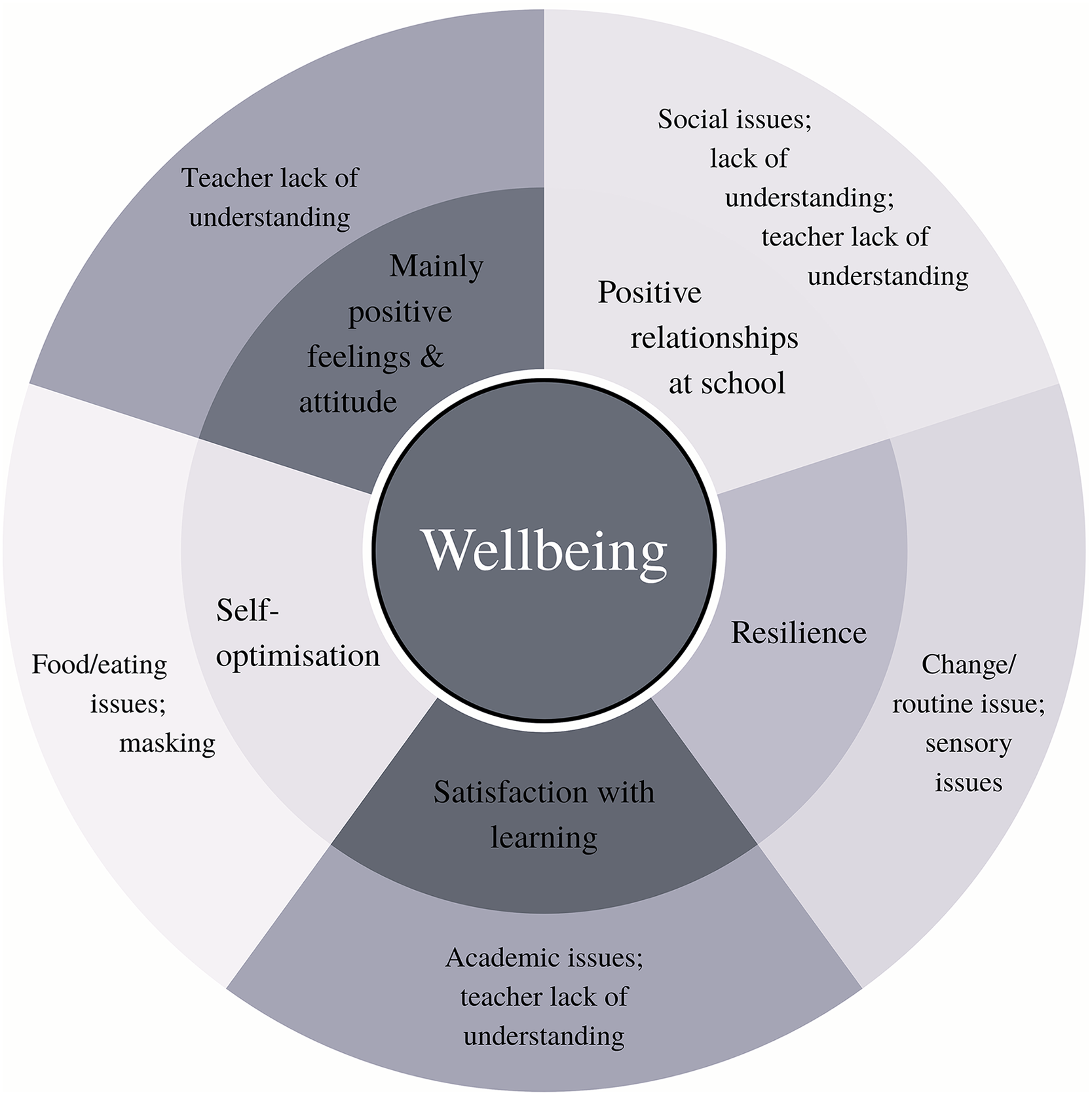
For Noble et al. (Reference Noble, McGrath, Wyatt, Carbines and Robb2008), ‘Student wellbeing is a sustainable state characterised by predominantly positive feelings and attitude, positive relationships at school, resilience, self-optimisation and a high level of satisfaction with learning experiences’ (p. 9). This definition includes both social and emotional aspects of wellbeing at school and thus provided a useful frame for our research. As shown in Figure 1, challenges encountered at school by students with autism represented in the literature and identified in our data (outer circle) are closely related to the aspects of wellbeing (inner circle) enunciated by Noble et al. Several of the challenges included in the outer circle of Figure 1 are listed in relation to more than one aspect of wellbeing. This highlights the interconnection between the aspects of wellbeing and the challenges that females with autism encounter.
Aspects of Wellbeing (Noble et al., Reference Noble, McGrath, Wyatt, Carbines and Robb2008) and Themes Identified in the Current Study.
We review the research on the school experiences of female students with autism in relation to each aspect of wellbeing as identified by Noble et al. (Reference Noble, McGrath, Wyatt, Carbines and Robb2008), pointing, where relevant, to differences from males with autism and neurotypical peers. We conclude with a discussion of the use of parent reports in research involving students, with children, and with adolescents with autism.
Positive Relationships at School
Forming and maintaining friendships is a central difficulty for females with autism (Myles et al., Reference Myles, Boyle and Richards2019; Tierney et al., Reference Tierney, Burns and Kilbey2016). Despite strong motivation for social connection, they frequently experience anxiety (Myles et al., Reference Myles, Boyle and Richards2019; Wright et al., Reference Wright, Courchesne, Pickles, Bedford, Duku, Kerns, Bennett, Georgiades, Hill, Richard, Sharp, Smith, Vaillancourt, Zaidman-Zait, Zwaigenbaum, Szatmari, Elsabbagh and Team2023), rejection, and social exhaustion. Bullying (Cook et al., Reference Cook, Ogden and Winstone2018; Mademtzi et al., Reference Mademtzi, Singh, Shic and Koenig2018) — often covert in nature (e.g., exclusion, gossip; Cridland et al., Reference Cridland, Jones, Caputi and Magee2014) — is common and difficult for teachers to detect.
Although females with autism may exhibit fewer externalised behaviours than males (e.g., Greenlee et al., Reference Greenlee, Winter and Marcovici2020; Sedgewick et al., Reference Sedgewick, Hill and Pellicano2018), females with autism who attribute the peer victimisation or bullying that they experience to factors internal to themselves are prone to negative emotions, anxiety, and maladaptive coping mechanisms (Greenlee et al., Reference Greenlee, Winter and Marcovici2020; Tierney et al., Reference Tierney, Burns and Kilbey2016), and, in some cases, self-harm (Tierney et al., Reference Tierney, Burns and Kilbey2016). Teacher understanding plays a critical role in setting the tone for acceptance by showing respect, empathy, and liking for the child with Asperger syndrome (Sciutto et al., Reference Sciutto, Richwine, Mentrikoski and Niedzwiecki2012). Where awareness is limited, students may be mischaracterised as disengaged or problematic (e.g., Milner et al., Reference Milner, McIntosh, Colvert and Happé2019). Hamilton and Roberts (Reference Hamilton and Roberts2025) reported that some of the nine females with autism aged 11–16 years in their study believed that similar externalised behaviours by males and females were treated differently by teachers, with males receiving greater lenience. Hamilton and Roberts (Reference Hamilton and Roberts2025) attributed the differences to the interaction between gender stereotypes concerning appropriate behaviour and presentations of autism. Other females with autism who did not have externalised presentations felt unseen and wanted teachers to recognise and understand their experiences and needs (Hamilton & Roberts, Reference Hamilton and Roberts2025).
Recent studies (e.g., Grove et al., Reference Grove, Clapham, Moodie, Gurrin and Hall2025; Hamilton & Roberts, Reference Hamilton and Roberts2025) have examined the role of autistic identity in the experiences of females with autism. Although some females with autism want to embrace and maintain their autistic identity, doing so can come at the cost of social difficulties. In addition, behavioural support for females with autism provided by parents and teachers often aims to help females with autism behave similarly to their neurotypical peers, which, although well meaning, risks reinforcing feelings of being pathologically different (Hamilton & Roberts, Reference Hamilton and Roberts2025).
Resilience
Resilience is the ability both to bounce back to a similar (or higher) level of emotional wellbeing following negative events and experiences and to respond adaptively to difficulties (Noble et al., Reference Noble, McGrath, Wyatt, Carbines and Robb2008). It involves individual capacities and is also a function of the physical and psychosocial environment in which the presence of supportive adults is crucial (Szatmari, Reference Szatmari2018). It is notable that little work has explicitly applied our general knowledge about resilience in individual development to study the wellbeing of people on the autism spectrum (Szatmari, Reference Szatmari2018). For females with autism, resilience is continually challenged by social stressors and sensory sensitivities, while a need for routine and structure further challenges the resilience of students with autism (Honeybourne, Reference Honeybourne2015; Mademtzi et al., Reference Mademtzi, Singh, Shic and Koenig2018).
Sensory processing difficulties can be triggered by environments such as noisy classrooms or crowded spaces (e.g., school corridors, canteens; Tierney et al., Reference Tierney, Burns and Kilbey2016). Such difficulties have been associated with reduced executive and cognitive function in children (aged 5–8 years) with autism (Pastor-Cerezuela et al., Reference Pastor-Cerezuela, Fernández-Andrés, Sanz-Cervera and Marín-Suelves2020). Specific difficulties concerned impaired inhibitory control, auditory attention, and short-term verbal memory, all of which make bouncing back more difficult for students with autism compared with their neurotypical peers. Teachers and parents of children with autism (aged 4–17 years) have described sensory experiences that resulted in distraction and anxiety and limited the ability of the children to participate in learning activities (Jones et al., Reference Jones, Hanley and Riby2020).
Satisfaction With Learning
Satisfaction with learning concerns the nature, quality, and relevance of learning experiences (Noble et al., Reference Noble, McGrath, Wyatt, Carbines and Robb2008). There appear to be few studies on the degree to which school students with autism are satisfied with their learning, but because school is a significant part of students’ lives, it is reasonable to expect some overlap between findings related to life satisfaction and satisfaction with learning for school students. Moser et al. (Reference Moser, Smith DaWalt, Burke and Taylor2025), for example, found that 17–26-year-olds with autism had lower life satisfaction than their peers without autism, and Franke et al. (Reference Franke, Hills, Huebner and Flory2019) found a similar relationship for 13–18-year-olds. The additional energy required to manage sensory and relational issues detracts from the ability of females with autism to respond positively to learning setbacks that would be otherwise manageable. In addition to exhibiting more internalised behaviours, such as sadness and anxiety, than males with autism, females with autism may also have greater concentration difficulties and poorer emotional regulation (Sanchez et al., Reference Sanchez, Bullen, Zajic, McIntyre and Mundy2024). Furthermore, Pastor-Cerezuela et al. (Reference Pastor-Cerezuela, Fernández-Andrés, Sanz-Cervera and Marín-Suelves2020) reported issues related to executive function, such as difficulty processing and understanding verbal instructions, that negatively impact the ability to engage in learning. O’Hagan et al. (Reference O’Hagan, Bond and Hebron2024) linked school avoidance and absenteeism to internalised anxiety, noting that reduced attendance negatively impacts learning and can exacerbate mental health issues. Although academic success might be expected to positively impact satisfaction with learning, teachers are often unaware of how difficult it can be for females with autism to achieve good results (Jarman & Rayner, Reference Jarman and Rayner2015).
Self-Optimisation
Self-optimisation is a realistic and broadly positive assessment of one’s abilities across intellectual, physical, emotional, social, and spiritual spheres of life, accompanied by a desire to get ‘the best out of oneself’ (Noble et al., Reference Noble, McGrath, Wyatt, Carbines and Robb2008, p. 31). Self-optimisation involves ongoing effort to improve all aspects of oneself (fitness, beauty, cognitive and physical performance, and social relationships) through rational self-control (Nehring & Rӧcke, Reference Nehring and Röcke2024). Disordered eating relates to this aspect of wellbeing because of the feeling of control it can provide. This is especially pronounced in such illnesses as anorexia nervosa (Froreich et al., Reference Froreich, Vartanian, Zawadzki, Grisham and Touyz2017). Several researchers (e.g., Hamilton & Roberts, Reference Hamilton and Roberts2025; O’Hagan et al., Reference O’Hagan, Bond and Hebron2024; Tomlinson et al., Reference Tomlinson, Bond and Hebron2022) have, based on small-scale studies, stressed the importance of involving females with autism in planning their own learning supports (e.g., Tomlinson et al., Reference Tomlinson, Bond and Hebron2022). This is a constructive way for students to exercise control, which is consistent with research showing that providing students with such opportunities for autonomy is associated positively with academic buoyancy and academic self-efficacy (Kingsford-Smith et al., Reference Kingsford-Smith, Alonzo, Beswick, Loughland and Roberts2024).
Connections between autism and disordered eating have been made, with aversion to some tastes and textures contributing to restrictive eating (Brede et al., Reference Brede, Babb, Jones, Elliot, Zanker, Tchanturia, Serpell, Fox and Mandy2020), body dissatisfaction related to fat (Laskowski et al., Reference Laskowski, Jürgensen, Lehe, Halbeisen and Paslakis2025), and sensory overload caused by loud disordered or crowded environments (Brzóska et al., Reference Brzóska, Kazek, Kozioł, Kapinos-Gorczyca, Ferlewicz, Babraj, Makosz-Raczek, Likus, Paprocka, Matusik and Emich-Widera2021). In addition, young people with autism experience relatively high rates of co-occurring physical problems, notably chronic pain and gastrointestinal issues, that become more prevalent in adults with autism (Grove et al., Reference Grove, Clapham, Moodie, Gurrin and Hall2025). Gastrointestinal issues are likely contributory to the approximately 70% of children with autism who exhibit atypical eating behaviours and/or eating-related challenges (Laskowski et al., Reference Laskowski, Jürgensen, Lehe, Halbeisen and Paslakis2025).
Mainly Positive Feelings and Attitude
This aspect of wellbeing concerns positive feelings and attitudes related to mood and a predominantly optimistic outlook in relation to school (Noble et al., Reference Noble, McGrath, Wyatt, Carbines and Robb2008). Females with autism are more likely than males to experience internalising difficulties such as anxiety and depression (Sanchez et al., Reference Sanchez, Bullen, Zajic, McIntyre and Mundy2024). When anxiety leads to poor school attendance (O’Hagan et al., Reference O’Hagan, Bond and Hebron2024), it adds to challenges with forming positive social connections with peers and teachers, which can further increase anxiety. Females with autism have been shown to experience greater emotional difficulties in adolescence than their non-autistic peers (Wright et al., Reference Wright, Courchesne, Pickles, Bedford, Duku, Kerns, Bennett, Georgiades, Hill, Richard, Sharp, Smith, Vaillancourt, Zaidman-Zait, Zwaigenbaum, Szatmari, Elsabbagh and Team2023). Additionally, Chen et al. (Reference Chen, Li, Chu, Wu, Chu, Wang, Tsai, Chiang and Huang2026) reported associations between social and communication difficulties and mood problems in autistic students aged 7–9 years; these associations decreased with age for boys but became stronger beyond 9 years for females with autism.
Parental Report
Although self-report is generally preferable to proxies, parent reports are the best option when children (especially very young children) lack the language skills to articulate their experiences or cognitive abilities to understand the questions/issues of interest (Seifer, Reference Seifer and Teti2005), and alternative methods are prohibitively expensive.
The advantages of parent reports include that parents have access to a greater variety and quantity of observational data concerning their child than a researcher could hope to amass (Brewin et al., Reference Brewin, Renwick and Fudge Schormans2008). Recent studies of students with autism in which parent reports have been used include those of Lopez-Espejo et al. (Reference Lopez-Espejo, Nuñez, Saez, Ruz, Moscoso and Vives2025) and Hodge et al. (Reference Hodge, Sutherland, Boulton, Baracz, Ong, Bennett, Guastella and Silove2025), whose research concerned preschool-age children. Wright et al. (Reference Wright, Courchesne, Pickles, Bedford, Duku, Kerns, Bennett, Georgiades, Hill, Richard, Sharp, Smith, Vaillancourt, Zaidman-Zait, Zwaigenbaum, Szatmari, Elsabbagh and Team2023) and Jaisle et al. (Reference Jaisle, Groves, Black and Kofler2023) used parent reports in studies involving school-age children with autism, while Ghanouni and Quirke (Reference Ghanouni and Quirke2023) interviewed parents of adults with autism in addition to adults with autism. Other studies involving small samples (n = 3) of adolescent females have incorporated the voices of females with autism with parent reports (e.g., O’Hagan et al., Reference O’Hagan, Bond and Hebron2024; Tomlinson et al., Reference Tomlinson, Bond and Hebron2022).
Method
Research Design
We employed a qualitative informant design that elicited written responses to open-ended questions via an online survey completed by parents of female students aged 7–14 with autism. The use of a survey maximized the possible number of participants, and open-ended survey questions have been shown to elicit more diverse answers than close-ended questions exploring the same issues (Reja et al., Reference Reja, Manfreda, Hlebec and Vehovar2003).
Procedure
Participants were recruited by posting an advertisement on four autism-related websites: (a) the professional website of Professor Tony Attwood (https://www.tonyattwood.com.au), (b) Amaze (https://www.amaze.org.au), (c) Asperger’s Victoria (https://www.aspergersvic.org.au), and (d) Autism South Australia (https://www.autismsa.org.au). The advertisement included a link to the Qualtrics online survey website. On clicking this link, participants were provided with information equivalent to a participant information sheet and a button to access the survey questions, by which they gave their consent. Additionally, participants were recruited by means of posters displayed on the Hobart campus of the University of Tasmania and on a noticeboard in a psychology practice waiting room. A Facebook page was created that outlined eligibility criteria and the purpose of the study; a link was also provided so that potential participants could access further information and the survey if they were interested in participating.
Participants
Thirty-eight parents of females with autism aged 7–14 years participated. Although information about the respondents’ gender and their geolocation would have been interesting, it may have further limited the number of responses and so was not collected.
Measure
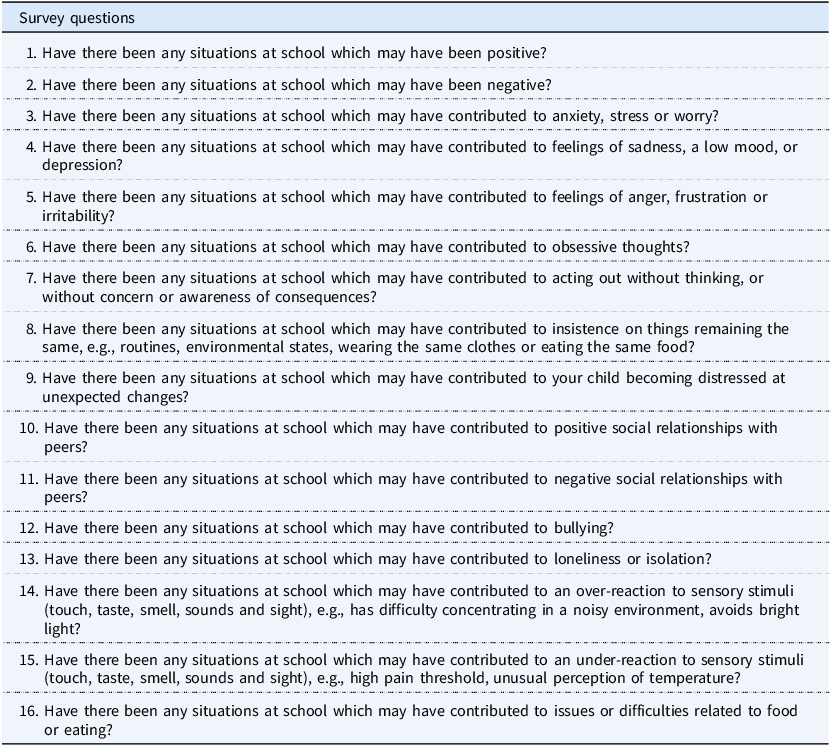
The survey comprised questions that were original and constructed to elicit information from participants regarding how different situations at school impacted their daughters’ social and emotional wellbeing. They were designed to explore aspects, both positive and negative, of the school experiences of females with autism that have been reported in the literature. These questions concerned feelings related to anxiety and depression, obsessive traits, impulsivity and concern for sameness, relationships with peers, bullying, sensory sensitivity, and issues related to food or eating. Respondents were prompted, where appropriate, to provide positive as well as negative experiences. If participants answered ‘yes’ to a question, the additional prompt, ‘Please describe how the sensory sensitivities experienced by your child contribute to her overall social and emotional wellbeing at school’, was made available. Given the research on parent reports (e.g., Seifer, Reference Seifer and Teti2005), we were aware that observable behaviours may be overrepresented in our data, while less readily observable aspects of wellbeing may be underrepresented. The survey questions are provided in Table 1.
Survey Questions

Data Analysis
Data were analysed using an inductive thematic approach (O’Leary, Reference O’Leary2004; Sciutto et al., Reference Sciutto, Richwine, Mentrikoski and Niedzwiecki2012). Initial coding identified recurring issues, which were then grouped into broader themes. The surveys were thoroughly read and discussed with another researcher with relevant expertise. First-cycle coding (Miles et al., Reference Miles, Huberman and Saldaña2014) was used to initially summarise the data. Then second-cycle coding (Miles et al., Reference Miles, Huberman and Saldaña2014) was used to summarise the data into a smaller number of themes. This ensured that the themes identified were closely connected to the raw data, so the perspectives of participants were heard and accurately reported. Through reading and rereading the survey responses, the key issues were identified by the first author and discussed with and agreed upon by the second author. It was determined, with the exception of issues related to food or eating, that an issue was a key issue if it was discussed in relation to three or more survey questions across the 38 participants.
Ethical Considerations
Permission to conduct this study was granted by the University of Tasmania Human Research Ethics Committee (Ethics Reference: H0016091). Participants were guaranteed anonymity as no identifying data were collected.
Results
The average age of females with autism reported in the survey was 10.35 years (SD = 2.47). The majority of respondents were from Australia (approximately 79%), with approximately 19% from the United States and 2% from the United Kingdom.
Although responses to each question were analysed separately, there was overlap among the issues discussed. A total of six key issues were initially generated. These themes were bullying, social issues, academic issues, sensory issues, change issues, and a lack of understanding about autism. A seventh concerning ‘issues related to food or eating’ was added as a key theme despite being mentioned only in relation to Question 16, which asked specifically about these issues. Such issues were, however, mentioned by 12 participants, comparable with the number of participants who mentioned some of the other key themes, and we were keen to explore its extent in this younger cohort of females with autism.
Responses to the questions ranged in length from a simple yes/no (five respondents) to a few words or several sentences. All participants were given a pseudonym to honour the fact that these were real people who willingly gave their time to share the experiences of their daughters, as well as their own insights, opinions, and experiences. When participants referred to their daughter by name, a pseudonym was also used. In the next section, the results are presented for each of the key issues identified, ordered according to the number of times each was mentioned. Illustrative quotations are provided throughout.
Social Issues
There were 88 mentions of social issues by 24 participants, most frequently in relation to the question, Have there been any situations at school which may have contributed to loneliness or isolation?
Connecting with peers through shared interests was identified by four participants as contributing to a positive school experience and fostering positive peer relationships. For instance, Jenny reported this about her daughter’s experience:
My daughter plays both the bass guitar and double bass. She joined the school bands and junior choir where she found many other girls similar to her. Quiet, kind, caring and creative. She also joined the robotics club and the literacy club. These extracurricular activities have basically kept our daughter at school by providing her with small, caring groups of girls who she could get to know better and gave her a sense of belonging. (Jenny, parent of a 14-year-old daughter)
Having their daughters have the opportunity to explain autism to their peers was described as a positive experience by two participants. For example, Stacey shared the following:
She understands when behaviour of other children becomes disruptive to her learning (she finds this very frustrating) and she facilitated a class discussion on the way people could help her and improve their behaviour. This went very well, and she received a special award at assembly. (Stacey, parent of an 8-year-old daughter)
Participants frequently described their daughters’ feelings of being different from their peers and the impact this had on them. Alexandra highlighted her daughter’s feelings in her response:
I can tell when she has had a bad day because she will hop in the car and start yelling at me. She had openly told me she worries she is different, is not anyone’s first choice of a friend … she has been advised that she has ASD or Aspergers, we have explained it to her, and we spend a lot of time trying to encourage her and make her feel special, but ultimately she feels lesser or different and it makes her sad. (Alexandra, parent of an 8-year-old daughter)
Being excluded by their peers was also a common experience for females with autism. For instance, Esther shared the following about her daughter’s experience:
She gets very sad when she has no one to play with, which is often. She feels sad when she is picked last for teams, and when she can’t find a partner for activities. There was a situation last year where all the girls in her class apart from her were invited to a birthday party, and she was inconsolable. (Esther, parent of a 13-year-old daughter)
Participants emphasised the anxiety that the social aspects of school caused their daughters. For instance, Jillian remarked, ‘She is constantly anxious, hence the GAD [generalised anxiety disorder]’ (Jillian, parent of a 14-year-old daughter). Similarly, Alexandra explained how this played out for her daughter:
Daily, the playground and social interaction worries Olivia. She often tells me of a social situation at lunchtime and relives it prior to going to sleep. There are many nights I lie beside her to calm her so she can go to sleep. (Alexandra, parent of an 8-year-old daughter)
Loneliness and isolation were also discussed by participants. For example, Sonya shared the following:
Spending recess and lunch on her own, other girls not wanting to sit with her and work with her, never being invited to birthday parties, to the movies or other girls houses on weekends, and other girls always declining her invitations. (Sonya, parent of a 14-year-old-daughter)
Sensory Issues
Twenty-three participants mentioned sensory issues a total of 38 times, most frequently in relation to the question, Have there been any situations at school which may have contributed to an over-reaction to sensory stimuli? Most commonly discussed were sensitivity to noise and sensory overload. Cathy observed that ‘my daughter often comments on how noisy it is at school, especially in the corridors. She says this doesn’t bother her, but I think it might. She generally avoids large crowds’ (Cathy, parent of a 13-year-old daughter). Similarly, Kylie explained, ‘Lighting in classroom can be overwhelming, noise in classroom can be overwhelming, swimming carnivals and athletics carnivals cause a sensory overload’ (Kylie, parent of a 13-year-old daughter). A sensitivity to noise sometimes made it difficult to concentrate in class; for instance, ‘If the noise level is loud, she finds it difficult to do her work. If the rooms are quiet, she is relaxed and can concentrate’ (Jenny, parent of a 14-year-old daughter). Vicky noted, ‘If the class is noisy, she doesn’t cope and runs from class’ (Vicky, parent of an 8-year-old daughter). Esther shared the following recurring situation:
Sometimes if the class is noisy, she yells ‘shut up, I’m trying to work’ or ‘shut up and do your work’, which results in punishment from teachers. Her sensitivities to noise are misunderstood by teachers and laughed at by other students. (Esther, parent of a 13-year-old daughter)
Ten participants described sensory overload in detail. For instance, ‘Sometimes my daughter needs a day away from school because it is too noisy, and she becomes tired from the interaction’ (Cathy, parent of a 13-year-old daughter). Similarly, Grace wrote, ‘She finds it exhausting. She tries to keep it together, but at the end of the day is tired and tearful’ (Grace, parent of an 11-year-old daughter). Alexandra provided the following example:
Olivia stops coping when there is too much noise, or she is hot. She gets irritable and angry, and I can see it bubbling in her. She will see me straight after school, and because I am safe, will start screaming at me. Now she is older, she waits until we are near or in the car, but it used to be across the playground. (Alexandra, parent of an 8-year-old daughter)
Change Issues
Issues related to change were discussed by 20 participants for a total of 36 mentions. They were referenced most frequently in relation to the question, Have there been any situations at school which may have contributed to your child becoming distressed at unexpected changes? Megan noted, ‘She can become very fixated on routines. Everything must be the same, or she freaks out. I think it is a symptom of anxiety or a negative experience. Very difficult to put a finger on the cause’ (Megan, parent of a 7-year-old daughter). Vicky explained, ‘there are many, too many, changes in the day’ (Vicky, parent of an 8-year-old daughter), while Alison explained, ‘with all the changes at school, Amanda struggles to adjust to them. She really likes routine, and any changes to that, she gets stressed (in her words), this will cause her to not sleep, worry and cry’ (Alison, parent of an 11-year-old daughter).
Bullying
Fifteen participants contributed a total of 29 mentions, most frequently in relation to the question, Have there been any situations at school which may have contributed to bullying? For instance, Sharon explained that ‘bullying by other girls has impacted on her not wanting to go to school’ (Sharon, parent of an 8-year-old daughter). Sue commented, ‘She is at a girls only private school and from time-to-time girls can be nasty and unaccepting of anyone who is different’ (Sue, parent of an 8-year-old daughter). Esther shared the following:
The other students have noticed her lack of eye contact and they say ‘hey weirdo, who are you talking to?’ and ‘it’s rude not to look at people’ etc. I have asked teachers to explain how hard eye contact is for her, but have been fobbed off. (Esther, parent of a 13-year-old daughter)
Sonya described the impact of bullying on her daughter:
She is a sweet girl. Very naïve, but a kind girl. When they aren’t ignoring her, the other girls take advantage of her naivety. She gets good marks and has a lot of potential, but is miserable. I am heartbroken my beautiful daughter is hurting and suffering and all I can do is be there for her and make sure she gets the psych support she needs. (Sonya, parent of a 14-year-old-daughter)
Lack of Understanding About Autism
Fifteen participants referred to a lack of understanding about autism among teachers. The 19 mentions included that of Fiona, who wrote, ‘Not all teachers understand, as she presents very neurotypical’ (Fiona, parent of a 7-year-old daughter), while Sharon explained, ‘Limited understanding by staff about her uneven learning profile adds to her low self-esteem’ (Sharon, parent of an 8-year-old daughter). Grace described difficulties with having her daughter’s needs met as follows:
School is a minefield. Most teachers do not have the time/experience to deal with the needs of High Functioning ASD. She is not suitable to attend the specialist school due to her abilities, but mainstream (even the alternative Steiner stream we have chosen) doesn’t have enough individual support. (Grace, parent of an 11-year-old daughter)
Cathy shared how a lack of understanding of females with autism had affected her daughter:
When my daughter was not attending school and we were still in the process of getting the ASD diagnosis, the school was treating her like a non-compliance/truancy case. She became afraid of the deputy principal (leading the non-compliance action) … he wasn’t very understanding of her situation, and he said they had never had a girl on the spectrum before, which was not true. (Cathy, parent of a 13-year-old daughter)
Academic Issues
Testing and the amount of work needed to be completed were both reported to be issues for females with autism. There were 18 mentions of academic issues across 12 participants, most frequently in relation to the question, Have there been any situations at school which may have contributed to anxiety, stress or worry? For instance, Chloe remarked, ‘My child can get anxious about academic testing, or the amount of work she needs to complete’ (Chloe, parent of a 10-year-old daughter). Another participant recalled, ‘NAPLAN [National Assessment Program – Literacy and Numeracy] tests resulted in major anxiety and poor sleep for weeks prior’ (Sharon, parent of an 8-year-old daughter). Difficulty understanding instructions was another issue described. For instance, Sue noted that ‘there are times when she is unclear on instructions and finds it hard to do tasks. Rather than asking for help, she gets angry’ (Sue, parent of an 8-year-old daughter). Similarly, Tina shared that her daughter had been ‘destroying schoolwork because of one mistake being pointed out’ (Tina, parent of a 9-year-old daughter).
Issues Related to Food or Eating
Twelve participants provided a total of 12 comments on this issue. Picky or fussy eating was identified as an issue by six participants. Elizabeth described how emotional upset affected her daughter’s eating:
She is very particular about what is in the lunchbox. She has had issues with peers commenting on what she has to eat, and will omit that from the lunchbox. She becomes very upset and emotionally wounded. Her food is very important to her, and if upset, is unable to eat at all. (Elizabeth, parent of an 11-year-old daughter)
Sonya explained, ‘She insists I cut the same lunch for her every day, and if I have to put something different in there for any reason, she refuses to eat ANYTHING’ (Sonya, parent of a 14-year-old daughter). Cathy commented, ‘My daughter’s Japanese class will often make traditional food and eat it in class. My daughter doesn’t like this, so won’t give me the permission notes, and avoids those classes’ (Cathy, parent of a 13-year-old daughter).
Not eating, or not eating enough, at school was also identified as an issue. For example, Fiona said, ‘She rarely eats at school. Persistent issue’ (Fiona, parent of a 7-year-old daughter). Maria remarked that her daughter ‘eats and drinks much less during school days than weekends/holidays’ (Maria, parent of a 7-year-old daughter).
The relationship between food and anxiety was discussed by two participants. Cathy noted, ‘When she is stressed, she will often eat several small bags of potato chips if we forget to hide them’ (Cathy, parent of a 13-year-old daughter), and Esther explained how her daughter’s anxiety could result in her not eating at school:
She is too anxious to eat at school, so is starving by the time she gets home, then ends up eating not only the entire contents of her lunchbox, and then raids the pantry, sometimes to the extent that she vomits. (Esther, parent of a 13-year-old daughter)
Furthermore, Sonya wrote, ‘She is becoming increasingly more difficult in what she eats. I am fearful of an eating disorder but am hoping the psychologist can assist in stopping that’ (Sonya, parent of a 14-year-old daughter). Jillian shared the following:
She was diagnosed with Bulimia last year. It is a cruel disease. It was triggered by a group of girls saying if she lost weight, she could join their ‘group’. Note – she was not overweight by any stretch of the imagination! (Jillian, parent of a 14-year-old daughter)
Discussion
School for the females with autism in this study was a place of considerable anxiety, often associated with and accompanied by social difficulties, with implications for their learning, and exacerbated by teachers’ lack of awareness of autism, especially as it manifests in females. In addition, issues with food and eating point to the possibility of disordered eating developing in early or preadolescence: Three of the 12 participants who commented on food and eating issues were parents of 7-year-olds and another was the parent of an 8-year-old.
Like most students, including those without autism, parents reported that their daughters were anxious about tests and the amount of schoolwork and homework that they needed to complete. These students, however, also experienced anxiety due to the inevitable changes that occur during a school day and deviation from routines. For some, anxiety interfered with their eating at school, with 12 parents reporting that their child engaged in binge eating or was unable to eat at school as a result of their anxiety.
The inability to eat at school was connected with social difficulties. Consistent with previous research (e.g., Mademtzi et al., Reference Mademtzi, Singh, Shic and Koenig2018), parents in the present study reported their daughters’ difficulty forming and maintaining friendships with neurotypical peers. Furthermore, similar to the findings of Cook et al. (Reference Cook, Ogden and Winstone2018), females with autism in the present study were sometimes the targets of bullying because of characteristics associated with autism, such as a lack of eye contact. Although not mentioned by participants in this study, poor social skills, including the ability to engage in conversation (Mademtzi et al., Reference Mademtzi, Singh, Shic and Koenig2018), were likely contributors to the social difficulties they experienced. Honeybourne (Reference Honeybourne2015) noted that teachers may expect more of girls in terms of their social skills. In addition, there is evidence that teachers respond differently to the same externalised behaviours characteristic of autism when they are exhibited by females as compared with males (Hamilton & Roberts, Reference Hamilton and Roberts2025).
The anxiety and social issues experienced by the females in this study had implications for their ability to participate fully in learning. For three participants, bullying led to their daughters being unwilling to go to school, echoing O’Hagan et al.’s (Reference O’Hagan, Bond and Hebron2024) finding in this regard. In addition, participants mentioned problems with understanding instructions and becoming angry as a result of making mistakes. Jarman et al. (Reference Jarman, Ollington, Rayner and Beswick2015) and Honeybourne (Reference Honeybourne2015) also noted difficulties with understanding instructions, as did Pastor-Cerezuela et al. (Reference Pastor-Cerezuela, Fernández-Andrés, Sanz-Cervera and Marín-Suelves2020). Like females in other studies (e.g., Honeybourne, Reference Honeybourne2015; Jarman et al., Reference Jarman, Ollington, Rayner and Beswick2015; Pastor-Cerezuela et al., Reference Pastor-Cerezuela, Fernández-Andrés, Sanz-Cervera and Marín-Suelves2020), our participants reported sensory overload and difficulty concentrating in noisy environments.
The fact that females with autism tend to be quieter than males about their difficulties (Cridland et al., Reference Cridland, Jones, Caputi and Magee2014; Honeybourne, Reference Honeybourne2015) may contribute to the lack of awareness and understanding among teachers of females with autism. Parents in this study were aware that their daughters could present as neurotypical, and this also likely contributed to teachers not considering autism to be relevant to females. Lack of awareness means that issues such as bullying as a result of autistic traits, anxiety and the consequent unwillingness to participate in certain activities or to attend school, and meltdowns due to sensory overwhelm are not handled appropriately. Indeed, there were examples of such behaviours being the subject of disciplinary actions likely to exacerbate the underlying difficulties.
Conclusion and Recommendations
Theoretically, our linking of students’ wellbeing with issues confronted by females with autism emphasises the potential wellbeing impacts of failures to address the needs of females with autism in the school context.
Teachers’ awareness of the existence and presentation of autism in females requires attention. Bowman and Harrison (Reference Bowman and Harrison2025) noted that teacher education programs pay insufficient attention to autism. Even when teachers have knowledge, they need support to implement new practices. Brock et al. (Reference Brock, Huber, Carter, Juarez and Warren2014), for example, found that teachers were not confident in their ability to carry out evidence-based practices and were only moderately interested in accessing training on these practices. Greater awareness of the academic and wellbeing implications of failing to support females with autism is necessary and could be motivating.
In addition, disordered eating reported retrospectively by adult participants in other studies (e.g., Brede et al., Reference Brede, Babb, Jones, Elliot, Zanker, Tchanturia, Serpell, Fox and Mandy2020; Honeybourne, Reference Honeybourne2015; Laskowski et al., Reference Laskowski, Jürgensen, Lehe, Halbeisen and Paslakis2025) was evident to 12 parents — three with daughters as young as 7 — in this study. The seriousness of eating-related disorders (anorexia is among the most lethal mental health conditions) and other mental health challenges means that it is imperative for education systems, schools, and teachers to have greater awareness of autism as a condition that affects females as well as males, the ways in which it manifests in females, and appropriate responses to the difficulties these students encounter. We concur with others (e.g., Hodge et al., Reference Hodge, Sutherland, Boulton, Baracz, Ong, Bennett, Guastella and Silove2025; Milner et al., Reference Milner, McIntosh, Colvert and Happé2019) that the current situation in which females are often overlooked in terms of both diagnosis and support needs to change.
It is vital that teachers are aware of the potential risk of females with autism developing disordered eating and eating disorders, and that they are alert to early warning signs. A prevalence range of eating disorders between 20% and 30% has been consistently found in adult autism samples (Solmi et al., Reference Solmi, Bentivegna, Bould, Mandy, Kothari, Rai, Skuse and Lewis2021) and are most likely to begin in adolescence (e.g., Breton et al., Reference Breton, Dufour, Côté, Dubois, Vitaro, Boivin, Tremblay and Booij2022). Breton et al. (Reference Breton, Dufour, Côté, Dubois, Vitaro, Boivin, Tremblay and Booij2022) emphasised that eating disorder prevention programs should start before puberty, which is consistent with our finding that children as young as 7 may be at risk of developing disordered eating.
Programs can mitigate the social difficulties experienced by females with autism by working either with the student with autism or with their neurotypical peers. The latter include peer training programs, like that discussed by Owen-DeSchryver et al. (Reference Owen-DeSchryver, Carr, Cale and Blakeley-Smith2008). Such programs need to be designed and implemented mindful of the desire of some females with autism to embrace their autistic identities (Grove et al., Reference Grove, Clapham, Moodie, Gurrin and Hall2025; Hamilton & Roberts, Reference Hamilton and Roberts2025), allowing them to engage in less masking or camouflaging — behaviours that have been found to negatively impact female students’ ability to learn, form positive relationships, and maintain mental health (Halsall et al., Reference Halsall, Clarke and Crane2021). Including females with autism in the design of measures to assist them also supports their autonomy and hence self-optimisation — an important aspect of wellbeing (Noble et al., Reference Noble, McGrath, Wyatt, Carbines and Robb2008).
Involving females with autism in extracurricular activities, where they can form connections with peers who share similar interests, is also likely to be helpful. Consistent with Sedgewick et al. (Reference Sedgewick, Hill and Pellicano2018), participants in this study reported that activities such as the school band and choir had been socially beneficial for their daughters. This may not always be possible, given the exhaustion reportedly experienced by each individual female student with autism as a result of the school day and the subsequent downtime that is needed.
Jarman et al. (Reference Jarman, Ollington, Rayner and Beswick2015) emphasised that even female students with autism who perform well academically may need additional support, such as extra time and multiple explanations. Furthermore, Wagner (Reference Wagner, Attwood and Grandin2006) asserted that teachers need to find out how much time female students with autism spend on homework to ensure it is not causing unnecessary anxiety and stress and is not taking over their home lives.
A common issue raised by participants in the present study was difficulty concentrating in a noisy classroom. There will inevitably be noise at school, but measures that may assist include allowing females with autism to listen to music through headphones while working, to help them concentrate (Jarman et al., Reference Jarman, Ollington, Rayner and Beswick2015). Participants also commented that school events such as swimming and athletics carnivals were too much for their daughters with autism and caused sensory overload. Females with autism could be excused from such events.
Limitations and Future Directions
Caution is appropriate when considering our results, as there were factors that limit the conclusiveness and generality of the findings. A major limitation of the present study arose from the anonymous nature of the survey. There was no way to verify autism diagnoses beyond the participants indicating that their child/adolescent had a diagnosis, and the perspectives were those of the parents; the results may have been different were they those of the children/adolescents themselves. Nevertheless, the key issues that emerged from the data were consistent with previous research that focused on females with autism.
Time constraints meant that it was not possible to conduct a pilot study to test and refine the survey questions. This means that we have less than optimal insight into the ways in which some of the questions might have been interpreted. Although the authors collaborated to agree on the coding of responses and were encouraged by the synergies between our findings and those in the extant literature, a more rigorous approach would have involved independent coding of a sample of survey responses, followed by negotiation of agreed interpretations.
The voice of the child with autism is important, and not having this is a limitation. However, there are well-established precedents for using parents as informants in relation to this population. Future research could obtain the perspectives of both parent and child to examine the extent to which their views coincide. Additionally, quantitative methods could be used in a large study to examine the relationships between the variables explored in this qualitative study. The results from this study add to the growing body of literature concerning females with autism by involving younger students and providing insight into the ways in which the school setting impacts the social and emotional wellbeing of females with autism from the perspective of parents.
The sample size achieved in this study was small, possibly as a consequence of the open-ended nature of the questions, which required respondents to formulate their responses and express them in their own words. We believe this resulted in richer data than would have been elicited from close-ended questions, but there was a trade-off with participant numbers.

 Open access

