




1. INTRODUCTION
Canada adopted the Official Languages Act in 1969 establishing both English and French as official languages throughout the country. Since then, French-language education has progressively gained public favor becoming commonplace in all Canadian provinces, albeit with two distinct programs of instruction available from kindergarten to secondary level: one developed specifically for francophones who have French as their mother tongue, usually the first language learned in the home during childhood (L1), and a second-language or French-immersion program (L2) for anyone wishing to pursue their public education in French. Rivard and Gueye (Reference Rivard and Gueye2016) have argued that “the challenge for teachers in these schools is how best to support the language development of students in the sheltered linguistic confines of the school and classroom, despite the overwhelming presence of a more dominant or higher status language” in the community at large (p. 18). Since content areas in many of these schools are taught in French, they must be considered privileged spaces for the acquisition of the target language (Lee et al., Reference Lee, Quinn and Valdés2013; Rivard & Cormier, Reference Rivard and Cormier2008; Schleppegrell & O’Hallaron, Reference Schleppegrell and O’Hallaron2011).
French-immersion students in Canada are increasingly choosing to pursue their post-secondary studies in francophone or bilingual universities (Burger et al., Reference Burger, Weinberg, Hall, Movassat, Hope, Tedick, Christian and Fortune2011). For instance, there are now more new admissions from French-immersion students than native speakers at our local francophone university. Moreover, most francophones in Canada live in minority-language settings with English, the lingua franca, dominating the institutional and cultural fabric in provinces outside of Québec (Krenca et al., Reference Krenca, Hipfner-Boucher and Chen2020; Matras, Reference Matras2009). As such, many of these university students, both L1 and L2, are required to complete a remedial language course to strengthen their linguistic proficiencies for the academic writing expected during tertiary studies.
A number of recent studies have investigated summary writing with several focusing on L1 students in secondary school, middle school, and university, respectively (De La Paz and Wissinger, Reference De La Paz and Wissinger2015; Galloway et al., Reference Galloway, Qin, Uccelli and Barr2020; Gil et al., Reference Gil, Bråten, Vidal-Abarca and Strømsø2010), while others have explored L2 writing with just university undergraduates (Baba, Reference Baba2009; Keck, Reference Keck2014; McDonough et al., Reference McDonough, Crawford and De Vleeschauwer2014). With the exception of the study by Gil et al., which was conducted in L1 Spanish, all of the other studies focused on writing in English, either L1 or L2 in an English as Foreign Language (EFL) context. In their review of the extant literature on writing from sources, Cumming et al. (Reference Cumming, Lai and Cho2016) underlined this bias towards the English language in current scholarship. Moreover, few studies have compared summary writing between francophones and French-immersion students (Cox, Reference Cox1995; Hart et al., Reference Hart, Lapkin, Swain, Malavé, Lapkin and Duquette1991). Yet, immersion programs are now widespread across most continents for supporting the acquisition of foreign languages or for maintaining indigenous and heritage languages (Lyster, Reference Lyster2007). In this study, we address this paucity of research by comparing summary writing between native-speaking francophones (L1) and French-immersion students (L2) from the beginning of secondary school to university. As such, the language use of L2 students will be compared to that of a comparable native-speaking benchmark group, which has been lacking in many studies of summary writing (Foster & Tavakoli, Reference Foster and Tavakoli2009; Wijers, Reference Wijers2018). The findings of this study are important because they would apprise educators in both schools and universities on possible program modifications for enhancing the writing proficiency in both L1 and L2 groups of students living in minority-language contexts. We review several areas of research that informed this descriptive study while focusing primarily on studies in L2 and French: the role of writing in language learning, generally; the use of summary writing in both science and language classrooms, more specifically; and the evaluation of writing for syntactic complexity and connector use.
2. LITERATURE REVIEW
2.1. Writing in language learning
Hasko (Reference Hasko2013) noted that “a ‘typical’ L2 developmental profile is an elusive target to portray, as L2 development is not linear or evenly paced and is characterized by complex dynamics of inter- and intralearner variability, fluctuation, plateaus, and breakthroughs” (p. 2). Researchers have thus advocated small-n longitudinal approaches to elucidate the developmental trajectories of individual L2 learners (Polat & Kim, Reference Polat and Kim2014; Spoelman & Verspoor, Reference Spoelman and Verspoor2010; Vyatkina, Reference Vyatkina2012). For instance, in their study of writing accuracy and complexity of L2 learners of Finnish, Spoelman and Verspoor (Reference Spoelman and Verspoor2010) noted “increased variability in the vicinity of a developmental jump and as a transition phase between two stages” of language development (p. 550). Nonetheless, cross-sectional designs are useful complimentary approaches for elucidating profiles of learners’ language production in task-based performances (Crossley & McNamara, Reference Crossley and McNamara2014; Hasko, Reference Hasko2013; Lambert & Kormos, Reference Lambert and Kormos2014; Pallotti, Reference Pallotti2009).
In his review of the literature in applied linguistics and language teaching for the period 2000–2006, Evans (Reference Evans2007) observed that there were few published studies specifically investigating L2 writing in French, and this despite recent calls for more writing in secondary language classrooms (Macaro, Reference Macaro2007; Williams, Reference Williams2012). Writing is a powerful tool for cognitively engaging students that requires linguistic precision to be effective, while its relative permanence enables metacognitive awareness, which make it ideal for language learning (Graham & Perin, Reference Graham and Perin2007; Rivard, Reference Rivard1994; Swain, Reference Swain and Hinkel2005; Williams, Reference Williams2012). Moreover, scholars in the area of L2 acquisition have argued for a greater variety of genres, tasks, learners, and languages in research on writing (Granger, Reference Granger and Aijmer2009; Hinkel, Reference Hinkel and Hinkel2011; Ortega, Reference Ortega2012). For instance, Benevento and Storch (Reference Benevento and Storch2011) conducted a longitudinal study of writing development over a six-month period with a small group of secondary students during their final year of studying French as a foreign language. The three essays, which were written in class, were evaluated for global quality, grammatical accuracy or clauses without errors, syntactic complexity, and connector use. Improvements were observed in all areas except grammatical accuracy, even though some types of errors did decrease over time. The authors also noted that students more often tended to use French connectors that could be mapped onto known English equivalents (cf. Siepmann, Reference Siepmann2005).
2.1.1. Summary writing
Summary writing has much potential for enhancing language acquisition as it involves processes related to both comprehension and production and, more importantly, is considered by many researchers to be a higher-order task that can also enhance content learning (De La Paz & Wissinger, Reference De La Paz and Wissinger2015; Galloway & Uccelli, Reference Galloway and Uccelli2019; Gil et al., Reference Gil, Bråten, Vidal-Abarca and Strømsø2010; Hood, Reference Hood2008; Newell, Reference Newell, MacArthur, Graham and Fitzgerald2006; Rivard, Reference Rivard1994; Winograd, Reference Winograd1984). Despite the routine use of summary writing in schools, there have been relatively few studies investigating the language use by adolescent writers in this task (Galloway et al., Reference Galloway, Qin, Uccelli and Barr2020; Kiuhara et al., Reference Kiuhara, Graham and Hawken2009; Miller et al., Reference Miller, Scott and McTigue2018).
To write a good summary, a student “must accurately communicate the gist of a text, while also modifying its surface elements, or reformulating it, and condensing it” (Rivard, Reference Rivard2001: 171). Furthermore, although the summarization task is often introduced well before the secondary level, even university students still have difficulty writing a good summary, especially those in L2 classrooms (Cordero-Ponce, Reference Cordero-Ponce2000; Howard et al., Reference Howard, Serviss and Rodrigue2010; Johns, Reference Johns1985; Johns & Mayes, Reference Johns and Mayes1990; Keck, Reference Keck2006; Yang, Reference Yang2016; Yu, Reference Yu2008). Moreover, the nature of the summarization task, for instance the length of the source text, its readability, whether it is present while writing, and its genre can all influence the resulting summary (Cumming et al., Reference Cumming, Lai and Cho2016; Hidi & Anderson, Reference Hidi and Anderson1986; Housen et al., Reference Housen, Kuiken, Vedder, Housen, Kuiken and Vedder2012). More specifically, studies have shown that the genre, or whether the source text is expository, narrative, or argumentative, can impact the written summary, even though some studies have given conflicting results (Hare & Borchardt, Reference Hare and Borchardt1984; Jiuliang, Reference Jiuliang2014; Way et al., Reference Way, Joiner and Seaman2000; Yu, Reference Yu2009).
De Leeuw et al. (Reference De Leeuw, Segers and Verhoeven2014) showed that summary writing can enhance vocabulary learning in grade five students as much as a task with inference questions while reading a text. Although the authors had predicted that the summary writing task would result in more vocabulary learning overall, they suggested that the observed lack of differences between these two tasks might be due to the inherent difficulty of summarization for elementary students. On the basis of their analysis of the strategies employed by expert writers while summarizing “hard news texts”, Yuan ke and Hoey (Reference Yuan ke and Hoey2014) underlined the importance of “teaching linguistic devices such as subordinators, conjuncts, lexical signals, lexical repetitions and parallelism” to students (p. 89).
Summary writing in L2 contexts has been investigated from a variety of perspectives: Comprehension processes (Baba, Reference Baba2009; Cumming et al., Reference Cumming, Rebuffot and Ledwell1989; Kozminski & Graetz, Reference Kozminsky and Graetz1986; Li & Kirby, Reference Li and Kirby2015); textual appropriation and misuse (Keck, 2006; Reference Keck2014; McDonough et al., Reference McDonough, Crawford and De Vleeschauwer2014; Shi, Reference Shi2012); and the role of grammatical knowledge in the creation of meaning (Yasuda, Reference Yasuda2015). For instance, Li and Kirby (Reference Li and Kirby2015) observed that the breadth of vocabulary in individual L2 students predicted their general understanding of a text using basic measures of comprehension, whereas depth of vocabulary was related to their summarization of the text, a task requiring deeper text processing. Baba (Reference Baba2009) concluded “that different aspects of L2 lexical proficiency have a differential impact on EFL learners’ summary writing, and that two factors in particular (structure of semantic network of words, and the ability to metalinguistically manipulate words) may constitute the construct of summary writing in L2” (p. 191).
Most of the studies of summarization in science education have focused on writing to learn in which conceptual growth was the primary measure for the impact of an intervention (Gil et al., Reference Gil, Bråten, Vidal-Abarca and Strømsø2010; Gunel et al., Reference Gunel, Hand and McDermott2009; Rivard, Reference Rivard1994). For example, Gil et al. (Reference Gil, Bråten, Vidal-Abarca and Strømsø2010) concluded that summary writing resulted in better understanding and more integrated learning than an argumentative writing task. However, other researchers have examined the role of summary writing in the development of literacy (Galloway & Uccelli, Reference Galloway and Uccelli2019; Rogevich & Perin, Reference Rogevich and Perin2008). For instance, Galloway and Uccelli (Reference Galloway and Uccelli2019) observed that the quality of summaries written by middle school students was predicted not only by their comprehension of the science text, but also by their skills in using academic language.
Rivard and his colleagues have compared summary writing in French by francophone and French-immersion students across the secondary program in one Canadian province. In Rivard (Reference Rivard2001), the study focused on content and language variables in the student summaries. The content variables focused on the ability to differentiate main ideas from secondary details, to integrate ideas within sentences, and to accurately convey the gist of the source text. French-immersion students, particularly those at the beginning of the secondary program, included more main ideas in their summaries, but also included more incidental details and inaccuracies. In comparison, summaries written by francophone students tended to be better organized, more coherent, and were stylistically superior with fewer grammatical errors.
Rivard et al. (Reference Rivard, Dilk and Barnabé2007) later evaluated grammatical errors in a fine-grained analysis of the written summaries in the original corpus. Although L2 students made more grammatical errors regardless of category than L1 students, they also showed more improvement over the course of the secondary program. Furthermore, changes over time were different for both groups of students depending on the particular type of error. Moreover, both groups made more errors than other Canadian students living in a province in which French is the dominant language. Many francophones in Canada live in linguistically restricted environments in which they are oftentimes more at ease with the dominant language, English outside of Québec, than their mother tongue (Matras, Reference Matras2009; Mougeon & Beniak, Reference Mougeon and Beniak1991; Tedick & Lyster, Reference Tedick and Lyster2019).
In a separate study, Rivard et al. (Reference Rivard, Diop and Nyongwa2004) compared summaries written in French by two groups of university professors, one in the science department, the other in the French Department, with those produced by students enrolled in an organic chemistry course in the same university. The source text on asymmetric catalysis, a chemical process, was taken from a popular science magazine, La recherche. The focus of the study was on comparing the written summaries for both linguistic and substantive aspects, la forme et le fonds. The summaries written by the science professors and students were more succinct and demonstrated greater fidelity to the original text. Although these individuals made more linguistic errors than the French professors who made none, their written summaries were judged to be better organized and stylistically superior. Although no differences were observed between the three groups for the relative number of connectors, the French professors included the greatest variety of connector words.
2.1.2. Complexity, Accuracy, and Fluency (CAF)
According to Larsen-Freeman (Reference Larsen-Freeman2009), “language performance and development are complex, nonlinear, dynamic, socially situated processes” (p. 588). Pallotti (Reference Pallotti2009) distinguishes between these two aspects with performance as product and development as process. They are both thought to be multidimensional consisting of three principal components of CAF that can each be further subdivided into various facets (Housen & Kuiken, Reference Housen and Kuiken2009; Housen et al., Reference Housen, Kuiken, Vedder, Housen, Kuiken and Vedder2012; Norris & Ortega, Reference Norris and Ortega2009). CAF are sensitive to many factors outside of the writer, such as the nature of the text, the context, or the task. For instance, the type of task planning made available, specifically, whether it involves rehearsal, occurs within the task itself, or prior to its execution, can impact language production (Ellis, Reference Ellis2009). Summary writing is thus an ideal communication task for divorcing linguistic skills from background knowledge and unrelated cognitive abilities, especially when students have ample time for the task while also being able to consult the source text for relevant information during the writing process (Galloway & Uccelli, Reference Galloway and Uccelli2015; Révész et al., Reference Révész, Kourtali and Mazgutova2017). Some studies of complexity and accuracy have shown that growth in one often occurs to the detriment of the other, particularly when the task is cognitively demanding (Ferrari, Reference Ferrari, Housen, Kuiken and Vedder2012; Larsen-Freeman, Reference Larsen-Freeman2006), but other scholars have concluded that task demands can actually push L2 learners towards an enhanced performance for both of these components (Polat & Kim, Reference Polat and Kim2014; Robinson & Gilabert, Reference Robinson and Gilabert2007). Bulté and Housen (Reference Bulté and Housen2014) have argued that “development is characterized by periods of growth and progress alternating with periods of stabilization or even temporary backsliding” (p. 54).
Syntactic complexity
Complexity can entail various lexical, morphological, syntactic, and phonological components (Bulté & Housen, Reference Bulté, Housen, Housen, Kuiken and Vedder2012). As the syntactic component is multidimensional involving coordination, subordination, and phrasal complexification with these directly related to writing maturity, researchers should ensure that their measurement practices accurately assess this aspect, regardless of the linguistic development of the target writers (Norris & Ortega, Reference Norris and Ortega2009; Vyatkina, Reference Vyatkina2012). For instance, Monroe (Reference Monroe1975) observed that less advanced college students in a L2 French course tend to use more coordination in their written texts, whereas intermediate learners use more subordination while advanced students include more elaborate complex clauses and phrases. Lambert and Kormos (Reference Lambert and Kormos2014) have argued that subordination is not a singular construct, but rather encompasses separate processes involving nominal, adverbial, and relative clauses with these surfacing at different points in linguistic development (Cf. Buysse et al., Reference Buysse, Housen and Pierrard2018; Nippold et al., Reference Nippold, Ward-Lonergan and Fanning2005; Welcomme, Reference Welcomme2013; Wijers, Reference Wijers2018). Moreover, Skehan (Reference Skehan2009) has argued that complexity should be “supplemented by measures of lexical performance” (p. 528), particularly when studying L2 learners. Yet other researchers view the lexical dimension as a part of the linguistic complexity construct (Bulté & Housen, Reference Bulté, Housen, Housen, Kuiken and Vedder2012; Vyatkina, Reference Vyatkina2012). Last, De Clercq and Housen (Reference De Clercq and Housen2017) concluded that French-language researchers investigating these linguistic aspects have adopted mainly qualitative approaches.
Logical connectors
Logical connectors, or transition words, are an important cohesion tool for creating meaning with subordinating conjunctions, particularly in academic writing. In L1, studies have shown that the use of connectors begins in early childhood and develops through school and beyond (Celce-Murcia, Reference Celce-Murcia, Schleppegrell and Colombi2002; Crowhurst, Reference Crowhurst1987; Galloway et al., Reference Galloway, Qin, Uccelli and Barr2020; Nagy & Townsend, Reference Nagy and Townsend2012; Nippold et al., Reference Nippold, Ward-Lonergan and Fanning2005). Other studies have highlighted differences between L1 and L2 learners in their use of connectors (Baba, Reference Baba2009; Benazzo, Reference Benazzo2004; Connor, Reference Connor1984; Crossley & McNamara, Reference Crossley and McNamara2009; Degand & Hadermann, Reference Degand and Hadermann2009; Reid, Reference Reid1992; Reynolds, Reference Reynolds2002; Rivard et al., Reference Rivard, Minkala-Ntadi, Roch-Gagné and Gueye2017; Vasiljevic, Reference Vasiljevic2013; Zufferey et al., Reference Zufferey, Mak, Degand and Sanders2015). Studies also suggest that syntactic complexity and lexical complexity are inextricably linked, though the developmental pattern varies with the task and the learner (De Jong et al., Reference De Jong, Steinel, Florijn, Schoonen, Hulstijn, Housen, Kuiken and Vedder2012; Larsen-Freeman, Reference Larsen-Freeman2006; Vyatkina, Reference Vyatkina2012). For Pallotti (Reference Pallotti2009), “linguistic complexity grows when this is specifically required by the task and its goals, and not for the sake of it” (p. 596). For instance, Robinson et al. (Reference Robinson, Cadierno and Shirai2009) suggest that a particular complex task can promote a greater usage of those logical connectors appropriate to the cognitive demands of the task.
Succinctness
Fluency refers to a general proficiency in using language and has historically encompassed three dimensions: speed, breakdown, and repair fluency (Housen et al., Reference Housen, Kuiken, Vedder, Housen, Kuiken and Vedder2012). The first of these involves characteristics like flow, rate, and eloquence of an utterance. Although used primarily with speech acts, it also has been used with writing using length-based measures. For instance, Godfrey et al. (Reference Godfrey, Treacy and Tarone2014) used the number of words in essays written by L2 French students as a proxy for fluency. Nonetheless, Norris and Ortega (Reference Norris and Ortega2009) advised caution in using length-based measures because of a tendency to conflate fluency and complexity. Although summary length and the number of sentences, T-units, and clauses might all be considered possible measures of fluency or complexity, these were included here to determine whether students were able to produce a succinct representation of the source text, as required in a good summary (Norris & Ortega, Reference Norris and Ortega2009; Ortega, Reference Ortega2003). As such, we are measuring the converse of fluency: succinctness in summary writing. In other words, inability to condense the text would lead to longer summaries and more sentences, T-units, and clauses for encapsulating the essential meaning or gist of the source text. Moreover, conciseness is a relative attribute and will involve comparisons between less and more mature writers, as well as between L2 and their native-speaking peers.
A number of researchers have examined these constructs specifically with learners of L2 French (Ågren et al., Reference Ågren, Granfeldt, Schlyter, Housen, Kuiken and Vedder2012; Bartning & Schlyter, Reference Bartning and Schlyter2004). On the basis of the oral proficiency of Swedish learners, Bartning and Schlyter elaborated a six-stage developmental sequence for the acquisition of morphosyntactic structures, such as subject-verb agreement, types of verbs, use of pronouns and connectors, and gender and number agreement. They concluded that syntactic complexity is closely related to the use of both verbs and logical connectors. Ågren et al. (Reference Ågren, Granfeldt, Schlyter, Housen, Kuiken and Vedder2012) reviewed developments in the field since Bartning and Schlyter’s initial article and suggested that a seventh stage should be added to reflect the proficiency of more “advanced and near-native speakers of L2 French” (p. 104). They further observed that some of these individuals, even after living in a country like France for 15–30 years, still had difficulty with certain grammatical conventions, such as subject-verb and gender agreement, as well as verb usage particularly in syntactically complex sentences.
3. CURRENT STUDY
The problem investigated in this study was how summaries written in French by francophone and French-immersion students based on an expository text from a popular science magazine compared in terms of syntactic complexity and connector use across academic levels. In this study, we conceptualize proficiency using academic level from grade nine to university as our proxy. In addition, we investigated whether there were any discernible differences in students’ abilities to write a succinct summary. We chose an authentic text rather than an excerpt from a textbook to avoid any curricular bias. We therefore extend previous work on summary writing by examining syntactic complexity and connector use in summaries written by French-immersion learners (L2) while comparing them to a native-speaker baseline group (L1) situated in the same minority-language context (Foster & Tavakoli, Reference Foster and Tavakoli2009; Skehan, Reference Skehan2009). The study is guided by the following questions:
-
RQ1. How do summaries written by L1 and L2 students compare by academic level for syntactic complexity, as well as succinctness, using various measures?
-
RQ2. How do summaries written by L1 and L2 students compare by academic level for the use of logical connectors?
-
RQ3. How do the various measures of syntactic complexity correlate with each other and with each type of logical connector in the written summaries?
4. METHOD
4.1. Participants
The present study investigated summary writing in French and included 400 summaries, 50 at each grade level (Secondary 1 to 4) in both L1 and L2. The fundamental difference between francophone education (L1) and French-immersion (L2) programs is that the former is designed to awaken students to their francophone identity, whereas the latter is an immersion program for enabling students to become bilingual. Cormier et al. (Reference Cormier, Bourque and Jolicoeur2014) have outlined the challenges regarding the maintenance and revitalization of the minority French language in Canada. In our province, well over 60% of families enrolling children in L1 schools have only one French-speaking parent with the other speaking another language, often English. In addition, roughly 50% of these students require “un appui en francisation” or support for young learners when they begin school in an instructional milieu which is entirely French except for English Language Arts. Students in the L1 program may be somewhat stronger linguistically than those in the L2 program, but both groups are far from being distinct and homogeneous. The entry point for both L1 and L2 programs was at the kindergarten level with all schools offering instruction in French for every subject except English Language Arts throughout elementary and secondary levels. Entire science classes from six schools, three in L1 and three from L2, participated in the study. These schools were well matched in terms of academic performance, and postsecondary participation rates. In addition, the corpus was enriched for the present study by including another 88 summaries written by students enrolled in a remedial writing course at a French-language university. Roughly half of these students had completed their education in one or the other language program, L1 or L2. These were collected two years later using the same materials and procedures.
4.2. Materials and procedures
Participants were allowed three hours to summarize a one-page article from Biosphère, a French-language magazine that publishes articles on wildlife and research from the zoological sciences. The article entitled “De retour au sud de la frontière,” which described the reintroduction of wolves to Yellowstone Park, was selected in consultation with science teachers in the participating schools. The actual task asked students to prepare a summary for the school newspaper. The genre of the original article and the summaries produced by students could both be considered recounts or reports of an expository text (Johns, Reference Johns2002). As such, we hypothesized that connector use would be similar in both the source text and the written summaries (Cf. Robinson et al., Reference Robinson, Cadierno and Shirai2009). Students were asked to condense the original text while paraphrasing it and including only main ideas. A detailed task description can be found in Rivard (Reference Rivard2001). All of the handwritten summaries were transcribed using Word software and assigned a number for identification purposes that would conceal the program and academic level of each writer. The summaries were hand-tagged for measures of syntactic complexity and connectors by two raters who were both specialized in language and linguistics. A summary written by a university student is included as sample coded text in Appendix A.
4.3. Measures
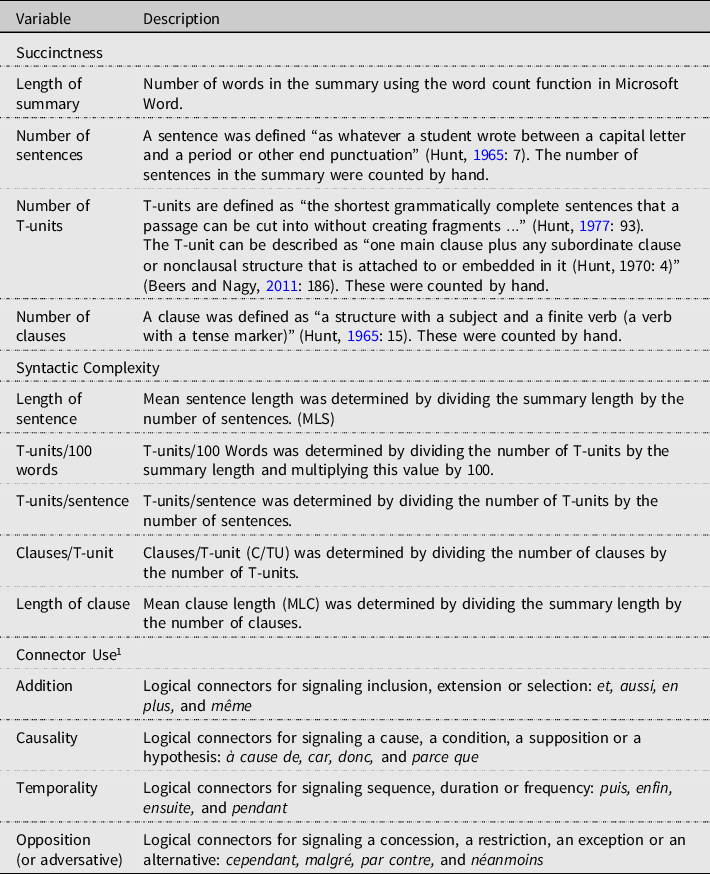
In this study, we included measures of complexity (Johnson, Reference Johnson2017; Polio, Reference Polio1997; Polio and Shea, Reference Polio and Shea2014; Skehan, Reference Skehan2009) and connector use (Bondi, Reference Bondi and Chapelle2013; Favart, Reference Favart2005; Grieve, Reference Grieve1996; Rossari, Reference Rossari2000). Syntactic complexity involved two measures of general or overall complexity: mean length of sentence in words (MLS) and T-units/100 words (Norris and Ortega, Reference Norris and Ortega2009; Ortega, Reference Ortega2003). A T-unit is a main clause along with subordinate clauses and any phrasal structures embedded within it. We also included a measure of subordination (clauses per T-unit or C/TU) and density (mean length of clause in words or MLC), the latter being a measure of phrasal and clausal elaboration typically associated with the academic register. We excluded coordination as a possible measure because the youngest L2 learners in our sample had spent nine years in a complete French-language program, so its use as a strategy for complexifying sentences was deemed peripheral given the extant language competencies of these students (Bardovi-Harlig, Reference Bardovi-Harlig1992; Monroe, Reference Monroe1975). Nonetheless we did initially examine the data for differences using a measure of coordination (T-units/sentences), but discarded it from further analysis as there were no significant differences which could be attributed to the effect of program or academic level. We used Hunt’s (Reference Hunt1965) definitions of sentence, clause, and T-unit or “minimal terminal unit” (1965: 21; cf. Beers & Nagy, Reference Beers and Nagy2009; Reference Beers and Nagy2011; and Hunt, Reference Hunt, Cooper and Odell1977). Succinctness or the ability to condense the source text was evaluated using four measures: summary length and the number of sentences, T-units, and clauses (Norris & Ortega, Reference Norris and Ortega2009).
Connectors were categorized according to the four types of logical relationships explicitly expressed through their use in the summaries: addition, causality, temporality, or opposition (Bulté & Housen, Reference Bulté, Housen, Housen, Kuiken and Vedder2012; Siepmann, Reference Siepmann2005). A brief description of the variables for measuring succinctness, syntactic complexity, and connector use along with illustrative examples of each are included in Appendix B.
The intraclass correlation coefficients (ICC) for parsing clauses and T-units was 0.982 and 0.966, respectively, for 50 summaries, which represents about 10% of the texts in the entire corpus. The ICC for coding the four types of connectors ranged from 0.844 to 0.931. The inter-rater agreement for both syntactic complexity and connector use was therefore deemed satisfactory.
4.4. Analysis
Descriptive statistics, means, and standard deviations were used to describe complexity and connector variables across the programs and levels. For research question 1 (RQ1), we compared values for complexity and succinctness by program and academic level using a two-way ANOVA design for exploring main effects and possible interactions between the factors. Bonferroni post hoc pairwise comparisons were used to determine significant differences between levels. For RQ2 on connector use, word counts for the four types of logical connectors were adjusted for summary length and then compared by program and level using a similar two-way ANOVA design. Actual words employed by students were also examined to determine the diversity or variety of connectors used in student summaries (Read, Reference Read2000). We adjusted the significance level for each ANOVA to control for Type I errors by dividing alpha by the number of variables tested. Nonetheless, we report the actual p-values in all the analyses while highlighting those values which were significant using the adjusted threshold (Rothman, Reference Rothman1990; VanderWeele & Mathur, Reference VanderWeele and Mathur2019). For RQ3, Pearson correlations across program and level for the different measures of syntactic complexity and logical connectors, calculated first separately then in combinations between the two sets of measures, were analysed.
5. RESULTS AND DISCUSSION
5.1. Syntactic complexity and succinctness
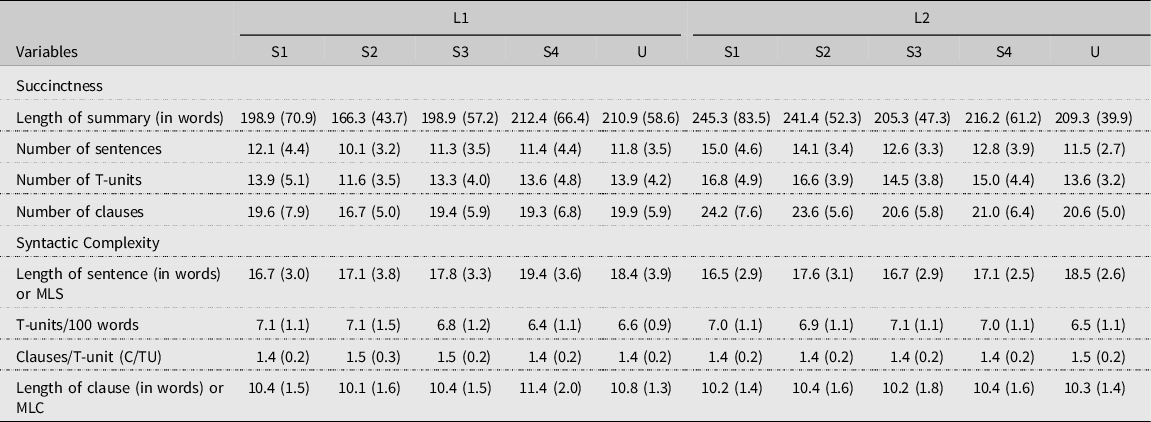
The descriptive statistics for the various measures of complexity and succinctness are shown by program and academic level in Table 1. An ANOVA summary for the main effects of program and academic level, separately, and for interactions between these categorical variables along with relevant post hoc comparisons are all given in Table 2.
Descriptive statistics for syntactic complexity and succinctness measures: mean (standard deviation)
ANOVA and post hoc summaries for selected succinctness and syntactic complexity variables
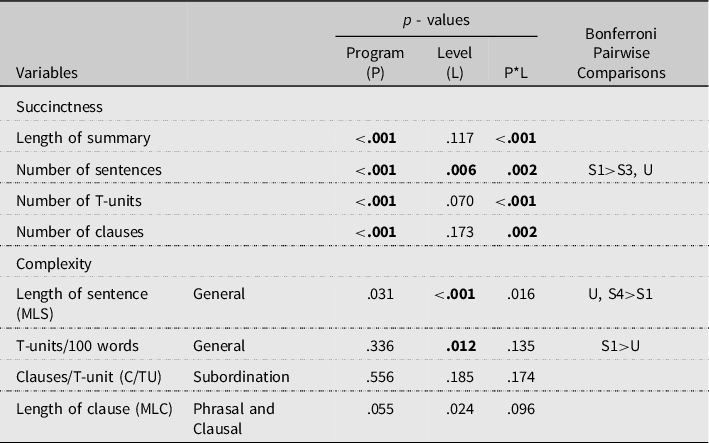
Note. The level of significance has been adjusted to control for Type I errors: α/number of variables for each set of tests = .05/4 = .0125. We have used bold font to identify p-values that suggest significant differences using the adjusted threshold.
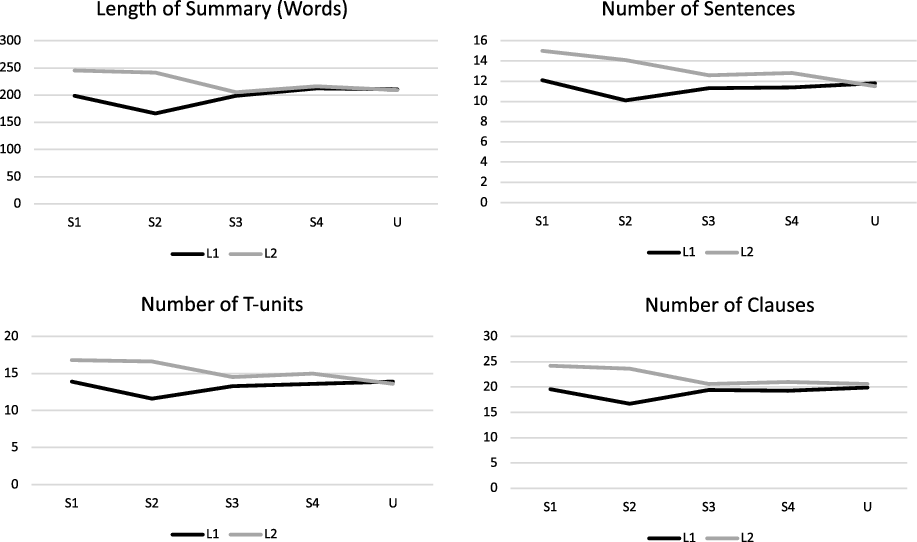
Significant interactions were observed for all four measures of succinctness: summary length, as well as the number of sentences, T-units, and clauses. The multiple line graphs in Figure 1 all show the same trend with L2 students at the beginning of the secondary program writing longer summaries by including more sentences, words, T-units, and clauses than more mature writers. The findings suggest that L2 students have difficulty condensing a text while in early secondary, but that they write just as succinctly as their L1 counterparts once in upper secondary.
Multiple line graphs for the succinctness of written summaries.
Statistically significant differences were observed for both measures of general complexity, the mean length of sentences (MLS) and T-units/100 words. More mature students at the end of secondary school and at university, regardless of program, tended to write longer sentences than students just beginning secondary school. The other general measure confirmed this finding with a pairwise comparison showing that summaries written by students at university included fewer T-units per 100 words than students in early secondary, thus their idea units were longer and more elaborate than less mature students. The remaining variables were meant to tease out the underlying mechanism for this general complexity: does subordination, phrasal-clausal complexity, or both, account for this development? No significant differences were found for either mean clauses/T-unit (C/TU), and mean length of clause, which are our respective proxies for subordination and phrasal-clausal complexity, that could be attributed to the effect of either program or level using the adjusted level of significance. This suggests that subordination and phrasal-clausal complexity rates did not vary much over the secondary program and even into first-year university in summaries written by students, regardless of program.
Overall, the results suggest that diverse measures are essential for accurately assessing syntactic complexity, especially when the proficiencies of writers are quite disparate (Bulté & Housen, Reference Bulté and Housen2014; Johnson, Reference Johnson2017; Kyle & Crossley, Reference Kyle and Crossley2018; Norris & Ortega, Reference Norris and Ortega2009; Vyatkina, Reference Vyatkina2012). The general complexity measures (MLS and TU/100 words) did not differentiate between L1 and L2 writers, but rather confirmed irregular progress through the secondary program into university. Moreover, this was only evident when contrasted over an extended period of time rather than between contiguous academic levels, our proxy for proficiency.
Many studies of writing complexity have observed that syntactic complexity is achieved by more proficient writers through phrasal and clausal elaboration (Beers & Nagy, Reference Beers and Nagy2011; Monroe, Reference Monroe1975; Staples et al., Reference Staples, Egbert, Biber and Gray2016). In comparison, our results using the adjusted threshold for the level of significance suggested that the writing of mature students is more complex, generally, but without significantly more subordination or phrasal-clausal elaboration. This anomaly begs the question as to how general complexity is actually achieved by the writers in our study. Some statiticians recommend never adjusting p-values while analysing data, because of possible spurious results due to Type II errors (Althouse, Reference Althouse2016; Rothman, Reference Rothman1990). Without the adjustment, the ANOVA for length of clause (MLC) did suggest that there were statistically significant differences for the effect of level, p = 0.024. The line graphs in Figure 2 represent the trends in the development of syntactic complexity, both general and phrasal-clausal elaboration, for L1 and L2 students from early secondary to university.
Multiple line graphs for general and phrasal-clausal complexity of written summaries.
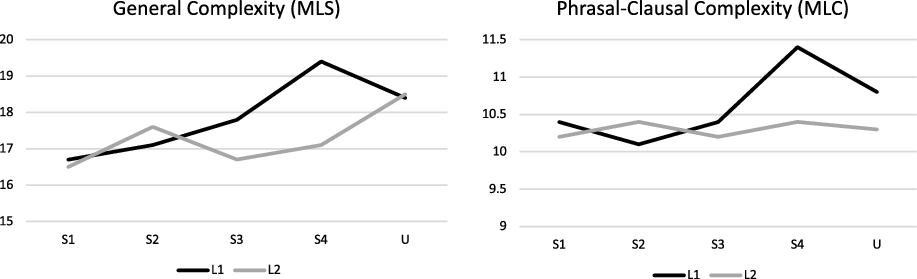
Visual inspection of these graphs suggests that this effect seems to be due to the enhanced phrasal-clausal complexity in the L1 writing of more mature students in S4 and university.
The participants in our study spanned secondary school through university, but the C/TU measure did not differentiate between students for subordination, irrespective of program. This is consistent with the findings of Kormos (Reference Kormos2011) who found no differences in subordination on narrative written tasks between native speakers and foreign language learners in a bilingual secondary school. However, it contrasts with the results of Vyatkina (Reference Vyatkina2012) who studied writing complexity in American college students of L2 German over four semesters. The L1 and L2 students in our study may have already reached a plateau in their use of subordination as a syntactic complexification strategy as determined by the unitary measure C/TU. This measure may have also been inadequate for detecting changes in syntactic complexity through subordination for these writers (Bulté and Housen, Reference Bulté and Housen2014). The measure may have conflated the types of subordinating clauses by masking the underlying changes in the use of nominal, adverbial, and relative clauses, as studies have shown that the latter tends to be employed by more mature writers (Buysse et al., Reference Buysse, Housen and Pierrard2018; Hancock and Kirchmeyer, Reference Hancock, Kirchmeyer and Dewaele2005; Lambert and Kormos, Reference Lambert and Kormos2014; Nippold et al., Reference Nippold, Ward-Lonergan and Fanning2005; Welcomme, Reference Welcomme2013; Wijers, Reference Wijers2018).
5.2. Logical connectors
Two aspects of connector use were investigated in our study: density and diversity. The descriptive statistics using word counts for the four types of logical connectors in the written summaries are presented in Table 3.
Descriptive statistics for connectors by program and academic level - mean (standard deviation) based on word counts
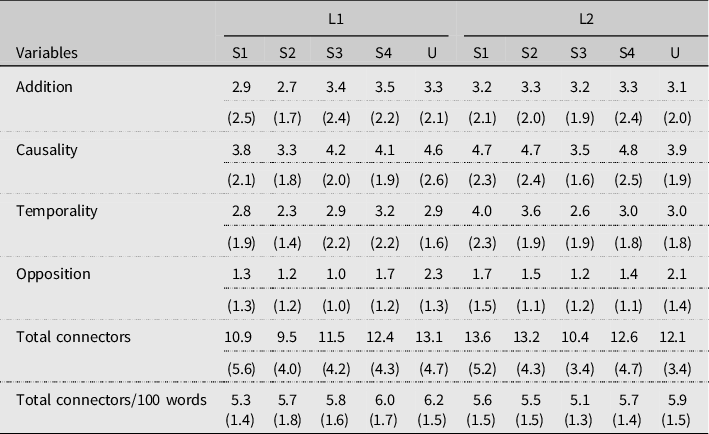
For density, the initial ANOVA by program and academic level suggested interactions for both temporal and causative connectors and a main effect of level for adversative connectors expressing opposition. However, when the word counts were adjusted for the length of the written summary in the ANOVA, the only result to persist was for the main effect of level with university students, irrespective of program, using significantly more adversative connectors than all of the secondary students, F(4, 477) = 8.79, p < 0.001. The ANOVA and pair comparisons for these statistical tests are included in Table 4 while Figure 3 graphically represents the relative proportion of adversative connectors in student summaries for all five proficiency levels. Yang and Sun (Reference Yang and Sun2012) similarly observed that adversatives were the only connector type to differentiate Chinese English as a Foreign Language (EFL) undergraduate students at different proficiency levels in an assessment of their argumentative writing.
ANOVA and pair comparisons for adversative connectors/100 words
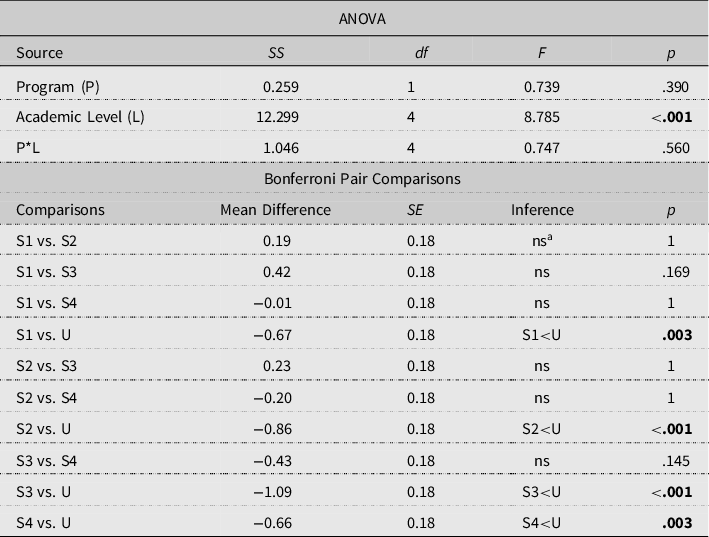
Note. The level of significance has been adjusted to control for Type I errors: α/number of variables for each set of tests = 0.05/4 = 0.0125. We have used bold font to identify p-values that suggest significant differences using the adjusted threshold.
a ns : not significant.
Adversative connector words in written summaries by program and academic level.
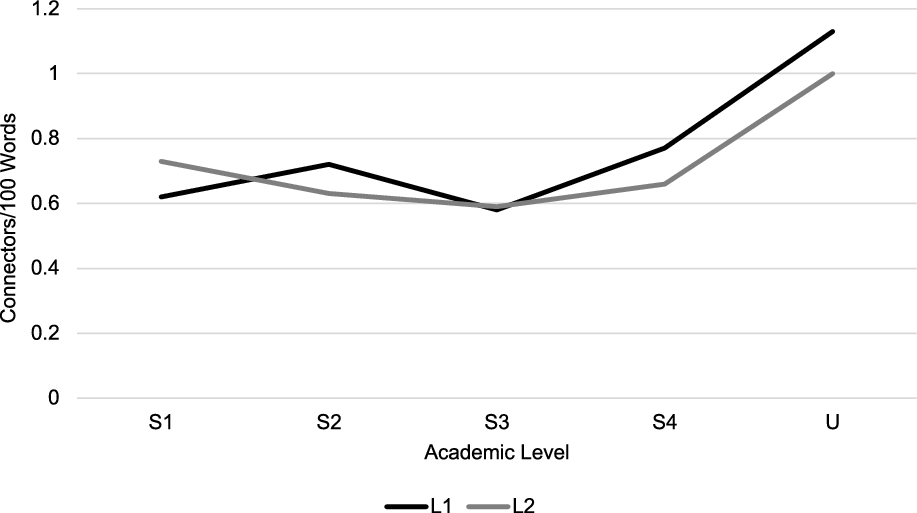
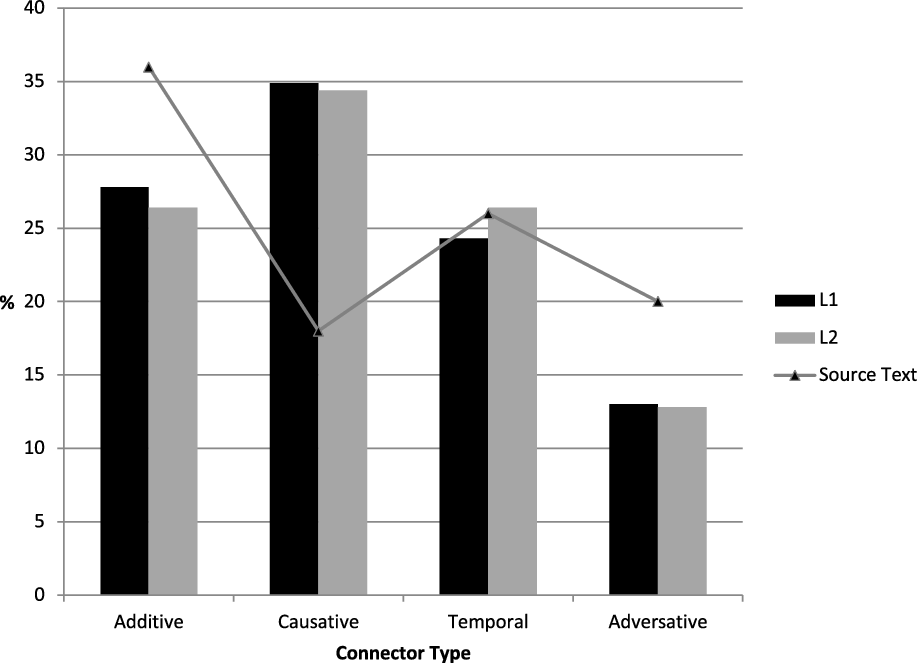
Figure 4 shows the frequency distribution of the four types of connector words by program across the academic levels compared to their presence in the source text for the summarization task. Students in both L1 and L2 programs tended to overuse connectors expressing causality while underusing both additive and adversative connectors when compared to the author’s use of the various connector types in the source text. As Robinson et al. (Reference Robinson, Cadierno and Shirai2009) have argued, task demands can influence language production, including the use of logical connectors.
Frequency distribution of connector words by type in L1 and L2 summaries compared with the source text.
In our exploration of lexical diversity, we excluded additive connectors because neither ANOVA using connector words, by summary length or adjusted for 100 words, suggested the presence of significant differences. Overall, the lexical diversity was greater in summaries written by L1 students than those of L2 students for each of the other three connector types as can be observed in Figure 5. Nonetheless the diversity of connector words for expressing causality barely differentiated L1 and L2 learners with only 30 word types for L1 compared to 29 for L2.
Diversity of connector words in L1 and L2 written summaries compared with the source text.
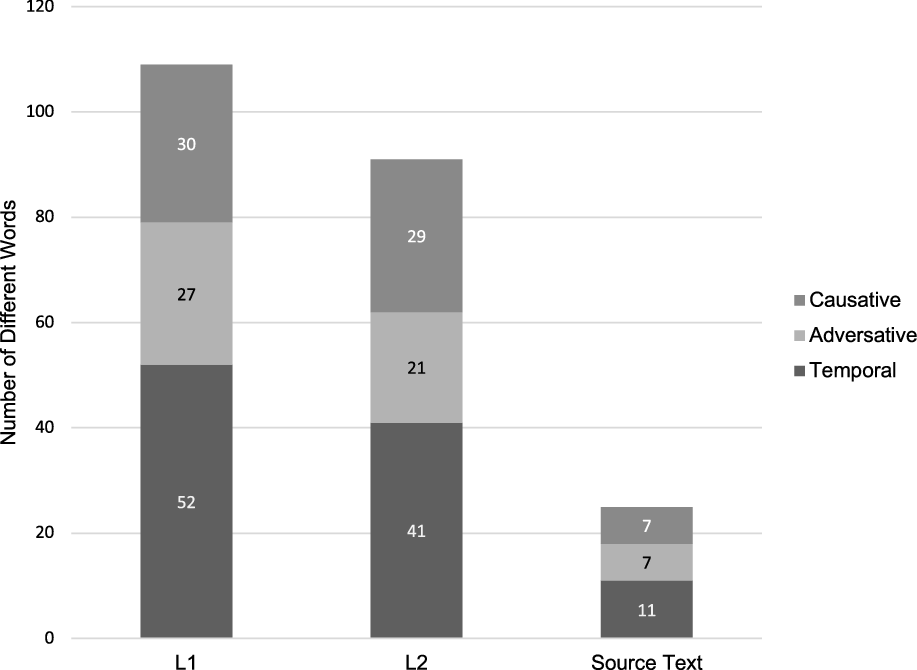
The conventional use of logical connectors seems to be problematic for both L1 and L2 students who tend to overuse causal connectors while underusing additive and adversative connectives when compared to their use by the author of the source text. Nonetheless, both groups of students employ more adversative connectives, which are fundamental to academic writing, but just at the post-secondary level (Galloway & Uccelli, Reference Galloway and Uccelli2019). In comparison, Myhill (Reference Myhill2009) observed that weaker writers in the United Kingdom tended to underuse additive, causal, and adversative connectors while overusing temporal connectors. Rivard et al. (Reference Rivard, Minkala-Ntadi, Roch-Gagné and Gueye2017) observed that both L1 and L2 students writing in French often employ causative connectives when an additive connective would be the more conventional usage. For instance, some students used parce que (because) instead of the simple connector et (and) to express an additive relationship. Moreover, L2 students’ lexical diversity with regards to possible connector words is restrained when compared with that of L1 students, with the former group also tending to map connector words onto their English equivalents and more often using words found in the source text (Benevento & Storch, Reference Benevento and Storch2011; Rivard et al., Reference Rivard, Minkala-Ntadi, Roch-Gagné and Gueye2017; Skehan, Reference Skehan2009). For instance, we observed that there were seven words to express opposition in our corpus, which are typical of academic language, that were not used by any of the L2 students at any level: à l’exception de, contrairement, contre, même, or, pendant que, and sinon. Furthermore, disaggregating the data by language program revealed four words that were used solely by more mature university students: bien que, contrairement, en dépit de, and même for L1 students; alors que, bien que, néanmoins, and par contre just by L2 students. In other words, secondary students had not yet appropriated these connector words for expressing opposition. Blondeau et al. (Reference Blondeau, Mougeon and Tremblay2019) also observed variations in connector use between diverse francophone communities in Canada. They concluded that different levels of bilingualism were associated with differential use of the words ça fait que, alors, donc, and the diglossic use of the English word “so” to express logical consequences during speech. This suggests that variations in the use of connectors can be geographic, linguistic, or developmental.
5.3. Correlations Between Measures
We calculated correlation coefficients between the linguistic measures as recommended by several researchers to determine if they were related in any way (Neumann, Reference Neumann2014; Norris & Ortega, Reference Norris and Ortega2009). We specifically investigated the relationships within each set of syntactic complexity and connector measures in the written summaries, separately, as well as those across the two sets of measures. The Pearson r-values and statistical significance for the various calculations across both programs and all academic levels are summarized in Figure 6.
Pearson correlation matrix for syntactic complexity and connector variables across programs and academic levels.
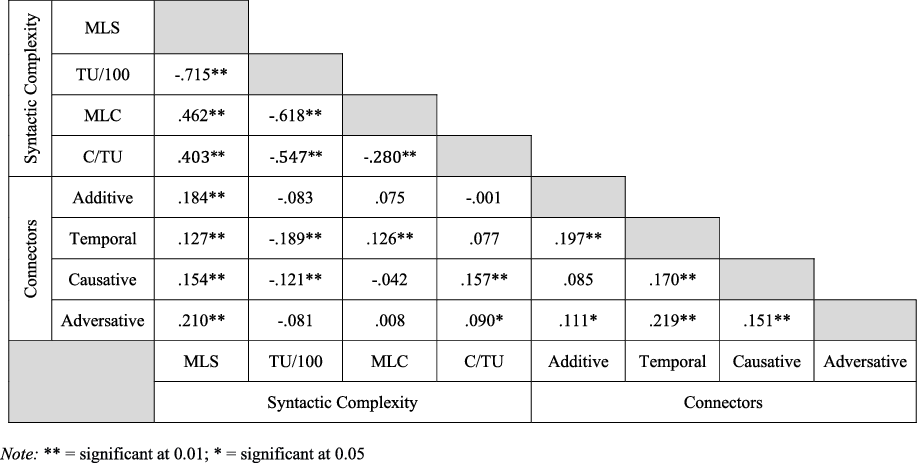
The correlations between the various syntactic complexity measures suggest that the rates of phrasal-clausal elaboration (MLC) and subordination (C/TU) tend to increase along with both measures of general syntactic complexity, the length of the sentence (MLS) and the length of a T-unit (TU/100 words). However, the Pearson correlation coefficient between MLC and C/TU was r = −0.280, p < 0.001, which suggests that the two strategies for building complexity, phrasal-clausal elaboration and subordination, are inversely related. In other words, as students used more clausal-phrasal elaboration in their written summary, they tended to use subordination less often. Furthermore, the correlation coefficients between TU/100 words and MLC, as well as between TU/100 words and C/TU, confirm that phrasal elaboration and subordination are both effective strategies for writing longer T-units, which are proxies for expressing more complex ideas. Moreover, the correlation between MLS and TU/100 words confirms that longer sentences are directly related to elaborating the constituent ideas.
Rivard and Gueye (Reference Rivard and Gueye2021) observed that writers at the university level made more errors while including certain types of verbs in their summaries compared to their less proficient peers. These errors were assessed when sentence construction was deemed inappropriate for the type of verb employed (transitive/intransitive, stative, or reflexive). In their study, Verspoor et al. (Reference Verspoor, Schmid and Xu2012) found that Dutch learners of English made more verb errors while writing increasingly complex sentences. We suspect that university students in our study may have been taking more risks while constructing complex sentences and therefore made more errors as a result (Ågren et al., Reference Ågren, Granfeldt, Schlyter, Housen, Kuiken and Vedder2012; Bartning & Schlyter, Reference Bartning and Schlyter2004; Schleppegrell, Reference Schleppegrell, Schleppegrell and Colombi2002).
These results lend modest support for the stage theory of syntactic complexification with the presence of phrasal-clausal elaboration in more mature L1 writers, while also corroborating findings of other researchers (Beers & Nagy, Reference Beers and Nagy2011; Staples et al., Reference Staples, Egbert, Biber and Gray2016). Beers and Nagy observed greater phrasal complexity in descriptive texts written by students as compared to other genres, while Staples et al. found that phrasal complexity manifests itself predominantly at the university level. Summarizing an expository text can thus be considered an effective task in both L1 and L2 classrooms for evaluating academic writing, and could be an effective tool for developing it in content classrooms.
When we examined the correlations between the four types of logical relationships that can be expressed by connectors, all except one were directly related, specifically the correlation between the number of additive and causative connectives, which might be due to the misuse of the latter to denote an additive logical relationship in the written summaries as suggested earlier.
We also calculated Pearson correlations between measures of syntactic complexity and connector use. Our focus here was on determining how the different types of connectors contributed to the strategies for writing more complex sentences. The length of sentences (MLS), which is one of the two measures of general syntactic complexity, was directly correlated with the use of every type of logical connector, whereas the second measure (TU/100) suggested that more temporal and causative connectors are found in longer idea units. In comparison, phrasal-clausal elaboration (MLC) involved the use of more temporal connectors, while subordination (C/TU) was directly correlated with both causative connectors and adversative connectors, the latter used for expressing opposition, hedging, or qualifying statements when framing arguments. This suggests that causative and adversative connectors are more often used when elaborating ideas through subordination whereas phrasal-clausal complexification instead tends to mobilize temporal connectors. As such, syntactic complexity and connector use appear to be inextricably linked (Ågren et al., Reference Ågren, Granfeldt, Schlyter, Housen, Kuiken and Vedder2012; Bartning & Schlyter, Reference Bartning and Schlyter2004; DeJong et al., Reference De Jong, Steinel, Florijn, Schoonen, Hulstijn, Housen, Kuiken and Vedder2012; Larsen-Freeman, Reference Larsen-Freeman2006; Vyatkina, Reference Vyatkina2012). Subordination can engage both causative and adversative connectors for making explicit the relationship between propositions, whereas phrasal and clausal elaboration usually involves discourse strategies, such as appositives, nominalization, and prepositional phrases that tend to mobilize temporal connectives.
An analysis by Rivard and Gueye (Reference Rivard and Gueye2021) suggested an increase in errors for the use of conjunctions and prepositions at the university level. Furthermore, the number of these errors for all students combined also increased directly with MLC: r = 0.65, p < 0.01. This suggests that students tend to make more errors in the use of conjunctions and prepositions, which might be the result of their taking linguistic risks in elaborating these clauses, as studies have shown that prepositional phrases are prominent in academic writing (Biber, Reference Biber1986) with Smith and Frawley (Reference Smith and Frawley1983) referring to prepositions as “intra-clausal conjunctions” (p. 349). We suppose that the increase in errors in the use of conjunctions and prepositions was also related to writers taking more risks while writing more syntactically complex sentences.
6. LIMITATIONS, IMPLICATIONS, AND CONCLUSIONS
The study compared summaries written by L1 and L2 students in secondary science classrooms, as well as those of linguistically similar groups in a university writing course, using selected measures in syntactic complexity and connector use.
6.1. Limitations
Several limitations are evident in our study of summary writing. The most obvious one is the cross-sectional design of the study that only provided snapshots of different groups of students over time rather than detailed longitudinal views of individual trajectories. Such an approach would be welcomed in a future study to confirm, disconfirm, or enhance the analyses herein presented. Nonetheless, the findings confirm the appearance of general complexity in the writing of more mature writers while offering muted support for the appearance of phrasal-clausal elaboration in some L1 writers.
A second limitation involves characteristics of the university students, including possible motivational differences for completing the summarization task. Although one might question just how representative the university cohort is of L1 and L2 students graduating from these programs at the secondary level, a study by Goldberg and Noels (Reference Goldberg and Noels2006) reported no difference in the motivational orientations of French immersion students for pursuing their post-secondary studies in an anglophone or a francophone university. In addition, the students in our cohort had all scored below the institutional benchmark for language skills in French when admitted to the university program and thus were all required to complete the remedial course. The two groups in the university cohort were therefore deemed comparable. However, selecting university students who did not require remedial work would likely amplify the differences with secondary students, but this was not possible. Nonetheless, significant differences were still observed for syntactic complexity and connector use in spite of these limitations. As for motivational differences, the students at the secondary level completed the summarization task in their science class, whereas the university students completed it in the remedial writing course. Although the task description was essentially the same for both groups, secondary students may have perceived it more as an assessment of content, while university students may have focused more on linguistic aspects.
We also recognize that the results are limited to a single summary-writing task, which is not representative of all possible genres in formal education. Moreover, the target language was French which has particular organizational characteristics, such as favoring hypotaxis to make coherence relations between clauses explicit, especially in formal writing. In comparison, connector use and even syntactic complexity in a paratactic language like Dutch could diverge from our findings (Degand & Hadermann, Reference Degand and Hadermann2009). We submit that our findings may not be valid across the multiplicity of written languages worldwide. Nonetheless, the results suggest that a summarization task can be tailored to meet certain pedagogical goals, for instance the effective use of particular connectors and or even verb tense sequencing in complex sentences, and this regardless of the language environment. We also believe that the summary writing task has potential for assessing the development of complexity across proficiency levels in both L1 and L2. We also acknowledge that we did not explore whether or not connector use and syntactic complexity were related to writing quality. Future studies might use the summarization task with diverse learners, languages, genres, and text types for exploring how it relates to the development of writing or even content learning.
6.2. Implications
Our results suggest that subordination does not figure prominently in syntactic complexity for these learners on the summarization task, while the correlation analyses suggest that subordination is directly linked with the use of logical connectors. We suspect that the unitary measure which we employed may have been masking the underlying process of complexification through subordination. We would recommend that future studies include measures of the sub-processes of subordination, such as the use of nominal, adverbial, and relative clauses (Nippold et al., Reference Nippold, Ward-Lonergan and Fanning2005; Wijers, Reference Wijers2018). We also suspect that language modality might explain the lack of differences observed for subordination, which seems to be a typical complexification strategy associate with orality, in comparison to writing which provides more time for phrasal and clausal elaboration (cf. Biber et al., Reference Biber, Gray and Staples2016; De Clercq & Housen, Reference De Clercq and Housen2017). Furthermore, we would argue that logical connectors may be a useful addition to studies of syntactic complexity, as we observed correlations between the various measures. Lastly, we propose that correlation analysis is a useful tool in applied linguistics, as our findings strongly suggest that many CAF variables are inextricably linked.
In our study, the use of logical connectors was assessed in summary writing, which constitutes an “embedded, comprehensive, and context-dependent” integrative task, (Read, Reference Read2000: 13). Baba (Reference Baba2009) has argued that “the ability to metalinguistically manipulate words” underlies proficient summary writing in L2 learners (p. 203). Research on writing confirms the importance of explicitly teaching textual features characterizing academic texts, including connector words for both L1 and L2 learners (Graham & Perin, Reference Graham and Perin2007; Schleppegrell & O’Hallaron, Reference Schleppegrell and O’Hallaron2011; Spycher Reference Spycher2007; Yuan ke & Hoey, Reference Yuan ke and Hoey2014). Comparing connector use in L1 and L2 in the classroom could help students understand the particularities of each language more explicitly; for instance, we know that English connectors are few and general, whereas those in French are many, specific, and more nuanced. Rivard and Cavanagh (Reference Rivard, Cavanagh, Tsedryk and Doe2019) have proposed classroom strategies for enhancing the use of connectors during the writing process.
6.3. Conclusions
A summarization task is an effective writing strategy for profiling linguistic competencies in syntactic complexity and connector use. Our results showed that L1 and L2 students from early secondary to university generally follow similar trajectories with respect to linguistic development despite persistent differences between the two language groups for certain aspects.
Several measures for succinctness differentiated L1 and L2 students in early secondary for their ability to condense the source text. Both L1 and L2 groups of university students demonstrated more general complexity in their written summaries than less mature writers. Furthermore, the use of phrasal-clausal elaboration for syntactic complexity was apparent just at the postsecondary level when L1 students were compared to less mature writers in early secondary. Both L1 and L2 students generally tended to overuse causal connectors while underusing additive and adversative connectives. However, both groups employ significantly more adversative connectives, but just at the post-secondary level. The only difference observed in the use of logical connectors between L1 and L2 writers was in lexical diversity, or the actual words used in the summary, with the former group using a richer, more diverse vocabulary. Moreover, correlation analysis confirmed that many linguistic variables are inextricably linked. The French-immersion students in our study might be considered advanced learners with some of them even demonstrating near-native competencies in the French language, though both groups of students were definitely hampered by their minority-language situation. These findings deviate from those in French as foreign language studies in which the L2 students often display significant differences between adjacent proficiency levels for both complexity and connector use. Finally, our study is important by providing another perspective as it employed quantitative measures to explore syntactic complexity and connector use, whereas the French-language research on these linguistic aspects have adopted mainly qualitative approaches. Both approaches are useful and complementary in analysing language use.
Funding
This work was supported by the Social Sciences and Humanities Research Council of Canada under [grant number 833-2007-1008].
Competing Interests Declaration
None to declare
APPENDIX A: Summary written by a L1 university student coded for syntactic complexity and connector Use
/ [Les loups sont de retour!] \ C1 T1
/ [Huit loups gris se sont fait réintroduire au plus ancien parc national de l’Amérique, Yellowstone.] \ C2 T2 / [Ils ont été exterminés de la région depuis [T1] 60 ans. \ C3 T3 / [Les écologistes ont faites des efforts pour [C1] les réintroduire\ C4 / lorsqu’ [T2] ils étaient l’animal important\ C5/qui manquaient dans le parc.] \ C6 T4
/ [Eldon Bruns, de la division de la pêche et la faune de l’Alberta dit que \ C7 / le United States Dish and Wild life service ont demandé pour des loups.] \ C8 T5 / [Les loups devaient chasser le wapiti et le cerf.] \ C9 T6 \ [La région Hinton en Alberta c’est fait choisi pour le lieux de capture des loups en 1995.] \ C10 T7 / [Avec des fléchettes anésthésiantes les biologistes les ont capturer et [A1] envoyer par helicoptère, avion et camion a Yellowstone.] \ C11 T8 / [Un loup est mort a cause d’ [C2] une fléchette.] \ C12 T9
/ [Sharon Rose du Fish and Wildlife service est allé aider dans le tribune téléphonique pour [C3] la réintroduction des loups.] \ C13 T10 / [Sharon a dit que \ C14 / les gens étaient très d’accord avec le projet.] \ C15 T11 / [Quinze loups ont été remis immédiatement dans les montagnes \ C16 / tandis que [O1] les autres ont été divisé en deux groupes et [A2] amenés a Yellowstone \ C17 / ou ils s’adaptent a leur nouvelle environnement.] \ C18 T12 / [Bien qu’ [O2] il y a des aspects positifs de la réintroduction \ C19 / il a aussi [A3] des aspect négatifs.] \ C20 T13 / [Les éleveurs ne veulent pas les loups dans leurs régions.] \ C21 T14 / [Cet argument a retarder le projet.] \ C22 T15 / [Une loi spéciale a été mise \ C23 / en place qui dit \ C 24 / qui les éléveurs peuvent abbattre les loups \ C25 / s’ [C4] ils attaquent leur bétail.] \ C26 T16
/ [Le loup bit maintenant [T3] bien.] \ C27 T17 / [Si [C5] tout continue être bien \ C28 / la réintroduction va continuer pour quelques années.] \ C29 T18 / [Ce projet va être un exemple pour d’autres régions.] \ C30 T19
Notes: [Brackets] denote the beginning and end of T-units, which are enumerated throughout the written summary (Ex., T10). Similarly, clauses are denoted by/slashes \ (Ex., C5). Grammatical errors have not been corrected. In this summary, there were 268 words, 19 T-units, and 30 clauses. Calculations for mean clause length (MCL) and clauses per T-unit (CTU) were 8.93 an 1.58, respectively. Connector words are in bold typeface and are identified within brackets by letter code and enumerated throughout the summary: for instance temporal [T3], causative [C5], additive [A3], and opposition or adversative [O2]
APPENDIX B: Descriptions of variables for succinctness, syntactic complexity and connector use


 Open access

